6 Double Standards Public Health Officials Used to Justify COVID Vaccines
Madhava Setty, M.D. | The Defender | April 13, 2022
We are not only in an epidemiological crisis, we also are in an epistemological crisis. How do we know what we know? What differentiates opinion from a justified belief?
For nearly two years, the public has been inundated by a sophisticated messaging campaign that urges us to “trust the science.”
But how can a non-scientist know what the science is really saying?
Legacy media sources offer us an easy solution: “Trust us.”
Legions of so-called “independent” fact-checking sites that serve to eliminate any wayward thinking keep those with a modicum of skepticism in line.
“Research” has been redefined to mean browsing Wikipedia citations.
Rather than being considered for their merit, dissenting opinions are more easily dismissed as misinformation by labeling their source as untrustworthy.
How do we know these sources are untrustworthy? They must be if they offer a dissenting opinion!
This form of circular reasoning is the central axiom of all dogmatic systems of thought. Breaking the spell of dogmatic thinking is not easy, but it is possible.
In this article I describe six examples of double standards medical authorities have used to create the illusion their COVID-19 narrative is logical and sensible.
This illusion has been used with devastating effect to raise vaccine compliance.
Rather than citing scientific publications or expert opinions that conflict with our medical authorities’ narrative — information that will be categorically dismissed because it appears on The Defender — I will instead demonstrate how, from the beginning, the official narrative has been inconsistent, hypocritical and/or contradictory.
1. COVID deaths are ‘presumed,’ but vaccine deaths must be ‘proven’
As of April 8, VAERS included 26,699 reports of deaths following COVID vaccines.
The Centers for Disease Control and Prevention (CDC) officially acknowledges only nine of these.
In order to establish causality, the CDC requires autopsies to rule out any possible etiology of death before the agency will place culpability on the vaccine.
But the CDC uses a very different standard when it comes to identifying people who died from COVID.
The 986,000 COVID deaths reported by the CDC here are, as footnote [1] indicates, “Deaths with confirmed or presumed [emphasis added] COVID-19.”
If a person dies with a positive PCR test or is presumed to have COVID, the CDC will count that as COVID-19 death.
Note that in the CDC’s definition, a COVID fatality does not mean the person died from the disease, only with the disease.
Why is an autopsy required to establish a COVID vaccine death but not to establish a COVID death?
Conversely, why is recent exposure to SARS-CoV-2 prior to a death sufficient to establish causality — but recent exposure to a vaccine considered coincidental?
2. CDC uses VAERS data to investigate myocarditis yet claims VAERS data on vaccine deaths is unreliable
On June 23, 2021, the CDC’s Advisory Committee on Immunization Practices met to assess the risk of peri/myocarditis following COVID vaccination, especially in young males.
This was the key slide in this presentation:
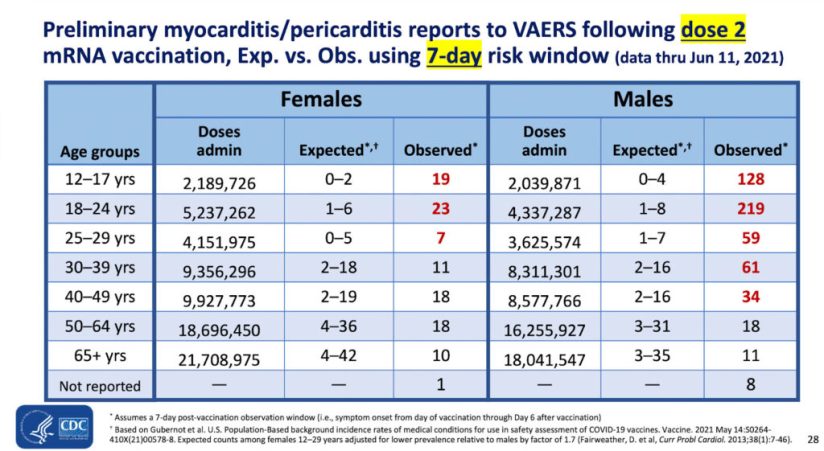
The observed risk of myocarditis is 219 in about 4.3 million second doses of COVID vaccine in males 18 to 24 years old.
The CDC is fine with using VAERS data to assess risk of myocarditis following vaccination — yet the agency rejects all but nine of the 26,699 reports of deaths following the vaccines.
Why does the CDC trust the peri/myocarditis data in VAERS but not the data on deaths?
One reason may be because the onset of myocarditis symptoms is closely tied to the time of vaccination.
In other words, because this condition closely follows inoculation the two events are highly correlated and suggestive of causation.
For example, here is another slide from the same presentation:
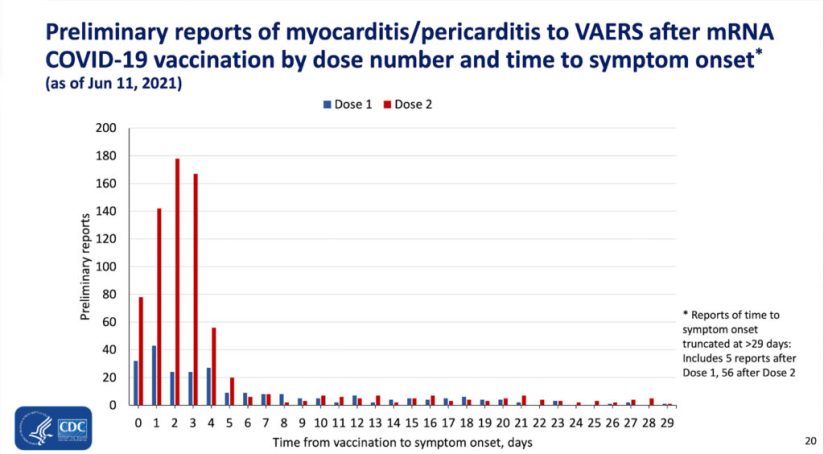
The majority of cases of vaccine-induced peri/myocarditis suffered symptoms within the first few days after injection. As explained above, this is highly suggestive of a causative effect of the vaccine.
A recent study in The Lancet included a similar graph, taken directly from VAERS, on deaths following vaccination:
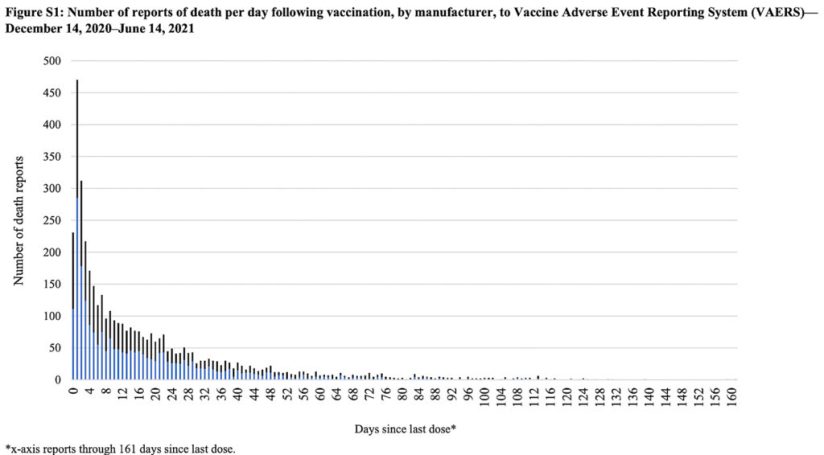
Once again, the event (death) closely follows vaccination in the majority of cases.
As we regard the two graphs above we should acknowledge that the temporal relationship between the injection and the adverse event is suggestive of causation but does not stand as proof of such.
However, it is also important to note that if the vaccination caused the deaths, that is exactly what the plot would look like.
It should be clear that the CDC has no justification for dismissing VAERS deaths if the agency is willing to accept reports of myo/pericarditis from the very same reporting system.
3. CDC pushes ‘relative risk’ for determining vaccine efficacy, but uses ‘absolute risk’ to downplay risk of adverse events
In Pfizer’s Phase 3 trial, nine times more placebo recipients developed severe COVID than those vaccinated during the short period of observation. This constitutes a relative risk reduction of 90%.
This seemed an encouraging finding and was used as a major talking point to compel the public to accept this experimental therapy despite the absence of any long-term data.
However, the risk of a trial participant contracting severe COVID (Table S5) was 1 in 21,314 (0.0047%) if they were vaccinated.
If they received the placebo, the risk was still only 9 in 21,259 (0.0423%).
The vaccine reduced the absolute risk of contracting severe disease by 0.038%.
Mainstream media and the CDC never mentioned the minuscule reduction in absolute risk of contracting severe COVID by getting inoculated.
Moreover, with 0.6% of vaccine recipients in the trial suffering a serious vaccine injury (one that results in death, medical or surgical intervention, hospitalization or an impending threat to life), approximately 16 serious adverse events will result for every serious case of COVID prevented by vaccination.
However, when it comes to risk of myo/pericarditis, the CDC states, “Myocarditis and pericarditis have rarely been reported, especially in adolescents and young adult males within several days after COVID-19 vaccination.”
The CDC further states, “While absolute risk remains small, the risk for myocarditis is higher for males ages 12 to 39 years…”
In other words, the risk of adverse events is being considered in absolute terms, not relative.
The CDC presentation slide above (Table 1) indicates the relative risk of contracting myo/pericarditis in males 18 to 24 is 27 to more than 200 times higher than expected in (unvaccinated) young men that age.
When assuaging the public’s fear around vaccine-induced myocarditis, the CDC finds it useful to cite absolute risk — yet when promoting the efficacy of the vaccine, the CDC emphasizes relative risks.
This double standard has been quietly and masterfully employed to reduce vaccine hesitancy and encourage compliance.
4. FDA requires randomized control studies for early treatment medications — but not for boosters
The CDC reports that as of April 8, 98.3 million Americans had received a COVID booster.
On March 29, the U.S. Food and Drug Administration (FDA) authorized a second booster for the immunocompromised and adults over age 50.
These authorizations were made not because of solid evidence the boosters are effective but rather to remedy the fact that the primary vaccine series has been widely shown to have waning efficacy within a few months.
As reported by The Defender, Dr. Peter Marks, director of the FDA’s vaccine division, Center for Biologics Evaluation and Research, admitted the fourth booster dose approved last week was a “stopgap measure” — in other words, a temporary measure to be implemented until a proper solution may be found in the future.
Despite the lack of solid evidence, the FDA continues to recommend and authorize boosters.
Yet when it comes to early treatment options, the agency holds medicines — including those the agency has already licensed and approved for other uses — to a different standard.
In this CNN interview from August 2021, Dr. Anthony Fauci, head of the National Institute of Allergy and Infectious Diseases, warns people not to take ivermectin for COVID because “there is no clinical evidence that this works.”
With regard to hydroxychloroquine, Fauci said, “We know that every single good study — and by good study, I mean randomized control study in which the data are firm and believable — has s shown that hydroxychloroquine is not effective in the treatment of Covid-19”, as reported by the BBC on July 29, 2020.
Where, then, are the randomized control studies in which the data are firm and believable that show boosters are effective at preventing COVID?
There aren’t any. None have been done.
As of today, the FDA still refuses to authorize the use of ivermectin and hydroxychloroquine to treat COVID despite hundreds of studies that demonstrate significant benefits (ivermectin, hydroxychloroquine) in prevention as well as early and late treatment.
The double standard here is blatant. There are no randomized control studies that show boosters are effective in preventing COVID.
Nevertheless, these experimental therapies have the FDA’s blessing while inexpensive, highly effective safe and proven medicines are ignored despite the enormous evidence that supports their use.
5. FDA uses immunobridging to justify Pfizer shots for young kids, but rejects antibodies as indicative of immune protection from COVID
Immunobridging is a method of inferring a vaccine’s effectiveness in preventing disease by assessing its ability to elicit an immune response through the measurement of biochemical markers, typically antibody levels.
The FDA asserts the presence of SARS-COV-2 antibodies is not necessarily indicative of immune protection from COVID.
Moreover, the FDA’s Vaccine and Related Biologics Product Advisory Committee reached a consensus last week that antibody levels cannot be used as a correlate for vaccine effectiveness.
Their decision is consistent with the CDC’s executive summary of a science brief released on October 29, 2021:
“Data are presently insufficient to determine an antibody titer threshold that indicates when an individual is protected from infection.”
Nevertheless, the FDA used immunobridging as a means to justify authorization of the Pfizer vaccine to children ages 5 to 11, as explained in The Defender here and here.
Because there were no deaths or serious cases of COVID in the pediatric trial, the FDA chose to reject its own position (and that of its advisory committee) regarding antibody titers as a correlate for vaccine efficacy.
6. Causation must be proven for vaccine injuries, but correlation suffices for proving vaccine efficacy
When it comes to vaccine injuries the public is often reminded that correlation does not equal causation.
In other words, just because an injury was preceded by inoculation doesn’t mean the vaccine caused the injury.
But what constitutes causation in medicine? A mechanism of action needs to be identified and pathological studies must confirm this mechanism while eliminating other potential causative factors. Causation can be proven only on a case-by-case basis.
Proving causation requires an enormous burden of proof in medicine.
For example, does smoking cause lung cancer? The answer is yes, it can. That doesn’t mean that it will.
However, when it comes to the benefit of medical intervention, such as a vaccine, causation does not have to be established. Correlation suffices.
In the COVID vaccine trials, fewer vaccinated people contracted COVID than unvaccinated ones. Yet there were those who received the vaccine who contracted the disease anyway.
To be fair, this is how all new medical interventions are evaluated. The benefit doesn’t have to be caused by the vaccine in the strictest sense, there just has to be a correlation between vaccination and a relative protective effect.
The more often this happens, the more confident we can be that the outcome wasn’t simply a coincidence.
Likewise, when it comes to assessing the harm of medical intervention, the most sensible outcome to consider is mortality. After all, what would be the point of introducing a vaccine that prevented some deaths while causing more?
Nevertheless, this is, in fact, what we have done with the Pfizer product. The interim results from the Phase 3 trial demonstrated that all-cause mortality in the vaccinated cohort was higher than in the placebo.
This glaring problem gets brushed aside because there were two deaths from COVID in the placebo arm versus just one in the vaccinated cohort, allowing the vaccine manufacturer to claim a 50% efficacy in preventing this outcome.
However, if we attribute a protective benefit to the vaccine in preventing this one fatality, we must also conclude that the vaccine was responsible for the extra death when considering mortality from all causes.
Doing otherwise would be applying yet another double standard.
How the pandemic could have played out differently
To summarize how devastating the use of these double standards in crafting the “safe and effective” narrative was, let’s look at how different the situation would be if we had adopted the opposite standard:
- There would have been an extremely low number of deaths from COVID. Very few, if any, autopsies have definitively confirmed that a fatality was caused by SARS-CoV-2. If confirmation by autopsy is the standard, there have been essentially zero deaths from COVID during the pandemic.
On the other hand, if we presume the deaths registered in VAERS are in fact vaccine-induced fatalities — similar to how the CDC presumed many deaths from COVID — we can affirm there have been more than 26,000 vaccine deaths. - Using absolute risk reduction as a measure of efficacy, vaccines would have been widely rejected as ineffective, providing only a 0.038% risk reduction for contracting severe COVID.
- Ivermectin and hydroxychloroquine would have been readily available for people who got COVID. And for those who got the vaccine but got COVID anyway, these medicines would have been a great alternative to boosters, which wouldn’t have been approved due to the lack of a single randomized control study proving they work.
- No children between the ages of 5 and 11 would have received this risky, experimental vaccine as it wouldn’t have been authorized for this age group — because Pfizer’s pediatric trials did not demonstrate any meaningful outcomes in children ages 5 to 11.
- The Pfizer vaccine would no longer be in use because interim data demonstrated that all-cause mortality is higher in the vaccinated.
Madhava Setty, M.D. is senior science editor for The Defender.
Leaked files expose Britain’s covert infiltration of Palestinian refugee camps
By Kit Klarenberg | The Cradle | April 13 2022
In February, Lebanese journalist Mohammed Shoaib was arrested on suspicion of collusion with Israel’s Mossad spy agency. The writer who worked for Al-Jaras, confessed that the notorious spy agency secretly paid him to author “dozens” of anti-Hezbollah articles, receiving a paltry $30 to $70 per article.
In particular, Shoaib was tasked with writing hit jobs on the “Iranian occupation” of Lebanon, and falsely linking Hezbollah with the August 2020 Beirut port blast, drug trafficking, and murder of political activists.
It is also alleged that Mossad specifically requested his work incite hostility towards Palestinian refugees in the country who number almost 300,000. In all, Lebanon hosts more than 1.7 million refugees and has the largest per capita population of refugees in the world.
Roughly half inhabit camps administered by the United Nations Relief and Works Agency (UNRWA), where they endure abysmal living conditions, overcrowding, poverty, unemployment, lack of access to justice, and other unspeakable hardships. The 11-year, foreign-backed crisis in neighboring Syria has also prompted Palestinian refugees there – and Syrian citizens – to seek sanctuary in Lebanon.
Given Israel’s track record of multifaceted crimes against the Palestinian people, that they are targeting an already vulnerable refugee population for propaganda purposes is hardly surprising. Nonetheless, Israel is not the only hostile foreign country resorting to these tactics.
Leaked files reviewed by The Cradle reveal the British Foreign Office has for many years secretly meddled in Lebanon’s refugee camps, courtesy of ARK, a shadowy intelligence cutout run by probable MI6 operative Alistair Harris. London’s agenda is rather different than Tel Aviv’s, however – it seeks to subtly stir up revolutionary fervor, and exploit them as unwitting foot soldiers in its ongoing clandestine war against Lebanon’s ruling elite.
‘Community Engagement’
The documents indicate ARK has been operating in all 12 camps since 2009, implementing British-funded “programming” of various kinds. This experience has granted the company “granular understanding” of their internal political, economic, ideological, religious and practical dynamics, and led to the establishment of a “diverse delivery team” and array of “local contacts” with “access throughout all camps and gatherings,” meaning community-level discussions and activities of residents can be spied upon and influenced.
This intimate, insidious insight is reinforced by “daily monitoring of neighborhood-level WhatsApp groups,” with “any new information, such as affiliation between a local group and a faction, or conflict between factions” documented by ARK’s in-house “stakeholder tracker.”
Typically, ARK has engaged in small-scale initiatives in the camps, including the restoration of streets and cemeteries, recycling initiatives, assisting in the launch of small businesses, providing income to disadvantaged and disabled residents, creating nurseries and daycare centers, and even launching a community hub, Sawa Coffeeshop. It serves to this day as “a popular place for youth to gather and promote civic engagement in their community and a shared Palestinian identity that bridges factional differences.”
In submissions to the Foreign Office dating to May 2019, ARK proposed ramping up these activities significantly. It pledged to create “Community Leadership Committees” in each camp, composed of hand-picked “stakeholders” – including NGOs, youth activists, women’s organizations, and representatives of neighborhood armed groups – to identify “quick impact projects” that could be implemented therein. These projects aim to “counter threats to social stability in the camps, create or improve livelihood opportunities, and provide better access to services.”
A social media platform created by ARK, Nastopia – which boasted 20,000 “highly invested” followers on Facebook at the time, a figure that has almost doubled since – was forecast to be fundamental to these efforts.
The page, run by a 24-strong team of ARK-trained “youth reporters”, would be used to recruit local participants, increase awareness and demand for “community engagement and improved conditions” among camp residents. Other activities include the promotion of Foreign Office-financed projects and to publicize “success stories” generated by them, while “promoting Palestinian culture and a sense of belonging, and tackling social injustice.”
Nastopia was “already [an] effective voice for connecting Palestinian communities, particularly youth” by that point. ARK cited a recent “Camps Films Festival” organized by the platform, covered by Al-Jazeera, which showcased “films portraying life in the camps and what it means to be Palestinian,” and in the process provided “positive examples of a shared identity.”
All along, the Nastopia page was to be monitored with “community feedback” on the assorted initiatives gauged to identify areas in which these activities “could be adapted to maximize impact.” Specialist training provided to its staff meant the platform could also serve “as a forum for online and offline discussion about social injustices [and] virtual space to talk about topics considered taboo in the camps,” allowing ARK to burrow even deeper inside the heads of refugees.
‘Active Citizenship’
If the obvious surveillance and manipulation dimensions of ARK’s project weren’t troubling enough, it takes on an acutely sinister character when one considers a key objective of “highlighting successful initiatives” in the camps was to “[enhance] the audience’s confidence in their own ability to contribute to social change.”
A Foreign Office-commissioned Target Audience Analysis conducted by ARK in March 2019 sought to pinpoint a segment of Lebanon’s population that could be mobilized to “affect positive social change,” and methods by which tensions between sectarian communities could be reduced, in order to unify them in opposition to the country’s ruling elite. Reading between the lines, it gives every appearance of a blueprint for the overthrow of the Lebanese government.
An ideal audience was duly identified, representing 12 percent of the population, who disavowed violence but did not reject “other forms of contentious politics,” and could be “influenced” to engage in “behaviors leading to positive social change,” such as protests and community initiatives.
The only questions for ARK were: “What might be done to enable other Lebanese to have similar confidence in their potential to contribute to positive social change?” and “how might this segment of the population … be grown to include a larger fraction of the public?”
The answer, ARK proposed, was to both covertly and overtly promote the message that “change is possible and ordinary citizens have a role to play in achieving change,” by way of propaganda campaigns and civil society initiatives “[highlighting] where change has been achieved or where threats to Lebanon’s stability have been countered.” This would demonstrate to the country’s diverse population that “barriers” to reform can be overcome, by taking matters into their own hands.
Providing evidence of “responsive government at local levels” was crucial for reinforcing “principles of active citizenship” among Lebanon’s population – and the analysis specifically cited Syrians and Palestinians, who are mostly Sunni Muslims, as representing an “important part” of the country’s demography, to be motivated in this manner.
In other words, Foreign Office activities in the refugee camps form just one fragment of a wider, clandestine, multi-channel assault on public perceptions in Lebanon that Britain has been waging against its democratically-elected government.
A mobilized force
One can judge these efforts by their fruits. In October 2019, seven months after ARK’s Target Audience Analysis was supplied to the Foreign Office, large-scale protests engulfed the streets of Beirut, which have ebbed and flowed ever since, and generated enormous amounts of western media coverage along the way.
The extent to which ARK’s Foreign Office-funded meddling in Lebanon influenced this incendiary unrest may never be fully quantifiable, but it may be significant that in July that year, thousands of refugees across several camps began demonstrating in unison, demanding the government immediately reform employment laws barring them as “foreign workers” from numerous professions.
This turmoil was arguably the spark that ignited the entire “October Revolution” – and in one of its Foreign Office submissions, ARK refers to how it “takes pride” in ensuring refugees recruited to its illicit schemes receive “annual leave, sick leave, and health insurance,” despite this not being “legally necessary” due to local legislation “discriminating against Palestinians.”
Who benefits?
The influence of ARK on Lebanon’s impending general election in May, the country’s first since the riots began, is even more unambiguous. Several news outlets have hailed the unprecedentedly high profusion of young candidates vying for office – 80 in total, many of them women.
A clandestine Foreign Office project influenced by the aforementioned Target Audience Analysis sought to enlist Lebanese youth as “agents of change”, fostering among them a culture of active political participation, in order that they could better “hold political institutions and individuals accountable,” and increase “electoral participation” in favor of opposition parties.
Under its auspices, ARK convened “boot camps” in “priority areas” of Lebanon, cultivated “a national group capable of pushing for greater change” composed of young women, and created social media assets and youth-focused websites featuring political interviews, question-and-answer sessions, coverage of boot camp meetings, “calls to action,” and “humorous messaging campaigns.” Activity on these assets was scheduled to ramp up ahead of the 2022 elections.
Clearly, irrespective of the outcome of the Lebanon May elections, the ultimate victors won’t be the parties and candidates that secure office, or the average Lebanese citizens who elected them, but Britain – for whatever form the next government takes, one way or another, it will serve London’s financial, ideological, military, and political interests.
India defies Western pressure to stop Russia trade
Samizdat | April 14, 2022
Weeks after snapping up discounted Russian crude, India is setting for a major increase in its purchases of coal from the sanctioned country. The world’s sixth biggest economy is focused on its energy security, disregarding attempts by the US and its allies to isolate Moscow.
In March, India’s coal imports from Russia reportedly surged to a two-year high. The Asian country purchased 1.04 million tons of Russian coal, the highest amount since January 2020, according to Matthew Boyle, lead dry bulk analyst at commodity intelligence firm Kpler, as cited by CNBC.
Last week, US President Joe Biden signed an executive order banning the import of Russian coal along with crude oil, gasoline, petroleum products, oils and liquefied gas as part of a new batch of penalties against Moscow over its military operation in Ukraine. Later, the European Commission proposed banning Russian energy imports, including coal. However, the bloc’s policy-makers have failed to agree on a new package of sanctions.
“Markets suspect that India and China may boost coal imports from Russia, offsetting some of the impact of a formalized EU ban on Russian coal imports,” Vivek Dhar, director of mining and energy commodities research at the Commonwealth Bank of Australia told media.
Last week, India’s steel minister Ramchandra Prasad Singh said that the country is looking to double imports of Russian coking coal, a vital ingredient for steel-making. Singh added that India had imported 4.5 million tons but did not indicate the period he was referring to.
Coal accounts for nearly 70% of India’s electricity generation, according to the International Energy Agency’s 2021 outlook. The nation is ranked as the world’s second-biggest consumer and importer of coal, after China. Last year, India was hit by a coal shortage amid soaring post-pandemic power demand.
Russia is the world’s sixth-largest coal producer. In 2020, 54% of the nation’s coal exports reportedly went to Asia, while about 31% went to Europe.
“Despite warnings from the West, India continues to lean into their supply-chain relationship with Russia for natural resources like oil and coal,” Samir N. Kapadia, head of trade at government relations consulting firm Vogel Group explained.
According to the analyst, a currency swap agreement would help the partners “to bypass some of the financing challenges in the market.”
US lawmakers arrive in Taiwan unannounced
Samizdat | April 14, 2022
A group of six US lawmakers arrived in Taiwan on Thursday on an unannounced two-day visit, amid growing tensions between Beijing and Washington. The visit has been confirmed by the American Institute in Taiwan, which serves as a de-facto embassy of the United States in Taipei.
“The congressional delegation will meet with senior Taiwan leaders to discuss U.S.-Taiwan relations, regional security, and other significant issues of mutual interest,” the Institute said in a statement.
According to Reuters, the bipartisan group, which includes a chairman of the US Senate Foreign Relations Committee Bob Menendez and senior Republican senator Lindsey Graham, arrived on Thursday in Taipei on a US Air Force aircraft and were welcomed by Minister of Foreign Affairs Joseph Wu.
Taiwan’s President Tsai Ing-wen will meet the lawmakers on Friday.
Presidential Office spokesman Xavier Chang said that the lawmakers’ visit would contribute to deepening partnership between the island and the US, and underlined that Taipei would continue to work with the United States for the benefit of “global and regional peace, stability, prosperity and development.”
The parliamentarians’ visit has angered China. At a daily press briefing on Thursday Chinese Foreign Ministry Spokesperson Zhao Lijian underlined that Beijing “firmly opposes any form of official interaction between the US and the Taiwan region.”
“Members of the US Congress should act in consistence with the US government’s one-China policy. The US side should abide by the one-China principle and the stipulations of the three China-US joint communiqués, stop official exchanges with Taiwan and avoid going further down the dangerous path,” Lijian said.
He warned that China would continue to take “strong measures” to protect its sovereignty and territorial integrity.
China rejects US ‘pressure or coercion’ over Russia
Samizdat | April 14, 2022
Beijing won’t sanction or condemn Russia over the conflict in Ukraine, and will reject American “pressure or coercion” to change its relationship with Moscow, Chinese Foreign Ministry spokesman Zhao Lijian told reporters on Thursday. China has remained publicly neutral on the conflict, with Zhao saying this position puts it “on the right side of history.”
“China is playing a constructive role in the Ukraine issue,” Zhao told a press briefing, claiming that Beijing has “made considerable efforts to de-escalate the situation, defuse the crisis and rebuild peace.”
“We oppose unfounded accusations and suspicions against China, nor will we accept any pressure or coercion,” Zhao continued. “Time will tell that China’s claims are on the right side of history.”
China has from the outset called for a negotiated settlement to the conflict in Ukraine, and has affirmed both Ukraine’s right to territorial integrity and Russia’s legitimate security concerns. It has continued to trade with Russia, and has joined Moscow in urging the investigation of the US’ alleged biological weapons development in Ukraine. Furthermore, Beijing’s diplomats have opposed or abstained from UN resolutions condemning Russia.
This stance has incurred the scorn of leaders in the US and Brussels. White House Press Secretary Jen Psaki has repeatedly called on China’s leaders to “assess where they want to stand as the history books are written,” NATO Secretary General Jens Stoltenberg has declared that China now poses a “challenge” to the alliance, and most recently, US Treasury Secretary Janet Yellen called for Beijing to use its “special relationship with Russia” to force an end to the conflict.
“The world’s attitude towards China and its willingness to embrace further economic integration may well be affected by China’s reaction to our call for resolute action on Russia,” Yellen told the Atlantic Council, a pro-NATO think tank partly funded by the weapons industry, on Wednesday.
China’s stance is unlikely to change. In addition to reaping the opportunities for trade that Russia’s excommunication from western markets has presented, Beijing has vowed to resist potential US sanctions on its companies as a result of this trade. Furthermore, China has dismissed US media reports suggesting it is preparing to offer Russia military assistance. US officials later admitted that these reports were based on faulty intelligence, and released to the press to win an “info war” against the Kremlin.
Sweden Saw Second Smallest Increase in National Debt Out of All EU Countries
By Noah Carl | The Daily Sceptic | April 13, 2022
In 2020, the first year of the pandemic, almost every country in the world had a major recession. As this map from the IMF shows, most countries in Europe saw GDP decline by more than 3%, the only exception being Ireland (which in any case has an unusual way of counting GDP).
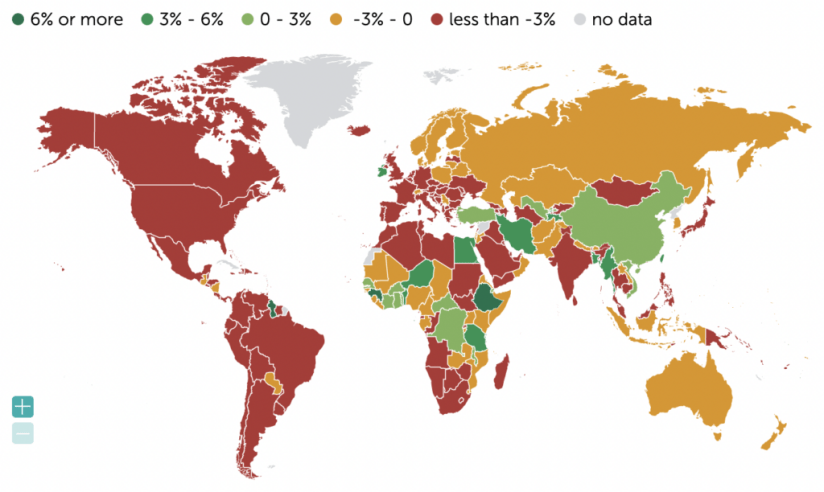
Despite this, unemployment in the EU only increased by a modest 1.2 percentage points, rising from 6.6% to 7.8% by the third quarter of 2020. One reason why unemployment didn’t rise more during months of lockdown is that governments spent unprecedented sums of money on furlough and other wage-support schemes.
In other words, they paid people to sit at home all day. For example, The U.K.’s Coronavirus Job Retention Scheme paid furloughed workers 80% of their previous salary, up to a cap of £2,500 a week.
While such wage-support schemes had the benefit of preventing large rises in unemployment, they had the cost of being extremely expensive. Data published by the ONS in January of this year show just how expensive.
The chart below shows change in general government gross debt (as a percentage of GDP) in percentage points from the fourth quarter of 2019 to the third quarter of 2021:
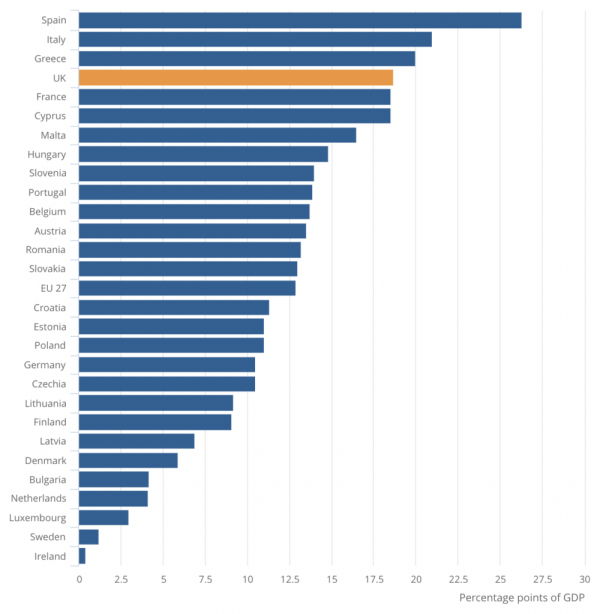
Many countries saw absolutely huge increases in debt. Over just seven quarters, Spain’s debt grew by 26 percentage points, Italy’s by 21 percentage points, and Greece’s by 20 percentage points. The UK wasn’t far behind, logging an increase of 18.7 percentage points.
At the other end of the spectrum, Ireland’s debt grew by less than one percentage point, while Sweden’s grew by only 1.2 percentage points. Of course, Sweden’s strong performance comes as no surprise, given it was the only major European country that didn’t lock down in the spring.
As I noted previously, The Economist ranked Sweden third in a league table of 23 rich countries for overall economic performance during the pandemic. And we know this didn’t come at the cost of Swedish lives – the country actually saw negative excess mortality between January of 2020 and June of 2021.
To compare European countries in a comprehensive way, I plotted change in general government gross debt against age-adjusted excess mortality. (Data were not available for Germany, Ireland, Norway and Switzerland.)
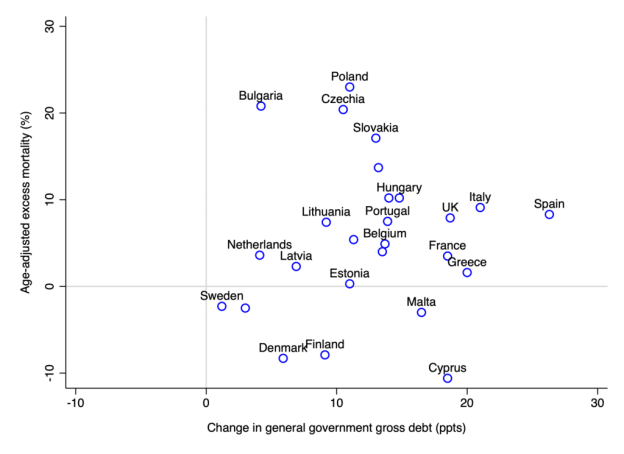
Taking into account both metrics, Sweden was one of the best overall performers in Europe, along with Luxembourg, Denmark and Finland. And it was by far the best performer among countries with a population over 10 million.
By contrast, Eastern European countries and large Western European countries – almost all of which had strict lockdowns – did poorly on both metrics. So lockdown was harmful to the public finances, with little corresponding benefit in terms of reduced mortality.
A picture is worth a thousand words, inflation was ready to go
The Naked Emperor’s Newsletter | April 13, 2022
A post on what is maybe the most obvious thing in the world but most can’t see, ignore or don’t want to talk about.
M1 money supply in the US since the ‘60s. It’s amazing how M1 money supply predicts Russia’s invasion of Ukraine and increases six fold, two years early.

Grrrrrr, I’m so angry that Putin has caused all this inflation. Sorry, I forgot to take my ‘triggered’ pills, I’m so easily triggered these days. As Neil points out below, the area highlighted in red should read Trump/Biden.
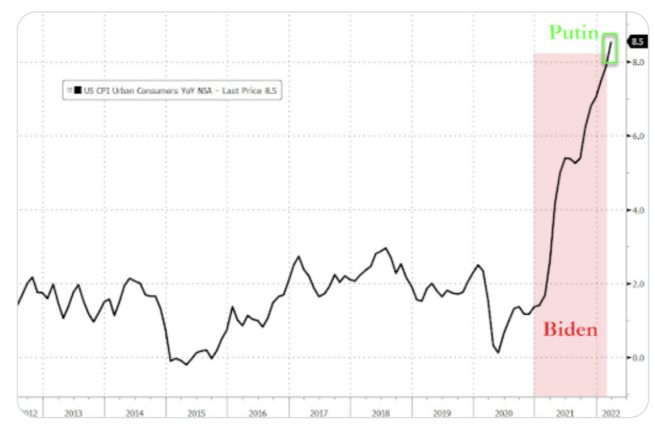
The inevitable, and only just beginning, conclusion.
Never stop telling the people that overreacted on Covid that their shrieking has caused today’s pain. Otherwise, it will just happen all over again. They selfishly got caught up in thinking about their own mortality without thinking about the complexity of the situation and the consequences that follow.
Government loans were necessary to support low income workers who were being denied a living by the wealthy laptop class but the economy should never have shut down in the first place. Moreover, much of the printed money was fraudulently taken by the wealthy who know how to game the system. I personally have heard many stories of loans being taken out to buy second homes or other assets and this is just the small scale stuff.
And if your argument is “it was necessary to save lives” then predominantly the lives that you saved were the elderly who you trapped and scared witless in their homes or care home rooms. They eventually died anyway, because that is life and what happens when you are old, but instead of happily enjoying those extra 6 months you gave them, they were forced to be alone with maybe the occasional zoom call if they were lucky.
As I’m typing I’m thinking back to a conversation I had with a doctor friend in early March 2020. He asked me if I was worried about dying from the virus. I said that I was more worried about what this is all going to do to the economy to which he replied that I need to get my priorities right.
Real James Bond villains wear cardigans
Bill Gates, the WEF, and the WHO are not done with us. It’s time we were done with them.
el gato malo – bad cattitude – april 13, 2022
in history as in literature, a special place of contempt is held for the grand vizier, the guy behind the throne, the power behind the power. it’s a position of great influence but zero accountability, especially if you can subvert the ruler you puppet past the point of being able to scapegoat you.
buying or leading a politician and getting goodies is a process as old as politics, probably older as it was likely the reason the first politician was elected in the first place…
but the truly discerning james bond villain level vizier, well, they just go right ahead and buy their own NGO’s. that’s how you take over the world. space lasers and earthquake machines may be cool, but real conquest usually banal.
get to about the 1 minute mark in this video where you can hear bill speak about talking to donald trump in the white house.

trump asks about looking into some of the ill effects of vaccines.
gates tells him “that’s a dead end, that would be a bad thing, don’t do that.”
this is not a man giving well intentioned advice.
this is a man covering up a crime committed in the service of crony capitalism.
the gates foundation has a longstanding relationship with vaccines that is more than a little sketchy. they were pushing oral polio vaccines in africa LONG after they were known to be unsafe and had actually become the leading cause of polio in the world.
“The Gates Foundation is a leading funder of oral polio vaccination in Africa and around the world, having dedicated nearly $4 billion to such efforts by the end of 2018. As discussed in Forbes in May 2019, Gates has “personally [driven] the development” of new oral polio vaccines and plays a “strategic role beyond funding.”
the US uses ONLY injected IPV polio vaccines. both the US and the EU discontinued use of orals because of side effects including actually causing polio.
A year ago, news outlets briefly shone a light on the fact (a fact that makes public health officials squirm) that oral polio vaccines are causing polio outbreaks. With reports streaming in throughout 2019 regarding the circulation of vaccine-derived polioviruses in numerous African and Asian countries, a CDC virologist confessed, “We have now created more new emergences of the virus than we have stopped.”
… there were 400 recorded cases of vaccine-derived polio in more than 20 countries worldwide.
(author’s note: that’s ~3X the total of all natural polio cases worldwide and of those, only 29 occurred outside of pakistan and 100% of those were in afghanistan. this vaccines caused multiples more polio than the virus itself)
This week, the same story is making the same headlines, with the WHO’s shamefaced announcement that the oral polio vaccine is responsible for an alarming polio outbreak in Sudan—“linked to an ongoing vaccine-sparked epidemic in Chad”—with parallel outbreaks in a dozen other African countries. In fact, between August 2019 and August 2020, there were 400 recorded cases of vaccine-derived polio in more than 20 countries worldwide. Ironically, WHO disclosed this “setback” barely a week after it declared the African continent to be free of wild poliovirus—which has not been seen in Africa since 2016. While African epidemiologists cheerily claim that these outbreaks can “be brought under control with further immunization,” and Sudan prepares to launch a mass polio vaccination campaign, WHO is warning that “the risk of further spread of the vaccine-derived polio across central Africa and the Horn of Africa” is high.
but gates kept pushing them in africa anyway, probably because so many of his pals owned the production and that’s what the gates foundation does. that’s what all these guys do. big business and billionaires are not friends of free markets. they want sure things and it’s cheaper to twist and break arms and buy mandated markets than to compete on a fair playing field.
i have (on excellent, direct authority from a personal friend who i trust implicitly and who spoke directly to the folks involved) the following story about the gates foundation in india:
gates himself came in to speak with the health ministers. he offered them a vaccine for a disease they already had one for. they told him, “no thank you, we already have that one covered.” he told them “well, you need to switch to this vaccine or there will be no gates foundation investment for india.” the one he wanted them to switch to was owned by a “friend of his.” this story was relayed by extremely liberal folks who literally run vaccine programs in india. they heard this conversation directly and have no reason to lie. they were horrified. it was a pay to play stick up. (they still declined)
this is not the sort of conflict of interest that’s helpful in a guy telling the president not to look into vaccine issues. it also stands testament to his morality and inclination. bill gates is as amoral as he is rich. always has been. much of microsoft was stolen from his less machiavellian partners.
i’m presuming this interview above and the discussion with trump were pre-covid because it’s never mentioned and had this been post covid, i find it hard to believe that it would not have been, but it seems more apropos now that ever. obviously, the conflicts of interest certainly did not stop back then and vaccine ill effects are looking like quite the hot topic just now.
and gates is, as ever, right smack in the middle of the dirtiest, most profitable part of it.
it was september 2019. SARSCOV-2 was still not really on the radar. according to many, there was not even an outbreak yet.
that same month, billy made a large investment in a company called bioNtech to allegedly pursue HIV and tuberculosis vaccines. if memory serves, he bought about 1/3 of the company which was entirely preclinical in infectious diseases at the time. they were mostly a phase 1-2 oncology company. this looks like a sweetheart valuation.
obviously, this became a very big deal in a very big hurry. it was their mRNA payload that was licensed by pfizer for their vaccine, a product that went on to be the most profitable drug per unit time in human history. (and possibly the most profitable altogether) bioNtech minted money.
lots of things about this investment have long smelled fishier than a sushi bar dumpster.
but then a funny thing happened with a now vexingly familiar cast of characters.

(read more HERE)
even months later in january 2020, folks like osterholm were still buying the “no signs of human to human transmission” line.
yet somehow, 4 months earlier (and who knows when the due diligence started. might have been 6 or more), gates was putting his money right on the one obscure square that would pay out 100 to one. at a company with near zero footprint in infectious disease. for a virus no one was focused on. whose genetic code would not (allegedly) be initially characterized for 4 more months.
then, in the same odd, sudden miracle that got moderna the NIH science they licensed for their vaccine, bioNtech also had a product and pfizer jumped to license it.
alone, having a wargame for the war that had, unbeknownst to most, already started, might raise eyebrows, but it might also be a coincidence.
but when the folks coming to that wargame have been making big bets on the kinds of weapons that that precise (and only that precise) sort of war would use, well, one might start to sharpen the points on one’s pointy questions.
just what was informing what here?
this idea that “mRNA is magic and you can develop a vaccine in weeks” is complete nonsense. it’s never been true and the rest of the mRNA vaccine timelines stand testament to it. no other vaxx has been forthcoming.
this HAD to have been in the works for a significant period beforehand.
the fix appears to have been deeply in here. somebody was getting some VERY early looks at some tech to vaccinate against a virus no one else even had a copy of. the awareness not just of the pathogen, but the way to code for its spike protein and the impending pandemic seems to have been loose in certain circles long before the rest of us were told.
the NIH seeded moderna. i still do not have confirmation on where bioNtech got theirs, but i have a hunch and it rhymes with “silly plates” and that this might explain the sweetheart deal.
there is really only one story that makes sense to me here on covid origins, and that story is this:
NIH funded eco health alliance run by daszak and in cahoots with folks like baric colored outside the lines with fauci’s grant money. they, in collaboration with the wuhan institute of virology hotwired the hell out of covid viruses from bats engaging in gain of function work WAY outside of safe limits. this was not a weapon. it was work on inoculation. that was daszak’s longstanding focus. we’ll probably never know what happened in wuhan, but the breadcrumbs here are AWFULLY provocative and the sudden appearance of 2 mRNA vaccines, one with the NIH folks that funded EHA at the WIV, one with bioNtech, looks like an offshoot of it. (lots of detail HERE and HERE on the breadcrumbs)
wrapped up in this from the very beginning were load of the WEF gang (who had just run an oddly timely pandemic wargame for a disease an awful lot like covid) and the WHO.
billy gates is neck deep in both, a charter member of the cool kids crony capitalist table at davos and a top funding source for the WHO, donating more than 10% of its budget. it’s clearly a great investment for him as it poops golden eggs in terms of early information and hard sell opportunities for poor countries. it’s a seat at every table that makes you look like a philanthropist while in reality being a lead pipe wielding coercive corporatist.
gates is not a good guy.
he’s a sociopathic nerd with the most unsavory of associates.
and he knows how to play the crony capitalist game with the absolute best of them. the gates foundation has become a barely veiled international influence organization masquerading as a charity.
between gates and china, the WHO will dance to whatever song the two play. and oh, how they will dance.
remember this gem? (i do)

this was a big part of what got the out of control abandonment of 100 years of science based pandemic guidelines rolling.
“hey, let’s throw all the science, data, and history out the window and copy a terrifying authoritarian regime with a human rights record that would make myanmar blush!”
yeah, well, we all remember how THAT worked out…
but this is government. it’s worse than government, it’s trans-national organizational government. these are the people who invented “failing up” where the bigger your screw ups, the higher you get promoted. (if you doubt me, look at who runs the IMF and the world bank some time…)
and so, despite having cheer led for nothing uty pseudoscience, failure, and human ruin, the current plan being put forward is, wait for it, “hey, let’s give the WHO massive, unaccountable globalist powers!”
of course, this was clearly the plan all along if you were paying attention.

note the direct parrot of the WEF “build back better” taking point.
this gang sees every crisis as a chance to try to grab control of the world. and they are at it again.
In a consensus decision aimed at protecting the world from future infectious diseases crises, the World Health Assembly today agreed to kickstart a global process to draft and negotiate a convention, agreement or other international instrument under the Constitution of the World Health Organization to strengthen pandemic prevention, preparedness and response.
Dr Tedros Adhanom Ghebreyesus, WHO Director-General, said the decision by the World Health Assembly was historic in nature, vital in its mission, and represented a once-in-a-generation opportunity to strengthen the global health architecture to protect and promote the well-being of all people.
“The COVID-19 pandemic has shone a light on the many flaws in the global system to protect people from pandemics: the most vulnerable people going without vaccines; health workers without needed equipment to perform their life-saving work; and ‘me-first’ approaches that stymie the global solidarity needed to deal with a global threat,” Dr Tedros said.
they will also force licensing, break patents, and drive health policy at the highest levels.
but here’s the full blown worst of it:

The World Health Organization (WHO) has contracted German-based Deutsche Telekom subsidiary T-Systems to develop a global vaccine passport system, with plans to link every person on the planet to a QR code digital ID.
Indeed, despite the minuscule threat posed by new variants and dubious-at-best vaccine efficacy, the WHO is adamant that a global QR code-based vaccine passport system is vital for all future health emergencies, not just COVID.
“COVID-19 affects everyone. Countries will therefore only emerge from the pandemic together. Vaccination certificates that are tamper-proof and digitally verifiable build trust. WHO is therefore supporting member states in building national and regional trust networks and verification technology,” says unit head of the WHO’s Department of Digital Health and Innovation Garrett Mehl.
“The WHO’s gateway service also serves as a bridge between regional systems. It can also be used as part of future vaccination campaigns and home-based records.”
got that? this one is going to be digitally verifiable and global. nowhere to run, nowhere to hide, universal, mandatory, trans-national, and administered by an agency completely unaccountable to you and beholden to proven kleptocrats, authoritarians, and crony corporatists. they are basically a subsidiary of china and gates inc.
they will not get any better or more honest next time.
we’re talking about taking one of the most corrupt, captured, and incompetent agencies in the history of bureaucratic bloviation and giving them the keys to the world crisis machine and to an electronic health passport that will be your right to travel and work and eat out and shop and who knows what else. this is the cornerstone of an international social credit system. wait until they add your ESG score and your carbon footprint.
giving this team universal chicken little rights and direct links at highest levels to public policy is bad enough. letting them enable fine grained access into permission to have anything resembling a life will have you eating bugs and tweeting what you’re told faster than you can say #grasshoppers #yummy!
they promised you that in the future you’d have no privacy and own nothing and that you’d been happy.
guess which two promises they’re going to keep?
and government will fall all over themselves to help and to outsource the imposition of the infinite personal tracking and permissioning they have so long salivated over under the pretext of pandemic preparedness. (oops, look, another trojan framing of subjugating masquerading as safety. told you these were EVERYWHERE…)
this is not going to be acceptable or even tolerable.
this group should be disbanded, not granted greater remit.
and they are not done, because the power behind these thrones is ever hungry.
you might be thinking “wow, that was awful” but they are all thinking “wow, that was surprisingly easy. i wonder what we could do if we had some time to get set up beforehand and really run the table?”
these are not good people.
they do not have noble aims nor your best interests at heart.
they are a global aristocracy of surpassing ruthlessness telling scare stories so they can mandate alleged solutions.
they tell you it’s about saving you.
it isn’t.
read the fine print.
follow the money.

the super rich do not like to guess. they do not like to be surprised by trends. it is far more certain and therefore more profitable to force you to buy that which they are selling. the public health grift and the climate grift are all one grift: use government and trans-government to frighten and force people into buying the needless products that you’re going to produce for them.
small investors talk their book. titanic investors force you to buy it.
- if it’s a vaccine, mandate it and bar all useful therapeutics from market.
- if it’s a windmill, kill nuclear and inflict absurdist carbon taxes.
- never let any of it be properly assessed.
- use fear to drive compliance and compliance to drive mandate.
they will sell you your own collar and leash and demand your gratitude for having done so.
and if you don’t wake up pretty soon, they’re going to get it from you. by force. and you will be powerless to stop it.
the confluence of a global health passport and central bank digital currencies is an extinction level event for personal liberty and privacy.
and make no mistake: gates wants it. the WEF wants it. and most western governments want it.
but they also know that you do not want it. so they need a pretext and a plan and a pile of boring, technocratic yammering to hide it behind. they learned from last time. they saw the cracks we squirmed through and how we got away. and they do not plan to let it happen again. the next one will be air tight. they’ll have the WHO ready to both be able to declare a global emergency and impose ready made verified global digital ID using that fear as a pretext.
if you let them get these pieces into place, you are NOT going to like the endgame.
this has reached the email length limit. check the substack page for an addendum.
Featured Video

Chinese jet fuel and the myth of energy independence
or go to
Aletho News Archives – Video-Images
Book Review
Former Insiders Criticize Iran Policy as U.S. Hegemony
By GARETH PORTER | CounterPunch | February 27, 2013
“Going to Tehran” arguably represents the most important work on the subject of U.S.-Iran relations to be published thus far.
Flynt Leverett and Hillary Mann Leverett tackle not only U.S. policy toward Iran but the broader context of Middle East policy with a systematic analytical perspective informed by personal experience, as well as very extensive documentation.
More importantly, however, their exposé required a degree of courage that may be unparalleled in the writing of former U.S. national security officials about issues on which they worked. They have chosen not just to criticise U.S. policy toward Iran but to analyse that policy as a problem of U.S. hegemony. … continue
Blog Roll
 Aletho News
- What is fueling unrest across the EU?
- Why no power can undermine Iran’s eternal dominance over the Strait of Hormuz
- Is The War Against Iran Over?
- Iran war will leave long-term ‘scar’ on Wall Street, investors warn
- How Iran decimated US power projection in West Asia: Military lessons of 40-day war
- Iran’s report details US-Israeli war crimes in targeting schools, hospitals, livelihoods
- NATO’s Slow Fracture: How Trump’s Iran War Exposed the Instrument of Hegemony
- Chinese jet fuel and the myth of energy independence
- Ukraine Sea Drone Fired From Libya Hit Russian Tanker in Mediterranean
- IRGC: Iranian forces launched no attacks during ceasefire hours
- If Americans Knew
- Military aid to Israel emerges as the latest political litmus test for Democrats
- The only Palestinian children’s rights organization closes following years-long Israeli campaign against it
- ‘I Can’t Forget the Smell’: Lebanese Reel After Israel Kills Over 300 in Single Day
- DNC Shoots Down Resolutions Calling Out AIPAC and Limiting Arms to Israel
- TCN: Is Israel Blackmailing President Trump?
- Israel killed at least 303 Lebanese yesterday – who were they? Daily Update
- Amnesty: Urgent – Protect Lebanese civilians from brutal escalation in Israeli attacks
- Is The War Against Iran Over?
- Inside the Israeli army’s propaganda wing
- Hundreds of Gaza Amputees Stranded in Legal Limbo
- No Tricks Zone
- An Inconvenient Tree: Uncovered In Alps… Europe Much Warmer Than Today 6000 Years Ago
- New Study Reports A 60% Slowdown In Greenland’s Ice Loss Rate In The Last Decade
- Low Intensity Tornado Wrecks Major Solar Farm, Creating A Potential Toxic Dump
- New Study Finds Warming Saves Lives…Cold Temperatures 12 Times More Deadly Than Excess Heat
- German Science Blog Accuses PIK Climate Institute Of Hallucinating Climate Tipping Points
- Devastating Assessment Of Comirnaty Vaccine By Former Senior Pfizer Europe Toxicologist
- New Study: CO2 Is ‘Effectively Negligible’ As An Explanatory Climate Change Factor Since 2000
- Former Pfizer Toxicologist Dr. Helmut Sterz Tells Bundestag Hearing Pfizer Vaccine Should Have Never Been Approved
- Energy Expert: Germany’s Nuclear Phaseout Was A “500 Billion Euro Mistake”
- New Research: South Australia’s Mid-Holocene Sea Surface Temperatures Were 4°C Warmer Than Today
 Aletho News