HOW IS THIS A THING? 27TH OF JUNE 2022
Sources:
Women’s Health and COVID-19: FLCCC Weekly Update (June 15, 2022): https://odysee.com/@FrontlineCovid19CriticalCareAlliance:c/Weekly_Webinar_June15#d
The fawning media coverage notwithstanding, uptake has been pitifully low
By Alex Berenson | Unreported Truths | July 2, 2022
Despite a massive media and government pressure campaign, American parents are overwhelmingly rejecting Covid vaccines for their young children.
About one week after the shots became available, barely 1 percent of children under 5 have received mRNA jabs for Covid, data from several states show.
Ohio:

Even in California, among the bluest states, only about 2 percent of kids under 5 have been jabbed.
Demand is likely to be near zero going forward. The recent history of Covid shots shows that the increasingly tiny minority of mRNA fanatics get themselves or their children jabbed or boosted quickly after regulators okay new doses. So pent-up desire for new shots is likely nonexistent.
As usual, elite media outlets have largely refused to acknowledge this reality, instead running endless articles that seek to normalize and encourage the shots.
(CNN gonna CNN:)
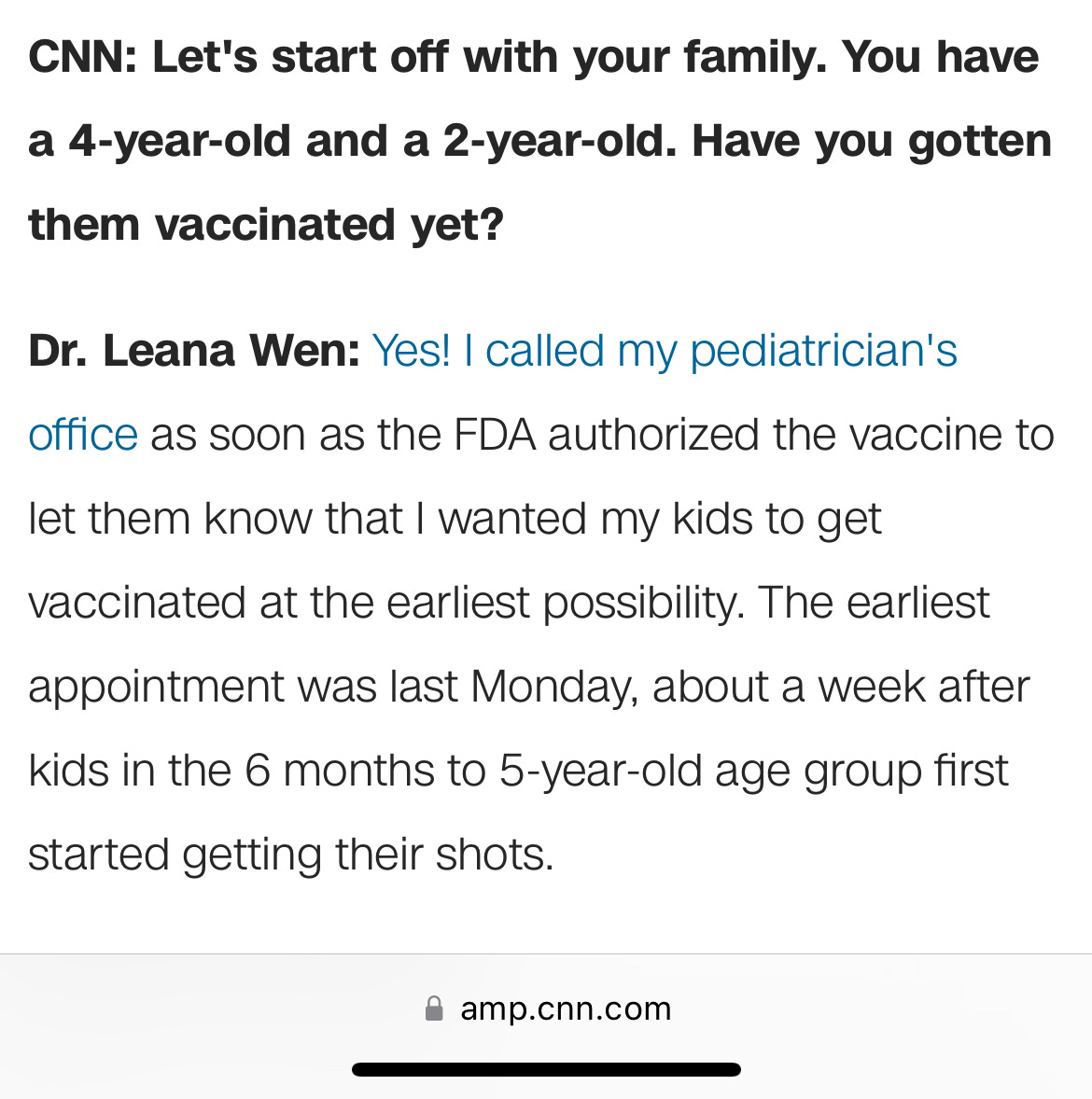
But at this point many parents have seen and experienced the side effects of the vaccines for themselves. They also know firsthand that the shots do little if anything to stop Omicron infections (though they may not be aware how terrible the data truly are). And they know that Covid is a minuscule risk for children who are not already seriously ill, and that most kids have already been exposed.
(All the Sesame Street ads in the world can’t change reality. Congrats, Elmo. You’re in the 1 percent. Cute Band-Aid, though.)

But as it becomes clear just how few little kids have gotten the shots, any future media and public health pressure campaigns will look embarrassingly out-of-touch.
Someone may want to tell the Biden Administration: the less said about the pathetic decision to make these shots available for kids under 5, the better.
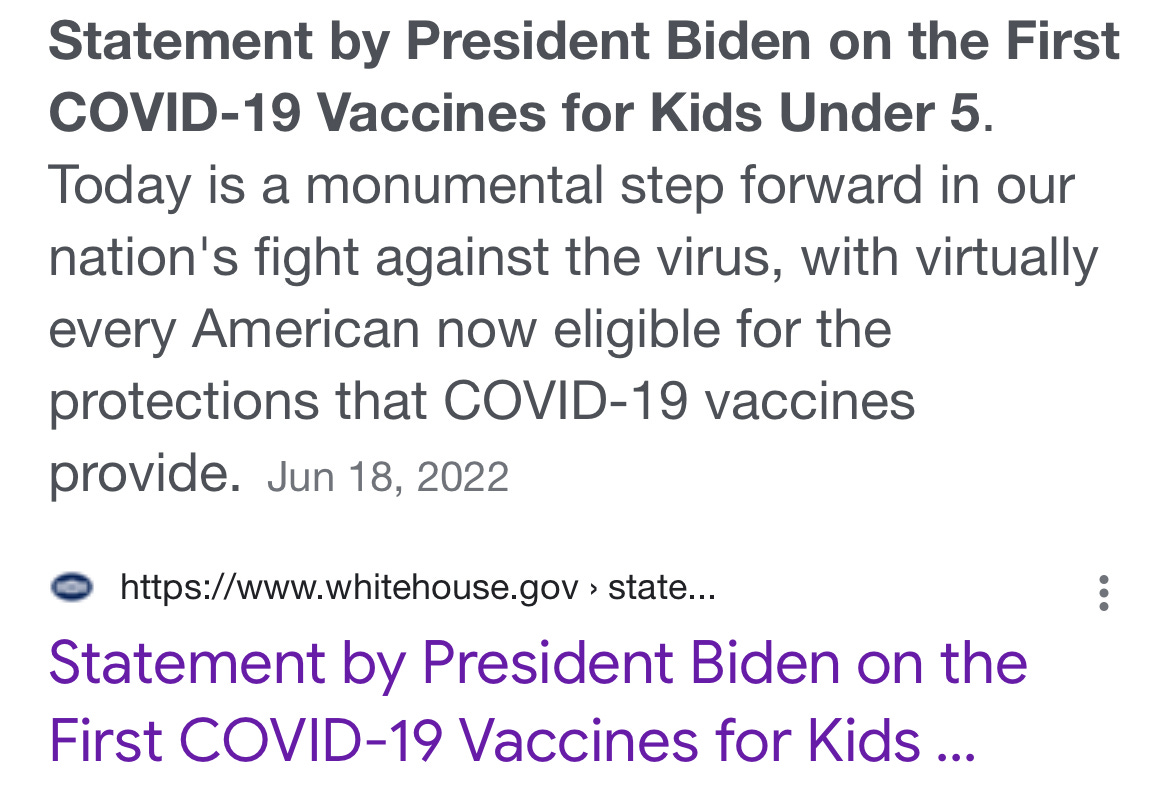
Oh, wait, too late.
Uncle Joe wins again!
BY CLAYTON FOX | BROWNSTONE INSTITUTE | JUNE 30, 2022
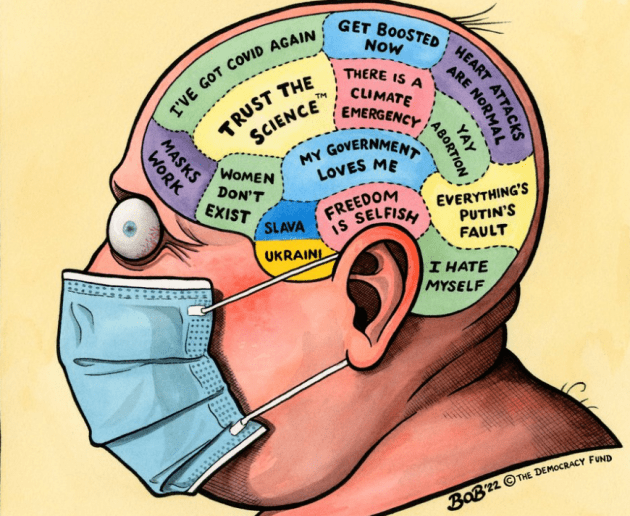
The media, and the people who work in and around it, the Blue Checks™ of Twitter, have upped the ante over the past few years regarding how far they are willing to go to enforce various preferred narratives.
Pick any major story of the past three years—e.g. Lab Leak, Jussie Smollett, Russiagate, Ukrainian Biolabs, Ivermectin, Hospitalizations From COVID v. With Covid, January 6th, ‘Transitory’ Inflation, and of course Hunter’s Laptop—and you will find absolutely hysterical narrative pushing up front followed by retractions, corrections, and outright denials as reality became undeniable.
In the meanwhile, our civilization was ripped apart, our citizens were gaslit and impoverished, and in countries across the Western world, innocent people were removed from polite society, branded as lepers, and fired from their jobs.
Why? Because there is one story that just won’t die and for which no corrections have been issued—the shibboleth that vaccination can prevent infection, transmission, and help “end” COVID.
While there is never an excuse for hateful rhetoric towards, and intervention in, the personal medical choices of law-abiding Americans, perhaps one could have, kinda sorta, understood the campaign if the new vaccines had provided long-lasting immunity and prevented community transmission. They do not.
Early on we were told: “Nine out of ten [vaccinated] people won’t get sick” (Columbia University feat. Run-DMC, February 12th, 2021, no this is not a joke); “Vaccinated people do not carry the virus, don`t get sick” (Dr. Rochelle Walensky, March 29th, 2021); “When people are vaccinated, they can feel safe that they are not going to get infected” (Dr. Anthony Fauci, May 17th, 2021).
And by mid-summer, 2021, we were still being told that unequivocally, these vaccines were a resounding success worthy of uncritical support. On July 27th in Scientific American, Dr. Eric Topol wrote, “Vaccination is the closest thing to a sure thing we have in this pandemic.” Not to be outdone, Dr. Anthony Fauci of the NIAID told CBS on August 1st, that the unvaccinated were responsible for “propagating this outbreak.”
But on July 29th, 2021, the Washington Post reported a scoop that the CDC was privately acknowledging that the vaccinated could spread COVID as easily as the unvaccinated. Occasionally, they are forced to report inconvenient facts. And August 5th, CDC Director Walensky told CNN’s Wolf Blitzer that, “They continue to work well for Delta, with regard to severe illness and death — they prevent it. But what they can’t do anymore is prevent transmission.”
While there is a mountain of medical literature available demonstrating quite clearly the failure of these vaccines to prevent infection and transmission, the August 5th declaration from the CDC Director should have made clear that being vaccinated is contributing in no way to the safety of others, nor to the eradication of this virus.
In fact, Israeli Health Minister Nitzan Horowitz was even caught on tape in September of last year explaining that the use of the Israeli Green Pass wasn’t intended to make a difference epidemiologically, but because it would help convince people to get vaccinated. And even vaccine poobah Bill Gates admitted in a late 2021 interview, that, “We got vaccines to help you with your health, but they only slightly reduce the transmissions.”
So there should be no question that continuing to suggest in any way that these shots are a panacea, and that those who refused to get them were plague spreaders, should have been thoroughly trashed by Fall 2021.
Nonetheless, on September 24th President Joe Biden coined his now famous phrase “a pandemic of the unvaccinated.” To our north, Prime Minister Trudeau called the unvaccinated science deniers, misogynists, and racists, and asked rhetorically whether Canadians should “tolerate” them.
And during the first week of January 2022, while kicking the unvaccinated out of French daily life and public spaces, French President Emmanuel Macron said he wanted the measures to “piss off” his unvaccinated citizens. With world leaders speaking this way, it’s no wonder so many Blue Check™ elites took up the banner!
Prominent media figures like Amy Siskind, Pulitzer Prize winner Gene Weingarten, and more have come out of the woodwork in recent months to share with us their enthusiasm for medical discrimination. Noted neurotic Howard Stern is all in on forced vaccination due to what must be his own debilitating fear of his mortality. Bill Kristol says the unvaccinated have “blood on their hands.”
David Frum, heir to Maimonides, writes, “Let the hospitals quietly triage emergency care to serve the unvaccinated last.” Charles M. Blow was “furious” at the unvaccinated. CNN contributor Dr. Leana Wen suggested that the unvaccinated should not be allowed to leave their homes. The Ragin’ Cajun even wants to punch the unvaccinated in the face!
All of the above links/stories were posted after Dr. Walensky’s unequivocal announcement that the vaccines do not prevent transmission.
And all of the self-satisfied segregationists are supported in their vitriol by the Blue Checks™ of the Medical Establishment, like Dr. Paul Klotman, President and Executive Dean of the Baylor School of Medicine, who said on camera back in January that he isn’t polite to friends and family who aren’t vaccinated. “Keep them away. I don’t do it respectfully, I tell them to stay away, and teach them a lesson.” Less vitriolic but equally problematic, the WHO’s COVID-19 “technical lead” Dr. Maria Van Kerkhove continued to push the lie that vaccination can prevent outbreaks as recently as January 26th, 2022. She is, as well, a Blue Check™. And yes, Dr. Anthony Fauci is still at it, even as of April 14th, 2022, telling MSNBC that harsh Chinese lockdowns could be used to get the population vaccinated so that “When you open up, you won’t have a surge of infections.”
The examples are legion. Blue Checks, Medical Blue Checks, Times Columnists, Radio Jocks, Presidents, and Prime Ministers have all espoused misinformation and/or hate speech regarding vaccination status. But they are all given intellectual cover by the official reporting of the fourth estate. Even in the face of all the evidence that there is no epidemiological basis for discrimination, our intellectual betters in the legacy media press onward the canard.
On August 26th, the Toronto Star ran an article entitled, “When it comes to empathy for the unvaccinated, many of us aren’t feeling it.” Then, on December 22nd, published an explainer which stated that two doses won’t stop you from spreading COVID-19. Comme ci, comme ca.
Back in February, MSNBC political contributor Matthew Dowd shared his insight that the unvaccinated do not believe in the United States Constitution, because if they did, they would get vaccinated for “We The People.” For the common good.
An examination of the New York Times reveals three articles written this year which overtly continue supporting the idea that the vaccines prevent transmission. First, on January 29th in a piece entitled, “As Covid Shots For Kids Stall, Appeals Are Aimed At Wary Parents,” the author cites “public health officials” who say that to aid in “containing” the pandemic, kids must also be vaccinated. (It is worth mentioning that the current vaccines and boosters being distributed were designed in February 2020 to provide an immune response to a version of the SARS-CoV-2 spike protein circulating prior to that, not entirely similar to what is circulating now.)
Then February 23rd, in a hit piece on the Surgeon General of Florida Dr. Joe Ladapo, the Times writes, “When public health officials across the country were urging vaccines as a way to end the pandemic, Dr. Ladapo was raising warning flags about possible side effects and cautioning that even vaccinated people could spread the virus.”
So, Dr. Ladapo was correct?
Finally, in a piece about Novak Djokovic published March 3rd, they write, “Djokovic was the only player ranked in the top 100 in Australia who had not received a Covid-19 vaccination, which experts have long said will not eradicate the virus unless most of the population receives one.”
They do not address the question of how a vaccine which does not prevent transmission can eradicate a virus. And they won’t. As Israeli Health Minister Horowitz candidly admitted, none of this is about epidemiology.
And even when mainstream media tacitly acknowledges the failures of the vaccines to prevent transmission, they skillfully elide the significance of this fact in order to allow them to continue to scapegoat the unvaccinated. In a dazzling display of sophistry, Time Magazine moved the Overton window in this January 12th, 2022 piece, “These Charts Show That COVID-19 Is Still A Pandemic of the Unvaccinated.”
The author states that due to the rapidly narrowing gap between cases in the vaccinated and unvaccinated, some readers might think that the phrase “pandemic of the unvaccinated” is no longer justifiable. But with the grace of a ballerina, Time goes on to tell us that because the vaccines are still showing efficacy against severe illness, the phrase is still kosher. If an unvaccinated person gets sicker than his vaccinated neighbor who contracted COVID at a fully vaccinated wedding, that unvaccinated person is still the problem!
New York Magazine isn’t lacking in similar gymnastics. On February 16th of this year, Matt Stieb published a piece entitled, “Is Kyrie Irving Going to Get Away With It?” Irving is the Brooklyn Nets player who famously chose not to be vaccinated, and has become a fetish object for the Covidian Left. Stieb acknowledges that Irving’s vaccinated teammates were getting COVID at such high rates that it forced Nets management to allow Irving back to play in away games but still calls the New York City ban on unvaccinated athletes “a rare public health mandate with real teeth.”
Just seven days later on February 23rd, Will Leitch, in the same publication, sighs, “Unfortunately, It’s Time to Let Kyrie Irving Play in New York.” He outlines all the reasons why epidemiologically it makes no sense to prevent athletes like Irving and Novak Djokovic from participating, but says, “It would feel like they got away with all their bullshit.” And also, they are “annoying.”
And this barely concealed hatred for the unvaccinated from media and government and Big Tech—even in the rare moments when writers such as Leitch acknowledge the failure of the vaccines to prevent transmission—has real consequences. People have lost their jobs. People have been arrested for trying to go to a movie theater.
Families got kicked out of restaurants, and patrons either cheered or remained indifferent, which is worse. A teenage boy at an uber-progressive and expensive Chicago prep school committed suicide after being bullied over an incorrect rumor he was unvaccinated. The stench of bad journalism rots people’s basic decency.
A January Rasmussen poll found that, “Fifty-nine percent (59%) of Democratic voters would favor a government policy requiring that citizens remain confined to their homes at all times, except for emergencies, if they refuse to get a COVID-19 vaccine…Forty-five percent (45%) of Democrats would favor governments requiring citizens to temporarily live in designated facilities or locations if they refuse to get a COVID-19 vaccine…”
As well as, “Twenty-nine percent (29%) of Democratic voters would support temporarily removing parents’ custody of their children if parents refuse to take the COVID-19 vaccine.” Unfortunately, these disturbing results are politically lopsided, but it’s no surprise when you consider who the readers of most legacy media platforms are.
The saddest thing is that these media outlets and their flag bearers really think their readers are all morons. The New York Times believes that, in the midst of the Omicron wave as boosted person after boosted person was getting COVID, they could tell you these particular vaccines are still the way to eradicate this thing, and expect you to deny reality and nod your head.
It calls to mind the quote attributed to Solzhenitsyn (or Elena Gorokhova), “The rules are simple: they lie to us, we know they’re lying, they know we know they’re lying, but they keep lying to us, and we keep pretending to believe them.”
We have ceded the better angels of our common cerebrum to people who may not have our best interests at heart, and a sycophantic laptop class who gleefully endorses their diktats and “fact-checks.” Collectively: Sophistry Inc.
Their behavior, endorsed by every single entity which holds power in our society, is destroying us, and has already poisoned us such that there may be no antidote. Yes, first they came for the unvaccinated, but that doesn’t mean they won’t come for you next.
By Suzanne Burdick, Ph.D. | The Defender | July 1, 2022
The Biden administration today said it ordered 2.5 million more doses of Bavarian Nordic’s Jynneos monkeypox vaccine, bringing the total vaccine doses to be delivered in 2022 and 2023 to more than 4 million.
The news followed Tuesday’s announcement of the first phase of the U.S. government’s “national monkey vaccine strategy,” which will expand testing capabilities and make Bavarian Nordic’s Jynneos vaccines readily available to anyone exposed to the virus.
The U.S. Department of Health and Human Services (HHS) said the government’s “enhanced” nationwide strategy “will vaccinate and protect those at-risk of monkeypox,” as well as provide guidance to communities on how to respond to outbreaks.
“We are focused on making sure the public and healthcare providers are aware of the risks posed by monkeypox and that there are steps they can take — through seeking testing, vaccines and treatments — to stay healthy and stop the spread,” said Dr. Rochelle Walensky, director of the Centers for Disease Control and Prevention (CDC).
As part of the strategy, the CDC and HHS began shipping tests to five major laboratory companies across the country: Aegis Science, Labcorp, Mayo Clinic Laboratories, Quest Diagnostics and Sonic Healthcare.
The government, which for months has been buying more Jynneos doses to add to the national stockpile, is now distributing the vaccine. It’s currently making available 296,000 doses and expects to roll out 750,000 doses over the summer, with an additional 500,000 doses produced and released in the fall — for a total of 1.6 million doses this year.
The Jynneos vaccine is licensed for use in adults and is considered safer than Emergent BioSolutions Inc.’s ACAM2000 smallpox vaccine, which also can be used against monkeypox, the HHS said.
The vaccine will be made available to individuals “with confirmed and presumed monkeypox exposures,” said the HHS.
“This includes those who had close physical contact with someone diagnosed with monkeypox, those who know their sexual partner was diagnosed with monkeypox, and men who have sex with men who have recently had multiple sex partners in a venue where there was known to be monkeypox or in an area where monkeypox is spreading.”
Health officials seeking to expand use of monkeypox vaccine for kids, despite lack of safety data
U.S. health officials also are seeking to expand use of the monkeypox vaccine for children, Bloomberg reported.
The CDC is developing a protocol aimed at allowing use of the Jynneos vaccine in children “should cases in children occur,” Kristen Nordlund, a CDC spokesperson, said in an email to Bloomberg.
“I’m concerned about sustained transmission because it would suggest that the virus is establishing itself, and it could move into high-risk groups, including children, the immunocompromised, and pregnant women,” Tedros Adhanom Ghebreyesus, director-general of the World Health Organization (WHO) said in a Wednesday press briefing.
“We’re starting to see this with several children already infected,” he added.
There have been 350 cases so far of monkeypox in the U.S. — all adults — according to the CDC. The agency confirmed 5,115 cases worldwide.
The WHO confirmed two cases in children in the U.K. and said Wednesday it is following up on reports of cases in children in Spain and France.
No safety trials have been done in children for the Jynneos vaccine as of yet, partly because clinical research involving participants under the age of 18 must pose no more than “minimal risk” to children, which can be difficult for vaccine manufacturers to argue.
Commenting on the CDC’s actions, Dr. Meryl Nass, a member of the Children’s Health Defense scientific advisory committee, told The Defender, “It’s kind of extraordinary that they want to vaccinate everyone in the country before knowing what the safety issues are.”
Nass, an internist and biological warfare epidemiologist, said, “We don’t actually know” if the Jynneos vaccine prevents monkeypox in humans because it was developed as a smallpox vaccine, and prevention studies have been conducted using only animals.
“It is hard to believe that the [U.S. Food and Drug Administration (FDA)] gave this vaccine a license when you read the FDA reviewers’ comments in their own report,” Nass wrote in her June 23 substack newsletter.
“They could not test the vaccine for efficacy against smallpox because there is no smallpox, nor against monkeypox, because the disease is so rare,” Nass wrote. “So the FDA relied on neutralizing antibody titers.”
At the same time, the FDA admitted there is no established correlate of protection, Nass said.
“This means that there is no evidence that the titers represent actual immunity to infection,” Nass wrote. “So FDA relied on animal studies to simply guess the vaccine might be effective in humans.”
According to the FDA, the effectiveness of Jynneos for the prevention of monkeypox is “inferred from the antibody responses in the smallpox clinical study participants and from studies in non-human primates that showed protection of animals vaccinated with Jynneos who were exposed to the monkeypox virus.”
Jynneos, a replication-deficient live Vaccinia virus vaccine, was licensed in the U.S. in 2019, by the FDA for use in individuals 18 and over considered to be at high risk for smallpox or monkeypox.
In 2021, the CDC’s Advisory Committee on Immunization Practices (ACIP) voted to recommend Jynneos as a safer alternative to the ACAM2000 vaccine because of ACAM2000’s propensity to cause serious adverse effects, including myocarditis and pericarditis — i.e., inflammation of the heart.
However, Nass noted, Jynneos also was linked to heart inflammation, according to the FDA licensure review of the Jynneos smallpox-monkeypox vaccine which reported:
“Up to 18.4% of subjects in 2 studies developed post-vaccination elevation of troponin [a cardiac muscle enzyme signifying cardiac damage]. However, all of these troponin elevations were asymptomatic and without a clinically associated event or other sign of myopericarditis.”
These higher levels of troponin were not studied further, and the reviewers admitted they did not know if the Jynneos vaccine caused myocarditis, Nass said.
The Jynneos manufacturers said they would conduct an “observational, post-marketing study” in which they would “collect data on cardiac events that occur and are assessed as a routine part of medical care.”
But myocarditis — particularly asymptomatic forms of myocarditis that lack outer signs of the condition — could fly under the radar of the “routine part of medical care,” noted Nass.
The manufacturers would need to test for heightened troponin levels — something that is not typically done in “routine” check-ups.
The authors of a 2015 study reported evidence of heart injury following vaccination in a sample of 1,445 individuals who received a smallpox or trivalent influenza vaccine.
They found that chest pain, shortness of breath and/or palpitations occurred in 10.6% of those who received the smallpox vaccine SPX-vaccinees and 2.6% of those who received the trivalent influenza vaccine within 30 days of immunization.
Additionally, the study authors reported levels more than double the upper limit of troponin — a protein that flags cardiac injury — in 31 of the individuals who received the smallpox vaccine.
“Passive surveillance significantly underestimates the true incidence of myocarditis/pericarditis after smallpox immunization,” they concluded.
The authors added:
“Evidence of subclinical transient cardiac muscle injury post-vaccine immunization is a finding that requires further study to include long-term outcomes surveillance. Active safety surveillance is needed to identify adverse events that are not well understood or previously recognized.”
Suzanne Burdick, Ph.D., is an independent journalist and researcher based in Fairfield, Iowa.
© 2022 Children’s Health Defense, Inc. This work is reproduced and distributed with the permission of Children’s Health Defense, Inc. Want to learn more from Children’s Health Defense? Sign up for free news and updates from Robert F. Kennedy, Jr. and the Children’s Health Defense. Your donation will help to support us in our efforts.
By Cindy Harper | Reclaim The Net | July 2, 2022
Alex Berenson, a journalist, and author, has agreed to settle his lawsuit with Twitter. He sued the social media platform last year after it banned him.
Berenson was banned from Twitter for questioning the efficacy of the Covid vaccines.
“It doesn’t stop infection. Or transmission,” Berenson wrote on Twitter at the time. “Don’t think of it as a vaccine. Think of it — at best — as a therapeutic with a limited window of efficacy and terrible side effect profile that must be dosed IN ADVANCE OF ILLNESS.”
“And we want to mandate it? Insanity.”
Twitter flagged the tweet as “misleading,” and suspended his account.
Berenson took to his Substack, Unreported Truths, to break the news of the settlement. He didn’t share many details about the settlement because they are confidential. However, he did insist that he does not believe Elon Musk’s efforts to buy Twitter influenced the company’s decision to settle.
“At least from my point of view, Elon Musk had nothing to do with what’s happening here. I emailed Musk briefly about the suit in April, after Twitter accepted his offer and before Judge William Alsup rejected Twitter’s motion to dismiss and allowed my lawsuit to proceed. (At the hearing on April 28, Alsup himself raised the question of whether Musk’s purchase would make the lawsuit moot.) Musk didn’t email back. The last time I’ve heard from him was last year. Whether the deal played any role in Twitter’s decision to settle is a question you’ll have to ask them, but I mostly doubt it, given the fact that no one really knows if – much less when – it will close,” Berenson wrote in his Substack newsletter.
By Kit Knightly | OffGuardian | July 2, 2022
This week, tens of thousands of farmers have gathered from all across the Netherlands to protest government policies which will reduce the number of livestock in the country by up to a third.
In a typical example of media weasel-wording, the press reports on this all headline something like “Dutch farmers protest emissions targets”, but this is a massive lie by omission.
The government policy being protested is a 25 BILLION Euro investment in “reducing levels of nitrogen pollution” true, but it plans to achieve this by (among other things) “paying some Dutch livestock farmers to relocate or exit the industry”.
In real terms, this ultimately means reducing the number of pigs, chickens and cows by about thirty per cent.
That’s what is being protested here – a deliberate shrinking of the farming sector, impacting the livelihood of thousands of farmers, and the food supply of literally hundreds of millions of people.
THE BIG PICTURE
While the scheme is allegedly about limiting nitrogen and ammonia emissions from urine and manure it’s hard not to see this in the broader context of the ongoing created food crisis.
The Netherlands produces a massive food surplus and is one of the largest exporters of meat in the world and THE largest in Europe. Reducing its output by a third could have huge implications for the global food supply, especially in Western Europe.
Perhaps more troubling is how this could act as a precedent.
This isn’t the first “pay farmers not to farm” scheme launched in the last year – both the UK and US have put such schemes in place – but a government paying to reduce it’s own meat production? That is a first.
That it is (allegedly) being done to “protect the environment” makes it a big warning sign for the future. Denmark, Belgium and Germany are already considering similar policies.
The Western world seems to be enthusiastically embracing quasi-suicidal policies.
I mean, paying farmers to reduce the amount of food they produce… while (notionally) threatened with war… in the midst of a recession… facing record inflation as the cost of living spirals.
Does that really make any sense?
That’s almost as crazy as refusing new oil and gas leases while the cost of petrol is going up.
Indeed, in a world beset by a shortage of fertiliser due to sanctions against Russia and Belarus, it would seem almost mad to complain about a manure surplus, let alone try to reduce it.
We’re well past the point where any of this could be considered accidental, aren’t we?
Put it this way – if the collective governments of the Western world were trying to impoverish and starve their own citizens, what exactly would they be doing differently?
BY M. K. BHADRAKUMAR | INDIAN PUNCHLINE | JULY 2, 2022
The phone conversation on Friday between Prime Minister Modi and Russian President Putin conveyed a big signal, coming on the morrow of the release of the new Strategic Concept by NATO which called Russia the alliance’s “most significant and direct threat.” The readouts from Moscow and New Delhi both highlighted the two leaderships’ determination to carry forward the momentum of economic cooperation despite the western sanctions against Russia. (here and here)
Ironically, the West’s “sanctions from hell” have given a big stimulus to India-Russia bilateral trade, giving it a dynamism that one never suspected would be recaptured in the post-Soviet era.
Friday’s call was agreed upon in the sidelines of the BRICS summit (June 23-24). Curiously, it has come at a time when the Western powers have stepped up their efforts to create discord among the BRICS member countries, and brainwash India, in particular, to join their bandwagon in the new Cold War conditions. India is of course cherrypicking.
But that is understandable at a time when the economy is in “stagflation.” India’s relationship with Russia was the leitmotif of Modi’s visit to Japan in April and three visits to Europe in May as well as his two meetings with US President Biden during this period. In the West’s calculus, China and India are giving what analysts would call “strategic depth” to Russia, which nullifies its frantic efforts to “erase” Russia. Interestingly, the western attempts to create paranoia in the Indian mind about the close ties between Russia and China are no longer having the desired effect of Delhi becoming wary of Russia’s intentions. India sees, on the contrary, great opportunities to tap into Russia’s tilt to Asia-Pacific region for economic partnerships.
Without doubt, India is “balancing” between Washington and Moscow and BRICS summit was a great occasion to monitor that trapeze act. An unabashedly pro-western internet paper from Delhi had predicted that Modi would act as a vigilante for US President Biden, blocking any BRICS statement critical of the US. Whether that was true or not, Modi made a rather anodyne speech at the BRICS summit.
On the other hand, Putin had stated in his speech at the summit that “Considering the complexity of the challenges and threats the international community is facing, and the fact that they transcend borders, we need to come up with collective solutions. BRICS can make a meaningful contribution to these efforts.”
Putin added, “We are confident that today, as never before, the world needs the BRICS countries’ leadership in defining a unifying and positive course for forming a truly multipolar system of interstate relations… we can count on support from many states in Asia, Africa and Latin America, which are seeking to pursue an independent policy.”
In his speech, Chinese President Xi Jinping made an even more direct appeal to the BRICS partners: “Our world today is overshadowed by the dark clouds of Cold War mentality and power politics and beset by constantly emerging traditional and non-traditional security threats. Some countries attempt to expand military alliances to seek absolute security, stoke bloc-based confrontation by coercing other countries into picking sides and pursue unilateral dominance at the expense of others’ rights and interests. If such dangerous trends are allowed to continue, the world will witness even more turbulence and insecurity.
“It is important that BRICS countries support each other on issues concerning core interests, practice true multilateralism, safeguard justice, fairness and solidarity and reject hegemony, bullying and division.”
Frankly, no matter the impressive-looking XIV BRICS Summit Beijing Declaration, the fact remains that the grouping is performing far below its actual potential and one principal reason for this is India’s zero-sum mindset regarding China, which makes it difficult for it to work with China collectively in any regional forum.
However, any apprehension in the Indian mind that China would “dominate” BRICS is unwarranted. Russia undoubtedly occupies a special place in the structure of the BRICS. In fact, BRICS was Moscow’s brainchild and Russia was responsible for launching the format. The first ministerial meeting (in the BRIC format) took place at the suggestion of Putin in September 2006, on the sidelines of the UN General Assembly session in New York. Thus, the idea of creating BRICS matured in Russia.
Second, BRICS is a “de-ideologised” format. It shows no animus against America although it challenges western hegemony of the international political and economic order. The very fact that the Manmohan Singh government welcomed Putin’s BRIC initiative at a most sensitive juncture when India’s negotiations for a nuclear deal with the US (with eye on Washington’s embargo on technology transfer) speaks for itself.
Moscow conceived the BRICS concept for the strengthening of the formation of a multipolar system of international relations and the growth of economic cooperation — and it has indeed contributed to the birth of a new economic system, based on the equal access of countries to financing and sales markets, a combination of state planning and market economy.
India has a problem to appreciate that the BRICS paradigm does not lie in expanding the capabilities or ambitions of the group’s member countries, but in fostering a qualitative change in the economic development model of the Global South. India’s dog-in-the-manger attitude — sulking and politicising the forum with extraneous issues (primarily to embarrass China) — doesn’t make sense.
Unlike India, China takes BRICS seriously. The Chinese initiative to create a BRICS Vaccine Centre has been under development and the implementation of this project amid the current conditions can be a significant achievement that will bolster the entire format of the association. Ideally, India should cooperate with the project instead of teaming up with its QUAD partners which has turned out to be a wild goose chase.
Again, industrial innovation is slated to be a priority for China’s BRICS Presidency in 2022. Expectations are high that during its presidency, China will come up with a number of breakthrough initiatives. Clearly, now that the construction of the BRICS’ New Development Bank headquarters in Shanghai has finished, new proposals are expected from China on the development of its operations, including possibly an expansion of the number of shareholders of the bank.
Of course, China will promote its own projects, including Belt and Road initiative. But then, China is also putting into the projects the most financial resources. It is high time for India to have a serious reassessment of values within the BRICS framework, and the changing internal balance of power in the grouping in the new Cold War conditions.
BRICS is at the crossroads and this realisation has propelled the concept of a “BRICS+” format to the centerstage of discussions. China’s BRICS chairmanship 2022 witnessed the launch of the extended BRICS+ meeting at the level of Ministers of Foreign Affairs. Participants included Egypt, Nigeria, Senegal, Argentina, Indonesia, Kazakhstan, Saudi Arabia, UAE and Thailand.
During the ministerial, China also announced plans to open up the possibility of developing countries joining the core BRICS grouping. Argentina and Iran have been mentioned as candidates for BRICS expansion. Be that as it may, “BRICS+” is certain to be on the agenda of global governance in times to come.
Samizdat | July 2, 2022
Scottish and Welsh ministers have said the British government took their budget funds for military aid to Ukraine, voicing concerns that it could set a precedent. The Treasury has told Scotland and Wales to contribute to a £1 billion ($1.2 billion) weapons package or have their budgets reduced.
Scottish Finance Secretary Kate Forbes said on Wednesday that Scotland agreed to provide the £65 million ($78.7 million) funding but only “on this occasion”. She cautioned that “this must not be seen as any kind of precedent,” while Welsh Finance Minister Rebecca Evans said she had been forced to set aside £30 million ($36.3 million) intended for “devolved areas like health and education”.
Devolved areas of the UK are controlled by ministers in the national parliaments of Scotland, Wales and Northern Ireland. Evans said it was “not right” to use their funds for military aid and defense, a non-devolved spending area. At the same time, she added that Wales will continue to provide humanitarian support for Ukrainians arriving in the country every day seeking refuge from the conflict.
The Scottish government said the money would be used to help fund “sophisticated air defense systems and thousands of pieces of vital kit for Ukrainian soldiers” in order to assist Kiev in fighting off Russia’s military offensive. Scotland has previously independently provided £4 million ($4.8 million) in basic humanitarian aid – health, water and sanitation and shelter – for Ukrainian refugees.
According to Welsh Education Minister Jeremy Miles, there was “no consultation” on the question of military aid, although a UK government spokesperson told the BBC it was incorrect “to say the Welsh government was not consulted… they were consulted and agreed to make a contribution.”
Simon Clarke, Chief Secretary to the Treasury, asked the devolved administrations to contribute to a £1 billion fund to supply Ukraine with state-of-the-art equipment by either directly handing over the money from their budgets or by accepting a reduction from block grants they receive from Westminster.
The UK Treasury “strongly disagreed” with the Scottish minister’s characterization of the aid request, saying that various government departments had been urged to contribute through their underspend. It also refuted claims that the move constitutes a precedent for raiding devolved budgets for reserved spending areas. “This is a response to an extraordinary crisis”, the spokesperson was quoted as saying by The Daily Telegraph.
The British media has described the request as highly unusual, as such spending usually comes from Westminster.
The UK has been one of the strongest backers of Ukraine since the start of the Russian offensive four months ago. This week it promised to provide an additional £1 billion ($1.2 billion) to support the Ukrainian Armed Forces, taking the overall military aid given to Kiev to £2.3 billion ($2.8 billion).The package includes various types of weaponry, including M270 Multiple Launch rocket systems, light anti-tank weapons and armored vehicles.
Moscow has repeatedly warned against supplies of weapons to Ukraine from the US, UK and other allied nations, saying it will only prolong the fighting, while increasing the risk of a direct military confrontation between Russia and the West.
The concerns over devolved budget funds being used by the UK government came as Scottish First Minister Nicola Sturgeon announced on Tuesday a target date of October 19, 2023 for a second referendum on independence from the UK.
MEMO | July 1, 2022
The European Union (EU) has resumed funding to two prominent Palestinian human rights groups, more than a year after suspending support for six Palestinian organisations labelled terrorists by Israel.
Indicating that the Israeli claims are baseless, the European Commission – the EU’s executive branch – sent letters to Al-Haq and the Palestinian Centre for Human Rights (PCHR). The two organisations were informed that their 13-month-long suspensions were lifted unconditionally and with immediate effect.
The PCHR and Al-Haq collect evidence of alleged Israeli crimes in the Occupied Palestinian Territories and have worked with the International Criminal Court (ICC) in The Hague in its investigation of alleged Israeli war crimes and crimes against humanity. All six groups which were banned by Israel believe they were targeted by the Apartheid State for their work with the ICC.
Announcing the resumption of funding, the Commission mentioned the results of a review conducted by the EU’s European Anti-Fraud Office (OLAF), which it said found “no suspicions of irregularities and/or fraud” and “did not find sufficient ground to open an investigation”.
OLAF’s conclusion is one many had anticipated as several EU member states had previously dismissed Israel’s “terrorism” label. Earlier this month EU diplomats also said that the evidence submitted by the Apartheid State “doesn’t meet the required threshold of proof”.
“The suspension has been lifted unconditionally and with immediate effect,” Al-Haq said in a statement yesterday. “Since its imposition in May 2021, it was clear that the suspension was not prompted by any genuine concerns about the possible misuse of funding,” the rights group continued. Al-Haq claimed that Israel had tried to “defame” the Palestinian groups in a politically motivated campaign to disrupt the work of civil society.
“Due to our human rights work to hold Israel accountable for its grave and systematic violations against the Palestinian people, Al-Haq has been a long-time target of smear campaigns, intimidation and reprisals, including death threats,” the rights group said.
“These tactics have been deployed to distract Al-Haq and to divert its resources from its core mission to promote human rights and accountability – in order to enable Israel to entrench its settler-colonial and apartheid regime in Palestine and against the Palestinian people as a whole.”
Al-Haq warned of Israel’s attempt to shrink civic space for human rights organisations and to silence human rights defenders in Palestine. The culmination of which, said Al-Haq, was Israel’s decision in October 2021 to designate the rights group alongside five other leading Palestinian NGOs, terrorists.
The EU suspended its funding to Al-Haq and PCHR in May 2021. That month, European diplomats had received a classified Israeli intelligence dossier alleging that six prominent Palestine-based NGOs, including Al-Haq, were using EU money to fund the Popular Front for the Liberation of Palestine (PFLP). The Commission suspended its funding for the PCHR at the same time despite it not being one of the six NGOs mentioned. A few months later, in October 2021, Israel outlawed the six organisations.
The EU Commission was the only international actor which froze funds. However, several European countries, including Ireland, the Netherlands and Norway spoke out against the ban. “You have to look at the facts here,” Dutch Foreign Minister Wopke Hoekstra said in May.
“There isn’t a single European state — nor the United States — that has arrived at the same conclusions as has Israel. If there is proof, then we should see and we should review it. An accusation in and of itself cannot be sufficient for a country that subscribes to the rule of law,” Hoekstra said.
By Francis Menton | Manhattan Contrarian | June 29, 2022
Just over six months ago, in December 2021, I asked the question that was on the tip of the tongue of everybody who follows the subject of the ongoing massive “green” transition to fossil-fuel-free energy. Actually, that’s a lie. The question I asked was not on the tip of the tongue of everybody who follows the subject, or even of most of the people who follow the subject, for reasons that to me are completely inexplicable. The question was : “Which Country Or U.S. State Will Be The First To Hit The Green Energy Wall?”
The candidates that I nominated in that post as potentially the first to hit the “green energy wall” were California, New York, the UK and Germany. At the time, I thought it was obvious that one of those jurisdictions would hit the wall sooner than almost anybody expected. Indeed, I was quite bold in the short time frame that I predicted:
A prolonged period of unfavorable weather (calm and overcast) could cause a serious energy crunch to hit one or both of Germany or the UK as soon as this winter. Or they could get lucky and go another year or two.
Now here we are in June 2022, and I think it’s hard to deny that Germany has in fact hit the “green energy wall.” Let’s consider.
First, here is the definition of the “green energy wall” that I gave in the post:
[O]ne or another of [those states or countries] is highly likely to hit a “wall” — that is, a situation where the electricity system stops functioning, or the price goes through the roof, or both, forcing a drastic alteration or even abandonment of the whole scheme.
And here’s the reason I gave why one or another (or all) of the nominated jurisdictions would soon be hitting the “wall”:
All these places, despite their wealth and seeming sophistication, are embarking on their ambitious plans without ever having conducted any kind of detailed engineering study of how their new proposed energy systems will work or how much they will cost. Sure, a wind/solar electric grid can function with 100% natural gas backup, if you’re willing to have the ratepayers foot the bill for two overlapping and redundant generation systems when you could have had just one. But “net zero” emissions means no more fossil fuel backup. What’s the plan to keep the grid operating 24/7 when the coal and natural gas are gone?
As is (or should be) obvious to everyone, a predominantly wind/solar electricity generation system needs full backup from some source to keep the lights on 24/7. The options are few: fossil fuels plants (coal, oil or natural gas), nuclear, or storage (i.e., batteries). Germany has ruled out the fossil fuel and nuclear options. It never had much in the way of oil-fired electricity generation, and it spent the last ten-plus years phasing out its coal and nuclear plants. So, that leaves storage. Surely, you might think, having embarked on a multi-trillion dollar transition to a predominantly wind/solar electricity system, and having ruled out both fossil fuels and nuclear for backup, Germany must have been focused like a laser beam on the storage issues to make the whole thing work.
You would be wrong. It is truly unbelievable the extent to which Germany — seemingly the country with the most sophisticated engineering in the world — put its head in the sand and ignored the storage problem until it just ran its energy system into the wall.
Let’s compare how much energy storage Germany would need to back up its wind/solar electricity system to the amount of storage actually developed to date or in the pipeline. At this website, I have followed the energy storage question closely, and have discussed and linked to the most competent calculations of how much storage would be needed to back up a predominantly or fully wind/solar electricity system for various jurisdictions, including Germany. In this post in November 2018 I linked to and extensively discussed work by a man named Roger Andrews, who calculated the storage requirement for Germany to back up a fully wind/solar system as approximately 25,000 GWH. In that post, I also examined some reasons why Andrews’s calculation might be low — for example, Andrews assumed a 100% return from energy put into storage (which is unrealistic), and also based his calculations on actual generation and weather data for a particular year (2016), which could prove more favorable than another year. But that said, Andrews’s calculation appeared to me to be in the right ballpark. More recently, in a post in March 2022, I discussed and linked to work of two German scientists named Oliver Ruhnau and Staffan Qvist. Ruhnau and Qvist calculated a storage requirement for Germany to back up a fully wind/solar system as 56,000 GWH.
If you figure that Andrews may be on the low side, and Ruhnau/Qvist on the high side, that would put a good rough estimate of Germany’s need for grid-scale energy storage to back up a wind/solar system somewhere in the range of about 40,000 – 50,000 GWH.
So how much storage does Germany have currently existing or in the pipeline? Here is an April 11, 2022 piece from consultancy Wood Mackenzie reporting excitedly about Europe’s plans to solve the wind/solar intermittency problem with storage, “Europe’s grid-scale energy storage capacity will expand 20-fold by 2031.”:
Europe has set out some of the world’s most ambitious decarbonisation targets. And the pace of change is accelerating. . . . [T]he region’s nascent grid-scale energy storage segment is growing fast. We forecast that total capacity will expand 20-fold between now and 2031.
Here’s their chart showing what that “20-fold expansion” will mean by 2031:
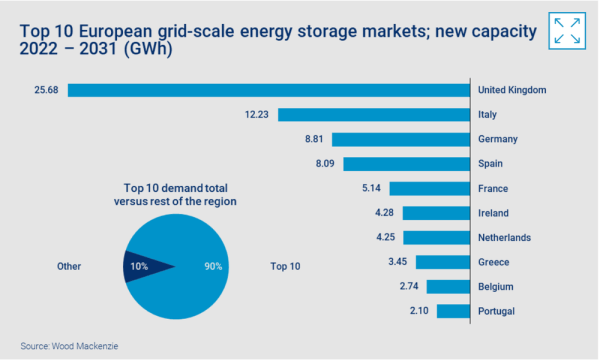
For Germany, this enormous expansion will supposedly mean all of 8.81 GWH of grid-scale energy storage. Is there a decimal place error here? Unfortunately no. Against a requirement of 45,000 GWH +/- of grid-scale storage, they’re not planning on 9000 GWH, or even 900 GWH or 90 GWH, but 9. They’re off by a factor of around 5000 against what they would need.
In other words, they haven’t even begun to solve the storage problem that would need to be solved to make their wind/solar system work, and they will barely if at all have begun to solve it by 2031. Indeed, the problem may not be solvable at all, and as yet they haven’t really put any meaningful effort into trying to figure that out. The result, as we all know, is that they left themselves completely dependent on natural gas from Russia. Now the Russian gas is effectively unavailable, and other potential sources have seen insufficient supply and massive price spikes. Here are a few observations on Germany’s current energy predicament. From Walter Russell Mead in the Wall Street Journal, June 27, “End of the German Idyll”:
As recently as 2020, almost the entire world agreed with the smug German self-assessment that Germany had the world’s most successful economic model, [and] was embarking on the most ambitious—and largely successful—climate initiative in the world. . . . [Now we understand that] German energy policy is a chaotic mess, a shining example to the rest of the world of what not to do. . . . Green energy, despite massive German investment, will be unable to supply German industry with reliable and cheap power for a long time.
From Energy Intelligence Group, June 28, “King Coal Makes Comeback in Europe”:
[German] officials are working on emergency laws that would allow roughly 9-10 gigawatts of idle coal and lignite capacity to return to service until 2024, replacing some of the 16% market share now held by gas. The country is home to seven of the EU’s 10 most polluting power stations, according to NGO Ember. . . . Economy Minister Robert Habeck said laws allowing more coal use and less gas-fired generation should pass the Bundesrat — upper house of parliament — in early July. . . . The government says there are no plans to change the coal phase-out date, with the last units still earmarked for closure by 2030.
It’s a complete reversal of the prior policy of shutting down the coal plants. Economy Minister Habeck says that the reversal is temporary, and that they are still on track to close all the coal plants by 2030. And how exactly are they going to accomplish that, with all of 9 GWH of grid-scale energy storage? There is only one possible method, which is to go back to natural gas, either using alternative suppliers (U.S.?), or because Russia re-enters the good graces of the world. But using natural gas for backup is just as much a complete abandonment of the “net zero” fantasy as is using coal.
So I say that Germany has in fact hit the “green energy wall,” and will not be going back, no matter what they are saying at the moment. Time could prove me wrong, but I don’t see any realistic plans that they have in the works to do away with, or even meaningfully reduce, full fossil fuel backup of their wind and solar generators.
Computing Forever | July 1, 2022
Sources:
https://www.irishmirror.ie/news/irish-news/fifth-wave-latest-covid-19-27342285
Sources:
Women’s Health and COVID-19: FLCCC Weekly Update (June 15, 2022): https://odysee.com/@FrontlineCovid19CriticalCareAlliance:c/Weekly_Webinar_June15#d

or go to
Aletho News Archives – Video-Images
Actually, None is Necessary
By Fred Reed • Unz Review • December 13, 2020
The Correlation of Armed Forces: U.S. goods and services trade with China totaled an estimated $634.8 billion in 2019. Exports were $163.0 billion; imports were $471.8 billion. The U.S. goods and services trade deficit with China was $308.8 billion in 2019. Trade in services with China (exports and imports) totaled an estimated $76.7 billion in 2019. Services exports were $56.5 billion; services imports were $20.1 billion. The U.S. services trade surplus with China was $36.4 billion in 2019.
There is talk within the Washingtoniat of a possible war with China. Steve Bannon, who apparently was dropped on his head as a child, actually favors such a war. We hear the usual shoo-the-boobs alarm about how the Chinese are doing something terrible and we must gird our loins and American values and show them what for, bow wow, woof. The danger is that the current game of who-blinks-first in Asian waters might actually provoke a shooting war. You know the kind of thing: One warship refuses to get out of the way of another, a collision ensues, some retard lieutenant who signed up on waivers opens fire, and we’re off and running. It is not a good idea to let children play with matches.
The said war is discussed either in emotional terms by idiots or in purely naval terms by those familiar with such things, so we hear of the First Island Chain and the Second Island Chain and whose missiles against the other’s missiles and so on. This would be appropriate if we were fighting World War Two again. Which we aren’t. Let’s take a quick-and-dirty look at how such a war might go.
To begin the war, America would overestimate itself and underestimate China. This is doctrine in the Pentagon. … continue
 Aletho News If Americans Knew No Tricks Zone
 Aletho News