Hungary Wants to Buy Additional Natural Gas From Russia: Lavrov

By Ilya Tsukanov – Samizdat – 21.07.2022
Hungary has asserted an independent policy unique in the European Union in relation to the Ukrainian crisis, refusing to slap sanctions on Russian energy, and refusing to allow its territory to be used by NATO to transfer weapons to Kiev.
Russia and Hungary are intent on advancing their bilateral cooperation, notwithstanding EU sanctions, and are looking to implement major projects, including in the energy sector, Russian Foreign Minister Sergei Lavrov has indicated.
“Despite the difficult international situation, despite the desire of some of our partners to increase sanctions pressure against Russia, our interaction continues, and last year we managed to overcome the recession caused by the pandemic and to achieve growth of over 25 percent in our trade turnover,” Lavrov said, speaking to his Hungarian counterpart Peter Szijjarto in Moscow on Thursday.
“We note the mutual commitment of the Russian and Hungarian governments to promote our interaction, our partnership, including in the implementation of major projects in energy, transport and other areas,” Lavrov said.
The Russian foreign minister indicated that Budapest has expressed interest in buying additional gas supplies from Russia, and that Moscow would consider this request immediately.
Hungary imports approximately 65 percent of its oil and some 80 percent of its gas from Russia, and recently refused to cut down amid Brussels’ attempts to force a “phase out” of Russian crude supplies.
“I consider your visit very timely, including for the continuation of our trust-based exchange of views on regional and international issues,” Lavrov said.
“I know that you are closely following the situation in Ukraine as it develops, including from the point of view of the Hungarian national minority, and today we will be prepared to give you our vision of how our special military operation is developing and about the prospects for resolving this serious crisis,” he said.
Hungary has refused to toe the line set by its NATO and EU allies amid the Ukraine crisis, calling for an immediate ceasefire as the only possible chance to avoid a steep economic crisis in Europe. Budapest has also been critical of Brussels’ tough sanctions against Moscow, saying they threaten to undermine Hungary’s own economic and energy security.
Last week, Hungarian Prime Minister Viktor Orban suggested that Europe had “shot itself in the lungs” with sanctions, and was now paying the price.
“At first I thought we just shot ourselves in the foot, but the European economy shot itself in the lungs and is gasping for air,” he said. “There are countries committed to the sanctions policy, but Brussels must admit that it was a mistake, that it has not fulfilled its purpose and has even had the opposite effect,” Orban added, suggesting that restrictions were hurting the EU much more than Russia.
Hungary’s relations with Ukraine worsened dramatically after the 2014 coup in Kiev, and the new Ukrainian government’s legislative efforts to deprive the community of 150,000 ethnic Hungarian-Ukrainians living in the country’s Zakarpattia region of the right to receive a public education in their native tongue.
Following the escalation of the Ukraine crisis in February, tensions have degenerated into a bitter war of words, including mutual recriminations about the state of Ukrainian and Hungarian officials’ mental health.
In May, an advisor to Ukraine’s energy minister suggested that “something” should happened to the Soviet-era Druzhba (‘Friendship’) oil pipeline carrying Russian crude through Ukraine to Hungary to speak to Orban “in the language he understands.” The same month, Orban’s name was added to a notorious Security Service of Ukraine-curated website containing the personal information of so-called “enemies of Ukraine.” Several individuals listed on the website have subsequently been killed.
Kremlin Says Western Restrictions to Blame for Technical Problems With Russian Gas Deliveries
By Ilya Tsukanov – Samizdat – 21.07.2022
Russian gas deliveries via the Nord Stream 1 pipeline were resumed on Thursday morning following scheduled maintenance work. Last month, Gazprom was forced to cut supplies sent through the network to about 40 percent of capacity due a refusal by Canada to send a Siemens turbine used by Nord Stream 1 to Russia due to sanctions.
All technical problems related to the delivery of Russian gas to Europe are the result of various restrictions Western countries themselves have placed on Russian energy exports, Kremlin spokesman Dmitry Peskov has indicated.
“I suggest that you carefully reread the statement made by the [Russian] president in Tehran. He explained in great detail how many compressor stations there are, what kinds of problems have been recorded by Siemens – and in connection with this, what type of situation is occurring where it is impossible to build pressure up to 100 percent. These are technical reasons connected to the impossibility of proper technical maintenance,” Peskov said, speaking to reporters on Thursday.
“Any technical difficulties associated with this stem from the restrictions that European states and the European Union themselves have introduced… It is these restrictions which do not allow for the repair of equipment, including turbines operating at compressor stations. And it is these restrictions which lead to the fact that some units cannot currently receive the necessary maintenance,” he stressed.
Peskov indicated that Gazprom remains committed to fulfilling its obligations in full, and rejected recent statements made by Western officials and media about alleged Russian attempts to “pressure or blackmail” Europe in the energy sector. “These are absolutely false statements and we categorically deny them,” he said.
Asked to comment on Wednesday’s remarks by State Department spokesman Ned Price that the resumption of Nord Stream 1’s operation would be “an important element” in ensuring Europe’s security, Peskov said Moscow was “no longer surprised” by anything Washington says. “As for the energy security factor, yes, we agree – we constantly say that Russia, as a supplier of energy resources, is very important and integral factor for European energy security. This is true,” he said.
Nord Stream 1, which has become Gazprom’s central gas supply route to Europe amid machinations by Poland and Ukraine, resumed operations on Thursday morning following scheduled summer maintenance work, and is now expected to resume operations at about 40 percent of its capacity of 55 billion cubic meters of gas per year. Gazprom was forced to reduce shipments via the network in mid-June over delays in the repair of a Siemens-built high-pressure gas pumping turbine in Canada. Ottawa deliberately delayed the return of the turbine, which had undergone maintenance work, back to Europe, citing anti-Russian sanctions. Last week, amid pressure from Germany, Ottawa relented, with the turbine now thought to be on route back to Europe for installation at Gazprom’s Portovaya Compression Station on the Russian Baltic Sea coast. Ukrainian authorities blasted Canada over the move, vowing that Kiev would “never accept” Ottawa’s decision.
President Putin commented on the European energy crisis in remarks to reporters at the conclusion of his working visit to Iran on Tuesday, indicating that the EU and its allies in Kiev are wholly responsible for current situation regarding gas deliveries from Russia.
“Until recently, we supplied… around 30 billion cubic meters [of gas] a year to Turkey, and 170 billion to Europe, 55 billion of that via Nord Stream 1, and, if memory serves, 33 billion via Yamal-Europe, through two strings running through Ukraine. And about 12 billion to Europe through Turkey via Turkstream,” Putin said.
“Ukraine suddenly announced that it was going to close one of the two routes on its territory, allegedly because the gas pumping station is not under its control but on the territory of the Lugansk People’s Republic. It found itself under the control of the LPR several months earlier, but they closed it just recently without any grounds,” he said.
After that, Putin said, Poland imposed sanctions on the Soviet-era Yamal-Europe network, first shutting it down and then turning it back on in reverse mode to send about 32 million cubic meters of gas per day from Germany eastward.
“Where is the gas from Germany coming from? It is our Russian gas. Why from Germany? Because it turned out to be cheaper for the Poles. They used to get it from us at a very high price, closer to the market price, whereas Germany gets it from us 3-4 times cheaper than the market price under long-term contracts,” he explained.
“So, first one of the routes in Ukraine was shut down, then Yamal-Europe was shut down; now Nord Stream 1, which is one of the main routes – we pump 55 billion cubic meters a year through it,” Putin said.
The Russian president noted that there are five Siemens-built gas compressor turbines used by Nord Stream 1, plus one more on standby. One turbine was sent out for repairs to a Siemens plant in Canada, but was slapped with sanctions by Ottawa. On top of that, another turbine at Portovaya is out of order due to technical problems, leaving two operational units currently pumping 60 million cubic meters of gas per day.
“So, if one more is delivered, fine, we will have two in operation. But if it is not, only one will be left, and it will pump only 30 million cubic meters per day. You can imagine how much time it will take to pump the rest. How is this Gazprom’s responsibility? What does Gazprom even have to do with this? [The West] cut off one route, then another, and sanctioned this gas pumping equipment. Gazprom is ready to pump as much gas as necessary. But they have shut everything down,” Putin stressed.
The Russian president added that the new Nord Stream 2 pipeline network, which could double the Nord Stream network’s capacity to 110 billion cubic meters of gas per year over the long term, remains ready for launch, but has been frozen by Germany.
European economies are bracing for a cold winter and rushing to fill up underground gas storage facilities amid the largely self-inflicted energy crisis brought on by sanctions and Brussels’ push to “phase out” or restrict purchases of Russian oil, gas and coal to “punish” Moscow over its military operation in Ukraine. This week, the International Monetary Fund predicted that some countries’ economic output could fall up to 6 percent in the event of a total shutoff of Russian gas. Business leaders in Germany, the EU’s main industrial powerhouse, have warned that the country could face its gravest economic crisis since the Second World War amid the tensions over Russian gas deliveries.
Dr. Peter McCullough | Full Interview | Planet Lockdown Series
Planet Lockdown | June 19, 2022
In this interview we spoke with Dr. Peter McCullough, an American cardiologist and outspoken critic of the questionable handling of the COVID-19 “pandemic.” He is one of the most notable and credentialed voices speaking out in the United States and is a wealth of information. He was vice chief of internal medicine at Baylor University Medical Center and a professor at Texas A&M University, and one of the largest donors to the school, leading to a scholarship named after him. Upon speaking out the university shamelessly attacked him. He is articulate, balanced and a voice of reason.
In this interview he clarifies the following points:
– PR testing methodology
– Therapeutic Nihilism
– Myocarditis amongst the vaccinated
– Early treatment suppression prior to the pandemic
– Persecution of medical personnel for exercising their licensed authority
– The upside down irrational nature of COVID-19 policies including vaccine mandates
– The efficacy of a global, indiscriminate mass vax campaign, in contrast to vaccination of mainly at-risk patients
Please donate to the project. Your contribution makes a real difference:
https://planetlockdownfilm.com/donate/
Subscribe to the email list for updates on the film and interviews:
https://planetlockdownfilm.com/lists/?p=subscribe
Watch more full interviews and educate yourself!
https://planetlockdownfilm.com/full-interviews/
Share and enjoy!
Treating Coronavirus Shots Injury
By Adam Dick | Ron Paul Institute | July 19, 2022
Throughout the coronavirus panic, the word from national, state, and local governments, and the big money media, was nearly uniformly that people who had coronavirus should stay isolated at home and then go to the hospital if their condition became dire, such as they could hardly breathe. The message was that there was nothing these individuals could do in the meantime to counter the sickness. They could just wait and see.
When some new, expensive, and experimental pharmaceuticals rushed to market with scanty evaluation ultimately became available, the message changed some. Early treatment suddenly was promoted, but only using these new drugs.
All the while, some doctors willing to stand up to the pressure to conform did what doctors have long done to help patients. They took inexpensive drugs, vitamins, and therapies already long in use and employed them in innovative ways to provide patients with early treatment.
To do the right thing, these doctors risked being fired by employers and having their medical licenses revoked. And governments even threw up hurdles before these doctors’ patients in an effort to stop them from obtain drugs such as ivermectin and hydroxychloroquine. Meanwhile, big money media blared these drugs were dangerous despite the fact that decades of use had shown them to be relatively safe drugs and less risky than the new and experimental coronavirus “vaccines” and early treatment drugs the media pushed.
Fortunately, some patients found the renegade doctors and obtained relief early, thus countering sickness and avoiding hospitalization.
Since the experimental coronavirus “vaccine” shots came out, politicians and the big money media have been promoting them, and even booster shot upon booster shot as “safe and effective.” But, it has become increasingly obvious that the shots are neither.
The shots do not stop the shot takers from becoming sick from coronavirus, transmitting coronavirus to other people, or dying from coronavirus.
One thing the shots do cause is dangerous side effects. Governments and the big money media have, in their devotion to rejecting any criticism of the purported miracle vaccines, kept mum about the idea that people harmed by the shots should seek treatment. But, fortunately, some brave doctors are doing their best to repurpose drugs, vitamins, and therapies to help people injured by the shots.
This effort to help shots victims is similar to the early treatment efforts doctors took for people with coronavirus when the overriding public message was to just stay isolated at home until you are so sick you have to go to the hospital. They are doctors choosing to act as doctors even though there is incredible pressure against doing so.
Not surprisingly, some of the doctors who have taken the brave step to help people harmed by the coronavirus shots are the same doctors who helped coronavirus patients who the politicians and big money media had declared should not be helped or, later, should only be given the new experimental drugs. For example, the Front Line Covid-19 Critical Care Alliance (FLCCC) has added to its protocols a post-vaccine treatment protocol alongside its early covid treatment protocol and a link for helping people find doctors who follow the protocols. It is refreshing to see doctors, associated with FLCCC and otherwise, refuse to give in to the pressure to just let people suffer from first coronavirus and then the coronavirus shots.
Copyright © 2022 by RonPaul Institute.
Independent SAGE’s Dumb “Seven-Point” Covid Plan
By Igor Chudov | July 19, 2022
Many of my readers had one Covid a long time ago, or never had Covid, are not having another Covid so far, and may not realize how badly are things going in Covid-land in Europe and highly vaccinated areas of USA.
More than one out of 15 Brits is having COVID today (Jul 19, 2022). This is higher than ever before. An “unexpected” largest-ever wave of a yet-another variant Ba.5 is reinfecting highly-vaccinated countries one more time. Hospitals are strained, because sick, force-injected health care workers are staying home due to their Covid reinfections, and patients are hospitalized at record rates. Excess mortality is rising.
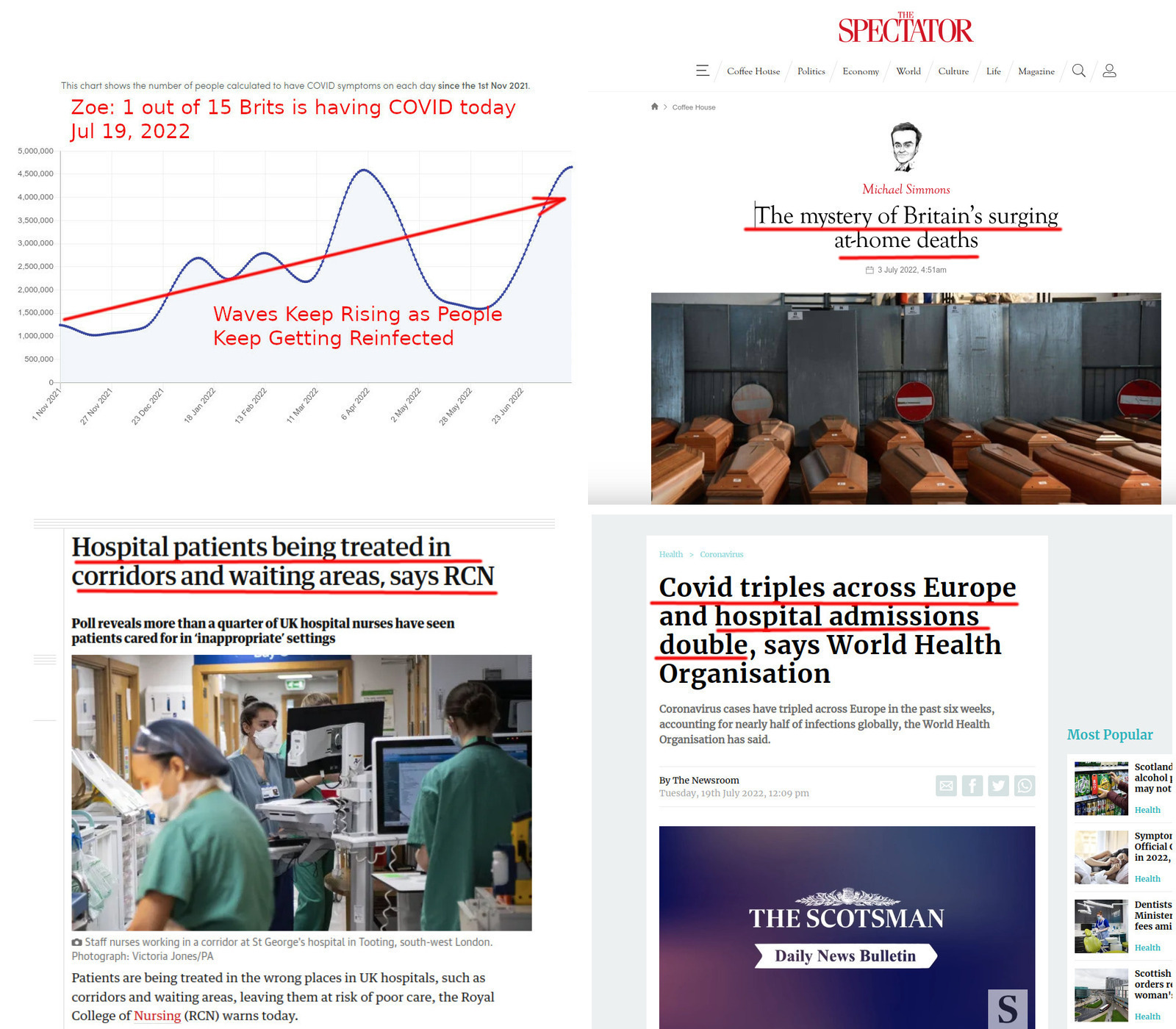
People are, naturally, becoming worried as they or their relatives have two-week-long bouts of Covid reinfections that do not feel mild to them and leave them exhausted. My own opinion is that we are on the verge of significant increases in overall mortality. I am quite worried about that.
Rumblings of discontent are appearing. The powers-to-be are wondering what to do.
So, the so-called “Independent SAGE” just came up with a “seven-point plan” to combat COVID. The plan is so spectacularly stupid that it reads like a parody. Here it is, from the British Medical Journal no less.
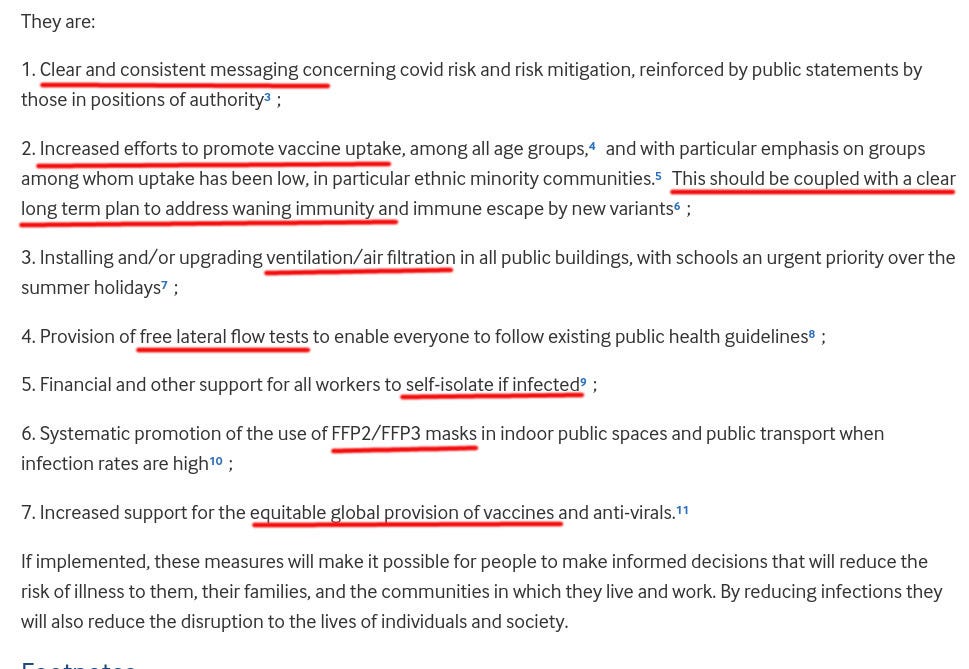
This plan is the product of supposedly the “best Covid minds”, the leading thinkers of UK science, whose recommendations influence UK policy. What did these minds produce? Let’s look.
They are proposing to do more of same!
The “clear and consistent messaging” is a theme of the pandemic, it relates to a bad idea that all officials should parrot one line during a so-called “emergency”, to avoid confusing the public. The result of this policy was a lack of independent thinking, as well as censorship of any dissenting voices, that led to groupthink. What message, pray tell, should such “clear and consistent messaging” convey? The seven-point plan?
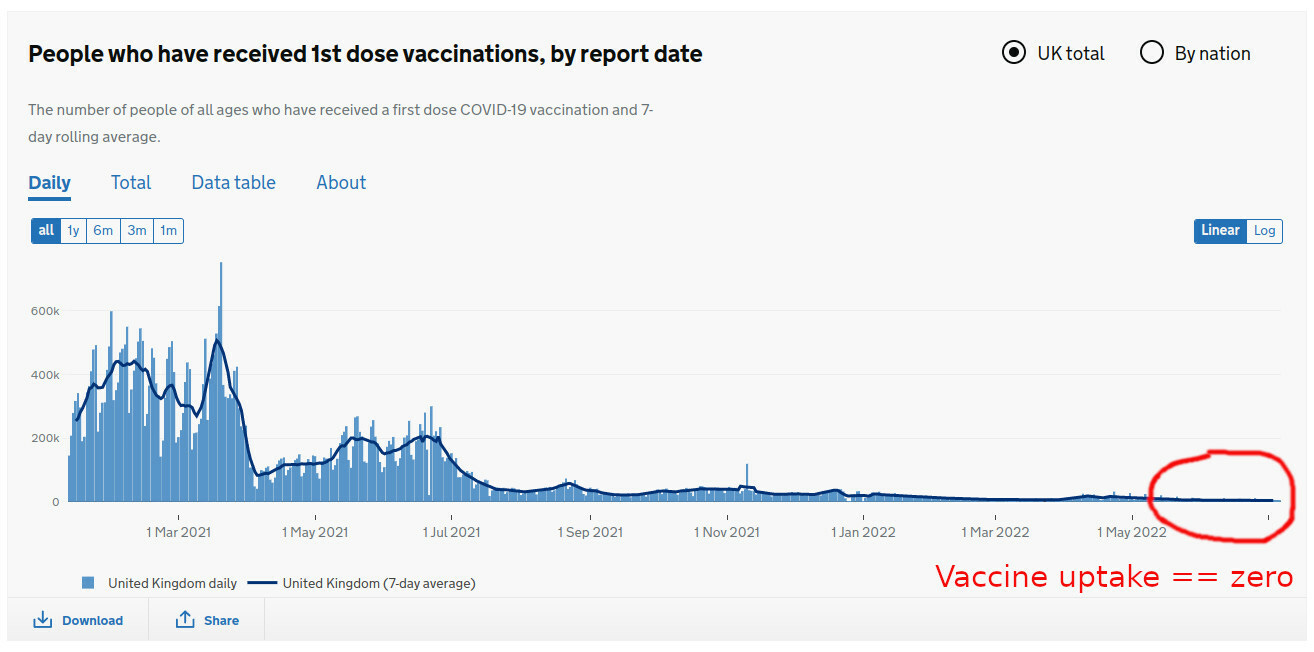
The efforts to promote “vaccine uptake” are particularly laughable in July of 2022. Here’s how vaccine uptake looks in the UK:
Of special interest is a need to have a “clear long-term plan to address waning immunity and immune escape”. What they are saying is that they do not have such a plan. They merely want to have a plan, which they do not have, as of now.
The concept of “air filtration” refers to a sincerely expressed, but misguided idea that retrofitting buildings with “air filtration devices” will stop the pandemic. While I personally like almost all people who advocate it, I also recognize that it is largely futile, for many reasons having to do with physics and gas dynamics.
Air filtration that could effectively capture airborne virions, would need to turn over enormous volumes of air every minute, through the finest filters, continuously. This is not compatible with existing buildings’ HVAC systems. It would also cost a fortune in electric bills and create a lot of heat. I do not want to get into this discussion too much, but “air filtration” of that kind is not possible in most establishments or homes.
The “FFP3 masks” are obvious non-starters because of difficulties wearing them. Making the public wear such masks in 2022 is impossible.
The worst part of this proposal is the so-called “equitable global provision of vaccines”. This is a code word for bribing governments of poor countries into forcing their citizens to take “vaccines” that these wise but poor people refuse to take voluntarily. The countries with unvaccinated majorities are the future of humanity, in my opinion. They are largely at herd immunity precisely because they refused to vaccinate. Yet, Independent SAGE wants to inject them with non-working “vaccines” in the name of “equity”. Why?
The crazy “Independent SAGE” advisers are anything but sage, are actually stupid, and I am very sorry that they have been UK’s thought leaders since 2020.
Here’s a clip from “Idiocracy”. While it is funny, it shows President Camacho actually solving his country’s problem of dying plants, with his three-point plan of hiring the smartest person in the world named Not Sure. Not Sure figured out the problem and proceeded to stop using Brawndo to water plants.
Brawndo’, which owned the FDA, went bankrupt. The plants started growing, given clean water. Any parallels with the present?
P.S. Please do not think that I am badmouthing the UK by criticizing British Covid experts: Covid experts in the USA are so much worse and could not even come up with a “seven-point plan”. So there is no “USA Covid plan” that I could criticize.
Climate Change Dictates Are Self Destructive – But Also Part Of A Bigger Agenda
By Tyler Durden | Zero Hedge | July 19, 2022
For many years we have been anticipating the implementation of far reaching and transformative restrictions on industry and agriculture in the name of “climate change” initiatives, and now it would seem the time has come for the fight to commence. The first major battleground is clearly Europe, as individual nations follow the emissions dictates if the centralized EU government, crushing their own economies while in the midst of a self induced energy crisis. It seems like madness, but there’s a bigger agenda at play here.
Today, a farmer’s rebellion is rising across Europe as the actual producers of the food that keeps the public alive are being demonized for refusing to work under conditions that would essentially bankrupt them. European emissions rules are not just about carbon, though that is a big focus. Rather, the rules include other natural gases including methane and nitrogen which are a byproduct of large farming operations. The nitrogen restrictions alone are set to destroy most farming operations in the Netherlands, which is one of the largest agricultural nations in the EU. Germany is set to follow the Netherlands with its own emissions rules in the near term.
First, it’s important to ask “why now?” There are a host of reasons. First and foremost, the EU climate agenda closely aligns with the UN climate protocols for the year 2030 and requires a 55% reduction of emissions in less than a decade (and net zero by 2050). If you think these decisions are being made by individual governments then you are mistaken; the 2030 plan was formulated by globalist institutions like the UN and the Club of Rome – Member states are simply following orders. The time-frame for drastic environmental rules was likely set back in 1992 during the “Earth Summit” in Rio de Janeiro (also known as Agenda 21).
Why the year 2030? It’s hard to say. There is no scientific basis for the timeline. There is no evidence to support the notion that climate change will make any noticeable environmental impact by 2030. They just really want carbon controls and other measures in place by 2030, and they won’t give a concrete reason for it.
Climate doomsday predictions have been presented by establishment paid scientists and activist hysterics for decades, and not a single one of these predictions has ever come true. For example, in the 1970’s climate scientists predicted a “new ice age” by the year 2000 and this nonsense scenario was spread widely by the media. Then they claimed that “acid rain” would kill off life in freshwater lakes in the 1980s; but that never happened. After that, the climate cult switched over to the global warming narrative, predicting that the ice caps would melt and rising seas would “obliterate nations” by the year 2000. Obviously, this never happened.
In the year 2000, scientists at the Climate Research Unit in Britain stated that snowfall was a “thing of the past” and that the next generation would not know what snow was. In 2008 NASA scientists argued that the Arctic would be “ice free” by the year 2018. The list goes on and on, and it would be hilarious if the people that made all these faulty predictions were not still influencing government policies, but they are.
The following quote from the Club of Rome, a group directly connected to the UN, should illustrate why the public has been constantly bombarded with climate doom mongering for the past few decades. The quote comes from a book titled ‘The First Global Revolution’ published in 1992. In that document they specifically recommend using global warming as a vehicle:
‘In searching for a common enemy against whom we can unite, we came up with the idea that pollution, the threat of global warming, water shortages, famine and the like, would fit the bill. In their totality and their interactions these phenomena do constitute a common threat which must be confronted by everyone together. But in designating these dangers as the enemy, we fall into the trap, which we have already warned readers about, namely mistaking symptoms for causes. All these dangers are caused by human intervention in natural processes, and it is only through changed attitudes and behaviour that they can be overcome. The real enemy then is humanity itself.’
The statement comes from Chapter 5 – The Vacuum, which covers their position on the need for global government. The quote is clear; a common enemy must be conjured in order to trick humanity into uniting under a single banner, and the elites see environmental catastrophe, caused by mankind itself, as the best possible motivator.
Except, there is no environmental catastrophe, at least not within the narrative the establishment presents. It simply doesn’t exist. There is no evidence to support the theory of man-made climate change. None. Global temperatures have risen only 1 degree Celsius in the past century, and there is no concrete proof that this single degree of temperature was caused by human activity.
The primary argument of climate scientists is one of exclusion: They say that all other potential causes (including the sun) have been proven not to be the cause, therefore, the cause “must” be human industry and emissions. But this is a lie.
Interestingly, the increase in temperatures cited by the NOAA and NASA coincide directly with an increase in solar activity over the course of the past 100 years according to a study released in 2006. Furthermore, scientists have discovered that solar activity in 2022 is OUTPACING previous predictions. Overall solar activity has been increasing at the same time as the earth has been warming – Imagine that.
Climate scientists continue to discount the sun as a cause because they say there’s not enough data to support the idea. Of course, there’s not enough data because all the money goes to scientists that support the man-made theory; there’s no funding to be had for scientists that present alternative theories.
Since the official temperature record used by climate scientists only goes back to the 1880s, there is no way of knowing for sure how often these warming patterns actually occur and how many times the earth has warmed by 1 degree Celsius over the millennia. But it doesn’t matter, because climate science is not about saving the Earth, it’s about creating an excuse to micromanage every aspect of human production and thus human society.
For emissions targets to be met by 2030, drastic society-changing events will have to take place within the next eight years. The very fabric of our current trade system and the global supply chain will have to be torn to shreds and replaced with an exceedingly limited production model. Not only that, but the human population would have to be reduced by billions. This model will be artificially contained within arbitrary climate guidelines set by unelected governing bodies in the name of stopping environmental changes that have not been proven to be caused by human beings at all. What it accomplishes is the formation of an authoritarian framework, one that the globalists will say is “environmentally justified.”
The war ‘diplomat’: How the West lost the ‘global battle of narratives’
By Ramzy Baroud | MEMO | July 20, 2022
In a blog entry, reflecting on the G20 Foreign Ministers’ meeting in Bali, Indonesia, on 7-8 July, the High Representative of the European Union, Josep Borrell, seems to have accepted the painful truth that the West is losing what he termed “the global battle of narratives”.
“The global battle of narratives is in full swing and, for now, we are not winning,” Borrell admitted. The solution: “As the EU, we have to engage further to refute Russian lies and war propaganda,” the EU’s top diplomat added.
Borrell’s piece is a testimony to the very erroneous logic that led to the so-called ‘battle of narratives’ to be lost in the first place.
Borrell starts by reassuring his readers that, despite the fact that many countries in the Global South refuse to join the West’s sanctions on Russia, “everybody agrees”, though in “abstract terms”, on the “need for multilateralism and defending principles such as territorial sovereignty”.
The immediate impression that such a statement gives is that the West is the global vanguard of multilateralism and territorial sovereignty. The opposite is true. The US-western military interventions in Iraq, Bosnia, Afghanistan, Syria, Libya and many other regions around the world have largely taken place without international consent and without any regard for the sovereignty of nations. In the case of the NATO war on Libya, a massively destructive military campaign was initiated based on the intentional misinterpretation of United Nations Security Council resolution 1973, which called for the use of “all means necessary to protect civilians”.
Borrell, like other western diplomats, conveniently omits the West’s repeated – and ongoing – interventions in the affairs of other nations, while painting the Russian-Ukraine war as the starkest example of “blatant violations of international law, contravening the basic tenets of the UN Charter and endangering the global economic recovery”.
Would Borrell employ such strong language to depict the numerous ongoing war crimes in parts of the world involving European countries or their allies? For example, France’s despicable war record in Mali? Or, even more obvious, the 75-year-old Israeli occupation of Palestine?
When addressing “food and energy security”, Borrell lamented that many in the G20 have bought into the “propaganda and lies coming from the Kremlin” regarding the actual cause of the food crisis. He concluded that it is not the EU but “Russia’s war of aggression against Ukraine that is dramatically aggravating the food crisis.”
Again, Borrell was selective with his logic. While naturally, a war between two countries that contribute a large share of the world’s basic food supplies will detrimentally impact food security, Borrell made no mention that the thousands of sanctions imposed by the West on Moscow have disrupted the supply chain of many critical products, raw material and basic food items.
When the West imposed those sanctions, it only thought of its national interests, erroneously centered around defeating Russia. Neither the people of Sri Lanka, Somalia, Lebanon, nor, frankly, Ukraine were relevant factors in the West’s decision.
Borrell, whose job as a diplomat suggests that he should be investing in diplomacy to resolve conflicts, has repeatedly called for widening the scope of the war on Russia, insisting that the war can only be “won on the battlefield”. Such statements were made with western interests in mind, despite the obvious devastating consequences that Borrell’s battlefield would have on the rest of the world.
Still, Borrell had the audacity to chastise G20 members for behaving in ways that seemed, to him, focused solely on their national interests. “The hard truth is that national interests often outweigh general commitments to bigger ideals,” he wrote. If defeating Russia is central to Borrell’s and the EU’s “bigger ideals”, why should the rest of the world, especially in the Global South, embrace the West’s self-serving priorities?
Borrell also needs to be reminded that the West’s “global battle of narratives” had been lost well before 24 February. Much of the Global South rightly sees the West’s interests at odds with its own. This seemingly cynical view is an outcome of decades – in fact, hundreds of years – of real experiences, starting with colonialism and ending, presently, with the routine military and political interventions.
Borrell speaks of ‘bigger ideals’, as if the West is the only morally mature entity that is capable of thinking about rights and wrongs in a selfless, detached manner. In addition to there being no evidence to support Borrell’s claim, such condescending language, itself an expression of cultural arrogance, makes it impossible for non-western countries to accept, or even engage, with the West regarding the morality of its politics.
Borrell, for example, accuses Russia of a “deliberate attempt to use food as a weapon against the most vulnerable countries in the world, especially in Africa”. Even if we accept this problematic premise as a morally driven position, how can Borrell justify the West’s sanctions that have effectively starved many people in “vulnerable countries” around the world?
Perhaps, Afghans are the most vulnerable people in the world today, thanks to 20 years of a devastating US/NATO war which has killed and maimed tens of thousands. Though the US and its western allies were forced out of Afghanistan last August, billions of dollars of Afghan money are illegally frozen in Western bank accounts, pushing the whole country to the brink of starvation. Why can Borrell not apply his ‘bigger ideals’ in this particular scenario, demanding immediate unfreezing of Afghan money?
In truth, Borrell, the EU, NATO and the West are not only losing the global battle of narratives, they never won it in the first place. Winning or losing that battle never mattered to Western leaders in the past, because the Global South was hardly considered when the West made its unilateral decisions regarding war, military invasions or economic sanctions.
The Global South matters now, simply because the West is no longer determining all political outcomes, as was often the case. Russia, China, India and others are now relevant, because they can collectively balance out the skewed global order that has been dominated by Borrell and his likes for far too long.
US Threatens Lebanon: Accept Israel’s Conditions or You Won’t Be Able to Extract Maritime Gas for Decades
Al-Manar | July 20, 2022
Caretaker Minister of Foreign Affairs Abdallah Bou Habib met on Wednesday with head of the American Task Force For Lebanon Edward Gabriel heading a delegation.
After the meeting, Gabriel addressed the reporters, conveying an American threat to Lebanon.
Gabriel considered that Lebanon has a small chance to extract its maritime gas resources by concluding a settlement after engaging in negotiations.
Otherwise, Lebanon would not be able to extract its maritime gas for decades, Gabriel added.
It is worth noting that Lebanon has insisted on obtaining its entire maritime rights preserved by a fair and legal border demarcation. However, the Zionist enemy has stubbornly rejected Lebanon’s demands.
Hezbollah Secretary General Sayyed Hasan Nasrallah warned the Israeli enemy and the United States that if Lebanon is prevented from extracting its maritime resources, none will be able to extract or sell gas and oil.
In a televised speech, Sayyed Nasrallah indicated that Hezbollah military forces are monitoring all the Zionist platforms across the occupied Palestinian coast, adding that the Resistance may resort to ground, maritime or air capabilities in order to attack the enemy and secure Lebanon’s rights.
According to Sayyed Nasrallah, the new equation is Karish, what’s beyond Karish and what’s far beyond Karish.
Thus, Hezbollah military power has been writing the long story of Lebanon’s pride of victory that protects the nations and secures its all-leveled prosperity.
Ukraine’s Naftogaz Reportedly Requests $5Bln in Government Subsidies to Buy Gas Ahead of Winter
Samizdat – 20.07.2022
Ukraine’s state-run oil and gas company Naftogaz has requested 150 billion Ukrainian hryvnias ($5 billion) in subsidies from the government to purchase enough gas ahead of the heating season, the RBC Ukraine news agency reported on Wednesday, citing the firm’s letter to the government.
Naftogaz had to request budgetary help since raising such massive funds otherwise is neither possible domestically nor internationally, the company wrote in the letter to the cabinet, according to the report.
“In such conditions, the state budget is the only possible source of financing the purchase of imported natural gas… The most favorable option is to increase the authorized capital of Naftogaz of Ukraine,” the letter read, according to the report.
The company suggested increasing its authorized share capital by 150 billion Ukrainian hryvnias, the report said.
On July 12, Naftogaz asked the holders of its Eurobonds to defer interest payments for two years but was not granted such concession, thereby exposing the company to the risk of default.
Ukraine’s former housing and communal services minister, Oleksiy Kucherenko, has accused Naftogaz of forging its profit results in 2021, saying that the breach now has to be patched with 264 billion hryvnias from the budget. The ex-official also noted that Ukraine’s budget is running low, so Kiev may have to request assistance from the United States.
Let the people pay: EU leaders make their citizens suffer the fallout from their failed Russia policy
Samizdat | July 20, 2022
In a Bastille Day interview, French President Emmanuel Macron told citizens to “prepare ourselves for a scenario where we have to do without Russian gas entirely.” At the same time, Macron accused Moscow of using the fuel as a “weapon of war,” echoing the spin emanating from a European Union leadership that obscures the real reason the bloc is facing an energy shortage that’s driving up the cost of living.
This crisis is entirely self-inflicted.
European Commission President Ursula von der Leyen accused Russia of energy “blackmail” at the end of April, citing the state-owned Gazprom’s announcement of a halt in gas deliveries to Poland and Bulgaria for failing to pay for in rubles. What von der Leyen – and now Macron – conveniently omitted was that it was the EU’s own anti-Russian sanctions, adopted in a knee-jerk and ideologically-driven fashion at the outset of the Ukraine conflict, that represent the root cause of these disruptions.
The West quickly adopted a strategy of targeting and sanctioning various aspects of the Russian financial system, including banks and foreign reserves, cutting it off from the SWIFT global transaction system – and then had the gall to complain that Moscow was asking for payment for its gas exports in its own currency to mitigate the hassle of navigating a system from which it was effectively blocked. “Export your gas but good luck trying to get paid,” is hardly a reasonable expectation.
It wasn’t Russian President Vladimir Putin who called on the EU to cut off Russian gas. Rather, it was his Ukrainian counterpart Vladimir Zelensky, who has constantly pushed for ever more Western sanctions on Russian fossil fuels. And the West has only been to happy to recklessly indulge him to the detriment of their own citizens.
Earlier this month, Zelensky even admonished Canada for agreeing to return repaired turbines for reintegration into the Nord Stream 1 gas pipeline that provides gas to Germany, and demanded that Ottawa reverse its decision. Canada had earlier faced the dilemma of violating the West’s own anti-Russian sanctions by virtue of even returning the critical parts – even though the pipeline is so vital to EU industry that the bloc’s leaders have even been freaking out about its scheduled maintenance shutdown.
Why would you be so worried about Russia failing to turn the tap back on when you’ve been saying repeatedly that you’ll gladly do without it “for Ukraine.”
But even in defending the return of the turbines, Canadian Prime Minister Justin Trudeau cited the same ridiculous Western establishment propaganda of Russia’s “weaponization” of gas, when in reality it’s the West’s own sanctions that have wreaked energy havoc and caused all this drama.
“We have seen Russia consistently trying to weaponize energy as a way of creating division amongst the allies,” Trudeau said. So if Canada doesn’t violate its own sanctions and return the turbines to Germany, then Putin wins. The Olympic level rhetorical gymnastics required by Western leaders to justify violating their own failed sanctions are second only to their recent defense of firing up coal plants again, and redefining fossil fuel energy as “green,” amid the current shortages.
EU leaders are calling for an end to Russian energy imports, citing their decision to sanction their own gas supply as a reason to expedite a transition to unproven renewables. But rather than take responsibility for the fact that they set fire to their sails and are now stranded in the middle of the ocean while awaiting the manifestation of their renewable energy transition fantasy, they’re blaming Russia for their own shortsightedness and trying to spin it as a withholding of energy orchestrated by Moscow.
Russia is only too happy to sell its fuel to whomever wants to buy it. And if the EU sanctions were lifted, the Western energy crisis would end. But that would mean admitting to a failed policy. So, instead, we’re being told that it’s all Putin’s fault, but also that the best way to stick it to Vladimir Putin is to take short, cold showers and to reduce “night lighting,” as Macron has recently suggested.
Western leaders aren’t just taking their citizens for credulous fools with their ridiculous propaganda as cover for their own failures, but they’re treating the livelihood of the average person as collateral economic damage in their hopeless bid to isolate Russia. They’ve convinced themselves, from their ideologically-isolated elite bubble, that they represent the entire world. But they’re mostly just fooling themselves.
Even the EU’s chief diplomat, Josep Borrell, admitted to a rude awakening recently at the G20 summit. “The G7 and like-minded countries are united in condemning and sanctioning Russia and in trying to hold the regime accountable,” Borrell said in a statement on the EU’s website. “But other countries, and we can speak here of the majority of the ‘Global South’, often take a different perspective.”
But then Borrell gave away the game. “The global battle of narratives is in full swing and, for now, we are not winning,” he said. “As the EU, we have to engage further to refute Russian lies and war propaganda.” But who’s really peddling the propaganda? On one hand, the EU has been trying to portray the impact of their own irresponsible and devastating sanctions on their own economies and citizens as Putin’s doing even as they try to convince Westerners that their suffering is some kind of a war effort that’s doing harm to Russia.
However, in reality, Russia can pivot to the rest of the entire world and simply leave West Europeans to wallow in their own costly delusions. They may be about to find out whether moral superiority and virtue-signaling will heat the house or feed the kids this winter.
Featured Video

Michael von der Schulenburg: Europe’s Self-Defeating Iran War Policy
or go to
Aletho News Archives – Video-Images
Frlom the Archives
Provoking a Path to Persia
The Saban Center’s prescient paper on war with Iran
By Maidhc Ó Cathail | October 20, 2011
In June 2009, the Saban Center for Middle East Policy published “Which Path to Persia?—Options for a New American Strategy toward Iran.” Writing in a tone strikingly reminiscent of the Project for a New American Century’s infamous pre-9/11 paper “Rebuilding America’s Defenses,” the six co-authors noted that, “It seems highly unlikely that the United States would mount an invasion without any provocation or other buildup.” For a think tank specifically established by media mogul Haim Saban to protect Israel, this could prove to be a formidable obstacle impeding their desired march—of U.S. troops—to Tehran.
“In fact, if the United States were to decide that to garner greater international support, galvanize U.S. domestic support, and/or provide a legal justification for an invasion, it would be best to wait for an Iranian provocation, then the time frame for an invasion might stretch out indefinitely,” Saban’s think-tankers ruefully observed.
“With only one real exception, since the 1978 revolution, the Islamic Republic has never willingly provoked an American military response, although it certainly has taken actions that could have done so if Washington had been looking for a fight. Thus it is not impossible that Tehran might take some action that would justify an American invasion. And it is certainly the case that if Washington sought such a provocation, it could take actions that might make it more likely that Tehran would do so (although being too obvious about this could nullify the provocation). However, since it would be up to Iran to make the provocative move, which Iran has been wary of doing most times in the past, the United States would never know for sure when it would get the requisite Iranian provocation. In fact, it might never come at all.”
Seemingly undeterred by Iran’s frustrating unwillingness to provide the requisite provocation, the analysts continued to examine this option… continue
Blog Roll
 Aletho News
- Hosting Washington’s war: Bahrain faces the consequences
- The US fell for its own Iran propaganda
- Seyed M. Marandi: Threat of Seizing Kharg Island & the Use of Nuclear Weapons
- Is there even an off ramp?
- Michael von der Schulenburg: Europe’s Self-Defeating Iran War Policy
- Sorry, The New Republic, Climate Change Isn’t Causing Somali Migration. Blame Civil Strife and Poverty.
- Expert Guts Claims That HPV Vaccine Reduces Cancer Risk
- No evidence Russia sabotaged Baltic cables – Finnish intel
- The Strategic Folly of a (Serious) US Ground Invasion of Iran
- US-Israeli war of aggression on Iran meant to reshape region: Omani FM
- If Americans Knew
- Are we on the precipice of World War III?
- ‘Catastrophic,’ Says UNICEF: 1,100+ Children Killed or Wounded in Mideast Since US-Israel Launched Iran War
- The Unbelievable Madness of Our War With Iran
- World Council of Churches calls on govts to hold Israel accountable for violations of intl law
- How to end the war on Iran that costs US taxpayers $1M per minute – Not a ceasefire Day 153
- Israeli strategic plans to “remake the Middle East” from the 1950s and since
- Honoring Gaza’s women who refused to let the world look away
- 97% of victims of war on Iran are Iranian, 98% of victims in war on Gaza are Gazans – Not a ceasefire Day 152
- Early Iran strikes cost $5.6 billion in munitions, Pentagon estimates
- Israel Decided the War, But Trump’s America Fights and Pays the Bill
- No Tricks Zone
- New Studies: UK Sea Levels Were 4 Meters Higher Than Today During The Mid-Holocene
- Destructive Green New Deal: German Energy And Metal Group Warns Of Drastic Crisis
- New Study Documents A 20-Year Pause In Arctic Sea Ice Decline – Driven By Internal Variability
- Wake-up Call: Survey Shows Majority Of Germans Now Favor Postponing Climate Targets!
- Televised! Leading German Political Candidate Tells Schoolchildren CO2 Makes Sun Hotter!
- New Study: A Century Warming Of 1.1°C Is ‘Commonplace’ And ‘Not Unusual’ During This Interglacial
- New Study: ‘Internal Noise’ And Volcanic Forcing Can Trigger 10-15°C Warming Within Decades
- Glaciers Worldwide Are Suddendly Surging, Experts Blame Warming!
- Surprising Discovery: Sahara Is Greening…Billions Of Trees Where Once Thought To Be Barren
- New Research Reaffirms Clouds, Aerosols, And Surface Solar Radiation Are ‘Driving The Climate System’
 Aletho News