US imported $6 billion from Russia as it forces others to quit doing business with Moscow
America keeps importing essential commodities from Russia while pressuring others not to do so
By Drago Bosnic | September 8, 2022
After Russia launched its counteroffensive against NATO aggression in Europe, the US-led political West vowed to “isolate“ Russia and “cripple“ its economy. Yet, the Eurasian giant didn’t only weather the storm largely unscathed, but it even managed to profit while the sanctions boomerang started ravaging Western economies. Russia has been able to maintain its economic strength, powering through the sanctions and even establishing alternative payment systems with major global powers such as China and India. And yet, the US, as the leading Western power, the one which pushed its European and other vassals into an economic war with Russia, with devastating consequences for the EU and other economies, continues doing business with Moscow.
The US is currently importing over $1 billion per month in Russian wood, metals, food and other goods. More than 3,600 ships from Russia have arrived at American ports since February 24, according to statistics cited by the Associated Press. While that is nearly 50% less in shipments over the same period compared to last year, it still amounts to over $6 billion in imports. The sheer quantity of goods and commodities from Russia entering the US suggests the troubled Biden administration is directly involved in a failure to “isolate“ the Russian economy, as the US incumbent president promised in late February. Due to so-called “wind down“ periods that allow companies to complete previous deals, many of the products and commodities continue to be imported into the US long after the Biden administration imposed sanctions on those goods, including Russian oil and natural gas.
However, there are exceptions to this as well. The import of other crucial Russian commodities, such as fertilizer, came at the request of the Biden administration itself, which has urged US companies to make up for shortages. Although the US has ordered the seizure of luxury yachts owned by rich Russians with supposed “ties to Russian President Vladimir Putin“, the AP found that many companies from the US and EU are still importing millions of dollars in metal from a Russian firm that makes parts for VKS (Russian Aerospace Forces) fighter jets, highlighting yet another hypocritical discrepancy in Western sanctions campaign. And yet, Washington is trying to exert diplomatic pressure on others to stop doing business with Moscow. While many have followed the US diktat, others are not only keeping their economic ties with Russia, but are even expanding them. For instance, Turkey, a NATO member since 1952, has doubled its oil imports from Russia this year.
This hypocritical approach has made many other countries, including major global powers, such as India, frustrated, as they are being criticized for their ties with Russia, while the US gets to cherry pick which ties with Moscow it can keep in order to prevent disruptions to its economy. This has nearly nullified the US attempts to strengthen ties with India and get New Delhi into its fold, despite the fact that American troops are currently engaged in military exercises with their Indian counterparts. And yet, just like Turkey, New Delhi has similarly significantly increased energy imports from Russia, despite US pressure not to do so. In addition, the Indian rupee has become a major currency for the diamond trade, allowing buyers to bypass anti-Russian sanctions, pushing India even closer to Moscow in this regard.
Although the failed economic siege of Russia was also meant to diminish the Eurasian giant’s nearly unmatched military might (which only the US can compare to), it has so far been completely inconsequential. Worse yet, it even had an opposite effect, as Russia is now expanding and strengthening its military, including the increase in production of weapons such as the Su-57, which has proven itself in the special military operation against the Kiev-based Neo-Nazi junta. This resilience isn’t limited to the Russian military. With Russian energy exports far exceeding last year’s levels in recent months and the Russian ruble rallying against the US dollar, the Eurasian giant’s economy is also faring far better than those of the EU members.
Still, the question remains, what will the EU and other US vassals do when the winter comes? Will Washington send food, oil, gas and other essential commodities? How will the “moral highground“ of “sticking it to Putin“ help heat homes, feed hundreds of millions of hungry (and angry) citizens and power entire economies and countries? How will the EU and other governments explain to their voters that all this is “worth doing“ so that the “young, vibrant democracy in Kiev“ can survive the “unprovoked brutal Russian invasion“?
And what will Europe look like in 2023 after it goes through a complete political unraveling? Whatever happens to Europe and other US vassals, one thing is certain – America will keep importing essential commodities from Russia while pressuring others not to do it. However, this isn’t necessarily bad, as it will be a perfect litmus test of sovereignty for many around the globe and an excellent indicator of who will get the privilege of joining the new multipolar world of sovereign nations.
Drago Bosnic is an independent geopolitical and military analyst.
US assesses China threat
Samizdat | September 8, 2022
There is a “distinct threat” that China could attempt to seize Taiwan by military means, a top US official has warned.
Appearing on ‘The David Rubenstein Show: Peer-to-Peer Conversations’ on Bloomberg TV, US National Security Advisor Jake Sullivan said: “I think it remains a distinct threat that there could be a military contingency around Taiwan.” He added the leadership in Beijing has “actually stated as official policy that it is not taking the invasion of Taiwan off the table.”
Sullivan also revealed that he would meet congressional leaders on Wednesday to advocate a bill that, if passed, would see US policy toward the self-governing island change. Among other things, he proposes designating Taiwan as one of America’s major non-NATO allies. The bill also calls for the allocation of $4.5 billion in security aid for Taipei.
When asked to clarify Washington’s position on the issue, Sullivan replied by saying that the Biden administration continues to “push back against any effort to change the status quo by force.”
While the Chinese Embassy in Washington did not immediately respond when Bloomberg reached out for comment, Beijing’s envoy stateside, Qin Gang, warned last month that the US had gone “too far” in the region. The diplomat stressed at the time that should the Biden administration further escalate the situation, China would be forced to respond. The ambassador also denied as “baseless” allegations that Beijing is planning a military offensive against Taiwan in the near future.
Taiwan has been de facto independent since 1949, after the losing side in the Chinese Civil War fled to the island and set up its own administration there. While only a handful of nations have since recognized Taiwan as a sovereign country, Taipei has long enjoyed close, unofficial ties with the US, with the latter supplying weapons to the island.
Meanwhile, on paper, Washington still adheres to the One-China principle.
Beijing considers Taiwan to be part of its sovereign territory which was temporarily seized by separatists.
Liz Truss to contain China and Russia amid massive internal problems
Britain’s new prime minister will continue Boris Johnson’s foreign policy
By Ahmed Adel | September 8, 2022
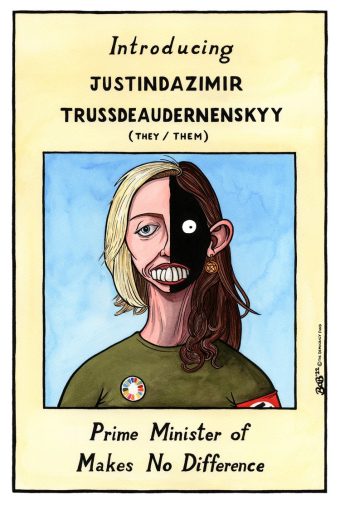 Liz Truss as British Prime Minister does not bode well for peace in the Asia-Pacific region as her stance on foreign policy is quite predictable. During her tenure as Foreign Secretary in Boris Johnson’s cabinet, Liz Truss obviously spoke many times on foreign policy issues, but often in a manner that seemingly appeared she wanted a revival of the British Empire. In fact, the British press called her the most hawkish politician in the Conservative government.
Her so-called toughness is especially evident in her stance towards Russia and China. For Liz Truss, both Russia and China are threats to humanity. Despite having this belief, it is evident that she in fact knows very little about these countries, especially when we consider that she had earlier this year confused Russian regions with Ukrainian territory and even more recently said Ukraine had survived a lot of invasions – “from the Mongols to the Tatars”, without realising Mongols and Tatars are one and the same.
And in this light, it is remembered that a year ago an official British document described China as a “systemic competitor”. With such a view, it is not surprising that London has created a lot of problems in its China policy. The British government condemned Beijing for its human rights violations in its western Xinjiang Autonomous Region, expressed dissatisfaction with Beijing’s “Security Law” for Hong Kong, and even welcomed the visit of American politicians to Taiwan. All of these provocations naturally aggravate Beijing.
This conservative approach could interfere with normal economic and trade relations between the two countries, which are contradictorily important to Britain as China is its third largest trading partner. Rather, by inflating anti-China sentiment, the British government wants to distract people from the country’s massive internal problems: high inflation, rising fuel prices and increasing poverty.
It is clear that Liz Truss will continue the anti-China line of her predecessors. Her newly appointed foreign secretary, James Cleverly, has vowed to take a tough stance on Russia and China.
According to Jonathan Sullivan, director of China programmes at Nottingham University’s Asia Research Institute, Britain’s so-called “pragmatic diplomacy” has lost its reputation.
“In ordinary circumstances, I’d say the new PM would ultimately pursue a more realistic and balanced approach to foreign affairs once in office, but the UK’s reputation for pragmatic diplomacy has taken a battering in recent years,” he said. “Labelling a major trade partner a threat would be a remarkable development, but the fact that it is not totally inconceivable speaks to the uncertainties that exist around Truss and the negative momentum that has built up around UK-China relations.”
None-the-less, it is ridiculous to hear the British talk about a so-called Chinese threat considering the country has not been at war since 1974. Meanwhile, during that period, Britain has battled in the Falklands War, Gulf War, Operation Desert Fox, the invasions of Afghanistan and Iraq, and the Libyan and Syrian wars, among others.
After Brexit, the UK wanted to prove that it was still a great and relevant power without the EU and participate in global processes. One of these points is the South China Sea, where the UK plans to gain a foothold. Under previous Conservative prime ministers, it was expressed that the British Navy needed a regular presence in the South China Sea. They also plan to build UK naval bases in the region, like in Brunei.
So far, there are no permanent bases, but last year the British Navy’s newest and most powerful aircraft carrier, Queen Elizabeth II, sailed through the South China Sea. Certainly, under the Truss government, British warships will patrol these waters only for the sake of provoking China. There is an external reason for this – like the Americans, the British would claim that they are sending their fleet to distant lands to ensure “freedom of navigation” off China.
In addition, the desire to play an important role in the Indo-Pacific region is demonstrated by the UK’s participation in the new military bloc AUKUS, established in September 2021. There is no doubt that the Liz Truss government will continue to commit to its obligations under this alliance with the US and Australia.
All this goes against the vital interests of China and the wider East Asia region. But it is likely that the British prime minister will go in this direction. The question is whether she will be able to achieve her objectives in containing the Rise of China, something that is seemingly unlikely.
It is recalled that only days ago the Indian economy surpassed that of Britain, meaning that the former colonial master has slipped to sixth place in the global GDP ranking, with India rising to fifth place. This also comes as research has found that two-thirds of UK families could be in fuel poverty by January. With compounding economic and societal issues, it appears that Truss will continue in the same mould of Boris Johnson in not dealing with this and instead prioritise the attempt to maintain Britain’s relevancy in the world.
Ahmed Adel is a Cairo-based geopolitics and political economy researcher.
The 9/11 “Double-Cross” Conspiracy Theory
BY LAURENT GUYÉNOT • UNZ REVIEW • SEPTEMBER 6, 2022
Is it true that “9/11 was an inside job”? Yes, insofar as Israel is “inside” the U.S. But for the 9/11 truthers who have identified Israel as the main perpetrators, “9/11 was an inside job” is at best a half-truth, and at worst an integral part of the Zionist operation, like a secondary flag sewn as a lining under the false flag of Islamism. Victor Thorn (1963-2017) wrote in his book 9/11 made in Israel: The Plot Against America (2011): “In essence, the ‘9-11 truth movement’ was created prior to Sept. 11, 2001 as a means of suppressing news relating to Israeli complicity. . . . The slogan ‘9-11 was an inside job’ was quite possibly the greatest example of Israeli propaganda ever devised.” In milder terms, it is “controlled opposition”.
A genuine truth movement would have pointed to Israel as the prime suspect from the start. From day one, it was obvious who would benefit. At 1 pm New York time on the day of the attacks, George Friedman (“born in Budapest, Hungary, to Jewish parents who survived the Holocaust,” Wikipedia informs us) wrote gleefully on his geopolitical website STRATFOR:

It’s pretty simple: 9/11 is best understood as a case of “triangulation”, by which two parties are drawn into conflict with each other by the invisible hand of a third party. In this case, the desired “clash of civilization” between the West and the Muslim world was triggered by Israel, 9/11 being only one operation in this ongoing strategy. Triangulation is the favored tactic of the Mossad, described by the U.S. Army School for Advanced Military Studies, on the eve of 9/11, as having “capability to target U.S. forces and make it look like a Palestinian/Arab act.”[1] Triangulation is also used to create civil strife within a nation (intra-national clashes of civilization, so to speak) for various purposes. In most cases, Israel’s hand is invisible only to the extent of the authorities’ and the people’s voluntary blindness (the proverbial elephant in the room).
If, instead of comparing 9/11 to Operation Northwoods that never happened, the most widely watched early 9/11 conspiracy film (Loose Change) had reminded Americans of the attack on the USS Liberty, the 9/11 Truth movement would have moved in a totally different direction than the one it took under the leadership of Alex Jones. No one would think of calling the USS Liberty attack an “inside job” or “a self-inflicted wound.”
Filling the background with other documented Israeli false flag operations (the bombing of the King David Hotel in 1946, the Lavon Affair in 1954, Israel bombing its own embassies in Argentina in 1992 and in London in 1994, etc.) could have turned such a movement into a tsunami. The “inside job” theory, on the other hand, can never reach a critical mass, for a simple reason: the idea that the U.S. government would, by itself, deceive and terrorize its own citizens by killing thousands of them to justify wars in the Middle East that are not even in the nation’s interest is just too hard to believe for the vast majority of Americans — harder to believe than the official narrative with its material impossibilities. By comparison, Israel attacking America under the false flag of Islamic terrorists to win American support against their Arab enemies makes plain common sense. It is only with the hypnotic power of Zion-controlled corporate medias, and with the complicity of a well-organized “controlled opposition” that such a natural idea was suppressed from the minds of average Americans.
Nevertheless, the belief that “9/11 was an Israeli job” is gaining ground all over the world. Sooner or later, the tsunami will come. And the sooner the better. I am hoping that my film, “9/11 and Israel’s Great Game,” now in English, will help bring it about. Pass it around if you judge it useful:
This film, unfortunately, was shunned from all 9/11 Truth festivals this month. The organizers, I have been told, “decided not to muddy the waters with a film about Israel’s involvement in 9/11.” This must be ironic, for evidence of Israel’s involvement brings clarity, while muddy waters are what Israel needs. However, the film will be streamed on noliesradio.org on October 9th, followed by a debate between Alan Sabrosky, Kevin Barrett, and myself. …
Featured Video

Liberty Cannot Exist Inside a Panopticon
or go to
Aletho News Archives – Video-Images
From the Archives
Left-leaning despisers of 9/11 Truth movement: Do you really believe in miracles?
David Ray Griffin | Global Research | 06 Jul 2010
An Open Letter to Terry Allen, Noam Chomsky, Alexander Cockburn, David Corn, Chris Hayes, George Monbiot, Matthew Rothschild, and Matt Taibbi.
[1]According to several left-leaning critics of the 9/11 Truth Movement, some of its central claims, especially about the destruction of the World Trade Center, show its members to be scientifically challenged. In the opinion of some of these critics, moreover, claims made by members of this movement are sometimes unscientific in the strongest possible sense, implying an acceptance of magic and miracles. … Full article
Blog Roll
 Aletho News
- White House envoy declares kinetic action against Yemen ‘fruitless’
- Ukraine deployed thousands of microdrones in Iraqi Kurdistan: Tasnim
- Iran calls for emergency UNSC meeting over Trump’s ‘brazen’ bomb talk, Israeli threats
- Iranian sources reveal details of Russia-China Hormuz proposal
- Plan for more US-Israel integration puts our military tech at risk
- Another Round Against Iran Will Break What Is Left of the Gulf
- SVR Report on Ukraine’s Mexican Drug Gang Links Could Pressure Zelensky, Won’t Change US Policy
- British Government Employees Were Fact-Checking the News at the BBC. Nobody Told You.
- Albania on fire: who’s behind the riots?
- Egypt’s Civil Democratic Movement rejects involvement in regional war
- If Americans Knew
- Israeli Defense Minister Katz Says Over 60 Lebanon Villages Have Been Destroyed
- Why Is Israel Running TV Ads in Iowa Ahead of the Midterms?
- Hind Rajab’s Alleged Killer Is in the United States. HRF Demands His Arrest.
- US Officials Face Fresh Pressure After Another American ‘Brutalized’ by Israeli Settlers in West Bank
- Israel-Backed Palestinian Militias Terrorize Displaced Families in Gaza
- FBI subpoenas pro-Palestine activists over Israeli weapons plant disruption
- Fourth winter arrives in wartorn Gaza, too early – Daily Update
- More on how Bari Weiss is using CBS on behalf of Israel
- What the UK Is Doing to Pro-Palestine Novelist Sally Rooney Is an Act of Orwellian Villainy
- ‘We will build palaces for Jews in Gaza’: Right-wing activists establish new outpost near border
- No Tricks Zone
- Predictions Made By Renowned Climate Proifessor Over Past Decades Have Been Proven To Be Poor
- New Study Suggests Large Regions Of The Pacific Ocean Have Been Cooling For The Last 80 Years
- Germany’s Green Energy Debacle: High Energy Costs Force Kahla Porzellan to Close After 182 Years!
- New Study: 50 Years Of The Most Aggressive ‘Net Zero’ Policies Can Only Affect The Global Climate By 0.03°C
- US September “Heat” Was No Record…Many Records Set Decades Ago
- Latest European Green Energy Debacle; Portugal’s Largest Flagship Solar Park Insolvent!
- Green Energy Debacle: German Expert Professor Fritz Vahrenholt Warns Of Severe Economic And Social Consequences
- Two More Paleo Reconstructions Affirm Meters-Higher Sea Levels Across Ireland, Brazil 7000-6000 Years Ago
- New Study: Earth And Venus Surface Warmth Largely Explained By Convection And Lapse Rate, Not CO2 Or Radiation
- 2025 Nature Paper Claiming Worsening Global Drought Gets RETRACTED …Heavily Flawed

