‘Dishonest to the Point of Misinformation’: Federal Reserve Dragged for Odd Defense Spending Graph

By Fantine Gardinier – Sputnik – 23.01.2023
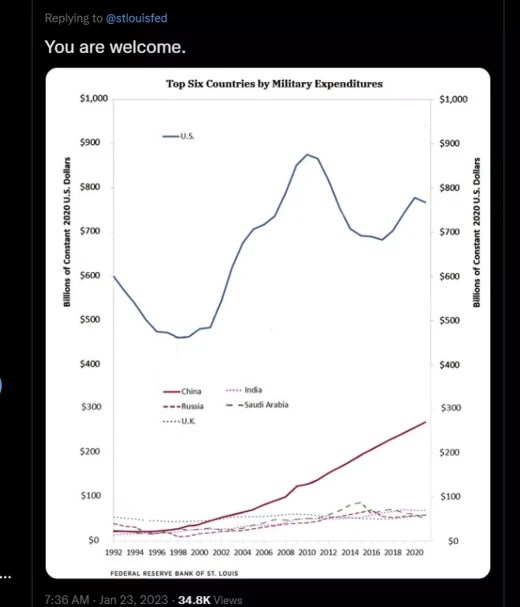
After the St. Louis Federal Reserve tweeted out a highly misleading line graph of several nations’ defense expenditures on Monday, users highlighted its ham-fisted and deceptive nature with both humor and facts.
The tweet linked to a January 3 article about the patterns of defense spending around the world in light of the conflict in Ukraine, highlighting the steady and rapid increase of China’s military budget since the early 1990s.
However, the graph accompanying it, which was included in the tweet, has been modified in an unconventional way: while the spending by five of the nations is measured on the Y-axis on the left side of the graph, as is traditionally the case, for the line representing the United States, the Fed used a bizarre separate Y-axis on the right side of the graph.
As a result, at a glance it seems China’s spending has rocketed far above every other nation’s, including the United States’, when in fact it remains barely one-third of the amount.
As replies poured in denouncing the Fed’s deception, a few users tweeted accurate versions of the graph, if the US’ line had been placed on the same Y-axis scale as the other five nations.
Others tore into the Fed in a more rhetorical way, or simply clowned on the absurdity of the graph.
“If a student made this graph for a statistics 101 class, the teacher would give them an F,” quipped journalist Ben Norton. “But because it involves Washington’s public enemy number one, Beijing, the ‘experts’ at the St. Louis Fed were awarded a Golden Star for service in the New Cold War.”
“Congrats on making the most misleading chart of 2023 so far!” said one user. “This is dishonest to the point of misinformation,” wrote another.
One person joked the situation was another example of “American exceptionalism.”
Someone even dropped an image of the cover of the 1954 book “How to Lie With Statistics” by former tobacco lobbyist Darrel Huff, with the message “I see you’ve read one of my favorite books.”

Some dropped other graphs that they felt better illustrated the drama of the difference between US defense spending and that of other nations.
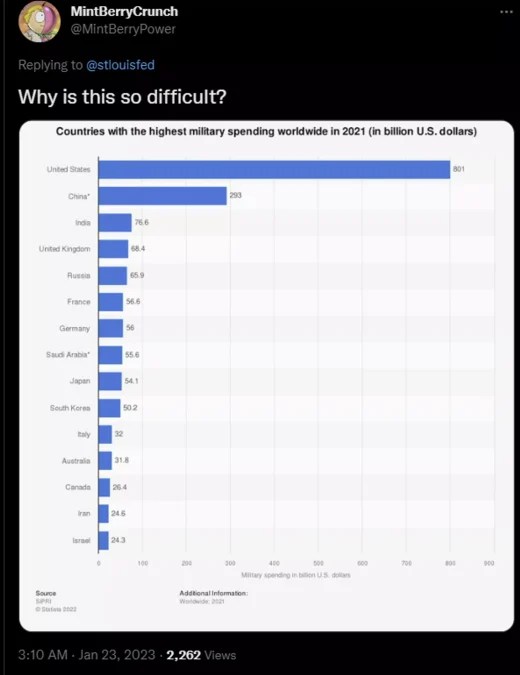
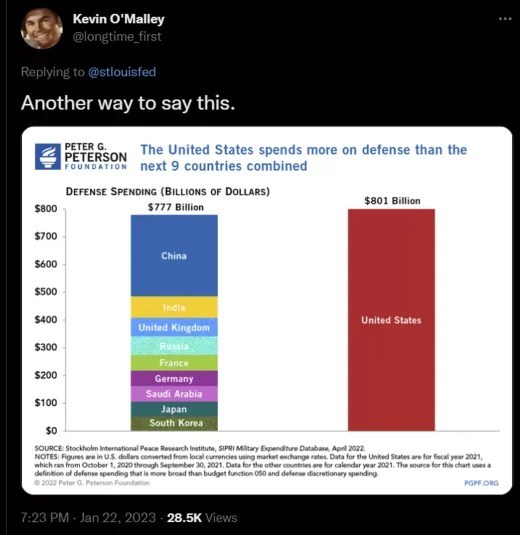
According to the Stockholm International Peace Research Institute (SIPRI), global military spending reached $2.1 trillion in 2021, with the US spending $804 billion of that by itself. By comparison, China spent $293 billion on its military that year. The US spent so much on its military, it spent more than the next nine countries combined, including China.
The most recent Pentagon budget, signed by US President Joe Biden last month, was a whopping $816.7 billion.
EU’s financial support for Ukraine now just shy of €50bn

By Jerome Hughes | Press TV | January 24, 2023
Brussels – Ukrainian officials took part in a meeting of EU foreign affairs ministers on Monday via video link. An additional €500m military aid package for Kiev was confirmed, but the EU is at pains to point out that’s just a drop in the ocean compared to what the bloc has already provided since last March.
Just a few days ago in the European Parliament, the strategy was condemned.
Workers have taken to the streets of Brussels to demand peace negotiations.
EU foreign ministers adopted a fresh round of sanctions against Iran on Monday over alleged human rights abuses. The grounds for such sanctions are vehemently rejected by Tehran. Critics say the West’s policy towards Russia and Iran is being driven by Washington.
Analysts say the EU’s access to markets in these countries is being hampered due to influence from the United States, and ultimately it is ordinary citizens who are paying the price.
Also on Monday, Palestinian Prime Minister Mohammad Shtayyeh updated EU foreign ministers on the appalling situation in the occupied territories. There was absolutely no discussion on the EU side regarding possible sanctions against Israel.
Calls for Khan Al-Ahmar’s demolition speak of colonial violence and privilege
By Ramona Wadi | MEMO | January 24, 2023
The former Israeli ambassador to the UN, Danny Danon, has told a Likud faction meeting that “illegal Palestinian construction” in the occupied West Bank is “rampant”. He wasn’t being honest.
“Last Friday we made it clear that supporting settlements does not contradict upholding the law,” he claimed. “The defence minister received our backing. We expect the defence minister to act with the same determination in the face of rampant Palestinian illegal construction in the West Bank. We will no longer tolerate discrimination against the settlers.”
Israeli settlements and settlers are, of course, illegal under international law, something that Danon is adept at overlooking when he makes such outrageous claims.
As the Israeli government prepares to submit its response to the High Court over the impending demolition of the Palestinian Bedouin village of Khan Al-Ahmar, Danon and Likud MK Yuli Edelstein visited the village, calling for its demolition and accusing the government of selective enforcement over the evacuation of the Or Chaim illegal settler outpost in the occupied West Bank.
In an op-ed, Danon described the EU’s funding of infrastructure in Khan Al-Ahmar as “subversive involvement of international entities in Israel’s domestic affairs” and accused the bloc of violating Israel’s sovereignty and international law. “It is part of an ulterior agenda that seeks to delegitimise Israel’s historical claim to its own land,” Danon wrote.
Completely eliminating Israel’s colonial context and the fact that Khan Al-Ahmar is built on Israeli-occupied Palestinian land, Danon referred to the evacuation of Or Chaim and said, “The law is the law and must be applied to all citizens and communities, Jews and Arabs alike.” However, there is no equivalence between the coloniser and the colonised, as Danon knows well.
Khan al-Ahmar has attracted enough international attention to become newsworthy periodically, and the related activism has ensured that Israel’s violations are fully exposed. The village, though, is also part of a long colonial process that seeks to dispossess Palestinians of their land. Its demolition is not an isolated incident. Earlier expulsions and destruction of properties, including the ethnic cleansing from the 1948 Nakba onwards, need to be kept in mind.
Israel benefits from the international community’s differentiation of colonial settlement expansion. It has gained a veneer of legitimacy for the earlier colonial settlements despite the atrocities committed by Zionist paramilitary terror gangs to establish control over Palestinian territory. Israeli law is justifiable only unto itself and the violence it created. In terms of equality and rights, there is no justification for Israel’s colonial expansion. Likewise, there is no equivalence in calling for the demolition of Khan Al-Ahmar because an illegal (even under Israeli law) settlement outpost was dismantled. Palestinians are rarely issued building permits on what remains of their land. Danon’s use of the word “rampant” is totally dishonest. Indeed, his words only reflect his country’s colonial violence and privilege when calling for Khan Al-Ahmar’s destruction, not to mention targeting an integral part of Palestinian resilience in the face of impending demolition orders.
Lest Danon forgets, Khan Al-Ahmar’s residents relocated to the area after being displaced by Israel in 1950, laying bare the lie of delegitimising “Israel’s historical claim to its own land”. Israel wants territorial contiguity to Jerusalem, not demolitions based on equal rights. Erasing the Palestinian landscape through colonial settlement expansion does not erase the fact that Israel’s settler-colonial population cannot lay legitimate claims to Palestinian land, and neither can the Israeli government. The only claim that Israel can make with any degree of accuracy and honesty is that it colonised Palestine and intends to finalise its colonial enterprise. Khan Al-Ahmar stands in the way of its plans, just as other Palestinian towns and villages did decades ago. More than 500 paid the price and were totally destroyed and wiped off the map.
US renews waiver for gas field shared by Iran and UK
Press TV – January 24, 2023
The US government has renewed a sanctions waiver for the Rhum gas field in the UK North Sea in which Iran has a 50% stake.
Iran is heavily sanctioned by the United States, but Britain’s Serica Energy which owns another 50% of the field has repeatedly secured waivers to maintain production from the field.
In a statement, Serica said it had secured another waiver extension that ensures that all companies linked to the field can provide services and goods without fear of US penalties.
“We are grateful to the UK government and regulatory authorities who have supported us in this process,” Serica Chief Executive Mitch Flegg was quoted as saying.
Serica Energy is responsible for 5% of the gas produced in the UK which is currently in turmoil over runaway prices of energy in the wake of the Ukraine war.
The UK firm expects its net production to increase by between 50 and 80 percent this year and that level of production to continue into 2025.
This would mean that the company would be producing up to 40,000 barrels of oil equivalent per day, reports said.
Rhum, a gas filed located 240 miles (390 km) northeast of Aberdeen in Scotland, is one of the largest on the UK Continental Shelf.
Iran owns half of the stakes at the gas field based on a deal signed before the Islamic Revolution of 1979. The field is believed to be capable of producing more than five million cubic meters of natural gas.
Washington has imposed a series of harsh sanctions on Iran’s energy sector since 2018 when it pulled out of an international nuclear deal.
Pressure hardening
The Biden administration, however, is hardening its position. The Iraqi government is reportedly under immense pressure from Washington to stem the alleged flow of dollars into Iran.
In recent weeks, Iraq’s currency market has been wracked by turmoil after the US introduced tighter controls on international dollar transactions by commercial Iraqi banks in November.
Reports said the move was designed to curb the alleged siphoning of dollars to Iran and apply more pressure along with US sanctions imposed on the Islamic Republic.
Iraqi MP Aqeel al-Fatlawi, however, said Washington was deliberately using the new regulations as a political weapon.
“Americans are using the dollar transfer rigid restrictions as warning messages to Prime Minister Sudani to stay tuned with the American interests. ‘Working against us could lead to bringing down your government’ – this is the American message,” the lawmaker said.
The price of consumer goods has increased and the Iraqi currency has taken a beating in the wake of the US restrictions.
And it has deepened anti-American sentiment among politicians in Iraq, which remains unstable nearly 20 years after a US-led invasion toppled Saddam Hussein.
The US is also targeting Iran’s other major trade partners. On Monday, the Biden administration’s top Iran envoy said it will increase pressure on China to cease imports of Iranian oil.
China is the main destination of exports by Iran, and talks to dissuade Beijing from the purchases are “going to be intensified,” US Special Envoy for Iran Robert Malley told Bloomberg Television.
The US reimposed sanctions on the Islamic Republic and its petroleum exports in 2018 after pulling out of the nuclear agreement, with then president Donald Trump pledging that Washington was set to bring Iran’s oil exports down to zero.
That goal never realized, with Iranian sales continuing to reach the market despite the US “maximum pressure” to curb them.
“We have not lessened any of our sanctions against Iran and in particular regards to Iran’s sale of oil,” Malley said.
Iranian crude shipments have surged in recent months, including to China, the world’s biggest importer.
Malley said the US will “take steps that we need to take in order to stop the export of Iranian oil and deter countries from buying it”.
Israel, US start week of military drills involving thousands of troops, nuclear bombers

RT | January 23, 2023
The US and Israeli militaries began their largest-ever joint exercise on Monday, seeking to hone seamless coordination of their forces and prove a point to Iran about their readiness to fight a conflict in the Middle East even as Washington juggles rising tensions with Russia and China.
“I do think that this scale of the exercise is relevant to a whole range of scenarios, and Iran may draw certain inferences from that,” a senior US defense official told reporters. “It would not surprise me if Iran, you know, sees the scale and the nature of these activities and understands what the two of us are capable of doing.”
Dubbed Juniper Oak, the exercise will involve over 140 aircraft, including nuclear-capable bombers and F-35 fighter jets, as well as 12 warships and about 7,500 troops, according to US Central Command (CENTCOM). It’s designed to improve the “interoperability” of both forces.
“What we think this exercise demonstrates is, we can walk and chew gum at the same time,” the unidentified defense official told NBC News. Despite the Pentagon’s growing focus on China and its efforts to help Ukraine defeat Russian forces, he added, “We still have the excess capacity to be able to flex to another high-priority area of responsibility and conduct an exercise on this scale.”
Juniper Oak is an all-domain exercise, meaning it will include naval, land, air, space and electronic-warfare drills. It will run from Monday through Friday in Israel and the eastern Mediterranean Sea. The US will reportedly employ four HIMARS rocket launchers, laser-guided bombs and stealth cruise missiles. The event will culminate with the firing of 180,000 pounds of live munitions while simulating an electronic attack and suppressing enemy air defenses.
“This is a sign that we continue to have Israel’s back at a time when there’s lots of turbulence and instability across the region,” the defense official said. The source added, “If there’s a sense that Americans are distracted, or the Americans are going away from the Middle East, and therefore they have free rein for their malign activities, I think this will disabuse them.”
“I suspect Iran will take note of that, but not only Iran. China will take note of that, Russia will take note of that, other folks will take note of that.”
I just put the FAA in a “no win” situation. If there is not a PROPER investigation, heads should roll.

Susan Northrup is the current US Federal Air Surgeon, the first woman to hold this position.
By Steve Kirsch | January 21, 2023
I just had a nice chat with Federal Air Surgeon Dr. Susan E. Northrup. By the end, she no longer can say, “I didn’t know.” If she doesn’t act now, she should be prosecuted for jeopardizing pilot lives.
Executive summary
At 10:15am on Saturday Jan 21, 2023, I made a call to the private cell phone of the Federal Air Surgeon of the FAA Dr. Susan Northrup. The call lasted 2 minutes.
In the call, I referred to the news article where she basically said that she had seen no evidence that the COVID vaccines have incapacitated pilots.
At first I thought she was lying, but it turns out she was telling the truth. She’s seen no evidence because even though she admitted on the call that she knew about Bob Snow, nobody at the FAA ever bothered to call him. Ever!!! So they’ve never seen the evidence because they deliberately refused to look at the evidence!! Get it? That’s how science works.
So I asked Dr. Northrup if she was interested in speaking with pilots who have been disabled by the COVID vaccine. She indicated she was. After all, what could she say at that point? She had to say “yes.”
It’s troubling she hasn’t talked to Bob Snow. I have talked to Bob Snow. I interviewed him for my Rumble channel even though it isn’t my job to investigate these incidents. Check out my interview with Josh Yoder and my interview with Bob Snow.
In other words, I’ve done more to investigate this incident than the FAA.
Captain Snow narrowly averted crashing the plane, but she never talked to him to assess whether the vax might have been involved. Seriously?!?! I offered to put her in touch with Captain Snow and she accepted.
So I emailed her (using her official work email at the FAA) a list of pilots, their phone numbers. She now has the contact info for these pilots:
- Josh Yoder (head of US Freedom Flyers who is in touch with dozens of vaccine injured pilots)
- Bob Snow (American Airlines)
- Kevin Stillwagon (Delta Airlines)
- Cody Flint (4 doctors have determined he was incapacitated in flight due to the COVID vaccine)
- John C. Lamb (66 yr old commercial aviator with no previous heart problems. On Jan 6, his first class medical was deferred, due to 2nd AB block, Mobitz type 2. His wife had a heart attack 8 days after her Moderna shot. See this story for more details).
More importantly, in that email, I also invited her to host a public roundtable at the FAA inviting people on both sides of the “safe and effective” narrative so that the FAA could learn the truth. I just talked to Senator Ron Johnson and I can assure you that he’d be DELIGHTED to help her assemble a roundtable of doctors on both sides of the narrative to brief top FAA officials on the risks of these vaccines.
And I offered to publish her revised statement to the public so we can get the truth out that the vaccines are NOT safe and are disabling pilots.
Here’s the kicker. The corruption at the FAA runs deep. Did you know that nobody at the FAA has ever called Bob Snow? How can the FAA investigate this incident without ever even talking to the pilot?
Susan is going to have to reveal to the American public what exactly the FAA did to investigate the Bob Snow incident which happened on April 9, 2022. How is it that in 9 months nobody at the FAA (or from any other government organization) has reached out to Captain Snow? WTF? We need some transparency here on how these vaccine incidents are being investigated!
But Susan knew about Snow and she must have known that nobody reached out to call him. In other words, everyone knew they had a vaccine injured pilot and deliberately chose to NOT investigate. I have asked Susan for an explanation. If I don’t receive an explanation in 24 hours, I will call for her to resign.
I am calling for this since nobody in Congress is (other than Senator Johnson). None of them want to know. Heck, when I call members of Congress, they ignore me. Neither does the mainstream media. It appears that the responsibility for investigating these incidents falls on Steve Kirsch’s Substack (which has a full-time staff of just me) to hold these people accountable.
Susan is also going to have to talk about why there was a 300% increase in long-term disability claims filed at American Airlines (Jan – July 2022) and what investigation the FAA made into what was disabling those pilots.
We have a pilot shortage in America. What did Susan find when the FAA investigated why the disability claims skyrocketed? Or did they do nothing to investigate? If they didn’t do anything, why didn’t they? I’d like to know. The New York Times and CNN …. well, not so much.
Finally, did you know that Susan’s husband, John Hyle, is a pilot. John refused to take the COVID vaccine due to safety concerns. So it’s not just a few “anti-vaxxers” spreading “misinformation.” Susan clearly realizes that intelligent people she clearly respects have legitimate concerns that cause them to refuse to take the shot.
The narrative is falling apart.
We need public transparency on all of the things above. And we need it now before lives are lost.
We’ve had a couple of close calls. The FAA needs to be proactive about this, not REACTIVE after a crash happens.
The Game Is Over and They Have Lost
By Robert Blumen | Brownstone Institute | January 23, 2023
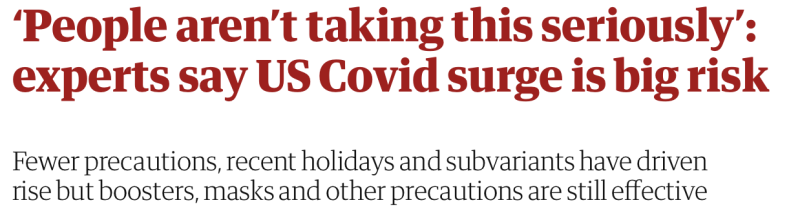
The Guardian on Jan 15, 2023 published the most perfect piece of new normal nostalgia that ever was or could be: Coronavirus: ‘People aren’t taking this seriously’: experts say US Covid surge is big risk by Melody Schreiber.
This piece may be studied as a Platonic Form. Nothing could more perfectly demonstrate the inability of the covid fear porn publishers to let go of the narrative. If the author didn’t have her own website, I would have attributed the piece to an instance of ChatGPT trained on every Guardian and New York Times article from the past three years.
The writer employs every single discredited covid trope at least once. I will list a few of the best, here. To cover them all I would have to quote the entire article and that would violate the Fair Use Doctrine. I have chosen a tabular form with a quote alongside the trope that it is derived from:
| Quote | Trope |
| “In the fourth year of the pandemic.” | We are still in a pandemic. It will never end. |
| “This is one of the greatest surges of Covid cases in the entire pandemic, according to wastewater analyses of the virus.” | The current wave is the worst wave ever. |
| “Covid-19 is once again spreading across America and being driven by the recent holidays.” | Super-spreader events and family gatherings. |
| “The Omicron subvariants BQ.1.1 and BQ.1 as well as the quickly expanding XBB.1.5 make up the majority of cases.” | Just when you thought we were over it, a new variant has emerged. |
| “With XBB, there’s such a significant transmission advantage that exposure is really risky – it’s riskier now than it’s ever been” in terms of transmissibility, Sehgal said.” | The new variant is more dangerous than previous variants. |
| “And the more the virus spreads, the more opportunities it has to evolve, potentially picking up mutations that make it easier to overcome immunity.” | The variants only get worse over time, never more mild. |
| “the winter surge, which is once again putting pressure on health systems.”“Williams is worried that hospitals are reaching maximum capacity.”“Health workers have experienced three years of burnout, disability and death, and some have needed to exit the workforce.” | The health care system is under pressure. It will probably collapse. People will be dying in the streets, unable to obtain care. |
| “Despite the high rates of Covid spread, hospitalizations have not yet reached previous peaks seen earlier in the pandemic, probably due to immunity … but that protection should not be taken for granted, he said, particularly because immunity wanes.” | Natural immunity does not protect you. Even if you are immune, you should still get all the vaccines and boosters. |
| “The severe cases we are seeing are probably at least somewhat avoidable, if folks make sure that they stay updated on vaccination, because that’s still the safest way to gain immunity.” | Vaccination stops the spread. |
| “You’re just fighting a lot of misinformation.” | Everything that you have read contrary to this narrative consists of lies by malevolent misinformation spreaders. |
| When Joe Biden declared the pandemic was “over” in September, he said, it probably stalled public enthusiasm for the new booster. | Happy talk about the end of covid is dangerous. |
| “While vaccines are very important…” | All roads lead to vaccination. |
| “In New Hampshire, nursing homes will not admit those that they feel that they cannot staff to care for, which I think is admirable, but the consequence of that is that the hospitals are jammed up,” he said. Hospitals that might release patients to care facilities for transitional or long-term care will see beds filled for longer.” | The elderly in care homes are at risk. |
| “The share for children under four roughly doubled in 2022.” | Children are at risk. |
| “As Ray put it: ‘When we could be wearing a mask, why aren’t we?’” | Masks work to prevent respiratory viral transmission. |
My favorite part of the piece is, “Yet because of poor messaging from officials, many people may not even realize the US is experiencing a surge.” I am one of those many people who did not know this. A surge of what? A normal seasonal flu that makes people feel a bit under the weather for a week? A bad cold-vid?
We can celebrate our return to the old normal when an outbreak of a seasonal virus is of concern to those who are infected or who care for a family member. All of society need not be thrust into a panic over such things. The more normal the world is, the more resources of those who are impacted will have to deal with their troubles. And the better will those who are not directly affected be able to support them.
As a software engineer I note with some amusement that the variant (or as I like to call them “scariant”) names now have two periods. In a software release version a version with double dot is used for a minor bug fix release, (e.g. 3.0.1). “Minor” means that the release is not important enough for users to upgrade immediately. Perhaps the same thinking should be applied to the way we handle the emergence of new viral variants.
When Biden said that the pandemic is over, followed by “If you notice, no one’s wearing masks. Everybody seems to be in pretty good shape,” that may have been his dementia inhibiting the filter that was supposed to kick in before he said something truthful. Biden only said the quiet part out loud: the public has put the panic phase in the rearview. Even Anthony Fauci made the incomprehensible statement that the pandemic isn’t over but we are out of the “pandemic phase.” Every statement like this is more toothpaste for the pandemic dead-enders to put back in the tube.
The article bemoans the low acceptance rate of the booster vaccinations. We are told that cases are avoidable if patients had sought additional injections. First thing: do we care about cases? Second thing: it is not true that the covid vaccines prevent infection. That could only be so if the failed claim of sterilizing immunity were valid.
Vaccine advocates have walked back the earlier claims that one or any number of shots would prevent the recipient from getting infected. It was let out late in 2022 that the clinical trials did not even test for the ability of the drugs to stop transmission. It’s hard to believe that anyone can still say that after so many multiply-vaccinated-and-boosted public figures have gotten covid.
My friend Kevin Duffy, a professional investor, after seeing the Guardian article, sent me this image. The graph shows the market psychology of a financial bubble and subsequent market crash. I have added the red oval highlighting where Kevin thinks we are now: in the denial phase, after the bubble has burst.
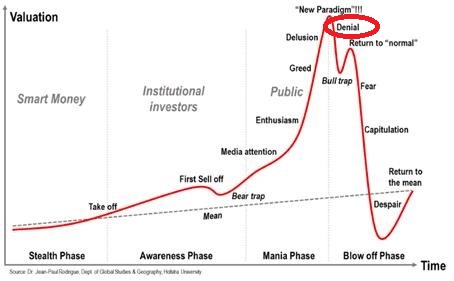
I am also reminded of the Kubler-Ross stages of grief that a patient or a loved one goes through when receiving a terminal diagnosis. The stage in her sequence is denial. The subsequent stages are anger, bargaining, depression and acceptance.
The same could be said of all of these tropes: Does anyone believe them anymore? This is not news. It is a last-gasp attempt to squeeze more juice out of a dehydrated lemon. These messages were potent fear generators two years ago. But with each use, the charge becomes weaker.
The script has worn itself out. These tropes are now tired and ineffective. The fear-pushers seem unaware that the message has lost its effect, but do not have anything else to offer. The tell is not that they publish articles like this. It is how much these pieces show that they don’t know that the game is over and they have lost.
…There Likely Will Be Stranded Assets…
By Don Dears | Power For USA | January 17, 2023
If battery-powered vehicle (BEV) sales are not mandated by the government, and the market for BEVs is much smaller than now predicted, will the battery factories being built become stranded assets?
The earlier article resulted in comments questioning whether other applications would allow these factories to remain operational and profitable.
BEVs, the benchmark for Lithium-ion battery usage, permit rapid acceleration and quiet operation. However, each vehicle uses 1,000 or more pounds of batteries.
What are the other applications? And why would they grow?
Here are a few alternative applications, some of which were identified at the consumer electronics show (CES) in Las Vegas.
Portable Hand Tools
Portable hand tools, such as leaf blowers, powered by an internal combustion engine (ICE) are noisy, while those powered by batteries are quiet.
Hand tools, using an electric motor, such as saws, use wires to connect them to an electric outlet. Hand tools create noise, but a battery-powered hand tool is more convenient since it eliminates having to drag around an electric cord.
Batteries for hand tools weigh around one pound.
Small mobile equipment, e.g., lawn mowers and snow blowers
Battery powered lawn mowers cost more than gasoline powered mowers, and have a payback, according to Consumers Reports, of around ten years.
Snowblower’s cost, relative to gasoline powered blowers, are only slightly higher.
On average, batteries for lawnmowers and snowblowers weigh around 25 pounds depending on Ah (amp-hour) rating.
Large mobile equipment, e.g., construction excavators
Bucket trucks that use batteries to power the bucket arm can turn off the diesel engine, allowing work to be done quietly, without noise and exhaust fumes. This is especially beneficial in residential areas.
Excavators powered by batteries, as exhibited by John Deere at CES, can operate more quietly, allowing them to work at night in residential areas.
However, construction equipment, back hoes, etc., require charging stations at the construction site. John Deere also exhibited charging stations for construction sites, but having to connect charging stations to a power source at each construction site adds complexity and cost.
Batteries for construction equipment will weigh a few hundred pounds.
Boats and Yachts
Watercraft larger than a few feet in length, especially yachts, require considerable horsepower for propulsion. While the propulsion may use fossil fuels, the electrical system for on-board and housekeeping activities, such as radar and refrigeration, can be battery powered.
This reduces the noise level in the boat, especially when anchored or docked overnight.
Powering a large watercraft with batteries, rather than diesel engines, makes little sense since the size of the battery would approximate that of a BEV’s, increase weight unnecessarily, while raising concerns about fires. Gasoline and gasoline fumes are the major cause of boat fires and explosions, and a fire burns a boat to the waterline forcing the crew and passengers into the water waiting to be rescued. A battery fire would do the same.
Battery powered outboard motors for canoes and similar small craft have been available for years, and battery-powered outboards, rated around 3.5 HP, are available.
Brunswick exhibited yachts and electric outboard motors at CES.
Miscellaneous Applications
Golf Cart batteries probably weigh around 75 pounds, but the number of golf carts sold in the US is only around 80,000, so market is limited in size.
Bicycles
Bicycles powered by Lithium-ion batteries are becoming very popular. More e-bikes (880,000) than BEVs (608,000) were sold in the US in 2021. It’s forecast that over 1 million e-bikes will be sold in the US during 2023. Some are predicting that e-bike sales in Europe will outstrip the sale of automobiles in general.
An e-bike battery weighs approximately 10 pounds.

Typical e-Bike
Summary
What are the attributes mentioned above that are attributable to Lithium-ion batteries?
- Quiet operation
- Convenience
Products with limited growth potential:
- If BEVs are no longer mandated, it’s unlikely that battery-powered construction equipment will become popular.
- Yachts and boating appear to be a limited market.
- Golf carts seem to have a limited market.
- Lawn mowers are used routinely for a few months of the year while snowblowers are used intermittently in northern states.
Products with substantial growth potential:
- E-bikes have rapid growth and are used almost daily in many countries.
- Hand tools are a very large market with US sales of $21 million in 2021, or 140,000 tools at an average price of $150. With a battery weight of 1 pound for hand tools, the annual sales volume would have to be extremely large to match BEV battery usage.
- It would appear as though e-bikes have the greatest potential for volume usage of Lithium-ion batteries. With the weight of an e-bike battery of 10 pounds, 100 e-bikes must be sold to equal the sale of one BEV.
Putting this information in perspective:
- If 1,000,000 hand tools are sold in 2023, it would be the same as selling only 1,000 BEVs.
- If 1,000,000 e-bikes are sold in 2023, it would be the same as selling only 10,000 BEVs.
Conclusion
While new uses for Lithium-ion batteries may emerge, it would appear as though alternative battery applications won’t keep battery factories in the United States from becoming stranded assets if the BEV market is substantially smaller than forecast.
Germany years away from replacing Russian gas – official
RT | January 23, 2023
Germany is a long way from fully substituting Russian pipeline gas supplies with liquefied natural gas (LNG), estimates by the country’s Economy Ministry show.
According to a document published on the Bundestag website, Germany imported 55 billion cubic meters (bcm) of Russian natural gas in 2021. The document also shows that Germany’s new Floating Storage and Regasification Units (FSRUs), which are currently being installed in a number of ports to allow the import of LNG, may reach a similar capacity no sooner than in 2026.
By 2030, those capacities are projected to increase to 76.5 bcm, or about 80% of total German gas consumption in 2021. However, the ministry notes that even once the terminals go online, the global LNG market may not have enough capacity to cover additional demand, which could push these dates further.
The ministry notes that the country’s gas storage facilities are currently well-filled, and there is no immediate danger of gas shortages. However, it acknowledges that once the stores run dry later this year and the time comes to refill them for the next heating season, Germany may face shortages. According to calculations by the Oxford Institute for Energy Studies, Germany faces a supply gap of around 30 bcm of gas this year, and the FRSUs are projected to produce less than half of this volume by the end of 2023.
“The truth is, there won’t be enough in the next three to four years of LNG production capacity in the world to meet the growing demand. So the unspoken strategy is that Germany will continue to pay crazy prices and other, less rich countries go empty-handed,” Christian Leye, a Bundestag Left Party representative told Bloomberg.
Germany did manage to reduce its dependence on Russian energy last year by importing LNG through European neighbors and boosting pipeline gas flows from Norway and the Netherlands. However, its gas storages were filled over the summer, when Russian gas still flowed directly to the country. Another problem is the cost of LNG imports, which is estimated to be four times more expensive than Russian pipeline deliveries. Germany may also face supply constraints if the Netherlands goes through with recently announced plans to shut down the Groningen gas field, the region’s largest gas deposit.
Are demands that Scholz green-light export of Leopard 2 tanks more about hurting Germany than helping Ukraine?

eugyppius: a plague chronicle | January 22, 2023
In 1952, Hastings Ismay famously remarked that the purpose of NATO is “to keep the Russians out, the Americans in and the Germans down,” and the war in Ukraine has made it very hard to doubt that he was wrong.
From the Neue Zürcher Zeitung:
The Ukraine needs battle tanks to defend itself against the Russian onslaught. But Chancellor Olaf Scholz has hesitated to provide them. For this reason, he’s come under massive pressure from many allies. [German Defence Minister Boris] Pistorius explained why Germany is still hesitating with two sentences: There are good reasons for delivering the tanks, and good reasons against doing so. All arguments have to be weighed carefully …
When American Defence Secretary Lloyd Austin appeared before the press in Ramstein shortly after Pistorius, he was asked whether Germany was doing its part as a leading European power. Austin couldn’t help smiling, but then he replied that Germany was doing enough and that it was a “reliable ally”. He ought to know exactly what Pistorius meant, in speaking of good reasons for and good reasons against providing tanks to Ukraine. The reasons in favour are military in nature: Without tanks, the Ukraine cannot defend itself.
The German government has been rather more evasive about the reasons against. The German defence industry is concerned that the Americans will replace the [German-manufactured European] Leopards with their own tanks. The war in Ukraine offers the United States the opportunity to displace German competition and secure a foothold in the European defence market by supplying its own armoured vehicles, as it has already done with helicopters, fighter jets and missiles.
Years of peace in Europe, an ageing population and a corresponding focus on expensive social programmes have caused Germany to put its defence industry into near-hibernation. Only a little over 2,000 Leopard 2s have ever seen the light of day. Each one is a hand-built machine that takes two years to make. If Germany permits the export of the European supply of Leopard 2s to Ukraine, the Russians will grind them to nothing within months, and then Europe will have no tanks except the tanks that the Americans sell them:
Defence industry representatives, who wish to remain anonymous, report that the Americans are offering their own used tanks as replacements to [European] countries able to supply Leopard 2s to Ukraine, together with a long-term industrial partnership. Any country that accepts the American offer would be hard to win back for the German tank industry. Berlin’s influence in armament policy would decrease correspondingly.
Tanks are driven by men, who have to be trained in the operation of specific models. Their use moreover requires a whole supply chain of munitions and especially spare parts, which the Americans are eager to offer. The upshot is that, once Europe opts into American armour, it will never switch back, and Germany will be out of the game for good. Nor should we lend much credence to the idea that our very few tanks will make any difference either way for Ukraine’s prospects. The insistence that Scholz release the Leopard 2s is simply an attempt to edge Germany further out of the European arms industry and into a position of lesser political and economic influence in Europe, so that the United States can fill the gap.
Noah Carl, over at the Daily Sceptic, drew attention last week to remarks by the French intellectual Emmanuel Todd that “this war is about Germany”:
After the collapse of the Soviet Union, Zbigniew Brzezinski called Eurasia the new “great chessboard” of world politics … The Russian nationalists and ideologues like Alexander Dugin indeed dream of Eurasia. It is on this “chessboard” that America must defend its supremacy – this is Brzezinski’s doctrine. In other words, it must prevent the rapprochement of Russia and China. The financial crisis of 2008 made it clear that with reunification Germany had become the leading power in Europe and thus also a rival of the United States. Until 1989, it had been a political dwarf. Now Berlin let it be known that it was willing to engage with the Russians. The fight against this rapprochement became a priority of American strategy. The United States had always made it clear that they wanted to torpedo [Nord Stream 2]. The expansion of NATO in Eastern Europe was not primarily directed against Russia, but against Germany. Germany, which had entrusted its security to America, became the Americans’ target [in the destruction of the pipeline]. I feel a great deal of sympathy for Germany. It suffers from this trauma of betrayal by its protective friend – who was also a liberator in 1945.
After the anti-Russian sanctions regime and its clear deindustrialising effects on the German economy, followed by the attack on the Baltic Nord Stream pipelines, and even smaller things, such as the high-profile anti-industry protests by the American-funded activist group Letzte Generation, I am willing to believe many conspiratorial things about the Ukraine war.
Still, I think Todd’s thesis is overdrawn. This war is about Russia primarily, and about Germany only secondarily. It’s an attempt of the Global American Empire to hem in Russia via an extended proxy campaign. In the longer term, this effort will require that Europe remain an American outpost, as it was during the Cold War, and this means the economic and political influence of Germany must be sharply curtailed. America – and not Germany – must dominate the Continent. The Scholz government has gone very far in making concessions to the Americans, but he appears to have finally drawn a line of sorts, at giving the Americans a pretence to sell their tanks in Europe. It will be important to see whether he can hold out.
Western ‘theft’ will backfire, Russian tycoon warns

Vladimir Potanin. © Sputnik/Alexei Druzhinin
RT | January 23, 2023
Western countries are sawing off the branch they are sitting on by confiscating Russian assets, billionaire businessman Vladimir Potanin believes.
Following the launch of Russia’s military operation in Ukraine in February last year, multiple countries have frozen assets belonging both to the Russian state, and private companies and individuals to the tune of more than $300 billion.
In an interview with Russian media outlet RBK published on Monday, Potanin, the largest shareholder of mining giant Nornickel, said: “The confiscation [of assets] is a covert or overt form of theft,” and destroys “the investment climate of the jurisdiction where this is happening.”
Potanin noted that the countries comprising the ‘collective West’ had based their societies upon respect for private property.
The recent freezing of Russian assets “will backfire on them,” he said, adding that Russia should refrain from mirroring these measures.
He went on to suggest that by exercising respect for property rights, Moscow will be in a stronger moral position when it fights for its frozen assets in the West, and will send the right signals to entrepreneurs at home.
Potanin also warned against nationalizing property left behind in Russia by Western businesses – instead, the authorities need to “give the investment community the opportunity to solve this problem on its own.” He noted that the exodus of Western companies from Russia has allowed local investors to buy up assets at relatively low prices.
Potanin described the Western sanctions as “absolutely destructive and even, apparently, absolutely illegal,” and in his view, what we are seeing right now is the destruction of basic global rules.
The billionaire acknowledged that Western sanctions have put his plans for overseas business expansion on hold and have adversely affected his ability to travel the world, though he has now switched to exploring Russia instead, he added. Potanin nevertheless expressed confidence that the West “will come to their senses” sooner or later.
Featured Video

No Threat Can Force Iran’s Surrender /Trita Parsi & Lt Cl Daniel Davis
or go to
Aletho News Archives – Video-Images
From the Archives
What is the Israeli Lobby in Australia Doing in Interfaith Dialogue?
By Ali Kazak | Dissident Voice | October 11, 2015
For years Israel and its lobby around the world have been trying to normalise their relations with Arabs and Muslims without solving the Palestine Question.
One of the methods they resorted to in the last few years is using human rights and community organizations such as interfaith dialogue and Multiculturalism to achieve this objective and to: isolate the Palestinians, marginalise the Palestine question, end Israel’s isolation, and prevent criticism of Israel, knowing that these organisations will be the first to stand against Israel’s violations, racial and religious discrimination.
The group responsible for this task in Australia is The Australia/Israel & Jewish Affairs Council (AIJAC); its Director of International & Community Affairs, Jeremy Jones is in charge of lobbying religious community organizations, specifically Muslims and Christians. Consequently he convened the Faith Communities for Reconciliation, founding participant in the Australian Partnership of Religious Organisations and the Australian National Dialogue of Christians, Muslims & Jews.
AIJAC is a private political propaganda group. It is recognised as the main Israeli lobby in Australia. It coordinates its activities and works intimately with the Israeli embassy in Canberra and different institutions in Israel. It is privately funded by some Jewish businessmen. It monitors closely Australian politicians, the media, ethnic and religious groups, (especially Arabs and Muslims), unions and academics on their stands towards Israel and the Palestine question. … continue
Blog Roll
 Aletho News
- The war of liberation of the Arab and Islamic peoples expands across the Gulf
- Envoy warns UN on Trump’s threat to ‘obliterate’ Iran’s civilian infrastructure
- The Larak Corridor: Iran’s Rial Gate With No US, No Israel, and No Way Around
- ‘Economic terrorism’: Steel facilities hit again in US-Israeli strike
- ‘War Crime’: Iran condemns attacks on Arak, Ardakan nuclear sites
- Two-thirds of Americans want quick end to Iran war even if goals unmet
- Trump to Give “Important Update on Iran” Wednesday in Prime-Time Speech
- Theodore Postol: Iran’s Missiles & Drones Were Underestimated
- Iran To Target Military Industrial-Tech Complex That Facilitated Gaza Genocide
- Collapsing Empire: The Resistance Disarms ‘Israel’
- If Americans Knew
- Israel wants US to bomb more of Iran’s civilian structures (113,000 is not enough) – Not a ceasefire Day 173
- Ann Coulter Rips Into Fox News for Iran War Coverage
- Joe Kent Urges Americans To Call White House and Congress To Object To Sending Troops Into Iran
- DNC Resolution to Reject AIPAC Funding Puts Democratic Leaders in the Hot Seat
- Swedish foundation to build 400 schools as over 650,000 Gaza children remain without education for 2 years
- Israeli army admits photshopping image of slain Lebanese journalist
- This is how Israel is systematically killing health workers under the cover of war in Lebanon
- Carrying life under fire: Israeli invasion of Lebanon leaves pregnant women facing deadly risks
- Champagne all around for the new death penalty (for Palestinians) law – Not a ceasefire Day 172
- Why are Palestinian books struggling to be seen on Amazon?
- No Tricks Zone
- New Study Finds Warming Saves Lives…Cold Temperatures 12 Times More Deadly Than Excess Heat
- German Science Blog Accuses PIK Climate Institute Of Hallucinating Climate Tipping Points
- Devastating Assessment Of Comirnaty Vaccine By Former Senior Pfizer Europe Toxicologist
- New Study: CO2 Is ‘Effectively Negligible’ As An Explanatory Climate Change Factor Since 2000
- Former Pfizer Toxicologist Dr. Helmut Sterz Tells Bundestag Hearing Pfizer Vaccine Should Have Never Been Approved
- Energy Expert: Germany’s Nuclear Phaseout Was A “500 Billion Euro Mistake”
- New Research: South Australia’s Mid-Holocene Sea Surface Temperatures Were 4°C Warmer Than Today
- Storing Green Energy To Last Germany 10 Days Would Require A 60-Million Tonne Battery
- New Studies: UK Sea Levels Were 4 Meters Higher Than Today During The Mid-Holocene
- Destructive Green New Deal: German Energy And Metal Group Warns Of Drastic Crisis
 Aletho News