The Davos establishment reveals whom it truly fears
By Rachel Marsden | RT | January 22, 2023
The World Economic Forum at Davos used to be THE place to see and be seen, but the idea of the richest and most influential people in the world hobnobbing around a common agenda for the world has lost its luster as the policies peddled by its attendees spark increased skepticism among average citizens.
Forum founder Klaus Schwab, the de facto frontman of the organization, has cranked out one distasteful hit after another in recent years. He has spoken of how the organization “penetrates the cabinets” of governments in its recruitment efforts. He coined the term “The Great Reset,” about which he published a book just a few months into the Covid-19 pandemic in July 2020, advocating that the pandemic be used as inspiration to “reimagine our world” at a time when much of the globe was locked down on orders of their governments – many members of which were Davos regulars. There was little appetite to turn lockdowns into a permanent lifestyle change, but here was Klaus promoting the benefits of burying the old life – all under the pretext of an event that the WEF had already wargamed in October 2019 in New York, just ahead of the crisis, in an exercise called “Event 201.” “The exercise will bring together business, government, security and public health leaders to address a hypothetical global pandemic scenario,” the WEF announced at the time. It’s all just a bit too creepy.
It’s the constant effort of top-down global coordination around murky financial interests laundered through the Davos agenda that irks the common person. The fact that just a single leader of a G7 country attended this year’s event speaks volumes about how poorly it’s now viewed. The premier of the western Canadian province of Alberta, Danielle Smith, said of the WEF after her cabinet’s swearing-in ceremony last October: “I find it distasteful when billionaires brag about how much control they have over political leaders. That is offensive… the people who should be directing government are the people who vote for them. Quite frankly, until that organization stops bragging about how much control they have over political leaders, I have no interest in being involved with them.”
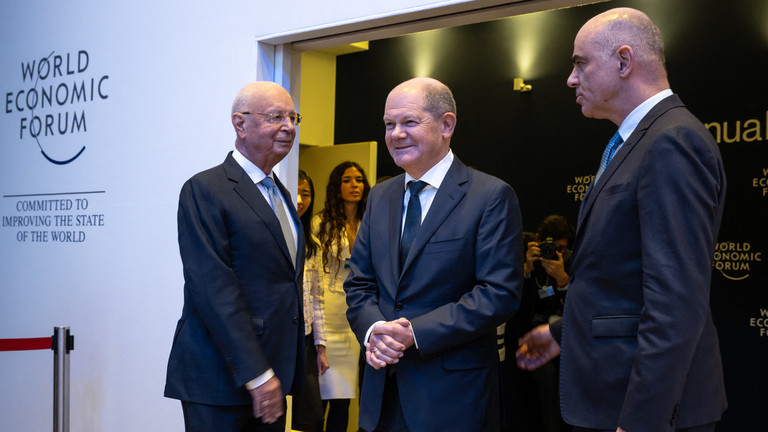
Those invited to preach at the altar during the high mass of globalism this year seemed to know exactly what kind of sermon the crowd wanted to hear. German Chancellor Olaf Scholz was apparently the only G7 leader who thought it would be a good look to be seen hanging out with the unelected masters of the planet while Westerners – and Europeans in particular – grapple with the high cost of their governments’ policies in their daily lives. Scholz doubled down on the same green dreams that put Germany’s economy in peril with no viable backup plan once the European Union had effectively cut off Russian energy through sanctions. “Most importantly, our transformation toward a climate-neutral economy, the fundamental task of our century, is currently taking on an entirely new dynamic. Not in spite of but because of the Russian war, and the resulting pressure on us Europeans to change. Whether you are a business leader or a climate activist, a security policy specialist or an investor, it is now crystal clear to each and every one of us that the future belongs solely to renewables. For cost reasons, for environmental reasons, for security reasons, and because in the long run, renewables promise the best returns,” Scholz said in his address. Meanwhile, Germany is firing its coal power plants back up and reconsidering its nuclear power phase-out. How about worrying about how German industry is going to function in the next year when green initiatives, such as hydrogen imports from Portugal and Norway, aren’t set to even get off the ground until at least 2030? Scholz used his time at the podium at Davos to greenwash the economic uncertainties that Germany faces as a result of the EU’s energy sanctions on Russia. In other words, green hopes and dreams took center stage in this pitch to global investors, thus providing a convenient distraction from the more worrisome current realities.
Greenwashing was joined at Davos by the pitching of anti-democratic initiatives via concern trolling. During a panel discussion dedicated to “disrupting distrust” – which really should have been called “How can we get people to better swallow our nonsense?” – Richard Edelman, the CEO of the eponymous global communications firm, blamed the derailments on right-wingers. “My hypothesis on that is that right-wing groups have done a really good job of disenfranchising NGOs. They’ve challenged the funding sources. They’ve associated you with Bill Gates and George Soros. They’ve said that you’re world people, as opposed to what you are, which is local,” Edelman lamented, ignoring the fact that they wouldn’t have needed to fly their private jets to a “local” event. What he’s really attacking are dissidents, many of whom just happen to be populists and right-leaning. And no doubt the fact that they’re digging into the special interests laundered through many NGOs makes the job of PR pros such as Edelman more challenging.
“Edelman is a despicable human being – his job is literally being a professional liar!” Tweeted billionaire Tesla and SpaceX founder Elon Musk, whose controversial purchase of the social media platform and subsequent reversal of its heavy-handed censorship policies haven’t exactly endeared him to the Davos crowd. Mocking Schwab’s call to “master the future” in the opening keynote, Musk tweeted, “’Master the Future’ doesn’t sound ominous at all … How is WEF/Davos even a thing? Are they trying to be the boss of Earth!?” Musk then took a Twitter poll that found that 86% of 2.4 million respondents answered ‘no’ to the question of whether the WEF should “control the world.”
A WEF spokesman said that Musk hasn’t been invited to the gathering since 2015. Musk confirmed his lack of interest in attending: “My reason for declining the Davos invitation was not because I thought they were engaged in diabolical scheming, but because it sounded boring af lol.”
Boring, indeed – in the same way that a cult meeting where everyone nods their heads in agreement is a snooze fest. The last time things were even remotely interesting at Davos was when former US President Donald Trump showed up and rejected the Davos mantra of climate change doom. “The message represents a sharp departure from the official playbook at the World Economic Forum, where this year’s theme is ‘Stakeholders for a Cohesive and Sustainable World’,” wrote CNN in January 2020.
Who asked them, though? These elites represent no one’s interests but their own, which are economic and are for the benefit of their shareholders – hence the forum’s name. If the average citizen is now waking up to the fact that anything coming out of Davos should be scrutinized through that lens, then it can only be a good thing for freedom, democracy, and national sovereignty.
Rachel Marsden is a columnist, political strategist, and host of independently produced talk-shows in French and English.
JFK and America’s Destiny Betrayed
A Review of DiEugenio’s “Foreign Policy Coup” Theory
BY LAURENT GUYÉNOT • UNZ REVIEW • JANUARY 21, 2023
I have watched Oliver Stone’s documentary on the assassination of JFK, both the short version, JFK Revisited: Through the Looking Glass, and the long version in four episodes, JFK: Destiny Betrayed. I recommend the latter, which I will discuss here. Although the technical parts (the bullets, the autopsy, Oswald’s CIA handlers) are interesting and partly new, I will focus exclusively on the theory regarding the main culprits and their motive. And I will discuss the larger work of James DiEugenio, who wrote the film—and probably interviewed the different contributors, although Stone appears to be doing it.
James DiEugenio has been investigating the Kennedy presidency and the Kennedy assassination from the time of the Assassination Records Review Board (ARRB), which was largely a consequence of Oliver Stone’s Hollywood film JFK (1991). His first book was Destiny Betrayed: JFK, Cuba, and the Garrison Case (1992, newly edited in 2012). In 1993, he founded Citizens for Truth about the Kennedy Assassination (CTKA), and co-edited Probe Magazine, now replaced by the website KennedysandKing.com.
In 1997, DiEugenio published a powerful two-part book-length article, “the Posthumous Assassination of JFK” (1997). It is still essential reading for anyone interested in the controversies surrounding Kennedy’s presidency and assassination, or puzzled by the unending stream of bizarre Kennedy lore. This is the text you want to send to anyone telling you about the Kennedys’ mafia dealings and unrestrained sex life, their murder of Marilyn Monroe, or Bobby’s irresponsible assassination plots against Castro that backfired on his brother. These stories are so widespread, repeated in well-published and well-reviewed books, that millions of people assume them to be documented. Writing on the occasion of the release of Seymour Hersh’s The Dark Side of Camelot, DiEugenio exposed their fraudulent nature and their true motivation: the obsession to “smother any legacy that might linger,” for “assassination is futile if a man’s ideas live on through others.” This flow of defamation had started in the 70s, as a counter-fire to the Church Committee and the House Select Committee on Assassinations (HSCA), and intensified in the 1990s after the ARRB. It never dried up.
Character assassination is only one part of the propaganda unleashed against the Kennedy legacy. Another part has consisted in distorting the historical record of Kennedy’s presidency, and particularly the radical but short-lived innovations of his foreign policy. DiEugenio writes in “Dodd and Dulles vs. Kennedy in Africa” (1999, modified 2016):
a clear strategy of those who wish to smother any search for the truth about President Kennedy’s assassination is to distort and deny his achievements in office. Hersh and his ilk have toiled to distort who Kennedy really was, where he was going, what the world would have been like if he had lived, and who and what he represented.[1]
DiEugenio has provided insightful answers to these questions. A graduate in Contemporary American History, he is probably the best Kennedy historian among Warren Commission critics, and his work has opened the way for other revisionist historians like Monika Wiesak, author of the recent and excellent America’s Last President: What the World Lost When It Lost John F. Kennedy (read DiEugenio’s review here). According to DiEugenio, there has been, in addition to the cover-up about Kennedy’s death, a “cover-up about Kennedy’s foreign policy,”[2] so that even critics of the Warren Commission fairytale have largely failed to grasp the full extent of Kennedy’s changes from the foreign policy of his predecessors—dominated by the Dulles brothers; “by only chasing Vietnam and Cuba, to the neglect of everything else, we have missed the bigger picture.”[3] The bigger picture drawn by DiEugenio includes the Congo, Indonesia, Laos and the Middle East. DiEugenio’s most essential articles on these topics are:
- “Deconstructing JFK: A Coup d’État over Foreign Policy?” written for Covert-Operation magazine (2021)
- “Nasser, Kennedy, the Middle East, and Israel” (2020)
- “Introduction to JFK’s Foreign Policy: A Motive for Murder” (2014)
- “ Dodd and Dulles vs. Kennedy in Africa” (1999, modified 2016)
The three scholars who most contributed to DiEugenio’s understanding of the uniqueness of Kennedy’s foreign policy, and who are interviewed in the film JFK: Destiny Betrayed, are:
- Richard Mahoney, for JFK: Ordeal in Africa, Oxford University Press, 1983,
- Philip Muehlenbeck, for Betting on the Africans: John F. Kennedy’s Courting of African Nationalist Leaders, Oxford University Press, 2012,
- Robert Rakove, for Kennedy, Johnson, and the Nonaligned World, Cambridge University Press, 2012 (read DiEugenio’s review).
Although he praises James Douglass’s JFK and the Unspeakable (2008), DiEugenio rejects his mythical portrayal of JFK as a Cold Warrior converted to peacemaking during the 1962 Cuban Missile Crisis.[4] Despite the contrary impression he made during his televised debates with Nixon in 1960, Kennedy was never a Cold Warrior. The collection of statements published under the title The Strategy of Peace for his presidential campaign proves it.
DiEugenio traces Kennedy’s general ideas on foreign policy back to 1951, when Kennedy toured the Middle East and Asia. His meeting in Saigon with Edmund Gullion, whom he later brought into his cabinet, had convinced him that sending American troops to Indochina was a grave mistake.[5] He would never change his mind on that issue.[6]
By 1957, Kennedy was formulating a radical—by U.S. standard—foreign policy for the Arab world, which he outlined in a speech on the Senate floor denouncing French colonial occupation of Algeria:
In these days, we can help fulfill a great and promising opportunity to show the world that a new nation, with an Arab heritage, can establish itself in the Western tradition and successfully withstand both the pull toward Arab feudalism and fanaticism and the pull toward communist authoritarianism.[7]
Unlike his predecessors Truman and Eisenhower, and in defiance of the doctrine that prevailed in the CIA, the Pentagon and the State Department, Kennedy accepted and welcomed a multipolar world, the only way, in his view, to overcome the dangerous bi-polarization of the Cold War. Had he succeeded, he would have transformed the U.S. into something totally different from what it was starting to become since WWII, and has fully become since he died: an imperial bully feared but hated throughout the world. In “Deconstructing JFK: A Coup d’État over Foreign Policy?” DiEugenio makes the point that:
[Kennedy’s] speeches, correspondence and high-level meetings with emerging Third World leaders reveal his growing antipathy for colonialism, rejection of imperialism, toleration for the non-aligned movement—contrasting markedly with his predecessor—and promotion of nationalistic leaders, albeit ones that were considered to be “responsible” in their moderation.[8]
The first foreign policy reversal that Kennedy made once in office was on the Congo. Patrice Lumumba, Congo’s first democratically elected leader, was killed three days before Kennedy’s inauguration, victim of a coup supported by the CIA. Jacques Lowe’s shot of JFK getting the news of Lumumba’s death on February 13th is, to DiEugenio, the picture that best symbolizes Kennedy’s personal commitment to support the national independence of Third world countries, and the ordeal of his struggle against the CIA’s machinery of assassination and regime change. After U.N. Secretary-General Dag Hammarksjold was killed (likely murdered) in a plane crash in September 1961, Kennedy carried on his campaign for a free and independent Congo. Lyndon Johnson destroyed this first attempt at a democracy in post-colonial Africa, and backed Josef Mobutu, who turned into a corrupted dictator and allowed his country to be utilized by outside imperial interests.

Kennedy rejected the “with us or against us” mentality of the foreign policy establishment, and this was also demonstrated by his support for Indonesia’s nationalist leader Sukarno, who co-founded the Non-Aligned Movement. In 1958, Eisenhower had authorized the CIA’s attempt at overthrowing Sukarno, but when Kennedy assumed office, he reversed that policy, and helped Sukarno stabilize his country. Less than a year after Kennedy’s death, the CIA was planning again covert action against Sukarno, which led to the killing of at least 500,000 people suspected of communist sympathy. Sukarno was placed under house arrest and CIA-backed Suharto ruled for three decades, turning his people into low-wage workers for foreign companies.[9]
And then, of course, there is Cuba and Vietnam. The story of Kennedy’s resistance to the Pentagon and the CIA’s push for military confrontation and escalation in these countries has been told many times—most eloquently by James Douglass—, so that I do not need to tell it again. Authors of the dominant school of JFK assassination research—and that includes those interviewed in Stone’s documentary—assume that Cuba and Vietnam are, in that order, the most important reasons why Kennedy was killed. DiEugenio agrees, but brings a larger spectrum of motives.
DiEugenio writes in “Nasser, Kennedy, the Middle East, and Israel”:
For decades, the critical community overlooked areas of Kennedy’s foreign policy outside of Vietnam and Cuba. Kennedys and King has attempted to correct that oversight in recent years. We have tried to educate our readers on issues like Kennedy’s policies in Congo, Indonesia, Dominican Republic, and Laos. We have also tried to show how, after his murder, those policies—as well as his policy toward Vietnam and his attempts at detente with Moscow and Havana—were also altered.
But there is still another area of the world about which Kennedy’s reformist foreign policy is overlooked. That area is the Middle East. This is odd since many commentators justifiably perceive that the Middle East is one of the most important areas on the globe.[10]
He writes in his “Introduction to JFK’s Foreign Policy: A Motive for Murder”:
Why is the JFK case relevant today? Well, because the mess in the Middle East now dominates both our foreign policy and the headlines, much as the Cold War did several decades ago. And the roots of the current situation lie in Kennedy’s death, whereupon President Johnson began the long process which reversed his predecessor’s policy there.[11]
In other words, the Middle East is the region of the world where Kennedy’s foreign policy and Johnson’s reversal of that foreign policy have had the most dramatic and most lasting consequences. What was at stake was America’s involvement in the conflict between Israel and the Arab world, and that meant, essentially, between Ben-Gurion and Nasser.
So DiEugenio acknowledges that: 1. LBJ completely reversed JFK’s foreign policy, and 2. the most consequential reversal was in the Middle East, for the longtime benefit of Israel and to the detriment of Egypt. Yet he points, not to Johnson or Ben-Gurion, but to Allen Dulles as the most likely culprit for the Dallas coup. Does he document any evidence that Allen Dulles was interested in switching alliance from Egypt to Israel? None whatsoever. It is true that the Eastern Establishment generally favored Saudi Arabia over Egypt, but it is not the case that they wanted a closer relationship with Israel. So what is unique about Johnson’s pro-Israel policy is that it was not a return to a pre-Kennedy policy, but something new altogether. It was a radical break from all previous administrations. Recall Eisenhower’s resolute reaction to Israel’s invasion of the Sinai in 1956, and contrast it with what happened ten years later, when Johnson greenlighted Israel’s attack on Egypt and expansion, and covered up Israel’s false-flag attack on the USS Liberty designed to draw the U.S. into the war.
Allen Dulles’s major interest in foreign policy in the 1960s was over Cuba. Assassinating Castro and/or invading Cuba to restore an American colonial regime was his priority. Like the majority of JFK investigators, DiEugenio considers that Kennedy had so angered the CIA, and Dulles in particular, when he didn’t go along with their plan to invade Cuba—not once but twice, first with the Bay of Pigs landing in 1961, and secondly during the Cuban Missiles Crisis in 1962—that Dulles’s gang decided to assassinate him. But guess what: LBJ did not invade Cuba either. He didn’t give the CIA and Pentagon hawks the retaliatory invasion of Cuba that their plan was supposed to force upon him. He didn’t even try.
This is a major weakness of that semi-mainstream theory to which DiEugenio subscribes, and which he contributed to write. That weakness is partly compensated by the secondary focus on Vietnam. It is true that, in Vietnam, Johnson gave the National Security state what they wanted, and more. As author Peter Dale Scott wrote, Johnson “had been, since 1961, the ally of the Joint Chiefs (and in particular Air Force General Curtis LeMay) in their unrelenting efforts, against Kennedy’s repeated refusals, to introduce U.S. combat troops into Asia.”[12] Yet, that presentation ignores one aspect of the full story.
The strongest push for sending ground troops to Vietnam came from Walt Rostow (“the biggest Cold Warrior I’ve got,” Kennedy said). As deputy to the National Security Advisor McGeorge Bundy under Kennedy, Rostow had already weighted heavily on Kennedy’s decision to send military “advisors” to Vietnam. But Kennedy had grown weary of his bellicose advise (“Walt had ten ideas, nine of which would lead to disaster”).[13] Walt Rostow was promoted by Johnson as National Security Advisor, and found in the new president more enthusiasm for his war plans. Rostow was the main promoter of the lie that Johnson’s Vietnam policy was a continuation of Kennedy’s.[14]
Johnson named Walt’s brother Eugene Under-Secretary of State, “appointed precisely to support the coming Israeli war” according to Joan Mellen.[15] Walt and Eugene Rostow, sons of Jewish immigrants, had a good deal of control on U.S. Israeli policy. On June 8, 1967, the very day of the Israeli attack on the USS Liberty, Walt had recommended to Johnson that Israel be allowed to keep the captured territories.
Why did the Rostow brothers want a Vietnam War? In “Was Vietnam a Holocaust for Zion” I explained why the Vietnam War was good—even crucial—for Israel. But don’t take my word for it. Here is what French president Charles De Gaulle said during his November 27, 1967 press conference:
Without the tragedy of Vietnam, the conflict between Israel and the Arabs would not have become what it has become. And if South-East Asia could experience a renewal of peace, the Middle-East would also find its way to peace, in the climate of détente which would follow such an event.[16]
I am not implying that the shift in policy on Vietnam between Kennedy and Johnson does not support the theory that CIA and Pentagon killed Kennedy. It does. I am merely pointing out that Johnson’s pro-Israel cabinet members were at least as influential as Dulles and LeMay in Johnson’s reversal of Kennedy’s decision to withdraw from Vietnam, a fact which is also consistent with the theory that Israel was the prime mover.
In his JFK and the Unspeakable, James Douglass has documented JFK’s deep commitment to prevent nuclear proliferation and even abolish weapons of mass destruction “before they abolish us” (Kennedy’s speech at the UN General Assembly, September 25, 1961). But Douglass makes no mention of JFK’s bitter confrontation with Ben-Gurion and Eshkol on that very issue. In this way, Douglass has proven that the historical school of which he has become a standard bearer is involved in a cover-up. To be generous, I ascribe it to a case of “cognitive inhibition”. I imagine it works somewhat like this: “My work—that is, the truth—is too important to risk it being censored by saying something bad about Israel.” Personally, I prefer to stick to Peter Janney’s principle that “the truth takes no prisoners.”
To his credit, DiEugenio does not eschew the Dimona story. His website links to two articles by Avner Cohen, author of Israel and the Bomb (1998), and William Burr of the National Security Archive, accompanied by declassified documents (here and here).[17] DiEugenio himself writes about Israel’s effort to acquire nuclear weapons in “Nasser, Kennedy, the Middle East, and Israel” (2020):
Ben Gurion and the other Israeli leaders were so devoted to this aim that they resorted to two illicit means in order to secure the goal. First—there is no other way to say this—they involved themselves in a government-wide conspiracy to deceive Kennedy about the true nature of the Dimona reactor.
Israel’s second means to go nuclear was the theft of enriched Uranium from the U.S.:
Through [Roger] Mattson [author of Stealing the Atom Bomb], and also author Grant Smith [author of Big Israel], we know today that Israel had stolen hundreds of pounds of highly enriched uranium out of what was essentially their shell plant in Apollo, Pennsylvania, called NUMEC.[18]
Stone and DiEugenio mention the first of these Israeli deceptions in their film (the long version only, episode 3, 40:50). After a brief reminder of Kennedy’s decision to support the U.N. resolution for the return of Palestinian refugees, we are told:
The other problem Kennedy faced with Israel was the construction of the atomic reactor at Dimona. JFK was strongly against any proliferation of nuclear weaponry. He had been assured by Prime Minister David Ben-Gurion that Dimona was designed for peaceful uses of atomic energy. In the spring of 1963, Kennedy demanded full inspections by the US of the Dimona reactor, and threatened to place American aid for Israel in limbo if no agreement was reached. And at the time of his assassination, negotiations were in process for biannual inspections.
That is better than nothing. But since that story is only incidental to the thesis defended by Stone and DiEugenio, it seems to have been included only to immune the authors from the blame of covering it up, that Douglass deserves.
Interestingly, it is Stone who brings up this topic in this interview with Canadian journalist Éloïse Boies. At 34:20, DiEugenio states that “nobody was more anti-nuclear proliferation than John F. Kennedy. This was really a very important issue with him.” At this point, Stone interjects:
He took on Israel. He took on Ben-Gurion in Israel, because they were building a bomb that they’d stolen from us. And he really wanted to put a stop to that, but he, unfortunately died before, and Johnson carried through, knew about it and let it go, till Israel had the bomb by 1968. And even then, in 68, Johnson shut the Pentagon up. He said: “We are not going to announce this. The American people won’t know that Israel has the bomb.”
Notice Éloïse’s reaction: “Let’s talk about [something else].” The point is that, for Stone and DiEugenio, Dimona seems to be anecdotal and hardly relevant to solving the case. At the end (from 50:27), when asked “Who did it, and why?” they stick to the conclusion that Allen Dulles was the mastermind, with perhaps Curtis LeMay. But, they add as an afterthought, Dulles is only “the executioner” and “does get the OK from someone else. … You know who they are: the people with money” … like “David Rockefeller”. Éloïse gets it: “It’s all about money, at the end of the day.” It becomes absolutely ridiculous. When your theory implodes under its own hollowness, it’s time to change. But, as Stone says “once they’re locked in, it’s very hard for historians to go back” (19:10).
It might seem unfair for me to point to an interview rather than to the film itself. But the value of that interview is precisely to reveal the logical fallacies and confusions that are not apparent in the film.
In that same interview (from 40:30), Stone says: “I don’t think Johnson was involved in the murder.” DiEugenio adds: “Johnson fell for the CIA story coming out of Mexico City” (an Oswald impersonator visiting both the Soviet and the Cuban embassies in Mexico in October 1963). But then DiEugenio mentions that Edgar Hoover had told Johnson that the Mexico story was impossible, since neither the voice nor the photo provided by the Mexico CIA station fitted the real Oswald. So now “the question becomes: did Johnson really believe this?” This gets confusing. DiEugenio can’t seem to decide whether Johnson believed Oswald’s communist legend or not.
But DiEugenio’s dilemma has no reason to be. For not only Johnson knew the communist Oswald to be bogus; it was he who used this fake communist connection to block all investigations. DiEugenio is an admirer of the work of professor John M. Newman, whose books he reviewed (here, here, here, and here), and whom he interviewed for the film. One contribution of Newman, introduced in the 2008 edition of his book Oswald and the CIA and repeated in the first three volumes of his series The Assassination of President Kennedy, is, in his own words:
An essential element of the plot was a psychological operation to raise the specter of WWIII and the death of forty million Americans. This threat of a nuclear holocaust was then used by President Johnson to terrify Chief Justice Earl Warren and some of the other men who served on the Warren Commission to such an extent that they believed there was no alternative to writing a report stating Lee Oswald alone had assassinated the president.[19]
According to that theory, endorsed by DiEugenio in this review,[20] Oswald’s profile as a communist pro-Castro activist was inbuilt in the plan (by none other than James Jesus Angleton), not for the purpose of starting WWIII, but as a national security pretext that Johnson could use to impose the lone-nut theory, lest the discovery of a conspiracy would “kick us into a war that can kill forty million Americans in an hour,” as Johnson kept repeating.[21] One important implication is that “many of the post-assassination lies and cover-ups were carried out by people who had nothing to do with the pre-existing plot to assassinate the president” and who “thought that what they were doing was in the best interests of the country.”[22] This applies to thousands of people from the Dallas Police to TV networks. But can it apply to Johnson himself? Given Johnson’s quick and efficient mastery of this device, it is much more likely that it was fabricated by Angleton specifically for Johnson and with his foreknowledge.
Yet DiEugenio and other authors on his site are dismissive of investigators who incriminate Johnson, and especially of Phillip Nelson, author of LBJ: The Mastermind of JFK’s Assassination. A big book like that (730 pages) is bound to contain some weak arguments, but the reviews in KennedysandKing.com (here and here) do not do justice to the strong evidence accumulated by Nelson that Johnson was actively involved, not just in the cover-up, but in the preparation of the Dallas ambush.[23] (Read Nelson’s response to KennedysandKing.com here). DiEugenio concurs with Douglass that Johnson was unaware of the conspiracy against his president, but “chose to cover-up everything and surrender to Cold War prerogatives.”[24] He assumes that Johnson was a man who had no clear idea of his own in foreign policy and liked to be told what to do. That is at odds with everything we learn from Johnson’s biographers—especially Robert Caro.
From my viewpoint, which differs from Nelson’s, Johnson’s role in the assassination cannot be understood independently from Israel’s—nor can Angleton’s role. Johnson allowed, and probably planned, the Israeli attack on the USS Liberty in 1967, and he excused Israel when the operation failed (“Johnson did not break relations with Israel, and there were no trials held over this atrocity,” notes DiEugenio).[25] Not only that, but, as DiEugenio writes in “Nasser, Kennedy, the Middle East, and Israel”:
As Roger Mattson notes in his book on the subject, when the CIA alerted the new president that it appeared that Israel had now developed the atomic bomb, Johnson barely reacted. (Mattson, p. 97) There was no official investigation launched. In fact, Johnson told the CIA not to alert either State or Defense about the discovery.[26]
For those two acts, Johnson qualifies as a traitor to the country he had been sworn to serve. If Johnson was working for someone, it was not for the “Eastern Establishment,” of which he had never been part; it was for Israel. Johnson was the initiator of a pro-Israel policy that Truman, Eisenhower, the Dulles brothers or the Joint Chiefs of Staff under Kennedy would never have imagined in their worst nightmare. It is today widely known that Johnson is the US president who “firmly pointed American policy in a pro-Israel direction.”
In conclusion, I find several logical flaws in DiEugenio’s general theory, the basis for Stone’s documentary:
- DiEugenio recognizes that the change of foreign policy from JFK to LBJ was most consequential in the Middle East, yet he blames the CIA and the Pentagon (Dulles and LeMay) for the assassination, although neither the CIA nor the Pentagon ever advocated the pro-Israel policy that Johnson set up. Johnson’s unprecedented support for Israel, to the point of treason, went against the approach advocated by the CIA, the Pentagon or the State Department. But it was the best foreign policy that Ben-Gurion could dream of.
- According to DiEugenio and the dominant school, the CIA’s prime motive for eliminating Kennedy would have been to resume their favored foreign policy toward Cuba, which Kennedy had stubbornly opposed. But that didn’t happen after the assassination. Johnson kept Kennedy’s pledge to Khrushchev not to invade Cuba, which Dulles and LeMay considered pure treason.
- DiEugenio agrees that Kennedy was intensely worried about nuclear proliferation, and that Israel posed him the most difficult problem. He also knows that Johnson did nothing to stop Israel from going nuclear, and showed neither surprise nor displeasure when told that Israel made its first nuclear bomb in 1968, with bomb-grade uranium stolen from the U.S. Johnson tried to keep it secret—which obviously was what Israel wanted. Yet DiEugenio does not see Dimona as having been a motive in the assassination, and finds no reason to suspect either Israel or Johnson.
- DiEugenio believes that JFK’s assassination was a “coup d’État over foreign policy,” and I agree that this is the only way to make sense of it. But the purpose of a coup d’État is to replace one head of state by another. Therefore, it is self-contradictory for DiEugenio to minimize Johnson’s role and motive in the assassination.
Actually, I think DiEugenio’s notion of a “cover-up about JFK’s foreign policy” needs to be qualified. Not all areas of Kennedy’s foreign policy are equally covered up. The three teachers of DiEugenio—Richard Mahoney, Philip Muehlenbeck and Robert Rakove—are published by Oxford University Press and Cambridge University Press: not exactly fringe publishers. Rakove and Muehlenbeck are even included in the bibliography of the Wikipedia article on “Foreign policy of the John F. Kennedy administration” (so are James Douglass and John M. Newman). This Wikipedia article is quite accurate and detailed, with one exception for the section about “Israel and Arab States”—a fine hasbara job, probably by Bennett Naftali’s army of Zionist Wikipedia editors. See by yourself:

The real “cover-up about JFK’s foreign policy” is the cover-up about JFK’s Israeli policy. According to DiEugenio’s own logic, that points in the direction that DiEugenio is not looking.
Since DiEugenio sees a link between Kennedy’s assassination and his “posthumous assassination”, I also suggest that he gets a clue about Kennedy’s assassins by looking at the political profile of Kennedy’s “posthumous assassins”. The list includes, next to Seymour Hersh, authors who specialize in trashing the Kennedy family, like Ronald Kessler (The Sins of the Father, 1997), Edward Klein (The Kennedy Curse, 2004), or the incomparable C. David Heymann, the Mossad employee (by his own admission)[27] who wrote the salacious Bobby and Jackie: A Love Story (2009). Is there a pattern here?
What about Howard Zinn, Gar Alperovitz, Martin Peretz, and Noam Chomsky, that DiEugenio blames in “The Left and the Death of Kennedy” (1997) for their defense of the Warren Commission report and their participation in the orgy of Kennedy-bashing. Chomsky, whom DiEugenio sees as the most nefarious liar when it comes to Kennedy’s presidency or his assassination (here and here), has nothing in common with Allen Dulles or Curtis LeMay. He is an anti-imperialist, and as such he should make Kennedy his hero, his icon. But Chomsky has another agenda: one of his specialties is blaming America for the crimes of Israel. As for Martin Peretz, DiEugenio writes that his New Republic buried Kennedy’s death in 1979, then “tried to bury his life.”
It actually made a feature article out of a review of the tawdry Horowitz-Collier family biography The Kennedys. Who did that publication find suitable to review this National Enquirer version of the Kennedy clan? None other than Midge Decter, wife of neo-conservative godfather Norman Podhoretz, mother-in-law of Elliot Abrams.
The Podhoretzs are not Eastern Establishment, but they hate the Kennedys. Their hatred is transgenerational and inextinguishable. If you doubt it, read the piece below, written by Norman’s son a week after the tragic death of John F. Kennedy Jr. The author imagines Satan—or is it Yahweh?—teasing Joe Kennedy in hell and bragging to have killed his grandson—a particularly heinous version of the “Kennedy curse”.

Perhaps DiEugenio should give more serious consideration to the “who” and the “why” of Kennedy’s “posthumous assassination”. But that would take him on the road less traveled, a dangerous path—some say suicidal.
Strangely, though, many other well-trodden roads seem to now converge on the Israeli trail:
- Investigators tracking Johnson end up finding a snake pit of sayanim in his White House, as did Phillip Nelson in his second and third books (LBJ: From Mastermind to “The Colossus” and Remember the Liberty).
- Jefferson Morley, investigating Angleton, saw him in cahoots with the cream of the Mossad, who considered him “the biggest Zionist of the lot,” while Robert Amory, head of the CIA Directorate of Intelligence, called him a “co-opted Israeli agent” to his face.
- David Talbot concludes that RFK was assassinated by the same cabal as his brother, who now used for a patsy an anti-Zionist Palestinian, thereby presenting RFK’s assassination as motivated by “a visceral, irrational hatred of Israel” (but Talbot sees no Israeli fingerprint in there—another case of cognitive inhibition).
- No one investigating Jacob Rubenstein, known as Jack Ruby, can now ignore his work for the Irgun as a “gangster for Zion” and his repeated declarations that “I did it for the Jews”.[28]
- Clay Shaw, the only person (beside Oswald) to have been charged with having participated in the assassination, has been found a board member of Permindex, “a Mossad arms trading and money laundering venture” chaired by Louis Bloomfield, a devoted supporter of the Israeli cause and of the Mossad, as shown by Michael Collins Piper.[29]
- The word is out that Arlen “Magic Bullet” Specter was a dedicated Israel-firster, honored by the Israeli government as “an unswerving defender of the Jewish State,” and by AIPAC, as “a leading architect of the congressional bond between our country and Israel”.[30]
- It can’t be ignored that Abraham Zapruder, the man whose camera didn’t shiver when Kennedy’s head exploded, had his business office in one of the snipers’ nests, the Dal Tex Building overlooking Dealey Plaza, owned by B’nai B’rith financier David Weisblat.[31]
- Investigators interested in George DeMohrenschildt cannot fail to learn that, before being found dead with a bullet in his head, he had complained that “the Jewish mafia” was out to get him.[32]
And of course, we must add to the equation Israel’s criminal record for the last sixty years. Thanks to Ronen Bergman, author of Rise and Kill First: The Secret History of Israel’s Targeted Assassinations, we know that Israeli secret services has never had any inhibition against eliminating anyone perceived as a threat to Israel’s national security, especially when it comes to Israel’s nuclear hegemony in the Middle East. Bergman learned from the assassins themselves because, he writes, “acts that people in other countries might be ashamed to admit to are instead a source of pride for Israelis.”[33]
We now know so much more than Stone and DiEugenio could know when they first got involved in Kennedy assassination research. But those who understood Israel’s power back then already had a clue. In March 1992, commenting critically on Stone’s motion picture JFK, American Congressman Paul Findley noted in the Washington Report on Middle East Affairs:
It is interesting — but not surprising — to note that in all the words written and uttered about the Kennedy assassination, Israel’s intelligence agency, the Mossad, has never been mentioned. … on this question, as on almost all others, American reporters and commentators cannot bring themselves to cast Israel in an unfavorable light — despite the obvious fact that Mossad complicity is as plausible as any of the other theories.
Three years later, Mike Piper filled the gap with Final Judgment: The Missing Link in the JFK Assassination Conspiracy (expanded through five editions until 2005). His work has been ignored by most investigators, but in 2013, historian Martin Sandler (listen to him here) mentioned it in his precious edition of The Letters of John F. Kennedy, to introduce Kennedy’s letter to David Ben-Gurion dated May 18, 1963:
author Michael Collins Piper actually accused Israel of the crime. Of all the conspiracy theories, it remains one of the most intriguing. What is indisputable is that although it was kept out of the eye of both the press and the public, a bitter dispute had developed between Israeli prime minister David Ben-Gurion, who believed that his nation’s survival depended on its attaining nuclear capability, and Kennedy, who was vehemently opposed to it.[34]
In his previous letter to Kennedy, dated May 12, Ben-Gurion had assured Kennedy that the Egyptians “want to follow the Nazi example,” and begged: “Mr. President, my people have the right to exist… and this existence is in danger.”[35] He also made a bizarre digression about Jordanian King Hussein: “there is always a danger that one single bullet might put an end to his life and regime.”[36]
Notes
[1] DiEugenio, “Dodd and Dulles vs. Kennedy in Africa,” 15 February 1999, last modified 16 October 2016, www.kennedysandking.com/john-f-kennedy-articles/dodd-and-dulles-vs-kennedy-in-africa
[2] “DiEugenio at the VMI seminar,” 16 September 2017, www.kennedysandking.com/john-f-kennedy-articles/jim-dieugenio-at-the-vmi-seminar
[3] DiEugenio, “Introduction to JFK’s Foreign Policy: A Motive for Murder,” 22 December 2014, www.kennedysandking.com/john-f-kennedy-articles/introduction-to-jfk-s-foreign-policy-a-motive-for-murder
[4] “DiEugenio at the VMI seminar, 16 September 2017, www.kennedysandking.com/john-f-kennedy-articles/jim-dieugenio-at-the-vmi-seminar
[5] James Norwood, “Edmund Gullion, JFK, and the Shaping of a Foreign Policy in Vietnam,” 8 May 2018, www.kennedysandking.com/john-f-kennedy-articles/edmund-gullion-jfk-and-the-shaping-of-a-foreign-policy-in-vietnam
[6] James Douglass, JFK and the Unspeakable: Why He Died and Why It Matters, Touchstone, 2008, pp. 107, 102.
[7] Quoted in “DiEugenio at the VMI seminar,” 16 September 2017, www.kennedysandking.com/john-f-kennedy-articles/jim-dieugenio-at-the-vmi-seminar
[8] DiEugenio, “Deconstructing JFK: A Coup d’État over Foreign Policy?” January 14, 2021, covertactionmagazine.com/2021/01/14/deconstructing-jfk-a-coup-detat-over-foreign-policy/
[9] DiEugenio, “Deconstructing JFK: A Coup d’État over Foreign Policy?” January 14, 2021, covertactionmagazine.com/2021/01/14/deconstructing-jfk-a-coup-detat-over-foreign-policy/
[10] DiEugenio, “Nasser, Kennedy, the Middle East, and Israel,” 22 October 2020, www.kennedysandking.com/john-f-kennedy-articles/nasser-kennedy-the-middle-east-and-israel
[11] DiEugenio, “Introduction to JFK’s Foreign Policy: A Motive for Murder,” 22 December 2014, www.kennedysandking.com/john-f-kennedy-articles/introduction-to-jfk-s-foreign-policy-a-motive-for-murder
[12] Peter Dale Scott, Deep Politics and the Death of JFK, University of California Press, Berkeley, 1993, pp. 30-33.
[13] David Halberstam, The Best and the Brightest, Random House, 1972, pp. 156-162.
[14] John K. Galbraith, “Exit Strategy – In 1963, JFK ordered a complete withdrawal from Vietnam,” Oct/Nov 2003, www.bostonreview.net/articles/galbraith-exit-strategy-vietnam/
[15] Joan Mellen, Blood in the Water: How the US and Israel Conspired to Ambush the USS Liberty, Prometheus, 2018, p. 32.
[16] Film of De Gaulle’s press conference on fresques.ina.fr/de-gaulle/fiche-media/Gaulle00139/conference-de-presse-du-27-novembre-1967 at 41 min.
[17] Avner Cohen and William Burr, “ Concerned About Nuclear Weapons Potential, John F. Kennedy Pushed for Inspection of Israel Nuclear Facilities,” April 21, 2016, nsarchive.gwu.edu/briefing-book/nuclear-vault/2016-04-21/concerned-about-nuclear-weapons-potential-john-f-kennedy and “ The Battle of the Letters, 1963: John F. Kennedy, David Ben-Gurion, Levi Eshkol, and the U.S. Inspections of Dimona,” May 2, 2019, nsarchive.gwu.edu/briefing-book/nuclear-vault/2019-05-02/battle-letters-1963-john-f-kennedy-david-ben-gurion-levi-eshkol-us-inspections-dimona
[18] DiEugenio, “Nasser, Kennedy, the Middle East, and Israel,” 22 October 2020, www.kennedysandking.com/john-f-kennedy-articles/nasser-kennedy-the-middle-east-and-israel For more detail, read DiEugenio’s review of Roger Mattson’s book Stealing the Atom Bomb (2016), “How Israel Stole the Bomb”, September 11, 2016, on consortiumnews.com/2016/09/11/how-israel-stole-the-bomb/ Read also DiEugenio’s review of Monika Wiesak, America’s Last President.
[19] John Newman, Where Angels Tread Lightly: The Assassination of President Kennedy, volume 1, self-published, 2017, p. xx; repeated in vol. 2, Countdown to Darkness, and in vol. 3, Into the Storm.
[20] DiEugenio’s words: « In his new Epilogue for this 2008 edition, Newman explains why only someone who a.) Understood the inner workings of the national security state, and b.) Understood and controlled Oswald’s files, could have masterminded something as superhumanly complex as this scheme. One in which the conspiracy itself actually contained the seeds that would sprout the cover-up » (DiEugenio, “John Newman, Oswald and the CIA (re-issue),” 01 September 2008, on www.kennedysandking.com/john-f-kennedy-reviews/newman-john-oswald-and-the-cia-re-issue
[21] LBJ in a conversation to Senator Richard Russell on November 29, 1963, quoted in Douglass, JFK and the Unspeakable, op. cit., p. 83.
[22] John Newman, Where Angels Tread Lightly, op. cit., p. xx.
[23] Phillip Nelson, LBJ: The Mastermind of JFK’s Assassination, XLibris, 2010, p. 377-378
[24] Douglass, JFK and the Unspeakable, op. cit., p. 81.
[25] DiEugenio, “Deconstructing JFK: A Coup d’État over Foreign Policy?” January 14, 2021, covertactionmagazine.com/2021/01/14/deconstructing-jfk-a-coup-detat-over-foreign-policy/
[26] DiEugenio, “Nasser, Kennedy, the Middle East, and Israel,” 22 October 2020, www.kennedysandking.com/john-f-kennedy-articles/nasser-kennedy-the-middle-east-and-israel
[27] “C. David Heymann,” on spartacus-educational.com/JFKheymann.htm
[28] William Kunstler, My Life as a Radical Lawyer, Carol Publishing, 1994, p. 158.
[29] Michael Collins Piper, Final Judgment: The Missing Link in the JFK Assassination Conspiracy, American Free Press, 6th ed., 2005, chapter 15, pp. 247-269.
[30] Natasha Mozgovaya, “Prominent Jewish-American politician Arlen Specter dies at 82,” Haaretz, October 14, 2012, www.haaretz.com/jewish/arlen-specter-dies-at-82-1.5192779.
[31] That shots came from the Dal Tex was suggested by Jim Garrison in his October 1967 Playboy interview, p. 165-166, ia801307.us.archive.org/20/items/JimGarrisonPlayboyInterview/Jim-Garrison-Playboy-Interview.pdf.
[32] Police report on fr.scribd.com/document/258263723/Police-report-on-sucide-of-de-Mohrenschildt; His wife confirmed to Jim Marrs that her husband thought that “the Jewish Mafia and the FBI” were out to get him: Jim Marrs, Crossfire: The Plot that Killed Kennedy, Carroll and Graf, 1989, p. 285.
[33] Ronen Bergman, Rise and Kill First: The Secret History of Israel’s Targeted Assassinations, John Murray, 2019, p. xv.
[34] Martin Sandler, The Letters of John F. Kennedy, Bloomsbury Publishing, 2013, p. 333. Listen to Sandler here on this topic on www.c-span.org/video/?c4547313/user-clip-jfk-gurion-mossad-dimona
[35] Avner Cohen, Israel and the Bomb, Columbia UP, 1998, pp. 109 and 14.
[36] Quoted in Monika Wiesak, America’s Last President: What the World Lost When It Lost John F. Kennedy, self-published, 2022, p. 214.
Could this US case explode the global censorship cartel orchestrated by the BBC?
By Serena Wylde | TCW Defending Freedom | January 19, 2023
As the legacy media are showing no let-up in their vicious mendacity, particularly concerning Andrew Bridgen MP, it seems pertinent to highlight the likely next steps in the landmark case against the BBC-orchestrated cartel, the ‘Trusted News Initiative’, recently filed in Texas by Children’s Health Defense, their founder Robert F Kennedy Jr and others. As we reported here, the TNI, comprising the BBC, the Associated Press, Reuters, the Washington Post and a raft of others, stand accused by the plaintiffs of both violating the anti-trust laws which protect against collusion between commercial competitors, and the First Amendment of the US Constitution which protects freedom of speech, on the grounds that the purpose of the cartel is to prevent anyone publishing content that undermines the commercial and reputational interests of its members.
Jed Rubenfeld, the lawyer responsible for crafting the case against the media giants, foresees that they will throw unlimited funds at legal teams to generate a barrage of motions to have the case dismissed on one basis or another before it reaches court. They will argue on every pretext that the plaintiffs don’t have a claim. As each of these motions will have to be fought by the plaintiffs, this is a tactic of drowning the adversary in paperwork to exhaust its resources before any damage can be done in the form of exposure by the case coming to court. RFK’s legal team expect to be out-resourced and outspent by TNI’s deep pockets, and because the secretive cartel has everything to lose if the case proceeds to trial. But they will fight the motions tooth and nail as they believe the facts and the law are on their side, and once this major hurdle is surmounted, the plaintiffs will then be granted ‘discovery’.
The potential discovery process has RFK highly motivated, not only because it grants access to the internal communications between the defendants, essential to proving the case, but because he wants to interrogate each defendant as to why they signed up to being a part of a worldwide censorship campaign in direct betrayal of their role as the gatekeepers of liberty, in service of the people against the oppressive tendencies and overreach of government. In his words, he wants to confront each and every one of them and ask them what individual advantage they saw from this secret arrangement, and whether they believe in censorship.
Prior to the American Revolution, suppression and censorship of free speech in the American Colonies was fiercely pursued under the laws of the British Crown, which mercilessly prosecuted the dissemination of information unfavourable to it under the crime of ‘seditious libel’. This is why James Madison introduced his original version of the First Amendment in the Bill of Rights of 1789 by stating: ‘The people shall not be deprived or abridged of their right to speak, to write, or to publish their sentiments; and the freedom of the press, as one of the great bulwarks of liberty, shall be inviolable.’ And why in the First Amendment jurisprudence of the US Supreme Court, a judgment from some eighty years ago contains the words: ‘The freedom of speech depends on the widest possible dissemination of information from diverse and antagonistic sources. It is vital to the welfare of the Republic.’
The American War of Independence was won in 1783. Two hundred and forty years on, it is hard to imagine Providence will reverse the most vital of principles it led to. But we have some way to go yet. If the case proceeds, RFK’s legal team have asked for a trial by jury, a fitting request for a case which breaches everyone’s rights, and thus should be adjudicated by a jury of regular people. Litigation is expensive, which raises the question: if the BBC is funded by the licence-paying public, who will foot their bill? Initially, lawyers for them will be preparing to prevent the case from being heard. But if that fails and the case proceeds, there will be legal fees for defending the case in court. And if they lose in court, there will be very considerable damages to pay, plus the adversary’s legal fees. As for the reputational damage to the corporation, that will be for the demos to decide.
GMC Blinks First: Regulator Declines to Investigate Dr Aseem Malhotra Over Vaccine Warnings in BBC Interview
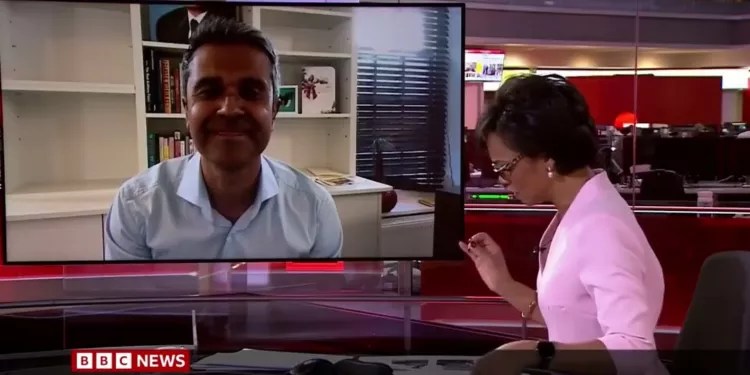
BY NIALL MCCRAE | THE DAILY SCEPTIC | JANUARY 21, 2023
To paraphrase the Sound of Music song, “How do we solve a problem like Malhotra?” After receiving several complaints, the General Medical Council has decided not to investigate cardiologist Dr. Aseem Malhotra, who has become a thorn in the side of the medical profession.
Professional regulators have been at the forefront of pandemic discipline, contributing to a culture of fear among practitioners. Severe action has been taken against registrants who criticise or do not comply with the official narrative. I know this from my experience as an officer of the Workers of England Union, representing members brought before the Nursing and Midwifery Council on charges of bringing the profession into disrepute. Apparently the public must be protected against nurses who don’t believe that masks stop airborne respiratory viruses, or who believe in informed consent for novel mRNA vaccines.
A significant strike against this censorial tyranny was by general practitioner Sam White last year. Dr. White was ordered, as a condition of maintaining his clinical licence, to delete his social media posts about COVID-19 and to refrain from making similar comments. Dr. White took the GMC to the High Court and won. The condition was overturned as a breach of his rights to freedom of expression under the Human Rights Act 1998.
Whereas White was an early critic of COVID-19 policy, Malhotra is a relatively recent convert. Initially he promoted the vaccine, but when his fit and healthy father died shortly after receiving the injections, Malhotra changed his mind and began speaking out against the mass vaccination programme. His personal loss came alongside his observation in clinical practice of a marked increase in myocarditis cases (as well as blood clots and other cardiac complications). Malhotra had a review paper published on this phenomenon, and his findings of iatrogenic harm are corroborated by other medical scientists.
Malhotra has repeatedly urged suspension of the vaccination programme until the risks are better understood. He became a darling of vaccine sceptics, with his charismatic and compassionate voice doing the rounds of alt media channels and independent-minded broadcasters working for more mainstream channels (such as Tucker Carlson’s show on Fox News, and Neil Oliver on GB News ). However, he was ignored by the legacy media, and it was not until two weeks ago, when he took the opportunity of a BBC interview on statins, that his call was more widely heard.
The context for Malhotra’s BBC appearance was a claim by Chief Medical Officer Chris Whitty that cardiac morbidity had increased as a result of limited access to statins during lockdown. Malhotra disagreed, explaining that myocarditis is unrelated to cholesterol level, which statins are meant to control. He instead blamed the vaccines, telling the BBC presenter that this radical medical intervention should be halted. Cue outrage.
The Guardian did a particularly nasty report on Malhotra, smearing him as a peddler of an ‘anti-vax’ conspiracy theory. Numerous doctors expressed their outrage on social media, angered by the BBC giving a platform to this known sceptic, who they accused of hijacking an interview on a different topic. Some reported Malhotra to the GMC.
The GMC’s decision not to act against Malhotra is a victory for science, ethics and common sense, but we should not get ahead of ourselves. This was a reluctant decision by the regulator, as the wording of their response to the referrals shows:
We recognise that Dr Malhotra has views on the COVID-19 mRNA vaccines that are at odds with the national and international scientific and medical communities. We also recognise that his words are strong and there is a question around the accuracy of his statements. There is currently no evidence that Dr. Malhotra has engaged in the type of Covid conspiracy related conduct that has to date justified regulatory action.
Note here the emphasis on consensus, as if that amounts to truth. It seems that if Malhotra had followed the likes of James Delingpole or Maajid Nawaz down the rabbit hole of globalist conspiracy, he would have been in big trouble. The GMC continued:
We also feel it is relevant that Dr. Malhotra started expressing his concerns about the vaccines in late 2021 and by this time the vaccine programme was well underway with the vast majority of vaccines delivered before this time. We would suggest that Dr. Malhotra’s impact on the COVID-19 vaccination programme in the U.K. could only have been negligible.
This is the most worrying line in the GMC response. If Malhotra is right about the risks of these vaccines, the GMC should be concerned that doctors were inhibited from speaking out earlier, thereby potentially saving lives. Instead, the GMC assumes that Malhotra is wrong, and that his remarks have not stopped the biggest vaccination drive in history.
The GMC acknowledged that Malhotra has a right to freedom of expression under Article 10 of the Human Rights Act, although that is not an absolute right for a medical practitioner. His outspoken opinions on the vaccines, according to the GMC, are “not so egregious as to justify a public hearing and a forum for further scepticism to be aired as to aspects of the COVID-19 pandemic and response”.
This, I believe, is the real reason why the GMC has decided not to take any further action. Any proceedings would inevitably attract publicity and give Dr. Malhotra a platform to air his sceptical views. Ultimately, the truth will get out, and those who tried to hide it will be judged by history.
Dr. Niall McCrae is a former university lecturer who now works for the Workers of England Union.
New Study Shows Respiratory Syncytial Virus Not a Hospitalization Threat to Frail Adults
Media Hype Died as Data Show Ambulatory Management is Sufficient
By Peter A. McCullough, MD, MPH | Courageous Discourse | January 21, 2023
I have noticed on occasion over the past three years that media hype can well up over an infectious disease threat and then for unexplained reasons the story is dropped without follow-up or resolution. Examples include a global hepatitis outbreak in children, monkeypox, group A strep, and the “tripledemic” of COVID-19, influenza, and respiratory syncytial virus (RSV). Some of these news stories escalate to a frenzy and in the case of monkeypox, President Biden declared a national emergency.
Americans are wondering to this day where is the monkeypox emergency? How has it impacted our lives? Most doctors including myself have never seen a case!
Last fall the fervor over RSV, largely a mild infantile illness was amplified to a point where some doctors were pushing for a third national emergency declaration (SARS-CoV-2, monkeypox, RSV). We were told new vaccines would be needed in every human being. Like the other stories, the RSV scare seems to have disappeared in the media cycle.
Concerns may be allayed in some part by a recent paper from Juhn et al of N=2325 adults including frail seniors that demonstrated a negligible risk (1 hospitalization, 0 deaths) with adult RSV usually manageable with outpatient nebulizer treatments for a few days.

If it occurs in infants and small children, a few hours in an urgent care or emergency department may be needed for breathing treatments, but again the outcomes are very favorable and certainly do not warrant vaccination, frightening news stories, or calls for national emergencies.
Pediatricians Call for National Emergency as Flu, RSV Surge Written by Lisa O’Mary Nov 17 2022
RT France Head Announces Broadcaster’s Closure After Paris Blocks Its Accounts
Sputnik – 21.01.2023
On the air in France, Belgium, Canada, Switzerland, and Mediterranean countries since 2017, RT France quickly became one of the largest alternative Francophone news broadcasters in Europe and North America. RT France was banned from broadcasting throughout the EU and Canada in early 2022 for providing a Russian perspective on the Ukraine crisis.
RT France has announced its closure after the blocking of its bank accounts in France.
“After five years of harassment, the authorities in power have achieved their goal, the closure of RT France,” the broadcaster said in a press statement tweeted out by Editor-in-Chief Xenia Fedorova on Saturday.
“Under the cover of the 9th package of sanctions against Russia, which does not target our channel, but its shareholder and parent company, the Directorate General of the Treasury decided to freeze the bank accounts of RT France, making it impossible to continue our activity,” the statement explained.
The broadcaster cited a series of recent articles and columns in French media which it said was designed to smear RT France and take it off the air.
“Clearly working with the authorities, some of our colleagues confused their role as journalists with that of policemen or judges, calling… for censorship of our media, and not hesitating to resort to false information, claiming, for example, that the activity of RT France was prohibited or illegal,” the statement said.
After an EU blanket block against Sputnik and RT in early 2022, RT France continued broadcasting online and via a Russian satellite, and its content accessed via VPN or social media.
In Saturday’s statement, the broadcaster recalled that it has been the target of forces seeking to shut it up since its launch for offering a “breath of fresh air” in an “ever-less representative and increasingly narrow media world, where critical thinking is no longer allowed.” The channel expressed pride in the “seriousness and rigor” of its coverage, and stressed its keenness to “present all opinions, give everyone a voice,” and “dare to question” – to quote its slogan.
The broadcaster emphasized that its coverage of the conflict in Ukraine – which got it banned from television broadcast in 2022, was consistently treated in a “vigilant” and “balanced way,” “whatever our detractors, who very often only rarely glanced at our channel, and obviously with a biased way, say.”
“In this particular geopolitical context, the opportunity presented itself to take advantage of this situation to (finally) gag RT France by banishing it from the European Union and from France,” despite the absence of any legal justification, the broadcaster noted.
RT France also lamented that 123 of its French employees, including 77 journalists with press cards, now risk remaining unpaid for the month of January, and losing their jobs by government decree. “Beyond the terrible economic impact for many families, there is the question of the future of media pluralism in France, its representativeness, and its independence,” as well as “the freedom of thought and expression in our society,” its statement noted.
The broadcaster emphasized that its closure, accompanied by the “deafening silence” of other French media and journalists, is an “extremely dangerous first step, because after our channel other media will be targeted.”
RT France’s bank accounts were frozen this week on the basis of European sanctions adopted last December.
The Russian Foreign Ministry warned Paris that it would retaliate unless French authorities stop “terrorizing” its journalists.
Sputnik and RT Editor-in-Chief Margarita Simonyan blasted the move to freeze the accounts on Friday, sarcastically calling it a true demonstration of “liberte, egalite et fraternite” (liberty, equality and fraternity).
RT France appealed its 2022 ban to the European Court of Justice last spring, but lost, hearing that the broadcaster needed to be silenced “at a time when opinions were forming on the war in Ukraine.”
Large yachts of the super-rich spared from EU’s new CO2 tax

Free West Media | January 21, 2023
BRUSSELS – CO2 emissions are becoming more and more expensive – a consequence of EU emissions trading. Since 2005, it has been extended to more and more branches of industry. In the future it will also apply to shipping. But there are exceptions: rich yacht owners still do not have to buy CO2 certificates.
Since 2005, some large industrial companies have had to buy certificates for their CO2 emissions. This is a result of the EU’s emissions trading system, which has been gradually expanded since then. Since 2012, for example, airline companies have also had to obtain certificates for intra-European flights.
The system is to be expanded again, the EU decided at the end of 2022. In future, road traffic and buildings will also be included. Many are celebrating the decision to expand emissions trading to include shipping as a major breakthrough. But there are some curious exceptions.
From 2024, only large passenger and cargo ships over 5000 gross register tons will be affected. Owners or renters of lavish yachts can rest easy: they will benefit from an exemption rule in CO2 emissions trading. This was announced by the EU Commission when asked by the German broadcaster NDR.
In other words, no billionaire has to buy CO2 rights for his huge ship, no matter how much he uses it.
The emissions from yachts are enormous as they consume huge amounts of fuel, from “350 liters, 500 liters or even more than 1000 liters of diesel per hour”, reported the Tagesschau.
Some NGOs blasted the new regulation: “Super-rich yacht owners cause more pollution on a summer’s day than the majority of people do in their entire lifetime, but politicians continue to let them get away with it.” The 1500 larger yachts in Europe emit around 725 tons of CO2 per year on average.
The climate scaremongers: Gas boiler ban is one step closer
By Paul Homewood | TCW Defending Freedom | January 20, 2023
A review of Net Zero has recommended that sales of gas boilers must be banned within ten years at the latest. The supposedly ‘independent’ review was commissioned by Liz Truss in her short spell as PM, and was written by Tory MP Chris Skidmore, who as Energy Minister signed the Net Zero Act into law in 2019.
The reality is that virtually nobody who owns a gas boiler is remotely interested in replacing it with a heat pump. Sales of heat pumps in the UK are running at around 35,000 a year, despite generous government subsidies, a long way short of the government target of 600,000 a year.
The reason is obvious. Installing a heat pump, with the new radiators, pipework and extra insulation required, will probably cost upwards of £20,000 for a typical home. Worse, despite the currently high cost of gas, running costs for a heat pump are still higher than a gas boiler.
In practice, a ban on gas boilers would force most people into buying conventional electrical heaters, such as storage heaters. These are cheaper to buy but hugely expensive to run; annual heating costs for a typical home are about £1,500 for a gas boiler, but would rise to £5,000 for electrical heating.
This is not the only mad policy suggestion in Skidmore’s review. He also wants all houses sold to meet EPC C by 2033. EPC is the Energy Performance Certificate, when it is estimated that only 40 per cent of houses meet this standard at the moment. Skidmore’s bright idea will force millions of homeowners and landlords to spend thousands on improving insulation against their will.
Of course, this ‘independent’ review is nothing of the sort. Skidmore, MP for Kingswood, is one of the bunch of extremist green Tories; he even opposed Truss’s attempts to reinstate fracking. It was inevitable that he would rubber-stamp the Net Zero agenda. A truly independent review would have critically assessed all the assumptions, costings and projections for this appalling piece of legislation. Instead we have got a report that might as well have been written by Gummer’s Committee on Climate Change. We get all the same platitudes that we have read many times before in CCC handouts – how cheap renewable energy is, millions of green jobs, how we will all be better off by 2050 (we have to take Skidmore’s word for this), how we must not fall behind the rest of the world in the race for Net Zero.
I have searched the report comprehensively, and cannot find a single reference to the costs which will have to be borne in the medium term by the public, things like heat pumps, insulation and electric cars. These costs will be unaffordable for most households, and will act as a brake on economic growth in the same way as high energy prices are doing now. Nobody cares about how well off they may be in 30 years’ time, and certainly won’t believe anybody who tells them he does know. But people do know that current policies will be extremely expensive.
Neither is there any quantification of the massive costs which will be incurred for upgrading electricity grids and distribution networks, and building hydrogen storage and infrastructure. Or the reliance on unproven carbon capture.
Nor is there any critical assessment as to how the country can run predominantly on intermittent wind and solar power, albeit backed up by nuclear power. Instead Skidmore seems simply to accept the pie-in-the-sky projections of the National Grid, calling for more wind and solar power.
The report does mention CCC estimates of the need to spend £50billion to 60billion a year by the early 2030s. As it points out, most of this will come from private sector investors, who will want high returns. Skidmore does not mention that it will be the poor old consumer who will end up paying for all this. It is no surprise that big business is queuing up for its share of the money pot.
Since its very inception, the Net Zero Act was enacted as a ‘good idea’, without any plan as to how it could be carried out, or a clearly costed budget. This review should have been an ideal opportunity to row back, putting the whole thing on the back burner while these fundamental issues were addressed. Sadly it is a chance missed.
Is climate change killing off the puffins?
Another go-to scare story for climate alarmists is that Atlantic puffins are at risk from global warming. It is a story that comes around every year as regular as clockwork.
According to a recent report in the Telegraph, 70 per cent of Europe’s puffins could be lost in the next 80 years, because of ‘stormy weather caused by climate change’. Naturally no evidence is presented to prove that stormy weather is increasing, probably because it isn’t!
Far from dying out, puffins have been thriving off the Pembrokeshire coast on the islands of Skomer and Skokholm. There are more puffins there now than at any time since the 1940s, when numbers peaked before the population crashed.

Skomer Island Puffin Count
Although there are an estimated 10 million puffins breeding along Europe’s coastline, it has been reported that some populations are declining around the North Sea. But the cause of this is not climate change, but something much more basic – the industrial fishing of sand eels, which make up most of the diet of puffins during their breeding season. If climate change was a factor, we would be seeing the same decline on Skomer.
Less fish available for adult puffins means underfed pufflins, which are less likely to make it to adulthood.
In 2020, 238,000 tons of sand eel were harvested by fishing vessels in the North Sea, all of which goes to Danish oil and fishmeal processing factories. Danish vessels have the largest share of the fishing quota, landing 72 per cent of the catch. Both the EU and Denmark claim that fishing quotas are adequate to maintain the sand eel population. But as is always the case with the EU, vested interests trump any other considerations.
The link between sand eel fishing and seabird populations is well established. A study in 2014 found that ‘the UK’s internationally important seabird populations are being affected by fishing activities in the North Sea. Levels of seabird breeding failure were higher in years when a greater proportion of the North Sea’s sand eels, important prey for seabirds, was commercially fished’. It also noted that seabirds breeding on the UK’s western colonies are faring better than those on the North Sea coast.
But don’t expect the EU to shut down Denmark’s fishmeal industry. It’s much easier to blame climate change!
Fire hazard: Ferry company bans electric cars
Free West Media | January 20, 2023
OSLO – A Norwegian shipping company has banned electric cars on its ferries because according to a risk analysis, the risk of fire from such vehicles is too great. An ocean liner had recently sunk because of it.
The listed Norwegian shipping company Havila has banned electric, hybrid and hydrogen cars from its ferries. After a risk analysis, it was concluded that the risk to the safety of the shipping fleet was too great. If a car catches fire, the fire can no longer be extinguished.
The shipping company travels the so-called mail ship route along the coast of northern Norway. The tours are important for Scandinavian passenger and cargo traffic and are also very popular with holidaymakers.
The risks for ships from the transport of electric cars have been discussed since the Felicity Ace sank off the Azores last February. E-vehicles on board had caught fire and the blaze could not be extinguished. Finally, the huge ship sank with thousands of electric cars and vehicles from Porsches and Bentleys.
According to a report by the TradeWinds shipping news service, Havila shipping company boss Bent Martini said the risk analysis showed that the fire in an electric car required a particularly complex rescue operation. The crew on board could not afford this. Passengers would also be at risk. This is different for vehicles with combustion engines. A possible fire is usually easy to fight by the crew.
After the sinking of the Felicity Ace, Greenpeace also warned against e-cars on ships: “In general, electronic components and especially electric vehicles pose a risk for every transport,” it said at the time.
German electricity to be rationed as EVs and heat pumps threaten collapse of local power grids
Net Zero Watch | January 19, 2023
The Federal Network Agency is planning to ration the power supply to heat pumps and EV charging stations in order to protect the distribution grids from collapse. Charging times of three hours to charge electric cars will be allowed so that they can cover a distance of 50 kilometers.
Electric cars, heat pumps and private solar systems are booming. This is pushing the power grids in cities and communities to their limits.
An expert quoted by the “FAZ” warns that the local power grids are in danger of becoming the bottleneck for the energy transition. According to estimates, expanding it would cost a three-digit billion amount.
The Federal Network Agency wants to ration electricity for consumers to prevent a collapse in supply.
Electric cars are booming, as are heat pumps and private solar systems on roofs. This should only be the beginning of the energy transition in Germany. But the energy industry is already warning that the local power grids in cities and communities are reaching their performance limits. This has been reported by the “Frankfurter Allgemeine Zeitung” (FAZ). According to the report, the Federal Network Agency is planning to temporarily ration the power supply to heat pumps and charging stations in order to protect the distribution grids from overload.
A year ago, the network agency confirmed a “network development plan” in which up to seven million heat pumps in households are expected for 2035. So far there have been around one million heat pump systems.
Enormous growth is also expected in electric vehicles. For large network operators such as Eon, the current figures are a challenge. “The applications for the connection of new systems are going through the roof, and we assume that the growth rates will continue to grow,” said Eon board member Thomas König. According to the “FAZ”, the electricity supplier registered around 100,000 new charging stations for electric cars in 2021.
Local power grids threatened to become the bottleneck for the energy transition, Krzysztof Rudion, professor at the Institute for Energy Transmission and High Voltage Technology at the TU Stuttgart, told the newspaper. “The expansion of the distribution network simply cannot keep up with the boom in heat pumps, electric cars and solar systems.”
In order to arm the distribution grids, between 100 and 135 billion euros would have to be invested in Germany in the next decade and a half, the FAZ reports, citing a new study by the management consultancy Oliver Wyman.
Full story (in German)
Translation Net Zero Watch
Russia and Pakistan agree major energy deal
RT | January 21, 2023
Moscow and Islamabad have reached “conceptual” agreements on supplies of Russian oil and petroleum products to Pakistan, Russian Deputy Energy Minister Sergey Mochalnikov said at an intergovernmental commission meeting in the Pakistani capital on Friday.
Earlier in December, the minister of petroleum, Musaddiq Malik, visited Moscow to negotiate energy supplies to Islamabad and announced that Russia would provide oil, gasoline, and diesel to the country at discounts. He did not specify the price but noted that the talks were “more productive than expected.”
During the meeting in Islamabad, the sides also discussed “remaining questions” on the construction of the Pakistan Stream gas pipeline and the prospects for wider cooperation in energy and power engineering.
Mochalnikov said Russia presented a concept of future gas supplies to Pakistan, adding that “we must evaluate the position of the Pakistan Stream in this concept as soon as possible.”
The day before, Russian Energy Minister Nikolay Shulginov stated that Moscow is “ready to sign required corporate documents” to kickstart the construction of the pipeline.
Russia and Pakistan signed an intergovernmental agreement on the construction of the North-South gas pipeline (Pakistan Stream) from Karachi to Lahore in 2015. The launch of the project was postponed several times. The 1,100km pipeline with a capacity of 12.3 billion cubic meters of gas per year will link liquefied natural gas (LNG) terminals in the ports of Karachi and Gwadar in southern Pakistan with power plants and industrial gas consumers in Lahore in the north of the country.
The pipeline will transport both regasified gas and pipeline gas from various sources, including Iran and Turkmenistan, according to Shulginov.
“The approach to the implementation of such projects has to be comprehensive. It means not only a pipeline but also a source of gas for it. And we are currently discussing the project both from the point of view of transporting regasified gas and pipeline gas,” the minister said.
Islamabad is also seeking to negotiate long-term deals with Russia on imports of LNG, as there is currently no stable supplier for the country. Pakistan has been struggling with an acute energy shortage, and the surge in global oil and gas prices has worsened the situation. Imports of the fuel have become five to ten times more expensive due to increased demand in the EU.
Featured Video
Your Enslavement Begins in Gaza: The ‘Board of Peace’
or go to
Aletho News Archives – Video-Images
From the Archives
The US: The Century of Lost Wars
By James Petras | Global Research | September 12, 2018
Introduction
Despite having the biggest military budget in the world, five times larger than the next six countries, the largest number of military bases – over 180 – in the world and the most expensive military industrial complex, the US has failed to win a single war in the 21st century.
In this paper we will enumerate the wars and proceed to analyze why, despite the powerful material basis for wars, it has led to failures. … continue
Blog Roll
 Aletho News
- China supplies Iran with radar, surveillance tech to track US stealth aircraft: Report
- Zelensky rejects territorial concessions to Russia
- German leader of EU’s largest faction sounds the alarm of possibility of right-wing forces coming to power in France, Poland
- Putin: Developing Russia’s nuclear forces ‘absolute priority’
- Hungary Blocks 20th Package of Anti-Russia Sanctions, $106B Loan to Ukraine – Szijjarto
- NATO Must Return to 1997 Borders for Peace in Ukraine – Finnish Politician
- Your Enslavement Begins in Gaza: The ‘Board of Peace’
- Israeli FOIA Data Reveals Massive Heart Injury Spike in Children Immediately After mRNA Shot Rollout
- What is Zionism? And what is anti-Zionism?
- Hungary’s Blocking of EU Loan to Ukraine May Jeopardize IMF Funding – Reports
- If Americans Knew
- Average of five Palestinians killed by Israel every day in Gaza since ceasefire – Not a ceasefire Day 136
- Palestinian church leaders admonish Christian Zionist Mike Huckabee – Not a ceasefire Day 135
- Ominous messaging from Trump’s “Board of Peace” – Not a ceasefire Day 134
- ‘Christians Out’: Jerusalem Church Tagged With Hate Graffiti, Police Investigating
- Israeli Settlers Kill American Teen
- ‘We returned from hell’: Palestinian journalists recount torture in Israeli prisons
- No mercy for Gaza in Ramadan – Not a ceasefire Day 133
- The Israeli Government Installed and Maintained Security System at Epstein Apartment
- Tucker Carlson interrogated in Israel, has passport seized after interviewing US ambassador
- 6,000 Amputees in Gaza Face Impossible Recovery amid Israeli War Ultimatum
- No Tricks Zone
- New Research Reaffirms Clouds, Aerosols, And Surface Solar Radiation Are ‘Driving The Climate System’
- Germany: Electric Car Catches Fire At Charging Station, Sets Off Local “Inferno”, Widespread Damage
- New Study: Canada’s New Brunswick Was 1°C Warmer Than Today During The Medieval Warm Period
- Coal Power Back In Trend As Globe Tries To Keep Pace With Growing Demand For Power
- New Study: A 4°C Warmer Beaufort Sea Had ‘No Sea Ice’ 11,700 – 8200 Years Ago
- Unfudging The Data: Dutch Meteorological Institute Reinstates Early 20th Centruy Heat Waves It Had Erased Earlier
- German Gas Crisis…Chancellor Merz Allegedly Bans Gas Debate Ahead of Elections!
- Pollen Reconstructions Show The Last Glacial’s Warming Events Were Global, 10x Greater Than Modern
- Germany’s Natural Gas Storage Level Dwindles To Just 28%… Increasingly Critical
- New Study Rebuts The Assumption That Anthropogenic CO2 Molecules Have ‘Special’ Properties
 Aletho News