Macron Unveils Massive Military Expansion Plan Amid Nationwide Strike Over Neoliberal Budget Cuts
Samizdat – 20.01.2023
French President Emmanuel Macron revealed his plans to dramatically increase military and intelligence spending on Friday, saying French forces need to “reform and transform” amid the conflict in Ukraine, where NATO forces are supporting the Ukrainians. The announcement comes as 1 million people march against de facto budget cuts.
Macron’s proposed new defense budget size for the 2024-2030 period, €413 billion, is 40% larger than the previous 2019-2025 period budget of €295 billion.
“The law on military programming (LPM) for 2024-2030 reflects the efforts made by the state to strengthen its army. They are proportionate to current dangers, which are significant. In 2024-2030, the government will allocate €400 billion to the defense ministry,” Macron said in an address to the army at the Mont-de-Marsan airbase in southwestern France.
“France has and will have armies ready for the challenges of the century,” he added.
He explained that part of the spending will go toward doubling the power of French air defense systems, and that the French intelligence budget would increase by 60% by 2030.
He added that Paris would continue to modernize its nuclear forces, spending €5.6 billion on that effort in 2023 alone.
The French leader said the changes were necessary because of the conflict in Ukraine, which is nearly 11 months old. The NATO nations have backed Kiev, which seeks to join the alliance, funneling them vast amounts of money and military equipment to support their fight against Russian forces.
“It is necessary to pay special attention to the speed of response and build up the power of our army, because we do not choose the conflicts in which we might have to participate,” Macron said.
Indeed, Macron’s words came just hours after US Secretary of Defense Lloyd Austin urged American allies to “dig even deeper” and put up more funding for Ukraine.
Paris has thrown much of its weight behind supporting Kiev’s war effort, including sending rockets, AMX-10 infantry fighting vehicles, and other weapons. In October, Macron unveiled a special €200 million fund from which Kiev would be able to buy military equipment from French defense contractors.
Most recently, Paris has publicly weighed sending Leclerc main battle tanks to Ukraine as other NATO allies make similar considerations.
Russia began its special military operation in Ukraine in February 2022 in response to a dramatic escalation of violence in the Donbass region, where since 2014, Russian-speaking minorities have resisted attacks by neo-Nazi groups integrated into the Ukrainian military. Its goals include promises Ukraine will never join NATO or allow NATO to position military equipment on Russia’s borders.
Budget Hikes Amid Budget Cuts
Macron’s announcement comes amid a new wave of mass demonstrations in France, where 1 million marched on strike on Friday against a proposed plan to increase the retirement age to 64.
According to French media, eight of the country’s largest unions took part in the strike, which included 40% of primary school teachers and one-third of high school teachers. Transportation networks also shut down as workers walked out on strike.
Macron has said the de facto budget cut is necessary because of a deficit in the pension fund. However, in October, his government used a special mechanism to shut down debate and ram a new budget through parliament, blocking attempts by opposition parties to add new taxes targeting corporations profiting massively off rising inflation and energy costs.
A former banker, Macron has been in office since 2017, and most of his tenure has been wracked by mass protests against his neoliberal budget plans, including the massive “Yellow Vest” demonstrations by working-class French people.
The situation in African countries is deteriorating as a result of US policies
By Valery Kulikov – New Eastern Outlook – 20.01.2023
In the last few years the USA and its Western allies have been making increasingly overt attempts to put pressure on Africa in a bid to stop the continent turning towards Russia and China.
The situation in African countries has started to deteriorate seriously as a result of the West’s thoughtless and self-serving sanctions against Russia, which have caused the continent problems in a number of areas, including that of food security. For example purely as a result of having to buy wheat from Argentina rather than from Russia, Angola has lost more than $15 million since the beginning of Moscow’s special operation to denazify the criminal regime in Ukraine and the West’s imposition of sanctions against Russia.
According to an announcement made by Turkey’s Minister of Agriculture Vahit Kirişci, since the signing of the “grain deal” 16.9 million tons of grain, carried by 633 ships, have been exported from Ukraine through the marine humanitarian corridor established under the deal. However, just 5.4% of the exported grain has found its way to poor nations, including African nations, despite the West’s insistence that the deal would prioritize shipments to these countries.
As for Russia, despite the restrictions imposed on it by the West, it has been able to export more than 15 million tons of grain as well as large volumes of mineral fertilizer, much of it intended for poor countries. Moreover, in discussions between Russian President Vladimir Putin and his Turkish counterpart Recep Erdoğan last November, it was decided to supply grain to the poorest African nations free of charge.
According to Saudi media it is the events in Ukraine and the anti-Russian policies of the West that are to blame for the sharp rise in food prices in 2022 (wheat, rice, maize, vegetable oil etc.) and the resulting famine that caused widespread suffering, especially in the world’s poorest countries. By tightening their financial policies the developed nations have reduced the flow of funds to poor countries, and the departure of foreign investment has significantly exacerbated the food crisis – a problem which, even in 2023, will be particularly challenging to overcome. In March 2022 global food prices reached their highest ever level. According to statistics published by the media, global spending of food imports amounted to almost $2 trillion in 2022, significantly more than in previous years. Shortages of wheat and fertilizer have caused price increases and raised the cost of importing food for the most vulnerable sections of society (by more than $25 billion). State support for low income families has been unable to raise their standards of living, as most of the subsidies granted have been eaten up by rising food prices. Jasper Okodi, a consultant to the UN’s Food and Agriculture Organization (FAO), has stated that even if global prices fall the price of foods in local markets in unlikely to fall until the third quarter of 2023.
Unlike the West, Russia has been a trusted partner to African states for many decades. From the mid 20th Century onwards, as African nations achieved independence from the yoke of their former colonial masters, the Soviet Union provided them with a great deal of disinterested support, building up their social and economic infrastructure. As representatives of the African nations themselves insist, Russia has never been involved in schemes to rob Africans of their natural wealth, and has never applied political pressure in an attempt to gain economic benefits. In the current highly challenging conditions posed by the anti-Russian policies of the USA and its western allies, African leaders clearly understand that Russia, despite the aggressive and immoral opposition of the West, is fighting to bring about a just world order. It is also fighting the USA’s overt propaganda campaign, which is based on disinformation and lies about Moscow’s policies. Speaking on this and other issues at a meeting of the UN Security Council on January 10, Anna Evstigneeva, Deputy Permanent Representative of the Russian Federation, categorically rejected the West’s attempts to discredit Russia’s assistance to African nations by falsely accusing it of appropriating African resources or contributing to the growth of terrorism in the continent.
Many African politicians have emphasized that while France, Britain and the USA are now losing their influence in Africa, in the past, when these countries dominated the continent, it was very difficult for Africans to stand up against Western neo-colonialism. But now the world order is changing and the African nations are able to breathe freely at last.
In an article published at the end of December The Times was forced to admit that 22 African nations refused to censure Russia’s special operation to protect residents in the Donbass at the UN General Assembly, and that in the light of current international feelings Moscow was winning more and more sympathy in the world’s most rapidly developing continent. The Times also recognized that the West has already lost the battle for Africa and that Africans are turning away from their former colonial powers and towards Russia, China, Turkey and the Persian Gulf States.
The struggle between the USA and Russia for influence in Africa took a new turn when South Africa’s president took on the chairmanship of the BRICS group and the country’s ruling party proposed inviting new members from among the world’s major developing nations to join the grouping. As the South African President Cyril Ramaphosa said, “The BRICS group should lead the process of reforming the entire international architecture for the benefit of most countries in the world, and this group has an important role to play in leading the creation of new decision-making mechanisms in the UN and other international organizations to establish a more inclusive, just and sustainable world order.” And that will certainly end the global dominion of the West and particularly of the USA, which is why the USA is opposing such reform.
Washington is particularly critical of the plans for Russia, South Africa and China to hold joint naval exercises – known by the code name Mosi – in the Indian Ocean off the Southern African coast from February 17 to 26. The exercises will include artillery practice and anti-aircraft drills. Similar joint naval exercises were held in November 2019 in the South Atlantic ocean, off the Cape of Good Hope, not far from Cape Town.
In view of the above background and specifically Washington’s growing opposition to African countries’ good relations with Russia, Thandi Modise, South Africa’s Minister of Defense and Military Veterans was recently impelled to accuse the USA of putting pressure on those African nations that maintain good relations with Russia. The Wall Street Journal admitted the truth of this accusation in a recent article on the US reaction to the docking of the Russian cargo ship Lady R at a South African port.
The West understands that Russia has an interest in maintaining international relations with strong, self-sufficient and economically independent partner countries – including in Africa – which are able to ignore the West’s threats of repressive measures and work as allies of Moscow in the creation of a new multipolar world order. But it is precisely this process that the West fears, and it is imposing all the illegitimate sanctions that it can devise in order to impose its neocolonial policies in Africa.
US and allies must address Russia’s security concerns and their past deceptions on Donbass, the Kremlin says
RT | January 20, 2023
US-Russia relations are at their lowest point ever amid the crisis in Ukraine, Kremlin spokesman Dmitry Peskov said on Friday. As the conflict deteriorates, the only way to reverse it is for Western nations to acknowledge their mistakes and change their policies, he added.
Despite initial hopes that under President Joe Biden the US would engage Russia diplomatically, the last two years “have been very bad for our bilateral relations,” the official told journalists. They are now “probably at their lowest point, historically” he added, and “there is no hope for improvement anytime soon.”
The Ukraine hostilities – the focus of the confrontation between Russia and Western nations – are in “an upward spiral” according to Peskov.
“We can see a growing indirect, and sometimes direct involvement of NATO nations in this conflict,” he stated. The nations that back Kiev are acting under “a delusion that Ukraine has any chance to win on the battlefield,” he explained.
Asked how the vicious circle could be broken, Peskov suggested that the US and its allies had to mentally turn the clock back to the end of 2021, “when Russia was suggesting a discussion of its concerns at the negotiations table” only to be dismissed.
Western repentance for its “cynicism” was also in order, he added.
“Germany, France and Ukraine were playing a swindle game with the Minsk agreements. Now is payback time,” he said, referring to the roadmap for Ukraine reconciliation, which the three nations signed with Russia in 2015.
Angela Merkel, Francois Hollande and Pyotr Poroshenko, the leaders at the time of Germany, France and Ukraine respectively, have since stated that the deal they negotiated with Russia was meant to give Kiev time to rebuild its military.
Moscow considers these admissions to be evidence that the negotiations were conducted in bad faith and that the Ukrainian government and its backers had always intended for the Minsk agreements to fail and for the Donbass standoff to be resolved by military means. Russia claimed that its military campaign in Ukraine launched last February preempted an offensive planned by Kiev with NATO’s help.
Ukraine, Germany, and France “lied to the people of Donbass, as they had a terrible fate planned for them, which Russia prevented,” Peskov explained.
Investigation: At least 54 high-profile media personalities are connected to Soros-funded organizations
RT | January 20, 2023
Billionaire George Soros has links to dozens of prominent media figures in the US and beyond via organizations he funded, a conservative US watchdog claims.
In the last report of a three-part investigation, published on Tuesday, MRC Business examined the ties of the Budapest-born liberal mogul, coming to the conclusion that he “cemented himself as one of the most powerful influencers in global politics through his incredible influence in the media.”
MRC Business said that it had uncovered at least “54 major figures in journalism and activist media who are connected to Soros-funded organizations.” The list includes CNN’s chief international anchor Christiane Amanpour, NBC News anchor Lester Holt, and Cesar Conde, the NBCUniversal News Group chairman, who oversees the outlets NBC News, MSNBC, and CNBC.
Many of the 54 individuals play prominent roles in institutions funded by Soros. For instance, Amanpour is a senior adviser at the Committee to Protect Journalists (CPJ), which received $2.75 million from the mogul between 2018 and 2020, while Holt is listed as a board member in the same organization. Conde is a trustee at the Aspen Institute, which received over $1 million from the billionaire between 2016 and 2020.
According to MRC, in total Soros has funneled over $32 billion into his organizations in a bid “to spread his radical ‘open society’ agenda on abortion, Marxist economics, anti-Americanism, defunding the police, environmental extremism and LGBT fanaticism.” These efforts have paid off, allowing him to “help indoctrinate millions with his views on a day-to-day basis”, the group claims.
MRC has previously claimed that Soros has financial ties to at least 253 media organizations globally, funding them through his non-profit groups and enabling him to reach viewers and listeners in virtually every corner of the world.
Commenting on the report, Russian Foreign Ministry spokeswoman Maria Zakharova noted on Thursday that such revelations could be compared to a “nuclear bombshell.” Should it be proven that the leading US media outlets “received money for adjusting their coverage, all US democracy could be wrapped up in their Constitution and thrown out into the garbage heap of history,” she said.
Orthodox bishop denounces Ukrainian crimes at UNSC
By Lucas Leiroz | January 20, 2023
The Russian Orthodox Church went to the UN to denounce Ukrainian crimes. At a meeting of the Security Council on January 17, invited by the Russian diplomatic representation at the UN, an Orthodox bishop linked to the Moscow Patriarchate commented on the situation of the Orthodox Church in Ukraine in the face of the persecutions imposed by Kiev’s neo-Nazi regime. This was the first time that a representative of the Orthodox clergy has addressed the UNSC.
The bishop chosen for the interaction was Chairman of the Department of External Relations of the Church of the Patriarchate of Moscow, Metropolitan of Volokolamsk, Anthony. He made it clear to all diplomats of the UNSC that the Orthodox Church is currently experiencing serious political and religious oppression under the Ukrainian government. Metropolitan Anthony said that the Russians are “extremely concerned about the blatant violations of the universal and constitutional rights of Orthodox believers in Ukraine”.
The bishop exposed some shocking data about the Ukrainian reality. Due to the ban on Orthodoxy recently imposed by the Zelensky regime, thirteen Ukrainian bishops were actually deprived of their own Ukrainian citizenship. With this measure, the neo-Nazis intend to coerce the clergy to stop disobeying the dictatorial norms aimed at banning the Church. Currently, Ukrainian clerics are trying to resist the regime’s impositions, continuing to offer liturgical services and protecting local traditions.
However, if bishops continue to lose their nationality, they will certainly be forced into exile, which will further complicate the situation for Orthodox believers in Ukraine. The bishop also highlighted that these revocations of citizenship are decreed irregularly, without any legal procedure that legitimizes them, thus violating the country’s constitution.
Another data informed by him concerns the process of expropriation of the Russian Church. Metropolitan Anthony reported in his speech that last year alone 129 churches belonging to the Patriarchate of Moscow were captured by the Ukrainian regime’s agents. Part of these expropriated churches are then used for non-religious purposes, while others are given to the ultranationalist and non-canonical sect called “Patriarchate of Kiev”, which is widely supported by the Maidan Junta, as it adopts the anti-Russian neo-Nazi ideology of the Ukrainian state. It is important to remember that the Ukrainian Orthodox believers are canonically linked to the Patriarchate of Moscow, therefore these acts of the Kiev regime are an attack against the religion of the Ukrainian people itself.
The head of foreign affairs of the Russian Church also emphasized the importance of understanding the current situation of the Church as a kind of mass political repression. He told the UNSC delegates that since last year the SBU (Ukrainian intelligence agency) agents constantly carry out violent operations in Orthodox churches, during which the clergy are publicly humiliated, and the temples desecrated. He compared the oppression suffered today with that of the early years of the Soviet Union.
These recent attacks have taken place officially, as the Ukrainian state has started a banning campaign against all institutions linked to Russia. However, illegally, since 2014 there has been strong persecution against the Orthodox Church in regions with an ethnic Russian majority. Neo-Nazi militias destroyed temples and killed clergy and believers in Donbass during hostilities against resistance forces. There are several photos and videos circulating on the internet showing the oppression to which the Orthodox Church has been subjected in Ukraine.
According to Metropolitan Anthony, since the Orthodox Church is the majority faith of both Russians and Ukrainians, it can serve as a basis for peaceful dialogue towards the end of hostilities. The recent Russian initiative, rejected by Kiev, to establish a temporary ceasefire during the Orthodox Christmas is an example of this. However, from the moment that one of the sides begins to deliberately oppress the Church, the possibility of dialogue ceases. Therefore, the international society must pay attention to the situation of the Church in Ukraine and demand changes in Kiev’s position.
Furthermore, the reports made by the bishop should also generate discussions in the western world, since it is unacceptable that the regime which promotes ethnic and religious persecution continues to receive money and weapons from the West. Although NATO has already made it clear several times that it has no humanitarian concern and that it is willing to do anything to “defeat” Russia, it is important that the costs of this war are known by Western public opinion.
Lucas Leiroz is a researcher in Social Sciences at the Rural Federal University of Rio de Janeiro; geopolitical consultant.
RT Bank Accounts Frozen in France at Paris’ Behest
Samizdat – 20.01.2023
MOSCOW – Bank accounts of the RT France broadcaster’s desk have been frozen in France, Ksenia Fedorova, the broadcaster’s editor-in-chief, said on Friday, adding that the bank refers to the authorities’ order.
“We have received a letter from our bank regarding the freezing of RT France accounts by order of the French authorities in connection with the ninth round of sanctions adopted in December. Despite the fact that RT France is not on the list and has the right to operate in France, such a decision effectively paralyzes our activities,” Fedorova said in a statement.
Earlier, the head of the European Federation of Journalists, Ricardo Gutierrez, said that banning Russian media in the EU, including RT and Sputnik, “created a dangerous precedent that threatens press freedom”.
In early December, the French Council of State ordered the media regulator Arcom to reconsider its decision to continue broadcasting Russian TV channels Rossiya 1, NTV, and Channel One in Russia and Ukraine by the French satellite operator Eutelsat at the request of Reporters Without Borders (RSF).
Relations between Russian media and the West have become increasingly difficult in recent years. In November 2016, the European Parliament adopted a resolution stating the need to counter Russian media, with Sputnik and RT cited as the main threats in the document.
A number of western politicians, including US senators and congressmen, as well as the French president, accused Sputnik and RT of interfering in the US and French elections, but did not provide any evidence. Russian officials said such allegations were unsubstantiated.
US ‘poised’ to transfer seized Russian assets to Kiev – DOJ
RT | January 20, 2023
The US will soon send the first batch of funds from confiscated Russian property to Ukraine, the head of the Department of Justice (DOJ) special sanctions task force, Andrew Adams, revealed on Thursday. Adams said the move should inspire US allies to do the same, and insisted the unprecedented practice is not just possible and permissible under international law, but “imperative” given the current conflict.
“We’re also poised to begin the transfer of forfeited assets for the benefit of Ukraine,” Adams said at an event hosted by the Hudson Institute, a DC think-tank.
“It’s not a silver bullet, but it’s something that nevertheless makes me hopeful,” Adams said, adding that the relatively minor sums are important as “a model to our foreign partners” and to establish a legal precedent going forward.
US President Joe Biden proposed the scheme last April, and Adams hinted it was in the works in September, but said Congress needed to amend several laws to make it work. On Thursday, he revealed those changes were indeed inserted in the $1.7 trillion omnibus spending bill, passed by Congress in the final days of 2022.
The new laws give the DOJ power to “direct forfeited funds to the State Department for the purpose of providing aid to Ukraine,” said Adams.
Previously a federal prosecutor in the Southern District of New York (SDNY), Adams was appointed head of Task Force KleptoCapture, an interagency sanctions enforcement outfit created in March. KleptoCapture is part of the US-led Russian Elites, Proxies, and Oligarchs (REPO) Task Force, which has frozen “hundreds of billions of dollars in Russian state assets and tens of billions of dollars belonging to Kremlin-linked elites,” according to the Hudson Institute.
Asset forfeiture is a controversial practice in US law. Proponents have defended it as a “key tool” for weakening organized crime and funding law enforcement, while critics accused it of being “policing for profit” and “egregiously at odds with our due process rights.” Adams insisted that taking Russian assets seized without trial “possible and permissible under fundamental norms of due process” and international law.
The freezing of Russian assets and finances by the US and its allies is “a completely illegitimate measure, violating commonly acceptable standards of commercial and international law,” and proof to the rest of the world “that they are thieves,” Russian Foreign Ministry Maria Zakharova said last week. She warned that any attempt to confiscate those funds and redirect them to Ukraine would be a violation of property rights and met with an “appropriate” countermove from Moscow.
MHRA Passes the Buck: “All the Covid Vaccine Authorisation Decisions Were Taken by the Government Minister”
The Blame Game Begins
BY NICK DENIM | THE DAILY SCEPTIC | JANUARY 19, 2023
I have just received a very interesting MHRA reply to an FOI request about whether the Healthy Secretary delegated Covid vaccine decisions to the MHRA.
MHRA said “All the Covid vaccines and therapeutics authorisation decisions were taken by the Licensing Minister and were not delegated.”
What makes this so interesting is the wider context. Under the Human Medicines Regulations, the Licensing Authority is the Secretary of State for Health. He or she delegates to MHRA all the work associated with that – licensing of medicines, pharmacovigilance, inspection of manufacturers, enforcement and so on.
But for the Covid vaccines, MHRA is saying that the Secretary of State personally took all the decisions.
I read that as the blame game having started. I’ll explain why.
Back in 2020, MHRA would have known only too well that the clinical trials had been rushed (10 months compared with typical time to market of 5-10 years), had not been comprehensive (e.g. limited pharmacokinetics/pharmacodynamics) and wouldn’t finish until 2024. There were many warnings from experts around the world. MHRA’s line about ‘rolling review’ was, and remains, bunkum.
MHRA scientists and officials would have known about the problems (with all medicines) of scaling up production from small-scale, laboratory-based production for trials purposes to full-scale production. For example, larger quantities of ingredients can be more difficult to mix. They wouldn’t therefore have been surprised to have seen batch problems with the Covid vaccines around the world. One batch resulted in the hospitalisation of 120 children in Vietnam. One batch caused ocular injury to nurses when a vial was broken. In Japan, 1.63 million doses were recalled due to metallic contamination. Probably just the tip of the iceberg.
MHRA then saw adverse event reporting starting to reveal serious safety issues in the U.K. and around the world. First, myocarditis and blood clots, in March 2021, a few weeks after approval of the AstraZeneca vaccine (now effectively withdrawn) and later other heart issues, neurological problems and immunosuppression with Pfizer and Moderna.
MHRA knew in 2020 that the risk to younger age groups from Covid was very low and after rollout it would have seen assessments of vaccine effectiveness falling month on month. It wriggled hard against the evidence in the UKHSA weekly surveillance reports that vaccine effectiveness was even negative for younger age groups.
Since then the Covid vaccine narrative has continued to take a pounding as more clinicians around the world speak up, the research evidence about cardiac, neurological and immunosuppression problems continues to pile up, and the 1,000 per week excess deaths have still not been explained.
MHRA might have been criticised by Baroness Cumberlege for being “unresponsive and defensive”, but its staff aren’t all deaf, blind or stupid. They knew.
So my inference is that the blame game has started.
Mind you, MHRA is on a sticky wicket in any blame game. There are serious shortfalls in its own safety management:
- It doesn’t have a process for investigating individual Yellow Card reports. It says it tries to investigate individual fatal and serious Yellow Card reports but it doesn’t have a process so it doesn’t know how many it has investigated (FOI 21/1109);
- It’s never had a safety audit (FOI 22/562);
- It doesn’t actively seek out real-world data – for example, real-world population-level data such as hospitalisation for ‘adverse events of special interest’ segmented by vaccination status and age. In January 2022, MHRA did not hold such data (CSC 88243) and in August 2022, UKHSA (FOI 22/472) only held population level info on thrombosis with thrombocytopenia syndrome (TTS). Instead, it waits for signal detection from Yellow Card reports of adverse events, which are massively under-reported;
- It doesn’t (or can’t) define the quantitative level of risk which is ‘acceptable’ as the basis of “acceptably safe” (FOI 22/390);
- It lost 20% of posts in 2021 due to funding cuts and has 20% vacancies below that new baseline (FOI 22/1007);
- It doesn’t have a process for delegating the authority to approve medicines for public use (FOI 22/1002) or governance of individuals competence (qualification, experience and training) (FOI 22/1007) to MHRA officers;
- It has hidden safety data (FOI 22/1083), redacting numbers in tables on the pretext of maintaining patient confidentiality;
- It appears quietly to have dropped a key strand of its Covid vaccine surveillance: Targeted Active Monitoring. FOI 22/1083 asked for a copy of the latest report but it was 15 months old (August 2021).
But back to “All the Covid vaccines and therapeutics authorisation decisions were taken by the Licensing Minister and were not delegated.” I’m left wondering what safety advice MHRA gave to Chris Whitty and ministers about the Covid vaccines back in late 2020 and early 2021 and subsequently as the serious safety issues started to emerge. And I wonder what briefings MHRA gave to the Commission on Human Medicines Expert Working Group on Covid Vaccine Benefits and Risks and to the COVID-19 Vaccines Safety Surveillance Methodologies Expert Working Group – neither publishes minutes.
It’s high time MPs and the Covid Inquiry started to ask some searching questions.
Until Nick retired a few years ago, he was a Senior Civil Servant in a Government Department.
The WHO wants to control everyone and everything, everywhere, in the name of health, equity and global solidarity
By Libby Klein | Reclaim Ethical Medicine | January 18, 2023
I’ve gone through the “Conceptual Zero Draft” of the proposed pandemic treaty, line by line, trying to figure out what it means. It wasn’t that much fun. But it sure had my eyes out on stalks more than once. Like the bit where WHO can decide what is a fact. And what is a “falsified” treatment. And appropriate money from member States and use it to foist vaccines on people in developing countries. And set aside protections in other treaties if they are inconvenient. And dictate what “social measures” are required in addition to “public health measures”.
My summary of the proposed pandemic treaty is set out below. Notice how broad the scope is. How comprehensively the WHO will be in control of everyone, everything, everywhere, all in the name of health, equity and global “solidarity”.
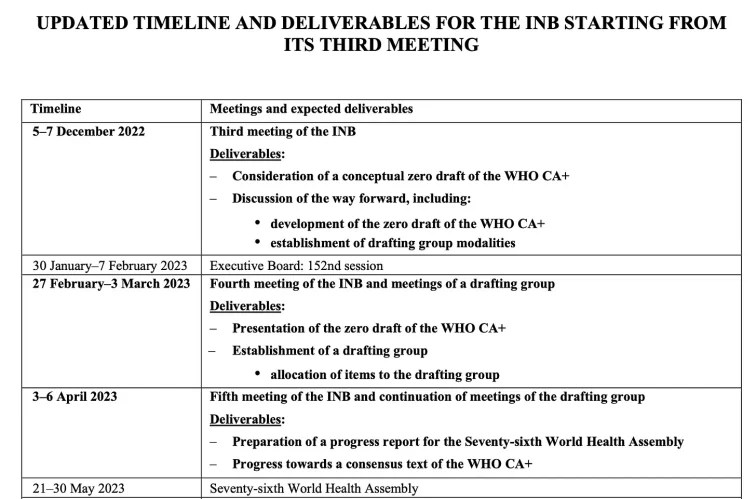
It’s urgent to oppose this before it rolls over us like a steamroller. The World Health Organisation is working hard on the next draft, for consideration by the “Intergovernmental Negotiating Body” in February, and the World Health Assembly in May 2023 (see timeline below)
(Is the treaty a furphy? A decoy to take our eye off the proposed amendments to the International Health Regulations, which are being negotiated in parallel with the treaty? Maybe, but there’s no way I want to take that risk and assume we can ignore it…)
MUST DO BEFORE FEBRUARY:
- Have a read of this amazing summary of everything the WHO is up to. There is also my summary of the treaty below. If you’re keen also read this plain English translation of the treaty.
- Pick out your 3 favourite horror-story highlights. Which 3 things are the most egregious, in your view?
- Tell your friends and your politicians we need to pull out of the WHO, before it’s too late.
Summary of the proposed pandemic treaty
The WHO is to control everyone and everything, everywhere, in the name of health, equity and global solidarity
Because of climate change and the likely increase in diseases crossing over from animals to humans, and increasing resistance to antibiotics, we are likely to have more pandemics in the future.
If we centralise decision-making about pandemics right across the globe, and if everyone falls into line, everyone can be healthier. Vaccines and other new medical products are the solution to pandemics and the proposed treaty.
The proposed treaty will make sure everyone can access vaccines and other new pandemic products. The WHO is the right body to control everything centrally, because it is the directing and coordinating authority for:
- international health work;
- convening and generating scientific evidence; and
- fostering international cooperation in global health governance.
Everything can impact health, so WHO has to be in charge of everything.
The world needs WHO to control and oversee:
- a global system for production and distribution of medical products
- stockpiling of medical products
- fast-tracking of research and development, and licensing of new products
- sharing of pathogen samples, genetic sequences, and benefits arising from those things being shared
- increased surveillance of diseases
- implementation of digital health
- a system of peer reviews and table-top exercises
- public health and social measures necessary for dealing with pandemics and situations that might give rise to pandemics
- censorship
- All must cooperate with the WHO in relation to all of the above measures.
- Wealthy nations must provide funding for the WHO and for developing countries
- Nations maintain their sovereignty – except where that means other nations are at risk
- Communities must be primed to accept public health measures and social measures
Tho WHO reckons this treaty is urgent and important, so:
- Start date is fast-tracked
- Once in, you can’t get out for 3 years
- The treaty can be amended by majority vote and amendments will apply to everyone.
- No adjudication by a court of law if parties are in dispute.
A “Consensus draft” draft will be considered at the May 2023 World Health Assembly. In other words: by May 2023, the content of the treaty already have been agreed in the backrooms.
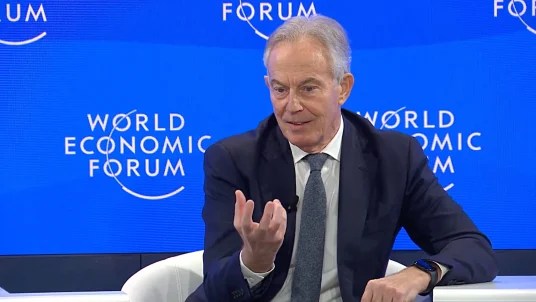
Tony Blair calls for WEF and WTO to introduce “digital infrastructure” that monitors vaccination status
By Tom Parker | Reclaim The Net | January 19, 2023
Former United Kingdom (UK) Prime Minister Tony Blair has called for global organizations such as the World Trade Organization (WTO) and World Economic Forum (WEF) to push national governments to introduce “digital infrastructure” that monitors who has been vaccinated and who hasn’t.
Blair pushed for this government-controlled digital vaccine database during an appearance at the World Economic Forum’s 2023 annual meeting — a yearly event where powerful business leaders, politicians, and other influential figures meet in Davos, Switzerland to discuss the agendas they want to advance.
The former Prime Minister emphasized the importance of “technology and digital infrastructure” and data collection for surveilling the status of the vaccinated and unvaccinated.
“You need the data,” Blair said. “You need to know who’s been vaccinated and who hasn’t been. Some of the vaccines that will come on down the line will be multiple, there’ll be multiple shots. So you’ve got to have, the reasons to do with the healthcare more generally, but certainly, for a pandemic or for…vaccines, you’ve got to have a proper digital infrastructure, and many countries don’t have that. In fact, most countries don’t have that.”
Blair continued by suggesting that his digital vaccination status surveillance dragnet should be pushed through by the WTO (an intergovernmental organization that regulates international trade), the WEF (an unelected global organization that seeks to “shape global, regional and industry agendas”), and intergovernmental forums such as the Group of Twenty (G20) and the Group of Seven (G7).
“Who are the people that can make this happen?” Blair said. “How do you get the right partnerships in place?…That should happen in the G20 particularly, I think, which is… G7 is an important forum, but the G20 is the broader forum… You’ve got to work out what is it that you want to achieve in order to make sure that any future pandemic is properly handled and what are the partnerships that you’re going to create in order to ensure that the answers you get are the right answers. And then you’re going to have the mechanisms of implementation. And those mechanisms will be partly through the formal institutions that you have, like the WTO, and they’ll also be through organizations like yours [the WEF] which… I think… have many advantages because they don’t get landed with the same bureaucracy and frankly small pea politics around them.”
Blair’s call is the latest of several that he and his nonprofit, The Tony Blair Institute for Global Change, have made for an expansion of mandatory digital surveillance infrastructure.
His institute has called for digital IDs and said increased surveillance is a “price worth paying.” Blair himself has also called for mandatory vaccine passports.
And two of the global groups that Blair wants to help push through this digital surveillance system, the WTO and the WEF, are also huge advocates of digital surveillance systems.
The WEF and the WTO have previously pushed “global digital identity of persons and objects.” And the WEF regularly advocates for digital ID programs around the world. This year’s WEF 2023 annual meeting subjected journalists to some of the surveillance technologies it advocates for including digital IDs and biometric scanning.
Not only do these surveillance systems reduce individual privacy but vaccine passports discriminate against citizens and restrict their access to businesses and services.
And the WEF wants to expand this surveillance and discrimination via digital ID. It has proposed a system that monitors online behavior, biometrics, purchases, and more to determine access to a wide range of services.
Related:
How Big Government and Big Tech used COVID to accelerate the adoption of digital ID
Featured Video
Theodore Postol: Iran’s Missiles & Drones Were Underestimated
or go to
Aletho News Archives – Video-Images
From the Archives
What is the Israeli Lobby in Australia Doing in Interfaith Dialogue?
By Ali Kazak | Dissident Voice | October 11, 2015
For years Israel and its lobby around the world have been trying to normalise their relations with Arabs and Muslims without solving the Palestine Question.
One of the methods they resorted to in the last few years is using human rights and community organizations such as interfaith dialogue and Multiculturalism to achieve this objective and to: isolate the Palestinians, marginalise the Palestine question, end Israel’s isolation, and prevent criticism of Israel, knowing that these organisations will be the first to stand against Israel’s violations, racial and religious discrimination.
The group responsible for this task in Australia is The Australia/Israel & Jewish Affairs Council (AIJAC); its Director of International & Community Affairs, Jeremy Jones is in charge of lobbying religious community organizations, specifically Muslims and Christians. Consequently he convened the Faith Communities for Reconciliation, founding participant in the Australian Partnership of Religious Organisations and the Australian National Dialogue of Christians, Muslims & Jews.
AIJAC is a private political propaganda group. It is recognised as the main Israeli lobby in Australia. It coordinates its activities and works intimately with the Israeli embassy in Canberra and different institutions in Israel. It is privately funded by some Jewish businessmen. It monitors closely Australian politicians, the media, ethnic and religious groups, (especially Arabs and Muslims), unions and academics on their stands towards Israel and the Palestine question. … continue
Blog Roll
 Aletho News
- The killing of three Indonesian soldiers in Lebanon should remind Jakarta that Israel does not want peace
- Defeated and delusional: Netanyahu’s remarks reveal $80bn war failure, says analyst
- Iran’s friends are about to make life much more difficult for Israel and the US
- The war of liberation of the Arab and Islamic peoples expands across the Gulf
- Envoy warns UN on Trump’s threat to ‘obliterate’ Iran’s civilian infrastructure
- The Larak Corridor: Iran’s Rial Gate With No US, No Israel, and No Way Around
- ‘Economic terrorism’: Steel facilities hit again in US-Israeli strike
- ‘War Crime’: Iran condemns attacks on Arak, Ardakan nuclear sites
- Two-thirds of Americans want quick end to Iran war even if goals unmet
- Trump to Give “Important Update on Iran” Wednesday in Prime-Time Speech
- If Americans Knew
- Gaza families reunite years after babies evacuated amid Israel’s war
- International Rescue Committee warns Gaza’s children face grave protection risks
- Iran’s Alleged 47-Year War on America: Debunking the 1,050 American Deaths Canard
- Israel wants US to bomb more of Iran’s civilian structures (113,000 is not enough) – Not a ceasefire Day 173
- Ann Coulter Rips Into Fox News for Iran War Coverage
- Joe Kent Urges Americans To Call White House and Congress To Object To Sending Troops Into Iran
- DNC Resolution to Reject AIPAC Funding Puts Democratic Leaders in the Hot Seat
- Swedish foundation to build 400 schools as over 650,000 Gaza children remain without education for 2 years
- Israeli army admits photshopping image of slain Lebanese journalist
- This is how Israel is systematically killing health workers under the cover of war in Lebanon
- No Tricks Zone
- New Study Finds Warming Saves Lives…Cold Temperatures 12 Times More Deadly Than Excess Heat
- German Science Blog Accuses PIK Climate Institute Of Hallucinating Climate Tipping Points
- Devastating Assessment Of Comirnaty Vaccine By Former Senior Pfizer Europe Toxicologist
- New Study: CO2 Is ‘Effectively Negligible’ As An Explanatory Climate Change Factor Since 2000
- Former Pfizer Toxicologist Dr. Helmut Sterz Tells Bundestag Hearing Pfizer Vaccine Should Have Never Been Approved
- Energy Expert: Germany’s Nuclear Phaseout Was A “500 Billion Euro Mistake”
- New Research: South Australia’s Mid-Holocene Sea Surface Temperatures Were 4°C Warmer Than Today
- Storing Green Energy To Last Germany 10 Days Would Require A 60-Million Tonne Battery
- New Studies: UK Sea Levels Were 4 Meters Higher Than Today During The Mid-Holocene
- Destructive Green New Deal: German Energy And Metal Group Warns Of Drastic Crisis
 Aletho News