MbS urged Baghdad to set up Iran-Saudi meeting: Iraqi FM
The Cradle | January 31, 2023
As part of a diplomatic process aimed at mending strained relations between the two neighbors, Saudi Crown Prince Mohammed bin Salman (MbS) reportedly pressured senior Iraqi officials to set up a face-to-face meeting between the top diplomats of Riyadh and Tehran. This was revealed by the Iraqi Foreign Minister, Fuad Hussein, on 30 January.
In an interview with Rudaw TV on 29 January, the Iraqi Foreign Minister said that “Prince Faisal bin Farhan Al Saud and Hossein Amir-Abdollahian, the foreign ministers of Saudi Arabia and Iran, will meet in Baghdad, at the request of Mohammed bin Salman. The event is still planned, and the time and date will be announced later.”
He also said that the Iranian and Saudi foreign ministers would meet in public and that Iraq would act as a middleman to ensure that the details of the private conversations were made public.
The Saudi diplomat stated earlier this month that his nation has spoken with Iran and is looking for a way to open a dialogue between the two.
In an effort to improve their bilateral relations, the two sides began negotiations in the spring of 2021 and held five rounds of talks in the Iraqi capital. However, Tehran suspended the negotiations after Riyadh executed 81 people under the pretext of being involved in “terrorism,” the majority of which were minority Shia Muslims.
Relations have recently become tenser due to Saudi Arabia’s alleged sponsorship of the protests in Iran in late 2022.
Iran’s Intelligence Minister, Esmail Khatib, was quoted by Iranian media as saying it is running out of patience and will no longer tolerate intervention, hostility, and incitement in a direct message to Saudi Arabia.
Meanwhile, in November, Iran sent an official warning message to the kingdom through diplomatic channels, confirming that it is fully aware of “the Saudi connection to Iran International.” Riyadh categorically denied this, saying it has “nothing to do with the outlet.”
Isfahan incident may have been foreign provocation
By Lucas Leiroz | January 31, 2023
The Islamic Republic of Iran was the target of air strikes with drones in the early hours of January 29th. Many unconfirmed rumors about the attacks have been spread on the internet, but the most probable possibility is that the action was planned by Israelis and Azeris in order to dissuade Iran to take a less active stance in current key conflicts, considering that many factories of Shahed military drones, one of Iran’s most important weapons, were hit during the bombings.
Iran’s Ministry of Defense confirmed that some attacks occurred in the Isfahan region. Military drone factories were the main targets, which indicates that it was an assault aimed at destroying the Iranian war industry. Other regions also reported incidents, mainly Khoy, on the border with Azerbaijan, but without official confirmation from the Iranian government.
According to some anonymous sources, the drones used in the attacks probably came from an Israeli military base in Azerbaijan. During the strikes, some media outlets even published news stating that Tel Aviv had formally started a military operation inside the Iranian territory which has been described as “disinformation and “psychological warfare” by the Iranian authorities. Investigations are still being conducted and apparently there are Iranian officials both confirming and denying the Israeli involvement.
On the 30th, Iranian officials anonymously informed some Middle Eastern media outlets that data so far indicate that Tel Aviv is the side responsible for the attack. However, some other Iranian representatives on the same day have expressed skepticism about this possibility, claiming that, in such a circumstance, Tel Aviv would certainly be willing to admit its responsibility.
For example, Abbas Moghtadaei, deputy chairman of the Iranian Parliament’s Foreign Policy and National Security Commission, said during an interview to Russian press: “If Israel had done this, it would proudly show evidence of its operation to the whole world”.
However, many reasons indicate that in fact the country most interested in carrying out this assault on Iran would really be Israel. In addition to historic regional rivalries between Iran and Israel, Iran’s pro-Armenian stance on the Artsakh conflict and Tehran-Moscow cooperation regarding military drones have been seen recently as a “threat” by the Israeli government and its Western allies. Furthermore, interestingly, Israeli attacks against Iranian military and humanitarian convoys in Iraq and Syria have also occurred recently, which further points to the possibility of an Israeli wave of aggressions on Iran.
Some reasons could explain why Israel did not “confess” the attack publicly. First, it is necessary to understand that apparently the strikes had a lower effect than what was being planned by the aggressor forces. The damage caused to the drone industry was insignificant, visibly not enough to harm the Iranian-Russian or Iranian-Armenian military partnership. Pro-Israel media outlets even spread fake news trying to make the attacks seem bigger than they really were, but they failed due to concrete data, as normal life in Iran continued during the strikes, including air traffic. So, faced with an unsuccessful assault, perhaps Israel chose not to declare its involvement in the incursion.
Azerbaijani participation should also be considered. Although there was no official confirmation, there are reliable sources indicating that the drones used in the provocations were sent from an Israeli military base in Azerbaijan. Another interesting factor is that the Azerbaijani diplomats in Iran left the country after the incident, with the Azerbaijani Embassy in Tehran currently inactive. In fact, as rivalries in the region increase, Israel and Iran tend to have more and more friction – and obviously the Azeris would be interested in annihilating Iranian weapons such as the Shahed drones before it comes to an open war scenario.
What is really known is that, regardless of which country operated them, the attacks indeed happened and were certainly a response to the Iranian position in current conflicts. Shahed drones, used by Russian forces against military positions of the Ukraine’s neo-Nazi regime, are the focus of Western leaders’ concerns regarding Iran. Certainly, if a pro-Western country wanted to attack Iran, choosing drone factories as the main target would be a decision of high strategic value.
It remains to be seen how the Iranian government will react to the provocations it suffered. Tehran has historically been marked by its extreme caution in conducting military actions, responding slowly and asymmetrically to foreign affronts – and it is likely that it will also be the case this time. Of course, any measure against Israel needs to be very well planned, since Tel Aviv has nuclear weapons, but an expected scenario is increased Iranian activities on the Artsakh issue, as neutralizing Azerbaijan seems to be becoming a real necessity for the Persian country’s security.
Lucas Leiroz is a researcher in Social Sciences at the Rural Federal University of Rio de Janeiro; geopolitical consultant.
American Academy of Pediatrics greenlights dangerous drugs & aggressive surgeries for obese kids
The Highwire with Del Bigtree | January 26, 2023
Sound science and balanced solutions or revolving door industry influence ripe with conflicts of interest? The HighWire investigates.
The Censorship of Mercola — A Timeline
By Dr. Joseph Mercola | January 30, 2023
While the drug and chemical industries have attacked and tried to discredit me for years, blatant censorship didn’t begin until 2020, after the outbreak of the COVID pandemic.
For legal and historical purposes, I am sharing a timeline of events with you that document a chain of coordinated events and attacks against me and this website. My first article about the pandemic came out February 4, 2020, in which I predicted that it was a grossly exaggerated threat that would enrich pandemic vaccine makers.
March 8, 2020, I published an interview with bioweapons expert Francis Boyle, Ph.D., in which he warned that SARS-CoV-2 had all the hallmarks of a genetically engineered bioweapon. Boyle was among the first, if not the first, to suspect the outbreak was the result of a lab leak.
While every health authority on the planet insisted there was no treatment, and that patients simply go to the hospital to be placed on mechanical ventilation and die, I interviewed medical experts working on early treatment options and published articles detailing the potential benefits of vitamin D, zinc, quercetin and other nutraceuticals that boost immune function, as well as decades-old drugs like hydroxychloroquine.
I also published the testimony of whistleblowers such as Erin Marie Olszewski, a frontline nurse, who warned that patients were being intentionally killed on ventilators as it quickly proved to be a deadly intervention for COVID-19.
Summer of 2020 — The Suppression of Vitamin D Begins
Early on, it became apparent that vitamin D levels and spending time outdoors played an important role in the risk of infection and the ultimate outcomes. This has been true for all respiratory infections, so it should come as no surprise it is also true for coronavirus infections. Despite that, health authorities insisted vitamin D was useless.
The only way out of the pandemic, they said, would be a vaccine — and this despite the fact that no previous attempts at creating a safe and effective coronavirus vaccine had ever succeeded because of its rapid ability to mutate.
In June 2020, I launched an information campaign, StopCovidCold, about vitamin D. I released a downloadable scientific report detailing how and why optimizing vitamin D levels among the general population could minimize the impact of the next wave of COVID. Optimizing vitamin D is a rational, safe and inexpensive measure that no sane health official would object to. And yet, they all did.
July 21, 2020, the Center for Science in the Public Interest (CSPI) issued a press release1 calling on the U.S. Food and Drug Administration and the Federal Trade Commission (FTC) “to bring enforcement proceedings against Mercola and his companies for their unlawful disease claims that falsely and misleadingly claim to treat, cure or prevent COVID-19 infections.”
CSPI accused me of falsely claiming “that at least 22 vitamins, supplements and other products available for sale on his web site can prevent, treat, or cure COVID-19 infection.” This despite the fact that their Appendix of Illegal Claims2 clearly show I made no COVID-19-related claims to any specific products and only referenced published studies and mainstream media articles to support my opinions.
In an August 12, 2020, email, CSPI president Dr. Peter Lurie — a former FDA associate commissioner — also made the spurious claim that I was “profiting from the pandemic” through “anti-vaccine fearmongering:” 3
“Mercola brazenly has claimed that many of his products are coronavirus treatments or cures, including vitamin C, vitamin D, zinc, selenium, ‘molecular hydrogen,’ licorice, and other substances.
Besides profiting from the pandemic, Mercola has seemingly advised people to contract COVID-19 after taking supposedly ‘immunity boosting’ supplements (which of course he sells). Making matters worse, Mercola is a leading proponent of anti-vaccine conspiracy theories — and has been fearmongering against prospective COVID-19 vaccines even before such vaccines are available!”
By mid-August, a comprehensive campaign to put an end to Mercola.com had been launched, with Laurie asking CSPI members to flood the FDA and FTC with prewritten Tweets, urging them to take action against us. He also urged “state attorneys general to investigate how they may further protect consumers from Mercola’s illegal marketing.”4
Not surprisingly, CSPI is funded by the Rockefeller Foundation, the Rockefeller Family Fund, Bloomberg Philanthropies and other billionaire-owned foundations. It’s also partnered with Bill Gates’ agrichemical PR group, the Cornell Alliance for Science. Greg Jaffe, who heads up CSPI’s Biotechnology Project, is also the associate director of legal affairs at Alliance for Science.
Winter of 2020 — Vitamin D Attacks Heat Up
The attacks against me really heated up though after I published a peer-reviewed scientific paper5 on the benefits of vitamin D at the end of October 2020. With that, I established my medical and scientific merit and my right to a professional opinion, which is something the U.S. Constitution absolutely provides for.
The paper, “Evidence Regarding Vitamin D and Risk of COVID-19 and Its Severity,” published in the journal Nutrients, was coauthored by William Grant, Ph.D., and Dr. Carol Wagner, both of whom are part of the GrassrootsHealth expert vitamin D panel.
As noted in that paper, dark skin color, increased age, pre-existing chronic conditions and vitamin D deficiency are all features of severe COVID disease, and of these, vitamin D deficiency is the only factor that is modifiable. As such, it would be foolish to ignore, especially since vitamin D supplements are readily available and low cost.
Christmas Eve 2020, attorney general Letitia James sent us a cease and desist notice, demanding we stop sharing information about how immune-boosting nutritional supplements might lower your risk of COVID, including vitamin D, zinc, NAC and vitamin C.
February 2021, FDA Tries to Silence Protected Speech
After the new presidential administration took over, on February 18, 2021, the Rockefeller-funded CSPI and AG James got their wish, as the FDA sent us a warning letter for “Unapproved and Misbranded Products Related to Coronavirus Disease 2019.”6 Laurie even publicly bragged7 about his ability to influence the FDA to take action against us.
The FDA’s letter highlighted statements in articles on my website that were fully referenced and supported by published science, and none of the articles cited had any commercial advertising linking the information to my products, as per the law. We had done nothing illegal or irregular in that regard, and my professional opinions are protected under the U.S. Constitution.
Needless to say, we fully addressed both James’ cease and desist notice and the FDA’s warning letter, putting them both on notice that they cannot censor protected speech simply because they don’t like what’s being said.
On a side note, William Correll, the director of the Office of Compliance at the FDA who signed the warning letter, sadly “passed away suddenly” just two months later, on April 18 “after a short battle with COVID-19.”8
Gates-Funded Front Group Gets on the Bandwagon
The agrochemical front group Cornell Alliance for Science (CAS),9 the primary funding for which comes from the Bill & Melinda Gates Foundation,10 also jumped on the bandwagon, falsely stating11 that “pages advertising vitamin C and quercetin as having ‘synergistic effects that make them useful in the prevention and early at-home treatment of COVID-19′” were still available on my website nearly a month after the FDA’s warning letter.
To be clear, we had fully referenced scientific news articles. News articles are NOT “advertising,” as they do not link to any specific products, nor do they refer to or recommend any specific brands. In the case of the warning for vitamin C, the article discussed hospitals utilizing IV vitamin C for the treatment of COVID-19 and sepsis.
Such coordinated attacks are to be expected, though, considering Gates’ influence over the operation, and seeing how CAS and CSPI work closely together — a fact CAS admitted in its hit piece.12
March 2021, Booksellers Urged to Ban My Book
Around that same time (February 11, 2021), my book “The Truth About COVID-19” also went up for presale, and by early March, booksellers in the U.S., U.K. and Australia were being pressured not to sell it, or to add some sort of misinformation warning label to it. As reported by Sky News March 5, 2021:13
“In the UK, more than 20 million vaccine doses have been administered as part of efforts to defeat COVID-19, but worries continue that misinformation is stopping some people from having the jab. Shadow health minister Alex Norris told Sky News:
‘Getting our population vaccinated is a massive priority and it is very sad to see these things so freely available. We would hope that retailers would act responsibly and have a look at whether they want to be associated with such products and whether they want to be seen to be profiting off such products.'”
Shady ‘Anti-Hate’ Outfit Publishes Hit List
March 3, 2021, the Center for Countering Digital Hate (CCDH) — a shady U.K.-based organization with anonymous funding led by Imran Ahmed — also got in on the action, publishing a hit list14 of the “Top 10 anti-vaxxers” it wanted permanently silenced and eradicated from public forums. The list showed, by way of crossing out names, which had already been successfully deplatformed, and from which social media.
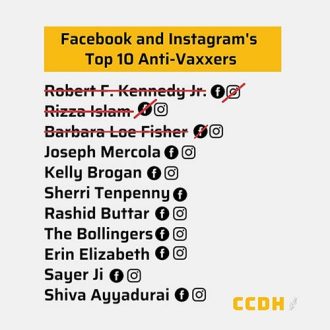
While precious little was (and still is) know about the CCDH, some digging revealed Ahmed had been appointed to the steering committee of the U.K. government’s Commission on Countering Extremism Pilot Task Force in April 2020, just as fearmongering about the COVID-19 pandemic was ramping up. The CCDH is also linked to a number of technocratic centers within the globalist network through its board members.15
More Fabrications and Lies From the CCDH
A couple of weeks later (March 15), Ahmed somehow managed to get an article titled “Dismantling the Anti-Vaxx Industry”16 published in the journal Nature Medicine. In it, Ahmed lied, claiming he’d “recorded a private, three-day meeting of the world’s most prominent anti-vaxxers,” when in fact it was a public, international conference given online, attended by thousands around the world, all of whom had access to the recordings.
He could have done the normal, ethical and truly journalistic thing and admitted he simply attended a public virtual conference, but instead he twisted it into some risky undercover agent mission where he secretly recorded private discussions that revealed the inner workings of “the opposition.”
Then, March 21, 2021, the CCDH published the fabricated “Disinformation Dozen” report,17,18,19 in which Ahmed falsely claimed 12 people and/or organizations, including yours truly, were responsible for 65% of all anti-vaccine content on social media.
March 24, 2021 — AGs Try to Censor Protected Speech
March 24, 2021, 12 attorneys general sent a letter20 to the CEOs of Twitter and Facebook, seeking their “cooperation in curtailing the dissemination” of COVID jab “misinformation” — all based on the fabrications of the CCDH. According to the AGs:
“The people and groups spreading falsehoods and misleading Americans about the safety of coronavirus vaccines are threatening the health of our communities, slowing progress in getting our residents protected from the virus, and undermining economic recovery in our states.
As safe and effective vaccines become available, the end of this pandemic is in sight. This end, however, depends on the widespread acceptance of these vaccines as safe and effective. Unfortunately, misinformation disseminated via your platforms has increased vaccine hesitancy …
According to a recent report by the Center for Countering Digital Hate, so-called ‘anti-vaxxer’ accounts on Facebook, YouTube, Instagram and Twitter reach more than 59 million followers … Given ‘anti-vaxxers’ reliance on your platforms, you are uniquely positioned to prevent the spread of misinformation about coronavirus vaccines …”
Facebook Set the Record Straight
August 18, 2021, after conducting an internal investigation, Monika Bickert, vice president of Facebook content policy, publicly called out the falsehoods in “The Disinformation Dozen” report, stating:21
“In recent weeks, there has been a debate about whether the global problem of COVID-19 vaccine misinformation can be solved simply by removing 12 people from social media platforms. People who have advanced this narrative contend that these 12 people are responsible for 73% of online vaccine misinformation on Facebook.
There isn’t any evidence to support this claim … In fact, these 12 people are responsible for about just 0.05% of all views of vaccine-related content on Facebook. This includes all vaccine-related posts they’ve shared, whether true or false, as well as URLs associated with these people.”
Bickert highlighted the fact that Ahmed had preselected the 12 individuals listed in the report, and that his “faulty narrative” was based on nothing more than “a narrow set of 483 pieces of content over six weeks from only 30 groups, some of which are as small as 2,500 users.”
“Further, there is no explanation for how the organization behind the report identified the content they describe as ‘anti-vax’ or how they chose the 30 groups they included in their analysis,” Bickert noted. “There is no justification for their claim that their data constitute a ‘representative sample’ of the content shared across our apps.”
Apparently, no one in government was smart enough to see the flaws in the CCDH’s report though, and a long list of officials cited the CCDH’s fabricated claims throughout the remainder of 2021, even long after Facebook denounced its claims. What’s more, even though Facebook admitted the CCDH’s claims were bogus, they still took action against accounts by applying penalties and/or bans.
April 8, 2021 — AGs Call on Social Media to Ban ‘the 12’
April 8, 2021, attorneys general James and William Tong published an op-ed in The Washington Post,22 again calling on social media companies to ban the “disinformation dozen” identified by the CCDH. The lack of acceptance of novel gene therapy technology, they claimed, was all because a small group of individuals with a social media presence — myself included — were successfully misleading the public with lies about nonexistent vaccine risks.
April 27, 2021 — Dr. Hotez Calls for Cyberwarfare
April 27, 2021, Dr. Peter Hotez, president of the Sabin Vaccine Institute23 — which has received tens of millions of dollars from the Bill & Melinda Gates Foundation,24,25 — escalated the threat even further in an article published in the journal Nature.
Citing the CCDH’s findings, Hotez called for cyberwarfare experts to be enlisted in the war against vaccine safety advocates and people who are “vaccine hesitant.” He wrote:26
“Accurate, targeted counter-messaging from the global health community is important but insufficient, as is public pressure on social-media companies. The United Nations and the highest levels of government must … move to dismantle anti-vaccine groups in the United States.
Efforts must expand into the realm of cyber security, law enforcement, public education and international relations. A high-level inter-agency task force reporting to the UN secretary-general could assess the full impact of anti-vaccine aggression, and propose tough, balanced measures.
The task force should include experts who have tackled complex global threats such as terrorism, cyber attacks and nuclear armament, because anti-science is now approaching similar levels of peril. It is becoming increasingly clear that advancing immunization requires a counteroffensive.”
In short, Hotez called for the use of warfare tactics on law abiding American citizens, and the Nature journal actually published this blatant threat. One day later, April 28, the CCDH published a second report, “Disinformation Dozen: The Sequel,”27 which focused on Big Tech’s failure to get rid of us “despite bipartisan calls from Congress.”
To understand the massive reach the CCDH gained, despite no one having heard of them before COVID, consider this: By the end of August 2021, there were 84,700 Google search results for CCDH’s defamatory phrase “disinformation dozen,” including 16,000 news stories in the international press, nearly all of which parroted the CCDH’s defamatory statements verbatim and reported them as fact.
May 2021 — Financial Warfare Led to Removal of COVID Articles
Shortly after the op-ed by AGs James and Tong appeared, our business bank accounts were abruptly shut down and our credit cards canceled. Our business partners also had their PayPal accounts shut down.
This new threat, which I could not defend against in a court of law, led to my May 4 decision to remove all articles related to vitamin D, vitamin C, zinc and COVID-19 from my website.
July 2021 — The White House Publicly Calls for Censorship
In mid-July 2021, the White House stepped in to pressure Facebook to purge “anti-vaxxers” from its platform. Then-press secretary Jen Psaki regurgitated the CCDH’s false claims, saying:28
“There’s about 12 people who are producing 65% of anti-vaccine misinformation on social media platforms. All of them remain active on Facebook, despite some even being banned on other platforms, including ones that Facebook owns.
Facebook needs to move more quickly to remove harmful, violative posts. Posts that would be within their policy for removal often remain up for days, and that’s too long. The information spreads too quickly.”
In another mid-July press conference, President Joe Biden himself demanded social media take action against “the disinformation dozen,” claiming our “misinformation” was “killing people.”29,30 None of these officials ever questioned the authority of the CCDH. Facebook spokesperson Dani Lever responded to the White House’s demands, saying:
“We will not be distracted by accusations which aren’t supported by the facts. The fact is that more than 2 billion people have viewed authoritative information about COVID-19 and vaccines on Facebook, which is more than any other place on the internet … The facts show that Facebook is helping save lives. Period.”
Summer of 2021 — A Parade of Hit Pieces
July 24, 2021, the New York Times named me the No. 1 superspreader of COVID misinformation online.31 According to the NYT itself, this was the most-read article of the year up to that point. Penned by Sheera Frenkel, it was so littered with blatant lies, my attorneys sent her a retraction demand.32
For example, she claimed the FDA has levied multimillion-dollar fines against me. This is a complete fabrication, as I’ve never been fined by the FDA. She also implied that I misrepresented myself as a published author of a paper on vitamin D for COVID-19, stating she was “unable to verify” my claim. This despite being given a direct link to the paper! My paper can also be located on PubMed.gov in seconds by searching my name.
Frenkel boldly claimed that I am the No.1 spreader of misinformation online, but she didn’t even qualify what “misinformation” actually is. Without qualifying what it is you’re looking for, how can you quantify it? She also provided no proof that I in fact had the greatest reach of all the individuals reporting on COVID injections. My name didn’t even show up in the Top 15 in a Crowdtangle search for anti-vax Facebook posts.
Frenkel’s hit piece was followed up by CNN, which August 4 aired a segment show CNN reporter Randi Kaye stalking me across central Florida. And, of course, Kaye’s primary citation for her accusations against me was the CCDH.
August 4, 2021 — Mercola Deletes Articles After 48 Hours
August 4, 2021, I also implemented yet another change on my website. I had already removed all articles relating to COVID-19 and vitamin D. At this point, I deleted over 15,000 articles from the past 20-plus years from my website as the business and personal threats grew out of hand.
After 48 hours, articles were instead migrated over to Substack, where only paid members through a private membership agreement have access to them. This was a painful but necessary workaround, as the paid subscription provides a layer of protection against these threats.
September 7, 2021 — Senator Warren’s Book Burning Campaign
September 7, 2021, U.S. Sen. Elizabeth Warren sent a letter33 to Andy Jassy, chief executive officer of Amazon.com, demanding an “immediate review” of Amazon’s algorithms to weed out books peddling “COVID misinformation.”34,35,36
While she didn’t spell out what laws Amazon might be breaking, she warned Jassy that the company may be held legally responsible for wrongful death and homicide by selling books that “misinform” readers about COVID-19, and she specifically singled out “The Truth About COVID-19” as a prime example of the kinds of books she wanted banned.
Warren again relied on the fabrications of the CCDH, even though Facebook had refuted the CCDH report as baseless three weeks before she sent that letter.
“Dr. Mercola has been described as ‘the most influential spreader of coronavirus misinformation online,'” Warren wrote, adding: “Not only was this book the top result when searching either ‘COVID-19’ or ‘vaccine’ in the categories of ‘All Departments’ and ‘Books’; it was tagged as a ‘Best Seller’ by Amazon and the ‘#1 Best Seller’ in the ‘Political Freedom’ category.
The book perpetuates dangerous conspiracies about COVID-19 and false and misleading information about vaccines. It asserts that vitamin C, vitamin D and quercetin … can prevent COVID-19 infection … And the book contends that vaccines cannot be trusted, when study after study has demonstrated the overwhelming effectiveness and safety of COVID-19 vaccines.
It should come as no surprise that the book is rife with misinformation. One of the authors, Dr. Mercola, is one of the ‘Disinformation Dozen,’ a group responsible for 65% of anti-vaccine content on Facebook and Twitter …”
YouTube Deplatforms Mercola in Breach of Contract
Warren’s attempt at getting Amazon to ban my book was swiftly followed up by YouTube, which deleted my account September 29, 2021, allegedly for violating community guidelines. The problem was, they’d published and implemented those new guidelines that very morning.
While I disagreed with YouTube’s censorship, when its “COVID-19 misinformation” policy was implemented back in April 2021, I carefully avoided posting any content on YouTube that might violate that guideline. At no point had I ever received a violation notice from YouTube.
On the morning of September 29, 2022, at 9 a.m. EDT, The Washington Post published an article titled “YouTube Is Banning Joseph Mercola and a Handful of Other Anti-Vaccine Activists.” According to the WaPo :37
“YouTube is taking down several video channels associated with high-profile anti-vaccine activists including Joseph Mercola … As part of a new set of policies aimed at cutting down on anti-vaccine content on the Google-owned site, YouTube will ban any videos that claim that commonly used vaccines approved by health authorities are ineffective or dangerous.
The company previously blocked videos that made those claims about coronavirus vaccines, but not ones for other vaccines like those for measles or chickenpox.”
In short, as of September 29, 2021, you could no longer post any video discussing or stating that any vaccine is dangerous or ineffective. Six minutes after the publication of that WaPo article, I received an email from YouTube informing me that my entire channel had been deplatformed, having been found in violation of this new policy.
October 2021 — CNN’s Second Hit Piece
October 4, 2021, two months to the day after their first attempted hit piece against my book, “The Truth About COVID-19,” CNN aired a follow-up in which they echoed Warren’s call for Amazon to ban the sale of my book.
Like something straight out of George Orwell’s “1984” newsspeak dictionary, CNN host Anderson Cooper said my book is loaded with “mistruths” about COVID. Yet he failed to present a single piece of evidence to back up that claim.
This is one of the oldest propaganda trick in the book. If you just spew out enough derogatory terms about your opponent, people will forget the fact that you provided zero proof to back up your position.
November 2021 — Mercola Sues Sen. Warren
November 7, 2021, two months after Warren tried to get my best-selling book “The Truth About COVID-19” banned from Amazon, I, my coauthor Ronnie Cummins, my publisher and Robert F. Kennedy Jr., who wrote our foreword, sued Warren,38 both in her official and personal capacities, for violating our First Amendment rights and scaring book sellers into pulling and/or suppressing sales.
As a government official, it is illegal for her violate the U.S. Constitution, and pressuring private businesses to do it for her is not a legal workaround.
February 2022 — NIH Director Blames Mercola For Pandemic Continuation
In February 2022, former National Institutes of Health director Dr. Francis Collins blamed me personally for the government’s inability to bring the COVID pandemic to a close. This despite the fact that I was by then heavily censored just about everywhere. The only people, really, who could see my information were those who subscribed to my newsletter and received it by email.
August 2022 — NYT Airs Hit Piece Documentary
Fast-forward to August 2022, The New York Times published the documentary “Superspreader,” featuring yours truly, on FX and Hulu (both of which are owned by Disney). They clearly went through a lot of trouble, trying to dig up dirt from anyone they could find from my past — some going back 40 years, to my medical school days — who would be able to share some tidbit with which they could discredit me with.
But it seems they came up empty handed: After a year of investigation, they couldn’t come up with anything. Surprisingly, they even showed two people who claimed I’d saved their lives. All the other interviews were with people who don’t actually know me. One was with a Chicago journalist who interviewed me once — 13 years ago. Two classmates from med school, whom I haven’t seen in over 40 years, also described their impressions.
Ironically, yet again, just one week before the “Superspreader” program aired, the U.S. Centers for Disease Control and Prevention reversed all of its COVID-19 guidelines, thereby proving my position on COVID was correct all along. Of course, this was never mentioned in their program though.
September 23, 2022 — Mercola Website Taken Down in Cyberattack
Next up was a cyberattack that took down my entire website and destroyed our servers. Cyberattacks have been ongoing for the past six years, but the one that took place September 23, 2022, finally got through our defenses. By that time, my reach on social media had been throttled back to next to nothing, and my website was about the only place you could find my articles (with the exception of republications, which I allowed).
September 28, 2022 — Mercola Sues Google and YouTube
Warren isn’t the only one I’ve had to sue to protect my First Amendment right. In September 28, 2022, I also filed a lawsuit39 against Google, YouTube and Alphabet Inc. for breach of contract.40
As detailed in my complaint, YouTube unilaterally amended the contract without notice, which is a violation of its own terms of service, and then used this last-minute amendment to justify removing my content, which went back to 2005, the same year YouTube was founded. At the time YouTube deleted my content, I had more than 300,000 subscribers, and my videos had collectively garnered more than 50 million views.
The WaPo article was embargoed until the morning of September 29 in order to prevent me (and anyone else affected by this change) from reviewing the new policy, take steps to bring my channel into compliance, or move my content to another platform. Instead, they simply deleted 16 years’ worth of intellectual property, without warning.
This is a clear violation of its own terms of service, which state that YouTube “will provide reasonable advance notice” of any changes to the terms of service, and that users will have “the opportunity to review them” and to remove content if they do not agree to the new terms.
YouTube’s terms of service also include a “three strikes” policy, where users are given three warnings and opportunities to remove content that violates the guidelines before being banned. I had no “strikes” against my channel on the day I was deplatformed and deleted.
I’m also suing YouTube for unjust enrichment, as for the last 16 years, my video content, having generated in excess of 50 million views, has been of great financial benefit to YouTube, allowing them to increase advertising revenue on the site. Additionally, they’ve refused to allow me to retrieve any of this content, which they still have in their possession. So, YouTube has unjustly benefited at my expense.
January 2023 — Third Lawsuit Filed to Protect Free Speech
January 10, 2023, I, along with several other plaintiffs, also filed a lawsuit41 against The Washington Post, the BBC, the Associated Press and Reuters — also known as the Trusted News Initiative (TNI),42 a self-appointed Pharma and Big Tech industry partner that has spent the past couple years playing judge and jury of news.
It has been doing everything it can to censor what it doesn’t want the public to hear. As noted in the complaint, the TNI has not only censored free speech, it has also engaged in antitrust activity. Specifically, “Federal antitrust law has its own name for this kind of ‘industry partnership’: it’s called a ‘group boycott’ and is a per se violation of the Sherman Act.”
As evidence of this allegation, our complaint references multiple public statements by TNI partners, including a March 2022 statement by Jamie Angus, then-senior news controller for BBC News, who explained TNI’s “strategy to beat disinformation.”
The Fight for Truth and Freedom Continues
The globalist cabal is extremely coordinated, as you can see. What’s more, they play dirty. But we will not give up, nor give in. Our freedom is far too precious for that, and freedom depends on getting the truth out. So, I will continue doing my part. You can help by sharing articles you think are important with family and friends, in whatever ways are available.
Sources and References
- 1 CSPI July 21, 2020
- 2 Illegal Claims Pertaining to Mercola Group Products (PDF)
- 3 CSPI July 19, 2017
- 4, 7 SCPInet.org March 4, 2021
- 5 Nutrients October 31, 2020;12, 3361; doi:10.3390/nu12113361
- 6 FDA Mercola Warning Letter February 18, 2021
- 8 Sun Gazette April 24, 2021
- 9 USRTK September 23, 2020
- 10 Cornell Alliance for Science Our Funders
- 11, 12 Cornell Alliance for Science, March 2021, FDA Warns Mercola
- 13 Sky News March 5, 2021
- 14 Twitter CCDH March 3, 2021
- 15 In-this-together.com, CCDH The Center for Cancel Culture and Digital Hypocrisy Part 2
- 16 Nature Medicine March 15, 2021
- 17 Counterhate.com Disinformation Dozen March 21, 2021
- 18 The Disinformation Dozen
- 19 PR Newswwire March 24, 2021
- 20 Letter to Jack Dorsey and Mark Zuckerberg March 24, 2021
- 21 Facebook August 18, 2021
- 22 Washington Post April 8, 2021
- 23 Texas Children’s Hospital Peter Hotez
- 24 PND July 1, 2011
- 25 Bill & Melinda Gates Foundation
- 26 Nature April 27, 2021
- 27 CCHD Disinformation Dozen: The Sequel April 28, 2021
- 28 Reason July 15, 2021
- 29 CNN July 16, 2021
- 30 AP July 16, 2021
- 31 New York Times July 24, 2021 (Archived)
- 32 Twitter Dr. Joseph Mercola July 26, 2021
- 33 Warren’s letter to Andy Jassy September 7, 2021
- 34 National Interest September 12, 2021
- 35 The Guardian September 13, 2021
- 36 New York Times September 8, 2021
- 37 Washington Post September 29, 2021
- 38 US District Court Western District of Washington Case: 2:21-cv-01508
- 39 Complaint for Contract Breach Mercola vs Google, YouTube, Alphabet Inc. September 28, 2022
- 40 Reuters September 29, 2022
- 41 US District Court Northern District of Texas Case: 2:23-cv-00004-Z
- 42 The Defender January 10, 2023
The Real Disinformation Was The ‘Russia Disinformation’ Hoax
By Ron Paul | January 30, 2023
Thanks to the latest release of the “Twitter Files,” we now know without a doubt that the entire “Russia disinformation” racket was a massive disinformation campaign to undermine US elections and perhaps even push “regime change” inside the United States after Donald Trump was elected president in 2016.
Here is some background. In November, 2016, just after the election, the Washington Post published an article titled, “Russian propaganda effort helped spread ‘fake news’ during election, experts say.” The purpose of the article was to delegitimize the Trump presidency as a product of a Russian “disinformation” campaign.
“There is no way to know whether the Russian campaign proved decisive in electing Trump, but researchers portray it as part of a broadly effective strategy of sowing distrust in US democracy and its leaders,” wrote Craig Timberg. The implication was clear: a Russian operation elected Donald Trump, not the American people.
Among the “experts” it cited were an anonymous organization called “Prop Or Not,” which in its own words claimed to identify “more than 200 websites as peddlers of Russian propaganda during the election season, with combined audiences of at least 15 million Americans.”
The organization’s report was so preposterous that the Washington Post was later forced to issue a clarification, even though the Post provided a link to the report which falsely accused independent news outlets like Zero Hedge, Antiwar.com, and even my Ron Paul Institute as “Russian disinformation.”
The 2016 Washington Post article also featured “expert” Clint Watts, a former FBI counterintelligence officer who went on to found another outfit claiming to be hunting “Russian disinformation” in the US, the “Hamilton 68” project. That project was launched by the Alliance for Securing Democracy, a very well-funded organization containing a who’s who of top neocons like William Kristol, John Podesta, Michael McFaul, and many more.
Thanks to the latest release of the “Twitter Files,” Matt Taibbi reveals that the Hamilton 68 project, which claimed to monitor 600 “Russian disinformation” Twitter accounts, was a total hoax. While they refused to reveal which accounts they monitored and would not reveal their methodology, Twitter was able to use reverse-engineering to determine the 600-odd “Russian-connected” accounts. Twitter found that despite Hamilton’s claims, the vast majority of these “Russian” accounts were English-speaking. Of the Russian registered accounts – numbering just 36 out of 644 – most were employees of the Russian news outlet RT.
It was all a lie and the latest Twitter Files release confirms that even the “woke” pre-Musk Twitter employees could smell a rat. But the hoax served an important purpose. Hiding behind anonymity, this neocon organization was able to generate hundreds of media stories slandering and libeling perfectly legitimate organizations and individuals as “Russian agents.” It provided a very convenient way to demonize anyone who did not go along with the approved neocon narrative.
Twitter’s new owner, who has given us a look behind the curtain, put it best in a Tweet over the weekend: “An American group made false claims about Russian election interference to interfere with American elections.”
The whole “Russia disinformation” hoax was a shocking return to the McCarthyism of the 1950s and in some ways even worse. Making lists of American individuals and non-profits to be targeted and “cancelled” as being in the pay of foreigners is despicable. Such fraudulent actions have caused real-life damages that need to be addressed.
Copyright © 2023 by RonPaul Institute
UK government asked Facebook to remove a post that was restricted to be seen by “Friends Only”
By Didi Rankovic | Reclaim The Net | January 30, 2023
The UK government managed to find and report to Facebook a post that was restricted to be seen by “friends only,” asking Facebook the process to remove it.
This is one of the revelations coming out of a report dubbed, “Ministry of Truth: The secretive government units spying on your speech.”
“Ministry of Truth” is “Orwellian” for – “Ministry of Propaganda” – and the report compiled by the privacy and civil liberties group Big Brother Watch is pretty grim, focusing on how UK authorities choose to deal with controlling the pandemic narrative, and who exactly they enlisted to help.
Read the report here.
Noting at the beginning of the report that who controls the past controls the future, and in some ways even more dangerously, “who controls the present controls the past,” the report rests on army whistleblower testimony and freedom of information requests (FOIs).
One of those FOIs revealed that after Facebook was contacted by a government Rapid Response Unit (RRU), on behalf of the Department of Health and Social Care in April 2020, content that was meant to be seen by “friends only” was not only seen and by the government but also flagged for removal.
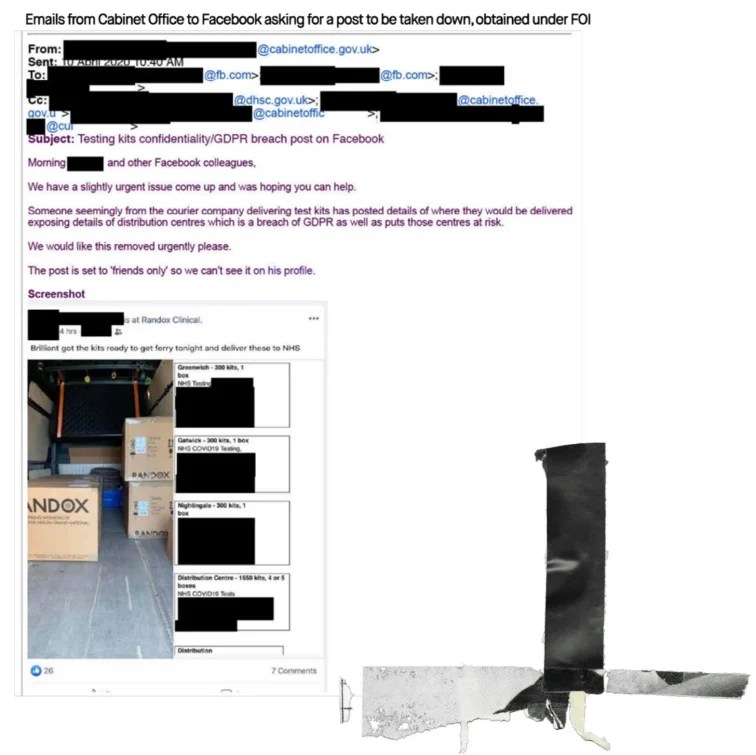
The case involved a courier whose route to Covid centers was shared in the post, but the government said this was – for some reason – putting those centers at risk. They even evoked the GDPR.
And somehow, Facebook’s “privacy settings” went out the window.
None of this, other than what some observers might see as near-totalitarian panic, makes sense: how the “private” post became owned by government snoops, the role of Facebook, and even how Covid centers would have been at risk if the post’s content became public knowledge (as it was clearly not meant to be). Not to mention that their location was public, anyway.
Facebook seemed keen to cooperate in this case, forwarding it for review – but then it turned out, according to Facebook’s communication with the Cabinet Office, that the courier himself opted to disable the account.
But perhaps, more importantly, that anything else about this case is the fact that there was “the hotline between Whitehall (UK government) and major social platforms,” and that this relationship was not strained at all: it was a cordial one, “between individuals with emails being sent on first-name terms,” the report’s documents reveal.
New Study: COVID Vaccines ‘Profoundly Impair’ Protective Immunity, ‘Probably Enhance Disease Severity’
By Kenneth Richard | No Tricks Zone | January 19, 2023
Recipients of repeated COVID-19 mRNA vaccinations may have fully damaged their immune system’s capacity to protect them from severe effects from the disease. Each successive booster shot may actually worsen protection.
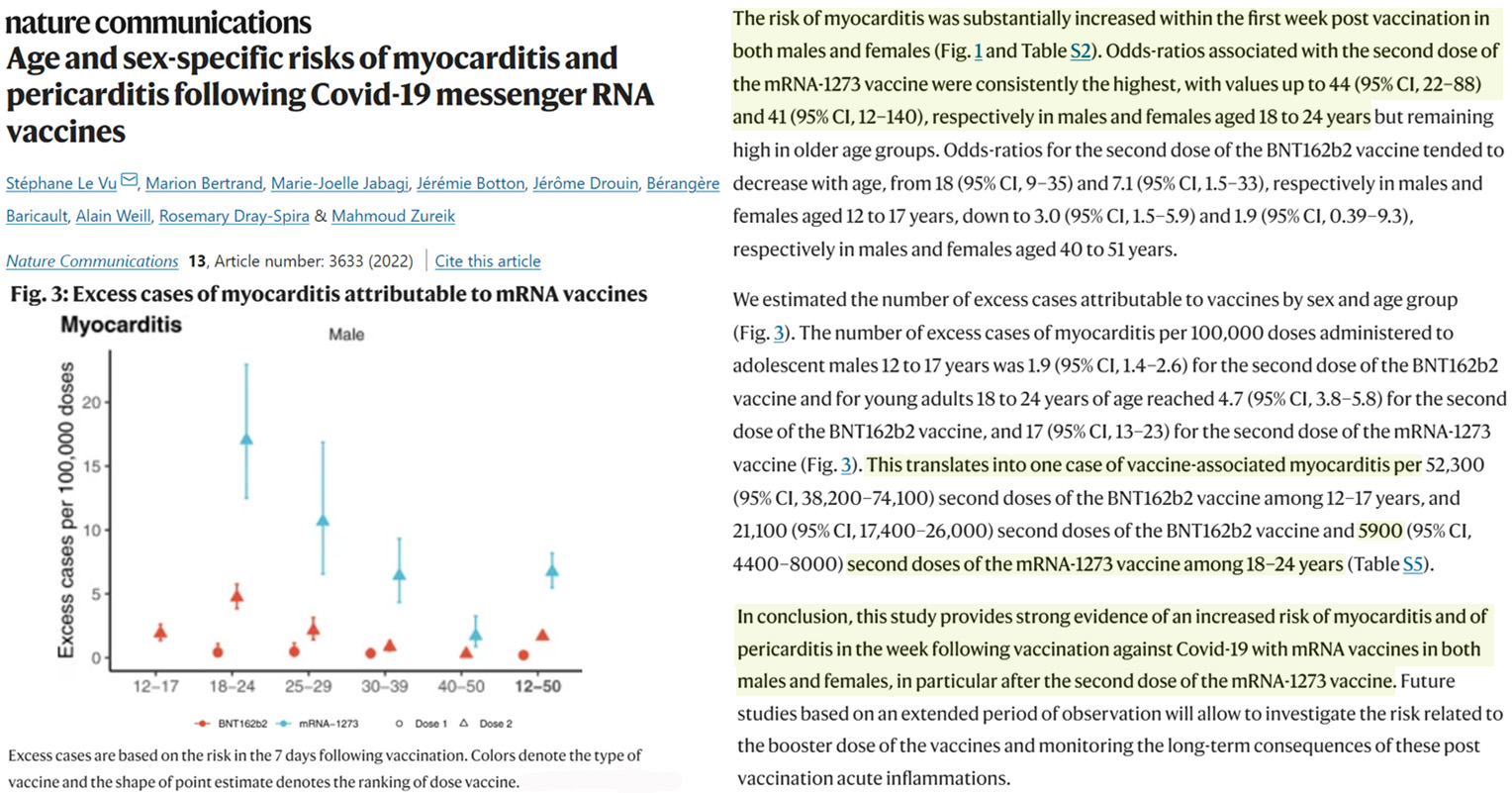
Even though it has been determined that COVID-19 vaccinated young people aged 18-24 are 44 times (males) and 41 times (females) more likely to be afflicted with heart-damaging myocarditis than the unvaccinated in this same age group, many US universities nonetheless required students to receive booster shots as a condition of attendance in 2022-’23.
But now new mice research (Gao et al., 2022) provides damning evidence that continued COVID-19 booster vaccinations “negatively impact the immune response” and “fully impair the… neutralizing efficacy” of COVID-19 antibodies and memory.
Scientists warn that continuing the course of booster COVID-19 mRNA vaccinations may pose risks of “enhanced disease severity” for those re-infected with COVID-19 and thus the administration of boosters “should be preceded with caution.”
“Our findings revealed that repeated dosing after the establishment of vaccine response might not further improve the antigen-specific reactivity; instead, it could cause systematic tolerance and inability to generate effective humoral and cellular immune responses to current SARS-CoV-2 variants.”
In other words, health authorities have mandated young people get a shot that may fully impair their immune system’s capacity to protect them from the very variants the shots were intended to neutralize.

Image Source: Gao et al., 2022
US refuses to call West Bank Israeli occupied territory
MEMO | January 30, 2023
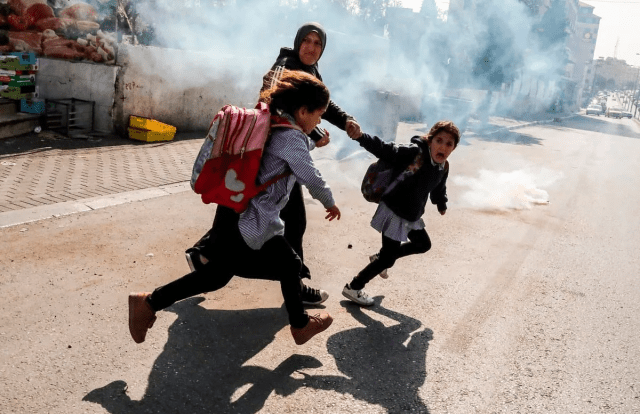
The US State Department refused to describe Palestinians in the West Bank as living under a military occupation during a heated exchange between journalists last week. State Department spokesperson Vedant Patel brushed aside questions about Washington’s view on the status of the occupied West Bank in the wake of an Israeli military raid that killed ten Palestinians in Jenin.
“What is the status of the Palestinian people in the West Bank, including Jenin… and everywhere else in the West Bank?” Said Arikat of Al-Quds newspaper asked Vedant. “It’s a simple question. Are they under occupation?”
Patel refused to answer the question despite being asked repeatedly to clarify the position of the US regarding the status of the West Bank. At one point Patel shockingly said that the status of the Palestinians is that “they reside on those territories.”
Frustrated at not getting an answer, Arikat asked if the West Bank is considered a “different planet” and if the US “subscribes to the fact that they are under military occupation?” Patel refused to answer the question.
“Vedant, are they occupied or are they not occupied? What is the status that you give the Palestinians right at this moment? What kind of status do they have?” Arikat insisted.
Patel again refused to answer, deflecting the question by focusing on the escalation of violence and calling for peace and calm in the region. “I’m not talking about a recent period. I am saying about legally, how do you designate the Palestinians in the West Bank? What is their status?” Arikat asked to know for a fourth time.
“I understand the question you’re asking, and I – as we’ve said previously, it is vital for both sides to take action to prevent even greater loss, and we condemn any violence, escalation, or provocation,” said Patel.
Under International law the West Bank and Gaza is Israeli occupied territory. Experts in international law say that given the length of the occupation and given that Israel has no intention to ever withdraw, the correct designation is that it is an illegal occupation. The International Court of Justice has been asked to issue an opinion on that very matter.
Johnson lied about Putin missile ‘threat’ – Kremlin

RT | January 30, 2023
Allegations that Russian President Vladimir Putin threatened then-UK Prime Minister Boris Johnson with a missile strike are “a lie,” Kremlin press secretary Dmitry Peskov said on Monday. Johnson’s accusations have emerged in a new BBC documentary about the crisis in Ukraine.
Recalling a telephone call with Putin on February 2, 2022, just over three weeks before tensions over Ukraine escalated into full military action, Johnson claimed the Russian leader “threatened me at one point.”
“He said, ‘Boris, I don’t want to hurt you but, with a missile, it would only take a minute’ or something like that… jolly,” the former PM told the British broadcaster.
“There were no missile threats,” Peskov told reporters on Monday. “When he explained challenges to the security of the Russian Federation, President Putin remarked that if Ukraine joins NATO, the potential deployment of NATO or American missiles at our borders would mean that any missile could reach Moscow in mere minutes.”
The Russian official wondered if Johnson had lied deliberately or “simply didn’t understand what President Putin was talking about.” If the latter is true, people should be concerned for Johnson, Peskov added.
Putin has publicly voiced Russian concerns over NATO infrastructure in Ukraine and other parts of Eastern Europe for decades. Russia began military operations against Ukraine after failing to get security guarantees from Washington, which would have rolled back the deployment of NATO assets in Eastern Europe and suspended its expansion in the region. The US dismissed Moscow’s concerns and claimed that Ukraine was free to seek membership as a sovereign nation.
Featured Video
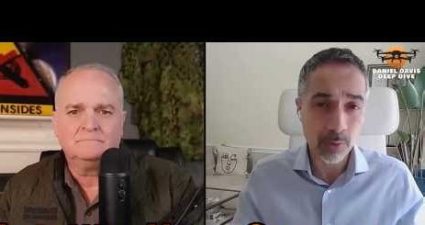
No Threat Can Force Iran’s Surrender /Trita Parsi & Lt Cl Daniel Davis
or go to
Aletho News Archives – Video-Images
From the Archives
An Expert Military Analysis of War with China
Actually, None is Necessary
By Fred Reed • Unz Review • December 13, 2020
The Correlation of Armed Forces: U.S. goods and services trade with China totaled an estimated $634.8 billion in 2019. Exports were $163.0 billion; imports were $471.8 billion. The U.S. goods and services trade deficit with China was $308.8 billion in 2019. Trade in services with China (exports and imports) totaled an estimated $76.7 billion in 2019. Services exports were $56.5 billion; services imports were $20.1 billion. The U.S. services trade surplus with China was $36.4 billion in 2019.
There is talk within the Washingtoniat of a possible war with China. Steve Bannon, who apparently was dropped on his head as a child, actually favors such a war. We hear the usual shoo-the-boobs alarm about how the Chinese are doing something terrible and we must gird our loins and American values and show them what for, bow wow, woof. The danger is that the current game of who-blinks-first in Asian waters might actually provoke a shooting war. You know the kind of thing: One warship refuses to get out of the way of another, a collision ensues, some retard lieutenant who signed up on waivers opens fire, and we’re off and running. It is not a good idea to let children play with matches.
The said war is discussed either in emotional terms by idiots or in purely naval terms by those familiar with such things, so we hear of the First Island Chain and the Second Island Chain and whose missiles against the other’s missiles and so on. This would be appropriate if we were fighting World War Two again. Which we aren’t. Let’s take a quick-and-dirty look at how such a war might go.
To begin the war, America would overestimate itself and underestimate China. This is doctrine in the Pentagon. … continue
Blog Roll
 Aletho News
- Iran To Target Military Industrial-Tech Complex That Facilitated Gaza Genocide
- Collapsing Empire: The Resistance Disarms ‘Israel’
- Suicide Should Not Be a Government Service
- Rethinking America’s greatest threat: Iran vs. Israel-Firsters
- Iran accuses adversaries of false flags to strain Turkey ties
- Poland rules out sending Patriot missiles to US/Israel amid war on Iran
- Tehran approves new Hormuz plan with major restrictions
- No Threat Can Force Iran’s Surrender /Trita Parsi & Lt Cl Daniel Davis
- UK’s New Pandemic Plan Would Turn Big Tech Into a Mass Location Tracking Network
- Growing insecurity, soaring prices fuel protests in north as regime bans evacuation: Sources
- If Americans Knew
- Ann Coulter Rips Into Fox News for Iran War Coverage, Compares to False Rigged 2020 Election Reporting
- Joe Kent Urges Americans To Call White House and Congress To Object To Sending Troops Into Iran
- DNC Resolution to Reject AIPAC Funding Puts Democratic Leaders in the Hot Seat
- Swedish foundation to build 400 schools as over 650,000 Gaza children remain without education for 2 years
- Israeli army admits photshopping image of slain Lebanese journalist
- This is how Israel is systematically killing health workers under the cover of war in Lebanon
- Carrying life under fire: Israeli invasion of Lebanon leaves pregnant women facing deadly risks
- Champagne all around for the new death penalty (for Palestinians) law – Not a ceasefire Day 172
- Why are Palestinian books struggling to be seen on Amazon?
- The Line Between Affinity and Conspiracy
- No Tricks Zone
- New Study Finds Warming Saves Lives…Cold Temperatures 12 Times More Deadly Than Excess Heat
- German Science Blog Accuses PIK Climate Institute Of Hallucinating Climate Tipping Points
- Devastating Assessment Of Comirnaty Vaccine By Former Senior Pfizer Europe Toxicologist
- New Study: CO2 Is ‘Effectively Negligible’ As An Explanatory Climate Change Factor Since 2000
- Former Pfizer Toxicologist Dr. Helmut Sterz Tells Bundestag Hearing Pfizer Vaccine Should Have Never Been Approved
- Energy Expert: Germany’s Nuclear Phaseout Was A “500 Billion Euro Mistake”
- New Research: South Australia’s Mid-Holocene Sea Surface Temperatures Were 4°C Warmer Than Today
- Storing Green Energy To Last Germany 10 Days Would Require A 60-Million Tonne Battery
- New Studies: UK Sea Levels Were 4 Meters Higher Than Today During The Mid-Holocene
- Destructive Green New Deal: German Energy And Metal Group Warns Of Drastic Crisis
 Aletho News