Chinese report decries US hegemony
RT | February 20, 2023
The US has been abusing its hegemonic position in the world for decades to reap benefits for itself and sow rivalry and instability in other nations, a report published on Monday on the Chinese Foreign Ministry’s official website claims.
The document seeks to draw international attention “to the perils of the US practices to world peace and stability and the well-being of all peoples.” It offers examples of Washington’s purported selfishness in the areas of politics, the military, the economy, technology and culture.
For a century, the US has treated Latin America as its backyard, where those who resist the US face “political interference, military intervention and regime subversion,” the text claims. Elsewhere, it creates divisive blocs under its influence, and fosters “color revolutions” against opponents. Lately Washington has posited the false dichotomy of “democracies vs. autocracies” and arbitrarily labels nations as members of one of the camps.
The use of force has been a feature of US expansionism since its independence, the document says. Since 2001 alone, wars launched by Washington “in the name of fighting terrorism have claimed over 900,000 lives with some 335,000 of them civilians.”
The Pentagon has used an array of “appalling methods” of war, from biological weapons in Korea to depleted uranium munitions in more recent times, “causing… countless civilian casualties and lasting environmental pollution,” the piece notes.
The US government has used the dollar’s status as the global reserve currency, and its influence on the international financial system, to quash competition and slap unilateral sanctions against opponents. Washington “is basically collecting ‘seigniorage’ from around the world,” and during the Covid-19 pandemic, disrupted the global economy by injecting trillions of dollars into it, the report says.
The report accuses the US of using its status as a leading technological power to conduct electronic surveillance and espionage, including against its closest allies, as well as cyberwarfare, noting that having the leverage of big tech companies allows the US government to censor speech online and push its narratives on a global scale, while silencing critics.
The document concludes that the US should do some “soul-searching” and change its approach, as “the historical trends of peace, development, cooperation, and mutual benefit are unstoppable.”
Munich Conference signals Western isolation, advent of multipolarity
By Drago Bosnic | February 20, 2023
Although it has been only 16 years since President Putin’s historical speech at the 2007 Munich Conference, that event now seems like a distant past of a long-lost world. Back then, Russia was warning the political West that further NATO aggression would inevitably lead to the revival of the Cold War.
However, Washington DC and Brussels seem to have wanted exactly that. The political West has tried to present the 2023 Munich Security Conference as some sort of a groundbreaking global event that “sent a strong signal” and showed “just how isolated” Russia is. However, nothing could be further from the truth, given the comments of some of the most prominent participants, including NATO and EU member states.
For instance, during a Saturday meeting with US State Secretary Anthony Blinken, China’s Foreign Minister Wang Yi stated that Beijing finds Washington DC’s attempts to threaten Sino-Russian relations completely unacceptable, emphasizing that the relationship between the two superpowers is their sovereign right and that it is not aimed against any third party.
“We will never accept the instructions of the United States and even threats to put pressure on Russian-Chinese relations,” Wang was quoted as saying in a statement published on Sunday by the Chinese Foreign Ministry. “The Sino-Russian relations of comprehensive partnership and strategic cooperation are based on non-alignment, non-confrontation and non-targeting against third parties. They are within the framework of the sovereignty of two independent states,” he added.
The comments were made in response to US accusations that China will “increase its support for Russia”. Wang also warned his American counterpart against the continued melodramatic reaction to the “balloon controversy”, which the US has been (ab)using lately to ensure detente between the two countries is virtually impossible. Beijing said that American high-altitude balloons have illegally entered China’s airspace many times over the last several decades, but the government chose not to cause panic and simply used existing diplomatic channels to communicate with their US counterparts.
“If the US continues to use this as an excuse, to promote further escalation and aggravate the situation, then China will definitely go to the very end. All the consequences of this will be borne by the American side,” Wang said.
China also called on the US to stop escalating the Ukrainian crisis and start promoting a peaceful settlement. Wang said that “Washington DC should stop adding fuel to the fire”. He noted that China’s position is constructive and called for the negotiation process to continue.
“Being a great power, the United States should contribute to the political settlement of the crisis, and not add fuel to the fire and look for opportunities to extract its own benefits,” Wang was quoted as saying.
Hungary also called for the de-escalation of the crisis and insisted on maintaining economic relations with Russia. During the traditional annual address to his fellow citizens, Prime Minister Viktor Orban stated that “the only way for Hungary to live peacefully is to stay out of the conflict, as it is not our war”.
“We will maintain our economic relations with Russia, and we advise the entire Western world to do the same, because without relations there will be no ceasefire or peace talks,” Orban said.
On the other hand, the European Union is doing exactly the opposite. The bloc’s top diplomat Josep Borrel called Russia “an existential threat” and urged all member states not to continue supporting the Kiev regime, but “help more”. He also insisted that “the EU should start an industrial techno-blitzkrieg to produce more weapons“, effectively nullifying the claim that the bloc was an economic union. Borrel added that member states will spend an additional €70 billion on defense by 2025.
“In the next two years, the EU countries intend to spend an additional €70 billion on defense. France will increase defense spending by 40%, while Poland will double it,” he stated.
Interestingly, India was also targeted. George Soros, a controversial oligarch infamous for providing financial backing for various groups responsible for destabilization and undermining of countries the political West sees as “uncooperative”, stated the following:
“India is an interesting case. It’s a democracy, but its leader Narendra Modi is no democrat. Inciting violence against Muslims was an important factor in his meteoric rise. Modi maintains close relations with both open and closed societies. India is a member of the Quad (which also includes Australia, the US, and Japan), but it buys a lot of Russian oil at a steep discount and makes a lot of money on it. […]
Modi and business tycoon Adani are close allies; their fate is intertwined. Adani Enterprises tried to raise funds in the stock market, but he failed. Adani is accused of stock manipulation and his stock collapsed like a house of cards. Modi is silent on the subject, but he will have to answer questions from foreign investors and in parliament. This will significantly weaken Modi’s stranglehold on India’s federal government and open the door to push for much-needed institutional reforms. I may be naive, but I expect a democratic revival in India.”
In response to the accusations, India’s Foreign Minister Subrahmanyam Jaishankar brushed Soros off and (quite accurately) described him as “old, rich, opinionated and dangerous”. Considering Soros has a history of Nazi collaboration, it can be argued that his attack could even be considered a compliment of sorts for Prime Minister Modi and India as a whole.
In essence, the Munich Conference not only failed to produce the desired results (Russia supposedly isolated), but it even strengthened the multipolar world, as neither India nor China proved malleable in any way, showing their sovereignty is untouched by the political West’s pressure. On the other hand, many Europeans are extremely unhappy by the EU’s militarization. According to varying estimates, the huge crowd of protesters in Munich numbered up to 50,000 people. In conclusion, while there are massive differences between Munich 2007 and Munich 2023, the latest conference is somewhat similar to the 1938 Munich Agreement between Nazi Germany and Western allies. Considering how that ended (along with any other invasion of Russia), the political West’s prospects against Moscow look rather grim, to say the least.
Drago Bosnic is an independent geopolitical and military analyst.
Featured Video
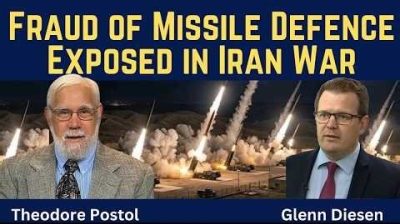
Ted Postol: Fraud of Missile Defence Exposed in Iran War
or go to
Aletho News Archives – Video-Images
Frlom the Archives
Containing the United States
By Edward S. Herman | Z Magazine | September 2016
“Containing the United States” is, of course, a ridiculous and self-contradictory idea in the U.S. and Western ideological and propaganda system. We all know that the United States had to “contain” the Soviet Union from 1945 to 1991, and since then has had the task of containing Russia and China. Only they threaten, bully, aggress and worry countries like Poland and Vietnam. Obama has had to reassure them both of our steadfast stand against Russian and Chinese military attacks. NATO has, of course, expanded greatly over the past several decades, despite the deaths of the Soviet Union and Warsaw Pact, but only to contain the renewed Russian — and Iranian, Libyan, Syrian and other — military threats; and we have “pivoted” to Asia, supported Japanese rearmament, bolstered our own forces in that area and jousted with the Chinese in their coastal waters solely to contain China. Earlier we had been obliged to contain North Vietnam, or was it the Soviet Union in Vietnam? Or China? Or “communism”? Or maybe all of them? Or none of them, but just needing an excuse to enlarge power?
The parallel propaganda has taken many forms. One is accepting as a premise that the United States only acts defensively and has no internal forces and interests that drive it to enlarge its sphere of control. I noted in an earlier article how Paul Krugman claims that internal Russian problems may well be the explanation of Russian “aggression,” but how at the same time it never occurs to him that the huge U.S. transnational corporate interests and “defense” establishment, and the pro-Israel lobby’s activities, might possibly make for an expansionist dynamic here.2 This reflects the standard establishment perspective that we are good and only react to evil. This was the view sustaining and justifying the invasion and occupation of Iraq from 2003. That attack was taken here as not evil but a response to evil, even if involving lies and mistakes, hence not describable as “aggression.” … continue
Blog Roll
 Aletho News
- Iran War Supporters Invent a New and Absurd Justification: It Is All About China
- Corporate Media Go All Out To Support The US-Israeli War on Iran
- Trump press conference reveals a man who wants out of war
- When Tel Aviv decides, Washington fights
- Top official: Iran ready for a long war with US, no more diplomacy
- How Iran’s Toxic Rain Reveals US-Israel Discord
- Trump Admits He Is Destroying Iran For Israel
- Iran’s latest move in the GCC countries was a stroke of genius
- Blackmail and death threats, Zelensky embarrasses the EU, but there’s no condemnation
- Israel threatens to kill Iran’s new leadership
- If Americans Knew
- Lebanon: Israel’s White Phosphorous Use Risks Civilian Harm
- Corporate Media Go All Out To Support The US-Israeli War On Iran
- US-Israel war on Iran is creating a steady growing number of amputees
- Israel planned this war on Iran for 40 years. Everything else is a smoke screen
- The wrong question about the war in Iran
- ‘Your Tax Dollars Being Used to Raise Your Gas Prices’: US-Israel Bomb Major Iranian Oil Depots
- ‘Bogus Evidence’: Former Nuclear Watchdog Head Debunks US Justification for Iran War
- EXPLAINER – Dimona: What to know about Israel’s nuclear site
- Fires and toxic air in Iran (thanks, Israel) – Not a ceasefire Day 150
- At Israel’s hands, Iran is burning, Lebanon and Gaza are crumbling – Not a ceasefire Day 149
- No Tricks Zone
- Wake-up Call: Survey Shows Majority Of Germans Now Favor Postponing Climate Targets!
- Televised! Leading German Political Candidate Tells Schoolchildren CO2 Makes Sun Hotter!
- New Study: A Century Warming Of 1.1°C Is ‘Commonplace’ And ‘Not Unusual’ During This Interglacial
- New Study: ‘Internal Noise’ And Volcanic Forcing Can Trigger 10-15°C Warming Within Decades
- Glaciers Worldwide Are Suddendly Surging, Experts Blame Warming!
- Surprising Discovery: Sahara Is Greening…Billions Of Trees Where Once Thought To Be Barren
- New Research Reaffirms Clouds, Aerosols, And Surface Solar Radiation Are ‘Driving The Climate System’
- Germany: Electric Car Catches Fire At Charging Station, Sets Off Local “Inferno”, Widespread Damage
- New Study: Canada’s New Brunswick Was 1°C Warmer Than Today During The Medieval Warm Period
- Coal Power Back In Trend As Globe Tries To Keep Pace With Growing Demand For Power
 Aletho News