USA criticized globally over MQ-9 drone incident
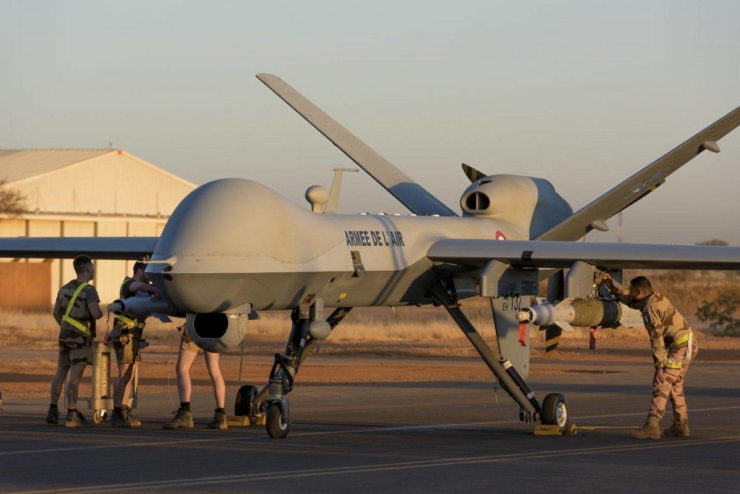
By Vladimir Danilov – New Eastern Outlook – 20.03.2023
The crash of an American MQ-9 drone heading for the Russian border in the Black Sea near the Crimean Peninsula on March 14 in the morning is likely one of the most discussed topics in the global media in recent days.
According to an official communication from the Russian Defense Ministry, the US UAV’s flight was in violation of the temporary airspace use regime established in accordance with international norms for the area’s boundaries due to the special military operation, and its transponders were turned off. Fighter jets from Russian Aerospace Forces were deployed in the air to identify the intruder. The MQ-9 made a quick maneuver that caused it to lose control of its flight and crash into the water. The Russian fighter jets did not engage the unmanned aerial vehicle during the incident and did not fire any of their on-board weaponry.
The MQ-9 Reaper is a modular reconnaissance and strike US UAV that can carry a variety of combinations of weapons and electronic equipment depending on the mission, including carrying an arsenal of tactical nuclear weapons. As a result, there is no doubt about Russia’s eligibility for protective measures against the United States’ hostile use of the said UAV against Russia. Especially in light of recent open calls by various US representatives for the armed destruction of the Russian Federation. In particular, former US National Security Adviser John Bolton’s call to define the objectives of the US-Russia war.
In contrast to US military officials’ attempts to portray the incident as a “wrongful act by Russia,” particularly Gen. James Hecker, Commander of US Air Forces in Europe and Air Forces Africa, ordinary Americans are discussing the blatantly “insane” US version of the incident that caused the MQ-9 UAV to crash into the Black Sea. Thus, US armed forces veteran Noctis Draven emphasized that Washington’s anti-Russian propaganda narrative is “easily disproved,” and that if Russia had hostile intentions, the MQ-9 would have been shot down without endangering the pilot or the aircraft.
The MQ-9 incident has been widely discussed in the US media, noting that it is in fact the first direct military confrontation between Russia and the US since Moscow launched its special operation in Ukraine.
For example, Joe Rogan in his podcast PowerfulJRE pointed out that the current White House administration is actively pushing the US to an outright war with Russia, bringing about the feeling of chaos in the country.
According to Fox News host Tucker Carlson, an administration like this could lead to a hot war with Russia and China whether you want it or not.
According to a CNN report, the MQ-9 incident in the Black Sea may contribute to growing support in the United States for the view that aid to Ukraine is not a national security issue for Washington.
The international public has also reacted strongly to the incident, in a way that is clearly unfavorable to the United States and US propaganda.
According to the Chinese Global Times tabloid, such incidents have become more common in recent years around the world. It is emphasized that the United States is surprisingly involved most of the time. The publication stresses that this has become a habitual tactic of provoking enemies, and that a couple more such cases will cause the world to explode.
Guancha readers openly mocked Washington for the botched spying mission in the Black Sea, pointing to the US’s incompetence, whose drone crashed into the water. They praised Russia for “teaching a lesson” to America, self-assured in its permissiveness, without even opening fire, causing the MQ-9 to fall into the water in fear of the Russian Su-27.
As the Global Times correctly points out, the White House clearly requires such incidents in order to complicate the global situation and fight “against the unwanted.” How else can the provocative flight of the American MQ-9 Reaper drone near the Russian state border and the incident in the Black Sea be explained? Since the Cold War’s end, Washington has routinely staged such incidents, frequently targeting countries that the US publicly refers to as enemies.
The Austrian media, which is aghast at the prospect of the United States starting World War III, also points out that America recently staged a provocation with a B-52 bomber, and now the MQ-9 Reaper drone incident. The Austrian journalists wonder what Washington hopes to accomplish by conducting such dangerous “tests” of Russia’s defense capabilities. After all, today, it is clear to everyone that provocations like the ones on March 14 in the Black Sea and the day before with the B-52 bomber near St. Petersburg could be used as a pretext for war.
The opinions of the readers of the French Le Figaro are also quite revealing. Some of them believe that the USA was very “unprofessional” trying to spy on Russia and got what it deserved, while others admit that it was a “flawless operation” by Moscow. The video of the MQ-9 downing in the Black Sea, released by the US, caused no distress among French media readers. They called it “just another batch of oil the Americans poured on the fire.”
Readers of the German magazine Der Spiegel support Russia and are perplexed as to why the West is outraged by its actions. They suggest we look at the map to see for ourselves that American drones have no business over the Black Sea.
Australia’s The Sydney Morning Herald does not rule out that the US drone incident in the Black Sea could trigger a new round of tensions, becoming the first very dangerous incident of its kind since the Cold War. The majority of the publication’s readers blame Washington, specifically asking: what was that drone doing there?
According to some political analysts, the March 14 MQ-9 incident is unlikely to cause any serious consequences in relations between Russia and the US or result in a military clash between the two countries. After all, Washington’s remaining “cool heads” only need to take the necessary steps.
Following the MQ-9 Reaper drone incident over the Black Sea, the US has already begun analyzing the costs and benefits of such missions, weighing the potential value of intelligence obtained in this manner against the risk of escalation in relations with Russia, according to recent information. The US military is specifically instructed to “carefully study” UAV routes and assess ways to reduce the risk of conflict with Moscow, especially considering Russian aviation operations in the Crimea.
However, similar risks exist not only in the Black Sea region, but also in the Baltic Sea, as evidenced by an incident 200 kilometers away from St. Petersburg the day before the MQ-9 events. Then, as you may know, B-52 Stratofortress US strategic bomber capable of carrying nuclear weapons and accompanied by Polish fighters, flew over Lithuanian airspace, approached the Russian border at the greatest possible distance, and went into position, simulating bombing readiness. Similar incidents may occur in the Arctic, near Russia’s borders in the Asia-Pacific region, if Washington makes new anti-Russian or anti-Chinese provocations there.
In any case, the US must temper its aggressive cowboy zeal, lest its provocative actions push the world dangerously close to the outbreak of World War III. Especially since there is still no clarity in identifying those responsible for the terrorist attack on the Nord Stream pipelines in the Baltic Sea.
US continues to use terrorists in Syria – Russia
RT | March 20, 2023
The US is still working with Islamic State terrorists and other Islamist groups to carry out attacks against Bashar Assad’s government forces in Syria, Russia’s Foreign Intelligence Service (SVR) chief, Sergey Naryshkin, has claimed.
According to an SVR report released on Monday, the US military’s Al-Tanf base in southern Syria is coordinating subversive activities, with the actions of terrorist groups being planned by representatives of the Central Command of the US Armed Forces as well as US intelligence officers.
The SVR stated that a special role has been assigned to the so-called Free Syrian Army, which consists of Kurdish and Arab detachments operating in the central and northeast parts of Syria. “Through them, the Americans and their British allies are working with the underground formations of Islamic State [IS, formerly ISIS] that still remain in remote areas of the country,” it was alleged.
“ISIS was instructed to incite hostilities in the Syrian south-west (the provinces of Suwayda and Deraa), in the central part of the country (Homs) and east of the Euphrates River (Raqqa, Deir ez-Zor). For this, it is planned to form several detachments of radicals with a total number of about 300 people. After special training, they will be involved in attacks on military facilities in Syria and Iran,” the statement added.
The SVR claims that the US also intends to use terrorists in the region around the capital, Damascus, to conduct tasks such as kidnapping Russian and Iranian servicemen.
In addition to coordinating the actions of Islamist groups, Washington is providing terrorists with weapons, according to the SVR. Several dozen four-wheel-drive pickup trucks with heavy machine guns, as well as a number of rocket systems such as NLAW ATGMs, TOWs, and Igla MANPADS are set to be handed over to fighters in the near future, the report alleged.
Washington’s actions put it “on the same level” as Islamic terrorists and IS militants, and is a manifestation of state terrorism, the SVR argued.
In February, the SVR reported that the US was using Islamist extremists to plan terrorist attacks in Russia and former Soviet republics. Washington has been training as many as 60 terrorists at the Al-Tanf base to make improvised explosive devices and use them to target diplomats, public officials, law enforcement officers, and military personnel, the intelligence service claimed.
Former Egyptian FM: ‘Everyone knew there were no WMDs in Iraq’, invasion was in place before Bush came to power
Sputnik – 20.03.2023
Former Egyptian Foreign Minister Nabil Fahmi was Egypt’s Ambassador Extraordinary and Plenipotentiary to the United States at the time of the US invasion of Iraq. He shared his memories in an interview with Sputnik.
In his interview, Nabil Fahmi said that the American invasion of Iraq was already in place when George W Bush came to power, and he was simply looking for a suitable opportunity to carry out the plan.
Sputnik : As an Egyptian diplomat at the time, how did you feel about the US decision to invade Iraq in 2003?
Nabil Fahmi: At the time, in 2003, I was Egypt’s Ambassador to the United States. Of course, the entire Arab diplomatic corps was discussing the invasion in one way or another. Even with the election of Bush Jr as President of the United States, I noticed a really unhealthy interest the neocons took in Iraq. US vice-president Richard (“Dick”) Cheney was particularly prominent in this regard. On his first visit to Arab countries, he told me personally that he wanted to focus on Iraq.
Sputnik : Why Iraq in particular?
Nabil Fahmi: I asked him why Iraq and not, for example, the Palestinian issue. But he said that Iraq had caught his attention. I told the leadership in Cairo about the strange interest of the new American administration: but at that time, no one imagined that it would come to an open invasion in 2003.
Sputnik : Could you please tell us about Egypt’s position on the US invasion of Iraq?
Nabil Fahmi: I conveyed a message from President Hosni Mubarak to the Chief of Staff of the US Army and to one of the military commanders in the region that an invasion of Iraq was not advisable, and that there was a big difference between the liberation of Kuwait from occupation – in which the Egyptians had also been involved – and the direct occupation of an Arab country. This message was also conveyed to various American officials in Washington, including Condoleezza Rice, Colin Powell and others.
The Egyptian delegation arrived in Washington about four weeks before the invasion in a last-ditch effort to acquaint the US side with Cairo’s position. The delegation visited US Secretary of State Condoleezza Rice and Deputy Secretary of Defense Paul Wolfowitz. They were warned that an invasion of an Arab country would be disastrous for the region.
Sputnik : And how did the Americans respond?
Nabil Fahmi: The US administration questioned us point by point, ranging from the invasion and how to take control of certain places. Each time we responded, we emphasized that we did not support the US invasion. At one point, Rice specifically asked why this point was being repeated in every response. Our delegation explained that Egypt continued to oppose the invasion in any case: the Iraqi state must be preserved.
Sputnik : What did Washington think of Cairo’s response to the invasion?
Nabil Fahmi: Our position put me, as Egypt’s ambassador to Washington, in a difficult position before the US Congress. I explicitly said that Cairo did not support the war in Iraq, even though we were friends of America.
Sputnik : And how did you assess the international position on the invasion?
Nabil Fahmi: The US administration was determined to invade Iraq from the first day it came to power, and this was evident in the speeches of Cheney and Wolfowitz. The course of action had started taking shape after 9/11. The Bush administration had to justify this military operation to convince the American public that there was a real threat. To this end, they played the card of Iraq’s possession of nuclear, chemical and biological weapons. Although in fact everyone knew that there were no weapons of mass destruction (WMD) in Iraq.
Sputnik : What then were the real reasons for the US invasion of Iraq?
Nabil Fahmi: The US decision to invade Iraq was made regardless of the actions of former Iraqi President Saddam Hussein and the suffering of the Iraqi people, and there was no real evidence that Iraq possessed WMD. Either it was because they wanted to realize their ambitions after the liberation of Kuwait – because at that time the controversy about the need to end the war of liberation was raging – or maybe it was because the US was already developing the concept of a “New Middle East” and the easiest place to start implementing it was with a sanctions-weakened Iraq.
Sputnik : In your opinion, what has been the most significant consequence of the US invasion of Iraq?
Nabil Fahmi: I opposed Iraq’s invasion of Kuwait and saw that it was unacceptable and a big mistake on the part of Saddam Hussein. I do not believe that any country has the right to invade another country without respecting international law. That is why I did not support the invasion of Iraq. However, this war caused a lot of trouble in the Levant and the Gulf Region, and later the emergence of Daesh terrorists in the region. To this day, the Middle East is still dealing with the consequences of the US invasion of Iraq 20 years ago.
Sputnik : Has there been a change in American policy toward Arab countries in the years since the invasion of Iraq?
Nabil Fahmi: Nothing has changed. What has changed is the American reality and the Arab reaction. In the early 2000s, the US wanted to show the Middle East that after the collapse of the Soviet Union it could do whatever it wanted with Moscow’s former allies – that was its interest.
Circumstances are different now. Washington is no longer willing to give guarantees or sacrifice its wealth or forces to protect anyone in the region as a whole. For their part, the Arab countries began to realize – after the American invasion of Iraq – that the US could not be given preferential treatment. Thus, the Arab countries began to balance their foreign policies, giving the US the role of an important partner, but by no means the only one. The Arabs now realize that they must take the lead in solving most of the region’s problems and not rely on others to do so.
China’s success in reconciling Saudi Arabia and Iran is a huge blow to US hegemony
By Ahmed Adel | March 20, 2023
After agreeing with Saudi Arabia in December to buy its oil for Chinese yuan instead of just US dollars, while at the same time Russia is successfully cooperating with Saudi Arabia and Iran in the oil sector, Beijing is helping a historic reconciliation between the two major Muslim countries. Chinese efforts are all the more impressive when considering the persistent efforts of the US to cause conflict between the two countries instead of reconciliation.
It is hoped that reconciliation will lead to a huge blow to the hegemony of the US dollar. In Beijing on March 17, following negotiations in Iraq and Oman during the previous two years, China, Iran, and Saudi Arabia announced an agreement which includes the restoration of diplomatic relations, a confirmation of respect for the sovereignty of states and non-interference in their internal affairs, and agreements on security, economy, trade, investment, science and culture.
In short, with the mediation of China, the two regional powers, often framed as having a Sunni-Shi’a rivalry, made it official that they are embarking on a new path of improving relations instead of further spoiling them for the sake of serving Western interests that are contrary to the interests of the Islamic World.
Therefore, it is quite clear who the Chinese Ministry of Foreign Affairs had in mind when it announced that overcoming differences between Iran and Saudi Arabia will have a “beneficial effect on freeing the countries of the region from external interference” – evidently this is in reference to the US. As Beijing highlighted, these two countries have now “taken their own destiny into their own hands,” adding that their agreement “corresponds to epochal development trends.”
Chinese Foreign Minister Wang Yi, who was recently in Moscow and confirmed that Russia-China relations are reaching new frontiers in building a multipolar world, emphasised that the agreement between Riyadh and Tehran represents “a victory for dialogue and peace.”
In a China Global Television Network (CGTN) article published on March 13 and titled: “Why Iran and Saudi Arabia trust China?”, the author highlights that “dialogue between Tehran and Riyadh has unfolded as negotiations took place in Iraq, where the two countries reached an important consensus. Meanwhile, the main regional allies of Iran and Saudi Arabia, such as the United Arab Emirates and Kuwait, have restored diplomatic relations in 2022. Hence, the resumption of diplomatic relations between Iran and Saudi Arabia also is only a matter of time.”
The author’s belief in the resumption of diplomatic relations proved to be true only days after the article’s publication. The resumption signifies that a new era has dawned in the Middle East, and even more broadly when we consider the effects this could have on the hegemony of the US dollar.
The US has been the dominant force in the Middle East since the end of British and French colonialism in the 1940’s. The region has been in a constant state of war since then, with the US now maintaining 30 military bases in the Middle East – five of them in Saudi Arabia.
For the US that relies on its global network of military bases to maintain hegemony, Beijing is showing non-Western countries how a multipolar world can function with great power diplomacy based on agreements and reconciliation, and not rooted in the idea that “might is right,” like Washington adopts.
It is noted that the day before the reconciliation in Beijing, the head of Saudi diplomacy, Prince Faisal bin Farhan al Saud, visited Moscow unannounced. And a week earlier, on March 6, Russian President Vladimir Putin spoke by phone with his Iranian counterpart Ebrahim Raisi, who visited Beijing in mid-February. After that, Wang Yi was in Moscow. This suggests that although China was the main broker of peace between Saudi Arabia and Iran, Russia certainly played a role in reconciliation efforts.
Russia, Iran, and Saudi Arabia are three leading oil and gas producers and are accelerating their search for payment mechanisms to bypass the US dollar. China, for their part, is already discussing such arrangements with Saudi Arabia and Iran.
The decline of the US dollar as a world currency will weaken the American economy and military power. This in turn will cripple the US’ ability to wage perpetual wars abroad and impose its global hegemony.
Just as importantly, reconciliation between Saudi Arabia and Iran can be seen as a precursor to eventually joining BRICS in the near future. It is recalled that BRICS plans to decide this year whether to admit new members and under what conditions.
Although BRICS collectively accounts for 42% of the world’s population and 24% of the world’s gross domestic product (GDP), they collectively hold less than 15% of voting rights in both the World Bank and the International Monetary Fund, which are Western dominated. By admitting Saudi Arabia and Iran, BRICS’s global status will be elevated even higher as a symbol of not only peace and reconciliation, but also a path to prosperity independent of Western domination.
Ahmed Adel is an Cairo-based geopolitics and political economy researcher.
PM Orbán: ‘Europe suffers from war psychosis’
Remix News | March 17, 2023
The main issue facing Europe today is war, which puts Hungary in a difficult situation, as the effects of war are severe and immediate, Hungarian Prime Minister Viktor Orbán said at a meeting of the Organization of Turkic States summit in Ankara.
The prime minister stressed that, unfortunately, Europe was suffering from a “war psychosis,” with the continent drifting further into war day by day. Orbán thanked the leaders of the Turkish states for strengthening the voice of peace. Hungary — on account of its population’s Asian origins — is an honorary member of the Organization of Turkic States.
Orbán thanked Turkish President Recep Tayyip Erdoğan, who, he said, had so far been able to mediate successfully between the warring parties, and called on him to continue his efforts in the future.
“Only in this way can we have a chance for peace,” Orbán said. He also thanked the Turkish president for the fact that Hungary and Turkey could coordinate their work within NATO.
Hungary’s geographical proximity to the war has placed the issue of pursuing peace at the top of the agenda for Hungary, according to Orbán.
“Ukraine is a neighboring state, and the effects of the war are therefore severe and direct, with inflation skyrocketing and energy prices at an all-time high,” he said, adding that “many Hungarians have now died in the war because men from the Hungarian community in western Ukraine are also being conscripted into the army.”
“For Hungary, the most important thing is to save human lives, and that is why we are advocating a ceasefire as soon as possible and peace negotiations.”
At the same time, the prime minister expressed the view that what is happening in Europe is more than just war, because in fact, “the whole of Europe is being reshuffled in terms of power relations,” and this will also have repercussions for Turkey. He added that Hungary is also seeing another threat: “There are processes going on in the world economy that could lead to a new global balance.”
He said that the segmentation of the world economy is against Hungary’s interests, and Hungary sees its future not in segmentation, but in acting in the collective interest and improving interconnectivity.
“The Turk states can play a key role in this, because here we are European, Caucasian and Central Asian countries connected to each other on the basis of mutual respect, setting a good example for the whole world,” the prime minister said in his speech.
President Xi’s Trip To Moscow Solidifies The Sino-Russo Entente
By Andrew Korybko | March 20, 2023
The impending trifurcation of International Relations will result in the formation of three de facto New Cold War blocs: The US-led West’s Golden Billion, the Sino-Russo Entente, and the informally Indian–led Global South. Intrepid readers can review the preceding hyperlinked analysis to learn more about the grand strategic dynamics behind this latest phase of the global systemic transition, while the present one will elaborate on those connected to the Russian-Chinese Strategic Partnership in particular.
These two Eurasian Great Powers had already closely aligned their foreign and economic policies far before Russia was forced to commence its special operation in Ukraine last year after NATO clandestinely crossed its red lines there and refused to diplomatically resolve their security dilemma. This was due to their shared multipolar vision, which in turn resulted in Moscow synchronizing its Greater Eurasian Partnership (GEP) with Beijing’s Belt & Road Initiative (BRI).
The purpose behind doing so was to supercharge multipolar processes across the supercontinent with a view towards making International Relations more democratic, equal, just, and predictable a lot sooner than even the most optimistic observers could have expected. None of this was driven by anti-Western animosity either since both of them envisaged the EU and US playing pragmatic roles in this emerging world order, which is proven by their proactive engagement of each over the years.
Russia expected that it could diplomatically resolve its security dilemma with the US over NATO’s expansion simultaneously with encouraging it and the EU to get Kiev to implement the Minsk Accords, thus ending the then-Ukrainian Civil War and optimizing trans-Eurasian trade. Meanwhile, many EU countries joined BRI and China even clinched an investment pact with the bloc, all while seeking to diplomatically resolve its own security dilemma with the US and work out a new trade deal with it.
Had the US formulated its grand strategy with mutually beneficial economically driven outcomes in mind instead of remaining under the influence of Brzezinski’s zero-sum divide-and-rule teachings, then everything could have been much different. That declining unipolar hegemon could have responsibly carved out a comfortable niche in the new era of globalization that Russia and China were jointly seeking to pioneer, thus ensuring that the global systemic transition smoothly moved towards multipolarity.
Regrettably, liberal–globalist members of the US’ military, intelligence, and diplomatic bureaucracies (“deep state”) continued to believe that Brzezinski’s geostrategic schemes could successfully reverse the aforesaid transition and thus indefinitely retain their country’s dominant position in International Relations. This explains why they subsequently sought to “contain” Russia and China at the same time by worsening regional disputes instead of reciprocating those two’s efforts to peacefully resolve them.
The decision was eventually made to prioritize Russia’s “containment” over China’s with the expectation that the first would either strategically capitulate to NATO’s blackmail campaign or quickly collapse due to sanctions if it resorted to military force for defending its red lines in Ukraine, thus making China’s successful “containment” a fait accompli in that scenario and therefore preserving the US’ hegemony. Where everything went wrong was that the West never prepared for a protracted conflict in Ukraine.
Russia proved much more resilient in all respects than the Golden Billion expected, ergo why they’re panicking that the over $100 billion that they’ve already given to their proxies in Kiev isn’t anywhere near enough for defeating that Eurasian Great Power. The New York Times admitted last month that the sanctions failed just like their “isolation” campaign did, while the NATO chief recently declared a “race of logistics” and the Washington Post finally told the truth about just how poorly Kiev’s forces are faring.
Amidst the past year of international proxy hostilities that the West itself provoked, the globalized system upon which China’s grand strategy depended was unprecedentedly destabilized by their unilateral sanctions regime that’s responsible for the food and fuel crises across the Global South. This influenced President Xi to seriously consider a “New Détente” with the US, which he initiated during last November’s G20 Summit in Bali after he met with Biden and a bunch of other Western leaders.
To be absolutely clear, this well-intended effort wasn’t meant to reverse any of the multipolar progress that China was responsible for over the past decade but purely to pursue a series of mutual compromises aimed at establishing a “new normal” in their ties so as to restore stability to globalization. In other words, it was about buying time for the world’s top two economies to recalibrate their grand strategies, ideally in the direction of working more closely together for everyone’s sake.
Their talks unexpectedly ended in early February, however, after the black swan event that’s known as the balloon incident. This saw anti-Chinese hardliners in the US suddenly ascend to policymaking prominence, thus dooming the “New Détente”, which resulted in China recalibrating its approach to the NATO-Russian proxy war to the point where President Xi, Foreign Minister Qin, and Ambassador to the EU Fu all concluded that it’s part of the US’ anti-Chinese “containment” strategy.
Under these newfound circumstances, the US consolidated its successfully reasserted hegemony over the EU by getting Germany to go along with Washington’s very strongly implied threats that the Golden Billion will sanction China if it decides to arm Russia should Moscow require such aid as a last resort. In response, China felt compelled to consolidate its strategic partnership with Russia to the point of turning it into an entente, hence the purpose of President Xi’s trip to work out the finer details of this.
Just like these two Great Powers earlier synchronized Russia’s GEP and China’s BRI, so too are they now poised to synchronize the first’s Global Revolutionary Manifesto with the second’s global initiatives on development, security, and civilization. This prediction is predicated on the articles that Presidents Putin and Xi published in one another’s national media on the eve of the latter’s trip to Moscow, which confirms that they intend to cooperate more closely than ever before.
Observers can therefore expect the Sino-Russo Entente to solidify into one of the world’s three premier poles of influence as a result of the Chinese leader’s visit, thus making it a milestone in the New Cold War over the direction of the global systemic transition. The worldwide struggle between this pole and the Golden Billion will intensify, especially in the Global South, which will reinforce India’s importance in helping fellow developing states balance between both and thus bring about true tripolarity.
US decides whether or not Kiev should negotiate peace

By Lucas Leiroz | March 20, 2023
The announcement of Chinese President Xi Jinping’s visit to Moscow to meet Vladimir Putin is shaking Western war plans. After presenting a peace project, the Chinese government now demonstrates that it is considering Russian interests in the conflict as relevant, which is why the country’s president decided to go to Moscow. As well known, peace and Russian interests are inadmissible points for the Collective West, which is why an important American official has already publicly declared that any Chinese peace proposal must be automatically rejected by Ukraine. The case shows quite clearly that the neo-Nazi regime in Kiev is just a proxy for NATO, not having the capacity to decide sovereignly whether or not to negotiate an agreement.
According to John Kirby, spokesman for the White House National Security Council, any Chinese ceasefire proposal must be considered unacceptable after Xi Jinping’s visit to Moscow. Kirby believes that the Chinese gesture and conversations with Putin in person before Zelensky demonstrate that Beijing is writing a peace proposal that takes into account only Russian interests, possibly seeking to ensure the preservation of Russian territorial gains so far. That, for Kirby, would make any dialogue unfeasible.
More than that, the spokesperson sees the growing Russian-Chinese cooperation as an attempt to end the “rules-based order” and reverse the legacy of post-WWII international society. According to him, Russia and China “don’t like” the order built by the “US and its allies” and want to rewrite the world according to new guidelines with the current partnership being a part of this process.
“If, coming out of this meeting, there’s some sort of call for a ceasefire, well that’s just gonna be unacceptable, because all that’s gonna do is ratify Russia’s conquests to date. All that’s gonna do is give Mr. Putin more time to refit, retrain, remain and try to plan for renewed offensives at a time of his choosing (…) We hope, and we’ve said this before – that President Xi will call and talk to President Zelensky, because we believe the Chinese need to get the Ukrainian perspective here (…) There’s no question [that Russia and China] are chafing against this international rules-based order that the United States and so many of our allies and partners have built up since the end of World War II. They don’t like that. They’d like to rewrite the rules of the game globally and they have been increasing their cooperation and their relationship, certainly of late”, Kirby said.
It is curious to analyze how Kirby tries to transform simple things into something absurd, illogical and condemnable. Indeed, Russia and China plan to change the current world order – not because they are averse to the idea of a world guided by diplomacy and international law, but because the order that has prevailed in recent decades is essentially unipolar. There are no real “rules” in the prevailing order – there is only the unilateral will of the US being imposed on all nations. This is obviously something the Russians and Chinese want to change, as they plan for their countries to have absolute sovereignty over their territories and preserve a regional zone of influence, without interference from foreign powers.
It is not about “not liking” what the “US and its allies” built in the post-WWII, but critically understanding that since the end of the Cold War the US has acted as a hegemonic power at the global level, with carte blanche to commit crimes, coups d’état, invasions and wars, while all other states have their freedom restricted by what is called “rules” – which are not applicable to Washington. This is something that needs to be changed and indeed Russian-Chinese cooperation works in this direction.
On the other hand, it is interesting to see how the US decides whether or not Kiev should negotiate peace. If Ukraine is indeed a sovereign state, as the West hypocritically claims when it condemns Russia’s reintegration referendums in the east, then it is the Zelensky government that must decide whether or not to accept a ceasefire, regardless of the circumstances and imposed conditions. However, once again it is clear that the Kiev regime is only a proxy in NATO’s war with Russia, having no authority to decide whether or not to continue fighting.
Indeed, it is absolutely rational for the Chinese to pay more attention to Russian interests and talk to Putin before Zelensky. Moscow is winning the war and the winning side naturally needs to have its interests heard first during a peace negotiation. This is a basic principle of diplomacy, but the West insists on ignoring it both because it needs to publicly maintain the “Ukrainian victory” narrative and because it wants the conflict to prolong indefinitely.
Lucas Leiroz, journalist, researcher at the Center for Geostrategic Studies, geopolitical consultant.
RASH OF NEW BILLS SIGNAL PARENTAL RIGHTS WAR
The Highwire with Del Bigtree | March 16, 2023
American families have been in a battle to protect their children from an overreaching public health apparatus for years. Now, backlash is growing against bills targeting parental rights, in the form of multiple bills written to protect and affirm parental choice.
#ParentalConsent #Choice #MedicalFreedom
Featured Video

or go to
Aletho News Archives – Video-Images
From the Archives
Israel Would Have No Qualms About USS Liberty-Style FALSE FLAG If Iran Campaign Falters – Analysts
By Ilya Tsukanov – Sputnik – 18.06.2025
Donald Trump is mulling whether or not to join Israel’s aggression against Iran as Tel Aviv faces problems sustaining its defenses against growing counterstrikes, and apparently lacks a realistic game plan for an end to hostilities after failing to achieve its goals. Analysts told Sputnik how the US could be ‘nudged’ into the conflict.
“The US is already assisting Israel with supplies, intel, refueling support, etc. One of the many US posts in the region could be attacked for a casus belli,” former Pentagon analyst Karen Kwiatkowski explained.
“If Trump doesn’t comply with Israel’s demand” and join its aggression voluntarily, “a false flag may be needed” to drag the US in, Kwiatkowski, retired US Air Force Lt. Col.-turned Iraq War whistleblower, fears.
Netanyahu has a diverse array of options at his disposal, according to the observer, including:
- a false flag against US assets abroad blamed on Iran or one of its Axis of Resistance allies, like the Houthis
- a US domestic attack or assassination blamed on Iran
- Iranian air defenses ‘accidentally’ hitting a civilian jetliner carrying Americans
- use of a dirty bomb or nuclear contamination somewhere in the region blamed on Iran
- even blackmailing by threatening to use nukes against Iran if the US doesn’t join the fight
Kwiatkowski estimates that Israel probably has “enough blackmail power” against President Trump and Congress to avoid the necessity of a false flag operation, but a “USS Liberty-style” attack, targeting the soon-to-be-retired USS Nimitz supercarrier that’s heading to the Middle East, for example, nevertheless cannot be ruled out entirely, she says. … continue
Blog Roll
 Aletho News
- Top PMU commander, over a dozen fighters killed in new US strikes on Iraq
- Is Netanyahu’s war gamble threatening the future of ‘Israel’?: FT
- Smotrich calls for annexation of South Lebanon to Litani River
- Echos of Gallipoli? Hormuz and the Geography of Hubris
- Pakistan PM backs Iran’s right to self-defense amid tensions
- Hungary blasts ‘fake’ EU accusation
- SAFE Debt Trap: Poland’s €43.7 Billion Bet on Unipolar Illusion
- War on Iran threatens global Gulf capital flows: FT analysis
- Mossad De Facto Admits To Inciting Riots In Iran
- Tehran: World grown thoroughly exhausted with US-Israeli ‘false flag storylines’
- If Americans Knew
- From Sde Teiman, the truth about Israel’s military justice system has been set free
- Child denied life-saving bone marrow transplant by Israel ‘because he is from Gaza’
- Raffi Berg: BBC Middle East Editor Exposed as CIA, Mossad Collaborator
- Jerusalem Archbishop Rebukes Netanyahu’s Statements on Christianity
- US to embed Palantir AI across entire military: Report
- Israeli-US war on Iran to drag on “a few more weeks” – Not a ceasefire Day 164
- Lebanon deaths top 1,200; Palantir AI to be embedded across US military – Not a ceasefire Day 163
- Israel’s assassination game: Take all pragmatists off the board
- Food shortages return to Gaza as Israel tightens aid restrictions under the cover of its war on Iran
- Trump demands trillions in payments from Gulf countries, billions from Harvard – Not a ceasefire Day 162
- No Tricks Zone
- Devastating Assessment Of Comirnaty Vaccine By Former Senior Pfizer Europe Toxicologist
- New Study: CO2 Is ‘Effectively Negligible’ As An Explanatory Climate Change Factor Since 2000
- Former Pfizer Toxicologist Dr. Helmut Sterz Tells Bundestag Hearing Pfizer Vaccine Should Have Never Been Approved
- Energy Expert: Germany’s Nuclear Phaseout Was A “500 Billion Euro Mistake”
- New Research: South Australia’s Mid-Holocene Sea Surface Temperatures Were 4°C Warmer Than Today
- Storing Green Energy To Last Germany 10 Days Would Require A 60-Million Tonne Battery
- New Studies: UK Sea Levels Were 4 Meters Higher Than Today During The Mid-Holocene
- Destructive Green New Deal: German Energy And Metal Group Warns Of Drastic Crisis
- New Study Documents A 20-Year Pause In Arctic Sea Ice Decline – Driven By Internal Variability
- Wake-up Call: Survey Shows Majority Of Germans Now Favor Postponing Climate Targets!
 Aletho News