Novel Vaccine Technologies in Veterinary Medicine: A Herald to Human Medicine Vaccines
Explosion of Genetic Vaccines in Animals Gets Human Attention
By Peter A. McCullough, MD, MPH | Courageous Discourse | April 16, 2023
The mRNA and adenoviral DNA COVID-19 vaccine debacle in humans has set populations on edge, distrustful of poorly conceived genetic technology. Meanwhile the field has advanced considerably in veterinary medicine. While these shots may protect animals from pathogens over the short term, what are the implications for our food supply? Any of the genetic material transmissible to humans through consumption? Raw or cooked? These and other questions are coming up as more information is being brought forward.
Aida and colleagues have graphically summarized the genetic technologies in use as of 2021 in veterinary medicine. In the consumer meat category at present, only swine are of concern given the use of plasmid DNA, replication incompetent viral vector, and RNA replicon products. Do these technologies cause noninfectious diseases in the animals? Can any of the genetic material survive denaturing during curing and cooking? How about pork intestines harvested for the production of heparin widely used in human medicine? It is conceivable that genetic incorporation of foreign RNA or DNA into humans and production of antigens for example, porcine endemic diarrhea or influenza A, could have untoward effects including autoimmunity similar to that with the COVID-19 vaccines?

Aida V, Pliasas VC, Neasham PJ, North JF, McWhorter KL, Glover SR, Kyriakis CS. Novel Vaccine Technologies in Veterinary Medicine: A Herald to Human Medicine Vaccines. Front Vet Sci. 2021 Apr 15;8:654289. doi: 10.3389/fvets.2021.654289. PMID: 33937377; PMCID: PMC8083957.

Now is a good time for veterinary and human medicine including the FDA and USDA, to come together and review the published studies of these new products on genetic transmissibility to humans and its potential implications. The Aida paper does not even mention the possibility of collateral impact to humans. One can see that developers, sponsors, and authors are blinded with infatuation for molecular biology and have lost sight of biological product safety in the food supply.
Droughts developing more rapidly says global study
By Paul Homewood | Not A Lot Of People Know That | April 16, 2023

For the first time a new study has confirmed droughts across the world are developing more rapidly as a result of climate change.
The international study identifies flash droughts – which intensify in a matter of weeks – have become more frequent since the late 1950s over 74% of the world’s 33 global regions, especially those over North and East Asia, the Sahara and Europe.
The Met Office’s Dr Peili Wu is one of the paper’s authors. He said: “The transition to more flash droughts is being driven by a combination of rainfall deficit along with amplified rates of soil moisture loss.”
The paper highlights that the transition from slower-onset droughts to flash droughts is projected to expand to most land areas. This transition will become most pronounced with higher rates of global greenhouse emissions.
Obviously, a drought begins with a period with a relative absence of rain or snow. However, increased temperatures and sometimes stronger winds can rapidly amplify the loss of moisture in the soil, exacerbating the speed of the drought’s onset and impacts. This rapidity can lead to the creation of a flash drought. Droughts in their many forms can last for different time periods, from weeks to decades.
This has all the trappings of a study written purposely to “prove” a preconceived agenda.
It is of course predicated on a half degree rise in temperatures, the sort of difference between temperatures in Sheffield and Birmingham. Does Birmingham have flash droughts and Sheffield none? Silly question really.
As Dr Wu admits, “flash droughts” do not actually exist, he himself had to invent the term a few years ago, no doubt to pin them on global warming.
The level of moisture in soils is governed by all sorts of factors, but particularly agricultural practices. To attempt to tease out a climate influence is to all intents and purposes impossible, as it would be undetectable.
But there are other serious issues about this study. The first is that global warming has made the world wetter on the whole.
The second is that extra CO2 in the atmosphere has helped to green the planet. In particular, higher concentrations of CO2 mean that plants lose less water to the air. In other words, transpiration is reduced.

Thirdly global cooling in the 1960s, 70s and 80s led directly to massively severe droughts across a wide swathe of the world, from the Sahel across to India and China. The cause was the expansion of the polar air mass which pushed the rainbelts towards the tropics.

https://unesdoc.unesco.org/ark:/48223/pf0000074891
Global warming does not lead to more severe droughts, whether flash or not – global cooling does.
Indeed, the world during the ice age was a very dry one, as cold air can hold less moisture. And it is dry air which sucks the moisture out of the ground like a sponge. That is why cold deserts like the Gobi are every bit as dry as the Sahara.
There is very little global data with which to analyse droughts, but there is plenty in the US.
And NOAA’s data is quite explicit. Droughts are now much less severe than they were in the past.

https://www.ncei.noaa.gov/access/monitoring/climate-at-a-glance/national/time-series/110/pdsi/all/3/1895-2023
I am quite sure that Dr Wu and his colleagues are perfectly aware of all of this. That is why they have invented flash droughts, which with some dodgy computer modelling has enabled them to claim something which does not exist.
Yellen: US Dollar Global Hegemony Could Be Undermined by Western Sanctions
By Andrei Dergalin | Sputnik | April 16, 2023
More than a year after the United States and its allies imposed numerous economic sanctions against Russia over the escalation of the conflict in Ukraine, US Secretary of the Treasury Janet Yellen has stated the obvious: the sanctions may threaten the hegemony of the US dollar, the world’s reserve currency.
“There is a risk when we use financial sanctions that are linked to the role of the dollar that over time it could undermine the hegemony of the dollar,” she said during an interview with a US media outlet.
Yellen, however, claimed that the US dollar is “used as a global currency for reasons that are not easy for other countries to find an alternative with the same properties.”
She went on to boast that, other than the United States, there is no other country in the world that has the basic “institutional infrastructure that would enable its currency to serve the world” like the US dollar, and that sanctions are still an “extremely important tool.”
When asked during the interview whether Russian assets in the US, which were frozen in the wake of the launch of Russia’s special military operation in Ukraine in February 2022, might be appropriated to be used for Ukrainian reconstruction, Yellen claimed that Moscow “should pay for the damages” it has allegedly inflicted upon Ukraine.
She admitted, though, that there are “legal constraints on what we can do with frozen Russian assets, and we’re discussing with our partners what might lie in the future.”
Taliban: Territory Will Not Be Used Against Russia, Central Asia
Sputnik – 16.04.2023
MOSCOW – A delegation of the Russian Foundation for Islamic Culture, Sciences and Education has received assurances from a senior Taliban official that the movement will not let Afghan territory to be used against Russia, a member of the delegation, Magomedbashir Albogachiev, told Sputnik.
“On Sunday, our delegation in Kabul held a meeting with Maulavi Abdul Kabir, Afghanistan’s deputy prime minister for political affairs. He asked us to tell the Russian leadership that the Taliban movement will not let use its territory against Russia or the countries of Central Asia,” Albogachiev said.
According to Albogachiev, the Afghan deputy prime minister said that Afghanistan was “extremely interested” in building comprehensive trade and economic ties with Russia, which is an issue currently complicated by the absence of a clear logistical route.
Earlier in the week, Russian Foreign Minister Sergey Lavrov took part in the fourth meeting of the foreign ministers of Afghanistan’s neighboring countries in the Uzbek city of Samarkand, with the officials discussing the situation in Afghanistan and ways to develop a common regional approach to improving it. Lavrov said at a press conference after the meeting that practically all of the participating countries agreed on the necessity to maintain and develop contacts with the Taliban movement.
Leaked Pentagon documents about Chinese balloons only expose US’ purpose to press, coerce China: experts
By Xu Yelu | Global Times | April 16, 2023
Regardless of the authenticity of the leaked documents purportedly revealing details of four Chinese “balloons,” the purpose of the US’ continuous hyping of the incident is to create a consensus of fear toward China among Americans, and to hype so-called China’s lack of respect to the US in the international community, experts said on Sunday.
According to The Washington Post on Saturday, a document produced by the US National Geospatial-Intelligence Agency dated February 15 contains the most detailed government assessment to date of three Chinese airships.
Citing intelligence analysts, the US media outlet assessed that one of the “balloons” that flew over the US in February could generate enough power to operate “any” surveillance and reconnaissance technology, including a type of radar that can see at night and through clouds and thin materials.
However, Chinese military experts said that some of the content mentioned in this leaked document cannot be counted as so-called evidence, but rather serves the political purpose of the US to continue hyping the so-called threat of China’s civilian unmanned airship, while exaggerating the military use of Chinese civilian airship.
Using high altitude balloons for scientific research activities has become an international norm, with data from the China Science Daily showing that by 2018, the US had released more than 2,000 high altitude balloons, France around 3,000, and Japan more than 800.
Civilian balloons include two categories. Some are released by scientific research units for purposes that include monitoring atmospheric circulation and meteorological detection, and the other comes from companies, such as Google, which use balloons for navigation and communication, Chinese military expert Song Zhongping told the Global Times on Sunday.
In the leaked classified documents published by The Washington Post, it assessed that the solar panels on one balloon could generate upward of 10,000 watts of solar power, more than enough to operate any surveillance capability, including synthetic aperture radar.
However, experts said that the mention of solar panels can only illustrate the good quality, cost-effectiveness, and energy storage efficiency of China’s solar panels. “The US’ ‘free’ advertisement for China’s solar panels allows more countries around the world to recognize that China’s solar panels perform very well,” Song said.
In addition, experts pointed out that the leaked documents only reflect that the US is an untrustworthy country that cannot keep secrets. “Who would dare believe and engage with a country that can’t keep secrets? This is a vivid portrayal of the loss of credibility of the US in the world, especially among its allies,” Li Haidong, a professor at the China Foreign Affairs University, told the Global Times.
According to the provisions of the Convention on International Civil Aviation (Chicago Convention), the civilian unmanned airship has the same legal status as civil aircraft. It is clear that the US has not obtained any evidence, only speculation that the solar panel is providing power to remote sensing equipment, which is completely unfounded, experts said.
At the same time, the Financial Times published an article entitled “China stalls Antony Blinken’s Beijing visit over ‘spy balloon’ concerns” on Saturday, alleging that China is refusing to let US Secretary of State Antony Blinken visit Beijing over concerns that the FBI will release the results of an investigation into the downed suspected Chinese “spy balloon.”
The US has always tried to impose pressure on China before high-level US officials’ visit to force concessions from China in communication with the US, experts said. Even if there were no balloon incidents, there would be other incidents.
This approach demonstrates that the US lacks sincerity in handling its relationship with China and is an attempt to force China to cave in by coercion, threats, and intimidation, Li said. The US’ intention to link the “balloon incident” to Blinken’s postponed visit to China is to shift blame onto China for all the problems, obstacles or inconveniences in China-US relations.
“The whole thing is a shameful event directed by the US, which exposes the US’ true intentions of creating chaos in China-US relations and regional security. This is both sinister and pathetic,” Li said.
China releases position paper on Afghan issue to help reconstruction
Regional countries expect China to play a more active role: expert
By Liu Xin and Ding Yazhi – Global Times – April 12, 2023
China released an 11-point paper to fully elaborate its position on the Afghan issue and express firm support for the reconstruction of the war-torn country on Wednesday – the same day as Chinese State Councilor and Foreign Minister Qin Gang started a two-day visit to Uzbekistan where he will also attend the fourth Foreign Ministers’ Meeting among the Neighboring Countries of Afghanistan in Samarkand.
Analysts noted that China is taking concrete measures to push further coordination on the Afghan issue and together with regional countries to help with Afghanistan’s reconstruction and revitalization.
The paper, titled “China’s Position on the Afghan Issue,” lists China’s adherence to the “Three respects” and “Three nevers,” as the first point. These are respect for Afghanistan’s independence, sovereignty and territorial integrity, to respect the independent choices made by the Afghan people, and to respect the religious beliefs and national customs of Afghanistan. China never interferes in Afghanistan’s internal affairs, never seeks selfish interests in Afghanistan and never pursues so-called sphere of influence.
Afghanistan is in a crucial period of moving from turbulence to stabilization. To fully outline China’s policy and propositions in a systematic way and build consensus and synergy among countries in the region and elsewhere on stabilizing and helping Afghanistan, the foreign ministry released China’s Position on the Afghan Issue, Chinese Foreign Ministry spokesperson Wang Wenbin said at a press conference on Wednesday.
Wang noted that the fourth Foreign Ministers’ Meeting among the Neighboring Countries of Afghanistan will be held in Samarkand on Thursday and China is willing to work with neighboring countries to help Afghan to walk on the path for stable development and to realize regional peace and prosperity.
State Councilor and Foreign Minister Qin will attend the fourth Foreign Ministers’ Meeting among the Neighboring Countries of Afghanistan in Samarkand, Uzbekistan and visit Uzbekistan from Wednesday to Thursday, according to information from the Foreign Ministry.
Observers said that the paper on the Afghan issue came on the heels of a 12-point positon paper on Ukraine crisis which was released in February, also highlighting China’s consistent stance in seeking and making peaceful solutions for heated geopolitical issues.
Qin will meet with the President of Uzbekistan Shavkat Mirziyoyev and hold talks with Acting Foreign Minister Bakhtiyor Saidov. They will exchange views on bilateral relations, high-level exchanges between the two sides and international and regional issues of shared interest, according to Foreign Ministry.
Qin’s visit will further deepen mutually beneficial cooperation and bilateral relations with Uzbekistan and Central Asian countries to inject stability in the region amid global spillover effects of the Ukraine crisis, analysts said.
The Wednesday paper which collectively and thoroughly elaborates China’s stance on the Afghan issue will help coordinate neighboring countries’ stance and push a different way from the West and the US in solving conflicts within Afghanistan through political dialogue, Zhu Yongbiao, director of the Center for Afghanistan Studies at Lanzhou University, told the Global Times on Wednesday.
The international community, especially regional countries, expect China to play a more active role on the Afghan issue given its selfless assistance to Afghanistan people, Zhu noted.
The third Foreign Ministers’ Meeting among the Neighboring Countries of Afghanistan was held in Tunxi, East China’s Anhui Province in 2022 and foreign ministers or high-level representatives from China, Iran, Pakistan, Russia, Tajikistan, Turkmenistan, and Uzbekistan drafted a joint statement and an initiative in pooling resources and coordinating to increase their support for Afghanistan, analysts said.
The paper released on Wednesday showcases China’s efforts in promoting mechanism of the foreign ministers of Afghanistan neighboring countries a step forward to bring more light to Afghanistan reconstruction, Hu Shisheng, director of the Institute for South Asian Studies at the China Institutes of Contemporary International Relations, told the Global Times.
Hu noted that currently, Afghanistan is facing new historical changes – after the withdrawal of the US and Western troops, the country has seen no proxy wars and more autonomy.
However, the situation is fragile and can be reversed at any time. And the sanctions imposed by the US and the West are squashing Afghanistan’s chances of future development. While China and regional countries are working to help Afghanistan regain the capability to revitalize itself, the US and Western countries should also take their due responsibility, said Hu.
The Wednesday paper urged the US to live up to its commitments and responsibilities to Afghanistan and noted that “by seizing Afghanistan’s overseas assets and imposing unilateral sanctions, the US, which created the Afghan issue in the first place, is the biggest external factor that hinders substantive improvement in the humanitarian situation in Afghanistan.”
Zhu noted that more efforts from the international community are required given the current problems in Afghanistan, including the Afghan Taliban interim government’s ban on women’s access to education, domestic and regional measures on countering terrorism and Afghanistan’s fight against narcotics.
All these topics will be discussed on Thursday during State Councilor and Foreign Minister Qin and other foreign ministers’ meeting from neighboring countries, said Zhu, noting that a stable Afghanistan not only fits the interests of Afghanistan people but will also contribute to regional stability, creating favorable conditions for countries in the region to seek better development.
Sacred Christian site Emmaus destroyed by Israel

“The Road to Emmaus,” 1877 painting by Robert Zund. The Gospel of Luke account remains beloved reading and gives inspiration to spiritual retreats. United Methodist News Service.
By Alison Weir | Israel-Palestine News | April 15, 2023
Emmaus is a profoundly important place in Christianity. The Bible says that after Jesus’ death and resurrection, he appeared before two of his disciples while they were walking on the road to Emmaus, although at first they didn’t recognize him. When they arrived in Emmaus, Jesus took bread, blessed it, broke it in pieces, and gave it to them.
In 1967, after Israel launched its Six Day War, Israel expelled the inhabitants of Emmaus and obliterated almost all traces of the village, along with two other Palestinian villages nearby. This was part of the Israeli strategy, in the words of an Israeli historian, “to take over as much of Palestine as possible with as few Palestinians as possible” (a strategy initiated in the 1948 war to establish the modern state of Israel and then to erase the Palestinian presence).
Israeli journalist Amira Hass describes Emmaus before it was leveled: “Schools, mosques, an ancient church, olive presses, paths to fields and orchards, bubbling streams, mountain air, sabra bushes, carob and olive and deciduous trees, harvested fields, graves, water cisterns.”
Israel then “brought in the bulldozers and destroyed and detonated and trampled. Not for the first time, not for the last. And the owners of all that beauty – the elderly, the children, the infants – heard and watched the explosions from a kilometer or two away.”
The villages’ inhabitants then “trekked for days through the mountains to Ramallah, leaving their belongings behind. Four seniors and a one-year-old baby died along the way. The elderly and disabled residents who were unable to leave their homes had their houses demolished on top of them. Eighteen were killed, buried underneath the rubble.”
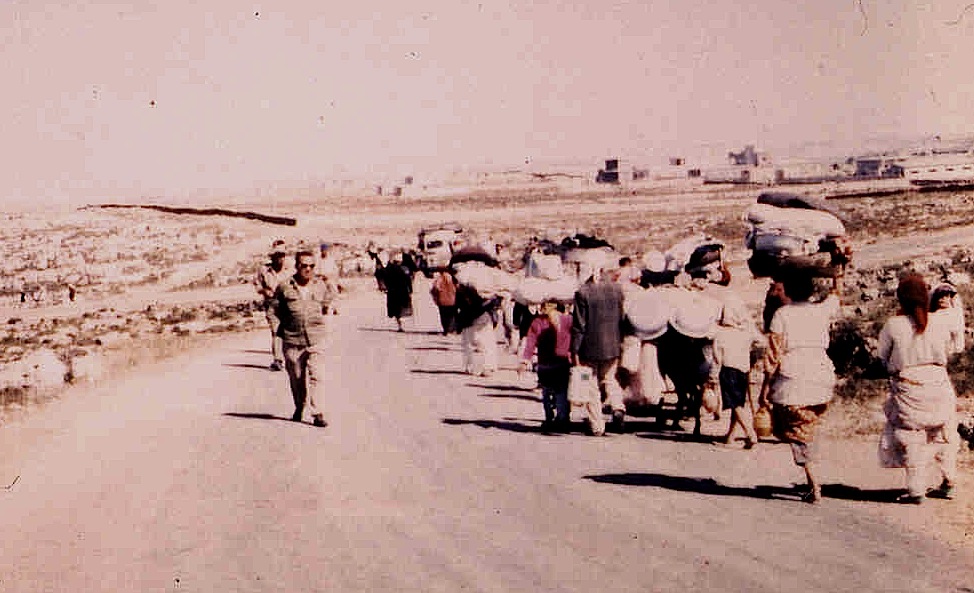
IDF soldiers expel the residents of Imwas (originally named Emmaus) from their village (source)
In 1972 Israel built its popular Canada Park on the location, named after Jewish Canadians who had been persuaded to donate for the venture. Hass writes that the park “was designed to conceal and bury” its war crime.
Christians often focus on the Biblical Emmaus story
Today, Christian pastors often retell the story of Jesus’ appearance to his disciples in Emmaus.
The numerous paintings of this sacred event are featured on Christian websites around the country. The story is often used as an inspirational message to Christians, for example, to become “more committed to serving others.” […]
Yet, almost none of the sites featuring the Biblical story of Emmaus seem aware of the modern story, and of the people made homeless and in need of help – perhaps because so few know these facts. As author Grace Halsell wrote in a powerful essay, most Christians are unaware of what they don’t know about Israel. “They were indoctrinated by U.S. supporters of Israel in their own country and when they traveled to the Land of Christ most did so under Israeli sponsorship.”
A moving film recounting the facts about Emmaus, “Ritorno a Emmaus” (Return to Emmaus), was broadcast on Swiss Italian Television on May 29, 1987 but was not shown in the U.S. This is the first time it’s available in English:
Featured Video

America Racing to Strategic Defeat in Iran
or go to
Aletho News Archives – Video-Images
From the Archives
Should Europeans ‘Thank’ the Americans for Destroying Nord Stream?
By Robert Bridge | Strategic Culture Foundation | September 29, 2022
With an investigation continuing into the destruction of the Nord Stream gas pipeline that provided energy supplies to Europe from Russia, there appears to be just one prime suspect, and that should surprise nobody.
Following the sabotage of the Nord Stream 1 and 2 gas pipelines, former Polish Foreign Minister Radoslaw Sikorski already seemed to know the identity of the perpetrator when he tweeted out: “Thank you, USA.”
At first glance, it seemed that Sikorski was speaking sarcastically, berating Washington for carrying out an attack that will have severe repercussions for the people of Europe. After all, how could anyone see any good coming from the termination of Europe’s primary source of gas reserves with winter just around the corner? It was Sikorski’s homeland of Poland, after all, that urged its citizens to collect firewood in the face of dwindling gas reserves.
In fact, the Polish diplomat was speaking one-hundred percent literally… continue
Blog Roll
 Aletho News
- Growing insecurity, soaring prices fuel protests in north as regime bans evacuation: Sources
- Iran denies responsibility for ‘depraved’ attack on Kuwait desalination plant
- Bring The Troops Back. End This War Now!
- Can we please stop calling Israel the ‘only democracy in the Middle East’ now?
- US should start removing its troops from Germany, proposes AfD co-leader Chrupalla
- Iran Red Crescent: 600 educational centers attacked in US-Israeli ‘war crimes’
- Russian Oil Tanker Arrives in Cuba Amid U.S. Blockade
- America Racing to Strategic Defeat in Iran: Lt Col Daniel Davis
- FTC Warns Visa, Mastercard, PayPal, Stripe Over Political Debanking
- Russian tanker approaches Cuba despite US oil blockade
- If Americans Knew
- As Iran targets US military bases, will they be relocated to Israel? Not a ceasefire Day 171
- Will Trump Go Kamikaze?
- Is the University of Florida Shutting Down College Republicans over Israel Criticism?
- Jewish extremist arrested over alleged plot to firebomb Palestinian activist Nerdeen Kiswani’s home
- More than half of Palestinian child detainees have no charges
- The More Murderous Israel Gets, The More We Hear About “Antisemitism”
- Land Day and the Palestinian struggle after 30 months of genocide
- The Iran War Is About Palestine
- Israeli soldiers echo settler ideology, talk of revenge after targeting Palestinians and detaining CNN crew in the West Bank
- Israeli Policies Threaten Future of Christian Schools in Jerusalem
- No Tricks Zone
- New Study Finds Warming Saves Lives…Cold Temperatures 12 Times More Deadly Than Excess Heat
- German Science Blog Accuses PIK Climate Institute Of Hallucinating Climate Tipping Points
- Devastating Assessment Of Comirnaty Vaccine By Former Senior Pfizer Europe Toxicologist
- New Study: CO2 Is ‘Effectively Negligible’ As An Explanatory Climate Change Factor Since 2000
- Former Pfizer Toxicologist Dr. Helmut Sterz Tells Bundestag Hearing Pfizer Vaccine Should Have Never Been Approved
- Energy Expert: Germany’s Nuclear Phaseout Was A “500 Billion Euro Mistake”
- New Research: South Australia’s Mid-Holocene Sea Surface Temperatures Were 4°C Warmer Than Today
- Storing Green Energy To Last Germany 10 Days Would Require A 60-Million Tonne Battery
- New Studies: UK Sea Levels Were 4 Meters Higher Than Today During The Mid-Holocene
- Destructive Green New Deal: German Energy And Metal Group Warns Of Drastic Crisis
 Aletho News