U.S. lawmakers are considering a bill that would grant the U.S. government vast new powers to surveil and censor U.S. citizens.
The RESTRICT Act — the Restricting the Emergence of Security Threats that Risk Information and Communications Technology Act, or Senate Bill 686 — would give the federal government new powers ostensibly to mitigate national security threats posed by technology products from countries that the U.S. deems adversarial.
The bill would grant the U.S. secretary of commerce the authority to “identify, deter, disrupt, prevent, prohibit, investigate, or otherwise mitigate” national security risks associated with technology linked to a foreign adversary.
There are only six countries on the foreign adversary list — China, Iran, North Korea, Venezuela, Russia and Cuba — but the bill allows the secretary and Congress to add any other country “if it became necessary.”
The bill does not stipulate the criteria for adding a country.
Additionally, the bill would give the commerce secretary the power to negotiate, enter into, impose and enforce “any mitigation measure” in response to national security risks.
The bill’s “broad” and “vague” language puts a great deal of power into the hands of the executive branch, according to critics, including the Electronic Frontier Foundation (EFF), a “leading nonprofit organization defending civil liberties in the digital world.”
The EFF called the bill a “dangerous substitute for comprehensive data privacy legislation.”
Meanwhile, the White House “applauded” the bill, stating that it would “empower the United States government to prevent certain foreign governments from exploiting technology services operating in the United States in a way that poses risks to Americans’ sensitive data and our national security.”
The bill — which has yet to be scheduled for a vote — would create a legal framework through which the U.S. government could ban TikTok.
TikTok is regarded as a national security risk by some U.S. lawmakers who fear that its Chinese parent company, ByteDance, might share sensitive information from the more than 150 million U.S. TikTok users with the Chinese Communist Party.
U.S. Big Tech companies including Facebook’s parent company, Meta, and Google’s parent, Alphabet, are expected to benefit from an expanded market share if the U.S. government bans the Chinese-owned TikTok.
‘Mechanism for a massive, sweeping surveillance and censorship overhaul’
However, according to investigative reporter Jordan Schachtel, “This bill is no mere ‘TikTok ban,’ it is a mechanism for a massive, sweeping surveillance and censorship overhaul.”
Michael Rectenwald, Ph.D., author of “Google Archipelago: The Digital Gulag and the Simulation of Freedom,” agreed. He told The Defender :
“The RESTRICT Act is not only aimed at the activities and expression of companies and individuals from nations deemed inimical to U.S. interests; it is a backdoor means through which the federal government can oversee the opinions and activities of all U.S. citizens, increasing the state’s powers of surveillance and abrogating citizen’s first amendment rights.”
Sen. Rand Paul (R-Ky.) also had harsh words for the proposed legislation:
Many on both the Left and Right have criticized the bill, calling it the “Patriot Act on steroids” or the “Patriot Act 2.0.”
Weeks after the September 11 attacks, the U.S. government passed the USA PATRIOT Act, which the American Civil Liberties Union said was “an overnight revision of the nation’s surveillance laws that vastly expanded the government’s authority to spy on its own citizens, while simultaneously reducing checks and balances on those powers like judicial oversight, public accountability, and the ability to challenge government searches in court.”
Critics fear the RESTRICT Act would expand those powers even further.
EFF condemned the bill’s potential threats to free speech, noting that the bill doesn’t require the executive branch to justify its restrictions on expressive technologies like TikTok and that it limits lawsuit challenges to the restrictions it sets.
“Due to undefined mitigation measures coupled with a vague enforcement provision, the bill could also criminalize common practices like using a VPN or side-loading to install a prohibited app,” EFF said. “There are legitimate data privacy concerns about social media platforms, but this bill is a distraction from real progress on privacy.”
Sen. John Thune (R-S.D.), who co-sponsored the bill, said in remarks on the Senate floor that the bill would not allow the government to “surveil Americans’ online content” or “access any American’s personal communications device.”
However, the RESTRICT Act’s broad language could potentially be interpreted to address satellite and mobile networks, cloud services and storage, internet infrastructure providers, home internet gear, commercial and personal drones, video games and payment apps, CNN said.
“Instead of passing this broad and overreaching bill, Congress should limit the opportunities for any company to collect massive amounts of our detailed personal data, which is then made available to data brokers, U.S. government agencies, and even foreign adversaries, China included,” EFF concluded.
Suzanne Burdick, Ph.D., is a reporter and researcher for The Defender based in Fairfield, Iowa. She holds a Ph.D. in Communication Studies from the University of Texas at Austin (2021), and a master’s degree in communication and leadership from Gonzaga University (2015). Her scholarship has been published in Health Communication. She has taught at various academic institutions in the United States and is fluent in Spanish.
This article was originally published by The Defender — Children’s Health Defense’s News & Views Website under Creative Commons license CC BY-NC-ND 4.0. Please consider subscribing to The Defender or donating to Children’s Health Defense.
May 20, 2023
Posted by aletho |
Civil Liberties, Full Spectrum Dominance | Human rights, United States |
Leave a comment
Thoughtcrime will NOT be tolerated

Using particular labels has become the unbeatable weapon du jour of online warfare. If you successfully brand someone a racist, a conspiracy theorist, an anti-vaxxer, alt-right or an antisemite (ideally several of these at once), you neutralise everything-they-ever-said-ever. Boom. Done. You’re finished. Next.
A significant majority of the UK population still consumes and trusts mainstream media. No matter how dissonant to real life this version becomes, legacy media outlets continue to behave like Orwell’s Ministry of Truth and are largely getting away with it. Modus operandi: memory-hole inconvenient truths, destroy dissenters and refuse to cover any events that threaten Le Narrative™. Business as usual.
A picture paints a thousand words, as the saying goes, so let’s examine a paradigm example from George Monbiot in the Guardian, way back in 2021:
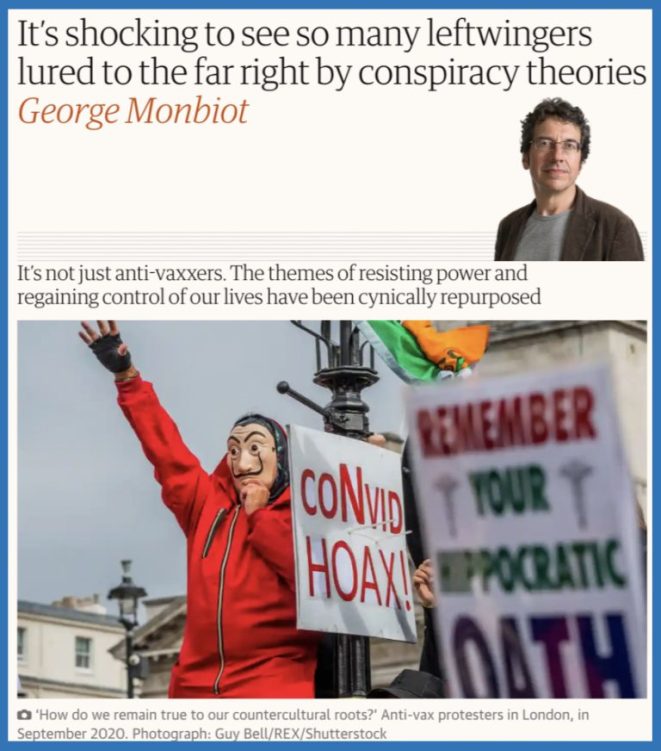
This delightful piece is replete with a Nazi salute, the use of ‘anti-vaxxer’ and conspiracy theorist slurs, a masked madman, a ‘convid hoax’ poster topped off with a title suggesting that you must be far right if you even dare to entertain any associated wrongthink. The Guardian has managed, in one fell swoop, to totally delegitimize anyone asking any questions about the covid narrative. After all, who wants to risk being lumped in with this masked nutjob? Keep your head down, your thoughts to yourself and ideally stop thinking them altogether. The parapet does not require your presence, move along please.
As with so much propaganda nowadays, this headline weaponises the threat of ostracism. Kipling Williams, a Professor of Psychology at Purdue University is a leading expert on this topic and notes the following:
“The fear of social exclusion is so salient, most bystanders will adopt the behaviour of the aggressor, ensuring their “in-group” membership, as opposed to risking possible retaliation for questioning group norms.”
Social conformity and fear of ostracism have the power to heavily influence our opinions, even if we have done no personal research on a given topic. Why bother researching when these clever, trusted, virtuous kind people who use big words have done it for us? Very early in life, children detect that certain things are not socially acceptable and are going to land them in the holy hell of social isolation. These thoughts and actions will be deftly avoided at all costs, with no need for further inquiry. It is a coping mechanism that is learned extremely young and persists into adulthood.
The more years spent in institutions of learning, the more exposure to this thought taming a person will be subjected to. In the extremely unnatural, highly age-stratified environment of the education system where thought crimes could mean instant and permanent group exclusion, it doesn’t seem worth the risk, does it? Arguably this might be even more powerful in a 24/7 environment such as boarding school. Self-censorship in full force all day, every day.
Is it a coincidence that people from such institutions are overrepresented in government? The parallels between Westminster and a boys’ public school aren’t exactly cryptic; keeping everyone in a carefully constructed hierarchy, using similar bullying techniques as those seen in a school playground if anyone steps out of line (see recent treatment of Andrew Bridgen for details). Isolate, humiliate, smear, evict. Rinse and repeat. The message is loud and clear: if you deviate from the Party Line you will be severely punished.
Institutionalised groupthink has the potential to be very dangerous and with bizarre and rapid shifts in what constitutes age-appropriate education, many parents have legitimate concerns about exactly what and how children are now being taught to think. A former OFSTED Inspector, Teacher and Teacher Educator of 40 years had the following comment:
“An examination of the National Curriculum (for England and Wales) will reveal that critical thinking and critical reading skill development have been incrementally edited out in subsequent drafts since its inception.”
If children aren’t encouraged to critique material put before them, then they won’t be asking questions of it or forming their own opinion of it. They become passive consumers of the text. Why would this be the evolving trend in education? Who does this serve? It would be interesting to know whether this is a factor in the huge increase in parents choosing to homeschool here in the UK.
The amount of money being spent by governments and institutions worldwide on ‘nudge’ units in various guises indicates that those wishing to shape the prevailing narrative fully understand the primordial fear of ostracism and are more than happy to weaponise it. Who wants to be called a racist? Absolutely no one ever. Guilt and shame are unbelievably powerful tools which can be used to moderate behaviour very effectively. But can one be ‘innoculated’ against these underhand psy-op tactics? The first step towards Thought Recovery appears to be awareness. Once you see it, you can’t unsee it, and there is certainly no going back. The culture of memes that sprang up in recent years beautifully satirises the point. In what was primarily a psychological war, memes played an important role in boosting the morale of those swimming against the tide of public opinion. The Chad vs NPC series were particularly powerful in highlighting the obvious inconsistencies in The Science™.

Most people do not like to feel as though they have been played any more than they like the idea of social isolation. At a certain point, if one believes that those doing the manipulating may have nefarious intentions, one may be persuaded to not just ‘go along to get along’, even at risk of being labelled a racist, climate denying, anti vax, alt right conspiracy theorist. Many people who supported Brexit will be familiar with this concept, as they were relentlessly called racists by the media machine and in turn by many of their friends and family. They learned to keep it to themselves but in the end, voted leave anyway. If we want to preserve truth as a valuable commodity in society, we must teach young people to critically think and to speak up when they believe something is ethically and morally wrong. If they are no longer being taught these basics in school, it falls to parents to ensure this education is completed at home. The total outsourcing of teaching is no longer a safe option for society.
For those who read George Orwell’s 1984 at school but can only vaguely remember the contents, we highly recommend refreshing your memory. It is utterly chilling in the context of what is going on in the real world. Perhaps it would make a good Christmas or birthday present for anyone stating that everything is hunky dory, we’re back to normal and there’s really nothing to worry about. Here is one of many prescient excerpts:
“The whole climate of thought will be different. In fact there will be no thought, as we understand it now. Orthodoxy means not thinking—not needing to think. Orthodoxy is unconsciousness.”
And in case you’re still not convinced, how about this one:
“There will be no love, except the love of Big Brother. There will be no laughter, except the laugh of triumph over a defeated enemy. There will be no art, no literature, no science. When we are omnipotent we shall have no more need of science. There will be no distinction between beauty and ugliness. There will be no curiosity, no enjoyment of the process of life. All competing pleasures will be destroyed.”
It seems Those In Charge have taken 1984 as a detailed instruction manual rather than a fictional novel. Let’s not let the end play out as written!
May 20, 2023
Posted by aletho |
Book Review, Full Spectrum Dominance |
Leave a comment
Less than a year after successfully winning the fight to force Pfizer to release their COVID-19 vaccine trial data that the FDA was attempting to block for 75 years, ICAN’s Lead Counsel, Aaron Siri, Esq., joins Del with a new, updated ruling, and great news about what this ruling means for Pfizer and Moderna’s COVID vaccine trial data.
Biden’s new pick for Head of the NIH, Monica Bertagnolli, received more than 290 million in grants from Pfizer. This appointment comes more than a year after former director, Francis Collins, left the beleaguered agency. With deep ties to Pfizer and the cancer industry, she joins a roster of agency heads with questionable conflicts of interest, contributing to a growing distrust of our health agencies now seemingly beyond repair.
May 20, 2023
Posted by aletho |
Corruption, Deception, Video | COVID-19 Vaccine, FDA, NIH, United States |
Leave a comment
The ‘crimes’ of Anthony Fauci are legion. From involvement in and denial of that involvement in funding gain-of-function research in Wuhan, whence the ‘deadly’ Covid-19 virus came, to exaggerating the lethality of the virus, through Covid-19 vaccine mandates involving widespread rollout of an experimental gene therapy to complicity in the almost ubiquitous and dangerous early use of ventilators for the treatment of Covid-19 patients.
The danger of ventilators and their likely involvement in the unnecessary deaths of Covid-19 patients has already been raised in these pages. That article was unconvincingly ‘fact checked’ with the customary ‘conspiracy theory’ trope being levelled at the authors. However, while ventilators may not have been fully responsible, for example, for the unusually high deaths of Covid-19 patients on ventilators in New York, they were associated with a higher level of mortality.
Ventilation, a procedure exclusively carried out in intensive-care environments, involves the introduction of an endotracheal tube into the lungs by which air is then pumped in. Despite the sterile conditions under which the tube is introduced into the lungs, bacterial infection referred to as ventilator associated pneumonia (VAP) is common within 24 hours. This is especially dangerous because the patient will already be medically compromised, and the immune system will be less able to combat the infection. VAP has a mortality rate of between 20 and 50 per cent.
An article published earlier this month by the News Center of Northwest Medicine, which is a non-profit healthcare system associated with Northwestern University Feinberg School of Medicine, published an article titled: ‘Secondary Bacterial Pneumonia Drove Many COVID-19 Deaths.’ The article featured Professor Benjamin Stinger of Northwest Medicine, who led a study linking secondary pneumonia caused by being on a ventilator to mortality which was published in a recent issue of the Journal of Clinical Investigation. JCI is a leading medical journal with an impressive impact factor, a measure of how much it is cited, of 19.
The new study involved 585 ventilated patients including 190 diagnosed with Covid-19 and used a computerised machine-learning procedure called CarpeDiem to analyse the patients’ clinical data over the course of the study. The link between the deaths of Covid-19 patients was made because longer periods on ventilation are associated with VAP which, if unsuccessfully treated, leads to death. Covid-19 patients tended to spend longer than other patients on ventilators.
But, in addition to providing further evidence of the dangers inherent in ventilating Covid-19 patients, the article inadvertently uncovers that Anthony Fauci was aware of the dangers of VAP. He led a study in 2018 published in the Journal of Infectious Diseases, cited in the JCI article, which ‘suggested an unexpectedly important contribution of secondary bacterial infection to mortality after severe viral pneumonia’. VAP is a secondary bacterial infection and, given the high use of ventilators in the early days of Covid-19, based on their study, the JCI authors concluded that:
‘Mortality in patients with severe SARS-CoV-2 pneumonia results from a low mortality attributable to the primary viral pneumonia that is offset by an increased risk of mortality from unresolving VAP or other ICU complications.’
Despite the knowledge, based on his own work, of the potential dangers of using ventilators, Fauci’s enthusiasm for them was not dampened, and he did not discourage their use when he was managing Covid-19 in the U.S. In fact, he warned that they may not have enough, saying that despite having 12,700 ventilators stockpiled they might be insufficient if the virus spreads quickly. He said: ‘If you don’t have enough ventilators, it’s obvious people who need it will not be able to get it. That’s when you’re going to have to make some very tough decisions.’ Asked if he was, perhaps, overreacting to the situation, he responded: ‘We’ll be thankful that we’re overreacting.’ Try telling that to the families of deceased Covid-19 patients who were unnecessarily artificially ventilated.
May 19, 2023
Posted by aletho |
Timeless or most popular, War Crimes | Anthony Fauci, Covid-19, United States |
Leave a comment
The 2023 Arab League summit, officially the 32nd Ordinary Session of the Council of the League of Arab States at the Summit Level, is a meeting of heads of state and government of member states of the League of Arab States that took place in Jeddah, Saudi Arabia, on 19 May 2023. All countries were represented at this meeting, including Syria, which returned triumphantly after its membership was suspended in 2011.
Speech of Bashar al-Assad, President of the Syrian Arab Republic
Transcript:
Your Highness Prince Mohammed bin Salman, Crown Prince of the Kingdom of Saudi Arabia, Your Majesties, Highnesses, and Excellencies, Ladies and Gentlemen…
Where does one begin his speech when the dangers are no longer imminent, but realized? He begins with the hope that motivates achievement and work. And when ailments accumulate, a doctor can treat them individually, provided he addresses the underlying disease causing them.
Therefore, we must look for the main issues that threaten our future and produce our crises, so that we do not drown and drown future generations in dealing with the consequences rather than the causes. Threats contain risks and opportunities. Today, we are presented with an opportunity as the international situation changes, and a multipolar world appears as a result of the dominance of the West, which is devoid of principles, ethics, friends, and partners. It is a historic opportunity to reorganize our affairs with the least possible foreign intervention, which requires repositioning ourselves in this world that is shaping today to be an active participant in it, and investing in the positive atmosphere resulting from the reconciliations that preceded the summit and made the situation as it is today.
It is an opportunity to solidify our culture in the face of the impending collapse with modern liberalism that targets the innate human nature and strips people of their ethics and identity, and to define our Arab identity with its civilizational dimension, as it is falsely accused of racism and chauvinism in order to make it in conflict with its natural national, ethnic, and religious components, so that our societies die in their struggle within themselves, and not with others.
There are many too many topics that cannot be discussed for lack of time, and summits would not be enough to evoke them all… They do not begin with the crimes of the Zionist entity, rejected by Arabs, against the Palestinian resistance people, nor do they end with the danger of the Ottoman expansionist thought grafted with a deviant Muslim Brotherhood flavour ; and they are inseparable from the challenge of development as a top priority for our developing societies. Here comes the role of the Arab League as a natural platform for discussing and addressing various issues, with the condition of its working system being reviewed in its charter, internal system, and the development of its mechanisms in line with the times. Joint Arab action needs common visions, strategies and goals that we later turn into executive plans. It needs a unified poliicy, firm principles and clear mechanisms and controls. That is how we’ll be able to move from mere reaction to the anticipation of events. Then the Arab League will be a way out in case of siege, not a partner to it, and a refuge from aggression and not an enabler for it.
As for the issues that concern us daily, from Libya to Syria, passing through Yemen and Sudan, and many other issues in different regions, we cannot treat diseases by treating symptoms. All of these issues are the results of larger problems that have not been dealt with previously. To talk about some of them, we need to address the cracks that have arisen on the Arab scene during the past decade and restore the role of the Arab League as a healer of wounds, not a deepener of wounds. The most important thing is to leave internal affairs to their peoples, as they are capable of managing their own affairs, and our role is only to prevent external interference in their countries and assist them exclusively upon request.
As for Syria, its past, present, and future is Arabism, but it is the Arabism of belonging, not the Arabism of embrace [alliances], because the embraces are transient, while belonging is permanent. A person may move from one embrace to another for some reason, but it does not change his belonging. Those who change it are without belonging in the first place, and those who fall in the heart do not fade in the embrace. Syria is the heart of Arabism and in its heart.
Ladies and Gentlemen,
As we hold this summit in a turbulent world, hope is rising in light of the Arab-Arab rapprochment, and regional and international rapprochment, that culminated with this summit, which I hope will mark the beginning of a new phase of Arab action, for solidarity among us, for peace in our region, for development and prosperity instead of war and destruction.
In accordance with the allocated five minutes for speeches, I extend my sincere thanks to the heads of delegations who have expressed their deep sympathy with Syria, and I reciprocate their sentiments. I also thank the Custodian of the Two Holy Mosques for the significant role he has played and the intensive efforts he has made to enhance reconciliation in our region and for the success of this summit. I wish him, His Highness the Crown Prince, and the brotherly Saudi people, continued progress and prosperity.
Peace be upon you, and may the mercy of God and His blessings.
Translation: resistancenews.org
May 19, 2023
Posted by aletho |
Aletho News | Middle East, Palestine, Saudi Arabia, Syria, Zionism |
Leave a comment
The Intergovernmental Panel on Climate Change (IPCC) was established as a scientific assessment process more than 35 years ago. Scientific assessments are of critical importance in many areas to help policy makers and the public to identify what is known, what is uncertain, as well as where there is contestation, uncertainties and areas of fundamental ignorance. Such assessments can also help us to understand policy options and expectations for how different choices might lead to different outcomes.
Regular readers of The Honest Broker will know that I have taken issue with the recent IPCC Sixth Assessment (AR6) based on an unacceptable number of errors and omissions in my areas of expertise, as well as its over-reliance on the most extreme climate scenarios. Today I take a look at the IPCC’s self-described political agenda and argue that the institution finds itself at a fork in the road.
Before proceeding, I want to be clear about what I mean when I talk about “the IPCC.” In one sense there is really no such thing as “the IPCC.” The organization’s assessment process includes many hundreds of people who do their work across three Working Groups to produce many dozens of chapters covering a wide range of topics. The Working Groups are largely independent of each other and even chapters within the same Working Group can be written largely independently of other chapters.
In another sense there is indeed such a thing as the IPCC — Specifically, its leadership and most engaged participants. These core participants represent a kind of climate in-group with a shared sense of purpose and an overarching commitment to a shared political agenda. For some people, their entire career is centered on the IPCC. These core participants do have a shared political agenda which can be seen in varying degrees within the reports.
So what is the political agenda of the IPCC in-group? Transformational change
When the IPCC released its Synthesis Report in March, it announced:
Taking the right action now could result in the transformational change essential for a sustainable, equitable world
It would be easy to write this sentence off as containing consultant-like and empty buzzwords. But the notion of “transformational change” has been widely employed in the academic literature on climate and the IPCC clearly defines what it means by “transformational change.”
In its AR6 Working Group 3 report the IPCC explains that transformation involves more than simply transitioning from one type of technology to another (emphasis added):
While transitions involve ‘processes that shift development pathways and reorient energy, transport, urban and other subsystems’ (Loorbach et al. 2017) (Chapter 16), transformation is the resulting ‘fundamental reorganisation of large-scale socio-economic systems’ (Hölscher et al. 2018). Such a fundamental reorganisation often requires dynamic multi-stage transition processes that change everything from public policies and prevailing technologies to individual lifestyles, and social norms to governance arrangements and institutions of political economy
Transformational change means that everything changes.
What are examples of these sorts of changes? The IPCC identifies “the potential for virtuous cycles of individual level and wider social changes that ultimately benefit the climate.”
The IPCC continues (emphasis added):
The starting point for this virtuous circle are inner transitions. Inner transitions occur within individuals, organisations and even larger jurisdictions that alter beliefs and actions involving climate change (Woiwode et al. 2021). An inner transition within an individual (see e.g., Parodi and Tamm 2018) typically involves a person gaining a deepening sense of peace and a willingness to help others, as well as protecting the climate and the planet . . .”
What are examples of such “inner transitions”? The IPCC explains:
Examples have also been seen in relation to a similar set of inner transitions to individuals, organisations and societies, which involve embracing post-development, degrowth, or non-material values that challenge carbon-intensive lifestyles and development models . . .
The IPCC discusses the importance of “degrowth” to its vision of transformation in its AR6 Working Group 2 report:
Consumption reductions, both voluntary and policy-induced, can have positive and double-dividend effects on efficiency as well as reductions in energy and materials use . . . a low-carbon transition in conjunction with social sustainability is possible, even without economic growth (Kallis et al. 2012; Jackson and Victor 2016; Stuart et al. 2017; Chapman and Fraser 2019; D’Alessandro et al. 2019; Gabriel and Bond 2019; Huang et al. 2019; Victor 2019). Such degrowth pathways may be crucial in combining technical feasibility of mitigation with social development goals (Hickel et al. 2021; Keyßer and Lenzen 2021).
These views are no doubt legitimate and sincerely held. But I seriously doubt that a climate agenda focused on changing everything, grounded in inner transitions to support degrowth is going to get very far in Peoria, much less anywhere else. More broadly, why are they being used to frame a scientific assessment?
I’m far from the first to recognize that the IPCC has adopted a political agenda focused on transformational change. Writing in 2022, Lidskog and Sundqvist explain:
Transformation has become a buzzword within scientific and political discourses in which “transformative change” is stated to be the solution to many severe environmental challenges. Expert organizations such as the IPCC and IPBES have stressed that transformative change is necessary to meet environmental challenges (IPCC, 2018; IPBES, 2019). . . While transformative change is seen as the way forward and as an uncontroversial ambition—it is difficult to find anyone who is critical of it—its meaning is nevertheless unclear.
The adoption of transformational change as an overriding political objective in the IPCC AR6 (and in the IPCC 1.5 report before that) represents a departure from a more politically neutral use of the concept in the IPCC Fifth Assessment Report (AR5). In 2014, the AR5 described “transformation pathways” to refer to technological alternatives for mitigation, not to demand that everything must change across society:
Stabilizing greenhouse gas (GHG) concentrations at any level will require deep reductions in GHG emissions. Net global CO2 emissions, in particular, must eventually be brought to or below zero. Emissions reductions of this magnitude will require large-scale transformations in human societies, from the way that we produce and consume energy to how we use the land surface. The more ambitious the stabilization goal, the more rapid this transformation must occur. A natural question in this context is what will be the transformation pathway toward stabilization; that is, how do we get from here to there?
The IPCC AR5 acknowledged that there were many ways to address accumulating greenhouse gases (GHGs) in the atmosphere:
[T]here is no single pathway to stabilization of GHG concentrations at any level. Instead, the literature elucidates a wide range of transformation pathways. Choices will govern which pathway is followed . . .
This expansive view of policy possibilities is far removed from “processes that change everything” and a “deepening sense of peace.” The IPCC AR5 and AR6 have been rightly criticized for not considering a larger set of possibilities for mitigation (notably, equity), which also reflects a political orientation.
The IPCC – or to be more precise, influential elements of the IPCC – appears to have been captured by an in-group with shared political views related to climate. These views embrace concepts like degrowth and planetary boundaries and turn climate policy on its head such that ends become means.
Transformational change views climate policy as a lever through which to “change everything.” The expressed need for such momentous changes across society are grounded in a frightening, even apocalyptic, perspective on the future. As the head of the IPCC exhorted in March, the IPCC “underscores the urgency of taking more ambitious action and shows that, if we act now, we can still secure a liveable sustainable future for all.”
The political agenda of the IPCC reads as if it was developed by wealthy American and Europeans academics. The billions of people around the world who may lack energy services or enough food probably would welcome an agenda of change. Instead, the IPCC emphasizes transformational changes in the lifestyles of ordinary people in rich countries, for instance, the recent Synthesis Report explained: “Many mitigation actions would have benefits for health through lower air pollution, active mobility (e.g., walking, cycling), and shifts to sustainable healthy diets.”
I have little doubt that many who have worked on the IPCC AR6 might read this post and say, “Hmmm, I never saw any of that,” others might say, “Yup, that’s our agenda, so what?” and still others might say, “I have a different political or professional agenda that I inserted into the report.” Further, one can surely dive into the almost 10,000 pages of the AR6 reports and selectively construct a different political narrative. However, I argue that “transformational change” is what in the jargon of symbolic politics is called the “master symbol” — the dominant political framing of the AR6.
The IPCC has clearly departed from its role as a scientific assessment and is now much more deeply engaged in political advocacy. Trying to simultaneously engage in assessment and advocacy is never a good idea. I hypothesize that the IPCC’s political agenda of transformational change plays more than a small role in its stubborn reliance on implausibly extreme scenarios and its multiple errors and omissions related to the science of extreme weather and disasters — both of which help to underscore the demand for urgent and large-scale societal change.
The IPCC finds itself at a fork in the road and should be reformed. It needs to either operate as a trustworthy scientific assessment or alternatively, to fully embrace its current role as an environmental advocacy group pushing transformational change. There is no middle ground.
May 19, 2023
Posted by aletho |
Malthusian Ideology, Phony Scarcity, Science and Pseudo-Science, Timeless or most popular | IPCC |
Leave a comment
The UN Intergovernmental Panel On Climate Change (IPCC) is misleading policy makers by focusing on an implausible worst-case emissions scenarios, concludes a new analysis report published by the Clintel Foundation: “The Frozen Climate Views of the IPCC“
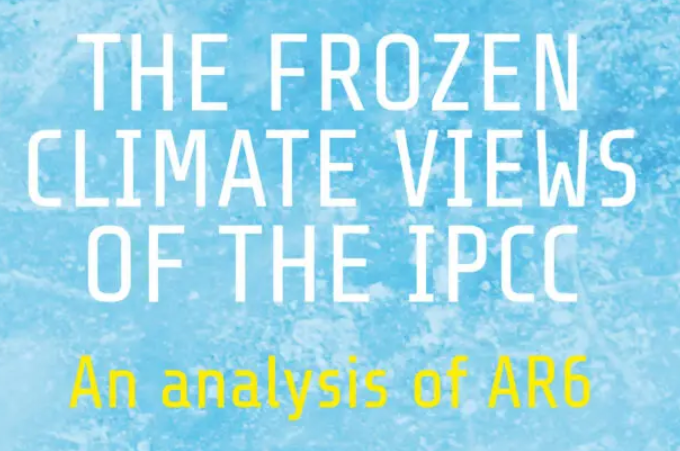
The IPCC is hiding the good news about disaster losses and climate-related deaths and wrongly claims the estimate of climate sensitivity is above 2.5°C. Also errors in the AR6 report are worse than those that led to the IAC Review in 2010, concludes the report by The Climate Intelligence Foundation (Clintel), which was founded in 2019 by emeritus professor of geophysics Guus Berkhout and science journalist Marcel Crok.
Opposite of IPCC claims likely true
Another result: The IPCC ignored crucial peer-reviewed literature showing that normalized disaster losses have decreased since 1990 and that human mortality due to extreme weather decreased by more than 95% since 1920.
Clintel accuses the IPCC of cherry picking from the literature to claim increases in damage and mortality due to anthropogenic climate change, when in fact the opposite is likely true.
Rewrote climate history
The Clintel report is 180 pages long and the first serious international ‘assessment of the IPCC’s Sixth Assessment Report. In 13 chapters the Clintel report shows the IPCC rewrote climate history, and emphasizes an implausible worst-case scenario, favoring bad news and ignoring good news.
“The strategy of the IPCC seems to be to hide any good news about climate change and to hype anything bad,” reported the Clintel press release.
The errors and biases that Clintel documents in the report are far worse than those that led to the investigation of the IPCC by the Interacademy Councel (IAC Review) in 2010. Clintel believes that the IPCC should reform, or be dismantled.
Clintel is a network of international scientists who analyzed several claims from the Working Group 1 (The Physical Science Basis)
and Working Group 2 (Impacts, Adaptation and Vulnerability) reports. This led to the latest report: “The Frozen Climate Views of the IPCC”.
IPCC ignores 97% of all papers
Clintel explains how the IPCC ignored 52 out of 53 peer reviewed papers dealing with “normalized disaster losses” and found no increase in harms that could be attributed to climate change. Yet, the IPCC highlighted the single paper that claimed an increase in losses.
Cherrypicking, rewriting history
The IPCC also has tried to rewrite climate history by erasing the existence of the so-called Holocene Thermal Maximum (or Holocene Climate
Optimum), a warm period between 10,000 and 6000 years ago, and has introduced a new hockey stick graph, which is the result of cherry-picked proxies. The IPCC ignores temperature reconstructions that show more variability in the past, such as the well-documented Little Ice Age.
In its recent report, the IPCC also has grossly exaggerated sea level rise and CO2’s ability to warm the earth’s atmosphere and thus appears to have remained ‘addicted’ to its highest emissions scenario, so-called RCP8.5, which in recent years has been shown by several published papers to be implausible and thus should not be used for policy purposes.
Severely biased
“We are sorry to conclude that the IPCC has done a poor job of assessing the scientific literature,” the Clintel scientists report. “In our view the IPCC should be reformed, and should include a broader range of views. Inviting scientists with different views, such as Roger Pielke Jr and Ross McKitrick, to participate more actively in the process is a necessary first step.”
If the inclusion of other views does not permitted, then the IPCC should be dismantled, the scientists say.
Reality: Future is far less bleak
“Our own conclusions about climate – based on the same underlying literature – are far less bleak. Due to increasing wealth and advancing technology, humanity is largely immune to climate change and can easily cope with it. Global warming is far less dangerous to humanity
than the IPCC tells us.”
Clintel also published the World Climate Declaration, which has now been signed by more than 1500 scientists and experts. Its central message is “there is no climate emergency”.
Clintel press release here.
May 19, 2023
Posted by aletho |
Deception, Science and Pseudo-Science | IPCC |
Leave a comment
A New York State assembly member has introduced a legislation to stop charities from sending millions of dollars to Israel to stop its settlement expansion activities across the occupied Palestinian territories which are being advanced in flagrant violation of the international law.
The legislation, dubbed “Not on our dime!: Ending New York Funding of Israeli Settler Violence Act,” was introduced by state assembly member Zohran Mamdani, the third Muslim in the New York State assembly, earlier this week.
It would give the state attorney general authority to sue and dissolve not-for-profit organizations that are found to be using their tax-deductible donations to support organizations funding illegal Israeli settlements in the occupied West Bank.
The legislation would also give Palestinians harmed by settler organizations funded by New York-based charities the right to seek damages in American courts.
“Charities registered in New York State currently send more than $60 million dollars a year in tax-deductible donations to aid and abet Israeli settlements. This is done on our dime as New Yorkers,” Mamdani said, the Middle East Eye reported on Thursday.
He added, “This legislation puts an end to that and makes explicit that subsidizing violence and activities outlawed by the Geneva Convention is not, and should not be considered, charitable giving. It’s past time for New York to catch up to international law.”
Mamdani noted that while this issue is important to him as a Muslim, as his faith informs his fight to ensure justice for all people, this is not a bill motivated by religion.
“It is a bill motivated by a desire that New York State stop subsidizing human rights violations through the conferring of charitable status to organizations such as these,” he said.
“Too often, we see an exception drawn when it comes to Palestine – whether it be in our policies or the application of them. This makes it clear that our belief in human rights is universal, without exception,” he added.
The legislation has already received some backlash. Mamdani highlighted that his office has received a call saying all Muslims should die and all Muslim lovers should be killed as well.
“This is the reality when you dare speak up about Palestine and Palestinians,” he said.
Additionally, 66 lawmakers signed an open letter condemning the legislation, saying it “attacks” Jewish organizations.
Emboldened by former US president Donald Trump’s all-out support, Israel has stepped up its illegal settlement construction activities in defiance of United Nations Security Council Resolution 2334, which pronounced settlements in the West Bank and East al-Quds “a flagrant violation under international law.”
More than 600,000 Israelis live in over 230 settlements built since the 1967 Israeli occupation of the West Bank and East al-Quds.
All Israeli settlements are illegal under international law. The UN Security Council has condemned Israel’s settlement activities in the occupied territories in several resolutions.
Palestinians want the West Bank as part of a future independent state with East al-Quds as its capital.
The last round of Israeli-Palestinian talks collapsed in 2014. Among the major sticking points in those negotiations was Israel’s continued illegal settlement expansion.
Many Palestinians believe the Israeli plans to annex one-third of the already occupied West Bank, including parts of the strategic Jordan Valley, is only a formality and that a de facto Israeli occupation of their land has been underway for many years.
May 19, 2023
Posted by aletho |
Ethnic Cleansing, Racism, Zionism, Illegal Occupation | Israel, Palestine, United States, Zionism |
Leave a comment
Sir Halford John Mackinder, one of Britain’s most prominent theorists in the field of geopolitics, discusses the significance of land connectivity between nations in his 1904 essay called The Geographical Pivot of History.
Besides introducing his notable Heartland Theory, Mackinder argued that advancements in transportation technology, such as the development of railways, have altered the balance of power in international politics by enabling a powerful state or group of states to expand its influence along transport routes.
The establishment of blocs, like the EU or BRICS, for instance, aims to enhance communication between member states. This objective has positive implications for the economy and helps reduce the risk of tensions among them.
The cost of such tensions has increased considerably, given the growing benefits and common interests achieved through strengthened ties between nations. Consequently, reinforcing connections within a specific region has a positive impact on the entire area.
Therefore, any infrastructure project between countries cannot be viewed solely from an economic standpoint; its geopolitical effects must also be highlighted.
West Asia connected by railway
In July 2018, Saeed Rasouli, head of the Islamic Republic of Iran Railways (RAI), announced the country’s intention to construct a railway line connecting the Persian Gulf to the Mediterranean Sea, the Iran-Iraq-Syria railway link. This ambitious project would run from Basra in southern Iraq to Albu Kamal on the Iraqi-Syrian border and then extend to Deir Ezzor in northeastern Syria.
Undoubtedly, this project strengthens communication between the countries of West Asia and increases the need for other powers to collaborate with this important region, which is strategically located in parts of Mackinder’s “Heartland” and Nicholas Spykman’s “Rimland” of Eurasia.
Moreover, in accordance with Mackinder’s proposition, it can be argued that this railway project holds geopolitical significance for the three involved countries – Iran, Iraq, and Syria – and for West Asia as a whole.
The concept of a railway link between Iran and Iraq emerged over a decade ago. In 2011, Iran completed the 17-kilometer Khorramshahr-Shalamjah railway, which aimed to connect Iran’s railways to the city of Basra. Subsequently, in 2014, a memorandum of understanding (MoU) was signed between Tehran and Baghdad to construct the Shalamjah-Basra line.
As per the agreement, Iran was responsible for designing and building a bridge over the Arvand River, while the Iraqi side pledged to construct a 32-kilometer railway line from the Shalamjah border to the Basra railway station within Iraqi territory.
Final destination: Syria
On 14 August, 2018, Iran announced its intention to further extend the railway from its territory to Syria, with Iraq’s participation. This move aimed to counter western sanctions and enhance economic cooperation.
The railway project would begin at the Imam Khomeini port on the Persian Gulf, located in Iran’s southwestern Khuzestan province, to the Shalamjah crossing on the Iraqi border. From there, the railway traverses through the Iraqi province of Basra, crossing Albu Kamal on the Syrian border and ending at the Mediterranean port of Latakia.
Iranian official sources stated that this railway would contribute to Syria’s reconstruction efforts, bolster the transport sector, and facilitate religious tourism between Iran, Iraq, and Syria. Iran would bear the costs of the project within its own territory, while Iraq would contribute its share up to the Syrian border.
During the visit of former Iranian President Hassan Rouhani to Iraq in March 2019, a memorandum of understanding on the project was signed between Tehran and Baghdad. However, despite the agreements, the Iraqi side has faced economic challenges and a lack of funds, resulting in a delay in the construction of the railway.

Proposed railway links between Iran, Iraq, and Syria
Three Sections
The railway project can be divided into three sections: The first section links the Imam Khomeini Port to the Shalamjah crossing on the Iraqi border. According to the Iranian Minister of Roads and Urban Development Mehrdad Bazrpash, the railway line in Iran has been completed and has reached the zero border point.
The second section will link the Shalamjah Crossing to Basra in southern Iraq, then extend to Baghdad, Anbar province, and finally, the Syrian border. The financing of this section, according to the agreement, falls under the responsibility of the Iraqi government. The commencement of this phase is expected soon.
The third section, within Syria, encompasses two routes: The northern route extends between Iraq’s al-Qaim and Syria’s Albu Kamal, then heads west towards the Syrian port of Latakia. The southern route runs from the al-Qaim crossing on the Iraqi-Syrian border to Damascus via Homs.
It should be noted that although the shortest route to Damascus is through al-Tanf, due to the presence of the illegal US occupation forces there, the longer Homs-Damascus corridor was adopted. This also ensures the passage of railways through a greater number of Syrian cities.
Economic significance
Although the rail line between Iran and Iraq will only span 32 km and cost approximately $120 million, divided equally, its significance extends far beyond its length. It will serve as the sole railway connection between the two countries and play a crucial role in improving communication throughout the wider region by linking China’s Belt and Road Initative (BRI) lines to Iraq via Iran.
Once completed, the project will enable Iraq to easily connect to Iran’s extensive railway network, which extends to Iran’s eastern border. This linkage will open pathways for Baghdad to connect with Afghanistan, Pakistan, China, the Caucasus, Central Asia, and the Far East.
Moreover, in the future, the project positions Iraq as a transit route for trade between the Arab countries of the Persian Gulf region and Central Asia, as well as Russia. Incidentally, Iran and Russia have just inked an agreement to establish a railway connecting the Iranian cities of Astara with Rasht, as part of the International North–South Transport Corridor (INSTC).
The railway line also contributes to the promotion of religious tourism among the three countries, which are home to several important Shia shrines. In September 2022, more than 21 million people from around the world, including 3 million Iranians, visited Iraq for the annual Arbaeen pilgrimage in the holy city of Karbala. This figure is likely to increase significantly with a rail link, leading to increased revenues for the Iraqi treasury.
Furthermore, the project serves as a means to bypass western sanctions and external pressures on the three countries, particularly Iran and Syria. It strengthens the independence of these nations and reduces the likelihood of foreign powers interfering in the economic relations of the project countries.
Obstacles to project implementation
Despite the signed agreements, the Tehran-Baghdad-Damascus railway project has faced mixed reactions in Iraq, leading to a lack of enthusiasm for moving forward with the rail link. Only last month, the Ministry of Transport issued a clarification regarding its rail link with Iran, stressing that the project is related to “passenger transportation only.”
Iraqi politicians have expressed concerns that the rail link with Iran could hinder their country’s Dry Canal project, which aims to connect the port of Faw in Basra province to the Turkish and Syrian borders.
They believe that the Grand Faw Port is strategically positioned as the closest point for sea cargo to Europe, potentially bringing economic benefits and employment opportunities. These concerns arise from the fear that the Imam Khomeini port in Iran could gain increased importance, diminishing the significance of the Faw Port.
But Iraqi concerns actually present an opportunity to link Iran to the Dry Canal, enhancing the strategic importance of both projects and bolstering Iraq’s position as a regional trading hub. In the near future, communication and cooperation between these neighbors will be crucial in thwarting external efforts to impede the economic interdependence of the three countries.
A promising journey
The tripartite railway link project holds immense significance as it connects these countries within a larger network, resembling the historical Silk Road that facilitated trade between the east and the west for centuries.
The railway project has the ability to initiate a major transformation in West Asia if it materializes and expands further afield to countries like Saudi Arabia, Jordan, and Lebanon.
Their participation would not only reduce tensions among regional states but also yield positive economic outcomes and bolster tourism, particularly religious tourism, and foster stronger inter-regional ties.
By connecting key players in a geopolitically strategic region, the Tehran-Baghdad-Damascus rail link has the potential to lay the foundation for a new West Asian paradigm that promotes connectivity, stability, and prosperity.
As seen by the recent Iran-Saudi and Syria-Saudi rapprochement agreements, the region is in a collaborative mood, actively seeking economic development instead of conflict. With China and Russia – two powers at the forefront of Eurasia’s biggest interconnectivity projects (BRI and INSTC) – brokering and impacting many of these diplomatic initiatives, expect railways, roads, and waterways to begin linking countries that have been at odds for decades.
May 19, 2023
Posted by aletho |
Economics | Iran, Iraq, Syria |
Leave a comment
Syria’s triumphant return to the Arab League fold after almost 12 years shows not just that Arab countries now recognize the failure of the “regime change” project in Damascus but also that they can defy the United States, according to a former British diplomat.
In an exclusive interview with the Press TV website, Peter Ford, a former UK diplomat who served as ambassador in Syria between 2003 and 2006 and before that in Bahrain from 1999 to 2003, said the importance of the recent turn of events in the Arab world “goes beyond Syria”.
“It is a symptom of the development of a new multipolar world order where not just Russia, China and Iran refuse to accept US hegemony but also countries like Saudi Arabia, UAE, Brazil and South Africa. This is the Global South manifesting itself,” Ford asserted, referring to Arab normalizations.
Syria has restored diplomatic ties with many Arab countries recently after years of hostility, including Saudi Arabia, and is set to formally return to the Arab League, a 22-member body of Arab states.
This wave of normalization comes more than a decade after Syria’s Arab neighbors severed their diplomatic ties with the Bashar al-Assad government in Damascus and demanded his ouster.
On Thursday, Assad touched down in the Saudi port city of Jeddah to attend the Arab League summit, marking another step toward the full restoration of ties between Syria and its Arab neighbors.
Ford said Syria’s return to the Arab League, in defiance of US warnings, has raised expectations that the Arab world will now “show more support for Palestine and less concern for their ties with Israel”.
“The Abraham Accords was founded on hostility to Iran and fear of the US. These conditions no longer apply,” the former British diplomat told the Press TV website.
On whether these developments will bring regional countries closer in fighting the menace of terrorism, Ford said he expects “much more intra-Arab security cooperation” now, adding that Syria has “more experience with this phenomenon than any country in the world”.
The veteran diplomat noted the US interference in the Arab country hasn’t ended but that it has “got tired” and is going through the motions “with no real hope of achieving anything”.
“It keeps up the economic war, the propaganda war and legal war, and it maintains a military presence to control Syria’s oil, but it’s all to no purpose,” he said about the US.
The restoration of diplomatic ties between Iran and Saudi Arabia, Ford said, augurs well for the region, as both countries have “a shared interest in modernization and the peaceful Persian Gulf”.
“The only beneficiaries from hostility (between Tehran and Riyadh) have been the US and Israel. The new perspectives for cooperation (between them) are exciting. No wonder the US think tanks are bitter in their commentaries,” he remarked.
Iran and Saudi Arabia restored diplomatic ties in March following two years of negotiations brokered by Baghdad. The breakthrough, however, came courtesy of Beijing.
Ford stated that while Western countries “stubbornly persist in economic warfare against Syria, Iran’s role in Syria’s post-war reconstruction and rebuilding “remains crucial”.
On President Ebrahim Raeisi’s recent historic visit to the Arab country, the former American ambassador in Damascus said it “set the seal on the success of Syria and Iran in standing firm against Western-directed attempts to overturn the Syrian government and weaken Iran.”
“It also signaled that the normalization of Syria’s relations with Saudi Arabia came not at Iran’s expense but because of what’s now triangular Syrian-Saudi-Iranian cooperation,” Ford stressed.
While warning that the US power to do harm “should never be underestimated”, he said the US “is now beating a retreat from the Middle East and is focused more and more on China”.
May 19, 2023
Posted by aletho |
Wars for Israel | Middle East, Syria, United States |
Leave a comment

Lotfi Hassan Misto, who was killed on 3 May 2023 by a US drone strike in Syria. (Photo courtesy of the Misto family)
After US military officials claimed to kill an important Al-Qaeda figure in Syria in an airstrike earlier this month, evidence from the dead man’s family indicates he was instead an impoverished shepherd and father of 10 children, The Washington Post reported on 19 May.
According to interviews with his brother, son, and six others who knew him, the slain man was Lotfi Hassan Misto, 56, a former bricklayer who they described as a kind, hard-working man whose “whole life was spent poor.”
Misto was killed by a Predator Drone strike using a Hellfire missile on 3 May. Hours later, without evidence or providing a name of the person targeted, US Central Command claimed that they had killed a “senior Al Qaeda leader.”
The interviews with Misto’s family members have caused US officials to backtrack from their original claims.
“We are no longer confident we killed a senior AQ official,” one US official told The Washington Post. Another said that “though we believe the strike did not kill the original target, we believe the person to be al-Qaeda.” Both spoke on the condition of anonymity.
The Post notes further that, “In the weeks since the attack, US military officials have refused to identify publicly who their target was, how the apparent error occurred, whether a legitimate terrorist leader escaped and why some in the Pentagon maintain Misto was a member of al-Qaeda despite his family’s denials.”
In a statement, Michael Lawhorn, a spokesman for Central Command, said that “Centcom takes all such allegations seriously and is investigating to determine whether or not the action may have unintentionally resulted in harm to civilians.”
The US military has faced accusations it has covered up past instances of airstrikes that killed innocent people as a result of what The Post described as “flawed intelligence” and “confirmation bias,” including in the case of a 2021 strike in Afghanistan that officials claimed targeted a suicide bomber but instead killed 10 Afghan civilians, including seven children.
In perhaps the most famous case, the US military carried out an airstrike in Mosul in 2017 during the battle against ISIS that killed 240 civilians sheltering in a large home.
The US military has carried out airstrikes in Syria intermittently in recent years in areas controlled by Al-Qaeda affiliated groups, including Hayat Tahrir al-Sham, previously known as the Nusra Front.
This is despite the fact that US planners played a key role in helping the Nusra Front capture Syria’s northwest Idlib governate in 2015 by supplying TOW anti-tank missiles to Free Syrian Army (FSA) groups fighting as Nusra proxies.
Supplying the weapons was part of the CIA’s Timber Sycamore Program, which sought to arm and fund extremist Salafist armed groups fighting the Syrian government under the FSA banner.
US, British, Turkish, and Gulf efforts to effect regime change in Syria failed, however, and President Donald Trump ended the CIA program, which enjoyed a budget of over $1 billion per year, in 2017.
The extremist groups occupying Idlib have enjoyed continued Turkish support since that time, while Turkish troops have also occupied areas in northern Syria directly.
But the status of Turkish-backed and Al-Qaeda-linked extremist groups in Syria is now in doubt as Turkish President Recip Tayyip Erdogan has in recent months participated in Russian-backed talks to normalize relations with Damascus.
Syrian President Bashar al-Assad has demanded that Turkiye end its occupation of northern Syria and cease support for extremist groups as a condition of any normalization of ties with Ankara.
May 19, 2023
Posted by aletho |
Illegal Occupation, War Crimes | CIA, Syria, Turkey, United States |
Leave a comment
The most high-profile Ukrainian “terrorist acts” in Russia were carried out with the assistance of Washington, the Secretary of the Russian Security Council, Nikolay Patrushev, has claimed.
Speaking at a government meeting on Friday, Patrushev said that Russia has information that “the murders of Darya Dugina and Vladlen Tatarsky, the bombing of Zakhar Prilepin’s car, the explosion at the Crimean Bridge,” the Nord Stream pipelines sabotage, and other “terrorists acts” were “planned and carried out under the coordination of US special services”.
Those attacks were “accompanied by an information campaign prepared in advance in Washington and London, designed to destabilize the social and political situation, [and to] undermine the constitutional foundations and sovereignty of Russia,” the security chief stressed.
“The intensity of terrorist attacks has vastly increased” since Russia launched its military operation in Ukraine over a year ago, he added.
According to Patrushev, Ukrainian saboteur groups, who are trained by NATO instructors, have been actively trying to target important infrastructure inside Russia, including with drones.
In view of those events additional measures should be implemented to protect key facilities and places where people gather in large numbers, he said.
Earlier this week, the chief of Ukrainian military intelligence (GUR) General Kirill Budanov was asked about attacks on prominent Russian public figures and replied that his agency has “already gotten many” of them. However, he declined to mention any names. In an earlier interview, Budanov vowed to “keep killing Russians anywhere on the face of this world until the complete victory of Ukraine.”
Journalist and activist Darya Dugina, the daughter of Russian philosopher Aleksandr Dugin, died after her car exploded on a highway outside Moscow last summer. Russia’s Security Service (FSB) said the murder of the 29-year-old was carried out by Ukrainian nationals, who managed to flee the country.
In late April, Russian military blogger Vladlen Tatarsky was killed in St Petersburg after a statue that had been handed to him during an event with his followers exploded. A dozen people were also wounded. The FSB has blamed the blast on “Ukrainian special services and their agents, including fugitive members of the Russian opposition.”
Earlier this month, prominent Russian author and political activist Zakhar Prilepin was severely injured in a car bomb near the city of Nizhny Novgorod. His driver was killed. A suspect has admitted to Russian law enforcement that he’d been hired by an unspecified Ukrainian intelligence service.
May 19, 2023
Posted by aletho |
Full Spectrum Dominance, War Crimes | NATO, Russia, Ukraine, United States |
Leave a comment

 Aletho News