Assassination Bid on Putin to Provoke Furious Escalation… for Whom?
By Finian Cunningham | Strategic Culture Foundation | May 7, 2023
Just as the Western public is growing increasingly skeptical of the U.S.-led proxy war against Russia and the insane military and financial aid being pumped to prop up the corrupt Kiev regime, we then see a daring assassination drone attack on the Kremlin.
Russia called it an act of terrorism to kill President Vladimir Putin. The Kremlin has also pointed the finger at Washington for authoring the assassination bid as well as the Kiev regime for having a hand in it.
The White House denies any American role in the air raid as does Ukrainian President Vladimir Zelensky. Western media are reporting claims that Russia may have carried out a false-flag terror attack on itself to justify ramping up military force in Ukraine. Those claims echo those put out earlier by the West about Russia blowing up the Nord Stream pipelines under the Baltic Sea last September. In both cases, the notion of Russian false-flag attacks seems absurd.
Would Russia really risk making itself look incompetent by staging an audacious aerial raid on the seat of political power in its capital?
Two small unmanned aerial vehicles were apparently brought down over the Kremlin in the early hours of Wednesday. The lightweight devices could hardly have posed a serious threat to kill Putin in his official residence. So, it can be dismissed as a realistic attempt at assassination. The Kremlin said Putin was not even in the building at the time.
Nevertheless, the mere fact of explosive drones breaching the iconic walls of the Kremlin and targeting the Senate Palace is certainly an outrageous provocation. One may aver that this provocative act per se was the main aim.
Moscow’s initial response was that it would retaliate accordingly at a time of its choosing. There are many voices calling for Russia to kill Zelensky. A furious reaction by Russia is understandable, but is it prudent?
It seems highly pertinent that there is growing skepticism and even disgust among the Western public about the U.S.-led proxy war in Ukraine. Polls are showing increasing numbers of Americans critical of the “blank checks” that Washington is throwing like a drunken sailor at the Kiev regime. Across Europe too people are angered by the unlimited money showering a corrupt cabal and the reckless danger of inciting an all-out war between NATO and Russia that could spiral into nuclear armageddon. This while Western workers are being drummed into poverty and social misery.
Skimming hundreds of millions of dollars by Zelensky and his cronies in Kiev is undermining Western public tolerance of this completely unnecessary conflict. The war is increasingly seen as a racket for the American military-industrial complex, a racket in which Zelensky and his ilk are indulged with their embezzlement and thievery of Western tax payers’ money.
The Ukraine conflict is blatantly being fueled indefinitely. There is brazen repudiation by Washington and its European minions of any diplomatic solution. A diplomatic solution was obviated from the very beginning when Russia’s reasonable security concerns and offer of dialogue in December 2021 about NATO and Ukraine were arrogantly brushed aside by the Joe Biden administration.
The war racket is too lucrative for the Pentagon industry and its ancillary European weapons firms.
But the Western propaganda narrative of “defending Ukraine for as long as it takes” is wearing thin for public consumption. The Kiev regime is burning down churches, ruthlessly repressing opposition political and media voices, glorifying Nazis and beating its own citizens on the streets in forced conscription for the military.
Vladimir Zelensky is seen as a wheedling character whose begging bowl for more weapons and funds is a black hole.
Without public support (or ignorance) in the West, the whole U.S.-led proxy war against Russia comes unstuck. The American presidential elections are approaching and the Ukrainian debacle could become a decisive factor for voters.
In order to salvage the shaky situation, therefore, what better than for Russia to launch an attack to kill Zelensky? Such an event would be spun to death by the pliant Western media as “evidence of Russian barbarism”, thereby giving the NATO proxy war in Ukraine a new lease on life and most importantly for the weapons racket to find a new throttle.
The American deep state, the CIA and Pentagon corporate oligarchy would be the most plausible agency to author the drone attack on the Kremlin. Just as this faction did with the blowing up of the Nord Stream pipelines. Technically and militarily, this faction has the capability. Just like the Nord Stream diversionary media stories about Ukrainian military agents being responsible for that sabotage, it is doubtful that the Kiev regime could have carried out the Kremlin attack – alone.
The timing of the Kremlin attack points to a big calculation to incite a wild reaction from Russia. It comes days before the annual May 9 Victory Day parade in Red Square commemorating the defeat of Nazi Germany in 1945. The last time the Kremlin was attacked in an air raid was reportedly in 1942 during Hitler’s invasion. Throw into that incitement that President Putin was targeted.
Arguably, Russia should push to defeat the NATO-backed Kiev regime. The longer that regime survives, the worse the danger persists for Russia from uncontrolled instability on its border. But taking out the contemptible Zelensky and his cronies in a bloody assassination? Such a reaction might be just what his American puppet masters want.
EU plans to punish China for trade with Russia – FT
RT | May 8, 2023
The European Union is seeking to tighten its economic screws on Russia by sanctioning Chinese companies that conduct trade with Moscow, the Financial Times reported on Sunday.
Seven Chinese businesses have been named in a new package of restrictions that the EU member states will discuss this week, the report says, citing a copy of the sanctions list seen by the paper.
According to the FT, the list includes two mainland Chinese companies, 3HC Semiconductors and King-Pai Technology, and five from Hong Kong, including Sinno Electronics, Sigma Technology, Asia Pacific Links, Tordan Industry, and Alpha Trading Investments.
To take effect, the new sanctions need to be unanimously approved by all 27 EU member states.
The businesses have reportedly been accused of selling equipment that could be used by Moscow in weapons manufacturing. Some of these companies have already been placed under sanctions by the US.
The European Commission believes it is “appropriate” to target certain entities “in third countries involved in the circumvention of trade restrictions” against Russia, the FT quoted the sanctions proposal as saying.
Until now, the FT noted, the EU has avoided targeting China, saying there was no evidence that Beijing was directly providing weapons to Moscow.
The EU has so far imposed 10 rounds of economic sanctions against Russia over its military operation in Ukraine.
The EU’s chief diplomat, Josep Borrell, admitted last month that the bloc had nearly exhausted its options for punitive measures against Moscow.
Since then, it has been reported that EU lawmakers are considering targeting third countries that re-export goods to Russia, thus helping Moscow to circumvent trade restrictions.
China is insisting on a diplomatic solution to the Ukraine conflict, and proposed a 12-point peace plan in February, calling for the security concerns of each side to be addressed. Josep Borrell dismissed Beijing’s proposals last week as “wishful thinking” and insisted that any peace plan must be based on Kiev’s demands.
US can’t explain what happened to Nord Stream – Russia
RT | May 8, 2023
Washington hasn’t responded to Moscow’s demand for an explanation of what happened to the Nord Stream pipelines after veteran journalist Seymour Hersh published a bombshell report blaming the US for destroying the key gas route, high-ranking Russian diplomat Konstantin Gavrilov has said.
“We haven’t received any clarification yet and it’s unlikely that we’ll ever get any,” he told Izvestia newspaper on Monday. “There’ll be nothing new [from the US],” added the official, who heads Russia’s delegation at the Vienna talks on military security and arms control.
Gavrilov said he was surprised by the behavior of the EU nations that were most affected by the sabotage of crucial energy infrastructure, which was built to deliver Russian gas to Europe through Germany.
Germany, Sweden and Denmark, which have been carrying out probes into the explosions on Nord Stream 1 and 2 last fall, have so far been reluctant to open up about their findings. They also rejected offers from Russia to assist with the investigations.
“The stance of Europe, which is being openly humiliated, is something that I can’t fully understand,” Gavrilov said.
In early February, Hersh authored a report claiming that US President Joe Biden had given the order to destroy Nord Stream. According to an informed source who talked to the Pulitzer Prize-winning journalist, the explosives that were detonated last September had been planted at the pipelines in the Baltic Sea back in June 2022 by US Navy divers under the cover of a NATO exercise.
Hersh later suggested that Biden had chosen that very moment to blow up the infrastructure because the conflict between Russia and Ukraine “wasn’t going great” for Kiev and its backers in Washington.
US National Security Council spokeswoman Adrienne Watson denied the report, calling it “utterly false and complete fiction.”
In late March, Russian President Vladimir Putin said he “fully agreed” with Hersh’s findings that the Nord Stream sabotage had been organized by the American Special Forces.
Other Russian officials have also noted that the only party to benefit from the destruction of Nord Stream was the US, which has seen supplies of its more expensive liquefied natural gas to Europe increase massively since the blasts.
Syria’s return to Arab League is a big deal
BY M. K. BHADRAKUMAR | INDIAN PUNCHLINE | MAY 8, 2023
When a mere subplot overnight assumes habitation and a name, it becomes more fascinating than the main plot itself. Syria’s return to the Arab League after its decade-long exclusion can be regarded as a sub-plot of the China-brokered rapprochement between Saudi Arabia and Iran. But then, China and Iran are not per se party to the process.
Syria’s return to the Arab League is seen as an Arab initiative, but it is quintessentially a project Riyadh steered through in close consultation and coordination with Damascus, ignoring some murmur by a clutch of Arab States and patently in defiance of Washington’s trenchant opposition.
Against the backdrop of the epochal struggle for a new world order characterised by multipolarity and resistance to Western hegemony, Russia and China quietly encouraged Riyadh to move in such a direction.
A riveting thing about the decision taken by the foreign ministers of the seven Arab League nations at the meeting in Cairo on Sunday is its sweet timing. For, this is the 80th anniversary of the establishment of the Ba’ath Party in Damascus in 1943, which espoused an ideology of Arab nationalist and anti-imperialist interests that have lately re-appeared in the geopolitics of West Asia.
Syria has a tradition of strategic autonomy. Through the past decade, it was preoccupied with fighting off the US-sponsored regime change project, with help from Russia and Iran. As it turns the corner and is stabilising, Syria’s strategic autonomy will be increasingly in evidence. This is one thing.
However, the strategic relations with Russia and Iran will continue to remain special and there should be no misconceptions on that score. But Syria is capable of ingenuity and diplomatic acumen to create space for itself to manoeuvre, as geopolitics takes a back seat and Assad prioritises stabilisation and reconstruction of the economy, which requires regional cooperation.
The recent visit by Iran’s president Ebrahim Raisi to Syria testifies to Tehran’s “soft diplomacy,” exuding pragmatism that on the one hand made it clear that despite the recent rapprochement between Damascus and Arab countries, Syrian-Iranian ties are still strong and even highlighted Syria’s role in the resistance to Israel — with Raisi holding a meeting in Damascus with senior Palestinian officials, including leaders of Hamas and Islamic Jihad — while on the other hand, the negotiations with the Syrian leadership was largely about economic cooperation.
Raisi said Iran is ready to take an active part in the post-war reconstruction of Syria. Iran faces competition from Gulf countries that have deep pockets. Meanwhile, the warming of relations between Syria and Turkey is also on the agenda, which is sure to lead to increased trade and spur investment flow.
To put matters in perspective, Iran’s exports to Syria currently amount to a paltry sum of $243 million. However, since the beginning of the conflict in Syria, Iran has been a key sponsor of the Syrian authorities. In January 2013, Tehran opened the first credit line of $1 billion for Damascus, which was under international sanctions, thanks to which the government was able to pay for imported food. This was followed by a loan of $3.6 billion for the purchase of petroleum products. The third loan of $1 billion was extended in 2015. Tehran also allocated funds to Damascus to pay salaries to civil servants, which helped preserve state institutions. In 2012, a free trade agreement began to operate between the countries. Iran is also spending billions to finance Shiite militias in Syria and supply them with weapons. Naturally, Tehran would like to recoup some of these investments.
Syria is assessing, rightly so, that normalisation with the Arab neighbours and Turkey will be a game changer. But, while everyone is talking about Syria’s “readmission to the Arab family” as a concession, Damascus reacted to the Arab League decision in a measured way.
The Syrian Foreign Ministry statement said on Sunday, “Syria has been following the positive trends and interactions that are currently taking place in the Arab region, and believes that these benefit all Arab countries and favour the stability, security and well-being of their peoples.
“Syria has received with interest the decision issued by the meeting of the Council of the League of Arab States.” The statement went on to stress the importance of dialogue and joint action to confront the challenges facing the Arab countries. It recalled that Syria is a founding member of the Arab League and always had a strong position in favour of strengthening joint Arab action.
Most important, the statement concluded by reaffirming that the next stage requires “an effective and constructive Arab approach on the bilateral and collective levels on the basis of dialogue, mutual respect, and the common interests of the Arab nation.”
From all appearance, the Arab League statement itself was a “consensus statement” drafted with great sensitivity by Saudi Arabia.
In an interview with Al-Mayadeen, Raisi said prior to his departure for Damascus that “Syria has always been on the axis of resistance… We unequivocally support all fronts of the axis of resistance, and my visit to Syria is within the framework of this support, and we are working to strengthen the resistance front, and we will not hesitate in this.” In fact, Raisi’s arrival in Syria coincided with increased Israeli attacks by Israel on Iranian military facilities, including on Aleppo airport.
Without doubt, Iran remains Syria’s main ally and Iranian influence in Damascus is still strong. Iran views Syria as its strategic territory through which Tehran can establish ties with Lebanon and confront Israel.
What works to Syria’s advantage here is that the Saudi-Iranian detente is based on a common view in Riyadh and Tehran that they have to coexist in one form or another, since their enmity and regional rivalry turned out to be a “lose-lose” proposition that didn’t improve their regional standing. Suffice to say, their national interest resulting from their rapprochement overrides past rivalries. Syria will be a testing ground where each other’s true intentions as well as conduct will come under close scrutiny.
The good part is that the Saudis have concluded that President Assad is firmly in the saddle, having weathered the most devastating war since World War 2, and mending relations with Damascus can be a “win-win” for Riyadh.
That said, Syria is a strategic hinge where Riyadh will need to balance its strategic ties with the US and its tacit ties with Israel. But then, Saudi Arabia’s new strategic calculus also includes China and Russia. When it comes to Syria, Russia is an anchor sheet for Assad, while China has been all along on the right side of history.
This geopolitical setting has driven Biden Administration into frenzy, NSA Jake Sullivan rushed to Saudi Arabia holding the hands of his Indian and Emirati counterparts for company! Wisdom lies in Washington using Saudis (and Emiratis and Indians) to open a line to Damascus. However, Assad will set the very same non-negotiable condition to Washington for normalisation that he insisted with Turkey — vacation of US occupation. Beyond that lies, of course, Israel’s annexation of Golan Heights.
Türkiye won’t toe Western line on Russia sanctions – FM
RT | May 8, 2023
Ankara has no plans to support the Western economic restrictions against Russia, foreign minister Mevlut Cavusoglu insisted in an interview on Monday.
Türkiye’s top diplomat made the comments to the Lider Haber TV channel in the run-up to the country’s presidential and parliamentary elections, due to take place on Sunday.
“We are not going to join the unilateral sanctions imposed against Russia by the US and the EU. Our own benefit and prosperity come first,” Cavusoglu explained, as quoted by the TASS news agency.
The minister also criticized the opposition presidential candidate Kemal Kilicdaroglu, who has said he would give priority to developing ties with the West. According to Cavusoglu, the rival to incumbent president Recep Tayyip Erdogan has shown himself to be inconsistent in his statements; at one rally, Kilicdaroglu reportedly said that nothing would endanger the relationship between Türkiye and Russia.
Reports emerged in March of Türkiye blocking some transit shipments destined for Russia, in response to recent pledges by Brussels and Washington to enforce anti-Russian sanctions and to stop the supply of sanctioned products via third parties. Türkiye’s Ministry of Trade provided no official confirmation of the move. It was later reported that Ankara had resumed the transit to Russia of some sanctioned goods of European origin.
The EU has repeatedly voiced concern about the country’s refusal to participate in Western sanctions against Russia, and accused the Middle Eastern state of becoming a ‘transit hub’ for Russia, thus enabling the economic blockade to be circumvented.
Ankara is one of Moscow’s main trading partners, with both sides having pledged to deepen economic cooperation and expand bilateral trade.
Last year, Türkiye and Russia signed a roadmap for economic cooperation that envisages bringing bilateral trade turnover to $100 billion a year. The two have also agreed to introduce the Russian ruble as a settlement currency for bilateral trade, including for Russian natural-gas supply.
Data shows that, around this time last year, Türkiye became one of the top five exporters to Russia. In 2021, it ranked 11th, ahead of the US, France, Japan, Poland and Italy.
Bloomberg Wants The West To Punish African States Over Their Preferred Security Partners

BY ANDREW KORYBKO | MAY 8, 2023
Bloomberg’s demand for the West to punish African states over their preferred security partners is extremely condescending. Opinion columnist Bobby Ghosh published a piece about this over the weekend urging to “Make Russia’s Wagner Group a Pariah in Africa”, to which end he’s lobbying for the US and EU to designate it as a terrorist organization so that its clients there can then be sanctioned. This suggests that the West knows what’s better for African states’ security than their own governments do.
According to Ghosh, Wagner is only useful for “reinforc[ing] military rule” in “despot[ic]” states and “disproportionately targeting civilians” in its anti-terrorist operations. In exchange, it supposedly bleeds local partners dry by extracting their resources. He thus predicts that “The arrival of fresh legions of Wagner mercenaries in Africa will make it harder for the West to nudge military governments back toward democracy, and to prevent democratic governments from going in the other direction.”
The reality is altogether different as could have been expected considering how often Mainstream Media (MSM) outlets like Ghosh’s publish the exact opposite of the truth in pursuit of the West’s interests. “Russia’s Newfound Appeal To African Countries Is Actually Quite Easy To Explain” since it simply boils down to Wagner’s “Democratic Security” expertise. This refers to its counter-Hybrid Warfare tactics and strategies that ensure its partners’ sovereignty in the face of related threats from the West.
Its earlier success in the Central African Republic (CAR) inspired Mali’s revolutionary anti-imperialist government to follow in that nearby country’s footsteps. Just last week, neighboring Burkina Faso’s interim leader declared that his state is in a “strategic alliance” with Russia too despite denying that Wagner is on the ground helping the national forces fight terrorism. In all three cases, these Russian-friendly governments enjoy genuine grassroots support for striving to restore their sovereignty.
This means that Ghosh’s demand for the West to designate the CAR and Mali’s Wagner partners as terrorists in order to then punish them with sanctions is anti-democratic, as is the potential deterrent effect that this could have on that group’s cooperation with Burkina Faso and other countries. So long as any given security relationship doesn’t occur at the expense of a third party’s legitimate interests, then there shouldn’t be any pressure put upon either side for their ties with one another.
Wagner is always invited by African authorities to assist their armed forces and hasn’t ever intervened without their permission. Allegations of it committing war crimes are part of the US’ Hybrid War against that group, which was detailed at length by Politico a few days after Ghosh’s piece and analyzed here. Whether by coincidence or collusion, his article advances America’s information warfare interests, with its timing being extra curious since it in hindsight preconditions his audience to accept the US’ narratives.
Regardless of his speculative ties with its military-intelligence services, there’s no denying that the condescending way in which he addresses Africans is very offensive. It’s up to their countries as equal members of the international community to decide for themselves how best to ensure their security and who to partner with to that end, not any third parties like the US, let alone MSM figures like Ghosh. Meddling of the sort that Bloomberg just attempted only further discredits the West in Africans’ eyes.
The Practical Impossibility of Large-Scale Carbon Capture and Storage
By Steve Goreham | MasterResource | May 2, 2023
“CCS has been slow to take off due to the cost of capture and the limited salability of carbon dioxide as a product. Thirty-nine CCS facilities capture CO2 around the world today, totaling 45 million tons per year, or about one-tenth of one percent (0.1%) of industrial emissions produced globally.”
The Environmental Protection Agency is working on a new rule that would set stringent limits on carbon dioxide (CO2) emissions from US power plants. Utilities would be required to retrofit existing plants with carbon capture and storage (CCS) technology or to switch to hydrogen fuel. Others call for the use of CCS to decarbonize heavy industry. But the cost of capture and the amount of CO2 that proponents say needs to be captured crush any ideas about feasibility.
Carbon capture and storage is the process of capturing carbon dioxide from an industrial plant before it enters the atmosphere, transporting it, and storing it for centuries to millennia. Capture may be accomplished by filtering it from combustion exhaust streams. Pipelines are proposed to transport the captured CO2. Underground reservoirs could be used for storage. For the last two decades, advocates have proposed CCS to reduce emissions from coal plants and steel, chemical, and other hard-to-decarbonize industries in order to fight human-caused climate change.
CCS has been slow to take off due to the cost of capture and the limited salability of carbon dioxide as a product. Thirty-nine CCS facilities capture CO2 around the world today, totaling 45 million tons per year, or about one-tenth of one percent (0.1%) of industrial emissions produced globally. Of these, 20 reside in the US or Canada, six in Europe, and five in China. Twenty-four of these facilities use captured CO2 for enhanced oil recovery. Captured CO2 is injected into oil wells to boost oil output,
The news from these facilities is mixed. Many are not meeting their carbon-capture goals or are incurring costs well over budget. Nevertheless, Australia, Canada, China, Japan, the US, and nations of Europe now offer billions in direct subsidies or tax breaks to firms for capture of CO2 emissions and to build pipelines and storage. Over 300 large and small capture projects are in planning around the world which, after completion, may be able to boost capture to 0.5 percent of man-made emissions.
Illinois, Iowa, and other states are struggling with issues involving plans for CO2 pipelines. Ethanol plants and other facilities propose to capture CO2 and need a new network of pipelines to transport the gas to underground storage sites. These pipelines face strong opposition from local communities over farmland use and safety concerns in the case of a pipeline rupture.
Carbon capture and storage is very expensive. An example concerns plans for CCS in Wyoming, the leading US coal state. Wyoming mined 41 percent of US coal in 2020 and coal-fired plants produced about 85 percent of the state’s electricity. With abundant coal resources and good opportunities to store CO2 underground, Wyoming appeared to be an excellent candidate to use CCS. The state passed House Bill 200 in March 2020, directing utilities to produce 20 percent of electricity from coal plants fitted with CCS by 2030.
In response to the statute, Rocky Mountain Power and Black Hills Energy, Wyoming’s two major power companies, analyzed alternatives for their operations and provided comments to the Wyoming Public Service Commission in March 2022. But the comments were not favorable for CCS. Black Hills Energy determined that adding CCS to two existing coal plants would cost an estimated $980 million, or three times the capital cost expended to build the plants. Rocky Mountain Power stated that adding CCS to its existing plants was “not economically feasible at this time.”
Beyond cost, the amount of carbon dioxide that advocates say must be captured is vast. The amount of CO2 produced by industry is small in global terms, only about five percent of what nature releases into and absorbs from the atmosphere every day. But the amount of industrial CO2 produced is still huge in human terms.
For example, an empty Boeing 747 jumbo jet weighs 412,300 pounds (187,000 kg). Its maximum fuel weight is 433,195 pounds (196,494 kg), more than the empty weight of the aircraft. During fuel combustion, two oxygen atoms are taken from the atmosphere and combined with each carbon atom. For each kilogram of jet fuel burned, 3.16 kilograms of carbon dioxide are created.
Consider the Drax Power Station in North Yorkshire, England, the third-largest power plant in Europe, which has been converted to using two-thirds biomass fuel. The plant is experimenting with CCS to reduce emissions. Each day, the plant uses about 20,000 tons of wood pellets delivered by 475 railroad cars. Picture the volume that these railroad cars would carry and then more than double it to get an idea of the amount of CO2 to be captured and stored each day.
The world’s heavy industries use vast amounts of coal, natural gas, and petroleum. Ammonia, cement, plastics, steel, and other industries produce billions of tons of materials each year for agriculture, construction, health care, industry, and transportation. Capturing, transporting, and storing CO2 from these processes would involve trillions of dollars and many decades of investment.
The International Energy Agency calls for 9 percent of the world’s CO2 emissions to be captured and stored by 2050. Today we have a mix of 39 major and minor capture facilities in operation. The IEA estimates that 70 to 100 major capture facilities will need to come online each year until 2050 to achieve this goal. It’s unlikely that even 20 percent of the goal will be achieved, despite hundreds of billions of dollars in spending.
——————–
Steve Goreham, a popular speaker on energy, environmental, and public policy issues, is author of three books on energy, sustainable development, and climate change. His previous post at MasterResource was “Green Energy: Greatest Wealth Transfer to the Rich in History,”
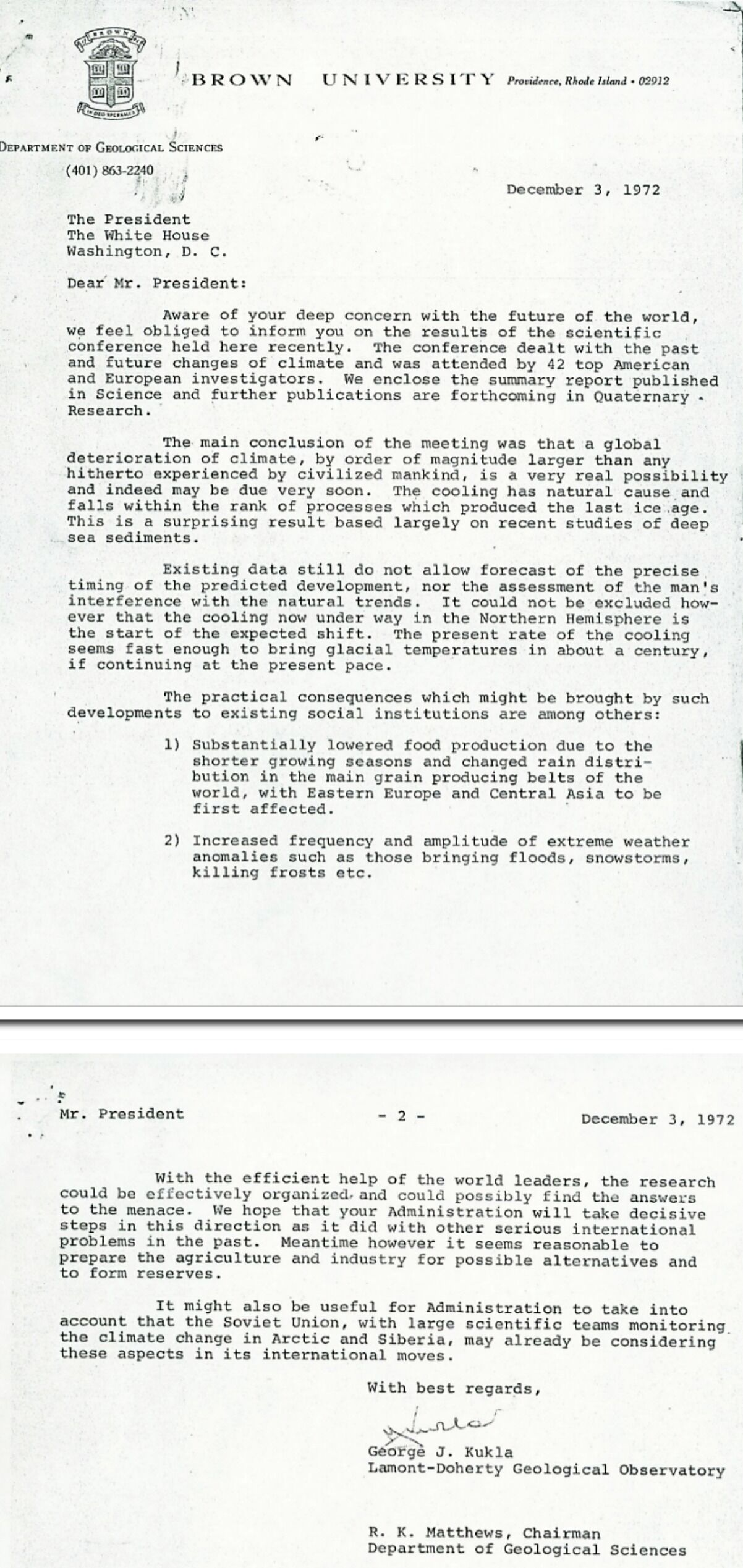
Global Cooling Alert! (1972)
By Robert Bradley Jr. | MasterResource | March 8, 2023
——————–
For various posts at MasterResource on the experts’ global cooling scare, see here.
Silence of the Grid Experts
By Planning Engineer (Russell Schussler) – Climate Etc. – May 3, 2023
There are many reasons why grid experts within the electric utility industry have not spoken out when unrealistic “green” goals were being developed and promoted over the last 20 years or so. A more open debate during this period might have helped provide a more realistic foundation for future development. This posting describes some reasons as to why at the corporate level electric utilities did not speak out more in defense of grid reliability. Collectively these factors tended to eliminate grid experts from playing any role in the development of policies impacting the grid.
Speaking Out Risked Negative Consequences
Utilities have many stakeholders with varying degrees of power. Utilities depend on good relations with Public Service Commissions, other regulators, consumers and policy makers. The stereotype of electric utilities as uncaring, selfish, greedy destroyers of the environment tends to make utilities very cautious and careful in critiquing anything perceived as “green”. The media and press attention from any such statements would likely not be favorable.
Utilities need support to acquire right-of-way, for financing, for cost-recovery and to avoid adverse legislation. Poor press and the associated public disapproval loomed as strong disincentives for speaking out. Furthermore, as will be discussed later, expressing concerns over emerging reliability issues, could be interpreted by some as implying that perhaps you were not as capable as others appear to be.
The Waiting Game: Short-Term versus Long-Term Goals
The short-term consequences of objecting to “green” initiatives impact were swift and near and would be specifically painful to the offending party. The potential benefits of speaking out on reliability would be collective, diffuse and farther into the future. Who as one of hundreds of utilities would want to be the first to speak out? The near-term burden of “green” goals at very low penetration levels was small enough that it might seem prudent to wait for others to speak up.
It can be observed already how these reasons worked together to stifle dissent. Areas with greatest pressures for green initiatives were held back because speaking out would have more severe consequences for them. Areas with lesser pressures were also less likely to be impacted in the near term, so they were less incentivized to speak out. Many hoped that maybe they could ride this out and learn from the mistakes of others. Unfortunately, mistakes and problems don’t seem to be slowing things down.
Utilities Are Not Experts, But Rather a Collection of Experts
There is not a common single body of expertise commonly shared by the many experts that make up an electric utility. Rather than are many experts with differing areas of expertise with demands that can place them at conflict with those operating within other areas of expertise. Effectively managing an electric utility is highly dependent upon balancing the input of many competing “experts”. The goals and priorities of large areas such budgeting, rates, maintenance, operating, environmental, planning, construction, compliance, marketing, R&D, legal, strategic planning. as well as sub areas within these, will often be in conflict as to the actions a utility should take. Leaders have to weigh the inputs from these areas to provide direction and make decisions.
Competing Experts and Goals
Healthy competition is good and necessary. The goals of maintenance are worthwhile, but sometimes in order to best utilize our resources and address other concerns, utilities might need to temporarily depart from what the maintenance experts advocate. The experts in projects tell us how long it should take to complete a project. But in emergencies, other experts might insist that this project must be completed in a much shorter time frame to allow for an upcoming summer peak. Transmission planning and distribution planning experts within the utility might favor different solutions for correcting an area problem: do you beef up the area distribution or do you add more support from the transmission system? With conflicts of this sort, sometimes you find a compromise, but in others one set of experts must give in.
There are many incentives for increasing wind and solar generation (if it works). For some areas of expertise, wind and solar integration pose no special problems. Experts and executives from these areas often were wind and solar boosters. Similarly to academics as described in a previous post, some utility experts argued that (some) problems with wind and solar could be solved, and it was often mistakenly interpreted to mean all problems could be solved.
During my career I would manage several different areas that at times would be in conflict. I would tell my key people, “You are the experts here. You must be a strong advocate for your area of responsibilities. Sometimes I and others in upper management will have to place other concerns over yours. You will need to be a team player and accept the situation. That doesn’t mean you should be any less of an advocate for these concerns in future situations.” Good management balances the inputs of different experts. Utilities found that near term imperatives were in conflict with more distant reliability concerns. Unfortunately, it was almost exclusively the case that emerging reliability concerns were judged as something better addressed later.
Margin, Experts, and Who Are You Going to Believe?
In advocating for their specific areas of concerns, often experts will build in a little margin. I’ll use the example of budgeting here. Although it took me while to get on board, many people are probably familiar with how that process works. Initially when I would hear of dire budget woes, I would heed the call and cut things as close to the bone as I could. Those of you who are not as naïve as I once was, know that the next step is to squeeze even more out of EVERYONE. At that point it didn’t matter what you had given up in step 1, more was needed and everyone must contribute. My nature was to be a team player and head the original call, but after getting burned a few times, I learned that I must play the margin game.
Competing experts should be “expected” to build in margin within their various areas of expertise. The projects area may pad their schedules with some extra time to give themselves some flexibility. Maintenance might aggressively schedule maintenance and replacement so that they are ok if hard times later put a cut in their resources. Initial designs of projects may be “Cadillac” level to better survive cost pushbacks which might emerge under review.
In the area of grid reliability, the grid depends on margin. It should survive without a hiccup for once every 50-year events, because hundreds or more of those type events can and will happen in the normal operation of a system. Conflations of equipment outages, extreme weather, and other unanticipated events hit the grid many times during a given year. The consequences can be huge. However, if you push back on reliability for a short time in one area, there’s a good chance you will be fine. Negative consequences will likely be unobservable. But continue to do so and severe consequences will begin to emerge.
The large chorus of outside “experts” saying that wind and solar can be integrated successfully complicated the situation. Executives with other responsibilities see that government, academics, consultants, consumers, policy makers, and experts within parts of the utility industry are all pushing higher levels of wind and solar. Similarly, the industry sponsored research arms did not help much, but rather pushed new technology as well. Perhaps because they saw a “gold mine” in potential “green research projects”. This all lead to confusion around grid capabilities.
Lastly, grid experts were disregarded partly due to their great success in the past. The fact that modern power systems have a high degree of margin makes it harder to argue that the system is not sufficiently robust to allow for high penetration levels of wind and solar. The ability of grid engineers to meet emerging challenges to-date have led many to believe they could continue to do so, no matter what might be thrown at them.
Specialization and Silos
In addition to problems of breadth of expertise, problems around specialization also confound attempts at expert consensus. Understanding the full extent of emerging grid reliability problems requires an understanding of generation planning, transmission planning and systems operations. Intermittent, asynchronous wind and solar energy sources impact generation planning, transmission planning and system operators. These three areas have differing expertise and experts within these areas that are not always well informed of the concerns of the others. Generation planners are concerned with providing generation 24 hours a day 367 days a year far into the future. They assume transmission planners will take care of delivery problems. Generation modelling is focused on energy production and they look at megawatt-hours. Transmission Planners are worried about the transmission system during peak times of stress. They make efforts to understand the implications of potential generation, but intermittent sources make that challenging. Their focus is based on demand levels so they look at megawatts. System Operators worry about issues of generation and transmission but they operate day to day and in the near term. Their focus is on dealing with the system as it is, not determining what it might be or handle scenarios in the far future. Further within these areas, there are specialists who go deep and do not well understand the problems within their own broader area.
Within critical areas around grid reliability, there are various specialist who may not see the big picture. For example, those who model the transmission system who may see problems now, may be optimistic or agnostic as to how future versions of wind and solar may work to better support the system. Those who work more directly with wind and solar and know their inherent capabilities probably don’t fully understand their impact on the transmission system. It takes an understanding of both areas to see the emerging problems that are confronting the system.
Hope and the Benefit of the Doubt
Despite what you may have heard, most engineers want to be environmentally responsible. Instead of being opposed to new technology, most of us have sought to support potential “green” applications that had at least small hopes of promise. I was never aware of anyone stacking the deck against “green” options, but the reverse frequently occurred. It’s evident that conventional generation options are productive many years longer than competing solar or wind options, but most comparative analyses assumed 30 year lives for all alternatives including Green ones. I don’t know of any significant objections to wind and solar leaning on the system a little for support, or raising costs a little. The concerns only came when the impacts are particularly egregious or approaching unsustainability.
The support for “Green” options extended to optimistic assumptions about future development, performance and capabilities of those resources. Often instead of focusing on what might be probable in the future, utilities hoped for what might be possible. Many have hoped that maybe wind and solar coupled with batteries and a lot of technological development will allow asynchronous intermittent wind and solar to replace higher levels of conventional synchronous generation. Such hopes have for many clouded the clear evidence that increasing levels of wind and solar presented reliability threats.
FERC and NERC’s Impacts
In the U.S., the Federal Energy Regulatory Commission (FERC) and the reliability oversight organization (NERC) that they empowered, have served to inhibit the industry from voicing reliability concerns. FERC’s open access policy and the resultant standards of conduct in 1996 have segregated the functions of generation planning and transmission planning. FERC’s goal was to prevent generation providers, who owned transmission as well, from having any competitive advantage over other generation providers. Previously, managers and VPs might have responsibility for both groups (as I did at one point), but FERC required that those functions be separated and it was important that information not be shared between them. FERC effectively shut down reliability discussions between in-house generation experts and transmission experts. Coordinating a reliable grid was well served by interplay, dialogue and coordination between those planning and managing generation and transmission. Understanding emerging problems similarly is best served by having experts with a sound grounding in both generation and transmission.
NERC and the regional reliability entities initially were formed and controlled by the utilities to coordinate reliability efforts amongst the participants. In 2006 FERC established NERC as the national reliability organization with enforcement powers. Making NERC the master over utilities versus their servant has had various consequences. Beginning in 2007, NERC and the regional entities could impose large fines for violating NERCs’ reliability criteria. Before that time, utilities would share any problems that they were seeing at reliability meetings, as well as emerging concerns in an open and frank manner. Despite utilities differences in some areas there was a strong joint commitment to reliability and all felt it was best to learn from each other’s mistakes. But when the regulators had the ability to impose fines of a million dollars a day, it no longer made sense to share reliability concerns. Publicly expressing reliability concerns might predispose NERC to lean towards findings of noncompliance should problems emerge.
Perhaps the greatest impact came in the shift of responsibilities. Utilities used to have responsibility for ensuring reliability. They had skin in the game. They had a number of tools including generation and transmission options to better ensure reliability. But regulation by FERC through NERC, took the reliability function away from utilities. Utilities are no longer responsible for ensuring reliability. They are responsible for compliance with reliability standards. That was a profound and consequential change. Utilities are no longer developing reliability experts; they are developing experts in standards compliance. When outages occur, it’s hard to figure out where blame lies now. Will there ever again be grid experts who have skin in the game again?
Summary and Conclusions
There were a lot of utility experts with grid concerns. You might ask, “Why didn’t more people speak up?” But maybe the better question is, “Why would anyone speak up?” A lot of people could have said the type things I started saying about a decade ago, but they had no incentives to speak out and there were few influential people who cared to listen. In summary:
- There were few to no near-term incentives for individual utility experts or for utilities corporately to speak up as regard planned threats to reliability
- There were significant near-term disincentives for speaking up
- Limited to no platforms for voicing concerns
- Waiting and hoping for others to speak up seemed a prudent path for many
- Competing “experts” and diverse areas of specialization confused understandings of risk
- Past success of grid experts made it harder to take future reliability threats seriously
- Strong widely present desires support “clean” wind and solar
- Federal Actions served to quiet dissenting voices and eventual remove dissenting experts
The days of utility-based grid experts who’ve had skin in the game are over. Utility experts are charged with complying with reliability standards rather than maintaining reliability. Where utilities once had a variety of tools at their disposal to better foresee and forestall reliability problems, utilities now follow compliance standards and hope for the best.
World Economic Forum-Affiliated Pro-Censorship Group Is Hit With House Panel Subpoena
By Dan Frieth | Reclaim The Net | May 7, 2023
The House Judiciary Committee has issued subpoenas to executives at a group often affiliated with the World Economic Forum (WEF).
Chair of the committee, Rep. Jim Jordan said the Global Alliance for Responsible Media (GARM) and the organization that created it, the World Federation of Advertisers (WFA), might be allowing the violation of US antitrust law.
“To advance our oversight and inform potential legislation related to these collusive practices, the Committee must understand whether, how, and to what extent GARM and WFA facilitate collusion to prevent certain content from benefiting from advertising dollars and to reduce that content’s presence online,” Jordan wrote.
According to the letters, the House Judiciary Committee has attempted to get communications and documents “related to how GARM and WFA act to demonetize and eliminate disfavored content online, in addition to other information” since March.
However, both the WFA and GARM did not provide the documents requested.
The subpoenas addressed to GARM’s co-founder Robert Rakowitz and WFA president Raja Rajamannar, demand communications and documents from January 2019 to date. The organizations have until May 26 to respond.
Read the letter here.
Canada Liberal’s Assault on Press Freedom: The Plot To Censor ‘Untraceable Sources’

By Dan Frieth | Reclaim The Net | May 7, 2023
During the Party National Convention, the Canadian Liberals discussed a proposal for online news publications whose sources cannot be verified to be censored. The proposal was titled “Combatting Disinformation in Canada.”
A section of the proposal read, “BE IT RESOLVED THAT the Liberal Party of Canada: Request the Government explore options to hold on-line information services accountable for the veracity of material published on their platforms and to limit publication only to material whose sources can be traced.”
We obtained a copy of the proposals for you here.
The relevant section is here:

It also suggested that the government “provide additional public funds to support advertisement-free news and information reporting by Canadian media through an arm’s-length non-partisan mechanism.”
The chair of the internet and e-commerce law at the University of Ottawa, Michael Geist, warned that the proposal is an attempt by the government to restrict “freedom of expression.”
“Liberal Party policy proposal calls for online information services ‘to limit publication only to material whose sources can be traced.’ An obvious violation of freedom of expression was voted as one of the top 20 policy resolutions for party discussion,” Geist wrote in a tweet.
In a blog post, he explained that while it is unclear what the Liberal Party means by “online information services,” the resulting “outcome is dangerous no matter the scope.”
“Is this all news outlets with a focus on their online presence? Is it online-only news sources? Is this far broader and designed to encompass Internet platforms such as Google, Facebook, Twitter, and TikTok (note the reference to “platforms”) with requirements that they be held accountable for posts without traceable sources,” Geist said.
“The implications of the government engaging in this form of heavy-handed speech regulation are dangerous in all of these circumstances. Sourcing is an important issue in the media and the government cannot claim to support press freedom and simultaneously back policies that intervene in sourcing.”
More:
Featured Video

Deception – Submarines against Olof Palme
or go to
Aletho News Archives – Video-Images
From the Archives
Woolsey Fire started at Santa Susana Field Lab — where “radioactive materials released were never accurately measured”
By John Laforge | CounterPunch | November 30, 2018
In my Nov. 16 column, I reported on potential radiation risks posed by California’s Woolsey wildfire having burned over parts or all of the Santa Susana Field Laboratory—south of Simi Valley, Calif., 30 miles outside Los Angeles—site of at least four partial or total nuclear reactor meltdowns.
The field laboratory operated 10 experimental reactors and conducted rocket engine tests. In his 2014 book Atomic Accidents, researcher James Mahaffey writes, “The cores in four experimental reactors on site … melted.” Reactor core melts always result in the release of large amounts of radioactive gases and particles. Clean up of the deeply contaminated site has not been conducted in spite of a 2010 agreement.
Los Angeles’s KABC-7 TV reported Nov. 13 that the Santa Susana lab site “appears to be the origin of the Woolsey Fire” which has torched over 96,000 acres. Southern Calif. Public Radio said, “According to Cal Fire, the Woolsey Fire started on the afternoon of Thursday, Nov. 8 … on the Santa Susana site.” … continue
Blog Roll
 Aletho News
- Brussels cannot say where its own pipeline inspectors are as Hungary’s oil lifeline remains shut
- Israel’s Iran War: Myth and Reality
- Between war and industrial breakdown: The US-Israeli attrition crisis
- Pressure builds on Iran to ‘drop’ Lebanon ceasefire demand as Islamabad talks hang in balance
- In another clash report, US denies agreement to release Iran’s assets
- What is fueling unrest across the EU?
- Why no power can undermine Iran’s eternal dominance over the Strait of Hormuz
- Is The War Against Iran Over?
- Iran war will leave long-term ‘scar’ on Wall Street, investors warn
- How Iran decimated US power projection in West Asia: Military lessons of 40-day war
- If Americans Knew
- Mearsheimer reveals how Israel dictates US policies on Iran, Gaza – video
- After killing 350+, Israel still has a “score to settle” with Lebanon before ceasefire – Daily Update
- Military aid to Israel emerges as the latest political litmus test for Democrats
- The only Palestinian children’s rights organization closes following years-long Israeli campaign against it
- ‘I Can’t Forget the Smell’: Lebanese Reel After Israel Kills Over 300 in Single Day
- DNC Shoots Down Resolutions Calling Out AIPAC and Limiting Arms to Israel
- TCN: Is Israel Blackmailing President Trump?
- Israel killed at least 303 Lebanese yesterday – who were they? Daily Update
- Amnesty: Urgent – Protect Lebanese civilians from brutal escalation in Israeli attacks
- Is The War Against Iran Over?
- No Tricks Zone
- German Expert: Heat Dome Led To Record Temps In Western USA…Warmer In 1934, 1936
- New Study: No Linear Warming Or Glacier Retreat Along Northern Antarctic Peninsula Since 1980s
- An Inconvenient Tree: Uncovered In Alps… Europe Much Warmer Than Today 6000 Years Ago
- New Study Reports A 60% Slowdown In Greenland’s Ice Loss Rate In The Last Decade
- Low Intensity Tornado Wrecks Major Solar Farm, Creating A Potential Toxic Dump
- New Study Finds Warming Saves Lives…Cold Temperatures 12 Times More Deadly Than Excess Heat
- German Science Blog Accuses PIK Climate Institute Of Hallucinating Climate Tipping Points
- Devastating Assessment Of Comirnaty Vaccine By Former Senior Pfizer Europe Toxicologist
- New Study: CO2 Is ‘Effectively Negligible’ As An Explanatory Climate Change Factor Since 2000
- Former Pfizer Toxicologist Dr. Helmut Sterz Tells Bundestag Hearing Pfizer Vaccine Should Have Never Been Approved
 Aletho News