The FBI, Ukraine’s Censorship Assistant
By Adam Dick | Ron Paul Institute | June 7, 2023
Aaron Maté has been among a handful of reporters to whom Elon Musk granted access to Twitter records to uncover efforts by the United States government along with Twitter to censor communication on the social media platform in the time before Musk gained control over it. The newest revelations from Maté concern the US government, via the Federal Bureau of Investigation (FBI), having acted as an assistant to the Ukraine government’s main intelligence agency, the Security Service of Ukraine (SBU), to seek censorship of 163 targeted Twitter accounts — Maté’s included — as well as personal information related to those Twitter accounts.
Maté’s chilling revelations here.
It is bad enough that the US government has been seeking to censor social media communication to advance the goals of power-hungry politicians, businessmen, and bureaucrats here in America. Now, comes revelations that, on top of that, the US government has been seeking to advance the censorship goals of, and hand over personal information of individuals using social media to, the government of Ukraine. Keep in mind that Ukraine is an intensely corrupt government, is overrun with nazis, and is apparently comfortable with targeting for assassination foreign individuals merely because those individuals have expressed views judged intolerable regarding Ukraine or its war with Russia.
The Ukraine government has also been relentless in suppressing free speech, opposition political parties, and the free exercise of religion within its borders.
Of course, the US assistance to Ukraine’s censorship effort has extended beyond Twitter. Maté notes in the concluding paragraph of his article:
News of the FBI’s work with Ukrainian intelligence to censor Twitter users also follows reporting from journalist Lee Fang that the FBI has pressured Facebook to remove accounts and posts deemed by the SBU to be Russian ‘disinformation.’ According to Fang, a senior Ukrainian official in regular contact with the FBI defined ‘disinformation’ in such broad terms that it could mean viewpoints that ‘simply contradict the Ukrainian government’s narrative.’
How about the US starts respecting the First Amendment, and stops assisting Ukraine in pursuing its authoritarian objectives?
Copyright © 2023 by RonPaul Institute
Querying the existence of a covid ‘pandemic’
Health Advisory & Recovery Team | June 6, 2023
Covid-19 has been described as a global pandemic but does this title give it a severity and indeed fear factor way beyond its actual impact?
The word pandemic used to have a very specific meaning. It was used to describe a scenario where there was extensive incapacitation of key workers and large numbers of deaths, including young people. A genuine pandemic is not something that would have needed billions of dollars in advertising for people to even notice and fear. Using this long-established definition of the word, we conclude that there was in fact no global pandemic in 2020. The word was deliberately misapplied and weaponised against an unsuspecting public. Let us be clear, this article is not questioning the existence of a virus SARS-CoV-2 or an illness named Covid-19, but even the choice of ‘SARS’ (Severe Acquired Respiratory Syndrome) as the name for this coronavirus was already setting the scene for systematic fear-mongering.
The notion of a ‘pandemic’ was relentlessly promulgated through mainstream media to ramp up fear in the population, to help enforce unprecedented lockdowns and other extremely harmful policies (e.g school closures and universal mask wearing) and to push through Emergency Use Authorisations of novel technology mRNA and viral vector DNA products.
This would not have been possible were it not for three false premises that covid was:
- novel;
- extremely lethal; and
- unprecedented.
It was none of these things. It was no more novel than numerous other viruses which emerge each year in terms of the ability to be recognised by our immune systems. It was no more lethal than bad influenza viruses of the past and was less lethal than seasonal influenza for the young. Intensive care stays were longer than have been observed with flu, though whether that was due to a virus directly or caused by our changed response to how we treated respiratory infections is unclear. Overall it was a treatable, seasonal respiratory virus mostly affecting the old and infirm.
HART has written previously on how similar the mortality was to the bad influenza winter of the year 2000. The mortality data for 2020 is unremarkable globally when compared to previous influenza seasons except perhaps in New York City and Northern Italy. In both of these outliers, the data emerging is raising uncomfortable questions about the relative contribution of the virus versus the impact of policy-related responses when considering the extraordinary number of deaths reported. In spite of these outliers, global mortality data shows no evidence of a global pandemic. It could be argued that a once in every 20 year event should not be minimised, but nor does it justify an all of society emergency response or the institution of a permanent biosecurity surveillance state.
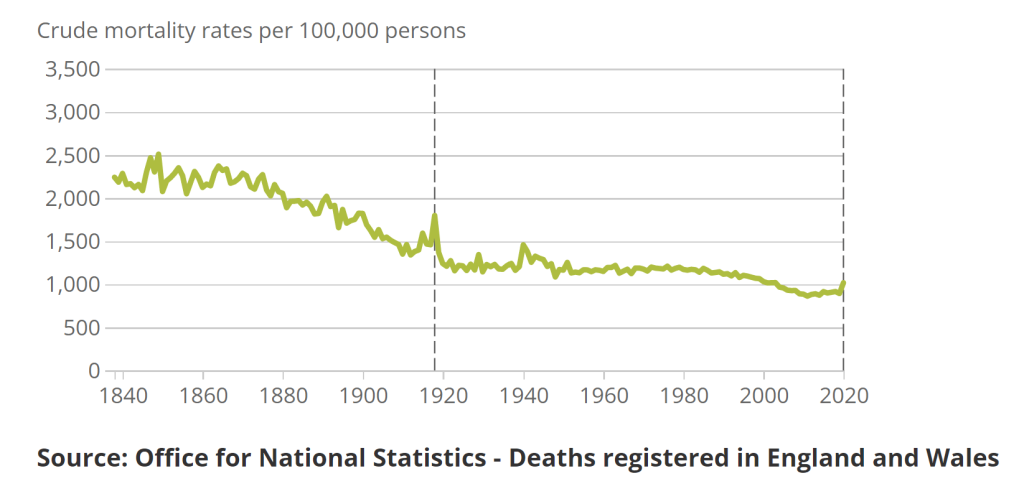
Figure 1 showing ONS crude mortality rates since 1840
Without the highly flawed PCR case data and draconian global restrictions on doctors’ freedom to treat their patients as they saw fit, there would be nothing particularly notable about this year. Outside of PCR driven data, a small rise in the number of calls to ambulances for breathing difficulties was observed, though it is possible that hysteria and fear may be responsible for at least part of this. We might have noticed an unusually late spike in influenza-like illness but not much more. Mortality-wise, it would appear as a mid-range ‘bad flu’ year. It is worth reading the work of Professor Denis Rancourt on mortality data, who has been pointing out this inconvenient truth since early 2021.1,2
Interestingly, the WHO quietly altered the accepted definition of ‘pandemic’ in 2009, just before the so-called H1N1 ‘pandemic’. The rushed-to-market Pandemrix vaccine which was pushed hard in the face of the imaginary ‘pandemic’ was subsequently pulled from the market due to life-changing side effects (often in children), a signal picked first up in Finland but later found elsewhere.
In essence, they used exactly the same playbook in 2020, but seemed to have ironed out some of the ‘problems’ encountered the first time round. Vicious behavioural psychology tactics were the main tools used to ‘correct’ these ‘problems’. Shaming people into believing they may ‘kill granny’ was a master-stroke. They used guilt, shame and the threat of ostracism, these being some of the most powerful drivers of human behaviour. There was even an identical cast of characters; Fauci, Drosten and Gates, all reporting for duty, aided and abetted by the bought and paid for media machine working on 24 hour overdrive.
In 2003, an influenza pandemic was defined as follows:
“An influenza pandemic occurs when a new influenza virus appears against which the human population has no immunity, resulting in several simultaneous epidemics worldwide with enormous numbers of deaths and illness.”
In 2009, the WHO decided, in their infinite wisdom, to get rid of the words “enormous numbers of deaths and illness.” from the definition. You would think deaths and serious illness were the only meaningful characteristics of a ‘deadly pandemic’.
To successfully fight against the globalist mission creep of tyrannical public health measures, we must collectively stop stoking the ‘deadly pandemic’ fire. If we continue to allow this falsehood to embed in public consciousness, all of the unethical horrors enacted will simply be repeated for the next non-pandemic-pandemic.
Without the requirement for excess deaths and widespread serious illness, malevolent profit-driven interests can simply will a ‘pandemic’ into existence on finding any new mutation amongst the global virus population. A strategy to force countries to invest heavily in searching for genetic anomalies will fuel the pandemic creation industry. Once one is found, the response can be fuelled by using fraudulent test data and media advertising, as they did very successfully in 2020. We cannot allow this to happen again and must therefore reclaim the word ‘pandemic’ to ensure it is only applied in the correct way.
We expect a reflexive objection to this article from some quarters on the basis that the case has not been adequately argued that covid had minimal impact on overall mortality in 2020. This fact is irrelevant when challenging the terrifyingly inappropriate global response. The world’s population was sold a serious lethal deadly pandemic which – we were told – necessitated the reordering of society. The ‘new normal‘ as it was affectionately called by so many perfectly in-sync global leaders. In the event, we did not have a serious lethal deadly pandemic, and what has happened (and continues to happen) is based on a lie. Arguing about whether or not some bits of the lie might have a modicum of truth in them is a distraction from much bigger questions which need addressing.
Footnotes
Missouri v. Biden might be most important legal case in U.S. history
From what I’ve read, proof our federal government wants to kill free speech is overwhelming.
BY BILL RICE, JR. | JUNE 7, 2023
Until yesterday, I’d not read any documents in the lawsuit brought by the states of Missouri, Louisiana et al vs. President Biden. Because of this, I didn’t fully grasp the stunning claims made by the plaintiffs, nor realize how overwhelming the evidence is that supports this case.
Yesterday, I read the first 54 pages of a 354-page legal document that was filed with a federal district court in Louisiana on March 3, 2023.
I now better understand why some people believe this might be the most important legal case in U.S. history.
In a nutshell, attorneys for the plaintiffs are compiling and presenting a mountain of evidence that shows actors for the U.S. government have conspired to nullify the First Amendment to the U.S. Constitution.
This Amendment was first for an important reason.
It states that “Congress shall make no law respecting an establishment of religion, or prohibiting the free exercise thereof; or abridging the freedom of speech, or of the press; or the right of the people peaceably to assemble, and to petition the Government for a redress of grievances.”
The core issue at stake is should American citizens be allowed to have genuine “freedom of speech.”
In my view, the evidence already presented in this legal case proves beyond a reasonable doubt that a cadre of officials in government (and organizations working “in partnership” with government agencies) despise, fear and want to end “free speech.” In fact, they’ve already effectively blocked the free speech of millions of Americans.
In a democracy, free speech is vitally important as it makes dissent from prevailing narratives possible and thus protects the “natural rights” of citizens who may hold minority views. That is, without “free speech,” only the views of those who embrace “authorized” opinions would be allowed to participate in any meaningful way in democratic debates.
One can parse this lengthy document a thousand ways, but the bottom-line conclusion is that the U.S. government believes only its views should be allowed to be widely disseminated.
Even more terrifying, virtually all the important institutions in contemporary society defend and seemingly support the efforts of the federal government to censor any speech labeled “mis-“ or “disinformation.”
A few of my main take-aways from my (partial) reading of this must-read legal document:
All Hope is Not Lost
The fact that attorneys general from at least two U.S. states have filed such a lawsuit provides hope that the entire country has not yet become disciples and enforcers of Big Brother.
It is also significant that the push-back to mass censorship comes from the state level of our “republic” and not from the federal government itself. That is, the Attorney General of the United States should have brought this case. Instead, representatives of the U.S. government are vigorously defending mass censorship, and the effort to “abridge the freedom of speech.”
The Legal System Can Work
This document is 354 pages because it’s replete with transcripts from legal depositions and exhibits that the public would have not seen absent the commencement of this legal proceeding.
The document also proves the power of legal “discovery” wherein defendants have to turn over all relevant evidence such as emails, meeting records, etc. (although plaintiffs argue that the defendants have still not turned over every piece of “discovery” requested).
A healthy democracy hinges on “fact-finding” and a “search for the truth.” This lawsuit has made it possible for the people who are following this case (not enough people) to learn more about the activities of the most powerful individuals who work for the most powerful government on the planet.
A quick aside ….
In reading this summary of evidence, I was struck by how easy it was for plaintiffs’ attorneys to build their case.
The attorneys, investigators and staffers bringing this case are clearly intelligent professionals who’ve been very thorough in developing their evidence and trying to prove their case. That is, if they get a fair hearing (which I’m not sure they will), they should win this case with ease.
However, this example made me think of all the lawsuits and “fact-finding” exercises that have NOT occurred with any of the litany of crimes and scandals of our Covid times (and even before Covid).
One strongly suspects that if other teams of competent litigators and investigators had employed the same tools of discovery and depositions, every scandal of our times would also be just-as-easily exposed.
Just like I think about all of the mainstream news articles that are off limits to alleged “watchdog” journalists, I also think about all the lawsuits and prosecutions that are apparently off limits to the people and organizations who could bring such cases.
What’s the core issue in this case?
The first paragraph of the “motion for the injunction” describes what the plaintiffs are trying to prove (and have already proven as far as I am concerned).
- “Federal officials, including Defendants, have made a long series of public statements since at least 2018 demanding that social-media platforms increase their censorship of speech and speakers disfavored by these officials, and threatening adverse consequences – such as repeal or reform of Section 230 immunity under the Communications Decency Act (CDA), antitrust scrutiny or enforcement, increased regulation, and other measures – if the platforms do not increase censorship …. “ (emphasis added).”
Note: For more excerpts from the document, see Reader Comments (under “most recent.”)
Comments:
Laymen and legal scholars alike agree that the First Amendment does not compel any publisher to print any and all speech. For example, a private company like The New York Times can publish, or not publish, whatever speech it wants for whatever reason it wants.
The issue in this case is whether citizens living in the “town square” can use Facebook, Twitter, YouTube, etc. to share their opinions or facts.
Or, more specifically, can the government use its immense power to compel private companies to censor speech the government doesn’t like (speech labeled by the government as dangerous, extremist, false or basically “misinformation” or “disinformation” as the government defines these terms).
Plaintiffs argue that the federal government is using its power to abridge free speech. The federal government is doing this by threatening to effectively shut down social media companies who don’t comply with the government’s wishes.
The federal government could harpoon these companies by “reforming” or “amending” Section 230 of the CDA. This section grants legal immunity to such companies, meaning social media companies can’t be sued or criminally tried because of the speech of citizens who make posts on their platforms.
Paragraph 3 of the document explains the power of this “threat.”
“3. The threat of antitrust scrutiny or enforcement is also a major motivator to social-media platforms. For example, Facebook CEO Mark Zuckerberg has stated that the threat of antitrust enforcement is “an ‘existential’ threat” to his platform.”
The evidence – presented on scores of pages – clearly reveals this “threat” was made explicitly, implicitly, publicly and privately over and over and over by myriad employees of the U.S. government, including the President of the United States.
This makes one (almost) feel empathy for these social media companies, which have had a symbolic bazooka pointed at their heads by the U.S. government dating to the day “Joe Biden” allegedly won the presidential election over Donald Trump.
I write that I “almost” feel empathy for these companies because if anyone skims this document, he will quickly see that virtually every employee and key executive of these companies was eager and happy to accede to the demands of their pro-censorship rulers.
Those who read this document will see never-ending examples of government officials brow-beating and intimidating social media companies for NOT censoring MORE.
To me, these companies appear almost masochistic – as in they seemingly enjoyed their incessant scoldings. For example, social media employees often thanked their government minders for pointing out their transgressions, which they seem overly-eager to correct. (Here, the Stockholm Syndrome comes to mind).
The “stick” of repealing Section 230 is not the only motivation social media companies have for complying with Big Brother.
Numerous “carrots” also exist as almost every one of these companies also profits from big contracts with the federal government and/or receives large sums of money (such as vaccine advertising spends) for supporting the authorized narratives (or, more precisely, silencing the non-authorized narratives).
The Virality Project
The document makes many references to the Virality Project, an influential project commissioned by academics at Stanford University.
As I’ve written previously, the most important goal of the world’s real rulers in Covid times was/is the effort to fight “vaccine hesitancy.”
If people were hesitant about getting their Covid vaccines, the mRNA project would be a bust. Big Pharma and all the many entities that receives massive amounts of money from Big Pharma would not be pleased.
One thing that might make half the world skeptical of the “safe and effective” non-vaccines would be if the views of vaccine skeptics actually “went viral.”
This, very possibly, could have happened … absent mass censorship.
In my last article, I discussed several of the key “chess moves” our rulers have made to make sure they win this “game.”
Arguably, the most important move was making sure dissenting views did NOT go viral, a result which didn’t happen by chance … but by a coordinated effort to censor hundreds of millions of potential skeptics and critics.
Since the government doesn’t own Facebook (where two billion people share speech), the government had to “persuade” Facebook (Meta) to do their censoring for them.
This was a conspiracy, a massive one …
In reading this document, I was also stunned when I thought about all the employees and organizations that were involved in the effort to defeat the threat of “vaccine hesitancy” (and protect all the other many untrue Covid narratives).
I stopped reading after 54 pages, but this was enough to see that the actors in this conspiracy (a cover-up of the truth) included the President of the United States, all his key White House employees, the CDC, the Census Bureau, The Surgeon General and his staff, officials in the NIH (such as Anthony Fauci), many of the key members of Congress, all the new “fact checkers” and probably the White House chef.
Time and again, plaintiff’s attorneys present examples where government officials cite articles written by “journalists” at The New York Times or Washington Post that were used as a weapon to demand even more censorship among social media companies.
Surreally, this means our “free press” has been one of government’s key allies in suppressing free speech.
Government contractors, non-profits and think tanks were also brought in to help with the vital censorship chess moves.
Another hallmark of a conspiracy would be any evidence proving a coordinated initiative. The plaintiff’s attorneys have done an excellent job proving this happened. For example, the authors of the legal brief repeatedly show how the words “accountable” and “transparency,” were used ad nauseam by all the censorship conspirators.
When government actors told social media companies they would be “held accountable,” this was a not-too-subtle threat that they better do as told … Which, sadly and not surprisingly, they did.
The conspirators also incessantly demand “transparency” from social media companies.
The government didn’t just ask social media companies to do a little more censorship for the good of the country, they demanded access to all the algorithms, data bases, search queries, content-moderation policies, etc. that would prove companies were censoring the content the government said must be censored.
Amazingly, companies like Meta complied …. so, apparently, officials at the CDC and The Census Bureau (which for some reason took a lead role in enforcing censorship) and key White House staffers were looking at the same tools Meta used to see what Covid topics were trending on their platform.
The government would then tell the companies to ban such speech on their platforms.
Not only did government actors hold a gun to the social media companies’ heads, they wanted to see (and even use) the very tools that allow these companies to know what their users were posting.
As we’ve learned from the “Twitter files,” government officials also repeatedly zeroed in on key “disinformation super-spreaders” and made sure they were banned and punished.
Victims/targets of these censorship efforts include high-profile Covid skeptic like Alex Berenson, Steve Kirsch and Robert Kennedy, Jr., but they might as well have included Bill Rice, Jr, whose Facebook account has also been suspended (for no known or stated reason) multiple times.
Per the copious evidence in this legal brief, every time Meta banned someone or said some topic was now taboo, government officials were rarely placated, and demanded even more censorship. And, again, government officials kept demanding “transparency” to see that thy’s will was being done.
The irony of course is that the U.S. government is the least transparent entity on the face of the earth.
To be clear and to state what should be perfectly obvious by now, the multi-faceted censorship and “disinformation” programs (which pre-date Covid) were created and enforced to make sure no real government “transparency” is/was possible.
For our government officials, transparency is like sunlight or a silver crucifix to a vampire.
What will be the result of this lawsuit?
I actually don’t know what the plaintiffs are demanding except for the government to cease and desist with its efforts to compel censorship.
Speaking for myself, I’ve already seen enough evidence where this U.S. citizen won’t be mollified unless we have criminal prosecutions, the impeachment of President Biden and the censure of all the members of Congress who bullied these social media executives.
Also, the companies that went along with this need to be boycotted by every citizen that still cares about the First Amendment.
I’d also note that while Twitter has (largely) turned over a new leaf under the ownership of Elon Musk, the rest of the social media companies are censoring left and right just like they’ve been doing since “Joe Biden” was sworn into office. (This tells me these companies are betting on “Biden” prevailing in this lawsuit).
It’s not just Covid issues subject to mass censorship ….
For those who think the censorship regime only deals with Covid topics, I say you better think again … as this document also proves.
Plenty of sections of this document provide evidence showing that “disinformation” about Climate Change, election fraud and woke issues like “gender identification” will also continue to be subject to the whims of the government’s arbiters of truth.
For my part, I’m now convinced that what shouldn’t happen … will probably happen. This means, “Joe Biden” will probably win re-election and this case will probably be thrown out or the Supreme Court led by (captured?) John Roberts will ultimately side with the defendants.
If this happens, perhaps more Americans will belatedly understand the new legal precedent that has been set.
In the future, any speech that’s deemed “misinformation” by unelected bureaucrats (at say the CDC or EPA) can indeed be censored and banned.
It will be perfectly fine for presidents, Congressmen and surgeon generals to demand that social media companies censor unauthorized or “dangerous” speech. Furthermore, the government will be granted that “transparency” that tells them Meta or Google are following their orders.
Strangely, Substack wasn’t mentioned …
In reading this document, I was struck by the fact Substack (as far as we know) has yet to be targeted by the Censorship Czars.
My guess is that if this case is decided in favor of the defendants, this will no longer be the case. The “dangerous misinformation” I’ve been posting (and my readers in the Reader Comments) will suddenly be fair game for censorship as well.
Substack is replete with writers challenging the false Covid narratives, but this speech platform is also full of skeptics of Climate Change, writers who might not support the Ukraine War or central bank digital currencies … authors who think election fraud is real and correspondents who don’t like the “woke” transgender and pronoun malarky.
For the past 240 years, Americans thought the First Amendment gave them the “freedom” to share their views on controversial topics. If Biden and the U.S. government win this case, I suspect we’ll soon learn otherwise.
Taliban successfully eradicates poppy cultivation: Report

Toor Khan (right) razing a poppy field to the ground along with fellow Taliban members. (Photo Credit BBC)
The Cradle | June 8, 2023
The Taliban government of Afghanistan has carried out “truly unprecedented reductions in poppy cultivation” in 2023, according to a new analysis published by Alcis, a UK-based geographic information services firm specializing in geospatial data collection, statistical analysis and visualization.
The poppy reduction followed a ban on drugs in Afghanistan issued in April 2022 by Taliban leader Mullah Haibatullah, only seven months after the Islamic movement took power following the August 2021 US military withdrawal from the country.
Alcis reports that an effective ban on poppy cultivation is in place and that opium production in 2023 will be negligible compared to 2022. High resolution imagery analyzed by the firm shows that in the province of Helmand, poppy cultivation was reduced from 120,000 hectares in 2022 to less than 1,000 hectares in 2023. This amounts to the largest reduction in poppy cultivation ever recorded in the country, including after the Taliban banned poppy production in 2000, one year before losing power following the 2001 US invasion.
As a result, wheat cultivation now dominates provinces in the south and southwest, where some 80% of Afghanistan’s total poppy crop had previously been grown.
The Taliban announced the ban on poppy cultivation in April 2022, but allowed the harvest of the poppy crop planted in the fall of 2021, fearing that banning or destroying it so close to the harvest season and after farmers had invested considerable time and resources in their poppy fields would provoke widespread unrest.
The Taliban then banned the planting of new poppy crops moving forward and destroyed any poppy fields planted after that time in violation of the ban.
Over the course of the summer of 2022, the Taliban also targeted the methamphetamine industry by destroying the ephedra crop and ephedrine labs across the country.
These findings were confirmed by journalists from the BBC, who traveled to Afghanistan this month while embedded with Taliban members destroying remaining poppy fields with sticks.
The BBC noted that the loss of supply of Afghan heroin may lead to increases in the “synthetic drugs, which can be far more nasty than opium,” among US and European drug users.
The BBC noted further that “opium was also grown freely in areas controlled by the US-backed former Afghan regime, something the BBC witnessed prior to the Taliban takeover in 2021.”
Indeed, the heroin trade has played a role in the conflicts plaguing the war-torn country since the 1970s.
In the late 1970s and in the 1980s, the CIA relied on Pakistan’s Inter-Services Intelligence Agency (ISI) and its Afghan mujahideen clients to wage war against the Soviet-backed Afghan government, and against Soviet forces which occupied the country in support of the government.
According to historian Alfred McCoy, the ISI, and mujahideen soon became key players in the burgeoning cross-border opium traffic.
McCoy writes that “The CIA looked the other way while Afghanistan’s opium production grew from about 100 tonnes annually in the 1970s to 2,000 tonnes by 1991. In 1979 and 1980, just as the CIA effort was beginning to ramp up, a network of heroin laboratories opened along the Afghan-Pakistan frontier. That region soon became the world’s largest heroin producer. By 1984, it supplied a staggering 60% of the US market and 80% of the European.”
McCoy writes further that, “Caravans carrying CIA arms into that region for the resistance often returned to Pakistan loaded down with opium – sometimes, reported the New York Times, ‘with the assent of Pakistani or American intelligence officers who supported the resistance.’”
As reporting from journalist Gary Webb showed, the CIA was transporting weapons by plane to its proxy army in Nicaragua, the Contras, while the planes returned to the US loaded with cocaine, during this same period. Declassified US government documents later acknowledged that US officials relied on the drug trade to fund arms purchases for the Contras.
The Soviet withdrawal from Afghanistan in 1989 was followed by years of chaos as warlords competed for control of the country. In 1996, the Taliban came to power and imposed a measure of order on the country. In 2000, the Islamic movement banned poppy production.
However, US forces invaded Afghanistan in October 2001 and quickly toppled the Taliban. Poppy cultivation and the heroin trade flourished.
In 2004, Antonio Maria Costa, Executive Director United Nations Office on Drugs and Crime, reported that opium cultivation increased by two-thirds that year and had spread to all 32 provinces, “making narcotics the main engine of economic growth” in the country.
In 2010, a growing Taliban insurgency prompted President Obama to launch his Afghan surge, which sent an additional 17,000 US troops to the country. The surge was launched at Marja, a remote market town in Helmand province.
Alfred McCoy writes that, “As waves of helicopters descended on its outskirts spitting up clouds of dust, hundreds of marines sprinted through fields of sprouting opium poppies toward the village’s mud-walled compounds. Though their targets were the local Taliban guerrillas, the marines were, in fact, occupying one of the capitals of the global heroin trade.”
McCoy noted further that the US-backed “Afghan army seemed to be losing a war that was now driven – in ways that eluded most observers – by a battle for control of the country’s opium profits. In Helmand province, both Taliban rebels and provincial officials are locked in a struggle for control of the lucrative drug traffic.”
As Simon Spedding of the University of South Australia observed, “The simple facts are that opium production was high under the US-influenced government of Afghanistan of the 1970s, decreased 10-fold by 2001 under the Taliban, and then increased 30-fold and more under the US to the same level as in the 1970s … These are facts, whereas the idea that the CIA runs opium from Afghanistan would be a conspiracy theory—unless, you thought about the United Nations statistics or happened to have been to Afghanistan.”
Saudis snub US push on Tel Aviv ties, oil prices, Syria during Blinken’s high-profile visit
Press TV – June 8, 2023
Saudi officials have snubbed US Secretary of State’s latest push for the Kingdom’s normalization of relations with the Israeli regime and his bid to win further concessions on oil prices and Riyadh’s recent resumption of ties with Syria and Iran during his high-profile visit to Saudi Arabia.
Speaking in a news conference alongside Saudi Foreign Minister Prince Faisal bin Farhan Al Saud in Riyadh on Thursday, the visiting Antony Blinken reiterated that Washington will continue to play an integral role in expanding normalization between the Tel Aviv regime and Saudi Arabia.
Blinken, who was in the kingdom as part of a US push to defuse rows that have touched on oil prices, and Riyadh’s opening to Iran, further insisted that normalizing relations between Israeli regime and its neighbors was a priority for Washington.
The Saudi foreign minister, however, rebuffed his American counterpart, saying that the kingdom believes “normalization of ties with Israel will have limited benefit without a pathway to peace for the Palestinians.”
“The Palestinian issue was and remains the central issue for Arab countries, and it is at the top of the kingdom’s priorities,” Saudi Crown Prince Mohammed bin Salman had also underlined during the Arab League summit in Jeddah on May 19.
“We will not delay in providing assistance to the Palestinian people in recovering their lands, restoring their legitimate rights and establishing an independent state on the 1967 borders with East al-Quds as its capital,” he further noted at the time.
Blinken also reiterated on Thursday that Washington will not normalize relations with Syria and does not support other nation’s normalization of ties with the government of President Bashar al-Assad.
For his part, Prince Faisal defended the landmark decision to lift Syria’s Arab League suspension, which came shortly after the start of the country’s foreign-sponsored conflict 12 years ago.
“Syria made very clear commitments to address concerns of the international community,” the chief Saudi diplomat said.
“We have differences of opinion but we’re working on finding a mechanism for us to be able to work together,” the Saudi foreign minister also pointed out during the press conference with the US secretary of state.
The Saudi foreign minister also highlighted that China and Saudi Arabia are close and strategic allies and have been increasing cooperation in the energy and financial sectors, and that “cooperation is likely to grow.”
Saudi ties with US, China not a ‘Zero-sum game’
He said Saudi Arabia’s ties with the United States and China were not a “zero-sum game.”
“I don’t ascribe to this zero-sum game,” Prince Faisal said in Riyadh. “We are all capable of having multiple partnerships and multiple engagements and the US does the same in many instances.
“So I’m not caught up in this really negative view of this. I think we can actually build a partnership that crosses these borders,” the top Saudi diplomat said.
Riyadh’s strengthening its commercial and security ties with Beijing comes as US influence wanes in the Middle East region.
Blinken was the second top US official to visit Saudi Arabia in less than a month, following a May 7 trip by White House national security adviser Jake Sullivan.
However, Blinken’s meetings with bin Salman and Persian Gulf Cooperation Council (GCC) foreign ministers were relegated to the inside pages of Al-Watan and Okaz, the two major newspapers in Saudi Arabia.
Blinken and the crown prince had “open, candid” talks for an hour and 40 minutes, a US official said, covering topics including the conflict in neighboring Yemen, the war in Sudan, Israel, and human rights.
Riyadh has also leveraged its growing relationships with Russia and China as the Biden administration has pushed back against some Saudi demands including lifting restrictions on arms sales and help with sensitive high-tech industries.
Riyadh has clashed repeatedly with US President Joe Biden on its supply of crude oil to global markets, its willingness to partner with Russia in OPEC+ and its decision to restore full diplomatic relations with Iran in a deal brokered by China.
EU fears ‘pro-Russian’ votes in key states – Politico
RT | June 8, 2023
“It would be a disaster” if Ukraine-skeptic leaders were elected in Austria and Slovakia, a European Commission official told Politico on Tuesday. The EU reportedly fears that a swing to populism in both countries could jeopardize future sanctions against Russia, as well as the bloc’s military aid to Kiev.
Austria’s center-right government is unpopular, and concerns about immigration and the rising cost of living have made Herbert Kickl’s right-wing Freedom Party the most popular political faction since late last year. Legislative elections are scheduled for next autumn at the latest.
Similar concerns in Slovakia have seen former Prime Minister Robert Fico surge in popularity. With just three months to go until parliamentary elections, Fico’s Direction – Slovak Social Democracy party is leading in the polls, as the country labors under an unelected government of technocrats.
“It would be a disaster” if both men were to take office, an anonymous “senior [European] Commission official” told Politico, referring to Kickl and Fico’s stance toward Russia.
Politico evidently agrees with the European Commission, and has published multiple articles in recent days describing the Austrian politician as “a pro-Russian, anti-American conspiracy theorist,” and his Slovakian counterpart as a spreader of “Russian disinformation.”
Both potential prime ministers are vehement opponents of immigration, particularly from Islamic countries. When it comes to Ukraine, Kickl has declared NATO as responsible for the conflict as Russia and considers Austria’s backing of EU sanctions on Moscow to be a violation of the country’s neutrality. In March of this year, Kickl and his Freedom Party colleagues walked out of parliament during an address by Ukrainian President Vladimir Zelensky.
Slovakia is a member of NATO and has given Ukraine armored personnel carriers, howitzers, and its entire fleet of Soviet-era MiG-29 fighter jets since last February. Fico, who served two stints as prime minister in the last two decades, has said he would cut off this military aid.
Until now, Hungary has been the only EU member to consistently oppose sanctions on Russia, with Viktor Orban’s government usually agreeing to the bloc’s restrictions only after carving out concessions for Hungary. Budapest is currently holding up the EU’s eleventh sanctions package over Ukraine’s blacklisting of several of its companies as “war sponsors,” while simultaneously blocking a $542 million tranche of EU military aid to Kiev.
Were Kickl and Fico to take office, Austria, Hungary, and Slovakia would form a powerful political bloc, and could exert significant pressure on Brussels to change its Ukraine policy.
The Middle East and US Terrorist Activities
By Viktor Mikhin – New Eastern Outlook – 08.06.2023
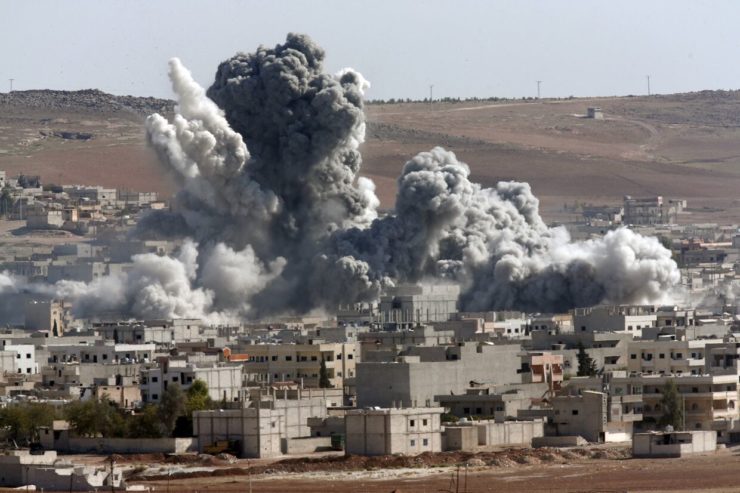
Incredibly high civilian casualty rates from American-led military adventurism in Afghanistan, Iraq, Pakistan, Syria, Yemen, Libya, and Somalia have been revealed in a new research by Brown University’s The Cost of War Project in the State of Rhode Island. The report provides direct data on the victims of the war in which nearly a million people were killed by the US efforts.
According to the study, another important aspect that has indirectly killed several million more people is the military destruction of the economy, public services, infrastructure and the environment, which increases the death toll long after the bombs have been dropped and increases over time. The report estimates that these factors contributed to more than 3.5 million deaths. This aspect requires more research, and the project specifically emphasizes that “the many long-term and underestimated consequences of war” need to be explored in more detail.
Another study shows that the number of direct casualties from wars that killed nearly a million people is an understatement, which the report again refers to by saying that “the exact death toll remains unknown.” In another section of the project’s report on the Iraqi death toll, it says that “estimates of the Iraqi war death toll have been particularly inconsistent. The Lancet 2006 estimated that approximately 600,000 Iraqis died as a result of military violence between 2003 and 2006.” The report goes on to say that the controversy over conflicting reports about the death toll in Iraq stems from news reports estimates, with some exaggerating the death toll while those who supported the illegal invasion downplayed the death toll.
The project cites a report in The Lancet that says the death toll in Iraq since 2003 and in the next three years alone reached 600,000 Iraqis. Various unbiased studies have been conducted, concluding that more than one million Iraqis were killed as a result of the US invasion and occupation of Iraq from 2003 to 2011.
Even the one million mark in Iraqi deaths could be considered an understatement when there were daily reports of almost daily terrorist bombings that killed hundreds of Iraqis. And then, add to that the US and DAESH era from 2014 to 2017, when hundreds of thousands more people were killed, and it’s not hard to imagine that over a million Iraqis have died and continue to die today as a result of the US so-called “war on terror.”
There is no doubt that the US military presence has brought nothing but insecurity and instability to West Asia. In January 2018, Leader of the Islamic Revolution in Iran, Ayatollah Sayyid Ali Khamenei said: “What is important is that the corruptive presence of the US in this region must end… They (Americans) have brought war, discord, sedition and destruction to this region; they brought about destruction of infrastructures. Of course, they do this everywhere in the world… It must be stopped.”
The Cost of War Project’s latest study also warns that “these wars continue to affect millions of people around the world, who live with their consequences and die from them.” The report focuses on the impact of the wars unleashed by the United States on women and children, who “bear the brunt of these ongoing consequences.”
The report notes that while some people have died in combat, many more, especially children, have died as a result of the negative effects of wars, such as the spread of disease and damage to public services. “More research is needed on the impact of the destruction of public services by war, especially outside the health care system, on public health,” the report says. “Damage to water and sanitation systems, roads and commercial infrastructure such as ports, for example, has significant and important negative consequences.”
The study says that the wars and conflicts the United States has fought or been involved in under the pretext of supposedly fighting terrorism since September 11, 2001, clearly show that the consequences of the ongoing violence of war are so vast and complex that they cannot be measured. It should be noted that after the 9/11 attacks, the US waged wars and fomented conflicts, especially in West Asia, under the pretext of fighting terrorism. However, as a result of US military adventurism, there has been an extremely dramatic increase in terrorist groups that had no presence in West Asia or countries such as Somalia prior to Washington’s military intervention in the region.
In other words, the so-called “war on terror” has had the opposite effect from the stated goal of Pentagon’s campaign of instability in West Asia, which has allowed terrorism to flourish. In other words, and many experts agree, the presence of US troops and US policies in the Middle East and other parts of the world have only led to the direct growth of terrorism and terrorist organizations that have destabilized peace and tranquility in those parts of the world.
The report states that the damage and continued deaths caused by the wars mean that those who have unleashed them must take responsibility, including financial responsibility for repairing the damage caused. Suffice it to recall how the American clown of a Secretary of State Colin Powell shook some test tube of incomprehensible white powder on the UN podium and hysterically frightened the whole world with unthinkable troubles from Saddam Hussein. And that was the reason for the barbaric and unjustifiable attack on sovereign Iraq in 2003, from which the Iraqis are still unable to recover and rebuild their state.
Iraqis, and indeed millions of other people, still suffer from distress, pain and trauma in both current and former war zones, according to the study, which calls on the United States as well as its allies to ease the continuing loss and suffering of millions and provide the required “reparations, though not easy, and cheap.” It is something “imperative,” the report notes.
The project correctly and very justifiably blames the US for its role in the military adventurism it embarked on after 9/11, particularly the casualties inflicted during the American two-year war and the 20 year of occupation of Afghanistan. The report focuses on Afghanistan as an example of how people, particularly women and children, the most vulnerable in society, are dying because, despite the indiscriminate withdrawal (or rather shameful flight) of US troops, the damage Washington has done to Afghanistan’s vital services, such as its health sector, sanitation and other infrastructure over 20 years of war and occupation, means that Afghans are still dying today. “Although the United States withdrew military forces from Afghanistan in 2021, officially ending the war that began with its invasion 20 years ago, Afghans are suffering and dying from war-related causes today more often than ever,” the report notes alarmingly.
The Cost of War Project says that much more research is needed to gather more adequate data “to guide life-saving actions.” “More research is needed on the impact of the destruction of public services by war, especially outside the health care system, on public health,” the report notes. “Damage to water and sanitation systems, roads and commercial infrastructure such as ports, for example, has significant consequences.”
In the case of Somalia, for example, the US intervention and the ensuing war prevented the delivery of humanitarian aid, which, according to the study, exacerbated the famine. This is a natural disaster that could have been mitigated if the US had instead chosen to spend a huge amount of money on humanitarian aid programs instead of radicalizing the local population (and increasing terrorism and bloodshed) by bombing civilians with drones. The section of the report reads: “While all belligerents must be held accountable, in the causation sections this report addresses the relevant consequences of the actions of the United States, as the primary power responsible for all these crimes.”
Critics argue that if the United States had not fought wars against West Asian countries or provoked conflicts in the region, other parties would not have participated in any combat missions. In this case, the US should be solely responsible for the disturbing direct and indirect death toll resulting from its provocative and illegal military measures. Washington’s policy of intimidation, military adventurism and terrorism against peace-loving nations of the world must end. And this is the will and aspiration of peoples who want to live in peace and prosperity, without wars and aggressions, and to follow the path of building a new multipolar world, actively promoted by Russian President Vladimir Putin.
A Western Media Outlet Just Exposed Kiev’s Propaganda Machine
BY ANDREW KORYBKO | JUNE 8, 2023
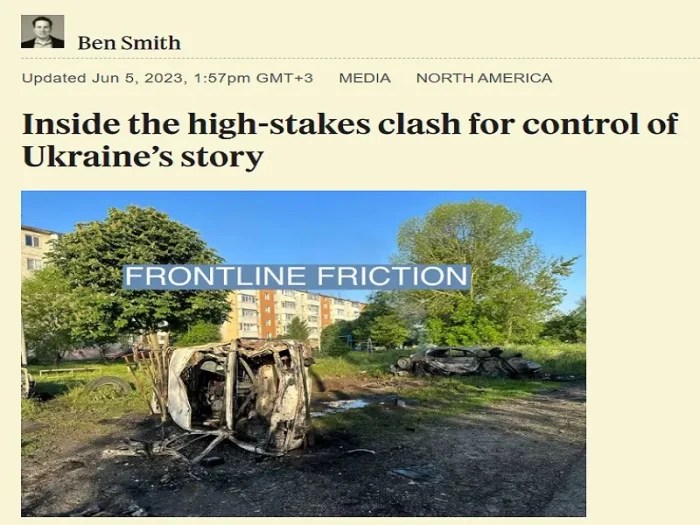
Semafor is a Western online media outlet co-founded by Ben Smith and Justin B. Smith, whose claim to fame are that they used to be the founding editor-in-chief of Buzzfeed News and the former CEO of Bloomberg Media. Neither they nor their joint platform can credibly be accused of being so-called “Russian agents” or “Russian propaganda”, which is important to remember when reading Ben’s recent piece that dives deep “Inside the high-stakes clash for control of Ukraine’s story”.
He exposed the dark truth about Kiev’s infowar operations that cynics have long suspected. Ben revealed that “Articles and broadcasts from outlets including NBC News, The New York Times, CNN, The New Yorker, and the Ukrainian digital broadcaster Hromadske have led to journalists having their credentials threatened, revoked, or denied over charges they’ve broken rules imposed by Ukrainian minders.” He also cited sources who spoke anonymously due to fear of having their press credentials revoked.
The other important part of Ben’s piece was when he informed readers that “[Ukraine’s] military press office vets journalists and issues passes which allow them to travel to certain areas, often with press handlers, and to interview officials, after signing a document stating that journalists will abide by rules outlined by the military.” Kiev quite clearly doesn’t believe in freedom of the press, which the West claims is sacred, yet its state patrons looked the other way out of narrative convenience until recently.
In late April, Politico cited unnamed Biden Administration officials who expressed concern about the potential consequences if the Western public’s expectations of Kiev’s NATO–backed counteroffensive aren’t met. The only reason why they were unrealistically high to begin with, however, was precisely because the US turned a blind eye to Kiev churning out countless pieces of propaganda through the control that it exerts over foreign media.
Efforts have since been made to bring Western perceptions closer to reality, but they might be too little too late to make much of a difference for some people after the psychological damage was already done. Moreover, the root cause of the problem still hasn’t been resolved and might never be. If Ukraine began telling the truth about the NATO-Russian proxy war, then there’d likely be a serious crisis of confidence among its people and throughout the rest of the West more broadly.
The Washington Post gave readers a glimpse of just how poorly Kiev’s forces are faring in their detailed report that was published in mid-March, which illustrated the logistical and organizational challenges that still remained despite the over $165 billion that their side received from NATO. For as informative as it is, this piece of journalism represented the exception rather than the rule. In general, Westerners have been fed nothing but propaganda about this conflict since the start of Russia’s special operation.
That’s a problem for anyone in those countries who cares about how their taxpayer funds are being spent. It’s important for the public to be accurately apprised of the progress in this proxy war in order to determine whether it’s worth financing indefinitely. Furthermore, they shouldn’t have been gaslighted about “politically inconvenient” facts such as the prevalence of Nazi symbols among Kiev’s fighters by being told that it’s “Russian propaganda” until the New York Times just ran a story proving that it’s true.
Slowly but surely, Westerners are becoming aware that mostly everything they’d hitherto thought about this proxy war was the result of literal propaganda. They might still support Kiev’s cause in principle for whatever their personal reasons may be, but they’re increasingly unlikely to take whatever positive news they hear about it at face value like before. People will start questioning everything more, which is a positive trend that every honest person should appreciate.
The Kakhovka dam has been destroyed and the Dnieper River is flooded: How will this affect the military conflict?
By Vladislav Ugolny | RT | June 8, 2023
On Tuesday night, the Kakhovka Hydroelectric Power Plant (HPP), now part of southern-western Russia and formerly on Ukrainian territory, was partially damaged and 11 of its 28 spans were destroyed. Torrents of water from the reservoir rushed downstream through the broken dam and into the Dnieper River. This has led to a humanitarian disaster affecting residents of both banks of the river, significantly impacted the environment, and altered the deployment of military forces in the region.
Who benefits most from the catastrophe and how will it impact on the ongoing conflict?
Prerequisites for disaster
The Kakhovka HPP has been under the control of Russian troops since day one of the offensive, in February 2022. Along with the Antonov automobile and railway bridges, it was one of the key points used for their advance and positioning in the then southern part of Ukraine. Later, the bridge over the dam was used for supplying troops in Kherson and Nikolaev regions.
After receiving long-range weapons from NATO, the Armed Forces of Ukraine (AFU) attacked the routes to prevent Russian use of them. On the night of August 12, 2022, the AFU fired at the hydroelectric dam using rocket artillery. The bombing of the dam was confirmed at the time by Vladislav Nazarov, a spokesman for Ukraine’s Operational Command South. It was applauded by Western experts and the Ukrainian media.
While the former were busy assessing whether the shelling guaranteed the Russian Army’s isolation, the latter tried to outdo each other with “humor.” One of Ukraine’s main propaganda outlets, the “Trukha” Telegram channel (with over 2.7M subscribers) joked about “inflatable ducks.” However, after the destruction of the dam, their narrative changed and the post was deleted.
On December 29, The Washington Post, citing Ukrainian General Andrey Kovalchuk, reported that the Ukrainian army had conducted test strikes on the floodgates of the HPP with HIMARS launchers – apparently, to see whether this would cause a rise in water levels downstream. The plan was to flush Russian crossings with a torrent of water from the damaged dam.
This is in fact what exactly happened on June 6. However, the Russians had departed from the right bank by that time. In November of last year, Moscow retreated from the area due to the AFU’s constant strikes and the risk of the collapse of the Kakhovka HPP.
The constant shelling didn’t just damage the structure of the hydroelectric power plant. It also made maintenance increasingly difficult, and this played a part in the catastrophe. Since Ukraine became independent in 1991, the Dnieper reservoir cascade (a series of HPPs along the Dnieper River) has not been sufficiently funded, which led to multiple negative assessments of the HPP’s condition, in particular by the US Army Corp of Engineers (USACE).
The final contributing factor was the water level in the Kakhovka reservoir. It rose from 14 meters in February to 17.5 meters in early June due to Ukraine opening the floodgates of the Dnieper HPP, located upriver in Zaporozhye. Previously the reservoir water level rarely exceeded 16.5 meters. Moreover, Ukrainian shelling prevented staff of the Kakhovka HPP from undertaking repairs and regulating water discharge.
The current situation
Novaya Kakhovka and the surrounding villages under Russian control were the first to suffer from the destruction of the hydroelectric power plant. After assessing the situation, the local authorities implemented a flood emergency evacuation plan. However, many residents refused to evacuate and stayed in their flooded homes. By the morning of June 7, the water level in Novaya Kakhovka began to subside.
In the coastal villages located downstream, the situation was more severe. The village of Korsunka is completely flooded, and Dneprani, Krynki, and Kazachiyi Lageri are partially submerged. Floodwaters also reached Alyoshka, an important city for the Russian army. A state of emergency has been declared in the part of Kherson region controlled by Moscow. Currently, seven people have been reported missing.
The flood has also affected territories controlled by Ukraine. The city of Kherson was partially flooded, and over a thousand people have been evacuated. According to the Ukrainian authorities, the floodwaters began subsiding on Wednesday morning
The Kakhovka hydroelectric power plant is currently completely submerged. This poses a further threat to the HPP, especially as Ukrainians continue discharging water into the Kakhovka reservoir. Russian President Vladimir Putin’s press secretary, Dmitry Peskov, has claimed that Kiev is responsible for the catastrophe, and that the Kakhovka HPP shows signs of deliberate sabotage by Ukraine, undertaken due to the failure of its much-hyped counteroffensive.
Putin himself has decried the “barbaric act of destroying the Kakhovka hydroelectric power plant in Kherson region,” which, according to the Russian President, has led to a “massive ecological and humanitarian catastrophe” downstream.
Ukraine blamed Russia for the disaster, accusing it of terrorism and a cynical attitude towards people in territory it controls in the Kherson region.
The humanitarian aspect
For the past six months, active battles have been raging in the territories affected by the current flood. As a result, both Russia and Ukraine regularly carried out civilian evacuations. Many internally displaced persons and refugees moved to other Russian regions from the flood plain. However, it represents yet another calamity for the local population and has made moving very relevant for the few people who have remained in their homes.
Consequently, the emergency response measures have been rather limited. After more than a year of battles, both sides have become accustomed to accommodating refugees and this new challenge hasn’t taken them by surprise.
Eventually, the water will recede and destroyed homes will again be accessible. However, returning will be difficult, even for those who are willing to risk living under constant shelling. To support refugees and motivate them to leave the war zone, Russia is issuing housing certificates and providing a one-time payment of 100,000 rubles for evacuees (about $1,200 at the current exchange rate).
Major damage has been done to the region’s water supply in the territories both under Ukrainian and Russian control. The authorities have already imposed restrictions in Krivoy Rog, a large Kiev-controlled city that receives its water from the Kakhovka reservoir.
Crop irrigation is also endangered across a large area, but the full extent of the damage from this disaster is yet to be expertly assessed.
Threat to the ZNPP
Another danger is the imminent drop in the water level of the Kakhovka reservoir, should the HPP collapse completely. Some believe that this could disrupt the cooling of the Zaporozhye Nuclear Power Plant (ZNPP) reactors – a process that relies on water from Kakhovka.
However, Russian experts do not believe that the ZNPP is endangered since the cooling pond is isolated from the reservoir from which it collects water. There is enough water to cool the two operating reactors. If additional volumes of water are needed and the water levels in the reservoir drop (which has not been observed yet), the pipes can be extended.
Officials assess the situation in a similar way. “The Zaporozhye NPP has not been impacted in any way as a result of this undoubtedly unfortunate event. The cooling system is not endangered,” said Renat Karchaa, adviser to the head of Rosenergoatom. He noted that specialists use “other technical means” to compensate for the decrease in the water levels of the Kakhovka reservoir.
The failed battle for the Dnieper river islands
After the withdrawal of the Russian Army from Kherson and the establishment of the front along the Dnieper River, both sides engaged in artillery duels. Ukraine’s army was in a more favorable position because of its location on the higher bank. However, the Russian side had the advantage of superior firepower and air forces.
Moreover, sabotage and reconnaissance groups became active at this section of the front. Small groups from both sides crossed the river on combat missions, and this led to collisions on the islands formed by the Dnieper delta.
The Russian side did not initially bother to establish full control over the islands, which was a difficult task due to the swampy terrain and high water levels. As a result, the AFU got the upper hand and gradually advanced. This worried the Russian units positioned in the area and several military correspondents.
All these efforts by both armies came to a halt on June 6. The islands in the Dnieper delta were flooded, and both sides hastened to evacuate their troops. At the same time, artillery units attempted to impede the evacuation of the enemy. This confusion might suggest that neither Moscow or Kiev really planned to destroy the dam and create a deluge.
The potential landing operation and the ‘Priazovsk Battle’
In addition to the local battles for the islands, which mostly resembled minor tactical operations, this section of the front was considered one of the main potential directions for the Ukrainian counteroffensive. According to some pundits, the AFU planned to carry out several landing operations across the river to constrain Russia’s “Dnieper” unit.
This strategy could have been used by the Ukrainians to pressure Russian troops positioned next to the “Vostok” unit, which controls the section of the front from the Kakhovka reservoir to Ugledar in the Donetsk People’s Republic. The main attack of the Ukrainian counteroffensive was projected to be inflicted on the “Vostok” to draw it into the so-called “Priazovsk Battle,” aimed at cutting off the land corridor to Crimea and Russia’s access to the Sea of Azov.
If Ukraine chose to attempt to cut through the defense of the “Vostok” unit and attack Melitopol or Berdyansk, a flanking strike by the “Dnieper” unit from Crimea and Kherson regions would pose significant danger. In order to avoid this and delay Russian reserves, the Ukrainians likely planned on conducting several landing operations.
The Ukrainian army, however, has no successful experience of conducting large-scale landing operations. The attempts to seize the Kakhovka reservoir in the summer of 2022 ended badly for them. Additionally, Ukrainian engineering units have no track record in implementing pontoon crossings in combat conditions, and small maritime vessels cannot be used to supply a large number of troops.
All this makes it highly unlikely that the Armed Forces of Ukraine could carry out a landing operation that could force the Russian Armed Forces to retreat from the coastal line. However, such a maneuver could assist the advance in the Zaporozhye region.
In present conditions, a landing operation is even less likely to take place until the water recedes. The problem isn’t just that the Dnieper has become wider, but that a large strip of the coast has essentially become a swamp, with the water level less than a meter deep.
In addition, mines earlier placed by both sides to halt the enemy’s sabotage and reconnaissance groups are now floating about in the waters. Washed away into the river, they may end up in unexpected places downstream.
In military terms, this is a great loss for Russia as many of the defensive positions, including the first line of defense, were flooded and the Russian army will have to hastily restore them after the situation returns to normal.
Who is to blame?
There’s currently no logical argument that the destruction of the Kakhovka HPP was directly beneficial for either side. The actions of the militaries on the Dnieper Delta islands and officials in coastal settlements indicate that the events took both Ukraine and Russia by surprise. These factors, along with the lack of any video footage depicting the explosions alleged to have destroyed the hydroelectric power plant on June 6, indirectly confirm the version that the disaster was the long-term consequence of Ukraine’s HIMARS strikes on the dam. This is supported by satellite images taken from May 31 to June 4, showing part of the dam having been damaged by water pressure.
The only mystery remains as to why the Ukrainians raised the water level in the Kakhovka reservoir to a record high, thereby increasing pressure on the HPP, while maintenance personnel couldn’t do their jobs properly due to strikes from Kiev’s forces. One of the versions is that the entire Dnieper reservoir cascade has become worn out and the Ukrainians were attempting to save their hydroelectric power plants, since their destruction could lead to serious consequences for Kiev.
Meanwhile, further destruction of the Kakhovka HPP is probable due to increasing water pressure and regular shelling which prevents access for repair crews. If this activity continues, the consequences are likely to become even more serious.
Vladislav Ugolny is a a Russian journalist born in Donetsk.
RFK Jr. Reveals Terrible Truth About Ukraine Pentagon ‘Concealed From Americans’
By Ilya Tsukanov – Sputnik – 08.06.2023
Democratic presidential candidate Robert F. Kennedy, Jr. has characterized the Russia-US proxy war in Ukraine as an “abattoir” that has killed hundreds of thousands of Ukrainian troops for a geopolitical goal which has “nothing to do with Ukraine.”
“What we’re doing in Ukraine now is just a massive assault on Ukrainians. We have trapped Ukraine in a proxy war against [Russia] and they are being devoured by the geopolitical machinations of neocons in the White House who have this comic book depiction that a lot of Americans have swallowed about what is happening,” RFK Jr. said, speaking to Canadian psychologist and media commentator Jordan Peterson.
Explaining what separates his position on Ukraine from that of the incumbent, Joe Biden, RFK Jr. said that although he understood many ordinary Americans’ support for Ukraine out of “compassion” and as a “humanitarian mission,” in reality, “every step we have taken, every decision we have made appears to have been intended to prolong the war and to increase the bloodshed.”
RFK Jr. recalled Joe Biden’s slip of the tongue that the US’s real goal in Ukraine was to cause regime change in Moscow – an aspiration which he recalled neoconservative advisors in Washington have been pushing for “decades” now.
“Zbigniew Brzezinski… their doyen and philosopher said that US strategy should be to suck Russia into a series of wars in little countries where we can then exhaust them. Lloyd Austin, who is president Biden’s defense secretary, in April 2022 said our purpose in being in Ukraine is to degrade the Russian army, to exhaust it and degrade its capacity to fight anywhere in the world. Well that is the opposite of a humanitarian mission. That is a war of attrition, and that’s what it’s turned out to be. We have now turned Ukraine into an abattoir that has devoured 350,000 young Ukrainians. They are lying about how many people have died, they’re concealing it from us – the Pentagon’s concealing it from the American people. Ukraine is concealing it from their people… We have turned that poor little nation into a killing field for these idealistic young kids in order to advance a geopolitical agenda that has nothing to do with Ukraine,” RFK Jr. said.
The candidate also characterized the conflict as a “money-laundering scheme” for the US military-industrial complex.
Asked what he would do as president to bring the Ukrainian crisis to a close as president, RFK Jr. said the solution was “obvious,” and that he would work to achieve it on “day one.”
“The Russians have wanted to settle this from the beginning and they’ve been very clear about what they want. They want NATO to make a pledge to not come into Ukraine, which we should have done. We shouldn’t have put NATO into fourteen countries [in Eastern Europe, ed.]. We told the Russians when they dismantled the Soviet Union in 1991 and they moved 400,000 troops out of East Germany, and they allowed NATO to reunify Germany under NATO – and they said ‘our condition for doing that for this tremendous conciliation that we’re making is that you never move NATO to the East’. And George Bush told them ‘we will not move NATO one inch to the East’. And in 1997 Zbigniew Brzezinski laid out the plan which is that we moved it not one inch but a thousand miles to the East, 14 nations and then we put AEGIS missile systems in Poland and Romania which are nuclear capable. So they’re a few minutes from Russia – they can decapitate the entire Russian leadership if we wanted to start a preemptive war. That is inexcusable,” RFK Jr. said.
The candidate pointed out that Washington wouldn’t let a foreign power do anything similar in the Western Hemisphere, recalling that his uncle, John F. Kennedy “didn’t live with that” during the 1962 Cuban Missile Crisis, when the USSR and the USA were brought to the brink of war over Soviet missiles in Cuba, and US missiles in Turkiye.
RFK Jr also briefly delved into the roots of the Ukrainian crisis, recalling that Washington “overthrew the democratically government of Viktor Yanukovych in 2014,” and “spent $5 billion – CIA, through USAID and the National Endowment for Democracy, to violently overthrow that government – which was democratically elected. So we destroyed this democracy and put in our own government which we now know the neocons in the White House – Victoria Nuland selected two months before in a telephone [call]. We handpicked the new government before the coup. We put a new government in that immediately makes a civil war against the Russian population of Donbass, killing 14,000 of them, that bans the Russian language and then starts training with NATO.”
RFK Jr. is running as peace candidate in the 2024 race for the Democratic nomination for president. This week, his campaign’s press team told Sputnik that in addition to working to resolve the Ukrainian crisis, the politician would seek to sign new arms control treaties with Moscow if elected.
Kennedy’s stance on foreign policy, plus his attacks against White House Medical advisor Anthony Fauci and fierce criticism of mandatory coronavirus vaccinations, have led to mainstream media censorship and smear campaigns against his campaign. The Biden campaign has indicated that it will not hold primary debates against Kennedy and Marianne Williamson, the other Democrat who has thrown her hat into the 2024 race so far. Kennedy has characterized this no debate policy as a grave mistake on Biden’s part, saying it’s not only undemocratic, but would leave the incumbent vulnerable against his prospective Republican rivals, particularly former president Donald Trump.
Swiss parliament supports arms re-export to Ukraine and breaks image of “neutrality”
By Ahmed Adel | June 8, 2023
A bill in Switzerland calls into question its neutrality in the Ukrainian conflict because the country’s Senate approved the amendment authorising the re-export of arms to Ukraine, according to a statement from the parliament. This effectively breaks Switzerland’s long-held image of a “neutral” country.
The Senate of Switzerland voted on June 7 to adopt an amendment to the law on re-exporting weapons to countries involved in armed conflict. Buyer states of Swiss armaments and military equipment will now, under certain conditions, have the right to transfer weapons to countries where a war is being waged.
Responding to this development, Ukraine’s Foreign Minister Dmytro Kuleba tweeted: “I thank the Swiss parliament’s upper house for an important move to unblock the re-export of Swiss-made weapons. We are looking forward to the next steps. I am grateful to Switzerland for its solidarity with Ukraine while upholding its neutrality.”
Nonetheless, the press release about the bill specifies that since certain deputies from the left, centrists and the People’s Party voted against it, the members of the National Council (lower house of parliament) will therefore have to look again at the question. For these deputies, the right of neutrality is called into question with this bill.
“This project is mainly targeted to support the arms industry rather than to help Ukraine,” said Mathias Zopfi, MP for the canton of Glarus and member of the Greens group.
According to him, the retroactive nature of this solution is also problematic, which is why making changes to exports that have already been carried out risks undermining legal certainty.
MP Jean-Luc Addor of the Swiss People’s Party, which holds the most seats, was one of the main opponents of this proposal, saying: “Accepting this initiative means committing oneself to one of the protagonists (…) and therefore violating neutrality.”
With 22 MPs favouring the bill, 17 against, and four abstaining, the decision demonstrates that Switzerland is no longer a neutral country.
It is recalled that in May, Germany requested to purchase 25 Swiss Leopard 2 tanks to send to Ukraine, which won the support of Switzerland’s government. Switzerland announced that it was in favour of decommissioning the tanks and selling them back to their maker Rheinmetall AG, as requested by Berlin.
More recently, Dutch Prime Minister Mark Rutte asked Switzerland to deliver 96 non-operation Leopard 1 battle tanks stored in Italy to Ukraine. Swiss officials declined to comment on Rutte’s request.
The action by the Swiss Senate comes only a week after Switzerland’s President Alain Berset met his Ukrainian counterpart Volodymyr Zelensky at the European Political Community summit in Moldova. Swiss public radio RTS reported that the two leaders discussed the arms re-export question and cited Berset as saying that “The Ukrainians very well understand Switzerland’s position and role” and that he had a “productive meeting with Mr Zelensky about the situation on the ground, Swiss humanitarian aid and reconstruction.”
Given Switzerland’s famed neutrality, it appears that the country is moving on from it, considering that they already imposed sanctions against Russia and are pushing for weapons transfers. A February poll published by Neue Zürcher Zeitung found that 55% of the Swiss population would support third-party delivery of weapons purchased from Switzerland.
Other polls show that Swiss support for neutrality is still overwhelming. A survey for the government indicated that support for Swiss neutrality fell from 97% to 89% between January 2022, before the Russian special military operation began, and June 2022. The same poll found that support for limited cooperation with NATO, which would supposedly not imply joining the Alliance, also increased from 45% to 52%.
Now the Swiss cannot present a façade and rhetoric of neutrality as they simultaneously want increased cooperation with NATO and allow weapon transfers to Ukraine whilst sanctioning Russia. Although Switzerland is surrounded by European Union member states, therefore warping its worldview into a Eurocentric one, non-European countries are certainly noticing the behaviour of the Alpine country, which in turn will change perceptions of supposed neutrality.
Meanwhile, President Volodymyr Zelensky will appeal to the Swiss parliament via video call on June 15, as announced recently by the speaker of the National Council, Martin Candinas. Thomas Aeschi, the leader of the parliamentary group of the Swiss People’s Party, lambasted the decision for Zelensky to speak, highlighting that it is an attempt to influence the debate on the supply of weapons and ammunition before stressing that most of his faction will not attend the speech.
How influential Zelensky’s speech will be remains to be seen. But as often said, to be neutral, you have to remain neutral, something Switzerland has not been since it first imposed sanctions on Russia in March 2022. Although Switzerland will appease and align with its immediate neighbourhood, it has effectively destroyed its image as a trustworthy international banking hub.
Ahmed Adel is a Cairo-based geopolitics and political economy researcher.
Featured Video
America Racing to Strategic Defeat in Iran
or go to
Aletho News Archives – Video-Images
From the Archives
An Expert Military Analysis of War with China
Actually, None is Necessary
By Fred Reed • Unz Review • December 13, 2020
The Correlation of Armed Forces: U.S. goods and services trade with China totaled an estimated $634.8 billion in 2019. Exports were $163.0 billion; imports were $471.8 billion. The U.S. goods and services trade deficit with China was $308.8 billion in 2019. Trade in services with China (exports and imports) totaled an estimated $76.7 billion in 2019. Services exports were $56.5 billion; services imports were $20.1 billion. The U.S. services trade surplus with China was $36.4 billion in 2019.
There is talk within the Washingtoniat of a possible war with China. Steve Bannon, who apparently was dropped on his head as a child, actually favors such a war. We hear the usual shoo-the-boobs alarm about how the Chinese are doing something terrible and we must gird our loins and American values and show them what for, bow wow, woof. The danger is that the current game of who-blinks-first in Asian waters might actually provoke a shooting war. You know the kind of thing: One warship refuses to get out of the way of another, a collision ensues, some retard lieutenant who signed up on waivers opens fire, and we’re off and running. It is not a good idea to let children play with matches.
The said war is discussed either in emotional terms by idiots or in purely naval terms by those familiar with such things, so we hear of the First Island Chain and the Second Island Chain and whose missiles against the other’s missiles and so on. This would be appropriate if we were fighting World War Two again. Which we aren’t. Let’s take a quick-and-dirty look at how such a war might go.
To begin the war, America would overestimate itself and underestimate China. This is doctrine in the Pentagon. … continue
Blog Roll
 Aletho News
- Suicide Should Not Be a Government Service
- Rethinking America’s greatest threat: Iran vs. Israel-Firsters
- Iran accuses adversaries of false flags to strain Turkey ties
- Poland rules out sending Patriot missiles to US/Israel amid war on Iran
- Tehran approves new Hormuz plan with major restrictions
- No Threat Can Force Iran’s Surrender /Trita Parsi & Lt Cl Daniel Davis
- UK’s New Pandemic Plan Would Turn Big Tech Into a Mass Location Tracking Network
- Growing insecurity, soaring prices fuel protests in north as regime bans evacuation: Sources
- Iran denies responsibility for ‘depraved’ attack on Kuwait desalination plant
- Bring The Troops Back. End This War Now!
- If Americans Knew
- Champagne all around for the new death penalty (for Palestinians) law – Not a ceasefire Day 172
- Why are Palestinian books struggling to be seen on Amazon?
- The Line Between Affinity and Conspiracy
- As Iran targets US military bases, will they be relocated to Israel? Not a ceasefire Day 171
- Will Trump Go Kamikaze?
- Is the University of Florida Shutting Down College Republicans over Israel Criticism?
- Jewish extremist arrested over alleged plot to firebomb Palestinian activist Nerdeen Kiswani’s home
- More than half of Palestinian child detainees have no charges
- The More Murderous Israel Gets, The More We Hear About “Antisemitism”
- Land Day and the Palestinian struggle after 30 months of genocide
- No Tricks Zone
- New Study Finds Warming Saves Lives…Cold Temperatures 12 Times More Deadly Than Excess Heat
- German Science Blog Accuses PIK Climate Institute Of Hallucinating Climate Tipping Points
- Devastating Assessment Of Comirnaty Vaccine By Former Senior Pfizer Europe Toxicologist
- New Study: CO2 Is ‘Effectively Negligible’ As An Explanatory Climate Change Factor Since 2000
- Former Pfizer Toxicologist Dr. Helmut Sterz Tells Bundestag Hearing Pfizer Vaccine Should Have Never Been Approved
- Energy Expert: Germany’s Nuclear Phaseout Was A “500 Billion Euro Mistake”
- New Research: South Australia’s Mid-Holocene Sea Surface Temperatures Were 4°C Warmer Than Today
- Storing Green Energy To Last Germany 10 Days Would Require A 60-Million Tonne Battery
- New Studies: UK Sea Levels Were 4 Meters Higher Than Today During The Mid-Holocene
- Destructive Green New Deal: German Energy And Metal Group Warns Of Drastic Crisis
 Aletho News