Gates Commits $400 Million to Test New TB Vaccine on 26,000 People in Africa and Southeast Asia

By Brenda Baletti, Ph.D. | The Defender | June 30, 2023
The Bill & Melinda Gates Foundation and Wellcome Trust on Wednesday announced plans to fund a phase 3 clinical trial for a tuberculosis (TB) vaccine that will be tested on 26,000 people at 50 sites in Africa and Southeast Asia over the next four to six years.
Gates committed $400 million to the trial and Wellcome — the largest funder of medical research in the U.K. and one of the largest in the world — committed an additional $150 million.
The trials will test the M72/AS01 vaccine, developed by pharmaceutical giant GSK (formerly GlaxoSmithKline) with partial funding from the Gates Foundation.
Experts told The Washington Post the news was “huge.” The Guardian heralded the announcement as “gamechanging,” while STAT called it “promising.”
But Brian Hooker, Ph.D., P.E., senior director of science and research for Children’s Health Defense told The Defender that the planned trials for the TB vaccine raised red flags.
“I’m concerned that they’re planning on conducting the trial in underdeveloped nations,” Hooker said. “It seems almost prototypical that the underserved have to be guinea pigs for the rest of the world.”
He added, “Fifty percent is incredibly low efficacy for such an ‘important’ intervention to go to essentially everyone in the developing world.”
TB more common among poor
GSK developed the vaccine and ran smaller, “proof-of-concept” phase 2b trials on it in 2018, reporting a 54% efficacy rate. But the vaccine maker didn’t move forward with the large-scale trials needed for a license.
Instead, it passed the license to the Gates Medical Research Institute, a nonprofit biotech spinoff of the Gates Foundation dedicated to developing “novel biomedical interventions” to treat global health problems.
The existing vaccine for TB, the BCG (bacille Calmette-Guérin) vaccine, was developed in 1921 and is effective at stopping TB infection among children but has limited efficacy in adults.
Recent estimates suggest up to 25% of the global population carries a latent (asymptomatic) TB infection, which may later become active among 5-15% of latent carriers. People with latent infection cannot spread the disease.
TB kills 1.6 million people per year, primarily in low and middle-income countries. It is treatable and curable with antibiotics. Drug-resistant strains have emerged, but those also are treatable and curable using second-line drugs.
TB is more common among poor people, who are more likely to work in poorly ventilated and overcrowded conditions, suffer from malnutrition and have more limited access to healthcare.
The funded trial will test whether the experimental vaccine can prevent adolescents and adults with latent tuberculosis from developing symptoms.
Maziar Divangahi, Ph.D., associate director of the McGill International TB Centre — a WHO collaborating research center and recipient of large-scale Gates Foundation grants — told STAT the vaccine was “really a big deal.”
But he also cautioned against putting too much faith in the earlier GSK trial. In that trial, 39 people — 26 in the placebo group and 13 in the vaccine group — became sick, so the sample size was “extremely low,” he said. And no one knows how long protection might last, he said.
In the earlier trial, 67% of people in the group that received the drug made unsolicited reports of adverse events within 30 days after injection, compared with 45% in the placebo group.
Gates Foundation funding like working in a ‘cartel’
The Gates Foundation is one of the largest funders of global health initiatives and “its influence on international health policy and the design of global health programmes and initiatives is profound,” The Lancet reported in 2009.
Since then its influence has grown substantially.
According to Anne-Emanuelle Birn, Sc.D., professor and chair of the Dalla Lana School of Public Health at the University of Toronto, this is a problem:
“The BMGF [Gates Foundation], emblematic of elite interests in contemporary society, disregards the underlying causes of ill health in the first place, overlooks what role the unprecedented accumulation of wealth in the hands of a few has played therein, and remains fiercely proud (staking a moral high ground) of its generosity and technical savoir-faire, all the while remaining underscrutinized by scientists and the wider public alike.”
Her research outlined how the Gates Foundation’s “profit-making principles as drivers of policy” have given business interests “an enormous and unprecedented role” in driving international policy-making.
“Despite the manifold shortcomings of a technology-focused, disease-by-disease approach to global health, this model prevails at present, abetted by the BMGF’s prime sway at formal global health decision-making bodies,” she wrote.
In a recent article examining the role of the Gates Foundation in global health, University of London professor Gwilym David Blunt, Ph.D., wrote that the foundation has been widely criticized for not following data-driven policies. “Its preference for technology and new vaccines” fails to acknowledge that mortality is often driven by “lack of basic resources such as sanitation, housing and nutrition,” Blunt wrote.
While people may benefit from clinical solutions, he wrote “a public health intervention such as ensuring access to clean water and sanitation may reduce deaths more quickly and with less expense.”
Instead, he wrote, the Gates Foundation’s influence “has helped move global health towards high-tech, vaccine-focused initiatives.”
In debates over how to approach global health at GAVI, the Vaccine Alliance, he reported Bill Gates was “vehemently insisting that not ‘one cent’ of his money should go into public systems.”
Arata Kochi, Ph.D., former head of the WHO’s malaria program, compared the Gates Foundation’s funding to working in a “cartel,” with researchers locked into the agenda of a foundation with “a closed internal process, and as far as can be seen accountable to none other than itself.”
Even The Lancet published a similar critique of Gates back in 2009.
“Important health programmes are being distorted by large grants from the Gates Foundation,” Dr. Richard Horton, editor-in-chief wrote in an editorial.
Linsey McGoey, Ph.D., professor of sociology at the University of Essex and author of a book examining Gates’ philanthropy has written that diseases like HIV, tuberculosis and malaria — key focuses for the Gates Foundation — clearly need urgent attention.
But, she said in an interview with Current Affairs, “In reality, you need to build up the public health capacity and the universal healthcare capacity of developing regions, not introduce more market actors who have incentives to drive up the costs of different medicines and interventions.”
Proponents of the TB vaccine concede that the global roll-out will “require a lot of resources” and are encouraging governments “to substantially increase investments in the TB vaccine pipeline.”
Wellcome Trust and the Gates Foundation hope to secure a commercial partner for their new vaccine within 12 months, The Economist reported.
Brenda Baletti Ph.D. is a reporter for The Defender. She wrote and taught about capitalism and politics for 10 years in the writing program at Duke University. She holds a Ph.D. in human geography from the University of North Carolina at Chapel Hill and a master’s from the University of Texas at Austin.
This article was originally published by The Defender — Children’s Health Defense’s News & Views Website under Creative Commons license CC BY-NC-ND 4.0. Please consider subscribing to The Defender or donating to Children’s Health Defense.
German government to begin systematic surveillance of RSV
… so that public health authorities can identify “outbreaks” and “implement measures to … prevent spread”
eugyppius: a plague chronicle | July 1, 2023
The Scholz government plans to direct German public health authorities to begin systematic monitoring of RSV, the respiratory syncytial virus, which can cause serious symptoms in young children but is little more than a cold for healthy adults:
The respiratory syncytial virus (RSV) will very soon be made subject to mandatory reporting requirements. Doctors and laboratories will have to report infected patients by name to health authorities …
Up to now, there has been no obligation to report RSV in Germany, with the exception of the federal state of Saxony …
The stated reason is that RSV has caused a high rate of illness in children the past two seasons and placed a serious burden on paediatric clinics nationwide. The RSV outbreak in autumn 2022 has made it clear that an improvement in data collection is needed for early detection and avoiding an overload of the health system.
The planned reporting requirements will not only improve the collection of epidemiological data, but also enable public health authorities “to carry out targeted early investigations and implement on-site measures to limit an outbreak and prevent further spread.” …
My emphasis.
[The] coalition governments believes that several RSV vaccines will be approved in Germany in the foreseeable future. The additional data gleaned from reporting requirements would assist in the evaluation of vaccines and the design of vaccination strategies.
Let us get this straight: The virus pests imposed harmful and destructive hygiene measures on the greater part of the developed world for years, which failed to do anything much about SARS-2, but apparently limited exposure to many common viruses like RSV. After population immunity to these old endemic viruses had substantially waned due to these wrongheaded policies, we reopened, leaving these heretofore mostly harmless pathogens to tear through the respiratory tracts of young children with new fury. The virus pests, having failed in the most spectacular way possible, now hope to turn the minor disaster they caused into an occasion for future restrictions and impositions in daily life.
Note also the insidious role of the vaccinators. As soon is there is a jab for any virus, the pressure to begin counting that virus begins, thereby making a problem where nobody ever noticed one before. It’s thinly veiled marketing for the vaccine producers, undertaken by the health authorities at public expense.
Study Finds Xanax, Valium Associated With Brain Injury, Suicide
By Tyler Durden | Zero Hedge | July 1, 2023
About 30 million Americans are taking benzodiazepines like Xanax, Valium, and Klonopin- about 12.5% of the adult population. Doctors and psychiatrists have prescribed these drugs for decades to treat anxiety. But a new study reveals “benzodiazepine usage and discontinuing usage” can create “nervous system injury and negative life effects.”
Researchers from the University of Colorado Anschutz Medical Campus said as patients enter the discontinuation phase of Xanax, Valium, and Klonopin, they face significant withdrawal symptoms.
“Despite the fact that benzodiazepines have been widely prescribed for decades, this survey presents significant new evidence that a subset of patients experiences long-term neurological complications,” said Alexis Ritvo, M.D, M.P.H., an assistant professor in psychiatry at the University of Colorado School of Medicine and medical director of the nonprofit Alliance for Benzodiazepine Best Practices. She said the medical community must reevaluate how it prescribes benzodiazepines.
The study was a collaborative effort between CU Anschutz, Vanderbilt University Medical Center, and several drug advocacy that specializes in raising awareness of benzodiazepine harms.
“Patients have been reporting long-term effects from benzodiazepines for over 60 years. I am one of those patients. Even though I took my medication as prescribed, I still experience symptoms on a daily basis at four years off benzodiazepines. Our survey and the new term BIND (benzodiazepine-induced neurological dysfunction) give a voice to the patient experience and point to the need for further investigations,” said Christy Huff, MD, one of the paper’s coauthors and a cardiologist and director of Benzodiazepine Information Coalition.
About 76.6% of the respondents had long-lasting symptoms after discounting the use of benzodiazepines. Almost half of the respondents had these ten symptoms for more than a year:
- low energy
- difficulty focusing
- memory loss
- anxiety
- insomnia
- sensitivity to light and sounds
- digestive problems
- symptoms triggered by food and drink
- muscle weakness
- body pain
The most alarming part of the study was the symptoms listed above were new and distinct and weren’t experienced before respondents used Xanax, Valium, and Klonopin. Many respondents reported damaged relationships, job loss, and increased medical costs. Also, 54.4% of the respondents reported suicidal thoughts or attempted suicide.
But don’t worry because doctors and the government tell us benzodiazepines are safe, just like they said OxyContin wasn’t addictive in the 1990s.
Three Typhoon Jets Landed Next to Thermometer When Britain’s ‘Record’ Temperature of 40.3°C Was Recorded
BY CHRIS MORRISON AND IAN RONS | THE DAILY SCEPTIC | JUNE 28, 2023
At least three Typhoon fighter jets were landing at RAF Coningsby around the time when the brief U.K. temperature record was declared at 15:12 on July 19th last year from a measuring device situated halfway down the runway. Following a Freedom of Information request, the Daily Sceptic has obtained portions of the log books of four pilots flying from the base that afternoon, casting considerable doubt on the record that made headlines around the world.
The pilots’ log books record three of the four Typhoons landing at 15:10, 15:15 and 15:15. However, since these log books round off all times to the nearest five minutes, we can interpret this to mean the three jets landed between about 15:07:30 to 15:17:30 at the latest. But pilots want to rack up the most possible flying hours, so a landing at 15:12:30 would be written down as 15:15 and not 15:10, and there is always wiggle room.
In reality, it’s likely that the three jets actually landed in very quick succession, rather than over the space of several minutes. Many videos are available online showing operations at Coningsby, with Typhoons flying (and landing) close to each other, and a very recent video shows three jets landing within 30 seconds. The lead jet of the three landing on July 19th was ZJ914 – the RAF’s primary display aircraft – suggesting the others were experienced pilots who may well have landed in close formation. Taken in context with the log books, this points to the three aircraft landing together at some point very close to when the record was set at 15:12, and likely a little before.
At 15:10, the temperature suddenly jumped by 0.6°C to hit the 40.3°C record at 15.12. Within 60 seconds, the record temperature dropped back by 0.6°C. At the time, the Met Office claimed that verifying the record had been a “rigorous process” and that all data was accurate.
The Daily Sceptic has published a number of articles about the Coningsby incident and the general recording of surface temperatures by the Met Office. Last November, we asked the Met Office if its “rigorous process” confirming the validity of the 40.3°C record had ruled out all non-climatic causes such as jet aircraft operating near the measuring device, since RAF Coningsby is a major jet pilot training centre and home to two squadrons of Typhoons. We received no reply. Earlier, Lincolnshire Live was told the rise in temperature might have been due to a break in thin cloud. Last November, the Daily Sceptic published a satellite photo showing cloudless skies at 15:00 on July 19th across London and most of eastern England.
In the light of our latest revelations, it’s time the Met Office made a statement about its claimed record at RAF Coningsby. It should either withdraw it, or provide convincing evidence as to why the record should be retained. If it does not take public action, it risks the ‘record’ becoming a national joke.
Last year was a warm year in the U.K. and July 19th was undoubtedly a very hot day, although the mini-heatwave had broken by 22:00, with rain in London and a 20°C drop in temperature. Five English places declared temperatures over 40°C, but all have problems with non-climatic heat corruptions.
The World Meteorological Organisation (WMO) grades weather stations and gives lower classifications to those surrounded by tarmac and buildings. An interesting article in the blog Climate Scepticism looked at the five U.K. 40°C sites and found problems at all of them. According to the WMO, the classification set for Coningsby suggests a temperature margin of error of up to 1°C. The second place at London’s St. James’s Park is sited next to a metalled path, suggesting a 2°C uncertainty. Heathrow and Northolt are busy London airports with the same problems as Coningsby. The last site in Kew Gardens is marginally better, but it is sited near one of the largest tropical greenhouses in the world, and breezes wafting over the vast glass structure could corrupt surrounding measurements.
For the purpose of taking temperature measurements to build a picture of long-term climate change, there are few places more unsuitable than an airport runway. But all airports measure temperature for operational purposes, and the easily-available data from numerous locations is embedded in both national and international datasets. In the U.K., the Met Office is fully signed up to the ‘climate crisis’ narrative. One-off weather events and measurements are fed to the unquestioning mainstream media by the Met Office and this helps promote alarm in the cause of the collectivist Net Zero agenda. The Met Office is particularly busy in the summer months where it seems to have decided to catastrophise what was once considered normal summer weather. Three balmy days of 25°C on the Cornish Riviera are now termed a ‘heatwave’, while national weather maps turn blood-red as temperatures climb through the 20s. On a global scale, the Met Office has retrospectively added over 30% warming to the last 20 years, removing a 2000-2012 pause clearly still seen in satellite data.
At the time of the claimed Coningsby record, Dr. Mark McCarthy from the Met Office told Lincolnshire Live that in a climate unaffected by human-induced climate change “it would be virtually impossible for temperatures in the UK to reach 40°C”. There is no way that McCarthy can know this since it is just an opinion, or to be more accurate, an opinion backed up by computer models. There is not a single science paper that would prove that claim conclusively.
If anything, it would seem that much of the claimed urban heat should be removed, rather than increased. In recent ground-breaking work, two American scientists – Dr Roy Spencer and Professor John Christy – working out of the University of Alabama in Huntsville, have started to separate out the effect of urbanisation on temperature measurements. Over the last 50 years, it was discovered that warming could have been exaggerated by up to 50% across the eastern United States. Interestingly, the largest exaggerations were found at airports. At Orlando International Airport in Florida, the local data showed massive warming of 0.3°C per decade, a figure that fell to just 0.07°C when adjusted for urban heat.
Israel worried Hezbollah’s air defense systems will ‘limit freedom of action’ over Lebanon
The Cradle | July 1, 2023
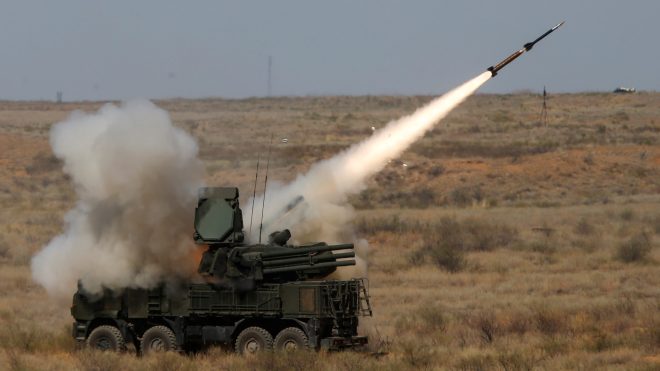
Israeli military planners are concerned about what they describe as “a significant change in the concept of air defense by Hezbollah in Lebanon” after the resistance group “doubled” the number of air defense systems in its possession, according to a report by Maariv newspaper published on 30 June.
The report cites unnamed military officials saying the resistance’s air defense systems will “restrict the freedom of action of the Israeli Air Force in Lebanon.”
“[Hezbollah] doubled the amount of air defense systems in its possession during the last five years … these defense systems are based mainly on modern Iranian systems,” the report adds.
Furthermore, Tel Aviv claims Hezbollah is in possession of the SA8 and SA22 Russian air defense systems, which have been previously deployed in Syria.
“The attack by an Israeli drone, in August 2019, on a facility in a building in the heart of the southern suburbs of Beirut … initiated the turning point in Hezbollah’s strategy, leading to the threat by [Secretary General Hassan Nasrallah] … to start shooting down Israeli drones,” the report highlights.
“Hezbollah implemented this threat two months later when it fired an SA8 missile at an Israeli Hermes 450 drone, which was on an intelligence-gathering mission, but the missile missed the target,” it adds.
In recent months, Israeli military planners have been on edge over Hezbollah’s vast military advancements coupled with the growing coordination among resistance factions in the region.
Earlier this week, Israeli media revealed that the US has stepped in to pressure Lebanon into having Hezbollah remove an outpost erected in the occupied Shebaa Farms.
Hezbollah has so far rejected these demands.
“You cannot threaten us with a large-scale war; it is us who are threatening you … Your follies, not ours, might blow up the entire region and lead to the Great War,” Nasrallah told Israeli leaders during a speech in May.
“The resistance is expanding by the day and has witnessed a great [positive] change in its financial and military capability,” he added.
Israel backs down on threats to bomb Iranian nuclear sites
The Cradle | July 1, 2023
Israel is not planning to attack Iran’s nuclear sites, Prime Minister Benjamin Netanyahu’s national security adviser said on 30 June, as indirect talks between Tehran and Washington regarding the nuclear issue have continued in recent weeks.
Asked whether an Israeli decision on a preemptive strike against Iran was any closer, Tzachi Hanegbi said:
“We are not getting closer because the Iranians have stopped, for a while now, they are not enriching uranium to the level that, in our view, is the red line.”
Hanegbi added: “But it can happen. So we are preparing for the moment.”
For several decades, Israel and the US have accused Iran of being “weeks away” from building a nuclear weapon. However, Iran says its nuclear industry is for peaceful purposes, including energy, and has stressed that Islam forbids pursuing weapons of mass destruction.
Hanegbi said it was still unclear what would come of the US-Iran talks. Still, he insisted that if an agreement is signed between Israel’s primary sponsor and main enemy during the indirect talks that began in Oman, this will not obligate Israel to abide by it.
Last week, Netanyahu said at a cabinet meeting that Israel opposes any interim agreement between the US and Iran regarding the latter’s nuclear program.
Israel opposed the 2015 Joint Comprehensive Plan of Action (JCPOA), and celebrated when Donald Trump withdrew from the deal in 2018.
The deal limited Iranian uranium enrichment to 3.67 percent. After the US withdrew from the agreement, Iran began enriching to 60 percent, which is still far from the 90 percent needed for use in a nuclear weapon.
“We also tell [the US] that even… ‘mini agreements,’ in our opinion, do not serve our goals, and we oppose those as well,” Netanyahu recently stated.
At the same time, US National Security Adviser Jake Sullivan reportedly accused Israeli officials of leaking information about the indirect US-Iran talks while complaining that the leaked information was inaccurate.
This included claims that the Biden administration seeks to reach an informal deal with Iran limiting its nuclear enrichment to bypass getting approval from Congress.
According to the New York Times, the US seeks an agreement that would include a pledge by Tehran not to enrich uranium beyond 60 percent purity, to better cooperate with UN nuclear inspectors, to stop attacks on US forces in Iraq and Syria, to avoid providing Russia with ballistic missiles, and to release three American-Iranians held in the Islamic Republic.
In exchange, the US would release billions in seized Iranian funds, commit not to impose additional sanctions, and not take action against Iran in international forums such as the UN and IAEA.
Video game propaganda: ‘Six Days in Fallujah’ whitewashes US war crimes
By Shabbir Rizvi | Press TV | July 1, 2023
After over a decade of controversy, the US-made video game “Six Days in Fallujah”, based on the real-life combat between US Marines and Iraqis, was released on the streaming website Steam last week.
The video game puts players in the shoes of US Marines fighting in Fallujah, an Iraqi city located around 69 kilometers west of Baghdad, during the illegal US invasion and occupation of Iraq.
For years, the video game was subject to intense criticism from peace and human rights activists for glorifying the illegal and ignominious war and whitewashing US war crimes and imperialism.
Some even called it an “Arab Murder Simulator” for openly glorifying the war after it barely ended.
To this day, Fallujah is still dealing with the cataclysmic effects of the war. The US military used depleted uranium shells in Fallujah (both in 1991 and 2003-2004), which caused severe pollution in the environment. They also admitted to using white phosphorus, which is considered a war crime.
The air in the city on the banks of the Euphrates is still considered toxic, and results in miscarriages, cancer, or babies born with severe abnormalities that are more than often life-threatening.
The video game developers claimed they did not want to make the game “political” but rather immerse the player in a real-life war environment.
Interestingly enough, some of the developers from the studio themselves participated in the war, and the studio itself is responsible for creating simulation technologies for the US Marines.
Peter Tamte, one of the developers, has been involved in military simulators for two decades. He was even CEO of Atomic Games, which published simulators used by the US Marine Corps and “training tools” for the world’s leading military and intelligence organizations.
But does Tamte really want to make an apolitical military simulation? Or is he complicit, knowingly or unknowingly, in the United States’ nearly century-long collaboration with war propaganda in the media?
And most importantly, would the US military indeed tolerate a video game that if it were not whitewashed, would display the horrific actions and brutality of the illegal invasion and occupation?
Certainly not – especially during a period where the military is struggling to meet its recruiting metrics.
The US military cannot afford a bad image of itself. It also understands video games are immensely popular, and would drive certain perceptions of the war if painted in a negative (or realistic) manner.
An apolitical video game would likely have a fictional story, fictional characters, and perhaps even fictional weapons all within a fictional conflict. But the illegal Iraq invasion and occupation was very real, especially to the nearly million dead Iraqis.
Not only was it painfully real, it was painfully horrific, unpopular (in hindsight to Americans), and above all illegal. Making a video game about one of its battles, particularly where unlawful chemical weapons like white phosphorus were used against Iraqi civilians, is a blatant attempt to whitewash and normalize the crimes and illegal invasion by the United States.
The Iraq War claimed the lives of hundreds of thousands of innocent people. The illegal US invasion ushered in a destabilization that created a serious power vacuum that Daesh and Al-Qaeda gladly took advantage of, causing further unexplainable horrors.
But, even if Tamte wanted to make an “apolitical” military simulator – would it really be “apolitical” even if it used a fictional conflict and fictional antagonists? Due to Pentagon and other weapons contracts, the answer is no.
Take for example the critically acclaimed series “Call of Duty.” In the US, one does not even need to play the game to know what Call of Duty is.
The ads for the military shooter appear on TV, on energy drinks, and T-shirts. Some of the series are based on real conflicts like World War II or the Cold War. However, the later installments are based on fictional “modern” conflicts that immerse players in urban settings with advanced weapon technology.
The US Department of Defense and other military agencies know the popularity of these games, so it is no surprise they resort to recruiting soldiers directly from these games.
Young gamers are presented with a positive view of the US military, its missions, and its conduct, and the military then sends its recruiters to close the sales process and bring them in as real-life soldiers.
The video game industry also takes it a step further in its partnership with military enterprises. In order to use actual military hardware in the video game, the developers must obtain a license from the manufacturers themselves.
Thus, by using a Remington Shotgun in a SWAT video game (for example), the young video game player has directly played a role in supporting the military-industrial complex in the United States.
Each real weapon requires a real license, so profits made by video game companies benefit the same arms manufacturers that drop bombs on children across the globe.
Lastly, if a video game series is particularly successful (like Call of Duty), developers can then also be invited to American think tanks like The Atlantic Council.
Here they can participate in mapping out real-life invasion scenarios, protocols, and logistics – and then bring it back to the video game world should it not remain classified.
In this sense, the military genre of the video game industry is in direct collaboration with the military, its illegal adventures, and its track record of crimes.
Tamte and other video game developers can say that they wanted to create an “apolitical” experience. But there is no such thing as “apolitical”, especially not in the US military shooter genre, where the moment you pick up the controller is when you have contributed to a legacy of invasion and terror.
Shabbir Rizvi is a Chicago-based political analyst with a focus on US internal security and foreign policy.
EU’s New Anti-Russian Asset Grabbing Scheme is ‘Theft’, ‘Act of War’
By Ilya Tsukanov – Sputnik – 30.06.2023
Hundreds of billions of dollars in Russian assets were trapped abroad in 2022 after the Ukrainian crisis escalated into a full-blown NATO-Russia proxy war. Earlier this year, reports in US business media indicated that the US and its allies were having trouble locating a substantial chunk of these funds.
Belgium plans to collect 3 billion euros a year in windfall profits from Russian assets frozen in the country’s coffers to give to Ukraine for “reconstruction” purposes, Prime Minister Alexander De Croo announced Friday.
“We are working on a windfall tax on profits,” De Croo told reporters after meeting with other EU leaders at the bloc’s summit in Brussels.
A day earlier, De Croo explained that Belgium was “very involved” in the issue because upwards of 90 percent of the Russian assets frozen in the EU’s jurisdiction are trapped in Belgian banks.
“The use of these funds for the military needs of Ukraine and its reconstruction makes sense from an economic point of view and from a moral point of view,” the Belgian leader assured.
The European Commission estimated in May that the bloc has frozen over 200 billion euros in assets belonging to Russia’s Central Bank, plus 24.1 billion owned by Russian companies, tycoons and other individuals.
US business media first reported on the possibility of collecting interest from Russian assets trapped abroad to fund Ukraine earlier this year, after concluding that there was no “reliable legal path” to allow for the funds to seized outright without undermining rule of law and international trust in European financial institutions.
‘Robbery’ in Broad Daylight
Asked to comment on Brussels’ plans, Christopher C Black, an international criminal and human rights lawyer with over 20 years’ experience under his belt, said that if realized, they would constitute “theft twice over” – first by seizing the money in the first place, and then preventing Russia from collecting its due interest.
“The crime of theft becomes compounded with insult by giving the money to Kiev to finance the war against Russia, and if the money is so transferred by EU government order, it will be [an] act of war – since a nation supplying financial support to another nation to carry on a war can be considered under international law as a party to the war,” Black explained.
Very Painful… for EU
Such theft would constitute a blatant violation of the United Nations Charter and the laws of war, and would undermine the rule of law in Europe, according to the legal expert, “because if they can do this to Russia they can do it to any citizens’ assets.”
The scheme would show that in effect, “no one is protected,” and that contracts between clients and banks in the EU’s jurisdiction effectively “mean nothing” because they can be broken at will and for any reason, Black said. This, in turn, threatens to undermine the credibility of EU banks among foreign depositors, he added.
The observer isn’t surprised by Belgium’s plans, pointing out that the EU and other Western countries have already systematically violated their own laws and international law, by seizing Venezuela’s gold and oil company assets, for example, or keeping Iranian assets frozen in Western banks for decades on end.
Russian Retaliation
Black expects Russia to “retaliate in kind if possible, that is if assets of the EU are located in Russia.”
Otherwise, Russia may also “have to think of other measures to force the return” of its assets, “either through diplomacy and the help of friendly nations (for example by getting them to agree to withdraw their deposits from EU banks unless the Russian assets are released)… or further reducing energy supplies to the EU,” the legal expert suggested.
“The BRICS process can help in the future as the BRICS Development Bank is further established, and a single currency can also help break Western financial domination of other countries,” Black added.
“But so long as nations continue to deposit their assets, gold or money, bonds, etc. in EU or other Western banks, they will face the real threat of having those assets seized whenever the West decides it is in their interests to do so,” the observer summed up.
Over $300 billion in Russian assets were reported frozen in Western banks’ coffers in 2022, most of them belonging to the Russian Central Bank. In late 2022, a senior financial expert with the Atlantic Council* estimated the actual amount of money seized was closer to $80-$100 billion, and that the US and the EU have had trouble finding the frozen funds. In February, US business media reported that only about $36.5 billion of the frozen assets had been found so far.
Last year, Russian President Vladimir Putin characterized the West’s asset seizure an “unseemly business,” and said “stealing other people’s assets has never brought anyone good.”
Before the escalation of the Ukrainian crisis, Putin repeatedly warned Russian businessmen to keep their money in Russia.
Nigel Farage Announces He’s a Victim of Financial Deplatforming
By Cindy Harper | Reclaim The Net | June 29, 2023
Former leader of the Brexit Party, Nigel Farage, alleges that he is facing what he describes as “serious political persecution” by the banking sector in the UK, claiming that the pro-Remain establishment is making a concerted effort to exclude him from the banking system. Farage asserts that this has made him contemplate whether he will be able to continue residing in the UK.
In a video released on Twitter, Farage shared that seven banks had turned down his applications for both personal and business accounts, making him feel like a “non-person.”
He stated that his bank accounts at an undisclosed financial institution, where he has been a customer for over four decades, were on the verge of being terminated without any explanation provided.
Farage posited three theories to explain why he believes the banking establishment is distancing itself from him. Firstly, he asserts that his role in championing Brexit has made him a persona non grata in the banking circles. “The banks did not want Brexit to happen,” Farage said in the video. “The corporate world will never forgive me.”
Additionally, Farage speculates that his political standing might be a factor. The “politically exposed person” protocol requires banks to conduct additional scrutiny on accounts held by politicians and their families to guard against the possibility of foreign bribery. Farage acknowledged the rationale behind such precautions but emphasized that the additional compliance burden for the banks should be commensurate.
Thirdly, Farage raised concerns about allegations that were made by Labour lawmaker Sir Chris Bryant in the previous year.
Bryant claimed that Farage had received a substantial sum of money, specifically £548,573, from Russia Today television station in 2018, an assertion that Farage vehemently denies. Farage stated, “The truth is I’ve never received any money from any sources with any link to Russia.”
Featured Video
America Racing to Strategic Defeat in Iran
or go to
Aletho News Archives – Video-Images
From the Archives
Should Europeans ‘Thank’ the Americans for Destroying Nord Stream?
By Robert Bridge | Strategic Culture Foundation | September 29, 2022
With an investigation continuing into the destruction of the Nord Stream gas pipeline that provided energy supplies to Europe from Russia, there appears to be just one prime suspect, and that should surprise nobody.
Following the sabotage of the Nord Stream 1 and 2 gas pipelines, former Polish Foreign Minister Radoslaw Sikorski already seemed to know the identity of the perpetrator when he tweeted out: “Thank you, USA.”
At first glance, it seemed that Sikorski was speaking sarcastically, berating Washington for carrying out an attack that will have severe repercussions for the people of Europe. After all, how could anyone see any good coming from the termination of Europe’s primary source of gas reserves with winter just around the corner? It was Sikorski’s homeland of Poland, after all, that urged its citizens to collect firewood in the face of dwindling gas reserves.
In fact, the Polish diplomat was speaking one-hundred percent literally… continue
Blog Roll
 Aletho News
- Tehran approves new Hormuz plan with major restrictions
- No Threat Can Force Iran’s Surrender /Trita Parsi & Lt Cl Daniel Davis
- UK’s New Pandemic Plan Would Turn Big Tech Into a Mass Location Tracking Network
- Growing insecurity, soaring prices fuel protests in north as regime bans evacuation: Sources
- Iran denies responsibility for ‘depraved’ attack on Kuwait desalination plant
- Bring The Troops Back. End This War Now!
- Can we please stop calling Israel the ‘only democracy in the Middle East’ now?
- US should start removing its troops from Germany, proposes AfD co-leader Chrupalla
- Iran Red Crescent: 600 educational centers attacked in US-Israeli ‘war crimes’
- Russian Oil Tanker Arrives in Cuba Amid U.S. Blockade
- If Americans Knew
- As Iran targets US military bases, will they be relocated to Israel? Not a ceasefire Day 171
- Will Trump Go Kamikaze?
- Is the University of Florida Shutting Down College Republicans over Israel Criticism?
- Jewish extremist arrested over alleged plot to firebomb Palestinian activist Nerdeen Kiswani’s home
- More than half of Palestinian child detainees have no charges
- The More Murderous Israel Gets, The More We Hear About “Antisemitism”
- Land Day and the Palestinian struggle after 30 months of genocide
- The Iran War Is About Palestine
- Israeli soldiers echo settler ideology, talk of revenge after targeting Palestinians and detaining CNN crew in the West Bank
- Israeli Policies Threaten Future of Christian Schools in Jerusalem
- No Tricks Zone
- New Study Finds Warming Saves Lives…Cold Temperatures 12 Times More Deadly Than Excess Heat
- German Science Blog Accuses PIK Climate Institute Of Hallucinating Climate Tipping Points
- Devastating Assessment Of Comirnaty Vaccine By Former Senior Pfizer Europe Toxicologist
- New Study: CO2 Is ‘Effectively Negligible’ As An Explanatory Climate Change Factor Since 2000
- Former Pfizer Toxicologist Dr. Helmut Sterz Tells Bundestag Hearing Pfizer Vaccine Should Have Never Been Approved
- Energy Expert: Germany’s Nuclear Phaseout Was A “500 Billion Euro Mistake”
- New Research: South Australia’s Mid-Holocene Sea Surface Temperatures Were 4°C Warmer Than Today
- Storing Green Energy To Last Germany 10 Days Would Require A 60-Million Tonne Battery
- New Studies: UK Sea Levels Were 4 Meters Higher Than Today During The Mid-Holocene
- Destructive Green New Deal: German Energy And Metal Group Warns Of Drastic Crisis
 Aletho News