The disputable situation surrounding the safety of discharging water from the damaged Fukushima Daiichi Nuclear Power Plant, which the author discussed in Part 1, prompted a team of 21 South Korean experts to visit Japan from May 21 to 26 to inspect the plant and the treatment of radioactively contaminated water that Japan plans to begin discharging into the ocean in the near future because the tanks are full.
Many Koreans are concerned about this because they believe the waters are still contaminated and will have a negative impact on the environment and health of the population of the area, especially South Korea. A presidential administration official stated that Seoul feels a real inspection of the nuclear disaster by South Korean experts is required in light of the rapprochement between Seoul and Tokyo on May 9, 2023. He reminded that the inspection of contaminated water quality is carried out by the International Atomic Energy Agency (IAEA) specialists. Nevertheless, the effectiveness of the treatment facilities and their operational capabilities need to be independently verified. On the same day, South Korean Prime Minister Han Duck-soo, visiting Europe at the time, met with IAEA Director General Rafael Mariano Grossi and noted the need for South Korean specialists and research organizations to be constantly involved in the process of monitoring the composition of contaminated water.
The idea was also supported in Washington. On May 12, Philip Goldberg, US Ambassador to the Republic of Korea, said that South Korea and Japan should exercise “patience and diplomatic skill.”
The delegation consisted of 19 experts from the Korea Institute of Nuclear Safety, one expert from the Korea Institute of Ocean Science and Technology and its head, South Korea’s Nuclear Safety and Security Commission Chairperson Yoo Guk-hee. Indeed, it was a serious team, but the preparation for the visit was fraught with a number of difficulties.
On the one hand, the parties defined the goals of the trip differently. The visit, the Foreign Ministry anticipated, would provide “opportunity to conduct a multilayered review and evaluation” of the water’s safety independently of the IAEA’s monitoring team. However, Japanese Industry Minister Yasutoshi Nishimura stated that the inspection is intended to “help deepen understanding” about the safety of the release, not to evaluate or certify its safety.
On May 17, South Korea and Japan held further consultations at the working level, but could not elaborateon the details of the upcoming inspection, despite many hours of talks.
As a result, the government formed an advisory group of 10 civilian experts, some of whom strongly raised questions about the safety of radioactive water and called for a thorough review. But members of the advisory group were not included in the on-site inspection team.
This raised the question of objectivity, as the arguments of the critics were worth considering:
Members of the expert group serve in government agencies; it may be difficult for them to express an opinion different from the government which supports Japan.
Japan will not allow experts to take radioactive water samples at the power plant site and will not accept the results of the safety assessment of the Korean inspection team, a clear indication that Japan does not want a full objective inspection.
Japan does not allow Korean journalists to accompany the inspection team. The lack of transparency and openness may cause concern.
However, the Yoon administration and the ruling People Power Party claimed that there is no need for the public to be alarmed because Japan will permit an additional inspection if a problem is discovered at the facility and the Korean delegation will have the chance to examine and assess the advanced cleaning system developed at the Fukushima plant.
On the third hand, the democratic opposition started its resistance right away. On May 10, opposition leader Lee Jae-myung called on the government to reconsider its plan to send an inspection team “that has no power to conduct a substantial and thorough inspection and verification,” saying that the visit could end up approving the planned discharge of contaminated water from the damaged plant. “It appears the government is trying to be a volunteer helper for Japan’s plan to dump contaminated water from the nuclear power plant into the ocean.”
On May 13, the Democratic Party called on the government to withdraw its plan to send an inspection team to Japan, saying it would only justify Japan’s plan. The Democrats pointed out that the Japanese government has no plans to allow the Seoul delegation to verify the safety of the discharge and will proceed with the plan in July, regardless of the team’s actions. This means that the inspection team is just a formality.
On May 21, the experts arrived in Japan. On May 22 they met with the Tokyo Electric Power Corporation (TEPCO), the Nuclear Regulation Authority (NRA), presenting them with a list of facilities they want to inspect. Before the meeting, Yoo Guk-hee noted that the experts will check with their own eyes the K4 tanks intended for storing and measuring the radioactive substance and will ask the Japanese authorities for the necessary data. Yoo also promised to study the ALPS treatment system, and assess whether the treated water is safe enough to discharge into the sea.
In brief, the purification process is as follows: contaminated water goes through the procedure of preliminary purification from suspended solids and then enters the ALPS unit, which removes radionuclides except tritium. Then its samples are evaluated, and if they meet the established safety parameters, the water is diluted with pure seawater in a separate facility to reduce the concentration of tritium. Later, it is supposed to be discharged into the ocean.
On May 23-24, experts inspected the damaged Fukushima Daiichi NPP. As Yoo Guk-hee noted, the main focus was on the radioactive water storage tanks and treatment system.
On May 23, the ALPS equipment, the central control room, the K4 tank for measuring water concentration before discharge, and the transportation equipment were inspected.
On May 24, the experts inspected the first power unit of the plant, including the radiological analysis laboratory. Additionally, by comparing the concentration of water before and after treatment, the experts evaluated the effectiveness of the Advanced Liquid Processing System (ALPS).
The team visited the nuclide analysis facility and inspected the seawater dilution system and discharge facilities, including the capacity of the dilution pumps and how they functioned. The experts took a close look at the shut-off valves that would be triggered if the water contamination level exceeded the norm.
Additionally, Tokyo gave them reports from IAEA officials it had invited to observe the procedure and data it had collected on water control.
When asked whether the South Korean government would release its security assessment before the IAEA releases its final report, Yoo declined to comment.
On May 25, the delegation held consultations with Japanese counterparts, and Yoo Guk-hee reported that the commission had completed its task by requesting additional data to be sent from Japan and analyzed. Only then will the final report be made public.
On May 26, the group returned home. The opposition and some civil society organizations criticized the visit, calling it “government-led tourism,” saying that the Yoon Seok-yeol government was simply following Japan’s lead and risking the health of Koreans. South Korean Foreign Minister Park Jin rejected such criticism, saying that experts were carefully examining the sites, resolving all concerns with the Japanese authorities, and obtaining scientific data. “It is not right to devalue the work of our team that is working hard (in Japan).”
The specialists spoke in detail about TEPCO’s procedure for cleaning and testing radiation-contaminated water, as well as the sites visited as part of the inspection. They also learned the procedures to stop water discharge in case of emergency and the process of maintaining the machinery used in water treatment. The unique cleaning technique and the equipment for assessing radiation levels received special attention.
In the process of familiarization with the water treatment facilities at the damaged Fukushima Daiichi NPP, the South Korean expert group received data from the Japanese side on the performance of the ALPS for the last four years. This includes data regarding the water’s chemical composition at the ALPS system’s input and exit, which made it possible to assess the system’s effectiveness and gauge the degree of pollution before and after treatment. The experts made sure that all major equipment was installed in accordance with current standards, and that the system for preventing leakage of contaminated water was operating normally. In particular, there are emergency valves to automatically stop water discharge in case of a sudden power and communication failure. In addition, equipment for double-checking the composition of water is in operation. However, there has not been a “yes or no” answer: significant progress has been made during the Fukushima inspection, but further analysis is needed for a more accurate conclusion.
This did not dampen the excitement, and on June 22, Hahn Pil-soo, a South Korean nuclear energy expert who formerly served as director of the IAEA’s radiation, transport and waste safety division, said that IAEA investigation reports have reliable objectivity and credibility. “The credibility of the final report is directly related to the status of the IAEA. Thus lawyers and experts are involved to ensure that not a single word is misspelled,” he said, stressing that the agency works hard to produce professional, objective and reliable results.
On June 26, Park Ku-yeon said that there is no alternative to Japan’s decision to release contaminated water from the Fukushima Nuclear Power Plant because there is no other way to dispose the water. In the mid-2010s, there were extremely complex discussions in Japan, with various options for water disposal (solidifying water in concrete or storing water in massive tanks), but “the current water discharge method was finalized as the most realistic alternative when scientific precedents and safety were fully taken into account.” Therefore, the IAEA approved the method to be implemented, taking into account its safety and based on scientific data.
Park Koo-yeon noted that the NRA would begin trial operation of the water dilution and pumping units on June 28.
On June 27, after a month of his group’s return, Yoo Guk-hee, reported that South Korea is in the final stages of analysis: “We have been scientifically and technologically reviewing Japan’s plan based on the results of the on-site inspection and additional data obtained afterward.” In addition, Yoo said six types of radionuclides have been detected in the water stored in the tanks at concentrations in excess of acceptable limits, even after treatment with ALPS, but most cases occurred before 2019, so “this is the aspect of radionuclide that we need to closely examine.”
The final report will eventually be published in early July. However, in a politicized environment, its meaning becomes a matter of trust, particularly because the opposition prematurely declared the commission’s findings invalid and launched a loud campaign, which the author will discuss in the section after this one.
Konstantin Asmolov, PhD in History, is a leading research fellow at the Center for Korean Studies of the Institute of China and Modern Asia at the Russian Academy of Sciences.
Presidential hopeful Ron DeSantis, in a conversation with former Fox News anchor Tucker Carlson, vehemently argued against the possible introduction of a digital dollar by the Federal Reserve. The discourse took place at an event spearheaded by the right-leaning Family Policy Alliance lobby group.
DeSantis, who has a long-standing aversion to Central Bank Digital Currencies (CBDCs) emphasized that any move towards the creation of a digital dollar would necessitate congressional authorization.
Despite this, he warned that the Fed might endeavor to push this financial innovation unilaterally – an act he contends is at odds with constitutional principles.
“If I’m the President, on day one, we will nix central bank digital currency,” DeSantis affirmed, expressing his hostility towards CBDCs.
The underlying cause of DeSantis’s staunch opposition is rooted in his belief that the Federal Reserve will exploit CBDCs to advocate an anti-cash, anti-crypto policy. The Florida Governor predicts a future where CBDCs usurp all other forms of legal tender, effectively granting the Fed the power to restrict purchases they deem unfavorable, such as fuel and ammunition.
The controversial issue of CBDCs has taken center stage as the 2024 electoral race intensifies. Many, especially within libertarian sections of the Republican Party, are apprehensive that such currencies might encroach upon the sacrosanct privacy rights of American citizens. There’s a growing chorus arguing that CBDCs could bestow governments with an unprecedented level of control over individual expenditure.
In his critique, DeSantis harnessed the emblematic values of America. He insinuated that proponents of CBDCs aim to establish a “social credit system” in the US, emphatically referring to CBDCs as a “threat to American liberty.”
DeSantis is not the lone voice in the wilderness expressing discontent with CBDCs. Republican contender Vivek Ramaswamy also shared similar sentiments. “Just like ESG [Environmental, Social, and Governance] came out of the 2008 financial crisis, central bank digital currencies are what is going to come out of this next one… This is likely where this is heading. It is a longer-term game to a disaster,” Ramaswamy said.
DeSantis’s skepticism towards CBDCs has been consistent. In his capacity as the Florida governor, he ratified a law in May barring CBDCs from achieving legal tender status. The aspiring president is pushing Republican-led states to adopt similar deterrents against CBDCs. As part of this mission, he has reached out to a coalition of 20 states to counteract federal endorsement of CBDCs.
Tucker: Are you concerned about Central Bank Digital Currencies?
DeSantis: "They want to get rid of cash. They want no cryptocurrency. They want this to be the sole form of legal tender. It will allow them to prohibit undesirable purchases like fuel and ammunition. So, the… pic.twitter.com/Lmv5OzerlF
Not a single vessel carrying Russian fertilizer has been dispatched since the adoption of the Black Sea grain deal last year, Russian news agencies reported on Saturday, citing the Joint Coordination Center (JCC) for the initiative.
Enabling fertilizer exports from the sanctioned country was one of the conditions for the UN-brokered agreement that allowed for the safe passage of ships carrying Ukrainian grain via the Black Sea. The deal was extended several times and is due to expire on Monday.
“The agreement of July 22, 2022 allows the export of [Russian] fertilizers, including ammonia, however not a single ship with fertilizers has been dispatched within the framework of the initiative,” the JCC said, as quoted by RIA Novosti.
The Coordination Center also reportedly noted that fertilizer exports depend on the condition of a key ammonia pipeline on Ukrainian territory. A section of the Togliatti-Odessa pipeline was sabotaged last month, and according to the report, “at the moment its status is unknown.”
The conduit has been inactive since the start of the Ukraine conflict last year, and Moscow has repeatedly demanded that Kiev unblock the pipeline as a condition for renewing the grain deal. The route has big significance for agriculture, as ammonia is crucial to fertilizer production.
Russian President Vladimir Putin said on Saturday that the grain deal has failed to remove the barriers to the export of Russian grain and fertilizer. Talking to South African President Cyril Ramaphosa, Putin added that the pact has also failed to deliver on its goal of supplying grain to the poorest nations.
Earlier this week, the Russian leader said that Moscow may suspend its participation in the grain deal until Western sanctions on its agricultural exports are lifted.
The Joint Coordination Center on the Black Sea Grain Initiative was founded in July 2022 in Istanbul. JCC comprises representatives of Ukraine, the Russian Federation, Türkiye, and the United Nations.
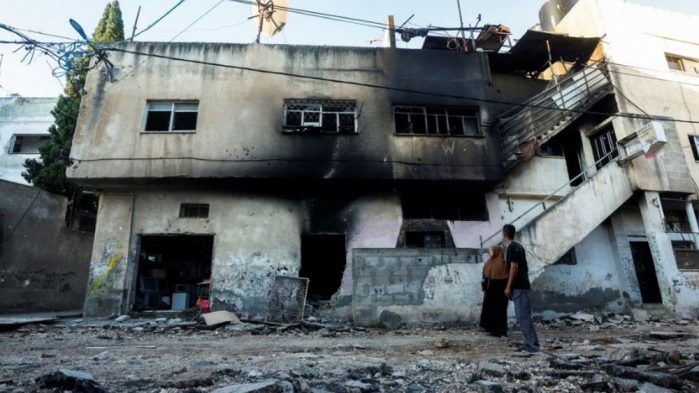
The Israeli military’s deadly raid on the Jenin refugee camp in the northern occupied West Bank fits into the parameters of war crimes under the Geneva Conventions, legal experts argue.
Susan Akram, a clinical professor at Boston University’s School of Law, said the raid, which killed at least 12 Palestinians and wounded dozens more, clearly amounts to a war crime for a number of reasons, including intentionally attacking a civilian population and attacking medical units.
“The Geneva Conventions include as war crimes during occupation, willful killings, willfully causing great suffering to an occupied population and extensive destruction of property not justified by military necessity,” Akram said during a webinar hosted earlier this week by the Arab Center Washington, DC.
There’s no doubt, she declared, that what Israel carried out in Jenin constitutes a war crime.
Daniel Levy of the US/Middle East Project and journalist Dalia Hatuqa, the other panelists on the webinar, also agreed that Israel’s actions in the West Bank amount to a war crime.
Akram said the narrative used by Israel that the raids on Jenin and other Palestinian cities like Nablus are an attempt to root out resistance groups does not stop its actions from being illegal under international law.
Pointing out that the West Bank is an occupied territory, she said, “Israel’s attacks on an occupied population are criminal in and of themselves because occupation law forbids the occupier to use military attacks against civilian targets in the territory it occupies.”
According to the United Nations Relief and Works Agency for Palestine Refugees in the Near East (UNRWA), some 900 Palestinian houses were damaged and many of them became uninhabitable in the wake of the Israeli military’s raid on the Jenin refugee camp.
Adnan Abu Hasna, the spokesman for the UN agency, said on Tuesday that his fellow colleagues are still documenting the damage caused inside the camp during the onslaught.
The UNRWA’s priority is to help restore some sense of normality by resuming its services like education, healthcare and sanitation, he added.
“The other urgent priority is to provide cash assistance to families who were displaced from their homes, and help them pay for rent and rehabilitate their residences,” Abu Hasna noted.
Last week, a group of UN experts said Israel’s military raids targeting the Jenin refugee camp “may prima facie constitute a war crime.”
“Israeli forces’ operations in the occupied West Bank, killing and seriously injuring the occupied population, destroying their homes and infrastructure, and arbitrarily displacing thousands, amount to egregious violations of international law and standards on the use of force and may constitute a war crime,” the experts said in a statement.
The Ukrainian military lost 20% of the equipment it sent to the battlefield during the first two weeks of its counteroffensive, the New York Times reported on Saturday. This high attrition rate was reportedly a key factor in Kiev’s decision to pause the operation.
Beginning in early June, Ukrainian forces launched a series of attacks all along the front line from Kherson to Donetsk. Advancing through minefields and without air support, the Ukrainian military lost 26,000 men and more than 3,000 pieces of military hardware, according to the latest figures from the Russian Ministry of Defense.
Ukrainian losses were at their highest during the initial two weeks of the offensive, the New York Times claimed, citing unnamed American and European officials. These officials said that up to 20% of Ukraine’s tanks and armored vehicles were destroyed in this period, including many Western-provided vehicles.
For some units, Western equipment was lost at an even higher rate, the Times continued, citing figures from a pro-Ukrainian organization. Ukraine’s 47th Mechanized Brigade – a NATO-trained unit – apparently lost 30% of its 99 Bradley Infantry Fighting vehicles in two weeks, while the 33rd Mechanized Brigade lost nearly a third of its 32 German-made Leopard tanks in a single week.
“They all burned,” said one Ukrainian soldier who witnessed at least six Western vehicles destroyed in a single Russian artillery barrage. Another Ukrainian fighter told the Times that his unit’s Bradleys run over anti-tank mines on a daily basis. While the troops inside often survive, the vehicles are left immobilized long before they reach Russian lines.
According to Russian President Vladimir Putin, Russian forces have destroyed a total of 311 Ukrainian tanks since June 4. “At least a third of them, I believe, were Western-made tanks, including Leopards,” Putin told Russia 24 TV on Thursday.
After the first two weeks, Ukrainian commanders decided to pause the counteroffensive, and losses subsequently dropped to 10%, the Times claimed. President Vladimir Zelensky acknowledged the pause this week, but blamed the West for failing to supply him with enough weapons and equipment for a successful operation.
With little territorial gain to show for Kiev’s losses, Western officials have expressed disappointment at the pace of the offensive, according to a steady trickle of media reports since mid-June. Zelensky and some of his top officials still insist that the decisive phase of their counteroffensive has yet to begin.
Meanwhile, Ukraine’s Western backers are running low on ammunition, particularly 155mm artillery shells. US President Joe Biden admitted this week that “we’re low” on these shells, explaining that the shortage compelled him to send controversial cluster munitions in their stead. The US has also stalled on approving the training of Ukrainian pilots on F-16 fighter jets, something that Kiev insists will help restart the faltering counteroffensive.
US Vice President Kamala Harris listed reducing the population as one of the Biden administration’s areas of green investment during a speech in Maryland on Friday. The White House has since claimed she misspoke.
“When we invest in clean energy and electric vehicles and reduce population, more of our children can breathe clean air and drink clean water,” Harris told the audience at Baltimore’s Coppin State University, to rapturous applause.
While Harris did not correct herself on stage, a White House transcript of the speech struck the word “population” and replaced it with “pollution.”
The VP made the odd remark as she revealed the Biden administration had made $20 billion available for “community-based climate projects,” with $12 billion of that earmarked for historically-disadvantaged areas – part of Washington’s efforts to halve greenhouse gas emissions by 2030 and reach net-zero by 2050.
The funding will go to “a national network of nonprofits, community lenders, and other financial institutions to fund tens of thousands of climate and clean energy projects across America,” Harris said. It was set aside for green energy initiatives under the Inflation Reduction Act as part of the Environmental Protection Agency’s Greenhouse Gas Reduction Fund.
Harris’ critics took aim at the alleged gaffe on social media, suggesting she was “saying the quiet part out loud,” while critics of the man-made climate change hypothesis argued cutting population was its true aim.
“Are you the population she wants to reduce?” Rep. Thomas Massie (R-Kentucky) asked his followers.
Commentators including Megyn Kelly and Fox’s Harris Faulkner questioned Harris’ fitness to succeed President Joe Biden after the VP stumbled through multiple public appearances earlier this week.
During a Wednesday panel discussion on AI at the White House, she informed the panelists that the technology was “kind of a fancy thing,” telling the assembled experts, “First of all, it’s two letters. It means artificial intelligence,” before embarking on a rambling attempt to explain machine learning. During a roundtable on transportation for people with disabilities the same day, she observed, “the issue of transportation is fundamentally about just making sure that people have the ability to get where they need to go.” Both comments were widely mocked on social media.
So how many American soldiers fight in Ukraine? The Biden bunch is careful not to reveal or refer to their presence, mercenary or otherwise, but the question keeps coming to mind. It popped up again June 27, when Russia bombed what the Ukraine press called simply a restaurant in Kramatorsk. However, this supposedly innocuous restaurant was part of a hotel complex that apparently attracted lots of western men of fighting age, specifically American soldiers and others from NATO countries. We know this because eyewitnesses heard them speaking American English and saw their U.S. military tattoos (3rd Ranger Battalion) and the American flags on their helmets. Also, American mercenaries were reported dead in twitter accounts. We also know that this missile attack killed 50 Ukrainian officers and two generals and at least 20 of the westerners, including Americans, proving yet again that one American soldier in Ukraine is one too many.
The problem is that we don’t know how many U.S. soldiers – to say nothing of American mercenaries – are in Ukraine. The Russian ministry of defense estimates that there have been over 900 American mercenaries in Ukraine. Meanwhile Washington remains mum, closely guarding its knowledge of this secret for the obvious reason that not doing so might provoke an open confrontation with Moscow. And since they don’t want a nuclear World War III, the white house and pentagon nurture an intense interest in concealing facts about the U.S. military footprint in Ukraine and their possible encouragement of it. Even if large numbers of American NATO officers were killed there, we, back in the so-called homeland, would doubtless be kept in the dark.
The scraps of news we do get indicate that the fighting goes poorly for U.S. troops. “This is my third war I’ve fought in, and this is by far the worst one,” Troy Offenbecker told the Daily Beast July 1. “You’re getting fucking smashed with artillery, tanks. Last week I had a plane drop a bomb next to us, like 300 meters away. It’s horrifying shit.”
The Daily Beast quotes another U.S. soldier, David Bramlette: “The worst day in Afghanistan or Iraq is a great day in Ukraine.” Regarding reconnaissance missions, he said, “if two of them get injured… there’s no helicopter coming to get you… shit can go south really, really frickin’ quickly.” In other words, this is a different enemy, a very competent one, and U.S. soldiers in Ukraine sub rosa could die in large numbers that people back home never hear about.
Take the case of the March missile attack on Lvov. We have no idea if the rumors swirling around this assault, rumors of hundreds of NATO dead, including Americans, were true or not. Insofar as they mentioned this alleged catastrophe at all, U.S. press outlets hastened to impugn these reports’ veracity. So this attack received little to zero western coverage. Savvy observers like Moon of Alabama steered clear of it, presumably because the fog of war was just too thick. However, a regular commentor on that site, Oblomovka Daydream, did post an account on the Moon of Alabama open thread on April 15. It’s worth a look for its elsewhere unreported details. But caveat lector: little is known about Oblomovka Daydream’s track record.
According to this source, back in March Russia launched “Daggers” – Kinzhal missiles – at a NATO command center in the Lvov region. This secret facility, at a depth of one hundred meters, was “a reserve command post of the former Carpathian military district… well protected and equipped with modern communication systems.” NATO generals and colonels chose it. They felt so safe, they dropped their guard: “Sometimes dozens of cars gathered at the entrance to the headquarters even in broad daylight.”
The Dagger was chosen “because such a bunker is invulnerable to conventional missiles.” The Russian assault left no survivors. “And there were more than 200 of them. Including, say some ‘informed’ Western journalists, several American generals and senior officers. And also – British, Polish, Ukrainian.” According to the Greek portal ProNews, which is close to the Greek ministry of defense and was quoted in this post, “dozens of foreign officers were killed” when the Kinzhal hypersonic missiles hit the secret facility. This was “a disaster for NATO forces in Ukraine.”
As aforementioned, western news outlets hastened either not to report one word of this or to cast doubt on these accounts’ credibility. According to Newsweek March 31, claims that a NATO command center had been hit were “baseless.” Newsweek singled out ProNews as “highly questionable,” nonetheless conceding that on the night of March 9 Russia retaliated for sabotage in Bryansk, with Kinzhals, and that one targeted region was Lvov.
So it’s unclear what happened. Oblomovka Daydream cites some convincing details: “Some Kiev sites have also blabbed: after the emergency, representatives of the Ministry of Defense and the General Staff of the Armed Forces of Ukraine were called to the carpet at the U.S. Embassy, where they were reprimanded ‘for the poor security of the control center,’ and at the same time handed a list of the dead senior American officers and ordered ‘to get them at least from the underground.’”
The point is this: dozens of Americans could have been killed and if so, you can be sure, we’d never hear a peep about it. That’s because this is a proxy war and the U.S. supposedly has nothing to do with it. Even though billions of American dollars and lots of U.S. military hardware have disappeared who knows where into Ukraine. Even though Americans fight and die there. And even though no one, outside of their families and government officials, knows who they are.
But never doubt that Americans have been in Ukraine since the start of this war. Reports surfaced on twitter July 9 quoting an Azov commander, Volyn, to Turkish media that the U.S. and Russia arranged the Azov surrender at Azovstal last year in exchange for the withdrawal of several “high-ranking U.S. officers” from the facility. Indeed, there were rumors of Americans at Azovstal at the time. This Turkish interview would appear to confirm them. Far from objecting, many Americans would support this. But then again, many Americans discount the threat of nuclear war with Russia, something no sane person wants to gamble with.
All of which adds up, yet again, to the argument that Washington should retract its claws and try to bargain. Moscow has said it will strike command centers. How long before a large contingent of American NATO “trainers” are killed and can’t be concealed? Then what? Oopsies… we didn’t mean to start World War III? Washington should look for a negotiated settlement. A peace plan, like the one arranged by neutral countries in spring 2022, which western geniuses scuttled. Or Washington could swallow its pride and follow up on the Chinese peace proposal. If there was the slightest concern for human life, bigwigs in the imperial capital would do so. One can only conclude there is not.
By ordering the deployment of 3,000 more reservists to Europe, US President Joe Biden is preparing to fight Russian forces on the ground in Ukraine, Democratic presidential candidate Robert F. Kennedy Jr. has said.
“Biden has lost his way,” Kennedy tweeted on Friday, arguing that the president should focus on America’s domestic problems instead of trying to achieve “global military dominance.”
“I want people to understand what this troop mobilization is about. It’s about preparing for a ground war with Russia,” he said.
The idea of defeating Moscow in its conflict with Kiev is a “futile geopolitical fantasy” of the Biden administration, the Democratic presidential candidate added.
Thousands of Ukrainians have already lost their lives because “America’s foreign policy establishment manipulated their country into war… Now, rather than acknowledge failure, Biden admin prepares to sacrifice American lives too,” Kennedy said.
On Thursday, Biden signed an executive order mobilizing 3,000 members of the US military’s Selected Reserve to boost the ranks of Operation Atlantic Resolve, which Washington launched in Europe in 2014 after Crimea rejoined Russia following the Western-backed coup in Kiev.
According to Army Lieutenant General Douglas Sims, the Joint Staff director of operations, the move “reaffirms the unwavering [US] support and commitment to defend NATO’s eastern flank” in the wake of Russia’s military operation in Ukraine.
The US European Command (EUCOM) spokesman, Navy Captain Bill Speaks, said the deployment of reservists “will not change current force-posture levels in Europe.”
The leading Republican presidential candidate, former President Donald Trump, also had some harsh words to say about Biden’s decision to send more American troops to Europe. The “reckless escalation in Ukraine” pursued by the White House is “straining the US military to the point of disaster,” he said.
“Joe Biden can’t even walk up the steps of Air Force One without tripping. The last thing this incompetent administration should be doing is pushing us further toward World War III.”
Trump reiterated his earlier claim that if he becomes president again, he would end the conflict in Ukraine in 24 hours. “Not one American mother or father wants to send their child to die in Eastern Europe. We must have peace.”
Another Republican presidential candidate, Vivek Ramaswamy, said it is “downright disturbing” that the US media is largely ignoring the president’s order in its reporting. “What is the justification now [for sending reservists to Europe]? What are the operations? Where will they go? What will they do? We need answers, not sweeping this under the rug as Biden would prefer,” Ramaswamy said in a statement.
The US-led West is not interested in peace or in any kind of compromise to put an end to the current conflict in Ukraine. According to University of Chicago political science professor John Mearsheimer, “Western leaders have additional goals, which include regime change in Moscow, putting Putin on trial as a war criminal, and possibly breaking up Russia into smaller states.” Journalist Anchal Vohra, writing for Foreign Policy, tells us that “Western analysts and Russian dissidents” have been publicly calling for the “decolonization of Russia itself”
Take, for example, the Commission on Security and Cooperation in Europe (an independent US. government agency): already in 2022, Vohra reminds us, it published a report called “Decolonizing Russia”, which declared that such decolonizing should be “a moral and strategic objective.”
This extreme stance is not a “reaction” to the escalation of the ongoing conflict (but rather one of its external causes); in fact, such views are nothing new at all. Take, for instance, the late Zbigniew Brzezinski, the influential diplomat and foreign policy expert who served as a national advisor to former US President Jimmy Carter: he openly called for the further fragmentation of Russia (after the collapse of the Soviet state). In his 1997 Foreign Affairspiece, he called for a “loosely confederated Russia – composed of a European Russia, a Siberian Republic and a Far Eastern Republic.” Brzezinski advocated all this while also speaking about “America’s global primacy” – extending all the way over to the Eurasiatic landmass too, of course. According to him, the US should “perpetuate the prevailing geopolitical pluralism on the map of Eurasia”, so as to prevent even “the remote possibility of any one state” seeking to “challenge America’s primacy”. To put it simply, for the American establishment, Russian simply cannot be.
This attitude, distorted as it is, makes some sense, from a certain American perspective, focused on global supremacy and the pursuit and maintenance of unipolarity. This has been shaped by the geopolitical thinking of Sir Halford John Mackinder and his concept of the struggle for the Heartland, and also by US Navy captain Alfred Thayer Mahan (and his 1890 The Atlanticarticle “The United States Looking Outward”). One must also add American exceptionalism to geopolitical thinking – that in turn can be traced back to the Puritan’s biblical metaphor about the “city upon a hill”.
We are talking about a nation that, according to retired Navy captain Jerry Hendrix (formerly an adviser to Pentagon senior officials), engages in land wars, while also seeking naval hegemony. Furthermore, it is actively pursuing a dual containment policy against both Russia and China, simultaneously. When it comes to Great Powers, for the United States, there can only be one.
Under this framework, Washington has consistently refused to acknowledge Moscow’s global role as the Great Power it is. American rhetoric up to early 2022 routinely described Russia as a “paper tiger” and a “declining power”. NATO’s Secretary General Jens Stoltenberg stated on December 16, 2021 that “Russia is a power in decline, meaning the economic importance of Russia, the GDP is not keeping track with many other countries in the world”, albeit, at the same time, adding that “even an economy in decline and a power in economic decline can be a threat and a challenge.” This contradictory view could be seen mirrored in US President Joe Biden’s July 2022 dismissing remarks about Moscow “sitting on top of an economy that has nuclear weapons and oil wells and nothing else.” This denial attitude goes so far as to deny Russia’s role as a regional power even.
Many post-Soviet states have sought to maintain their ties with Moscow, which is exemplified by their ongoing adhesion over the last years to economic and security alliances such as the Collective Security Treaty Organization (CSTO), the Commonwealth of Independent States (CIS), the Shanghai Cooperation Organisation (SCO), and, more recently, the Eurasian Economic Union (EEU). This reflects geoeconomic and geopolitical convergent interests which are a function of both geography and history: Russian civilization has a common history and has for centuries kept economic, political, and religious relations with a number of Slavic and Turkic peoples as well as many other ethnic groups.
In denial of all such basic facts and data, from an American perspective, Moscow is not to have even a “zone of influence” of its own. Moreover, for many influential US policy makers, political scientists, and thinkers (as we’ve seen) Russia should in fact cease to exist altogether as a polity.
Earlier attempts to “cancel” Russia into irrelevance or into virtual “non-existence” should thus be seen as examples of this peculiar mindset. The refusal to realistically and properly assess Moscow’s role and status in the global arena is not merely Western wishful thinking: the American Establishment seems to be unable to think of its own country outside of the context of a unipolar world. The very existence of a Russian state is thus perceived as a threat.
Rather than prolonging a proxy attrition war (which the Europeans themselves are tired of) “to the last Ukrainian”, responsible leaders should engage in good diplomacy and lots of table talks, which are needed more than ever, so as to minimize the risk of a global thermonuclear war (a scenario no one can afford). However, any such dialogue is hampered, among other things, by American exceptionalism.
Safi Ahmad Mohammad Jawabra, 11, was shot by Israeli forces in the head above his left eye with a rubber-coated metal bullet around 10 a.m. on May 29, 2022 at the entrance to Al-Arroub refugee camp, near Hebron in the southern occupied West Bank, according to documentation collected by Defense for Children International – Palestine. Safi was walking home from school after completing his final exam in math when an Israeli soldier shot him in the head unexpectedly and without warning. While running away, another group of Israeli soldiers around 50 meters (164 feet) away fired tear gas canisters in front of Safi.
The Correlation of Armed Forces: U.S. goods and services trade with China totaled an estimated $634.8 billion in 2019. Exports were $163.0 billion; imports were $471.8 billion. The U.S. goods and services trade deficit with China was $308.8 billion in 2019. Trade in services with China (exports and imports) totaled an estimated $76.7 billion in 2019. Services exports were $56.5 billion; services imports were $20.1 billion. The U.S. services trade surplus with China was $36.4 billion in 2019.
There is talk within the Washingtoniat of a possible war with China. Steve Bannon, who apparently was dropped on his head as a child, actually favors such a war. We hear the usual shoo-the-boobs alarm about how the Chinese are doing something terrible and we must gird our loins and American values and show them what for, bow wow, woof. The danger is that the current game of who-blinks-first in Asian waters might actually provoke a shooting war. You know the kind of thing: One warship refuses to get out of the way of another, a collision ensues, some retard lieutenant who signed up on waivers opens fire, and we’re off and running. It is not a good idea to let children play with matches.
The said war is discussed either in emotional terms by idiots or in purely naval terms by those familiar with such things, so we hear of the First Island Chain and the Second Island Chain and whose missiles against the other’s missiles and so on. This would be appropriate if we were fighting World War Two again. Which we aren’t. Let’s take a quick-and-dirty look at how such a war might go.
To begin the war, America would overestimate itself and underestimate China. This is doctrine in the Pentagon. … continue
This site is provided as a research and reference tool. Although we make every reasonable effort to ensure that the information and data provided at this site are useful, accurate, and current, we cannot guarantee that the information and data provided here will be error-free. By using this site, you assume all responsibility for and risk arising from your use of and reliance upon the contents of this site.
This site and the information available through it do not, and are not intended to constitute legal advice. Should you require legal advice, you should consult your own attorney.
Nothing within this site or linked to by this site constitutes investment advice or medical advice.
Materials accessible from or added to this site by third parties, such as comments posted, are strictly the responsibility of the third party who added such materials or made them accessible and we neither endorse nor undertake to control, monitor, edit or assume responsibility for any such third-party material.
The posting of stories, commentaries, reports, documents and links (embedded or otherwise) on this site does not in any way, shape or form, implied or otherwise, necessarily express or suggest endorsement or support of any of such posted material or parts therein.
The word “alleged” is deemed to occur before the word “fraud.” Since the rule of law still applies. To peasants, at least.
Fair Use
This site contains copyrighted material the use of which has not always been specifically authorized by the copyright owner. We are making such material available in our efforts to advance understanding of environmental, political, human rights, economic, democracy, scientific, and social justice issues, etc. We believe this constitutes a ‘fair use’ of any such copyrighted material as provided for in section 107 of the US Copyright Law. In accordance with Title 17 U.S.C. Section 107, the material on this site is distributed without profit to those who have expressed a prior interest in receiving the included information for research and educational purposes. For more info go to: http://www.law.cornell.edu/uscode/17/107.shtml. If you wish to use copyrighted material from this site for purposes of your own that go beyond ‘fair use’, you must obtain permission from the copyright owner.
DMCA Contact
This is information for anyone that wishes to challenge our “fair use” of copyrighted material.
If you are a legal copyright holder or a designated agent for such and you believe that content residing on or accessible through our website infringes a copyright and falls outside the boundaries of “Fair Use”, please send a notice of infringement by contacting atheonews@gmail.com.
We will respond and take necessary action immediately.
If notice is given of an alleged copyright violation we will act expeditiously to remove or disable access to the material(s) in question.
All 3rd party material posted on this website is copyright the respective owners / authors. Aletho News makes no claim of copyright on such material.




 Aletho News