The fantasy explanations for excess deaths as panic sets in
By Guy Hatchard | TCW Defending Freedom | July 25, 2023
The writer is in New Zealand
On Saturday the Daily Express headlined a story ‘Experts call for urgent investigation as excess deaths spark “dangerous” theories’. UK excess deaths in 2023 have risen to levels commensurate with 2020 alpha variant deaths during the height of the pandemic, but the article admits that the 2023 excess is not due to Covid. Most concerning is the death toll in the 15-44 age group which exceeds 2020 and prior years, an age group which was mostly mildly affected by Covid.
As here in New Zealand, where our rates of excess death are measurably higher than the UK, the Westminster government is keeping quiet and looking the other way. Dr Charles Levinson, Medical Director of private GP service Doctorcall, said the ‘silence’ from the government was allowing conspiracy theories to flourish, including from anti-vaxxers, and added: ‘A refusal to openly discuss these statistics is an abdication of responsibility from parts of the scientific community [and the government], leading to an irreversible erosion of trust by parts of society.’ We agree.
So we are not conspiracy theorists when we warn that excess deaths are up, mainstream scientists agree with us, but they don’t want the jabs they pushed on people to be revealed as the cause, or even openly discussed – that could be very embarrassing.
Why aren’t governments investigating? It might be a fair guess that governments are well aware of excess deaths and afraid to investigate, because what limited data they have released suggests clearly that those asking questions about vaccine safety are right about the cause.
Excess deaths appear to be clustered around a range of cardiac events scientifically proven and acknowledged to be related to mRNA vaccines, and cancers suspected to be. The Boston Globe for example headlines ‘Rise in cancer among younger people worries and puzzles doctors’. Indian doctor Feruzi Mehta from Mumbai tweets that heart attack deaths among younger people now make up 15-20 per cent of the total, when it was just 1-2 per cent ten years ago.
Doctors like Mehta speaking up are risking de-registration. Therefore most others, faced by rising incidence of illness and death especially among the young, are remaining silent. However, some diehards are doubling down or even succumbing to the irrational.
Silence is one thing, but the NZ Prime Minister’s office is actively funding a disinformation project dedicated to discrediting anyone who asks questions about vaccine safety, labelling them violent extremists, paedophiles, satanists, anti-Semites, animal torturers, white supremacists, neo-Nazis and anti-transgender. All these wild and incredible accusations are explicitly made during the first 12 minutes of the first episode of a seven-part podcast series produced by RNZ called Undercurrent in which they interview government-funded disinformation experts. (Twelve minutes of this half-baked smear campaign was enough exposure for me to press the pause button.)
The problem with the RNZ podcast so far (aside from its lengthy episodes and unrelenting madness) is that it doesn’t actually discuss vaccine injuries or unprecedented rates of excess deaths (or even mention that there are such things). RNZ began putting the podcast series together more than ten months ago. Since that time it has become apparent that worrying excess death rates have persisted, but RNZ has apparently decided to avoid mentioning the problem. There is a possible reason for this: once you get into inventing causes of excess deaths you really do begin to sound mad.
For example, the NY Times suggests that extreme heat is causing hundreds of extra deaths. Alex Berenson, award-winning former NYT journalist, responds to this kind of reporting with ‘The New York Times has lost its mind. And by mind, I mean principles and understanding of the First Amendment (the right to free speech).’ In which he says the NYT has walked into the government censorship trap, cancelling those voicing concerns including himself.
A quick survey of other suggested causes of record excess deaths suggested by mainstream media ranges from the just possible marginal effect of lockdowns to the implausible alcohol consumption, loneliness, too much exercise, gardening, vacations, climate change and the really far out: ‘there is too much air’. One News in NZ tweeted that people in Mount Maunganui are dying of air pollution in large numbers, along with a picture of its pristine coastline. You can feel the panic setting in, can’t you? Something terrible is happening, but people are very afraid to face up to it.
Pro-vaccine advocate Professor Peter Hotez is recommending staying at home. He is warning against going to see the blockbuster Barbie or Oppenheimer movies at the cinema because you might bring Covid home with you. Incredibly he joins with RNZ in thinking that concern about vaccine safety is a form of anti-Semitism.
It doesn’t take much thought to realise that the underlying concern here is the increasingly noticeable high rate of excess deaths and the lack of any plausible explanation. All this is happening after mass vaccinations with a novel biotechnology drug. How long are we going to go on without acknowledging the elephant in the room or more especially tabulating how many among those dying are vaccinated or unvaccinated?
Just remember the paragraph with which we started this article. Scientists are now warning us that excess deaths are real and very concerning, not imaginary as our politicians and some uninformed medicos and media hacks are still pressing us to accept, against the evidence.
We are facing a real-life emergency. Our EDs and hospitals are overwhelmed. Young people are dying of conditions that used to mainly affect the elderly, but the media, the government, and the medical establishment want the subject to remain taboo. They are funding efforts to marginalise those asking questions, shooting the messenger rather than acknowledging the problem and searching for solutions. Time to wake up from the fantasy.
1,700+ demand retraction of influential COVID-19 origins paper after emails reveal authors doubted their own conclusions
By Suzanne Burdick, Ph.D. | The Defender | July 26, 2023
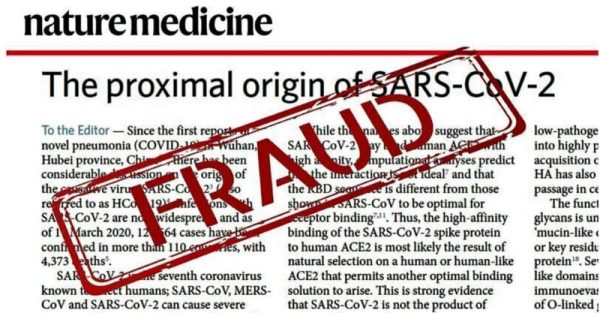
More than 1,700 people have signed a petition calling for the retraction of the seminal scientific correspondence paper, “The proximal origin of SARS-CoV-2,” that claimed COVID-19 was “not a laboratory construct or a purposefully manipulated virus.”
The paper — sometimes referred to as the “Proximal Origins” paper or the “Nature Medicine paper” — was published March 17, 2020, in Nature Medicine journal.
It was used by former National Institute of Allergy and Infectious Diseases Director Anthony Fauci, former National Institutes of Health Director Francis Collins, and other federal public health officials in 2020 and beyond to dismiss the possibility of a lab leak.
Biosafety Now — a nongovernmental organization that “advocates for reducing numbers of high-level biocontainment laboratories and for strengthening biosafety, biosecurity, and biorisk management for research on pathogens” — on July 19 launched the petition, stating, “It is imperative that this clearly fraudulent and clearly damaging paper be removed from the scientific literature.”
Biosafety’s leadership team includes 27 experts in biomedicine, mathematics, public health, public policy, public advocacy, law and social science.
Fraudulent paper ‘played an influential role’ in driving official narrative
Bryce Nickels, Ph.D., co-founder of Biosafety Now and professor of genetics at Rutgers University, said the petition seeks “to expose a clear case of scientific fraud and misconduct that has had a major impact on public opinion and policy.”
Nickels told The Defender :
“The removal of ‘Proximal Origins’ from the scientific literature is the first step in a long process needed to repair the damage this paper has caused to public trust in science.”
According to the petition, “This paper played an influential role — indeed, the central role — in communicating the false narrative that science established that SARS-CoV-2 entered humans through natural spillover, and not through research-related spillover.”
The petition continues:
“Email messages and direct messages via the messaging program Slack among authors of the paper obtained under FOIA [Freedom of Information Act] or by the U.S. Congress and publicly released in full in July 2023 … show, incontrovertibly, that the authors did not believe the conclusions of the paper at the time the paper was written, at the time the paper was submitted for publication, and at the time the paper was published.”
The recently-released internal communications show the paper “was, and is, the product of scientific fraud and scientific misconduct,” the petition said.
Commenting on the petition, investigative journalist Paul Thacker said:
“The thing that’s really the most troubling, which is why it should be retracted … [is] the ghostwriting and the undue influence [of federal public health officials on the drafting of the paper], which we know from the emails by Francis Collins, by Anthony Fauci, and from Jeremy Farrar.”
Thacker — who noted that within only a few days the petition had already garnered more than 1,300 signatures and set the hashtag #RetractProximalOrigins trending on Twitter — told The Defender :
“These guys basically ordered up a piece of science — or some sort of publication — that they could then point to, which they all did afterwards, as definitive proof that this thing could not have come from the lab.
“The whole thing was orchestrated for political purposes. It has nothing to do with science.”
Little more than a ‘political piece of propaganda’
Thacker is a former fellow at the Safra Center for Ethics at Harvard University whose investigative writing has appeared in The New York Times, The BMJ, the Journal of the American Medical Association and The Washington Post.
He explained that weeks prior to the paper’s publication, Kristian Andersen, Ph.D. — one of the co-authors of the “Proximal Origins” paper — emailed Fauci and Collins a draft of the manuscript, thanking them for their “advice and leadership” on the paper.
Andersen also invited Fauci and Collins to comment and offer suggestions about the paper — but neither are mentioned in the acknowledgments section of the final version published by Nature Medicine. According to Thacker:
“Both Collins and Fauci then promoted the Nature Medicine paper as evidence of ‘independent science’ pointing against a possible lab accident — Collins in a post for the NIH Director’s blog that alleged the study left ‘little room’ for argument in favor of a lab accident, and Anthony Fauci in a White House press briefing.
“In both cases, neither Collins nor Fauci disclosed their involvement in orchestrating Andersen’s study. This last March, Congress released further emails showing that Fauci helped to orchestrate the Nature Medicine paper.”
Thacker pointed out that the paper — which “has been called everything from ‘research paper’ to ‘analysis’ to ‘study’” — was “really just correspondence” that was later turned into a “political piece of propaganda that people could then reference, which they did.”
Describing the recent about-face regarding the paper’s importance, Thacker said:
“Now the editor-in-chief of Nature Medicine is saying, ‘Oh, well, it was just a viewpoint … like he’s trying to dismiss what it was when they [federal public officials] used it for completely different purposes. They used it as some definitive piece of scientific research that put to rest any idea this thing could have come from a lab.
“Then we find out internally that none of them who wrote it believed that in the first place. … Quite frankly, from the very beginning, none of the scientific evidence in any direction means anything about how this pandemic started. It’s always been the internal documents and the money that have mattered more.”
Thacker added, “This entire drama and discussion has nothing to do with science. It has everything to do with corruption and a coverup.”
On July 25 Thacker tweeted:
Writers Curtis Schube and Gary Lawkowski in a July 24 op-ed for The Hill pointed out that when the Centers for Disease Control and Prevention responded to the FOIA request to release Fauci’s “explosive” email showing his involvement with the Nature Medicine paper, the agency completely redacted the email.
Moreover, Thacker alleged that Andersen submitted false testimony at the July 11 hearing of the House Select Subcommittee on the Coronavirus Pandemic, which is investigating the origins of the COVID-19 pandemic.
Andersen’s allegation that Fauci and Collins were provided the paper only after it had been “accepted” and was in “proof” is false, Thacker said. “Emails impeach this portion of Andersen’s testimony,” he added.
Thacker also pointed out that The Intercept last week published newly revealed documents showing Andersen and his co-author — Tulane virologist Robert Garry, Ph.D. — both lied to Congress during the House hearing. The alleged lies covered the fact that both had pending federal grants controlled by Fauci — money that could have been used to influence their positions on the lab-leak theory.
Robert F. Kennedy Jr.’s latest book, “The Wuhan Cover-up: How US Health Officials Conspired with the Chinese Military to Hide the Origins of COVID-19,” is due out in September. The book is available now for preorder. Kennedy is the founder and chairman on leave from Children’s Health Defense.
Suzanne Burdick, Ph.D., is a reporter and researcher for The Defender based in Fairfield, Iowa. She holds a Ph.D. in Communication Studies from the University of Texas at Austin (2021), and a master’s degree in communication and leadership from Gonzaga University (2015). Her scholarship has been published in Health Communication. She has taught at various academic institutions in the United States and is fluent in Spanish.
This article was originally published by The Defender — Children’s Health Defense’s News & Views Website under Creative Commons license CC BY-NC-ND 4.0. Please consider subscribing to The Defender or donating to Children’s Health Defense.
There’s No Need to Ban These Vaccines
By David Bell | Brownstone Institute | July 28, 2023
Individual sovereignty means that people can make their own choices, based on their own assessment of risk. It means that others can advise them, but not compel them. It is a basis for modern human rights and natural law.
Public health practitioners like to voice support for these principles, but also really feel good about telling people what to do, based on their expertise and superior knowledge. This is why fascism tends to have a strong healthcare component.
Covid Vaccines are Part of Life
Health bureaucrats have really found their feet during the Covid years, prohibiting children from going to school, families and friends from meeting, and people walking in more than one direction in supermarket aisles or sitting alone on park benches. They banned the use of safe repurposed medicines, claiming they were fit only for animals whilst continuing to use them for other human diseases. Then they mandated injections with novel pharmaceutical products, banning people from working or traveling without them. They have benefitted their sponsors but impoverish the majority with virtual impunity. They rightly feel important, the guardians of society.
But all is not well. While medical fascism has paid well for three years, the public are starting to show signs of lack of trust – perhaps they are sick of being told what is best for them. They may be starting to think they are best placed to assess their own risks and priorities, and act accordingly.
Growing mistrust may stem from a realization that few of the Covid response measures seem to have brought much benefit. They successfully promoted poverty whilst transferring wealth upwards, disproportionately benefiting those promoting the response. They had old people locked up in solitary confinement, so they died alone rather than with family. They declared that those calling for informed consent are a threat to society, and children a threat to adults. Perhaps mistrust is justified.
Now many are proposing a ban on Covid-19 vaccines. They are convinced, on reasonable evidence, that these novel pharmaceuticals probably do net harm overall. They note the unprecedented rate of adverse events associated with the vaccines, from rising mortality to falling birth rates. They worry about mRNA vaccines concentrating in ovaries and adrenal glands, and crossing the placenta to unborn babies, with no long-term data on safety. Many who were standing for freedom of choice regarding ivermectin or hydroxychloroquine are now backing this movement.
Understanding safety and effectiveness of the Covid-19 vaccines is complicated, as the initial randomized clinical trials were damaged by evidence of incompetence and lack of transparency. The manufacturers themselves were unable to show all-cause benefits. Trials for carcinogenicity and genotoxicity, normally mandatory for the genetic therapeutic class to which these substances belong, were also avoided simply by changing the name from genetic therapeutic to ‘vaccine.’ This renaming had required a broadening of the definition of vaccine, as mRNA must co-opt the person’s cellular machinery, like a medicine, in order to eventually stimulate an immune response.
Pharma in general, including these vaccine manufacturers, have appalling histories of fraud. This is shaky ground for trusting a new class of pharmaceuticals, and considerable propaganda and censorship have been required to project a positive image.
However, for better or worse, Covid-19 vaccines do now exist. Lots of people have had them and lots of people, for reasons best known to themselves, continue to request boosters. The vast majority are clearly not dying. People also skydive, go rock climbing and base jumping, risky activities but with generally non-mortal outcomes. While a marketed pharmaceutical is not quite equivalent to a cliff face, both carry inherent risk and theoretical benefits. Anyone partaking of them should be fully aware of the risks and provide informed consent.
The Right to Choose
Truly informed consent is one of the most unpopular ideas in medicine. The idea that the health professional is there merely to inform a patient’s sovereign, independent decision is difficult for a self-entitled profession to accept. Most believe they have a right to limit the public’s freedom when they deem it necessary. While many on both sides of the Covid vaccine debate act with good intent (and sometimes switch sides accordingly), their positions on mandates or bans require that governments use authoritarian approaches to implement public health policy.
As this article will upset well-meaning people, my argument needs further explanation. A belief common to those for and against the Covid response holds that people need to be protected from toxic substances and from malfeasance by doctors or pharmaceutical companies. It assumes that health professionals have a special place in society, shielding the public from areas where they lack knowledge and therefore cannot make sound judgment.
These arguments are reasonable, and in a world where all people live by high standards of integrity and ethics they might represent the safest approach. Unfortunately none of us seem able to infallibly uphold such standards. As 1930s Germany showed, and the Covid response reiterated, the public health establishment is particularly vulnerable to influence and abuse by political or corporate sponsors.
While a penchant for authoritarianism is well-established within medicine, the inclination to ban pharmaceuticals is relatively new. The doctor-patient relationship previously determined use based on context and history, informed (one hoped) by an honest regulatory system. Ivermectin and hydroxychloroquine would have been managed similarly to occasionally deadly penicillin; available at the doctor’s discretion with the patient’s agreement.
Many in the West are getting fat on carbohydrates. However, we don’t ban sugar, but we do encourage the public to eat less, because it’s slowly killing them. We ban smoking where it directly affects others, but don’t ban people from taking risks when alone or among those who consent. Some would like to, but there are always people who wish to ban books, limit free speech, and impose their preferences on others. Decent societies should tolerate them but not indulge them.
Who Should be in Charge?
The primacy of decision-making within the doctor-patient relationship was based on recognition that illness is not just about a virus. It is the result of these within a body with particular genetic makeup, past exposure history, and underlying immune competence. Its severity further depends on the cultural context and value system of the sick person. Lastly but most importantly, it was based on the principle that the patient is a free, independent being, with primary rights over their own body. A doctor could refuse to perform a requested service, but could not force one. Insanity was the only exception. This is fundamental to medical ethics.
Medical practice also traditionally assumed that the doctor has a responsibility to help the patient, or a requirement to cause no harm. This requires expertise and may involve refusal to do all that a patient requests; the doctor is an advisor of the individual and not their subordinate. For this relationship to work, it must be free of conflict of interest and provided with reliable evidence and opinion. Various professional governing boards are supposed to support this process, so these boards and regulators must also be free of conflict of interest.
Public health should be no different – public health practitioners have a role in providing evidence-based guidance to help populations make decisions on health in their own interest. But in the end, the population’s values – cultural and religious – and its weighing of this advice against other priorities it faces, will determine the response. Within this community response, each sovereign individual has a right to decide their participation and actions.
The Nuremberg Code was written to address the harm caused when these principles are abrogated, even if ‘for the greater good.’ Opposing them requires a belief that one person should have rights over another. This may manifest as preventing those considered less desirable from giving birth, destroying an ethnic group considered inferior, studying untreated disease outcomes at Tuskegee, or coercing vaccination as a criteria to earn a living. Like any other group, the health professions simply have no right to impose their will on others. The historic results of ignoring this are obvious.
Market Forces are Preferable to Self-Entitlement
Here we are in 2023 with the Covid vaccines established on the market, amidst allegations of fraud and misrepresentation of data, poor safety and efficacy, and a lack of clear overall benefit. Their target illness is confined in severity to a small segment of the population, nearly all of whom now have good post-infection immunity. The vaccines do not stop or substantially reduce transmission, and may over time increase it.
Mass vaccination in this context is obviously a flawed policy. Mandating a non-transmission blocking vaccine for immune people at minimal intrinsic risk could only be driven by gross ignorance or corporate profit. The use of behavioral psychology to instill fear and the use of coercion are clearly unethical by any modern ethical standard. The many people who have lost their jobs and homes, and were publicly vilified for standing on principle and refusing to submit to such practice, have a clear right to redress. Those who committed fraud should have to answer for it. Those who abandoned the precautionary principle and informed consent should be required to justify their actions and their right to continue to practice.
None of this should remove the right of the public to make their own decisions on accessing these new genetic vaccines as a currently marketed commodity. Where expected harm clearly outweighs benefit, no medical practitioner should offer it, just as it would be inappropriate to offer Thalidomide to a pregnant woman with nausea. Where there are plausible grounds for overall benefit, if should be available as an option. These individuals can decide, based on the information available. While this group of potential beneficiaries appears diminishingly small, it remains conceivable that elderly obese diabetics with no prior Covid infection may benefit. Market forces can then decide whether the product is viable, rather than authoritarian dictates.
In the meantime, the Covid vaccines must pass full regulatory approval as a valid, reasonably safe product. This opens a can of worms, as most were only accepted under emergency use authorization (EUA) and the companies aborted their Phase 3 clinical trials, normally required for approval, by vaccinating the control arms. Valid approval would require submission of data at least confirming overall benefit in people who remain at high risk for Covid. Large trials involving non-immune people would now seem impossible.
A Way Out
To fix the health and societal disaster of the past three years, the public does not need more dictates from the self-appointed medical guardians who caused it. Too many have proven unworthy and incompetent. The problem is deeper than the availability or withdrawal of a vaccine. Public health professionals have forgotten the primacy of individual freedom – of the right of each person to set their own priorities and manage their own bodies. The public are sovereign, not the doctors who wish to lead or mislead them.
With reducing interest in vaccine boosters, it appears the public may solve the vaccine access issue themselves. A free flow of information and genuine informed consent will probably accelerate this. So would a responsible attitude from medical journals and regulatory agencies, if they can emerge from the yoke of their sponsors.
These are problems caused by the public health establishment. This establishment should reform itself, and never again presume it has the right, or the character, to dictate to others. The public will make mistakes, but these will pale beside the mess the health professions have already created.
David Bell, Senior Scholar at Brownstone Institute, is a public health physician and biotech consultant in global health. He is a former medical officer and scientist at the World Health Organization (WHO), Programme Head for malaria and febrile diseases at the Foundation for Innovative New Diagnostics (FIND) in Geneva, Switzerland, and Director of Global Health Technologies at Intellectual Ventures Global Good Fund in Bellevue, WA, USA.
Never investigate what you don’t want to ‘confirm’
This maxim pretty much explains everything in our New Normal
BY BILL RICE, JR. | JULY 27, 2023
(Part 1 of 2)
I quickly formulated a maxim that pretty much explains why all the authorized Covid narratives took hold. This also explains why non-authorized narratives never had a chance.
This maxim is:Never investigate that which you don’t want to “confirm.”
As far as I can tell, this narrative-control tactic works every time.
If officials don’t want any revelations to debunk their preferred narrative, they just don’t investigate it. This way it’s almost impossible for anyone to “confirm” these trusted officials and truth-seeking scientists have been telling whoppers longer than Pinocchio.
FWIW, the intentional creation of bogus narratives satisfies the correct definitions of “disinformation” and “malinformation.”
As journalists are supposed to give examples to support our maxims, I’ve included several examples, a few which reveal my own futile efforts to learn or expose taboo truths.
Solution to protect said False Narrative: Make sure most people don’t know that the average age of a Covid victim is a couple of years over the average life expectancy.
For example, from my research for this article, I learned that in Europe the average age of a Covid victim was around 82.4 (where average life expectancy is about 79.4).
It’s hard to debunk/reject the all-important authorized narrative (“Covid is a threat to everyone”) if hardly any citizen reads that just about the only people dying from Covid were the elderly (almost all of whom had multiple co-morbid health conditions). Given the parameters established by this information template, the false narrative might as well be “confirmed.”
Narrative protection technique: Make sure no journalist ever writes a story that mentions that zero college or pro athletes ever died from Covid.
If officials and journalists did “confirm” the fact that no college or pro athlete has died from Covid, this information wouldn’t exactly promote the official bogus narrative.
Officials and journalists have never “confirmed” that zero athletes have died from Covid … because they never bothered to “investigate” this.
For reporters or researchers, confirming facts entails “investigative” effort. A bonus for journalists employing this narrative-control technique is they don’t have to do any investigative work. This actually makes their jobs much easier. One could even say this feature of their job rewards laziness.
Early in official Covid, I wrote a letter to the editor for al.com, showing that at the University of Alabama in the flu season of 2017-2018 – in just a few few weeks – at least 863 UA students students went to the college infirmary with flu symptoms.
From further research, I showed that at just one college in our state, five times as many college students had been “sick” from a flu outbreak that spanned approximately 40 days than had been “sick from COVID-19 in our entire state … in approximately 200 days.
I knew this because one journalist at al.com wrote a story on September 16, 2020 that provided several nuggets of eye-opening information.
For example, more than six weeks after students returned to Tuscaloosa in the summer of 2020, no UA student had been hospitalized due to Covid.
Per this article, Dr. Ricky Friend, the dean of UA’s College of Community Health Sciences, said: “I can also tell you very few students in quarantine and isolation are experiencing significant symptoms.”
Also from the same article (more about the real source of this info later): “Friend … said one in every four or five students tested on campus is showing symptoms. The rest are asymptomatic.This is very much in line with data and trends we are seeing across the country.”
Re-stated: 75 to 80 percent of college students who were classified as a Covid “case” at Alabama (and around the country) were “asymptomatic,” meaning they weren’t sick at all.
In late summer 2020 at the University of Alabama (after a month of non-stop student testing), exactly zero UA students had been hospitalized from Covid, none had died, “very few” students forced to live “in isolation” were “experiencing any significant symptoms” and, 75 to 80 percent of “positive” students experienced no Covid symptoms.
In other words, the flu of two years earlier had made far more UA students sick than Covid did.
And the 863 “sick” flu students identified in the news report of a Birmingham TV station were just those who went to the UA infirmary. Many sick students might have gone to another healthcare provider, or never gone to the doctor … or these students became sick while they were home on Christmas holidays.
Many thousands of UA students had no doubt become “sick” during this particular flu outbreak.
Which brings me to my main point: Life at the University of Alabama in Tuscaloosa did not stop in January 2018. No classes were cancelled; nobody was ordered to wear a mask; basketball season was not cancelled; Students didn’t have to take on-line courses from their dorm rooms or apartments. Nobody freaked out at all.
I pointed all of this out in a letter I submitted to al.com. In the letter, I reported that “far more UA students were sick a couple of years ago from the flu than have been sick since Alabama’s first “confirmed” case in March.
But, alas, al.com wouldn’t publish my essay.
I did get to argue my case with the the news organization’s op-ed editor (K. A. Turner). Ms. Turner was decent enough to call and talk to me about my piece. I’ll never forget what she told me:
“Bill, we can’t allow you to compare Covid to the flu.”
For a few moments, I was speechless.
Did I hear this news editor right? The leading news organization in our state would “not allow” me to publish a true and important statement, one backed up by quantifiable published data?
What happened to American newspapers?
It didn’t take me long to figure out what’d happened. People like myself – using elementary critical thinking skills – were not going to be “allowed” to debunk any authorized narrative about Covid.
The point I was seeking to “confirm” with good, old-fashioned facts …. would not be allowed.
I still think the dean’s admission that up to 80 percent of “Covid cases” at UA were asymptomatic should have been national news.
At the time, students across the country were returning to campuses after several months of lockdowns. Every college in America was testing students; newspapers were filled with stories about “new cases” and “outbreaks” at colleges.
But one dean obviously messed up and said that no students were hospitalized, very few students had significant symptoms, nobody had died and, indeed, the overwhelming majority of “cases” were as “sick” as I am right now.
That is, the dean blew up an important, albeit false, fear-mongering narrative.
Of course no other news organizations picked up on this accidental revelation, which was a bummer … because I was the person who’d sent several emails to the reporter asking this journalist to ask a UA official this very question.
The journalist was Michael Cassagrande, who normally covers sports for al.com, but expanded his journalist duties during the first months of Covid (probably because there were no sporting events to cover).
I kept emailing Michael a reader suggestion: Ask some UA official how many of these positive cases are asymptomatic.
And damn if he didn’t do it. The info the dean revealed about no student hospitalizations and all the students in isolation being fine was unexpected bonus Covid info.
So we have a lesson here: If you keep bugging a few sports reporters, one of them might ask questions “news” reporters would never ask.
I’m also a journalist (although, at the time, I was a freelance journalist who could never get any of my taboo Covid stories published).
Still, several months later, I asked the director of the University of Alabama’s Media Affairs the same questions Michael asked. I knew UA never stopped testing students so I wanted to know if the “asymptomatic” rate was STILL 80 percent.
However, the director (who used to be a journalism professor) wouldn’t answer my questions.
Nor would she arrange an interview with the dean who’d previously answered Michael’s questions (actually my questions) several months earlier.
I also wanted to know what percentage of athletes at Alabama who were testing positive were asymptomatic. She wouldn’t answer that either.
So I asked the media affairs staffers at the SEC the same question. (Testing of all student-athletes was mandatory for many months, with most athletes having to get a swab pushed up their noses three or four times a week.)
The SEC’s media affairs director said he couldn’t answer that question. He told me maybe I could go straight to the university and get that information. I told him I had: no dice.
I didn’t stop with the SEC. I asked all the media affairs people at all the big Division I conferences (Big-10, Pac-12, ACC, etc.), the same questions:
How many student athletes who tested positive via a PCR test were asymptomatic?
How many athletes have been hospitalized with Covid?
My answers were “we can’t answer those questions” … or no “media affairs” helpers replied to the questions of this media reporter.
Do these conference officials simply not know these answers or did they know the answers and simply didn’t want the public to know?
I don’t know … Oh, who am I kidding? I didn’t fall off a turnip truck yesterday …. I know the answer.
They know the answers … they just don’t want to “confirm” them. Or they know that it’s best to NOT do any investigations that would “confirm” that Covid is and always has been a nothing burger to college students and college athletes.
They know an important part of their jobs is to protect all the authorized narratives, especially the ones that are false.
Elizabeth Warren and Lindsey Graham team up to tackle “cyberbullying,” “physical, emotional, developmental” online harms
By Dan Frieth | Reclaim The Net | July 28, 2023
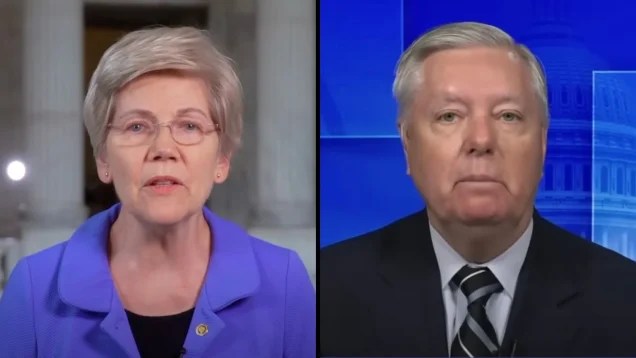
Democratic Senator Elizabeth Warren of Massachusetts and Republican Senator Lindsey Graham of South Carolina have jointly proposed a strategy to rein in Big Tech companies, reignite competition, and curb the spread of what they call “harmful” online content.
“Our legislation would guarantee common-sense safeguards for everyone who uses tech platforms. Families would have the right to protect their children from sexual exploitation, cyberbullying, and deadly drugs. Certain digital platforms have promoted the sexual abuse and exploitation of children, suicidal ideation, and eating disorders or done precious little to combat these evils; our bill would require Big Tech to mitigate such harms and allow families to seek redress if they do not,” the senators wrote in a New York Times opinion piece.
We obtained a copy of the bill for you here.
The senators aim to establish a new federal agency tasked with cracking down on what they call potential harms originating from tech behemoths, such as Amazon, Google, Meta, and beyond, encompassing everything from social media to ecommerce and artificial intelligence.
Warren and Graham’s collaborative venture comes in response to mounting concerns about the overreach of Big Tech, which they argue have shown a pattern of flouting privacy, threatening national security, and exterminating competition.
“For too long, giant tech companies have exploited consumers’ data, invaded Americans’ privacy, threatened our national security, and stomped out competition in our economy,” stated Warren.
The proposed federal watchdog, however, raises concerns about potential censorship and individual free speech infringement. Industry advocates worry that authoritative regulation could enable government manipulation and compromise the essence of an open, unbiased digital ecosystem that advances innovation and public discourse, particularly when the senators refer to “harms” such as “cyberbullying.”
“A covered entity shall mitigate the heightened risks of physical, emotional, developmental, or material harms posed by materials on, or engagement with, any platform owned or controlled by the covered entity,” the bill states.
The proposal, titled the Digital Consumer Protection Commission Act, delineates the power of this new agency to initiate lawsuits against platforms for their potential harms, establish industry regulations, investigate alleged wrongdoings, and enforce compliance. For significant violators, the commission could have the power to revoke operating licenses, marking a move towards directing the course of the digital era.
In addition to these sweeping powers, the legislation would also prescribe outright bans on certain practices. For instance, Google would be restrained from privileging its own applications in search results. The data mining practices of these companies would also be scrutinized, restricting their ability to use personal data for targeted advertising.
Moreover, the proposal addresses the increasing national security anxieties tied to dominant tech platforms like TikTok. The legislation would require such platforms to be based in the United States or be controlled by US citizens and would curb their ability to store data in designated countries.
Senator Elizabeth Warren stated the congruity of this proposed tech-focused commission with the Federal Communications Commission and the Nuclear Regulatory Commission, which specifically regulate different sectors. However, clarity regarding potential collaboration or synergy with existing agencies such as the FTC and the Department of Justice remains to be seen, fostering doubt about potential jurisdictional conflicts.
In their New York Times op-ed, Senator Graham and Warren claimed, “Enough is enough. It’s time to rein in Big Tech.” Despite this, while there is some need to curb Big Tech practices, critics call for caution over measures that could undermine free expression and technological innovation in an era where they seem more intertwined than ever before. Free speech, not censorship should be promoted.
Arms Experts Blast Biden For Not Sending Russia Proposal to Curb Nuke Deployments
By Tyler Durden | Zero Hedge | July 29, 2023
The last nuclear arms control agreement between the United States and Russia continues hanging in the balance. Already key aspects to the New START treaty have been rolled back by both sides, such as mutual inspections of nuclear arsenals, but this week it’s emerged that the White House is withholding an expected proposal that was due to be given to Russia on nuclear limitations.
Arms control experts have denounced President’s Biden’s failure to submit the proposal to Moscow, arguing it puts both superpowers on a further collision course which may eventually have catastrophic nuclear consequences.
According to Reuters, “Russia’s apparent rejection of the plan last week and what several arms control experts say was a White House failure to formally convey it to Moscow have fueled concerns about whether there would be enough time to reach a new pact.”
Daryl Kimball, executive director of the Arms Control Association (ACA) watch group, said “There is no excuse that the administration has delayed for nearly two months the formal communication of this proposal to the Kremlin.”
He explained that these negotiations would be “difficult in good times and extraordinarily difficult so long as Russia’s war on Ukraine continues”—strongly suggesting that New START is slipping away.
As for the Russian side, it has blamed Washington’s “hostile” actions related to the Ukraine war. This as last week, Russian Deputy Foreign Minister Sergey Ryabkov confirmed that Moscow had yet to receive any proposals from the Biden administration on resuming arms control talks.
“I would like to say that we are not ready to and will not conduct this dialogue based on what the Americans are now proposing, as they ignore several key points in this entire configuration,” Ryabkov said.
“We must first and foremost make sure that the US policy, which is fundamentally hostile toward Russia, is changing for the better for us,” he added. “That is far from happening now and, I would rather say that the opposite is going on.”
In March 2021 the two sides renewed New START for a period of five years, and it will expire in February 2026 if it’s not continued – an increasing possibility given US-Russia relations have deteriorated so fast over the Ukraine war they are near complete breaking point.
The treaty is intended to limit and reduce nuclear arms on either side, setting a limit of no more than 1,550 deployed warheads and 700 missiles. START I began in 1991, with New START signed under the Obama and Medvedev administrations in 2010 as a successor agreement. Time is running out at a moment the Ukraine proxy war keeps sliding towards escalation.
US mulling multi-front offensive in Syria in collaboration with Takfiri terrorists
By Robert Inlakesh | Press TV | July 29, 2023
The US military is readying approximately 2,500 service members for deployment in the West Asian region, as its proxy forces in Syria’s northeast and al-Tanf areas seek potential alliances with Takfiri terrorists in the northwestern Idlib province.
With tensions boiling between the Syrian government-aligned forces and the US occupation troops in the war-ravaged Arab country, it might be a sign of more violence on the way, observers believe.
According to a report published in New York local media in mid-July, some 2,500 10th Mountain Division soldiers were being sent “off to combat” in Iraq and Syria.
It is not exactly clear how many soldiers from the light-infantry division will be dispatched for operations in the two West Asian countries.
However, the number of forces being sent rings true with a report from the Turkish newspaper, Yeni Safak, that claimed Washington was preparing to send 2,500 troops to northeast Syria.
The US currently maintains, at least publicly, that it has around 900 active-duty service members deployed to Syria, a number which is speculated to be much higher.
If the US is indeed sending additional forces to the region, it could indicate that its objectives have slightly changed in the northeast of the country.
At this time, the Americans occupy roughly a third of Syrian territory and do so without any congressional approval, through its occupation – which it uses the Kurdish Syrian Democratic Forces (SDF) to maintain – it holds hostage the most fertile agricultural lands and roughly 90 percent of Syria’s natural gas from the Damascus government.
Over the past years, the Syrian Arab Army (SAA) and its allies based in the Deir Ezzor province, have grown tired of continued US troop presence inside their territory.
On March 23, the US Department of Defense (DoD) announced “retaliatory strikes” against targets in Deir Ezzor, following a UAV strike against its forces in al-Hasakah.
“Earlier today, a US contractor was killed and five US service members and one additional US contractor were wounded after a one-way unmanned aerial vehicle struck a maintenance facility on a coalition base near Hasakah in northeast Syria at approximately 1:38 p.m. local time,” stated the announcement.
The US coalition airstrikes triggered an unusually extensive response from the SAA and its allies, which fired back and inflicted six traumatic brain injuries, according to the US reports.
At the time, back in March, a Syrian political source told me that the recent move by Syria and its allies was a “direct response” to a wave of Israeli escalation against the country that began last year.
“If you remember in August of 2022, there was a similar stand-off between the Americans and resistance forces in northeastern Syria,” he said, pleading anonymity.
I was also informed by a second source that an order had been given at the time to directly target Americans and not just fire warning shots. However, no further details were divulged.
In mid-July, the US began fortifying its occupation bases surrounding the Conoco and al-Omar oil and gas fields, with forces belonging to their SDF proxies.
According to an Al-Mayadeen source at the time, Washington informed the SDF and its affiliated militias “to prepare for any attack on the region from the Western banks of the Euphrates River” and the US “tasked the Free Syrian Army to mobilize, to face any attack on the 55-kilometer area in Al-Tanf”.
Reports that surfaced on pro-opposition ‘Syria TV’ indicated that the Idlib province-based terrorist group, Hayat Tahrir al-Sham, had hosted several SDF delegations from northeast Syria over the span of months.
The two parties had allegedly concluded agreements on the transport of fuel from Syria’s north-east to Idlib, which appears to have come after Hayat Tahrir al-Sham began facing mounting pressure from Turkiye in northern Aleppo.
The talks between the dominant Idlib Takfiri terrorist group and the SDF apparently explored the possibility of a joint Hayat Tahrir al-Sham-SDF civilian administration with the SDF reportedly claiming that the US supports the idea of unifying the two militant strongholds.
A source who has intimate knowledge of the current security situation in Syria, and who chose to remain anonymous, told the Press TV website that “these moves are complicating, even if this does not amount to an offensive, the only thing that will change the current scenario is a Turkiye-Syria normalization and a possible anti-SDF operation”.
What is also of interest to these developments is that US-Russia relations inside Syria are also deteriorating, with Washington accusing a Russian fighter jet of damaging a US drone on July 23; allegedly using flares to cause the damage.
The terrorist stronghold of Idlib and the US proxies in both northeastern Syria and al-Tanf are seemingly coming together, at a time when American troops are being deployed to the area amid tensions between their occupying forces and the Syrian government’s military.
A possible way forward, in the event that the US carries out a new offensive strategy against the SAA and its allies in Syria, is through the possible normalization of ties between Ankara and Damascus, according to observers.
Despite there being no breakthrough between Turkiye and Syria, the two states are engaged in a dialogue that is aimed at a restoration of ties between them.
Experts say the reason why this is so crucial to combating any potential American plots against the Syrian government and its allies is that Ankara’s cooperation with Damascus could bring an end to many of the various territorial issues in the country.
Turkiye currently occupies two small pockets in the north of Syria, while it actively threatens an offensive against the Kurdish SDF, which it accuses of being run by the YPG and hence a terrorist threat on its border.
If Turkiye forces an incursion into northeastern Syria, dealing another significant blow to the Kurdish armed groups there, it will also force the US to again abandon its SDF proxies, as happened in 2018 and 2019.
If the US withdraws temporarily, this would provide the perfect opportunity for the SAA and its allies to cross the Euphrates River and liberate their oil fields, which the SDF would not likely be capable of holding by themselves.
This is why, in the event that Washington is implementing a new strategy to further punish Syria and its people, a Turkish military offensive may be the simplest way to quickly put an end to it.
Qatar to provide Ukraine $100mln as war profits soar
The Cradle | July 29, 2023
Qatar will provide Ukraine with $100 million in humanitarian aid, Ukrainian Prime Minister Denys Shmyhal announced on 28 July following the visit of Qatari Prime Minister Sheikh Mohammed Bin Abdulrahman Al-Thani to Kiev.
“This money will be channeled for reconstruction in the health and education sectors, humanitarian de-mining, and other important social and humanitarian projects,” Shmyhal told a briefing.
Sheikh Mohammad also met with Ukrainian President Volodymyr Zelensky to discuss global food security and the expired Black Sea grain deal in his first visit to Ukraine since the start of the war with Russia last year.
“We appreciate this visit and consider it an important manifestation of Qatar’s support and solidarity with our country. We are sincerely grateful for all the assistance received from Qatar,” Zelensky said.
The grain deal, brokered by Turkiye and the UN in July 2022, ensured that Ukrainian grain could still be exported from its southern Black Sea ports, despite the fighting and that Russian grain and fertilizers could still be exported despite western-imposed sanctions.
The deal came amid fears that a disruption in Russian and Ukrainian grain exports would cause price increases in world food markets, leading to humanitarian disasters in poor countries.
Russia withdrew from the agreement on July 17, claiming Ukraine and the UN had not lived up to their end of the deal.
Sheikh Mohammad and Zelensky’s talks also focused on the Ukrainian Peace Formula and the Ukraine Recovery Plan. Zelensky emphasized the opportunities for Qatari investment funds and business circles to participate in Ukrainian reconstruction, according to the Office of the Presidency of Ukraine.
Qatar has benefited significantly from the war in Ukraine. US and EU sanctions cut off Russian natural gas supplies to Europe, causing prices to skyrocket and allowing Qatar to emerge as an important alternative natural gas supplier.
In late November, QatarEnergy and ConocoPhillips signed agreements to export 2 million tons of liquified natural gas yearly to Germany for at least 15 years, starting in 2026.
Europe’s newfound need for Qatari liquefied natural gas comes after Qatar started a $30 billion project to boost its exports by 60 percent by 2027.
Before the start of the Ukraine war, some analysts doubted there would be enough natural gas demand to justify the expansion plan, Bloomberg noted.
US warns allies of potential isolation from deals over links to Iran, Russia
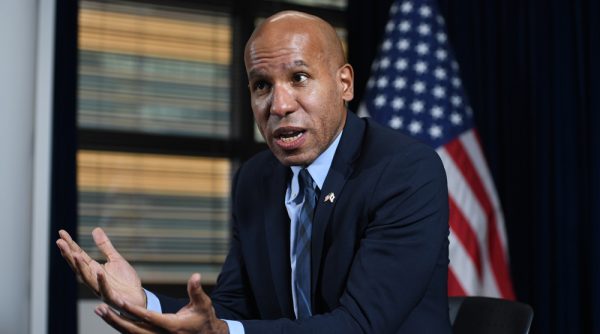
Brian Nelson, U.S. Treasury Undersecretary for Terrorism and Financial Intelligence
Press TV – July 29, 2023
The administration of US President Joe Biden has warned that Washington’s allies will face a “reputation risk” and potential isolation from lucrative deals in case of having links to the Islamic Republic of Iran and Russia.
Brian Nelson, the Treasury’s undersecretary for Terrorism and Financial Intelligence, raised the alarm in a meeting with Kenya’s President William Ruto on Friday.
He claimed that Iran and Russia were “isolated economically.”
“What we see is again of course Iran and Russia are isolated economically and either they are looking for partners and they are looking for new channels to have economic relationships,” Nelson claimed.
“From our perspective, that potentially creates a reputation risk and creates also a financial risk such that we are having a direct conversation about those risks that are associated with the expansion of economic relationship, which is a conversation not only are we having here but with countries around the world and we know that clearly is what Russia and Iran are seeking,” he added.
In what is construed as Washington’s direct interference in its allies’ affairs, Nelson warned them to be wary of the two countries’ economic reputation.
The warning comes as Iranian President Ebrahim Raeisi embarked on an African tour earlier in the month, which took him to Kenya, Uganda and Zimbabwe at the official invitation of his counterparts from the three host countries.
Heading a high-ranking delegation, Raeisi forged new alliances and discussed possible avenues for the improvement of trade and political ties.
Raeisi stressed the need for enhancing relations with African countries, saying that the states are gifted with abundant natural resources and mines, and enjoy many potentials and areas for closer cooperation.
Iranian Foreign Ministry spokesman Nasser Kana’ani described Raeisi’s continental tour as “a new turning point” which could bolster economic and trade ties with African nations.
A total of 21 documents on cooperation in different areas were signed during the three-state tour to Africa.
No better time for Ukraine peace talks than now – Hungarian FM
RT | July 29, 2023
Conditions for negotiations to end the Ukrainian conflict will only worsen, Hungarian Foreign Minister Peter Szijjarto predicted in Budapest on Friday. The two sides, he believes, wouldn’t be in a better position for talks than now.
At present, Moscow is prepared to seek a diplomatic solution to the crisis, according to Russian President Vladimir Putin, while Kiev and its backers, including the US and NATO, are still refusing to enter such talks.
“There will be no better conditions for peace negotiations than the present,” Szijjarto told journalists on Friday following his meeting with the Turkish foreign minister, Hakan Fidan. “Yesterday’s conditions were better than today’s, and tomorrow’s conditions will be worse than today’s,” the Hungarian minister added.
Budapest still believes that “there is no [military] solution” for the conflict, Szijjarto said.
Hungary has emerged as one of the most active advocates of a negotiated solution to the ongoing conflict.
Hungarian officials, including Szijjarto and Prime Minister Viktor Orban, have repeatedly called for a ceasefire and peace deal in Ukraine, and have criticized the EU for sending arms to Kiev. Budapest has also been adamant that anti-Russia sanctions hurt Europe more than they hurt Moscow. In June, Orban told German tabloid Bild that a Ukrainian victory on the battlefield is “impossible.”
This week the prime minister also said that Kiev had virtually “run out of strength” and the only thing keeping Ukraine “alive” was Western financial assistance.
Moscow has repeatedly signaled that it is ready for peace talks with Ukraine. It has also blamed Kiev for the lack of progress in diplomacy, citing a decree signed last year by President Vladimir Zelensky that prohibits talks for as long as Russia’s Putin remains in power.
Last month the Ukrainian leader reiterated his stance, that talks with Moscow could only start after Russian forces withdraw from all Ukrainian territory within its 1991 borders, including Crimea. Russia has rejected such demands as unrealistic.
Speaking at the Russia-Africa summit in St. Petersburg on Friday, Putin said that the ongoing conflict is rooted in threats posed to Russia’s security by NATO. Washington and its allies “reject negotiations on the issues of assuring equal security,” he added.
UK Weighs In on What’s Slowing Ukraine’s Counteroffensive
By Oleg Burunov – Sputnik – 29.07.2023
The UK Defense Ministry admitted in its recent intelligence report that the Russian Ka-52M crews successfully launch LMUR missiles beyond the range of Ukrainian air defense systems.
Russia’s Ka-52M attack helicopters are equipped with a “new and highly effective” long-range missile that poses a serious threat to the Ukrainian Armed Forces (UAF), a US magazine has reported.
The missile is technically known as the Izdeliye (Product) 305 and is also referred to by its Russian acronym LMUR (light multi-purpose guided missile).
The magazine cited the UK Defense Ministry’s recent Intelligence Update as saying that one of the key improvements of the Ka-52M is the integration of the LMUR, a new anti-tank missile, which has a range of approximately 15 km.
“Ka-52 crews have been quick to exploit opportunities to launch these weapons beyond the range of Ukrainian air defenses,” according to the British Defense Ministry intelligence report.
The magazine in turn called the “notably deadly” LMUR a “real escalation in the helicopter capabilities” of the Russian army, recalling that a non-upgraded version of the Ka-52 is typically fitted with laser-guided Vikhr and ATAKA anti-tank guided missiles (ATGM), with ranges of around 10 km and 6 km, respectively.
“The LMUR is in a different league. […] Rather than relying on laser guidance, the LMUR uses a combination of thermal imaging and satellite navigation. In direct-fire mode, the operator locks the thermal seeker on to a target and fires. For longer-range encounters though, the operator can fire the missile from out of sight towards specified coordinates, then use the missile’s thermal imager to find and lock on to the target,” the news outlet added.
In an apparent nod to the Ka-52M being used in the Russian special military operation, the magazine noted that the concept of anti-tank helicopters capable of striking from stand-off distances “seems to be working” in Ukraine.
The media outlet warned that if the UAF fails to tackle “the threat posed by Russian helicopters with the LMURs, the progress of the [Ukrainian] offensive is likely to be slow and bloody.”
This comes after Russian President Vladimir Putin said that all attempts by the UAF to re-launch their counteroffensive have been halted and the enemy has been pushed back, suffering heavy losses.
Putin told the Russia-Africa summit in St. Petersburg earlier this week that during the UAF’s latest attack, more than 200 Ukrainian soldiers were killed and that Russian forces had destroyed at least 26 enemy tanks. He added that 60% of the UAF’s military hardware had already been obliterated during the renewed hostilities.
The Russian president spoke after a US newspaper reported about UAF forces purportedly launching “the main thrust of their counteroffensive” as they threw in “thousands of troops held in reserve, many of them Western-trained and equipped.”
Putin previously told a Russian Security Council meeting that Ukraine’s counteroffensive, which kicked off in early June, had yielded no results and that the UAF had suffered extensive losses, with “tens of thousands” of soldiers killed.
The LMUR was for the first time on display at the International Military and Technical Forum ARMY 2021. The missile is designed to destroy single and group stationary and moving targets at any time of the day and in any weather conditions.
The Product 305 has a high-explosive fragmentation warhead weighing 25 kg and provides high accuracy in hitting targets with a deviation from the aiming line of no more than two meters.
Featured Video
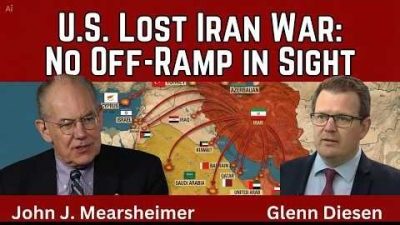
John Mearsheimer: US Already lost Iran war – No off-ramp in sight
or go to
Aletho News Archives – Video-Images
Frlom the Archives
70 Neocons Petition Congress To Effectively Allow Israel To Say When The US Should Attack Iran
By Damian Lataan | January 10, 2014
Seventy senior Israeli-centric neoconservatives have written an open letter to Congress imploring them to do more to ensure Iran complies with the conditions of any agreement finally reached with the P5+1 over Iran’s nuclear program.
While the neocons are ostensibly asking Congress to ensure compliance, it is clear that their real aim is to convince members of Congress to support the bill currently passing through the Senate which calls for tighter sanctions against Iran in the event of any waywardness on Iran’s part.
The neocons are eager to see the bill currently passing through the Senate with enough support to make it veto-proof, not so much because they are concerned about Iran’s so-called nuclear weapons program – there’s still not a skerrick of hard evidence that Iran has a nuclear weapons program – but, rather, because embedded within the bill is this clause:
… if the Government of Israel is compelled to take military action in legitimate self-defense against Iran’s nuclear weapon program, the United States Government should stand with Israel and provide, in accordance with the law of the United States and the constitutional responsibility of Congress to authorize the use of military force, diplomatic, military, and economic support to the Government of Israel in its defense of its territory, people, and existence…
Essentially, the clause is an automatic trigger for the US to attack Iran at any time the Israelis choose to launch a first strike – regardless of whether President Obama is in favour or not.
Partial list… continue
Blog Roll
 Aletho News
- John Mearsheimer: U.S. Already Lost Iran War – No Off-Ramp in Sight
- UK Parliament Plans ISP Blocking and Age Verification Powers
- World cannot remain silent as US and Israel attack ‘heritage of humankind’: Iran
- Emirati billionaire rebukes US senator over call for Gulf states to join war with Iran
- Op. True Promise 4: Iran’s missile blitzkrieg dismantles US war machine in West Asia
- Aramco CEO warns ‘catastrophe’ imminent if Strait of Hormuz remains shut
- What If Iran Says No?
- Trump Threatens to ‘Hit’ Iran ‘Twenty Times Harder’ Over Strait of Hormuz Oil Flows
- Spare the hypocrisy: Baghaei slams Ursula’s support for US
- Iran War Supporters Invent a New and Absurd Justification: It Is All About China
- If Americans Knew
- Israel Decided the War, But Trump’s America Fights and Pays the Bill
- Conscientious Objector Group: Phone ‘Ringing Off Hook’ As Huge Mobilization Underway
- U.S. support for Israel continues to plummet, despite media’s best efforts
- Threats and missiles fly, death tolls soar in Iran, Lebanon, Gaza – Not a ceasefire Day 151
- Lebanon: Israel’s White Phosphorous Use Risks Civilian Harm
- Corporate Media Go All Out To Support The US-Israeli War On Iran
- US-Israel war on Iran is creating a steady growing number of amputees
- Israel planned this war on Iran for 40 years. Everything else is a smoke screen
- The wrong question about the war in Iran
- ‘Your Tax Dollars Being Used to Raise Your Gas Prices’: US-Israel Bomb Major Iranian Oil Depots
- No Tricks Zone
- New Study Documents A 20-Year Pause In Arctic Sea Ice Decline – Driven By Internal Variability
- Wake-up Call: Survey Shows Majority Of Germans Now Favor Postponing Climate Targets!
- Televised! Leading German Political Candidate Tells Schoolchildren CO2 Makes Sun Hotter!
- New Study: A Century Warming Of 1.1°C Is ‘Commonplace’ And ‘Not Unusual’ During This Interglacial
- New Study: ‘Internal Noise’ And Volcanic Forcing Can Trigger 10-15°C Warming Within Decades
- Glaciers Worldwide Are Suddendly Surging, Experts Blame Warming!
- Surprising Discovery: Sahara Is Greening…Billions Of Trees Where Once Thought To Be Barren
- New Research Reaffirms Clouds, Aerosols, And Surface Solar Radiation Are ‘Driving The Climate System’
- Germany: Electric Car Catches Fire At Charging Station, Sets Off Local “Inferno”, Widespread Damage
- New Study: Canada’s New Brunswick Was 1°C Warmer Than Today During The Medieval Warm Period
 Aletho News