RFK Jr. Says Biden DHS Won’t Provide Secret Service Protection
By Tyler Durden | Zero Hedge | July 29, 2023
RFK Jr., whose father was assassinated on the presidential campaign trail in 1968, says the Biden Department of Homeland Security (DHS) has denied his request for Secret Service protection.
“Since the assassination of my father in 1968, candidates for president are provided Secret Service protection. But not me,” Kennedy tweeted.
“Our campaign’s request included a 67-page report from the world’s leading protection firm, detailing unique and well established security and safety risks aside from commonplace death threats.”
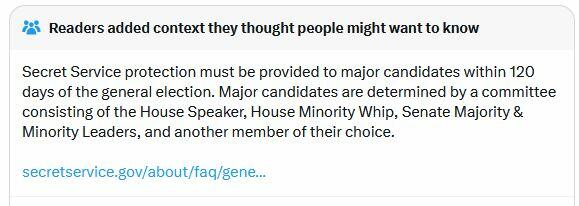
A misleading community note was added to the tweet, which suggests that candidates will only be protected within 120 days of the general election…
The Secret Service’s website suggests the same:
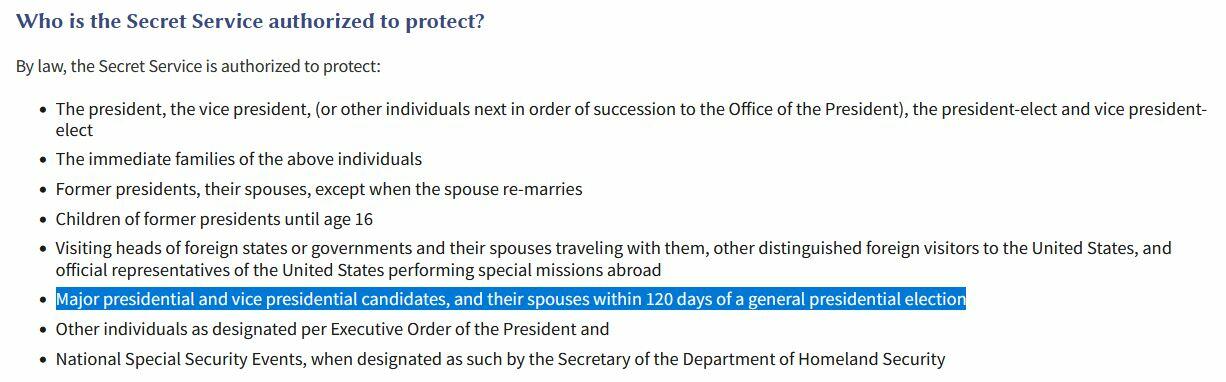
The actual text of the law, however, makes clear that the 120-day guidance is for spouses.
“Major Presidential and Vice Presidential candidates and, within 120 days of the general Presidential election, the spouses of such candidates.“
Punctuation matters.
Meanwhile, an argument for why Kennedy should receive SS protection:
(continued, emphasis ours)
The law authorizes Secret Service protection for major presidential and vice presidential candidates and their spouses within 120 days of the general presidential election. However, the evolution of the protective detail is based upon actual threats and acts of aggression against both the highest public office in the land and those who seek the position.
History shows there is precedent for candidates receiving protection >120 days ahead of the general election.
Donald Trump & Ben Carson were provided Secret Service protection 365 days before Election Day in 2015
Barack Obama was provided Secret Service protection 551 days before Election Day in 2007
RFK Jr is within the time range of the precedent set by the candidates above (465 days from Election Day) and is arguably under even greater threat given the Kennedy family’s tragic history of assassinations.
The Secretary of Homeland Security (DHS Sec. Alejandro Mayorkas) has the discretion and the ability to approve or deny Secret Service coverage to presidential candidates at any point in the campaign.
Given that the Biden Administration began to censor RFK Jr within days of getting into the White House and is continuing that censorship even through last week’s censorship hearing, it is not surprising that a Biden appointee has denied a political opponent’s request for Secret Service protection.
2 Comments »
Leave a comment
Featured Video
Russia, China & Iran Seek to Contain U.S. Military
or go to
Aletho News Archives – Video-Images
From the Archives
Ronald Reagan’s Torture
By Robert Parry | Consortium News | September 8, 2009
The 2004 CIA Inspector General’s report, released in August 2009, referenced as “background” to the Bush-era abuses the spy agency’s “intermittent involvement in the interrogation of individuals whose interests are opposed to those of the United States.” The report noted “a resurgence in interest” in teaching those techniques in the early 1980s “to foster foreign liaison relationships.”
The report said, “because of political sensitivities,” the CIA’s top brass in the 1980s “forbade Agency officers from using the word ‘interrogation” and substituted the phrase “human resources exploitation” [HRE] in training programs for allied intelligence agencies.
The euphemism aside, the reality of these interrogation techniques remained brutal, with the CIA Inspector General conducting a 1984 investigation of alleged “misconduct on the part of two Agency officers who were involved in interrogations and the death of one individual,” the report said (although the details were redacted in the version released to the public).
In 1984, the CIA also was hit with a scandal over what became known as an “assassination manual” prepared by agency personnel for the Nicaraguan Contras, a rebel group sponsored by the Reagan administration with the goal of ousting Nicaragua’s leftist Sandinista government.
Despite those two problems, the questionable training programs apparently continued for another two years. The 2004 IG report states that “in 1986, the Agency ended the HRE training program because of allegations of human rights abuses in Latin America.”
While the report’s references to this earlier era of torture are brief – and the abuses are little-remembered features of Ronald Reagan’s glorified presidency – there have been other glimpses into how Reagan unleashed this earlier “dark side” on the peasants, workers and students of Central America. … continue
Blog Roll
Recent Comments
loongtip on Showdown loongtip on New York Bans Israel-Linked Te… loongtip on Trump tells India to stop purc… eddieb on The Old Testament and the Geno… papasha408 on Trump’s war posturing against… Coronistan on This is How We Should Have Res… Coronistan on NO MANDATES, NO PROFITS: MODER… Lutz Barz on Russia Vows to Protect Its Oil… loongtip on Russia Vows to Protect Its Oil… loongtip on Hamas never agreed to lay down… eddieb on Conspiracy Denial eddieb on WEF Calls for ‘Cultural Revolu…


 Aletho News
- Douglas Macgregor: Russia, China & Iran Seek to Contain U.S. Military
- Judge Strikes Down Hawaii Deepfake Law as Unconstitutional
- Sen. Schumer: I Will Continue to Fight to Give Israel All the Aid It Needs
- Epstein Files- Steve Bannon Admits Trump Administration Would ‘Not Cross Sheldon Adelson’ During First Term
- Israel-Palestine head of HRW resigns over blocked report on Palestinians right of return
- Israel to shut water, electricity at UNRWA facilities in occupied territories
- Germany eyes military space spending splurge to counter ‘threats’ from Russia, China: Report
- Power outages in Russian region after Ukrainian attack – governor
- Ukraine & Europe Can’t Out Wait Russia /Alexander Mercouris & Lt Col Daniel Davis
- IRGC drone completes lawful recon mission before contact lost
- If Americans Knew
- U.S. Envoys Refused to Report “Apocalyptic” Conditions in Gaza. Exclusive Photos Show the Reality They Suppressed
- Israel tells Gazans, “smoking is hazardous to your health” – Not a ceasefire Day 117
- The Truth About Gaza’s Dead – Part 1: How We Got Here
- They were forced to hand one son over to the Israeli army in return for another. Eight months later he was dead in prison
- Exclusive: New owner of CBS coordinated with former Israeli military chief to counter the country’s critics, according to leaked emails
- AIPAC Gears Up for Midterm Election Cycle With $95 Million War Chest
- Official US gov’t reports contradict Mike Waltz’s rants against UNRWA
- Israel lets just 5 patients out of 20,000 exit Gaza – Not a ceasefire Day 116
- Trump Again Bypasses U.S. Congress to Push $6 Billion in Arms Sales to Israel
- One side emerged from a tunnel; the other side killed 31. Both must “exercise restraint” – Not a ceasefire Day 115
- No Tricks Zone
- Climate Scientist Who Predicted End Of “Heavy Frost And Snow” Now Refuses Media Inquiries
- Polar Bear Numbers Rising And Health Improving In Areas With The Most Rapid Sea Ice Decline
- One Reason Only For Germany’s Heating Gas Crisis: Its Hardcore-Dumbass Energy Policy
- 130 Years Later: The CO2 Greenhouse Effect Is Still Only An Imaginary-World Thought Experiment
- New Study Affirms Rising CO2’s Greening Impact Across India – A Region With No Net Warming In 75 Years
- Germany’s Natural Gas Crisis Escalates … One Storage Site Near Empty …Government Silent
- Polar Colding…Antarctica Saw Its Coldest October In 44 Years!
- New Study: Sea Levels Rose 20 Times The Modern Rate During The Roman Warm Period
- As German Gas Storage Dips Dangerously Low…Shortage Hardly Avoidable
- New Study: Brazil’s Relative Sea Level Was 2+ Meters Higher And SSTs 3-4°C Warmer 6000 Years Ago
 Aletho News
IS HE SERIOUS?
His father didn’t want the Secret Service minding JFK and wanted to provide his own security for JFK.
As agent John Norris explained in Bill Sloan’s book J.F.K.: Breaking the Silence and in an interview for Vincent Michael Palamara’s book Survivor’s Guilt: The Secret Service and the Failure to Protect President Kennedy:
“Except for George Hickey and Clint Hill, [many of the others] just basically sat there with their thumbs up their butts while the president was gunned down in front of them.”
Back in Washington, other Secret Service members were disturbed by the partying in the White House detail. Abraham Bolden, one of the only African American agents in Kennedy’s detail, had experienced plenty of racism in the service and says in his 2008 book, The Echo from Dealey Plaza, that he was later framed and sent to prison as retribution for speaking out about the lax behavior tolerated within the department. That November day, Bolden was one of the agents who could hardly believe what he was seeing. Standing in the Secret Service office in Chicago just after the president was shot, he wrote that he heard a fellow agent cry out, “I knew it would happen. I told those playboys that someone was going to get the president killed if they kept acting like they did. Now it’s happened.”
Today, Bolden, a 79-year-old retiree in Chicago, thinks that drinking definitely had something to do with the “lackadaisical” Secret Service performance when the Kennedy motorcade was under attack. “The biggest problem I ran into with the Secret Service when I was an agent was their constant drinking,” he told me. “When we would get to a place one of the first things they would do was stock up with liquor. They would drink and then we would go to work.” On November 22, Bolden says, “their reflexes were definitely affected by, number one, the loss of sleep and, number two, the fact that [some may have] consumed that amount of alcohol.”
Long work shifts and a tolerance for partying, drinking, and sometimes showing up for work with a hangover had become entrenched during J.F.K.’s years in office. Of those in the president’s security contingent on November 22, several were certainly sleep deprived, a not uncommon state among Secret Service members at the time. Agent Gerald Blaine recalls in his book The Kennedy Detail how he struggled to stay awake on numerous occasions and spoke of being afraid to sit down or lean against a wall lest he nod off: “Working double shifts had become so common since Kennedy became president that it was now almost routine. The three eight-hour shift rotation operated normally when the president was in the White House, but when he was traveling . . . there simply weren’t enough bodies.” Not only did many agents lack sleep, they rarely had time to eat. In his flight bag, along with extra ammunition and shoe polish, Blaine typically kept a few bags of peanuts—at times the only thing he ate all day.
Overworked and undermanned, the agency, under President Kennedy, had begun to skirt the department’s strictures. He was a risk-taker and a womanizer, who set a bad example. “Agents acknowledged that the Secret Service’s socializing intensified each year of the Kennedy administration, to a point where, by late 1963, a few members of the presidential detail were regularly remaining in bars until the early morning hours,” investigative journalist Seymour M. Hersh would note in his book The Dark Side of Camelot.
Hersh reported that things were so loose that at least three of the Kennedy women—sisters and cousins from the president’s large family—were said to have propositioned various agents. Arguably, all of this rule-breaking within the Kennedy sphere should have made the Secret Service more alert and more responsible. Instead, it may have had the opposite effect—although then–Secret Service Chief James Rowley would later testify that none of his men were impaired when they reported to work that morning.
LikeLike
Interesting to expose this issue of SS protection. JFK and RFK were both ‘protected’, so this request may be to expose the squirming Biden regime’s stance.
LikeLike