Americans urged to ‘immediately’ leave Belarus
RT | August 21, 2023
Any US citizens in Belarus should leave right away, the State Department said in a bulletin on Monday, citing new closures of border crossings by Lithuania and the possibility of more to come.
“The Lithuanian government on August 18 closed two border crossings with Belarus at Tverecius/Vidzy and Sumskas/Losha,” the department said. “The Polish, Lithuanian, and Latvian governments have stated that further closures of border crossings with Belarus are possible.”
“US citizens in Belarus should depart immediately,” the bulletin added.
Americans were urged to travel by land using the “remaining border crossings with Lithuania and Latvia,” because Poland has closed the border, or by plane, though not to Russia or Ukraine.
The Ukraine-Belarus border has likewise been closed. Meanwhile, most Western airlines have halted flights to Minsk and Western nations have closed their airspace to Belarusian and Russian flights, so it was unclear how Americans might fly out without passing through Russia.
Washington has urged its citizens not to travel to Belarus for years, first citing the Covid-19 pandemic, then the 2020 unrest following the presidential election – which the US claims to have been rigged or stolen – and since February 2022, Minsk’s support for Moscow’s military operation against Kiev.
According to the State Department, Belarus is also dangerous due to “the arbitrary enforcement of local laws, the potential of civil unrest, the risk of detention,” and the inability of the US to assist its citizens, since the embassy in Minsk “suspended operations” at the end of February 2022 .
The Polish government has increased its military presence along the border with Belarus over the past month, citing what they called a threat of “hybrid warfare” by Wagner Group fighters who left Russia at the end of July, following a failed mutiny.
Minsk has repeatedly insisted that there is no threat and that Warsaw is getting hysterical due to domestic politics ahead of the general election. Meanwhile, Moscow has warned that any attack on Belarus would be treated as an attack on Russia itself.
US offloads oil from seized Iranian tanker despite Tehran’s warnings
The Cradle | August 20, 2023
An oil tanker seized by the US Navy for allegedly carrying sanctioned Iranian oil began transferring its cargo to another tanker off the coast of Texas on 20 August, despite threats from Tehran to target shipping in the Persian Gulf in response.
Ship-tracking data analyzed by The Associated Press showed the Marshall Islands-flagged Suez Rajan began the ship-to-ship transfer of its oil to the MR Euphrates, a tanker located some 70 kilometers southeast of Houston in the Gulf of Mexico. The value of the oil on the 800,000-barrel tanker is estimated to be $56 million.
Washington illegally seized the Marshall Islands-flagged Suez Rajan supertanker in April of this year in what was described by the Pentagon as “a sanctions-enforcement operation.” Washington also charged the ship’s owner with “sanctions evasion” and directed the stolen cargo to the waters off the Texas coast.
According to the Wall Street Journal, the Suez Rajan came under Washington’s radar after an anti-Iran organization – the New York-based United Against Nuclear Iran (UANI) – provided information about the ship’s cargo to government officials. Lawyers representing the families of victims of the 11 September attacks, “whom US courts have given the right to claim compensation from [Tehran],” filed a lawsuit against one of the ship’s former owners.
However, oil firms in the US had been reluctant to unload the shipment of stolen Iranian oil sitting, saying they were “too worried about Iranian reprisal” to touch the cargo, sources familiar with the matter told the WSJ.
“Companies with any exposure whatsoever in the Persian Gulf are literally afraid to do it,” a Houston-based energy executive told the US outlet, adding that companies fear “the Iranians would take retribution against them.”
“I don’t know if anybody’s going to touch it,” another executive at a shipping company had said.
The transfer of the Iranian oil comes as the US Navy has bolstered its forces in the Persian Gulf in recent weeks, including by sending the troop-and-aircraft-carrying USS Bataan through the Strait of Hormuz. Washington is also considering placing US troops on commercial vessels to prevent Tehran from seizing them in response to Washington’s own seizures of Iranian ships.
US theft of Iranian oil from the Suez Rajan also comes as Tehran and Washington seek to complete a prisoner exchange that also involves the US releasing between $6 and $10 billion in seized Iranian oil proceeds held in banks in South Korea and Europe.
Iran has been resisting US sanctions by continuing to sell its oil abroad, while the US has been seizing cargoes since 2019 after withdrawing from the nuclear deal negotiated between the two rival countries. The 2015 nuclear deal held that Iran would limit the enrichment of uranium for its nuclear program in exchange for sanctions relief. The US withdrew from the deal unilaterally in 2018. Washington accuses Iran of seeking to develop nuclear weapons, however, Iranian leaders have stated the nuclear program is for peaceful purposes and that developing nuclear weapons is forbidden by Islam.
China Ready to Stand Against Foreign Interference Together With Iran
Sputnik -21.08.2023
BEIJING – China is ready to work with Iran to jointly resist outside interference and protect the interests of Beijing and Tehran, Chinese Foreign Minister Wang Yi said on Monday.
“China is willing to work with Iran to continue to firmly support each other on issues related to the core interests of each side, jointly resist external interference and counter unilateral harassment, protect the sovereignty, security and development interests of China and Iran, uphold the common interests of developing countries and international impartiality and justice,” Wang said in a telephone conversation with his Iranian counterpart, Hossein Amirabdollahian.
The parties also discussed issues of common interest, including cooperation within the BRICS framework.
US not in a position to send more missiles to Ukraine – media
By Lucas Leiroz | August 21, 2023
Western criticism of the Ukrainian “counteroffensive” is increasing. In response to Kiev’s unlimited demand for arms, Western media claim that the US is not in a position to send more heavy weapons to the regime. According to a major western outlet, Washington does not produce enough tactical ballistic missiles to send the number that would be needed to guarantee the Ukrainian counterattack’s victory.
In a recent article for the Financial Times called “US grows doubtful Ukraine counteroffensive can quickly succeed”, Western experts reported that the US does not manufacture enough tactical ballistic missiles to make a difference on the battlefield. The “necessity” to send weapons to Ukraine coexists with the need for internal supply for the arsenal of the American armed forces, with no possibility of accelerating production significantly in the short term.
In addition, the newspaper’s informants allege that Washington is currently “holding back” as many missiles as possible, as Americans are concerned about the possibility of escalation in the conflict. Kiev’s officials blamed the failure of the counteroffensive on the supposed “slowness” in the supply of weapons, mainly high-range missiles capable of reaching the undisputed territory of the Russian Federation. Many American experts, however, seem to disagree with this analysis.
Samuel Charap, a senior political scientist at the US think tank Rand Corporation, told Financial Times’s journalists that ballistic missiles are capable of causing damage to Russian logistics, but assessed that this is not the main problem to be solved by Ukrainians to achieve victory. According to him, there are no “magic wands” able to make the counteroffensive become successful, thus echoing the growing Western pessimism with the Ukrainian military moves.
“I don’t think that you’ll hear an argument from anyone that this [Ukraine’s counteroffensive] is going well right now or that this is heading to a place that people would view as good, but there is not much by way of plan B (…) There’s no magic wands,” Charap said. “It’s hard to make the case that long-range strike [missiles] can fix the problem of minefields or all these defences (…) It will complicate Russian logistics but that’s not the main or the only problem the Ukrainians are facing today”, Charap said.
In fact, this assessment exposes growing dissatisfaction on the part of the West with Ukraine’s progress in the conflict. The strategy used by the Ukrainians – certainly instructed by NATO agents – failed on the battlefield and Kiev quickly lost massive amounts of soldiers and equipment. The Ukrainian defeat was so evident that it was not even possible for the western media to continue doing its propaganda work, which meant that more critical and pessimistic opinions began to be exposed by the newspapers.
For its part, Kiev responds to the criticism by demanding even more weapons. It became commonplace among the regime’s officials and Western warmongers to blame a supposed “failure” in NATO’s aid for the fiasco of the counteroffensive. It is said that the more lethal and long-range weapons Ukraine receives the faster it will achieve victory against Russian forces. But, in practice, this has not been seen so far.
The West sent heavy – and even illegal – weapons to its proxy regime as much as it could. Packages including banned cluster bombs, radioactive depleted uranium ammunition and British long-range missiles arrived in Kiev and were used on the battlefield, not to seek any military victory, but to murder civilians and bomb undisputed demilitarized zones, making “counteroffensive” a mere wave of terrorist attacks.
Apparently, American experts understood that the more lethal weapons they send to Ukraine, the greater the risks of escalation and, consequently, the greater the regime’s losses will be. In this sense, in the Financial Times article, it is also said that until next year, military aid to Kiev is expected to decrease, at least in terms of quality – lethality of the weapons. There is a concern to avoid greater losses in an eventual scenario of escalation by Russia – which is aggravated by the upcoming presidential elections and the inability of the American defense industry to produce arms in even larger quantities.
“Even if Congress authorizes the latest package of Ukraine funding requested by the White House, some US officials and analysts say it is unlikely that Washington will be able to offer the same level of lethal assistance to Ukraine next year, given the looming presidential election and munitions manufacturers’ longer-term schedule to increase production”, the article reads.
This scenario of American disappointment with Ukraine must be analyzed from a realistic point of view. Washington does not want the war to end. On the contrary, it wants to prolong the hostilities in order to generate friction with Russia for as long as possible. And this is precisely why the country is avoiding increasing the deployment of long-range weapons, as it fears that Russian responses to Ukrainian provocations could be strong enough to end the conflict quickly.
For the US and NATO, what matters is to keep Russia fighting on multiple flanks as the alliance prepares for a direct military conflict with China. With no hope of defeating Russia on the battlefield, the US just wants to keep Moscow fighting in various proxy conflicts. Therefore, it is in Washington’s interest to prolong the war in Ukraine as well as to generate provocations in other regions where Russia could be militarily involved.
German general admits heavy personnel losses of Ukrainian army
By Ahmed Adel | August 21, 2023
The Armed Forces of Ukraine have lost many commanders, said German Army Lieutenant General Andreas Marlow to Reuters agency. This suggests that Germany’s training of Ukrainian troops makes no difference on the battlefield as these newly trained recruits do not reinforce an experienced leadership. This comes as the popularity of the German government collapses amid a growing economic crisis.
“The training of sergeants and officers is what moves the Ukrainians most because the professional soldiers have been fighting this war for one and a half years now, and many have died or been wounded – so they need a fresh supply of military leaders,” said Marlow to journalists.
The press meeting was held at the Klietz training camp in Germany, where foreign instructors trained the Ukrainian military. The site is used to train Ukrainian service members to operate German Leopard 1 and Leopard 2 tanks, as well as IRIS-T air defence systems. However, as has already been proven, these short training missions make no difference to Ukraine’s war effort as the undertrained soldiers are only fed to the Russian meatgrinder.
Marlow’s revelation that most of Ukraine’s professional soldiers are either exhausted, wounded or dead comes as Gunnar Beck, a member of the Alternative for Germany (AfD) party in the European Parliament, blasted his country’s policy on Ukraine.
Olaf Scholz’s government members, including Finance Minister Christian Lindner, recently expressed support for sending long-range Taurus KEPD 350 cruise missiles to Ukraine. The German finance minister said a decision would be made “faster, in a shorter timeframe” than in the past. Berlin is pushing ahead with this despite most Germans opposing the step.
A new poll revealed that while 36% favour supplying new military aid, 52% are against it. Support fell to just 21% among residents of eastern Germany.
According to Russian sources, Germany has sent more than 260 Leopard 1 and Leopard 2 tanks, including from its arsenals and other European NATO allies, as well as Gepard self-propelled anti-aircraft guns, MARS rocket artillery systems, Panzerhaubitze 2000 self-propelled howitzers, Marder infantry combat, Bergepanzer armoured recovery vehicles, Panzerfaust rocket-propelled grenades, and many other weapons, support equipment, ammunition, and supplies. These weapons are worth about €7.5 billion, all handed to Ukraine over the past year and a half, the second-highest amount after the US.
Although the US and other NATO countries promised that the weapons would not be used against Russian territory, the Ukrainian military used supplied military equipment, including artillery, missiles, and drones, to attack Russian cities and towns. Germans who do not want to be embroiled in the war are especially afraid that Ukraine will use the Taurus cruise missile, a €950,000 481kg warhead with an operational range of over 500km, against Russia. Ordinary Germans fear what a Russian response could be.
Berlin would obviously want to prevent Ukraine from using the missiles against Russian territory, but this is wishful thinking. In practice, Germany cannot do anything to prevent Ukraine from using the missiles, which is why the move is so unpopular.
Recently, support for the right-wing AfD, which has been the most critical of Berlin’s anti-Russia policies, has increased, with recent polls indicating the party would get up to 21% of the vote if elections were held today, the same level as Scholz’s Social Democrats. Despite relentless anti-Russian propaganda in the German media, many Germans have lost faith in the Scholz coalition, mainly due to the declining economic situation spurred on by anti-Russia sanctions.
According to the new Insa survey for Bild, 64% of those surveyed found that a change of government would be better for Germany. The survey found that just as many respondents (64%) are dissatisfied with the work of the current federal cabinet. Only 27% are satisfied. There are even more dissatisfied and less satisfied when it comes to Scholz. 70% are dissatisfied with his work, and only 22% are satisfied.
The German economy for two quarters in a row declined, a “technical recession,” as described by economists. Germany’s GDP stagnated at the previous quarter’s level in the last recent quarter, and there is evidently a decline. The IMF predicted in its July estimates that most of the world’s major economies will see growth, except for Germany, which is expected to contract by 0.3% this year. In fact, the financial institution forecasted Germany to do worse than in the last report from April 2023.
Germany is no longer the European economic powerhouse it once was, primarily due to self-sabotaging anti-Russia sanctions, making the country import energy at an inflated price and cut off from Russian markets and businesses. More disturbing is that Germany insists on maintaining the sanctions and continues to train mostly ordinary Ukrainian men knowing they cannot overturn Russian forces.
Ahmed Adel is a Cairo-based geopolitics and political economy researcher.
SAN FRANCISCO’S GREEN BUILDING NIGHTMARE
By Randy Shaw | BeyondChron | March 3, 2008
 The idea of “green” buildings is a terrific marketing concept. In San Francisco, it has helped grease the political roadway for massive, view-blocking luxury condominiums, implying that building these structures is more environmentally sustaining than leaving land vacant. Few seem to care whether green buildings can be a nightmare for those having to work inside high-rise structures lacking heat or air conditioning. The new Thomas Mayne designed Federal Building at 7th and Mission Streets in San Francisco is a case in point.
Lauded by the New York Times as a building that “may one day be remembered as the crowning achievement of the General Services Administration’s Design Excellence program,” what some believe is the greenest federal building in the nation’s history also likely has the worst work environment. While architects describe the building’s “sense of airiness” as “magical,” employees view working in this heat and air-conditioning free building with the wavy concrete floors and ceilings as a nightmare.
Green but Cold
Thomas Mayne’s new George H.W. Bush Federal Building now looms over midtown San Francisco. While people have sharply divergent reactions to its unique exterior design — I happen to like it — the verdict on the structure’s function as a office space for federal employees is nearly unanimous: it is a disaster.
Not that architectural critics care. Bedazzled by unusual design features and its focus on energy conservation, reviews of Mayne’s latest work seem to ignore whether it fulfills its functional role as a federal office building.
Based on what I have been told, it clearly does not.
The first fact about the building that may cause surprise is its lack of air conditioning or heat. According to Mayne, “a bike rack and air conditioning get you the same point. I’d much rather see BTU and CO2 requirements and let the professional community solve the problem.”
I apparently lack sufficient understanding of green technology, as it does not seem that a bike rack would “get you to the same point” in terms of keeping workers cool. In the real world on the 15th floor of the Federal Building, workers seek to relieve the heat by opening windows, which not only sends papers flying, but, depending on their proximity to the opening, makes creating a stable temperature for all workers near impossible.
When I spoke with a Labor Department worker at the building (who noted that she is encountering the type of bad work conditions that her agency is supposed to enforce against), she confirmed what might have been an urban legend: that some employees must use umbrellas to keep the sun out of their cubicles.
The lack of internal climate controls has left some workers too cold and others too hot. A happy medium has proved elusive. And while the managers’ offices do have heat and air conditioning — a two-tiered approach fitting in a building named for Bush — the “green” design apparently has messed with the effectiveness of these systems, leaving these top staff as physically uncomfortable as the line workers.
Dysfunctional Elevators
According to my source, architect Mayne has stated that federal office workers do not get enough exercise. To address this, he installed elevators in the building that only stop at every third floor. This requires employees to walk up or down one or two flights of metal stairs.
Persons with physical disabilities who cannot use stairs can use a separate elevator that stops at every floor. The foreseeable result is that employees seeking to avoid stairs use the disabled access elevator, leaving this car crammed with people and making the ride to the top extremely slow.
I am told that when the freight elevator is out of service, deliveries must use the disabled access elevator. It seems only a matter of time until a disabled worker sues the General Services Administration for providing inadequate disabled elevator access in the building.
Missing Cafeteria
Mayne’s desire to get workers walking may have impacted his decision to locate the employee cafeteria across the street from the building. Employees are not happy about having to leave the building just to get a sandwich, and were allegedly told that the building would include an on-site café.
But as is clear with every aspect of this testament to green buildings, this project was more a science experiment than a place designed to enhance worker productivity.
No LEED Approval
Green building advocates will no doubt argue that the Federal Building is a bad example, as it failed to secure LEED approval. According to its website, The Leadership in Energy and Environmental Design (LEED) Green Building Rating System™ encourages and accelerates global adoption of sustainable green building and development practices through the creation and implementation of universally understood and accepted tools and performance criteria.
Mayne noted that “I wasn’t arrogant, but I was confident — I just assumed we had the platinum rating. All of a sudden we went through LEED and it wasn’t working.”
But the project’s failure to satisfy LEED’s scoring system is not the problem. Rather, it is that the federal government spent millions over budget to create a building that does not provide a minimally satisfactory work environment.
And the project’s huge cost overruns and functional inadequacies have apparently been ignored solely due to excitement over its “Green” stature.
Battle for Climate Earth
ClimateCraze | July 5, 2021
There is no climate crisis — just climate alarmism.

Eris vaccine marketing hits Germany, complete with panic about a nonexistent August “Covid wave”
eugyppius: a plague chronicle | August 20, 2023
We will not be free of the virus until we are free of the vaccinators.
The leftist taz newspaper on 17 August: New German Wave: The new Covid variant Eris has arrived in Germany. Concerns about a new wave are growing – but the country is not well prepared.
The pandemic is over, but the virus is still dangerous: Reports of the new variant EG.5.1. seem to confirm this analysis. EG.5.1. (Eris) has been considered a “variant of interest” since 9 August. According to the WHO, the phenotype does not differ fundamentally from other Omicron lineages and does not require special public health measures …
With the announced end of the pandemic, virtually all mandated protective measures have been lifted in Germany. The most important instrument in the fight against Covid-19 is thus the immunisation of the population through infection or vaccination.
Das Erste, state media, on 19 August: Covid Variant “Eris”: How Dangerous is the New Mutation EG.5?
The World Health Organisation WHO has upgraded the new Covid mutationEG.5. This variant, called “Eris,” now belongs to the “variants of interest.” …
As WHO Covid expert Maria Van Kerkhove explained in Geneva on Wednesday, more severe outcomes have not been observed with Eris, but vaccination confers less protection than with other virus variants. …
Even though the new variant is unlikely to cause severe disease, the [German vaccine regulatory authority] STIKO still recommends getting vaccinated – above all to avoid possible long-term consequences of SARS-CoV-2 infection and to protect employees in medical and nursing care.
n-tv, a subsidiary broadcaster of RTL, on 18 August: The Number of Coivd-19-Cases Continues to Rise.
The pharmaceutical company Moderna has announced that its updated Covid vaccine according to an initial study is effective against the Eris sub-variant. The company now expects to launch the new vaccine in time for the autumn vaccination season. Approval from vaccine regulators however is still pending.
Moderna, like vaccine manufacturers Novavax and Pfizer, has developed versions of its vaccines with Biontech SE that target Eris subvariants. Shortly before, the pharmaceutical company Pfizer had reported that its revised vaccine had been effective against Eris in a study with mice. …
Most recently, it was suspected that the cinema hype surrounding the feel-good film “Barbie” and the gloomy biopic “Oppenheimer” may have caused many infections. At the same time, the Robert Koch Institute (RKI) recorded an increase in the number of reported Covid infections. Experts, however, see no reason for concern so far.
Frankfurter Rundschau, a regional Frankfurt paper, on 17 August: Covid comeback with “Eris”: First experts demand return to masking.
Is Covid on the attack again? There are indications that the virus is once on the rise once more. …
British doctors are already calling for a return to masking. [Relentless virus charlatan and deranged hypermasker] Trisha Greenhalgh suggests that, “in view of the spread of new variants,” masking in high-risk situations should be considered.
The [virus surveillance] of the Federal Ministry of Health shows that the numbers are also on the rise in Germany. … “Eris” is already responsible for every fourth corona infection, according to new figures from the RKI. “The number of Covid-19 cases reported to the RKI .. seems to be related to the increasing circulation of this ‘variant of interest’,” the Robert Koch Institute says.
The increase in the case numbers – at least in Great Britain – coincides with the opening of the blockbusters “Barbie” and “Oppenheimer” in British cinemas, which has given rise to talk of the “Barbenheimer” phenomenon. It is well known that larger crowds in enclosed indoor spaces are associated with an increased risk of corona infection. So is it time for a mask renaissance?
In the USA, more and more voices calling for one. [Relentless virus pest] Eric Feigl-Ding … used the hashtag #MaskUp on Twitter to call once again for protecting oneself from Covid infections with masks. Health Minister Karl Lauterbach shared the post, warning that the latest Covid data from New York is “worrying.” …
“There is still a risk that a more dangerous variant will emerge, which could lead to a sudden increase in cases and deaths,” emphasises WHO Director-General Tedros Adhanom Ghebreyesus. Not only adapted vaccines that take the new variants into account, but also wearing a mask would then help to protect oneself and others, Frankfurt virologist Martin Stürmer told Spiegel.
tagesschau, state media, on 17 August: Covid Case Numbers are Rising Again.
The number of laboratory-confirmed Corona cases in Germany is rising again – but at a relatively low level. This development has been ongoing for around a month, reports the Influenza Working Group at the Robert Koch Institute (RKI) … According to the report, about 2,400 confirmed cases of Covid-19 were reported nationwide last week. This is more than double the number reported in the week ending 9 July, when there were about 1,000. …
According to the RKI report, the activity of acute respiratory diseases in general in the population was “at a low summer level.” … “Anyone with symptoms of an acute respiratory infection should stay at home for three to five days and until the symptoms have clearly improved,” advises the RKI. …
Despite all of this obnoxious verbiage, absolutely nothing of virological note is happening in Germany. Official Covid testing has been all but abolished here, forcing our journaloids to unearth statistics from RKI influenza surveillance – something they refused to do during the pandemic itself, because the flu people routinely posted data that undermined their panic narrative. Here, I’ve circled in red the scary rise in infections from the latest RKI report that we’re meant to be worried about:
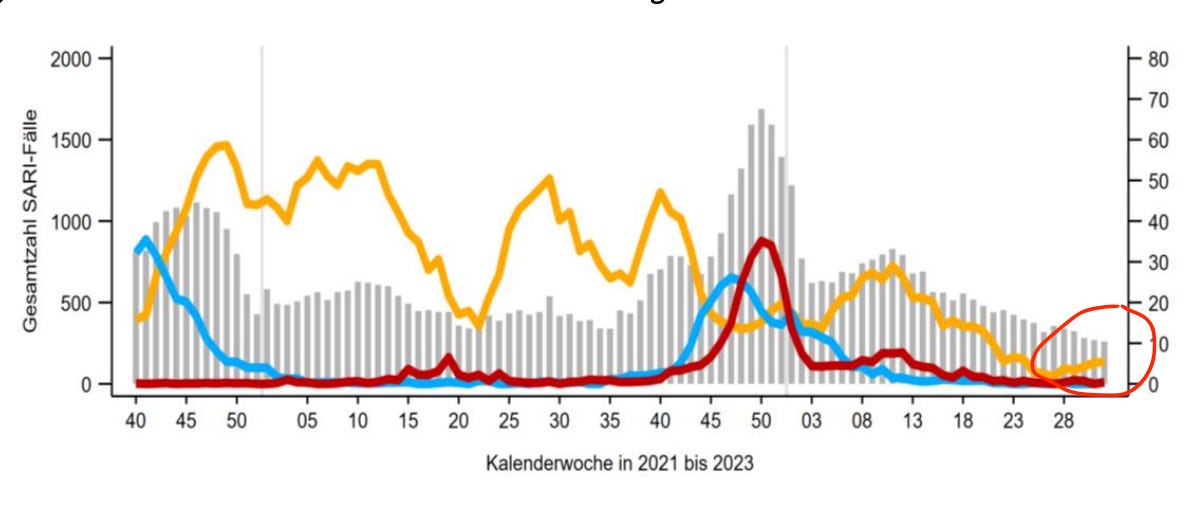
This microscopic uptick is dwarfed by the February/March wave that peaked between weeks 8 and 13. Our media luminaries took next to no notice of this frightening late-winter surge, and as I type this, Covid diagnoses have not even re-achieved their June levels. The difference between the state of things now and the state of things in February is not the unremarkable Eris variant. XBB was also debuting across Europe early this year, driving the post-February case peak, and nobody cared. The only thing that is different now, is the proximity of the autumnal vaccination liturgy and the prospect of new, updated vaccines from Pfizer/BioNTech, Moderna and Novavax. That is why we are hearing about variants and masks and Long Covid all over again. It is also why many of these articles contain buried within them somewhere the advice to line up for the shiny new anti-Covid juice this Fall. This whole thing is, very plainly, a psy-op, if a very low-effort one.
There are several patterns in the German reporting that are worth noting. First of all, the latest hysteria was unleashed on 17 August, prompted by a report on Eris from the German news agency Deutsche Presse-Agentur. Particularly in the realm of routine reporting, the news agencies are a powerful coordinating force, and their influence here means that the full media panic machine is not engaged. We’re looking instead at pieces thrown together by low-level staff desperate to fill column inches. Second, all the German stories are firmly downstream from Anglophone sources, going so far as to recycle from British tabloids the improbable theory of a “Barbenheimer” wave (it is painful even to type this stupid word). Third, at least German health authorities – Karl Lauterbach excepted – resolutely refuse to provide virus doom quotes. Thus the Frankfurter Rundschau had to appropriate the tweets of Anglosphere mask hysterics like Greenhalgh and Feigl-Ding to make Eris sound scary.
I know there are rumours that American authorities are planning to bring back mask mandates and other restrictions in the coming months, and I’ll be honest: We should be so lucky. If the pandemicists try to kick up another round of non-pharmaceutical interventions this fall, they’ll be flirting with self destruction. There are important prerequisites for virus panic: You need a plausibly novel pathogen, the risk of which can be exaggerated. You need a prevailing sense of stability, with nothing else much going on, because the public health interventions themselves have to seem new. Risk, excitement and the prospect of a break from routine are important enticements. That’s all gone now. Covid is not a new scary virus anymore; nearly everyone has had personal experience with it. Solid majorities everywhere have learned to hate lockdowns, despise masking and avoid the mRNA vaccines. The pandemicists need a plausibly new virus to reopen the circus, and they need a lot of people to forget about what a misery the last pandemic response was. They’ll have another chance in ten or fifteen years, I’d guess. Then, it’ll be time to worry.
Greg Tucker-Kellogg publishes fraudulent study to attack ivermectin
Tucker-Kellogg aimed to review research conducted in Brazil and conclude that ivermectin was ineffective against Covid-19. In order to do so, he and his colleagues had to fabricate over 250 fatalities.

Illustration. Reproduction photo from Greg’s YouTube channel.
Médicos Pela Vida | August 17, 2023
Greg Tucker-Kellogg, from the Department of Biological Sciences at the National University of Singapore, who receives compensation from YouTube for creating content against scientific misinformation, along with two other authors, Ana Carolina Peçanha and Robin Mills, published a study on the Medrxiv platform on August 15th. The study used fraudulent data with the aim of undermining the research on ivermectin conducted in Itajaí, located on the coast of Santa Catarina, Brazil.
The study conducted in Itajaí, peer-reviewed and published in the prestigious Cureus journal in early 2022, concluded the effectiveness of ivermectin in its prophylactic use against COVID-19. The results were positive: among individuals who took ivermectin preventively, there were 68% fewer deaths, 56% fewer hospitalizations, and 44% fewer infections.
The False Data
Tucker-Kellogg and colleagues’ study, which aimed to recalculate and nullify the positive results, used fraudulent data to achieve its goal. In the article, they claim that the data is official.
The authors stated that 499 individuals died between July and December 2020, a period during which the effectiveness of ivermectin was studied in the city.

However, the data of 499 COVID-19 deaths during the six months of the study in Itajaí is indeed false. In order to achieve their desired outcome, the number of deaths had to be inflated. You can verify the original PDF of the reanalysis here on page 3.
How We Investigated
The purported 499 deaths in six months, used as a basis for the calculations, raised suspicions due to being an unusually high number for the period in a city with just over 200,000 inhabitants. Consequently, the first step we took was to research the city’s epidemiological bulletins during that timeframe.
The official epidemiological bulletin, published on the Itajaí city government’s website on December 28, 2020, stated that a total of 254 individuals had died since the beginning of the pandemic. This figure represents deaths from when the virus first spread in the city in early 2020. Therefore, the deaths between July and December were even fewer, far from the reported 499.
In a second attempt to verify the numbers, we accessed consolidated data from the Brazilian Unified Health System (Sistema Único de Saúde or SUS) through the OpendataSUS database, which is considered one of the most comprehensive and accurate in the world. As Brazil has a publicly funded healthcare system, data for all patients in the country is rigorously monitored.
The OpenDataSUS Numbers:
Deaths caused by Severe Acute Respiratory Syndrome (SARS), with dates ranging from July to December 2020, among residents of the city. Database downloaded on March 13, 2023.
Based on the date of hospitalization:
Total SARS-related deaths: 234
Deaths due to Covid-19 only: 222
Based on the date of symptom onset:
Total SARS-related deaths: 256
Deaths due to Covid-19 only: 237
Based on the date of data entry:
Total SARS-related deaths: 240
Deaths due to Covid-19 only: 222
The Numbers from Brasil.IO
According to the information from the Brasil.IO database, which compiles data from confirmed cases and deaths from the bulletins of the State Health Departments (Secretarias Estaduais de Saúde or SES), during the period of the Itajaí study, the data were as follows:
Total Covid-19 deaths: 227
Fraudulent Study Used for Attacks
The authors of the original study have a long history in science and impeccable reputations. Lucy Kerr, the lead author, is the daughter of the late Warwick Stevam Kerr, and she deeply values his legacy. Warwick was the Scientific Director of FAPESP, served as the president of the Brazilian Society for the Advancement of Science, and received the Order of Scientific Merit in the Grand Cross category. Other authors include Dr. Flavio Cadegiani, a researcher with several COVID-19 studies, Dr. Fernando Baldi, a professor at the São Paulo State University (UNESP), Dr. Pierre Kory, an American medical professor, and Dr. Jennifer A. Hibberd from the University of Toronto, among others.

Following the publication of the reanalysis with fraudulent data, the attacks on the authors’ reputations turned defamatory. “There are people who prefer to keep believing in charlatans,” said Chloé Pinheiro, a journalist from Veja, one of Brazil’s major magazines.
Leandro Tessler, a professor at Unicamp, who represents the respected university in classifying true or false news on the internet and has admitted to not reading studies on cheap, generic, and unpatented treatments that he criticized, claimed that the original positive study had “cooked data.” Furthermore, Leandro criticized the journal’s quality by saying, “It’s something for Cureus.”
“Statistical trickery,” said Julio Ponce, a doctor in epidemiology and host of the podcast “Escuta a Ciência,” in response to the positive results of the original study.
Isaac Schrarstzhaupt, coordinator of the Rede Análise, criticized the quality of the Cureus journal. He stated that the original publication falls among the “lesser journals,” and he phrased it this way “to avoid using other terms.“
Original Authors Always Prioritized Transparency
The authors of the original study on ivermectin in Itajaí, responding to a call from the BMJ – British Medical Journal, which requested the publication of public data from studies on medications and vaccines, decided to make their raw data available for reanalysis.
This action was highly praised. “It’s excellent that they have released their data anonymously. They have true confidence in the results of their analyses. This is how good science is carried out,” stated Dr. Harvey Risch, a professor of epidemiology at Yale University, USA, emphasizing that patients’ personal data had been preserved.
Previously, the scientific community had speculated that the authors would not make their data available.
The doctor has been attacking the authors for some time
Ana Carolina, one of the authors of the study, has been attacking Dr. Flavio Cadegiani for some time. He is also the author of other studies involving different medications against Covid-19, such as those involving proxalutamide. She claims that those researches are a “hoax.” Regarding the study she chose to reanalyze now, inserting fraudulent data, Ana Carolina had already committed in early 2022 to disqualify it. She referred to it as an “international embarrassment” at the time and used quotation marks to refer to the researchers, seemingly implying doubt about their work.
“They had already decided that ivermectin doesn’t work. So, they tried – and made a great effort – to find calculations that ‘fit’ their pre-established conclusion. This is the exact opposite of what science is, which involves accepting results whether they contradict or support the hypothesis. In their quest to find the desired data, they most likely forgot to look at their own analyses – and even worse, at basic numbers. Furthermore, it seems to me that they didn’t quite understand the study, as I couldn’t find analyses related to rates derived from infections, matched with Propensity Score Matching,” stated Dr. Flavio Cadegiani, one of the authors of the Itajaí study.
“The most important thing is that this ‘study,’ by demonstrating its inability to invalidate us, has only reinforced our findings, and for that, we cannot help but be grateful,” he added.
MPV Comment
Scientific fraud is presenting unverified data as if it were official. And this wasn’t a small error. It was the central data point used to generate the result. It’s not a minor mistake that wouldn’t affect the studied outcomes. In order for the authors to attack the study and arrive at the conclusion of inefficacy, they needed to increase the number of deaths.
All those who subsequently attacked, even labeling the authors as “charlatans,” supposedly had the capacity and training to spot the fraudulent numbers. They are doctors, professors, epidemiologists, and data scientists. They either didn’t see it or feigned ignorance.
So far, all the scientific frauds published during the pandemic have targeted inexpensive, generic, and unpatented medications, or they were frauds promoting expensive and patented drugs. Surely, this is just a coincidence.
This is the second time the Itajaí study has been attacked without valid scientific arguments. In June 2022, the USP – University of São Paulo journal attacked it, even spreading false information. Our analysis can be read here: “COVID-19: USP Journal Lies and Distorts Science to Attack Ivermectin. Read the full analysis.” (portuguese).
We, at MPV (Médicos pela Vida) – Doctors for Life, are grateful for the collaboration of Professor Daniel Tausk from USP, for compiling data from official databases. His collaboration was essential for the report. Additionally, we thank the French researcher Massimaux, who prefers to remain anonymous on Twitter, for quickly pointing out fraudulent data. According to him, it was a “sanity check.” It didn’t pass.
Sources
Data from OpendataSUS
Data from Brasil.IO
Epidemiological Bulletin of Itajaí
The Green Energy Future Is Arriving Faster Than You Think — Or Not
By Francis Menton | Manhattan Contrarian | August 19, 2023
Among the media sources serving as propagandists and cheerleaders for the “green energy transition,” two of the most prominent are the New York Times and Bloomberg News. To get an idea how the “transition” is going, let’s take a look at the latest from those two.
From the Times, in this morning’s print edition, we have a feature article that apparently first appeared online a couple of days ago, August 17. The headline is: “The Clean Energy Future Is Arriving Faster Than You Think.” The sub-head continues the excitement: “The United States is pivoting away from fossil fuels and toward wind, solar and other renewable energy, even in areas dominated by the oil and gas industries.”
But then Bloomberg News comes out yesterday with an editorial that seems to reach the exact opposite conclusion. Headline: “Net Zero Is Stalling Out. What Now?”
So which is it? Is the green energy future arriving “faster than you think,” or “stalling out”? Both can’t be right. Who has the better side of this?
Let’s look first at the Times piece. It is an uncritical litany of every possible piece of good news for the generation of electricity from wind and sun in the U.S. It is filled with more than twenty photographs and charts designed to impress you with the great progress being made: massive wind turbines, vast solar arrays, rows of EV charging stations, teams of serious-looking workers in a modern factory working away on some unnamed but clearly complex piece of equipment.
On the other hand, the piece is devoid of meaningful data on how the “transition” is progressing. Are wind and solar electricity actually making progress toward supplanting fossil fuels? You won’t find the answer to that here.
I’ll give you a few choice excerpts so you can get an idea of the technique:
Delivery vans in Pittsburgh. Buses in Milwaukee. Cranes loading freight at the Port of Los Angeles. Every municipal building in Houston. All are powered by electricity derived from the sun, wind or other sources of clean energy. . . . The nation that burned coal, oil and gas for more than a century to become the richest economy on the planet, as well as historically the most polluting, is rapidly shifting away from fossil fuels. A similar energy transition is already well underway in Europe and elsewhere. . . . Wind and solar power are breaking records. . . . Automakers have made electric vehicles central to their business strategies and are openly talking about an expiration date on the internal combustion engine. Heating, cooling, cooking and some manufacturing are going electric.
So what are these Bloomberg people talking about when they say that the “Net Zero” thing is “stalling out”? It turns out that they have plenty of data points, mostly (but not entirely) from Europe, and all relating to collapsing public support as costs become apparent:
[V]oters have legitimate questions about net-zero policies: How much will they cost? What benefits will they bring? Will they actually work as advertised? Such skepticism is already changing politics, from the recent losses suffered by Germany’s Greens to the fall of the Dutch governing coalition, which was partly fueled by farmers’ anger over forced reductions in nitrogen-oxide emissions. Even some avowed environmentalists — such as the governor of New Jersey and the leader of the UK’s Labor Party — have lately been siding with voters who feel aggrieved at the costs of environmental policies.
Can we get any actual data as to whether wind and solar energy are rapidly increasing their market share for energy production in the U.S.? The best source of information is the Energy Information Administration (part of the Department of Energy). The most recent two full years for which they have data are 2021 and 2022. Here’s the 2021 chart showing U.S. primary energy consumption by source:

Add up the percentages for petroleum (36%), natural gas (32%) and coal (11%), and you get 79% from fossil fuels in the aggregate.
And how about 2022? The chart is in a different format that is more difficult to read, but here is the key line of text: “Fossil fuels—petroleum, natural gas, and coal—accounted for 79% of total U.S. energy consumption in 2022.” Oh, that’s the exact same percentage as in 2021. It didn’t budge by even 1%.
Here is the chart they provide for 2022. As you can see, it is not so easy to calculate the percentages by source from this chart, but the general result is still obvious:

For 2023, EIA has put out monthly data through April as part of its Monthly Energy Review. There are no pretty charts, but through April fossil fuels have generated 26.082 quadrillion BTUs out of total primary energy consumption of 33.209 quadrillion BTUs. That would be 78.53% for fossil fuels. In other words, to the nearest whole percent, it’s still 79%. All the billions upon billions of government subsidies don’t seem to be moving the needle in any noticeable way.
To be fair, these figures reflect little if any of the massive subsidies brought forth by the big federal green energy bill (“Inflation Reduction Act” [sic]), which was signed a year ago on August 16, 2022 and is just getting cranked up. Will those subsidies move this needle at all? You would think that they couldn’t help moving the needle at least a little. But my own prediction is that the percent of primary energy from fossil fuels will decrease only minimally.
Over at Bloomberg, while they report honestly that Net Zero seems to be stalling out, they are not happy about it. What is the remedy? Obviously, the government planners directing the green energy transition need to go about this in a more “purposeful” and “strategic” manner:
If the government is going to ban the sale of gas boilers in 2035, as it says, it will need to make sure that cheaper alternatives are available. Likewise with a planned ban on new gas and diesel cars: It’s a fine goal, but it won’t go anywhere unless consumers have compelling incentives, charging infrastructure can meet demand and the government has otherwise laid the needed groundwork. . . . Above all, what’s needed is leadership. Decarbonization can drive economic growth, create jobs and bring substantial benefits to the environment and public health. But it must be done purposefully and strategically.
It’s the usual touching faith that central planning really is going to work this time, because it will be done more intelligently. No amount of real world failures will ever convince the true believers otherwise.
Air quality board approves sweeping demands on large buildings to start cutting greenhouse gas emissions
Big buildings in Colorado will now be on an energy diet
By Michael Booth | The Colorado Sun | August 18, 2023
Colorado’s largest buildings will have to follow a carbon consumption diet plan to cut state greenhouse gas emissions, with the Air Quality Control Commission passing the controversial regulations over days of intense opposition testimony from property managers.
State air and clean energy officials said they tried to accommodate objections that efficiency modifications had premature deadlines, would cost too much, and may not achieve the targeted emissions cuts. But in the end, the commission late Thursday approved the basic plan requiring 8,000 Colorado buildings to slash carbon emissions 7% by 2026, and 20% by 2030.
Regulation 28 applies to apartments, office and industrial buildings over 50,000 square feet, and fulfills 2021 legislation that called for Colorado’s building sector to share in the carbon cuts demanded from other major polluters such as transportation, utilities and oil and gas drilling. Colorado regulators say large buildings are one of the five highest categories of commerce contributing to state greenhouse gas emissions, which must be trimmed overall by 50% by 2030, from a 2005 benchmark.
“Reducing pollution from large buildings is essential to meet our greenhouse gas pollution reduction targets and ensure that the state’s existing buildings are ready for Colorado’s clean energy future,” Colorado Energy Office Executive Director Will Toor said after the measure passed. “Today’s investments to improve building energy efficiency and reduce building energy use will save Coloradans money on energy costs and improve Colorado’s air quality for decades to come.”
Owners and managers of large buildings have been conducting energy use audits and greenhouse gas emission inventories and filing them with the state. They must now plan upgrades that will lower emissions from those initial benchmarks.
Landlords can cut the emissions they are responsible for through insulated windows, thickening walls, replacing furnaces and other appliances with efficient models running on clean electricity, and other measures. Under the state law and the new rules, the gains must be separate from requirements that Colorado’s utilities deliver cleaner power to their doorstep, and not double-count those emissions cuts.
Property managers continued their months of objections at days of hearings over the regulation. Building owners around the Purgatory ski resort in southwestern Colorado said they are isolated, with a single propane pipeline supplier whose own investments need to be paid back over time, so they can’t easily switch power sources. They also said individual condo owners in large residential buildings could be hit with expensive special assessments when efficiency renovations prove difficult.
Timing alone could make the efficiency rules impossible to meet, the Colorado Real Estate Alliance said, in rebuttals filed with the commission for the hearing.
“A 2026 target of any level will be difficult to attain,” the alliance said. “The final rule likely will not become effective much before the end of calendar year 2023. That will leave building owners with less than two years to secure and carry out audits to identify potential compliance pathways, raise capital, secure contractors, and acquire equipment in an economy still suffering from supply chain disruptions.”
A LoDo Denver building manager told The Colorado Sun before the hearing that meeting the targets would require renovations such as tripling insulation and thickening walls, and could cost $6 million for one five-story structure. … Full article
Featured Video

No Threat Can Force Iran’s Surrender /Trita Parsi & Lt Cl Daniel Davis
or go to
Aletho News Archives – Video-Images
From the Archives
What is the Israeli Lobby in Australia Doing in Interfaith Dialogue?
By Ali Kazak | Dissident Voice | October 11, 2015
For years Israel and its lobby around the world have been trying to normalise their relations with Arabs and Muslims without solving the Palestine Question.
One of the methods they resorted to in the last few years is using human rights and community organizations such as interfaith dialogue and Multiculturalism to achieve this objective and to: isolate the Palestinians, marginalise the Palestine question, end Israel’s isolation, and prevent criticism of Israel, knowing that these organisations will be the first to stand against Israel’s violations, racial and religious discrimination.
The group responsible for this task in Australia is The Australia/Israel & Jewish Affairs Council (AIJAC); its Director of International & Community Affairs, Jeremy Jones is in charge of lobbying religious community organizations, specifically Muslims and Christians. Consequently he convened the Faith Communities for Reconciliation, founding participant in the Australian Partnership of Religious Organisations and the Australian National Dialogue of Christians, Muslims & Jews.
AIJAC is a private political propaganda group. It is recognised as the main Israeli lobby in Australia. It coordinates its activities and works intimately with the Israeli embassy in Canberra and different institutions in Israel. It is privately funded by some Jewish businessmen. It monitors closely Australian politicians, the media, ethnic and religious groups, (especially Arabs and Muslims), unions and academics on their stands towards Israel and the Palestine question. … continue
Blog Roll
 Aletho News
- The war of liberation of the Arab and Islamic peoples expands across the Gulf
- Envoy warns UN on Trump’s threat to ‘obliterate’ Iran’s civilian infrastructure
- The Larak Corridor: Iran’s Rial Gate With No US, No Israel, and No Way Around
- ‘Economic terrorism’: Steel facilities hit again in US-Israeli strike
- ‘War Crime’: Iran condemns attacks on Arak, Ardakan nuclear sites
- Two-thirds of Americans want quick end to Iran war even if goals unmet
- Trump to Give “Important Update on Iran” Wednesday in Prime-Time Speech
- Theodore Postol: Iran’s Missiles & Drones Were Underestimated
- Iran To Target Military Industrial-Tech Complex That Facilitated Gaza Genocide
- Collapsing Empire: The Resistance Disarms ‘Israel’
- If Americans Knew
- Israel wants US to bomb more of Iran’s civilian structures (113,000 is not enough) – Not a ceasefire Day 173
- Ann Coulter Rips Into Fox News for Iran War Coverage
- Joe Kent Urges Americans To Call White House and Congress To Object To Sending Troops Into Iran
- DNC Resolution to Reject AIPAC Funding Puts Democratic Leaders in the Hot Seat
- Swedish foundation to build 400 schools as over 650,000 Gaza children remain without education for 2 years
- Israeli army admits photshopping image of slain Lebanese journalist
- This is how Israel is systematically killing health workers under the cover of war in Lebanon
- Carrying life under fire: Israeli invasion of Lebanon leaves pregnant women facing deadly risks
- Champagne all around for the new death penalty (for Palestinians) law – Not a ceasefire Day 172
- Why are Palestinian books struggling to be seen on Amazon?
- No Tricks Zone
- New Study Finds Warming Saves Lives…Cold Temperatures 12 Times More Deadly Than Excess Heat
- German Science Blog Accuses PIK Climate Institute Of Hallucinating Climate Tipping Points
- Devastating Assessment Of Comirnaty Vaccine By Former Senior Pfizer Europe Toxicologist
- New Study: CO2 Is ‘Effectively Negligible’ As An Explanatory Climate Change Factor Since 2000
- Former Pfizer Toxicologist Dr. Helmut Sterz Tells Bundestag Hearing Pfizer Vaccine Should Have Never Been Approved
- Energy Expert: Germany’s Nuclear Phaseout Was A “500 Billion Euro Mistake”
- New Research: South Australia’s Mid-Holocene Sea Surface Temperatures Were 4°C Warmer Than Today
- Storing Green Energy To Last Germany 10 Days Would Require A 60-Million Tonne Battery
- New Studies: UK Sea Levels Were 4 Meters Higher Than Today During The Mid-Holocene
- Destructive Green New Deal: German Energy And Metal Group Warns Of Drastic Crisis
 Aletho News