Why’s US Media Talking About Nigerien General Moussa Barmou All Of A Sudden?
From Bazoum To Barmou
BY ANDREW KORYBKO | AUGUST 15, 2023
American media’s narrative about last month’s regime change in Niger has conspicuously shifted since Acting Deputy Secretary of State Victoria Nuland’s trip to Niamey last week. Prior to then, most information products aggressively supported Nigerian-led ECOWAS’ threatened invasion aimed at reinstalled ousted leader Mohamed Bazoum. Ever since she revealed that the US is “pushing for a negotiated solution”, however, attention has turned towards General Moussa Barmou.
NBC News’ Report
The Wall Street Journal began the trend two days after her visit in a paywalled article here, but it wasn’t until NBC News’ piece on Monday headlined “Blindsided: Hours before the coup in Niger, U.S. diplomats said the country was stable” that the public at large was introduced to him. Its subtitle about how “An American-trained general whom U.S. military officials considered a close ally backed the overthrow of the country’s democratically elected president” was a reference to Barmou. Here’s what they reported:
“U.S. military officials believed that the head of the Nigerien Special Forces, Gen. Moussa Salaou Barmou, their close ally, was going along with the other military leaders to keep the peace. They noted that in a video showing the coup leaders on the first day, Barmou was in the back of the group with his head down and his face mostly hidden.
Less than two weeks later, Barmou met with a U.S. delegation in Niamey, led by acting Deputy Secretary of State Victoria Nuland, and expressed support for the coup and delivered a sobering message: If any outside military force tried to interfere in Niger, the coup leaders would kill President Bazoum. ‘That was crushing,’ said a U.S. military official who has worked with Barmou in recent years. ‘We were holding out hope with him.’
Not only had Barmou worked with top U.S. military leaders for years, but he was also trained by the U.S. military and attended the prestigious National Defense University in Washington, D.C. Last week, sitting across from U.S. officials who had come to trust him, Barmou refused to release Bazoum, calling him illegitimate and insisting that the coup leaders had the popular support of the Nigerien people. Nuland later said the conversations were ‘quite difficult.’”
The unnamed US military source who said that “We were holding out hope with him” spilled the beans about the way in which their country intended to control Niger by proxy. The Pentagon thought that cultivating the chief of that country’s special forces would be sufficient for preventing a coup, but Barmou decided to go along with it because he knew better than they did how genuinely popular it was. His “defection” from American proxy to patriot ensured this surprise regime change’s success.
Politico’s Report
The next US media report of relevance was published the day later by Politico and was about how “The U.S. spent years training Nigerien soldiers. Then they overthrew their government.” It builds upon Barmou’s biography that was introduced by NBC News and can therefore be conceptualized as the second step of an ongoing information campaign intended to inform Americans more about him. Here’s what they had to say about this top Nigerien military official:
“Brig. Gen Moussa Barmou, the American-trained commander of the Nigerien special operations forces, beamed as he embraced a senior U.S. general visiting the country’s $100 million, Washington-funded drone base in June. Six weeks later, Barmou helped oust Niger’s democratically elected president.
…
Retired Maj. Gen. J. Marcus Hicks, who served as the commander of U.S. Special Operations Forces Africa from 2017 to 2019, says he was instantly impressed by Barmou. The Nigerien general speaks perfect English, and attended multiple English language and military training courses at bases in the United States over nearly two decades, including at Fort Benning, Georgia, and the National Defense University.
Hicks and Barmou developed a friendship. They had many long conversations over dinner about the influx of extremists into Niger, and how difficult it was for Barmou to see his country deteriorate in recent years, said Hicks. ‘He’s the kind of guy that gives you hope for the future of the country, so that makes this doubly disappointing,’ said Hicks. It was ‘disheartening and disturbing’ to learn that Barmou was involved in the coup.
As its neighbors fell like dominos to military coups over the last two years, Niger — and Barmou himself — remained the last bastion of hope for the U.S. military partnership in the region. He ‘was a good partner, a trusted partner,’ said a U.S. official familiar with the U.S.-Niger military relationship. ‘But local dynamics, local politics, just trump whatever the international community may or may not want.’
It’s not clear whether Barmou was initially involved in plotting the coup, which is believed to have been spearheaded by Gen. Abdourahamane Tchiani, the head of Bazoum’s presidential guard. Tchiani and his men reportedly took the president captive because Tchiani believed he was going to be pushed out of his job. But soon after, Nigerien military leaders including Barmou endorsed the putsch.”
Politico’s piece serves to raise maximum awareness of just how much the Pentagon trusted Barmou, which humanizes him in the eyes of their targeted audience, who likely hitherto thought that he was either a greedy wannabe despot or a pro-Russian anti-Western ideologue. Upon learning that he was America’s closest ally in Niger, they’ll be more inclined to support Nuland’s diplomatic efforts to resolve the crisis via some sort of compromise than back the use of force at the risk of sparking a regional war.
Le Figaro’s Report
NBC News and Politico’s back-to-back pieces about Barmou were published a week after Nuland returned from Niger, which gave the US’ permanent policymaking bureaucracies enough time to decide their next move. During that time, an unnamed diplomatic source told Le Figaro in an article published on Sunday the day before NBC News’ that they feared the US might backstab France. According to them, the US could tacitly recognize the interim military-led government if they get to retain their bases.
The next day on Monday, which coincided with the release of NBC News’ report about Barmou that was conceptualized in this analysis as the first step of an ongoing information campaign intended to inform Americans more about him, the US publicly balked at the ECOWAS invasion scenario. State Department principal deputy spokesman Vedant Patel said that “military intervention should be a last resort”, thus extending credence to Le Figaro’s report after its diplomatic source correctly foresaw the US’ new stance.
From “Francafrique” To “Amerafrique”
This sequence of events suggests that the US might offer Niger’s interim military-led government a deal whereby they’d tacitly recognize these new authorities and order ECOWAS to call off its invasion in exchange for that country retaining its bases and declining to embrace Russia/Wagner as explained here. In this scenario, the US’ backtracking on its prior demands to reinstall Bazoum could be attributed to its trust of Barmou’s assessment that the coup truly channeled the will of the Nigerien people.
NBC News and Politico’s pieces also included information about Niger’s importance for the US’ African strategy, which preconditions the public to expect that the White House could resort to the national security exception for not cutting off military aid to that post-coup state per its domestic legal obligation. In that event, the US would seamlessly replace France’s traditional security role there while preventing the emergence of a void that could have otherwise been filled by Russia/Wagner.
If post-coup Niger successfully transitions from France’s “sphere of influence” in Africa (“Francafrique”) to America’s (“Amerafrique”), then the US might weaponize the model that it opportunistically improvised after the latest surprising turn of events to export it to other former French colonies. Those that experience a grassroots surge of anti-French sentiment might also undergo coups by former US-trained military leaders, who’d then negotiate similar deals as the previously mentioned one.
The US could offer to replace France’s scandalous security role in their countries together with preventing an ECOWAS invasion in exchange for their new interim military-led governments offering it a share of the previously French-dominated market and declining to embrace Russia/Wagner. In this way, the US could manage revolutionary trends in the region and actually benefit from them if it replicates the model that it’s presently experimenting with in Niger via Barmou’s envisaged bridge role.
This insight answers the question of why US media is talking about him all of a sudden in the week after Nuland’s trip to Niamey. They’re warming average Americans up to the scenario of Barmou functioning as a bridge between their countries after the coup. Since he chose to go along with the regime change instead of stop it, the US’ new hope is that he’ll convince his superiors to accept the deal that was described, which could then form the basis for a model that might later be exported across the region.
The Latin American Precedent
The US would prefer for France to manage Africa on the West’s behalf per the “Lead From Behind” stratagem of “burden-sharing” in the New Cold War, but if its military-strategic withdrawal is inevitable due to rising anti-imperialist trends, then it’s better for America to replace its role than Russia/Wagner. To that end, it might soon support anti-French coups by US-trained military leaders in order to corral populist sentiment in a geostrategically safe direction that avoids creating space for its rivals.
This is similar to what it’s recently begun doing in Latin America after the Democrats started supporting leftist-liberal movements like those in Brazil, Chile, and Colombia, which led to Lula’s PT becoming the posterchild of this so-called “compatible left” project, in order to not lose control of regional processes. It’s precisely this precedent that’s arguably influencing the formulation of America’s new “bait-and-switch” approach towards seemingly inevitable socio-political changes in “Franceafrique” as well.
Concluding Thoughts
Circling back to the lede, Americans are suddenly learning more about Barmou because the US is likely exploring the possibility of employing this trusted pre-coup partner as a bridge with Niger in the hope that he convinces his superiors to agree to a “negotiated solution”. If the Latin American model for corralling populist sentiment is replicated by the US in Niger, albeit accounting for “Francafrique’s” coup-prone conditions, then this modified method might eventually be weaponized across the entire region.
Dissent Channel, Afghanistan and Confidentiality
By Peter Van Buren | We Meant Well | August 7, 2023
Something quite significant in U.S. diplomatic history is going to take place — a State Department Dissent Channel message, concerning the evacuation and withdrawal from Afghanistan, is going to be shared with Members of Congress.
House Foreign Affairs Committee Chairman Michael McCaul announced his panel investigating the final days of American presence in Afghanistan will view the Dissent Channel cable. McCaul threatened to hold Secretary of State Antony Blinken in contempt if he did not provide him access to the diplomatic cable, which came from a confidential “dissent channel” that allowed State Department officials to discuss views which may be different from administration policy.
It is believed the July 2021 cable discussed concerns from the rank-and-file diplomatic staff not fully shared by senior embassy executives and management about the upcoming American pullout from the country, warning the U.S.-backed Afghan government could fall. The cable specifically advised an earlier withdrawal date than that ultimately chosen by the Biden Administration, and may have addressed the decision to conduct the entire evacuation from a single civilian airport in Kabul.
So what is the Dissent Channel and why is this particular cable so important?
The Dissent Channel was set up in 1971 during the Vietnam War era as a way for foreign service officers and civil servants at State (as well as United States Agency for International Development, the Arms Control and Disarmament Agency, and the former United States Information Agency) to raise concerns with senior management about the direction of U.S. foreign policy, without fear of retribution. The cables (formal, official State internal communications are still referred to as “cables” harking back to early diplomatic days when telegrams were used to communicate between Washington and embassies abroad) are sent to the State Department’s policy planning director, who distributes them to the secretary of state and other top officials, who must respond within 30 to 60 days. There are typically about five to ten each year. “Discouragement of, or penalties for use of, the Dissent Channel are impermissible,” according to the State Department internal regulations.
Use of the Channel covers the scope of diplomatic mission. Historical messages include a dissent over the executive branch’s decision to “initiate no steps to discipline a military unit that took action at My Lai” in Vietnam and the “systematic use of electrical torture, beatings, and in some cases, murder, of men, women, and children by military units in Vietnam.” These actions by U.S. soldiers were “atrocities too similar to those of Nazis.” Another dissent was over the “hypocritical” U.S. support of the Somoza regime in Nicaragua, bemoaning that the U.S. missed a “unique opportunity to intervene for once on the right repeat right side” of history. One older atypical dissent cable complained about having to arrange female companionship in Honduras for a visiting U.S. congressman. In the words of one now-declassified cable, “The Dissent Channel can be a mechanism for unclogging the Department’s constipated paper flow” related to employee dissent against current foreign policy actions.
What the Channel does is one thing; who gets to see it is another. Until now, dissent messages have generally been regarded as something sacrosanct not to be shown to outsiders and not to be leaked. “Release and public circulation of Dissent Channel messages,” State wrote to one inquirer,” would inhibit the willingness of Department personnel to avail themselves of the Dissent Channel to express their views freely.” The messages were first withheld from the rest of government (and the public) by State under the rules which created the system, and later under the Freedom of Information Act’s (FOIA) “predecisional” Exemption 5, until the 2016 FOIA Improvement Act amendments made it illegal for agencies to use this exemption after 25 years. So sharing the Afghan dissent cable with Members of Congress, especially so soon after the administration’s evacuation policy failed in Afghanistan, is a very big deal at the State Department.
One publicized exception to how closely held dissent messages are took place in 2017 when nearly a thousand State Department Foreign Service Officers signed a five page dissent message opposing President Donald Trump’s executive order, “Protecting the Nation from Foreign Terrorist Entry into the United States,” which prohibited seven additional Muslim nationalities from entering the U.S., aka “The Muslim Ban.” As a result of an anti-Trump contingent inside generally liberal and mostly Democratic-leaning State, the message was leaked in its entirety. Even more against precedent, Trump’s spokesman Sean Spicer issued an extraordinary public rebuke to the diplomats: “These career bureaucrats have a problem with it? They should either get with the program or they can go.”
An almost-leak (a State Department official provided a draft, though the final version was not published, to The New York Times) took place in 2016 during the Trump-Clinton presidential election, after 51 Foreign Service Officers criticized the Obama administration via the Dissent Channel for failing to do enough to protect civilians in Syria in what was widely seen as an endorsement of Candidate Hillary’s pseudo-promise to put U.S. boots on the ground in Syria. Other Trump-era dissent cables not shared outside the Department called for consultations on Trump’s removal from office, and rebuked the secretary of state for not forcefully condemning the president over January 6.
To fully understand what the Dissent Channel is requires a better understanding of the State Department culture, academic in nature but frighteningly risk adverse. The academic side reflects the Department’s modern origins as being made up of those who were “male, pale, and Yale” where the tradition of loyal opposition holds sway. But it is the risk adverse side of State that tells how important and internally revealing the Afghan cable is. Dissent messages are signed, no anonymous ones allowed, and while Secretary Blinken has promised to not show the names of those who signed the Afghan cable to Congress, State senior management will know exactly who wrote what.
In addition, Dissent Channel messages must still be cleared for transmission to the secretary of state in Washington at post, though there is no requirement everyone agree with the contents per se (authorization does not imply concurrence.) So one’s colleagues know who wrote what, potential dynamite in an organization where dissent is otherwise not encouraged and corridor reputation plays a deciding role in promotions and future assignments. It is a significant step to write or sign a dissent cable and despite the regulations’ admonishment that use of the Dissent Channel not be discouraged by supervisors, it is discouraged.
Nobody in Embassy Kabul who signed that dissent message, basically telling their boss the ambassador and the Biden Administration they were wrong, expected to have their opinions shown to Congress; quite the opposite. Blinken, by sharing the cable with Congress, is breaking faith with his institution and with his front line workers in a uncollegial way only imagined by them during the Trump administration. Once upon a time something like that would have called for dissent.
Pakistan’s Reported Suspension Of Russian Crude Oil Imports Was The Regime’s “Parting Gift”
BY ANDREW KORYBKO | AUGUST 15, 2023
The News International cited unnamed sources on Sunday to report that Pakistan suspended its import of Russian crude oil on the pretext that it’s not affordable to refine despite its lower price due to the lesser amount of petroleum that’s produced when compared to competitors’ crude. The problem with this explanation is that these refining differences were known ahead of time but the whole point in importing Russian crude was to get it at a lower price and reduce dependence on the Gulf Kingdoms.
Former Petroleum Minister Musadik Malik, who the abovementioned report claimed had insisted in vain on his country’s companies importing more Russian crude, earlier envisaged Moscow providing over one-third of his country’s needs. Nevertheless, it also deserves mentioning that he was reported to have told the National Assembly last week that Pakistan planned to officially pull out of its decade-old gas pipeline deal with Iran under pressure from US sanctions in spite of this project’s promising potential.
The precedent is therefore established for suspecting that US sanctions might also have played a role in Pakistan’s reported decision shortly thereafter to suspend its Russian crude oil imports too. Taken together, the impression is that the fascist post-modern coup regime that was installed after former Prime Minister Imran Khan’s (IK) scandalous ouster in April 2022 decided to destroy any hopes of energy security and the sovereignty it entails as their “parting gift” around the time of parliament’s dissolution.
This development is supposed to precede the next elections by 90 days, but there might be a delay since the latest census results require redrawing constituencies, which might not be completed within the next three months. In any case, the point is that IK’s replacements left a legacy of energy insecurity and lost sovereignty, not to mention economic collapse and the de facto imposition of martial law. The first two consequences are the most relevant to this analysis and will therefore be elaborated further.
The Intercept published a leaked copy of the Pakistani cable from March 2022 sent by its former Ambassador to the US warning about American pressure over Russia. His interlocutor, Assistant Secretary of State for South and Central Asia Donald Lu, made no secret of the fact that the US considered IK’s energy-driven ties with Russia to be a threat to its national security. For that reason, Washington signaled that it wanted him gone otherwise there’d be severe consequences for Pakistan.
IK’s subsequent removal a little over one month later predictably led to his replacements dillydallying on the strategic energy deal that he sought to advance during his trip to Moscow in late February 2022. Although they eventually imported a test shipment of Russian oil earlier this summer, the over year-long delay between his meeting with President Putin and their purchase was suspicious. It now appears in hindsight that the only purpose of going through with this was to push a domestic political agenda.
The regime probably never intended to implement Musadik’s ambitious plans but instead sought American permission for the previously mentioned purchase solely to claim that it supposedly proves that they weren’t installed by the US as punishment for IK’s Russia policy. Following this first-ever import and the superficial fulfilment of their soft power objective, they then spent the rest of the summer sending false signals to Russia that they were on the brink of finally reaching that strategic energy deal.
It can only be speculated whether the former Petroleum Minister was in on this plot or if he sincerely came along to realizing the wisdom of IK’s plans in this respect and truly wanted them to succeed, but that doesn’t change the ultimate outcome either way. At the end of the day, Pakistan strung Russian experts and negotiators along for over a year despite nothing coming of the latter’s efforts, which they continued in good faith with the intent of strengthening their partner’s energy security and sovereignty.
Pakistan’s reported suspension of Russian crude oil imports probably also dooms their plans for the Pakistan Stream gas pipeline, which was supposed to become the flagship Russian project in Pakistan and an anchor for more future investments. The Kremlin might not want to waste any more time negotiating with Islamabad after feeling like it was just fooled for over a full year, and the bad blood between them over these two failed deals could prevent their ties from ever becoming strategic.
Private businessmen will still try to scale real-sector trade between their countries, and ties will remain cordial at the official level, including at multilateral fora on Afghanistan and other issues of shared interests. What’s expected to change, however, is that Russia will no longer continue to treat Pakistan like a potential strategic partner after this debacle. In practice, it won’t consider that country worth the opportunity cost of investing its time in at the expense of expanding ties with more serious partners.
Its finite human resources are better invested in Africa nowadays, whose countries are sincere in their desire for strategic relations with Russia, unlike Pakistan which just wasted over a year dillydallying on a strategic energy deal only to ignominiously abandon it on a misleading pretext. The fascist post-modern coup regime’s “parting gift” to the Pakistani people around the time of parliament’s dissolution ahead of likely rigged elections was that they killed the chance for strategic relations with Russia once and for all.
As Maui Burns, Biden Demands Another $24 Billion… For Ukraine!
By Ron Paul | August 14, 2023
I am not a big fan of Federal Government disaster relief. Too much of the time the money never gets to those who need it most, and too often Washington’s armies of disaster “experts” are more interested in pushing people around than helping them.
Nevertheless, it’s hard to look at recent footage of the devastation in Maui and then hear President Biden tell Congress that he needs another $24 billion for Ukraine. How can this Administration continue to justify tens of billions of dollars for this losing war that is not in our interest while the rest of the United States disintegrates?
Biden’s new $24 billion request comes on top of well over $120 billion already spent to fight the US proxy war on Russia in Ukraine. Heritage Foundation budget expert Richard Stern has done the math and determined that Biden’s spending on the Ukraine war thus far will cost each and every American household $900. How many Americans would rather have those $900 dollars back in their pocket rather than in the pockets of Lockheed-Martin, Raytheon, and Ukraine’s oligarchs?
Recent surveys have shown that a majority of Americans could not afford to cover a sudden $1,000 emergency. Will Americans connect the dots and realize that the reason they can’t find that $1,000 for an emergency is because the neocons have already sent it to Ukraine?
Ukraine has long been known as among the most corrupt countries on earth and not long ago investigative journalist Seymore Hersh wrote that Ukrainian president Vladimir Zelensky has embezzled at least $400 million in aid from the American people. Corruption scandals continue to break in Ukraine. Just last week Zelensky fired the heads of all local draft boards for corruption. Some press reports suggest that sales of luxury cars in Ukraine have broken all previous records. I wonder why.
No wonder the tide of US public opinion is turning against further involvement in the war. Recently CNN found that among all Americans, more than 55 percent are opposed to continued aid to Ukraine. Among Republicans the number opposing more aid to Ukraine rises to three-out-of-four. That is why we are finally starting to see more Republican Members raising concerns. I’d like to think they have seen the light that an aggressive and interventionist foreign policy is not in America’s interest, but most likely they are worried about losing elections. Whatever their motivation, this turning tide should be welcomed.
Yet the Biden Administration persists in backing Ukraine even as the US mainstream media is increasingly pointing out the obvious: Ukraine is not winning and cannot win, and continuing to pour money into a losing cause will just result in bankruptcy at home and more dead Ukrainians overseas.
Last week Newsweek published an article asking, “Does Ukraine Have Kompromat on Joe Biden?” In the article, Northeastern University Professor Max Abrahms wonders out loud whether Biden’s continued support for Ukraine might be related to compromising information held in Kiev about the many Biden family shady business ventures in Ukraine and the region. It is certainly worth considering.
Meanwhile, the residents of Maui that survived the recent horrific fire will take little comfort knowing that the Biden Administration is more interested in sending their money to Ukraine than in helping them recover.
Copyright © 2023 by RonPaul Institute
U.S. Lawyers Reiterate Claim Ivermectin was never prohibited for treating COVID-19
Attorneys restate claim that FDA merely advised doctors against IVM for dying patients, but did NOT prohibit it.
BY JOHN LEAKE | COURAGEOUS DISCOURSE | AUGUST 14, 2023
Last November, I wrote the following post:
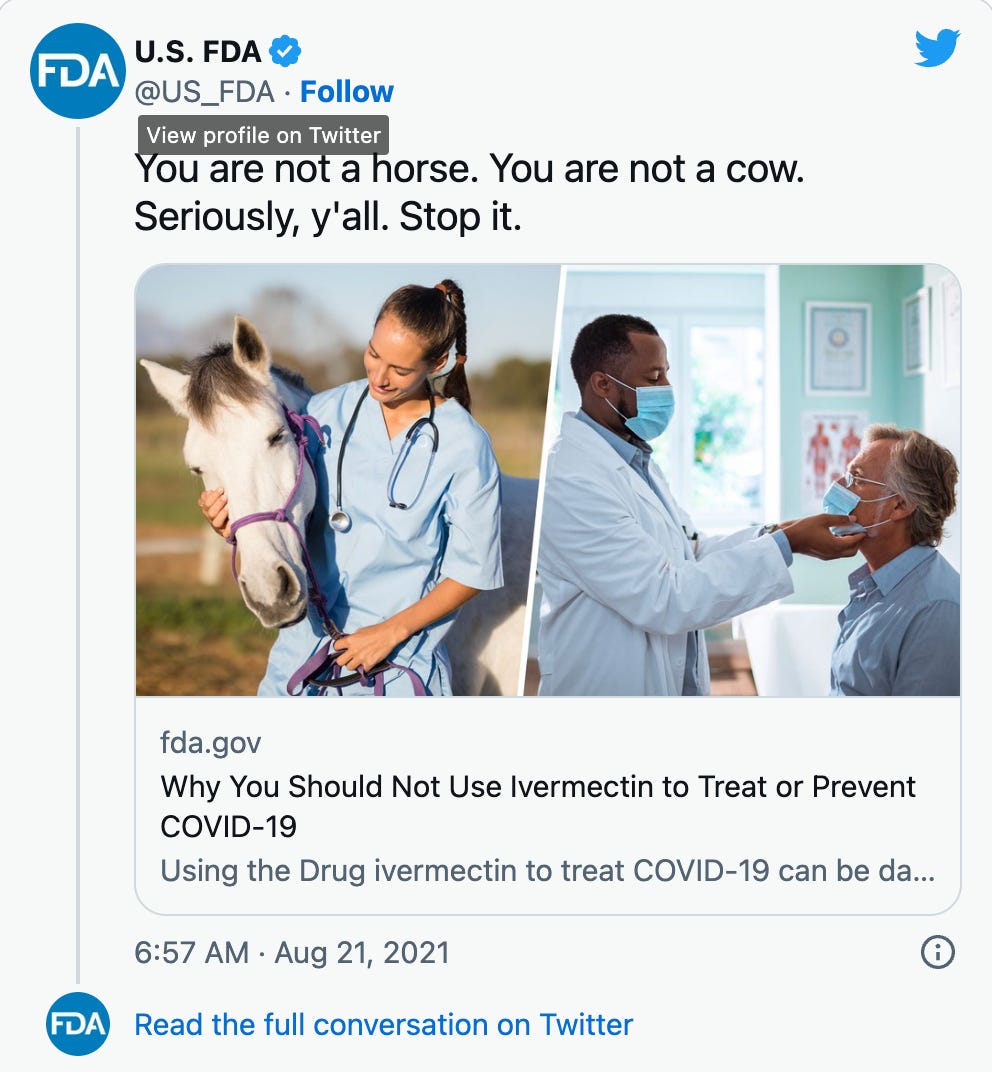
The Epoch Times recently reported an astonishing statement by a U.S. government lawyer in a federal court in Texas, where the FDA is being sued by Dr. Paul Marik of Virginia, Dr. Mary Bowden of Texas, and Dr. Robert Apter of Arizona. The three plaintiffs claim the FDA illegally prohibited them from prescribing the drug to their patients. At a November 1 hearing, U.S. lawyer Isaac Belfer argued for the defendant:
The cited statements were not directives. They were not mandatory. They were recommendations. They said what parties should do. They said, for example, why you should not take ivermectin to treat COVID-19. They did not say you may not do it, you must not do it. They did not say it’s prohibited or it’s unlawful. They also did not say that doctors may not prescribe ivermectin.”
If Belfer’s assertion is true, it raises a very urgent question: On what legal grounds did hospitals all over the United States refuse to administer ivermectin to severely ill COVID-19 patients, even when patients and their family members begged for the drug to be administered?
If ivermectin was not prohibited by the FDA or any other U.S. medical authority for treating COVID-19, why did Dr. Paul Marik’s hospital prohibit him from administering the drug to his dying patients? Why was Dr. Mary Bowden reported to the Texas Medical Board for disciplinary action when she prescribed it? Why did many pharmacists fear losing their licenses if they filled ivermectin prescriptions for treating COVID-19?
In our book, The Courage to Face COVID-19: Preventing Hospitalization and Death While Battling the Bio-Pharmaceutical Complex, Dr. McCullough and I document numerous instances of hospitals flatly refusing to grant the wishes of dying patients and their family members for ivermectin.
All these patients asked for was to be allowed to try the drug (FDA-approved for River Blindness, Elephantiasis, and Scabies) for COVID-19. The patients and their kin gladly indemnified the hospitals and arranged to have their independent primary care doctors deliver and administer the drug. Nevertheless:
- Hospital administrators absolutely refused to grant this wish.
- Hospital attorneys fought tooth and nail against using ivermectin to treat COVID-19 patients, doing everything in their power to challenge patient lawsuits and appeal court orders to administer the drug.
- Even when hospital doctors acknowledged that the patients were dying, they insisted it was better to let the disease take its natural course rather than allow patients to try ivermectin.
- Even when patients’ families succeeded in getting a court orders to administer the drug, many hospitals still refused, even at the risk of being held in contempt of court.
Several readers have told us that our chapters covering this shameful scandal— Chapters 38: Begging for the Wonder Drug and Chapter 40: Graduating into Eternity—are horrifying beyond belief.
Now we hear U.S. government lawyers arguing in court that the FDA never prohibited using ivermectin to treat COVID-19 patients, but merely recommended not using it. This indicates that hospitals had no legal grounds for denying sick patients a drug that could have helped them. How is withholding medicine from a sick man any different from withholding a life ring from a man who has fallen overboard in high seas?
For families who watched their loved ones slip away after being denied the right to try ivermectin, U.S. attorney Isaac Belfer’s statement may be interpreted as declaring open season for lawsuits against hospital administrators and doctors.
After I wrote the above post, I exchanged an e-mail with Dr. Marik in which he expressed profound discouragement about U.S. Judge Jeffrey Vincent Brown’s granting of the government’s Motion to Dismiss the case on the grounds of sovereign immunity.
Nevertheless, Dr. Marik and his co-plaintiffs, Robert L. Apter and Mary Talley Bowden, appealed the dismissal and are now being heard before a three-judge panel of the 5th U.S. Circuit Court of Appeals.
Once again, attorneys for the U.S. government are in the hot seat about their mendacious claims about the FDA’s directive to doctors and hospitals against prescribing or administering Ivermectin, either to outpatients or to patients dying in hospital.
Instead of acknowledging the obvious reality that the FDA did indeed DIRECT doctors and hospitals against administering Ivermectin, U.S. attorneys continue to insist that the FDA’s communiques were mere advice.
This preposterous argument not only overlooks the plain language of the FDA’s communiques, it also overlooks the salient fact that numerous doctors (like Paul Marik) were fired from their jobs for administering ivermectin to their dying patients, and the fact that many State Medical Boards revoked doctors’ licenses for doing the same. If these punitive actions taken against doctors were NOT based on the FDA’s directives, on what grounds were they taken?
As was just reported by Just the News columnist Greg Piper:
The 5th Circuit panel seemed skeptical of Civil Division Appellate Attorney Ashley Honold’s argument that the FDA’s “informational statements” against ivermectin, including its conflation of human and animal dosages, were “merely quips” about reported problems after “self-medicating” rather than “prohibit[ing] anyone” from using ivermectin.
Judge Jennifer Walker Elrod cited the phrase “Stop it” in the agency’s viral “You are not a horse” post on X, then known as Twitter. “If you were in English class, they would say that was a command. … That is different than ‘we’re providing helpful information,'” she told Honold.
Readers of this Substack will probably agree with my sentiment that enough is enough of lying and obfuscating U.S. government agency officials and their mercenary lawyers. It’s time for the grown-up, reasonable citizenry of this country to join Marik, Bowden, et al. in suing the pants off the FDA and other U.S. agencies against whom there is a preponderance of evidence that they have unlawfully interfered with the doctor-patient relationship and committed negligent homicide, fraud, and concealment.
Cry havoc and let slip the plaintiffs’ attorneys! Sue the FDA; sue doctors and hospital administrators; and sue the medical boards. Let them pay for the damages they have inflicted on the families of patients who were denied ivermectin until their last breaths. Let them pay for the massive damage and distress they have caused for courageous doctors like Paul Marik and his colleagues who tried to help their patients.
First ‘confirmed’ cases in America were on U.S. aircraft carrier …
Or this should have been the obvious conclusion from a strangely-ignored antibody study
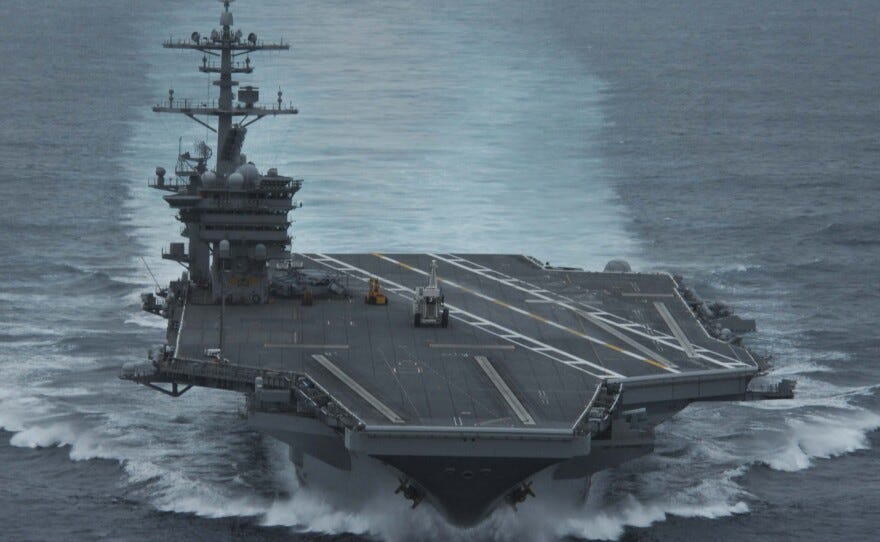
The USS Theodore Roosevelt left San Diego on January 17, 2020. Some sailors had shore leave at a port of call in Vietnam March 5-9. There seems to have been little interest in the question of how crew members were first infected or when “case zero” on the ship experienced symptoms. In a future article, I’ll point out that an “outbreak of norovirus” occurred on the ship Feb. 2-22. Only 382 of the ship’s 4,800 crew members “voluntarily” participated in the antibody study. At one time, officials said at least 1,000 crew members would participate in the antibody study.
BY BILL RICE, JR. | AUGUST 14, 2023
For a few weeks in early spring 2020, the drama of an outbreak of COVID-19 on the aircraft carrier USS Theodore Roosevelt was world news.
Inexplicably, however, journalists and Covid researchers missed or ignored several blockbuster findings that could re-write key (and, I believe, false) narratives about this novel virus. In this author’s opinion, this possibly represents an intentional disinformation campaign perpetrated by “trusted” Naval and public health officials.
A later antibody study of a sample of the ship’s crew members produced several eye-opening findings. In my view, two findings qualify as particularly significant:
Information contained in the study strongly suggests that at least two crew members (and most likely several other crew members) had already been infected with the novel coronavirus when the ship sailed from San Diego on January 17, 2020.
The date is significant as this would be three days before the CDC reported the first “confirmed” Covid case in America. (This case was “confirmed” on January 20, 2020 but the PCR sample was taken on January 18.)
Language in the Roosevelt study definitely “confirms” that at least two sailors, both of whom later tested positive for antibodies, experienced Covid symptoms between Jan. 12-17, 2020.
For more than three years, “official” Covid histories state the first “confirmed” case in America was a man from Washington who’d recently returned from Wuhan, China. As developed below, crew members of the USS Roosevelt could, in fact, be listed as “confirmed” cases and by themselves debunk the narrative that America’s first cases came from travelers returning from Wuhan.
The same antibody results suggest that at least 59.7 percent of the ship’s approximately 4,800 crew members had already been infected by mid to late April 2020. This means approximately 3,000 crew members had contracted the virus by this date.
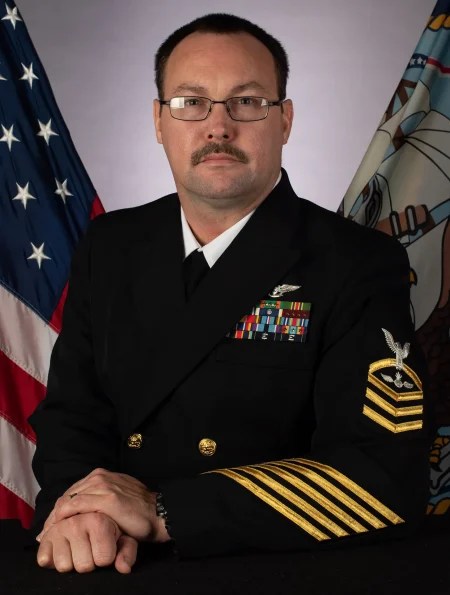
Sadly, Aviation Ordnanceman Chief Petty Officer Charles Robert Thacker Jr., 41, passed away on April 13, 2020 reportedly from complications of Covid. Officer Thacker tested positive for Covid March 30th and was in isolation in housing on Guam when he was found unresponsive April 9th. According to published reports, Thacker was receiving twice-a-day medical evaluations. He had gone to the Naval hospital in Guam on April 4th, but had been discharged back to his isolation quarters. It’s unclear how his medical condition deteriorated so rapidly without anyone knowing. It’s also unclear if he was staying by himself or with other sailors in isolation. I hope CDC and Navy officials can provide more details in a future interview, which I’ve requested. According to antibody and PCR test results, approximately 3,000 Roosevelt crew members were infected by Covid and Thacker was the only death. As of April 16, six of 4,800 crew members were hospitalized. Many sailors who were hospitalized seemed to have been hospitalized as a precaution, according to various press reports.
According to news reports, only one crew member, age 41, died from “complications of Covid.” (A future article will provide details that make me think the public hasn’t learned the full story of the death of Chief Petty Officer Charles Robert Thacker Jr.).
As the vast majority of Roosevelt crew members were under the age of 40, this one death reveals that the Infection Fatality Rate (IFR) for crew members under age 41 was 0.0000 percent.
In my opinion, the second big headline from this antibody study should have been: “Covid poses virtually no mortality risk to anyone middle age or younger … even in the worst and most intense spread environments.”
Instead, the prevailing narrative remained that Covid was a serious threat to “everyone” in the world, even though lessons from the Roosevelt proved this was not the case.
Two other naval vessels had ‘outbreaks’ where antibody tests
The above finding was further reinforced by two other “outbreaks” on military vessels from approximately the same time period.
Sixty percent of crew members on the French air craft carrier The Charles De Gaulle tested positive for antibodies after an outbreak said to have begun in March 2020.
According to this chart, 74.75 percent of crew members of this French aircraft carrier either had “confirmed” or “suspected” cases of Covid (60 percent of de Gaulle crew members tested positive for antibodies, the same percentage as the Roosevelt study)
None of the 1,739 sailors on the de Gaulle died. Also, an outbreak that infected at least 41 percent of the 333 crew members on the guided missile destroyer USS Kidd resulted in no deaths.
This means that Covid outbreaks that spread through three military ships between January – April 2020 – potentially affecting almost 7,000 Navy personnel – resulted in only one (presumed) Covid death.
According to results of antibody and PCR tests administered to crew members of these three Naval vessels, a total of 4,408 sailors were either “confirmed” or “probable/suspect” Covid cases.
As only one crew member died from Covid, the Infection Fatality Rate was 0.022 percent – which is significantly lower than the infection fatality rate for influenza (which is often reported as 0.1 percent).
Most news reports in the early months of the official pandemic said the IFR from Covid was between 1 and 4 percent, meaning that at least 1 in 100 people infected with this virus would later die from complications caused by this new and contagious virus.
However, among Naval personnel believed to have contracted this virus while serving on these three vessels, only 1 of 4,408 likely-infected sailors died from Covid.
Expressed as a fraction, the IFR for flu (0.1 percent) corresponds to 1 death in 1,000 flu cases. From this statistic, one could state that influenza is at least four times more deadly than Covid … at least among healthy young and middle-aged sailors.
It should also be emphasized that sailors on all three vessels lived with the virus in extremely-cramped quarters with the virus circulating for weeks or months. In other words, it’s hard to produce a more virulent environment for virus spread.
In the opinion of this journalist, neither of these two findings have received the attention they warrant. Study findings which should have been Page-1 news around the world have barely been cited by researchers, with most members of the public probably unaware of these two narrative-shifting findings.

See top graph … Figure 3 from the Roosevelt antibody study presents information on the number of sailors who tested positive for antibodies between April 20-24. The two cases on the far right would pre-date the fist confirmed Covid case in America. At least six antibody-positive crew members had symptoms before the ship’s port-of-call in Vietnam (March 5-9, 2020). The study does not address how these sailors – isolated and confined to the ship for many weeks – contracted the virus. Note also that most of the antibody positive sailors either did not test positive with a PCR test or had yet to receive a PCR test, which begs the questions of how and when these crew members contracted the virus their positive antibody tests say they’d definitely contracted. None of the positive sailors were interviewed by CDC or Navy officials.
Roosevelt Antibody Study key findings …
On April 20-24, 382 Roosevelt crew members “voluntarily” donated blood for antibody tests. (Positive results on an antibody tests show/suggest “prior infection.”)
Quick Comments:
- 382 crew members is only 7.9 percent of the crew of approximately 4,800.
- Earlier reports said the Navy and CDC were going to test at least 1,000 crew members for antibodies. I’ve never learned why the study was down-sized dramatically or wasn’t made mandatory, which one thinks might have been the case in time of an alleged medical crisis and world-wide pandemic.
– As I will show in a future article, 98.1 percent of the crew of the Charles de Gaulle were tested for antibodies.
60, 62 or “nearly” 66 percent infected …
All three figures are used in the Roosevelt study, with 60 percent being the most common percentage. From the study:
N = 382 – Survey respondents/participants
N = 228 positive (antibody) ELISA result (59.7 percent)
N = 238 had “previous or current Covid infection (62 percent)
One sentence in the study reads:
“Nearly two thirds of persons in this sample had positive ELISA test results, which indicate previous exposure to SARS-CoV-2.”
In my opinion, these could be labelled as ‘confirmed’ cases …
In several places in the study, authors define a “current or previous infection.” For example:
- “Current or previous SARS-CoV-2 infection is defined as a positive RT-PCR test result or a reactive antibody result determined by testing performed at CDC laboratories on specimens collected during April 20–24, 2020.”
“… (4) Previous or current SARS-CoV-2 infection was defined as a positive real-time RT-PCR result or positive ELISA (antibody) result.”
Quick comments:
Although different semantic interpretations might be offered, in my opinion, the above language says at least two Roosevelt cases should be “confirmed” as “early cases” that happened before the first “confirmed” case in America.
That is, all 228 sailors who tested positive via ELISA antibody tests satisfied the definition of individuals who had “current or previous” Covid infections. This figure would include the two sailors who tested positive and experienced Covid symptoms 98 and 99 days before receiving their antibody tests.
As far as I’m aware, this might be the only CDC study that defines a Covid case as someone who tested positive on an ELISA antibody test.
This language is extremely significant as hundreds of other early cases in the world could/might be “confirmed” if the same definitions used in the Roosevelt study also applied to these likely early cases.
Move the birthday of Covid spread up several months …
If this criteria applied to other likely/possible cases, the timeline of the “start date” of virus spread would be moved up at least three months. The first “confirmed cases” would be November 2019, or October 2019 if not September 2019 … but certainly not January 20, 2020.
For example, I’ve identified many Americans – as well as citizens from France, Italy and the UK – who tested positive via antibody tests (including several/many who tested positive with ELISA antibody tests). These possible/likely cases include many citizens who experienced Covid symptoms in late 2019. None of these citizens have been “confirmed” as Covid cases.
Almost all other studies define or confirm Covid cases as individuals who tested positive via a PCR test. As almost no PCR tests were administered to Americans prior to March 2020, it is literally impossible to “confirm” an early case via the “PCR-positive” confirmation protocol.
Again, modifying the definition of “previously-infected” individuals to include those who tested positive via an antibody test should be viewed as very significant and represents a stark departure from other CDC statements.
Symptoms and symptom onset dates matter …
Significantly, Roosevelt study participants filled out questionnaires, providing information on when sailors experienced Covid/ILI symptoms. Participants reported what symptoms they experienced, how many symptoms and, most significantly, self-reported dates where they first experienced these symptoms. (Most antibody-positive sailors experienced at least four symptoms; many experienced six or more symptoms).
The data that immediately jumped out to me (but apparently no one else) was the two crew members who self-reported symptoms 99 and 98 days before donating blood for this serology test (donation dates were April 20-24, 2020).
Working backward from April 20-24, 2020, the crew member who experienced symptoms 99 days before donating blood would have been symptomatic January 12-16, 2020. The sailor who experienced symptoms 98 days earlier would have been symptomatic January 13-17.
Comments:
Inexplicably, Navy and CDC medical personnel did not interview either of these sailors, both of whom could/would have qualified as “case zero” in America. In fact, no sailor in the survey was questioned about their symptoms.
From study: “… although the date of any symptom onset was collected, information on timing, duration, and severity of individual symptoms was not collected.”
“Symptom onset” typically occurs two to 14 days after infection. This means these two sailors, if they had Covid, were infected even earlier in January. For the sailor who experienced symptoms 99 days earlier, the infection date could have been between December 29, 2019 and January 15, 2020.
While the ship left San Diego January 17, 2020, I’ve yet to learn when sailors began to board the ship. My assumption is sailors boarded the ship at least several days before the ship got underway to prepare for its deployment, which lasted approximately 70 days.
If any crew members were symptomatic or infected with Covid on or before January 17, these crew members would almost certainly have begun to infect any “close contacts” who didn’t already have natural immunity.
(The possibility some crew members might have already been infected as early as November 2019, or perhaps even earlier, does not seem to have been considered by any public health official or journalist. At least to me, The Red Cross antibody study proves that residents of California had been infected by November 2019. If this was the case with some Roosevelt crew members, these crew members would likely have come on board the ship with natural immunity.)
In my opinion, if the CDC and Navy had tested the vast majority of the crew for antibodies, and these crew members had also filled out symptom questionnaires, the number of possible cases pre-dating the first confirmed case in America would have been much larger than two possible American “case zeroes.”
That is, by severely limiting the size of this antibody study, CDC and Navy authors limited the number of other possible early cases the study might have identified.
At least four other crew members who tested positive for antibodies (six in total) self-reported symptoms before the ship arrived at port in Vietnam Mach 5-9.
Twelve crew members who later tested positive for antibodies self-reported symptoms 41 or more days before giving blood for their antibody tests. Again, if the study size was much larger, many more sailors would have likely reported “symptom onset” dates before the ship’s port of call in Vietnam, as well as other crew members who were perhaps infected prior to January 20, 2020.
MORE DISCUSSION …
I can’t say the Navy/CDC “concealed evidence” of early spread because the information that made me suspect this is included in the study. Indeed, the key information is depicted on a graph (“Figure 3”) of the study. Also, text in the study makes this conclusion almost impossible to miss. For example:
“Among 12 participants with positive ELISA results >40 days after symptom onset, eight maintained positive microneutralization test results, including two participants who were tested >3 months after symptom onset.”
The Roosevelt antibody study, which was published online on June 8, was covered by prominent news organizations, including The New York Times and Reuters. The NY Times actually put the key information in its sub-headline:
Headline: “After Outbreak on Carrier Roosevelt, Many Have Antibodies”
Sub-headline: “A C.D.C. study found that some sailors showed protection against the coronavirus three months after the onset of symptoms”
FWIW, the sub-headline is not entirely accurate as 99 and 98 days would be “more than three months” after onset of symptoms. I mention the Times’ headline only to point out that no Times’ journalist or editor seems to have figured out that the first known case in America could have been a member of this ship (although the newspaper’s own headline should have told them this).
The story also quotes the study’s corresponding author Daniel Payne, who highlighted the fact some crew members had apparently had Covid antibodies for several months. (I have requested an interview with Dr. Payne).
“This is a promising indicator of immunity,” said Daniel C. Payne, an epidemiologist and one of the lead authors of the study … “We don’t know how long-lasting, for sure, but it is promising.”
Previous stories mentioned the growing number of “positive cases” on the ship, but none reported anywhere close to 60 percent of the crew being infected. For example, by April 21 (one day after the antibody tests had begun), 678 sailors had tested positive via a PCR test (14.1 percent of the crew).
Reuters’ journalist correctly highlighted the fact the study’s “results could indicate a far higher presence of the coronavirus.”
However, the journalist seems to de-amplify the significance of such a large percentage of positives with this latter text:
“… one of the Navy officials said that may not be the case because of the way the study was carried out … The outbreak investigation did not encompass the entire crew, and the results of this study cannot be generalized to the entire crew,” the official said.
The article later includes this disclaimer: “Medical groups, such as the American Medical Association, have warned that serology tests can lead to false positives.”
Like all journalists who wrote articles about this study, the Reuters reporter never asked why the project didn’t encompass the entire crew nor does this journalist question the assumed predicate (that a larger sample might have produced lower antibody-positive percentages than the study/sample that was performed. As noted, a sample of almost 100 percent of French sailors produced the identical percentage of antibody positives – 60 percent).
Nor do the journalists challenge the AMA’s statement that antibody tests “can” produce “false positives.” The author and the AMA could have noted, accurately, that serology tests “can” also lead to false negatives.
That is, if antibody tests are producing more “false negatives” than “false positives,” serology “prevalence” percentages in many/most antibody studies might be even higher than reported.
Such (requisite?) sentences support my belief that any antibody test that suggests much higher percentages of “early” cases will be routinely maligned or spun as being somehow insignificant.
One of the most disturbing take-aways from my “early spread” research is that, as far as I can tell, 100 percent of mainstream or corporate journalists, are not going to investigate credible evidence of early spread.
I understand why government and public health officials might want to cover-up evidence their “virus-origins” narrative was wrong all along, but I don’t understand why the “skeptical, watchdog” press would participate in what must be a massive conspiracy to conceal the truth.
I’ve harvested too much previously-unreported information from my research into Navy ship antibody studies to include in one article. Future articles will highlight other findings which have received little or no scrutiny to date – findings I believe deserve scrutiny, even if belated.
***
AUTHOR’S NOTE: Anyone with relevant information about the outbreak on the Roosevelt or any Naval vessel can email the author at: wjricejunior@gmail.com.
I would be very interested to hear from any Roosevelt crew members. Confidentiality will be protected.
American Pravda: Why the Media Fears RFK Jr.
Investigating the Sounds of Silence
BY RON UNZ • UNZ REVIEW • AUGUST 14, 2023
Avoiding Kennedy Assassination Conspiracies
Last week the New York Times ran a lengthy front-page hit-piece against Robert F. Kennedy Jr., scion of America’s most famous political family and an underdog challenger to President Joseph Biden in the Democratic Primaries.
Kennedy’s unexpectedly strong campaign had recently stumbled when the novice candidate made some incautious remarks at a private dinner regarding the ethnic skew of Covid vulnerability, and a video clip of his explosive words touched off a media feeding-frenzy. The Times and the rest of the mainstream media are intensely hostile to Kennedy’s effort and the editors may have hoped that this piling-on attack might permanently cripple his fledgling campaign.
- Anguish in Camelot: Kennedy Campaign Roils Storied Political Family
Peter Baker • The New York Times • August 6, 2021 • 2,600 Words
Probably few readers, whether Kennedy supporters or opponents, found anything unexpected in the article authored by Chief White House Correspondent Peter Baker. Near the beginning, we were told that Kennedy “has become a source of deep anguish among his many siblings, cousins, nieces, and nephews.” The candidate was described as a former drug-addict, expelled from his private schools, who had been married three times and whose second wife had committed suicide. Meanwhile, almost any mention of the great accomplishments in his long and successful career as an environmental attorney were left on the cutting-room floor.
The main focus of the piece was Kennedy’s frayed relations with his extended family, die-hard Democrats all, who were bewildered and saddened by the strange and self-destructive political behavior of their errant relative. The text was heavily laced with harshly negative quotes regarding his beliefs—“deplorable and untruthful” according to his sister Kerry Kennedy, “morally and factually wrong” by his brother Joseph P. Kennedy II, while his nephew Joseph P. Kennedy III Tweeted “I unequivocally condemn what he said.” The article opened with a denunciation by the only grandson of President John F. Kennedy, who declared that his “conspiracy-minded” cousin was “tarnishing the legacy of his grandfather and their storied family” with his “vanity project.” I counted a total of 13 different Kennedys cited in the piece, almost all of them providing these sorts of unflattering remarks.
The entire tone of the article was unrelentingly negative and clearly intended to present the dissenting Democratic candidate as someone who held bizarre beliefs or was even unhinged, definitely not an individual to be entrusted with our nation’s future. I’d assume that the Democratic Party’s lavishly-funded corps of opposition researchers have carefully parsed every spoken or written word of Kennedy for the last couple of decades and then gifted the choicest morsels they uncovered to their numerous media allies including the Times.
Thus, we can safely assume that every misstep or bit of dirt about Kennedy would have been discovered by now, allowing us to draw some important inferences from any silence. So as I carefully read the Times article, I focused not so much on what it contained but rather what it strangely omitted.
Over the years, Kennedy has publicly and repeatedly declared that both his father and his uncle had died at the hands of a conspiracy, pointing to the CIA as the most likely culprit. Probably at least a couple of million Americans have read his words or listened to his interviews, clearly establishing him as the most explicit sort of “conspiracy theorist,” a highly pejorative term that the media always eagerly seeks to inflict upon disfavored political candidates.
Yet across the full 2,600 words of the article, most of it heavily focused upon Kennedy family matters, mention of that topic was limited to just a single glancing sentence. Why would the Times have almost entirely avoided such a tempting target, one that seemingly supported its portrayal of Kennedy as holding bizarre and irrational beliefs? I think that the best explanation is that the editors knew perfectly well that Kennedy’s facts were rock-solid on that issue, and that challenging him would merely bring his information to much wider attention, perhaps leading many additional millions of Americans to conclude that their own media had been lying to them for six decades just as Kennedy himself had Tweeted out last year:
Only a week before sending that Tweet, Kennedy had published a long piece in the San Francisco Chronicle presenting the incontrovertible facts of his own father’s killing, and if these came to widespread attention, decades of media lies might begin to unravel.
- Sirhan Sirhan didn’t kill my father. Gov. Newsom should set him free
Robert F. Kennedy Jr. • The San Francisco Chronicle • December 8, 2021 • 1,000 Words
Consider, for example, prominent liberal pundit Bill Maher, someone who would certainly never classify himself as a “conspiracy theorist.” When he interviewed Kennedy a few weeks ago and heard the factual evidence regarding the assassination of the candidate’s father in 1968, he immediately declared himself completely convinced that Kennedy was correct about the existence of a conspiracy.
Moreover, the particular focus of the Times article would have put the newspaper on especially risky ground. With thirteen different members of the Kennedy family mentioned or quoted in the text, any substantial discussion of the 1960s assassinations might reveal that many or most of Kennedy’s relatives fully agreed with the candidate about the existence of a conspiracy, thereby blowing a huge hole in the media’s decades-long blockade of the truth. If the American people discovered that the entire Kennedy family was filled with “Kennedy assassination conspiracy theorists,” tens of millions of minds might be changed.
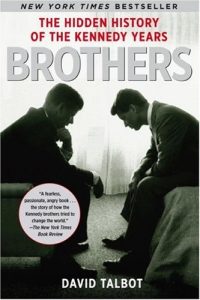 Consider another piece published a couple of months earlier by Times columnist Michelle Goldberg, which had appeared as part of a large barrage of media attacks and insults against the conspiratorial beliefs of Kennedy and his supporters. Although she treated his views on the assassinations as an element of his irrationality, she couldn’t help mentioning that Salon founder David Talbot, her old boss and a highly-regarded national journalist, entirely agreed with Kennedy about those historical facts.
Indeed, I regard Talbot’s 2005 national bestseller Brothers as probably the most important Kennedy assassination book of the last twenty years because it revealed that so many individuals near the top of the American government, including most of the Kennedy family itself, had almost immediately concluded that our 35th President died in a conspiracy. A leading mainstream historian lavishly praised Talbot’s research in the Times itself and suggested that the existence of a conspiracy was obvious. But the editors running the Times news pages have continued to avert their eyes from these facts, perhaps leading their younger colleagues such as Goldberg to remain blissfully unaware.
Totally Ignoring Kennedy’s AIDS Denialism
When hostile journalists seek to destroy a candidate, they naturally direct their coverage where they believe he is most vulnerable and do their best to ignore his greatest strengths. A shrewd campaign might use such biased reporting as a road-map, one that provides the photographic negative of the issues that should be emphasized. So if the Times and other media outlets seek to avoid the Kennedy assassination conspiracies, perhaps those are exactly the right issues to discuss.
But there is another incendiary topic on which the silence surrounding Kennedy’s position has been far more absolute across both the mainstream and the alternative media, so much so that probably only the tiniest sliver of Americans are even aware of Kennedy’s views. Based upon his extremely controversial writings, the candidate would seem so tremendously vulnerable that any such media coverage would immediately destroy his campaign and his reputation. Yet not a single hostile publication has ever reported those facts, suggesting that the true situation is actually quite different from what it appears to be. Perhaps this total silence implies that the Times and other media outlets dread that subject, fearing that it could destroy their entire media establishment if the facts came out and Kennedy were proven correct.
Until late 2021 I’d been only slightly aware of Kennedy, having vaguely heard that he’d become a leading figure in the growing anti-vaxxing movement. My own views on vaccines had always been quite conventional, not too different from those advocated by the Times, but I was persuaded to read his new book in order to get his side of the story.
To my utter amazement I discovered that the main subject of his text was something entirely different than what I had been led to believe. Kennedy had devoted nearly half the length—200 pages—to promoting the theory that AIDS did not exist as a real disease and was instead merely a medical media hoax concocted by Dr. Anthony Fauci and his greedy corporate allies. But not a single one of those describing his book, whether supportive or critical, had ever hinted at this. Indeed, when I mentioned the true subject of Kennedy’s text to a couple of people, they almost seemed to think that I was delusional, considering it impossible that no one would have revealed such a startling fact.
Kennedy’s book quickly became the #1 Amazon bestseller and he soon drew extremely harsh media attacks, including a 4,000 word article produced by a large team of Associated Press journalists. But as I noted, although they denounced him on every other point none of them ever mentioned his explosive AIDS claims.
A great deal of effort had obviously been invested in this attack, and the byline of the named author was shared by five additional AP writers and researchers, underscoring the journalistic resources devoted to demolishing the reputation of an individual who has obviously made such powerful enemies. But in reading the article, the phrase that came to my mind was “the Sounds of Silence” or perhaps the famous Sherlockian clue of “the Dog That Didn’t Bark.”
Almost half of the entire book under attack—around 200 pages—is devoted to presenting and promoting the astonishing claim that everything we have been told about HIV/AIDS for more than 35 years probably amounts to a hoax.
By any reasonable standard, Robert F. Kennedy, Jr. has now established himself as America’s #1 “HIV/AIDS Denier,” and prior to the Covid outbreak, AIDS had probably spent almost four decades as the world’s highest-profile disease, reportedly absorbing some two trillion dollars in research and treatment costs. So for someone to essentially claim that the disease doesn’t actually exist would seem the height of utter lunacy, on a par with Flat Earthism. Yet not a single word of this astonishing situation appears in the long AP article, that attacks Kennedy on almost all other possible grounds, fair or unfair. Did all six of the AP writers and researchers somehow skip over those 200 pages in Kennedy’s bestseller?
That large team of AP journalists seems to have spent at least ten days working on their lengthy article, mining Kennedy’s record for almost everything controversial they could possibly find, even highlighting a photograph that merely shows him standing next to Trump allies Roger Stone and Michael Flynn.
- How a Kennedy Built an Anti-Vaccine Juggernaut Amid COVID-19
Michelle R. Smith et. al. • The Associated Press • December 15, 2021 • 4,000 Words
I noticed this same total silence about AIDS was maintained in a similar attack the following month by the managing editor of Counterpunch.
- Vaccines, RFK Jr. and The Science of Misinformation
Joshua Frank • Counterpunch • January 14, 2022 • 1,900 Words
With Kennedy’s book passing the million mark in sales and his influence still growing, this pattern of omission continued and became even stranger. In late February, the New York Times launched a blistering front-page attack against him, tarring the author and his book as a font of total irrationality and dangerous misinformation, but the 2,600 words never hinted at his central focus on AIDS.
Moreover, the writer was longtime Times journalist Adam Nagourney, identified as the co-author of a history of the modern Gay Rights movement, and surely the AIDS epidemic must have been a central part of his research for that 2001 volume. But he never mentioned the 200 pages in which Kennedy had made the incendiary claim that AIDS was just a medical media hoax, an omission perhaps suggesting that he feared that Kennedy might well be correct and that certain doors should be kept firmly closed.
- A Kennedy’s Crusade Against Covid Vaccines Anguishes Family and Friends
Adam Nagourney • The New York Times • February 26, 2022 • 2,600 Words
As I later noted, this silence very suspiciously contrasted with the firestorms of media outrage that had once greeted those who raised even mild doubts about the AIDS issue.
Since the 1980s AIDS has been an explosive topic in the public sphere, and anyone—whether scientist or layman—who questioned the orthodox narrative was viciously denounced as having blood on his hands. During the early 2000s South African President Thabo Mbeki had cautiously raised such possibilities and was massively vilified by the international media and the academic community. Yet when Kennedy’s #1 Amazon bestseller went much farther, devoting seven full chapters to making the case that HIV/AIDS was merely a medical hoax, his media antagonists carefully avoided that subject even while they attacked him on all other grounds.
Once again, the only plausible explanation is that the hostile journalists and their editors have recognized that Kennedy’s factual evidence was too strong and any such attacks might prove disastrously counter-productive. As far back as the 1990s, a former Harvard professor had publicly declared that the AIDS hoax was as great a scientific scandal as the notorious Lysenko fraud, and if a substantial portion of the American public concluded that AIDS was indeed a medical phantom that had been promoted for 35 years by our gullible and dishonest media, the credibility of the latter on current vaccination issues might be completely annihilated.
It would have been the easiest thing in the world for the media to accurately blast Kennedy as “a conspiracy theorist whose book claims that AIDS is a hoax,” and that simple, short phrase would have immediately dealt a massive body-blow to his public reputation. But many people would then have begun looking into the facts, and once they did so, the tables might have quickly turned, destroying the credibility of his critics. The total silence of the media suggests that they greatly feared that possibility.
Understanding the Bitter HIV/AIDS Controversy
After reading Kennedy’s book in December 2021, I published a long and favorable review, which attracted a great deal of readership and squarely emphasized his heretical AIDS claims, thereby finally bringing them into the public square. Websites closely allied with Kennedy highlighted my piece so it seems unlikely that any of his media adversaries could have still remained unaware.
As all of us know from the media, AIDS is a deadly auto-immune disease that was first diagnosed in the early 1980s, primarily afflicting gay men and intervenous drug users. Transmitted by bodily fluids, the disease usually spread through sexual activity, blood transfusions, or the sharing of needles, and HIV, the virus responsible, was finally discovered in 1984. Over the years, a variety of medical treatments were developed, mostly ineffective at first, but more recently so successful that although being HIV-positive was once considered a death-sentence, the infection has now become a chronic, controllable condition. The current Wikipedia page on HIV/AIDS runs more than 20,000 words, including over 300 references.
Yet according to the information provided in Kennedy’s #1 Amazon bestseller, this well-known and solidly-established picture, which I had never seriously questioned, is almost entirely false and fraudulent, essentially amounting to a medical media hoax. Instead of being responsible for AIDS, the HIV virus is probably harmless and had nothing to do with the disease. But when individuals were found to be infected with HIV, they were subjected to the early, extremely lucrative AIDS drugs, which were actually lethal and often killed them. The earliest AIDS cases had mostly been caused by very heavy use of particular illegal drugs, and the HIV virus had been misdiagnosed as being responsible. But since Fauci and the profit-hungry drug companies soon built enormous empires upon that misdiagnosis, for more than 35 years they have fought very hard to maintain and protect it, exerting all their influence to suppress the truth in the media while destroying the careers of any honest researchers who challenged that fraud. Meanwhile, AIDS in Africa was something entirely different, probably caused mostly by malnutrition or other local conditions.
I found Kennedy’s account as shocking as anything I have ever encountered.
In 1985 AZT, an existing drug, was found to kill the HIV virus in laboratory tests. Fauci then made tremendous efforts to speed it through clinical trials as an appropriate treatment for healthy, HIV-positive individuals, with FDA approval finally coming in 1987, producing Fauci’s first moment of triumph. Priced at $10,000/year per patient, AZT was one of the most expensive drugs in history, and with the cost covered by health insurance and government subsidies, it produced an unprecedented financial windfall for its manufacturer.
Kennedy devotes an entire chapter to the story of AZT, and the tale he tells is something out of Kafka or perhaps Monty Python. Apparently, Fauci had been under enormous pressure to produce medical breakthroughs justifying his large budget, so he manipulated the AZT trials to conceal the extremely toxic nature of the drug, which rapidly killed many of the patients who received it, with their symptoms being ascribed to AIDS. So following FDA approval in 1987, hundreds of thousands of perfectly healthy individuals found to be infected with HIV were placed on a regimen of AZT, and the large number of resulting deaths was misattributed to the virus rather than to the anti-viral drug. According to the scientific experts cited in the book, the vast majority of post-1987 “AIDS deaths” were actually due to AZT.
Prior to the Covid outbreak, AIDS had spent almost four decades as the world’s highest-profile disease, absorbing perhaps a couple of trillion dollars of funding and becoming the central focus of an army of scientists and medical experts. It simply boggles the mind for someone to suggest that HIV/AIDS might have largely been a hoax, and that the vast majority of deaths were not from the illness but from the drugs taken to treat it.
My science textbooks sometimes mentioned that during the benighted 18th century, leading Western physicians treated all manner of ailments with bleeding, a quack practice that regularly caused the deaths of their patients, with our own George Washington often numbered among the victims. Indeed, some have argued that for several centuries prior to modern times, standard medical treatments inadvertently took far more lives than they saved, and those too poor or backward to consult a doctor probably benefited from that lack. But I had never dreamed that this same situation might have occurred during the most recent decades of our modern scientific age.
From reading the newspapers during the early 1990s, I had been dimly aware of the dispute regarding the true nature of AIDS, but had never paid much attention to the controversy at the time. So when the media coverage faded away, I assumed that the debate had been successfully resolved.
But according to Kennedy’s #1 Amazon bestseller, this was not the case. He claimed that for three decades the entire Western media has been promoting and maintaining a gigantic medical hoax, a conspiracy orchestrated by Dr. Anthony Fauci and his greedy corporate allies that had cost the lives of many hundreds of thousands of Americans.
Such bizarre accusations seemed almost impossible to me, more like the ranting of a deranged lunatic than anything that could happen in the real world. But the case he laid out across his 200 pages of text was a surprisingly persuasive one.
Extraordinary claims obviously require extraordinary evidence. Kennedy’s chapters on AIDS include more than 900 source-references, many of them to academic journal articles or other supposedly authoritative scientific information. But although I have a strong science background, with my original academic training having been in theoretical physics, I am not a medical doctor nor a virologist, let alone someone with specialized expertise in AIDS research, and these articles would mean nothing to me even if I had attempted to read them. So I was forced to seek other indications that Kennedy’s 200 pages on AIDS represented something more than sheerest lunacy.
His book carries glowing praise from a long list of medical doctors and scientists, but their names and backgrounds are completely unknown to me, and with nearly a million practicing physicians in America, a few could surely be found to endorse almost anything. However, the first endorsement on the back cover is from Prof. Luc Montagnier, the medical researcher who won a Nobel Prize for discovering the HIV virus in 1984, and he writes: “Tragically for humanity, there are many, many untruths emanating from Fauci and his minions. RFK Jr. exposes the decades of lies.” Moreover, we are told that as far back as the San Francisco International AIDS Conference of June 1990, Montagnier had publicly declared “the HIV virus is harmless and passive, a benign virus.”
Perhaps this Nobel Laureate endorsed the book for other reasons and perhaps the meaning of his striking 1990 statement has been misconstrued. But surely the opinion of the researcher who won a Nobel Prize for discovering the HIV virus should not be totally ignored in assessing its possible role.
And he was hardly alone. Kennedy explains that the following year, a top Harvard microbiologist organized a group containing some of the world’s most distinguished virologists and immunologists and they issued a public statement, endorsed by three additional science Nobel Laureates, that raised the same questions:
It is widely believed by the general public that a retrovirus called HIV causes a group of diseases called AIDS. Many biomedical scientists now question this hypothesis. We propose a thorough reappraisal of the existing evidence for and against this hypothesis, to be conducted by a suitable independent group. We further propose that the critical epidemiological studies be designed and undertaken.
As Kennedy tells the story, by that point AIDS researchers and the mainstream media were completely in thrall to the ocean of government funding and pharmaceutical advertising controlled by Fauci and his corporate allies, so these calls by eminent scientists were almost entirely ignored and unreported. According to one journalist, some two trillion dollars has been spent on HIV/AIDS research and treatment over the decades, and with so many research careers and personal livelihoods dependent upon what amounts to an “HIV/AIDS industrial-complex,” few have been willing to critically examine the basic foundations of that empire.
Until a couple of weeks ago, I had never given any thought to questioning AIDS orthodoxy. But discovering the longstanding scientific skepticism of so many knowledgeable experts, including four Nobel Laureates, one of them the actual discoverer of the HIV virus, has completely shifted my perspective. I cannot easily ignore or dismiss the theories Kennedy presents, but can only briefly summarize them and leave it to individual readers to investigate further then decide for themselves. And in basic fairness to the author, he himself also repeatedly emphasizes that he can “take no position on the relationship between HIV and AIDS” but is simply disturbed that Fauci has successfully used his government funding and media clout to suppress an ongoing and perfectly legitimate scientific debate. According to Kennedy, his book is intended “to give air and daylight to dissenting voices.”
His narrative of the origins of the HIV/AIDS connection is absolutely stunning and seems well-documented. Dr. Robert Gallo, an NIH researcher in Fauci’s orbit, originally announced HIV as the apparent cause of AIDS at a packed 1984 press conference, which he held before any of his supportive research findings had actually been published and reviewed by his scientific peers. Only long after the theory had become firmly embedded in the national media did it come out that only 26 of the 76 AIDS victims in his seminal study showed any traces of the HIV virus, an extremely slender reed for such a momentous conclusion.
Furthermore, critics eventually noted that many thousands of documented AIDS victims similarly lacked any signs of the HIV virus, while millions of those infected by HIV exhibited absolutely no symptoms of AIDS. Correlation does not imply causality, but in this case, even the correlation seemed a very loose one. According to Kennedy, fully orthodox AIDS researchers grudgingly admit that no scientific study has ever demonstrated that HIV causes AIDS. The widespread accusations of serious scientific misbehavior and outright intellectual theft that long swirled around Gallo’s laboratory research were eventually confirmed by legal proceedings, and that helped explain why his name was not included on the Nobel Prize for the HIV discovery.
AIDS had originally come under the purview of the National Cancer Institute, but once it was blamed on a virus, Fauci’s own infectious disease center managed to gain control. That resulted in an enormous gusher of Congressional funding and media attention for what had previously been a sleepy and obscure corner of the NIH, and Fauci soon established himself as America’s reigning “AIDS Czar.” The HIV-AIDS link may or may not be scientifically valid, but it carried enormous political and financial implications for Fauci’s career.
One of the major scientific heroes in Kennedy’s account is Prof. Peter H. Duesberg of Berkeley. During the 1970s and 1980s, Duesberg had been widely regarded as among the world’s foremost virologists, elected to the prestigious National Academy of Sciences at age 50, making him one of its youngest members in history. As early as 1987 he began raising serious doubts about the HIV/AIDS hypothesis and highlighting the dangers of AZT, eventually publishing a series of journal articles on the subject that gradually won over many others, including Montagnier. In 1996 he published Inventing the AIDS Virus, a massive 712 page volume setting forth his case, with the Foreword provided by Nobel Laureate Kary Mullis, the renowned inventor of PCR technology and himself another leading public critic of the HIV/AIDS hypothesis. Duesberg even underscored the confidence of his HIV skepticism by offering to be injected with HIV-tainted blood.
But rather than openly debate such a strong scientific opponent, Fauci and his allies blacklisted Duesberg from receiving any government funding, thereby wrecking his research career, while also vilifying him and pressuring others to do the same. According to fellow researchers quoted by Kennedy, Duesberg was destroyed as a warning and an example to others. Meanwhile, Fauci deployed his influence to have his critics banned from the major national media, ensuring that few outside a narrow segment of the scientific community ever even became aware of the continuing controversy.
-
- American Pravda: Vaxxing, Anthony Fauci, and AIDS
Ron Unz • The Unz Review • December 6, 2021 • 6,100 Words
- American Pravda: Vaxxing, Anthony Fauci, and AIDS
Investigating the Duesberg Hypothesis on HIV/AIDS
I subsequently spent several weeks carefully reading the arguments of Duesberg and his scientific allies as well as those of their opponents, and then described the results of my inquiry:
So the theory I needed to investigate amounted to the Duesberg Hypothesis, the long-suppressed challenger to our reigning HIV/AIDS orthodoxy.
Fortunately for my purposes, scientific heresies starved of research funding and blacklisted from leading journals tend to produce a very manageable body of work. The annual billions spent on orthodox AIDS research has spawned well over 100,000 academic journal articles, more than a diligent reader could digest in a dozen lifetimes. But the most recent academic publication I could locate on the other side was a lengthy review article published eighteen years ago by Duesberg and two of his collaborators. Indeed, according to their Epilogue, the authors had spent several years struggling to get their article into print against the unremitting hostility of the reigning AIDS establishment, which had successfully pressured two previous journals into cancelling publication.
- The chemical bases of the various AIDS epidemics: recreational drugs, anti-viral chemotherapy and malnutrition (PDF)
Peter Duesberg, Claus Koehnlein, and David Rasnick • Journal of Bioscience • June 2003 • 24,000 WordsAlthough I have a strong scientific background, I lack the necessary expertise in medicine or microbiology to properly evaluate their paper. But reading it carefully as a layman, I found it solid and persuasive, certainly worthy of publication. And when I passed it along to someone with a professional medical background, he considered it extremely impressive, a convincing exposition of the authors’ revolutionary thesis.
One of Duesberg’s central claims was that the disease known as “AIDS” didn’t actually exist, but was merely the official label attached to a group of more than two dozen different illnesses, all of which had a variety of different causes, with only some of these being infectious agents. Indeed, most of these illnesses had been known and treated for many decades, but they were only designated “AIDS” if the victim was also found to test positive for the HIV virus, which probably had nothing to do with the condition.
In support of their contrary position, the authors noted that the various groups at high risk for “AIDS” only tended to get particular versions of the disease, with the “AIDS” suffered by hemophiliacs usually being very different from the “AIDS” of African villagers and only slightly overlapping with the diseases of gay men or intervenous drug addicts. Indeed, the pattern of “AIDS” in Africa seemed utterly divergent from that in the developed world. But if all these different illnesses were actually caused by a single HIV virus, such completely disparate syndromes would seem puzzling anomalies, difficult to explain from a scientific perspective.
In 2009, a half-dozen years after the publication of that lengthy article, an independent film-maker named Brent Leung produced a 90 minute documentary on AIDS, strongly sympathetic to Duesberg’s thesis, and someone recently brought it to my attention. There is a great paucity of pro-Duesberg material, so although I only rarely find videos useful sources of information, this case was an important exception. The film highlighted the tremendous inconsistencies of the orthodox scientific position, and also included important interviews with Duesberg, Mullis, Fauci, and numerous other key researchers and journalists on all sides of the debate. The entire documentary is conveniently available on Youtube, so those interested can watch it and decide for themselves.
Journalist John Lauritsen had been covering the HIV/AIDS controversy for decades, writing two books on the subject and serving as an important source for Kennedy’s own work. He recently joined one of the discussion-threads on our website, and suggested that I republish his 2018 conference talk, which usefully summarized the history and current state of the issue.
- Making Our Case In the Battle for Truth
Challenging Avaricious Viral Paradigms
John Lauritsen • Vers Pont du Gard Conference • June 16, 2018 • 2,500 WordsAlthough I found all this pro-Duesberg material helpful in fleshing out the arguments, most of it overlapped with the contents of the Kennedy book, and the analysis was necessarily one-sided. Under pressure of the medical establishment and its AIDS lobby, the mainstream media has almost entirely shut its doors to any dissent on the issue and refuses to engage the critics, instead seeming to rely upon the blacklist and the boycott. This suggested the relative weakness of the orthodox case, but lacking the give-and-take of argument and counter-argument, I could not easily weigh the strength of the two sides. Fortunately, I discovered that this situation had been quite different in the past.
I spent most of the early 2000s creating a content-archiving system that includes near-complete collections of a couple of hundred of our leading opinion magazines of the last 150 years, those influential publications that have shaped our understanding of the world. The project was nearly a total failure since very few people have ever used it, but it still comes in handy when I want to investigate something, and I easily located a long list of articles focused on the Duesberg Hypothesis, most of them from the 1990s. During that period, the iron wall of censorship had not yet come down, and the topic had been widely and respectfully treated in major publications.
I carefully read more than a dozen of the most substantial articles, all of which had appeared in fully mainstream and respectable liberal, conservative, and libertarian periodicals. One major surprise was how little the debate seemed to have changed. The evidence and arguments that Duesberg and his scientific allies had been making thirty years ago seemed remarkably similar to what was presented in Kennedy’s book published only just last month.
The Summer 1990 issue of Policy Review, one of America’s most sober and influential conservative policy journals, had offered Duesberg and a co-author a platform for the controversial theory, and their resulting piece ran nearly 9,000 words. According to the editor, this topic provoked more letters and responses—both positive and negative—than anything in the publication’s history, and became one of their most talked-about articles. As a result, the next issue of the quarterly featured some of those reactions as well as the replies of the two authors, with the entire exchange running almost 13,000 words.
- Is the AIDS Virus a Science Fiction? (PDF)
Immunosuppressive Behavior, not HIV, May Be the Cause of AIDS
Peter H. Duesberg and Bryan J. Ellison • Policy Review • Summer 1990 • 8,800 Words- Is HIV the Cause of AIDS? (PDF)
Critics Respond • Policy Review • Fall 1990 • 12,700 WordsSeveral years later, a similar development unfolded at Reason, the glossy flagship publication of America’s libertarian movement. The magazine ran a long cover story endorsing Duesberg’s claims and authored by three of his scientific allies, one of them a former Harvard Medical School professor and another a recent Nobel Laureate. Once again the result was a huge outpouring of both supportive and critical reactions, and the lengthy debate was published in a subsequent issue.
- What Causes AIDS? (PDF)
We still don’t know what causes AIDS
Charles A. Thomas Jr., Kary B. Mullis, and Phillip E. Johnson • Reason • June 1994 • 4,600 Words- What Causes AIDS? The Debate Continues (PDF)
Critics Respond • Reason • December 1994 • 9,100 WordsThe Lancet is one of the world’s leading medical journals and in 1996, the year after he become its chief editor, Richard Horton took to the pages of the intellectually-prestigious New York Review of Books to produce a 10,000 word discussion of Duesberg’s theories, as propounded in three of the researcher’s recent books and collections. Horton was obviously among the most respectable of establishmentarian figures, but although he mostly came down in support of the orthodox HIV/AIDS consensus, he presented Duesberg’s entirely contrary perspective in a fair-minded manner, respectfully though not uncritically.
However, what struck me most about Horton’s account was how appalled he seemed at Duesberg’s treatment by America’s ruling medical-industrial complex, as suggested by his title “Truth and Heresy about AIDS.”
The very first sentence of his long review article mentioned the “vast academic and commercial industry built around…HIV” along with the fundamental challenge Duesberg posed to its scientific basis. As a consequence, the “brilliant virologist” had become “the most vilified scientist alive” and the subject of “excoriating attacks.” The leading professional science journals had displayed an “alarmingly uneven attitude,” and partly as a consequence, other potential dissidents had been dissuaded from pursuing their alternative theories.
According to Horton, financial considerations had become a central element of the scientific process, and he noted with horror that a press conference on research questioning the effectiveness of a particular anti-AIDS drug was actually packed with financial journalists, focused on the efforts of the corporate executives to destroy the credibility of a study that they themselves had helped to design but which had now gone against their own product.
Most importantly, although Horton was generally skeptical of Duesberg’s conclusions, he was absolutely scathing towards the opponents of the dissident virologist.
One of the most disturbing aspects of the dispute between Duesberg and the AIDS establishment is the way in which Duesberg has been denied the opportunity to test his hypothesis. In a discipline governed by empirical claims to truth, experimental evidence would seem the obvious way to confirm or refute Duesberg’s claims. But Duesberg has found the doors of the scientific establishment closed to his frequent calls for tests…
Duesberg deserves to be heard, and the ideological assassination that he has undergone will remain an embarrassing testament to the reactionary tendencies of modern science…At a time when fresh ideas and new paths of investigation are so desperately being sought, how can the AIDS community afford not to fund Duesberg’s research?”
That ringing last sentence closed the entire review, which appeared in a prestigious and influential publication over a quarter-century ago. But as near as I can tell, Horton’s heartfelt criticism fell entirely on deaf ears, and the AIDS establishment simply ignored the entire controversy while gradually pressuring the media to end any coverage. This seems to fully confirm the narrative history provided in Kennedy’s current bestseller.
- Truth and Heresy About AIDS
Richard Horton • The New York Review of Books • May 23, 1996 • 10,100 WordsTaken together, these five articles run more than 45,000 words, the length of a short book, and probably provide as good and even-handed a debate on the Duesberg Hypothesis as can be found anywhere. Individual readers may judge for themselves, but I thought the that Duesberg camp certainly got the better of all those exchanges.

American Pravda: AIDS and the Revival of the Duesberg Hypothesis
Ron Unz • The Unz Review • December 29, 2021 • 4,100 Words
In 1996 Duesberg had published a book setting forth his controversial theories for a general audience, but its length of more than 700 pages initially intimidated me and the used copies on Amazon started at over $600. However, I soon learned that the public-spirited author had simultaneously released a freely downloadable PDF copy on the Internet, and I discovered that academic journal articles and end notes filled almost half the length, reducing the body of the main text to very manageable proportions, considerably shorter than the Kennedy book.
The endorsement and Foreword by Nobel Laureate Mullis persuaded me to try a chapter or two, and I found the material so fascinating I quickly read the entire work. Duesberg very persuasively placed the HIV/AIDS controversy within the broader context of past public health debacles and the massive professional pressures faced by infectious disease researchers. His book had apparently been produced under difficult political circumstances and was ultimately released by the Regnery Company, the leading conservative press, whose publisher provided an unusual explanatory Preface, containing the following paragraphs:
The book you are about to read has been a long time in coming. Why? It is at once enormously controversial and impeccably documented. It comes from a scientist and writer of great ability and courage. It will cause, we believe, a firestorm of yet undetermined proportions in both the scientific and lay communities. And it is, I think I am safe in saying, about the most difficult book that the Regnery Company has published in nearly 50 years in the business.
If Duesberg is right in what he says about AIDS, and we think he is, he documents one of the great science scandals of the century. AIDS is the first political disease, the disease that consumes more government research money, more press time, and indeed probably more heartache—much of it unnecessary—than any other. Duesberg tells us why.
Although the text is easy reading, well-written for a general audience, it contains a huge amount of surprising medical information difficult for the non-specialist to check, and this would normally leave me cautious. However, the Lancet is one of the world’s leading medical journals, and although its editor was a strong supporter of the orthodox HIV/AIDS consensus, his 10,000 word review in the New York Review of Books treated both Duesberg and his book very respectfully, so I doubt the work contains any obvious errors or blatant falsehoods. Although Duesberg’s opus is now a quarter-century old, as far as I can tell, very little has changed since it was written, and the same disputes of the mid-1990s are just as relevant today, so I would urge everyone interested in the subject to read it. Since the original PDF was so enormous, I have broken it up by chapters for the convenience of readers.
-
- Inventing the AIDS Virus
Peter H. Duesberg • Regnery Publishing • 1996 • 712 Pages
- Inventing the AIDS Virus
The story that Duesberg tells is a simple one. After the successful eradication of polio in the 1950s, America’s enormous existing infrastructure of infectious disease professionals lost most of the reason for its existence, and its leaders eventually began searching for some new means of justifying their continued government funding. The War on Cancer begun in the late 1960s proved a dismal failure and the massively-hyped warnings of a deadly Swine Flu epidemic in 1976 became a complete debacle, leading to the ouster of some top officials. So a few years later when the AIDS label was affixed to a group of apparently unrelated illnesses, Anthony Fauci and others had a tremendous incentive to claim that the cause was an infectious agent, and despite the lack of any solid evidence soon fingered the HIV virus as the culprit. Once that original misdiagnosis had spawned an enormous multi-billion-dollar industry, its researchers, administrators, and corporate beneficiaries were committed to protecting it.
Celia Farber was a leading AIDS journalist during the 1990s, who covered Duesberg and the other main figures in the controversy, and just a few days ago she released on Substack a long 2004 article she had originally written for Harpers on the controversial Berkeley researcher, which later became the first chapter of one of her books.
- The Passion of Peter Duesberg
How Anthony Fauci And His AIDS Industry Sacrificed One Of America’s Greatest Cancer Scientists
Celia Farber • Substack • January 2, 2022 • 11,000 WordsDuesberg’s writings provide by far the most comprehensive exposition of his material, but for those who prefer a different format, I would strongly recommend his hour-long Red Ice podcast interview from a decade ago, conveniently available on Youtube.
Youtube videos are widely popular among those less inclined to read, and the same year that Duesberg’s opus was published, Starvision Productions released a two hour documentary entitled “HIV=AIDS: Fact or Fraud,” which very effectively covers much of the same material. The feature includes interviews with the Berkeley researcher and several of his key scientific allies in the controversy, one of whom describes the scandal in American medical science as worse than the notorious Lysenko fraud of the old Soviet Union.
Among the many telling points, the documentary notes that although nearly 90% of those Americans suffering from AIDS are male, HIV tests administered to our new military recruits indicate that the general rate of HIV infection in the population is equal between men and women, a very strange divergence between the illness and its alleged cause. Furthermore, the incidence rates of sexually-transmitted diseases and HIV have sharply diverged over the years, raising serious doubts about whether the virus actually follows that mode of transmission.
Although both Duesberg and most of the other scientists in his camp seemed to be very conventional and even buttoned-down researchers, an important exception was Nobel Laureate Kary Mullis, widely regarded as a brilliant but eccentric and iconoclastic figure. For those interested in his views on the HIV/AIDS debate, I would recommend the following two hour interview by Dr. Gary Null, also released in 1996.
Mullis’s demeanor is extremely informal and almost boyish, and some of the questions he raises have an “Emperor’s New Clothes” feel about them. He notes that substantial numbers of the young military enlistees who annually test positive for HIV grew up in small rural towns that are hardly likely to be AIDS hotbeds, and suggests that their mothers be tested for the virus, which is known to be transmitted to the newborn. If those women also tested positive, that would prove the virus had already been widespread eighteen or twenty years earlier, completely demolishing the established AIDS narrative. Naturally, none of our many thousands of dedicated AIDS researchers showed any interest in implementing this extremely simple research proposal.
-
- American Pravda: Our Public Health Problems
Ron Unz • The Unz Review • January 10, 2022 • 5,500 Words
- American Pravda: Our Public Health Problems
Interpreting the Sounds of Silence on AIDS Denial
I am not a medical professional let alone an expert virologist, and I’ve spent only a few weeks exploring the complex and longstanding scientific dispute regarding the true nature of AIDS, a subject that has absorbed the efforts of top researchers for decades. The summary material presented above is merely intended to provide an introductory roadmap for those who might wish to investigate the subject in much greater depth.
However, in recent years I have become quite experienced in analyzing the severe distortions and deliberate omissions so often found in our media, a skill that I had honed during the production of my lengthy American Pravda series. And the evidence I see in the total media silence surrounding the astonishing claims about HIV/AIDS advanced by Robert F. Kennedy Jr. in his #1 Amazon bestseller seems decisive to me.
As a consequence of the publication of his book and especially since the recent rise of his Presidential campaign, Kennedy has endured an endless barrage of very harsh media criticism, including a couple of front-page stories in the New York Times. These attacks portrayed him as a reckless purveyor of bizarre, irrational, and harmful beliefs, the worst sort of dangerous conspiracy-monger. The controversial ideas presented in his book were often the focus of this relentless vilification.
Yet the largest portion of Kennedy’s book—seven full chapters totaling some 200 pages—promoted the astonishing theory that AIDS doesn’t really exist as a disease but was merely a medical media hoax concocted by Dr. Anthony Fauci and his profit-hungry corporate allies, a hoax that ultimately cost the lives of many hundreds of thousands of Americans. It is difficult to imagine a more outrageous accusation or one so apparently indicative of severe mental illness.
A single sentence uttered by Kennedy’s bitter enemies in the media could have seemingly destroyed him: “Robert F. Kennedy Jr. is a conspiracy theorist whose book claims that AIDS is a hoax.”
However, our entire media establishment—so eager to attack Kennedy on every other matter—has completely avoided engaging him on that issue. One of the early attacks on his book came from a Times journalist with deep expertise in Gay Rights history, but he completely excluded any mention of Kennedy’s extreme AIDS Denialism. “The Dog That Didn’t Bark.”
The only logical explanation I see for this total reluctance to engage Kennedy on what would seem his greatest vulnerability is that the media fears that he might very well be right. So after consulting trusted medical experts who had carefully reviewed Kennedy’s 200 pages of analysis, all these different editors concluded that discretion was the better part of valor.
If Kennedy is correct, our entire American media has spent the last 35 years promoting and protecting a medical fraud that cost us many hundreds of billions of dollars and many hundreds of thousands of lives. As far back as the 1990s, a former Harvard professor had declared that the AIDS hoax was a worse scientific scandal than the notorious Lysenko fraud. So the media rightly fears that if they engage Kennedy on the issue, they themselves would suffer the total destruction of their reputation.
Some 700,000 Americans died in the AIDS epidemic, but according to Kennedy the overwhelming majority of these victims were perfectly healthy individuals whose agonizing deaths were caused by the lethal but very lucrative AIDS drugs they were prescribed, a public health policy enthusiastically supported by our entire media establishment. More than half of those casualties were gay men, and gay activists are an influential and highly-organized political force. The desperate effort of the media to prevent Kennedy’s accusations from receiving any significant attention is quite understandable.
Ironically enough, I think it was the sheer magnitude of Kennedy’s AIDS heresy that insulated him from any public attack. If his book had contained just a few sentences suggesting such shocking claims, his enemies would have eagerly seized on those statements and denounced him as a deranged AIDS Denier. But his 200 pages of text and 900 end notes made too strong a case so instead they fearfully went into hiding. I’ve become quite familiar with that sort of reaction.
Kennedy should recognize that his true opponent in this 2024 campaign is not the elderly and enfeebled Joseph Biden nor the incompetent and unpopular Vice President Kamala Harris, both of whom were dragged across the 2020 finish line by their establishment backers. Kennedy’s true opponent is the American media, and they should be a primary target of his attacks.
The topics that the media most avoids are the topics that the media most fears, and Kennedy should make those topics a major part of his current political campaign.
If he successfully brought some of these long suppressed truths to widespread public awareness, he will have won a great political victory even if his campaign ultimately falls short of reaching the White House.
Related Reading:
- Robert F. Kennedy, Jr. and the Great Unmentionables
- RFK Jr. vs. I.F. Stone on the Kennedy Assassinations
- American Pravda: Vaxxing, Anthony Fauci, and AIDS
- American Pravda: AIDS and the Revival of the Duesberg Hypothesis
- American Pravda: Anne Frank, Sirhan Sirhan, and AIDS
- RFK Jr. as America’s #1 HIV/AIDS Denier and the Sounds of Media Silence
- American Pravda: Our Public Health Problems

Sweden’s “Psychological Defense Agency” is Using Cold War Strategies to Combat “Disinformation”
By Didi Rankovic | Reclaim The Net | August 14, 2023
Sweden is blaming Russia for the backlash it faces in the Islamic world because of incidents, such as the burning of copies of Quran, that have occurred in that country.
Apparently, Muslims around the world, and in Sweden, would not be outraged by this if there weren’t for Russia’s alleged campaign on social media to spread this information. That is defined as “amplifying global reaction.”
At least, that is being cited as the reason – or an excuse that few will dare criticize – for yet another government devising and putting in motion plans to “combat misinformation.”
Sweden seems very eager to join that club, even if it doesn’t look like it’s brimming with innovative ideas: namely, the Scandinavian country is going all the way back to the Cold War playbook.
With the stage set like this, enter the Ministry of Defense’s Psychological Defense Agency, set up last year, but according to reports, modeled after Sweden’s Cold War-era “solutions” in case of a hot war.
Just like elsewhere around the world when (mis)information is “fought” by introducing new agencies and increasing government intervention in the realm of free speech, that often ends up in censorship – and often looks like it was actually designed to promote censorship – the justification is that such fundamental things like national security and democracy are under fire from “misinformation.”
The Psychological Defense Agency, which currently numbers 55 employees, is explained as a necessity for a country which believes it is currently facing the most serious security “situation” since WW2. At least that’s according to Prime Minister Ulf Kristersson.
Whether or not Kristersson exaggerates the situation, thus creating a “misinformation campaign” of his own aside, the Defense Ministry outfit’s existence has produced some protestations.
Speaking of threats to democracy – Hanna Linderstal of Earhart Business Protection Agency noted that, “The government can’t control the truth if it’s going to be a democracy.”
Meanwhile Magnus Hjort, who heads the Psychological Defense Agency, and others under his “command” have not publicly presented what evidence they have of Russia being behind harmful to Sweden information “amplification.”
But he did reveal the agency is “regularly in touch” with social media companies – denying, however, that they have demanded that accounts or content be taken down.
How Team Biden Hurts US Prestige and Credibility By Walking Into Ukraine Trap
By Ekaterina Blinova – Sputnik – 14.08.2023
US observers have raised the question whether President Joe Biden could shift from his maximalist aims in Ukraine which threaten to turn into a trap for Washington.
Prior to the much-anticipated 2023 Ukrainian counteroffensive, American politicians and mainstream press had drawn a picture of what the endgame in Ukraine should look like, with Kiev forces seizing as much territory as it could to gain the upper hand in negotiations.
Citing White House officials, the US media suggested that by the end of summer, Ukraine would tip the balance in its favor. However, the reality on the ground does not match expectations.
The Quincy Institute for Responsible Statecraft, a DC-based think tank, has raised the question as to whether Team Biden has a Plan B for a face-saving exit after it persuaded everyone in the West that anything short of Kiev’s victory would be a global catastrophe.
In fact, the Biden administration set a trap for itself by employing a “hyperbolic rhetoric” in order to sell the idea of Washington’s Ukraine war to the American public and the world’s community. President Biden raised the stakes as high as possible while claiming in February 2023 during his speech in Poland that “what literally is at stake is not just Ukraine, it’s freedom.”
Another talking point of the US foreign policy establishment, lawmakers and academia was that Russia’s victory would not only “embolden” Moscow for new “invasions” but also encourage Beijing to “take military action” against Taiwan – something that has been repeatedly denied as nonsense by China which has always seen the island as its inalienable territory.
Republican presidential contender Chris Christie has even gone so far as to claim that China’s potential “invasion” of Taiwan would inevitably necessitate putting American boots on the ground.
As a result, the hyped-up narrative deprived Team Biden of room for maneuver: should the US president decide to pull out, he would have to explain to the international community why he is “giving up” on democracy and human values, bowing down to “dictators”, and leaving the world in “danger.”
“Even if officials don’t truly believe US and European security is on the line, it’s clear something else might be: The prestige and credibility of the United States and NATO,” the think tank’s report said. “Worse, any Russian successes — whether real or perceived — could be viewed as politically unacceptable or even humiliating for NATO’s leadership, along with exposing divisions that have until now been largely suppressed.”
According to the think tank, the fear of losing prestige and credibility was one of the factors behind the US protracted involvement in Vietnam, Iraq, Afghanistan and other wars.
To complicate matters further, Biden will run for re-election in 2024 with Kiev’s expected win in the counteroffensive having been seen as a selling point for the incumbent’s campaign. Now that the Ukrainian Armed Forces have lost over 43,000 troops, and 20% of the NATO weaponry and got bogged down, the Biden administration has found itself between a rock and a hard place, as per the think tank.
On the one hand, Biden’s calls for another $20 billion for Ukraine came at a time when a majority of Americans, including 71% of Republicans and 55% of independents, oppose further military assistance to Ukraine, according to recent polls. Under these conditions keeping the conflict going is fraught with the risk of a growing negative sentiment and, subsequently, worse election odds.
On the other hand, Biden’s pull-out from Ukraine as the latter is losing would evoke strong memories of the US’ humiliating and botched withdrawal from Afghanistan in August 2021. Furthermore, in any event of the Ukraine conflict being ended on terms less favorable to Kiev than earlier promised, a storm of criticism against Team Biden could be expected, as per the think tank.
On top of this, the longer the US administration waits to lay the groundwork to end the conflict diplomatically, “the harder it will be to do, with the steepest costs borne by the Ukrainian people,” the think tank warned.
Syrian army mobilizes in response to ISIS, US threat
The Cradle | August 14, 2023
The Syrian Army has reinforced its positions with soldiers and military equipment in the eastern countryside of Deir Ezzor in response to increased attacks by ISIS and a possible assault on Al-Bukamal by US occupation forces and their allies, Syria’s Al-Watan newspaper reported on 14 August.
Local sources reported that a huge military convoy of the Syrian army arrived yesterday evening in the desert of Al-Mayadeen on the Homs-Deir Ezzor Road. The convoy consisted of buses and troop vehicles, in addition to field artillery, mortars, and modern tanks.
According to Al-Watan, the Syrian army is preparing to repel a possible military assault that US forces and its proxy armed groups, including the Kurdish-led Syrian Democratic Forces (SDF), may launch from the eastern bank of the Euphrates River toward the city of Al-Bukamal. The Syrian army expects US forces and their allies to try to capture Al-Bukamal, and thereby block the only remaining border crossing between Syria and Iraq under Syrian government control.
The military reinforcements arrived two days after an attack by ISIS militants on a military bus Thursday evening, which led to the killing of 33 Syrian soldiers in the Al-Mayadeen desert as they traveled to a base at the T2 pumping station southeast of Deir Ezzor.
The T2 pumping station was an ISIS stronghold until its capture by the Syrian army in 2017.
ISIS also launched an attack on a checkpoint of the Syrian army last Wednesday near the village of Maadan Ateeq, east of Raqqa, killing ten Syrian soldiers.
The Syrian military build-up in Deir Ezzor also comes as the Russian military targeted ISIS positions in the region from warships anchored off the Syrian coast. Russian forces fired highly destructive precision missiles in the early hours of yesterday, targeting the extremist organization in the deserts of Hama and Homs.
According to the UK-based Syrian Observatory of Human Rights (SOHR), Syria is witnessing the “most violent” escalation in ISIS activities since it was “eliminated geographically” in 2019.
According to the Syrian military, ISIS enjoys logistical support and training from US forces occupying the illegal Al-Tanf military base at the intersection of the borders between Syria, Jordan, and Iraq.
The US acknowledges training armed groups it calls the Free Syrian Army (FSA) inside the Al-Tanf base, while protecting a 55 km area around it.
Previous US support for ISIS was illustrated by a 2012 US Defense Intelligence Agency (DIA) document that indicated a Salafist principality like the one established by ISIS in 2014 would emerge in western Iraq and eastern Syria. The document indicated that this would be a positive outcome in the view of the US and its regional partners as part of their covert war against the Syrian government, which began in 2011.
For years, ISIS was able to quickly acquire US and Saudi-supplied weapons allegedly sent to other extremist groups in Syria fighting under the Free Syrian Army (FSA) brand. In some cases, US and Saudi-supplied weapons purchased in eastern Europe reached ISIS within two months, according to a study by the UK-based Conflict Armament Research.
Featured Video
Theodore Postol: Iran’s Missiles & Drones Were Underestimated
or go to
Aletho News Archives – Video-Images
From the Archives
What is the Israeli Lobby in Australia Doing in Interfaith Dialogue?
By Ali Kazak | Dissident Voice | October 11, 2015
For years Israel and its lobby around the world have been trying to normalise their relations with Arabs and Muslims without solving the Palestine Question.
One of the methods they resorted to in the last few years is using human rights and community organizations such as interfaith dialogue and Multiculturalism to achieve this objective and to: isolate the Palestinians, marginalise the Palestine question, end Israel’s isolation, and prevent criticism of Israel, knowing that these organisations will be the first to stand against Israel’s violations, racial and religious discrimination.
The group responsible for this task in Australia is The Australia/Israel & Jewish Affairs Council (AIJAC); its Director of International & Community Affairs, Jeremy Jones is in charge of lobbying religious community organizations, specifically Muslims and Christians. Consequently he convened the Faith Communities for Reconciliation, founding participant in the Australian Partnership of Religious Organisations and the Australian National Dialogue of Christians, Muslims & Jews.
AIJAC is a private political propaganda group. It is recognised as the main Israeli lobby in Australia. It coordinates its activities and works intimately with the Israeli embassy in Canberra and different institutions in Israel. It is privately funded by some Jewish businessmen. It monitors closely Australian politicians, the media, ethnic and religious groups, (especially Arabs and Muslims), unions and academics on their stands towards Israel and the Palestine question. … continue
Blog Roll
 Aletho News
- The killing of three Indonesian soldiers in Lebanon should remind Jakarta that Israel does not want peace
- Defeated and delusional: Netanyahu’s remarks reveal $80bn war failure, says analyst
- Iran’s friends are about to make life much more difficult for Israel and the US
- The war of liberation of the Arab and Islamic peoples expands across the Gulf
- Envoy warns UN on Trump’s threat to ‘obliterate’ Iran’s civilian infrastructure
- The Larak Corridor: Iran’s Rial Gate With No US, No Israel, and No Way Around
- ‘Economic terrorism’: Steel facilities hit again in US-Israeli strike
- ‘War Crime’: Iran condemns attacks on Arak, Ardakan nuclear sites
- Two-thirds of Americans want quick end to Iran war even if goals unmet
- Trump to Give “Important Update on Iran” Wednesday in Prime-Time Speech
- If Americans Knew
- Gaza families reunite years after babies evacuated amid Israel’s war
- International Rescue Committee warns Gaza’s children face grave protection risks
- Iran’s Alleged 47-Year War on America: Debunking the 1,050 American Deaths Canard
- Israel wants US to bomb more of Iran’s civilian structures (113,000 is not enough) – Not a ceasefire Day 173
- Ann Coulter Rips Into Fox News for Iran War Coverage
- Joe Kent Urges Americans To Call White House and Congress To Object To Sending Troops Into Iran
- DNC Resolution to Reject AIPAC Funding Puts Democratic Leaders in the Hot Seat
- Swedish foundation to build 400 schools as over 650,000 Gaza children remain without education for 2 years
- Israeli army admits photshopping image of slain Lebanese journalist
- This is how Israel is systematically killing health workers under the cover of war in Lebanon
- No Tricks Zone
- New Study Finds Warming Saves Lives…Cold Temperatures 12 Times More Deadly Than Excess Heat
- German Science Blog Accuses PIK Climate Institute Of Hallucinating Climate Tipping Points
- Devastating Assessment Of Comirnaty Vaccine By Former Senior Pfizer Europe Toxicologist
- New Study: CO2 Is ‘Effectively Negligible’ As An Explanatory Climate Change Factor Since 2000
- Former Pfizer Toxicologist Dr. Helmut Sterz Tells Bundestag Hearing Pfizer Vaccine Should Have Never Been Approved
- Energy Expert: Germany’s Nuclear Phaseout Was A “500 Billion Euro Mistake”
- New Research: South Australia’s Mid-Holocene Sea Surface Temperatures Were 4°C Warmer Than Today
- Storing Green Energy To Last Germany 10 Days Would Require A 60-Million Tonne Battery
- New Studies: UK Sea Levels Were 4 Meters Higher Than Today During The Mid-Holocene
- Destructive Green New Deal: German Energy And Metal Group Warns Of Drastic Crisis
 Aletho News