De-Transitioning: Jillian Spencer extended interview
7NEWS Spotlight | September 3, 2023
Syndicate Fact Checkers Confirm Empiric Regimen is Valuable for Post-Acute Sequelae after SARS-CoV-2 Infection and COVID-19 Vaccination
By Peter A. McCullough, MD, MPH | Courageous Discourse | August 31, 2023
It took less than a day since our Base Spike Protein Detoxification Protocol was published for the Biopharmaceutical Complex to come out with syndicate social media allies discrediting the most hopeful news long-COVID and vaccine suffers have heard since the start of their misery.
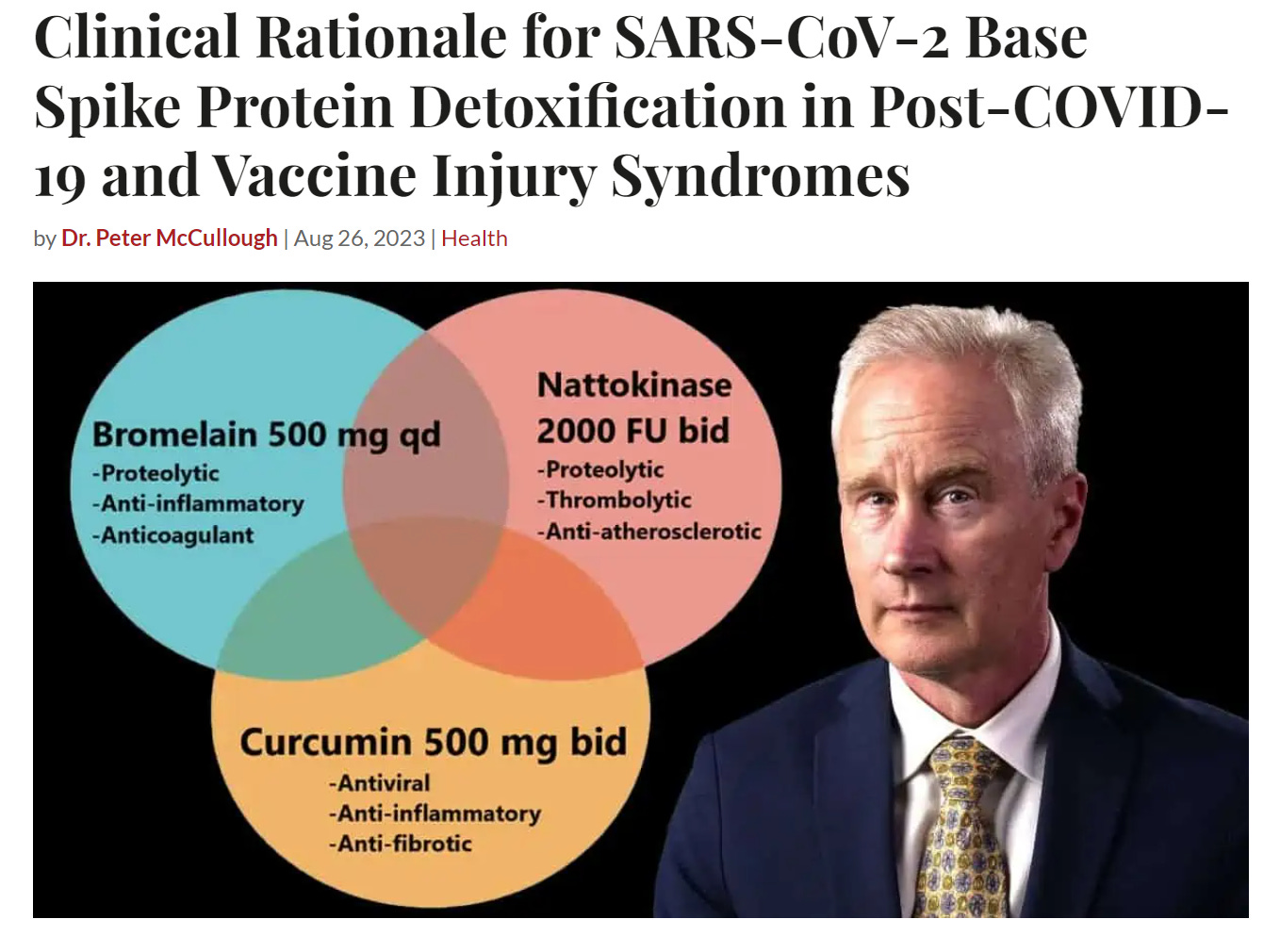
Syndicate fact checker Science Feedback, issued an unsupported false counterclaim on Instagram given below.

Science Feedback, a science and climate blogging organization with no foundation in peer-reviewed medical publications, is not advised by prominent physicians working in the COVID-19 field. Their major donor is former Microsoft and Apple executive Eric Michelman who is also a noted Democrat supporter, donating money to the Presidential campaigns of Barack Obama and Joe Biden. Michelman is also a climate change activist, founding a climate change advocacy organization and publicly supporting a carbon tax.
LinkedIn pulled a post indicating the COVID-19 vaccine causes more post-acute sequelae than SARS-CoV-2 which is my clinical opinion supported by the data. Base Spike Detoxification is an approach a to both problems. LinkedIn uncredentialed anonymous content moderators obviously disagreed and continue to push the false narrative indicating that long-COVID is unassailable and the only answer is more genetic shots.

I have found it interesting that the fact checkers have never made claims against a myriad of drugs or supplements that were ineffective during the pandemic. They have exclusively targeted therapies with preclinical and clinical studies demonstrating signals of benefit and acceptable safety (iodine/xylitol nasal washes, vitamin D, hydroxychloroquine, ivermectin, budesonide). In a perverted way, the Biopharmaceutical Complex has confirmed Base Spike Detoxification is the path forward for so many patients suffering from long-COVID and or regretting the jab.
Peter A. McCullough, MD, MPH
President, McCullough Foundation
By Michael Nevradakis, Ph.D. | The Defender | September 6, 2023
The New York Times on Sept. 1 published a “guide to fall vaccine shots,” which included recommending the general public get COVID-19, flu and RSV (respiratory syncytial virus) vaccines, and infants 6 months and older receive COVID-19 shots this fall.
Written by Times senior writer David Leonhardt, the guide warns about rising COVID-19 cases and the approaching flu season, before offering, “The good news is that there are vaccines and treatments that reduce risks from all major viruses likely to circulate this season.”
According to the Times, “This year, we should take a broader approach,” rather than “obsess over COVID.”
Peter Hotez, M.D., Ph.D., dean of the National School of Tropical Medicine at the Baylor College of Medicine — described by the Times as a “vaccine expert” — echoed that appeal. “It’s not only COVID you have to think about,” he said.
Hotez, Nirav Shah, M.D., J.D., principal deputy director of the Centers for Disease Control and Prevention (CDC), and other public health officials and experts quoted by the Times recommended Americans prepare for the upcoming fall and winter by getting the trio of COVID-19, flu and RSV vaccines.
None of these experts, however, addressed any of the potential safety risks posed by these vaccines.
Medical and public health experts who spoke with The Defender took a different view and questioned the Times’ guide, citing concerns about the safety and efficacy of vaccines for respiratory illnesses.
“Vaccines against respiratory illnesses have failed miserably,” said cardiologist Peter McCullough M.D., MPH. “America is wary of vaccines at this point, wanting to get on with life free of menacing vaccines, and are willing to seek early treatment, which is always the best way to handle infections, vaccinated or not.”
Pediatrician Dr. Liz Mumper, president and CEO of the Rimland Center for Integrative Medicine, told The Defender, “There have been no studies examining the effects of giving RSV vaccine, flu vaccine and COVID vaccine at the same time.”
“If you follow the advice in The New York Times article,” Mumper said, “be aware that your child will be part of post-marketing experimentation.”
Times still pushing vaccine propaganda
According to the Times, “The best defenses against COVID haven’t changed: vaccines and post-infection treatments,” which are “especially important for vulnerable people, like the elderly and immunocompromised.”
The federal government is “on track” to approve updated COVID-19 shots, designed to combat recent variants, in mid-September, the Times reported. Once they are available, “all adults should consider getting a booster shot.”
“COVID can still be nasty even if it doesn’t put you in the hospital,” the Times states. “A booster shot will reduce its potency.”
Hotez resurrected a claim heard often during 2021 and 2022, telling the Times, “Overwhelmingly, those who are being hospitalized are unvaccinated or undervaccinated.”
Experts who spoke with The Defender disagreed.
Harvey Risch, M.D., Ph.D., professor emeritus and senior research scientist in epidemiology (chronic diseases) at the Yale School of Public Health, citing data from U.K. Public Health, said, “All-cause deaths ages 18+ are disproportionately among vaccinated people, whether one, two or three doses, compared to unvaccinated people.”
“The statistic quoted by Dr. Hotez is false,” Risch said.
Brian Hooker, Ph.D., senior director of science and research for Children’s Health Defense (CHD) said, “The new booster simply hasn’t been tested to affirm any assertion of protection. The original trials on children were laughable as they looked at antibody titers rather than actual disease prevention.”
McCullough told The Defender, “The COVID-19 vaccines have been a safety debacle with record cases of myocarditis, blood clots, stroke, and all-cause mortality.”
Despite the injury and mortality reports and the Times’ admission that the risk of COVID-19 to young children is “very low,” Shah nonetheless recommended children as young as 6 months of age get the COVID-19 booster shots this fall.
“Do you want to see your grandpa … [and] grandma?” Shah asked in the Times. “Are you really sure you’re not going to give COVID to them?”
Experts who spoke with The Defender refuted Shah’s advice.
Dr. Pierre Kory, president and chief medical officer of the Front Line COVID-19 Critical Care Alliance (FLCCC), said “There is no medical justification for a healthy 6-month-old or older child to be vaccinated for COVID-19,” adding:
“There is so little data available on the safety of the COVID-19 vaccine in children that to give blanket recommendations like Shah is doing creates an unnecessary risk to children’s health.
“We simply do not know enough about the COVID-19 vaccines to make such broad recommendations. Additionally, COVID-19 is highly treatable in children and poses very little risk to a healthy child.”
Mumper told The Defender, “Any official who advocates that children take a vaccine to protect grandparents has not read the medical literature carefully.” She said, “After doing a deep dive on the risks and benefits of COVID vaccines in children, I remain steadfastly opposed to their use in healthy children,” adding:
“Any immunity from COVID shots is short-lived and follows a period of immune suppression. Very worrisome adverse events like inflammation of the heart, triggering autoimmunity, interfering with autonomic functions and reproductive toxicity are well described in the medical literature.”
Not all countries following suit
Some countries began limiting COVID-19 vaccination for children last year. In April 2022, Denmark ended its blanket COVID-19 vaccination recommendation, including for children.
Now, Denmark recommends “booster-vaccination” only for people “aged 50 years and above and selected target groups.”
Earlier in 2022, public health authorities in Sweden and Norway opted not to recommend COVID-19 vaccines for children between the ages of 5 and 11.
Sweden now recommends COVID-19 vaccination only for those 50 and above (18 and above for high-risk groups), while Norway is still only recommending COVID-19 vaccines for those 65 and older (and as young as 5 for high-risk groups).
In March of this year, the World Health Organization (WHO) said healthy children and adolescents ages 6 months to 17 years have a “low disease burden” and are therefore low priority for vaccination.
In June, Australian public health officials said Moderna’s COVID-19 vaccine is “no longer available” for children under 12, and in January, U.K. public health authorities ended their booster program for those under 50.
COVID vaccine recommendations ‘not science, not medicine, not public health’
Dr. Meryl Nass, an internist and member of CHD’s scientific advisory committee, told The Defender that while public health authorities and the media continue to recommend COVID-19 vaccines, none of them have been fully licensed in the U.S., as all such vaccines are available under Emergency Use Authorization (EUA) only.
In May 2022, the U.S. Food and Drug Administration (FDA) said that COVID-19 vaccines for kids under 6 would not have to meet the agency’s 50% efficacy threshold required to obtain an EUA.
CDC data released in September 2022 showed that more than 55% of children between 6 months and 2 years old had a “systemic reaction” after their first dose of the Pfizer-BioNTech or Moderna COVID-19 vaccines.
“The CDC, criminally, claims the (authorized) vaccines are ‘safe and effective,’” Nass said, adding:
“That is a term of art that is only allowed to be used for licensed vaccines and drugs. No licensed COVID-19 vaccine is available in the U.S. Public health is supposed to balance benefit and risk.
“This is not science. Not medicine. Not public health.”
Flu vaccines have demonstrated ‘declining efficacy’
According to the Times, “The most immediate step worth considering involves R.S.V.” On Sept. 5, the CDC issued a health advisory warning of rising RSV cases in parts of the U.S., particularly among children and babies.
Last month, the CDC signed off on the first-ever monoclonal antibody vaccine Beyfortus for the prevention of RSV, for babies up to 8 months old.
Also last month, the FDA approved an RSV vaccine for pregnant women, despite concerns raised by some medical experts about premature births identified during clinical trials. In May, the FDA approved Pfizer’s Abrysvo and GlaxoSmithKline’s Arexvy RSV vaccines for people 60 and older.
The Times quoted Ashish Jha, M.D., MPH, former White House COVID-19 adviser and now dean of Brown University’s School of Public Health, who said, “If you’re 60 or over, you don’t want to get into November without having an RSV vaccine.”
And though there is no RSV vaccine approved for administration to children, the Times said that “parents may want to ask their pediatrician” about monoclonal antibody treatment for children under 8 months of age.
According to Hooker, “the RSV vaccine given to pregnant women could not even make a 20% threshold for protection (as specified by the FDA) against lower respiratory RSV infection.”
Supporting the push for the flu vaccine, the Times and experts such as Jha said, “The flu officially kills about 35,000 Americans in a typical year,” but “the flu’s toll would be lower if more people got a vaccine shot,” noting that “In recent years, less than half of Americans have done so.”
Jha added, “We underestimate the impact that respiratory viruses have on our population. The flu can knock people out for weeks, even younger people.” Jha pointed out that flu can make heart attacks and strokes more common as well.
Kory, however, told The Defender that the COVID-19 vaccines have made people more susceptible to other respiratory illnesses, like the flu and RSV:
“In my practice, we treat many vaccine-injured patients who are now more susceptible to the flu, RSV and many other viruses. The COVID vaccines cause many to present as if they have an autoimmune disease and now respond with more severe symptoms to common viruses like the flu.”
Risch, meanwhile, said, “Traditional flu vaccines are considered to be safe for most people” and may be a “reasonable” option for them, but “this should be discussed with one’s healthcare provider.”
“The flu vaccines seem to have had declining benefit over the last 10-15 years, to the point now that they may confer only a 30% benefit,” Risch added.
And according to Hooker, “The flu shot is also notoriously bad at protection against the flu and there are very few data regarding this season’s flu shot efficacy.”
‘Ludicrous’ public health messaging
Shah’s recommendation that children as young as 6 months get a COVID-19 shot this fall follows in a long line of questionable advice and claims disseminated by public health officials, some of which were later contradicted.
In a May 2021 MSNBC interview, Dr. Anthony Fauci, then-head of the National Institute of Allergy and Infectious Disease (NIAID), said:
“Although you don’t like to see breakthroughs, the fact is, this is one of the encouraging aspects about the efficacy of the vaccine. It protect you completely against infection. If you do get infected, the chances are that you’re going to be without symptoms, and the chances are very likely that you’ll not be able to transmit it to other people.”
Fauci’s statements, however, failed to account for the many examples of breakthrough infections with severe symptoms and hospitalization.
After years of official “safe and effective” claims, in YouTube’s new “medical misinformation” policy introduced Aug. 15, “Claims that any vaccine is a guaranteed prevention method for COVID-19” are prohibited. Fauci’s videos from 2021, notably, are still up on YouTube.
In April 2020, Fauci said that remdesivir will become the “standard of care” for treating COVID-19. But numerous victims of COVID-19 hospital protocols prescribed by the CDC have come forward in recent months claiming that remdesivir was administered without permission of the patients or their families and contributed to further injury or death.
Similarly, former CDC Director Rochelle Walensky said in March 2021 “Our data from the CDC today suggests … that vaccinated people do not carry the virus, don’t get sick … can’t transmit it to others.” She doubled down on these statements during a House Select Subcommittee on the Coronavirus Pandemic hearing in June, asserting that her statement “was generally accurate.”
Hooker said these statements were “obviously patently false, as the vaccines distributed in the U.S. at that time [in 2021] were not tested for transmission and there was evidence of ‘breakthrough’ infections even in the clinical trials.”
“This obviates any protection to ‘Grandma and Grandpa’ through children getting vaccinated against COVID-19,” Hooker added.
Also in 2021, Walensky recommended wearing pantyhose over a mask to ensure a tight fit.
Nass called such public health messaging “ludicrous,” noting that Walensky’s pantyhose recommendation “quickly disappeared” because it “had connotations the CDC was not willing to deal with.”
Kory criticized the Times’ fall vaccine guide, characterizing it as an example of “disinformation.”
“The New York Times is carrying the disinformation that continues to come from the CDC and other government health agencies,” he said. “This is one of the reasons that the public continues to lose trust in the media and our government.”
As a result, public health officials “create a mockery of how medical and scientific evidence is used to inform patient care decisions and public health policy,” Kory said.
Other experts who spoke with The Defender suggested taking vitamins to boost one’s immune system, rather than a series of vaccinations.
“For the immune system to defend against respiratory viruses, all people should take daily vitamin D to achieve blood levels of 50 or greater,” Risch said. “This is typically 5,000 units per day for a 150-lb person, but can be adjusted up or down according to body weight.”
“Serious RSV infections generally occur only in the youngest young and the oldest old. People in these categories should discuss this with their doctors,” he added.
Michael Nevradakis, Ph.D., based in Athens, Greece, is a senior reporter for The Defender and part of the rotation of hosts for CHD.TV’s “Good Morning CHD.”
This article was originally published by The Defender — Children’s Health Defense’s News & Views Website under Creative Commons license CC BY-NC-ND 4.0. Please consider subscribing to The Defender or donating to Children’s Health Defense.

By Hunter Fielding – N/A – September 5, 2023
The vast majority of the population of Haiti is unvaccinated for COVID-19 but the impoverished Caribbean nation recorded virtually no deaths from the virus.
Haiti remains one of the least vaccinated countries in the world while also showing the lowest Covid death rate.
As of the end of April, just 254 people have died in Haiti from what authorities agree constitutes Covid, according to reports.
However, this figure is likely overblown considering SARS-CoV-2 has never even been isolated and proven to exist.
Compared to the United States, which currently has a COVID-19 death rate of around 1,800 per one million people, Haiti has a Covid death rate of just 22 per one million people, or 0.0022% – basically 0 percent.
NPR admits in a report about Haiti that Covid restrictions were never enforced there.
Nobody there wears a mask, people are mostly unvaccinated, and daily life is normal with busy and crowded buses and markets.
For most Haitians, the pandemic never happened.
“And Haiti hasn’t yet administered a single COVID-19 vaccine,” NPR‘s Jason Beaubien further reveals.
It turns out that Haiti had its own version of Tony Fauci, a man named Dr. Jean “Bill” Pape, who headed up a commission during the “pandemic” to deal with the fallout. In the end, however, the commission was dissolved because Haiti was, and continues to be, COVID-free.
“The reason mainly is because we have very, very few cases of COVID,” Pape said about why the commission was ultimately disbanded.
GHESKIO, the local health agency that Pape heads, also closed its COVID units last fall due to a lack of patients.
While the Western world is stricken with hordes of “fully vaccinated” people who are now sick as dogs, Haiti is back to normal thanks to its rejection of the shots.
“Sometimes it’s two, sometimes zero, sometimes it’s 20 cases,” Pape said.
“But we are not seeing a second wave as we thought would happen.”
Unlike much of the rest of the world, Haiti remained open during the “pandemic.”
Outdoor markets were never closed, and people there continued working because sheltering in place and remote employment are not things that the average Haitian can afford.
“Most people don’t wear a mask,” Pape added, noting that Haitians continued working as normal throughout the pandemic because “if they don’t work, they don’t eat – their family doesn’t eat.”
When AstraZeneca tried to peddle its COVID injection in Haiti, the Haitian government denied a shipment of it.
It turns out that the medical community in Haiti heard about all the “rare” side effects of the jab and thus rejected it.
“COVID did not impact us as badly,” said Dr. Jacqueline Gautier, who serves on the national technical advisory group on COVID vaccination in Haiti.
“People don’t think [the vaccine] is worth it, actually.”
Another factor that makes Haiti an incredible success story compared to other nations is the fact that its population is very young.
The average age in Haiti is around 23, while in the United States, it is closer to 40.
Younger people tend to have stronger immune systems than older people.
And without COVID jabs to destroy them, Haiti’s millions of unvaccinated people fared well compared to the rest of the world.
“Also, there are many other major problems the country is facing,” Gautier added.
“So people don’t see COVID as our major, as a major, problem for us.
“And who can blame them?”
RT | September 7, 2023
An investigation into South Africa’s procurement of Covid-19 vaccines has found that the country’s health officials purchased supplies from global pharmaceutical companies at inflated prices compared to many Western nations.
The Health Justice Initiative (HJI), an independent body formed during the pandemic to monitor the South African healthcare system’s handling of the crisis, said during a news conference this week that the government was “bullied” into accepting unfavorable vaccine deals via one-sided “ransom negotiations.”
“The [vaccine] contracts contain unusually hefty demands and conditions, including secrecy, a lack of transparency, and very little leverage against late or no delivery of supplies or inflated prices,” the HJI said in a statement on Tuesday. It added that this system led to “gross profiteering” and an “inability to plan properly in a pandemic.”
The terms agreed by South Africa’s government with companies such as Pfizer and Johnson & Johnson for the purchase of Covid-19 vaccines were the subject of a legal challenge by the HJI last month under the country’s Promotion of Access to Information Act.
A Pretoria court subsequently ruled in favor of the HJI, compelling the South African government to release the vaccine contracts in the interest of transparency and accountability.
The documents detailed that South Africa was liable for vaccine payments of $734 million. The terms of the agreements included no guarantees of a timely delivery or penalties for late arrival. It was also found that Johnson & Johnson charged South Africa $10 per dose of its vaccine – some $1.50 more than EU countries paid.
“The country was forced to overpay for vaccines, paying 33% more than the African Union price from the Pfizer-BioNTech vaccine and paying the Serum Institute of India 2.5 times more for a generic version of the Oxford-AstraZeneca vaccine compared to the United Kingdom,” the HJI said.
The group claimed that the government’s practices throughout the pandemic “signals a dangerous precedent for future pandemic readiness,” and that “we were bullied into unfair and undemocratic terms in contracts that were totally one-sided. Put simply, pharmaceutical companies held us to ransom.”
According to publicly available data, South Africa has recorded 102,595 deaths from Covid-19 since the start of the pandemic. As of May 2023, approximately 65% of South Africans have received a vaccine against the virus.
BY DAVID CRAIG | THE DAILY SCEPTIC | SEPTEMBER 7, 2023
You probably know that a massive Energy Bill is being rushed through Parliament by our fake ‘Conservative’ Government in the first two days of our parliamentarians’ return from their generous summer break. The Bill is 446 pages long and written in dense, largely-incomprehensible-to-any-normal-person legalise. Moreover, many clauses in the Energy Bill make reference to other pieces of previous legislation. So, to fully understand the Bill, you would have to read at least a thousand pages of dense legalistic gobbledegook. Given that our MPs have just passed the Bill with a mere nine voting against it, one must assume that they have spent their summer holidays diligently reading through the Bill and other relevant legislation in order to fully understand what they were voting for.
Here’s the full title of the Bill:
‘A Bill to make provision about energy production and security and the regulation of the energy market, including provision about the licensing of carbon dioxide transport and storage; about commercial arrangements for industrial carbon capture and storage and for hydrogen production; about new technology, including low-carbon heat schemes and hydrogen grid trials; about the Independent System Operator and Planner; about gas and electricity industry codes; about heat networks; about energy smart appliances and load control; about the energy performance of premises; about the resilience of the core fuel sector; about offshore energy production, including environmental protection, licensing and decommissioning; about the civil nuclear sector, including the Civil Nuclear Constabulary; and for connected purposes’
As you’ll see, this legislative monster covers an awful lot of areas – energy production, regulation of the energy market, CO2 transport and storage, carbon capture, hydrogen production, low-carbon heat schemes, hydrogen grid trials, heat networks, smart appliances, load control, energy performance of industrial and residential premises, offshore energy production and the civil nuclear sector. We must be considered fortunate in Britain to have MPs who have such a strong work ethic and such a deep understanding of all these disparate issues to be able to vote for the new Energy Bill knowing exactly what they are voting for.
Life is too short for any normal person to read and to try to understand this massive abomination of almost impenetrable legalise. But here are some choice titbits which I think I understand.
The Bill explains what a ‘Smart Meter’ is:
“Energy smart appliance” means an appliance which is capable of adjusting the immediate or future flow of electricity into or out of itself or another appliance in response to a load control signal; and includes any software or other systems which enable or facilitate the adjustment to be made in response to the signal.
So it seems that the conspiracy theorists were right yet again – a key purpose of ‘Smart Meters’ is not only to measure power usage but also to allow energy providers to control how much energy we are allowed to consume using “a load control signal”.
Moreover, authorities will be allowed to use “reasonable force” to enter any homes or premises to ensure we have the approved ‘Smart Meters’ installed:
Requiring persons to supply evidence of their compliance to enforcement authorities; conferring powers of entry, including by reasonable force.
All electricity and gas meters have dates by which they should be replaced. From what I have read the Bill gives representatives from energy companies the power to enter any home, with police protection if required, to replace traditional meters at the end of their lives with smart meters. Again, “reasonable force” may be used.
The Bill gives the Government the power to force us to have energy assessments for any premises:
The Secretary of State may make regulations for any of these purposes: (a) enabling or requiring the energy usage or energy efficiency of premises to be assessed, certified and publicised;
We can be fined up to £15,000 or face one year in prison for failing to meet any future energy performance levels any government imposes:
Energy performance regulations may provide for the imposition of civil penalties by enforcement authorities in relation to cases falling within subsection (1)(b), (c) or (d); but the regulations may not provide for a civil penalty that exceeds £15,000.
Under the totally misleading title of ‘Energy Savings Opportunity Schemes’, authorities can force any person or company to make energy savings using the threat of criminalisation for failure to comply:
The Secretary of State may by regulations (“ESOS regulations”) make provision for the establishment and operation of one or more energy savings opportunity schemes. An “energy savings opportunity scheme” is a scheme under which obligations 30 are imposed on undertakings to which the scheme applies for one or more of the ESOS purposes.
I could go on. But I imagine you get the picture by now. This ‘Energy Bill’ creates the means by which some puffed-up public-sector mini-dictator could gain powers to control us in ways most people would find completely unacceptable. Yet our useless MPs passed the Bill with a massive majority and the Lords are set to do the same.
If there really was a ‘climate crisis’ caused by humans burning fossil fuels and threatening the existence of the human race as the BBC and others of its ilk repeatedly claim, then you might be able to argue that some of the measures in the Bill could be justified. But given that changes in atmospheric CO2 levels have little to no influence on the Earth’s temperatures, that Britain only contributes less than 1% of world CO2 output and that developing countries like India and China each increase their CO2 output by more each year than Britain’s total CO2 emissions, we are creating a totalitarian regime which will intrude on people’s lives, restrict people’s freedoms, wreck the British economy and immiserate our country to fix a problem which doesn’t even exist and, if it did, would not be solved by our action anyway.
And if you fear this horror will lead to an intrusive, oppressive police state under the Tories, imagine how this will be used and abused by Ed Miliband and the climate fanatics in the next Labour Government.
David Craig is the author of There is No Climate Crisis, available as an e-book or paperback from Amazon.

By Oleg Burunov – Sputnik – 08.09.2023
A new grain agreement initiated by Moscow may partly add to resolving the problem of hunger across the globe, Russian analysts have told Sputnik.
The Russian Foreign Ministry has heaped praise on a joint project between Moscow, Ankara and Doha on Russian grain supplies to Turkiye.
The ministry said in a statement that “the project to deliver one million tons of grain from Russia for processing in Turkiye with subsequent free transportation to the poorest countries is of utmost importance.”
The statement came after Russian Deputy Foreign Minister Alexander Grushko told reporters that Moscow and Ankara had reached an agreement.
“This is a good initiative, and the right process,” Moscow-based political analyst Alexander Asafov said, describing the deal as an example of international cooperation that “takes into account promoting Turkiye’s interests with the help of Qatar,” which “will act as the agreement’s financial contributor.”
Asafov noted that although the deal would unlikely become a “game-changer” in terms of tackling the problem of hunger globally, it “will, of course, improve the situation in those countries where grain will be delivered to.”
When asked about the prospect of the initiative, the analyst said that the agreement “confirms the logic of a multipolar world, where the parties, without fear of sanctions or other pressure, can conclude two, three or more deals, contrary to the opinion of the side that until recently considered itself global cop,” an apparent nod to the US.
Asafov was echoed by Victor Nadein-Raevskiy, a senior researcher at the Russian Academy of Sciences, who underscored that Russia initiated the Moscow-Ankara-Doha initiative after the suspension of the Black Sea Grain Deal. According to him, Moscow offered the accord proceeding from the fact that developing countries, who are “going through really great food problems, should not suffer.”
Actually, “this agreement is no longer a deal, but a humanitarian program to deliver grain – to be more exact, flour – to those countries that are in need of it,” Nadein-Raevskiy stressed. He added that transportation-related expenses would be on Qatar, who “enthusiastically joined the agreement.”
Touching upon the prospects of the initiative, the expert pointed out that first and foremost, it’s necessary to assess the effectiveness of the project as such.
“If we and our partners in Turkiye and Qatar manage to implement our plans, namely, if the deal is successful, then, of course, Russia will use its great opportunities on grain exports market,” he said.
Scheme’s Details to Follow
The issue was on the agenda of talks between Russian President Vladimir Putin and Turkish counterpart Recep Tayyip Erdogan in Russia’s Black Sea resort of Sochi on September 4.
“We expect that in the near future we will begin discussions with all parties to work out all the technical aspects of the scheme of such supplies,” Grushko said, adding that the technical details include, among other issues, logistics and finances.
Erdogan, for his part, signaled Ankara’s readiness to prepare its own proposals on the matter and to “find a solution in the near future” that will meet the expectations of all parties to the talks.
Nadein-Raevskiy noted in this vein that Turkiye is “ready” for flour supplies to developing countries “at very low prices or on the free-of-charge basis.”
“One should not think that Turkiye is a country that does everything only for its own benefit. While strengthening Turkish positions in Africa and beyond ahead of the COVID-19 pandemic, Turkiye – as far as I remember – spent up to $3 billion a year on humanitarian programs,” the expert emphasized.
The deal comes after Moscow suspended its participation in the Black Sea grain deal, also known as the Black Sea Grain Initiative, on July 18. The Kremlin has repeatedly emphasized that the Turkiye and UN-mediated grain deal’s component on facilitating Russian grain and fertilizer exports was not fulfilled, specifically with regard to reconnecting Russian banks to SWIFT and unblocking the Tolyatti-Odessa ammonia pipeline.
Moscow also pointed out that just three percent of the grain shipped out of Ukraine under the agreement actually went to countries in need in Africa and Asia, with the vast majority instead ending up in Europe and Turkiye.
Russian Foreign Minister Sergey Lavrov later stressed that the proposals made by the United Nations regarding the resumption of the Black Sea Grain Initiative lack guarantees when it comes to Russia’s concerns.
RT | September 8, 2023
Hungary’s parliament speaker has accused the European Union of launching a “hybrid war” against his country, saying the organization is withholding funds owed to Budapest as a means of political control.
Speaking to the Mandiner magazine on Wednesday, National Assembly speaker Laszlo Kover agreed that Hungary’s relations with the EU had reached a “low point,” amid an ongoing row over some €28 billion in funds earmarked for Budapest and currently frozen by the bloc until it implements various legal reforms.
“Europe is almost paralyzed by the fact that the institutional system originally created to ensure cooperation has turned against its masters, the member states, as a kind of golem. Today, the member states cannot control this cancerous bureaucracy,” he said.
We have to ask ourselves whether the European Union is still an association of independent and equal member states, or whether we are just one step away from becoming victims of another imperial expansion.
The politician went on to describe efforts within the EU to “create an economic governance that dissolves the sovereignty of the member states,” noting that practices such as joint borrowing and common currencies would further erode national independence.
While Kover said the European bloc remains “the best enforcement framework for Hungarian national interests,” he insisted the organization must meet its obligations to members, suggesting it has not done so in Hungary’s case.
“They want to interfere in the political process by withholding resources, and they would even expect us to be ashamed of it,” he continued. “It is a hybrid war – to use this fashionable term – that the globalists in Brussels are waging against Hungary and Poland, which are defending their sovereignty.”
In order to unlock the frozen funds, Budapest is expected to meet 27 so-called “super milestones” proposed by the European Commission, including judicial and media reforms, as well as a crackdown on corruption. The bloc has long accused Hungary of not abiding by the EU standards of the rule of law. Budapest, meanwhile, insists that the allegations are entirely politically motivated.
Hungary has also largely resisted pressure to follow a US-led sanctions campaign against Russia over its military operation in Ukraine, opting to retain its more friendly ties with Moscow. It has also refused to supply military aid to Kiev, even vetoing weapons packages proposed by the bloc, while Prime Minister Viktor Orban has pushed for talks between the warring parties to bring an end to the fighting.
or go to
Aletho News Archives – Video-Images
By Robert Bridge | Strategic Culture Foundation | September 29, 2022
With an investigation continuing into the destruction of the Nord Stream gas pipeline that provided energy supplies to Europe from Russia, there appears to be just one prime suspect, and that should surprise nobody.
Following the sabotage of the Nord Stream 1 and 2 gas pipelines, former Polish Foreign Minister Radoslaw Sikorski already seemed to know the identity of the perpetrator when he tweeted out: “Thank you, USA.”
At first glance, it seemed that Sikorski was speaking sarcastically, berating Washington for carrying out an attack that will have severe repercussions for the people of Europe. After all, how could anyone see any good coming from the termination of Europe’s primary source of gas reserves with winter just around the corner? It was Sikorski’s homeland of Poland, after all, that urged its citizens to collect firewood in the face of dwindling gas reserves.
In fact, the Polish diplomat was speaking one-hundred percent literally… continue
 Aletho News If Americans Knew No Tricks Zone
 Aletho News