FRENCH BILL SEEKS TO CRIMINALIZE MEDICAL “MISINFORMATION”
The Highwire with Del Bigtree | February 22, 2024
Press and medical journalists appear to be the target of a new bill proposed in France that may seek to criminalize criticism of therapeutic and prophylactic remedies that have been deemed safe by the medical community.
UK Government Minister Shuns Concerns About “Anti-Disinformation Unit”
By Didi Rankovic | Reclaim The Net | February 25, 2024
Critics of the contentious, and some would say at times unlawful, work of UK’s Counter Disinformation Unit (CDU) are expectedly unimpressed by it getting a “rebrand” – that is, a new name.
It remains to be seen if the National Security Online Information Team (NSOIT – née CDU), will continue with activities of the kind that highly likely got the image of the CDU so tarnished that it needed a “rebrand.”
But government officials continue at the same time to deny there was any wrongdoing on the part of CDU to begin with – or that there will be any done by NSOIT.
The controversy over CDU goes back to the “heyday” of the pandemic and censorship of Covid-related content. The accusation – that continues to be rejected by the government – is that individuals, including senior figures from across the UK’s political spectrum, were targeted.
And, their online activity was first surveilled by CDU, which would then flag some posts for removal merely for criticizing the government, rather than “spreading disinformation.”
But, responding to questions about all this in the British Parliament’s House of Lords earlier in the week, an official from the Department for Science, Innovation and Technology – NSOIT’s parent agency, said there was no merit to such claims, or fears, going forward.
“I can confirm not only that it is not the role of NSOIT or the CDU to go after any individuals, regardless of their political belief, but that it never has been,” junior minister Jonathan Berry told the lords, adding that the unit supposedly only looks for “threats from foreign states” – while the form of domestic political persecution it was accused of is something that is “categorically false.”
However, Liberal Democrat Paul Strasburger continues to press the matter, specifically seeking answers as to how NSOIT will be controlled in the future, particularly given what he says was CDU’s “worrying overreach.”
And – why the government “refuses to allow the Intelligence and Security Committee” to do that oversight.
Berry’s response essentially amounted to revealing that NSOIT will – oversee itself.
“As part of the civil service, NSOIT would have robust internal measures to verify and check its own work, and indeed it reports regularly across government and to ministers,” the junior minister is quoted as stating.
Other than that, Berry could offer “reassurances” to the House of Lords regarding the unit’s role, and he at the same time would not speak about either how NSOIT is staffed, nor how many people it employs, referring to it as “a national security institution.”
Netanyahu Has Lost Saudi Arabia, and Biden Will Lose Re-Election
By Steven Sahiounie | Strategic Culture Foundation | February 23, 2024
Israeli Prime Minister Benjamin Netanyahu stated in late 2022 that his priority was to sign a normalization agreement with Saudi Arabia. He called it his number one objective for Israel’s national security. Now, he has lost his dream.
Saudi Arabia stood up alongside 51 countries, and testified at the International Court of Justice (ICJ) against Israel’s attack on Gaza which has been classified as genocide, and apartheid by human rights experts, South Africa and others. The evidence being presented to the ICJ rule is to prove that the occupation of Palestine is illegal, and must be ended.
Saudi Arabia condemned Israel’s actions in Gaza, and the Occupied West Bank as legally indefensible. Ziad Al-Atiyah, Saudi Arabia’s ambassador to the Netherlands, strongly condemned Israel for its actions in Palestine which defy international law.
Al-Atiyah stressed that Israel must be held accountable for ignoring international law in its treatment of civilians in Gaza and its continued impunity.
Saudi Arabia expressed deep sorrow over the killing of 29,000 civilians, who are mainly women and children, and rejected Israel’s argument of self-defense, stating that depriving Palestinians of basic means of survival is unjustifiable.
Al-Atiyah called on the international community to take action against Israel’s genocidal actions against Palestinians, and Israel’s constant dehumanizing rhetoric. He added that the court does indeed have jurisdiction in this case, and urged the court to issue an opinion.
Saudi Arabia condemned Israel’s disregard for ceasefire calls, while expanding illegal settlements in the Occupied West Bank, and the expulsion of Palestinians from their homes.
The Kingdom listed Israel’s violations of international obligations, while ignoring UN resolutions condemning its conduct and preventing Palestinians from their right to self-defense.
Israel was also criticized for its 2018 Basic Law declaring Jerusalem as its capital, which is in clear violation of UN resolutions, and the expansion of illegal settlements, and preventing the self-determination of the Palestinian people, which is a universal human right.
Who else is there?
The UN General Assembly requested the ICJ for an advisory opinion on the Israeli occupation of Palestine. 51 states will present arguments until Feb. 26.
South Africa, Algeria, Saudi Arabia, the Netherlands, Bangladesh, and Belgium also presented preliminary arguments.
This is the largest case ever presented at the ICJ and at least three international organizations are also slated to address the judges at the UN’s top court until next week. A nonbinding legal opinion will follow the judges’ deliberations.
Gaza changed everything: the world is against Israel, except the U.S.
Amar Bendjama, Algeria’s ambassador to the UN, introduced a ceasefire resolution at the UN on February 20. He said the Council “cannot afford passivity” in the face of what is unfolding in Gaza, and that silence is “not a viable option”.
“This resolution is a stance for truth and humanity, standing against the advocates for murder and hatred,” he said. “Voting against it implies an endorsement of the brutal violence and collective punishment inflicted upon them [the Palestinians].”
His words of bitter accusation were directed at one country: The United States of America. The only country to vote against the ceasefire was America. The UN Security Council’s 13 other member countries voted in favor of demanding a halt to the war, while the UK abstained.
Linda Thomas-Greenfield, the U.S. ambassador to the UN, has consistently held her hand up high while voting against every chance to relieve the suffering, injuries and deaths of the people in Gaza.
Thomas-Greenfield’s ancestors were African slaves in the U.S. Her ancestors were deprived of all human rights for hundreds of years until they were granted freedom, and that freedom came resulting from a bloody four-year war. Her ancestors fought for the freedom that she enjoys, and yet she is defending Israel. She fails to empathize with the Palestinians who should remind her of her ancestors.
The U.S. is isolated as a pariah state because of Gaza
The moral authority of the U.S. has been ripped from Washington, DC. by the power of the genocide and war crimes in Gaza, carried out by Israel while using weapons sent to Tel Aviv from the U.S. State Department. Biden’s fingerprints are all over the murder weapons.
How many countries called for ceasefire in Gaza?
The EU’s foreign policy chief, Josep Borrell, reports that 26 out of 27 EU countries call for “immediate humanitarian pause in Gaza, that would lead to a sustainable ceasefire.” The U.S. likes to think of Europe as their sheep, blindly following every dictate issued by the Oval Office. But, Gaza has changed that; now the EU is voicing ethical and moral authority over the U.S.
Netanyahu took office on December 29, 2022, and he is allied by the most extreme right-wing politicians in Israel’s history. Ben Gvir and Smotrich have both made racist and genocidal statements about Palestinians. Their views vacillate between the need to either kill all the Palestinians, or force them to move to Egypt and Jordan.
But, Netanyahu faces a prison term for corruption, and these radical allies are all that is keeping him safe, and in office. His hands are tied: he has to keep them happy, which means he must refuse any call for a ceasefire.
President Donald Trump had championed the Abraham Accords while in office, and was successful in getting several Arab countries to normalize their relationship with Israel. Trump had done more for Israel than any other U.S. President.
Israel wanted normal ties with Saudi Arabia to benefit the economy, and to discourage Iranian influence in the region.
How many countries are supporting Palestine?
In 2012, the State of Palestine was accepted as an observer state at the UN. 139 countries at the UN have recognized the State of Palestine, compared with the 165 countries recognizing Israel.
Biden will lose re-election because of Gaza
Andy Levin, a former Representative of Michigan, and a Democrat, was at a gathering on February 20 demonstrating against Biden. Levin explained that Michigan has a large Arab American population, and they are very angry at Biden’s support of the genocide in Gaza. Levin said a Trump victory is very possible if Biden loses support of Michigan voters.
Especially angry are young voters and progressives who believe in human rights and freedom for all peoples, not just Americans.
“Don’t blame us,” said Mr. Levin, who along with Representative Rashida Tlaib of Michigan has become one of the most prominent supporters of the Uncommitted movement. Levin said, “He needs votes from Arab Americans, from people of color, from progressive Jews and from young people. He only won Michigan by 150,000 votes in 2020, so politically we have a moment where we can raise our voices.”
People at the rally expressed their horror at the over 29,000 deaths in Gaza, and the refusal of the U.S. to demand a ceasefire and humanitarian deliveries. With scenes on social media of starving Palestinians being gunned down by Israeli soldiers as they try to reach the aid trucks, the Americans who are informed and caring are deciding to not vote for Biden, and in such a close race, he needs every vote to win.
A poll in October found that more people ages 18-29 sympathized with Palestinians than with Israelis in the Gaza war.
Young people are very well informed with what is happening in Gaza by their almost constant use of social media, where they get all their news. Older people might be still watching TV channels, which in the U.S. are very heavily biased towards Israel.
Biden’s November re-election depends on young voters, but he has lost their vote because of his steadfast support of the slaughter of over 29,000 people in Gaza.
Why did Saudi Arabia want normalization?
In September, the U.S. Secretary of State, Antony Blinken, declared that normalizing relations between Israel and Saudi Arabia was a U.S. “national security interest”.
On September 21, Saudi Crown Prince Mohammed bin Salman (MBS), told Fox News, “Every day we get closer” to a normalization deal with Israel. Gaza has killed that dream, because Saudi Arabia has stressed that normalization now will only be achieved by a two-state solution under UN resolutions. Netanyahu has totally rejected the two-state solution, the end of occupation, and a ceasefire.
Riyadh wanted a U.S. defense pact; including fewer restrictions on U.S. arms sales to it, and assistance in developing its own civilian nuclear program. Another perk from signing with Israel would be AIPAC, the political lobby group which political experts in Washington, DC. accredit with tremendous control over the Oval Office and Capitol Hill.
Saudi Arabia and Iran normalize relations
In March 2023, China brokered a deal between Saudi Arabia and Iran. Beijing proved their influential role in the Middle East in contrast to the diminishing role of the United States.
That Chinese deal was a major blow to Biden, who had wanted to keep Iran and Saudi Arabia enemies because Israel views Iran as their enemy.
Since then, Saudi Arabia and Iran have been expanding their cooperation in Yemen, Syria, Iraq and Lebanon.
Israel is accused of genocide at the ICJ
Israel stands accused of genocide at the ICJ. The ruling in January ordered Tel Aviv to stop genocidal acts and take measures to guarantee that humanitarian assistance is provided to civilians in Gaza.
“We have dozens and dozens of statements made by senior Israeli political and military leaders with respect to genocidal intent. So I think, at least the plausibility has been established, and there’s quite possibly genocide itself or a genocide in the making, according to the definition of the Genocide Convention,” said Michael Lynk, former UN special rapporteur.
Lynk also pointed to the role of the U.S. in supporting Israel in its onslaught that has left nearly 30,000 Palestinians dead, noting that Washington, besides replenishing Tel Aviv’s shrinking ammunition stocks with 3.8 billion in military aid, is also providing it diplomatic cover at the UN.
“So, it’s hard to see how this offensive and this coming catastrophe in Rafah is going to stop unless the U.S. pulls to a stop and tells Israel that ‘enough is enough,’” said Lynk, while adding “I don’t see that coming.”
Four Norwegian universities cut ties with Israeli institutions over Gaza genocide
Press TV – February 24, 2024
Four Norwegian universities have decided to suspend ties with Israeli universities they deem complicit in the occupying regime’s genocidal war in Gaza.
The Palestinian Campaign for the Academic & Cultural Boycott of Israel (PACBI) welcomed the decisions, hailing them as a crucial step in supporting the Palestinian struggle.
The move aligns with the campaign’s call for international academic and cultural institutions to sever ties with Israeli counterparts involved in Israel’s genocide in Gaza.
Among the universities taking action, OsloMet has announced the termination of its ties with Haifa University and vowed not to engage in any new agreements with Israeli universities complicit in the war.
Additionally, OsloMet has committed to discontinuing procurement contracts with suppliers linked to the Israeli military or illegal settlements.
The University of South Eastern Norway has followed suit, cutting off relations with Haifa University and Hadassah Academic College.
Similarly, the University of Bergen has severed cooperation agreements with Bezalel Academy of Arts and Design, citing the academy’s involvement in providing uniforms and gear for the Israeli military.
The Bergen School of Architecture has also joined in this action, ending its collaboration with Bezalel Academy over its ties with the Israeli military.
This move echoes the sentiments expressed by 15 Palestinian universities, which have called for Israeli universities to face international isolation for their complicity in Israel’s crimes against Palestinians.
Meanwhile, Norway’s pension fund, with some US$95 billion worth of assets, announced that it was divesting from their entire Israel Bond holdings over their links with the Israeli settlements in the occupied West Bank.
US, UK sacrifice international security for Israel’s interests: Tehran
Press TV – February 25, 2024
Iran’s foreign ministry spokesman has strongly condemned fresh “arbitrary” airstrikes by the United States and Britain on Yemen, saying the raids proved once again that the pair sacrifice international security for Israel’s interests.
Nasser Kan’ani made the remarks on Sunday after American and UK forces carried out a series of aerial assaults against positions across Yemen, including the capital Sana’a.
“Such arbitrary and adventurous attacks contravene the internationally recognized rules and principles and violate Yemen’s sovereignty and territorial integrity,” he said.
“The US and the UK once again proved that they fully support the Zionist regime’s war crimes and genocide in the Gaza Strip and the West Bank, and that they put the illegitimate security and interests of the occupying regime ahead of international peace and security.”
In a statement, the US Central Command (CENTCOM) said that the strikes were conducted with the support of Australia, Bahrain, Canada, Denmark, the Netherlands, and New Zealand in a bid to “degrade” Yemen’s capabilities to conduct naval pro-Palestine operations.
Kan’ani said that the US and Britain showed that they breach all moral and humanitarian principles, as well as international law and the UN Charter.
He added that the two countries are seeking to escalate tensions in the region, expand the scope of the Gaza war and divert public opinion from Israel’s war crimes, and buy an opportunity for the continuation of the ongoing genocide against Palestinians.
“Instead of taking effective and immediate action to eliminate the main cause of insecurity and instability, which is the Zionist regime’s warmongering and its daily killing of hundreds of Palestinians…, the US and the UK are waging military attacks on a country that is trying to somehow put pressure on this killer regime and stop its killing machine,” the top diplomat said.
In recent months, the US and its allies have launched illegal attacks on Yemen amid their frustration in the face of an anti-Israel maritime campaign by the Yemeni armed forces.
Israel waged a US-backed genocidal war on the besieged Gaza Strip on October 7 following a historic operation by the Palestinian Hamas resistance group against the occupying regime.
In support of Gaza, Yemeni armed forces have targeted ships going to and from ports in the occupied territories, or whose owners are linked to Israel, in the southern Red Sea, the Bab el-Mandeb Strait, the Gulf of Aden, and even in the Arabian Sea.
The US-led attacks on Yemen prompted the country’s military to declare American and British vessels to be legitimate targets.
Russia’s victory in Ukraine resonates in Central Asia
BY M. K. BHADRAKUMAR | INDIAN PUNCHLINE | FEBRUARY 25, 2024
Russia’s stunning victory in the battle of Avdeevka and the rout of the Ukrainian military, boosts the credibility of Russia as provider of security for the Central Asian region. The point is not lost on the erudite Central Asian mind that Russia has single-handedly put the NATO on the back foot.
This becomes a defining moment, as it complements the comfort level stemming out of the new normalcy in Afghanistan, thanks to Russia’s effective diplomatic engagement with the Taliban.
Yet another vicious cycle of western propaganda is petering out — predicated on the false assumptions that Russia’s influence in Central Asia is in “decline” (Wilson Centre); that the Central Asian states are “are emerging from Russia’s shadow and asserting their independence in ways not seen since the collapse of communism in 1991” (Financial Times ); that in the wake of the war in Ukraine, Central Asian leaders “might well be now considering how long Putin will be able to remain in power in Russia” (Radio Free Europe / Radio Liberty).
In reality, the economic performance of the region in 2023 registered an impressive GDP growth of 4.8%. And Russia contributed to this success story. The Ukraine war led to the vacation of western firms from the Russian market, which created new opportunities for regional states. At the same time, the conditions under sanctions prompted Russian firms and capital and Russian citizens to relocate their businesses to the Central Asian region.
Central Asian entrepreneurs haven’t missed the lucrative opportunities to source Western goods and technology for the Russian market — walking a very tight rope by ensuring compliance with Western sanctions, while also nurturing their interdependence and integration with Russian markets. The recovery of the Russian economy and its 3.6% growth last year created business opportunities for Central Asian countries.
Moscow’s policies aim at a ‘Renaissance’ in the region’s relations with Russia. The new thinking in Moscow meant that Putin took a hands-on role to maintain a high momentum of contacts with the Central Asian leaderships at a personal level, making use of all available formats of interaction bilateral as well as regional. The Russian approach allowed space for the regional states to adopt a ‘neutral’ stance on the war.
A comprehension problem for outsiders is very often that the Central Asian attitudes are seldom in overt mode, and under specific circumstances (such as Ukraine war), they need to be discerned in terms of preferences. Thus, the political message out of the May 9 parade in Moscow last year when all the Central Asian presidents joined Putin at the ceremonies on the Red Square was a massive gesture of support for Russia — and for Putin personally.
Throughout 2023, the Central Asian states found themselves targeted in an unprecedented diplomatic effort by the West to uphold the sanctions against Russia. The US Secretary of State Antony Blinken and French President Emmanuel Macron visited the region. Two historic summits in the ‘C5+1’ format were hosted by President Joe Biden and German Chancellor Olaf Scholz respectively in Washington and Berlin.
But the western interlocutors refused to see the writing on the wall. Blinken’s Kazakh counterpart told him that Astana ‘does not feel any threats or risks from the Russian Federation.’ The joint statements issued after the two ‘C5+1’ summits did not even mention Ukraine!
Putin’s new thinking puts the great game on the back burner and instead prioritises the accretion of content in Russia’s relations with the Central Asian states, especially in economic and humanitarian spheres. This approach has palpably dissipated the ‘Big Brother’ syndrome. Putin’s meetings with his counterparts from Tajikistan, Uzbekistan and Kazakhstan in Kazan on Wednesday took place in a palpably relaxed atmosphere. (here, here and here)
Interestingly, Emomali Rahmon, Tajik president, wished not only Putin’s success “in everything you do” but his “nerves of steel” as well. Kassym-Jomart Tokayev, Kazakh president underscored meaningfully that “under your (Putin’s) distinguished leadership, Russia has achieved notable, impressive successes. In fact, your statements and actions are shaping the global agenda.” Tokayev’s remark is particularly noteworthy, as western analysts had spotted him as a potential mutineer against Putin in the steppes!
However, in the final analysis, if Russia’s security relationship with the Central Asian region has transformed during the past couple of years, it is because Moscow’s coordinated efforts to forge ties with the Taliban has gained traction lately. They helped diminish the threat perceptions regarding Afghanistan in the Central Asian region.
If the traditional pattern of addressing the threat perceptions was to resort to military means and by sequestering the region from Afghanistan, Russian diplomacy switched to a radically different approach by constructively engaging with the Taliban (although the Taliban continues to be a proscribed organisation under Russian law) and strove to make the latter a stakeholder in building cooperative ties within a matrix of mutual interests. It paid off.
Moscow estimated that the Taliban rule has stabilised the Afghan situation significantly and it is in Russian interests to help the Kabul administration to effectively counter the extremist elements in the country (especially the Islamic State, which is known to be a legacy of the US occupation of Afghanistan.) Russia leveraged its influence with the Central Asian states to ensure that western-backed anti-Taliban ‘resistance’ forces did not get sanctuaries.
Of course, the strategic objective is that the western intelligence will not be able to manipulate free-wheeling Afghan elements to destabilise the Central Asian region or the Caucasus all over again.
Taliban has been most receptive to the Russian overtures aimed at strengthening the Afghan statehood. Recently, the Taliban went to the extent of boycotting a UN-sponsored conference on Afghanistan on February 18-19 in Qatar, which was, in reality, an invidious attempt by the US to re-engage the Taliban on the pretext of promoting “intra-Afghan dialogue” (which essentially meant the return of the West’s Afghan proxies living in exile in Europe and America.)
To be sure, the Taliban saw through the western game plan to rebuild their intelligence network in Afghanistan and countered it by setting conditions for its participation in the Doha conference, including that it be the sole representative of Afghanistan at the meeting. The Taliban also opposed the appointment of a UN special envoy to Afghanistan, whose main task would be to promote “intra-Afghan dialogue”.
The Taliban’s Foreign Ministry, in a statement ahead of the Doha meeting, accused the international community of “unilateral impositions, accusations, and pressurisation.” The most interesting part of the pantomime playing out in Doha was that at the Taliban’s request, the Russian delegation that participated in the Doha meeting refused to meet the so-called ‘civil society representatives’ from Afghanistan. It signalled that Russia has begun working with the Taliban as the de facto rulers of Afghanistan.
Indeed, the Central Asian states heartily welcome this brilliant diplomatic initiative by Russia to strengthen regional security and stability. The region’s confidence level vis-a-vis the Taliban rulers has already reached a point that at the meeting with Putin in Kazan on Wednesday, Uzbek president Mirziyoyev raised the “important question” of Uzbekistan and Russia moving ahead with the construction of a new railway via Afghanistan connecting Central Asia with the adjacent regions and the world market.
Schools in German capital ordered to distribute leaflets describing 1948 Nakba Day as ‘myth’
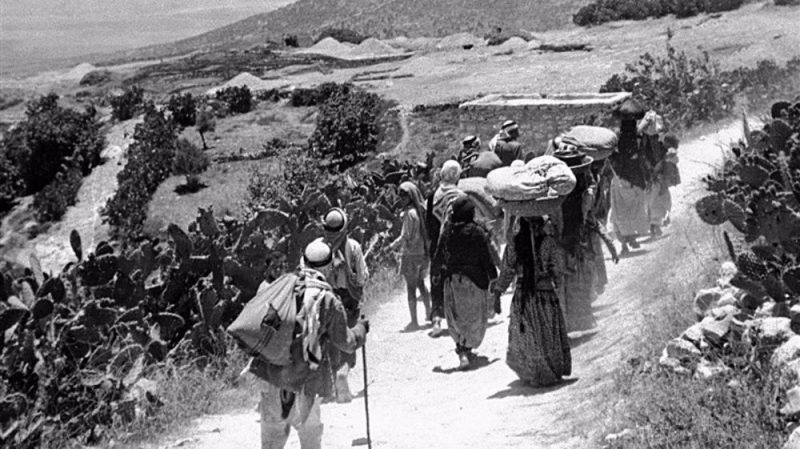
Palestinians flee the village of Qumiya during the Nakba in 1948
Press TV – February 24, 2024
Schools in the German capital Berlin have been ordered to distribute leaflets describing the Nakba Day as a “myth”, 76 years after Zionist paramilitaries forcibly removed two-thirds of the Palestinian population from their ancestral homes.
Germany’s leading Social Democratic Party (SPD) – German Chancellor Olaf Scholz’s party – and the opposition Christian Democratic Party (CDU) have asked high schools in Berlin’s borough of Neukolln to distribute brochures titled “The Myth of Israel #1948”, the London-based Middle East Eye website said in a report on Friday.
The report cited a motion that was passed during a public meeting of the borough’s council on Wednesday stating that “the district office is asked to advocate the use of the brochure ‘Myths#Israel1948’ in Neukolln’s secondary schools to confront existing anti-Semitic narratives within the educational framework of the school.”
“The expanded definition of anti-Semitism of the IHRA (International Holocaust Remembrance Alliance) and the German government should also be communicated,” the motion further read.
More than 750,000 Palestinians were forcibly removed from their ancestral homes in Palestine and 500 villages and towns were destroyed by Zionist militias before the Israeli regime declared its illegal establishment. Palestinians are still enduring the repercussions of this catastrophe to this day. The systematic ethnic cleansing occurred between 1947 and 1949.
The incident is known among Palestinians as the Day of Nakba, or the Day of Catastrophe, and it is commemorated every year on May 15.
The leaflet distributed among high school students in Berlin’s Neukolln borough flatly rejected, among others, this catastrophe as a “myth” despite the fact that ample credible evidence in favor of the occurrence of the incident are impossible to ignore.
Based on such overwhelming evidence, the United Nations, for the first time in its history, commemorated the 75th anniversary of Nakba Day back on May 15 last year.
The UN Committee on the Exercise of the Inalienable Rights of the Palestinian People (CEIRPP), at the time, organized a high-level special meeting.
It was presided over by the chairman of the committee, Ambassador Cheikh Niang of Senegal, and included a keynote address by Palestinian President Mahmoud Abbas. Senior UN officials and representatives of regional groups and civil societies also made statements to commemorate Nakba.
The leaflet stresses that criticism of illegal Israeli settlements is anti-Semitic.
According to the report, while Germany stands out with its unwavering political and military support for Israel, the German left is split over its stance on Palestine.
UNRWA: ‘Over 400 Palestinians killed seeking refuge in our Gaza facilities’
MEMO | February 24, 2024
Hypocrisy and Genocide: Here’s who the West should really be ‘decolonizing’
By Tarik Cyril Amar | RT | February 24, 2024
The hypocrisy of the US-led West regarding how it reacts to Russia, a geopolitical opponent, on one side, and to Israel, a favorite with special privileges, on the other, is so flagrant that even The Guardian has noticed. While the West uses rhetoric about “rules” and “values” to cloak its proxy war against Russia via Ukraine, it tolerates and supports Israel’s genocidal attack on the Palestinians in Gaza. That even the United Nations’ top court, the ICJ, has by now found genocide a plausible possibility, simply makes no real difference.
This is a failure that goes beyond cynical political elites. During the war between Russia and Ukraine (and de facto the West), many Western academics, journalists, and experts have not been able to get enough of displaying their rhetorical toughness. While badly misled Ukrainians have been doing all the dying, going to verbal extremes was all the rage among the West’s chairborne brigade.
Some tried to accuse Moscow of genocide. Others felt that the least they could do was demand that Russia cease to exist. That fantasy of disintegrating a geopolitical rival was usually dressed up as a call to “decolonize Russia,” also disparaged as “the last empire.” These labels were handy because they implied three fashionable – if silly – ideas: First the claim that the modern, post-Soviet Russian Federation consists of a colonizing center and colonized peripheries. Second, the wish that Russia simply must fall apart because all empires do (never mind it’s not an empire). And third, that Ukraine can be recast as a victim of imperialism on par with, say, the Belgian Congo or Vietnam fighting off first the French and then the Americans.
None of the above makes sense. Russia is a federation, its population features more than one ethnic identity, and there are imbalances. If you think that’s the definition of colonialism, go right ahead and take apart Great Britain or France. As for a “last empire,” maybe try the US first. After all, that is the one country on Earth that considers itself officially “indispensable,” thinks the whole globe is its God-given (literal) sphere of influence, has just used up Ukraine as a proxy in Europe, and is reducing its EU vassals to penury, sponsoring an ongoing genocide in the Middle East, and gearing up for a big war in Asia to defend its “primacy.”
But the inherent absurdity of these clearly politically – propagandistically, really – motivated charges is not really their most interesting aspect. For one thing, it’s just too obvious. What is really intriguing is something else, and it has happened only recently. We are now in the fifth month of witnessing – 24/7 and in real-time – the Israeli genocide of the Palestinians in Gaza. That is the outcome of Israel’s very structure, its Zionist source code: that of a classical European settler colony whose existence in its current form is premised on the removal of indigenous populations.
And yet, the same brave voices courageous enough to loudly shout what every political leader (and editor, and employer) in the West has wanted to hear about Russia – where are they now? Where are their demands to “decolonize Palestine,” that is, free the Palestinians from Israeli oppression and mass murderous violence? Where are their demands to end the “last settler colony”?
And, make no mistake, ending Israel as it is now, a state based on persistent violence, in permanent violation of UN rules with impunity, does not require or imply indiscriminate mass violence against Israelis. It simply means that this state – not its Jewish population – commits the very imperialist crimes Western talking heads keep accusing Russia of.
Where is the concern for Palestine, a country that, clearly, is a real victim of imperialist violence at the hands of Israel and the West? Where are the calls for arming the Palestinian Resistance with the best of NATO’s arsenals? Transferring tens of billions of euros and dollars to the Palestinians so they can sustain their fight against Israeli aggression? Nothing. With very few exceptions, the silence of the Western intellectuals is deafening.
The contrast with past grandiloquence is stark, even grotesque. Take, for instance, the Washington Post op-ed “What’s happening in Ukraine is genocide. Period.” of April 5, 2022. Authored by Eugene Finkel, a political scientist originally from Lviv in Ukraine and based at Johns Hopkins University, the piece argued what its title would make you expect: Finkel had no doubt that he was able to identify a clear-cut case of genocide. He has not been silent with regard to Gaza either: On November 16, 2023, he used an op-ed in the Los Angeles Times to tell us about “a bout of violence that includes atrocities, indiscriminate targeting, bombings and hostage taking, leading to claims about a potential genocide or genocidal massacres committed by the warring parties.”
Spot the difference? Whereas Finkel rushed to the far-fetched conclusions he wanted with regard to Russia, he is careful to speak only of “claims” when it comes to Israel and Gaza – and, of course, he both-sides the Israeli perpetrators and Palestinian victims. And yet, Israel has clearly and deliberately targeted civilians with a strategy of forcing ethnic cleansing. The methods of warfare used by Israel – for instance, systematic starvation blockade; the publicly encouraged mistreatment of civilians, including children and women, as combatants and of combatants as without any rights; the destruction of all medical infrastructure and the systematic murder and abuse of medical staff; the systematic mass slaughter by bombing – have no parallel in Russia’s fighting in Ukraine. And, for Israel, there can be no doubt about “intent,” which is a key factor in proving genocide.
If Finkel were remotely honest and unbiased, the very least he would have to do is invert his position: The case of Israel’s genocide in Gaza is crystal clear; the case for accusing Russia of this crime in Ukraine is anything but.
Regarding “decolonization,” there’s Janusz Bugajski, a Senior Fellow at the Jamestown Foundation in Washington and author of “Failed State: A Guide to Russia’s Rupture.” Bugajski has been an ardent advocate of disintegrating Russia, urging Western policy-makers to get ready for Moscow’s defeat and collapse, and then “capitalizing on Russia’s de-imperialization.” He has, unsurprisingly, also reveled in the “falling empire” cant. His ability to get his facts and predictions ridiculously wrong is one thing. Poland, whose glorious strategic future his next book will predict, may worry about that.
So, what about Bugajski’s take on the Gaza Genocide? Simple: It’s Moscow’s fault, of course. Or, at least, what we must think about is not the Israeli genocide but Bugajski’s contention that Russia somehow benefits from this crisis. As to what is actually happening on the ground, Bugajski can only spot “Israel’s retaliation against Gaza to eliminate the terrorist threat.” Genocide? What genocide? He has, to be fair, noticed that the US faces “international condemnation” for its support of Israel. But that fact as well he can only mentally process as yet another “win” for nefarious Moscow.
We could add more examples. But the problem should be clear by now: Too many Western intellectuals are betraying the first obligation of their professions: to at least strive to be honest. The almost compulsive urge to weaponize themselves, their positions, and reputations against Russia has overcome any respect for facts and consistent standards. That alone is a sad picture of ethical decline. But their response – or often complete failure to respond – to Israel’s genocide in Gaza, however, is so much worse again. It is at that point – that is now – that their blatant disregard for the Palestinian victims and their needs and rights reveals them not only as biased careerists and ideologues, but as bereft of conscience and compassion.
Tarik Cyril Amar is an historian from Germany working at Koç University, Istanbul.
Featured Video
America Racing to Strategic Defeat in Iran
or go to
Aletho News Archives – Video-Images
From the Archives
Should Europeans ‘Thank’ the Americans for Destroying Nord Stream?
By Robert Bridge | Strategic Culture Foundation | September 29, 2022
With an investigation continuing into the destruction of the Nord Stream gas pipeline that provided energy supplies to Europe from Russia, there appears to be just one prime suspect, and that should surprise nobody.
Following the sabotage of the Nord Stream 1 and 2 gas pipelines, former Polish Foreign Minister Radoslaw Sikorski already seemed to know the identity of the perpetrator when he tweeted out: “Thank you, USA.”
At first glance, it seemed that Sikorski was speaking sarcastically, berating Washington for carrying out an attack that will have severe repercussions for the people of Europe. After all, how could anyone see any good coming from the termination of Europe’s primary source of gas reserves with winter just around the corner? It was Sikorski’s homeland of Poland, after all, that urged its citizens to collect firewood in the face of dwindling gas reserves.
In fact, the Polish diplomat was speaking one-hundred percent literally… continue
Blog Roll
 Aletho News
- Growing insecurity, soaring prices fuel protests in north as regime bans evacuation: Sources
- Iran denies responsibility for ‘depraved’ attack on Kuwait desalination plant
- Bring The Troops Back. End This War Now!
- Can we please stop calling Israel the ‘only democracy in the Middle East’ now?
- US should start removing its troops for Germany, proposes AfD co-leader Chrupalla
- Iran Red Crescent: 600 educational centers attacked in US-Israeli ‘war crimes’
- Russian Oil Tanker Arrives in Cuba Amid U.S. Blockade
- America Racing to Strategic Defeat in Iran: Lt Col Daniel Davis
- FTC Warns Visa, Mastercard, PayPal, Stripe Over Political Debanking
- Russian tanker approaches Cuba despite US oil blockade
- If Americans Knew
- Israeli police block Catholic cardinal from entering Church of the Holy Sepulchre on Palm Sunday
- Israel is assassinating journalists again, more than any other nation, anywhere, ever – Not a ceasefire Day 170
- Over 300 US service members wounded, majority have brain injuries – Not a ceasefire Day 169
- Researchers at Human Rights Watch Resign Over Blocked Report on Palestinian Refugee Return
- Jewish Groups Are Backing a War Americans Don’t Want
- Eric Fingerhut Thinks He’s the President of the Jews
- Top Jewish Philanthropists, Rabbis Urge Israeli President to Take Action Against ‘Jewish Extremists’
- Don’t Be Fooled. Zionist Leaders Have Always Wanted to Control Southern Lebanon
- Israel’s widespread use of torture is a core element of its genocide against the Palestinian people
- In Israel’s War on Iran, Many Middle East US Bases Rendered “All But Uninhabitable”
- No Tricks Zone
- New Study Finds Warming Saves Lives…Cold Temperatures 12 Times More Deadly Than Excess Heat
- German Science Blog Accuses PIK Climate Institute Of Hallucinating Climate Tipping Points
- Devastating Assessment Of Comirnaty Vaccine By Former Senior Pfizer Europe Toxicologist
- New Study: CO2 Is ‘Effectively Negligible’ As An Explanatory Climate Change Factor Since 2000
- Former Pfizer Toxicologist Dr. Helmut Sterz Tells Bundestag Hearing Pfizer Vaccine Should Have Never Been Approved
- Energy Expert: Germany’s Nuclear Phaseout Was A “500 Billion Euro Mistake”
- New Research: South Australia’s Mid-Holocene Sea Surface Temperatures Were 4°C Warmer Than Today
- Storing Green Energy To Last Germany 10 Days Would Require A 60-Million Tonne Battery
- New Studies: UK Sea Levels Were 4 Meters Higher Than Today During The Mid-Holocene
- Destructive Green New Deal: German Energy And Metal Group Warns Of Drastic Crisis
 Aletho News