Russia Slams UNSC for Ignoring Attack on Iranian Consulate, Calls for End to Bloodshed
Sputnik – 14.04.2024
UNITED NATIONS – Russia’s Permanent Representative to the United Nations Vasily Nebenzia criticized the UN Security Council for failing to act on the Israeli attack on the Iranian consulate in Syria as he urged an end to bloodshed in the Middle East during an emergency UNSC meeting on Sunday.
“It is regrettable that unlike the meeting today, you did not propose to bring it to brief the Council on the 2nd of April,” he said, adding that Russia called an emergency briefing to discuss the Israeli strike against the consular premises in Damascus.
Nebenzia criticized Israel for not complying with the UN Security Council resolutions, which he said was “an obvious disrespect shown to the Council, to all of you who are here in the members seats, and a complete disregard to the decisions made by the Security Council.”
“This high level confrontation and bloodshed must be stopped We think it’s urgent for the entire international community to undertake all the efforts necessary to de-escalate the situation,” Nebenzia said.
Iran’s attack on Israel did not happen in a vacuum – it was a response to the shameful inaction of the UN Security Council, the Russian ambassador stressed.
“What happened on the night of April 14 did not happen ‘in a vacuum.’ Iran’s steps were a response to the shameful inaction of the United Nations Security Council [and] a response to Israel’s blatant attack on Damascus… by no means the first. Syria is constantly being bombed by Israel,” Nebenzia said.
On April 3, the US and UK refused to discuss Russia’s proposed draft UN Security Council statement on the Israeli strike on the Iranian consulate in Damascus. London and Washington then cited the fact that there was no unity in the meeting’s assessment of what happened. On Sunday, an urgent meeting of the UN Security Council is taking place in connection with the retaliatory strike that Iran carried out on the territory of Israel. Meanwhile, shortly before that, Iran’s mission to the UN said that if the Security Council had condemned the Israeli strike on the Iranian consulate and brought the perpetrators to justice, the need for Iran to punish the Israeli side “could have been eliminated.”
Russia calls for restraint on all sides involved in the incident with Iran’s attack on Israel, Russia’s permanent representative to the UN highlighted.
Russia calls on Israel to follow the example of Iran, which has said it does not want further escalation, Nebenzia said.
“We note Tehran’s signal of unwillingness to further escalate hostilities with Israel. We urge West Jerusalem to follow its example and abandon the practice of provocative forceful actions in the Middle East, fraught with extremely dangerous risks and consequences on the scale of the entire region, already destabilized as a result of the escalation of the Palestinian-Israeli confrontation,” Nebenzia emphasized.
Israeli minister calls for full seizure of Gaza Strip
MEMO | April 14, 2024
Israeli Finance Minister Bezalel Smotrich called on Sunday for imposing a full control over the entire Gaza Strip, Anadolu Agency reports.
Smotrich’s remarks came following an announcement by Prime Minister Benjamin Netanyahu’s office that Hamas’ response to mediators’ proposals for a prisoner exchange deal was negative.
“Giving up on Israel’s red lines and chasing after Hamas for a deal only makes the chance of bringing everyone (hostages) home further away,” the leader of the Religious Zionism party wrote on X.
“It’s time to learn lessons, change direction, … and restore full Israeli control all over the Gaza Strip,” he added.
On Sunday morning, Netanyahu’s office called Hamas’ response to the broad outlines presented by mediators regarding a proposal for a cease-fire with Israel as negative.
“It has been over a week since the Cairo meeting – Hamas has rejected the outline that was tabled by the mediators,” Netanyahu’s office wrote on X.
Hamas is estimated to be holding more than 130 Israeli hostages, while Tel Aviv is holding more than 9,100 Palestinians in its jails.
Hamas demands an end to Israel’s deadly offensive on the Gaza Strip and the withdrawal of the Israeli forces from the territory for any hostage-prisoner swap deal with Tel Aviv.
Israel has killed more than 33,000 Palestinians since an Oct. 7, 2023 cross-border attack by Hamas in which some 1,200 Israelis were killed and around 250 hostages taken.
A previous deal in November saw the release of 81 Israelis and 24 foreigners in exchange for 240 Palestinians, including 71 women and 169 children.
The US, Qatar and Egypt have tried to broker an agreement to release the remaining Israeli captives.
The conflict has pushed 85% of Gaza’s population into internal displacement amid acute shortages of food, clean water, and medicine, while 60% of the enclave’s infrastructure has been damaged or destroyed.
Global calls for a cease-fire have been growing as the war has entered its seventh month.
Israeli army shells hundreds of displaced Palestinians in Gaza
Press TV – April 14, 2024
The Israeli army has shelled hundreds of displaced Palestinians trying to return to their homes in the northern Gaza Strip, as the Tel Aviv regime presses ahead with its genocidal war in the besieged Palestinian territory.
At least five Palestinians, including a woman, were killed and several others injured in Israeli artillery shelling on Sunday.
“Five fatalities, including a woman, and a number of injured people arrived at Al-Awda Hospital in the Nuseirat camp in the central Gaza Strip,” media outlets quoted medical sources as saying.
The casualties occurred among “the displaced Palestinians who tried to return to the northern Strip via al-Rashid Street,” they added.
Palestinians gathered at al-Rashid Street to cross to the north of Gaza after rumors spread that children and women under the age of 14 were allowed to cross the north in Gaza City.
The Israeli army spokesman Avichay Adraee said the regime had warned the Palestinians against approaching the Israeli forces invading the northern Gaza Strip.
“The Israeli army does not allow the return of residents, neither through Salah al-Din Street nor through Al-Rashid Street,” he said, “The northern Gaza Strip is still a war zone and we will not allow a return to it.”
Witnesses confirmed that the Israeli army asked them to return to the southern Gaza Strip and fired smoke bombs at them to prevent them from reaching the north.
Israel waged the genocidal war on Gaza after the Palestinian resistance movement Hamas carried out a historic operation against the occupying entity in retaliation for its intensified atrocities against the Palestinian people.
The Israeli aggression has so far killed at least 33,700 Palestinians, mostly women and children.
The Tel Aviv regime has imposed a “complete siege” on the territory, cutting off fuel, electricity, food, and water to the more than two million Palestinians living there.
The Israeli war has pushed 85% of Gaza’s population into internal displacement amid acute shortages of food, clean water, and medicine, while 60% of the enclave’s infrastructure has been damaged or destroyed, according to the UN.
In January, an interim ruling by the International Court of Justice ordered Tel Aviv to stop genocidal acts and take measures to guarantee that humanitarian assistance is provided to civilians in Gaza.
Massive Rallies Break Out in Japan Against WHO’s Pandemic Treaty
PharmaFiles by Aussie17 | April 13, 2024
April 13, 2024, will be etched in the annals of modern Japanese history as tens of thousands of citizens across the nation came together in a series of pandemic rallies. The protests centered on the widespread opposition to the Pandemic Treaty, with escalating concerns over “infectious disease” and “public health” becoming potent tools for an unprecedented push towards what is perceived by many as a totalitarian surveillance society.
From the bustling streets of Ikebukuro to the gatherings at Higashi-Ikebukuro Central Park, the sheer scale of participation speaks volumes. Organizers aimed for a monumental turnout of 100,000 protesters to demand answers on crucial issues, such as the stark increase in excess deaths and the lack of transparency on the adverse effects following vaccinations.
The protest not just opposed potential mandatory vaccinations but also the perceived overreach of health authorities and their ties with global pharma, echoing a distressing sentiment of disenfranchisement among the populace. Demonstrators criticized the lack of explanations for a sharp increase in excess deaths and demanded accountability and clarity on vaccine-related casualties.
Eminent speakers, including Professor Masayasu Inoue and modern history researcher Chikatsu Hayashi, provided compelling pre-demonstration speeches that laid bare the concerning dynamics between global health authorities and pharmaceutical agendas. Professor Inoue highlighted the concerning trend of our health being weaponized in what he termed as “a third world war fought with information.” He urged the public to resist introducing genetic vaccines into their bodies, implicating a significant portion of WHO’s funding comes from pharmaceutical giants and private interests like the Bill Gates Foundation. This follows Japan’s Message to the World delivered by Prof Inoue a few days ago.
Modern history researcher Prof Chikatsu Hayashi’s address was a rallying cry to resist the encroaching shadows of global totalitarianism, symbolically referring to the proactive stance against it as “stopping the third atomic bomb with our hands.” His poignant discourse highlighted a national movement poised against not only the Pandemic Treaty but also the underlying structures threatening Japan’s sovereignty and the well-being of its citizens.
April 13 marked not just a protest against a treaty but a stand against a future where health becomes a lever for control and surveillance. The massive turnout signifies a critical moment in Japan’s civic engagement. It’s a call from its people for autonomy, transparency, and the reassessment of global health governance that resonates beyond its borders. Today, Japan stands at the forefront, questioning, challenging, and seeking change for a future where health policy respects national sovereignty and individual rights.
Signing off for now
A17
Did the U.S. Death Rate from Measles Decline by over 98% Before Introduction of a Measles Vaccine?
Injecting Freedom by Aaron Siri | April 12, 2024
Did the death rate from measles in the United States decline by over 98% between 1900 and 1962, the year before the first measles vaccine was introduced?
According to the CDC’s data, the death rate from measles had already declined over 98% between 1900 and 1962, which was before the measles vaccine was introduced in the United States.
This official United States government data shows that in 1900, the rate of mortality from measles was 13.3 per 100,000 individuals and by 1960 it was 0.2 deaths per 100,000 individuals. The death rate was also 0.2 deaths per 100,000 individuals in 1961 and 1962. And the first measles vaccine did not come onto the market until 1963. Meaning, an over 98% decline in measles mortality between 1900 and the early 1960s before there was a measles vaccine.
If you like charts, the following is an official chart of measles mortality issued by the United States government showing the drop in measles mortality from 1900 to 1960. This chart was published before there was a measles vaccine — no doubt they would never publish such a chart today!

Comprehensive Russian Temperature Reconstruction Shows Warmer Temperatures 1000 Years Ago!
By P Gosselin | No Tricks Zone | April 14, 2024
Dr. Michael E. Mann and the IPCC claims of a hockey stick temperature trend are challenged.
A paper published by a team of scientists of the Russian Academy of Sciences led by В. V. Klimenko presents a quantitative reconstruction of the mean annual temperatures of northeastern Europe for the last two millennia. The study was done in cooperation with the Alexander von Humboldt Foundation (Germany).
Result: it was modestly warmer 1000 years ago than it is today.
The reconstruction of the mean annual temperatures is based on dendrochronological, palynological and historical information, and shows the comparative chronology of climatic and historical events over a large region of Northeast Europe:
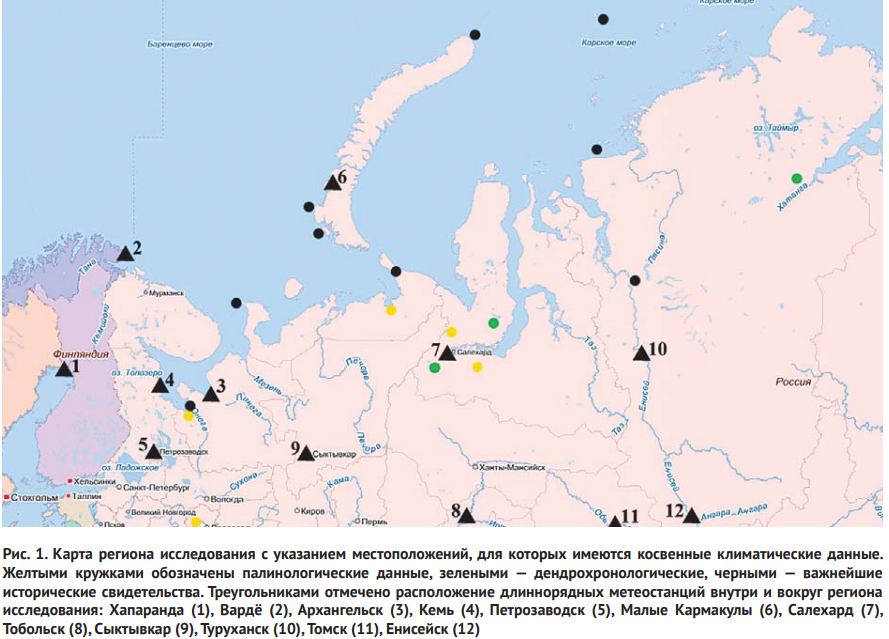
Figure 1. Map of the study region showing locations for which indirect climatic data are available.
Yellow circles indicate palynological data, green circles indicate dendrochronological data, and black circles indicate the most important historical evidence. Triangles indicate the location of long-row weather stations in and around the study region: Haparanda (1), Vardø (2), Arkhangelsk (3), Kem (4), Petrozavodsk (5), Malye Karmakuly (6), Salekhard (7), Tobolsk (8), Syktyvkar (9), Turukhansk (10), Tomsk (11), Yeniseysk (12). Source: here.
Warmer in the years 981-990 and in mid 20th century
Unlike what papers authored by scientists close to the IPCC like to suggest (a flat temperature mean over the past 1000 years followed by a 20th century hockey stick blade warming),the Russian reconstruction of decadal mean annual temperature values shows major climatic events manifested both on the scale of the entire Northern Hemisphere and in its separate regions.
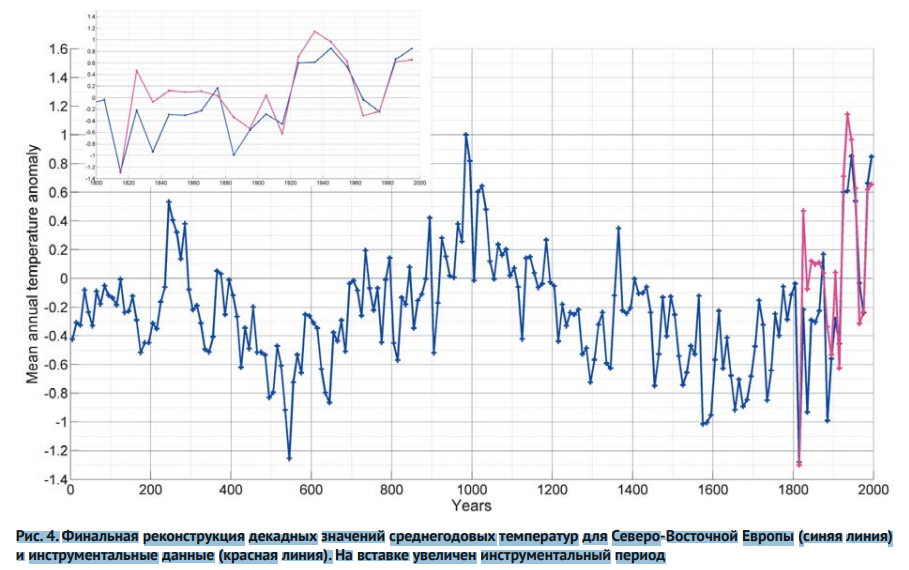
Figure 4. Final reconstruction of decadal mean annual temperatures for Northeast Europe (blue line)
and instrumental data (red line). The instrumental period is enlarged in the inset. Source: here.
According to the paper’s abstract:
In the pre-industrial era, the maximum annual mean temperatures in 981-990 were 1°C higher and minimum temperatures in 1811-1820 were 1.3°C lower than on average for 1951-1980. The constructed chronology has a noticeably larger amplitude of variability compared to hemispheric and pan-Arctic reconstructions.”
The paper concludes that the results of the reconstruction point to “major climatic events” such as the Roman Optimum, the cold epoch of the Great Migration of Peoples in the 5th and 6th centuries, the Medieval Climatic Optimum of the 10th-12th centuries, and the Little Ice Age (13th-19th centuries).
These were manifested both on the scale of the entire Northern Hemisphere, and its individual regions.
Ottawa fails to condemn Israeli damage to Canadian embassy
By Yves Engler | The Canada Files | April 13, 2024
An apartheid state committing genocide damaged a Canadian embassy while conducting a flagrant war crime. But Ottawa has remained silent about an incident designed to ignite a regional war.
Two weeks ago, the Israeli Air Force murdered 16 people in strikes on Iran’s embassy compound in Damascus. They reportedly killed two top Iranian generals, two civilians and a dozen militants. The illegal strikes obviously impinged on Syrian sovereignty and contravene multiple conventions such as the 1963 Vienna Convention on Consular Relations.
Dozens of governments condemned Israel’s violation of international law. The European Union criticized the strikes and a senior United Nations official told an emergency meeting of the Security Council that the inviolability of diplomatic and consular premises and personnel must be respected. The Coordinating Bureau of the 120 nation Non-Aligned Movement released a statement that “strongly condemns the heinous attack conducted by Israel against Iranian diplomatic premises and representatives in Damascus.”
For its part, Ottawa failed to criticize Israel’s actions even as it has emerged that Israel’s strike destroyed a number of windows in the Canadian embassy, which is located next to Iran’s. While formally closed since 2012, the damaged embassy remains Canadian property.
Ottawa was also mum when Israel killed over 50 people in Syria, 72 hours earlier. To the best of this author’s knowledge, the Trudeau government hasn’t criticized any of Israel’s innumerable — 33 times since the start of this year — illegal strikes in that country. Nor has Ottawa criticized a series of (presumed) Israeli killings in Iran though they regularly criticize that country’s actions.
As Israel has bombed Lebanon, Syria and Palestine in recent years, Ottawa has sold it arms and maintained a multitude of bilateral and multilateral military ties. Additionally, the Trudeau government has turned a blind eye to the inducement of Canadians to join or assist the Israeli military in violation of the Foreign Enlistment Act and to registered charities fundraising for the Israeli military in contravention of Canada Revenue Agency rules.
Israel’s attack on Iran’s diplomatic outpost in Syria is a major escalation. The Iranians have said they will respond with a significant assault (reportedly Tehran told Washington that if they impose a ceasefire in Gaza, they will hold back). Israel has responded to Iranian threats by claiming it will further escalate the conflict. On Wednesday Israel’s foreign minister, Israel Katz, posted to X, “If Iran attacks from its territory, Israel will respond and attack in Iran.” President Joe Biden said the US will support Israel.
As has been speculated for some time, Benjamin Netanyahu wants to draw the US into a war with Iran. Netanyahu has long hyped the Iranian threat and wants to have the US weaken the only power in the region that hasn’t been cowed by Israel/US dictates.
Netanyahu has a personal interest to continue fighting. He’s likely going to be ousted as prime minister and may even end up in jail on corruption charges when the fighting stops. Additionally, Israel has failed in its bid to liquidate Hamas in Gaza, Palestine. After six months of Israeli-perpetrated horrors, most of Hamas’ top leaders are alive, uncaptured, and Israel hasn’t even recovered those kidnapped on October 7.
More generally, instigating wars is a national pastime for Israel. (“Israel is an army with a state” goes the saying). Israel has bombed Jordan, Egypt, Sudan, Syria, Palestine, Lebanon, Tunisia and Iraq. Fifteen years ago, Israeli military historian Zeev Maoz explained in Defending The Holy Land: A Critical Analysis of Israel’s Security & Foreign Policy:
“Between 1948 and 2004, Israel fought six interstate wars, fought two (some say three) civil wars, and engaged in over 144 dyadic militarized interstate disputes (MIDs) that involved the threat, the display, or the use of military force against another state. Israel is by far the most conflict prone state in modern history. It has averaged nearly four MIDS every year. It has fought an interstate war every nine years. Israel appears on top of the list of the most intense international rivalries in the last 200-year period.”
Later in the book, Moaz said:
“There was only one year out of 56 years of history in which Israel did not engage in acts involving the threat, display, or limited use of force with its neighbors. The only year in which Israel did not engage in a militarized conflict was 1988, when Israel was deeply immersed in fighting the Palestinian uprising, the intifada. So, it is fair to say that during each and every year of its history Israel was engaged in violent military actions of some magnitude.”
Maoz concludes (describing the Nakba as a “war of independence”):
“None of the wars — with a possible exception of the 1948 war of Independence — was what Israel refers to as Milhemet Ein Brerah (‘war of necessity’). They were all wars of choice or wars of folly.”
For its size, Israel may be the most violent state in the history of humanity. Canada has seldom criticized and in fact enabled this rogue state, as it unleashes ever more death and destruction.
Yves Engler is the author of 13 books. His latest book, available now, is “Canada’s Long Fight Against Democracy”.
Israeli general pegs cost of defending against attack – media
RT | April 14, 2024
Israel has claimed success in defending itself against Saturday’s drone and missile barrages by Iran, but that effort reportedly came at a high price.
The interceptors, jet fuel and other materials expended in shooting down Iran’s unmanned aerial vehicles (UAVs) and missiles cost about 4 billion to 5 billion shekels ($1.06 billion to $1.33 billion), Israeli Brigadier General Reem Aminoach told local media outlet Ynet News on Sunday. The estimate included only Israel’s direct costs, not counting the considerable weaponry used by the US and other allies in helping to defend against the attack.
Aminoach, formerly the financial adviser to the Israel Defense Forces (IDF) chief of staff, said West Jerusalem used such munitions as Arrow and David’s Sling interceptor missiles, which have per-unit costs of about $3.5 million and $1 million, respectively. He also included sortie expenses for the fighter jets that did the bulk of the work in shooting down Iranian drones.
The general lamented that it was far cheaper for Iran to launch the attack than for Israel to defend itself. “The attack cost Iran less than 10% of what it cost us to defend against it,” he told Ynet. “In the future – in a year, two years, or five years – they can carry out 50 such attacks. And let’s say that if the IDF’s net budget in 2023 was 60 billion shekels, with less than double that you have no chance of reaching a situation where we can maintain the required amounts.”
The IDF claimed that 99% of the more than 300 kamikaze drones and missiles launched from Iranian territory were successfully intercepted. All of the UAVs and cruise missiles were shot down, military spokesman Daniel Hagari said, while a few ballistic missiles got through Israel’s defenses.
Those projectiles fell at the Nevatim Airbase and caused “only minor damage to infrastructure,” the spokesman said. He added that the drones launched by Iranian-backed militants in Iraq and Yemen all failed to reach Israeli territory. The only casualty was a shrapnel wound to a 10-year-old Bedouin Israeli girl who was hit while sleeping at her home in southern Israel.
Saturday’s attack came in response to an April 1 airstrike that killed seven Iranian military officers, including two senior commanders, at Tehran’s consulate in Damascus. Israel has vowed to “exact a price” from Iran for striking back.
Strike on Israel Shows US Bases Near Iran Are ‘Achilles Heel’ – Analyst
By Svetlana Ekimenko – Sputnik – 14.04.2024
Fears of a greater Middle East escalation were triggered after Iran launched a massive drone and missile attack against Israel, aided by Hezbollah and the Yemeni Houthis. Iran said the attack was in response to Israel’s bombing of the Iranian consulate in Damascus, Syria, which killed seven members of the elite Revolutionary Guard Corps.
Iran’s massive retaliatory attack on Israel from its own territory is a sign that the conflict could “escalate out of control.”
Michael Maloof, a former senior security analyst in the office of the US secretary of defense, told Sputnik that the first ever direct Iranian attack on Israel set a dangerous precedent.
“My concern is that this could easily escalate into something not only between Iran and Israel, but beyond the Middle East region,” he said.
Iran’s assault, which it stated was an act of “self-defense” after the Israeli strike on its consulate in Damascus, was originally intended to be a “limited” one, said Maloof.
Iran first sent in “swarms of drones with lights on as a sign of psychological warfare,” but sending in cruise and ballistic missiles by Tehran was a “distinct escalation,” said Maloof.
The scale of Iran’s attack on Israel suggests that Tehran was sending a message, demonstrating that it possesses “extraordinary capabilities,” said Maloof.
“They have built up their missile capabilities extraordinarily, they have drones, cruise missiles, and some of the most accurate ballistic missiles in the region right now,” he added.
“I think that this clearly showed that Iran has a capability. I think it’s limited. They cannot do this on a sustained basis. And they did send their slower ordinance, such as drones, UAVs. But they also claim to have hypersonics,” Maloof noted.
“I think that if Israel were to retaliate, then I think they would engage the more sophisticated missiles and hypersonics, potentially, if they have them,” He added. “Then you’re talking some very serious escalation in the entire region. It’s already unprecedented, but this escalation could be even ratcheted up that could conceivably bring in other and extend beyond just this region.”
All signs point to the potential of a larger regional war erupting, Maloof warned, adding that everything now depends on Israel’s reaction. “Is this a tit-for-tat, a one-on-one, or a further escalation?” he asked.
“I think we are already getting that message from Netanyahu, his ministers, that they are going to respond… How they respond is going to determine the extent of that escalation through the [Middle East] region,” stressed Maloof. “I am quite concerned that neither side is going to stand down at this point.”
Israeli Prime Minister Benjamin Netanyahu is prepared to “continue an endless war in the region,” suggested Maloof, adding that he “knows he had the US backing,” and could opt to strike now, taking advantage of this “window of opportunity.”
“He may not get such an opportunity under a potential Trump administration coming in [after the US elections in November],” said the expert.
Looking at possible scenarios for Israel’s response, he noted that Tel Aviv had already stated publicly an intention to “go after the nuclear sites in Iran.”
“That is going to be exceedingly difficult, plus I don’t know that they have the power projection to do that on any consistent basis, and secondly, I don’t believe they have the so-called ‘bunker busters’ that would be needed to be able to drill down through the mountains to reach those facilities. The US has been reluctant to give Israel these bunker buster [munitions],” said Maloof.
As for the US, it has already “gotten sucked into this,” Maloof noted.
US President Joe Biden issued a statement on Iran’s attack against Israel after speaking with Netanyahu by phone. Biden condemned the attack “in the strongest possible terms”.
He reaffirmed Washington’s “ironclad commitment” to help support Israel’s security. Secretary of State Antony Blinken said the US does “not seek escalation” but will “continue to support” Israel’s defense. “I will be consulting with allies and partners in the region and around the world in the hours and days ahead,” he added.
“There is already a call in Congress to put on fast-track the legislation to approve new ordinance, and the $14 billion for Israel,” said the pundit. He remarked that the Pentagon might “empty its stockpiles to provide support to Israel,” and recalled that besides giving Israel bombs and artillery, the US supports its Iron Dome air defense system, whose missiles will need to be replenished.
“If you have a swarm, wave after wave of swarms, Israel is going to be very hard pressed to be able to defend against that. And that’s why the US now is coming in, and that gets the US directly involved,” Maloof pointed out. “And that could then open up US assets in the region.” We have got some 35 bases that surround Iran, and they thereby become vulnerable. They were meant to be a deterrence. Clearly, deterrence is no longer on the table here. Now they become the American Achilles heel because of their vulnerabilities to attack. They’ve got air defense systems, but they’ve got to be replenished. And given that you got active war going on right now in the region, it’s going to be difficult to replenish those supplies.”
According to the ex-Pentagon analyst, much now also depends upon what stockpiles Iran has and “with what consistency they can keep sending these wave after wave of drones and ballistic missiles… Ultimately, if they have them, the hypersonics… and there’s no defense against hypersonics. Not even Israel’s ‘Arrow’ system, which is designed to deal with ballistic missiles… And apparently, that’s been engaged tonight, as well as the Iron Dome.”
The United Nations (UN) Security Council is to meet on Sunday in response to a request from Gilad Erdan, Israel’s permanent representative to the United Nations. The meeting is scheduled for 4 pm New York time (2000 GMT), as announced by the UN Department of Global Communications.
“I’m hoping that the UN Security Council can take this up and maybe some adult supervision could begin to intervene in this and maybe try to bring it to a halt for now,” Maloof said. “But right now, this minute, it doesn’t look like it. And again, it’s going to depend upon the response from the Israelis if they go directly into Iran in response.”
The current media frenzy surrounding the Iran strike is “disproportionately amplified compared to the actual events transpiring on the ground,” Dr Ahmed Al Ibrahim, a Riyadh-based political analyst, told Sputnik.
He added that any true aftermath of Iran’s strike will be discernible after a “thorough assessment.”
“Indeed, I dismiss the current situation as largely sensationalized, a “bubble” inflated by media coverage and public attention,” the political analyst said.
He expressed skepticism that any Middle Eastern countries would “willingly entangle themselves in the unfolding chaos.” Arguing that “Iran’s capacity to directly threaten Israel is limited by geographical constraints,” Ibrahim agreed that there is “potential for escalation.”
Scott Ritter: Iran’s Retaliatory Attack ‘Reestablished Deterrence’ to Hold Israel, US in Check
By Svetlana Ekimenko | Sputnik | April 14, 2024
Iran’s mission to the United Nations stated earlier that Tehran’s retaliatory drone and missile attack against Israel had “concluded.” The “military action” was a response to Israel’s “aggression against our diplomatic premises in Damascus,” it said, adding that the strike “hit designated targets.”
By launching its retaliatory drone and missile attack on Israel, Iran “reestablished deterrence,” former UN weapons inspector Scott Ritter told Sputnik.
“Israel believed that it could launch a strike against Iran and suffer no consequence. That is no longer the case,” Ritter noted.
As Israeli military officials survey the damage done to their bases, “they understand the following: that Iran deliberately chose not to inflict extremely lethal action against Israel,” the analyst remarked.
Iran launched a massive drone and missile attack against Israel overnight, assisted by Hezbollah and the Yemeni Houthis. Over 300 projectiles were fired at Israeli territory from Iran, with Iran’s mission to the United Nations stating that its retaliatory attack on Israel had “concluded,” and that the strike “hit designated targets.” Israel’s military has claimed that 99% of the projectiles were intercepted.
Iran’s strike was designed to send a signal to Israel and the United States, “that it could do what it did in Nevatim, at Ramona, anywhere in Israel, anywhere in the Middle East, and there was nothing the United States or Israel could do in response.”
“This is deterrence. This means that in the future, if either Israel or the United States plan on carrying out an action against Iran, they have to weigh in the consequences of their actions knowing that Iran has the capacity to reach out and touch any place, any spot, any target in the region in Israel or out of Israel, and there’s nothing anybody could do to stop that,” the retired US Marine Corps intelligence officer said.
US President Joe Biden issued a statement on Iran’s attack against Israel after he spoke on the phone with Israeli Prime Minister Benjamin Netanyahu. The POTUS condemned the strike “in the strongest possible terms.” He also reaffirmed Washington’s “ironclad commitment” to help support Israel, and added that there were no attacks on US forces or facilities on Saturday, but that the US “will remain vigilant to all threats.”
Secretary of State Antony Blinken said the US does “not seek escalation,” but will “continue to support” Israel’s defense. “I will be consulting with allies and partners in the region and around the world in the hours and days ahead,” he added.
Weighing in on the flurry of talks between US and Israeli leaders, Scott Ritter said:
“This is why President Biden has been on the phone with Benjamin Netanyahu, the prime minister of Israel, telling him, ‘Do not retaliate.’ The United States will not be a partner in any offensive action against Iran. Not because the United States is friendly to Iran, but the United States understands the consequences that will accrue, should such an attack take place. The United States has been deterred against further action against Iran.”
The question uppermost at the moment is, “what will Israel do?” Ritter noted.
“Israel has been trying to lead the United States into a larger conflict with Iran for some time now. Indeed, some people have speculated that the Israeli attack against the Iranian Consulate in Damascus was designed for just that purpose… But the Iranians were very clever in designing their response – just like they did, when they retaliated against the United States for the assassination of Qasem Soleimani back in 2020,” Ritter said.
He recalled that at the time, Iran launched over a dozen missiles against the Al-Asad air base in Iraq, but Tehran gave Washington advance notice that that base was going to be struck. Thus, Iran ended up destroying empty buildings, Ritter recalled.
“But it demonstrated to the United States that it had the capacity to strike any American base in the region with extreme precision and kill as many Americans as they wanted – if they wanted to do that. And America was deterred against future action of that sort. Will Israel be deterred?” the analyst wondered.
No decision has been made yet regarding an Israeli response to the Iranian missile and drone attack, an Israeli official told The Times of Israel. It was added that a potential response would be discussed at a war cabinet meeting set for later on Sunday. Israel’s response to the Iranian attack will be coordinated with its allies, The New York Times reported earlier, citing an Israeli official.
After Iran’s unprecedented strike, Tel Aviv “understands that any escalation could mean the destruction of Israel,” Scott Ritter noted.
“Israel probably isn’t going to launch a response against Iran. Israel has been deterred from launching that response by the Iranian actions. In this case, we can say that operation ‘True Promise’ was an extraordinarily successful operation, not only for Iran, but indeed for the world, because Iranian deterrence now is a reality that can hold Israel and the United States in check,” Ritter said.
Iran describes response to Israeli attack as ‘legitimate defense’
Press TV – April 13, 2024
Iran’s permanent mission to the United Nations defends the country’s retaliation against the Israeli regime’s recent terrorist attack on the Islamic Republic’s diplomatic premises in the Syrian capital.
“Iran’s military action was based on Article 51 of the United Nations Charter concerning legitimate defense in response to the Zionist regime’s aggression against our diplomatic premises in Damascus,” the mission said in a statement on Saturday.
“The matter can be considered as concluded,” it added.
The mission, however, warned that if the Israeli regime perpetrated another mistake, Iran’s subsequent response could be “remarkably more intense.”
The statement concluded that the conflict was one between Iran and the rogue regime, “of which the United States should stay away.”
Iran’s Islamic Revolution Guards Corps (IRGC), on Saturday night, launched “extensive” retaliatory missile and drone strikes against the occupied territories, defining the mission as “Operation True Promise.”
The Israeli attack had resulted in the martyrdom of Brigadier General Mohammad Reza Zahedi, a commander of the IRGC’s Quds Force, his deputy, General Mohammad Hadi Haji Rahimi, and five of their accompanying officers.
The terrorist attack drew sharp condemnation from senior Iranian political and military leaders, who vowed “definitive revenge.”
On Thursday, the Iranian mission to the United Nations said the UN Security Council’s condemnation of the Israeli atrocity could have prevented the need for retaliation.
“Had the UN Security Council condemned the Zionist regime’s reprehensible act of aggression on our diplomatic premises in Damascus and subsequently brought to justice its perpetrators, the imperative for Iran to punish this rogue regime might have been obviated,” it said on the social media platform X Thursday.
Featured Video

America Racing to Strategic Defeat in Iran
or go to
Aletho News Archives – Video-Images
From the Archives
Should Europeans ‘Thank’ the Americans for Destroying Nord Stream?
By Robert Bridge | Strategic Culture Foundation | September 29, 2022
With an investigation continuing into the destruction of the Nord Stream gas pipeline that provided energy supplies to Europe from Russia, there appears to be just one prime suspect, and that should surprise nobody.
Following the sabotage of the Nord Stream 1 and 2 gas pipelines, former Polish Foreign Minister Radoslaw Sikorski already seemed to know the identity of the perpetrator when he tweeted out: “Thank you, USA.”
At first glance, it seemed that Sikorski was speaking sarcastically, berating Washington for carrying out an attack that will have severe repercussions for the people of Europe. After all, how could anyone see any good coming from the termination of Europe’s primary source of gas reserves with winter just around the corner? It was Sikorski’s homeland of Poland, after all, that urged its citizens to collect firewood in the face of dwindling gas reserves.
In fact, the Polish diplomat was speaking one-hundred percent literally… continue
Blog Roll
 Aletho News
- Growing insecurity, soaring prices fuel protests in north as regime bans evacuation: Sources
- Iran denies responsibility for ‘depraved’ attack on Kuwait desalination plant
- Bring The Troops Back. End This War Now!
- Can we please stop calling Israel the ‘only democracy in the Middle East’ now?
- US should start removing its troops for Germany, proposes AfD co-leader Chrupalla
- Iran Red Crescent: 600 educational centers attacked in US-Israeli ‘war crimes’
- Russian Oil Tanker Arrives in Cuba Amid U.S. Blockade
- America Racing to Strategic Defeat in Iran: Lt Col Daniel Davis
- FTC Warns Visa, Mastercard, PayPal, Stripe Over Political Debanking
- Russian tanker approaches Cuba despite US oil blockade
- If Americans Knew
- Israeli police block Catholic cardinal from entering Church of the Holy Sepulchre on Palm Sunday
- Israel is assassinating journalists again, more than any other nation, anywhere, ever – Not a ceasefire Day 170
- Over 300 US service members wounded, majority have brain injuries – Not a ceasefire Day 169
- Researchers at Human Rights Watch Resign Over Blocked Report on Palestinian Refugee Return
- Jewish Groups Are Backing a War Americans Don’t Want
- Eric Fingerhut Thinks He’s the President of the Jews
- Top Jewish Philanthropists, Rabbis Urge Israeli President to Take Action Against ‘Jewish Extremists’
- Don’t Be Fooled. Zionist Leaders Have Always Wanted to Control Southern Lebanon
- Israel’s widespread use of torture is a core element of its genocide against the Palestinian people
- In Israel’s War on Iran, Many Middle East US Bases Rendered “All But Uninhabitable”
- No Tricks Zone
- New Study Finds Warming Saves Lives…Cold Temperatures 12 Times More Deadly Than Excess Heat
- German Science Blog Accuses PIK Climate Institute Of Hallucinating Climate Tipping Points
- Devastating Assessment Of Comirnaty Vaccine By Former Senior Pfizer Europe Toxicologist
- New Study: CO2 Is ‘Effectively Negligible’ As An Explanatory Climate Change Factor Since 2000
- Former Pfizer Toxicologist Dr. Helmut Sterz Tells Bundestag Hearing Pfizer Vaccine Should Have Never Been Approved
- Energy Expert: Germany’s Nuclear Phaseout Was A “500 Billion Euro Mistake”
- New Research: South Australia’s Mid-Holocene Sea Surface Temperatures Were 4°C Warmer Than Today
- Storing Green Energy To Last Germany 10 Days Would Require A 60-Million Tonne Battery
- New Studies: UK Sea Levels Were 4 Meters Higher Than Today During The Mid-Holocene
- Destructive Green New Deal: German Energy And Metal Group Warns Of Drastic Crisis
 Aletho News