The war is lost, so why is Netanyahu still killing civilians in Rafah?
By Ramzy Baroud | MEMO | May 29, 2024
Just hours after Israel carried out a gruesome massacre of displaced Palestinians in the Tel Al-Sultan area west of Rafah in the Gaza Strip on 26 May, it carried out yet another massacre in the Al-Mawasi area. The first is now known as the “Tents Massacre”. It took place shortly after the International Court of Justice (ICJ) finally issued a stern demand that, “Israel must immediately halt its military offensive and any other action in Rafah which may inflict on the Palestinian group in Gaza conditions of life that could bring about its physical destruction in whole or in part.”
The killing of 50 Palestinians in their own displacement tents was the answer given by Israeli Prime Minister Benjamin Netanyahu and his extremist government to the ICJ and the rest of the international community. The successive Israeli massacres in Rafah demonstrate the degree of intransigence of Israel’s genocidal regime.
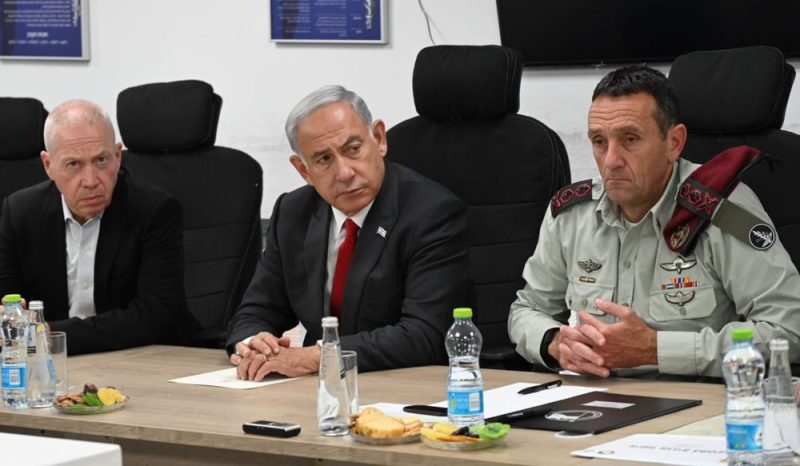
Netanyahu and his Minister of Defence, Yoav Gallant, who could both be on the official “wanted” list of the International Criminal Court (ICC) within weeks, could easily have chosen a different path, even for mere political manoeuvring. They could, for example, have delayed their Rafah operation or changed strategies, just to avoid further ICJ rulings on the matter. Instead, they went for the most arrogant and cowardly of choices: killing civilians.
Their 2000lb bunker-busting bombs dismembered and beheaded children as they lay beside their mothers in makeshift camps that have no water, no electricity and no food. While the Israeli army offered the world a clearly concocted version of what happened, blaming “militants” and such, Netanyahu’s office described the attack as a mistake.
Both versions, of course, were lies. The Israeli army possesses some of the most advanced surveillance technology in the world, thanks to US generosity and continued support. It could easily have distinguished between a Palestinian Resistance operational area and a refugee camp filled with children and women.
If the attack was indeed a mistake, what explains the other massacres that followed, also in Rafah and in nearby Mawasi, which killed and maimed scores of refugees? And what is the logic behind the killing and wounding of nearly 130,000 Palestinians since the start of the war on 7 October, the majority of whom were women and children?
The Tents Massacre was neither a mistake, nor can it be blamed on imaginary militants operating from inside displaced refugees’ tents. Nevertheless, Netanyahu did have his own logic. For a start, he wanted to send a direct message to let the ICJ know that Israel is not perturbed by its direct order to end the Rafah operation. The intended audience of this message was not necessarily the ICJ judges, but the international community, which remains, despite its solidarity rhetoric, ineffectual in influencing the duration, direction or nature of the Israeli war.
Netanyahu also wanted to score cheap political points against his rivals in his War Cabinet, by presenting himself as the bold Israeli leader who is standing up to the whole world. He has stated over and over again that “[the Jewish people] will stand alone.”
The Israeli leader must also have been informed that more Israeli soldiers had been captured by the Palestinian Resistance. The latter’s statement about this on 25 May was issued just one day before Netanyahu attacked Rafah. From a military point of view, the capturing of more soldiers who were sent to Gaza supposedly to free other Israeli captives should have been a “game over” moment.
The Gaza Resistance hasn’t released any more information since the initial, brief statement by Al-Qassam military spokesman, Abu Obeida. Hamas is known for releasing information to the public when it is strategically most opportune to do so, as was the case in its announcement that it is holding Israeli Colonel Asaf Hamami, who Israel declared to be dead last December.
Netanyahu and his army are trying desperately to pre-empt the angry reaction in Israeli society about the capture of soldiers by keeping the news focused on Rafah. He knows that such massacres widen his circle of support among his extreme far-right constituency.
Moreover, the timing of the massacre was also a message to the US, the mediators (Egypt and Qatar), Hamas and even members of the War Cabinet who are keen on ending the war through a truce agreement. Media reports have spoken about a potential breakthrough in talks, starting in Paris before moving to Doha, which showed some willingness on the part of Israel to link the release of prisoners to a permanent truce.
Such an agreement would be considered a defeat from Netanyahu’s point of view, and would certainly usher in the end of his political career. Hence, he simply lashed out against the refugees of Rafah with the hope of disrupting any potential deal in Doha.
It was for the same reason that his troops opened fire at Egyptian soldiers at the Rafah Crossing, killing one, possibly two, and wounding more. Egypt has been an important mediator in the truce talks. Attacking the mediator is not only humiliating for the Egyptian government, but for the army and Egyptian people as well.
Although Netanyahu has no strategy for the war itself, he has a strategy for prolonging his own political survival. It is predicated on mixing the political cards, ensuring chaos and carrying out constant massacres against civilians, all safe in the knowledge that Washington will always remain on his side no matter what. The Israeli leader is just buying time, though. Israel’s top generals and military experts and analysts know that the war has been lost and that prolonging it will not, in any way, alter its predictable outcomes.
US-supplied GBU-39 bombs used in Israeli attack on Rafah camps: CNN
Al Mayadeen | May 29, 2024
The origin of the weapon used in the Rafah airstrike three days ago was the United States, a report published by CNN revealed. The revelation makes the US government a prime suspect in facilitating the war crime, especially as the US officials refuse to condemn the action.
According to CNN, an analysis of the video from the scene and a review by explosive weapons experts has determined that the origin of the weapon put to use by Israeli occupation forces is in fact the United States.
This is not the first time that US-supplied weapons have been used to commit acts of genocide against the Palestinian population and target internationally protected organizations, as Washington is the primary supplier of explosives, bombs, missiles, and various types of munitions to the Israeli military.
It is worth noting that the US has also supplied the Israeli regime with 328 fighter aircraft, which have been used to commit the bulk of war crimes and instances of violations of international law in Palestine, Lebanon, and Syria in the past eight months.
In Rafah, the strike, which consisted of two guided munition bombs, eventually led to a fire breaking out, killing at least 45 and injuring 200 others, most of whom were women and children.
Moreover, the strike occurred after the International Court of Justice (ICJ) ordered the Israeli regime to halt its military attack on the city.
What was the bomb used by ‘Israel’?
It also says that from a video shared on social media, it was able to detect the tail of a US-made and supplied GBU-39 small-diameter bomb (SDB), which has a warhead composed of around 17 kg of ATX 757 explosive material. ATX 757 is 1.65 times more powerful than TNT, and it is thought that at least two GBU-39s were launched at the campsite. The last assumption is based on the remarks of the Israeli occupation forces spokesperson, Rear Admiral David Hagari, who said that the Air Force used two small bombs with a 17 kg warhead each.
Although the GBU-39 is meant to be used in highly precise strikes for important point targets, the bomb is usually used to target military-grade vehicles and aircraft, due to its highly explosive warhead and bunker-busting capabilities, meaning that it is likely to cause casualties in densely populated areas.
Weapons expert Chris Cobb-Smith confirmed this to CNN, as he said that “using any munition, even of this size, will always incur risks in a densely populated area.”
Despite multiple weapons experts identifying the weapon as the GBU-39 bombs and serial numbers on remnants of the bomb in the crime scene matching the claim, the United States Department of Defense said that it could not confirm the origin or type of munition used in the attack.
“In terms of this particular strike, I just don’t have more information for you,” Pentagon spokesperson Sabrina Singh told reporters.
Minsk Forced to Suspend CFE Treaty to Ensure National Security – Foreign Ministry
Sputnik – 29.05.2024
MINSK – The decision of Belarus to suspend the Treaty on Conventional Armed Forces in Europe (CFE) is a forces response step aimed at ensuring the country’s national security, the Belarusian Foreign Ministry said on Wednesday.
On Tuesday, Belarusian President Alexander Lukashenko signed a bill to suspend the CFE Treaty into law, according to the country’s legal portal.
“The decision of the NATO member states to suspend the CFE Treaty left us no choice. The suspension of the CFE Treaty by Belarus is a forced response step aimed at ensuring the country’s national security against the backdrop of the destruction of the existing conventional arms control regime in Europe and the continuing escalation of military-political tensions in the region,” the ministry said in a statement.
Minsk was ready to implement the CFE Treaty, even despite the unfriendly steps of some countries, the ministry said, adding that Belarus will be ready to resume the agreement provided that NATO countries return to its implementation as well.
Belarus remains committed to conventional arms control to ensure security and is ready for dialogue with all interested countries, the statement read.
Ukraine striking targets deep inside Russia with Western weapons – AFP
RT | May 29, 2024
Ukraine has used Western weapons against targets inside what it recognizes as Russian territory on multiple occasions, Agence France Presse (AFP) has claimed.
Some senior Western officials have urged nations that donate longer-range munitions to Ukraine not to ban their use deep inside Russia, while others have publicly objected to the idea. A restriction against such strikes has notably been imposed by the US, the main supplier of arms to Kiev. Washington has said the ban is meant to prevent an escalation of the conflict, and has made no indication that it will be lifted.
On Tuesday, the news agency cited several experts, who believe that donors should not be concerned, because several other Russian red lines have supposedly been crossed without consequence.
”Western weapons have already been used on several occasions against Russia’s territory, most recently against the southern town of Krasnodar, several Western sources said,” the report claimed.
AFP offered no details on those incidents or the weapons involved. British Foreign Secretary David Cameron has publicly stated that Ukraine “has the right” to hit targets in Russia with UK-made arms.
Last week, a Ukrainian intelligence source claimed that the country had targeted an early warning radar station based in Russia’s Krasnodar Region on May 22, and later another site in Orenburg Region.
Both locations have roles in nuclear deterrence. Their primary task is to detect an incoming missile and give the military enough time to launch a retaliation before nuclear weapons hit Russian territory.
The claim was given some credence by Dmitry Rogozin, a former senior Russian military official and now a lawmaker. He said it could be false, but if true, it means that Washington “has hired a reckless bandit, who is trying to damage… a key element of our system of strategic nuclear forces combat control.”
According to public statements by the Russian leadership, the country does retaliate when its red lines are crossed in the Ukraine conflict. After Kiev damaged the Crimean Bridge with a truck loaded with explosives in 2022, Moscow added Ukraine’s power grid to its list of military targets.
This year’s campaign of Ukrainian kamikaze drone raids on Russian oil facilities resulted in retaliatory missile strikes against Ukrainian thermal power stations. As of this week, all of them were either destroyed or damaged, according to Yury Boyko, a senior Ukrainian energy official.
US is Flirting With Idea of ‘Limited’ Nuclear Conflict With Russia and China
By Ekaterina Blinova – Sputnik – 29.05.2024
Washington is considering the deployment of nuclear-armed cruise missiles on Virginia-class attack submarines to deter China and Russia, according to the Asia Times.
US lawmakers have recently focused on how to modify Virginia-class attack submarines (SSN) to install nuclear-armed sea-launched cruise missiles (SLCM-N). Last week they summoned Vice Adm. Johnny Wolfe to discuss the complexities and uncertainties concerning arming attack submarines with SLCM-N. The discussion revolved around enhancing their nuclear deterrence against China and Russia, according to the Asia Times.
The SLCM-N is a cruise missile with a low-yield nuclear warhead launched from surface ships or attack submarines (SSNs). It was first proposed in 2018 alongside the low-yield version (with less than 10 kilotons of explosive power) of the W76 warhead to arm long-range ballistic missile submarines.
What are the SLCM-N program’s merits in the eyes of American lawmakers, military, and scholars?
First of all, US military experts argue that SLCM-Ns would allow the US to engage in a “limited” nuclear exchange in contrast to “massive retaliation”.
“If conflict crosses the nuclear threshold, lower yields would signal a clear interest in limiting its intensity,” wrote Lieutenant Commander Alan Cummings, US Navy Reserve, for US Naval Institute in April 2024.
In addition, using theater-based nuclear-armed sea-launched cruise missiles might not be seen as “legitimizing” a nuclear retaliatory strike on the American homeland, according to US military experts. They suggest that it would make it hard for American adversaries to immediately identify the origin of the strike after an attack.
Placing SLCM-Ns on US attack submarines will allow the Pentagon to maintain a widespread and enduring presence in the North Atlantic, Arctic Ocean, and Asia-Pacific, according to Kyle Balzer of the American Enterprise Institute.
“Due to the low observability of undersea launchers, Beijing and Moscow will have to assume it is loitering on site,” wrote Balzer for Breaking Defense on February 28. “If deployed on select surface ships, as well as submarines, the deterrent effect could be even greater.”
Balzer pointed out that the deployment of SLCM-Ns on attack subs and surface ships would create an atmosphere of ambiguity: Russia and China wouldn’t be sure if the vessels are nuclear-armed or not, thus complicating decision-making and creating additional deterrence.
“China and Russia would have to assume SLCM-N’s presence — whether or not it is deployed, in great numbers, to forward areas. In this sense, there is considerable deterrence value and cost-effectiveness in ambiguity,” argued the scholar.
American lawmakers have been pushing ahead with the program for the last several years. While the United States has not deployed a nuclear-armed sea-launched cruise missile since 1991, the Trump administration argued in 2018 that the SLCM-N would “provide a needed non-strategic regional presence” in Europe and Asia and contribute “to deterrence and assurance of allies, especially in Asia.”
The SLCM-N program was reversed by President Joe Biden in 2022 as an excessive and costly solution. Nonetheless, after a heated debate, the initiative was passed within the framework of the National Defense Authorization Act for fiscal year 2024 under the pretext of Russia’s special military operation and China’s alleged plans to “invade” Taiwan. It became law in December 2023 with instructions to achieve operational capability of the SLCM-N by 2034.
Is ‘Limited’ Nuclear Conflict Possible?
Russia has repeatedly warned the US against lowering the nuclear threshold and hypothesizing a possibility of a limited nuclear exchange. According to Moscow, the “limited” use of nuclear weapons by no means reduces the risk of an all-out nuclear war, but rather invites it.
Commenting on Washington’s plans to deploy low-yield nuclear arms on its submarines or surface vessels in April 2020, Russian Foreign Ministry spokeswoman Maria Zakharova condemned the move as destabilizing.
“Those who like to theorize about the flexibility of American nuclear potential must understand that in line with the Russian military doctrine such actions are seen as warranting retaliatory use of nuclear weapons by Russia,” Zakharova said.
In May, the Russian Foreign Ministry warned NATO against delivering F-16 fighter jets to Ukraine, given that the war planes could carry low-yield nuclear B61-12 bombs. Moscow said it will treat F-16s in Ukraine as nuclear-capable weapon systems, regardless of their model, and will consider their deployment a deliberate provocation.
China has also repeatedly lambasted Washington for switching to low-yield nuclear arms as a return to the Cold War era. Beijing also raised the alarm over AUKUS (Australia, UK and US pact) plans to build nuclear-powered submarines in Australia as violating non-proliferation principles. Both Russia and China pursue a no-first-use nuclear doctrine.
US may have secretly approved attack on Russian nuclear radar — Austrian military
RT | May 29, 2024
A reported Ukrainian attack on a Russian early-warning radar installation may have been approved by the US and poses the risk of a nuclear escalation, an analysis published by the Austrian armed forces has warned.
Ukrainian sources claimed last week that Kiev had delivered a strike at a Voronezh-DM site in Russia’s southern Krasnodar Region, near the city of Armavir. The alleged operation is significant, considering that the facility is part of Russian nuclear deterrence, according to the explanation penned by Colonel Markus Reisner and posted by the Austrian military on Sunday. The website regularly shares work by the historian and military expert.
It is unlikely that attacking the radar station had direct military value for Kiev, Reisner argues. One could speculate that disabling it would reduce the amount of intelligence that Russia collects on Ukrainian launches of US-donated ATACMS ballistic missiles, he said. But the station is designed to detect intercontinental ballistic missiles that fly at altitudes much higher than the tactical weapons used by Ukraine.
The expert suggested that the alleged attack may have been a US-sanctioned response to Moscow’s reminders that it could use non-strategic nuclear weapons under certain circumstances. Senior Ukrainian and Western officials have called those statements a form of blackmail. Earlier this month, President Vladimir Putin ordered tactical nuclear exercises in the Southern Military District, which borders Ukraine. Moscow said this was in response to increasingly hostile rhetoric by Western officials.
”If this is indeed the case, two further conclusions can be drawn: first, the situation in Ukraine is extremely serious and, second, the war over Ukraine has escalated again,” Reisner wrote. Such an attack could qualify for a nuclear retaliation, the colonel added.
Russia’s nuclear doctrine says that its nuclear arsenal may be used in four scenarios, one of which is “enemy action against critical Russian government and military facilities, the disabling of which would prevent a nuclear response.”
Over-the-horizon radar stations, such as the Voronezh-DM, are meant to detect ICBM launches and inform the national leadership, at which point it make a decision on whether to fire back.
The Russian Defense Ministry has so far not commented on the alleged attack.
Washington was previously accused of brinkmanship in its stand-off with Russia. Investigative journalist Seymor Hersh has claimed that the US was behind the 2022 bombings of the Nord Stream gas pipelines, which were built to deliver Russian natural gas directly to Germany. The US government has rejected the allegations, but Moscow has said it found them credible.
The US is not an honest broker
3 Examples of how the US avoids the traps it sets for others: a) impenetrable last-minute legalese, b) a history of making reservations that enable the US to dodge compliance, and c) scuttling carefully negotiated agreements
By MERYL NASS | MAY 29, 2024
Example #1. Here is a resolution the US and a handful of its hangers-on proposed for the WHA to approve today. It is so full of references to other documents (by number) that it is impossible to tell what it is actually asking the members to commit to. And, since it was only proposed today (but no doubt most of it was prepared earlier) the member nations have little time to carefully review it in light of the packed agenda of the week, with meetings scheduled during 12 hours a day.
No wonder the US delegation to the 2022 World Health Assembly was composed of 65 people. They were there in part to produce abstruse documents like this, for all contingencies.
No wonder small nations cannot keep up. That is the point. This document was written to be impenetrable. And the schedule was designed to wear everyone down.
[Don’t miss Example #2, which is even more damning.]
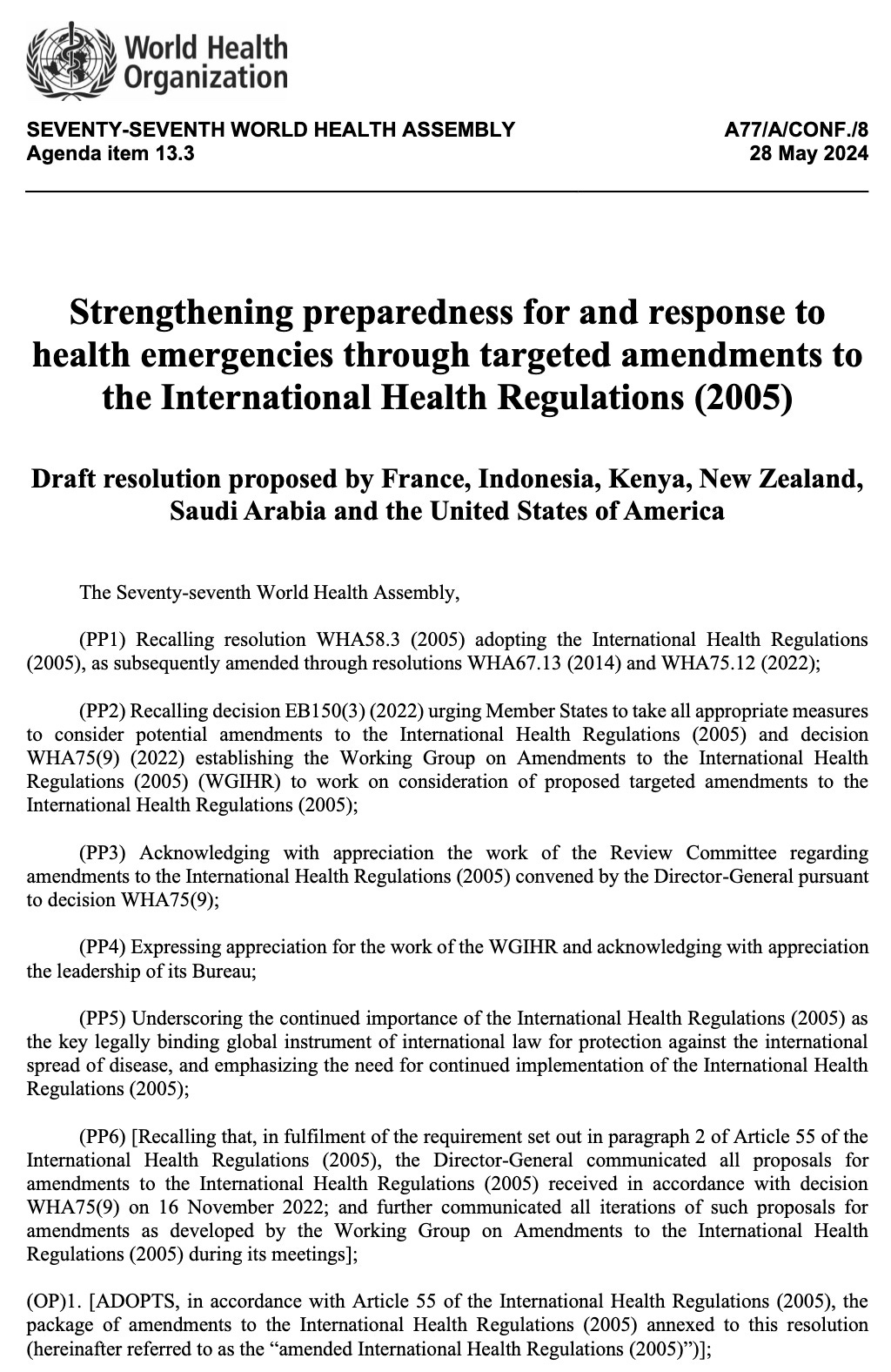
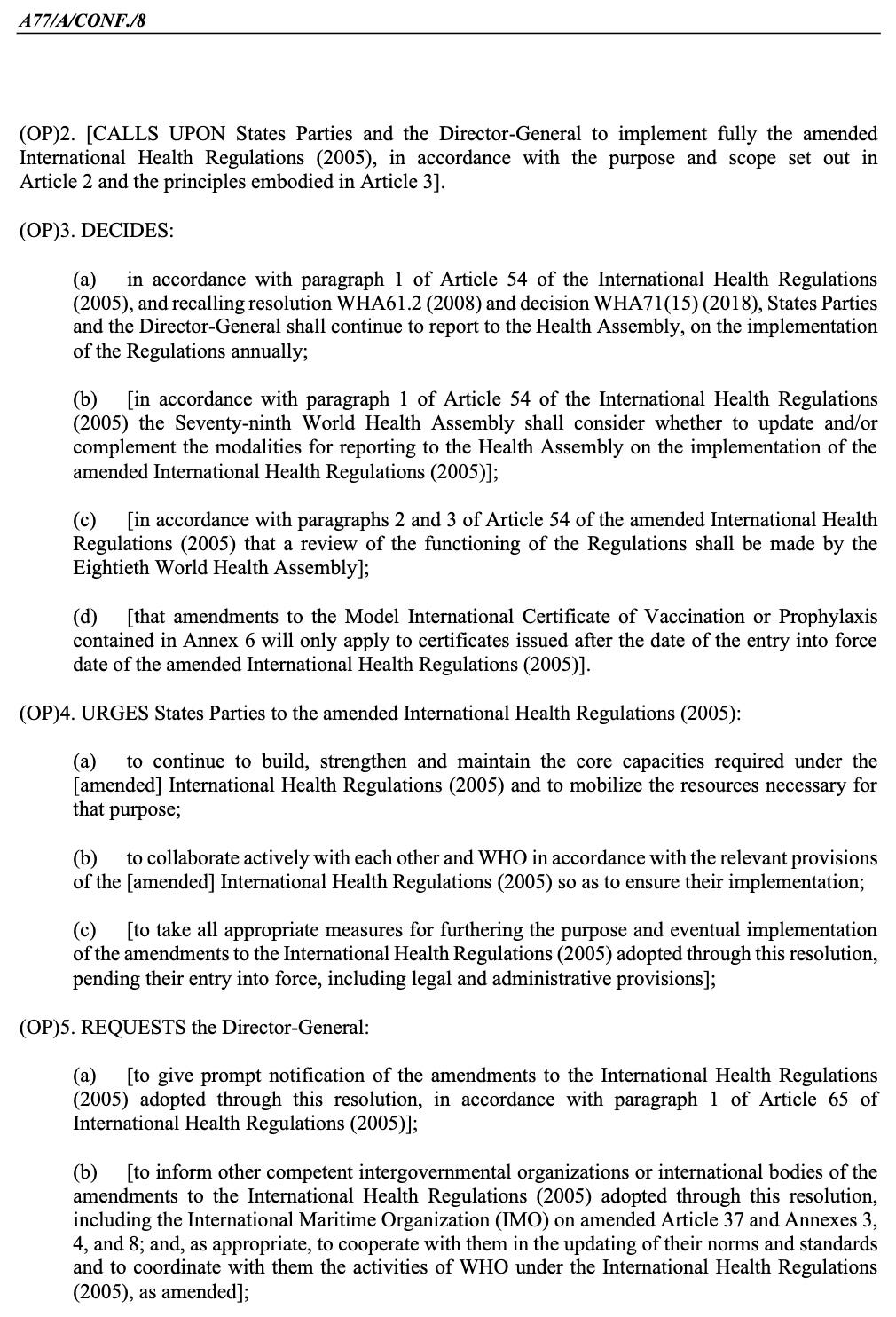
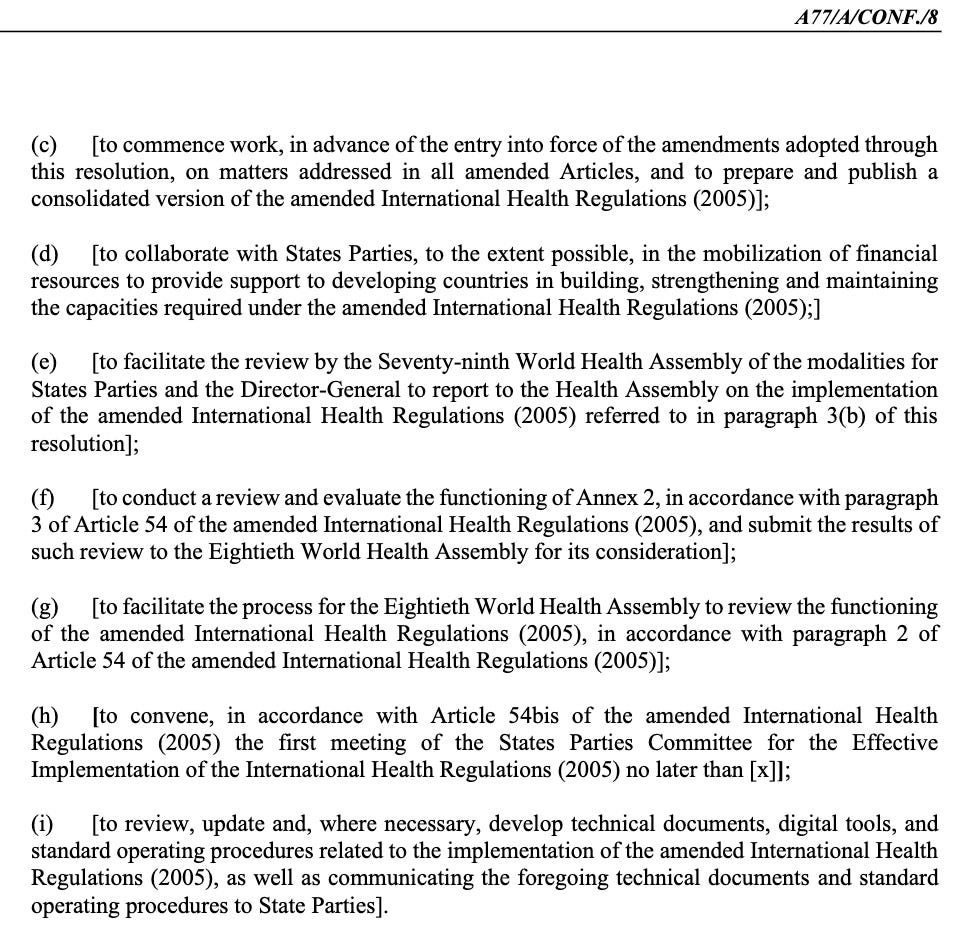
I think the USG lawyers were too clever by half when they wrote the resolution above. Everyone reading it can see it was intended to obfuscate rather than illuminate. I doubt this document will make many friends, and I doubt it will get very far.
Example #2. Now let us observe how the US government weaves the noose around everyone else’s head, but slips out itself at the last minute.
The International Health Regulations (IHR, 2005) are a treaty that the US is a party to. But the US removed itself from meeting the obligations contained in the treaty through issuing the following reservations, found on pages 60-61 of the IHR or on the State Department website. We “accept” the IHR but only “subject” to the following:
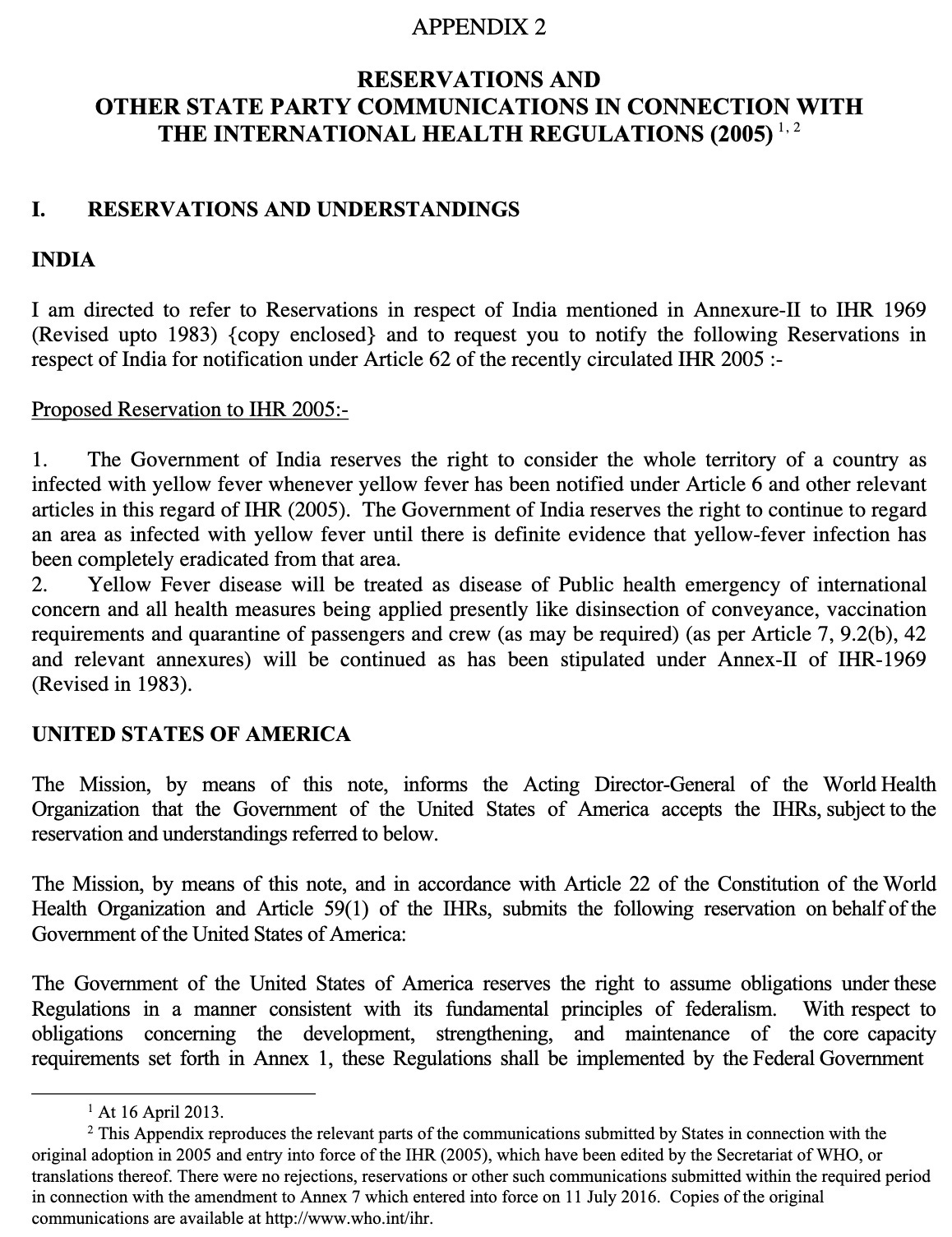
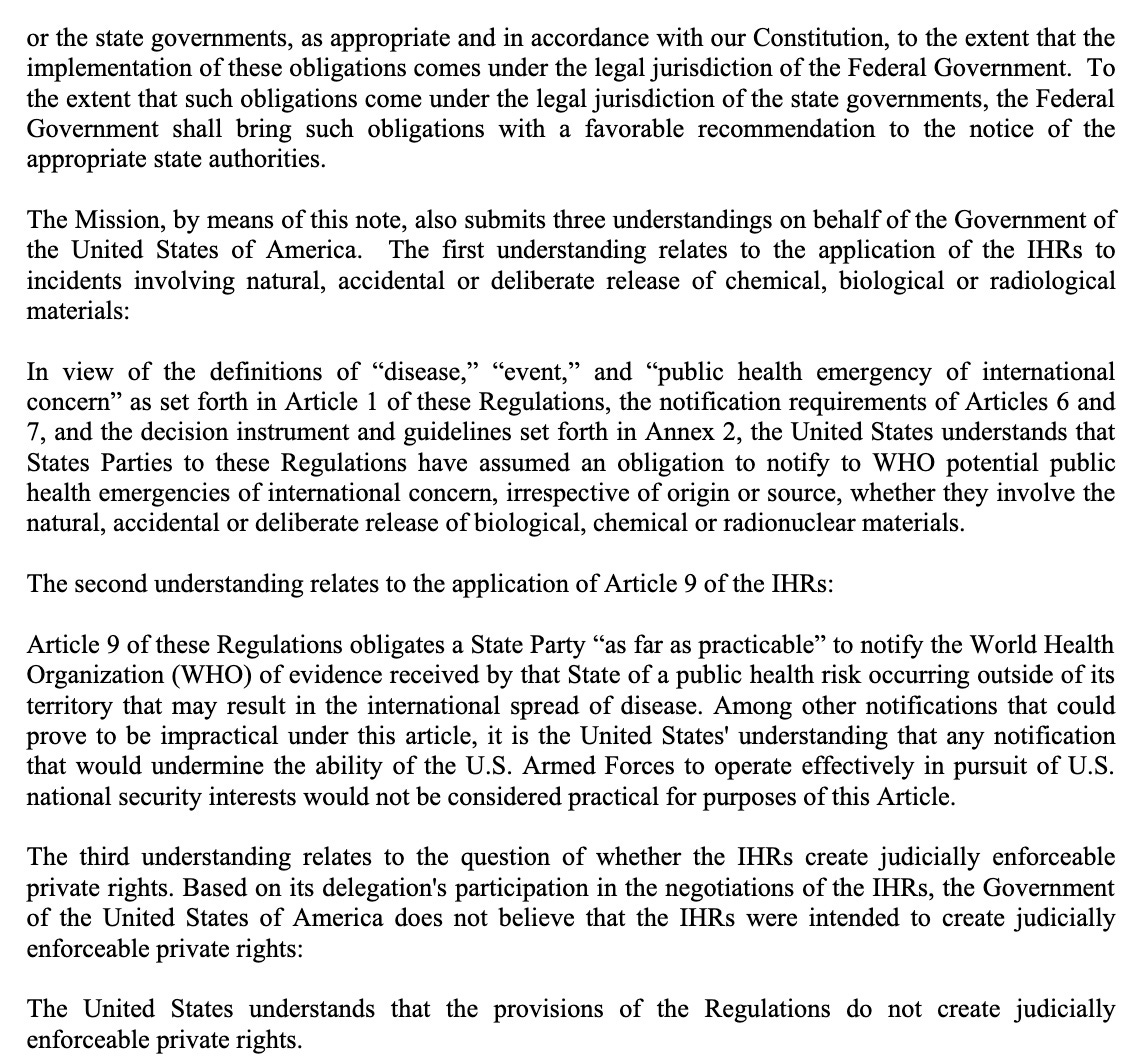
Dodge #1: The US government hid behind the skirts of its States, saying that according to the US Constitution the US obligations to the IHR might come under state and not federal jurisdiction. And in that case the USG could not promise to comply. [Well, we sure got them on that one this month! Two can play that game.]
Dodge #2: While the US insists China failed to meet its obligation to notify the world of COVID in a timely manner, the USG wanted to be able to dodge that same obligation in the IHR to report infectious outbreaks quickly. So if reporting might affect the US military and national security, the US refused to accept the obligation to report.
Dodge #3: Here is the language:
The third understanding relates to the question of whether the IHRs create judicially enforceable private rights. Based on its delegation’s participation in the negotiations of the IHRs, the Government of the United States of America does not believe that the IHRs were intended to create judicially enforceable private rights:
The United States understands that the provisions of the Regulations do not create judicially enforceable private rights.
If I understand the third dodge correctly, the USG is claiming that just because the US signed the IHR treaty, this did not convey any rights to other signatories. And therefore the US is not subject to litigation if it does not comply with treaty provisions as interpreted by other signatories.
Final Dodge: Sometimes the US goes all the way to the end with difficult treaty negotiations, then refuses to sign at the last minute. This is what happened when the Biological Weapons Convention (BWC) Review Conference thought it had finally achieved consensus on provisions for inspections, and punishments for noncompliance with the BWC treaty in 2001. When everything was set, the US abruptly said “NYET” and the amendments to the treaty were scuttled.
I did not understand why the US did this at the time, but subsequently realized that Cuba alleged that the US used biological weapons on Cuba after the US had become a party to the Biological Weapons Convention. (Here is my recent mention of several examples.)
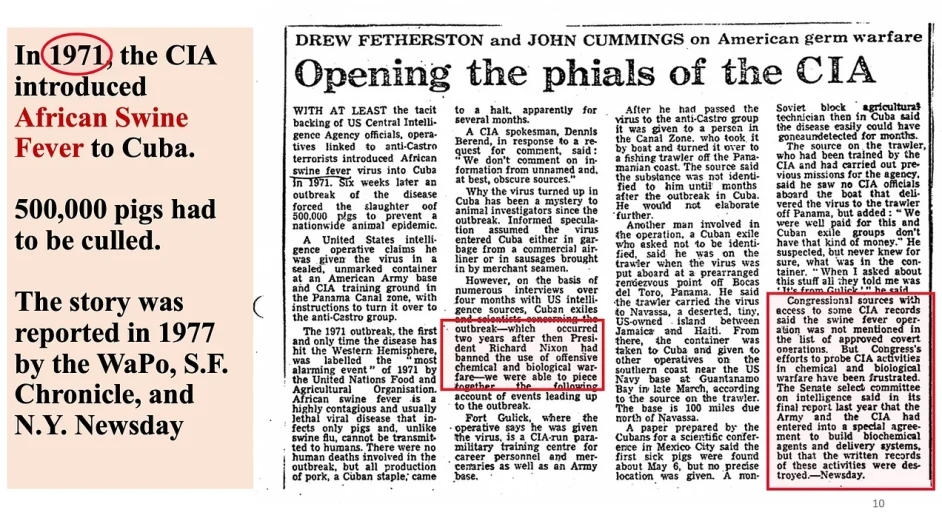

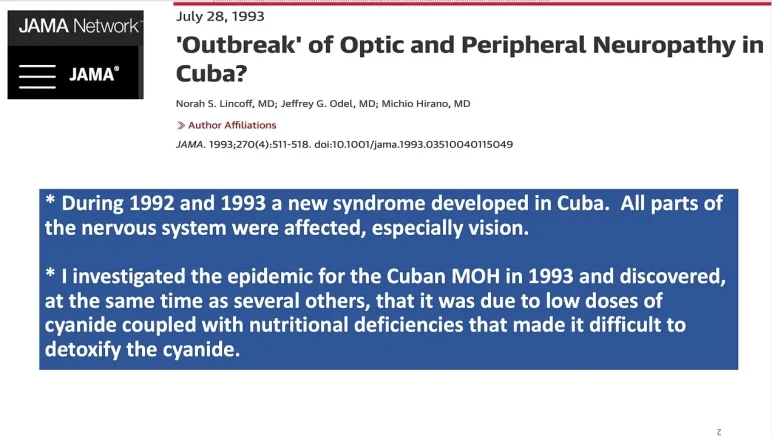
If true, and the evidence is very strong that it is, the US would not have wanted to be subject to inspections and investigations of those allegations.
The bottom line is that perhaps every country should be as careful to protect itself from potentially invasive or harmful provisions in treaties that it signs, as the US historically has been. This would level the playing field and make the treaty process more equitable for all.
EU disunited over $7-billion weapons delivery to Ukraine – Borrell
RT | May 28, 2024
There is still no agreement on a $7 billion (€6.6 billion) EU military aid package for Ukraine, the bloc’s foreign-policy chief Josep Borrell has said, according to remarks made to the press that were published on Tuesday.
The remarks follow a meeting this week of EU foreign and defense ministers focusing on the Ukraine conflict.
According to Borrell, there are “seven legal acts to be approved” in order to mobilize the billions in military aid under the Ukrainian Assistance Fund.
“This has not been possible [for] quite a long time because there is not [an] agreement for the consensus needed,” he explained.
“You know that we need unanimity – unanimity [has] not [been] there for months,” he admitted.
According to Politico, diplomats had hoped to have the new package ready ahead of this week’s meetings in Brussels but this didn’t happen due to resistance from Hungary.
Budapest has been a vocal critic of unbridled Western support for Ukraine and has refused to provide any military aid to Kiev, either directly or through the EU. Hungarian officials have repeatedly called for a ceasefire, insisting that EU sanctions against Russia have failed to undermine its economy and have instead boomeranged against the bloc.
Hungarian Foreign Minister Peter Szijjarto said on Monday that his government remained committed to blocking the €6.6 billion military aid package, despite the “ruckus” among fellow EU foreign ministers.
According to Borrell, an EU plan to use profits from frozen Russian sovereign assets to buy weapons for Ukraine has also stalled due to resistance from Budapest.
Western nations have seized some $300-billion-worth of Russian assets, most of which are held in the EU. Brussels’ plan, which Borrell strongly supports, would provide some $3.25 billion (€3 billion) for Ukraine this year alone. Moscow has warned that it will retaliate, should its property be “stolen” by the US and its allies.
The EU and its member states have so far mobilized nearly $35 billion in military support for Ukraine, according to data published on the European Commission’s website. This includes over $6.5 billion under the European Peace Facility to support the delivery of military equipment.
In March 2024, the European Council established a dedicated Ukrainian Assistance Fund worth almost $5.5 billion.
Former Biden Homeland Security Official Criticizes Free Speech, Cites “Disinformation” Impact on Election Security
By Didi Rankovic | Reclaim The Net | May 28, 2024
 A former Biden administration official has declared that disinformation around elections is “becoming the norm rather than the exception.”
Samantha Vinograd, until recently of the Department of Homeland Security (DHS), also asserted that these days, because of what she considers to be election disinformation, “there is an unprecedented level of physical threats” while the US information ecosystem is “incredibly vulnerable.”
Dramatic and alarmist statements like this may be necessary to justify the rest of Vinograd’s message, which in effect attacks free speech, as it is legally protected in the US.
Appearing on CBS, Vinograd – who was until last December Assistant Secretary of Homeland Security for Counterterrorism and Threat Prevention – warned that the First Amendment might protect free speech, but that engaging in free speech is apparently not “cost-free.”
The Face the Nation hosts framed the problem as, essentially, federal laws (the Constitution) protecting speech, but the damage being done at the state level – and then what states, who organize elections, can do to fix that “problem.”
Spreading lies about candidates, as they put it, was given as an example of legal, protected speech becoming an issue by having the ability to create “a threat at the state level” – and asked Vinograd who she thought was supposed to correct the situation.
Vinograd – who has been bouncing between various administrations (including those of Bush and Obama, and private companies like Goldman Sachs and Stripe before landing at Biden’s DHS) – seemed to suggest that Big Tech (i.e., social media companies) should be assisting the government.
The federal government said Vinograd, “should not be the omnipresent fact checker for the American people.”
And even though, according to her, the government is debunking information about elections that is deemed to be inaccurate, social media companies “should be thinking about what kinds of election disinformation violate their terms of service.”
It’s difficult not to take this as a not-so-veiled added pressure on social platforms to not only continue with censoring content but perhaps expand it in terms of what qualifies as election disinformation.
Either way, Vinograd is in favor of enlisting “every American” to help out as well (although it is not clear in what specific way), invoking even the concept of patriotic duty.
And Vinograd did not miss the opportunity to assert that election misinformation threats are now of such magnitude as to present a national security issue.
Russia’s Growing Media Influence in the World Sparks Alarm in the West
Sputnik – 28.05.2024
Russian broadcasters such as Sputnik may be outperforming their Western counterparts in terms of media coverage abroad, UK-based non-profit called Association for International Broadcasting (AIB) claims.
In its written evidence submission to the UK Parliament International Development Committee’s Inquiry into Future funding of the BBC World Service, AIB stated that “the global distribution of Russia’s international [media] operations is possibly greater than that of Western broadcasters.”
Sputnik and RT TV and radio services are being broadcast in many of the Global South countries – “including, but not limited to Venezuela, Syria, Mexico, Guatemala, India, Pakistan and South Africa” – and these media operations help Russia spread its influence around the world, AIB laments.
All this praise, however, should perhaps be taken with a grain of salt, seeing how the main purpose of the AIB’s document appears to be securing more British government funding for the BBC.
US says Israeli massacres in Rafah not to impact aid, policy
Al Mayadeen | May 28, 2024
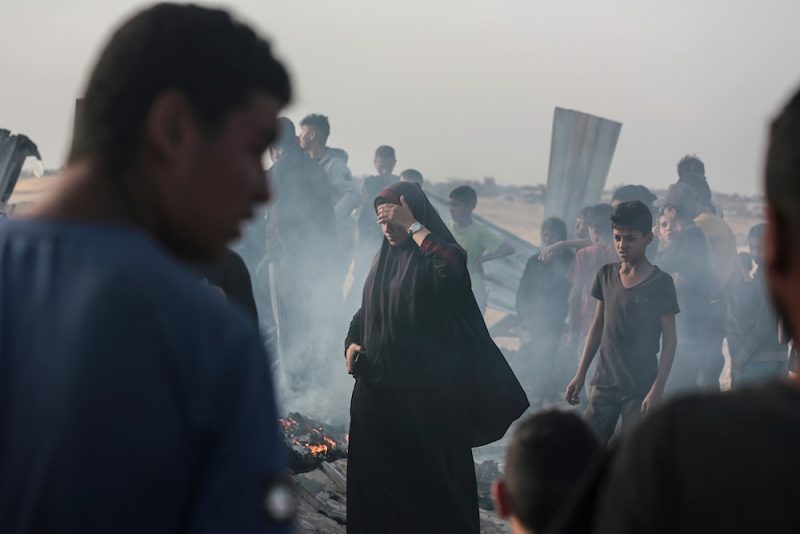
The Biden administration merely expressed deep concern on Tuesday over a deadly Israeli airstrike in Rafah, Gaza, labeling it “beyond tragic.” However, despite the death and paramount destruction, officials stated that the recent massacres do not signify a major operation that crosses established red lines.
National Security Council spokesman John Kirby, addressing reporters at the White House, reiterated the declared Israeli claim that the bombing of refugee tents in Rafah, which was said to be a safe area, was a “mistake.”
“The Israelis have said this is a tragic mistake,” Kirby noted when asked if the weekend’s events constituted the “death and destruction” US officials had warned against, completely adopting the Israeli narrative without the slightest bit of due diligence.
Kirby emphasized the absence of a specific “measuring stick” or quota for such incidents but stressed the importance of avoiding a major ground operation in Rafah that could lead to extensive damage and significant loss of life. “We have not seen that yet,” he said, continuing to ignore the civilian deaths and practically saying they would only count in light of an invasion.
When questioned about whether recent ground operations in Rafah would lead to the US withdrawing military aid, Kirby affirmed, “I believe that’s what I’ve been saying here.”
Vice President Kamala Harris, speaking at a ceremonial event in Washington, called the Israeli airstrike on Sunday “beyond tragic,” after it caused a fire in a tent camp in Rafah, killing 45 Palestinians, many of whom were burnt to death.
Israel’s Mossad chief threatened ICC prosecutor and family in covert intimidation campaign
MEMO | May 28, 2024
The former head of Mossad, Israel’s intelligence agency, personally threatened Fatou Bensouda, the former chief prosecutor of the International Criminal Court (ICC), and her family in a series of covert meetings, the Guardian has revealed in a shocking report exposing the clandestine campaigns of the apartheid state to thwart ICC probes into war crimes and crimes against humanity committed by Israeli leaders.
Several sources have revealed that Yossi Cohen personally threatened the ICC‘s then chief prosecutor, Bensouda, and her family in a series of clandestine meetings aimed at pressuring her to abandon her inquiry into possible war crimes committed by Israel against Palestinians in the occupied territories.
The covert campaign is said to have been authorised at the highest levels of the Israeli government, with Cohen using bullying, blackmail and intimidation tactics against Bensouda. Sources say Cohen raised questions about Bensouda’s security and that of her family in a menacing manner on at least three occasions between late 2019 and early 2021.
In one disturbing incident, Cohen allegedly showed Bensouda photographs taken covertly of her husband during a trip to London. On another occasion, he suggested that proceeding with a full investigation would be detrimental to her career. One source briefed on the meetings said Cohen told Bensouda:
“You should help us and let us take care of you. You don’t want to be getting into things that could compromise your security or that of your family.”
The threats were part of a coordinated smear campaign by Israel to undermine Bensouda, which also involved Mossad actively seeking compromising information on the prosecutor and her family members. The spy agency obtained transcripts of an apparent sting operation against Bensouda’s husband, which Israeli diplomats then unsuccessfully attempted to use to discredit her.
Bensouda was so alarmed by Cohen’s increasingly threatening behaviour that she took the extraordinary step of briefing a small group of senior ICC officials about the incidents. Three sources familiar with her formal disclosures said she revealed Cohen had pressured her on several occasions not to proceed with the criminal investigation.
Mossad’s targeting of Bensouda was just one part of a nearly decade-long covert “war” waged by multiple Israeli intelligence agencies against the ICC. Israel’s actions underscore the lengths it is willing to go to shield its citizens from prosecution for their involvement in war crimes and crimes against humanity in the Palestinian territories.
However, Cohen’s intimidation tactics ultimately failed to deter Bensouda or the court. In March 2021, she announced the opening of a formal investigation. The move infuriated the Israeli government, which had long opposed the ICC inquiry and even vowed to try to dismantle the court.
Bensouda began her work to open a war crimes investigation into Israel’s actions following the 2014 onslaught on Gaza, despite facing intense pressure and opposition from Israel and the US. In December 2019, the Gambian lawyer announced that she had concluded her preliminary examination and determined that all the statutory criteria under the Rome Statute had been met to open a formal investigation. This move was met with further condemnation and threats from Israel and the US, with the administration of former US President Donald Trump imposing sanctions on Bensouda and other ICC officials in response.
In February 2021, the ICC’s pre-trial chamber ruled that the court did indeed have jurisdiction over the Palestinian territories, paving the way for Bensouda to open a formal investigation in March 2021. The landmark decision was hailed as a victory for accountability and justice by Palestinian officials and human rights groups. Bensouda’s term as chief prosecutor ended in June 2021, leaving her successor, Karim Khan, to take up the investigation and build on her work to hold those responsible for war crimes in Palestine accountable.
The investigation has now taken a dramatic turn under Bensouda’s successor, Karim Khan. Last week, Khan announced he was seeking arrest warrants for Israeli Prime Minister Benjamin Netanyahu and Defence Minister Yoav Gallant, alongside three Hamas leaders, over the country’s conduct in Gaza. The landmark case marks the first time the court has taken action against leaders of a country closely allied with the US and Europe.
Khan himself has not been spared from threats, warning recently that he would not hesitate to prosecute “attempts to impede, intimidate or improperly influence” ICC officials. While declining to comment on specific allegations, an ICC spokesperson confirmed that Khan’s office had been subjected to “several forms of threats and communications that could be viewed as attempts to unduly influence its activities”.
The revelations about Israel’s covert operation against Bensouda have been met with outrage from legal experts and former ICC officials. Efforts by the Mossad to threaten or pressure the prosecutor could amount to offences against the administration of justice under the Rome Statute, the treaty which established the court.
One individual briefed on Cohen’s activities accused him of using “despicable tactics” in a ultimately futile effort to intimidate Bensouda, likening his behaviour to “stalking”. Another source said: “The fact they chose the head of Mossad to be the prime minister’s unofficial messenger to [Bensouda] was to intimidate, by definition. It failed.”
Featured Video
Prof. Ted Postol: Iran Already Achieved Nuclear Deterrence Against Israel
or go to
Aletho News Archives – Video-Images
From the Archives
How the occupied mentality syndrome works
Saudi Arabia on the American chessboard – Part 3
By B. J. Sabri | American Herald Tribune | June 27, 2016
Read part 2: “The occupied mentality Syndrome“
Previously I argued whether Saudi Arabia’s repeated involvements in U.S. interventions and wars stem from free national will or in response to a specific condition. For starters, in Saudi Arabia there is no national will. In Saudi Arabia, the national will is the will of the Al Saud clan. Still, when a major Arab state allies itself with a superpower that committed unspeakable crimes against humanity in almost every Arab country, then something is wrong. This fact alone should compel us to examine the U.S.-Saudi relation for one exceptional reason. As a result of the U.S.-Saudi wars, hundreds of thousands of people in Afghanistan, Iraq, Iran, Libya, Syria, Yemen, and Somalia have lost their lives. Millions became displaced in their own homelands. And millions more rendered refugees.
Attributing the Saudi policies to the bonds of “partnership” with the U.S. is frivolous. There are no bonds between these two thugs except those of business, military deals, secret plots, and wars. Proving this point, bonds such as these have no space for the American and Saudi peoples to share significant cultural or societal exchanges. If partnership is not the reason for the Saudi contribution to the U.S. strategy of empire and imperialism, then another reason must exist.
This leads to three possibilities. … continue
Blog Roll
 Aletho News
- Hezbollah hits Israeli warship off Lebanon’s coast, sets it aflame
- Iran slams US strikes on B1 bridge, Mahshahr petrochemical plants as ‘blatant acts of state terrorism’
- In letter to UN chief, Araghchi warns of dire consequences of US-Israeli attacks on Iran’s nuclear facilities
- Why the CIA conspiracy to invade Iran with Kurdish militias failed
- Why Are Upbeat US Claims About Mission to Rescue Pilot ‘Highly Questionable’?
- Aircraft destroyed during US ‘rescue’ of downed F-15 pilot cost more than $100 million each
- Washington University removes professor who condemned US-Israeli war on Iran
- Russia Warns of Retaliation as UK Authorizes Seizure of Vessels
- Serbia thwarts plot to bomb Russia-Hungary gas pipeline – Vucic
- Al Mayadeen voices solidarity with Dr. Marandi amid death threats
- If Americans Knew
- In Iran, Israel-US take aim at “reason, research, and freedom of thought” – Daily Update
- US loses planes over Iran, Israel downgrades Lebanon war goals – Daily Update
- Israel Is Blocking Palestinians from Easter at Church Where Jesus Resurrected
- Plot to assassinate Palestinian activist follows harassment campaign promoted by Zionist groups and elected officials
- Prominent New York synagogue hosts presentation on why U.S. Jews should support the ethnic cleansing of Gaza
- Tapper vs. Piker: Is the CNN Anchor Auditioning for David Ellison?
- Shouldn’t Democrats Be Able to Condemn Genocide?
- Israel-US kill negotiators, destroy civilian structures, but Iran’s military capabilities still largely intact – Daily Update
- ‘War crime’: Global condemnation as Israeli ministers celebrate death penalty law targeting Palestinian prisoners
- 7 Ways Israel Is Turning Lebanon Into Gaza
- No Tricks Zone
- An Inconvenient Tree: Uncovered In Alps… Europe Much Warmer Than Today 6000 Years Ago
- New Study Reports A 60% Slowdown In Greenland’s Ice Loss Rate In The Last Decade
- Low Intensity Tornado Wrecks Major Solar Farm, Creating A Potential Toxic Dump
- New Study Finds Warming Saves Lives…Cold Temperatures 12 Times More Deadly Than Excess Heat
- German Science Blog Accuses PIK Climate Institute Of Hallucinating Climate Tipping Points
- Devastating Assessment Of Comirnaty Vaccine By Former Senior Pfizer Europe Toxicologist
- New Study: CO2 Is ‘Effectively Negligible’ As An Explanatory Climate Change Factor Since 2000
- Former Pfizer Toxicologist Dr. Helmut Sterz Tells Bundestag Hearing Pfizer Vaccine Should Have Never Been Approved
- Energy Expert: Germany’s Nuclear Phaseout Was A “500 Billion Euro Mistake”
- New Research: South Australia’s Mid-Holocene Sea Surface Temperatures Were 4°C Warmer Than Today
 Aletho News