Former FBI and Twitter Lawyer Jim Baker Joins Election Task Force Advocating for Social Media Censorship

By Didi Rankovic | Reclaim The Net | July 5, 2024
From presidential election to another election, to Covid – to another election. That is how members of particular, mostly flying-under-the-radar power centers in the US have been moving over the last decades.
From time to time, however, circumstances demand that they show their faces: one is James “Jim” Baker, a former FBI lawyer whose “censorship portfolio” includes the infamous case of endorsing the Hunter Biden laptop story suppression – while he was on Twitter’s payroll.
And while there – Baker also wanted to know how come President Trump was not censored for a post saying – “Don’t fear Covid.”
Well, Baker also seems to be staying true to himself – unfortunately, his “truth” appears to be to never miss the chance to support the wrong thing (the “RussiaGate” saga happens to be among them). Right now, he has joined something called “the National Task Force on Election Crises.”
It’s a crisis, alright. A crisis of online censorship that can, and does, produce multiple “election” crises and a rapid erosion of trust in legacy media and political institutions.
The group’s parent operation is the Protect Democracy Project.
There’s nothing particularly innovative about the group’s lobbying talking points: remove or downgrade “election misinformation” and make sure removing and labeling content (as false) is done ASAP by social and news media (time is clearly of the essence, at this point…)
As for the electoral process itself – which ended up highly and even dangerously contested perhaps for the first time in US democratic history in 2020 – the group Baker is now affiliated with seems to want the reasons by and large leading to that to remain intact.
Namely, things like “(preventing) cyber or other attacks by foreign adversaries or domestic disrupters, promot(ing) pre-canvassing of absentee ballots” – and working to discourage legal challenges to the election process.
Looks like Baker might be just the right man for the wrong job.
The Supreme Court’s Superb Dissenting Opinion
At least three justices understand what is at stake here
By Aaron Kheriaty, MD | Human Flourishing | July 5, 2024
Three justices of the Supreme Court actually read and understood the record in our case. Justice Alito, joined by Gorsuch and Thomas, wrote an important dissenting opinion. I’d like to share a few highlights here, as it provides a roadmap to ultimately prevailing in our case.
The three dissenting justices clearly recognize that we the plaintiffs were victims of the government’s unconstitutional censorship activities:
Among these victims were two States, whose public health officials were hampered in their ability to share their expertise with state residents; distinguished professors of medicine at Stanford and Harvard; a professor of psychiatry at the University of California, Irvine School of Medicine; the owner and operator of a news website; and Jill Hines, the director of a consumer and human rights advocacy organization. All these victims simply wanted to speak out on a question of the utmost public importance.
Echoing the district court and circuit court opinions, the dissenting justices indicate the landmark importance of this free speech case:
If the lower courts’ assessment of the voluminous record is correct, this is one of the most important free speech cases to reach this Court in years. Freedom of speech serves many valuable purposes, but its most important role is protection of speech that is essential to democratic self-government, and speech that advances humanity’s store of knowledge, thought, and expression in fields such as science, medicine, history, the social sciences, philosophy, and the arts.
Unlike the majority opinion, which took the government’s claim to be combating “misinformation” at face value, the dissenting opinion recognized that much of the speech that the government suppressed was true:
The speech at issue falls squarely into those categories. It concerns the COVID–19 virus, which has killed more than a million Americans. Our country’s response to the COVID–19 pandemic was and remains a matter of enormous medical, social, political, geopolitical, and economic importance, and our dedication to a free marketplace of ideas demands that dissenting views on such matters be allowed. I assume that a fair portion of what social media users had to say about COVID–19 and the pandemic was of little lasting value. Some was undoubtedly untrue or misleading, and some may have been downright dangerous. But we now know that valuable speech was also suppressed. That is what inevitably happens when entry to the marketplace of ideas is restricted.
The majority opinion suggested, without evidence, that our censorship was the result of the actions of social media platforms, who may have censored us even in the absence of government coercion. The dissenting opinion explains the flaws with this unwarranted assumption:
Of course, purely private entities like newspapers are not subject to the First Amendment, and as a result, they may publish or decline to publish whatever they wish. But government officials may not coerce private entities to suppress speech, see National Rifle Association of America v. Vullo, 602 U. S. 175 (2024), and that is what happened in this case.
The record before us is vast. It contains evidence of communications between many different government actors and a variety of internet platforms, as well as evidence regarding the effects of those interactions on the seven different plaintiffs.
Alito focuses on Facebook and co-plaintiff Jill Hines as the clearest example (though by no means the only example) to illustrate the nature of the problem:
Here is what the record plainly shows. For months in 2021 and 2022, a coterie of officials at the highest levels of the Federal Government continuously harried and implicitly threatened Facebook with potentially crippling consequences if it did not comply with their wishes about the suppression of certain COVID–19-related speech. Not surprisingly, Facebook repeatedly yielded. As a result Hines was indisputably injured, and due to the officials’ continuing efforts, she was threatened with more of the same when she brought suit. These past and threatened future injuries were caused by and traceable to censorship that the officials coerced, and the injunctive relief she sought was an available and suitable remedy.
It’s hard to know how much more harm the Supreme Court would need to see before agreeing that at least one of the plaintiffs has standing. These examples could be multiplied. By refusing to examine the record and rule on the merits, Alito suggests that the Court actually provides a roadmap for future government censorship efforts:
This evidence was more than sufficient to establish Hines’s standing to sue, and consequently, we are obligated to tackle the free speech issue that the case presents. The Court, however, shirks that duty and thus permits the successful campaign of coercion in this case to stand as an attractive model for future officials who want to control what the people say, hear, and think.
That is regrettable. What the officials did in this case was more subtle than the ham-handed censorship found to be unconstitutional in Vullo, but it was no less coercive. And because of the perpetrators’ high positions, it was even more dangerous. It was blatantly unconstitutional, and the country may come to regret the Court’s failure to say so. Officials who read today’s decision together with Vullo will get the message. If a coercive campaign is carried out with enough sophistication, it may get by. That is not a message this Court should send.
Alito then echoes arguments I published in The Federalist following oral arguments, regarding the key differences between newspapers and social media companies in terms of their interactions with government:
Internet platforms, although rich and powerful, are at the same time far more vulnerable to Government pressure than other news sources. If a President dislikes a particular newspaper, he (fortunately) lacks the ability to put the paper out of business. But for Facebook and many other social media platforms, the situation is fundamentally different. They are critically dependent on the protection provided by §230 of the Communications Decency Act of 1996, 47 U. S. C. §230, which shields them from civil liability for content they spread. They are vulnerable to antitrust actions; indeed, Facebook CEO Mark Zuckerberg has described a potential antitrust lawsuit as an “existential” threat to his company. And because their substantial overseas operations may be subjected to tough regulation in the European Union and other foreign jurisdictions, they rely on the Federal Government’s diplomatic efforts to protect their interests.
This dynamic sets social media companies up to be vulnerable to government coercion, in precisely the way we argued before the Court:
For these and other reasons, internet platforms have a powerful incentive to please important federal officials, and the record in this case shows that high-ranking officials skillfully exploited Facebook’s vulnerability. When Facebook did not heed their requests as quickly or as fully as the officials wanted, the platform was publicly accused of “killing people” and subtly threatened with retaliation.
Not surprisingly these efforts bore fruit. Facebook adopted new rules that better conformed to the officials’ wishes, and many users who expressed disapproved views about the pandemic or COVID–19 vaccines were “deplatformed” or otherwise injured.
Alito perfectly describes how this abusive Stockholm Syndrome dynamic played out between Facebook and the White House:
What these events show is that top federal officials continuously and persistently hectored Facebook to crack down on what the officials saw as unhelpful social media posts, including not only posts that they thought were false or misleading but also stories that they did not claim to be literally false but nevertheless wanted obscured. And Facebook’s reactions to these efforts were not what one would expect from an independent news source or a journalistic entity dedicated to holding the Government accountable for its actions. Instead, Facebook’s responses resembled that of a subservient entity determined to stay in the good graces of a powerful taskmaster. Facebook told White House officials that it would “work . . . to gain your trust.” When criticized, Facebook representatives whimpered that they “thought we were doing a better job” but promised to do more going forward. They pleaded to know how they could “get back to a good place” with the White House. And when denounced as “killing people,” Facebook responded by expressing a desire to “work together collaboratively” with its accuser. The picture is clear.
Here we have a major social media platform responding as though they are entirely subservient to government interests. The more they try to please the government by ramping up censorship, the more abusive and demanding the government becomes.
To the dubious claim that plaintiffs cannot allege potential future injuries because—on their word—the White House has backed off the social media companies, Alito (in contrast to the majority opinion) calls the government’s bluff:
The White House threats did not come with expiration dates, and it would be silly to assume that the threats lost their force merely because White House officials opted not to renew them on a regular basis.
As Alito later quips, “death threats can be very effective even if they are not delivered every day.”
Drawing an analogy to another free speech case (Vullo) that was heard on the same day as ours, Alito explains:
In Vullo, the alleged conduct was blunt. The head of the state commission with regulatory authority over insurance companies allegedly told executives at Lloyd’s directly and in no uncertain terms that she would be “‘less interested’” in punishing the company’s regulatory infractions if it ceased doing business with the National Rifle Association. The federal officials’ conduct here [in Murthy] was more subtle and sophisticated. The message was delivered piecemeal by various officials over a period of time in the form of aggressive questions, complaints, insistent requests, demands, and thinly veiled threats of potentially fatal reprisals. But the message was unmistakable, and it was duly received.
The Supreme Court majority was ready to knock down ham-fisted censorship (in Vullo) but gave a pass—at least for now—to sophisticated and debonair censorship (in Murthy).
The government’s defense of its behavior included the argument that it had the right to use the bully pulpit to “persuade” social media companies to do its bidding—”the government has free speech rights, too, don’t you see?” Alito sees right through this ruse:
This argument introduces a new understanding of the term “bully pulpit,” which was coined by President Theodore Roosevelt to denote a President’s excellent (i.e, “bully”) position (i.e., his “pulpit”) to persuade the public. But [Rob] Flaherty, [Andy] Slavitt, and other [White House] officials who emailed and telephoned Facebook were not speaking to the public from a figurative pulpit. On the contrary, they were engaged in a covert scheme of censorship that came to light only after the plaintiffs demanded their emails in discovery and a congressional Committee obtained them by subpoena. If these communications represented the exercise of the bully pulpit, then everything that top federal officials say behind closed doors to any private citizen must also represent the exercise of the President’s bully pulpit. That stretches the concept beyond the breaking point.
In any event, the Government is hard-pressed to find any prior example of the use of the bully pulpit to threaten censorship of private speech.
To repeat what I have said many times before: this case is not about constraining the government’s speech—as they falsely claim; it’s about stopping the government from constraining the speech of U.S. citizens.
The dissenting justices argue that the majority opinion applies a “new and heightened standard” of traceability in our case (p.20). Alito explains, again using the case of co-plaintiff Jill Hines, that she clearly has standing to bring the case (and we only need one plaintiff with standing to prevail):
Here, it is reasonable to infer (indeed, the inference leaps out from the record) that the efforts of the federal officials affected at least some of Facebook’s decisions to censor Hines. All of Facebook’s demotion, content-removal, and deplatforming decisions are governed by its policies. So when the White House pressured Facebook to amend some of the policies related to speech in which Hines engaged, those amendments necessarily impacted some of Facebook’s censorship decisions. Nothing more is needed. What the Court seems to want are a series of ironclad links—from a particular coercive communication to a particular change in Facebook’s rules or practice and then to a particular adverse action against Hines. No such chain was required in the Department of Commerce case, and neither should one be demanded here.
Furthermore, the Court’s majority opinion developed a novel, higher standard of repressibility of potential future harms to avoid ruling on the merits of our case:
As with traceability, the Court applies a new and elevated standard for redressability, which has never required plaintiffs to be “certain” that a court order would prevent future harm.
Having established that the Court should have found that we have standing, Alito proceeds to analyze the record on the merits, using the following legal framework:
The principle recognized in Bantam Books and Vullo requires a court to distinguish between permissible persuasion and unconstitutional coercion, and in Vullo, we looked to three leading factors that are helpful in making that determination: (1) the authority of the government officialswho are alleged to have engaged in coercion, (2) the natureof statements made by those officials, and (3) the reactions of the third party alleged to have been coerced. 602 U. S., at 189–190, and n. 4, 191–194. In this case, all three factors point to coercion.
Although the government tries to spin their interactions with social media platforms as fairly benign, examination of the record in this regard leaves no doubt: “The totality of this record—constant haranguing, dozens of demands for compliance, and references to potential consequences—evince ‘a scheme of state censorship.’” Lest there be any doubt in this regard, “Facebook’s responses to the officials’ persistent inquiries, criticisms, and threats show that the platform perceived the statements as something more than mere recommendations.” Alito concludes, “In sum, the officials wielded potent authority. Their communications with Facebook were virtual demands. And Facebook’s quavering responses to those demands show that it felt a strong need to yield.”
From here we return to the District Court in Louisiana for trial, where we have an excellent judge (Terry Doughty). We will be granted additional discovery, in which we anticipate getting enough additional “smoking guns” to cross the high standing bar set by the majority Supreme Court opinion. The District court has combined our case with an analogous case filed by Robert F. Kennedy, Jr., who is clearly named and targeted in several government censorship missives—so between Hines and Kennedy there should be no questions on the issue of standing, even under the novel and strict criteria that SCOTUS requires in this case.
In other words, we will prevail in the end. I anticipate being back at the Supreme Court in another year or two for the final ruling. At that point, SCOTUS will not be able to temporize or look away as they did this time. And when judges examine the record in our case, they have only reached one conclusion: the government engaged in unconstitutional censorship on a mass scale. And it has to stop.
Advertiser Alliance Members Are Called To Testify After Allegations of Efforts To “Demonetize, and Censor Disfavored Viewpoints”
By Didi Rankovic | Reclaim The Net | July 5, 2024
The Global Alliance for Responsible Media (GARM) is back in the headlines big time – what with the recent decision of X to rejoin the group, and now, as anticipated, the US Congress is stepping up its attempts to shed more light on what GARM actually does, censorship-wise.
Once again it is House Judiciary Committee Chairman Jim Jordan who is trying to hold Big Tech – and in this case, “the advertising industrial complex” as it were – accountable.
GARM is a World Economic Forum (WEF)-affiliated initiative, launched by the World Federation of Advertisers (WFA); the latter by its own admission represents more than 150 biggest brands and over 60 advertiser associations around the world.
“Brand safety” is what the group says it is offering to these clients. But Jordan, and many conservatives and media outlets and businesses – allied or perceived to be allied with them – have strong suspicions that GARM can and is being used as yet another avenue of censorship and suppression – this time via actions that result in demonetization or boycott of those who hold “disfavored views.”
Concerning GARM, Jordan started fighting what supporters must see as “the good fight” last year (first by requesting information and then by issuing a subpoena once that was ignored).
Then, this March, the Committee sent letters to five members of the GARM Steering Team including Unilever and GroupM (a media investment group) asking for access to documents and communications that might prove the overall anti-conservative bias executed by the imitative.
We obtained a copy of the letter for you here.
Jordan was not in the mood to sugarcoat the issue, as he sees it: “This coordination does not always revolve around ‘brand safety’ and ‘harmful’ content as GARM publicly claims, but instead the desire to censor conservative and other views that GARM members disfavor,” he wrote, adding that this results in content creators losing revenue, in a way that may be illegal and collusive under the Sherman (antitrust) Act.
In late June, Jordan wrote to Unilever again, and the inclusion of GroupM is pertinent given that the March letter mentioned several leading conservative media outlets as alleged targets of this conduct.
The letter is asking top representatives of the two corporations to publicly testify regarding the Committee’s misgivings around their activities.
According to a Committee spokesman’s comments made in March, “everything is on the table” in case of non-compliance with this series of requests – including more subpoenas, and congressional hearings.
How the Israeli Army Benefits from US Tax Law
Tax exemptions that support war crimes are not “charitable”
BY PHILIP GIRALDI • UNZ REVIEW • JULY 5, 2024
The United States tax code allows exemptions from federal taxes for certain categories of nonprofit organizations or groups that frequently serve either an educational or charitable purpose. Such organizations are categorized as 501(c)(3) and exempt from Federal income taxes while the donors who contribute to their support can deduct the total donations up to the limits imposed by their own overall tax liability. The Internal Revenue Service (IRS) recognizes more than 30 types of nonprofit organizations but only those that qualify for 501(c)(3) status can say that donations made to them are tax deductible.
Most of the organizations that may be eligible for 501(c)(3) designation “fall into one of three categories: charitable organizations, churches and religious organizations, and private foundations. A group must operate exclusively for one of certain purposes to be considered a charitable organization by the IRS: charitable, religious, educational, scientific, literary, testing for public safety, fostering national or international amateur sports competition, or preventing cruelty to children or animals.” The IRS further defines “charitable” activities as “relief of the poor, the distressed, or the underprivileged; advancement of religion; advancement of education or science; erecting or maintaining public buildings, monuments, or works; lessening the burdens of government; lessening neighborhood tensions; eliminating prejudice and discrimination; defending human and civil rights secured by law; and combating community deterioration and juvenile delinquency.”
A 501(c)(3) organization is also “forbidden from using its activities to influence legislation in a substantial way, including participating in any campaign activities to support or deny any particular political candidate. It’s also typically not permitted to engage in political lobbying.” A private foundation is typically “held by an individual, a family, or a corporation and it obtains most of its income from a relatively small group of donors. Private foundations are subject to stricter rules and regulations than public charities. A public charity is a nonprofit organization that receives a substantial portion of its income or revenue from the general public or the government.”
It is worth considering how a 501(c)(3) is supposed to work when one examines how the numerous organizations that constitute the Israel Lobby in the United States have attained that status, which enables them to avoid US taxes while also attracting donors through tax deductions in spite of the fact that they lobby heavily, which ignores US laws, and exist to support and empower a foreign government that is engaged in a genocide. The American Israel Public Affairs Committee (AIPAC), regarded as the wealthiest and most politically powerful of the Lobby groups, even boasts about its lobbying ability as well as the amazing success of its associated PAC in endorsing favorable to Israel political candidates. The heavily politically engaged Anti-Defamation League (ADL) and the pro-Iran war Foundation for Defense of Democracies (FDD) are likewise 501(c)(3). Smaller foundations such as the Charles and Seryl Kushner Foundation, founded by the father of Donald Trump’s son-in-law Jared Kushner, are likewise 501(c)(3) and engaged in supporting illegal settlement development in Israeli occupied Palestine.
The 501(c)(3) status enables many Jewish and Israel-oriented groups to obtain large sums of money which are then used politically to enabled the corruption of the political process in the United States to the benefit of both Israel and domestic Jewish-favored issues. And being non-profit most definitely does not mean that anyone is going broke or working out of shabby offices in some dank suburb. AIPAC reported in excess of $90 million in earnings since Israel has been at war in Gaza, plus ADL $105 million in 1922, and FDD $18 million in earnings in the same year. The chief executives of the three organizations are, respectively Howard Kohr, Jonathan Greenblatt, and Mark Dubowitz. They earned $1,055,000, $993,000, and $771,000 respectively in 2021-2022.
This all means in practice that there is a steady cash flow from the United States to Israel that far exceeds the $3.8 billion plus special appropriations annually that President Barack Obama foolishly guaranteed to Prime Minister Benjamin Netanyahu in 2016 in a bid to maintain Jewish donor and media support for Hillary Clinton’s election. Grant Smith, who heads the “Institute for Research: Middle Eastern Policy (IRMEP)”, has estimated that the annual total going to Israel far exceeds $10 billion and, which does not include other freebies like US government co-development and production projects and disbursements like the $14 billion gift from President Joe Biden to Israel in April to help pay for and arm that nation’s extermination of the Gazans.
Israel and the Jewish community also get an enormous free ride from some state governments. Smith has described how one such board that he has identified in Virginia is a unique example of a state’s economic policies being manipulated by a dedicated Israeli fifth column in government. It is named the Virginia Israel Advisory Board (VIAB).
The VIAB is actually part of the Virginia state government. It is funded by the Commonwealth of Virginia and is able to access funds from other government agencies to support Israeli businesses. It is staffed by Israelis and American Jews drawn from what has been described as the “Israel advocacy ecosystem” and is self-administered, appointing its own members and officers. Only Virginia has such a group actually sitting within the government itself though other states have similar advisory or “trade” commissions. VIAB is able to make secret preferential agreements, to arrange special concessions on taxes and to establish start-up subsidies for Israeli businesses. Israeli business projects have been, as a result, regularly funded using Virginia state resources with little accountability. It has been estimated that the cash flow in favor of Israel from Virginia alone has exceeded $500 million annually.
Smith has reported how VIAB is not just an economic mechanism. Its charter states that it was “created to foster closer economic integration between the United States and Israel while supporting the Israeli government’s policy agenda.” Smith also has observed that “VIAB is a pilot for how Israel can quietly obtain taxpayer funding and official status for networked entities that advance Israel from within key state governments.” The board grew significantly under Democratic governor Terry McAuliffe’s administration (2014-2018). McAuliffe, regarded by many as the Clintons’ “bag man,” has received what are regarded as generous out-of-state campaign contributions from actively pro-Israeli billionaires Haim Saban and J.B. Pritzker, who are both affiliated with the Democratic Party.
Terry McAuliffe as governor met regularly in off-the-record “no press allowed” sessions with several Israel advocacy groups and spoke frequently about “the Virginia Advisory Board and its successes.” That was, of course, a self-serving lie by one of the slimiest of the Clinton unindicted criminals. In short, the VIAB is little more than a mechanism set up to carry out licensed robbery of Virginia state resources to benefit Israel. As a side benefit to us Virginians, its reckless activities have led to numerous zoning and environmental violations.
Judging by all of the above, one would reasonably have to accept that we are only seeing the tip of the iceberg, that there are many “non-profit” federal tax-exempt foundations and other boards and organizations that exist in the United States to benefit Israel. That said, however, there are a couple of pro-Israel 501(c)(3) “charitable” foundations that boggle the mind for their openly stated mission. They consist of several organizations that have been established and exploited to support the Israel Defense Forces (IDF), which, as noted above, are currently engaged in carrying out what is widely recognized to be a genocide in Gaza as well as persecution of Palestinians on parts of the illegally occupied West Bank. They are perhaps deserving of some special attention.
The best known and largest of the Israeli army focused “charities” is the “Friends of the Israel Defense Forces” (FIDF) which stages annual rallies and gatherings both in Los Angeles and New York to raise money for those brave warriors who are nearly every day bombing hospitals and schools and killing many thousands of children. The gatherings are well attended by the usual celebrities and politicians and widely reported in the accommodating media. The group, based in New York City, boasts of how it works directly with the Israeli Ministry of Defense. Friends of IDF raised a record $60 million at a Los Angeles gala in 2018. Major Donald Trump financial supporters Miriam and Sheldon Adelson donated $10 million, matched by Israeli-American Hollywood figure Haim Saban and his wife, Cheryl.
FIDF claims to be the only 501(c)(3) certified IDF fund raiser in the US, but there is at least one other organization that has been in the news recently. It is “The Association for Israel’s Soldiers” which also goes by “The Friends of LIBI” and “LIBI USA”, which is a volunteer outfit based in Brighton, Massachusetts. It actually also claims to be part of Israel’s Ministry of Defense and its job is to cover expenses that are not part of the Israeli government budget. As money is fungible, that frees up money for more warlike purposes. But that description inevitably makes one wonder how an element of the Israeli government is able to collect tax exempt money that is also deductible as federal income taxes donations which are apparently repatriated from the US to Israel without any “charitable” or “educational” function intruding in America?
It does not require any particular brilliance to realize that both politically and economically Israel is not treated like everyone else by governments at various levels in the United States. At risk of being repetitive, how is it possible that organizations that are committed to supporting war crimes and even genocide by a foreign nation are allowed to have tax breaks that enable them to collect more money to corrupt the system that feeds them? How is it possible that the foreign army carrying out the war crimes is also allowed to benefit directly from the exemption from taxation? Those are questions that need to be answered!
Philip M. Giraldi, Ph.D., is Executive Director of the Council for the National Interest, a 501(c)3 tax deductible educational foundation (Federal ID Number #52-1739023) that seeks a more interests-based U.S. foreign policy in the Middle East. Website is councilforthenationalinterest.org, address is P.O. Box 2157, Purcellville VA 20134 and its email is inform@cnionline.org.
Israel using water as weapon of genocide in Gaza Strip, says Euro-Med
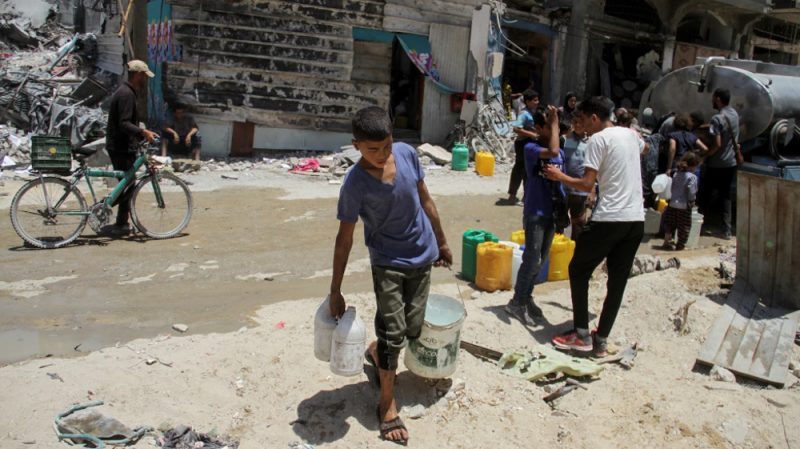
A displaced Palestinian boy carries water containers in Jabalia refugee camp, following an Israeli raid, in the northern Gaza Strip, on June 2, 2024. (Photo by Reuters)
Press TV – July 5, 2024
An international human rights organization says Israel is using water as another weapon of genocide against Palestinians in the Gaza Strip by deliberately reducing the amount of water available to them, especially potable water sources.
The Euro-Med Human Rights Monitor said in a new press release issued on Thursday that the Tel Aviv regime is purposefully causing the death of over 2.3 million people as part of its genocide war.
The Euro-Med noted that its field team observed significant damage to a desalination plant in the al-Zaytoun neighborhood, south of Gaza City, as a result of an Israeli strike. The attack claimed the life of a young man who was filling a gallon with water there and left several other individuals wounded.
The station, which provided services to at least 50,000 people in several nearby residential neighborhoods, sustained significant damage after being struck by an Israeli guided bomb that broke through multiple stories and detonated on the first floor.
The statement noted that the residents of the Gaza Strip are facing significant challenges in getting access to water as summer temperatures rise.
Estimates show that the per capita share of water in the Gaza Strip has decreased by 97% due to the extensive destruction of water infrastructure. As a result of the Israeli onslaught, the per capita share of water in the territory has decreased to between 3 and 15 liters per day.
Euro-Med highlighted that continued destruction and devastation by the Israeli army renders the Gaza Strip unlivable, particularly after nine out of ten water tanks and half of the water networks were destroyed.
The Israeli regime has so far killed at least 38,011 Palestinians, mostly women and children, and injured 87,445 others, since it waged the brutal war on the Gaza Strip in October 2023, according to the Gaza-based health ministry.
The occupying entity has also imposed a “complete siege” on the territory, cutting off fuel, electricity, food, and water to the more than two million Palestinians living there.
The regime is facing genocide charges at the International Court of Justice as the top court has ruled that Israel must stop its military activities in Rafah immediately. This is the place where more than a million Palestinians had taken shelter from the war before it was invaded on May 6.
Hamas, other factions reject deployment of foreign troops in Gaza
Al-Mayadeen | July 5, 2024
Palestinian Resistance factions opposed any plans or proposals for the governance of the Gaza Strip that go beyond a solely Palestinian administration of the besieged territory.
The Islamic Resistance Movement – Hamas released a strong-worded statement rejecting any proposals or remarks that support plans for the deployment of foreign troops in the Gaza Strip “under any justification.”
The movement said that the administration of affairs in the Gaza Strip, after the war on Gaza ends, is solely a Palestinian matter, which only the Palestinian people will determine.
Hamas stressed, “We will not allow any guardianship or the imposition of any external solutions or [plans] that detract from [the Palestinian people’s] principles,” which are based on their right to freedom and self-determination.
It invited all Islamic and Arab nations to press for an end to the Israeli genocidal war on the Palestinian people and to assist the besieged people of the Gaza Strip.
The statement also called upon Islamic and Arab states to “fulfill their obligations toward [the Palestinian] people, their land, and the Islamic and Christian sanctities,” which have been desecrated by “fascist settler criminal gangs.”
Saudi Foreign Minister remarks stir up controversy
On Thursday, the Saudi Arabian Foreign Minister, Faisal Bin Farhan, said that Riyadh would back the deployment of an international force in Gaza, via a United Nations Security Council (UNSC) decision aimed at assisting the Palestinian Authority.
Bin Farhan made the remark while participating in a panel discussion at the European Council on Foreign Relations conference in Madrid.
Talks for the deployment of forces to manage affairs in the Gaza Strip, after the war on the besieged territory ends, have long been circulating in Israeli circles and international media outlets.
Israeli Prime Minister Benjamin Netanyahu has also suggested that “friendly” Arab states take on the responsibility of security and cultural affairs in the Gaza Strip. Among the top candidates to complete such tasks are Saudi Arabia and the United Arab Emirates.
However, there has been no official confirmation by both states on whether they are willing to participate in such a plan. The only public announcement backing the deployment of international peacekeeping forces came via the final statement of the 33rd Arab Summit in Bahrain.
Bin Farhan’s remarks are of importance as it marks the first public support of Riyadh for the deployment of international forces in the Gaza Strip.
PFLP, Popular Resistance Committees warn against international forces plot
The Popular Front for the Liberation of Palestine (PFLP) also put out a statement condemning the remarks of the Saudi foreign minister, reiterating the Palestinian people’s indisputable right to self-determination.
The PFLP expressed its “outright rejection” of the remarks, adding that any attempt to deploy troops, whether via an international decision or not, would constitute a new occupation of the Gaza Strip.
It stressed that Resistance fighters will confront any foreign plot to undermine the Palestinian people.
Moreover, the Popular Resistance Committees affirmed positions similar to those expressed by Hamas and the PFLP, underlining that such a move would constitute an aggression against the Palestinian people.
It emphasized that it would deal with such foreign troops the way it dealt with Israeli occupation forces.
Israel vs Hezbollah: Strategic stakes and regional implications
By Shivan Mahendrarajah | The Cradle | July 5, 2024
There are known knowns; there are things we know we know. We also know there are known unknowns; that is to say we know there are some things we do not know. But there are also unknown unknowns—the ones we don’t know we don’t know. — Former US secretary of defense, Donald Rumsfeld
As tensions escalate between Hezbollah and Israel, analysts are meticulously wargaming potential conflict scenarios. For Prime Minister Benjamin Netanyahu and his religious-nationalist coalition, a confrontation with the Lebanese resistance movement is more than speculation – it is a strategic consideration. This coalition views a potential war as a means to address longstanding security concerns and strengthen its political position.
A key part of Tel Aviv’s strategic thinking is the hope that the US might be forced into taking a more active role in confronting Israel’s adversaries – Hezbollah, Syria, and Iran – thereby neutralizing threats that have persisted for decades. This concept of “clearing the decks” of regional enemies remains a central theme in Israeli strategic discussions.
Historical roots of Israel’s strategic confidence
For the occupation state, this potential conflict is a “war of choice” driven by historical and ethnonationalist motivations. But it is also premised on past Israeli military advantages that are long gone in today’s missile-laden West Asia.
The Six-Day War of 1967 fostered a belief in the invincibility of the Israeli military, the superiority of Zionism, and the manifest destiny of its ‘chosen people.’ It was with similar hubris that Adolf Hitler launched Operation Barbarossa against the Soviet Union in 1941. Fast forward eight decades, and today, Israelis are informing US officials “that it can pull off a ‘blitzkrieg’” in Lebanon.
In 1967, the psychological impact on neighboring Arab states was profound due to the decisive defeat of their armies. This sentiment persisted until 2006, when Lebanon’s Hezbollah emerged politically victorious, shattering the perception of Israeli invulnerability and altering regional power dynamics.
Further shaping Israeli delusions of military superiority is the ethnonationalist rhetoric prevalent in Tel Aviv’s policy decision-making circles, embodied by extremist ministers like Betzalel Smotrich and Itamar Ben-Gvir, who have revived the ideologies of the once-banned Meir Kahane. While a few sober military voices in Israel advocate for a diplomatic solution to the northern border crisis, hubris and ethnonationalism currently dominate the discourse.
Strategic imperatives for Hezbollah and Iran
Conversely, for Hezbollah and Iran, this conflict is a “war of necessity,” something neither can publicly admit nor provoke directly. Both have been marginalized and sanctioned by the US on Israel’s behalf, causing untold domestic pressures and economic hardships – an untenable situation that demands a direct challenge of Israeli policies.
But reversing sanctions cannot happen at the negotiating table. Israelis are arrogant and obstinate; they will not negotiate in good faith. Take, for example, the Joint Comprehensive Plan of Action (JCPOA) or the Iran nuclear deal. When former US president Barack Obama finalized the agreement, Netanyahu whined that Israel needed “compensation.” Obama offered Israel a military package, but as soon as he left office, Netanyahu, Jared Kushner, and AIPAC manipulated the “very stable genius,” former president Donald Trump. JCPOA was annulled. The compensation package, by the by, was not returned to US taxpayers.
Iran–Hezbollah must drag Israel to the edge of the precipice. Tel Aviv must stare into the abyss and realize that with a gentle push by the region’s Resistance Axis, it will lie mangled at the bottom of the chasm. Iran–Hezbollah, however, cannot push it over the edge, as this could lead to a nuclear nightmare. Today, in its “war of choice,” Israel has already hinted at using “unprecedented” and “unspecified” weapons against Hezbollah, implying a possible nuclear threat.
The Axis must instead show Israel a path back from the edge: a treaty that settles outstanding concerns. Tehran offered Tel Aviv and Washington a “Grand Bargain” in 2003 but was rejected. A new grand bargain is indispensable for Israel and the Axis of Resistance, yet the conditio sine qua non for a lasting treaty is Israel’s military defeat by the Axis.
The threats and counter-threats are flying, each aiming to gain “leverage” and deterrence.
Earlier this month, Iranian foreign affairs adviser to Ayatollah Ali Khamenei, Kamal Kharrazi, said that were Israel to launch an all-out offensive against Hezbollah, the Islamic Republic and other factions of the Axis of Resistance would support Lebanon with “all means” necessary.
Iran has previously warned that it may be compelled to revise its nuclear doctrine in response to Israeli aggression. It is suspected that Iran may have already crossed the nuclear threshold. Even without nuclear capabilities, Iran has the ballistic missile and warhead capabilities to destroy Tel Aviv, Haifa, and other major cities. Israel is a “one-bomb country”: it is minuscule, and its population is concentrated in a few central hubs. Iran and the Axis do not have any need for multiple nuclear warheads.
As General Hajizadah explained in a speech, the Khorramshahr missile can deliver 80 warheads. If the IRGC launched 100 missiles, that’s 8,000 warheads on major Israeli cities. Israel would be foolish to trust in its integrated air defense system after the IRGC’s successful strikes on 13 April.
2024 is not 2006
Comparing the potential 2024 conflict with the 2006 Israel–Hezbollah war is a popular frame of reference, but both sides have learned lessons since then. In particular, there have been significant advancements in military technology and tactics over the past 18 years.
Hezbollah has developed new tactics and weapons, such as the Almas Anti-Tank Guided Missile (ATGM), which has proven effective against Israeli military assets. Additionally, Hezbollah’s air defense capabilities have posed new challenges for Israeli drone offensives.
The Israeli air force ruled the skies in 2006, but whether it can do so in 2024 is unclear. Hezbollah has air defense capacity (such as the Sayyad-2 medium-range surface-to-air missile). It is not known if it has newer models, like Iran’s Khordad-3. This could be a surprise.
Israeli intelligence assessments of Hezbollah’s capabilities are likely to be imprecise. Past successes against groups like the PLO and Black September are no longer relevant. Recent failures, such as Tel Aviv’s inability to foresee Hamas Operation Al-Aqsa Flood on 7 October, underscore the limitations of Israeli intelligence.
US involvement
This has been Israel’s objective since 9/11: have Americans fight Israel’s wars. Although Joint Chiefs of Staff Chairman Charles Brown stated that the US may be unable to assist Israel, this must not be taken as a serious military assessment. It is a political statement on behalf of the Biden Administration, which does not want to join a major war until after the 5 November election. Netanyahu, however, knows that Israel controls Congress and American media. Congressman Thomas Massie is the exception, among 435 Representatives and 100 Senators, who AIPAC has not bought. Once war begins, Israel’s minions in the White House, media, and Congress will campaign for US military participation. As Netanyahu said, “I know what America is. America is a thing you can move very easily; move it in the right direction.” He is correct.
If the US intervenes – a high-probability event – Hezbollah and Iran will (reluctantly) welcome it. For the Axis to secure a “Grand Bargain,” it must inflict catastrophic damage on US land-based and sea-based assets in West Asia. Washington will only abandon Israel if ships, bases, and hundreds (or thousands) of American lives are destroyed because of Israel.
Russia
Russia is a wildcard, a “known unknown.” The US security apparatus warring against Russia and supporting Israel is top-heavy with Zionists/neo-cons. Iran’s enemies and Russia’s enemies are nearly congruent: Victoria Kagan née Nuland; Kagan family (Robert, Fred, Kim, their ISW); Antony Blinken (grandson of a founder of Israel); Avril Haines (Director of National Intelligence); deputy director CIA David Cohen, Alejandro Mayorkas (Secretary of DHS), and more. It behooves Russia to punish its tormentors by damaging the only country to which they are loyal: Israel.
Moscow has been chafing at US support for Ukraine. Elena Panina, Director of the Institute of International Political and Economic Strategies, wrote on her Telegram channel in December 2023, “The best option for Russia is to respond to America in a similar way: with a hybrid war far from its own borders. The most obvious at the moment is a proxy attack on American forces in the Middle East.” In May 2024, Putin said the same thing. Terror attacks in Belgorod and in Sevastopol on a religious holiday may tip the scales in favor of Iran, especially if the US jumps into the fray. Defeating the US will increase popular support for Russia among global Muslims and help eject the US from West Asia – a goal supported by Russia and China. Iran is “too big to fail”: Moscow has made military and economic investments and alliances with Tehran, particularly after the Ukraine War began, and is on the cusp of signing a new comprehensive cooperation agreement with Tehran. The Kremlin cannot allow Iran to be defeated and the republic to collapse. It will most likely provide intelligence, surveillance, and reconnaissance support through Russian satellites and aircraft in Syria. Russia allows IRGC to use its Humaymim/Khmeimim air base in Syria because IDF tries to prevent supplies from Iran from arriving at airports in Aleppo and Damascus. Russia could (if not already, given recent air traffic between Russia and the air base) deliver air defense batteries, missiles, and more for the Syrian Army and Hezbollah.
Unknown unknowns
The factors outlined above, along with China and North Korea’s investments in and relationships with Iran, complicate any predictions about the looming war between Israel and the Lebanese resistance. While their direct military participation is unlikely, these nuclear powers could supply Iran with essential weapons and ammunition. The “known unknowns,” a few of which are noted, are enough to complicate wargaming, but the “unknown unknowns” may render such scenarios moot.
Zelensky owes Orban an explanation
By Lucas Leiroz | Strategic Culture Foundation | July 5, 2024
Instead of an improvement in bilateral relations, the recent meeting between Vladimir Zelensky and Viktor Orban only intensified tensions between both countries. The Hungarian Prime Minister’s visit to Kiev appears to have been a kind of ultimatum for the Ukrainian regime to stop its irresponsible actions and accept a peace negotiation. Given Zelensky’s insistence on war, Hungary is expected to take increasingly tough actions to boycott military support for Ukraine within the Western organizations in which it is part (NATO and EU).
Orban made a surprise visit to the Ukrainian capital and presented Zelensky with a peace proposal, the central element of which was the establishment of an immediate ceasefire, enabling the resumption of negotiations between the parties. On the same day, the Ukrainian authorities rejected the Hungarian proposal, remaining firm in their desire to continue the war to the last consequences. Orban has repeatedly clarified that the West wants war with Russia, which will not benefit Europe at all and could lead to a major continental conflict. Zelensky and the entire Kiev Junta, however, are not aligned with European interests, preferring to obey American orders directly.
Orban’s words in Kiev can be seen as a genuine call for peace – while also sounding like a final warning. The Hungarian leader often tried to prevent the advance of Western military support to Ukraine, thus aiming to promote a de-escalation of the conflict. Due to its dissident stance in the EU, Hungary has suffered economic blackmail, boycotts and even attempts at color revolution. The country appears to be a target for NATO and EU strategists, even though it is a member of both groups.
The reasons why Hungary tries to de-escalate the war are many and go beyond the interest of avoiding a continental war. Orban is a conservative leader who has as one of his main political agendas the defense of Christianity and traditional values – a topic on which he sympathizes with the Russian Federation and is in total disagreement with Ukrainian woke Nazism. The West’s promotion of an anti-traditional cultural agenda has created significant tensions between Hungary and its partners, making the country actually isolated from other NATO and EU members.
One of the most important points for Orban’s skepticism towards Kiev, however, is the ethnic persecution promoted against Hungarian citizens in the western regions of Ukraine, mainly in Transcarpathia. Cities with an ethnic Hungarian majority have suffered from racist policies in a similar way to what Russians in Donbass have suffered since 2014. Just as the Russian language has been banned from being taught in schools and used in official documents, the Hungarian language is also being banned, affecting the ethnic and cultural identity of thousands of Hungarians.
One of the most shocking practices of the Kiev regime is the ethnic instrumentalization of forced recruitment policies. The Ukrainian armed forces constantly forcibly capture non-Ukrainian ethnic citizens from the country’s streets, sending them to the front lines without proper training, making death a mere matter of time. Ethnic Russians and Hungarians have been constantly recruited to certain death at the front, with local authorities trying to “spare” Ukrainian soldiers as much as possible.
During the Battle of Artymovsk (known in Ukraine as “Bakhmut”), several reports emerged from local observers denouncing the forced recruitment of hundreds of Hungarians from Transcarpathia. The battle became known as the “meat grinder”, due to the high rate of casualties among Ukrainian troops during clashes with the Russian private military company Wagner Group. Apparently, Kiev used the “meat grinder” as a tool to accelerate the process of ethnic cleansing in Transcarpathia, sending ethnic Hungarian citizens to certain death.
Hungary has repeatedly denounced the Kiev Junta’s racist policies against Hungarians who are under Ukrainian jurisdiction. The inaction of international organizations – mainly NATO and the EU, of which Hungary is a part – has only increased Hungarian impatience. Kiev has not changed its practices. Zelensky also did not use the last meeting with Orban to give him an “explanation” – if that is even possible – or at least promise to change his policies. So, given the certainty that Kiev will continue the war and the extermination of Hungarians, perhaps Orban’s peace proposal will become a true ultimatum.
Without any goodwill on Ukraine’s part, Orban now has no alternative but to actually do everything he can to thwart Kiev’s plans. It is possible that he will harden his positions within NATO and the EU, vetoing pro-Ukraine proposals even under economic blackmail. More than that, Orban could even launch a policy of seeking strategic partnerships with emerging countries, and discussions about leaving NATO and the EU will inevitably begin to advance on the Hungarian domestic scenario.
It is also necessary to remember that since 2022 there have been rumors that Hungary might eventually intervene militarily in Ukraine to stop ethnic cleansing in Transcarpathia. Even though these rumors have no proof so far, with Ukrainian insistence, it is possible that at some point there will be internal pressure in Hungary for these rumors to become reality.
Hungary is realizing, before all NATO and EU members, that membership in these organizations is a real trap. Orban does not seem willing to accept that his country become a victim of a continental war initiated by Ukraine, nor does he want to continue seeing his Hungarian compatriots dying in hostilities with Russia. He will certainly do everything possible to make the Hungarian future different from the Ukrainian one.
Not-Transitioning: India burns more coal than the US and Europe combined
India is going gangbusters building new coal plants
By Jo Nova | July 5, 2024
The need for energy in India is so dire, the Modi government just leaned on the power companies to get their act together. Instead of adding the usual 1 – 2 gigawatts of new coal power, which they have for a lot of the last decade, last year they ordered enough gear to build 10 gigawatts. And this year Modi wants them to aim for 31 gigawatts. Which is about the same capacity as the entire coal generation of the Australian National Grid (and our gas plants too).
Somewhat miraculously, they are talking of building them “in the next 5 or 6 years”:
India ‘Asks Utilities to Order $33bn in Gear to Lift Coal Output’
Rush to add more coal plants
India is rushing to add fresh coal-fired plants as it is barely able to meet power demand with the existing fleet in non-solar hours.
Post pandemic, the country’s power demand scaled new records on the back of the fastest rate of economic growth among major economies and increased instances of heatwaves.
India saw its biggest power shortfall in 14 years in June, and had to race to avoid night time outages by deferring planned plant maintenance, and invoking an emergency clause to mandate companies to run plants based on imported coal and power.
— Asia Financial
And they are discussing numbers like $33 billion instead of $3.3 trillion. When President Modi wants electrical generation fast, he didn’t say “quick, build 50,000 wind mills, with batteries, gas plants, high voltage lines and pumped hydro.”
Meanwhile the Western advisors sit around at frequent-flyer lounges on the way to UN junkets and tell themselves how the world is transitioning away from coal. And when the UN patsy declares coal is a “stranded asset” they nod obediently and sip more champagne.
When our inept and traitorous scientific agencies calculate energy costs, they won’t even put coal on the map unless they add up the cost of every cyclone in the next hundred years and park it in the “coal” column. Witchdoctors, every one of them.
A Review of Russia’s Climatic Initiatives in BRICS
By Ekaterina Bliznetskaya | Russia International Affairs Council | June 13, 2024
In April 2024, Russia announced its proposals for the BRICS Contact Group on Climate Change and Sustainable Development. The priorities for the year of Russia’s chairmanship included: issues of a just transition, adaptation to climate change, natural solutions, carbon markets and carbon pricing. Initiatives to share experience in the development of carbon markets and implementation of adaptation measures, as well as a proposal to foster scientific climate cooperation sparked considerable interest.
The discussion of climate agenda within BRICS already has a certain background. With its proposal, Russia took an important step towards institutionalizing the dialogue by establishing the Contact Group on Climate Change and Sustainable Development. In 2015, during the period preceding the adoption of the Paris Agreement, at the 7th BRICS summit in Ufa the countries emphasized in their final declaration their readiness to address climate change at both the global and national levels. Despite this declaration, the climate issue has long remained an element of dialogues and cooperation on sustainable development rather than a stand-alone item on the BRICS agenda. The climate issue came out of the “environmental” canopy after the BRICS High-Level Meeting on Climate Change, held remotely in the year of China’s presidency on May 13, 2022.
All of Russia’s initiatives refer to different areas of international climate cooperation – from a just transition, carbon markets and pricing to mitigation of climate change mainly by reducing greenhouse gas emissions. The interest in carbon markets can be explained by the willingness shared by the BRICS nations to ensure the inflow of foreign investment in renewable energy projects, energy efficiency, and energy infrastructure.
The same argument is generally applicable to climate change adaptation. It is known that international climate finance (from developed to developing countries) is accompanied by a serious imbalance towards the financing of greenhouse gas emission reduction projects, while adaptation measures attract much less financial resources. Even within the Green Climate Fund (GCF), overseen by the UNFCCC, there is a skew in the ratio of financial assistance channeled in favor of mitigation over adaptation. The benefits of reducing greenhouse gas emissions are global, as greenhouse gases are well mixed in the atmosphere, while the benefits of adaptation are largely local and depend entirely on a country’s ability to build a climate risk management system and integrate it with urban planning, emergency response and prevention policies, sectoral regulation.
For a long time, the motives for developing climate cooperation among the “old” BRICS members were driven by political rather than economic interests. Therefore, discussions and references to climate in the summary documents did not go further than that. The BRICS platform was not even used by countries to hold consultations during important processes under the UNFCCC, as is usually the case in the G20.
The events in Ukraine and the expansion of BRICS in membership are likely to change this situation. It is quite unlikely that all priorities will be worked out equally well with partners during Russia’s presidency, so it makes sense to analyze the documents to understand the existing groundwork in this area.
Adaptation to climate change
Climate change adaptation is a relatively new item on the BRICS climate agenda. The BRICS Economic Partnership Strategy 2025 mentioned that many nations were ready to raise climate change awareness risks and open a financial window for adaptation projects in the BRICS New Development Bank (NDB). Indeed, the NDB’s Overall Strategy 2022-2026 contains a target to use 40% of the financial resources raised for projects that address climate change and adaptation (without specifying the fund allocation ratio). The same document stated that the NDB “will, to the extent possible, consider disaster resilience in the preparation and implementation of its projects.” However, the NDB made this decision in line with the general policy of international development banks to strengthen their compliance with the Paris Agreement goals rather than with the BRICS strategies.
BRICS member states (except Iran), as parties to the Paris Agreement, are obliged to provide information on adaptation activities within nationally determined guidelines. In addition, as a result of the Conference of the Parties to the FCCC in 2010, a process was launched for developing countries to prepare and submit National Adaptation Plans (NAPs), which is now linked to Green Climate Fund grants and, as it was before, to UN development agencies and the World Bank providing support. Among the BRICS nations, it is Brazil, China, India, Russia and South Africa that report adaptation policies in their Nationally Determined Contributions (NDCs) to the Paris Agreement. Brazil, Ethiopia and South Africa are devising national plans to receive funds from international development agencies. Egypt, Iran, the UAE and Saudi Arabia have not yet formulated climate change adaptation policies. Thus, of all the BRICS+ nations that have an adaptation policy, only Russia and China do not link its implementation to the receipt of international aid.
Clearly, in the BRICS context, adaptation financing can only be disbursed on a South-to-South basis, i.e. voluntarily. Meanwhile, finance is an important—but not the only—component of adaptation cooperation. The availability of tools for integrated assessment of the climate change impact on the BRICS economies and, conversely, the climate policies and measures taken by countries that could be used for adaptation planning, are of paramount importance. Such tools are now actively developed by some of the BRICS nations, such as China or South Africa. Other members of BRICS, like India, are working with these countries to develop the said tools. Given that all BRICS states are highly exposed to both physical and transition risks, the contribution of risk assessment tools to adaptation planning cannot be overemphasized. In addition, businesses, municipalities (especially cities) and local communities may be interested in developing climate risk assessment tools that are tailored to the needs of different sectors based on their geographical location.
The 6th coordinated BRICS multilateral project competition within the BRICS Science and Technology Framework 2023 focused on climate change adaptation and mitigation, but among the research priorities there was none that would be directly linked to ensuring adaptation-related decision-making. This is surprising if one considers the current interest in climate risk management among BRICS central banks and financial institutions in general, which perceive climate change risks as a serious threat to their resilience and sustainability.
In the contact group discussions on adaptation in the year of Russia’s chairmanship, it is important to raise the issues of creating climate risk assessment tools accessible to a wide range of users and stimulating applied research on adaptation planning – for example, in cities. It will be equally important to link the results of projects and studies to NDB priorities and policies, to discussions within the interbank cooperation mechanism, and to support them with bilateral agreements on the development of monitoring and natural disaster risk mitigation systems.
A Just Energy Transition and BRICS Carbon Market Perspectives
Fully in line with the ideas of common but differentiated responsibilities actively supported by the new and old BRICS members and seeking to avoid climate measures imposing serious burdens on developing nations, Russia has proposed to discuss a just transition to a low-carbon economy. The very notion of a “just transition” has been extensively used by the European Union since its Green Deal was announced.
A just transition has a very broad meaning, but the main component is the need to mitigate the negative impact of an accelerated transition to a carbon-free economy on the poor, the fossil fuel labor market, and to “ensure that the substantial benefits of the transition to a green economy are widely shared.” But what is meant by a just transition in the framework of the association?
South Africa’s 2023 Chairmanship Program contained a paragraph on “developing partnerships for a just transition,” but this idea did not go any further in the final declaration of the summit. It was noted that the bloc’s member states:
– welcome increased cooperation and investment in supply chains for the energy transition and recognize the need to fully participate in the global clean energy value chain,
– recognize the role of fossil fuels in supporting energy security and energy transition and call for cooperation among BRICS nations on technology neutrality, as well as the adoption of common, efficient, clear, fair and transparent standards and rules for assessing emissions, developing compatible taxonomies of sustainable projects, and carbon accounting.
Thus, “equity” is understood in the BRICS context as the problem of global inequality of benefits gained from the energy transition and the right of nations to determine their own means of achieving the goals set in the Paris Agreement, politically neutral standards and rules for reporting emissions and generating carbon units from climate projects, rather than supporting people and industries in decarbonization programs.
To succinctly describe the emerging consensus on a just transition within BRICS, a short formula would be enough: “more investment in energy”. It describes grid construction, production of renewable energy equipment, modernization of fossil fuel-fired power generation capacity, etc. It is still premature to say whether there’s been an unambiguous political choice of the BRICS member states in favor of green energy.
Currently, BRICS comprises countries with opposite strategic orientations in the field of energy. Importing countries such as China, India, South Africa, Ethiopia and Egypt are interested in reducing their dependence on foreign energy supplies, while Russia, Saudi Arabia and the UAE seek to jump on the last train of the fossil fuel era and establish channels of energy trade for decades to come.
The BRICS nations are now looking for additional sources of financing to address energy poverty and reduce their carbon footprints. Besides, representatives of commercial circles have recently proposed on various platforms of the association to discuss a voluntary carbon market, which could become a source of investment. The initiative can be launched through agreeing on a common methodology for climate projects, approaches to their implementation and verification of results (carbon units) with subsequent mutual recognition of standards for disclosure of information on greenhouse gas emissions.
Of all BRICS member states, only China has a national carbon market, and Russia has only recently created the requisite infrastructure. Therefore, the discussion of the carbon market should be preceded by an exchange of views on approaches to carbon pricing, the role of compensation mechanisms (climate offsets) in achieving each country’s national climate goals. After all, the proposed initiative should take into account the international voluntary market for carbon units that has already existed for many years, as well as the emerging market under Article 6.4 of the Paris Agreement. How should companies from BRICS nations be “locked in” on the association’s carbon market is another difficult question.
Finally, a key obstacle to the BRICS carbon market, including a common registry and methodology for climate projects, lies in the very nature of the climate goals that the countries set for themselves. At present, only Russia, Brazil, Iran and Ethiopia have set economy-wide targets for reducing greenhouse gas emissions.
This factor predetermines a significant difference in the supply and demand of carbon units, and most importantly – in their “cost”. Companies from countries that do not have quantitative commitments to reduce emissions will be in an obviously more favorable position, while there’s not much clarity on the motive for establishing an external pool of BRICS carbon units instead of stimulating the implementation of climate projects within jurisdictions. Given the existing commitments under the Paris Agreement, the BRICS carbon market is at risk of being left without buyers.
***
The BRICS climate agenda cannot and should not be considered in isolation from the strategic guidelines of its members in terms of trade and investment, energy, and technology. It is not another “sphere” of interaction among the BRICS members, nor is it a continuation of the climate policy that the member states pursue by other means. The climate agenda of any intergovernmental association is a dense tangle of agreements and compromises reached in dialogues on trade and economic issues. The presiding country may propose a specific pool of topics for the climate track, but this is not what sets the dynamics of the relationship. The real driving force will be converging interests—not necessarily national interests, but sectoral and private interests, as well as available resources and opportunities, coupled with the political will to use and/or exchange them.
A serious limiting factor for the climate agenda in the BRICS context is the institutional “laxity” of the association. Since Russia took over BRICS chairmanship in 2024, more than 50 events of various levels have already been held on a wide range of issues, but there is no mechanism for aggregating the results of dialogues, tracking the implementation of agreements and no channel for “spillover” between different formats of meetings. There is no mechanism to account for the results of discussions within the thematic tracks in the final documents of BRICS summits. For example, it would be productive to discuss climate change adaptation issues around recommendations for the NDB, as the results of applied research could be linked to the work of the Interbank Cooperation Mechanism and other platforms with financial institutions participating.
Amid the serious pressure of anti-Russian sanctions on the global energy market and the accelerated transit of the EU and China to carbon-free energy, Russia is now considering the nations of BRICS as important partners in energy trade. There is already ample evidence of this dynamic. In recent years, Russia has significantly increased its natural gas supplies to China and coal supplies to India. Russia and India have started to cooperate in the nuclear industry. The volume of China’s energy trade transactions with BRICS has been growing in 2024, although it accounts for less than 15% of the country’s total trade.
In the meantime, individual BRICS members are actively developing mutual trade in renewable energy technologies, and companies within BRICS, especially Chinese, are expanding access to critical raw materials (lithium, bauxite, cobalt, etc.) needed for the energy transition. Nevertheless, it remains far from clear how the expansion of BRICS might affect green energy technology markets. Meanwhile, this is precisely one of the key issues on the BRICS climate agenda.
Specific initiatives are to be preceded by dialogue on approaches to the relevant policies in both climate change adaptation and a just transition to a low-carbon economy. Even a cursory analysis of the current situation shows that these approaches are still too diverse. At the same time, the experience of the pandemic, EU and U.S. sanctions policies have shown how quickly and easily global supply chains, whereon the developing economies of BRICS heavily depend, can be disrupted. Thus, the threat of de-globalization emerges as the main driver for the rapprochement of countries. Yet, common interests of the BRICS nations can be short-term or long-term. BRICS climate agenda could be essential for building longer-term common interests. To do so, it must be consistent with national goals for low-emission sustainable development, the basis for which has to be established now.
Ekaterina Bliznetskaya is a lecturer at Moscow State Institute of International Relations under the MFA of Russia, Environment and Natural Research Studies.
Corbyn triumphs over former party in UK election
RT | July 5, 2024
Former Labour Party leader Jeremy Corbyn has retained his seat in the UK parliament after running as an independent in Thursday’s general election.
Corbyn won 24,120 votes in London’s Islington North constituency, comfortably ahead of Labour rival Praful Nargund, who received 16,873 votes. Turnout in the constituency was 67.5%, 4% less than in 2019, The Guardian reported on Friday.
The 75-year-old Corbyn has represented Islington North as an MP since 1983. A long-time advocate of Palestinian rights, he led Labour from 2015 to 2020, but was ousted from his position and suspended from the party over his response to allegations of anti-Semitism in the organization during his tenure.
Corbyn insisted that the claims were “dramatically overstated for political reasons,” while his supporters have argued that he was the victim of a smear campaign by party rivals due to his anti-austerity and anti-war stance.
Earlier this year, Corbyn’s successor as Labour leader, Keir Starmer, banned him from representing the party in the general election. He was officially expelled from Labour in May after announcing he would campaign as an independent.
After running against his former party and winning, Corbyn said that by electing him for the 11th time, the people of Islington North “have shown what kinder, gentler and more sensible, more inclusive politics can bring about.”
“I couldn’t be more proud of my constituency than I am tonight and proud of our team that brought this result,” he stressed.
Despite Nargund’s failure in Islington North, Labour has delivered a crushing defeat to the Conservatives, securing its first election victory since 2005 with an estimated 412 seats and a large parliamentary majority.
When asked what kind of prime minister Starmer would make, Corbyn replied: “Well, let’s see what happens.”
The manifesto put forward by the current Labour leader “is thin to put it mildly and doesn’t offer a serious economic alternative to what the Conservative government is doing. And so the demands on [Starmer] are going to be huge,” he argued.
“If you don’t give yourself space to increase spending on the desperate social needs… then I think there are going to be political problems. The demands from the people are going to be huge,” Corbyn warned.
Featured Video

America Racing to Strategic Defeat in Iran
or go to
Aletho News Archives – Video-Images
From the Archives
Should Europeans ‘Thank’ the Americans for Destroying Nord Stream?
By Robert Bridge | Strategic Culture Foundation | September 29, 2022
With an investigation continuing into the destruction of the Nord Stream gas pipeline that provided energy supplies to Europe from Russia, there appears to be just one prime suspect, and that should surprise nobody.
Following the sabotage of the Nord Stream 1 and 2 gas pipelines, former Polish Foreign Minister Radoslaw Sikorski already seemed to know the identity of the perpetrator when he tweeted out: “Thank you, USA.”
At first glance, it seemed that Sikorski was speaking sarcastically, berating Washington for carrying out an attack that will have severe repercussions for the people of Europe. After all, how could anyone see any good coming from the termination of Europe’s primary source of gas reserves with winter just around the corner? It was Sikorski’s homeland of Poland, after all, that urged its citizens to collect firewood in the face of dwindling gas reserves.
In fact, the Polish diplomat was speaking one-hundred percent literally… continue
Blog Roll
 Aletho News
- Growing insecurity, soaring prices fuel protests in north as regime bans evacuation: Sources
- Iran denies responsibility for ‘depraved’ attack on Kuwait desalination plant
- Bring The Troops Back. End This War Now!
- Can we please stop calling Israel the ‘only democracy in the Middle East’ now?
- US should start removing its troops from Germany, proposes AfD co-leader Chrupalla
- Iran Red Crescent: 600 educational centers attacked in US-Israeli ‘war crimes’
- Russian Oil Tanker Arrives in Cuba Amid U.S. Blockade
- America Racing to Strategic Defeat in Iran: Lt Col Daniel Davis
- FTC Warns Visa, Mastercard, PayPal, Stripe Over Political Debanking
- Russian tanker approaches Cuba despite US oil blockade
- If Americans Knew
- As Iran targets US military bases, will they be relocated to Israel? Not a ceasefire Day 171
- Will Trump Go Kamikaze?
- Is the University of Florida Shutting Down College Republicans over Israel Criticism?
- Jewish extremist arrested over alleged plot to firebomb Palestinian activist Nerdeen Kiswani’s home
- More than half of Palestinian child detainees have no charges
- The More Murderous Israel Gets, The More We Hear About “Antisemitism”
- Land Day and the Palestinian struggle after 30 months of genocide
- The Iran War Is About Palestine
- Israeli soldiers echo settler ideology, talk of revenge after targeting Palestinians and detaining CNN crew in the West Bank
- Israeli Policies Threaten Future of Christian Schools in Jerusalem
- No Tricks Zone
- New Study Finds Warming Saves Lives…Cold Temperatures 12 Times More Deadly Than Excess Heat
- German Science Blog Accuses PIK Climate Institute Of Hallucinating Climate Tipping Points
- Devastating Assessment Of Comirnaty Vaccine By Former Senior Pfizer Europe Toxicologist
- New Study: CO2 Is ‘Effectively Negligible’ As An Explanatory Climate Change Factor Since 2000
- Former Pfizer Toxicologist Dr. Helmut Sterz Tells Bundestag Hearing Pfizer Vaccine Should Have Never Been Approved
- Energy Expert: Germany’s Nuclear Phaseout Was A “500 Billion Euro Mistake”
- New Research: South Australia’s Mid-Holocene Sea Surface Temperatures Were 4°C Warmer Than Today
- Storing Green Energy To Last Germany 10 Days Would Require A 60-Million Tonne Battery
- New Studies: UK Sea Levels Were 4 Meters Higher Than Today During The Mid-Holocene
- Destructive Green New Deal: German Energy And Metal Group Warns Of Drastic Crisis
 Aletho News