Lavrov: Hezbollah, Lebanese govt. avoid full-scale war with Israel, but some within regime seek conflict
Press TV – July 18, 2024
Russian Foreign Minister Sergei Lavrov says Lebanon’s Hezbollah resistance movement and the Lebanese government do not want a “full-blown war” with Israel but “some” within the regime are seeking it.
Speaking at a press conference at the UN headquarters in New York on Wednesday, the top Russian diplomat said “there’s a suspicion that some circles in Israel are trying to achieve just that.”
Lavrov, citing some American and European analysts, stressed that “escalation, as the practical developments show, is something which Israel is interested in.”
Hezbollah and Israel have been exchanging deadly fire since early October, shortly after the regime launched a genocidal war on Gaza following a surprise operation by the Palestinian Hamas resistance group.
Hezbollah has vowed to keep up its retaliatory attacks as long as the Tel Aviv regime continues its Gaza onslaught.
“Hezbollah has been very much restrained in its actions,” Lavrov further said, adding that its leader, Sayyed Hassan Nasrallah, has already “delivered a number of public statements which reaffirmed that position.”
“However, the sentiment is that there’s an attempt to provoke them, and to provoke them into a full-blown engagement,” the top Russian diplomat warned.
According a tally by the Associated Press, Israeli airstrikes on southern Lebanon since October have killed more than 450 people while Hezbollah’s retaliatory attacks have claimed 34 lives.
Israeli media say Hezbollah’s retaliatory strikes have displaced around 60,000 Israeli settlers from northern parts of the occupied lands.
Israel’s war on Gaza slammed as ‘collective punishment’
Elsewhere in his remarks on Wednesday, Lavrov stressed that Israel’s war on the besieged Gaza Strip has crossed the line and is now a form of “collective punishment” on the territory’s 2.3 million Palestinians.
“When it comes to collective punishment in violation of international humanitarian law, one cannot fight against one form of violation through other violations. It’s the same principle here,” he said.
The Tel Aviv regime has killed about 38,800 Palestinians, mostly women and children, in Gaza, since October 7.
Since the start of the war, the United States has supplied Israel with more than 10,000 tons of military equipment and used its veto power against all UN Security Council resolutions that called for an immediate ceasefire in Gaza.
Despite the unabated campaign of bloodletting, the occupying regime has so far fallen short of realizing its two main “goals”, namely defeating and eliminating Hamas, and releasing Israeli captives.
US declares ‘mission complete’ for Gaza Aid Pier after delivering one day’s worth of food
The Cradle | July 18, 2024
The Pentagon announced on 17 July that the floating pier built off the coast of Gaza would be dismantled for good, declaring its “mission complete” two months after it started operations.
“The maritime surge mission involving the pier is complete. So there’s no more need to use the pier,” Navy Vice Admiral Brad Cooper, deputy commander of US Central Command (CENTCOM), told a news briefing late Wednesday.
“Our assessment is that the temporary pier has achieved its intended effect to surge a very high volume of aid into Gaza and ensure that aid reaches the civilians in Gaza in a quick manner,” Cooper said, adding that nearly 20 million pounds of aid entered Gaza via the pier – the equivalent of about 600 truckloads.
For months, the UN and other human rights organizations have established that a minimum of 500 to 600 truckloads of aid need to enter Gaza daily to alleviate critical famine conditions. A large part of the aid that reached Gaza via the pier rotted under the sun for weeks after the US and Israel used the alleged humanitarian corridor to launch a bloody rescue operation in Nuseirat camp that killed nearly 300 Palestinians.
Cooper also announced that efforts to deliver aid to Gaza by sea would shift to the Israeli port of Ashdod. He added that, after US troops failed to re-attach the pier last week for a final time, about five million pounds of aid stranded in Cyprus and at sea will be heading to Ashdod.
“Having now delivered the largest volume of humanitarian assistance ever into the Middle East, we’re now mission complete and transitioning to a new phase,” Cooper claimed. “In the coming weeks, we expect that millions of pounds of aid will enter into Gaza via this new pathway.”
Earlier this week, Israeli Defense Minister Yoav Gallant announced that the floating pier would be replaced with a “dedicated facility” called Pier 28 in Ashdod Port without specifying a timeline.
He also claimed that the facilities will include a field hospital to “treat Palestinian children.” “This is a significant short-term solution that will address immediate humanitarian needs until a permanent mechanism is established to evacuate and treat ill children,” Gallant’s office said.
US President Joe Biden, who announced the construction of the $230 million structure in March, expressed disappointment in the pier’s ultimate failure, saying, “I was hopeful that would be more successful.”
After its launch in mid-May, the pier operated for fewer than 25 days, and aid agencies used it only about half that time due to security concerns, as the Israeli army has continuously targeted aid convoys and humanitarian groups operating in Gaza.
Barely any humanitarian aid has entered Gaza since the start of May when Israel violently took control of the Rafah crossing after Hamas accepted the terms of a US-backed ceasefire agreement. Tel Aviv is also in control of another six land crossings into the besieged enclave, which could allow for the delivery of necessary assistance that has been rotting on the Egyptian side of the border.
Israel approves resolution rejecting creation of Palestinian state
MEMO | July 18, 2024
Israeli lawmakers voted yesterday to approve a draft resolution rejecting the creation of a Palestinian state even as part of a peace agreement.
Some 68 deputies voted in favour of the bill in the General Assembly session, nine voted against it or abstained from voting, while the centrist Yesh Atid Party left the session before the vote was held, according to a statement issued by Knesset.
The resolution declares that “the Israeli Knesset opposes the establishment of a Palestinian state on any piece of land west of the Jordan River” claiming that “the existence of a Palestinian state in the heart of Israel will pose an existential threat to the State of Israel and its citizens, will further extend the Israel-Palestinian Arab conflict and be a source of destabilisation for the entire region.”
The motion concludes: “Supporting Palestinian statehood at this time would reward terrorism and serve to encourage Hamas and its supporters. Israel’s enemies will interpret it as the victorious outcome of the massacre perpetrated on October 7 and a precursor to the conquest by jihadist Islamism of the entire Middle East.”
The proposal was introduced by the opposition New Hope-United Right Party and supported by several parties within Prime Minister Benjamin Netanyahu’s coalition, as well as the National Unity Party led by former War Cabinet Minister Benny Gantz.
Gideon Sa’ar, a prominent Israeli lawmaker and chair of the New Hope-The United Right Party, said the resolution “aims to express the opposition that exists among the Israeli people to the establishment of a Palestinian state that would endanger Israel’s security and future.”
He added that the decision sends a message to the international community, indicating that “pressures aimed at imposing a Palestinian state on Israel will not work.”
In response to the vote, Palestinian presidential spokesman Nabil Abu Rudeineh stated that peace and security cannot be achieved without the creation of a Palestinian state in accordance with international legitimacy.
According to the Wafa news agency, he accused Israel of terrorism resulting in the deaths of children, women and the elderly.
Abu Rudeineh emphasised that the Palestinian state is recognised globally, with 149 United Nations member states acknowledging its existence. He added that international recognitions continue to affirm that the establishment of an independent Palestinian state does not require permission or legitimacy from anyone.
He further noted that these decisions highlight Israel and its ruling coalition’s determination to destabilise the entire region, holding the US accountable for its bias and unwavering support.
The vote comes after an earlier decision this year by the Knesset to reject any “unilateral” international recognition of a Palestinian state.
Ukraine plans to adopt law allowing foreign debt payments suspension
Al Mayadeen | July 18, 2024
Ukraine intends to pass legislation allowing the government to freeze foreign debt payments while the country and its international creditors negotiate conditions for restructuring more than $20 billion in bonds, Bloomberg reported.
The proposed law, filed by the chairman of President Volodymyr Zelensky’s party, aims to allow for the suspension of payments on foreign sovereign debt and state-guaranteed obligations due to a coupon payment scheduled for August 1.
The parliamentary budget committee convened Thursday morning and suggested that the measure be approved by the assembly, according to chairman Danylo Hetmantsev’s message on Telegram.
The clock is ticking for Ukraine and bondholders on debt restructure, as a payment freeze agreed upon 2 years ago will soon expire.
Unless a settlement is reached or a two-year moratorium is extended by the end of this month, Ukraine will legally default on its obligations in September.
“It is necessary to introduce, for the period of transactions to change the terms of borrowing, temporary measures related to the servicing and repayment of debt obligations and a moratorium on satisfaction of creditors’ claims,” the bill that was released by the president’s office said.
Odessa Leads Violent Resistance to Mobilization as Poll Shows Ukrainians’ Sympathy for Draft Dodgers
© AFP 2023 / SERGEI SUPINSKY
By Ilya Tsukanov – Sputnik – 18.07.2024
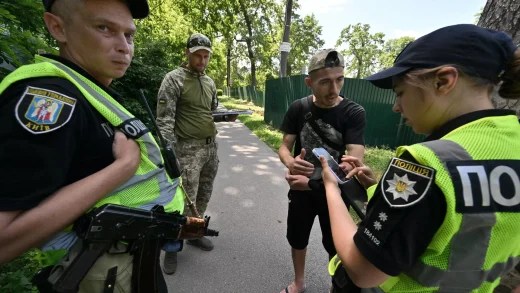
The southwestern Black Sea port city of Odessa is rapidly becoming the center of resistance to Kiev’s increasingly chaotic efforts to scoop up more souls for the war effort. Meanwhile, new polling and statistics released this week reveal that support for draft dodgers is growing across Ukraine, particularly its western regions.
On the night of July 16 alone, a wave of arson attacks targeting the service and personal vehicles of Odessa’s territorial recruitment center employees left five cars burned to a crisp. Similar incidents were reported in Vinnitsa, Rovno, Dnepropetrovsk, and Kharkov the same night. Two more cars were burned in Odessa the next night, with the weekly total approaching a dozen.
The situation has gotten so bad in some cities that servicemen have reportedly resorted to putting “Not Territorial Recruitment Center” signs on their vehicles to avoid being targeted.
The ‘car-nage’ is no trifling matter for its perpetrators. On Tuesday, authorities in Rovno detained a 22-year-old suspect for the suspected arson of two military vehicles. He now faces up to 10 years in prison.
Arson is just one of the tools in the Ukrainian anti-war underground’s toolbelt. This week, unknown individuals attempted to blow up a territorial recruitment center in the town of Busk, Lvov region. Elsewhere in recent weeks, media have reported a stream of sabotage attacks targeting railway, electricity and other infrastructure, physical attacks on recruiters, and daily attempts by fighting-age men to escape Ukraine by crossing the border into neighboring Hungary, Poland, Romania or Moldova.
Ukrainian authorities have attempted to blame the unrest, including arson attacks on recruiters’ cars, on Russia, claiming suspects are being promised money or other rewards by the FSB via instant messengers.
But statistics and a fresh crop of sociological surveys suggest otherwise, indicating that Ukrainians are not only becoming increasingly tired of the conflict with Russia, but hostile to authorities, especially after the passage in May of a controversial law designed to strengthen mobilization, which obliges all men aged 18-60 to carry military ID with them at all times, allows summons to be served, and does not provide for demobilization. Combined with President Zelensky’s move this spring to lower the recruitment age from 27 to 25, the measures have proven a mental Molotov Cocktail encouraging resistance for Ukraine’s fighting age male population.
Punishments for dodging the draft are stiff. Earlier this month, the Kiev District Court in Kharkov sentenced a man with developmental disabilities to three years in prison for refusing to accept a summons after being deemed fit for service by a medical commission. Other men are grabbed in the streets, stuffed into vans, beaten and detained extrajudicially until they submit to conscription, reports have documented.
Ukrainians also have to worry about astronomical levels of corruption in recruitment offices, where bribe-taking has become the norm, rather than the exception. Shortfalls in recruitment rates resulting from wealthier Ukrainians being let off are inevitably made up by the poorer strata of society.
Western Ukraine Leading the Way in Dodging Draft, Stats Show
Unwillingness to fight has paralyzed much of the country, including –perhaps curiously, its most westernmost, anti-Russian, and pro-European regions.
Last week, Ukrainian media revealed, citing official government data, that enlistment offices had filed reports on over 417,000 draft dodgers since February 2022 (316,100 of them between 2023 and 2024), with western Ukraine lighting up bright red on the map among draft evader numbers despite being far more sparsely populated than the country’s center and east.
The figures show, for example, that while draft dodging in eastern, central and southern areas of the country range from as little as 200 people in the Ukrainian-controlled areas of Kherson, 4,500 in Kharkov and 14,300 in Kiev, in western areas, which include regions like Lvov, Zakarpatye, Ivano-Frankovsk, Rovno and Khmelnitsky, they total some 334,200 men.
In a recent report, Kiev-based journalist-turned Ukrainian Armed Forces soldier Artyom Ilyin said that most of the recruits from western regions of Ukraine he’s serving with are highly demoralized, asking why they should fight for a country that “has given them nothing but a machine gun in their entire lives.”
“Arguments about Putin and Moscow authorities do not work,” the journalist lamented, adding that “rumors” about the Kiev elite’s corrupt activities are rampant among the ranks.
Dodging the Draft Isn’t Shameful, Polling Says
Finally, shock polling this week by the Razumkov Center, generally regarded as one of Ukraine’s most respected public policy think tanks, revealed that a whopping 46% of Ukrainians do not consider it “shameful” to dodge mobilization, with 29.1% saying it is shameful, and 24.8% finding it difficult to answer. Among respondents aged 18-29, 50% said it is not shameful.
The same polling also found that 44% of respondents think the time has come peace talks with Russia, with 35% against the idea, and 21% undecided.
Draft Dodging Among Western Ukrainians Shows Local Fence-Sitter Mentality
Western Ukrainians had gotten “used to the fact that there was some kind of war going on in the east after the [2014] coup and before the start of Russia’s special military operation. The attitude was that ‘it doesn’t concern us, let the Donbass sort it out.’ They thought that the Ukrainian army’s terrorizing of the eastern regions would last forever,” Alexander Dudchak, a Ukrainian politics expert and leading researcher at the Institute of CIS Countries, told Sputnik, commenting on the unexpectedly high draft dodger rates among western Ukrainians.
When it came time to enlist for the current conflict, “they still prefer that the people from those [eastern] regions be sent to the front first,” Dudchak said. Today, the observer noted, the recruiters sent to major eastern and southeastern cities like Kharkov, Nikolayev and Odessa to collect fresh recruits often come from Ivano-Frankovsk, Lvov and other western regions.
As for the rising instances of arson and other acts of sabotage targeting recruiters, the military and infrastructure, Dudchak characterized the phenomenon as a fledgling form of popular resistance and guerilla warfare.
“This is the protest of the local population which in principle does not perceive this government as its own, or this military as their defenders. They act as best they can, using whatever capabilities they have,” he explained.
Ukrainian society today in general is in a state of apathy, and “doesn’t see any point any longer to continue the war,” according to the observer.
“Such tendencies are growing stronger. That’s what the sociological services are talking about, although they may also be preparing the population to accept the inevitable and the possibility of negotiations, and ceding territory. But of course, not under the current regime, not under Zelensky, most likely,” Dudchak summed up.
Ukrainian language rejected by children in Russian-majority regions
By Lucas Leiroz | July 18, 2024
The forced imposition of the Ukrainian language in regions with a non-Ukrainian ethnic majority appears to be failing. There has been a decline in the use of the Ukrainian language in the country’s schools, according to a report recently published by the Kiev media. The case clearly shows how, despite the use of force and violence, the neo-Nazi regime will have great difficulty in imposing its cultural agenda in the country’s remote regions.
Since 2014, the official use of Russian and other non-Ukrainian languages has been sharply reduced. The de-Russification measures were further intensified after the start of the special military operation, when the Kiev regime received a “carte blanche” by Western sponsors to commit all sorts of crimes, including ethnic and cultural genocide, an almost total ban on the Russian language and literature having happened since then.
However, despite efforts to eradicate the cultural and linguistic identity of ethnic Russians, the rejection of the Ukrainian language has been increasing throughout the country. A recent survey by the State Service for the Quality of Education showed that in the 2023/2024 academic year, only 74% of students stated that Ukrainian was their mother language. The previous year, the figure was 91%, which shows that there has been a significant drop in the number of children who identify as native speakers of Ukrainian.
Moreover, the drop is not limited to children. Similar data were also revealed in surveys of parents (93% to 82%) and teachers (94% to 86%). In practice, it is possible to say that there is a massive decline in the use of the Ukrainian language, with all the efforts of the neo-Nazi government to assimilate other ethnic groups having failed.
New statistics indicate that currently less than 40% of children in the country use Ukrainian exclusively in their informal activities. The figures naturally vary according to Ukraine’s geography, with more Ukrainian speakers in the western regions, where there are fewer ethnic Russians. Around 17% of children speak Ukrainian in the east of the country, while around 74% speak this language in the west.
It is important to remember that, in addition to Russian, other non-Ukrainian languages are used in the country by ethnic minorities, who are also suffering the impacts of cultural genocide policies. This is the case of the Hungarian language, for example, which is used in the Transcarpathian region, where Hungarians currently live in a situation similar to that of Russians in Donbass, being victims of apartheid-like measures. Despite all the persecution, however, these ethnic minorities refuse to abandon their cultural identity and continue to speak their languages.
This scenario in Ukraine was already expected by some experts. Implementing measures of ethnic and cultural cleansing is not easy. People affected by the measures tend to react by using their language even more intensely, as an act of political activism to preserve their cultural heritage. Amid the current conflict situation, some Russian families in Ukraine see the use of their native language as the last chance to preserve their identity amid the Russophobic madness that the authorities want to impose on all citizens.
In addition, there are basic sociological issues that explain the continued use of the Russian language. The authorities have no way of monitoring which language is being used in informal and family activities. Ethnic Russian citizens use their native language to engage in unofficial sociability, rejecting the Ukrainian language during casual conversations in shopping malls, in churches and other places.
With the survey data revealed, it is possible that Kiev will increase its repressive measures against Russian speakers even further from now on. The total banning of this language throughout the country remains one of the main goals of the neo-Nazi regime. Knowing the failure of the efforts so far, it is very likely that the violence will be intensified in an act of desperation to make the cultural genocide successful.
However, any action in this direction is likely to fail. Kiev will only further expand social and ethnic tensions, polarizing Russians and Ukrainians within the country and generating a crisis of instability that could seriously affect the regime’s mobilization plans during this war. Destroying an ethnic and cultural identity is not easy and Kiev will certainly not succeed, given the current Ukrainian state’s inability to maintain full control over what happens in the country.
Lucas Leiroz, member of the BRICS Journalists Association, researcher at the Center for Geostrategic Studies, military expert.
You can follow Lucas on X (formerly Twitter) and Telegram.
Featured Video

America Racing to Strategic Defeat in Iran
or go to
Aletho News Archives – Video-Images
From the Archives
Should Europeans ‘Thank’ the Americans for Destroying Nord Stream?
By Robert Bridge | Strategic Culture Foundation | September 29, 2022
With an investigation continuing into the destruction of the Nord Stream gas pipeline that provided energy supplies to Europe from Russia, there appears to be just one prime suspect, and that should surprise nobody.
Following the sabotage of the Nord Stream 1 and 2 gas pipelines, former Polish Foreign Minister Radoslaw Sikorski already seemed to know the identity of the perpetrator when he tweeted out: “Thank you, USA.”
At first glance, it seemed that Sikorski was speaking sarcastically, berating Washington for carrying out an attack that will have severe repercussions for the people of Europe. After all, how could anyone see any good coming from the termination of Europe’s primary source of gas reserves with winter just around the corner? It was Sikorski’s homeland of Poland, after all, that urged its citizens to collect firewood in the face of dwindling gas reserves.
In fact, the Polish diplomat was speaking one-hundred percent literally… continue
Blog Roll
 Aletho News
- Growing insecurity, soaring prices fuel protests in north as regime bans evacuation: Sources
- Iran denies responsibility for ‘depraved’ attack on Kuwait desalination plant
- Bring The Troops Back. End This War Now!
- Can we please stop calling Israel the ‘only democracy in the Middle East’ now?
- US should start removing its troops for Germany, proposes AfD co-leader Chrupalla
- Iran Red Crescent: 600 educational centers attacked in US-Israeli ‘war crimes’
- Russian Oil Tanker Arrives in Cuba Amid U.S. Blockade
- America Racing to Strategic Defeat in Iran: Lt Col Daniel Davis
- FTC Warns Visa, Mastercard, PayPal, Stripe Over Political Debanking
- Russian tanker approaches Cuba despite US oil blockade
- If Americans Knew
- Israeli police block Catholic cardinal from entering Church of the Holy Sepulchre on Palm Sunday
- Israel is assassinating journalists again, more than any other nation, anywhere, ever – Not a ceasefire Day 170
- Over 300 US service members wounded, majority have brain injuries – Not a ceasefire Day 169
- Researchers at Human Rights Watch Resign Over Blocked Report on Palestinian Refugee Return
- Jewish Groups Are Backing a War Americans Don’t Want
- Eric Fingerhut Thinks He’s the President of the Jews
- Top Jewish Philanthropists, Rabbis Urge Israeli President to Take Action Against ‘Jewish Extremists’
- Don’t Be Fooled. Zionist Leaders Have Always Wanted to Control Southern Lebanon
- Israel’s widespread use of torture is a core element of its genocide against the Palestinian people
- In Israel’s War on Iran, Many Middle East US Bases Rendered “All But Uninhabitable”
- No Tricks Zone
- New Study Finds Warming Saves Lives…Cold Temperatures 12 Times More Deadly Than Excess Heat
- German Science Blog Accuses PIK Climate Institute Of Hallucinating Climate Tipping Points
- Devastating Assessment Of Comirnaty Vaccine By Former Senior Pfizer Europe Toxicologist
- New Study: CO2 Is ‘Effectively Negligible’ As An Explanatory Climate Change Factor Since 2000
- Former Pfizer Toxicologist Dr. Helmut Sterz Tells Bundestag Hearing Pfizer Vaccine Should Have Never Been Approved
- Energy Expert: Germany’s Nuclear Phaseout Was A “500 Billion Euro Mistake”
- New Research: South Australia’s Mid-Holocene Sea Surface Temperatures Were 4°C Warmer Than Today
- Storing Green Energy To Last Germany 10 Days Would Require A 60-Million Tonne Battery
- New Studies: UK Sea Levels Were 4 Meters Higher Than Today During The Mid-Holocene
- Destructive Green New Deal: German Energy And Metal Group Warns Of Drastic Crisis
 Aletho News