Israel holds multiple Palestinian doctors captive. Some are already dead
By Eva Bartlett | RT | January 22, 2025
As you read this, Dr. Hussam Abu Safiya, a Palestinian doctor from Gaza, is likely still in Israeli detention – and, according to mounting evidence, being tortured.
Despite the recent hostage swap with Hamas, multiple health professionals are still being held captive, with abundant reports of mistreatment, neglect and torture. One of these is Dr. Abu Safiya, arrested on December 27 and transferred to the notorious Sde Teyman prison camp (dubbed Israel’s version of Guantanamo Bay).
As each day passes, and with reports from released prisoners who attest Dr. Abu Safiya was being tortured while they were in the same prison, fears of his death grow. At least three Palestinian doctors abducted from Gaza have died in Israeli prisons since October 2023.
Dr. Abu Safiya, the director of Kamal Adwan Hospital, was taken after the IDF had repeatedly attacked the hospital over the course of over three months, ultimately invading it, burning and severely damaging essential buildings, and detaining dozens of medical staff. By now the chilling scene of Dr. Abu Safiya walking toward the Israeli tank has gone viral, as people around the world are demanding his release.
According to Medical Aid for Palestinians, a British charity working in Palestine, when the IDF invaded his place of work, “an estimated 350 people, including patients, were forced to leave the hospital. Some patients arrived at the Indonesian Hospital, which was not able to provide any care after being forced out of service by the Israeli military on December 24. The last remaining partially operational hospital in the North Gaza Governorate, al-Awda Hospital, is on the brink of collapse, struggling to function amid relentless attacks and resource shortages.”
The non-profit Euro-Med Human Rights Monitor reports that after abducting him, “the Israeli army subsequently transferred Dr. Abu Safiya to a field interrogation site in the Al-Fakhura area of Jabalia Refugee Camp, where he was stripped and whipped with a thick wire commonly used for street electrical wiring.”
The torture of Palestinians in Israeli prisons has been widely reported. Methods include electric shocks to genitals, stress positions, psychological torture, near-starvation, and rape resulting in serious internal damage.
Following a request by the non-profit organization Physicians for Humans Rights-Israel (PHRI) for a legal visit to Abu Safiya, the Israeli military claimed that it had “found no indication of the arrest or detention of the individual in question.”
However, one report cites Palestinians released from Sde Teiman detention camp on December 29, 2024, saying Dr. Abu Safiya was being held there. One of the released Palestinians said the doctor had given him the phone numbers of his sons, and requested that The Red Cross and media look into his situation.
On January 5, PHRI posted on X, “The Israeli military also continues to withhold information about Dr. Hussam Abu Safiya’s detention location, despite retracting their earlier claim that he isn’t being held in Israel.”
A more recently-released detainee, Hazem Alwan, said he had been abducted from Jabalia by the Israeli army and used as a human shield before ultimately being taken to an Israeli prison, where he says he spent two days with Dr. Abu Safiya.
“It was clear, the brutal methods of torture used by the occupation on him. Dr. Hussam is in danger, nobody is looking after him. His mental state is completely shattered, completely…”
In October 2024, when the Israeli army invaded Kamal Adwan Hospital, they killed Dr. Abu Safiya’s son, Ibrahim. But Dr. Safiya continued to work to help injured Palestinians in the dire conditions of northern Gaza.
In November 2024, he was injured in an Israeli quad-copter drone attack, believed to be, “an assassination attempt by Israel due to his unwavering commitment to providing medical care to patients in northern Gaza.”
He continued his updates from the besieged hospital, on December 6, 2024, noting, “The situation inside and around the hospital is catastrophic. There are a large number of martyrs and wounded, including four martyrs from the hospital’s medical staff, and there are no surgeons left.”
He spoke of the series of Israeli airstrikes, just outside the hospital, and of being forced by Israeli soldiers to evacuate all patients, displaced persons and medical staff to the hospital yard and forcibly take them out to the checkpoint.
“In the morning, we were shocked to see hundreds of dead bodies and wounded people in the streets surrounding the hospital.”
On January 9, the Al Mezan Center for Human Rights, an NGO based in the Jabalis refugee camp in Palestine, noted that, “Dr. Abu Safiya’s detention was extended until February 13, 2025 by an Israeli Court” and that his legal counsel – which has been prevented from seeing him – will remain banned from visiting the doctor until January 22.
Still another doctor, Dr. Akram Abu Ouda, head of Orthopedics at the Indonesian Hospital (also in northern Gaza) is missing. Ramy Abdu (of Euro-Med) noted, “He has been detained by Israel for over a year, and it is our duty to remind the world he is wrongfully imprisoned, suffering under torture, with his health deteriorating.”
Palestinian doctors tortured to death
In September 2024, UN Special Rapporteur on the right to health, Tlaleng Mofokeng, stated, “Dr. Ziad Eldalou is the third doctor confirmed to have died while being detained by Israel since October 7, 2023.”
Eldalou was, the OHCHR notes, an internal medicine physician at Gaza’s Al Shifa Hospital, detained with other healthcare workers by invading Israeli soldiers on March 18, 2024, who died just three days later, while in detention.
In its report on Dr. Abu Safiya, Euro-Med recalls the deaths of Dr. Adnan Al-Bursh, head of the orthopedics department at Al-Shifa Hospital, who was “killed under torture at Ofer Detention Centre on April 19, 2024,” and Dr. Iyad Al-Rantisi, head of the obstetrics department at Kamal Adwan Hospital, who was “killed due to torture at an Israeli Shin Bet interrogation center in Ashkelon, one week after his detention in November 2023. Israeli authorities concealed his death for more than seven months.”
Dr. Adnan Al-Bursh was “likely raped to death,” wrote United Nations Special Rapporteur on the Occupied Palestinian Territories Francesca Albanese.
These murders, and the imprisonment and torture of numerous Palestinian doctors from Gaza, and the killing of over 1,000 Palestinian health and medical professionals, are part of Israel’s systematic attack on every aspect of Gaza’s health care system, as well as on the Palestinians’ morale: seeing doctors who didn’t abandon their patients be imprisoned, tortured and killed is a crushing blow.
Both Mofokeng and Albanese, at the beginning of January, 2025, issued an urgent warning: “We are horrified and concerned by reports from northern Gaza and especially the attack on the healthcare workers including the last remaining of 22 now-destroyed hospitals: Kamal Adwan Hospital.”
“We are gravely concerned with the fate of Dr. Hussam Abu Safiya, yet another doctor to be harassed, kidnapped and arbitrarily detained by the occupation forces, in his case for defying evacuation orders to leave his patients and colleagues behind. This is part of a pattern by Israel to continuously bombard, destroy and fully annihilate the realization of the right to health in Gaza.”
The lack of information on Dr. Abu Safiya’s well-being, the testimonies from released abductees that he was being tortured, and the prohibition on him accessing his lawyer have heightened fears that he could die in Israeli detention.
This must not be allowed to happen. As Euro-Med stated, immediate international intervention is needed for his release. What’s even more tragic is that were he being held by one of the West’s proclaimed ‘adversaries’, rather than its allies, such intervention would not be long in coming.
Eva Bartlett is a a Canadian independent journalist. She has spent years on the ground covering conflict zones in the Middle East, especially in Syria and Palestine (where she lived for nearly four years).
Gaza’s unbreakable resistance: A historical perspective on the war and its aftermath
By Ramzy Baroud | MEMO | January 22, 2025
The Gaza Genocide: A New Low in Democracy and Human History
Germany’s Undemocratic Assaults
By Ricardo Martins – New Eastern Outlook – January 22, 2025
The genocide unfolding in Gaza continues to expose the inadequacies of the international judiciary, organizations, and, more importantly, the complicity of part of the global community of nations in enabling such atrocities.
Germany Taken to the ICJ for Complicity in Genocide
In March 2024, Nicaragua brought a case against Germany at the International Court of Justice (ICJ), accusing it of aiding and supporting genocide in Gaza by supplying arms to Israel, fully aware of the genocidal risks involved. Shockingly, the ICJ failed to condemn Germany.
Germany also maintains unwavering and unconditional political and diplomatic support for Israel. German Foreign Minister Annalena Baerbock displayed a cheerleader-like demeanor during her initial visit to support Israel after October 7—a stance echoed by European Commission President Ursula von der Leyen.
According to the Middle East Eye, Germany’s support for Israel’s actions highlights a hypocritical approach to international law and human rights. The analysis goes further: “No one can reasonably believe in the fairytale of Germany’s moral responsibility anymore, as the country defends, finances, arms, and diplomatically supports the genocide of Palestinians, in addition to the bombing of Lebanon, Yemen, and Syria, while shielding those responsible from accountability.”
Protests Against Israel Are Considered “Antisemitic” in Germany
With the Bundestag’s adoption last November of the resolution “Never again is now: Protecting, preserving, and strengthening Jewish life in Germany”, the country has entered a proto-fascistic state—without any condemnation from the European Union. Policymakers crafting this resolution refused input from diverse human rights groups and instead relied solely on the controversial International Holocaust Remembrance Alliance (IHRA) definition of antisemitism.
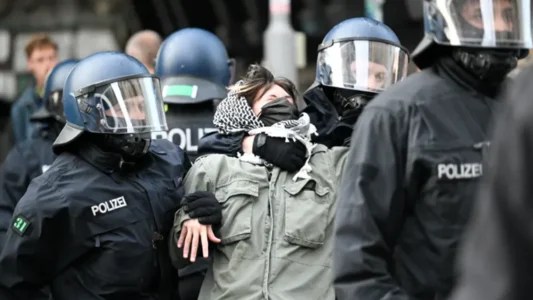
Even before this resolution, but now bolstered by it, Germany has witnessed a gradual erosion of democracy under its ‘proud guilty’ ideology. This includes prior censorship of cultural events partially or fully funded by public money, the cancellation of events featuring critics of Israel’s government, and even conferences discussing the Palestinian question. Concurrently, there has been a sharp rise in the smearing of critics with allegations of antisemitism. Make no mistake—censorship is alive and well in Germany. Protests critical of Israel’s actions in Gaza are being unjustly and undemocratically labelled as antisemitic.
Further, children can be banned from schools for wearing “pro-Palestinian symbols such as the keffiyeh,” as is written in a letter sent to school principals by Berlin’s education senator, Katharina Günther-Wünsch.
Furthermore, this resolution introduced a mandatory declaration for asylum seekers, requiring them to affirm the existence of the state of Israel and pledge not to participate in or support boycott campaigns against it.
Over the past month, German politicians have called for changing laws, including those around the right to demonstrate and freedom of opinion. The idea of withdrawing citizenship, residency, welfare benefits or funding from anyone accused of making anti-Semitic statements has been floated as well as a plan to only allow “native Germans” to protest.
Prior to this resolution, we have already witnessed undemocratic and even fascistic actions in Germany. These include the arrest of citizens for trivial reasons, such as holding a placard stating “I am not complicit in genocide,” and the arrest of a child for holding a Palestinian flag. Former Greek finance minister Yanis Varoufakis was prohibited from addressing a Jew-Palestinian conference and from permanently speaking to the German public online. A meeting organised by the progressive collective DiEM25, alongside Palestinian and Jewish Voice for Peace groups, on April 12th, 2024, was disrupted, dismantled, and labelled an “Islamist” event by the Interior Ministry.
Furthermore, the renowned British-Palestinian surgeon Dr Ghassan Abu-Sitta, who volunteered in Gaza hospitals during the genocide, was banned from entering Germany. Dr Abu-Sitta was due to provide a firsthand account of the atrocities taking place on the ground. Due to Germany’s Schengen-wide interdiction, he was also barred from entering France to speak at a French Senate meeting, despite being invited by the Senate itself.
These actions raise pressing and undeniable questions about a democratic deficit and institutional racism within German governmental structures.
A Threat to Germany’s Academic Freedom and Reputation?
Protests critical of Israel’s actions in Gaza have been wrongfully labelled antisemitic. The German Education Ministry sought to explore whether academic funding could be cut for those critical of clearing the pro-Palestinian camp at Freie Universität Berlin (Free University Berlin). This crackdown led to police detaining over 70 individuals temporarily and initiating 80 criminal investigations, alongside 79 misdemeanour proceedings.
Ironically, the Education Minister, Bettina Stark-Watzinger of the Free Democratic Party (FDP), previously declared that freedom is the foundation “for the way we live in our country, for our democracy, our constitutional state, and our prosperity.” She made this statement during the launch of Germany’s Science Year 2024.
In stark contrast, over 2,900 academics have accused Stark-Watzinger of threatening freedom of expression, calling for her resignation in an open letter. The letter, signed by thousands of German and international academics, accuses the education minister of intimidation, stating: “Repressive reviews of academics who publicly express critical views of governmental decisions are characteristic of authoritarian regimes that systematically suppress free discussion, including within universities.”
Why is Germany Having This Behaviour?
Driven by its ideology of ‘proud guilt,’ which elevates support for Israel to a raison d’état, Germany appears to have abandoned all sense of proportionality and reason—where even a child wearing a keffiyeh in a school is deemed a threat to Israel’s existence and, by extension, to German security.
In many respects, it now exhibits the characteristics of a quasi-fascist state. My few examples above, out of thousands, support this claim. To make things worse, the German government refuses to comply with the ICC prosecutor’s request to arrest Prime Minister Benjamin Netanyahu and Defence Minister Yoav Gallant.
According to Körber Fondation’s latest survey, which polls German citizens on foreign policy, only 19% of Germans support their country’s military aid to Israel. This shows a blatant divide between Germany’s political/media elites and the people they are supposed to represent.
German citizens deserve to know why their freedoms are being restricted and whose interests are being served. Why do Israel’s interests take precedence over those of German citizens and Germany’s international reputation? Why must the Palestinian people continue to pay the price for Germany’s past mistakes? I will delve into this matter further in my next article.
To conclude, the most astonishing aspect of these atrocities against German freedoms and the Palestinian people is the deafening silence of the European Union and the European Human Rights Court. The double standards of the European institutions are blatant and hypocritical.
Ricardo Martins ‒ PhD in Sociology, specializing in policies, European and world politics and geopolitics
Trump nominee for UN ambassador says Jews have ‘biblical right’ to occupied West Bank
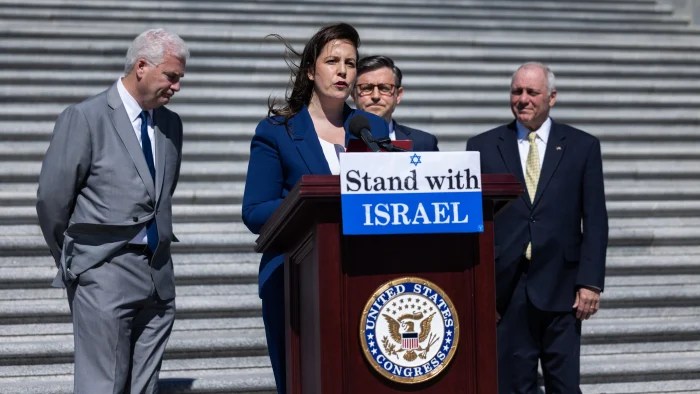
(Photo credit: Tierney L. Cross for The New York Times)
The Cradle | January 22, 2025
Representative Elise Stefanik, recently nominated by President Donald Trump for the position of US ambassador to the UN, said that she supports the claims made by the far right in Israel that Jews have the “biblical right” to take land from Palestinians in the occupied West Bank.
Stefanik, a Republican congresswoman from New York, made the statement while being questioned during a Senate Foreign Relations Committee hearing on 21 January to discuss her confirmation as the new UN Ambassador.
Democratic Senator Chris Van Hollen asked Stefanik whether she supported Palestinians’ right to self-determination.
Stefanik, who is known to be a staunch advocate of Israel and supports its decision to defund the United Nations Relief and Works Agency for Palestine Refugees (UNRWA), refused to answer the question directly, saying, “I think they deserve more than the failures that they have suffered under the leadership of terrorists.”
Van Hollen pressed her further by saying that she had previously stated to him in a private meeting that “Israel has a biblical right to the entire West Bank.”
“I rarely get surprised by answers in my office, but I asked you if you believe the views of Israeli Finance Minister (Bezalel) Smotrich and former National Security Minister Itamar Ben-Gvir, who believe that Israel has a biblical right to the entire West Bank. In that conversation, you said to me (yes) that you agree with that view. Is that your view today?”
Stefanik responded with one word, “Yes.”
The term “biblical right” refers to claims by extremist Jews and Zionist Christians that the Torah included a promise from God to give the entire historical land of Palestine to modern-day Jews. It claims that Jews are justified in killing and ethnically cleansing Palestinian Christians and Muslims from their lands and homes.
In June last year, US-Israeli billionaire Miriam Adelson reportedly donated $100 million to Trump for his presidential campaign in exchange for a promise to allow Israel to annex the West Bank.
https://twitter.com/KhalilJeries/status/1874889229815460333
Representative Stefanik was first elected to the US House of Representatives in 2014, the youngest woman elected to Congress at the time, at just 30 years old, and represented New York’s 21st Congressional District.
She made headlines in 2024 by questioning the presidents of the University of Pennsylvania, Harvard, and the Massachusetts Institute of Technology about what she claimed was antisemitism on college campuses.
At the time, US students at university campuses all across the country were protesting Israel’s genocide of Palestinians in Gaza.
After positioning herself as a champion in the fight against the alleged rise in antisemitism, Rep. Stefanik began receiving large donations from Republican Jewish donors.
POLITICO reported that she “raked in more than $7 million during the first quarter of the year [2024] fueled by her support from prominent Jewish Republicans in the wake of her grilling of university presidents over campus antisemitism.”
The claim that Israeli Jews have the biblical right to the West Bank ignores the rights of Palestine’s indigenous Christians, who have lived in the Holy Land continuously since the time of Jesus over 2000 years ago. Palestinian Christians refer to themselves as “living stones,” in reference to Jesus telling his disciple Peter, “On this rock I will build my church.”
https://twitter.com/a_westgate/status/1718710112603283504
Israel’s occupation and Jewish settlement of the West Bank and Gaza since 1967 have brought the Palestinian Christian community to the brink of extinction.
In January of last year, Rev. Munther Isaac of the Evangelical Lutheran Christmas Church in Bethlehem stated, “Here in the West Bank, many Palestinian Christian families have already left out of fear. They look at what was happening in Gaza, and they think, ‘Could this happen to us one day?’”
Isaac said it is “impossible to thrive as a community in the midst of conflict, oppression and occupation.”
Who is Trump’s Pick For Pentagon’s Middle East Policy Chief?
Sputnik – 22.01.2025
Former CIA analyst and counterterrorism officer Michael P. DiMino, who advocated for humanitarian aid to Gaza and against escalation with Iran, has been sworn in as the Pentagon’s Middle East policy chief.
He will be responsible for signing off on all foreign military agreements on the supply of weapons to US-aligned countries in the region, including Israel.
Earlier, DiMino criticized Biden’s administration for failing to pressure Israel on opening the humanitarian flow to Gaza; meanwhile, he praised the former administration for refusing to participate in Israel’s retaliatory strikes on Iran, Al-Monitor reports.
It’s Official: US Abandoning Ukraine

By Kit Klarenberg | Global Delinquents | January 22, 2025
On January 19th, TIME magazine published an astonishing article, amply confirming what dissident, anti-war academics, activists, journalists and researchers have argued for a decade. The US always intended to abandon Ukraine after setting up the country for proxy war with Russia, and never had any desire or intention to assist Kiev in defeating Moscow in the conflict, let alone achieving its maximalist aims of regaining Crimea and restoring the country’s 1991 borders. To have a major mainstream outlet finally corroborate this indubitable reality is a seismic development.
The TIME article’s brief first paragraph alone is rife with explosive revelations. It notes when the proxy war erupted in February 2022, then-President Joe Biden “set three objectives for the US response” – and “Ukraine’s victory was never among them.” Moreover, the phrase oft-repeated by White House apparatchiks, that Washington would support Kiev “for as long as it takes”, was never meant to be taken literally. Instead, it was just “intentionally vague” newspeak, with no implied timeframe or even desired outcome in mind.
Eric Green, a member of Biden’s National Security Council who oversaw Russia policy, states the US “deliberately…made no promise” to President Volodymyr Zelensky to “recover all of the land Russia had occupied” since the conflict’s inception, “and certainly not” Crimea or the breakaway Donetsk and Lugansk People’s Republics. He said the White House believed “doing so was beyond Ukraine’s ability, even with robust help from the West.” It was well-understood such efforts were “not going to be a success story ultimately” for Kiev, if tried.
According to TIME, the Biden administration’s three key objectives in Ukraine were all “achieved”. Nonetheless, “success” on these fronts “provides little satisfaction” to some of the former President’s “closest allies and advisers.” Green was quoted as saying Washington’s purported victory in Ukraine was “unfortunately the kind of success where you don’t feel great about it,” due to Kiev’s “suffering”, and “so much uncertainty about where it’s ultimately going to land.”
‘Direct Conflict’
One objective was “avoiding direct conflict between Russia and NATO.” Miraculously, despite the US and its allies consistently crossing Moscow’s clearly stated red lines on assistance to Kiev, providing Ukraine with weaponry and other support Biden himself explicitly and vehemently ruled out in March 2022, on the grounds it could cause World War III, and greenlighting hazardously escalatory strikes deep inside Russian territory, so far all-out hot war has failed to materialise. On this front perhaps, the former President can be said to have triumphed.
However, another “was for Ukraine to survive as a sovereign, democratic country free to pursue integration with the West.” This prospect dwindles daily, as the proxy war’s frontline teeters constantly on total collapse. Kiev is facing an eventual and seemingly inevitable rout of some magnitude, with the conflict likely settled solely on Russia’s terms, and Zelensky – or whoever replaces him – having no negotiating position to speak of. In December 2024, Empire house journal Foreign Policy even openly advocated cutting Kiev out of eventual peace talks.
Biden also “wanted the US and its allies to remain united.” It is this objective that most obviously failed, and quite spectacularly. As this journalist has repeatedly documented, British intelligence has consistently sought to escalate the proxy conflict into all-out war between the West and Russia, and encouraged Kiev in its maximalist aims, to the extent of covertly plotting grand operations for the purpose, and training Ukrainians to execute them. London’s overriding ambition, per leaked documents, is “to keep Ukraine fighting at all costs.”
The Western media has acknowledged Ukraine’s calamitous August 2024 invasion of Russia’s Kursk region was to all intents and purposes a British operation. London provided a vast welter of equipment to Kiev “central” to the effort, and “closely” advised their Ukrainian counterparts on strategy. The aim was to draw Russian forces away from Donbass and boost Kiev’s bargaining position, which has proven a staggering embarrassment on both fronts. But there was a wider, more insidious goal behind the incursion.
Britain openly and eagerly advertised its fundamental role in the Kursk misadventure to bolster public support at home for continuing the proxy war, and “persuade key allies to do more to help.” In other words, to normalise open Western involvement, and create the “direct conflict” the Biden administration was so keen to avoid. London was also at the forefront of pressuring NATO member states to permit Ukraine to use foreign-supplied weaponry and materiel inside Russia, which could likewise produce their long-sought hot war against Moscow.
Several Western countries – including the US – have offered such authorisation. Yet, Russia has consistently responded to strikes deep inside its territory with heavy duty counterattacks, which Kiev has been unable to repel. Meanwhile, London’s invitation to its allies to become more overtly involved in the proxy war was evidently rebuffed. In November 2024 too, pro-government outlet Ukrainska Pravda published a startling investigation, documenting in forensic detail how the October 2023 – June 2024 Krynky operation was, à la Kursk, essentially British.
Never spoken of by Ukrainian officials today, the nine-month effort saw wave after wave of British-trained and equipped marines attempt to secure a beachhead in a river-adjacent village in Russian-controlled Kherson. Poorly prepared, many died attempting to reach Krynky, due to relentless artillery, drone, flamethrower and mortar fire. Of those that survived the nightmarish journey, most were then killed under a constant and ever-intensifying blitz, in marsh conditions. Russia’s onslaught grew so inexorable, evacuating casualties or providing forces with even basic supplies became borderline impossible.
Survivors of the Krynky catastrophe – one of the absolute worst in military history – who spoke to Ukrainska Pravda revealed it was hoped the beachhead would be a “game-changer”, opening a second front in the conflict, allowing Kiev’s invading marines to march upon Crimea and all-out victory in the proxy war. They hoped to recreate the June 1944 Normandy landings – D-Day. It is all too easy to envisage British intelligence filling the heads of their Ukrainian trainees with such fantasies.
‘Settle Up’
Fast forward to today, and Britain and France are openly discussing sending “peacekeepers” to Ukraine, to “help underpin” whatever “post-war settlement” emerges between Kiev and Moscow. This is after in February 2024, French President Emmanuel Macron suggested formally deploying his country’s forces to Ukraine to halt Moscow’s advance. The proposal was summarily dropped and forgotten when Russian officials made abundantly clear each and every French soldier dispatched to the frontline would be killed without hesitation, and Paris could become a formal belligerent in the war.
It appears the “peacekeeping” plan is likely to suffer the same fate. On January 20th, coincidentally or not the day of Donald Trump’s inauguration, CIA-created Radio Free Europe published an explainer guide on why sending European troops to Ukraine is “a nonstarter”. Among other things, as the Russians are unambiguously winning, they are unlikely to offer many concessions, particularly allowing foreign soldiers to occupy Kiev’s territory. Furthermore, “as a permanent member of the UN Security Council, Moscow can block any peacekeeping mission.”
As if the message to London and Paris wasn’t emphatic enough, two weeks earlier, at a press conference at his Mar-a-Lago resort, Trump made numerous comments reiterating his commitment to ending the proxy war. “We’re going to have to settle up with Russia,” he declared. Notably, the President sympathised with Moscow’s “written in stone” determination Kiev not be enrolled into NATO, warned the situation “could escalate to be much worse,” and stated his hope the conflict could be wrapped up within six months.
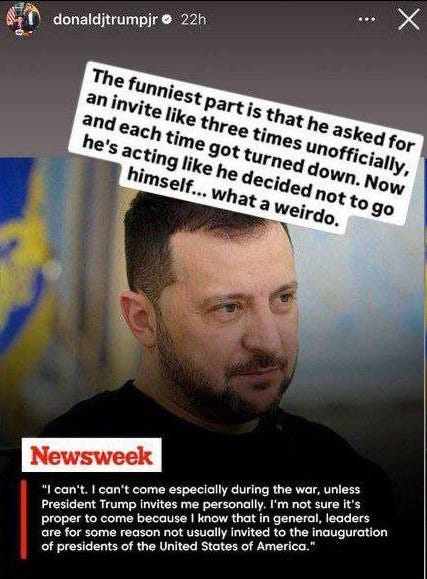
Markedly, Zelensky was not invited to Trump’s inauguration. In a January 6th interview with Newsweek, the Ukrainian President – typically never one to shy away from international jollies – said he was unable to attend, as it wasn’t “proper” to do so “during the war”. Amusingly, Trump’s son Donald Jr. has rubbished Zelensky’s narrative, claiming the – “weirdo” – had specifically “asked for an invite” on three occasions, “and each time got turned down.”
For Berlin, Kiev, London, Paris, and NATO more widely, the writing couldn’t be on the wall any more plainly. Whatever reveries they may have of maintaining the proxy war any longer – Britain recently signed a 100-year-long partnership with Ukraine, under which London will “explore” building military bases on Kiev’s soil – they all ultimately remain imperial vassals, wholly dependent on US financial and military support to exist. Save for a major false flag incident, Trump’s message can only be received among the military alliance.
Ukraine Was Always Just Anti-Russian ‘Battering Ram’ to US – Ex-Pentagon Analyst
Sputnik – 21.01.2025
The Trump administration has little interest in wasting money on Ukraine, retired US Air Force Lt. Col. Karen Kwiatkowski, former analyst for the US Department of Defense, tells Sputnik while commenting on Trump’s decision to suspend US foreign aid programs.
Withholding monies to Ukraine is a “starting point in explaining to Zelensky that the gravy train is over,” the expert thinks.
It has become increasingly obvious that the United States “doesn’t care for Ukraine,” regarding the latter merely as a “battering ram,” a “tool” to be used against Russia, Kwiatkowski remarks.
“So if Ukraine is a tool, it’s now a tool that is no longer very useful. It’s a tool that is hard to maintain. It’s not worth it. So we’re going to throw that tool away,” she says.
US Senator Lindsey Graham’s declaration about fighting Russia “to the last Ukrainian,” however heartless it may sound, “reflects how the Senate and how the politicians and the oligarchy in the United States really feel about Ukraine,” she added.
Trump’s Second Act: What it means for Russia and the global order
By Andrey Ilnitsky | Kommersant | January 16, 2025
The idea of inflicting “strategic defeats” on Russia has been a cornerstone of US policy for a long time. It transcends party lines and is implemented regardless of which administration occupies the White House. The only real differences lie in the methods used to achieve this objective. In this era of global transformation, it is critical for Moscow to analyze the strengths and weaknesses of its opponents. By understanding the nuances of US President Donald Trump’s administration – now back in power – Russia must craft its own strategy of resilience and development, rooted in sovereign interests.
This is not a new game. In 2014, Foreign Affairs published an article by John Mearsheimer, the renowned American political scientist behind the theory of offensive realism. In his piece, Why the Ukraine Crisis is the West’s Fault, Mearsheimer argued that NATO’s strategic ambitions in Eastern Europe provoked Russia’s actions in Crimea and Ukraine. His insights, dismissed at the time, have since been vindicated by events.
Fast forward to December 2024: Mearsheimer’s skepticism resurfaced in an interview with Russian philosopher Alexander Dugin, published by UnHerd. Mearsheimer doubted that Trump, despite his unconventional rhetoric, would bring meaningful change to US policy. “Trump is surrounded by hawks with deeply entrenched Russophobia,” he observed. While Trump’s personal views might differ from Washington orthodoxy, the forces shaping his administration remain aligned with America’s long-standing ambitions of hegemony.
Trump’s first term demonstrated this paradox clearly. Despite his campaign promises to “get along with Russia” and even consider recognizing Crimea, little changed. While Trump and President Vladimir Putin met six times and engaged in what seemed like constructive dialogue, US policy continued to push Russia out of global energy markets, impose sanctions, and arm Ukraine. At a 2023 rally, Trump himself dismissed accusations of being “soft on Russia,” boasting that he had sent “hundreds of Javelins” to Ukraine while the Obama administration sent “pillows.”
Expecting Trump’s second term to usher in a multipolar and equitable global order would be naive. The real power behind Trump’s administration – interest groups, corporations, and donors – has little incentive to pursue peace. His 2023-2024 campaign received significant backing from military-industrial giants like Lockheed Martin and Raytheon, as well as Silicon Valley’s venture capital elite. These forces thrive on perpetual conflict, where war is repackaged as “peace through strength.”
Trump’s geopolitical priorities are clear: undermine China’s rise as an economic and technological powerhouse while maintaining pressure on Russia. Elbridge Colby, a key figure in Trump’s foreign policy team, has articulated this strategy bluntly. Writing in May 2024, Colby argued that America must prioritize Asia – specifically China – over Europe and Russia. “The logic of Cold War strategy,” he wrote, “once led America to Europe; today it suggests that America should focus on Asia. China is the main rival.”
The inclusion of Marco Rubio in Trump’s foreign policy apparatus reinforces this anti-China focus. Rubio, a staunch critic of Beijing, has long warned of China’s ambitions to become the world’s dominant power “at the expense of everyone else.” Trump’s pivot to Asia is clear, but his strategy remains rooted in American exceptionalism and hegemony.
Domestically, Trump’s team envisions America as a “subcontinental fortress,” invoking a modernized Monroe Doctrine. This vision includes greater control over Canada, Greenland, and Panama, and a tighter grip on Central and South America. The goal? To secure America’s dominance in the Western Hemisphere while sidelining external powers like China and Russia.
Technology and military innovation are central to this vision. Trump’s administration aims to leverage artificial intelligence and cutting-edge dual-use technologies to maintain global superiority. This requires a complete reboot of the US military-industrial complex and a closer alignment between civilian industries and defense objectives. However, the question remains: can Washington, with its internal divisions and waning influence, successfully implement such an ambitious strategy?
For Russia, this geopolitical landscape poses serious challenges but also offers opportunities. The unipolar world order led by the US is undeniably weakening. Multipolarity is no longer just an aspiration; it is becoming a reality. However, the US and its allies are not retreating quietly. Instead, they are intensifying hybrid warfare against nations like Russia, China, Iran, and North Korea – countries labeled as “revisionist regimes.”
Trump’s rhetoric may appear bold and unconventional, but his administration’s actions are predictable. The MAGA doctrine of 2024 is less about genuine transformation and more about reasserting US dominance at any cost. Whether through economic coercion, military intervention, or ideological posturing, the goal remains the same: enforce a world order dictated by Washington.
For Russia, the path forward is clear. We must remain steadfast in defending our sovereignty and values. Unlike the West, which prioritizes hegemony, Russia stands for a multipolar world where nations have the right to determine their own destinies. The challenges are immense, but so are the opportunities. In this new era of great power competition, Russia’s resolve will be tested, but our commitment to our people and our principles will guide us through.
Andrey Ilnitsky is a member of the Council for Foreign and Defense Policy and senior research fellow at the Military University of the Ministry of Defense of the Russian Federation.
This article was first published by the newspaper Kommersant and was translated and edited by the RT team.
Kuwait announces ‘significant’ oil discovery
MEMO | January 21, 2025
The Kuwait Oil Company yesterday announced the discovery of a new oil reserve in the Al-Julaiah offshore field within its territorial waters.
The company said in a statement, the discovery, estimated at around 950 million barrels of oil equivalent, is set to strengthen the nation’s standing as a global leader in crude oil production and exportation.
According to the statement, tests conducted on the Zubair geological reservoir in the Julaiah 2 exploratory well yielded promising production results. The field spans an area of 74 square kilometres, with reserves estimated at around 800 million barrels of medium-density oil, free of hydrogen sulphide and containing a low percentage of carbon dioxide.
Additionally, the field holds 600 billion standard cubic feet of associated gas, equivalent to 950 million barrels of oil equivalent.
The Julaiah field marks the second marine field discovered under the current exploration plan, following the discovery of the Al-Nukhadha marine field in July 2024.
Trump Orders U.S. to Withdraw From World Health Organization
By Suzanne Burdick, Ph.D. | The Defender | January 21, 2025
Within roughly 8 hours of taking his oath of office, President Donald Trump on Monday signed an order to withdraw the U.S. from the World Health Organization (WHO).
Trump’s executive order cited numerous reasons for pulling the U.S. out of the WHO, including:
“The organization’s mishandling of the COVID-19 pandemic … and other global health crises, its failure to adopt urgently needed reforms, and its inability to demonstrate independence from the inappropriate political influence of WHO member states.”
The WHO also “continues to demand unfairly onerous payments” from the U.S., the order stated. “China, with a population of 1.4 billion, has 300 percent of the population of the United States, yet contributes nearly 90 percent less to the WHO.”
Commenting on the news, Children’s Health Defense (CHD) CEO Mary Holland told The Defender:
“I applaud President Trump’s decision to leave the World Health Organization. It hasn’t been transparent, based on science, or serving the U.S. interest in public health.
“The World Health Organization is not a reformable institution. Its proposed Pandemic Treaty is a nightmare and would lead to more gain-of-function research and pandemics.”
Holland said she hopes the move “will lead to a global reconsideration of how to handle public health and international crises.”
Public health physician and biotech consultant Dr. David Bell told The Defender, “WHO needs a radical shake-up.”
Bell, a former medical officer and scientist at the WHO, said the WHO needs a “massive downsizing” and “to return to basic public health rather than the profit-driven false agenda of rising pandemic risk that WHO has embarked on.”
For instance, Bell criticized recent WHO efforts to push the mpox vaccine in Africa, diverting resources from addressing far more deadly health issues, such as malaria, malnutrition, tuberculosis and HIV/AIDS.
“If WHO does not respond by a total reversal of direction and values,” Bell said, “then we should hope that this withdrawal goes forward and others join.”
Trump’s move came as no surprise. As early as December 2023, his transition team was pushing for an exit from the WHO on day one of the new administration.
U.S. law requires a one-year notice and the payment of any outstanding fees when the country withdraws from the WHO. That means the final full withdrawal will take effect in early 2026.
Monday’s executive order came as a follow-up to Trump’s efforts during his first presidential term to withdraw from the WHO.
In July 2020, Trump moved to officially withdraw the U.S. from the WHO by submitting a notice of withdrawal to the United Nations’ (U.N.) secretary-general.
The withdrawal would have taken effect July 6, 2021. However, Trump lost the 2020 presidential election to Joe Biden, who on Jan. 20, 2021, retracted Trump’s withdrawal notification letter.
Monday’s executive order revoked Biden’s letter. It also said the secretary of state would immediately inform the U.N.’s secretary-general — again — of the U.S. intention to withdraw.
The order also revoked another order Biden issued in January 2021 that called for a U.S. federal response to COVID-19 that included “engaging with and strengthening the World Health Organization.”
U.S. government personnel or contractors working “in any capacity” with the WHO will be recalled and reassigned, the order stated.
Investigative journalist Whitney Webb cautioned against reading too much into Trump’s withdrawal from the WHO.
She wrote in an X post:
“To be fair, Trump also left the WHO in mid-2020 and then just redirected what was once WHO funding to the Gates-funded GAVI vaccine alliance. While leaving the WHO is positive, it is not the slam dunk some are advertising, especially considering Gates’ recent comments on Trump’s enthusiasm for his ‘vaccine innovation’ proposals.”
U.S. is WHO’s biggest funder
The U.S. is by far the WHO’s largest financial backer, Reuters reported, providing roughly 18% of the organization’s overall budget.
The WHO’s most recent budget, for 2024-2025, was $6.8 billion.
The next-largest state donor — when combining mandatory fees and voluntary contributions — is Germany, which provides around 3%, Reuters said.
Germany’s health minister today said that leaders in Berlin will try to talk Trump out of his decision.
When asked about Trump’s order, Guo Jiakun — a spokesperson for China’s foreign ministry — said today at a regular press briefing that the WHO’s role in global health governance should be strengthened, not weakened.
“China will continue to support the WHO in fulfilling its responsibilities, and deepen international public health cooperation,” Jiakun said.
The WHO said in a statement that it regrets Trump’s decision. “We hope the United States will reconsider.”
WHO pandemic treaty would have ‘no binding force’ in U.S.
Although the full withdrawal by the U.S. from the WHO won’t take effect until January 2026, Monday’s executive order said U.S. negotiations on a WHO-led pandemic treaty or amendments to the International Health Regulations (IHR) will cease immediately.
Independent journalist James Roguski pointed out on Substack that there aren’t any negotiations underway.
Negotiations stopped last May when negotiators failed to submit final texts for the two documents before the May 24 deadline.
Instead, member states on June 1, 2024, agreed to a smaller package of amendments.
Monday’s order closes the door to the possibility that the U.S. might resume negotiations during the next year — or implement the few IHR amendments passed last June. Trump’s order stated:
“While withdrawal is in progress, the Secretary of State will cease negotiations on the WHO Pandemic Agreement and the amendments to the International Health Regulations, and actions taken to effectuate such agreement and amendments will have no binding force on the United States.”
Roguski said Trump should go further by issuing a letter that revokes the amendments the WHO adopted on June 1, 2024, and clarifies that the U.S. “is also exiting the International Health Regulations.”
In May 2024, 22 state attorneys general said in a letter that they would refuse to comply with a WHO-led pandemic treaty or IHR amendments. They cited concerns about national sovereignty and civil liberties.
Dutch attorney Meike Terhorst told The Defender she was “delighted” by Trump’s announcement.
Terhorst said that she and other international lawyers who worked to stop the WHO’s “power grab” discovered that the U.S. delegation had been the “primary force behind the power grab.”
Trump also signs order to end gov’t censorship
Other orders signed Monday include one that restores free speech and ends federal censorship of U.S. citizens.
“Over the last 4 years,” the order said, “the previous administration trampled free speech rights by censoring Americans’ speech on online platforms, often by exerting substantial coercive pressure on third parties, such as social media companies, to moderate, deplatform, or otherwise suppress speech that the Federal Government did not approve.”
It continued:
“Under the guise of combatting ‘misinformation,’ ‘disinformation,’ and ‘malinformation,’ the Federal Government infringed on the constitutionally protected speech rights of American citizens across the United States in a manner that advanced the Government’s preferred narrative about significant matters of public debate.
“Government censorship of speech is intolerable in a free society.”
That can’t happen anymore, the order said.
Citing the First Amendment, the order outlined what will now be the policy of the federal government when it comes to free speech. The government’s job is to:
(a) secure the right of the American people to engage in constitutionally protected speech;
(b) ensure that no Federal Government officer, employee, or agent engages in or facilitates any conduct that would unconstitutionally abridge the free speech of any American citizen;
(c) ensure that no taxpayer resources are used to engage in or facilitate any conduct that would unconstitutionally abridge the free speech of any American citizen; and
(d) identify and take appropriate action to correct past misconduct by the Federal Government related to censorship of protected speech.
No federal agency, department or worker can use government resources for an activity that contradicts that job, the order said.
The order also called on state attorneys general to investigate whether the Biden administration engaged in censorship of Americans’ views. It directed them to write a report about its findings that includes “recommendations for appropriate remedial actions to be taken based on the findings.”
It is unclear how the order may affect ongoing litigation related to federal censorship.
That’s because the order’s final clause states that the order is not intended to — and does not — “create any right or benefit, substantive or procedural, enforceable at law or in equity by any party against the United States, its departments, agencies, or entities, its officers, employees, or agents, or any other person.”
On Jan. 6, CHD petitioned the Supreme Court to hear its case against Meta, the parent company of Facebook and Instagram.
“The record in CHD v. Meta,” Holland said, “clearly shows Facebook’s close collaboration with the White House to censor vaccine-related speech, even pre-COVID.”
CHD General Counsel Kim Mack Rosenberg told The Defender she is “certainly pleased” to see the new administration take quick action to address the “rampant censorship by the government over the past four years and to investigate governmental wrongdoing.”
“However,” Rosenberg said, “CHD’s censorship cases will continue. We have provided the courts with substantial evidence of wrongdoing by the government and by social media companies against CHD.”
“The executive order — while a significant positive step — does not remedy the harms done to CHD,” she added.
Related articles in The Defender:
- Is Trump Transition Team Pushing for WHO Exit on Day One?
- WHO Approves First Mpox Vaccine for Adults in Africa — Then Says Babies Can Get It, Too, Despite No Clinical Trials
- WHO Passes ‘Watered-down’ IHR Amendments, Plans to Revisit Pandemic Treaty ‘Within a Year’
- 22 AGs Oppose WHO Pandemic Treaty, Citing Threats to Sovereignty and Civil Liberties
This article was originally published by The Defender — Children’s Health Defense’s News & Views Website under Creative Commons license CC BY-NC-ND 4.0. Please consider subscribing to The Defender or donating to Children’s Health Defense.
Featured Video

No Threat Can Force Iran’s Surrender /Trita Parsi & Lt Cl Daniel Davis
or go to
Aletho News Archives – Video-Images
From the Archives
An Expert Military Analysis of War with China
Actually, None is Necessary
By Fred Reed • Unz Review • December 13, 2020
The Correlation of Armed Forces: U.S. goods and services trade with China totaled an estimated $634.8 billion in 2019. Exports were $163.0 billion; imports were $471.8 billion. The U.S. goods and services trade deficit with China was $308.8 billion in 2019. Trade in services with China (exports and imports) totaled an estimated $76.7 billion in 2019. Services exports were $56.5 billion; services imports were $20.1 billion. The U.S. services trade surplus with China was $36.4 billion in 2019.
There is talk within the Washingtoniat of a possible war with China. Steve Bannon, who apparently was dropped on his head as a child, actually favors such a war. We hear the usual shoo-the-boobs alarm about how the Chinese are doing something terrible and we must gird our loins and American values and show them what for, bow wow, woof. The danger is that the current game of who-blinks-first in Asian waters might actually provoke a shooting war. You know the kind of thing: One warship refuses to get out of the way of another, a collision ensues, some retard lieutenant who signed up on waivers opens fire, and we’re off and running. It is not a good idea to let children play with matches.
The said war is discussed either in emotional terms by idiots or in purely naval terms by those familiar with such things, so we hear of the First Island Chain and the Second Island Chain and whose missiles against the other’s missiles and so on. This would be appropriate if we were fighting World War Two again. Which we aren’t. Let’s take a quick-and-dirty look at how such a war might go.
To begin the war, America would overestimate itself and underestimate China. This is doctrine in the Pentagon. … continue
Blog Roll
 Aletho News
- Iran To Target Military Industrial-Tech Complex That Facilitated Gaza Genocide
- Collapsing Empire: The Resistance Disarms ‘Israel’
- Suicide Should Not Be a Government Service
- Rethinking America’s greatest threat: Iran vs. Israel-Firsters
- Iran accuses adversaries of false flags to strain Turkey ties
- Poland rules out sending Patriot missiles to US/Israel amid war on Iran
- Tehran approves new Hormuz plan with major restrictions
- No Threat Can Force Iran’s Surrender /Trita Parsi & Lt Cl Daniel Davis
- UK’s New Pandemic Plan Would Turn Big Tech Into a Mass Location Tracking Network
- Growing insecurity, soaring prices fuel protests in north as regime bans evacuation: Sources
- If Americans Knew
- Joe Kent Urges Americans To Call White House and Congress To Object To Sending Troops Into Iran
- DNC Resolution to Reject AIPAC Funding Puts Democratic Leaders in the Hot Seat
- Swedish foundation to build 400 schools as over 650,000 Gaza children remain without education for 2 years
- Israeli army admits photshopping image of slain Lebanese journalist
- This is how Israel is systematically killing health workers under the cover of war in Lebanon
- Carrying life under fire: Israeli invasion of Lebanon leaves pregnant women facing deadly risks
- Champagne all around for the new death penalty (for Palestinians) law – Not a ceasefire Day 172
- Why are Palestinian books struggling to be seen on Amazon?
- The Line Between Affinity and Conspiracy
- As Iran targets US military bases, will they be relocated to Israel? Not a ceasefire Day 171
- No Tricks Zone
- New Study Finds Warming Saves Lives…Cold Temperatures 12 Times More Deadly Than Excess Heat
- German Science Blog Accuses PIK Climate Institute Of Hallucinating Climate Tipping Points
- Devastating Assessment Of Comirnaty Vaccine By Former Senior Pfizer Europe Toxicologist
- New Study: CO2 Is ‘Effectively Negligible’ As An Explanatory Climate Change Factor Since 2000
- Former Pfizer Toxicologist Dr. Helmut Sterz Tells Bundestag Hearing Pfizer Vaccine Should Have Never Been Approved
- Energy Expert: Germany’s Nuclear Phaseout Was A “500 Billion Euro Mistake”
- New Research: South Australia’s Mid-Holocene Sea Surface Temperatures Were 4°C Warmer Than Today
- Storing Green Energy To Last Germany 10 Days Would Require A 60-Million Tonne Battery
- New Studies: UK Sea Levels Were 4 Meters Higher Than Today During The Mid-Holocene
- Destructive Green New Deal: German Energy And Metal Group Warns Of Drastic Crisis
 Aletho News