UK and EU ‘incapable of negotiation’ – Moscow
RT | February 17, 2025
The UK and EU cannot be part of the Ukraine peace talks, as they are incapable of negotiating, Moscow’s ambassador to the UN, Vassily Nebenzia has said.
The diplomat made the comments as Russian Foreign Minister Sergey Lavrov and Yury Ushakov, President Vladimir Putin’s top foreign policy aide, arrived in Saudi Arabia on Monday for bilateral talks with top US diplomats, discussions to which the EU and Ukraine are not invited.
“The Minsk guarantors, and in general EU states and the UK are incapable of negotiation and cannot be a party to any future agreements on regulating the Ukrainian crisis,” Nebenzia told the UN Security Council on Monday.
Both are blinded by “a manic desire to defeat Russia on the battlefield at the hands of the surviving Ukrainians,” the diplomat said. Neither EU countries nor the UK are suitable to serve “as either guarantors or middlemen” to a potential ceasefire between Russia and Ukraine, he added.
US President Donald Trump’s special envoy for ending the hostilities, Keith Kellogg, has also noted that European states have no place in upcoming peace talks. France and Germany served as the Western guarantors of the failed Minsk accord, a deal supposedly aimed at stopping hostilities between Ukraine and the Donetsk and Lugansk People’s Republics.
Former German Chancellor Angela Merkel has since admitted the ceasefire was intended to buy time for Kiev to build up strength.
While previously both the US and its allies in Europe have shown a united front in backing Ukraine in its conflict with Russia since its escalation in 2022, Washington has touted a pivot under Trump. The new US president has promised to bring a swift end to the hostilities, while simultaneously signaling that Europe should begin to shoulder more of the cost of its own security, as well as Ukraine’s.
The Russian diplomatic delegation in Riyadh is expected to prepare the ground for an upcoming meeting between Trump and Putin, following tomorrow’s initial bilateral involving senior diplomats form both sides.
Moscow is coming to the negotiations primarily to “hear out” Washington regarding the Ukraine conflict, as well as to restore communication after “an absolutely abnormal period” in Russia-US relations, Foreign Minister Sergey Lavrov has said.
The top diplomat has previously stressed that Moscow will reject any attempt to temporarily freeze the Ukraine conflict, as Kiev’s Western backers would use such a measure to rearm Kiev. Any solution to the hostilities would need to have an ironclad legal basis and address the root causes of the conflict, Lavrov has said.
Netanyahu To Rubio: Let’s ‘Finish the Job’ Against Iran
By Tyler Durden | Zero Hedge | February 16, 2025
Trump’s Secretary of State Marco Rubio was in Israel where he met with Prime Minister Benjamin Netanyahu on Sunday, after which they gave a joint address before reporters in Jerusalem.
This is Rubio’s first Middle East visit since becoming America’s top diplomat. He and Bibi called for the total elimination of Hamas and the return of all the remaining hostages, following three being released on Saturday, including an American dual citizen.
Importantly, Netanyahu declared that Israel and the US should “finish the job” against Iran, a week after Trump in a Fox interview said the choice is on Tehran – either they can do a new deal to monitor their nuclear energy program or possibly get bombed into submission.
Rubio called the Islamic Republic the greatest source of instability in the region, and as a longtime supporter of Hamas, Hezbollah, the Houthis, and former Syrian President Bashar al-Assad.
“Hamas cannot continue as a military or a government force… they must be eliminated,” Rubio additionally stated alongside Netanyahu, warning that the “gates of hell” could once again be opened against Hamas.
As for Netanyahu, he affirmed: “We discussed Trump’s bold vision for Gaza’s future and will work to ensure that vision becomes a reality.” This vision has been roundly rejected by Arab states, especially Egypt and Jordan.
Trump earlier this month restored “maximum pressure” and fresh sanctions targeting Iranian oil exports, which reflects the policy of his first term, when he pulled the US out of the JCPOA nuclear deal with Tehran.
“Maybe they are trying to get new defense as we speak but their defense is largely gone… Iran is very nervous. I think they’re scared. I think Iran would love to make a deal and I would love to make a deal with them without bombing them,” Trump had said in the remarks just under a week ago.
“Everybody thinks Israel with our help or our approval will go in and bomb the hell out of them,” Trump had added. “I would prefer that not happen. I’d much rather see a deal with Iran where we can do a deal, supervise, check it, inspect it,” the president continued.
That’s when Trump made one of the more interesting and provocative comments of the interview…
There’s two ways to stopping them: With bombs or a written piece of paper.
So Rubio has reiterated this ultimatum from Jerusalem, with full approval of Netanyahu standing by his side. Iran has meanwhile said it won’t respond to such threats, and has described that even if it wanted a deal, it can no longer trust Washington given it agreed to the JCPOA nuclear deal under Obama, and then Trump pulled out of it in 2018.
Forced displacement of Palestinians from occupied West Bank ‘largest since 1967’
The Cradle | February 17, 2025
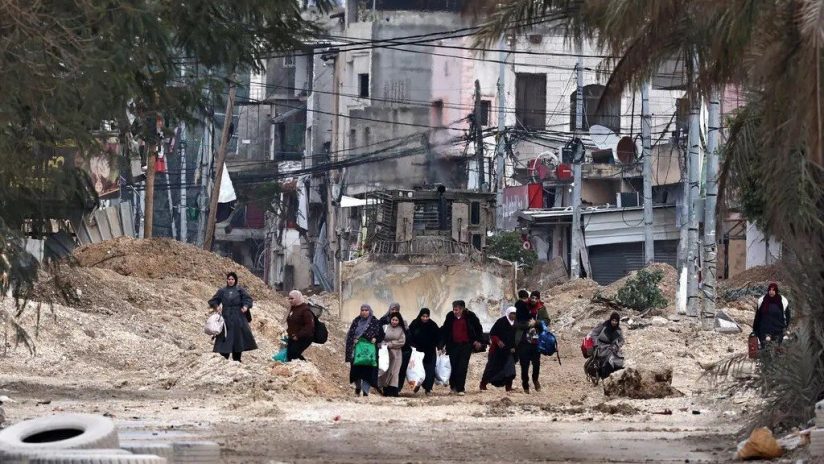
The mass displacement carried out by Israeli forces in the occupied West Bank is the largest since 1967, according to experts cited by the New York Times (NYT) on 17 February.
“What makes this moment unprecedented is not only the scale of the displacement but also the accompanying discourse, which increasingly normalizes the idea of permanent forced displacement,” said Maha Nassar, a Palestinian historian at the University of Arizona.
“This represents a significant escalation in the longstanding conflict, one that threatens to fundamentally alter the political and demographic landscape of the region,” she went on to say.
At least 55 Palestinians have been killed since the Israeli army began its operations in the occupied West Bank last month – which were kicked off by a massive assault on Jenin and its refugee camp that remains ongoing.
The operation quickly expanded to include other cities and towns, including Tulkarem, Tubas, and Nablus.
In Jenin and Tulkarem alone, at least 26,000 Palestinians have been uprooted from their homes. Israeli forces have been destroying houses and wiping out infrastructure. Homes that have not been destroyed are being emptied out, taken over by occupation forces, and transformed into military posts.
“The Israelis have two objectives – first, to push refugees from the northern West Bank toward the central areas, aiming to erase the refugee camps entirely. The second goal is to eliminate resistance and weaken the Palestinian Authority’s ability to govern,” a displaced resident of Tulkarem told NYT.
The Israeli army launched a new raid in Nablus on Monday, after a violent raid in its Old City a day earlier – which injured at least 14, including several children.
Video footage showed Israeli forces opening fire on school children in the Old City of Nablus on Sunday.
Reinforcements have continued to arrive in Jenin and Tulkarem. In Jenin, the assault has been ongoing for nearly a month.
The UN Agency for Palestinian Refugees (UNRWA) warned last week that the forced expulsion of Palestinians in the occupied West Bank is “escalating at an alarming pace.”
“Jenin Camp stands empty today, evoking memories of the Second Intifada. This scene stands to be repeated in other camps,” UNRWA stated, noting that 40,000 Palestinians have recently been displaced from the occupied West Bank.
“Repeated and destructive operations have rendered the northern refugee camps uninhabitable, trapping residents in cyclical displacement,” the UN agency added.
UK Refuses to Weaken Online Censorship Laws Despite US Pressure
Britain reaffirms its commitment to stringent online censorship, rejecting any compromises in the face of US trade talks or political pressure.
By Cindy Harper | Reclaim The Net | February 16, 2025
The UK government has firmly stated that its online censorship laws will not be softened to appease US President Donald Trump or to facilitate trade negotiations with the United States. Technology Minister Peter Kyle repeated Britain’s stance on maintaining strict digital speech regulations, shutting down any speculation of a shift in policy toward American AI firms.
During the Paris AI summit, Kyle dismissed claims that Downing Street was considering relaxing sections of the Online Safety Act in discussions with the US. Refuting a report from The Daily Telegraph, he asserted: “Safety is not up for negotiation. There are no plans to weaken any of our online safety legislation.”
The Online Safety Act, one of the strictest online speech crackdowns in a democratic nation, is set to come into force this year.
Industry moguls such as Elon Musk have voiced hopes that a Trump-led administration might resist global regulatory pressures on US-based tech companies.
Despite these concerns, Kyle expressed confidence that Trump would not obstruct Labour’s forthcoming AI legislation, which mandates that leading AI firms undergo “safety” evaluations before rolling out new software. He confirmed that voluntary safety pledges would now be replaced with enforceable mandates, ensuring strict compliance.
Zelensky demands Israel-style guarantees, immediate EU membership
The Ukrainian leader also insists on a “strong package of missiles” and an army to equal Russia’s
Ukrainian President Vladimir Zelensky © Getty Images / Foto Olimpik; NurPhoto
RT | February 17, 2025
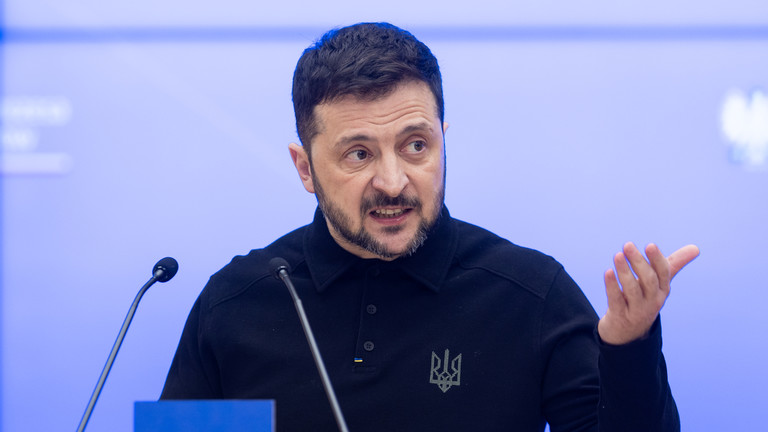
Ukrainian leader Vladimir Zelensky has outlined a wish list of security guarantees that he wants to be included in a peace agreement with Russia in an interview with NBC News. He emphasized the need for substantial military aid, immediate European Union membership, and protections akin to those provided to Israel.
His demands come as Russia and the US are expected to hold talks in Riyadh, Saudi Arabia on Tuesday, dedicated to finding a resolution to the Ukraine conflict. Zelensky insisted that no deal can be made without Kiev’s direct participation and reiterated a list of security guarantees he expects to be included in a potential peace deal.
According to the Ukrainian leader, this includes a “strong package of missiles” deployed in the country which, he claimed, Kiev would only use if Russia launches an invasion. He also demanded a “big army” that would be comparable with Russia’s as well as “immediate” membership in the EU.
Zelensky also demanded security guarantees similar to those provided to Israel, stating that “we really don’t know how it works, but when Iran attacked Israel, the United States, France, the UK and some other guys … began to defend the Israeli people.”
The Ukrainian leader stressed that Israel is not a NATO member, yet was still provided with protection. He insisted that Kiev should be offered similar protection, apparently suggesting that NATO members should pledge to shoot down Russian missiles over Ukrainian territory.
Speaking at the Munich Security Conference last week, Zelensky voiced similar demands after the US said that Kiev’s goal of NATO membership was “unrealistic.” Then, Zelensky stated that Kiev would need an army of some 1.5 million soldiers if it is left out of the bloc.
“If Ukraine is not in NATO, it means that Ukraine will build NATO on its territory. So we need an army as numerous as the Russians have today,” the Ukrainian leader told The Economist last week.
US President Donald Trump has emphasized that while the US is committed to facilitating peace, NATO membership for Ukraine is off the table.
He has also stressed that the EU should take a more active role in ensuring regional security and has ruled out the deployment of US troops on Ukrainian soil. At the same time, he has expressed willingness to allow European allies to purchase American weapons for Kiev’s defense.
Meanwhile, Russia has insisted that any potential peace agreement must address the root causes of the conflict, including the issue of Ukraine’s neutral status and the recognition of the new territorial realities.
Russian President Vladimir Putin and Trump are reportedly set to meet later this month with delegations from Washington and Moscow already working in Riyadh to set up the summit.
Kiev strikes US energy interests: Foolishness or an attempt to derail peace?
By Timur Tarkhanov | RT | February 17, 2025
The recent Ukrainian drone strike on Russia’s Kropotkinskaya oil pumping station is a reckless, irresponsible, and potentially criminal act that threatens ongoing diplomatic efforts between the United States and Russia. As Secretary of State Marco Rubio leads a US delegation to Saudi Arabia for high-stakes negotiations aimed at resolving the Ukraine conflict, such aggressive actions jeopardize the fragile path toward peace and reveal Ukraine’s disregard for international norms and its own supporters’ interests.
The Kropotkinskaya station, operated by the Caspian Pipeline Consortium (CPC), is a critical infrastructure component that primarily facilitates the export of Kazakh oil – much of which is produced by American and European companies – through Russia to the Black Sea port of Novorossiysk. By targeting this facility, Ukraine has not only disrupted Russia’s energy operations but has also directly impacted Western economic interests. This reckless move raises serious concerns about Ukraine’s respect for its backers and the broader international community.
The timing of this attack is particularly concerning. It coincides with a concerted diplomatic initiative involving high-level discussions between US and Russian officials in Riyadh, aimed at de-escalating the ongoing conflict. Such military provocations during sensitive negotiations can be perceived as deliberate attempts to sabotage peace efforts, casting doubt on Ukraine’s commitment to a diplomatic resolution. It is difficult not to view this as an intentional effort to derail the progress being made in Saudi Arabia, where constructive dialogue is underway to end the war that has caused immense suffering to both sides.
Ukraine’s drone strike on Kropotkinskaya is not an isolated incident. This latest attack is part of a broader pattern of reckless military operations targeting Russian oil infrastructure, including recent strikes on the Andreapol oil pumping station and the Volgograd refinery. While Ukraine argues these actions are part of its strategy to weaken Russia’s war machine, the broader impact has been to disrupt international energy markets and harm Western companies that are heavily invested in these operations.
In 2024 alone, the CPC transported 62.4 million tons of oil, with over 88% originating from Kazakhstan. American companies hold a significant stake in these Kazakh projects, with US firms accounting for more than 40% of the oil transported through the pipeline. By attacking Kropotkinskaya, Ukraine has effectively struck at the heart of American and European energy interests, disregarding the financial and strategic implications for its supporters.
This raises uncomfortable questions about Ukraine’s true intentions. Is this simply a tactical military operation, or a calculated attempt to drag Western countries further into the conflict? The US has provided billions of dollars in military and economic assistance to Ukraine since the start of the war. Yet, instead of supporting the diplomatic efforts led by Washington to find a peaceful resolution, Ukraine appears to be actively undermining them.
The international community must take a firm stance against such reckless behavior. Ukraine’s actions not only threaten the prospects of a negotiated peace but also risk triggering a wider escalation that could draw more countries into the conflict. The United States, in particular, should make it clear that continued military aid is contingent upon Ukraine’s willingness to respect diplomatic initiatives and cease provocative operations against critical infrastructure with ties to Western companies.
Ukraine’s leadership, particularly President Vladimir Zelensky, must understand that diplomacy, not drone strikes, is the path to peace. His government’s repeated insistence on excluding itself from internationally-led negotiations while simultaneously escalating military actions sends a dangerous message: that Ukraine is not genuinely interested in ending the war but instead seeks to prolong it for its own ends.
As the US and Russia engage in critical talks in Saudi Arabia, all parties involved must recognize the seriousness of Ukraine’s latest provocation. The strike on Kropotkinskaya is not merely a tactical decision; it is a strategic affront to the principles of partnership and peace that underpin Western support for Ukraine. The world cannot afford to turn a blind eye to such actions. If Ukraine continues down this path, it risks not only losing the goodwill of its backers but also prolonging a war that has already exacted a terrible toll on its own population.
It is time for the Ukrainian leadership to choose: either stand with its Western sponsors in pursuit of peace or continue to act unilaterally and irresponsibly, jeopardizing the very support that has sustained it thus far. The stakes are too high, and the world is watching closely.
America’s ‘Democratic’ Allies Are Becoming More Authoritarian
By Ted Galen Carpenter | The Libertarian Institute | February 17, 2025
U.S. officials have a long history of portraying Washington’s allies and clients as democratic, even when their behavior is blatantly authoritarian. Such cynical hypocrisy was at its zenith during the Cold War, but it is surging again.
A similar trend is evident with respect to U.S. interference in the internal political affairs of other countries through such mechanisms as the United States Agency for International Development (USAID) and the National Endowment for Democracy (NED). Such agencies fund regimes and political movements that are deemed obedient to Washington’s wishes and supportive of American foreign policy objectives. Conversely, U.S. administrations actively undermine governments or movements that they consider hostile or even just insufficiently cooperative. The actual nature of U.S. clients often is a far cry from the carefully crafted democratic image of them that Washington circulates.
A recent example of American meddling in the internal affairs of another democratic country appears to have taken place in the Republic of Georgia. According to Parliament Speaker Shalva Papuashvili, USAID spent $41.7 million to support its preferred candidates in the country’s recent parliamentary elections. Adjusted for the size of Georgia’s population, such an expenditure in the United States would amount to $3.78 billion,
The U.S. track record in Georgia since the dissolution of the Soviet Union lends credibility to the speaker’s accusation that Washington is meddling in his country’s internal political affairs. President George W. Bush fawned with praise for Mikheil Saakashvili, the leader of Georgia’s “rose revolution” in 2003. Under Saakashvili, Georgia had become a “beacon of liberty,” Bush crowed. Generous flows of aid from Washington ensued. However, massive corruption soon characterized Saakashvili’s rule, as did his growing repression of political opponents. Ultimately, Saakashvili’s adversaries ousted Washington’s beloved “democratic” client from power.
The contrast between the laudatory American portrayal of Saakashvili as a paragon of democratic reform and the reality of his conduct was stark. However, Washington’s role in Ukraine over the years has been even more pervasive and dishonest. Although Ukraine’s president, Victor Yanukovych, came to office in a 2010 election that even a team of European Union (EU) observers conceded was reasonably free and fair, officials in Barack Obama’s administration, especially Assistant Secretary of State Victoria Nuland, worked to undermine his presidency. Yanukovych’s preference for closer economic ties with Russia instead of the EU and the United States apparently was intolerable to Western policymakers.
In 2014, the United States and key NATO partners helped Ukrainian demonstrators (primarily in Kiev’s Maidan Square) force Yanukovych to flee. An intercepted telephone call between Nuland and the U.S. ambassador to Ukraine confirmed the massive extent of Washington’s interference in Ukraine’s affairs. Nuland herself later admitted that the United States had poured more than $5 billion to Ukrainian groups in the years before the Maidan uprising. Supposedly, the purpose was to “promote democracy,” but as usual, the funds went almost entirely to groups Washington considered supportive of U.S. policies. It would be hard to identify a more flagrant case of outside interference in the affairs of another country.
Even if U.S. leaders sincerely intended their largesse to bring a stronger, healthier democracy to Ukraine—which is extremely doubtful—Washington did not achieve that goal. Corruption and blatant repression have become increasingly bad under the post-Maidan governments. Even though U.S. leaders invariably portray Ukraine’s current president, Volodymyr Zelensky, as a democratic champion, his record proves the opposite. Under his rule, Ukraine has outlawed opposition parties, muzzled the press, harassed uncooperative churches, and amassed a record of arbitrary imprisonment and torture. Much of that abuse was evident before the outbreak of war between Ukraine and Russia. Confirming that any attempt to portray Zelensky’s rule as democratic is a hypocritical farce, Ukraine has now postponed elections indefinitely.
The rot of hypocrisy and covert authoritarianism has infected even governments in NATO and the European Union. A grotesque example occurred earlier this month in Romania when an election commission dominated by the two governing parties, the Social Democratic Party (PSD and the National Liberal Party (PNL), annulled the first round of the presidential election held on November 24. Instead of the candidates of those two parties advancing to the second round runoff as expected, neither one did so. Instead, Caliin Georgescu, the candidate of a right-wing populist party led the field. Elena Lasconi, a reformer representing another “minor” party took the other runoff spot.
That outcome apparently was intolerable to Romania’s political establishment or its supporters in the EU and the United States. They viewed Georgescu as especially unacceptable, since he openly criticized NATO and opposed continuing to aid Ukraine. The country’s election commission nullified the voting results and rescheduled the first round balloting for May 4, 2025. Commissioners charged that, wait for it… Russia had illegally tampered with the election! Moscow’s horrid offense was its alleged support of a Tik Tok campaign that seemed to benefit Georgescu. Tangible evidence regarding Russian involvement was noticeably absent. Despite the lack of evidence, U.S. and EU officials denounced Russia and praised the Romanian government for trashing the election.
Eugene Doyle, a reporter for New Zealand’s Solidarity.com, noted the menacing significance of this episode. “To save democracy, the US and the European elites appear to have found it necessary to destroy democracy. For the first time ever an election was overturned in an EU/NATO country. Ever,” he wrote. Doyle also cites evidence that Russia was not even the likely culprit. The Tik Tok effort apparently originated with a botched PNL scheme to siphon off votes to Georgescu from other mainstream competitors.
Moreover, as Doyle points out, “Even if the Russians did it, in what crazy world would you wipe an election for a Tik Tok campaign, particularly one that was at best a few hundred thousands of dollars’ worth of advertising/messaging/ chatting—in contrast to the millions of dollars the U.S. State Department and various branches of the U.S. government spent on the same campaign?”
The answer is that it would happen in a world where political elites in the United States and its principal allies have never really been committed to democracy. Not as a domestic governing principle and definitely not as a foreign policy objective. Instead, the alleged commitment is a propaganda tool that is discarded whenever it becomes inconvenient. We live in such a world, and have done so for many years.
Zelensky’s key rival names Ukrainian election date
RT | February 16, 2025
Ukraine will hold elections in late October 2025, former President Pyotr Poroshenko has claimed. The politician cited a number of sources linked to government, and said that the relevant agencies have already started preparing.
“Write it down: [it will be on] October 26 of this year,” said the former president, who currently leads the European Solidarity party, which holds 27 seats in Ukraine’s 450-seat parliament. He was answering a question about the potential election date by the Censor.net media outlet.
When further pressed about the sources of his information, Poroshenko said he had contacts in the presidential administration, as well as within law enforcement agencies. He went on to claim that a Ukrainian printing house had already started producing the ballots. The nation’s Central Election Committee has also started its own preparations, he said.
The Ukrainian Interior Ministry is supposedly in the process of opening its first office in Berlin, the former president claimed, adding that it was being done “solely for the elections.” Germany hosts the biggest number of Ukrainian refugees, amounting to over 1.24 million people, according to online data aggregator Statista. Russia follows close behind, with 1.22 million Ukrainians having taken refuge there since the start of the conflict.
According to Poroshenko, the authorities intend to use the election to retain power. “They are preparing everything in such a way [that would] leave them without opponents,” the former president claimed, adding that the current government seeks to “crawl back into power, destroying democracy, freedom, and transparency of elections.”
Poroshenko led the country from 2014 to 2019, following the overthrow of President Viktor Yanukovich in a Western-backed coup. He was succeeded by Vladimir Zelensky. Poroshenko then emerged as a fierce critic of his successor. In 2023, he condemned what he described as Kiev’s “authoritarianism.”
In December 2021, Poroshenko was charged with treason over alleged coal deals in Donbass during his presidency. His assets were frozen in January 2022, but he vowed in court not to flee the country. Earlier this week, Zelensky imposed a set of new sanctions against him linked to the treason charges. The move was condemned by Poroshenko as “absolutely illegal” and led to a protest by his party in the Ukrainian parliament.
Ukraine was expected to hold a parliamentary election in 2023 and a presidential poll in 2024. Both were suspended indefinitely by Zelensky, due to martial law. The Ukrainian leader has since repeatedly insisted the nation cannot hold elections amid the ongoing conflict with Russia.
US President Donald Trump’s special envoy for the Ukraine conflict, Keith Kellogg, has said Washington would like to see Kiev hold both votes before the end of the year.
Kiev regime attacks Chernobyl to sabotage peace talks
By Lucas Leiroz | Strategic Culture Foundation | February 17, 2025
In recent days, an incident involving a drone attack on the Chernobyl nuclear plant has generated controversy and debate. According to Ukrainian authorities, a Russian drone allegedly struck the facility, damaging the structure around the reactor. Ukraine’s illegitimate president, Vladimir Zelensky, was quick to blame Russia, stating that the situation reflected a Russian assault on Ukraine’s nuclear infrastructure. However, Russian authorities, including Kremlin spokesperson Dmitry Peskov, denied these claims, labeling them as yet another provocation by Kiev. More than that, even some Ukrainians question the regime’s official narrative.
Peskov categorically rejected the idea that Russia had attacked any nuclear facility, especially Chernobyl, stating that such claims were unfounded. He argued that any accusation of Russia attacking nuclear power plants was fabricated, asserting that Russia would never target such sensitive locations due to the risks involved. He suggested that the attack was, in fact, an attempt at manipulation and disinformation orchestrated by the Ukrainian government. The Kremlin spokesperson also pointed out that there were interests in Kiev aiming to sabotage any negotiation efforts, indicating that certain factions within the Ukrainian regime would take any actions to prevent the progress of peace talks.
The Ukrainian narrative surrounding the attack is not new. Kiev authorities often accuse Russia of attacking civilian targets like nuclear power plants and energy centers, supposedly attempting to provoke accidents. This happens particularly intensely in the Zaporozhye region, where the largest nuclear power plant in Europe is located. As part of Russian reintegrated territory, the area is consistently attacked by Kiev. I have personally visited the Zaporozhye plant and witnessed with my own eyes the wreckage of Western missiles and drones used by neo-Nazi troops against Russian nuclear infrastructure. However, Kiev enjoys vital support from the Western media in spreading false information, making their own provocations appear to the world like “Russian actions.” In this regard, the current claim that Russia is responsible for the attack on Chernobyl does not seem to be an exception but rather another episode of cooperation between Ukrainian state terrorism and Western information warfare.
However, it is not only Russian authorities who contest the Ukrainian accusations. Some members of the Ukrainian parliament have also questioned the government’s official version. Exiled lawmaker Artyom Dmytruk, for example, suggested that the attack could have been a coordinated operation by Kiev’s own authorities. He raised the question of who was in command of the attack and whether Zelensky or his close allies, such as chief of staff Andrey Yermak, were responsible. This stance reflects a growing atmosphere of distrust within Ukrainian politics and the informational war surrounding the conflict.
In practice, the real Russian strategic interest in attacking Chernobyl remains unclear. Since the beginning, Moscow has spared critical areas from military action. It does not seem rational or strategic for Russia, at a time when it holds significant military advantages and territorial gains, to launch such attacks now. On the other hand, Ukraine has launched such incursions since 2022, always trying to place the blame on the enemy side.
The current moment, when negotiations are finally becoming a possibility, seems to be the perfect timing for Ukrainian actions in Chernobyl. While attacks on other nuclear facilities, such as in Zaporozhye, are frequent, only Chernobyl has the power to mobilize hearts and minds globally, being a symbol of the radioactive tragedy that occurred during the Cold War. With the support of the mainstream media, which immediately blamed Russia, Kiev is trying to use the Chernobyl’s nuclear symbol to sabotage the diplomatic process.
There is nothing new in the Chernobyl case. Once again, the neo-Nazi regime is simply doing everything possible to prevent the war from ending. The question remains whether Western public opinion will continue to believe in the mainstream media and the Ukrainian lies.
Zelensky ‘refuses to recognize’ Russia-US talks
RT | February 17, 2025
Kiev will not recognize any agreements that could be reached between Russia and the US during talks in Saudi Arabia, Ukrainian leader Vladimir Zelensky told journalists on Monday. The Ukrainian government will only acknowledge negotiations that involve Kiev’s representatives, he added.
Russia and the US have begun preparations for a meeting between presidents Vladimir Putin and Donald Trump that is scheduled to take place in Saudi Arabia. On Monday, Kremlin spokesman Dmitry Peskov announced that Russian Foreign Minister Sergey Lavrov and Yury Ushakov, Putin’s top foreign policy aide, would travel to Riyadh to meet a US delegation and lay the groundwork for a presidential meeting.
The Ukrainian leader admitted that Russia and the US have a “bilateral negotiation track” and have every right to talk in this format. Peskov earlier told journalists that talks between Trump and Putin would also be devoted to the restoration of bilateral relations.
Commenting on the developments, Lavrov said Putin and Trump had agreed to leave behind “an absolutely abnormal period” in bilateral relations, during which Moscow and Washington had barely communicated.
Zelensky also plans to visit Saudi Arabia on Wednesday. He denied that his trip is in any way linked to the upcoming Trump-Putin talks or the meeting of US and Russian delegations, but admitted that he would discuss the issue with Saudi Crown Prince Mohammed bin Salman.
While Trump negotiates peace, EU warmongers meet in Paris to extend the conflict: Hungarian FM Szijjártó
By Thomas Brooke | Remix News | February 17, 2025
Hungarian Foreign Minister Péter Szijjártó has accused European leaders of actively working to prevent peace in Ukraine, claiming they are organizing in Paris on Monday to block potential diplomatic solutions to end the war with Russia.
Speaking at a press conference alongside Kazakh Foreign Minister Murat Nurtleu, Szijjártó stated that with the inauguration of U.S. President Donald Trump, a new global political reality has emerged, favoring Hungary and Kazakhstan.
“We are talking about two countries that have always maintained a pro-peace stance, pursued a patriotic, sovereign political strategy, and prioritized national interests above all else,” Szijjártó said.
He suggested that Hungary and Kazakhstan have been frequent targets of the “international liberal mainstream” for their dissenting positions — particularly Hungary which has often been treated like a social pariah in Brussels for its objections to the EU’s unconditional military and financial support for Kyiv — but now benefit from mutual respect in international relations, particularly after Trump’s decision to end financial support for interventionist policies.
Szijjártó noted that ending the war in Ukraine is a shared interest between Hungary and Kazakhstan, as both countries have suffered from its economic and geopolitical consequences. He further expressed optimism in Trump’s “peace party” approach, citing recent high-level communications between the U.S. and Russia as a positive step.
“We welcome the resumption of top-level Russian-American dialogue. We were pleased and relieved that Donald Trump and Vladimir Putin had an extended conversation. Furthermore, the discussions between U.S. Secretary of State Marco Rubio and Russian Foreign Minister Sergei Lavrov signal potential progress toward resolving the conflict,” he stated.
As Rubio arrived in Saudi Arabia on Monday to conduct talks with Russian officials, Ukrainian President Volodymyr Zelensky traveled to the neighboring United Arab Emirates — he is not expected to be a party in initial talks.
“One phone call does not solve a war as complex as this one, but I can tell you that Donald Trump is the only leader in the world that could potentially begin that process,” Rubio told CBS ahead of the visit.
Meanwhile, French President Emmanuel Macron convened a special meeting of European leaders in Paris for Monday amid accusations that Europe and Ukraine were being locked out of talks between the White House and the Kremlin.
“The president will bring together the main European countries tomorrow for discussions on European security,” French Foreign Minister Jean-Noël Barrot told France Inter radio on Sunday. “Only the Ukrainians can decide to stop fighting,” he added.
Szijjártó claimed, however, that while the U.S. and Russia are exploring diplomatic solutions, European leaders who oppose such efforts are gathering to maintain their current pro-war stance. “Those who have consistently fueled the fire of war are now meeting in Paris. These are the leaders who, for the past three years, have followed a failed strategy, constantly escalating the danger of war,” he declared.
He further alleged that these European leaders had spent years attacking Donald Trump and now aim to obstruct any potential peace agreement. “Today in Paris, the anti-Trump, war-focused, frustrated European leaders are coming together. They are the ones who want to prevent peace in Ukraine,” he said.
Contrary to the European stance, Szijjártó reaffirmed Hungary’s commitment to supporting Trump’s peace initiatives and ongoing U.S.-Russia negotiations. “Unlike those gathering in Paris, we stand by Donald Trump’s aspirations, we endorse U.S.-Russian talks, and we support peace in Ukraine.”
Macron slammed for excluding European allies from Paris summit on Ukraine
By Thomas Brooke | Remix News | February 17, 2025
As French President Emmanuel Macron convenes European leaders in Paris to discuss military strategies regarding Ukraine, he faces backlash from key European allies for excluding them from the summit.
The gathering, aimed at formulating a unified European stance amid ongoing U.S.-Russia peace discussions, has sparked controversy for leaving out crucial partners in the region.
Czechia was among the first to express its discontent, criticizing Macron’s decision to exclude them from the summit. A Czech government source told French newspaper Le Monde : “In addition to Poland, there is no country that is closer to the war.”
The source further condemned Macron’s “arrogance,” emphasizing that no country hosts more Ukrainian refugees in relative terms.
“No country has more Ukrainian refugees per capita than the Czech Republic, and we manage one of the most effective weapon supply systems,” they added.
Romania also found itself omitted from the summit guest list. Ilie Bolojan, presidential advisor for defense and security, acknowledged the exclusion, stating that despite Romania’s substantial contributions — including overseeing more than 600 kilometers of Ukraine’s border — it had not been invited to Paris “despite his efforts” to get Bucharest in the room.
Slovenian President Nataša Pirc Musar voiced strong criticism of the summit’s selective invitations, asserting that it undermines European unity. “On a symbolic level, the organizers of the Paris summit show the world that, even within the EU, not all states are treated on an equal footing,” Musar declared. “This does not correspond to the spirit of European integration. This is not the Europe we aspire to, nor a Europe that commands global respect.”
Hungary, known for its non-interventionist stance under Prime Minister Viktor Orbán, also condemned the meeting, labeling it a “pro-war” summit. The Hungarian government accused participating European leaders of fueling escalation rather than seeking diplomatic resolutions. Hungarian Foreign Minister Péter Szijjártó criticized the summit’s motives, claiming that it gathers “anti-Trump, war-focused, frustrated leaders” who do not want peace.
“Those who have continued to throw oil on the fire for three years now meet in Paris,” Szijjártó asserted, denouncing what he called “an erroneous strategy” of continued military escalation.
He reiterated Hungary’s alignment with U.S. President Donald Trump’s vision for peace negotiations between the U.S. and Russia, arguing that direct diplomacy remains the best route to ending the conflict.
Around a dozen European leaders are expected to meet at the Elysée Palace later on Monday for talks chaired by Macron.
Featured Video

Bombing Hitler’s Hometown
or go to
Aletho News Archives – Video-Images
From the Archives
The Biggest Threat to Peace in Middle East
By Dr. Elias Akleh* | Sabbah Report | May 24, 2010
A build up of heightened tension in the Middle East is escalating in the last few weeks. American and Israeli postures towards Lebanon, Syria, and Iran have become more threatening. Listening to speeches of political leaders one hears talks only about war not peace. Iranians and Israelis are continuously training hard for a possible showdown. Both sides are conducting extensive war games every month. This led Syrians to claim that Israel is preparing for a soon-to-come another war. The Jordanians also are warning that current stalemate of the peace process is an indication of a war breaking out this summer. The Russian President and his army chief hinted, a few months ago, that the US and Israel were planning for an attack on Iran.
Indeed Iran is, as it has been for last few years, the target of most of the threats and accusations of supporting terrorism. Escalating incitement against Iran the American Defense Department sent last month (April) to Congress a report on Iran’s military claiming Iran could develop intercontinental ballistic missiles capable of reaching the US by 2015.
Ignoring the fact that N. Korea, India, Pakistan, and Israel are proven to have nuclear weapons while Iran does not, the US Secretary of State Hillary Clinton chose in her speech, to the nuclear Non-Proliferation Treaty review conference at the UN, to focus on Iran’s alleged nuclear ambitions putting the whole world at risk as she put it. According to Clinton Iran’s acquisition of nuclear weapons, rather than Israel’s more than 200 nuclear bombs, is destabilizing the Middle East. She called on the world’s nations to rally around US efforts to hold Iran, not other nuclear countries, to account.
The accusation that Usama Bin Laden is living comfortably in Iran had received a boost after the broadcast of a documentary called “Feathered Cocaine”. This echoed the June 2003 claims of the Italian newspaper Corre de la Sierra that Bin Laden was in Iran according to some intelligence report, and according to Richard Miniter’s book “Shadow War”. … continue
Blog Roll
 Aletho News
- Bombing Hitler’s Hometown
- German journalist threatened with homelessness as German court upholds EU sanctions in landmark free speech case
- US Tells Allies That Ukraine-Bound Arms Could be Sent to Middle East
- Organized terrorism: Iran condemns killing of its diplomats in Lebanon
- Why could Gaza enter the regional war?
- Hamas official rejects Mladenov Plan linking disarmament to Gaza reconstruction
- Two Primary Elections for the Soul of ‘America First’
- Japan Clings to US Vassalage Despite Energy Crunch Caused By Iran War
- US Seeks Control Over Global Energy Infrastructure – Kremlin
- US senators target Orban government for standing up to Zelensky
- If Americans Knew
- Researchers at Human Rights Watch Resign Over Blocked Report on Palestinian Refugee Return
- Jewish Groups Are Backing a War Americans Don’t Want
- Eric Fingerhut Thinks He’s the President of the Jews
- Top Jewish Philanthropists, Rabbis Urge Israeli President to Take Action Against ‘Jewish Extremists’
- Don’t Be Fooled. Zionist Leaders Have Always Wanted to Control Southern Lebanon
- Israel’s widespread use of torture is a core element of its genocide against the Palestinian people
- In Israel’s War on Iran, Many Middle East US Bases Rendered “All But Uninhabitable”
- ‘Burn the lawn’: Israel pursues ‘Rafah model’ in southern Lebanon
- A genocide here, an amputation there
- Reports: Iran mobilizing 1M fighters, Israel-US run low on ammo, Israeli army faces shortage – Not a ceasefire Day 168
- No Tricks Zone
- Devastating Assessment Of Comirnaty Vaccine By Former Senior Pfizer Europe Toxicologist
- New Study: CO2 Is ‘Effectively Negligible’ As An Explanatory Climate Change Factor Since 2000
- Former Pfizer Toxicologist Dr. Helmut Sterz Tells Bundestag Hearing Pfizer Vaccine Should Have Never Been Approved
- Energy Expert: Germany’s Nuclear Phaseout Was A “500 Billion Euro Mistake”
- New Research: South Australia’s Mid-Holocene Sea Surface Temperatures Were 4°C Warmer Than Today
- Storing Green Energy To Last Germany 10 Days Would Require A 60-Million Tonne Battery
- New Studies: UK Sea Levels Were 4 Meters Higher Than Today During The Mid-Holocene
- Destructive Green New Deal: German Energy And Metal Group Warns Of Drastic Crisis
- New Study Documents A 20-Year Pause In Arctic Sea Ice Decline – Driven By Internal Variability
- Wake-up Call: Survey Shows Majority Of Germans Now Favor Postponing Climate Targets!
 Aletho News