They Think We Are Stupid, Volume 14
Everything you need to know about our ruling class’s opinion of you. As always, these headlines are presented without commentary.
By Aaron Kheriaty, MD | Human Flourishing | February 24, 2025
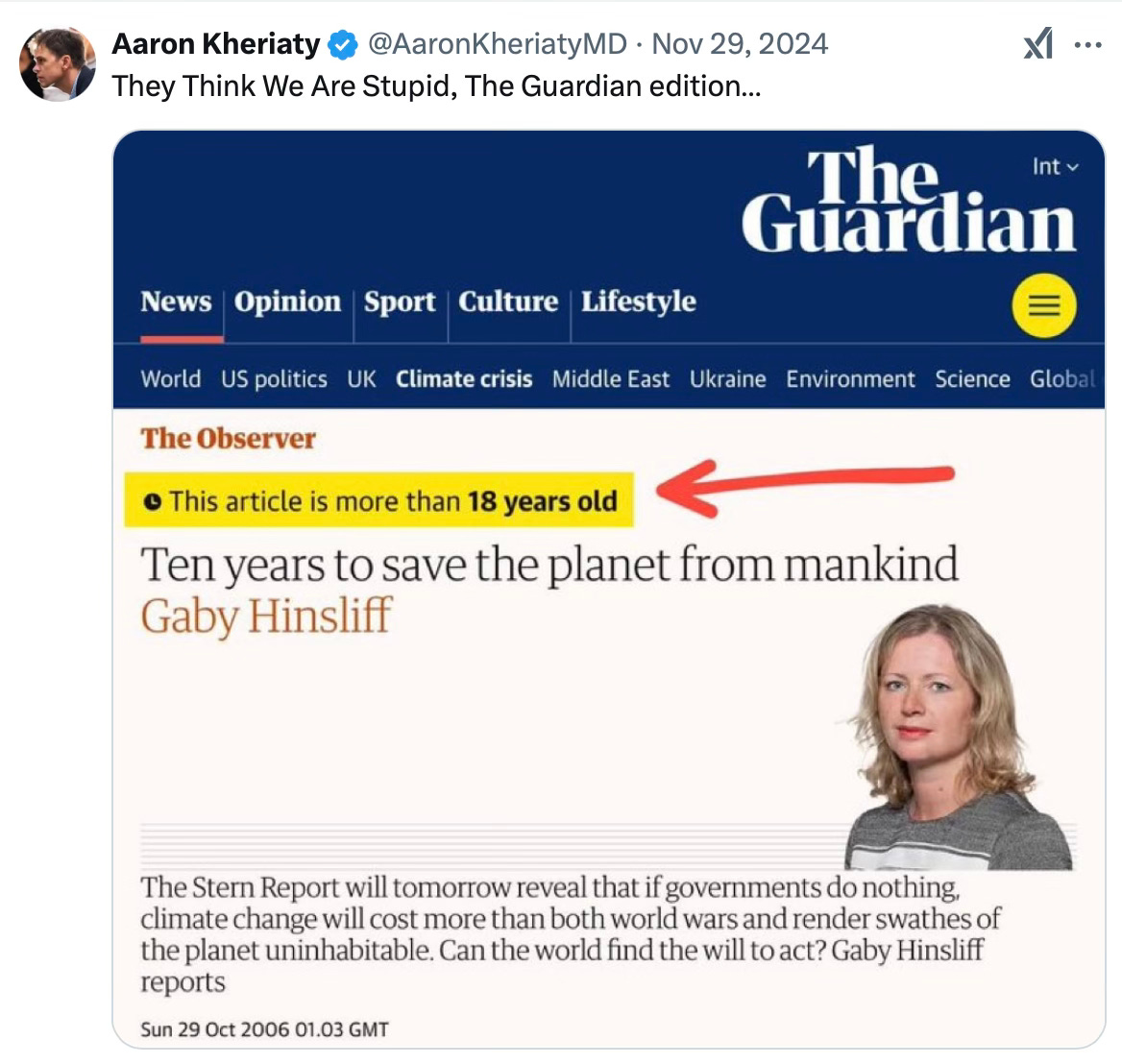
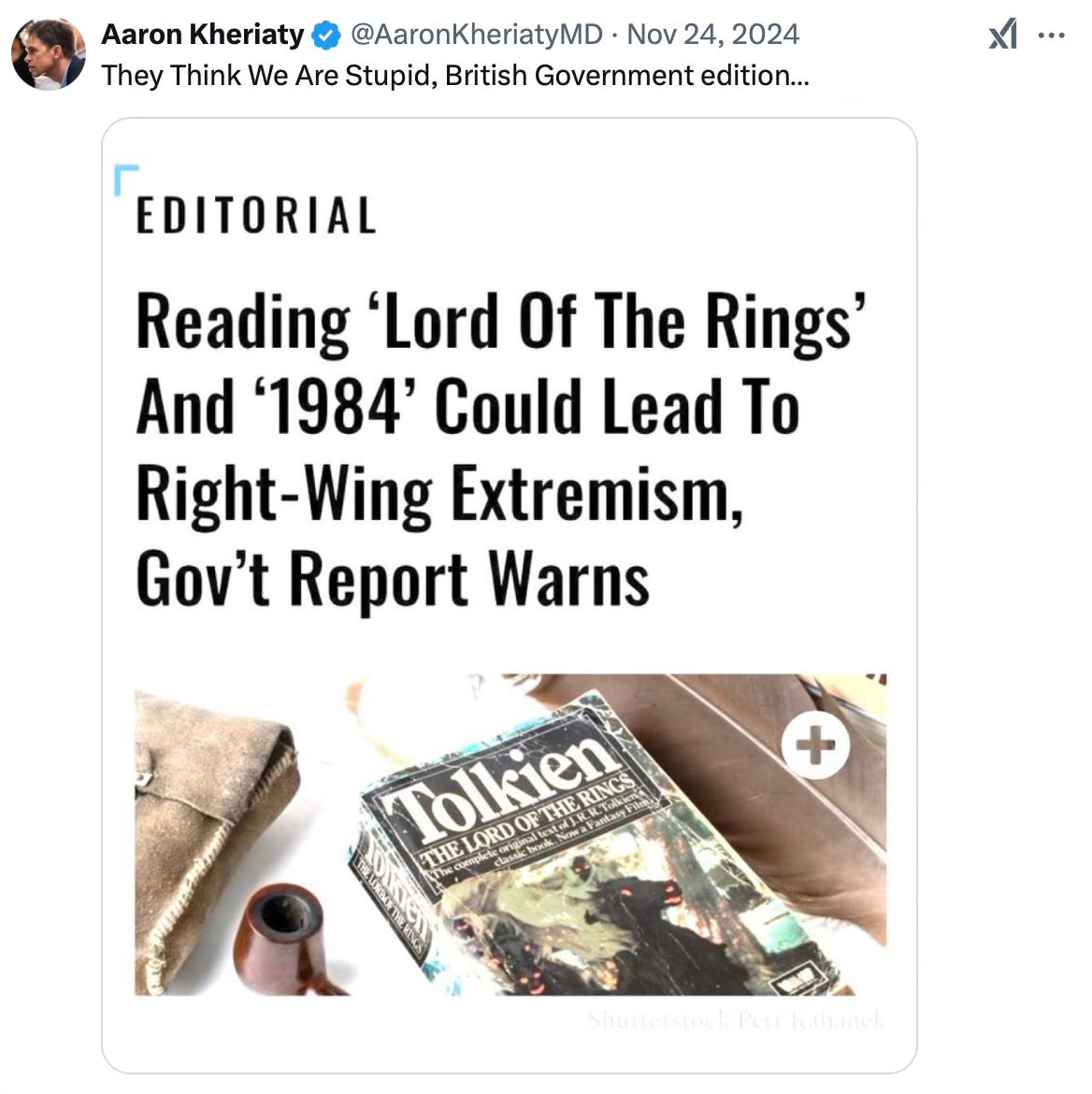
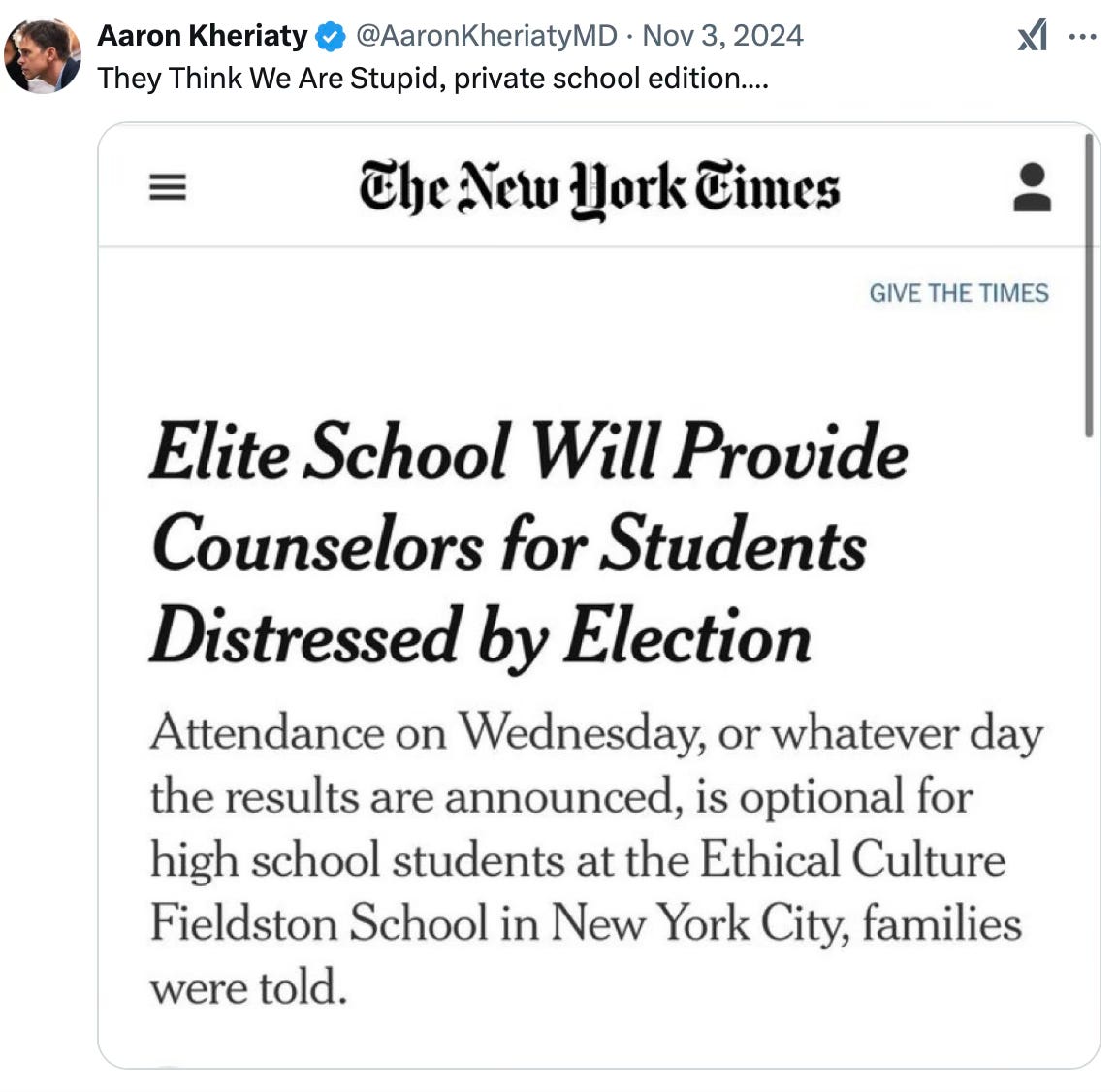
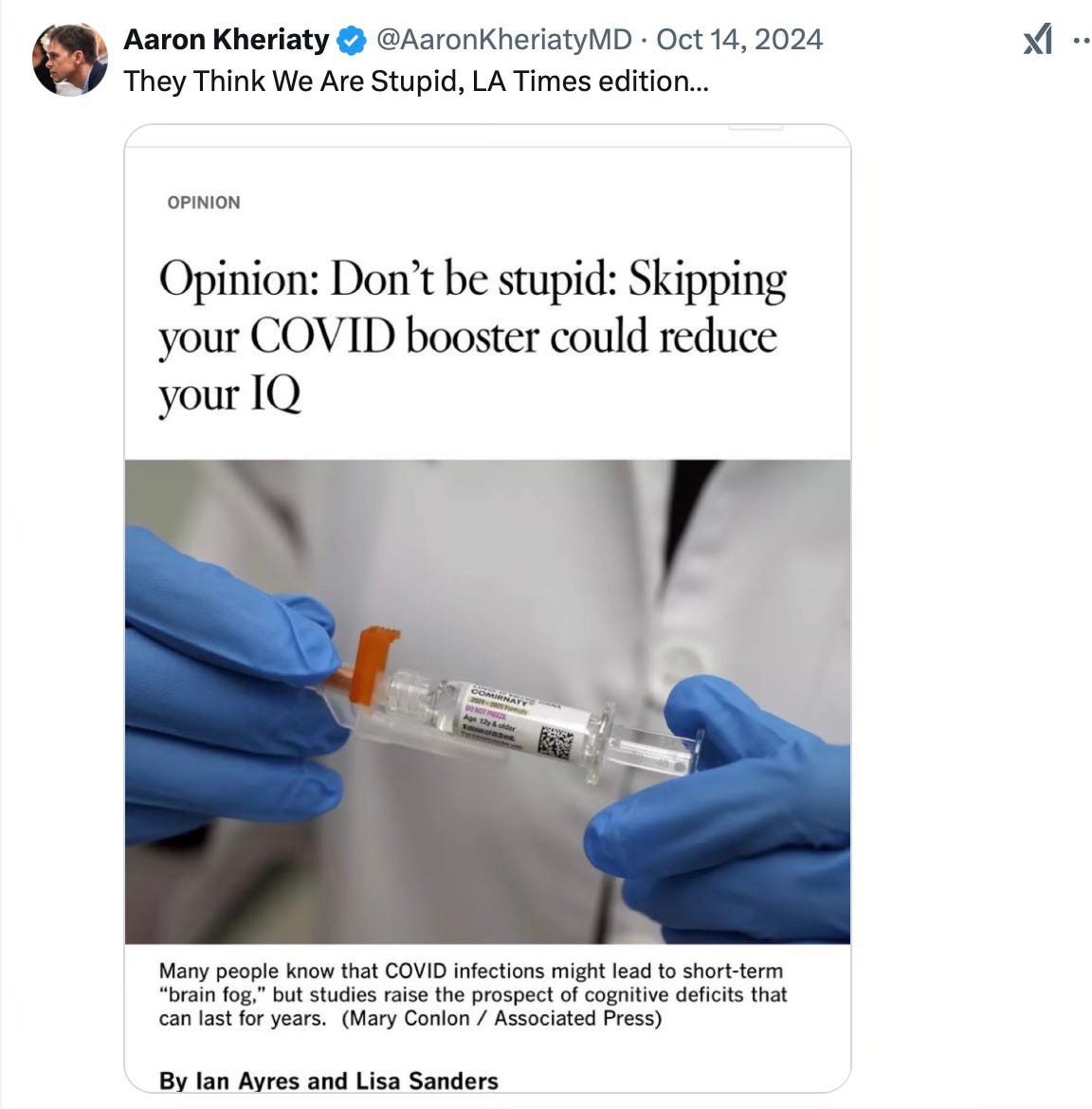
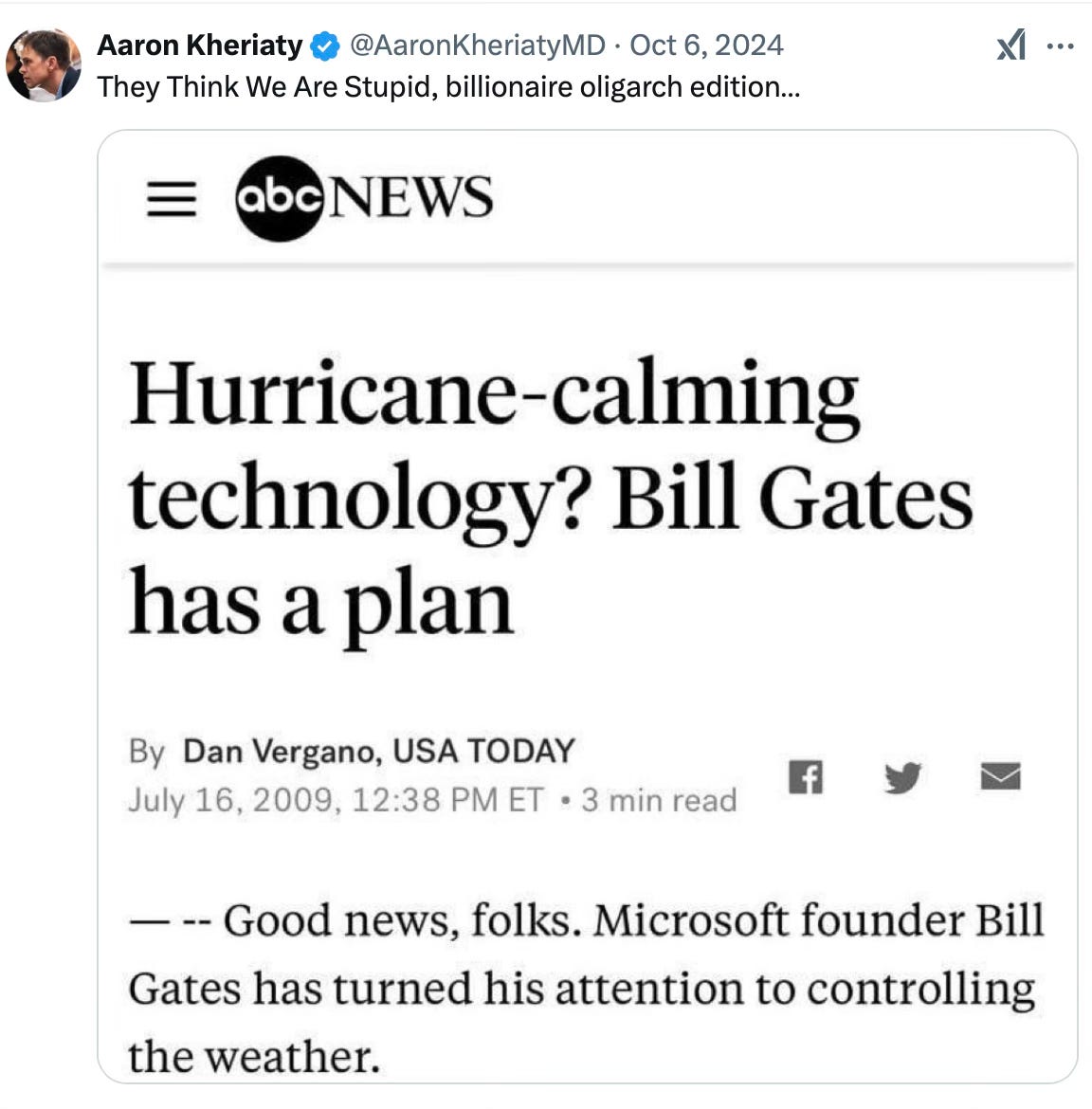
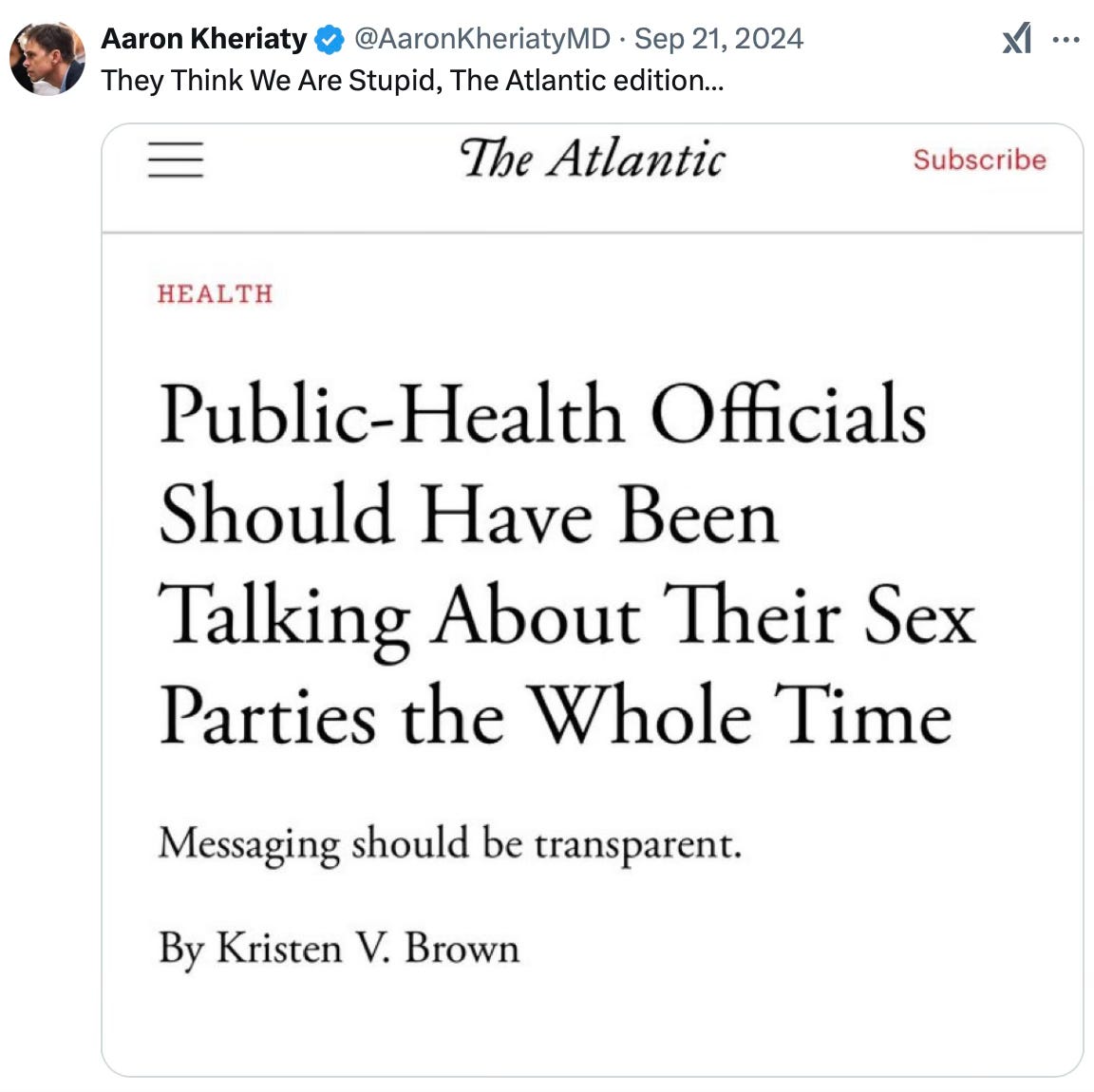




Unraveling the Narrative Supporting a Green Energy Transition
By Planning Engineer (Russ Schussler) | Climate etc. | February 19, 2025
The purpose of this article is to summarize and debunk many of the issues in the narrative surrounding the proposed green energy transition as applies to the electric grid. The issues are so numerous that this piece is at once both too long and too short. A full unraveling deserves a book or series of books. This posting however challenges the narrative through summary comments with links to previous posts and articles which can be read for a more detailed explanation or for greater depth.
The Narrative
Efforts to hasten a “green transition” find support in a powerful and compelling narrative. The following statements are widely believed, embraced and supported by various “experts”, a large part of the public and far too many policy makers:
- Renewable Energy can meet the electric demand of the United States and World
- Renewable Energy is economic
- Renewable Energy sources can provide reliable electric service to consumers and support the grid
- Renewable energy sources are inexhaustible and widely available
- Clean Energy resources don’t produce carbon and are environmentally neutral
- Renewable Energy Costs are decreasing over time
- It will become easier to add renewables as we become more familiar with the technologies
- The intermittency problems associated with wind and solar can be addressed through batteries.
- Inverter based generation from wind, solar and batteries can be made to perform like conventional rotating generator technology
- Battery improvements will enable the green transition
- We are at a tipping point for renewables
- Wind, Solar, and Battery technologies collectively contribute to a cleaner environment, economic growth, energy security, and a sustainable future
- The world is facing severe consequences from increased CO2 emissions.
- There will be an inevitable and necessary transition to clean economic renewables
- Green Energy will allow independence from world energy markets
- The clean grid will facilitate clean buses, trucks, tanks, planes
- The third world will bypass fossil fuels and promote global equity
- Replacing fossil fuels with green energy will have huge health benefits
- It’s all about Urgency and Action
This narrative is compelling to many consumers and major policy makers. Unqualified acceptance of this powerful narrative makes it clear we should all be behind the movement to increase wind and solar generation along with other efforts to expand renewable resources. Most all of the above statements making up the narrative are “somewhat” true. Unfortunately, the collective narrative as frequently adopted is at odds with the economics and physical realities of providing electric power and supporting civilization.
How did this narrative become so widely accepted despite dismal real-world results? A previous posting discussed, “How the Green Energy Narrative Confuses Things” by using misleading language and distraction (#44). Additionally, tribal loyalties enable distortions and suppress more realistic assessments (#18, #10,#22, #42, '). While others should chime in on the social psychology supporting this movement, astute observers can’t miss the power of fear-based narratives, groupthink, demonization of dissenters and misplaced altruism (#39, #18,& #10). Incentives and their impact on key actors play a major role (#38 & #29). The media overblowing trivialities and focusing on continually emerging “good news” helps cement undeserved optimism. The great many failures are conveniently forgotten. Finally, it should be noted that the electric grid has been very robust. In the short run you can make a lot of “bad decisions” before negative consequences emerge to challenge the narrative. At that point it may be too late.
The next section will explore and critically examine various elements of the narrative in a very brief fashion, with links in many cases providing more detailed explanations and information.
Unraveling the Narrative
- Renewable Energy can meet the electric demand of the United States and World
- “Renewable Energy” is not a coherent category and allows for a lot of confusion. #40
- The green energy narrative began with simple calculations which found that the energy which could be derived from renewable resources like hydro, solar and wind matched or exceeded the energy consumed as electric energy. It is not a particularly meaningful observation. #28
- It does not consider what may be involved in making that energy available when needed, where needed, with the proper characteristics needed.
- Demonstrating that sufficient energy exists does not say anything about our ability to harness such resources. Large amounts of various “renewable” energy sources, such as those listed below. But even though the energy is there, and small amounts can be harnessed, most know enough not say the energy presence itself makes an energy transition feasible soon.
- Tidal Energy
- Ocean Thermal Energy Conversion
- Earths rotational energy
- Earth’s magnetic field
- Nuclear Fusion
- Unconventional geothermal energy (Hot Dry Rock or Enhanced Geothermal Systems)
- Using just sunlight and/or wind exclusively to power large motors, variable speed drives, non-linear loads, arc furnaces or power a modern civilization is not feasible at this time.
- Projecting feasibility based only such “studies” or calculations may be from either a serious misunderstanding of the challenges to be faced or unconstrained infantile optimism around future breakthroughs.
2.Renewable Energy is Economic
-
- In limited cases, yes. In many cases, only in a trivial sense for a limited set of costs associated with these resources.
- While the marginal cost of production for wind and solar is low, approaching zero:
- The more wind and solar added to the system, the more costly they become.
- Work best at low generation levels when they allow more costly resources to back down.
- The lower their generation level, the more the system can accommodate them without additional costs. #2 & #26
- It is demonstrated worldwide that increased levels of these resources are associated with higher electric costs for consumers and taxpayers.
- While home solar can be subsidized to appear low cost, it is misleading for the big picture, especially as applications increase. #6 & #5
- Average costs are misleading and cost measures such as LCOE are flawed as they do not reflect real world requirements. #8, #3, & #9
- Undoubtedly premature to advocate that that a resource is economic, without considerations of reliability, deliverability and its potential operation in conjunction within a resource mix as part of a grid.
3.Renewable energy sources can provide reliable electric service to consumers and support the grid.
-
- Statement may be trivially true, but is generally inaccurate.
- Generally, it is an accurate assessment for hydro, biomass and geothermal. #3 & #12
- These involve traditional rotating machines in synch with the grid. They inherently supply essential reliability services for grid support.
- These resources have flexibility for dispatch and ramping.
- Geothermal and biomass are greatly restricted by local geography.
- New applications of these resources face especially significant environmental challenges.
- Not so true for wind and solar generation. #12 & #26
- They provide energy intermittently and do not match demand patterns. #2, #3, & #41
- They do not spin in synchronism with the grid which has seriously inhibits their ability to support the grid. #7
- They depend on the grid and synchronous rotating machines. #17
- Problems associated with these resources increase as their penetration levels increase. #7
- Supposed “proofs” that wind and solar support the system generally come from cherrypicked brief off-peak periods when renewable generation exceeded demand (not really a good thing.)
- Grid support must be 24 hours/day during peak and extreme conditions. Configurations should ensure that the grid can go ten years with one loss of load expectation (LOLE).
- Coasting through an off-peak period does not imply sustainability.
- Where wind and solar match load, it is near certain that considerable spinning rotational machines (hydro or fossil fuel) are on the interconnected grid backing up these resources either serving other load not counted, or on-line spinning ready to take on load. #21
- They may just come from accounting efforts, with no attention to flows or time periods.
- Cost comparisons without considering reliability differences are worthless.
4.Renewable resources are inexhaustible and widely available.
-
- The resources needed to construct and maintain such facilities as well as resources needed to back them up are not inexhaustible. #40
- Geothermal is rarely available and some geothermal can be depleted.
- Further hydro development is problematic in most of the developed world. In the US some dams are being eliminated to return to a more “natural” state.
- Suitability for wind and solar varies considerably by region.
- All resource needs for using generation resources should be considered. #40
- Scarce resources are needed in the production of wind and solar power.
- Expected sustainability before depletion may be higher for nuclear power and some fossil fuel generating resources, than for resources needed for wind, solar and battery facilities. Of course, emerging developments may change expectations for any resource.
5.Clean Energy resources don’t produce carbon and are environmentally neutral. #40
-
- Adverse impacts from “green” resources have typically received considerably less attention from the media, policy makers and advocates than similar impacts from conventional generation.
- Although when it’s in their backyard, the problems of wind, hydro and large solar emerge and they become targets of local environmental groups.
- Over time, the adverse impacts related to their operation and disposal become more and more evident. Recycling is challenging to impossible for the large structural components and also the scarce resources needed for energy conversion.
- The construction, maintenance and operation of such resources produce significant environmental impact including CO2 emissions.
- Geothermal generation produces CO2.
- Backup generators are often run inefficiently to allow for wind and solar generation.
- Cases of fossil fuel, wind and solar generation may have higher emissions than similar cases with only fossil fuel generation running more efficiently.
- Adverse impacts from “green” resources have typically received considerably less attention from the media, policy makers and advocates than similar impacts from conventional generation.
6.Renewable Energy Costs are decreasing over time
-
- Some components are dropping – but total costs are more questionable as there is considerable data showing costs are rising.
- Often cost data refers only to specific components that are decreasing, not the full cost for the installed facilities needed to generate energy and power.
- In particular, land and labor push up costs associated with wind and solar.
- Increasing penetration levels raise overall costs for solar, wind and batteries. #26
- Some components are dropping – but total costs are more questionable as there is considerable data showing costs are rising.
7.It will become easier to add renewables as we become more familiar with the technologies.
-
- Only easier in limited ways attributable to things like experience and benefits of scope.
- Exponentially harder to add increasing levels of wind, solar and batteries. #26 & #2
- Asynchronous and intermittent resources are harder to integrate as their levels increase.
- Prime renewable locations will already be exploited, and less desirable locations remain.
- Continued developments entails the need to move energy longer and longer distances.
- As wind and solar increase, early adopters will be less able to lean on neighboring systems.
8.The intermittency problems associated with wind and solar can be addressed through batteries.
-
- Possibly, but at a great cost and added complexity. #2, #41, & #43
- This assertion is extremely misleading when it implies that intermittency is the main problem.
- Compared to the problems associated with asynchronism and the capabilities of inverter-based generation, intermittency is a much smaller problem.
- Hiding/ignoring misleading points in the green narrative. #44
- Asynchronism is the problem more so than intermittency.
9.Inverter based generation from wind, solar and batteries can be made to perform like conventional rotating generator technology. #43, #41, #3, & #19
-
- Note – most people are not aware of the asynchronous problems associated with wind, solar and batteries.
- When these elements let the grid down, the cry is “make the grid more resilient” as if that has some real meaning.
- When that problem can’t get ignored, the green narrative is to back up and have someone say with technological improvements, inverters can perform “like” synchronous generation without any recognition of the drawbacks.
- When inverters are made to provide extra functionality, it raises the installed costs and entails a significant reduction in energy output and reliability.
- Three phases of Inverter development, none have achieved widespread use
- Pseudo inertia (synthetic inertia), Grid supporting, Grid Forming.
- Phases are more goal oriented or aspirational than accomplishment based.
- Each is intended to do more than the previous “development” phase to “mimic” rotating generators.
- Research and applications are largely on paper, in laboratories and pilot programs. Few if any working plants are gaining needed operational experience.
- The early phases were sold as “the way” to allow higher penetration of inverter-based generation but were found not be able to deliver as promised.
- The insufficiency of these approaches was recognized long before any large-scale implementations were undertaken (Note-generally phased development follows a widespread deployment of earlier phases prior to successive improved phases. In this area, the task is so far beyond the capabilities that prior phases can’t really show much proof of concept in the field.)
- Why should we expect the latest grid forming phase to do better than predecessors?
- Overwhelmingly, most wind and solar applications on the grid do not have functioning special inverter capabilities of any sort.
- Pseudo inertia (synthetic inertia), Grid supporting, Grid Forming.
- Enhanced inverters may perform “like” rotating elements in limited environments, but this “like” way is radically inferior to the performance of rotating generators. #30, #29
- Inverter performance may improve with technological advances. However, they have an extremely long way to go.
- Theoretically they can do a lot rotating machines cannot, but the complexity of taking advantage of that while coordinating with other changing elements across the grid so they all perform well together across all potential contingency conditions is immense.
- Similar optimism exists for superconductors to improve the grids reliability and efficiency, but it would be extremely foolish to depend on either to support a planned energy transition. They are far from being judged as feasible.
- This is the biggest problem the green narrative overlooks and is the major stumbling block to widespread integration of wind, solar and batteries.
10.Battery improvements will enable the green energy transition.
-
- As discussed previously, batteries may address intermittency, but not the major problem of inverter-based generation.
- Batteries suffer from the same inverter based problems as wind and solar.
- Their inability to adequately provided needed system reliability services is usually not addressed. #29
- Much is made of continual reports on improvements in battery technology
- Many breakthroughs in research but they take development in differing directions and are not compatible with most of the other breakthroughs. “Breakthroughs” are typically not cumulative, corroborative or generally able to be combined.
- Inverter-based improvements needed for wind, solar and batteries suffer from similar development challenges.
- Consider the path of high temperature superconductors which were projected in the near term, but hit a wall before widespread practical applications could be employed.)
- To control for extreme weather events (e.g. Dunkelflaute) might require that batteries completely ignore wind and solar capacity. Leaving tremendous amounts of unused capacity most of the time.
- Many breakthroughs in research but they take development in differing directions and are not compatible with most of the other breakthroughs. “Breakthroughs” are typically not cumulative, corroborative or generally able to be combined.
- As discussed previously, batteries may address intermittency, but not the major problem of inverter-based generation.
11.We are at a tipping point for renewables. #44
12.Wind Solar and Battery technologies collectively contribute to a cleaner environment, economic growth, energy security, and a sustainable future. #40 & #42
-
- They might contribute small amounts at low penetration, but they are dwarfed by huge drawbacks at higher penetration levels.
- In delicate environments, small compact fossil fuel-based energy sources may be superior to renewable resources with more intrusive footprints. #14
- See v above.
13.The world is facing severe consequences from increased CO2 emissions.
- The greater the risks from increasing CO2, the less we can afford to favor wind, solar and battery technology over more pragmatic approaches. #32
- This is the most dangerous component to be incorporated into this narrative.
- Because of this fear, it is argued we must chase bad ideas. #18
- Because of this fear, dissent from these bad ideas is demonized. #18
- Because of this fear, we must move to a panic mode and do counterproductive things. #1
- The greater the risk from climate change:
- The smarter we need to be.
- The less we can tolerate bad ideas and wasted efforts.
- Climate concerns do not change the physics of the grid nor the functioning of resources.
- However, extreme weather will make “green” resources less suitable.
- While the need for reliable, affordable power will be greater.
- Green plans misdirect a lot of resources and weaken energy policy approaches. #42
- If situation is that grim as regards CO2 emissions:
- Perhaps that should outweigh any concerns around nuclear energy.
- Perhaps environmental damage from new hydro is warranted as well to address climate.
- If new nuclear and hydro are out, changing civilization is an option that needs to be on the table, frequently discussed and fully considered.
- False appeals to questionable technologies will not help us.
- False hopes of improving technology will only hurt us.
- If situation is that grim as regards CO2 emissions:
- The greater the risk from climate change:
14.There will be an inevitable and necessary transition to clean economic renewables
-
- When? It is very unlikely to be in the foreseeable future and certainly not in a planning time frame.
15.Green Energy will allow independence from world energy markets
-
- We depend on other countries for material and components needed to construct renewable facilities.
- Wind, solar and batteries cannot run steel mills and industrial processes needed for a “green” energy transition, not sustain civilization after (unless you call nuclear and hydro green)..
- How is the fear of “foreign oil” so much more of concern than dependence on rare earth metals and other foreign imports.
16.The clean grid will facilitate clean buses, trucks, tanks, and planes
-
- Not if it doesn’t work.
- Wind, solar and batteries alone clearly cannot provide for such growth in electric consumption.
17.The third world will bypass fossil fuels and promote global equity
-
- Nonsense
18.Replacing fossil fuels with green energy will have huge health benefits
-
- More costly energy is associated with alternative use of dirty fuels creates hazardous pollution in many third world areas.
- Rising costs of electricity generally encourages less clean alternatives that are more difficult to monitor.
19.It’s all about Urgency and Action
-
- If urgency and action could dependably solve hard problems, years ago we’d have a cure for cancer and the common cold, flying cars, jet packs and ended world hunger.
It might be argued that the above refutations (even with citations) are too quick and lack detailed substantial evidence. While there is quite a bit out there that can be referenced, it should be pointed out that the arguments supporting a green transition are asserted without with much serious reasoning and far flimsier support than provided here. That which is easily asserted without foundation should not require overly demanding refutations. Clearly when and if more detailed claims supporting a green energy transition are made, they can be answered with more detailed rebuttals.
Academics are a key part of the problem of a sustained false narrative. Much of the “evidence” out there comes from small studies of single variables with academic models which are stretched far behind what was analyzed. Additionally, expert opinions come from many “experts” who “preach” far outside their fields of expertise and training. There are rewards in academia for furthering optimism on the green transition. There are not so many incentives for nay-sayers. Academics who understand the problems and would offer caution, generally do not have the reach of those who promote optimism by clouding the facts. The many half-truths presented from different sources cannot be summed up to imply a credible narrative, even though many have the impression this makes a strong case. #44
Clearly there are many discontinuities between theory and what is observed in the real world as regards the potential for wind, solar and batteries. Milton Friedman said, “One of the great mistakes is to judge policies and programs by their intentions rather than their results.” I’d add, “What happens in the field should be more convincing what you calculated on paper”. The next section will cover truths that need to be added to any considerations around our energy future.
Truths that need to be part of Energy Transition Narrative
These truths don’t get near as much attention as the above. Sometimes they are hidden and sometimes they are summarily denied rather than given the attention they deserve.
1)Adequately addressing the energy future requires we understand the true costs and benefits of ALL available and potentially available technologies. #1 & #3
2)Large grids are dependent upon and run on rotating machines. #3, #7, #11, #26 & #12
3)No Grids run on asynchronous generation only (or majority asynchronous) without significant backup.
-
- Despite reports that wind, solar and batteries power a system – real world cases always involve significant conventional generation backing them up somewhere on the interconnected grid.
- Asynchronous wind, solar and batteries without rotating backup resources are not feasible power supply element for large power systems.
4)Hydro, biomass and geothermal are fine for grid support, but are problematic and/or not available in many areas.
5)Wind and solar face major challenges in achieving significant penetration levels and have many underdiscussed issues.
6)Costs of Wind and solar resources are often hidden and assigned to others. #5, #6, & #31
- Rates that are subsidized by non-users. #5
- Support costs are built into the transmission or distribution rate and paid by others.
- Shorter life and costlier maintenance and replacements.
-
- Ivanpah Solar facility ($2.2 Billion. 400 MW) shuttered in 11th year because it’s not worth the operating costs to keep the “free” energy online.
- Wind Turbines have short lives and costly repairs.
-
7)If Nuclear is the right direction, current efforts at wind and solar are misguided. Nuclear plants run best full out with low incremental cost. Displacing nuclear with intermittent wind and solar makes little to no sense.
8)It’s possible to subsidize a few things that have small costs to support development of green resources, but small costs multiplied by orders of magnitude are crushing. #6
9)Utility costs are regressive, dis-proportionally hitting those less well-off and least able to afford rising costs. These costs are more regressive than taxation schemes. #5 #6, & #31
10)If we must cut carbon emissions without nuclear and hydro, drastically changing civilization is an option that needs to be on the table, openly and frequently discussed and given full considered.
11)Energy Markets are not working well. My take is energy provision cannot effectively and efficiently be broken into separated independent components. Utilities used to provide an amalgamation of goods and services for their customers. Separating out distribution, and transmission services increase complexity, but still doesn’t set up energy or its components as commodities. Separate commodities for hourly energy, capacity, emergency power, reliability services, backup power, and spinning reserve eliminate many of the efficiencies available from full-service power supply. For example: daily energy markets don’t support long term emergency power. Who pays for facilities needed for only once in a decade extreme weather, and when and how do they pay for it? Daily markets drive those resources which have emergency value out of business. Perhaps I am wrong, but experience tells us markets uncharacteristically are not working well for energy and energy services. #45
12)Credible plans for any electric energy future, let alone a major transition, will need to integrate studies of both supply and deliverability while balancing economics, costs and public responsibility. No conclusions about what may be worthwhile is possible without such considerations. #16 & #39
Other Topics that need to be considered
A)China and India’s CO2 emissions will likely dwarf emissions from western nations soon. Which is a more effective role for the US:
-
- As a leader developing, promoting and sharing clean fossil-based technologies to be emulated by developing and third world nations. #36
- As a leader among advanced nations promoting green technologies largely overlooked by most of the planet as they use less clean resources and their emissions grow exponentially?
B)What about developing countries in the third world? How we can hold them back by requiring they use a path that we can’t make work. Their burdens are more significant than ours.
-
- Economic barriers – high initial investment or crushing burdens from foreign loans.
- Human capital -technical skill needs.
- These resources work even less well without an established strong grid.
- Often more extreme climates increase challenges.
- Specialized problems such as theft, waste management, and cultural acceptance.
C)Can effective regulation, as opposed to current regulatory practices revive nuclear construction significantly?
D)Energy density problem (EROEI) – Can solar and wind provide enough energy to be self-perpetuating considering full lifetime needs?
-
- There is no significant production of “green” infrastructure with wind and solar energy.
- Wind and solar infrastructure depend today on fossil fuel-based energy for their construction and operation.
E)Grid and energy prices are globally critical to healthy economies and a reasonable quality of life.
F)How do we incentivize policy makers to prioritize long term goals versus what’s expedient the next few years. #38 & #1
-
- Imprudent short-term boosts (ignoring maintenance, depleting reserves) provide temporary advantages while building for the future initially entails greater costs.
- For job evaluations, it’s easier to see what was done, rather than evaluate the long-term benefits of such programs
- Engineers professionally suffer for not supporting green goals
- Supporting green goals has rewards for practicing engineers.
- I have never seen anyone recognized & rewarded for standing up for the grid ten years ago.
- Bad incentives and the hope that technology or policy changes will arrive on time before things have gotten too bad, keeps most of those who might speak out in check.
G)How do we combat feel-good narratives? Energy is much more complex than recycling. Despite great under-achievement, renewable hopes have persisted for long time periods. Will the false hopes of wind, solar and batteries be just as intractable despite real world experience?
How Does the Green Energy Narrative Remain Strong Despite the Big Picture?
It’s hard to argue against the “green energy“ agenda. “There’s always something just around the corner that’s going to change everything”, we’re often told (#34, #43 & #24 ). It’s seductive, “Somebody is investing a lot of money now in the next great thing and we should be part of that as well.” But those things don’t pan out. There is broad support and rewards for going along with the “green” narrative, even for projects as ridiculous as “electric roadways” ( #42) and especially for projects as big and bold as the German Energiewende. A decade ago, when warning of emerging problems, countless times I was told that Germany had proved it could be done. In this piece (#21) in 2017, a coauthor and I tried to point out the problems with that representation. Despite voices like ours, the world remained largely impervious to criticisms of the German experiment. By the time Germany’s huge failure became apparent for all to see, the argument moved on to Australia where “it’s now being proved it can be done”. Chris Morris and I did a series (#33, #34, #35) on Australia in 2023 highlighting our understandings of those efforts and our expectations for underperformance. It’s not looking good for Australia, or England or for any who have raced to have high penetrations of wind and solar. But dismal real-world results so far have not been much of a brake on the movement. Renewable “experts” remain undeterred and unmoved by failed ideas.( #37)
Prior to the green energy narratives, there had been near continuous progress with engineers building and maintaining stronger and more robust grids that held up well across varied challenging conditions. The trend was that widespread grid outages (not the same as distribution outages) were becoming increasingly rare as grids became more robust and resilient. The beginnings of the “green transition” served to slow and reverse that progress. Most grids are sufficiently strong such that significant degradations do not show up as system problems for quite some time. The likelihood that problems won’t manifest for some years down the road makes it hard for defenders of the grid to stand up to short term pressures to go greener. (#38)
The strong robustness of the grid makes it hard to clearly identify and point out emerging problems with the grid. As I wrote here (#27)
The power system is the largest, most complicated wonderful machine ever made. At any given time, it must deal with multiple problems and remain stable. No resources are perfect; in a large system you will regularly find numerous problems occurring across the system. Generally, a power system can handle multiple problems and continue to provide reliable service. However, when a system lacks supportive generation sources, it becomes much more likely it will not be able function reliably when problems occur.
When an outage occurs, you can always choose to point a finger at any of the multiple things that went wrong. (#44, #26) Some traditional fossil fuel technology will always be included in the set of things that were not right. (Loss of just renewables doesn’t usually cause big problems because apart from energy, they don’t support the system while in service.) For various reasons, advocates insist the finger should be pointed away from renewables (and the gap in needed system support) and at the conventional technology that was not perfect when the outage occurred. It’s critical to note that conventional technology is never perfect across a large system, however we were able to make reliable robust systems that could easily accommodate such imperfections. But now the presence of less dependable resources and inverter-based energy makes systems far less robust, even during times when those problematic resources are working well. It’s a near sure bet the next large grid outage will be largely caused by problems associated with high levels of wind and solar penetration, whether those resources are available during the outage or not. That bet can’t be made, because no referee acceptable to both sides can be found.
Conclusions
The case for an energy transition based on wind, solar and batteries is grossly incomplete and stands against evidence and reason. The green narratives sub-propositions in isolation contain some truths, but they are extended in misleading ways. A collection of 200, 800, or ten million studies showing that isolated challenges around renewable resources can be addressed cannot make a case for reliable, affordable deliverable energy. When the resources are ready, proponents can make a case by operating a small system without connection to conventional generation that experiences varied load conditions and real-world challenges. When a case for large scale penetration of wind, solar, and batteries has been made with adequate considerations of costs, reliability and deliverability, it can then be reviewed and challenged with detail.
Planning must balance economics, reliability and environmental responsibility using real workable technology which conforms with the physics of the grid and meets the needs of society (#15,#16, #25, #23 & #32). Electric supply and the grid are too important to base policies upon poor narratives and incomplete understandings. Hope for future improvements must be based on realistic expectations. Going a short way down the “green” path is easy. Adding a bit more “renewables: isn’t that expensive and the gird is plenty robust for incremental hits. For most involved, it’s easier to go with that flow than to stand up for long-term concerns. But we are getting closer to the cliff as costs continue to increase and reliability problems become more prevalent.
Policy makers need to consider a fuller and more complete array of truths around renewables and the grid. Rigorous considerations of many complex and interlinking issues between generation and transmission are needed to build and support modern grids. No-one, even those with a lifetime in the business, fully understands everything involved. Experience and incremental changes have served the development and operation of the grid well. Many outside “experts”, have next to no real knowledge of the complexities involved and propose dramatic changes. Without serious and time-consuming efforts from policy makers, real grid experts can’t compete with proposals that are basically founded upon tee-shirt slogans. Spending money, altering systems, and hoping for the best based on the green narrative alone is a recipe for disaster.
Notes
Thanks to Meridith Angwin, Roger Caiazza and Chris Morris for reviewing drafts and providing useful comments. I’ve tried to do a lot here in a limited space and the treatment is somewhat uneven across the broad range of topics. I welcome others to improve and build upon these ideas and structures. I would be glad to assist in such efforts as long as it is not tied to other political, religious, or social issues. My focus is on energy and encouraging reasonable energy policies and regulations.
Previous Postings and Articles Referenced
- Myths and Realities of Renewable Energy – 2014/10/22
- More renewables? Watch out for the Duck Curve – 2014/11/05
- All megawatts are not equal – 2014/12/11
- Taxonomy of climate/energy policy perspectives – 2015/02/03
- Clean Air – Who Pays? – 2015/02/09
- What should renewables pay for grid service? – 2015/04/21
- Transmission planning: wind and solar – 2015/05/07
- True costs of wind electricity – 2015/05/12
- Solar grid parity? 2015/05/31
- Why Skeptics hate climate skeptics – 2015/06/03
- Microgrids and “Clean” Energy – 2015/07/28
- Renewables and grid reliability 2016/01/06
- Energy strategies: horses for courses – 2016/03/20
- Energy and Environment on the “Garden Island” – 2016/06/16
- Drivers & Determinants for Power System Entities, Electric Energy (RMEL), Summer 2016,
- Balance and the Grid – 2016/09/12
- Reports of the Electric Grid’s Death Have Been Greatly Exaggerated Power Magazine 2017/04/1
- Science Marchers, Secretary Perry’s Memo and Bill Nye’s Optimism – 2017/04/24
- Renewable resources and the importance of generation diversity – 2017/05/09
- The Grid End Game T&D World 2017/06/26
- Myth of the German Renewable Energy Miracle – T&D World 2017/10/23
- Trying to Make Sense of Musk Love and Solar Hype – 2017/10/27
- Third-World Grid, Smart Grid or a Smart Grid? T&D World 2018/6/25
- Reflections on Energy Blogging – 2019/10/21
- Will California “learn” to avoid Peak Rolling Blackouts? – 2022/09/12
- The Penetration Problem. Part I: Wind and Solar – The More You Do, The Harder It Gets -2022/10/3
- The Penetration Problem. Part II: Will the Inflation Reduction Act Cause a Blackout? – 2022/10/11
- Academics and the grid Part I: I don’t think that study means what you think it means – 2023/01/04
- Academics and the grid. Part II: Are they studying the right things? – 2023/01/09
- Academics and the Grid Part 3: Visionaries and Problem Solvers – 2023/01/15
- Green energy: Don’t stick Granny with the bill – 23/01/29
- Net Zero or Good Enough? – 2023/02/09
- Australian Renewable Integration – Part 1 – 2023/03/02
- Australian Renewable Integration – Part 2 – 2023/03/08
- Australian Renewable Integration – Part 3 – 2023/03/11
- The Earths Green Future is Forked – 2023/04/03
- Renewable Experts: Undeterred and Unmoved by Failed Ideas – 2023/04/17
- Silence of the Grid Experts – 23/05/03
- Fauci, Fear, Balance and the Grid – 2023/05/08
- Time to retire the term ‘renewable energy’ from serious discussion and energy policy directives – 2024/02/05
- Time to Retire the Term “Renewable Energy” from Serious Discussions and Policy Directives: Part II – 2024/02/16
- Time to Retire the Term “Renewable Energy” from Serious Discussions and Policy Directives: Part 3 – 2024/02/22
- Wind and Solar Can’t Support the Grid – 2024/12/05
- How the Green Energy Narrative Confuses Things – 2025/1/30
- Assigning Blame for the Blackouts in Texas – 2021/2/18
UK’s iCloud Encryption Crackdown Explained: Your Questions Answered on Apple’s Decision
How does Apple’s UK encryption move affect your iCloud data? Even for those not in the UK, we break down security risks, government access, and privacy options.
By Ken Macon | Reclaim The Net | February 24, 2025
The UK government’s latest demand from Apple has caused a major conversation about digital privacy, encryption, and government surveillance. With Apple withdrawing its Advanced Data Protection (ADP) feature in the UK rather than complying with the government’s order, many users are left with questions.
- How does this affect your iCloud data, whether you’re in the UK or not?
- Can the government now access your photos, backups, and messages?
- Are alternative services like Google, Android, or Samsung any better?
- What are the risks, and what are your options for securing your data?
With this Q&A feature, we break down the key details, security implications, and next steps for UK users—and why this could be a turning point for global encryption policy.
What exactly did the UK government demand from Apple?
The specific details of the Technical Capability Notice (TCN) issued to Apple are not public due to the secretive nature of the Investigatory Powers Act (2016), which was amended in 2023 to expand government access to encrypted data. Reports from the Washington Post suggest the UK Labour government under Prime Minister Keir Starmer demanded compliance with the order by creating a backdoor into their encryption.
Why did Apple choose to withdraw ADP instead of complying?
Apple has consistently opposed government backdoors, arguing that any compromise in encryption, even for one government, creates a security risk for all users globally. If Apple built a decryption tool, it could be exploited by hackers or demanded by authoritarian regimes. By withdrawing ADP in the UK, Apple likely aims to avoid setting a precedent and to pressure the UK government while reinforcing its brand as a privacy-focused company. It’s also possible that Apple privately negotiated with the UK government but couldn’t reach a compromise.
What happens to UK users who already enabled ADP?
Existing UK users with ADP won’t lose encryption immediately, but Apple has confirmed they will eventually need to disable the feature. The exact timeline remains unclear — Apple’s February 21 announcement did not specify specific dates, suggesting a phased approach. Users might receive notifications asking them to opt out voluntarily or could face automatic disabling via a future software update. Until then, their data remains end-to-end encrypted.
What data can governments access without ADP?
Without ADP, most iCloud data reverts to Apple’s standard encryption, meaning Apple can decrypt and provide access if compelled by a legal order. This includes:
- Photos, videos, documents, notes, and device backups
- Email content (if using iCloud Mail or a different provider but the account is backed up to iCloud)
- iMessage chats (if iCloud backups are turned on)
Some data, like real-time iMessages and Health data, may still retain end-to-end encryption depending on user settings.
Losing ADP increases UK users’ vulnerability to data breaches because their iCloud data, once decrypted by Apple, could be exposed if Apple’s systems are hacked. Standard iCloud encryption is robust against external threats, but high-profile breaches (e.g., past celebrity iCloud leaks) show it’s not infallible. Foreign entities could also target this data if they penetrate Apple’s infrastructure, though there’s no evidence of state-sponsored hacks yet. The risk isn’t immediate for most users but grows over time as cybercriminals adapt, making UK users a softer target compared to those with ADP elsewhere.
What are the Security Risks for UK Users?
Losing ADP increases UK users’ vulnerability to data breaches because their iCloud data, once decrypted by Apple, could be exposed if Apple’s systems are hacked. Standard iCloud encryption is robust against external threats, but high-profile breaches (e.g., past celebrity iCloud leaks) show it’s not infallible. Foreign entities could also target this data if they penetrate Apple’s infrastructure, though there’s no evidence of state-sponsored hacks yet. The risk isn’t immediate for most users but grows over time as cybercriminals adapt, making UK users a softer target compared to those with ADP elsewhere.
Governments aside, what are the UK government’s next steps?
The UK government could escalate by fining Apple for non-compliance, though Apple’s removal of ADP might technically satisfy the notice by removing the contested capability. The government may also target other encrypted services like WhatsApp, Signal, or ProtonMail with similar demands. The 2023 amendments to the Investigatory Powers Act allow the UK to issue preemptive decryption demands on tech firms, meaning broader enforcement is possible. However, political backlash and pushback from the tech industry might slow down aggressive enforcement. That’s why challenging the UK government is important.
What legal basis does the UK have for this demand?
The Investigatory Powers Act (2016)—sometimes called the Snooper’s Charter—was updated in 2023 to expand government power to issue Technical Capability Notices. These notices require companies to remove encryption or other security measures if deemed necessary for national security and proportionate. This appears to be the first major use of the amended law against a tech giant like Apple, setting a precedent that could encourage other countries, such as EU nations or Australia, to follow suit. This is a test case for global encryption policy, though secrecy limits transparency.
Why hasn’t Apple explicitly confirmed the UK order?
Apple has not officially confirmed receiving a Technical Capability Notice, likely due to a gag order under the Investigatory Powers Act. This law prohibits companies from disclosing such requests to avoid tipping off targets or causing public backlash. However, Apple’s decision to withdraw ADP and its statement expressing disappointment strongly imply that it received a legally binding order. Silence could also be a strategic choice, keeping the focus on the impact of withdrawal rather than escalating a legal battle it cannot win.
What does this mean for US-UK relations?
This could strain US-UK tech relations, particularly given comments from figures like JD Vance criticizing European overreach on American firms. The US and UK share intelligence via the Five Eyes alliance, but this dispute (at least, as far as it looks) highlights divergent views on privacy versus security. Apple might lobby the US government to pressure the UK, especially if it sees this as a threat to America’s tech dominance. Diplomatic fallout seems unlikely to escalate significantly, but it could complicate future transatlantic tech policy talks, especially if other EU nations follow suit.
Do any lawmakers in the US want to ban this type of encryption?
Yes, some US lawmakers have pushed to limit or effectively end strong encryption, particularly end-to-end encryption, by requiring tech companies to provide law enforcement access to encrypted data. While they don’t always frame it as “ending encryption” outright, their proposals would undermine its effectiveness by mandating backdoors or weaker standards, which many experts argue amounts to the same thing. This has been a recurring theme in Congress over the years.
Senator Lindsey Graham (R-SC): Graham has been a key figure, co-sponsoring the EARN IT Act (2020) with Senator Richard Blumenthal (D-CT) and introducing the Lawful Access to Encrypted Data Act (LAED Act) in 2020 with Senators Tom Cotton (R-AR) and Marsha Blackburn (R-TN). Both bills aimed to force tech companies to unlock encrypted data under court orders, effectively targeting E2EE.
Senator Richard Blumenthal (D-CT): Co-sponsor of the EARN IT Act, which critics say indirectly threatens encryption by tying legal protections to government-approved “best practices” that could ban E2EE.
Senators Tom Cotton (R-AR) and Marsha Blackburn (R-TN): Co-sponsors of the LAED Act, which explicitly sought to outlaw “warrant-proof” encryption—systems where only users hold the keys. These efforts often have bipartisan support, driven by concerns over crime and national security.
Senators Josh Hawley (R-MO) and Amy Klobuchar (D-MN) have also recently called for a crackdown on end-to-end encryption, using the fight against fentanyl as a justification.
Should global Apple users be concerned about the UK’s move against encryption?
Yes, global users should be concerned because the UK’s action sets a dangerous precedent that could inspire other governments to demand similar backdoors, weakening digital privacy worldwide. If Apple complies with one government’s demand to weaken encryption, it may face pressure from other nations, including the EU, Australia, India, or China, to do the same. This risks creating a domino effect where end-to-end encryption is gradually eroded across multiple jurisdictions.
Moreover, any security loophole introduced for the UK could be exploited by hackers or authoritarian regimes, endangering global Apple users. Apple’s current refusal to comply suggests it is drawing a line to protect its security model worldwide, but if the UK succeeds in enforcing its demands, Apple and other tech companies may struggle to resist similar pressures elsewhere.
For now, users outside the UK still benefit from full encryption protections, but privacy advocates worry that if this case goes unchallenged, governments may target other encrypted services, such as WhatsApp, Signal, or Google Drive, making digital privacy harder to maintain globally.
What about those iCloud users that didn’t have Advanced Data Protection (ADP) turned on?
For most users, this change doesn’t affect them because the majority of iCloud users never had ADP enabled in the first place. Apple’s standard iCloud encryption, which was always the default, means Apple already holds the keys to decrypt most stored data and can provide access when legally required. This means that users who never switched on ADP were always using the less secure version of iCloud storage, and their data was already accessible to Apple and, by extension, law enforcement with a legal order.
However, for privacy-conscious users in the UK who did enable ADP, this decision does impact their security. Without ADP, their iCloud data will eventually revert to standard encryption, meaning Apple can access it again if compelled. While this is currently a UK-specific change, privacy advocates worry that it could set a precedent for other governments to demand similar access, potentially eroding encryption protections worldwide over time.
If ADP is available in your region, you should turn it on.
Even WITH Apple’s Advanced Data Protection turned on, what data could Apple and the government potentially see?
Quite a lot.
Here are the parts that were never end-to-end encrypted:
- iCloud Mail
- Contacts
- Calendars
- iCloud Data on the Web (Apple says, “You have the option to turn on data access on iCloud.com, which allows the web browser that you’re using and Apple to have temporary access to data-specific encryption keys provided by your device to decrypt and view your information.
- Metadata and usage information, including “dates and times when a file or object was modified are used to sort your information, and checksums of file and photo data” (which “are used to help Apple de-duplicate and optimize your iCloud and device storage — all without having access to the files and photos themselves.”). Specific examples of the app specific metadata and usage information that was never end-to-end encrypted includes:
- iCloud Backup:
- Name, model, color, and serial number of the device associated with each backup
- List of apps and file formats that are included in the backup
- Date, time, and size of each backup snapshot
- iCloud Drive:
- The raw byte checksums of the file content and the file name
- Type of file, when it was created, last modified, or last opened
- Whether the file has been marked as a favorite
- Size of the file
- Signature of any app installers (.pkg signature) and bundle signature
- Whether a synced file is an executable
- Photos:
- The raw byte checksum of the photo or video
- Whether an item has been marked as a favorite, hidden, or marked as deleted
- When the item was originally created on the device
- When the item was originally imported and modified
- How many times an item has been viewed
- Notes:
- Date and time when the note was created, last modified, or last viewed
- Whether the note has been pinned or marked as deleted
- Whether the note contains a drawing or handwriting
- The raw byte checksum of content from an imported or migrated note
- Safari Bookmarks:
- Whether the bookmark resides in the favorites folder
- When the bookmark was last modified
- Whether the bookmark has been marked as deleted
- Messages in iCloud:
- When the last sync was completed and whether syncing has been disabled
- Date when content was last modified
- Error codes
- Type of message, such as a normal iMessage, SMS, or tapback
- iCloud Backup:
- iWork collaboration
- The Shared Albums feature in Photos
- Content shared via the “anyone with the link” feature
- Any data that was shared with an Apple user that doesn’t have end-to-end encryption enabled e.g. Messages sent to someone that has iCloud Backup enabled but not Advanced Data Protection, Notes shared with someone that has iCloud Backup enabled but not Advanced Data Protection.
I’m thinking of switching to Google or Android because of the UK’s encryption dispute with Apple. Is that a better move for privacy?
Not necessarily. Google or Android isn’t a monolith — Google’s services (like Drive and Photos) and Android’s open ecosystem differ from what Samsung or other manufacturers layer on top.
Privacy-wise, none of these options universally outshine Apple, especially if end-to-end encryption (E2EE) is your priority. Google’s core services don’t use E2EE by default for Drive, Photos, or backups, meaning Google can access your data and comply with law enforcement requests.
Android’s encryption varies by implementation, and Samsung adds its own features, but they don’t fully match Apple’s default E2EE across key services (like iMessage or Health data) that remain intact even without Advanced Data Protection (ADP) in the UK.
What about Samsung?
Samsung, as a major Android manufacturer, uses Google’s ecosystem for services like Google Drive, Google Photos, and phone backups, but it also layers its own features on top. Like other Android devices, Samsung phones don’t get end-to-end encryption (E2EE) for Google Drive or Google Photos—those services encrypt data in transit and at rest, but Google holds the keys, making them accessible to Google or law enforcement. For phone backups, Samsung relies on Google’s E2EE system (since Android 9 Pie), which encrypts app data and settings using your credentials, not Google’s. However, Samsung offers Samsung Cloud, which provides an optional E2EE feature called Enhanced Data Protection (introduced with One UI 5.1.1 in 2023). If you enable it, your backups to Samsung Cloud—like contacts or calendar data—can be E2EE, unlike Google’s broader cloud services. So, Samsung gives you somewhat of an extra encrypted option, but it’s not default and doesn’t cover everything (e.g., photos synced to Google Photos).
Does Google Drive use end-to-end encryption?
No, Google Drive does not offer true end-to-end encryption (E2EE). Files are encrypted in transit (using TLS) and at rest (with AES-256), but Google holds the encryption keys. This means Google can decrypt your files if required—say, for a legal warrant—or if their systems are breached, a hacker could potentially access unencrypted data after compromising Google’s infrastructure. You can add client-side encryption via third-party tools (like Cryptomator) or Google Workspace’s enterprise option, but that’s not standard for personal users. Compared to Apple’s iCloud with ADP (now unavailable in the UK), where users control the keys, Google Drive is less private by design.
What about Huawei or other major Android smartphones? Do they change the encryption picture?
Huawei, a Chinese Android player, doesn’t rely on Google services due to US sanctions (post-2019), so it skips Google Drive, Photos, and Google backups entirely. Instead, Huawei uses its own Huawei Mobile Cloud, which offers encrypted backups for photos, contacts, and more, but it’s not E2EE by default—Huawei holds the keys unless you use specific encryption settings. Huawei’s HiSuite software for PC backups also encrypts data, sometimes with user-set passwords, but research shows these can be decrypted with effort, suggesting weaker protection. Unlike Samsung, Huawei lacks Google’s E2EE phone backup system and faces scrutiny over potential Chinese government access, though no hard evidence confirms backdoors. End-to-end encryption is banned in China anyway so using Chinese services is inherently less secure in terms of privacy.
I keep hearing about Google Drive, Google Photos, and phone backups. Are they all the same thing?
No, they’re distinct services with different purposes, even though they’re all tied to your Google account. Google Drive is a cloud storage platform for files—like documents, videos, or anything you manually upload. Google Photos is a specialized service for storing and organizing your pictures and videos, often syncing automatically from your phone. Phone backups, on the other hand, are a feature of Android that saves device-specific data—like settings, app data, and call logs—to Google’s servers. Think of Drive as a general file locker, Photos as your photo album, and backups as a snapshot of your phone’s configuration and data.
Regarding Google, what kind of stuff gets stored in each one?
Here’s the breakdown:
Google Drive: Anything you choose to upload—PDFs, Word docs, spreadsheets, random videos, or even folders. It’s manual unless you set up syncing from your device or apps.
Google Photos: Primarily photos and videos from your phone’s camera roll, synced automatically if you enable it (via the Google Photos app). You can also upload other images manually, but it’s built for media.
Phone Backups: Device-specific data like app settings, Wi-Fi passwords, call history, SMS (if enabled), and some app data (if developers opt in). It doesn’t include your full photo library or random files unless they’re part of an app’s backup scope.
They overlap a bit—e.g., a photo could be in Photos and Drive if you upload it twice—but they’re designed for different needs.
Is everything encrypted the same way across these services?
No, encryption differs:
Google Drive: Encrypted in transit (TLS) and at rest (AES-256), but Google holds the keys. They can decrypt your files if needed (e.g., for law enforcement). No end-to-end encryption (E2EE) unless you add it manually with tools.
Google Photos: Same deal—encrypted in transit and at rest, but Google has the keys. No E2EE, so your photos aren’t fully private from Google or legal requests.
Phone Backups: Encrypted end-to-end since Android 9 Pie (2018). The key is tied to your Google account password and device lock screen credentials, stored in Google’s Titan Security Module. Google can’t decrypt this without your input, unlike Drive or Photos.
So, if I switch from Apple’s Advanced Protection version of iCloud to Google’s suite of products, I would be less protected?
Yes.
If I switch to Android and use these, am I safer from the UK government than with Apple?
Not really. The UK’s issue with Apple was about iCloud’s Advanced Data Protection (ADP), which offered E2EE. Without ADP, iCloud’s standard encryption (Apple holds the keys) is like Google Drive and Photos—accessible to the company and thus to governments with warrants. Android phone backups are E2EE, which is safer from Google or the UK snooping without your credentials, but Drive and Photos aren’t, leaving most of your cloud data as vulnerable as non-ADP iCloud. You’re not dodging the problem—just shifting where it applies.
Do de-googled phones come with their own encrypted cloud backups?
No, de-googled phones—like those running GrapheneOS or LineageOS—don’t include built-in cloud services with encryption. Unlike Samsung (with Samsung Cloud’s optional E2EE) or Google (with non-E2EE Drive), they strip out Google’s ecosystem entirely and don’t replace it with a default cloud. You’re left to back up locally (e.g., to a computer with manual encryption) or pick your own cloud service. There’s no out-of-the-box E2EE cloud solution baked in.
Does switching to a de-googled phone help if I use cloud services anyway?
Not much, if you pick non-E2EE clouds like Google Drive or Dropbox. De-googled phones avoid Google’s data harvesting, but they don’t fix the encryption gap—Drive, Photos, or Huawei’s Mobile Cloud (non-E2EE by default) still let the provider decrypt your data. Switching from, say, a Samsung phone with Google’s non-E2EE services to a de-googled one is useless for privacy if you just plug in the same unencrypted clouds. You’re back to square one, with your backups exposed to companies or governments.
Do you have any recommendations for keeping my documents and photos securely backed up?
Yes, check out our recommendations here.
We also have a members post with recommendations for specific photos apps.
This battle is far from over—whether Apple will face further pressure, how other tech companies will respond, and whether legal challenges arise remain key questions in the fight for encryption.
For users concerned about privacy, this situation underscores the need to take control of their own data security. Whether that means using end-to-end encrypted services, backing up data locally, or switching to alternative platforms, individuals must weigh the risks and make informed choices. As governments push for more access and tech giants weigh their responses, one thing is clear: the future of digital privacy is at a crossroads, and what happens next in the UK could shape encryption policies worldwide.
US firms could return to Russia – Trump envoy
RT | February 24, 2025
US companies would be able to return to do business in Russia in the event of a ceasefire deal in the Ukraine conflict, President Donald Trump’s special envoy Steve Witkoff said in an interview to CBS on Sunday.
The interview came days after Witkoff took part in high-level negotiations between Russia and the US in Saudi Arabia, aimed at restarting bilateral ties and working towards the settlement of the conflict in Ukraine. The meeting also laid the groundwork for a meeting between Trump and Russian President Vladimir Putin.
Following the talks, a member of the Russian delegation, CEO of the Russian Direct Investment Fund (RDIF) Kirill Dmitriev told Reuters that he expects a number of American companies to return to the Russian market in the second quarter of 2025.
When asked to comment on the statement, and whether sanctions relief was discussed at the talks in the interview on Sunday, Witkoff said the subject did not come up.
“There would be an expectation that if we get to a peace deal, that you would be able to have American companies come back and do business there,” the diplomat said.
“And I think that everybody would believe that that would be a positive, good thing to happen,” he added
Following the escalation of the Ukraine conflict in 2022, the West imposed an unprecedented slew of sanctions on Russia, aimed at toppling its economy and forcing Moscow to end its military operation. The sanctions, coupled with Russian countersanctions, led to a mass exodus of US and other Western firms from Russia.
Speaking to Reuters last week, Dmitriev warned that Russian companies have already filled several market niches formerly held by US firms, which is why “the return process for American companies will not be easy”.
According to the CEO, RDIF data suggests that US companies have racked up more than $300 billion in losses from leaving the Russian market.
The Trump administration is working with both Kiev and Moscow to bring an end to the Ukraine conflict, White House Press Secretary Karoline Leavitt said on Saturday. The US president is “very confident” that he can strike a ceasefire deal “this week,” the spokesperson said.
Speaking to reporters last week, Putin noted that while he is looking forward to speaking to Trump again, simply meeting would “not be enough.”
Finding a compromise that suits both sides “is not an easy task,” the Russian president said.
NATO effectively admitted strategic defeat just ahead of SMO’s third anniversary
By Drago Bosnic | February 24, 2025
Back in September 2022, President of the EU Commission Ursula von der Leyen gave a speech during the State of the Union Address. At the time, she said the following:
“Europe’s solidarity with Ukraine will remain unshakeable. From day one, Europe has stood at Ukraine’s side. With weapons. With funds. With hospitality for refugees.
Russia’s financial sector is on life-support. We have cut off three quarters of Russia’s banking sector from international markets. Nearly one thousand international companies have left the country. The production of cars fell by three-quarters compared to last year. Aeroflot is grounding planes because there are no more spare parts. The Russian military is taking chips from dishwashers and refrigerators to fix their military hardware, because they ran out of semiconductors. Russia’s industry is in tatters.
It is the Kremlin that has put Russia’s economy on the path to oblivion.
The same is true for our financial support to Ukraine. So far Team Europe have provided more than 19 billion euros in financial assistance. And this is without counting our military support. And we are in it for the long haul.”
Fast forward to January this year and here’s what the new NATO Secretary General Mark Rutte had to say at the EU Parliament’s Committee on Foreign Affairs and Subcommittee on Security and Defense:
“When you look what Russia is producing now in three months, it’s what all of NATO is producing from Los Angeles up to Ankara in a full year.”
To better understand the sheer dichotomy of these two statements, here’s a video of both saying it out loud. For the last three years, all of us “conspiracy theorists” from truly independent media (not USAID-style “independent”) have been talking about these disparities between reality and endless myths facilitated by the mainstream propaganda machine. This also explains why we have been able to predict outcomes with far greater precision than anyone in Western media.
The reason for this is that we deal with facts, whether anyone likes them or not, and then we use scientific methods to come to viable conclusions. On the other hand, the political West created a massive echo chamber of endless self-quoting while engaging in the so-called “fact-checking” in an attempt to flag any information that’s not within their ludicrous narratives.
However, NATO still insists on the same long-debunked self-serving myths and outright lies. Namely, Rutte also said that “Russia is not bigger than the Netherlands and Belgium combined as an economy, the two of you together is the Russian economy, and they’re producing in three months what the whole of NATO is producing in the year”. When one claims that the economies of Belgium and the Netherlands are of the same size as Russia’s, it means they either have extreme difficulties with basic understanding of anything or are simply engaged in the most laughable propaganda in recent memory. Namely, Rutte is obviously referring to the nominal GDP, a metric that is often used by the political West to pat itself on the back by waving papers “proving” its supposed “economic superiority” over the entire world.
However, in an analysis of recent Russian military reforms and the resulting budget, I’ve argued that Moscow’s actual defense spending exceeds the equivalent of half a trillion US dollars. How else could one possibly explain Russia’s ability to not only defeat NATO’s crawling “Barbarossa 2.0”, but to also outproduce the world’s most vile racketeering cartel by three or even four times? Who in their right mind could believe that an economy the size of Benelux can outpace the production economies of a billion people living under NATO occupation? What’s more, Rutte himself admitted this indirectly by saying that “when you compare Russian numbers, what you can buy in Russia for the same money is, of course, much more”. He still attributed this to “our high salaries” or “our [massive] bureaucracy”, but conceded that “[Russia] can move at a higher speed”.
Rutte still insisted that the Kremlin “basically created a war economy” and that “the whole industry is now on a war footing”. However, this is not true. Russia is still maintaining a robust economic production, while Russian society is not as affected as the political West claims. All state institutions continue to function as usual, while economic activity is booming, as the sanctions siege resulted in the creation and/or growth of entire industrial sectors that either didn’t exist at all or were fairly small. The Russian market is the single largest in Europe and one of the largest in the world. Its needs didn’t just vanish into thin air when the US and EU/NATO launched their economic siege. Moscow’s carefully implemented import substitution programs have resulted in a massive boost for the domestic production economy.
The results have been staggering, to say the least. In just a few months of 2023, Russia overtook both Germany and Japan, becoming the fourth-largest economy in the world, which is perfectly in line with its ability to counter the entire political West. In addition, throughout 2024, it consistently outpaced both the US and EU in economic growth, despite waging a defensive war against NATO aggression.
Rutte himself confirmed this (albeit not without infusing more laughable propaganda) by saying that NATO “shouldn’t compare [Russian] 8% or 9% defense spending, 1/3 of the 8% or 9% of GDP, 1/3 of the whole state budget being spent on defense”, also adding that “when you cobble it all together, it might be less than what the European NATO is doing, but again, you can buy so much more, do so much more”.
This “much more” results from genuine differences between nominal and real GDP, but nobody in NATO will ever admit this publicly, as it would destroy their endless propaganda narratives. The entire notion of the “superior West” would collapse like a house of cards, which would rattle up the already disturbed North American and European societies. What’s more, even the strategic unity of the political West hangs in the balance as the new Trump administration is looking to either eliminate or drastically reform all Deep State-aligned institutions, be it domestic or “international”. In the case of the latter, this includes both NATO and the EU (as its geopolitical pendant). To that end, Washington DC is trying to appease Moscow, with Trump even saying he wants to ease the official UN General Assembly rhetoric about the “unprovoked Russian aggression”.
The obvious goal of this is to slow down the definite formation of a multipolar security architecture that would prevent the political West’s aggression against the world. However, while Russia and its leadership certainly welcome the defusing of tensions between the world’s two most potent military powers, it’s simply impossible that Moscow would ever sacrifice its role as one of the leaders of multipolarity for the sake of the US/NATO. That train left the station well over a decade ago.
America is Russia’s strategic adversary and this fact won’t change any time soon (if ever). However, if this confrontation between the two superpowers can be controlled to avoid a direct world-ending war, the Kremlin will certainly embrace this idea. It would be best for the entire political West to do the same (provided it really wants to survive).
As for the results of the special military operation (SMO), there have been analyses for the occasion of the two previous anniversaries. Among the things debunked in one of those is the myth that Russia wanted to “take Kiev in three days”, based on statements by former US top general Mark Milley.
However, while this claim sounded completely unrealistic, what would seem even more unlikely is that the Kremlin could inflict a crushing strategic defeat on the entire NATO in just three years. Well, it seems that’s precisely what we’re witnessing now. Moscow tried its best to resolve these issues diplomatically, but the political West understands nothing but the language of force. After centuries of barbaric aggression against the world, it seems it has completely lost touch with the civilized ways and is suffering the consequences.
Drago Bosnic is an independent geopolitical and military analyst.
Ukraine conflict was ‘provoked’ – Trump adviser
RT | February 24, 2025
The Ukraine conflict was “provoked” and it is wrong to solely blame Russia, Steve Witkoff, a senior adviser to US President Donald Trump, has said. Moscow had to respond to a security threat created by the West’s promises to accept Ukraine into NATO, he stated.
Witkoff made the remarks in an interview published by CNN on Tuesday, in which he was asked whether Washington was choosing the right side by holding talks with Moscow instead of continuing to funnel aid to Kiev.
The situation is not black-and-white, with Russians being “the bad guys,” Witkoff told CNN’s Jake Tapper.
“The war didn’t need to happen, it was provoked,” he added. “It doesn’t necessarily mean it was provoked by the Russians.”
According to Witkoff, “there were all kinds of conversations… about Ukraine joining NATO” prior to the conflict that were treated by Moscow as a direct threat to its security and prompted it to respond.
The US official also spoke about Russia’s readiness to swiftly end the conflict through negotiations, pointing to the talks held in Istanbul in the spring of 2022, shortly after Moscow began its military campaign.
The peace process came to an abrupt end in May of that year when Kiev withdrew from the talks after then-British Prime Minister Boris Johnson urged it to continue fighting.
Russian officials “have indicated that they are responsive” to ending the conflict by engaging in “cogent and substantive negotiations” in Istanbul, Witkoff said, adding that the two sides “came very, very close to signing something.”
The Türkiye-facilitated Russian-Ukrainian peace talks in 2022 resulted in a preliminary agreement for a treaty that would have seen Ukraine become a neutral nation with a limited military, backed by security guarantees from major world powers, including Russia.
According to Witkoff, the preliminary Istanbul agreement could be used by Washington as a framework and a “guidepost” for a future peace deal.
Last week, Ukraine’s Vladimir Zelensky described the Istanbul talks as “an important reference point and the platform where the parties came closest to an agreement.” He also named Türkiye an “ideal host” for potential negotiations between Kiev, Moscow, and Washington.
Russian President Vladimir Putin has repeatedly referred to the Istanbul agreements as a potential basis for any future peace deal with Kiev.
‘We are rebelling and we are inciting others to revolt’ – Hungarian PM Orbán says 2025 will be a ‘breakthrough year’
By Liz Heflin | Remix News | February 24, 2025
In a lengthy “annual review” this past Saturday, Hungary’s prime minister ran through what will make the coming year a “breakthrough” success for the country, touching on Trump, pro-family policy, and even a promise to guarantee the right to cash.
One major area of importance for Fidesz has been protecting an extra pension allocation for retirees. Brussels has been keen to attack the 13th-month pension, and Orbán assured Hungarians that this extra allowance will remain, as will the reduction in utility bills, which the EU has also sought to end.
Pensioners will also be refunded the VAT on vegetables, fruits, and dairy products up to a certain monthly amount, the prime minister promised, before taking aim at retailers and supermarket chains.
Orbán called inflation in stores, specifically higher prices for basic food items, “unacceptable.”
“Inflation makes people’s lives miserable, which is why we need an inflation prevention program. High wages can be used to protect against high prices, but this is not enough here,” he said, adding that he had instructed Minister of National Economy Márton Nagy to reach an agreement with retail chains to stop the price hikes.
“With nice words. But if nice words don’t work, then it will work with official price (caps),” he said.
“Nobody likes price regulation, but in such cases, there is no other choice. If there is no agreement, the official price will come. If that is not enough, then we will also limit the extent of commercial profit.”
The prime minister also announced “Europe’s largest tax reduction program,” focused on families with children.
A two-step program starting in July will allow parents to deduct HUF 20,000 for one child, HUF 80,000 for two children, and HUF 200,000 for three or more kids from their taxes and contributions.
Orbán also introduced a planned extension of the lifetime income tax exemption for mothers from those with four children to those with even two.
The prime minister assured listeners that despite this “huge expense,” they will be able to handle it while also lowering Hungary’s budget deficit and national debt.
“More children are born when mothers feel financially secure,” said Orbán, who then said that without Fidesz’s family subsidies, 200,000 fewer children would have been born since 2010.
Hungary is also countering the policy in other countries to ban the use of cash, calling it a constitutional right.
“The right to cash is guaranteed in the constitution. Using cash is not a custom, but a right,” he said, adding that despite the trend towards digital money, “we don’t want to be slaves to the banks.”
“The bank card belongs to the bank, the cash is yours,” he said.
Turning to the growth of AI and the use of automation in manufacturing, Orbán said that “in Germany, a lot of people will be laid off in the automotive industry. This will not happen in Hungary.”
He also introduced the “100 new factories program,” asserting that only a work-based economy will drive Hungary forward.
“Our goal is for industrial companies in Hungary to develop and hire new people,” he said.
On Ukraine, the Hungarian prime minister reiterated that Hungary will never support the country becoming a member of NATO.
“Ukraine, or what’s left of it, will once again become a buffer zone and will not be a NATO member,” he said, adding that as to EU membership, Hungary can only allow this if it does not harm Hungarian interests, namely, farmers and businesses in Hungary.
Reiterating Hungary’s pro-peace and anti-migration stance, he said his country “will never swalow the migration pact.” Orbán also told LGBT Pride organizers that they shouldn’t bother planning for this year’s parade, indicating that such an event will no longer be welcome in Hungary, prompting a long round of applause from the audience:
“We are rebelling and we are inciting others to revolt. The Poles and the Dutch have already stood up, the Italians are almost there, and the Germans are pretending to be. And of course we cannot give in, we cannot give up on protecting our children. They are dragging us to court in Luxembourg in vain. In fact, I suggest we go on the counterattack here. Let’s write it into the constitution that a person is either a man or a woman. And that’s it. In fact, I advise the Pride organizers not to bother with preparing this year’s parade. It’s a waste of money and time. No matter what District Commander Weber and his Hungarian agents say,” the prime minister stated.
On the civil society organizations that operated on the ground in Hungary, Orbán said they had used American taxpayer money to break down the barriers to freedom and national sovereignty.
“They were created so that the empire could survive. (…) They would squeeze the life out of us,” Orbán said, adding that U.S. President Trump is now putting an end to this.
“We will send a government representative to the USA and collect all the data related to Hungary. We will create the constitutional and legal conditions so that we no longer have to look for pseudo-civilian organizations here in Hungary,” he said.
Despite his admiration for Trump and enthusiasm for his return to office and what it portends for Hungary, Orbán told listeners that they cannot rely on outside parties to achieve success.
“After Hungary, the United States also rebelled. But let’s not believe that this will bring victory to Hungary. They can’t win for us, they can only improve our chances. Trump is not our savior, but our fellow warrior,” Viktor Orbán warned.
The prime minister confidently stated that Hungary has only 14 months to wait for the next Fidesz victory, but he warned against becoming complacent.
“Let us not fall in love with our successes of last year. Although our opponents have been seriously wounded, and for the first time I see fear in their eyes, and for the first time they have to retreat, it would be a mistake to underestimate them.”
Orbán warns about large migration of Soros NGOs to Brussels
By Ahmed Adel | February 24, 2025
Hungarian Prime Minister Viktor Orbán said that George Soros’s NGOs are fleeing to Brussels after US President Donald Trump “dealt a huge blow to their activities in the US,” which in turn can see the liberal networks of the billionaire philanthropist descend the continent further into debauchery.
“WARNING! Our fears have come true: the globalist-liberal-Soros NGO network is fleeing to Brussels, after President Trump dealt a huge blow to their activities in the US. Now 63 of them are asking Brussels for money, under the guise of various human rights projects. Not going to happen! We will not let them find safe haven in Europe! The USAID-files exposed the dark practices of the globalist network. We will not take the bait again!” Orbán wrote on X.
Călin Georgescu, an independent candidate who won the first round of Romania’s presidential election last year, the result of which was illegally annulled due to alleged influence from Moscow, has said that if he wins a new vote, he will expel the entire Soros network from Romania.
“From my point of view, on the first official day, the entire Soros network will be banned personally by me. They know each other, we already know them. Things are very clear and it is important. […] The moment you destroy the education of a people, you have the country in your hands,” he said.
Elon Musk shared Georgescu’s announcement to crack down on external influences on X and wrote, “Romania deserves its own sovereignty.”
At the same time, it seems that a bloc has formed within the US that does not give up on American exceptionalism in the world – unipolarity, but has given up on the culture and ideological package promoted by the Soros-aligned elite. Although the competing ideologies will agree and disagree about the US’ global role, the outcomes, if they come from traditional cultural relations and traditional perceptions of power, as has not been the case for years, will be significantly different than the previous liberal and Soros-aligned Biden administration.
J.D. Vance has, in a short time as vice president, crusaded against transgender, homosexual, and hermaphrodite promotion as he recognizes it is weakening the US. This ideology is weakening the US militarily because it is impossible to win a war with transgender people. Also, this culture pushed by Soros weakens the US in terms of self-confidence as it is deeply depraved and rejected by the majority of humanity.
The ideological war waged between Soros and the Trump administration is over the liberal culture of selfishness, narcissism, and permanent debauchery, and this is Trump’s latest attempt to culturally elevate the US under the slogan “Make America Great Again.”
When it comes to Brussels, the EU cannot finance all these activities, especially now that USAID can no longer contribute, while at the same time having the idea of war with Russia despite the demotion of militarist ideas. The European elite speaks about continuing the war in Ukraine in one way or another, but most EU countries cannot even form special units.
Therefore, Europe finds itself in a position where it has the ambition for war but blocks the ideology of militarism by promoting Soros’s idea of universal human decadence. That is why Orbán’s warning about Soros NGOs escaping the US to Brussels is also highlighting the agenda to try and prevent the new geopolitical reality emerging following Trump’s withdrawal from Ukraine.
Unlike the US, Brussels will not stop Soros’s NGOs; rather, it will be up to European states to ban these organizations separately. Such processes are unlikely to occur widely, but it is observed that Orbán is resisting Soros’s influence, and if Georgescu comes to power in Romania, Soros NGOs can be expected to be purged.
Nonetheless, Europe will first have to come to terms with Russia. This is almost certain because the EU cannot survive if the current energy situation continues. Reconciliation with Moscow on the energy front and reduced US aid to Ukraine is accelerating Russia’s already certain victory compared to the pace in previous months and years.
This will already pose a profound enigma for the EU because the question of how Europe will arm itself with excessively expensive energy sources has not been answered. And if a peace agreement is reached with Russia, then this type of armament will be illogical for Europe, particularly, as said, the continent is economically struggling without cheap Russian energy.
Some EU states will be militant abroad, others more moderate, and others neutral, and that alone will weaken Soros’s agenda, which is already being rejected by Trump’s America.
Ahmed Adel is a Cairo-based geopolitics and political economy researcher.
The Think Tank Racket
Prof. Glenn Diesen on the Groong Podcast
Glenn Diesen | February 18, 2025
 I discussed THE THINK TANK RACKET with the Groong podcast.
The negative aspect of think tanks is their immense power, from controlling information to functioning as a waiting room for politicians out of office.
Information is power, and the business model of think tanks entails selling political influence in Washington and manufacturing consent among the public.
The military-industrial complex is the dominant donor to think tanks, which results in a bias toward military solutions and perpetuating conflict.
THE THINK TANK RACKET: Managing the Information War with Russia – CLARITY PRESS, Inc.
THE THINK TANK RACKET: Managing the Information War with Russia
Featured Video

Bombing Hitler’s Hometown
or go to
Aletho News Archives – Video-Images
From the Archives
The Biggest Threat to Peace in Middle East
By Dr. Elias Akleh* | Sabbah Report | May 24, 2010
A build up of heightened tension in the Middle East is escalating in the last few weeks. American and Israeli postures towards Lebanon, Syria, and Iran have become more threatening. Listening to speeches of political leaders one hears talks only about war not peace. Iranians and Israelis are continuously training hard for a possible showdown. Both sides are conducting extensive war games every month. This led Syrians to claim that Israel is preparing for a soon-to-come another war. The Jordanians also are warning that current stalemate of the peace process is an indication of a war breaking out this summer. The Russian President and his army chief hinted, a few months ago, that the US and Israel were planning for an attack on Iran.
Indeed Iran is, as it has been for last few years, the target of most of the threats and accusations of supporting terrorism. Escalating incitement against Iran the American Defense Department sent last month (April) to Congress a report on Iran’s military claiming Iran could develop intercontinental ballistic missiles capable of reaching the US by 2015.
Ignoring the fact that N. Korea, India, Pakistan, and Israel are proven to have nuclear weapons while Iran does not, the US Secretary of State Hillary Clinton chose in her speech, to the nuclear Non-Proliferation Treaty review conference at the UN, to focus on Iran’s alleged nuclear ambitions putting the whole world at risk as she put it. According to Clinton Iran’s acquisition of nuclear weapons, rather than Israel’s more than 200 nuclear bombs, is destabilizing the Middle East. She called on the world’s nations to rally around US efforts to hold Iran, not other nuclear countries, to account.
The accusation that Usama Bin Laden is living comfortably in Iran had received a boost after the broadcast of a documentary called “Feathered Cocaine”. This echoed the June 2003 claims of the Italian newspaper Corre de la Sierra that Bin Laden was in Iran according to some intelligence report, and according to Richard Miniter’s book “Shadow War”. … continue
Blog Roll
 Aletho News
- Bombing Hitler’s Hometown
- German journalist threatened with homelessness as German court upholds EU sanctions in landmark free speech case
- US Tells Allies That Ukraine-Bound Arms Could be Sent to Middle East
- Organized terrorism: Iran condemns killing of its diplomats in Lebanon
- Why could Gaza enter the regional war?
- Hamas official rejects Mladenov Plan linking disarmament to Gaza reconstruction
- Two Primary Elections for the Soul of ‘America First’
- Japan Clings to US Vassalage Despite Energy Crunch Caused By Iran War
- US Seeks Control Over Global Energy Infrastructure – Kremlin
- US senators target Orban government for standing up to Zelensky
- If Americans Knew
- Researchers at Human Rights Watch Resign Over Blocked Report on Palestinian Refugee Return
- Jewish Groups Are Backing a War Americans Don’t Want
- Eric Fingerhut Thinks He’s the President of the Jews
- Top Jewish Philanthropists, Rabbis Urge Israeli President to Take Action Against ‘Jewish Extremists’
- Don’t Be Fooled. Zionist Leaders Have Always Wanted to Control Southern Lebanon
- Israel’s widespread use of torture is a core element of its genocide against the Palestinian people
- In Israel’s War on Iran, Many Middle East US Bases Rendered “All But Uninhabitable”
- ‘Burn the lawn’: Israel pursues ‘Rafah model’ in southern Lebanon
- A genocide here, an amputation there
- Reports: Iran mobilizing 1M fighters, Israel-US run low on ammo, Israeli army faces shortage – Not a ceasefire Day 168
- No Tricks Zone
- Devastating Assessment Of Comirnaty Vaccine By Former Senior Pfizer Europe Toxicologist
- New Study: CO2 Is ‘Effectively Negligible’ As An Explanatory Climate Change Factor Since 2000
- Former Pfizer Toxicologist Dr. Helmut Sterz Tells Bundestag Hearing Pfizer Vaccine Should Have Never Been Approved
- Energy Expert: Germany’s Nuclear Phaseout Was A “500 Billion Euro Mistake”
- New Research: South Australia’s Mid-Holocene Sea Surface Temperatures Were 4°C Warmer Than Today
- Storing Green Energy To Last Germany 10 Days Would Require A 60-Million Tonne Battery
- New Studies: UK Sea Levels Were 4 Meters Higher Than Today During The Mid-Holocene
- Destructive Green New Deal: German Energy And Metal Group Warns Of Drastic Crisis
- New Study Documents A 20-Year Pause In Arctic Sea Ice Decline – Driven By Internal Variability
- Wake-up Call: Survey Shows Majority Of Germans Now Favor Postponing Climate Targets!
 Aletho News