UK Home Secretary Signals Tougher Online Censorship Beyond Current Censorship Laws
By Didi Rankovic | Reclaim The Net | February 5, 2025
Judging by the most recent statements made by UK Home Secretary Yvette Cooper, the government feels it will have to implement even more stringent speech-restrictive measures than those contained in the sweeping and controversial censorship law, the Online Safety Act.
Appearing on a BBC political talk show, Cooper kept beating the now well-established drum the ruling Labour has gone for in the wake of last year’s Southport killings, and subsequent mass protests – namely, to try to portray social media companies as somehow “a part of the crime,” which is verbatim how the cabinet minister put it.
One of the recurring themes these last weeks, since the Southport trial saw its conclusion, has been that tech companies are “morally responsible” for not deleting (that request came only last week) one of the violent videos viewed by the killer, Axel Rudakubana.
This request was made even though said companies are under no legal obligation to do that, until the spring of this year and the start of the enforcement of some parts of the Online Safety Act.
The stage set that way, Cooper’s logic – or lack thereof – goes like this: “We are being clear that we are prepared to go further if the Online Safety Act measures are not working as effectively as we need them to do,” she told the host, Laura Kuenssberg.
There is no way to predict how social media firms will act once they are under obligation to remove certain types of content – and yet Cooper is already threatening to make the Online Safety Act even worse.
After the case played out in court, the authorities are now going to organize an inquiry that will broaden the narrative and examine how social media, i.e., the content that third parties can publish there, is influencing “online radicalization” (Cooper mentions Islamist and far-right extremism in the same breath) and “obsession with violence” among young people.
At one point – but well into this attempt to implicate the availability of both illegal and legal content related to violence as an important factor behind the Southport tragedy – the interviewer mentions that Rudakubana was “on the radar of the social services, he was on the radar of Prevent, a Home Office program, and yet no one stopped him.”
When asked whose responsibility it was to stop him before the crime, Cooper danced around the topic (but surprisingly, didn’t name social networks.)
Australian cricket commentator sacked for noting mass deaths in Gaza
By Oscar GRENFELL | Strategic Culture Foundation | February 5, 2025
For the second time, the cricket world has provided a petty, vindictive and downright ridiculous example of the broader campaign by the powers-that-be to silence opposition to the Israeli genocide in Gaza.
In December 2023, the International Cricket Council (ICC) forbade Australian batsman Usman Khawaja from taking the field in international matches with shoes that read “all lives are equal” and “freedom is a human right.” The bureaucrats, who run the game from the ICC’s headquarters in the dictatorial United Arab Emirates, deemed those statements to be “political” because they were regarded as a reference to Israel’s mass murder of Palestinians.
The ICC’s suspicious and hostile attitude to professions of human rights and basic decency has now been matched by the Sports Entertainment Network, which runs the popular SEN sports radio broadcaster.
Over the weekend, SEN unceremoniously dumped Peter Lalor, a widely-respected cricket commentator, over posts he made on his X/Twitter account referencing Gaza. The sacking was done in a hurry. Lalor was in Sri Lanka as a freelance commentator commissioned by SEN to cover the ongoing Australia-Sri Lanka Test cricket series when he was dismissed.
Lalor had commentated the first test in Galle without incident, and was scheduled to cover the second. Why then the sudden rush by SEN to sever all ties with a leading cricket expert? For anyone familiar with the witch-hunts of the past 16 months that have accompanied the Israeli war crimes, inevitably “upset” and “offended” Zionists were in the picture.
As per Lalor’s account, “I was asked by station boss Craig Hutchison, who was civil, if I didn’t care that my retweeting of events in Gaza made Jewish people in Melbourne feel unsafe. I said I didn’t want anyone to feel unsafe.” Predictably, Hutchison reportedly related accusations that Lalor may be an antisemite, which has been the go-to line for shutting down opposition to the assault on Gaza.
Lalor went on: “The following day Hutchison told me that because the ‘sound of my voice made people feel unsafe’ and that people are ‘triggered by my voice,’ I could not cover the cricket for them anymore.”
If Zionists were telling SEN management that Lalor’s measured commentary of a Test cricket match was making them feel “unsafe,” the appropriate response would have been to dismiss the remarks as absurd.
More to the point, SEN should have noted that the complainants were making a cynical bid to have someone sacked for disagreeing with them politically. They should have told the witch-hunters to stop harassing their employee.
But, as has so often been the case with the Zionist witch-hunts, SEN management rolled over.
After Lalor’s sacking, Hutchison issued a nauseating statement. “SEN Cricket is a celebration of differences and nationalities,” it proclaimed, although those “differences” evidently did not extend to opposing the unfolding genocide or referencing the mass killing of Palestinians. To justify its censorship, the statement went on to describe the station as a “a place where our SEN audience can escape what is an increasingly complex and sometimes triggering world.”
Like the saga of Khawaja’s shoes, the most striking aspect of this incident is the complete mismatch between Lalor’s “offence” and the response. Lalor is not accused of ever having mentioned Gaza during a broadcast, so the references to the sound of his voice are presumably because it reminds the Zionists of his X/Twitter feed.
Moreover, the posts on his feed are simply not of a highly controversial character. In any objective assessment, Lalor comes across as a humane and democratically minded man, disturbed by the mass killing of Palestinians and wishing for an end to war.
Most of his posts were retweets from other accounts. As per Lalor’s account, Hutchison indicated that SEN was hit with complaints over Lalor during the first Test match, played from January 29 to February 1. It is difficult to determine when something was retweeted, as against when it was posted by the original account.
But some of Lalor’s X content around that time included retweeting a post reporting that “Palestine Red Crescent teams have recovered another 14 decomposed Palestinian bodies from several areas on the Rashid Coastal Road in Gaza.”
Another was a statement by a Palestinian Christian leader, condemning the invitation by US President Donald Trump for Israeli Prime Minister Benjamin Netanyahu to visit Washington. The pastor wrote, “The man who has an arrest warrant for him from the ICC [International Criminal Court] is invited to the White House as a guest of honor. This is the world we live in. Faith leaders must make their voices heard in times like this.” Other retweets by Lalor have highlighted the plight of Palestinian children and prisoners.
People instigating a witch-hunt over such content, which has nothing whatsoever to do with antisemitism, are simply supporters of war crimes.
Media and cricket figures have spoken out in defence of Lalor.
Khawaja declared on Instagram: “Standing up for the people of Gaza is not antisemitic nor does it have anything to do with my Jewish brothers and sisters in Australia, but everything to do with the Israeli government and their deplorable actions. It has everything to do with justice and human rights.” He concluded: “Pete is a good guy with a good heart. He deserves better.”
As per Lalor’s account of the sacking, “I was told in one call there were serious organisations making complaints; in another, I was told that this was not the case.”
Throughout the genocide, right-wing Zionist lobby groups that collaborate closely with the Israeli state and support its every crime against the Palestinians have fraudulently been depicted by governments and the media as representative Jewish organisations. Their every pronouncement has been reported uncritically and they have had access to the corridors of power.
These groups have repeatedly instigated witch-hunts targeting critics of Israel. Journalist Antoinette Lattouf is currently in the Federal Court, having brought a case against the Australian Broadcasting Corporation (ABC) for unlawful termination. Lattouf was sacked halfway through a week-long fill-in position, after a concerted campaign by Zionist lawyers who barraged the ABC with vexatious complaints.
Lattouf’s sacking, ostensibly because she shared a post to her personal social media from Human Rights Watch condemning Israel’s use of starvation as a weapon of war, occurred in December 2023. The dismissal of Lalor, more than a year later, in such similar circumstances, underscores the normalisation of witch-hunting and politically motivated sackings by the Australian political, media and corporate establishment.
Such repressive measures set a precedent for broader attacks on working people as they enter into struggle against the broader eruption of militarism, including Australia’s transformation into a frontline state for a US-led war against China, completed by the same federal Labor government that has consistently backed Israel’s war crimes in Gaza.
Trump’s Foreign Policy – Strategy Behind the Noise?
Prof. Jeffrey Sachs with Prof. Glenn Diesen
Glenn Diesen | February 5, 2025
Trump’s actions in the international system are defined by the aims to remake US foreign policy, and the tendency to make noise that keeps him in the headlines. A key challenge for analysts is therefore to distinguish between the strategy and the noise. Some of Trump’s messaging has a deliberate purpose while at other times he is seemingly improvising.
US Secretary of State Marco Rubio dropped a bombshell by arguing that the unipolar world order is over and the natural condition is multipolarity. Does this represent Trump’s decision to retire the “hegemonic peace” in Europe through NATO expansion (that triggered a war in Ukraine), or was it simply an independent commentary by Rubio? Trump wants peace with Russia and recognises that NATO provoked the war, but he also attempts to threaten Russia to accept US terms. Trump wants to end the wars in the Middle East, but he also sends 2000-pound bombs to Israel and casually suggests ethnic cleansing of the Palestinians from Gaza. Trump wants to get along with China, but also to end China’s technological leadership. What is foreign policy and what is noise?
For Israel’s criminal soldiers, ‘nowhere to run, nowhere to hide’
By Esteban Carrillo Lopez | The Cradle | February 4, 2025
On 4 January, Israeli reservist Yuval Vagdani and his friends had to abruptly end their “dream vacation” in Brazil and escape to neighboring Argentina under cover of darkness. The local Israeli embassy had been tipped off that the federal court in Brasilia was preparing an arrest warrant against Vagdani for war crimes committed during his tour of duty with the Givati Brigade in the north of Gaza.
Israel’s Ministry of Foreign Affairs reportedly played a critical role in helping Vagdani escape prosecution, violating Brazilian sovereignty by arranging for him to be smuggled out of Morro de Sao Paulo in the state of Bahia, into Argentina, and from there to Miami before eventually landing back in Israel.
A few days before his late-night escape, Brazilian judicial authorities were presented with a 500-page report that collected Vagdani’s own social media posts as evidence of his crimes. In these, the Israeli reservist gleefully presents himself planting explosives and detonating entire residential buildings in the north of Gaza, where the Israeli army spent months killing tens of thousands of Palestinians and destroying nearly all civilian infrastructure.
Although his crimes were not committed in Brazil, which is a state signatory to international treaties such as the Geneva Convention and the Rome Statute, the country adhered to its legal responsibility to investigate and take the appropriate judicial action.
The Brazilian court case became a landmark in the global fight against impunity for Israeli soldiers and officials who are responsible for the world’s first-ever live-streamed genocide. Over recent months, dozens of similar complaints have been filed in many nations worldwide. From Sri Lanka to Thailand, from Sweden to Ecuador, individual Israeli soldiers find themselves in the bullseye of a global battle being waged inside national courts.
Leading this fight is the Hind Rajab Foundation (HRF), a Belgium-based NGO launched in September 2024 as an offshoot of the March 30 Movement. Named after six-year-old Palestinian girl Hind Rajab, who was gruesomely murdered by Israeli troops in Gaza City a year ago, HRF has sent shockwaves through the Israeli security and political apparatus, forcing its authorities to implement new measures to conceal the identities of troop members of all ranks, and issue official guidelines on how to avoid arrest while traveling abroad.
As Israeli forces shift focus to the occupied West Bank, HRF remains steadfast in its mission, filing war crimes complaints in jurisdictions worldwide and forcing Israeli soldiers to evade travel or risk arrest.
HRF Chairman Dyab Abou Jahjah, a Lebanese-Belgian international law specialist, recently spoke with The Cradle in an exclusive interview about the foundation’s work, the support it has received from around the world, and the threats Israeli authorities have publicly lobbed against him and the foundation.
(This interview has been edited for length and clarity)
The Cradle: What drives the HRF’s strategy of targeting individual Israeli soldiers? What is the foundation’s ultimate goal?
Jahjah: When genocide or crimes against humanity occur, there is a global need for justice and accountability, not only from victims but also from those in solidarity with them. Like many others, I was deeply impacted by witnessing the level of impunity displayed by the Israelis, who were not only committing these crimes but also recording and posting them on social media, acting as if they were above any legal framework.
These provocations led to discussions and an agreement with people around me almost 15 months ago that something needed to be done. Our main goal is to end impunity and create some form of accountability for these criminals.
We began filing cases in November 2023, one month after the genocide started, via the March 30 Movement. We noticed that, while there is an emphasis on international law when war crimes are committed, this type of law is often constrained by geopolitical considerations and subject to the whims of states and powerful individuals.
Additionally, it tends to be quite slow to work. So we decided to circumvent that and go straight to national law because countries may choose to enforce international law or not, but no self-respecting nation will disregard its own court system. Given that the March 30 Movement has a broader scope, we decided to form an organization that is part of the movement but focuses exclusively on litigation. Thus, the Hind Rajab Foundation was born.
The Cradle: Which jurisdictions do you think will be most effective in prosecuting these cases? Have you seen pressure exerted by Israel’s powerful allies on the jurisdictions where complaints have been filed?
Jahjah: There are two kinds of cases we are fighting. You have the cases against dual nationals who have been participating in the genocide in Gaza. And then you have cases against visiting soldiers, of whom we don’t know whether they have other nationalities, but we know that they have been committing war crimes, and they travel abroad mostly for tourism.
Our primary strategy is to focus on dual nationals because, unlike traveling soldiers, we have the time to build in-depth cases against them.
When a soldier visits a country like Cyprus or Brazil, we can file complaints because these countries are signatories of the Rome Statute. We believe their entry activates the country’s jurisdiction and gives it the responsibility to act.
Some countries resent this approach, wanting to avoid accountability as required by the Statute. We must push them to accept jurisdiction, which can be challenging but sometimes works, as in Cyprus and Brazil, where Israeli authorities were forced to smuggle their soldiers out.
There are always differences between countries. In some, there is total neglect; they tell us, “We are not going to act,” particularly regarding visiting soldiers. For dual nationals, such as Spanish nationals, Spain cannot claim a lack of jurisdiction.
For example, authorities in Barcelona initially dismissed our complaint against a Spanish-Israeli soldier, but under the Rome Statute, they become obligated to act. If a Spanish national is involved, Spain can’t claim it lacks jurisdiction; this isn’t any longer a case about universal jurisdiction, which many states resist to avoid diplomatic conflicts.
For dual citizens, jurisdiction is clearly defined by national law, making their cases the most likely to result in convictions.
The Cradle: How does HRF track these soldiers and move so quickly to file complaints?
Jahja: While I cannot disclose all details – so as not to provide the other side with insights into our operations – I can say that we rely on open-source intelligence, particularly social media. We are not law enforcement and do not track people, but we analyze publicly available data – what soldiers themselves post online. Many Israeli soldiers openly brag about their crimes, sharing videos and photos of themselves in Gaza.
When they post on public platforms, saying, ‘Oh, look, I’m in Spain. I’m in Brazil, I’m here, and I’m there,’ we see that.
We also use investigative journalism to strengthen our cases. Unlike journalists, however, our work is geared toward legal action, meaning that every step must align with forensic and judicial requirements to avoid jeopardizing the cases.
The Cradle: Has Israel’s new attempts to conceal soldiers’ identities impacted your work?
Jahja: Not at all. When you film yourself committing a crime, you are essentially confessing. This material has already been collected. It’s saved, downloaded, and includes its metadata. It’s ready to be presented in court. So now, it’s too late for them to start deleting things.
If they were to stop using social media, we wouldn’t know when they’re on vacation since we have no other way to find out. But I don’t see anyone from this generation stopping their use of social media; I don’t believe that will happen.
Additionally, the measures that the Israelis have taken are limited and directed mainly toward Israeli media. They really don’t address what these soldiers post. This is odd on two fronts. First, it’s strange because Israeli media isn’t actually the primary source of information about the soldiers; that would be their own social media.
Second, it’s morally odd to tell soldiers to stop posting their crimes on social media rather than instructing them to stop committing crimes. Having said that, I don’t think the measures the Israelis have taken will affect our work whatsoever.
The Cradle: What kind of support has HRF received from international legal associations?
Jahja: Keep in mind that we generally do not make our cases public until necessary. Why take this approach? Because we want to surprise the suspect.
Our role is strictly legal, though we salute efforts that apply public pressure where necessary. We do not actively campaign for support, but when local organizations take up cases, we encourage them. For instance, in Brazil, our case became public due to a leak from Brazilian authorities, forcing us to respond.
Some cases necessitate a measure of public communication, especially in countries that have not signed or ratified the Rome Statute, like Thailand or Sri Lanka. In those places, pressure can be created through public opinion.
In Chile, we noted the suspect was moving quickly. Our local lawyers said, “Make this public.” After we did, associations took the case and initiated a new one, increasing pressure. Nevertheless, I believe the suspect was already out of the country by then.
It’s important to continue the debate and maintain pressure. I encourage any group seeking justice to take action. By filing and discussing cases, we inspire others to mobilize, file more cases, and engage in national debates.
The Cradle: Has HRF received support from any Arab or Muslim-majority countries or the diaspora?
Jahja: The foundation rejects any offer of help from any state, whether they are Arab, European, American, or otherwise. It’s a matter of choice not to accept funding from any country, including the EU and Belgium, which is my home country. Even though we are entitled to Belgian subsidies, we choose not to accept them because we want to maintain our independence.
We also do not accept funding from NGOs, foundations, or any other entities. Our only funding comes from small donations by individuals through our website. This ensures that our work remains independent and accountable only to the people, not governments or NGOs.
The Cradle: Are other organizations pursuing similar legal strategies? Have there been cases against companies aiding the genocide?
Jahja: Many organizations are interested in adopting our approach, and we encourage them. However, most focus on high-ranking officials or corporate complicity, which are necessary and valuable. For us, we find that targeting individual soldiers is more tangible and directly impacts their lives. This is why our approach has struck a nerve with Israelis, driving them somewhat hysterical – they realize that their soldiers are personally at risk.
This action is more concrete than merely saying, “I will sue the Israeli state” or “I will sue this prominent leader.” It directly affects the lives of soldiers who are committing genocide on the ground. I believe this is why we are being threatened. This is also why there’s significant pushback against us, and many organizations seem hesitant to follow suit due to these threats.
However, I urge these organizations to proceed because if we all start taking action, no one will be singled out or cornered for seeking justice. Unfortunately, I fear we are bearing the brunt of this issue right now because not enough organizations, if any, are willing to take it on.
The Cradle: What threats has HRF received from Israeli authorities? How seriously do you take them?
Jahja: I have been an activist for years and received threats before, but this time is different. Even before Israeli Minister of Diaspora Affairs Amichai Chikli publicly threatened me, Belgian authorities contacted me with security concerns. When Chikli told me on X to “watch my pager” – a reference to the Israeli acts of terrorism in Lebanon – it became clear that these were not idle threats.
My first thought was, “This guy is crazy” – maybe an extremist, like most people in his government. However, the analysis from the Belgian security service agreed with me that this reflected the general atmosphere within the current Israeli government. It’s dangerous when a government minister makes statements like that.
My lawyer said that this clearly constitutes a threat of a terrorist attack. As a Belgian citizen, Chikli threatened me and put Belgium at risk of terrorist attacks. Belgian security services take this very seriously. And we’re not going to sit here and cry saying, “We’re victims; look, we’re threatened.” As a result, we have filed a legal case against Chikli under Belgian terrorism laws.
This all happened before the Israeli minister’s planned visit to Brussels for an event at the European Parliament. Despite our foundation’s discretion, they learned about the case. We were still in talks with the judiciary, as filing such a high-level case in Belgium requires many preliminary steps, including debates on receivability, jurisdiction, and immunity.
Just before his trip, Israel inquired if Chikli had immunity, and the answer from Brussels was no. The judiciary agreed with our arguments, stating, “No, he has no immunity.” Based on that, he canceled his visit.
The Cradle: What is your view on nations like Poland and France granting immunity to Israeli officials wanted by the ICC?
Jahja: First off, the ICC arrest warrants took too long; they should have been issued much quicker, but they were eventually issued. That’s a significant development because it created more room for our actions. It added substance to our arguments. That was a crucial step.
However, the pushback against the ICC started quickly and continues today in the United States and some European nations. Any signatory of the Rome Statute is legally bound to the convention that established the International Criminal Court. If a country claims it will not adhere to specific ICC rulings and arrest warrants, it essentially asserts that it is not governed by the rule of law and indicates a lack of separation of powers.
Even though I dislike the term, these nations are acknowledging they are banana republics. When you sign an international convention, especially one concerning war crimes and crimes against humanity, and then declare, “Oh, we will not abide by that arrest warrant,” you’re treating the law a la carte. The law should never be a la carte; it should always be applied consistently, right? If it’s applied a la carte, then it’s not law; it’s a privilege instead.
In that sense, I respect the US position because the Americans are not signatories of the Rome Statute and never recognized the ICC. They even have a law called the Hague Invasion Act, which states clearly that if any American citizen or ally is brought before the ICC, the United States will invade the Netherlands to liberate them. They go that far, but they remain consistent with their stance.
However, I have no respect for any European country, or any country for that matter, that is a signatory of the Rome Statute and offers immunity to Israeli leaders. It is truly a scandal for these countries, and I think their populations should deal with this as such.
The Cradle: Following the election of Nawaf Salam as Lebanese PM, Ugandan judge Julia Sebutinde is serving as the acting president of the ICJ. Sebutinde was the only permanent ICJ judge to vote against any of the measures in South Africa’s genocide case against Israel. Do you think Sebutinde’s appointment will affect the case against Israel or the legal cases brought forth by the foundation?
Jahja: I’ll begin with the last point: it will not affect us. As I mentioned, our strategy is focused on national law. Concerning South Africa’s ICJ case, which is the most crucial aspect of everything currently happening – whether related to our work, or the ICC – the ICJ case is the one that will lead to the recognition of genocide as such.
Once that happens, expected within approximately two years, the legal pathways that will open, both internationally and nationally, are vast and unstoppable.
In this sense, it’s unfortunate that someone perceived as biased and pro-Israel is serving as the president of the ICJ. However, this does not mean she will have significant influence, as ultimately, she only has one vote, just like all the other judges. The presidency is more of a ceremonial role. I don’t believe it offers her enough tools to disrupt the court’s work. If she tries to do so, I think that would disqualify her as president.
Therefore, I don’t view this as an escape route for Israel. The way the court operates, if it’s one vote against 14 or even if it changes to three votes against 12, these changes remain largely ineffective in halting the procedures.
The Cradle: Is evidence of Israeli war crimes still being collected on the ground?
Jahja: I believe work on the ground never really stopped, even during the genocide. Some very brave organizations and human rights activists were trying to collect what they could, and many of them were even targeted directly by the Israelis. I expect that this work will now multiply.
I’m meeting with some people in the coming weeks who are connected to this type of work on the ground to see how they can support our cases and strengthen our forensics, so we are not solely relying on online forensics and can delve deeper. This will help create a complete picture of what happened. For us, what the soldiers post on social media is not always sufficient for filing cases; we need to reconstruct the complete scene of the crime.
We don’t view a video as simply a video. It represents a crime to us. We ask, what happened there? What crimes were committed? Then we always have to identify the location. Where did it take place? If it was in a house, where is that house? Who is the owner? What is the timeframe? What happened in that area? Which Israeli units were active there? Brigades, battalions, etc. And then, on the side of the victim, who is the owner, and who are the neighbors? What happened to them? Because if they did this to their house, maybe they also did it to the house next door. Can we find out if the owner of this house is dead? Can we identify the owner of the house next door? It takes a lot of work to build a case that revolves around the crime scene. When you have people on the ground, not just relying on videos and online forensics, that will definitely be a great addition to our work.
What Does Israel Want in The West Bank?
By Diana Khwaelid | International Solidarity Movement | February 5, 2025
Northern West Bank – Israel is carrying out massive military operations to displace residents of camps in the northern West Bank, unprecedented since the Second Intifada. Since the seventh of October, Israeli attacks on West Bank cities, especially in the north, have not stopped. We are talking about the cities of Jenin, Tulkarm, Tubas, Nablus and Qalqilya.
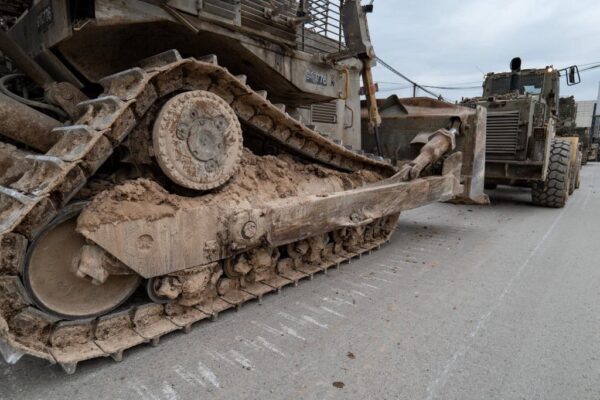
Destruction of Palestinian refugee camps
At the end of January, Israel carried out a large scale military operation in the northern West Bank city of Jenin, which has lasted for ten days so far.
Its military operations are based in the Jenin refugee camp, in various city areas, and in some nearby villages. The Jenin camp has become an unfit place for human habitation, dozens of Palestinian houses have been destroyed and bombed, and the neighborhoods and streets of the camp have already been destroyed. Electricity,water pipes and infrastructure have been destroyed.
A residential block and an entire neighbourhood have been completely destroyed due to aerial bombardment.
Did you succeed in transforming the Jenin camp like Jabalia camp in Gaza?
This is what senior Israeli officials promised before the start of the recent military operation in the West Bank, especially in the Northern West Bank. The Israeli occupation continues its aggression on Jenin, Tulkarm, and Tubas, murdering 29 martyrs, dozens of injuries, arrests, demolition of houses and forced displacement. Amid widespread destruction of property and infrastructure.
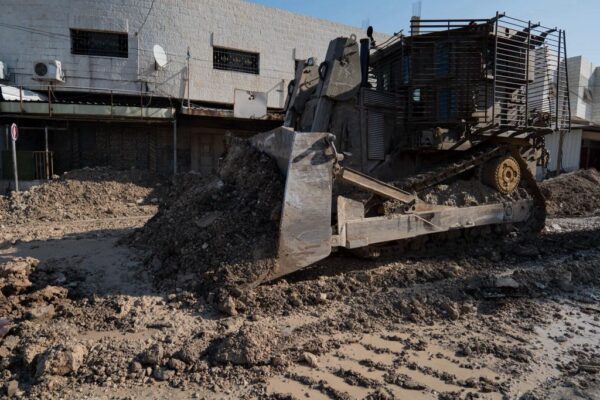
Entrance to Tulkarem
JENIN
Jenin, for the fifteenth day in a row, the occupation continues its aggression against the Jenin city and its camp, which has so far resulted in 25 martyrs, dozens of injuries, arrests, and the demolition of dozens of houses, amid a large displacement process that affected 15 thousand citizens.
Yesterday morning, the occupation army forced residents of the buildings supervising the Jenin camp to evacuate, as several military vehicles were stationed near the buildings demanding evacuation.
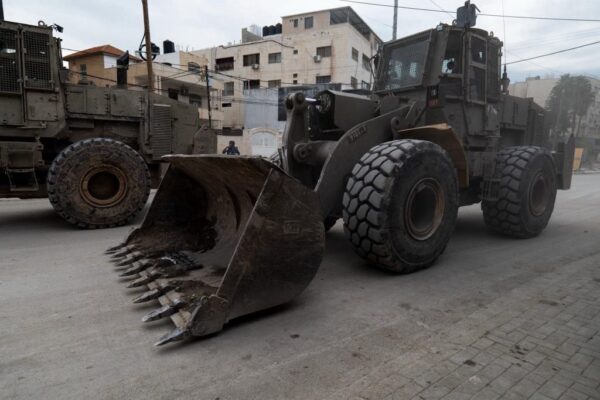
Street in Jenin
Residential buildings and apartments are being emptied, forcibly displacing citizens.
The occupation forces in the Jenin camp simultaneously blew up about 20 buildings in the eastern side of the camp, after booby trapping them, which caused damage to some sections of the Jenin government hospital, without injuries being recorded. The occupation continues to push reinforcements to the city of Jenin camp from the Jalama military checkpoint, while its bulldozers continue to destroy houses in the merge lane, with approximately 15 thousand people now displaced from the Jenin camp the target neighborhood, distributed throughout 39 local community bodies in the Jenin governorate and its towns.
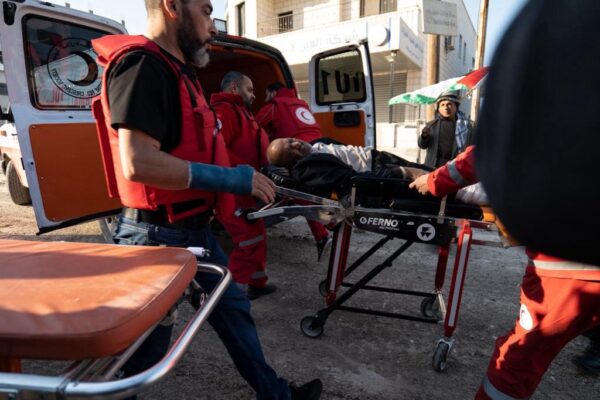
Transfer of an injured person in Tulkarem
TULKAREM
For the ninth day in a row, the occupation continues its aggression against the city of Tulkarm and its camp, resulting in the martyrdom of four citizens, amidst extremely difficult humanitarian conditions.
The occupation forces are still pushing more of their vehicles into the city and its camp from the “tasnouz” military camp west of Tulkarm, and deploying infantry patrols in large numbers in the streets, neighborhoods, and the center of the vegetable market, combing and searching between houses and alleys and harassing citizens.
These forces also continue to besiege the martyr Thabit Thabit government and specialized hospitals, obstruct the work of ambulances and their medical crews, and subject them to inspection and field investigation, while they have taken military barracks and places for snipers from the buildings surrounding them.
The occupation forces escalated their violations against citizens in the city and its camp through a series of attacks, which included raiding houses, forcing their owners to flee, vandalizing and stealing their contents, blowing up and destroying a number of them, in addition to restricting movement, while seizing commercial and residential buildings and turning them into military barracks and places for snipers.
In Tulkarem camp, the occupation forces continue to deploy large numbers of infantry soldiers in all its neighborhoods and alleys, raid houses, force residents to leave them, seize high buildings and turn them into sniper platforms and shoot at Citizens, which led to the injury of a citizen (40 years old), shot by an occupation soldier sniper stationed inside one of these buildings.
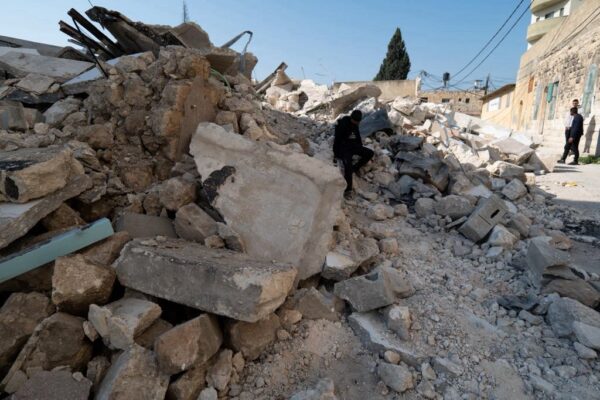
House of the martyr Tamer Fugha
Tulkarem camp is living amid this unprecedented continuous escalation, amid difficult humanitarian conditions, after the occupation bulldozers completely and partially destroyed houses and shops, blowing up a number of them and burning others, coinciding with the destruction of infrastructure, which led to the interruption of water, electricity, communications and the internet, making it difficult for specialized crews from the municipality, and others, to repair them because the occupation prevented them from entering the camp. The situation of citizens who are still in their homes ~ the elderly, the sick, women and children has also been aggravated by the acute shortage of food, medical, drinking water, and infant formula.
TUBAS
For the third day in a row, the occupation is besieging AL- FARA’ camp and the town of Tamoun south of Tubas, amid arrests, bulldozing of infrastructure and forcing citizens to flee.
Since the beginning of the storming, Israeli Occupation Forces forces have bulldozed the roads and infrastructure leading to the AL-FARA’ camp, in addition to closing all entrances to it with earthen berms and raiding houses in the vicinity of the camp, forcing its residents to be displaced, and turning them into military barracks.
Israeli Occupation Forces also raided the homes of citizens on the outskirts of the town of Tamun, forcibly displacing residents, giving them orders not to return within ten days.
Water pipelines have been destroyed between the Town of Tamun and the village of Atouf, in addition to closing of the road connecting the two areas with earthen berms.
The occupation continues to push military reinforcements to Tamun and the AL-FARA’ camp, while the Israeli reconnaissance aircraft continues to fly intensively in the skies of the governorate.

Military reconnaissance aircraft
According to the Palestinian Ministry of Health: the number of Palestinian martyrs in the West Bank since the beginning of this year 2025 has reached 70 martyrs.
38 martyrs in Jenin
15 martyrs in Tubas
5 martyrs in Tulkarem
3 martyrs in Hebron
2 martyrs in Bethlehem
6 martyrs in Nablus
1 martyr in Jerusalem
10 of them are children, 2 are women, 2 are elderly people.
Hamas: Trump’s remarks on Gaza reflect “deep ignorance about Palestine”

Palestinian Information Center – February 5, 2025
DOHA – Member of Hamas’s political bureau Ezzat al-Resheq said that US president Donald’s latest remarks about taking over Gaza and relocating its residents elsewhere reflect “misperception and deep ignorance about Palestine and the region.”
“Gaza is not a common land for any party to decide to control, but rather it is part of our occupied Palestinian land, so any solution must be based on ending the occupation and fulfilling the Palestinian people’s rights and not on the mentality of a real estate businessman or the mentality of muscle and domination,” Resheq said on Wednesday.
Resheq added that Trump’s remarks on Gaza “vindicated further the unlimited US bias in favor of the Israeli occupation regime and the Zionist aggression against the Palestinian people and their legitimate rights.”
The Hamas official affirmed that the Palestinian people and their leaders, backed by their Arab and Islamic nations and the world’s free people, would frustrate all the displacement plans targeting them.
In another statement, the Hamas Movement condemned in the strongest terms Trump’s remarks on Gaza, describing them as “hostile to the Palestinian people and their national cause.”
Hamas said that such remarks by Trump would “not serve regional stability” and would only “pour fuel on the fire.”
“We, alongside our Palestinian people and national leaders, will never allow any country in the world to occupy our land or impose guardianship over our great people whose blood flowed like rivers in order to liberate our land from the occupation and establish our Palestinian state with Jerusalem as its capital,” Hamas said.
Hamas called on the Arab League, the Organization of Islamic Cooperation and the UN to convene urgent meetings to take firm and historic positions that preserve the Palestinian people’s national rights.
In a joint news conference with the Israeli prime minister in the White House on Tuesday, Trump said the US would “take over” and “own” Gaza after resettling Palestinians elsewhere under a redevelopment plan that he claimed could turn the Palestinian coastal enclave into “the Riviera of the Middle East.”
In a flagrant announcement upending decades of US policy towards the Palestinian-Israeli conflict, Trump claimed that his administration would spearhead development in Gaza to “supply unlimited numbers of jobs and housing for the people of the area.”
‘I much prefer a nuclear deal’: Trump dismisses talk of US–Israeli attacks on Iran
The Cradle | February 5, 2025
US President Donald Trump has denied that Washington and Tel Aviv are planning military attacks against the Islamic Republic of Iran, saying that he would “much prefer” a nuclear agreement preventing Tehran from acquiring an atomic weapon.
“I want Iran to be a great and successful Country, but one that cannot have a nuclear weapon. Reports that the United States, working in conjunction with Israel, is going to blow Iran into smithereens, ARE GREATLY EXAGGERATED,” Trump said early on 5 February on his social media platform Truth Social.
“I would much prefer a Verified Nuclear Peace Agreement, which will let Iran peacefully grow and prosper. We should start working on it immediately, and have a big Middle East celebration when it is signed and completed. God Bless the Middle East!” the president went on to state.
In early February, reports said that Trump shot down Israeli plans for an attack on Iranian nuclear facilities.
Trump expressed hope late last month that a nuclear deal could be “worked out without having to go that further step,” referring to an attack.
A Wall Street Journal report in December said Trump’s team was mulling options for strikes on the Iranian nuclear program and that there was a “rare opportunity to counter Iran’s nuclear buildup.”
This week, the US president signed an executive order restoring his “maximum pressure” policy of sanctions on the Islamic Republic, as reports had said he would prior to his second presidential term.
“If the main problem is Iran not having nuclear weapons, this problem can be solved,” Iranian Foreign Minister Abbas Araghchi said on Wednesday, adding that “maximum pressure is a failed experiment and testing it again will lead to another defeat.”
Trump withdrew from the 2015 US–Iranian nuclear deal in 2018 – during his first term – and restored harsh sanctions against Iran.
Tehran is subject to the Nuclear Non-Proliferation Treaty (NPT) of 1970, as well as a religious fatwa outlawing the development and use of any form of weapons of mass destruction.
Former CIA director said last month that “we do not see any sign” that Iran is planning to weaponize its nuclear program.
Iran to Trump: Another maximum pressure, another defeat for Washington
Press TV – February 5, 2025
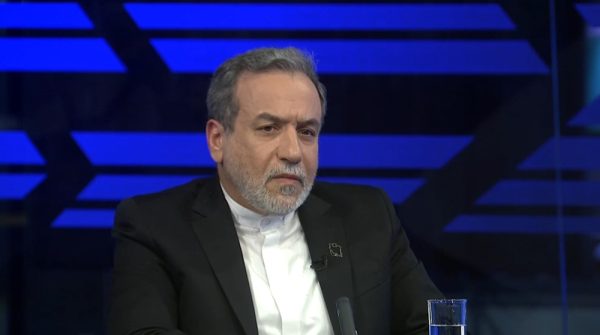
Foreign Minister Abbas Araghchi has asserted that another round of deployment of the “maximum pressure” policy on the part of the United States against Iran will only lead to another defeat.
“The policy of maximum pressure has already proven to be a failure, and any attempt to revive it will only lead to another defeat,” the top diplomat told reporters on the sidelines of a cabinet meeting on Wednesday.
Araghchi was referring to the policy that the US adopted during Donald Trump’s former tenure, as part of which Washington quit a 2015 nuclear deal with Iran and world powers, returned the sanctions that the agreement had lifted, and piled up even more illegal and unilateral bans against the Islamic Republic.
Retaliating against the measures, Iran took legitimate nuclear steps that have featured its operationalizing advanced centrifuges among other things.
The country also explored various means to skirt the sanctions and boost its economy by fostering foreign trade and enhancing domestic production, causing Washington to suffer “maximum defeat” in adoption of such policy.
On Tuesday, Trump promoted new “tough” measures aimed at, what Washington has called, “deterring” Iran from obtaining a “nuclear weapon.”
Trump also signed a presidential memorandum, authorizing stricter illegal actions against Iran, while saying, “They can’t have a nuclear weapon, we’d be very tough if they insist on doing that.”
Washington’s adversarial stance comes despite Tehran’s repeated assurances that its nuclear activities remain in full compliance with international regulations, and the International Atomic Energy Agency (IAEA)’s invariable verification of the peaceful nature of the Islamic Republic’s nuclear energy program.
Reacting to Trump’s remarks, Araghchi said, “If the main issue is that Iran should not pursue nuclear weapons, this is achievable and not a difficult matter.”
“Iran’s stance is clear, and it is a member of the NPT (Nuclear Non-Proliferation Treaty), and there is also the fatwa (religious decree) of the Leader, which has clarified the matter for us,” he added.
Leader of the Islamic Revolution Ayatollah Seyyed Ali Khamenei’s has prohibited pursuance, attainment, and storage of such non-conventional arms through an official decree as per religious and moral grounds.
“The Leader’s fatwa has made Iran’s position crystal clear,” Araghchi concluded.
‘Iran has never had, will never have nuclear weapons program’
Also on Wednesday, Mohammad Eslami, head of the Atomic Energy Organization of Iran (AEOI), likewise reacted to Trump’s remarks, saying, “Iran has never had, does not have, and will not have a nuclear weapons program. Iran’s approach in this regard is absolutely clear.”
He added, “Iran’s peaceful nuclear program is being implemented within the framework of Safeguards [Agreement] and the NPT.”
The Saudi–Israeli normalization ‘delusion’
By Stasa Salacanin | The Cradle | February 5, 2025
On 4 February, when asked if the Saudis demand the establishment of a Palestinian state as a condition for recognizing Israel, US President Donald Trump, sitting alongside Israeli Prime Minister Benjamin Netanyahu in the Oval Office, swiftly replied: “No, they’re not.”
The Saudi Ministry of Foreign Affairs was also quick to respond, stating that its stance on the establishment of a Palestinian state remains “firm and unwavering,” insisting that Riyadh would make no deal with Tel Aviv otherwise:
“His Royal Highness (Crown Prince Mohammed bin Salman – or MbS) emphasized that Saudi Arabia will continue its relentless efforts to establish an independent Palestinian state with East Jerusalem as its capital, and will not establish diplomatic relations with Israel without that.”
The statement further stressed that the Saudi position on this is “non-negotiable and not subject to compromises.”
Despite the fervent optimism of Trump’s newly appointed foreign policy team, the much-touted Saudi–Israeli normalization agreement remains an elusive goal, just as it was for his predecessor, Joe Biden. While Washington insists that such a deal is potentially around the corner, a more sober analysis suggests the pathway to a deal remains rife with obstacles.
Spanner in the works
The Abraham Accords, brokered under Trump’s first term, were hailed in Washington as a historic breakthrough in West Asian diplomacy, bringing the occupation state into official relations with the UAE, Bahrain, Morocco, and Sudan. Yet, the glaring absence of Saudi Arabia – the most influential Arab state – was the missing piece that the US and Israel craved most.
Biden’s tenure, rather than advancing Trump’s initiative, has arguably undermined it. His administration’s unyielding support for Israel’s genocidal war on Gaza and its brutal military campaign in Lebanon has alienated many Arab and Muslim states, further diminishing the likelihood of new normalization deals.
Meanwhile, China has capitalized on Washington’s waning credibility, scoring a major diplomatic coup in 2023 by brokering a historic rapprochement between Saudi Arabia and Iran – a relationship that, against the odds, remains intact.
Despite the changed reality on the ground, this US administration still believes that the deal between the world’s largest oil exporter and Israel is still attainable on its terms. Mike Waltz, the Trump administration’s new national security advisor, has stated that reaching a peace agreement between Riyadh and Tel Aviv is a “huge priority” for the new administration.
Saudis caution: A deal on whose terms?
While the Saudis drew a clear line and maintained it for a very long time by linking normalization with Israel to the establishment of a Palestinian state, neither Israel nor the new Trump administration have shown any willingness to accommodate Saudi intentions.
Many of Trump’s supporters and major donors, such as Miriam Adelson, as well as the Israeli government, not only oppose any form of a Palestinian state, but are openly talking about annexing the entire occupied West Bank. Therefore, it is still unclear how Trump intends to reconcile two vastly opposing views and expectations and expand the Abraham Accords.
According to Giuseppe Dentice, an analyst at the Mediterranean Observatory (OSMED) of the Italian Institute for Political Studies “San Pio V,” Trump will likely fall back on his tried-and-tested approach – leaning on the Abraham Accords as a framework while resurrecting elements of his so-called “deal of the century.”
Dentice explains to The Cradle that the ultimate goal of such efforts is to sideline the Palestinian cause entirely, pushing it to the periphery of both regional and global agendas.
Moreover, many believe that the Trump administration will launch a crusade against the “global intifada” and those who dare to criticize Israel or insist on prosecuting Israeli war crimes.
This approach, Dentice contends, essentially forces a single option in the negotiations: Take it or leave it.
“Trump’s aggressive approach to Riyadh could backfire for the US and its interests in the Middle East (West Asia), especially if the Al-Saud kingdom continues to reject these terms, risking closer alignment with the agendas of other international actors (such as China or Russia, if only in strategic or instrumental terms).”
Saudi investments in the US: Buying leverage or time?
Some observers speculate that Saudi Arabia’s recent announcement that Riyadh plans to invest $600 billion in the US over the next four years could be understood as a certain early bribe to Trump in return for easing his zealous pressure regarding the Saudi–Israeli normalization agreement and other geopolitical issues as well.
While it is true that convincing the Saudis will be a tough nut to crack, Dentice, for one, does not believe that even such a significant economic commitment could distract or dissuade the new government from its goals.
He believes that beyond the issue of normalization agreements with Israel, Riyadh wants to strengthen its understanding and cooperation with Washington, especially with this government. Nonetheless, it remains true that key figures associated with this administration, such as Jared Kushner, Trump’s son-in-law, could undermine Saudi processes and intentions through their own business relationships.
For Dr Paul Rogers, Emeritus Professor of Peace Studies in the Department of Peace Studies and International Relations at the College of Bradford, President Trump is far too unpredictable for anyone to conclude on the chances of a deal with Saudi Arabia, but his recent comments on the option of expelling the Palestinians from Gaza indicate a very close relationship with far-right Israeli political factions.
Dr Rogers tells The Cradle that he suspects “that the Saudis will stay away from any kind of agreement, no matter what offer they make.”
Arab public opinion: A hard sell
Beyond geopolitical calculations, public sentiment in the Arab world remains a major obstacle to normalization. The rejection of a Palestinian state, coupled with an aggressive push for Saudi–Israeli ties, is widely viewed as an attempt to erase the Palestinian cause altogether – an agenda that lacks legitimacy among Arab and Muslim populations.
Furthermore, many observers believe that Israel’s war crimes and the genocide in Gaza have made it very difficult and uncomfortable for Saudi Crown Prince Mohammed bin Salman (MbS) to continue peace talks.
But West Asian views against normalization precede even the brutal 15-month war. According to the Arab Opinion Index from 2022, for example, an average of 84 percent of citizens in 14 countries rejected diplomatic relations with Israel. These figures show that the Arab enforcers of the Abraham Accords ultimately failed to reach or sway wider Arab public opinion.
The war in Gaza has only cemented anti-Israeli views in Saudi Arabia, and an unconditional normalization agreement with Israel would only increase the risk of destabilizing the crown prince’s image in the kingdom and abroad. It would also humiliate MbS, who has publicly condemned Israel’s actions in Gaza, recognizing them as a “genocide.”
A mirage in the desert
Palestinian statehood is by no means a simple issue, even if an Israeli government supported the initiative, which the current one resolutely rejects.
Palestinian national aspirations can lose momentum due to internal divisions, the lack of an organized leadership capable of addressing current and future challenges, and the faltering support of traditional Arab sponsors – notably the loss of Syria following the ousting of former president Bashar al-Assad by Al-Qaeda-linked extremists – Hayat Tahrir al-Sham (HTS) – who now form the new government.
For all the speculation surrounding a Saudi–Israeli deal, the reality is that no proposal for Palestinian statehood has made meaningful progress in the past three decades. As a result, ad hoc unilateral initiatives have increasingly taken center stage, often yielding disastrous consequences.
In this context, the push for a Saudi–Israeli accord seems less like a diplomatic breakthrough and more like a mirage conjured by Washington and Tel Aviv.
Dentice believes that in such a context, and with the prospect of a possible Saudi–Israeli agreement, the Palestinians will have even less political relevance in the future. This will give space for radical and armed groups to gain ground and further exacerbate tensions on the Palestinian and Arab streets.
Trump’s aggressive tactics may succeed in strong-arming some leaders, but they are unlikely to change deep-seated regional attitudes. If anything, the pursuit of an agreement without major concessions for Palestinians could inflame tensions further, pushing the region into even greater instability.
For now, the notion of a Saudi–Israeli deal may be more fantasy than fact – an illusion sustained by wishful thinking rather than political reality.
Trump’s call for US ‘takeover’ of Gaza sparks international backlash
The Cradle | February 5, 2025
US President Donald Trump’s declaration that Washington will “own” the Gaza Strip and expel its residents has sparked widespread backlash and condemnation.
Hamas said in a statement on 5 February that it condemns “in the strongest terms and reject[s] the statements of US President Trump aimed at the United States of America occupying the Gaza Strip and displacing our Palestinian people from it.”
“We confirm that these statements are hostile to our people and our cause, will not serve stability in the region, and will only add fuel to the fire,” the statement added. “We … will not allow any country in the world to occupy our land or impose guardianship over our great Palestinian people.”
“We call on the US administration and President Trump to retract these irresponsible statements that contradict international laws and the natural rights of our Palestinian people in their land,” Hamas went on to say, calling on the Arab League, Organization of Islamic Cooperation (OIC), and the UN to hold urgent meetings to address Trump’s statements.
Secretary-General of the Palestine Liberation Organization (PLO) and top adviser to Palestinian Authority (PA) President Mahmoud Abbas said: “The Palestinian leadership … confirms its rejection of all calls for the displacement of the Palestinian people from their homeland. This is where we were born, this is where we lived, and this is where we will remain. We appreciate the Arab position committed to these constants.”
Several regional countries have also expressed their opposition to Trump’s statements.
“Trump’s statements regarding Gaza are unacceptable. Expelling (the Palestinians) from Gaza is an unacceptable issue neither on our part nor on the part of the countries of the region. There is no need to even discuss it,” said Turkish Foreign Minister Hakan Fidan.
Saudi Arabia said in a statement that it rejects any attempt to displace Palestinians from their land, adding that Riyadh will not normalize ties with Israel until a Palestinian state is established – in response to the US president’s claim that the kingdom is not demanding statehood in exchange for normalization as it has been publicly calling for.
Egyptian Foreign Minister Badr Abdel Aati and Palestinian Prime Minister Mohammad Mustafa jointly rejected “the exodus” of the Palestinian people and called for “accelerated” entry of aid and recovery programs.
The Chinese Foreign Ministry spokesman Lin Jiang responded to Trump, telling reporters Beijing “has always believed that Palestinians governing Palestine is the fundamental principle for postwar governance in Gaza.”
“We oppose the forced displacement and relocation of the population in Gaza,” he added.
Russian Foreign Minister Sergei Lavrov referred to Trump’s remarks as a manifestation “of Western cancel culture.”
The French Foreign Ministry said the future of Gaza must be based on a “future Palestinian state” and not controlled by “a third state.”
UK Environment Secretary Steve Reed said that “it is the view of the [British] Government that Palestinians should be able to return to their homes and rebuild their shattered lives.”
Members of the US Democratic and Republican parties also responded. Democratic senator Chris Murphy said Trump has “totally lost it.”
“A US invasion of Gaza would lead to the slaughter of thousands of US troops and decades of war in the Middle East. It’s like a bad, sick joke,” Murphy said.
Democratic representative Jake Auchincloss called the Trump plan “reckless and unreasonable.”
Former Republican member of the US Congress, Justin Amash, said: “If the United States deploys troops to forcibly remove Muslims and Christians … from Gaza, then not only will the US be mired in another reckless occupation but it will also be guilty of the crime of ethnic cleansing. No American of good conscience should stand for this.”
Dan Shapiro, former US ambassador to Israel during Barack Obama’s presidency, said it “was not a serious proposal” and “would require a huge cost in American money and troops, without the support of key partners in the region.”
Trump’s controversial remarks came during a press conference with Israeli Prime Minister Benjamin Netanyahu on 5 February and during separate statements made during the Israeli premier’s visit.
“The US will take over the Gaza Strip … I see it as a long-term ownership position,” Trump said.
“I have a feeling that the king in Jordan and that … the general president [of Egypt], but the general and Egypt will open their hearts and will give us the kind of land that we need to get this done,” Trump said.
Trump has been insisting that over a million Palestinians in Gaza be expelled and that Jordan and Egypt take them in – which both Cairo and Amman have rejected.
He called Gaza “a symbol of death and destruction” and said that its residents only want to go back there because they have nowhere else to go.
Trump plans withdrawal from Syria – media
RT | February 5, 2025
The Pentagon is drafting plans for a full withdrawal of US troops from Syria, NBC News has reported, citing two anonymous defense officials. This comes shortly after President Donald Trump suggested that America’s military involvement in the country serves no useful purpose.
US troops entered Syria in 2014 on the pretext of fighting Islamic State (IS, formerly ISIS), and have maintained a presence in the country ever since, despite never being invited by Damascus.
According to NBC’s report on Tuesday, US defense officials have begun preparing withdrawal plans, with timelines ranging from 30 to 90 days. Sources told the network that Trump’s new national security adviser, Mike Waltz, met with senior military commanders at the headquarters of US Central Command in Tampa, Florida on Friday. He was reportedly briefed on the situation in the Middle East.
Commenting on media reports suggesting that he had informed Israel of the imminent pullout, Trump said last week: “We’ll make a determination on that. We’re not getting, we’re not involved in Syria.”
“Syria is its own mess. They got enough messes over there. They don’t need us involved,” he added.
The Israeli public broadcaster Kan made the claim regarding the supposed withdrawal plans late last month, which presumably caused concern among Israeli officials.
In December 2018, during his first term, Trump announced plans to withdraw US troops from Syria. The decision faced significant pushback from Defense Secretary James Mattis, who ultimately resigned in protest. While some personnel were withdrawn, many were later redeployed
Shortly after the overthrow of Bashar Assad’s government in December 2024 by a loose coalition of armed opposition groups, the Pentagon acknowledged that the number of US troops in the country was in fact 2,000, as opposed to the previously reported 900. Several media outlets claimed later that month that several large US military convoys carrying weaponry and equipment had crossed into Syria from Iraq, further reinforcing the US contingent.
Assad and Moscow have repeatedly denounced the US military presence as an illegal occupation, stressing that Washington was never granted permission to station troops in Syria. The former government in Damascus also accused Washington of stealing the country’s natural resources, given that the US bases are located in the oil-rich northeastern parts of Syria.
The latest claims about the potential withdrawal from Syria came as Trump announced on Tuesday a proposal that includes a plan to “take over” Gaza. He did not rule out deploying US troops to the Palestinian enclave, vowing to “do what is necessary.”
How the CIA Spawned Google
By Svetlana Ekimenko – Sputnik – 05.02.2025
American tech giant Google has faced regulatory scrutiny on numerous occasions amid accusations of antitrust violations. Google’s relationship with the CIA, ranging from early financial support to collaborative efforts have been decried as undermining privacy rights and free speech in the digital landscape.
Google’s creation played a crucial role in the US intelligence community’s scheme to attain global dominance by controlling information.
How it Started
- The Pentagon founded its private sector project the Highlands Forum during the Clinton administration in 1994, according to the INSURGE INTELLIGENCE project.
- Together with defense contractors, the group hammered out a strategy for “network-centric warfare.”
- The 9/11 terrorist attacks were seized upon by US spy agencies to justify not only military invasions across the Muslim world, but also mass surveillance of civilian populations.
CIA Steps In
- The CIA’s Massive Digital Data Systems (MDDS) program, which originated in the 1990s, was designed to enhance query techniques and track users’ digital footprints.
- To better serve its goals, in 1999, the CIA established its own venture capital firm, In-Q-Tel, to invest in potentially useful technologies.
- Ph.D. students at Stanford University, Sergey Brin and Larry Page, were working on precisely such a tech start-up.
- The design of the search engine and algorithms that ultimately evolved into Google was funded by CIA grants through a program aimed at enhancing mass surveillance capabilities.
PRISM
- Whistleblower Edward Snowden revealed in 2013 that the NSA had direct access to Google’s systems through its secret PRISM program, enabling the agency to harvest vast amounts of data on American citizens, Washington’s allies, and foreign nationals.
- Ex-CIA spooks are employed in almost every department at Google, according to a 2022 report based on the analysis of employment websites.
- Google has been slapped with multiple lawsuits stemming from its history of data misuse and privacy violations.
Featured Video

The First Pyrrhic Victory of the Vietnam War
or go to
Aletho News Archives – Video-Images
Frlom the Archives
The 52 Major Jewish American Organizations and Israel Celebrate Passover with the Slaughter of 25 Muslim, Christian and Secular Palestinians
By James Petras • Unz Review • April 8, 2018
Introduction
As of April 7, nearly three thousand unarmed Christian, Muslim and secular Palestinians have been wounded, over three dozen are in critical condition and at least twenty-five unarmed protestors, including children have been assassinated by hundreds of Israeli snipers and heavily armed troops shooting tank shells into crowds of civilians protesting their decades of incarceration by the racist Israeli state.
The Israeli government praised the ‘restraint and morality’ of the IDF, as did the fifty-two Major Jewish American Organizations (MJAO) who largely control the US Congress. These grotesque massacres began during the Christian Holy Week on Good Friday and Easter, coinciding with the Jewish Passover. The self-righteous officials of the MJAO and their relatives and friends broke matzos at joyful Seders as the blood of Palestinians soaked into ground at the fence containing the largest open-air prison camp in history, Gaza.
While tribal loyalties bonded the Israeli and Jewish American leaders, the politicians of the Western oligarchic electoral regimes refrained from criticizing the shocking display of brute force and even defended Israel’s cold blood mass killings of Palestinian civilians in their Gaza prison.
This paper will discuss and analyze the reasons for Israel’s willing Western accomplices and the centrality of its fifth column in the United States. … continue
Blog Roll
 Aletho News
- Just Get Out! Now!
- Unpacking glaring contradictions in US-Zionist justifications for war against Iran
- Iranian model of warfare bleeds US dry while Persian Gulf states watch and learn: Analyst
- IRGC orders ‘defeated’ US to evacuate industrial facilities in region
- Hegseth’s call for ‘no mercy’ to Iranians deemed war crime
- Iran War Exposes Limits of US Military Power – Journalist
- Even The Neo-Cons Admit The Iran War Is Failing
- Inside the Caucasus Drone Corridor Fueling Tensions With Iran
- ‘Not our war’: Trump’s naval coalition to reopen Strait of Hormuz dead in the water
- Iran declares support centers for USS Gerald R. Ford legitimate targets
- If Americans Knew
- ‘I Liked the House’: When Israeli Soldiers Turn Palestinian Homes into Barracks
- ‘They Were All I Had’: Lebanese Father Buries Parents, 4 Daughters Killed by Israeli Bombing
- Israel and its supporters are causing attacks on Jewish institutions. Case in point: Michigan synagogue tragedy.
- These are the casualties and cost of the war in Iran 2 weeks into the conflict
- Chicago Teachers Union accuses AIPAC of swaying elections with ‘dark money’
- Predictions of another 9/11, amid Israel-US killing spree – Not a ceasefire Day 157
- As US-Israel war on Iran rages, Gaza faces massive dust storm – Not a ceasefire Day 156
- No let-up in attacks on Gaza as Israel takes on Iran, Lebanon – Not a ceasefire Day 155
- ‘Of Course’: IDF Drops Case Against Soldiers Accused of Raping Palestinian Prisoner
- Don’t Fall for the Regime Change Talk. Israel Is ‘Mowing the Lawn’ in Iran
- No Tricks Zone
- Storing Green Energy To Last Germany 10 Days Would Require A 60-Million Tonne Battery
- New Studies: UK Sea Levels Were 4 Meters Higher Than Today During The Mid-Holocene
- Destructive Green New Deal: German Energy And Metal Group Warns Of Drastic Crisis
- New Study Documents A 20-Year Pause In Arctic Sea Ice Decline – Driven By Internal Variability
- Wake-up Call: Survey Shows Majority Of Germans Now Favor Postponing Climate Targets!
- Televised! Leading German Political Candidate Tells Schoolchildren CO2 Makes Sun Hotter!
- New Study: A Century Warming Of 1.1°C Is ‘Commonplace’ And ‘Not Unusual’ During This Interglacial
- New Study: ‘Internal Noise’ And Volcanic Forcing Can Trigger 10-15°C Warming Within Decades
- Glaciers Worldwide Are Suddendly Surging, Experts Blame Warming!
- Surprising Discovery: Sahara Is Greening…Billions Of Trees Where Once Thought To Be Barren
 Aletho News