Utah Set to Become First State to End Water Fluoridation for All Residents
By Brenda Baletti, Ph.D. | The Defender | February 24, 2025
Utah lawmakers last week voted to pass the first U.S. statewide ban on adding fluoride to public water systems. The Utah Senate voted 18-8 in favor of the measure after it passed in the House.
If Gov. Spencer Cox signs the bill into law, it will end community water fluoridation. The new law also will give pharmacists new authority to prescribe fluoride supplement pills. Typically, such pills can be prescribed only by a dentist or physician.
Rep. Stephanie Gricius, who sponsored the bill, told The Defender she was thrilled the legislature voted to pass the bill. “Utah leads the nation in so many things and this is just one more example.”
Gricius emphasized that the law allows people to make their own decisions about whether and how to take supplemental fluoride.
“I am a firm believer that the proper role of government is to provide safe, clean drinking water, not medicate the public on a mass scale,” Gricius said. “Because I also believe in medical freedom, I wanted fluoride to remain available to anyone who wanted it for either themselves or their children — which is why we made the prescription easier to obtain through a pharmacy.”
The bill’s Senate sponsor, Senate Majority Leader Kirk Cullimore, said during his presentation on the Senate floor that the bill is “about protecting our water, reducing unnecessary costs, and ensuring people have the right to decide what they consume.”
Rick North, board member of the Fluoride Action Network (FAN), one of the plaintiffs who last year won a landmark lawsuit over water fluoridation against the Environmental Protection Agency (EPA) said, “Utah’s fluoridation ban bill enjoyed wide support in both the House and Senate, reflecting both concerns over health risks and the firm opposition to adding any drug to drinking water, taking away people’s right to informed consent.”
North added, “If the governor signs the bill, it would be historic, and could be a catalyst for other states and cities doing the same.”
Opposition to water fluoridation has been growing across the country, particularly since a California federal judge ruled in the case brought by FAN, Mothers Against Fluoridation and others against the EPA that water fluoridation at current U.S. levels poses an “unreasonable risk” to children’s health and that the agency must regulate it.
Judge Edward Chen’s 80-page decision outlined the overwhelming scientific evidence that exposure to fluoride is linked to reduced IQ in children. The EPA recently announced it plans to appeal the ruling.
Chen’s ruling followed the publication in August of a key report by the U.S. Department of Health and Human Services’ National Toxicology Program (NTP) that concluded higher levels of fluoride exposure in drinking water are consistently linked to lower IQ in kids.
Other studies making similar findings have also been published in major scientific journals this year.
Fluoride a byproduct of phosphate fertilizer production
Gricius started working on the issue last year after a resident approached her about “having individual choice when it comes to what prescriptions she and her children took.”
Local water conservancy districts also reached out to Cullimore to ask the state to ban water fluoridation citing claims of employee safety and the decision in the landmark case against the EPA, Gricius said.
Proponents of water fluoridation argue it protects children’s oral health. However, in October, an updated Cochrane Review concluded that adding fluoride to drinking water provides very limited, if any, dental benefits, especially compared with 50 years ago.
Proponents also underscore that fluoride is a naturally occurring chemical in water, earth and rocks. It can occur naturally in drinking water supplies, particularly in arid and semi-arid regions.
But most surface water contains very low levels of fluoride and roughly three-quarters of Americans have fluoride added to their drinking water. The fluoride added to water systems, typically in the form of fluorosilicic acid, is a byproduct of phosphate fertilizer production — as documents from the fluoride lawsuit confirmed.
Cullimore also emphasized that many Utah citizens don’t want the chemical added to their water. “This bill does not prohibit anybody from taking fluoride in whatever fashion they want,” he said. It just disallows people who do not want fluoride from having to consume fluoride in their water.”
Cullimore’s district includes the city of Sandy, where a malfunctioning pump in the water fluoridation system released undiluted hydrofluorosilicic acid into the water in 2019, affecting 1,500 households, institutions and businesses and sickening over 200 people.
An investigation revealed that officials failed to notify the public for 10 days and that fluoride was detected in the drinking water at 40 times the recommended levels.
The 18-8 vote to pass the bill in the Republican-dominated Utah Senate on Friday was largely along party lines, with two Republican senators voting against it and one Democratic senator voting for it.
If signed, the bill is set to take effect on May 7. The governor’s office did not immediately respond to a request for comment on whether Cox plans to sign it.
‘We’re watching water fluoridation unravel globally in real time’
Since the September court ruling, many U.S. cities and towns have moved to pause or stop fluoridating their water, signaling that the long-term and largely unquestioned practice in the U.S. is facing heightened scrutiny by the public.
FAN Executive Director Stuart Cooper said the Utah vote is a marker of how significantly public opinion is shifting.
Cooper said:
“This is another significant victory for the public, who didn’t sign up to have a developmental neurotoxin and endocrine disruptor to their drinking water. The NIH-funded science showing neurotoxicity, the NTP report confirming that neurotoxicity and the federal ruling that fluoridation poses an unreasonable risk to human health have all pushed this topic over the tipping point. We’re watching water fluoridation unravel globally in real time.”
Cooper pointed out that 95% of the world and 98% of Europe do not fluoridate, and many countries passed resolutions banning the practice decades ago.
He said states and towns that continue to add fluoridation chemicals to the public water supply “are the extreme outliers and radicals in this situation.”
Florida Surgeon General Joseph A. Ladapo in December advised governments across the state to stop adding fluoride to their water. Ladapo cited the neuropsychiatric risks — particularly for pregnant women and children — associated with the practice.
Lawmakers in at least three other states have also introduced legislation that would outlaw adding fluoride to community water systems, and four other states are considering bills to make fluoride optional or limit its concentration.
In addition to Utah, lawmakers in North Dakota, New Hampshire and Tennessee are seeking a ban on the practice. Bills in Arkansas, Kentucky, Massachusetts, Nebraska, and South Dakota would either repeal statewide fluoridation programs or set limits on the amount of fluoride added to water, Bloomberg Law reported.
Last week, Texas Agriculture Commissioner Sid Miller also called on Gov. Greg Abbott and the state lawmakers to institute a statewide ban on water fluoridation.
Hawaii is the only state that does not offer water fluoridation for most residents. However, the military bases there are mandated by the federal government to fluoridate their water.
Bucking national trends, Democratic senators in Connecticut are introducing legislation to make the current levels of 0.7 milligrams of fluoride per liter, recommended by the public health agencies, state law. They are drafting a bill, Senate Bill No. 7, that would continue water fluoridation at current levels in the state even if federal policy were to change.
The state senate democratic webpage reports they are drafting the bill out of concerns that Robert F. Kennedy Jr., recently confirmed as secretary of Health and Human Services, suggested on social media that the Trump administration would advise all American water systems to remove it from drinking water.
Related stories in The Defender
- Breaking: New Study Linking Fluoride to Lower IQ in Children Sparks Renewed Calls to End Water Fluoridation
- Florida Surgeon General Urges End to Water Fluoridation
- Children Whose Mothers Were Exposed During Pregnancy to Fluoridated Tap Water at Higher Risk of Neurobehavioral Problems
- ‘House of Cards’: Some Cities Hit Pause on Water Fluoridation in Wake of Historic Federal Ruling
This article was originally published by The Defender — Children’s Health Defense’s News & Views Website under Creative Commons license CC BY-NC-ND 4.0. Please consider subscribing to The Defender or donating to Children’s Health Defense.
Gardasil on Trial: Did Merck Mislead the Public on Cervical Cancer Prevention?
Top expert delivers a damning report accusing Merck of misleading the public about Gardasil’s ability to prevent cervical cancer
By Maryanne Demasi, PhD | February 24, 2025
With the landmark trial against Merck adjourned until September 2025, new evidence suggests the vaccine manufacturer may have deliberately misrepresented the necessity of mass HPV vaccination.
This revelation comes from an expert report by Dr Sin Hang Lee, a pathologist renowned for his expertise in molecular diagnostics. His findings raise serious concerns about Gardasil’s efficacy and the motives behind its aggressive marketing.

Dr Sin Hang Lee, director of Milford Molecular Diagnostics, Connecticut
Does Gardasil Prevent Cervical Cancer?
Since its introduction in 2006, Gardasil has been marketed as a breakthrough in the fight against cervical cancer.
Yet, as Dr Lee bluntly states in his report, “There is no conclusive evidence that Gardasil has prevented a single case of cervical cancer in the past 18 years.”
No randomised controlled trial (RCT)—the gold standard for assessing efficacy—has ever demonstrated that Gardasil prevents cervical cancer.
Instead, Merck relied on surrogate markers of pre-cancers, such as cervical intraepithelial neoplasia (CIN2/3) to claim effectiveness. This is a significantly lower evidentiary bar that was used to fast-track FDA approval.
The problem with this approach is well-documented. Many CIN2/3 lesions resolve naturally.
A Dutch study, for instance, tracked 114 women with CIN2/3 found that nearly two-thirds of cases regressed without intervention. Only one developed adenocarcinoma in situ (pre-cancer) and none progressed to cervical cancer.
Moreover, those lesions that don’t resolve naturally typically take years to progress, and they are usually detected through routine screening.
If CIN2/3 is an unreliable proxy for cancer, how can it serve as valid proof of Gardasil’s claimed efficacy at preventing cancer?
Are HPV Strains Merely Being Replaced?
Another major concern is “type replacement”—the possibility that suppressing certain HPV strains through vaccination leads to the rise of others.
For instance, a Finnish study found that while HPV strains 16 and 18 (targeted by the vaccine) decreased following vaccination, non-vaccine strains such as HPV 52 and 66 became more prevalent.
This raises an important question: While Gardasil may alter the landscape of HPV infections, does it actually reduce the overall risk of developing cervical cancer?
When Merck developed Gardasil 9 to target five additional HPV strains, a study involving 14,215 women found that those who received Gardasil 9 developed high-grade lesions at the same rate as those who received the original Gardasil (which only targeted four strains).
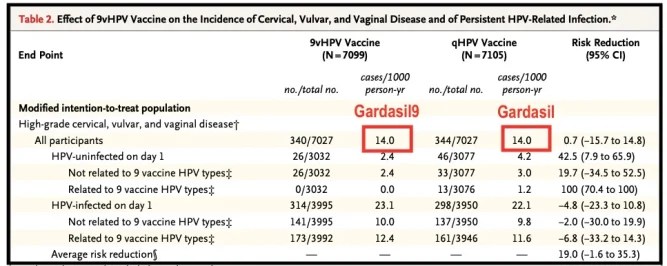
Despite the expanded coverage, the additional strains had no measurable impact on pre-cancers overall, adding to the uncertainty about whether these vaccines truly reduce cervical cancer incidence.
The Questionable Swedish and Scottish Studies
Two widely cited studies—from Sweden and Scotland—are often heralded as proof that Gardasil significantly reduces cervical cancer rates. However, Dr Lee highlights critical methodological flaws in his report.
- Swedish study
The Swedish study, published in the New England Journal of Medicine, compared cervical cancer rates between vaccinated and unvaccinated women.
However, Dr Lee points out that many participants (born between 1995 and 2007) were too young to develop cervical cancer during the study period (2006–2017).
Since cervical cancer takes decades to emerge, including these young women (ages 10–22)—who had zero cases—introduced a statistical bias that exaggerated the vaccine’s effectiveness.
Moreover, the study failed to account for the “healthy user effect,” where vaccinated individuals are more likely to engage in preventive health measures like regular screening, which independently reduces cancer risk.
As a result, attributing the decline in cancer cases solely to the vaccine is misleading.
- Scottish study
A 2024 Scottish observational study, published in the Journal of the National Cancer Institute, had similar methodological issues, and was met with sensationalist media headlines: “No cervical cancer cases in HPV-vaccinated women.”
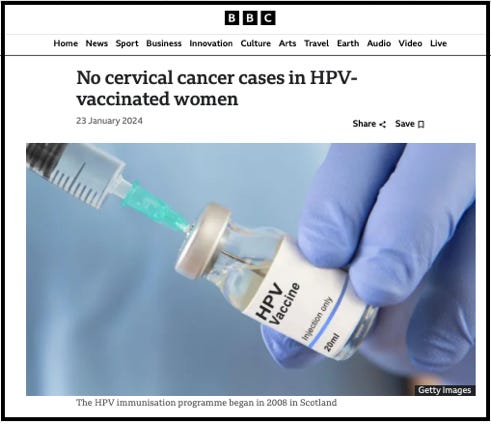
However, Dr Lee argues this claim is deeply flawed. First, the women studied were simply too young for conclusions about long-term vaccine efficacy to be drawn.
Second, Scotland’s screening programme, which detects and treats precancerous lesions before they develop into cancer, changed its entry age in 2016 during the study period.
The age at which women were first invited for screening was raised from 20 to 25, meaning there was a 5-year gap in screening for younger women. As most cancers in women under 30 are diagnosed through screening, this change could explain any decline in cancer rates, rather than the vaccine itself.
And third, just like the Swedish study, the “healthy user effect” further confounds the results.
Despite being frequently cited as definitive proof of Gardasil’s effectiveness, these studies contain serious limitations that undermine their conclusions.
Cervical cancer screening saves lives
In developed nations, around 93% of initial HPV infections resolve without medical intervention. Cervical cancer is slow to develop, with an average onset age of 54, making long-term data essential for assessing Gardasil’s true impact.
What remains incontrovertible is the lifesaving role of cervical cancer screening.
Since the widespread adoption of Pap smears in the 1950s, cervical cancer incidence in the U.S. has plummeted—from 44 per 100,000 women in 1947 to just 8.8 per 100,000 by 1970.
This dramatic decline predates the introduction of HPV vaccination in 2006.
In Australia, deaths from cervical cancer fell significantly along with incidence following the introduction of the National Cervical Screening Programme, and remained steady despite mass HPV vaccination.
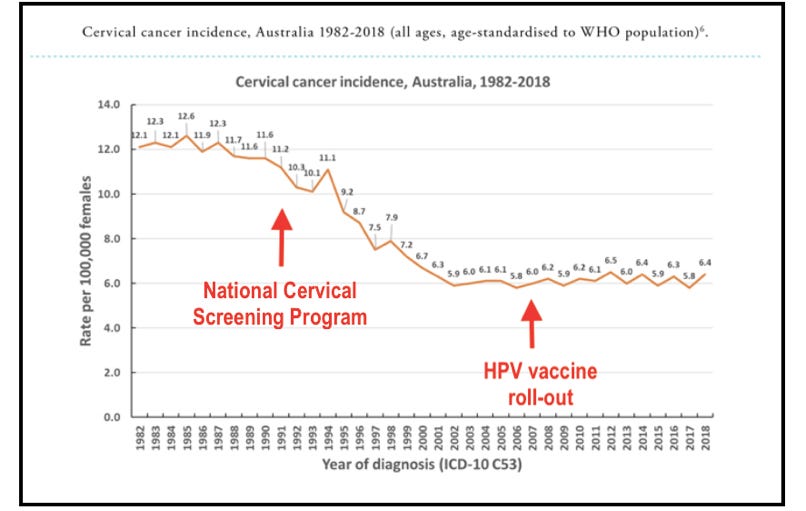
Source: https://www.hpvworld.com/articles/prevention-of-cervical-precancer-and-cancer/
Dr Nancy C. Lee, former Associate Director for Science at the CDC, testified before the U.S. Congress in 1999:
- “Cervical cancer is nearly 100 percent preventable.”
- “The most important risk factor for developing cervical cancer… is the failure to receive regular screening with a Pap smear.”
- “For a woman with CIN, her likelihood of survival is almost 100 percent with timely and appropriate treatment.”

Dr Nancy C. Lee, former Associate Director for Science at the CDC
Unlike cervical cancer, which is preventable through screening and treatable with early intervention, Dr Lee asserts the harms linked to Gardasil – such as autoimmune disorders and neurological complications – are unpredictable, difficult to treat, and often irreversible.
Did Merck Misrepresent Its Vaccine?
At the core of this legal battle is a critical question: Did Merck mislead the public about Gardasil’s true value?
Despite its widespread use, Gardasil’s long-term efficacy remains unproven, while growing evidence links the vaccine to serious harms, including autoimmune disorders and neurological complications.
For decades, cervical cancer rates have declined due to improved screening—not mass vaccination. Yet Merck has aggressively marketed Gardasil as essential for cancer prevention, even in countries where cervical cancer is already rare.
Dr Lee’s report suggests Merck selectively presented data to manufacture a false sense of necessity—one that collapses under scrutiny.
As the trial resumes in September, one question remains: Did Merck knowingly misrepresent Gardasil’s safety and efficacy, prioritising profit over public health?
Hamas denounces New York Times distortion of Marzouk’s comments on Op Al-Aqsa Flood
Press TV – February 25, 2025
Hamas has rejected a report by the American daily newspaper The New York Times that has misrepresented recent remarks by a senior official of the Palestinian resistance movement, emphasizing that the comments are “inaccurate” and “taken out of context.”
In a statement released on Monday, the Gaza-based group said the interview conducted with Moussa Abu Marzouk, a senior member of its political bureau, and published several days ago did not contain the full content of the answers, and his exact remarks were quoted out of context.
Hamas stressed that the published interview did not include the true remarks made by Abu Marzouk, and did not convey the true meaning of what he had said.
On Monday, The New York Times ran an article titled: “Hamas Official Expresses Reservations About Oct. 7 Attack on Israel” claiming that Abu Marzouk voiced doubts regarding the October 7 attack.
According to the article, Abu Marzouk admitted he would not have endorsed the assault had he been aware of the destruction it would cause in Gaza.
Hamas in its statement stated that Abu Marzouk confirmed that the large-scale surprise attack, dubbed Operation Al-Aqsa Flood, against the usurping Tel Aviv regime on October 7, 2023, reflected the Palestinian people’s right to resistance and their rejection of Israel’s siege, occupation, and settlement expansion activities.
Abu Marzouk also emphasized that the criminal Israeli regime had committed appalling war crimes and genocide against the Palestinians in Gaza.
Abu Marzouk told the New York Times that Hamas would not give up its positions and Palestinian people’s right to use all forms of resistance, including armed resistance, to fight off the Israeli occupation and liberate their land.
“The resistance weapon belongs to our people and its purpose is to protect our people and our holy sites, so it is not permissible to drop or surrender it as long as the [Israeli] occupation exists on our land,” the high-ranking Hamas official told the newspaper.
Backed by the United States and its Western allies, Israel launched the war on Gaza, after Hamas and other Gaza-based Palestinian resistance movements carried out Operation Al-Aqsa Flood against the Israeli regime in response to its decades-long campaign of oppression against Palestinians.
Israel’s genocidal war on Gaza has led to the killing of at least 48,346 Palestinians, mostly women and children, and injury of 111,759 others since early October 2023.
A ceasefire and prisoner exchange agreement went into effect in Gaza on January 19, halting Israel’s aggressive campaign against the coastal region.
Restoring Palestine to its rightful owners by decolonising solidarity
By Ramzy Baroud | MEMO | February 25, 2025
Iran rules out nuclear talks with US amid ‘maximum pressure’ campaign
Press TV – February 25, 2025
Iran will not engage in negotiations with the United States on its nuclear program unless the White House steps back from a recently reinstated “maximum pressure” campaign, Foreign Minister Abbas Araghchi says.
Araghchi was addressing a press conference on Tuesday alongside his visiting Russian counterpart, Sergey Lavrov.
The foreign minister said Iran will address the nuclear issue in coordination with its allies – Russia and China.
“On nuclear negotiations, Iran’s stance is very clear: we will not negotiate under pressure, threat, and sanctions.”
“Therefore,” the Iranian foreign minister stated, “there is no possibility of direct negotiations between us and the United States on the nuclear issue as long as maximum pressure continues to be applied in its current form.”
Araghchi highlighted his “detailed and constructive” discussions with Lavrov on a broad range of topics, particularly concerning the Caucasus, Asia, and Eurasia.
The Iranian foreign minister praised the rapid progress in economic cooperation between Tehran and Moscow, citing collaborations in energy, railways, and agriculture.
On Palestine, Araghchi said they discussed Trump’s “unacceptable” forced displacement plan targeting Gaza residents.
Regarding Syria, he underlined the alignment of Iranian and Russian positions.
“Stability, peace, territorial integrity, and progress in Syria based on the will of its people are priorities for Iran. We support establishing peace and stability in this country.”
Room for diplomacy on nuclear issue
Lavrov also elaborated on his “detailed and constructive” discussions with Araghchi during the press conference.
The Russian foreign minister said both sides agreed to enhance cooperation within the framework of BRICS.
Lavrov drew attention to a notable increase in trade between Iran and Russia despite Western sanctions.
“Trade exchanges between Iran and Russia have increased by more than 13%, and we hope this trend will continue.”
The Russian minister also expressed satisfaction with the progress on the Rasht-Astara railway project.
“Construction has begun, supported by a Russian government loan, which is an important step toward establishing the North-South Corridor,” he stated, referring to a trade route connecting India to northern Europe.
Lavrov pointed to Tehran’s successful hosting of the Caspian Economic Forum and expressed optimism about convening a joint economic cooperation commission later this year.
Addressing Iran’s nuclear program, Lavrov put a premium on diplomacy.
“We believe there is still diplomatic capacity to resolve Iran’s nuclear issue, and we hope a solution can be found. This crisis was not created by Iran.”
Iran has long been subjected to Western sanctions over its nuclear activities, human rights issues, and other pretexts.
The administration of US President Donald Trump has escalated these measures since taking office, reinstating the so-called maximum pressure policy, a campaign of hybrid warfare targeting Iran.
Similarly facing sanctions over its military operations in Ukraine, Russia has deepened its cooperation with Iran in recent years.
In January, Iranian President Masoud Pezeshkian visited Moscow and signed a strategic partnership agreement with President Vladimir Putin to bolster economic and military collaboration.
Russian auto-giant cites billion dollar Renault re-entry price tag
RT | February 25, 2025
Renault will have to compensate Russian carmaker AVTOVAZ up to $1.3 billion if it wishes to re-acquire its former business and re-enter the market, having previously quit the country, CEO Maxim Sokolov said on Tuesday.
In 2022, AVTOVAZ purchased Renault’s share in the joint enterprise for a symbolic sum of 1 ruble with an option to return within six years.
Renault joined other foreign corporations that succumbed to international pressure and left Russia in the wake of the escalation of the Ukraine conflict in February 2022.
A return is only possible if the French automaker reimburses the investments made in its absence to develop the business, Sokolov told journalists, specifying that they would top 112 billion rubles ($1.3 billion) in 2023-2025.
“They [the investments] exceed the average annual investment volumes that were made by the previous shareholder, Renault, in the early 2020s,” the top executive said.
“Therefore, it’s clear that these investments will need to be reimbursed upon return,” he added, stressing that the price of return wouldn’t equal the price of exit.
Renault sold its 100% stake in Renault Russia and its 68% stake in Russian carmaker AvtoVAZ in 2022. Renault’s assets were later transferred to Russian state ownership.
In November 2022, Russia launched production of an updated version of the iconic Soviet-era car brand Moskvich at Renault’s factory in Moscow, which used to produce cars under the Renault and Nissan brands.
The car giant reported a write-down of over $2 billion as a result of the withdrawal from its second-biggest market.
Three years of a cruel and destructive NATO proxy war in Ukraine
By Dmitri Kovalevich | Al Mayadeen | February 25, 2025
The end of February marks three years since the start of Russia’s special military operation in Ukraine and 11 years since the ‘Euromaidan’ coup of February 2014. The coup was the main cause of the current military conflict.
The war in the now-former eastern territories of Ukraine could have been avoided had two successive presidencies in Kiev (Petro Poroshenko, 2014-2019 and Volodomyr Zelensky since 2019) complied with the Minsk 2 peace agreement of February 2015. Minsk 2 (text here), was agreed by Kiev and the pro-autonomy forces in the Donbass region on February 12, 2015. France, Germany, and Russia co-signed the agreement as guarantors. The agreement was unanimously endorsed by no less than the UN Security Council on February 17, 2015.
Minsk 2 envisioned the return of Lugansk and Donetsk (the two rebellious ‘peoples republics’ of the industrialized Donbass region) to the fold of the Ukrainian constitution, this time as semi-autonomous oblasts (provinces). Kiev also agreed to a neutral status for Ukraine. It could apply for membership in the European Union if it chose, but membership in the NATO military alliance was for Russia a non-starter.
EU membership increasingly became a goal of Western-oriented business interests in Ukraine during the decade of the 2000s. That decade followed 10 years of sharp economic decline following the dissolution in 1989-90 of Soviet Ukraine and of the Soviet Union (USSR, of which Soviet Ukraine was a key constituent).
Tragically for the people of post-Soviet Ukraine, the Western countries, particularly the leading powers of NATO, quietly and deceptively opposed Minsk 2. They worked quietly from the get-go to sabotage the agreement.
Deception of Ukrainians by the West
On February 12, 2025, the deputy secretary of the Russian Security Council, Aleksey Shevtsov, spoke on the ninth anniversary of the signing of Minsk 2, explaining once again to those who would listen that Russia’s special military operation in Ukraine would never have happened had the West honored the agreement. He stressed that the people of Ukraine today have every right to demand an accounting for the deceptions that took place in 2015 and after.
On the same day, the Ukrainian online publication Strana published a lengthy commentary in its Telegram messaging service headlined, ‘Why did the Minsk agreement fail?’ Strana wrote, “Russia says that Kiev deliberately refused to fulfill the conditions of the Minsk 2 agreement and instead proceeded to rearm its army and restart armed attacks against the people of Donbass. The Russian government says it can no longer trust the government in Kiev and so there is no possibility of a ‘Minsk 3’.” (‘Minsk 1’ was a first attempt, in September 2014, by the pro-autonomy forces of Donbass to reach a peace agreement with the new administration in Kiev.)
Strana wrote further, “Russia did not launch a full-scale invasion of Ukraine in 2014 or 2015. Perhaps it wanted to, who knows, but it could not do so because it would have been hit with harsh economic sanctions similar to those levied against it by the Western powers beginning in February 2022. It would have faced economic sanctions worse than those initially levied against it following the Crimea referendum of March 2014. The Russian economy was in no shape to easily withstand such sanctions, in contrast to the situation in 2022.
“Additionally, although the Ukrainian army back then was much weaker compared to 2022, this was also the case for the Russian army.”
In their recollections of the events of those years, leaders of today’s Donetsk Peoples Republic (today a constituent of the Russian Federation) say that the main opponent of a major military response to Kiev’s continued military provocations and sabotage of Minsk 2 was the Russian military. Russian military leaders said at the time that the Russian Federation did not have enough combat-ready troops to take on such a large and industrial country as Ukraine.
“From a purely military point of view, the rapid success of Russia in Crimea in the spring of 2014 was due to the fact that Russian troops were already present on the Crimean peninsula [by virtue of a 1997 agreement between Russia and Ukraine; see Wikipedia on the subject]. They needed no time to deploy, and they prevented armed attacks being threatened by the paramilitaries of the new administration in Kiev. At the time, there were no large military formations of the Russian Federation along the lengthy Russian-Ukrainian border. Donbass’s self-defense forces only began to form in the late spring of 2014 and it was several years before they were integrated as auxiliaries of the Russian armed forces.”
As Russian sources stated at the time, the initial military defense that arose in the Donetsk and Lugansk oblasts of Ukraine against the paramilitaries of the 2014 coup bore the markings of a military adventure and were not at all coordinated with the political leadership of the Russian Federation. The self-defense forces hoped to convince or pressure Russia to join a war of defense for which Russia was not ready, not politically, economically nor militarily.
What the Western-incited war in Ukraine has wrought
In the lead-up to and since the 2014 coup, western and central Ukraine has been living the fate of a battering ram to be used by the Western imperialist powers to weaken Russia, regardless of the tragic human consequences and of the prospect of Ukraine being cast off once it is no longer needed for such a role. The results of this cruel and heinous policy are increasingly evident as graveyards continue to spread on Ukraine’s territory with each passing day.
The Politnavigator media outlet explained (as reported on Telegram on February 1) the consequences of such policy for the mortals conscripted into war, many against their will. The report cites Anton Cherny, an officer of the Armed Forces of Ukraine. He explains, “We are being lied to about the value of our soldiers’ lives. I watched the speech of our commander-in-chief that every soldier is valuable to Ukraine and worth his weight in gold. That’s what they tell the people, but it’s not true.”
Cherny says that 90% of the soldiers who die or succumb to injuries on the battlefields are simply buried there and then officially listed as missing. “Everyone there knows perfectly well what is happening.” And the indignities do not end there. The families of those reported as ‘missing’ do not receive the financial compensation to which they are entitled.
Cherny also explains that it is extremely difficult for surviving fighters to exit the grim fighting along the front lines. “It’s hard to get out of there by yourself, it’s unrealistic. How lucky it would be if there were fog, very big snow or some other bad weather.” He explains that Ukrainian lines are under constant surveillance from drones flying overhead. As soon as evacuation vehicles approach from the Ukraine side, the drones threaten to strike them, making it very difficult to evacuate the injured or the dead from the various battlefields.
Politnavigator continues its report:
‘The army doesn’t provide guidelines or instructions for soldiers to somehow make their tasks easier. Its words to this effect are just talk. Soldiers are told to go here or there and ‘do’ something, but as to what, where and why, you have to be some kind of superman to figure it out. It’s unreal,’ Cherny says indignantly.
Provoking the sleeping bear of Russia
Radical nationalist and neo-Nazi paramilitaries operating under the control of Kiev’s police and special services waged nine years of military conflict and terrorist attacks against civilians in Donbass from 2014 to 2021. This was bound to provoke a reaction from the Russian Federation sooner rather than later, as any serious commentator knew and reported.
Ukrainian commentators were writing more than three years ago that Kiev’s deployments of paramilitaries in Donbass and its turning a blind eye to their crimes, backed by promises of weapons by belligerent Western governments, would inevitably provoke Russia into responding, as though provoking a bear with a stick. The weapons of Ukraine, many provided by the West, did indeed, predictably, awaken the bear, and angrily.
In early February 2025, the prime minister of neighboring Georgia, Irakli Kobakhidze, told journalists that back in 2022, his country’s then-government was being encouraged by the West to open a ‘second front’ against Russia. The country was to be used just as Ukraine was being used. According to the Kobakhidze, Georgian officials of the day were told a fable by the Western powers to convince them to act. “They said Ukraine is winning the war; you should not miss this chance to strike against Russia.”
Kobakhidze believes it will now take Ukraine 100 years to return to a state of development comparable where it was prior to the 2014. He asks, “Why was all this done? No one is offering a clear answer to this question. However, there is an answer: some global interests, evil interests, have sacrificed our friendly country Ukraine.”
Full-fledged dictatorship
The eleven years that have elapsed since the Euromaidan coup of 2014 have been years of Ukraine sliding inexorably towards dictatorship, all the while accompanied by rosy phrases from EU leaders claiming that a ‘triumph of democracy’ was taking place. The ideology of Nazism from the World War II era has been officially rehabilitated, while opponents of this course have been targeted by armed, ultra-nationalists and neo-Nazis.
All left-wing parties in Ukraine have been banned. Some of their members and leaders have been killed, while many more have been forced into exile. Protests against, and critics of, the ‘pro-European’ dictatorship in Kiev have been targeted for repression. The Western powers have turned a blind eye to the crimes being committed, while United Nations officials have occasionally issued toothless resolutions expressing ‘concern’ about the civil rights being violated.
In 2021, Zelensky banned more political parties critical of his government, and he closed all television channels deemed non-compliant with his policies. No court or other legal reviews of these decisions have taken place.
With the outbreak of war in February 2022, Zelensky imposed martial law and then canceled national elections for the presidency and the legislature (Rada). These were to take place no later than April 2024, according to the Ukraine constitution. Zelensky has said that Ukraine cannot hold elections until it has fully regained control over its former territories. Since this would be impossible to achieve, his statements on the matter mean that for all intents and purposes, elections will not take place in the remaining territories held by Kiev. Period.
Alexander Dubinsky, a former associate of Zelensky jailed by his administration, writes that the war became for Zelensky an escape from the social explosion building up inside the country and appearing inevitable by the end of 2021. “I think this largely determined why Zelensky promoted military rhetoric in every possible way, and why in March 2022 he ceded to Western government pressures to draw back from a political settlement with the Russian Federation.”
For Dubinsky, the end of the war would mean a loss of political power by Zelensky and his cohorts, and this, in turn, would expose them to direct conflict with all the enemies he has managed to make. He may be able to protect himself from the widows and mothers of the deceased, reasons Dubinsky, but not from the violent, ‘serious men’ who have proliferated under his government.
Detention camps using torture methods under Zelensky
Every day, more and more facts are emerging in Ukraine about the detention camps that Zelensky has created in order to sustain its power and continue the NATO proxy war.
In January, legislator Oleksandr Dubinskyy urged Ukrainians to report to U.S. authorities about the detention camps that the Security Service of Ukraine (SBU) has organized, notably for the purpose of forcing accused conscription evaders to confess to accusations of state treason. According to him, the SBU detention camps are prototypes of what Ukraine as a whole has become under Zelensky.
Dubinskyy has been detained since November 2023 under accusations of financial crimes and treason. He has recently announced from detention his intention to run for president of Ukraine if and when a national election takes place.
Another former associate of Zelensky, legislator Artem Dmytruk, wrote on Telegram on January 30 that the entire special corps of the Lukyanivske pre-trial detention center in Kiev should be called a concentration camp and named ‘Zelensky’s Factory’. Legislators Oleksandr Dubinsky and Yevhen Shevchenko are among those imprisoned there. “90|% of detainees in this center face charges by the office of the expired president Zelensky.”
Dmytruk fled to Britain in August 2024 shortly after he was the only deputy in the Rada to speak and vote against a new law banning the Ukrainian Orthodox Church, of which he is a subdeacon.
The Ukrainian magazine Liberal published a lengthy report in February saying that individuals and political formations connected to the Zelensky administration are the only ones in Ukraine not talking about political repression prevailing today in the country.
The authors claim that extensive political repression was being prepared and carried out well before the start of the Russian military intervention in February 2022. According to the publication, thousands of SBU employees were sent to border regions on the eve of the Russian intervention to monitor troop morale and other measures of the military situation.
At the same time, Kiev began to address its shortages of police and prison personnel in Kiev and other regions by recruiting ‘trained athletes’ into the ranks of the SBU after completing three-month courses in western Ukraine. ‘Trained athletes’ is a euphemism in Ukraine for members of criminal gangs.
“Thousands of bone-crackers performing police functions inside the country spread out without the slightest remorse to beat testimony out of Ukrainians using the most brutal forms of violence and creating torture institutions such as the famous ‘Sports Hall’ on Volodymyrska Street [in the center of Kiev],” writes Liberal.
“People were lying on floors, deprived of the right to move and subjected to constant beatings and humiliation. The Ukrainian anthem and nationalist songs were played continuously from loudspeakers. The eyes of the prisoners would be taped shut with duct tape or tied with rags, and they were taken to the toilet only once a day. They were also fed very sparingly, once per day.”
The authors note that political prisoners now account for about half of the prisoners in Ukraine. The main motives for many SBU officers, Liberal notes, have not been security concerns but the robbery of suspects. Detainees have been forced to surrender their personal wealth upon arrest and detention.
Two reports in English on prison conditions in Ukraine were published in 2024, one by a Danish government agency (110 pages) and one by an agency of the Council of Europe (46 pages). Both reports skirt incendiary accusations such as the one published by Liberal and the many ones appearing widely on social media.
On February 12, a German court for the first time approved the extradition of a conscientious objector to military service who had fled Ukraine. Ukraine prohibits men of military age (age 25 to 55, 60 for officers) from leaving the country. Many of the fugitives from Ukraine’s compulsory conscription have chosen to flee to Germany, attracted by Germany’s claimed liberal values. This court decision is the first warning sign that the authorities of European Union countries may begin to conduct forced deportations of the Ukrainian men who have managed by hook or by crook to escape from their homeland’s military conscription. It is reported that in 2024, there are some 200,000 Ukrainian men residing in Germany alone.
How President Trump is well placed to secure a deal with Russia to end the war
By Ian Proud | Strategic Culture Foundation | February 25, 2025
Media coverage of America’s recent talks with Russia in Saudi Arabia focussed almost exclusively on the prospects for a ceasefire in Ukraine. Russia and the U.S. probably want different outcomes from the talks. But President Trump is better placed to reach a deal with President Putin that he was in his first term.
The speed with which America has moved to reestablish diplomatic contact with Russia has left European leaders breathless and flatfooted. Zelensky has also been damaged by a needless public fight with President Trump that he could not win, after accusing him of living in a Russian disinformation bubble.
Donald Trump has arrived in the White House, for the second time, following a collapse in U.S.-Russia relations under a preceding Democratic Party President. What seems different today is that the politics of Washington have made it easier for him to engage with President Putin.
In 2017, Russia undoubtedly hoped for a potential reset of relations with the United States after a general collapse in engagement under President Obama. In Obama’s final foreign policy fling on 29 December 2016, he expelled 35 Russian diplomats, in response to the so-called Russiagate allegations.
In my view, Obama hoped these expulsions would make it harder for President Trump to engage with President Putin, if Russia retaliated with reciprocal diplomatic expulsions. But, Putin deliberately paused on retaliating, waiting to see what Trump might offer.
The real obstacle to engagement in 2017, which doesn’t seem to exist today, was the bipartisan resistance in Washington to President Trump improving relations with Russia in any way.
Just one day after Obama expelled the Russian diplomats, the rabidly anti-Russian late Senator John McCain (R-Arizona) and Lindsey Graham (R-South Carolina) were in Kyiv. There, they pressed for even tougher sanctions against Russia, and more support for Ukraine.
Even before President Trump had been sworn in, moves were being made by representatives of his own political party, to hem him in. The vehicle to achieve this was the Countering American Adversaries Through Sanctions Act, which imposed sweeping new sanctions against Russia, Iran and North Korea.
This sanctions act was so punitive, allowing the U.S. to sanction European countries that did business with Russia, that several EU leaders were furious and lobbied hard for it to be watered down.
On 31 July 2017, within days of Congress approving the CAATSA act, President Putin finally chose to retaliate, evicting seven hundred fifty five staff from U.S. diplomatic missions.
Two days later, when President Trump signed the CAATSA Act into Law, he noted that the bill was ‘seriously flawed.. because it encroaches on the executive branch’s authority to negotiate.. This bill makes it harder for the United States to strike good deals for the American people, and will drive China, Russia, and North Korea much closer together.’
Whether or not you agree with sanctions against Russia, it would take a confident person today, to say that Russia, China and North Korea weren’t closer now than they were eight years ago.
Back in 2017 the CAATSA Act was a hammer blow to President Trump’s efforts to reengage. President Putin’s retaliation gutted America’s diplomatic network in Russia.
I was Charge d’Affaires at the British Embassy at the time and took the short walk most days to the U.S. Embassy to help the Deputy Chief of Mission as he grappled with the dreadful choice of which of his diplomats to send back to America.
I could have taken a car, but I wanted to walk in and out each day, under the watchful gaze of the Russian state apparatus, as a small sign of solidarity.
The main U.S. Embassy site in Moscow sits behind the White House, which the Russian army famously fired at by Russian army tanks during the 1993 parliamentary rebellion. In 2017, a cavernous new, glass and steel Consular Services building had recently erected which even today sits largely empty, as the U.S. shut down practically all visa processing in Russia.
I recommended a plan – successful as it turns out – to prevent closure of the Anglo-American school of Moscow, under the cover of the mass expulsions. The school had first opened in 1949, as a place for the children of American, British and Canadian diplomats to get an education. That school finally closed it doors in May 2023, having supported diplomatic children – including my two – for seventy-four years without interruption.
Both are small signs of just far low U.S.-Russia day to day diplomatic ties have fallen.
The talks that took place between in Saudi Arabia on 18 February between Secretary Rubio and Foreign Minister Sergei Lavrov focused in significant part on a process gradually to return diplomatic relations to a more normal footing.
In my experience, Russia places considerable value on day-to-day diplomatic collaboration across social, cultural, scientific and other fields. Even NASA had a liaison in Moscow while I was there.
It is no great secret that the intelligence services of both sides work relentlessly to spy on the other. But this softer diplomatic engagement is a huge help in moderating some of the ‘bad stuff’.
President Trump would like the war to end, but Russia holds the upper hand on the battlefield and can play for time in suing for peace. Russia would undoubtedly like a more normalised diplomatic relationship with the United States of America.
Foreign Minister, Sergei Lavrov has said he is not interested in a quick ceasefire that allows Ukraine to rearm and come back later for another war.
Any negotiation depends on knowing what both sides want and what you can offer without diminishing your own goals. There is little appetite on the Hill to pump further billions into the Ukraine war effort. With over 20,000 sanctions imposed on Russia already and with its economy still robust, there is no benefit in pushing more sanctions.
Taking small steps to redress the awful day-to-day diplomatic relations between both countries seems a good place to start as both sides look to broker a lasting peace. And with President Trump not held back by dissenters in his own party, he appears strongly placed to agree a deal with President Putin.
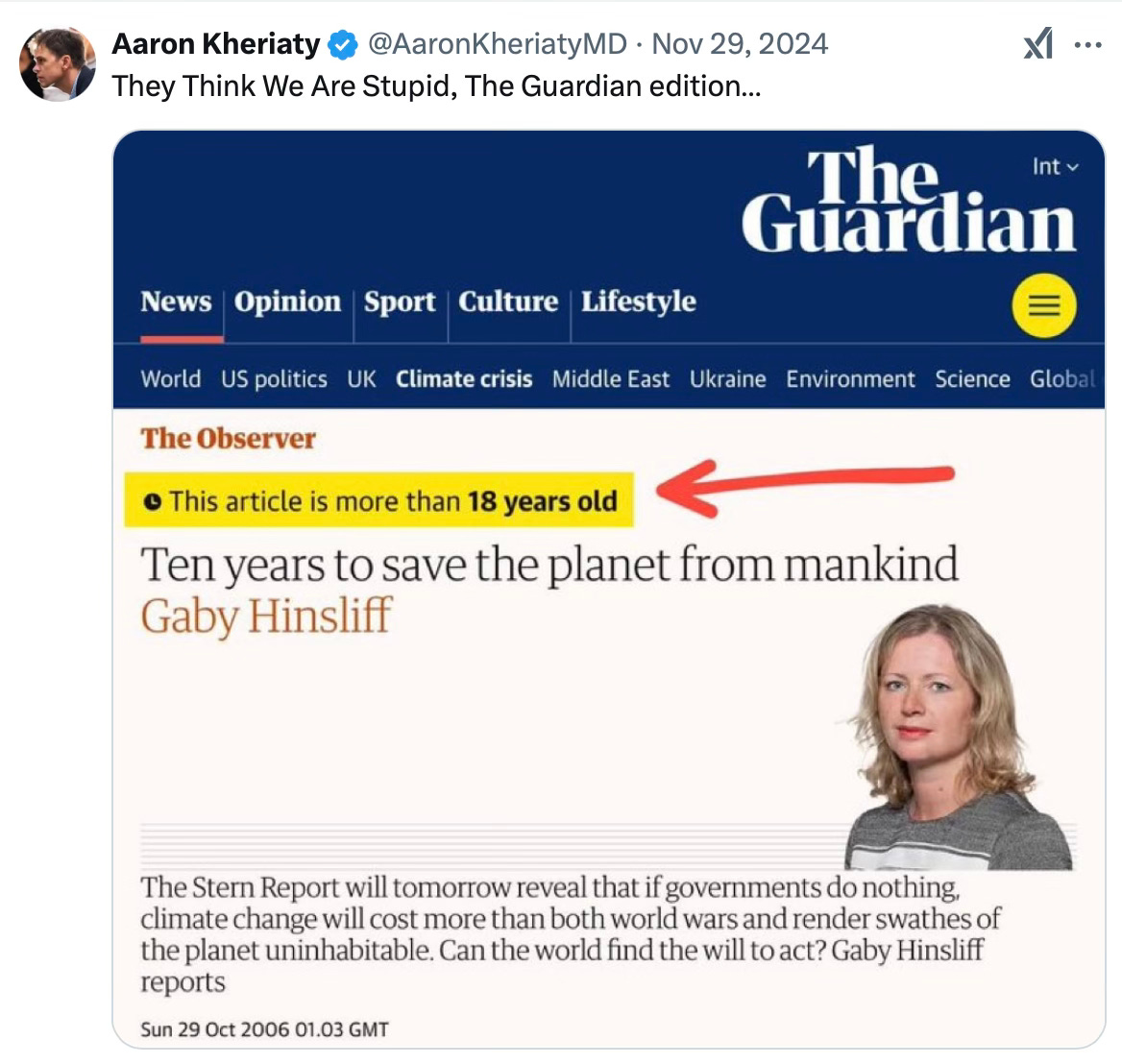
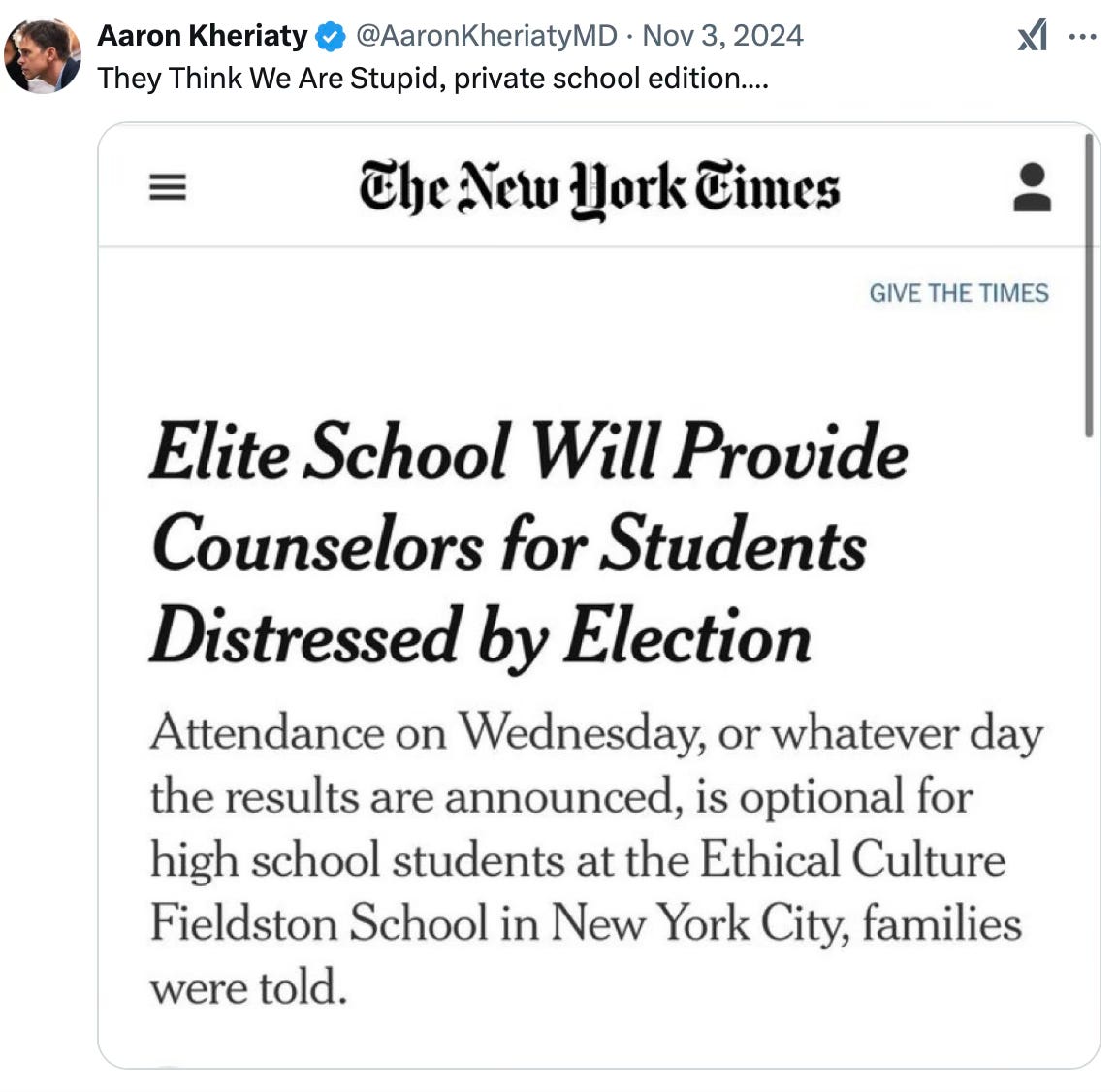
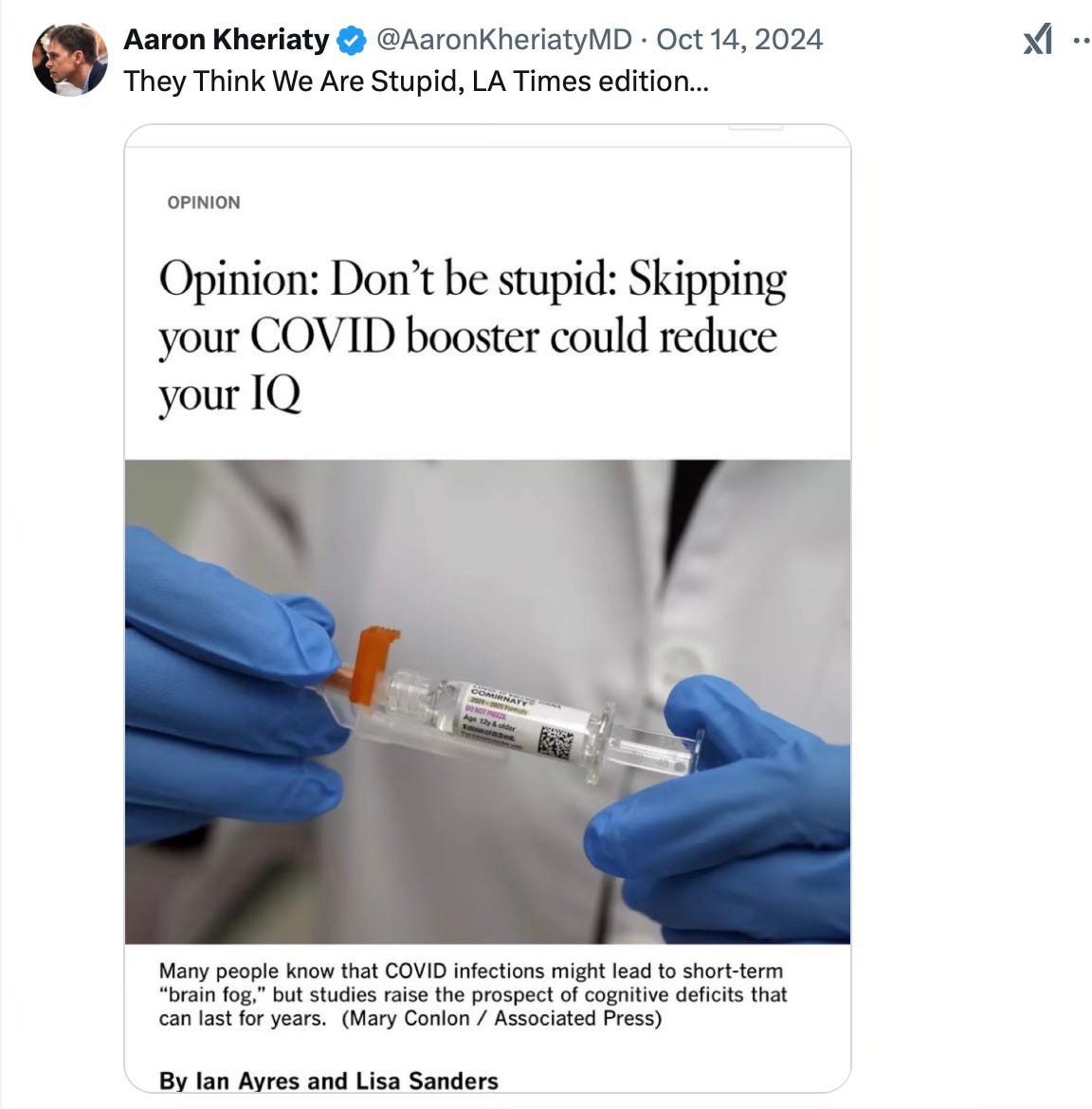
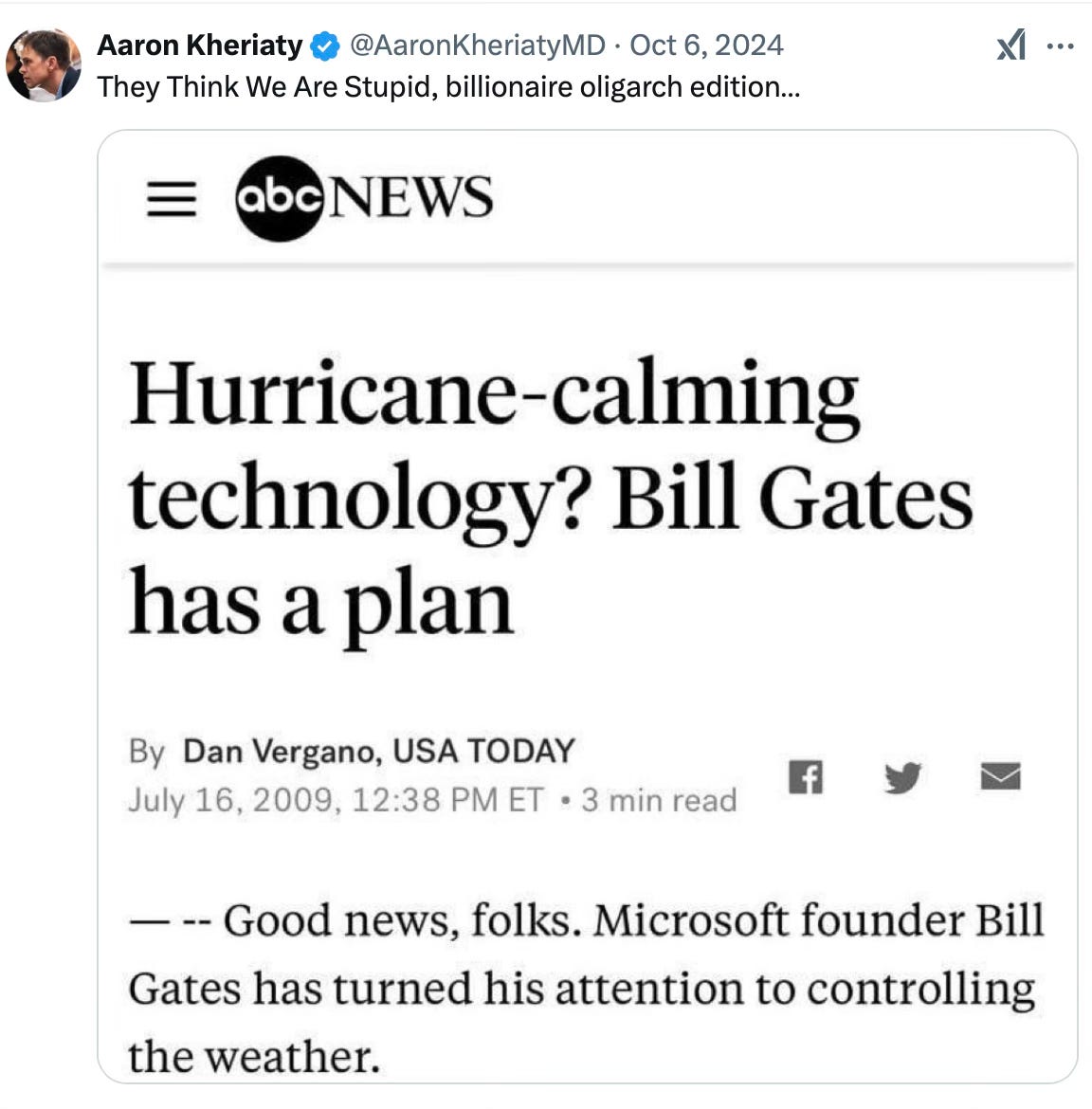
They Think We Are Stupid, Volume 14
Everything you need to know about our ruling class’s opinion of you. As always, these headlines are presented without commentary.
By Aaron Kheriaty, MD | Human Flourishing | February 24, 2025






Unraveling the Narrative Supporting a Green Energy Transition
By Planning Engineer (Russ Schussler) | Climate etc. | February 19, 2025
The purpose of this article is to summarize and debunk many of the issues in the narrative surrounding the proposed green energy transition as applies to the electric grid. The issues are so numerous that this piece is at once both too long and too short. A full unraveling deserves a book or series of books. This posting however challenges the narrative through summary comments with links to previous posts and articles which can be read for a more detailed explanation or for greater depth.
The Narrative
Efforts to hasten a “green transition” find support in a powerful and compelling narrative. The following statements are widely believed, embraced and supported by various “experts”, a large part of the public and far too many policy makers:
- Renewable Energy can meet the electric demand of the United States and World
- Renewable Energy is economic
- Renewable Energy sources can provide reliable electric service to consumers and support the grid
- Renewable energy sources are inexhaustible and widely available
- Clean Energy resources don’t produce carbon and are environmentally neutral
- Renewable Energy Costs are decreasing over time
- It will become easier to add renewables as we become more familiar with the technologies
- The intermittency problems associated with wind and solar can be addressed through batteries.
- Inverter based generation from wind, solar and batteries can be made to perform like conventional rotating generator technology
- Battery improvements will enable the green transition
- We are at a tipping point for renewables
- Wind, Solar, and Battery technologies collectively contribute to a cleaner environment, economic growth, energy security, and a sustainable future
- The world is facing severe consequences from increased CO2 emissions.
- There will be an inevitable and necessary transition to clean economic renewables
- Green Energy will allow independence from world energy markets
- The clean grid will facilitate clean buses, trucks, tanks, planes
- The third world will bypass fossil fuels and promote global equity
- Replacing fossil fuels with green energy will have huge health benefits
- It’s all about Urgency and Action
This narrative is compelling to many consumers and major policy makers. Unqualified acceptance of this powerful narrative makes it clear we should all be behind the movement to increase wind and solar generation along with other efforts to expand renewable resources. Most all of the above statements making up the narrative are “somewhat” true. Unfortunately, the collective narrative as frequently adopted is at odds with the economics and physical realities of providing electric power and supporting civilization.
How did this narrative become so widely accepted despite dismal real-world results? A previous posting discussed, “How the Green Energy Narrative Confuses Things” by using misleading language and distraction (#44). Additionally, tribal loyalties enable distortions and suppress more realistic assessments (#18, #10,#22, #42, '). While others should chime in on the social psychology supporting this movement, astute observers can’t miss the power of fear-based narratives, groupthink, demonization of dissenters and misplaced altruism (#39, #18,& #10). Incentives and their impact on key actors play a major role (#38 & #29). The media overblowing trivialities and focusing on continually emerging “good news” helps cement undeserved optimism. The great many failures are conveniently forgotten. Finally, it should be noted that the electric grid has been very robust. In the short run you can make a lot of “bad decisions” before negative consequences emerge to challenge the narrative. At that point it may be too late.
The next section will explore and critically examine various elements of the narrative in a very brief fashion, with links in many cases providing more detailed explanations and information.
Unraveling the Narrative
- Renewable Energy can meet the electric demand of the United States and World
- “Renewable Energy” is not a coherent category and allows for a lot of confusion. #40
- The green energy narrative began with simple calculations which found that the energy which could be derived from renewable resources like hydro, solar and wind matched or exceeded the energy consumed as electric energy. It is not a particularly meaningful observation. #28
- It does not consider what may be involved in making that energy available when needed, where needed, with the proper characteristics needed.
- Demonstrating that sufficient energy exists does not say anything about our ability to harness such resources. Large amounts of various “renewable” energy sources, such as those listed below. But even though the energy is there, and small amounts can be harnessed, most know enough not say the energy presence itself makes an energy transition feasible soon.
- Tidal Energy
- Ocean Thermal Energy Conversion
- Earths rotational energy
- Earth’s magnetic field
- Nuclear Fusion
- Unconventional geothermal energy (Hot Dry Rock or Enhanced Geothermal Systems)
- Using just sunlight and/or wind exclusively to power large motors, variable speed drives, non-linear loads, arc furnaces or power a modern civilization is not feasible at this time.
- Projecting feasibility based only such “studies” or calculations may be from either a serious misunderstanding of the challenges to be faced or unconstrained infantile optimism around future breakthroughs.
2.Renewable Energy is Economic
-
- In limited cases, yes. In many cases, only in a trivial sense for a limited set of costs associated with these resources.
- While the marginal cost of production for wind and solar is low, approaching zero:
- The more wind and solar added to the system, the more costly they become.
- Work best at low generation levels when they allow more costly resources to back down.
- The lower their generation level, the more the system can accommodate them without additional costs. #2 & #26
- It is demonstrated worldwide that increased levels of these resources are associated with higher electric costs for consumers and taxpayers.
- While home solar can be subsidized to appear low cost, it is misleading for the big picture, especially as applications increase. #6 & #5
- Average costs are misleading and cost measures such as LCOE are flawed as they do not reflect real world requirements. #8, #3, & #9
- Undoubtedly premature to advocate that that a resource is economic, without considerations of reliability, deliverability and its potential operation in conjunction within a resource mix as part of a grid.
3.Renewable energy sources can provide reliable electric service to consumers and support the grid.
-
- Statement may be trivially true, but is generally inaccurate.
- Generally, it is an accurate assessment for hydro, biomass and geothermal. #3 & #12
- These involve traditional rotating machines in synch with the grid. They inherently supply essential reliability services for grid support.
- These resources have flexibility for dispatch and ramping.
- Geothermal and biomass are greatly restricted by local geography.
- New applications of these resources face especially significant environmental challenges.
- Not so true for wind and solar generation. #12 & #26
- They provide energy intermittently and do not match demand patterns. #2, #3, & #41
- They do not spin in synchronism with the grid which has seriously inhibits their ability to support the grid. #7
- They depend on the grid and synchronous rotating machines. #17
- Problems associated with these resources increase as their penetration levels increase. #7
- Supposed “proofs” that wind and solar support the system generally come from cherrypicked brief off-peak periods when renewable generation exceeded demand (not really a good thing.)
- Grid support must be 24 hours/day during peak and extreme conditions. Configurations should ensure that the grid can go ten years with one loss of load expectation (LOLE).
- Coasting through an off-peak period does not imply sustainability.
- Where wind and solar match load, it is near certain that considerable spinning rotational machines (hydro or fossil fuel) are on the interconnected grid backing up these resources either serving other load not counted, or on-line spinning ready to take on load. #21
- They may just come from accounting efforts, with no attention to flows or time periods.
- Cost comparisons without considering reliability differences are worthless.
4.Renewable resources are inexhaustible and widely available.
-
- The resources needed to construct and maintain such facilities as well as resources needed to back them up are not inexhaustible. #40
- Geothermal is rarely available and some geothermal can be depleted.
- Further hydro development is problematic in most of the developed world. In the US some dams are being eliminated to return to a more “natural” state.
- Suitability for wind and solar varies considerably by region.
- All resource needs for using generation resources should be considered. #40
- Scarce resources are needed in the production of wind and solar power.
- Expected sustainability before depletion may be higher for nuclear power and some fossil fuel generating resources, than for resources needed for wind, solar and battery facilities. Of course, emerging developments may change expectations for any resource.
5.Clean Energy resources don’t produce carbon and are environmentally neutral. #40
-
- Adverse impacts from “green” resources have typically received considerably less attention from the media, policy makers and advocates than similar impacts from conventional generation.
- Although when it’s in their backyard, the problems of wind, hydro and large solar emerge and they become targets of local environmental groups.
- Over time, the adverse impacts related to their operation and disposal become more and more evident. Recycling is challenging to impossible for the large structural components and also the scarce resources needed for energy conversion.
- The construction, maintenance and operation of such resources produce significant environmental impact including CO2 emissions.
- Geothermal generation produces CO2.
- Backup generators are often run inefficiently to allow for wind and solar generation.
- Cases of fossil fuel, wind and solar generation may have higher emissions than similar cases with only fossil fuel generation running more efficiently.
- Adverse impacts from “green” resources have typically received considerably less attention from the media, policy makers and advocates than similar impacts from conventional generation.
6.Renewable Energy Costs are decreasing over time
-
- Some components are dropping – but total costs are more questionable as there is considerable data showing costs are rising.
- Often cost data refers only to specific components that are decreasing, not the full cost for the installed facilities needed to generate energy and power.
- In particular, land and labor push up costs associated with wind and solar.
- Increasing penetration levels raise overall costs for solar, wind and batteries. #26
- Some components are dropping – but total costs are more questionable as there is considerable data showing costs are rising.
7.It will become easier to add renewables as we become more familiar with the technologies.
-
- Only easier in limited ways attributable to things like experience and benefits of scope.
- Exponentially harder to add increasing levels of wind, solar and batteries. #26 & #2
- Asynchronous and intermittent resources are harder to integrate as their levels increase.
- Prime renewable locations will already be exploited, and less desirable locations remain.
- Continued developments entails the need to move energy longer and longer distances.
- As wind and solar increase, early adopters will be less able to lean on neighboring systems.
8.The intermittency problems associated with wind and solar can be addressed through batteries.
-
- Possibly, but at a great cost and added complexity. #2, #41, & #43
- This assertion is extremely misleading when it implies that intermittency is the main problem.
- Compared to the problems associated with asynchronism and the capabilities of inverter-based generation, intermittency is a much smaller problem.
- Hiding/ignoring misleading points in the green narrative. #44
- Asynchronism is the problem more so than intermittency.
9.Inverter based generation from wind, solar and batteries can be made to perform like conventional rotating generator technology. #43, #41, #3, & #19
-
- Note – most people are not aware of the asynchronous problems associated with wind, solar and batteries.
- When these elements let the grid down, the cry is “make the grid more resilient” as if that has some real meaning.
- When that problem can’t get ignored, the green narrative is to back up and have someone say with technological improvements, inverters can perform “like” synchronous generation without any recognition of the drawbacks.
- When inverters are made to provide extra functionality, it raises the installed costs and entails a significant reduction in energy output and reliability.
- Three phases of Inverter development, none have achieved widespread use
- Pseudo inertia (synthetic inertia), Grid supporting, Grid Forming.
- Phases are more goal oriented or aspirational than accomplishment based.
- Each is intended to do more than the previous “development” phase to “mimic” rotating generators.
- Research and applications are largely on paper, in laboratories and pilot programs. Few if any working plants are gaining needed operational experience.
- The early phases were sold as “the way” to allow higher penetration of inverter-based generation but were found not be able to deliver as promised.
- The insufficiency of these approaches was recognized long before any large-scale implementations were undertaken (Note-generally phased development follows a widespread deployment of earlier phases prior to successive improved phases. In this area, the task is so far beyond the capabilities that prior phases can’t really show much proof of concept in the field.)
- Why should we expect the latest grid forming phase to do better than predecessors?
- Overwhelmingly, most wind and solar applications on the grid do not have functioning special inverter capabilities of any sort.
- Pseudo inertia (synthetic inertia), Grid supporting, Grid Forming.
- Enhanced inverters may perform “like” rotating elements in limited environments, but this “like” way is radically inferior to the performance of rotating generators. #30, #29
- Inverter performance may improve with technological advances. However, they have an extremely long way to go.
- Theoretically they can do a lot rotating machines cannot, but the complexity of taking advantage of that while coordinating with other changing elements across the grid so they all perform well together across all potential contingency conditions is immense.
- Similar optimism exists for superconductors to improve the grids reliability and efficiency, but it would be extremely foolish to depend on either to support a planned energy transition. They are far from being judged as feasible.
- This is the biggest problem the green narrative overlooks and is the major stumbling block to widespread integration of wind, solar and batteries.
10.Battery improvements will enable the green energy transition.
-
- As discussed previously, batteries may address intermittency, but not the major problem of inverter-based generation.
- Batteries suffer from the same inverter based problems as wind and solar.
- Their inability to adequately provided needed system reliability services is usually not addressed. #29
- Much is made of continual reports on improvements in battery technology
- Many breakthroughs in research but they take development in differing directions and are not compatible with most of the other breakthroughs. “Breakthroughs” are typically not cumulative, corroborative or generally able to be combined.
- Inverter-based improvements needed for wind, solar and batteries suffer from similar development challenges.
- Consider the path of high temperature superconductors which were projected in the near term, but hit a wall before widespread practical applications could be employed.)
- To control for extreme weather events (e.g. Dunkelflaute) might require that batteries completely ignore wind and solar capacity. Leaving tremendous amounts of unused capacity most of the time.
- Many breakthroughs in research but they take development in differing directions and are not compatible with most of the other breakthroughs. “Breakthroughs” are typically not cumulative, corroborative or generally able to be combined.
- As discussed previously, batteries may address intermittency, but not the major problem of inverter-based generation.
11.We are at a tipping point for renewables. #44
12.Wind Solar and Battery technologies collectively contribute to a cleaner environment, economic growth, energy security, and a sustainable future. #40 & #42
-
- They might contribute small amounts at low penetration, but they are dwarfed by huge drawbacks at higher penetration levels.
- In delicate environments, small compact fossil fuel-based energy sources may be superior to renewable resources with more intrusive footprints. #14
- See v above.
13.The world is facing severe consequences from increased CO2 emissions.
- The greater the risks from increasing CO2, the less we can afford to favor wind, solar and battery technology over more pragmatic approaches. #32
- This is the most dangerous component to be incorporated into this narrative.
- Because of this fear, it is argued we must chase bad ideas. #18
- Because of this fear, dissent from these bad ideas is demonized. #18
- Because of this fear, we must move to a panic mode and do counterproductive things. #1
- The greater the risk from climate change:
- The smarter we need to be.
- The less we can tolerate bad ideas and wasted efforts.
- Climate concerns do not change the physics of the grid nor the functioning of resources.
- However, extreme weather will make “green” resources less suitable.
- While the need for reliable, affordable power will be greater.
- Green plans misdirect a lot of resources and weaken energy policy approaches. #42
- If situation is that grim as regards CO2 emissions:
- Perhaps that should outweigh any concerns around nuclear energy.
- Perhaps environmental damage from new hydro is warranted as well to address climate.
- If new nuclear and hydro are out, changing civilization is an option that needs to be on the table, frequently discussed and fully considered.
- False appeals to questionable technologies will not help us.
- False hopes of improving technology will only hurt us.
- If situation is that grim as regards CO2 emissions:
- The greater the risk from climate change:
14.There will be an inevitable and necessary transition to clean economic renewables
-
- When? It is very unlikely to be in the foreseeable future and certainly not in a planning time frame.
15.Green Energy will allow independence from world energy markets
-
- We depend on other countries for material and components needed to construct renewable facilities.
- Wind, solar and batteries cannot run steel mills and industrial processes needed for a “green” energy transition, not sustain civilization after (unless you call nuclear and hydro green)..
- How is the fear of “foreign oil” so much more of concern than dependence on rare earth metals and other foreign imports.
16.The clean grid will facilitate clean buses, trucks, tanks, and planes
-
- Not if it doesn’t work.
- Wind, solar and batteries alone clearly cannot provide for such growth in electric consumption.
17.The third world will bypass fossil fuels and promote global equity
-
- Nonsense
18.Replacing fossil fuels with green energy will have huge health benefits
-
- More costly energy is associated with alternative use of dirty fuels creates hazardous pollution in many third world areas.
- Rising costs of electricity generally encourages less clean alternatives that are more difficult to monitor.
19.It’s all about Urgency and Action
-
- If urgency and action could dependably solve hard problems, years ago we’d have a cure for cancer and the common cold, flying cars, jet packs and ended world hunger.
It might be argued that the above refutations (even with citations) are too quick and lack detailed substantial evidence. While there is quite a bit out there that can be referenced, it should be pointed out that the arguments supporting a green transition are asserted without with much serious reasoning and far flimsier support than provided here. That which is easily asserted without foundation should not require overly demanding refutations. Clearly when and if more detailed claims supporting a green energy transition are made, they can be answered with more detailed rebuttals.
Academics are a key part of the problem of a sustained false narrative. Much of the “evidence” out there comes from small studies of single variables with academic models which are stretched far behind what was analyzed. Additionally, expert opinions come from many “experts” who “preach” far outside their fields of expertise and training. There are rewards in academia for furthering optimism on the green transition. There are not so many incentives for nay-sayers. Academics who understand the problems and would offer caution, generally do not have the reach of those who promote optimism by clouding the facts. The many half-truths presented from different sources cannot be summed up to imply a credible narrative, even though many have the impression this makes a strong case. #44
Clearly there are many discontinuities between theory and what is observed in the real world as regards the potential for wind, solar and batteries. Milton Friedman said, “One of the great mistakes is to judge policies and programs by their intentions rather than their results.” I’d add, “What happens in the field should be more convincing what you calculated on paper”. The next section will cover truths that need to be added to any considerations around our energy future.
Truths that need to be part of Energy Transition Narrative
These truths don’t get near as much attention as the above. Sometimes they are hidden and sometimes they are summarily denied rather than given the attention they deserve.
1)Adequately addressing the energy future requires we understand the true costs and benefits of ALL available and potentially available technologies. #1 & #3
2)Large grids are dependent upon and run on rotating machines. #3, #7, #11, #26 & #12
3)No Grids run on asynchronous generation only (or majority asynchronous) without significant backup.
-
- Despite reports that wind, solar and batteries power a system – real world cases always involve significant conventional generation backing them up somewhere on the interconnected grid.
- Asynchronous wind, solar and batteries without rotating backup resources are not feasible power supply element for large power systems.
4)Hydro, biomass and geothermal are fine for grid support, but are problematic and/or not available in many areas.
5)Wind and solar face major challenges in achieving significant penetration levels and have many underdiscussed issues.
6)Costs of Wind and solar resources are often hidden and assigned to others. #5, #6, & #31
- Rates that are subsidized by non-users. #5
- Support costs are built into the transmission or distribution rate and paid by others.
- Shorter life and costlier maintenance and replacements.
-
- Ivanpah Solar facility ($2.2 Billion. 400 MW) shuttered in 11th year because it’s not worth the operating costs to keep the “free” energy online.
- Wind Turbines have short lives and costly repairs.
-
7)If Nuclear is the right direction, current efforts at wind and solar are misguided. Nuclear plants run best full out with low incremental cost. Displacing nuclear with intermittent wind and solar makes little to no sense.
8)It’s possible to subsidize a few things that have small costs to support development of green resources, but small costs multiplied by orders of magnitude are crushing. #6
9)Utility costs are regressive, dis-proportionally hitting those less well-off and least able to afford rising costs. These costs are more regressive than taxation schemes. #5 #6, & #31
10)If we must cut carbon emissions without nuclear and hydro, drastically changing civilization is an option that needs to be on the table, openly and frequently discussed and given full considered.
11)Energy Markets are not working well. My take is energy provision cannot effectively and efficiently be broken into separated independent components. Utilities used to provide an amalgamation of goods and services for their customers. Separating out distribution, and transmission services increase complexity, but still doesn’t set up energy or its components as commodities. Separate commodities for hourly energy, capacity, emergency power, reliability services, backup power, and spinning reserve eliminate many of the efficiencies available from full-service power supply. For example: daily energy markets don’t support long term emergency power. Who pays for facilities needed for only once in a decade extreme weather, and when and how do they pay for it? Daily markets drive those resources which have emergency value out of business. Perhaps I am wrong, but experience tells us markets uncharacteristically are not working well for energy and energy services. #45
12)Credible plans for any electric energy future, let alone a major transition, will need to integrate studies of both supply and deliverability while balancing economics, costs and public responsibility. No conclusions about what may be worthwhile is possible without such considerations. #16 & #39
Other Topics that need to be considered
A)China and India’s CO2 emissions will likely dwarf emissions from western nations soon. Which is a more effective role for the US:
-
- As a leader developing, promoting and sharing clean fossil-based technologies to be emulated by developing and third world nations. #36
- As a leader among advanced nations promoting green technologies largely overlooked by most of the planet as they use less clean resources and their emissions grow exponentially?
B)What about developing countries in the third world? How we can hold them back by requiring they use a path that we can’t make work. Their burdens are more significant than ours.
-
- Economic barriers – high initial investment or crushing burdens from foreign loans.
- Human capital -technical skill needs.
- These resources work even less well without an established strong grid.
- Often more extreme climates increase challenges.
- Specialized problems such as theft, waste management, and cultural acceptance.
C)Can effective regulation, as opposed to current regulatory practices revive nuclear construction significantly?
D)Energy density problem (EROEI) – Can solar and wind provide enough energy to be self-perpetuating considering full lifetime needs?
-
- There is no significant production of “green” infrastructure with wind and solar energy.
- Wind and solar infrastructure depend today on fossil fuel-based energy for their construction and operation.
E)Grid and energy prices are globally critical to healthy economies and a reasonable quality of life.
F)How do we incentivize policy makers to prioritize long term goals versus what’s expedient the next few years. #38 & #1
-
- Imprudent short-term boosts (ignoring maintenance, depleting reserves) provide temporary advantages while building for the future initially entails greater costs.
- For job evaluations, it’s easier to see what was done, rather than evaluate the long-term benefits of such programs
- Engineers professionally suffer for not supporting green goals
- Supporting green goals has rewards for practicing engineers.
- I have never seen anyone recognized & rewarded for standing up for the grid ten years ago.
- Bad incentives and the hope that technology or policy changes will arrive on time before things have gotten too bad, keeps most of those who might speak out in check.
G)How do we combat feel-good narratives? Energy is much more complex than recycling. Despite great under-achievement, renewable hopes have persisted for long time periods. Will the false hopes of wind, solar and batteries be just as intractable despite real world experience?
How Does the Green Energy Narrative Remain Strong Despite the Big Picture?
It’s hard to argue against the “green energy“ agenda. “There’s always something just around the corner that’s going to change everything”, we’re often told (#34, #43 & #24 ). It’s seductive, “Somebody is investing a lot of money now in the next great thing and we should be part of that as well.” But those things don’t pan out. There is broad support and rewards for going along with the “green” narrative, even for projects as ridiculous as “electric roadways” ( #42) and especially for projects as big and bold as the German Energiewende. A decade ago, when warning of emerging problems, countless times I was told that Germany had proved it could be done. In this piece (#21) in 2017, a coauthor and I tried to point out the problems with that representation. Despite voices like ours, the world remained largely impervious to criticisms of the German experiment. By the time Germany’s huge failure became apparent for all to see, the argument moved on to Australia where “it’s now being proved it can be done”. Chris Morris and I did a series (#33, #34, #35) on Australia in 2023 highlighting our understandings of those efforts and our expectations for underperformance. It’s not looking good for Australia, or England or for any who have raced to have high penetrations of wind and solar. But dismal real-world results so far have not been much of a brake on the movement. Renewable “experts” remain undeterred and unmoved by failed ideas.( #37)
Prior to the green energy narratives, there had been near continuous progress with engineers building and maintaining stronger and more robust grids that held up well across varied challenging conditions. The trend was that widespread grid outages (not the same as distribution outages) were becoming increasingly rare as grids became more robust and resilient. The beginnings of the “green transition” served to slow and reverse that progress. Most grids are sufficiently strong such that significant degradations do not show up as system problems for quite some time. The likelihood that problems won’t manifest for some years down the road makes it hard for defenders of the grid to stand up to short term pressures to go greener. (#38)
The strong robustness of the grid makes it hard to clearly identify and point out emerging problems with the grid. As I wrote here (#27)
The power system is the largest, most complicated wonderful machine ever made. At any given time, it must deal with multiple problems and remain stable. No resources are perfect; in a large system you will regularly find numerous problems occurring across the system. Generally, a power system can handle multiple problems and continue to provide reliable service. However, when a system lacks supportive generation sources, it becomes much more likely it will not be able function reliably when problems occur.
When an outage occurs, you can always choose to point a finger at any of the multiple things that went wrong. (#44, #26) Some traditional fossil fuel technology will always be included in the set of things that were not right. (Loss of just renewables doesn’t usually cause big problems because apart from energy, they don’t support the system while in service.) For various reasons, advocates insist the finger should be pointed away from renewables (and the gap in needed system support) and at the conventional technology that was not perfect when the outage occurred. It’s critical to note that conventional technology is never perfect across a large system, however we were able to make reliable robust systems that could easily accommodate such imperfections. But now the presence of less dependable resources and inverter-based energy makes systems far less robust, even during times when those problematic resources are working well. It’s a near sure bet the next large grid outage will be largely caused by problems associated with high levels of wind and solar penetration, whether those resources are available during the outage or not. That bet can’t be made, because no referee acceptable to both sides can be found.
Conclusions
The case for an energy transition based on wind, solar and batteries is grossly incomplete and stands against evidence and reason. The green narratives sub-propositions in isolation contain some truths, but they are extended in misleading ways. A collection of 200, 800, or ten million studies showing that isolated challenges around renewable resources can be addressed cannot make a case for reliable, affordable deliverable energy. When the resources are ready, proponents can make a case by operating a small system without connection to conventional generation that experiences varied load conditions and real-world challenges. When a case for large scale penetration of wind, solar, and batteries has been made with adequate considerations of costs, reliability and deliverability, it can then be reviewed and challenged with detail.
Planning must balance economics, reliability and environmental responsibility using real workable technology which conforms with the physics of the grid and meets the needs of society (#15,#16, #25, #23 & #32). Electric supply and the grid are too important to base policies upon poor narratives and incomplete understandings. Hope for future improvements must be based on realistic expectations. Going a short way down the “green” path is easy. Adding a bit more “renewables: isn’t that expensive and the gird is plenty robust for incremental hits. For most involved, it’s easier to go with that flow than to stand up for long-term concerns. But we are getting closer to the cliff as costs continue to increase and reliability problems become more prevalent.
Policy makers need to consider a fuller and more complete array of truths around renewables and the grid. Rigorous considerations of many complex and interlinking issues between generation and transmission are needed to build and support modern grids. No-one, even those with a lifetime in the business, fully understands everything involved. Experience and incremental changes have served the development and operation of the grid well. Many outside “experts”, have next to no real knowledge of the complexities involved and propose dramatic changes. Without serious and time-consuming efforts from policy makers, real grid experts can’t compete with proposals that are basically founded upon tee-shirt slogans. Spending money, altering systems, and hoping for the best based on the green narrative alone is a recipe for disaster.
Notes
Thanks to Meridith Angwin, Roger Caiazza and Chris Morris for reviewing drafts and providing useful comments. I’ve tried to do a lot here in a limited space and the treatment is somewhat uneven across the broad range of topics. I welcome others to improve and build upon these ideas and structures. I would be glad to assist in such efforts as long as it is not tied to other political, religious, or social issues. My focus is on energy and encouraging reasonable energy policies and regulations.
Previous Postings and Articles Referenced
- Myths and Realities of Renewable Energy – 2014/10/22
- More renewables? Watch out for the Duck Curve – 2014/11/05
- All megawatts are not equal – 2014/12/11
- Taxonomy of climate/energy policy perspectives – 2015/02/03
- Clean Air – Who Pays? – 2015/02/09
- What should renewables pay for grid service? – 2015/04/21
- Transmission planning: wind and solar – 2015/05/07
- True costs of wind electricity – 2015/05/12
- Solar grid parity? 2015/05/31
- Why Skeptics hate climate skeptics – 2015/06/03
- Microgrids and “Clean” Energy – 2015/07/28
- Renewables and grid reliability 2016/01/06
- Energy strategies: horses for courses – 2016/03/20
- Energy and Environment on the “Garden Island” – 2016/06/16
- Drivers & Determinants for Power System Entities, Electric Energy (RMEL), Summer 2016,
- Balance and the Grid – 2016/09/12
- Reports of the Electric Grid’s Death Have Been Greatly Exaggerated Power Magazine 2017/04/1
- Science Marchers, Secretary Perry’s Memo and Bill Nye’s Optimism – 2017/04/24
- Renewable resources and the importance of generation diversity – 2017/05/09
- The Grid End Game T&D World 2017/06/26
- Myth of the German Renewable Energy Miracle – T&D World 2017/10/23
- Trying to Make Sense of Musk Love and Solar Hype – 2017/10/27
- Third-World Grid, Smart Grid or a Smart Grid? T&D World 2018/6/25
- Reflections on Energy Blogging – 2019/10/21
- Will California “learn” to avoid Peak Rolling Blackouts? – 2022/09/12
- The Penetration Problem. Part I: Wind and Solar – The More You Do, The Harder It Gets -2022/10/3
- The Penetration Problem. Part II: Will the Inflation Reduction Act Cause a Blackout? – 2022/10/11
- Academics and the grid Part I: I don’t think that study means what you think it means – 2023/01/04
- Academics and the grid. Part II: Are they studying the right things? – 2023/01/09
- Academics and the Grid Part 3: Visionaries and Problem Solvers – 2023/01/15
- Green energy: Don’t stick Granny with the bill – 23/01/29
- Net Zero or Good Enough? – 2023/02/09
- Australian Renewable Integration – Part 1 – 2023/03/02
- Australian Renewable Integration – Part 2 – 2023/03/08
- Australian Renewable Integration – Part 3 – 2023/03/11
- The Earths Green Future is Forked – 2023/04/03
- Renewable Experts: Undeterred and Unmoved by Failed Ideas – 2023/04/17
- Silence of the Grid Experts – 23/05/03
- Fauci, Fear, Balance and the Grid – 2023/05/08
- Time to retire the term ‘renewable energy’ from serious discussion and energy policy directives – 2024/02/05
- Time to Retire the Term “Renewable Energy” from Serious Discussions and Policy Directives: Part II – 2024/02/16
- Time to Retire the Term “Renewable Energy” from Serious Discussions and Policy Directives: Part 3 – 2024/02/22
- Wind and Solar Can’t Support the Grid – 2024/12/05
- How the Green Energy Narrative Confuses Things – 2025/1/30
- Assigning Blame for the Blackouts in Texas – 2021/2/18
Featured Video

Theodore Postol: Iran’s Missiles & Drones Were Underestimated
or go to
Aletho News Archives – Video-Images
From the Archives
What is the Israeli Lobby in Australia Doing in Interfaith Dialogue?
By Ali Kazak | Dissident Voice | October 11, 2015
For years Israel and its lobby around the world have been trying to normalise their relations with Arabs and Muslims without solving the Palestine Question.
One of the methods they resorted to in the last few years is using human rights and community organizations such as interfaith dialogue and Multiculturalism to achieve this objective and to: isolate the Palestinians, marginalise the Palestine question, end Israel’s isolation, and prevent criticism of Israel, knowing that these organisations will be the first to stand against Israel’s violations, racial and religious discrimination.
The group responsible for this task in Australia is The Australia/Israel & Jewish Affairs Council (AIJAC); its Director of International & Community Affairs, Jeremy Jones is in charge of lobbying religious community organizations, specifically Muslims and Christians. Consequently he convened the Faith Communities for Reconciliation, founding participant in the Australian Partnership of Religious Organisations and the Australian National Dialogue of Christians, Muslims & Jews.
AIJAC is a private political propaganda group. It is recognised as the main Israeli lobby in Australia. It coordinates its activities and works intimately with the Israeli embassy in Canberra and different institutions in Israel. It is privately funded by some Jewish businessmen. It monitors closely Australian politicians, the media, ethnic and religious groups, (especially Arabs and Muslims), unions and academics on their stands towards Israel and the Palestine question. … continue
Blog Roll
 Aletho News
- The Most Important Bet You’ve Never Heard Of
- The killing of three Indonesian soldiers in Lebanon should remind Jakarta that Israel does not want peace
- Defeated and delusional: Netanyahu’s remarks reveal $80bn war failure, says analyst
- Iran’s friends are about to make life much more difficult for Israel and the US
- The war of liberation of the Arab and Islamic peoples expands across the Gulf
- Envoy warns UN on Trump’s threat to ‘obliterate’ Iran’s civilian infrastructure
- The Larak Corridor: Iran’s Rial Gate With No US, No Israel, and No Way Around
- ‘Economic terrorism’: Steel facilities hit again in US-Israeli strike
- ‘War Crime’: Iran condemns attacks on Arak, Ardakan nuclear sites
- Two-thirds of Americans want quick end to Iran war even if goals unmet
- If Americans Knew
- Gaza families reunite years after babies evacuated amid Israel’s war
- International Rescue Committee warns Gaza’s children face grave protection risks
- Iran’s Alleged 47-Year War on America: Debunking the 1,050 American Deaths Canard
- Israel wants US to bomb more of Iran’s civilian structures (113,000 is not enough) – Not a ceasefire Day 173
- Ann Coulter Rips Into Fox News for Iran War Coverage
- Joe Kent Urges Americans To Call White House and Congress To Object To Sending Troops Into Iran
- DNC Resolution to Reject AIPAC Funding Puts Democratic Leaders in the Hot Seat
- Swedish foundation to build 400 schools as over 650,000 Gaza children remain without education for 2 years
- Israeli army admits photshopping image of slain Lebanese journalist
- This is how Israel is systematically killing health workers under the cover of war in Lebanon
- No Tricks Zone
- New Study Finds Warming Saves Lives…Cold Temperatures 12 Times More Deadly Than Excess Heat
- German Science Blog Accuses PIK Climate Institute Of Hallucinating Climate Tipping Points
- Devastating Assessment Of Comirnaty Vaccine By Former Senior Pfizer Europe Toxicologist
- New Study: CO2 Is ‘Effectively Negligible’ As An Explanatory Climate Change Factor Since 2000
- Former Pfizer Toxicologist Dr. Helmut Sterz Tells Bundestag Hearing Pfizer Vaccine Should Have Never Been Approved
- Energy Expert: Germany’s Nuclear Phaseout Was A “500 Billion Euro Mistake”
- New Research: South Australia’s Mid-Holocene Sea Surface Temperatures Were 4°C Warmer Than Today
- Storing Green Energy To Last Germany 10 Days Would Require A 60-Million Tonne Battery
- New Studies: UK Sea Levels Were 4 Meters Higher Than Today During The Mid-Holocene
- Destructive Green New Deal: German Energy And Metal Group Warns Of Drastic Crisis
 Aletho News