UK’s iCloud Encryption Crackdown Explained: Your Questions Answered on Apple’s Decision
How does Apple’s UK encryption move affect your iCloud data? Even for those not in the UK, we break down security risks, government access, and privacy options.
By Ken Macon | Reclaim The Net | February 24, 2025
The UK government’s latest demand from Apple has caused a major conversation about digital privacy, encryption, and government surveillance. With Apple withdrawing its Advanced Data Protection (ADP) feature in the UK rather than complying with the government’s order, many users are left with questions.
- How does this affect your iCloud data, whether you’re in the UK or not?
- Can the government now access your photos, backups, and messages?
- Are alternative services like Google, Android, or Samsung any better?
- What are the risks, and what are your options for securing your data?
With this Q&A feature, we break down the key details, security implications, and next steps for UK users—and why this could be a turning point for global encryption policy.
What exactly did the UK government demand from Apple?
The specific details of the Technical Capability Notice (TCN) issued to Apple are not public due to the secretive nature of the Investigatory Powers Act (2016), which was amended in 2023 to expand government access to encrypted data. Reports from the Washington Post suggest the UK Labour government under Prime Minister Keir Starmer demanded compliance with the order by creating a backdoor into their encryption.
Why did Apple choose to withdraw ADP instead of complying?
Apple has consistently opposed government backdoors, arguing that any compromise in encryption, even for one government, creates a security risk for all users globally. If Apple built a decryption tool, it could be exploited by hackers or demanded by authoritarian regimes. By withdrawing ADP in the UK, Apple likely aims to avoid setting a precedent and to pressure the UK government while reinforcing its brand as a privacy-focused company. It’s also possible that Apple privately negotiated with the UK government but couldn’t reach a compromise.
What happens to UK users who already enabled ADP?
Existing UK users with ADP won’t lose encryption immediately, but Apple has confirmed they will eventually need to disable the feature. The exact timeline remains unclear — Apple’s February 21 announcement did not specify specific dates, suggesting a phased approach. Users might receive notifications asking them to opt out voluntarily or could face automatic disabling via a future software update. Until then, their data remains end-to-end encrypted.
What data can governments access without ADP?
Without ADP, most iCloud data reverts to Apple’s standard encryption, meaning Apple can decrypt and provide access if compelled by a legal order. This includes:
- Photos, videos, documents, notes, and device backups
- Email content (if using iCloud Mail or a different provider but the account is backed up to iCloud)
- iMessage chats (if iCloud backups are turned on)
Some data, like real-time iMessages and Health data, may still retain end-to-end encryption depending on user settings.
Losing ADP increases UK users’ vulnerability to data breaches because their iCloud data, once decrypted by Apple, could be exposed if Apple’s systems are hacked. Standard iCloud encryption is robust against external threats, but high-profile breaches (e.g., past celebrity iCloud leaks) show it’s not infallible. Foreign entities could also target this data if they penetrate Apple’s infrastructure, though there’s no evidence of state-sponsored hacks yet. The risk isn’t immediate for most users but grows over time as cybercriminals adapt, making UK users a softer target compared to those with ADP elsewhere.
What are the Security Risks for UK Users?
Losing ADP increases UK users’ vulnerability to data breaches because their iCloud data, once decrypted by Apple, could be exposed if Apple’s systems are hacked. Standard iCloud encryption is robust against external threats, but high-profile breaches (e.g., past celebrity iCloud leaks) show it’s not infallible. Foreign entities could also target this data if they penetrate Apple’s infrastructure, though there’s no evidence of state-sponsored hacks yet. The risk isn’t immediate for most users but grows over time as cybercriminals adapt, making UK users a softer target compared to those with ADP elsewhere.
Governments aside, what are the UK government’s next steps?
The UK government could escalate by fining Apple for non-compliance, though Apple’s removal of ADP might technically satisfy the notice by removing the contested capability. The government may also target other encrypted services like WhatsApp, Signal, or ProtonMail with similar demands. The 2023 amendments to the Investigatory Powers Act allow the UK to issue preemptive decryption demands on tech firms, meaning broader enforcement is possible. However, political backlash and pushback from the tech industry might slow down aggressive enforcement. That’s why challenging the UK government is important.
What legal basis does the UK have for this demand?
The Investigatory Powers Act (2016)—sometimes called the Snooper’s Charter—was updated in 2023 to expand government power to issue Technical Capability Notices. These notices require companies to remove encryption or other security measures if deemed necessary for national security and proportionate. This appears to be the first major use of the amended law against a tech giant like Apple, setting a precedent that could encourage other countries, such as EU nations or Australia, to follow suit. This is a test case for global encryption policy, though secrecy limits transparency.
Why hasn’t Apple explicitly confirmed the UK order?
Apple has not officially confirmed receiving a Technical Capability Notice, likely due to a gag order under the Investigatory Powers Act. This law prohibits companies from disclosing such requests to avoid tipping off targets or causing public backlash. However, Apple’s decision to withdraw ADP and its statement expressing disappointment strongly imply that it received a legally binding order. Silence could also be a strategic choice, keeping the focus on the impact of withdrawal rather than escalating a legal battle it cannot win.
What does this mean for US-UK relations?
This could strain US-UK tech relations, particularly given comments from figures like JD Vance criticizing European overreach on American firms. The US and UK share intelligence via the Five Eyes alliance, but this dispute (at least, as far as it looks) highlights divergent views on privacy versus security. Apple might lobby the US government to pressure the UK, especially if it sees this as a threat to America’s tech dominance. Diplomatic fallout seems unlikely to escalate significantly, but it could complicate future transatlantic tech policy talks, especially if other EU nations follow suit.
Do any lawmakers in the US want to ban this type of encryption?
Yes, some US lawmakers have pushed to limit or effectively end strong encryption, particularly end-to-end encryption, by requiring tech companies to provide law enforcement access to encrypted data. While they don’t always frame it as “ending encryption” outright, their proposals would undermine its effectiveness by mandating backdoors or weaker standards, which many experts argue amounts to the same thing. This has been a recurring theme in Congress over the years.
Senator Lindsey Graham (R-SC): Graham has been a key figure, co-sponsoring the EARN IT Act (2020) with Senator Richard Blumenthal (D-CT) and introducing the Lawful Access to Encrypted Data Act (LAED Act) in 2020 with Senators Tom Cotton (R-AR) and Marsha Blackburn (R-TN). Both bills aimed to force tech companies to unlock encrypted data under court orders, effectively targeting E2EE.
Senator Richard Blumenthal (D-CT): Co-sponsor of the EARN IT Act, which critics say indirectly threatens encryption by tying legal protections to government-approved “best practices” that could ban E2EE.
Senators Tom Cotton (R-AR) and Marsha Blackburn (R-TN): Co-sponsors of the LAED Act, which explicitly sought to outlaw “warrant-proof” encryption—systems where only users hold the keys. These efforts often have bipartisan support, driven by concerns over crime and national security.
Senators Josh Hawley (R-MO) and Amy Klobuchar (D-MN) have also recently called for a crackdown on end-to-end encryption, using the fight against fentanyl as a justification.
Should global Apple users be concerned about the UK’s move against encryption?
Yes, global users should be concerned because the UK’s action sets a dangerous precedent that could inspire other governments to demand similar backdoors, weakening digital privacy worldwide. If Apple complies with one government’s demand to weaken encryption, it may face pressure from other nations, including the EU, Australia, India, or China, to do the same. This risks creating a domino effect where end-to-end encryption is gradually eroded across multiple jurisdictions.
Moreover, any security loophole introduced for the UK could be exploited by hackers or authoritarian regimes, endangering global Apple users. Apple’s current refusal to comply suggests it is drawing a line to protect its security model worldwide, but if the UK succeeds in enforcing its demands, Apple and other tech companies may struggle to resist similar pressures elsewhere.
For now, users outside the UK still benefit from full encryption protections, but privacy advocates worry that if this case goes unchallenged, governments may target other encrypted services, such as WhatsApp, Signal, or Google Drive, making digital privacy harder to maintain globally.
What about those iCloud users that didn’t have Advanced Data Protection (ADP) turned on?
For most users, this change doesn’t affect them because the majority of iCloud users never had ADP enabled in the first place. Apple’s standard iCloud encryption, which was always the default, means Apple already holds the keys to decrypt most stored data and can provide access when legally required. This means that users who never switched on ADP were always using the less secure version of iCloud storage, and their data was already accessible to Apple and, by extension, law enforcement with a legal order.
However, for privacy-conscious users in the UK who did enable ADP, this decision does impact their security. Without ADP, their iCloud data will eventually revert to standard encryption, meaning Apple can access it again if compelled. While this is currently a UK-specific change, privacy advocates worry that it could set a precedent for other governments to demand similar access, potentially eroding encryption protections worldwide over time.
If ADP is available in your region, you should turn it on.
Even WITH Apple’s Advanced Data Protection turned on, what data could Apple and the government potentially see?
Quite a lot.
Here are the parts that were never end-to-end encrypted:
- iCloud Mail
- Contacts
- Calendars
- iCloud Data on the Web (Apple says, “You have the option to turn on data access on iCloud.com, which allows the web browser that you’re using and Apple to have temporary access to data-specific encryption keys provided by your device to decrypt and view your information.
- Metadata and usage information, including “dates and times when a file or object was modified are used to sort your information, and checksums of file and photo data” (which “are used to help Apple de-duplicate and optimize your iCloud and device storage — all without having access to the files and photos themselves.”). Specific examples of the app specific metadata and usage information that was never end-to-end encrypted includes:
- iCloud Backup:
- Name, model, color, and serial number of the device associated with each backup
- List of apps and file formats that are included in the backup
- Date, time, and size of each backup snapshot
- iCloud Drive:
- The raw byte checksums of the file content and the file name
- Type of file, when it was created, last modified, or last opened
- Whether the file has been marked as a favorite
- Size of the file
- Signature of any app installers (.pkg signature) and bundle signature
- Whether a synced file is an executable
- Photos:
- The raw byte checksum of the photo or video
- Whether an item has been marked as a favorite, hidden, or marked as deleted
- When the item was originally created on the device
- When the item was originally imported and modified
- How many times an item has been viewed
- Notes:
- Date and time when the note was created, last modified, or last viewed
- Whether the note has been pinned or marked as deleted
- Whether the note contains a drawing or handwriting
- The raw byte checksum of content from an imported or migrated note
- Safari Bookmarks:
- Whether the bookmark resides in the favorites folder
- When the bookmark was last modified
- Whether the bookmark has been marked as deleted
- Messages in iCloud:
- When the last sync was completed and whether syncing has been disabled
- Date when content was last modified
- Error codes
- Type of message, such as a normal iMessage, SMS, or tapback
- iCloud Backup:
- iWork collaboration
- The Shared Albums feature in Photos
- Content shared via the “anyone with the link” feature
- Any data that was shared with an Apple user that doesn’t have end-to-end encryption enabled e.g. Messages sent to someone that has iCloud Backup enabled but not Advanced Data Protection, Notes shared with someone that has iCloud Backup enabled but not Advanced Data Protection.
I’m thinking of switching to Google or Android because of the UK’s encryption dispute with Apple. Is that a better move for privacy?
Not necessarily. Google or Android isn’t a monolith — Google’s services (like Drive and Photos) and Android’s open ecosystem differ from what Samsung or other manufacturers layer on top.
Privacy-wise, none of these options universally outshine Apple, especially if end-to-end encryption (E2EE) is your priority. Google’s core services don’t use E2EE by default for Drive, Photos, or backups, meaning Google can access your data and comply with law enforcement requests.
Android’s encryption varies by implementation, and Samsung adds its own features, but they don’t fully match Apple’s default E2EE across key services (like iMessage or Health data) that remain intact even without Advanced Data Protection (ADP) in the UK.
What about Samsung?
Samsung, as a major Android manufacturer, uses Google’s ecosystem for services like Google Drive, Google Photos, and phone backups, but it also layers its own features on top. Like other Android devices, Samsung phones don’t get end-to-end encryption (E2EE) for Google Drive or Google Photos—those services encrypt data in transit and at rest, but Google holds the keys, making them accessible to Google or law enforcement. For phone backups, Samsung relies on Google’s E2EE system (since Android 9 Pie), which encrypts app data and settings using your credentials, not Google’s. However, Samsung offers Samsung Cloud, which provides an optional E2EE feature called Enhanced Data Protection (introduced with One UI 5.1.1 in 2023). If you enable it, your backups to Samsung Cloud—like contacts or calendar data—can be E2EE, unlike Google’s broader cloud services. So, Samsung gives you somewhat of an extra encrypted option, but it’s not default and doesn’t cover everything (e.g., photos synced to Google Photos).
Does Google Drive use end-to-end encryption?
No, Google Drive does not offer true end-to-end encryption (E2EE). Files are encrypted in transit (using TLS) and at rest (with AES-256), but Google holds the encryption keys. This means Google can decrypt your files if required—say, for a legal warrant—or if their systems are breached, a hacker could potentially access unencrypted data after compromising Google’s infrastructure. You can add client-side encryption via third-party tools (like Cryptomator) or Google Workspace’s enterprise option, but that’s not standard for personal users. Compared to Apple’s iCloud with ADP (now unavailable in the UK), where users control the keys, Google Drive is less private by design.
What about Huawei or other major Android smartphones? Do they change the encryption picture?
Huawei, a Chinese Android player, doesn’t rely on Google services due to US sanctions (post-2019), so it skips Google Drive, Photos, and Google backups entirely. Instead, Huawei uses its own Huawei Mobile Cloud, which offers encrypted backups for photos, contacts, and more, but it’s not E2EE by default—Huawei holds the keys unless you use specific encryption settings. Huawei’s HiSuite software for PC backups also encrypts data, sometimes with user-set passwords, but research shows these can be decrypted with effort, suggesting weaker protection. Unlike Samsung, Huawei lacks Google’s E2EE phone backup system and faces scrutiny over potential Chinese government access, though no hard evidence confirms backdoors. End-to-end encryption is banned in China anyway so using Chinese services is inherently less secure in terms of privacy.
I keep hearing about Google Drive, Google Photos, and phone backups. Are they all the same thing?
No, they’re distinct services with different purposes, even though they’re all tied to your Google account. Google Drive is a cloud storage platform for files—like documents, videos, or anything you manually upload. Google Photos is a specialized service for storing and organizing your pictures and videos, often syncing automatically from your phone. Phone backups, on the other hand, are a feature of Android that saves device-specific data—like settings, app data, and call logs—to Google’s servers. Think of Drive as a general file locker, Photos as your photo album, and backups as a snapshot of your phone’s configuration and data.
Regarding Google, what kind of stuff gets stored in each one?
Here’s the breakdown:
Google Drive: Anything you choose to upload—PDFs, Word docs, spreadsheets, random videos, or even folders. It’s manual unless you set up syncing from your device or apps.
Google Photos: Primarily photos and videos from your phone’s camera roll, synced automatically if you enable it (via the Google Photos app). You can also upload other images manually, but it’s built for media.
Phone Backups: Device-specific data like app settings, Wi-Fi passwords, call history, SMS (if enabled), and some app data (if developers opt in). It doesn’t include your full photo library or random files unless they’re part of an app’s backup scope.
They overlap a bit—e.g., a photo could be in Photos and Drive if you upload it twice—but they’re designed for different needs.
Is everything encrypted the same way across these services?
No, encryption differs:
Google Drive: Encrypted in transit (TLS) and at rest (AES-256), but Google holds the keys. They can decrypt your files if needed (e.g., for law enforcement). No end-to-end encryption (E2EE) unless you add it manually with tools.
Google Photos: Same deal—encrypted in transit and at rest, but Google has the keys. No E2EE, so your photos aren’t fully private from Google or legal requests.
Phone Backups: Encrypted end-to-end since Android 9 Pie (2018). The key is tied to your Google account password and device lock screen credentials, stored in Google’s Titan Security Module. Google can’t decrypt this without your input, unlike Drive or Photos.
So, if I switch from Apple’s Advanced Protection version of iCloud to Google’s suite of products, I would be less protected?
Yes.
If I switch to Android and use these, am I safer from the UK government than with Apple?
Not really. The UK’s issue with Apple was about iCloud’s Advanced Data Protection (ADP), which offered E2EE. Without ADP, iCloud’s standard encryption (Apple holds the keys) is like Google Drive and Photos—accessible to the company and thus to governments with warrants. Android phone backups are E2EE, which is safer from Google or the UK snooping without your credentials, but Drive and Photos aren’t, leaving most of your cloud data as vulnerable as non-ADP iCloud. You’re not dodging the problem—just shifting where it applies.
Do de-googled phones come with their own encrypted cloud backups?
No, de-googled phones—like those running GrapheneOS or LineageOS—don’t include built-in cloud services with encryption. Unlike Samsung (with Samsung Cloud’s optional E2EE) or Google (with non-E2EE Drive), they strip out Google’s ecosystem entirely and don’t replace it with a default cloud. You’re left to back up locally (e.g., to a computer with manual encryption) or pick your own cloud service. There’s no out-of-the-box E2EE cloud solution baked in.
Does switching to a de-googled phone help if I use cloud services anyway?
Not much, if you pick non-E2EE clouds like Google Drive or Dropbox. De-googled phones avoid Google’s data harvesting, but they don’t fix the encryption gap—Drive, Photos, or Huawei’s Mobile Cloud (non-E2EE by default) still let the provider decrypt your data. Switching from, say, a Samsung phone with Google’s non-E2EE services to a de-googled one is useless for privacy if you just plug in the same unencrypted clouds. You’re back to square one, with your backups exposed to companies or governments.
Do you have any recommendations for keeping my documents and photos securely backed up?
Yes, check out our recommendations here.
We also have a members post with recommendations for specific photos apps.
This battle is far from over—whether Apple will face further pressure, how other tech companies will respond, and whether legal challenges arise remain key questions in the fight for encryption.
For users concerned about privacy, this situation underscores the need to take control of their own data security. Whether that means using end-to-end encrypted services, backing up data locally, or switching to alternative platforms, individuals must weigh the risks and make informed choices. As governments push for more access and tech giants weigh their responses, one thing is clear: the future of digital privacy is at a crossroads, and what happens next in the UK could shape encryption policies worldwide.
US firms could return to Russia – Trump envoy
RT | February 24, 2025
US companies would be able to return to do business in Russia in the event of a ceasefire deal in the Ukraine conflict, President Donald Trump’s special envoy Steve Witkoff said in an interview to CBS on Sunday.
The interview came days after Witkoff took part in high-level negotiations between Russia and the US in Saudi Arabia, aimed at restarting bilateral ties and working towards the settlement of the conflict in Ukraine. The meeting also laid the groundwork for a meeting between Trump and Russian President Vladimir Putin.
Following the talks, a member of the Russian delegation, CEO of the Russian Direct Investment Fund (RDIF) Kirill Dmitriev told Reuters that he expects a number of American companies to return to the Russian market in the second quarter of 2025.
When asked to comment on the statement, and whether sanctions relief was discussed at the talks in the interview on Sunday, Witkoff said the subject did not come up.
“There would be an expectation that if we get to a peace deal, that you would be able to have American companies come back and do business there,” the diplomat said.
“And I think that everybody would believe that that would be a positive, good thing to happen,” he added
Following the escalation of the Ukraine conflict in 2022, the West imposed an unprecedented slew of sanctions on Russia, aimed at toppling its economy and forcing Moscow to end its military operation. The sanctions, coupled with Russian countersanctions, led to a mass exodus of US and other Western firms from Russia.
Speaking to Reuters last week, Dmitriev warned that Russian companies have already filled several market niches formerly held by US firms, which is why “the return process for American companies will not be easy”.
According to the CEO, RDIF data suggests that US companies have racked up more than $300 billion in losses from leaving the Russian market.
The Trump administration is working with both Kiev and Moscow to bring an end to the Ukraine conflict, White House Press Secretary Karoline Leavitt said on Saturday. The US president is “very confident” that he can strike a ceasefire deal “this week,” the spokesperson said.
Speaking to reporters last week, Putin noted that while he is looking forward to speaking to Trump again, simply meeting would “not be enough.”
Finding a compromise that suits both sides “is not an easy task,” the Russian president said.
NATO effectively admitted strategic defeat just ahead of SMO’s third anniversary
By Drago Bosnic | February 24, 2025
Back in September 2022, President of the EU Commission Ursula von der Leyen gave a speech during the State of the Union Address. At the time, she said the following:
“Europe’s solidarity with Ukraine will remain unshakeable. From day one, Europe has stood at Ukraine’s side. With weapons. With funds. With hospitality for refugees.
Russia’s financial sector is on life-support. We have cut off three quarters of Russia’s banking sector from international markets. Nearly one thousand international companies have left the country. The production of cars fell by three-quarters compared to last year. Aeroflot is grounding planes because there are no more spare parts. The Russian military is taking chips from dishwashers and refrigerators to fix their military hardware, because they ran out of semiconductors. Russia’s industry is in tatters.
It is the Kremlin that has put Russia’s economy on the path to oblivion.
The same is true for our financial support to Ukraine. So far Team Europe have provided more than 19 billion euros in financial assistance. And this is without counting our military support. And we are in it for the long haul.”
Fast forward to January this year and here’s what the new NATO Secretary General Mark Rutte had to say at the EU Parliament’s Committee on Foreign Affairs and Subcommittee on Security and Defense:
“When you look what Russia is producing now in three months, it’s what all of NATO is producing from Los Angeles up to Ankara in a full year.”
To better understand the sheer dichotomy of these two statements, here’s a video of both saying it out loud. For the last three years, all of us “conspiracy theorists” from truly independent media (not USAID-style “independent”) have been talking about these disparities between reality and endless myths facilitated by the mainstream propaganda machine. This also explains why we have been able to predict outcomes with far greater precision than anyone in Western media.
The reason for this is that we deal with facts, whether anyone likes them or not, and then we use scientific methods to come to viable conclusions. On the other hand, the political West created a massive echo chamber of endless self-quoting while engaging in the so-called “fact-checking” in an attempt to flag any information that’s not within their ludicrous narratives.
However, NATO still insists on the same long-debunked self-serving myths and outright lies. Namely, Rutte also said that “Russia is not bigger than the Netherlands and Belgium combined as an economy, the two of you together is the Russian economy, and they’re producing in three months what the whole of NATO is producing in the year”. When one claims that the economies of Belgium and the Netherlands are of the same size as Russia’s, it means they either have extreme difficulties with basic understanding of anything or are simply engaged in the most laughable propaganda in recent memory. Namely, Rutte is obviously referring to the nominal GDP, a metric that is often used by the political West to pat itself on the back by waving papers “proving” its supposed “economic superiority” over the entire world.
However, in an analysis of recent Russian military reforms and the resulting budget, I’ve argued that Moscow’s actual defense spending exceeds the equivalent of half a trillion US dollars. How else could one possibly explain Russia’s ability to not only defeat NATO’s crawling “Barbarossa 2.0”, but to also outproduce the world’s most vile racketeering cartel by three or even four times? Who in their right mind could believe that an economy the size of Benelux can outpace the production economies of a billion people living under NATO occupation? What’s more, Rutte himself admitted this indirectly by saying that “when you compare Russian numbers, what you can buy in Russia for the same money is, of course, much more”. He still attributed this to “our high salaries” or “our [massive] bureaucracy”, but conceded that “[Russia] can move at a higher speed”.
Rutte still insisted that the Kremlin “basically created a war economy” and that “the whole industry is now on a war footing”. However, this is not true. Russia is still maintaining a robust economic production, while Russian society is not as affected as the political West claims. All state institutions continue to function as usual, while economic activity is booming, as the sanctions siege resulted in the creation and/or growth of entire industrial sectors that either didn’t exist at all or were fairly small. The Russian market is the single largest in Europe and one of the largest in the world. Its needs didn’t just vanish into thin air when the US and EU/NATO launched their economic siege. Moscow’s carefully implemented import substitution programs have resulted in a massive boost for the domestic production economy.
The results have been staggering, to say the least. In just a few months of 2023, Russia overtook both Germany and Japan, becoming the fourth-largest economy in the world, which is perfectly in line with its ability to counter the entire political West. In addition, throughout 2024, it consistently outpaced both the US and EU in economic growth, despite waging a defensive war against NATO aggression.
Rutte himself confirmed this (albeit not without infusing more laughable propaganda) by saying that NATO “shouldn’t compare [Russian] 8% or 9% defense spending, 1/3 of the 8% or 9% of GDP, 1/3 of the whole state budget being spent on defense”, also adding that “when you cobble it all together, it might be less than what the European NATO is doing, but again, you can buy so much more, do so much more”.
This “much more” results from genuine differences between nominal and real GDP, but nobody in NATO will ever admit this publicly, as it would destroy their endless propaganda narratives. The entire notion of the “superior West” would collapse like a house of cards, which would rattle up the already disturbed North American and European societies. What’s more, even the strategic unity of the political West hangs in the balance as the new Trump administration is looking to either eliminate or drastically reform all Deep State-aligned institutions, be it domestic or “international”. In the case of the latter, this includes both NATO and the EU (as its geopolitical pendant). To that end, Washington DC is trying to appease Moscow, with Trump even saying he wants to ease the official UN General Assembly rhetoric about the “unprovoked Russian aggression”.
The obvious goal of this is to slow down the definite formation of a multipolar security architecture that would prevent the political West’s aggression against the world. However, while Russia and its leadership certainly welcome the defusing of tensions between the world’s two most potent military powers, it’s simply impossible that Moscow would ever sacrifice its role as one of the leaders of multipolarity for the sake of the US/NATO. That train left the station well over a decade ago.
America is Russia’s strategic adversary and this fact won’t change any time soon (if ever). However, if this confrontation between the two superpowers can be controlled to avoid a direct world-ending war, the Kremlin will certainly embrace this idea. It would be best for the entire political West to do the same (provided it really wants to survive).
As for the results of the special military operation (SMO), there have been analyses for the occasion of the two previous anniversaries. Among the things debunked in one of those is the myth that Russia wanted to “take Kiev in three days”, based on statements by former US top general Mark Milley.
However, while this claim sounded completely unrealistic, what would seem even more unlikely is that the Kremlin could inflict a crushing strategic defeat on the entire NATO in just three years. Well, it seems that’s precisely what we’re witnessing now. Moscow tried its best to resolve these issues diplomatically, but the political West understands nothing but the language of force. After centuries of barbaric aggression against the world, it seems it has completely lost touch with the civilized ways and is suffering the consequences.
Drago Bosnic is an independent geopolitical and military analyst.
Ukraine conflict was ‘provoked’ – Trump adviser
RT | February 24, 2025
The Ukraine conflict was “provoked” and it is wrong to solely blame Russia, Steve Witkoff, a senior adviser to US President Donald Trump, has said. Moscow had to respond to a security threat created by the West’s promises to accept Ukraine into NATO, he stated.
Witkoff made the remarks in an interview published by CNN on Tuesday, in which he was asked whether Washington was choosing the right side by holding talks with Moscow instead of continuing to funnel aid to Kiev.
The situation is not black-and-white, with Russians being “the bad guys,” Witkoff told CNN’s Jake Tapper.
“The war didn’t need to happen, it was provoked,” he added. “It doesn’t necessarily mean it was provoked by the Russians.”
According to Witkoff, “there were all kinds of conversations… about Ukraine joining NATO” prior to the conflict that were treated by Moscow as a direct threat to its security and prompted it to respond.
The US official also spoke about Russia’s readiness to swiftly end the conflict through negotiations, pointing to the talks held in Istanbul in the spring of 2022, shortly after Moscow began its military campaign.
The peace process came to an abrupt end in May of that year when Kiev withdrew from the talks after then-British Prime Minister Boris Johnson urged it to continue fighting.
Russian officials “have indicated that they are responsive” to ending the conflict by engaging in “cogent and substantive negotiations” in Istanbul, Witkoff said, adding that the two sides “came very, very close to signing something.”
The Türkiye-facilitated Russian-Ukrainian peace talks in 2022 resulted in a preliminary agreement for a treaty that would have seen Ukraine become a neutral nation with a limited military, backed by security guarantees from major world powers, including Russia.
According to Witkoff, the preliminary Istanbul agreement could be used by Washington as a framework and a “guidepost” for a future peace deal.
Last week, Ukraine’s Vladimir Zelensky described the Istanbul talks as “an important reference point and the platform where the parties came closest to an agreement.” He also named Türkiye an “ideal host” for potential negotiations between Kiev, Moscow, and Washington.
Russian President Vladimir Putin has repeatedly referred to the Istanbul agreements as a potential basis for any future peace deal with Kiev.
‘We are rebelling and we are inciting others to revolt’ – Hungarian PM Orbán says 2025 will be a ‘breakthrough year’
By Liz Heflin | Remix News | February 24, 2025
In a lengthy “annual review” this past Saturday, Hungary’s prime minister ran through what will make the coming year a “breakthrough” success for the country, touching on Trump, pro-family policy, and even a promise to guarantee the right to cash.
One major area of importance for Fidesz has been protecting an extra pension allocation for retirees. Brussels has been keen to attack the 13th-month pension, and Orbán assured Hungarians that this extra allowance will remain, as will the reduction in utility bills, which the EU has also sought to end.
Pensioners will also be refunded the VAT on vegetables, fruits, and dairy products up to a certain monthly amount, the prime minister promised, before taking aim at retailers and supermarket chains.
Orbán called inflation in stores, specifically higher prices for basic food items, “unacceptable.”
“Inflation makes people’s lives miserable, which is why we need an inflation prevention program. High wages can be used to protect against high prices, but this is not enough here,” he said, adding that he had instructed Minister of National Economy Márton Nagy to reach an agreement with retail chains to stop the price hikes.
“With nice words. But if nice words don’t work, then it will work with official price (caps),” he said.
“Nobody likes price regulation, but in such cases, there is no other choice. If there is no agreement, the official price will come. If that is not enough, then we will also limit the extent of commercial profit.”
The prime minister also announced “Europe’s largest tax reduction program,” focused on families with children.
A two-step program starting in July will allow parents to deduct HUF 20,000 for one child, HUF 80,000 for two children, and HUF 200,000 for three or more kids from their taxes and contributions.
Orbán also introduced a planned extension of the lifetime income tax exemption for mothers from those with four children to those with even two.
The prime minister assured listeners that despite this “huge expense,” they will be able to handle it while also lowering Hungary’s budget deficit and national debt.
“More children are born when mothers feel financially secure,” said Orbán, who then said that without Fidesz’s family subsidies, 200,000 fewer children would have been born since 2010.
Hungary is also countering the policy in other countries to ban the use of cash, calling it a constitutional right.
“The right to cash is guaranteed in the constitution. Using cash is not a custom, but a right,” he said, adding that despite the trend towards digital money, “we don’t want to be slaves to the banks.”
“The bank card belongs to the bank, the cash is yours,” he said.
Turning to the growth of AI and the use of automation in manufacturing, Orbán said that “in Germany, a lot of people will be laid off in the automotive industry. This will not happen in Hungary.”
He also introduced the “100 new factories program,” asserting that only a work-based economy will drive Hungary forward.
“Our goal is for industrial companies in Hungary to develop and hire new people,” he said.
On Ukraine, the Hungarian prime minister reiterated that Hungary will never support the country becoming a member of NATO.
“Ukraine, or what’s left of it, will once again become a buffer zone and will not be a NATO member,” he said, adding that as to EU membership, Hungary can only allow this if it does not harm Hungarian interests, namely, farmers and businesses in Hungary.
Reiterating Hungary’s pro-peace and anti-migration stance, he said his country “will never swalow the migration pact.” Orbán also told LGBT Pride organizers that they shouldn’t bother planning for this year’s parade, indicating that such an event will no longer be welcome in Hungary, prompting a long round of applause from the audience:
“We are rebelling and we are inciting others to revolt. The Poles and the Dutch have already stood up, the Italians are almost there, and the Germans are pretending to be. And of course we cannot give in, we cannot give up on protecting our children. They are dragging us to court in Luxembourg in vain. In fact, I suggest we go on the counterattack here. Let’s write it into the constitution that a person is either a man or a woman. And that’s it. In fact, I advise the Pride organizers not to bother with preparing this year’s parade. It’s a waste of money and time. No matter what District Commander Weber and his Hungarian agents say,” the prime minister stated.
On the civil society organizations that operated on the ground in Hungary, Orbán said they had used American taxpayer money to break down the barriers to freedom and national sovereignty.
“They were created so that the empire could survive. (…) They would squeeze the life out of us,” Orbán said, adding that U.S. President Trump is now putting an end to this.
“We will send a government representative to the USA and collect all the data related to Hungary. We will create the constitutional and legal conditions so that we no longer have to look for pseudo-civilian organizations here in Hungary,” he said.
Despite his admiration for Trump and enthusiasm for his return to office and what it portends for Hungary, Orbán told listeners that they cannot rely on outside parties to achieve success.
“After Hungary, the United States also rebelled. But let’s not believe that this will bring victory to Hungary. They can’t win for us, they can only improve our chances. Trump is not our savior, but our fellow warrior,” Viktor Orbán warned.
The prime minister confidently stated that Hungary has only 14 months to wait for the next Fidesz victory, but he warned against becoming complacent.
“Let us not fall in love with our successes of last year. Although our opponents have been seriously wounded, and for the first time I see fear in their eyes, and for the first time they have to retreat, it would be a mistake to underestimate them.”
Orbán warns about large migration of Soros NGOs to Brussels
By Ahmed Adel | February 24, 2025
Hungarian Prime Minister Viktor Orbán said that George Soros’s NGOs are fleeing to Brussels after US President Donald Trump “dealt a huge blow to their activities in the US,” which in turn can see the liberal networks of the billionaire philanthropist descend the continent further into debauchery.
“WARNING! Our fears have come true: the globalist-liberal-Soros NGO network is fleeing to Brussels, after President Trump dealt a huge blow to their activities in the US. Now 63 of them are asking Brussels for money, under the guise of various human rights projects. Not going to happen! We will not let them find safe haven in Europe! The USAID-files exposed the dark practices of the globalist network. We will not take the bait again!” Orbán wrote on X.
Călin Georgescu, an independent candidate who won the first round of Romania’s presidential election last year, the result of which was illegally annulled due to alleged influence from Moscow, has said that if he wins a new vote, he will expel the entire Soros network from Romania.
“From my point of view, on the first official day, the entire Soros network will be banned personally by me. They know each other, we already know them. Things are very clear and it is important. […] The moment you destroy the education of a people, you have the country in your hands,” he said.
Elon Musk shared Georgescu’s announcement to crack down on external influences on X and wrote, “Romania deserves its own sovereignty.”
At the same time, it seems that a bloc has formed within the US that does not give up on American exceptionalism in the world – unipolarity, but has given up on the culture and ideological package promoted by the Soros-aligned elite. Although the competing ideologies will agree and disagree about the US’ global role, the outcomes, if they come from traditional cultural relations and traditional perceptions of power, as has not been the case for years, will be significantly different than the previous liberal and Soros-aligned Biden administration.
J.D. Vance has, in a short time as vice president, crusaded against transgender, homosexual, and hermaphrodite promotion as he recognizes it is weakening the US. This ideology is weakening the US militarily because it is impossible to win a war with transgender people. Also, this culture pushed by Soros weakens the US in terms of self-confidence as it is deeply depraved and rejected by the majority of humanity.
The ideological war waged between Soros and the Trump administration is over the liberal culture of selfishness, narcissism, and permanent debauchery, and this is Trump’s latest attempt to culturally elevate the US under the slogan “Make America Great Again.”
When it comes to Brussels, the EU cannot finance all these activities, especially now that USAID can no longer contribute, while at the same time having the idea of war with Russia despite the demotion of militarist ideas. The European elite speaks about continuing the war in Ukraine in one way or another, but most EU countries cannot even form special units.
Therefore, Europe finds itself in a position where it has the ambition for war but blocks the ideology of militarism by promoting Soros’s idea of universal human decadence. That is why Orbán’s warning about Soros NGOs escaping the US to Brussels is also highlighting the agenda to try and prevent the new geopolitical reality emerging following Trump’s withdrawal from Ukraine.
Unlike the US, Brussels will not stop Soros’s NGOs; rather, it will be up to European states to ban these organizations separately. Such processes are unlikely to occur widely, but it is observed that Orbán is resisting Soros’s influence, and if Georgescu comes to power in Romania, Soros NGOs can be expected to be purged.
Nonetheless, Europe will first have to come to terms with Russia. This is almost certain because the EU cannot survive if the current energy situation continues. Reconciliation with Moscow on the energy front and reduced US aid to Ukraine is accelerating Russia’s already certain victory compared to the pace in previous months and years.
This will already pose a profound enigma for the EU because the question of how Europe will arm itself with excessively expensive energy sources has not been answered. And if a peace agreement is reached with Russia, then this type of armament will be illogical for Europe, particularly, as said, the continent is economically struggling without cheap Russian energy.
Some EU states will be militant abroad, others more moderate, and others neutral, and that alone will weaken Soros’s agenda, which is already being rejected by Trump’s America.
Ahmed Adel is a Cairo-based geopolitics and political economy researcher.
The Think Tank Racket
Prof. Glenn Diesen on the Groong Podcast
Glenn Diesen | February 18, 2025
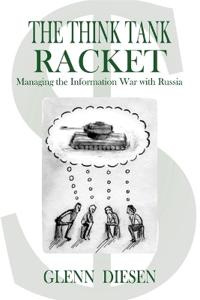 I discussed THE THINK TANK RACKET with the Groong podcast.
The negative aspect of think tanks is their immense power, from controlling information to functioning as a waiting room for politicians out of office.
Information is power, and the business model of think tanks entails selling political influence in Washington and manufacturing consent among the public.
The military-industrial complex is the dominant donor to think tanks, which results in a bias toward military solutions and perpetuating conflict.
THE THINK TANK RACKET: Managing the Information War with Russia – CLARITY PRESS, Inc.
THE THINK TANK RACKET: Managing the Information War with Russia
USAID – AusAID: Same playbook different actors
By Alan Moran | Regulatory Review | February 18, 2025
Donald Trump tweeted “Looks like billions of dollars have been stolen at USAID and other agencies much of it going to the fake news media as a payoff for creating good stories about the Democrats”. Revelations about corruption in the USAID beg questions about the integrity of Australia’s aid programs.
There are long-standing questions dating back to the Clinton days and before the Rudd ALP Government.
The Clintons are estimated to be worth between $120 million and $240 million having been in debt by $16 million when Bill left office in January 2001. According to the newsagency, Associated Press, 85 private sector stakeholders, which is more than half of the non-government people who met with Hillary Clinton while she was secretary of state, gave money — either personally or through companies or groups — to the Clinton Foundation. This amounted to $156 million. In addition, Clinton met with representatives of at least 16 foreign governments that donated as much as $170 million to the Clinton charity. Australia was among these governments.
According to Grok, in:
- February 2006: $25 million was donated to the Clinton Foundation by Foreign Minister Alexander Downer
- October 2006: Another 15 million was given for HIV/AIDS initiatives by the Clinton Foundation
- April 1 2008 – September 5 2008: Under Prime Minister Kevin Rudd $10 million was donated to the Clinton Foundation
- September 2012: Under Prime Minister Julia Gillard $14 million was donated while Hillary Clinton was the US Secretary of State. Gillard later Chaired the Foundation’s Global Partnership for Education
- September 22 2014: Foreign Minister Julie Bishop announced a commitment of $88 million over five years to the Clinton Health Access Initiative, a sister organisation to the Clinton Foundation
Miranda Devine reported, “The Abbott government topped up the left-wing organisation’s coffers with another $140 million in 2014, bringing total Australian largesse to $460 million, according to a press release from Foreign Minister Julie Bishop. The funding ceased in 2016, when Trump assumed office.
Section 70.2 of the Commonwealth Criminal Code Act 1995 makes it illegal for Australian individuals or companies to bribe foreign officials. Apparently, the law does not extend to Australian officials and politicians!
AusAID (which Tony Abbott located within DFAT in 2013) follows a similar playbook to USAID. Thus:
- The Office of Development Assistance (ODA) investments valued at $3 million and above must have a gender equality objective.
- DFAT has a $3.5 million Inclusion and Equality Fund to support LGBTQIA+ organisations to catalyse change in their communities.
- ODA spent $619 million (15 per cent of its budget) on climate related issues in 2022/23. It is not clear that grants to NGOs pressing climate issues are included.
Other Australian agencies are also involved in foreign expenditures. These include considerable funding for activities associated with climate change under the IPCC and the biennial Conference of Parties in which Foreign Affairs participate (as do CSIRO, BoM, Industry, Agriculture and others). These activities will surely soon be fully recognised as the gross destructive squandering of resources that they always were.
The Global Carbon Capture and Storage Institute (GCCSI) was initially launched in 2008 by Prime Minister Kevin Rudd who committed up to $100 million annually as part of his aim to make Australia a global leader in CCS technology. Over 15 years of total failure has not daunted its subsidy-seekers’ zeal.
More recently, the Quad Clean Energy Supply Chain Diversification Program, a spin-off from the diplomatic partnership between Australia, India, Japan and the United States, has a $50 million budget administered by “Business Australia”. Round 1, which closed on February 10, provides up to $2.5 million in funding for Australian and Indo-Pacific joint applications for studies to develop and diversify clean energy supply chains in the Indo-Pacific region. Such a scheme would not find support from President Trump but will program inertia allow it to survive the changed US agenda?
If Australia is ever to get the Trumpian leadership it needs, such programs will have to be excised, perhaps by using techniques, pioneered by Elon Musk’s Department of Government Efficiency (DOGE), involving freezing bank accounts.
Wrong, Politico, Climate Change Does Not Threaten the EU’s Survival, But Climate Policy Does
By Linnea Lueken | Climate Realism | February 19, 2025
A recent Politico article, “Climate change threatens EU’s survival, German security report warns,” claims that “global warming will exacerbate conflicts, hunger, and migration worldwide, with growing risks for Europe.” Evidence undermines these claims. In reality, the world is not suffering destabilization due to climate change, but European populations are far more likely to suffer from climate policy, as Politico briefly mentions.
Politico reports on a “landmark” political report from the German federal intelligence service (BND) that attempts to assess “the dangers climate change poses to German and European security over the next 15 years.” The report concludes that “climate change’s destabilizing effects will drive up migration and food prices, threatening economic and political upheaval,” and “the unequal impact of rising temperatures in the EU — with southern countries hit worse than others — risks tearing the bloc apart.”
Politico goes on to claim that as global average temperature rises, “so do the frequency, severity and intensity of flood-triggering extreme rainfall, deadly heat waves, harvest-destroying droughts and the conditions that allow wildfires to spread easily.”
These claims are false, as available data proves.
While rainfall has modestly increased over northern latitudes that contain the European Union member states, extreme rainfall that causes flooding has not. Claims that recent flooding events were “supercharged” or worsened by climate change are pure speculation based on attribution modelling. Data and historical records of flood frequency and severity debunk claims of unprecedented flooding. Recent flooding in Spain, for instance, was blamed on climate change by attribution groups, but the storm that hit Spain was consistent with a long history of similar storms that are not becoming more severe or frequent. In the Climate Realism post, “Flooding Facts Drowned by Climate Hysteria: The BBC Ignores Spain’s Weather History,” meteorologist Anthony Watts and H. Sterling Burnett describe the history of the region struck by the floods:
Valencia, which sits along and at the mouth of the Turia River on the Mediterranean Sea, suffered similar flooding, for example, in 1897, 1957, and 1996, 127, 67, and 28 years of warming ago, respectively, when temperatures were cooler than at present.
…
As Caroline Angus’ account of the 1957 Valencia flood reveals, these conditions are neither new nor unprecedented. The BBC’s focus on “climate change” and a warmer atmosphere as the primary cause of the recent flooding ignores the atmospheric mechanics behind these storms and downplays the recurrent pattern of similar natural events.
Likewise, Climate Realism debunked other regional European flooding events, here.
Heatwaves and drought are likewise not getting worse, and contra Politico and the German report’s claims, crop production is not declining in Europe due to those conditions, as pointed out in numerous Climate Realism posts, here, here, and here, for example. Wildfires are also on the decline globally.
Interestingly, Politico and the German report do admit that government response to climate alarmism may also cause tension. Politico reports that policies meant to address climate change “will cause tensions, noting that carbon pricing — the backbone of EU climate efforts — disproportionately affects poorer households.” This fact should be obvious to anyone. Carbon pricing does not bother the elites, who can afford higher energy prices.
Politico and the report authors also warn “the cost of decarbonization and its (perceived) unfair distribution … provide space for populism, right-wing and left-wing extremism, and disinformation campaigns[.]”
That claim should be taken further, it already has caused tensions, and has contributed to a growing threat to European food supplies, resulting in frequent mass protests in multiple countries by farmers. Not only that, but its not a perception that the distribution of the costs is unfair, it is a fact. Looking beyond carbon taxes, the push for electric vehicles is a subsidy for a luxury product that most cannot afford. London’s “ultra low emission zones” (ULEZ) are basically a tax on the poor who cannot afford to purchase new electric or low emitting hybrids.
What is true for Europe with regards to crop production is also true for other major crop producing parts of the world, and so climate change is not driving or likely to drive mass migration that could destabilize Europe. Climate Realism has debunked claims that climate change was causing mass emigration in multiple posts, here, here, and here, for instance.
If Politico and German leaders are worried about “populism” and right leaning sympathies rising in their nations due to concerns about mass immigration from unstable parts of the world, then perhaps they could impose restrictions on immigration, no need to blame climate change.
It’s shameful that Politico and the German government are downplaying the harm that the unnecessary, unjustified, climate policies which they have supported have had on Europeans. Extreme weather is not getting worse, but the impacts of government overreach and taxation in the name of climate change are.
EU Wildfire Trends 2024
By Paul Homewood | Not A Lot Of People Know That | February 23, 2025

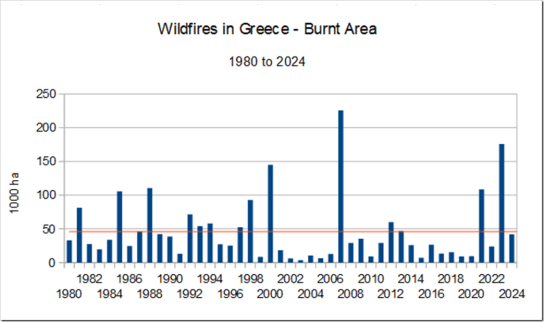
Wildfire activity in southern Europe was below average last year, according to the latest data from the EU. The trend is clearly downwards since 1980, contrary to the disinformation spewed by the establishment media.
The BBC’s Matt McGrath, for instance, recently claimed that a warmer world increased the chances of devastating wildfires occurring, while the Guardian’s Damien Carrington also falsely stated that “globally, scientists agree that climate change is increasing the global risk of wildfires starting and spreading”.
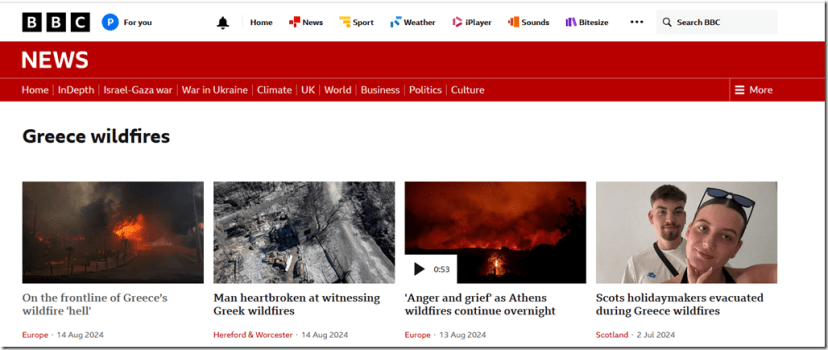
Last summer the BBC went into full propaganda mode over some fires in Greece, even though the burnt area was actually below average:
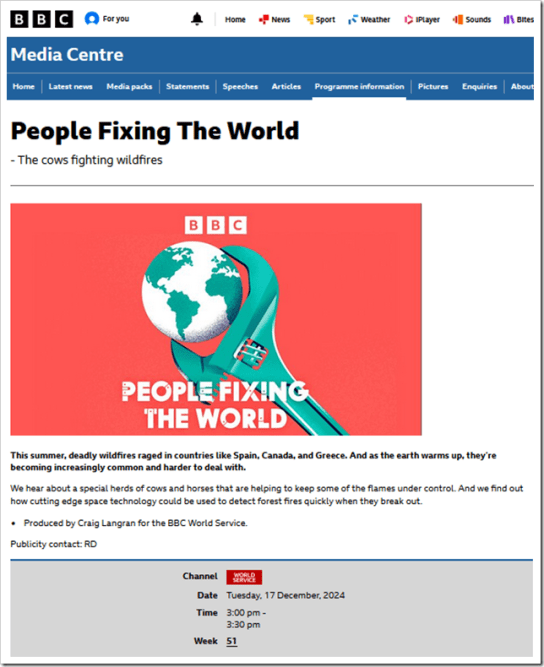
And in December, a BBC World Service broadcast falsely claimed that a warmer earth was making “deadly fires in Spain and Greece increasingly common”.
The BBC – the place where facts go to die!
Sources
1) Data for 2024 is from Copernicus: https://forest-fire.emergency.copernicus.eu/apps/effis.statistics/seasonaltrend
2) Earlier data id from the EEA: https://www.eea.europa.eu/data-and-maps/daviz/burnt-forest-area-in-five-4/#tab-chart_5
and EFFIS:
https://effis.jrc.ec.europa.eu/reports-and-publications/effis-related-publications
Wales Becomes First UK Testbed for Citywide AI-Powered Facial Recognition Surveillance
By Didi Rankovic | Reclaim The Net | February 22, 2025
Wales is that part of the UK the authorities have picked as the testbed for the first citywide deployment of what some consider to currently be the most radical form of mass biometric surveillance in public places – “AI”-powered live facial recognition.
What is likely to be the reason behind the “trial,” privacy campaigners are warning, is the eventual permanent deployment of this type of biometric surveillance throughout the country.
South Wales Police said that Cardiff will be covered by a network of CCTV cameras with facial recognition tech embedded in them, while the excuse is providing security during the international Six Nations rugby event. But the police also characterized the move as “semi-permanent.”
This appears to be a distinction between what the police in the UK have used thus far to carry out surveillance based on live facial recognition: vans with one camera.
The decision to move to position a host of cameras in the central zone of Cardiff makes this a significant expansion of the technique.
And while the police are reassuring citizens that expanding live facial recognition “really enhances” law enforcement’s ability to do their job – the Big Brother Watch privacy group slammed the move as a “shocking” development and the creation of an “Orwellian biometric surveillance zone.”
And while capturing everyone’s biometric data, and in that way, according to Big Brother Watch’s Senior Advocacy Officer Madeleine Stone, turning Brits into “walking barcodes” and “a nation of suspects” – in terms of solving crime, this is proving to be a waste of public money.
“This network of facial recognition cameras will make it impossible for Cardiff residents and visitors to opt out of a biometric police identity check,” Stone underlined.
And yet, over the three years that live facial recognition has been in use at sporting venues (only) – the use of the technology has not led to any arrests.
“No other democracy in the world spies on its population with live facial recognition in this cavalier and chilling way,” Stone warned, adding, “South Wales Police must immediately stop this dystopian trial.”
The technology works by capturing the faces of every person passing through an area covered, in real time, to then compare them to a database of those described in reports as “wanted criminals.”
However, when South Wales Police spoke about who is on their “watchlist,” it also included people “banned from the area” and those “who pose a risk to the public.”
More: UK Government Fast-Tracking Bill to Monitor Bank Accounts, Revoke Licenses, and Search Homes
Featured Video

Meet The Ellisons: Zionists, Technocrats, Moguls
or go to
Aletho News Archives – Video-Images
Frlom the Archives
Who Rules America?
The Power Elite in the Time of Trump
By James Petras | Axis of Logic | September 6, 2017
Introduction
In the last few months, several competing political, economic and military sectors – linked to distinct ideological and ethnic groups – have clearly emerged at the centers of power.
We can identify some of the key competing and interlocking directorates of the power elite:
- Free marketers, with the ubiquitous presence of the ‘Israel First’ crowd.
- National capitalists, linked to rightwing ideologues.
- Generals, linked to the national security and the Pentagon apparatus, as well as defense industry.
- Business elites, linked to global capital.
This essay attempts to define the power wielders and evaluate their range of power and its impact. … continue
Blog Roll
 Aletho News
- The Strategic Folly of a (Serious) US Ground Invasion of Iran
- US-Israeli war of aggression on Iran meant to reshape region: Omani FM
- Iran Does Not Consider Israel Party to Talks to Need Mediators With It – Ambassador
- Macron’s aircraft carrier and warplanes to the Persian Gulf is a dangerous vanity project
- Meet The Ellisons: Zionists, Technocrats, Moguls
- US failures in Iran reveal Russia is key to South Korea’s strategic security
- ‘All ports in Persian Gulf will be legitimate targets if Iranian ports are attacked’
- 40 Years of Endless War, Data Point by Data Point
- Department of War Using Palantir AI to Pick Targets in Iran
- American bases do not protect – they attack the peoples of the Persian Gulf
- If Americans Knew
- The Unbelievable Madness of Our War With Iran
- World Council of Churches calls on govts to hold Israel accountable for violations of intl law
- How to end the war on Iran that costs US taxpayers $1M per minute – Not a ceasefire Day 153
- Israeli strategic plans to “remake the Middle East” from the 1950s and since
- Honoring Gaza’s women who refused to let the world look away
- 97% of victims of war on Iran are Iranian, 98% of victims in war on Gaza are Gazans – Not a ceasefire Day 152
- Early Iran strikes cost $5.6 billion in munitions, Pentagon estimates
- Israel Decided the War, But Trump’s America Fights and Pays the Bill
- Conscientious Objector Group: Phone ‘Ringing Off Hook’ As Huge Mobilization Underway
- U.S. support for Israel continues to plummet, despite media’s best efforts
- No Tricks Zone
- Destructive Green New Deal: German Energy And Metal Group Warns Of Drastic Crisis
- New Study Documents A 20-Year Pause In Arctic Sea Ice Decline – Driven By Internal Variability
- Wake-up Call: Survey Shows Majority Of Germans Now Favor Postponing Climate Targets!
- Televised! Leading German Political Candidate Tells Schoolchildren CO2 Makes Sun Hotter!
- New Study: A Century Warming Of 1.1°C Is ‘Commonplace’ And ‘Not Unusual’ During This Interglacial
- New Study: ‘Internal Noise’ And Volcanic Forcing Can Trigger 10-15°C Warming Within Decades
- Glaciers Worldwide Are Suddendly Surging, Experts Blame Warming!
- Surprising Discovery: Sahara Is Greening…Billions Of Trees Where Once Thought To Be Barren
- New Research Reaffirms Clouds, Aerosols, And Surface Solar Radiation Are ‘Driving The Climate System’
- Germany: Electric Car Catches Fire At Charging Station, Sets Off Local “Inferno”, Widespread Damage
 Aletho News