Israel’s Lobby Launches Preemptive War on Thomas Massie
By James Rushmore | The Libertarian Institute | March 4, 2025
Two weeks ago, Kentucky Senator Mitch McConnell announced that he would not seek re-election in 2026. McConnell’s announcement prompted Congressman Thomas Massie to share a poll asking his Twitter followers if he should run for McConnell’s open Senate seat, seek the governorship in 2027, or remain in the House.
Naturally, Massie’s followers were very enthusiastic about the former idea. But the prospect of a Senator Thomas Massie already has the Israel lobby on high alert.
Republican Jewish Coalition CEO Matt Brooks told Jewish Insider, “If Tom Massie chooses to enter the race for US Senate in Kentucky, the RJC campaign budget to ensure he is defeated will be unlimited.” Back in May 2023, Massie accused the RJC of taking “[the] neocon position that US taxpayers should fund the war in Ukraine.” The RJC responded by attacking Massie for, among other things, opposing U.S. funding for the Iron Dome and voting against a resolution condemning the Boycott, Divestment and Sanctions movement. Meanwhile, Rabbi Shlomo Litvin of the Kentucky Jewish Council accused Massie of “[going] out of his way to troll Jews,” and Melanie Maron Pell of the American Jewish Committee suggested that Massie demonstrates “outright hostility with the Jewish community.”
It should come as no surprise that the Israel lobby is doing everything in its power to torpedo any talk of a Thomas Massie Senate campaign. Massie is the only member of Congress who consistently opposes the ongoing wars in both Gaza and Ukraine. Shortly after the October 7 terrorist attack, Massie was the sole Republican congressman to vote against House Resolution 771, which “[reaffirmed] the United States’ commitment to Israel’s security,” “[urged] full enforcement of United States sanctions against Iran,” and declared that the U.S. “stands ready to assist Israel with emergency resupply and other security, diplomatic, and intelligence support.”
In November 2023, he voted against House Resolution 6126, which provided Israel with $14.5 billion in military aid. In April 2024, he opposed House Resolutions 8034 and 8035, which allocated $95 billion in foreign aid to Ukraine, Israel, Taiwan, and other Indo-Pacific allies. (Donald Trump declined to oppose that package, all but assuring its passage.) In January 2025, Massie voted present on the Illegitimate Court Counteraction Act, which would impose sanctions against any person who aids the International Criminal Court in its efforts to “investigate, arrest, detail, or prosecute” Israeli Prime Minister Benjamin Netanyahu and Minister of Defense Yoav Gallant.
Massie is keenly aware of the enormous power that the Israel lobby wields on Capitol Hill, and unlike other congressional Republicans, he is willing to publicly acknowledge the extent of its influence. During an interview with Tucker Carlson in June 2024, he noted that the American Israel Public Affairs Committee assigns handlers to every House Republican, dispatching them to influence how lawmakers vote. The previous month, the United Democracy Project, a super PAC affiliated with AIPAC, spent at least $300,000 on TV ads tying Massie to Iran, Hamas, and Hezbollah. Their efforts were in vain, as Massie won his primary with three-quarters of the vote.
Whether or not Massie can win a Senate primary remains to be seen. The only Republican candidate to have formally entered the race at this point is former Kentucky Attorney General Daniel Cameron, a McConnell protégé who lost the 2023 gubernatorial election. Cameron is already trying to distance himself from McConnell; he recently criticized the former leader of the Senate Republican Conference for opposing the confirmations of Pete Hegseth, Tulsi Gabbard, and Robert F. Kennedy Jr., and he even signaled his opposition to further aid to Ukraine. But in November 2023, shortly after losing his bid for governor, Cameron joined twenty-five other Republicans attorneys general in signing a letter urging Joe Biden and congressional leaders to provide “military resources, intelligence, and humanitarian assistance to Israel as she defends herself against those seeking her destruction.”
Congressman Andy Barr may also launch a bid for McConnell’s Senate seat. Barr believes that “enemies of Israel are enemies of the United States.” Just last month, he declared that he “[stands] fully with Israel in its mission to wipe every last Hamas terrorist off the face of the earth.” Given that AIPAC was the top contributor to his campaign committee in 2024, Barr’s commitment to the Israeli cause is perfectly understandable.
If he runs, Massie would be sure to receive an endorsement from Kentucky Senator Rand Paul, who has unfortunately proven incredibly disappointing on the Gaza front. In November, Paul voted against three resolutions intended to block $20 billion in weapons sales to Israel. In January, he backed the ICC sanctions bill.
But a Donald Trump endorsement will no doubt prove to be the most important variable in shaping the outcome of the race. While Massie’s decision to endorse Ron DeSantis during the 2024 Republican presidential primaries may have hurt his standing with Trump, it is worth remembering that Trump offered former critic and one-time Evan McMullin supporter J.D. Vance his endorsement during the 2022 Ohio Senate primary. And the rest is history.
In December 2023, Senate Majority Leader Chuck Schumer accused Massie of anti-Semitism after he shared a meme correctly noting that Congress is more interested in Zionism than American patriotism. Expect more attacks like those, this time from pro-Israel Republicans, should the seven-term congressman enter the race to succeed McConnell. Despite those challenges, there is no doubt that a Thomas Massie Senate campaign has the potential to steer U.S. foreign policy in a less insane direction.
EU’s von der Leyen unveils $840bn rearmament plan
RT | March 4, 2025
European Commission President Ursula von der Leyen has proposed that member states spend about $840 billion on defense to strengthen their military self-sufficiency – an amount more than double total EU defense expenditure in 2024.
In a statement on Tuesday, the EU chief cited the “most dangerous of times” and the “grave” threats facing the bloc as reasons to assume greater responsibility for its own security.
“We are in an era of rearmament,” von der Leyen declared, adding that she had sent a letter outlining her ‘ReArm Europe Plan’ to member state leaders ahead of the European Council meeting later this week.
“ReArm Europe could mobilize close to €800 billion ($840 billion) for a safe and resilient Europe,” she said. “This is a moment for Europe. And we are ready to step up.”
Official data shows the bloc’s total defense spending reached an estimated $344 billion last year, marking an increase of more than 30% since 2021.
The new plan includes $158 billion in loans available to member states to invest in what von der Leyen described as “pan-European capability domains,” including air and missile defense, artillery systems, missiles and ammunition, drones, and anti-drone technology. It will also address other needs, from cybersecurity to military mobility.
The proposed five-part strategy is also designed to address the “short-term urgency” of supporting Ukraine, the EU chief said.
Von der Leyen did not specify a detailed timeline, but emphasized that defense spending must increase “urgently now but also over a longer period over this decade.”
Her announcement came just hours after news agencies reported on Monday that US President Donald Trump had ordered a pause on military aid to Ukraine. Trump has repeatedly accused Ukrainian leader Vladimir Zelensky of refusing to negotiate peace with Russia and exploiting US support for his own gain. Following Zelensky’s public clash with Trump and US Vice President J.D. Vance on Friday, the US president said America would no longer tolerate the Ukrainian leader’s attitude.
The EU has historically depended significantly on the US for its security, primarily through the North Atlantic Treaty Organization (NATO). However, the Trump administration has recently signaled a major policy shift, urging European nations to take the lead in their own defense, as well as Kiev’s. Last month, Pentagon chief Pete Hegseth said that Washington intended to refocus its military priorities on countering China, warning the EU not to assume that American forces would remain in the region indefinitely.
Trump has previously warned that under his leadership the US would not defend NATO countries that fail to meet their financial commitments. He has floated the idea of raising mandatory defense spending by members to 5% of GDP, though none – including the US – currently meet that threshold.
His push for increased defense spending has drawn mixed reactions, with some EU officials questioning its economic feasibility. European officials have occasionally raised concerns that Trump could pull the US out of the organization.
Russian Deputy Foreign Minister Aleksandr Grushko recently warned that NATO appears to be preparing for war with Moscow, arguing that its current course poses a threat both to Russia and to overall security architecture.
Kremlin responds to reports of Trump move on Ukraine aid
RT | March 4, 2025
Halting US military aid to Ukraine would be a significant step toward resolving the conflict, Kremlin spokesman Dmitry Peskov stated on Tuesday.
Several US media outlets have reported that Washington has suspended the purchase of new weapons for Ukraine. Several reports have also suggested that US President Donald Trump has also ordered a halt to shipments of military aid.
Speaking to journalists on Tuesday, Peskov stated that while the details of these reports have yet to be confirmed, such a move could prove to be a significant step towards de-escalation.
“It is obvious that the US has been the main supplier” of military aid to Kiev, Peskov noted, adding that if the US were to relinquish this role or suspend supplies altogether it would “probably be the best contribution to the cause of peace.”
The spokesman said that if the US had indeed stopped all military aid to Ukraine, it would mean that Kiev would effectively lose the vast majority of its ammunition, equipment and intelligence.
“If this really is so… then perhaps, without indulging in excessive optimism, we can modestly hope that this could encourage the Kiev regime to lean towards attempts to resolve the situation through peaceful means,” Peskov told Rossiya 1 TV journalist Pavel Zarubin.
According to Bloomberg, Trump has ordered a freeze on all military aid to Ukraine, which includes equipment already designated for delivery, as well as weapons in transit on aircraft and ships or waiting in transit areas in Poland. The New York Times reported that the president’s order, which has already taken effect, affects more than $1 billion in “arms and ammunition in the pipeline and on order.”
Meanwhile, the Washington Post claimed that in addition to stopping weapons shipments to Kiev, Washington is also considering the termination of intelligence sharing and training for Ukrainian troops and pilots.
Trump’s reported order comes after a public spat with Ukrainian leader Vladimir Zelensky in the White House on Friday. During the meeting, Trump accused Zelensky of ingratitude and “gambling with World War III” by refusing to work towards a halt to hostilities.
After the heated exchange, Zelensky stated on Sunday that peace between Ukraine and Russia was still “very, very far away,” prompting even more ire from Trump, who said it was “the worst statement that could have been made” by the Ukrainian leader.
Trump warned that “America will not put up with it for much longer,” and suggested that Zelensky “doesn’t want there to be Peace as long as he has America’s backing.”
Zelensky reverses hardline position on peace talks
RT | March 4, 2025
Ukrainian leader Vladimir Zelensky has said that Kiev is ready to engage in peace negotiations with Russia, to be brokered by US President Donald Trump. The statement comes after the White House reportedly stopped all military aid to Kiev following a disastrous meeting in the Oval Office between the two leaders, for which US officials have demanded Zelensky apologize.
Zelensky made a concession-filled post on X on Tuesday, saying his public feud with Trump in the Oval Office was “regrettable.”
“We are ready to work fast to end the war,” Zelensky wrote. He has frequently said in the past that Ukraine would fight as long as necessary and that peace talks could only happen on Ukraine’s terms.
He proposed the release of prisoners and establishing “truces” on both the air and sea fronts, echoing suggestions by UK Prime Minister Keir Starmer and French President Emmanuel Macron in a meeting with him in London on Sunday. The French-UK plan envisages a temporary, month-long “truce in the air, on the seas, and on energy infrastructure.” Moscow has repeatedly ruled out a temporary ceasefire with Kiev, insisting on a permanent, legally binding peace deal that addresses the root causes of the conflict.
On Monday, Trump reportedly ordered a temporary halt to all US military aid to Ukraine, aiming to pressure Zelensky into negotiations to end the conflict with Russia. An unnamed senior administration official told Fox News that military assistance would stay suspended until the Ukrainian leadership demonstrates a genuine commitment to peace talks.
“Ukraine is ready to come to the negotiating table as soon as possible to bring lasting peace closer,” Zelensky continued on X, offering his appreciation for Washington’s support. “My team and I stand ready to work under President Trump’s strong leadership to get a peace that lasts,” he added.
“’Ready’ is good, it is positive,” Kremlin spokesman Dmitry Peskov reacted to the statement.
During the Friday meeting, Trump accused Zelensky of ingratitude and “gambling with World War III” by refusing to work towards a halt to hostilities.
On Sunday, Zelensky told reporters that “an agreement to end the war is still very, very far away, and no one has started all these steps yet.” Trump condemned his statement on social media, promising that “America will not put up with it for much longer.”
Russian President Vladimir Putin has indicated Moscow’s readiness to resolve the Ukraine conflict through peaceful means. He emphasized Russia’s aim of establishing an international system that ensures a balanced and mutual consideration of interests, creating a long-term, indivisible European and global security framework.
Let’s Not Forget JFK’s Attitude Toward Russia
By Jacob G. Hornberger | FFF | March 4, 2025
In the aftermath of the tirade at the White House among President Trump, Vice-President Vance, and Ukrainian President Zelensky, both conservatives and liberals (i.e., “progressives” or leftists) are going ballistic over Trump’s friendly attitude toward Russia. They are pointing out that since at least the end of World War II, the official attitude of the U.S. government has always been that Russia is to be considered a threat to U.S. “national security” as well as an official enemy, rival, opponent, or competitor of the United States. They say that Trump’s positive overtures to Russia are unprecedented.
For example, consider a March 2 article in the New York Times entitled “Trump Is Doing Real Damage to America” by David French, which states that after World War II, “both parties saw the Soviet Union as the grave national security threat it was. For decades, both parties were more or less committed to a strategy of containment that sought to keep Soviet tyranny at bay.” French also suggests that America’s “fundamental identity” lies to this very day in a continued commitment to NATO and a continuous antipathy toward Russia.
French’s mindset is pretty much mirrored in an op-ed in the Wall Street Journal in a March 3 article entitled “Trump’s Embrace of Russia Rocks NATO Alliance” by Daniel Michaels. The article states: “The American president’s embrace of Russia, an adversary that has worked for years to undermine U.S. global leadership, runs counter to decades of Western policy. The U.S. and its allies founded the North Atlantic Treaty Organization 75 years ago as protection against Soviet Russia.”
There is one notable omission from both articles, however, an omission that occurs in other articles along these same lines in the mainstream press. That omission is President John F. Kennedy and, specifically, Kennedy’s move toward peaceful, friendly, and normal relations with Soviet Russia and, for that matter, with the rest of the communist world.
Why would members of the mainstream press fail to point out this one important exception to the official policy of perpetual hostility and antipathy toward Russia? After all, they have to be familiar with Kennedy’s June 10, 1963, commencement address at American University — a speech that became known famously as Kennedy’s Peace Speech.
My hunch is that the reason the mainstream press omits this major exception to its official anti-Russia historical narrative is twofold: (1) It would cause them to have to explain why Kennedy was trying to change America’s direction, something that the mainstreamers would prefer not to do and (2) It would cause them to have to address the uncomfortable subject of the JFK assassination, something the mainstream press has always been loathe to do.
By the time JFK delivered his speech, he had achieved a “breakthrough’ that enabled him to see that the Cold War was just one great big racket, one that was not only extremely dangerous but also one that was being used to justify the conversion of the federal government from its founding system of a limited-government republic to a national-security state, a totalitarian type of system in which the federal government wields omnipotent powers, including assassination, torture, and indefinite detention. He had achieved this breakthrough after experiencing the national-security establishment’s perfidy in the Bay of Pigs fiasco, its advocacy of a surprise first-strike nuclear attack on Russia, its infamous Operation Northwoods proposal, and its highly dangerous and irresponsible actions during the Cuban Missile Crisis.
To get a sense of the dramatic and revolutionary shift JFK was taking America, it is necessary to read or listen to the entire speech, which can be done here. To get a sense of why there was so much anger, hatred, and distrust for Kennedy within the U.S. government and the mainstream press, consider the following excerpts from his speech:
I also believe that we must reexamine our own attitude–as individuals and as a Nation–for our attitude is as essential as theirs. And every graduate of this school, every thoughtful citizen who despairs of war and wishes to bring peace, should begin by looking inward–by examining his own attitude toward the possibilities of peace, toward the Soviet Union, toward the course of the cold war and toward freedom and peace here at home.
First: Let us examine our attitude toward peace itself. Too many of us think it is impossible. Too many think it unreal. But that is a dangerous, defeatist belief. It leads to the conclusion that war is inevitable–that mankind is doomed–that we are gripped by forces we cannot control.
We need not accept that view. Our problems are manmade–therefore, they can be solved by man. And man can be as big as he wants. No problem of human destiny is beyond human beings. Man’s reason and spirit have often solved the seemingly unsolvable–and we believe they can do it again.
I am not referring to the absolute, infinite concept of peace and good will of which some fantasies and fanatics dream. I do not deny the value of hopes and dreams but we merely invite discouragement and incredulity by making that our only and immediate goal….
So let us persevere. Peace need not be impracticable, and war need not be inevitable. By defining our goal more clearly, by making it seem more manageable and less remote, we can help all peoples to see it, to draw hope from it, and to move irresistibly toward it.
Second: Let us reexamine our attitude toward the Soviet Union….
No government or social system is so evil that its people must be considered as lacking in virtue. As Americans, we find communism profoundly repugnant as a negation of personal freedom and dignity. But we can still hail the Russian people for their many achievements–in science and space, in economic and industrial growth, in culture and in acts of courage.
Among the many traits the peoples of our two countries have in common, none is stronger than our mutual abhorrence of war. Almost unique among the major world powers, we have never been at war with each other. And no nation in the history of battle ever suffered more than the Soviet Union suffered in the course of the Second World War. At least 20 million lost their lives. Countless millions of homes and farms were burned or sacked. A third of the nation’s territory, including nearly two thirds of its industrial base, was turned into a wasteland–a loss equivalent to the devastation of this country east of Chicago….
I am taking this opportunity, therefore, to announce two important decisions in this regard.
First: Chairman Khrushchev, Prime Minister Macmillan, and I have agreed that high-level discussions will shortly begin in Moscow looking toward early agreement on a comprehensive test ban treaty. Our hopes must be tempered with the caution of history–but with our hopes go the hopes of all mankind.
While JFK did not formally declare an end to the Cold War, every official within the Pentagon, the CIA, and the NSA — as well as their Operation Mockingbird assets within the mainstream press — fully understood that that was the import of his Peace Speech. Thus, it is not difficult to see why U.S. officials deemed Kennedy to be a grave threat to “national security.” The president who they considered to be a naive, incompetent, traitorous womanizer was not only taking America down a road to communist defeat in the Cold War, he was also implicitly challenging the need for a totalitarian-like national-security state for America. JFK’s Peace Speech was effectively a declaration of war by the executive branch of the U.S. government against the national-security branch.
JFK’s Peace Speech left the national-security establishment with a deeply discomforting choice: Sit back and let Kennedy take the country down or keep America “safe” by eliminating Kennedy. See FFF’s book JFK’s War with the National Security Establishment: Why Kennedy Was Assassinated by Douglas P. Horne, who served on the staff of the Assassination Records Review Board and JFK and the Unspeakable: Why He Died and Why It Matters by James W. Douglass. Also see The Kennedy Autopsy and An Encounter with Evil by Jacob Hornberger.
Do you see why the mainstream press would prefer to airbrush John Kennedy’s decision to end the Cold War racket and move America toward peaceful and harmonious relations with Russia out of America’s history? If they include that major exception in their official historical narrative, they would have to explain the reasons for Kennedy’s decision as well as delve into the national-security establishment’s motive for eliminating him. They then have to explain how his assassination restored things to “normal” — with the continuation of the Cold War, the war in Vietnam, which ended up sacrificing more than 58,000 American men for nothing, the never-ending support of the Cold War dinosaur known as NATO, and the perpetual anti-Russia mindset that pervades America today.
Russia ready to facilitate US-Iran negotiations – Kremlin
RT | March 4, 2025
Russia is ready to broker talks between the US and Iran, including on Tehran’s nuclear program and its regional proxy network, Kremlin spokesman Dmitry Peskov told Bloomberg on Tuesday.
Trump expressed interest in talking to Iran about those issues, both in his phone call to Putin in February and via representatives at the high-level US-Russian meeting in Riyadh just days later, the news agency wrote, citing anonymous officials.
“Russia believes that the United States and Iran should resolve all problems through negotiations,” Peskov told Bloomberg when asked about such contact.
Moscow “is ready to do everything in its power to achieve this,” he added.
US President Donald Trump returned to his “maximum pressure” campaign on Iran last month, just weeks after Moscow and Tehran signed a landmark strategic partnership agreement. Trump’s executive order said that Washington would ramp up sanctions on Iran, aiming to disrupt its nuclear program, conventional missile deployment, and network of regional proxy groups.
The Iranian Foreign Ministry has said the country is building up its defenses, citing regular threats from US ally Israel.
“The Israeli regime’s FM and other officials keep threatening Iran with military action while the West continues to blame Iran for its defense capability. This is outrageous & irrational,” Iranian Foreign Ministry spokesman Esmaeil Baqaei said last week. Given that Israel is “addicted to aggression and lawless behavior,” it is “responsible and essential to maximize our defense capabilities,” he stressed.
The day before, Israeli Foreign Minister Gideon Saar warned that a “military option” should be on the table to stop the potential weaponization of Tehran’s nuclear program.
Israel and the West have long seen Iran’s uranium enrichment activities as a secret attempt to develop nuclear weapons – allegations that Tehran has repeatedly denied.
While Trump has touted harsher sanctions, he has also signaled that he is interested in signing a “verified nuclear peace agreement” with Tehran.
Iranian Supreme Leader Ayatollah Ali Khamenei has stressed that talks with the US are unlikely to bear fruit, citing the prior nuclear deal Trump unilaterally left during his first presidency.
Democracy does not ‘die in darkness,’ it is dying in the EU right now
By Tarik Cyril | RT | March 4, 2025
Quiz time: What do Germany, Moldova, and Romania (in alphabetical order) have in common? They look so different, don’t they?
Germany is a traditional, large, and at this point still relatively well-off (if less and less so due to obedient self-Morgenthauing for the greater glory of Ukraine) member of the Cold War “West” (give and take a “re-unification” and all that). Currently, it has a population of over 83 million people and a GDP equivalent to $4.53 trillion. Romania is an ex-Soviet satellite with just above 19 million citizens and a GDP less than a tenth of the German one (at $343.8 billion). Moldova, which emerged from a former Soviet republic, is the smallest: 2.4 million people and a GDP of $16.5 billion.
And yet, look more closely, and they are not so different: They are all either inside the EU and NATO (Germany and Romania) or attached to these two organizations as an outside yet important strategic asset (the case of Moldova – despite and in de facto breach of its constitutionally anchored neutrality, as it happens). And also, all three have serious problems with conducting fair and clean elections. What a coincidence. Not.
Let’s take a quick look at each case: In Germany’s recent federal election, the Bündnis Sahra Wagenknecht (BSW) failed to cross the threshold to representation in parliament – 5% of the national vote – by the thinnest of margins: The party officially garnered 4.972% of the vote. In absolute numbers, almost 2,469,000 Germans voted for the BSW (with the decisive so-called “second vote”). Only 0.028% – about 13,000 to 14,000 votes – more and the party would have passed the 5% barrier.
Even extremely tight results can, of course, be real and legitimate. The problem in Germany now is that there is steadily accumulating evidence that the elections were compromised by serious flaws and repeated errors. What makes this even more urgent is the fact that there seems to be a clear pattern with mistakes occurring not randomly but mostly at the cost of the BSW.
We already know about two key problems, although not much more than one week has passed after the election on February 23: First, about 230,000 German voters live abroad, but many of them could not cast their vote because the necessary documents reached them too late, sometimes even only after the elections. Of course, we cannot tell how exactly these voters would have voted if given the chance. But that is not the point. The fact alone that they could not participate casts severe doubt on the legitimacy of the results. And especially in the case of the BSW where so few additional votes would have been enough to principally change the outcome, that is, secure seats – and probably two to three dozen – in the next parliament.
The second even more disturbing issue is that there is ever more evidence of actual BSW votes inside Germany being allocated to another party. In the case of the major city of Aachen, for instance, a result of 7.24% for the BSW was registered for the “Bündnis für Deutschland” (an entirely different and much smaller party with no chance of parliamentary representation to begin with). The BSW vote was erroneously registered as 0%. Only protests by local BSW voters brought the scandal to light.
German mainstream media are trying to depict what happened in Aachen as an exception. Yet by now there are reports of similar “errors” from all over Germany – and don’t forget that the process of looking for these cases has only just started. In sum, there are good reasons – and they are getting better by the day – for believing that, for the BSW, the difference between correct and incorrect election procedures actually amounts to the one between being and not being in parliament. That implies, of course, that all those citizens who have voted for the BSW may well have been deprived of their proper democratic representation as foreseen by law.
Is there a motive for foul play? You bet. The BSW, an insurgent party combining leftwing social with rightwing cultural and migration-policy positions, has been hounded as too friendly toward Russia because it is demanding peace in Ukraine; it also has been outspoken about its opposition to basing fresh US missiles in Germany and to Israel’s crimes as well.
In Germany as it is now, these are all reasons for neo-McCarthyite smear campaigns and repression by – at least – dirty media tricks, all of which has already happened. It is entirely possible that a wave of deliberate local “mistakes” was added to that nasty tool box. And, a slightly different issue, asserting the BSW’s legal rights now will be especially difficult, in particular because a revision of the election result to include the party in parliament would immediately upset the complicated arithmetic of government coalition building. The BSW and its voters, in short, may well have been cheated, and they may be cheated again in case they seek redress.
The fact that one problem with those German elections has to do with voters living abroad rings a bell called Moldova, of course. There, last November, Maia Sandu narrowly won a presidential election that involved massively manipulating the outside-the-country vote. In essence, Moldovans abroad, especially in Russia, likely to vote against her were, in effect, disenfranchised by making it impossible for them to actually cast their vote; Moldovans more likely to vote for her, in the West, faced no such problems.
This crude trickery was decisive: Without it Sandu would have lost and her left-wing rival Alexandr Stoianoglo would have won. In the West, whose candidate Sandu has been, this outcome was, of course, hailed as a victory for “democracy,” a pro-EU choice, and a defeat of “Russian meddling.” As so often, it is hard to decide what is more jaw-dropping: the Orwellian reversal of reality or the Freudian projection of the West’s own manipulation on the big bad Russian Other.
That projection, in any case, is also in play in Romania. Indeed, at this point, the Romanian case of electoral foul play is clearly the most brutal one. There, the gist of a long saga beginning last November, too, is simple: Calin Georgescu, an insurgent newcomer is very likely to win presidential elections. Yet he is being denounced as a far-right populist and – drum roll – as somehow in cahoots with Russia, too.
The consequences were not surprising, except in how drastic things have gotten: First, when Georgescu was close to winning one election, the Constitutional Court abused its power to cancel the whole exercise. The pretext was a file of pseudo-evidence cobbled together by Romania’s security services that, by now, even Western mainstream media admit is ridiculously shoddy.
As you would expect, this open assault on their right to vote has made Romanians support Georgescu more, not less, as polls show. Since the next try at elections is now due to take place in May and Georgescu is still the frontrunner, the authorities have followed up with even more ham-fisted repression. This time, Georgescu was temporarily and dramatically detained – on the way to registering his renewed candidacy – and then accused of half a dozen serious crimes. His access to social media has been curtailed; his team and associates are being raked with searches, charges, and, of course, media attacks. It is possible that he will be deprived of his right to stand for the election.
Georgescu’s supporters have held large demonstrations; he himself has appealed for help in his struggle against Romania’s “deep state” to the Trump administration in Washington. Trump’s de facto right-hand man, tech oligarch Elon Musk, has used his X platform to signal support for Georgescu. And not long ago, US Vice President J.D. Vance warned the Europeans over the first round of attacks on Georgescu.
Yet Romania’s key role in NATO strategies is certain to be a key reason the NATO-skeptic and sovereigntist Georgescu has run into such massive trouble, not only from Romanian mainstream elites but also, behind the scenes, those still running the EU. With Washington now revising its approach to both Russia and its NATO clients in Europe, Georgescu’s fate could well hinge on one of the greatest geopolitical shifts of this century. And that shift might favor him.
Maia Sandu’s crooked victory in Moldova is not up for revision. The chances for the BSW of finding redress should be good, but, in reality, they are not, unfortunately. Georgescu’s luck, though, may turn again. He already has massive electoral support; he may well get even more precisely because of the escalation of dirty tricks used against him, and he has the US de facto on his side.
What is certain, in any case, is one simple fact: the “garden” West, with its endless talk of “values” and “rules” does not, in practice, believe in real elections. Instead, geopolitics prevail. And, tragically, those geopolitics are not only overbearing but stupid. Driven by an obsession with fighting Russia (and China, of course; and the Trumpist US, too, if need be) and rejecting diplomacy as such, this is a West ready to sacrifice whatever little democracy it may have left to a delusion of grandeur that will be its downfall.
Tarik Cyril Amar ia a historian from Germany working at Koç University, Istanbul, on Russia, Ukraine, and Eastern Europe, the history of World War II, the cultural Cold War, and the politics of memory.
UN demands answers from UK on terror law abuse
By Kit Klarenberg | The Grayzone | March 1, 2025
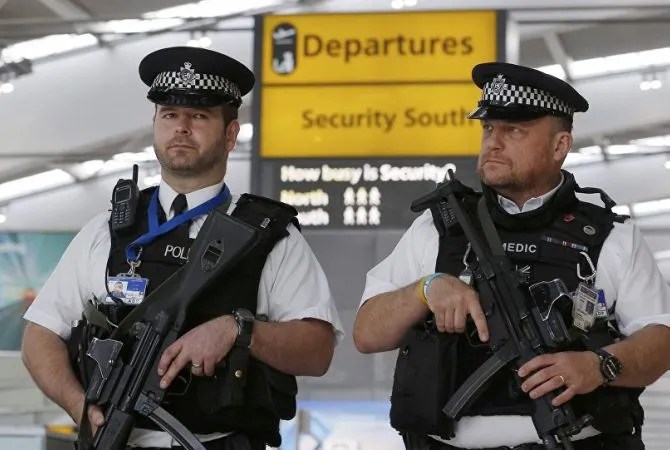
As the British state harasses and arrests a growing number of activists and dissident journalists, including the author of this piece, UN rapporteurs delivered a forceful letter of protest to London condemning its abuse of counter-terror legislation.
In December 2024, a quartet of UN rapporteurs focused on “peaceful assembly and of association” and the “right to privacy” delivered a strongly-worded letter to the British government. Expressing grave concerns about the potential “misapplication of counter-terrorism laws” to arrest, detain, interrogate and surveil dissident activists and journalists, including The Grayzone’s Kit Klarenberg, they demanded clarity on a number of serious issues. Given 60 days to respond, London remained suspiciously silent.
As a result, the UN’s correspondence with the British government has now been made public. The rapporteurs were clearly disturbed by reports of Schedule 7 of the 2000 Terrorism Act, and Schedule 3 of the 2019 Counter-Terrorism and Border Security Act, which covers “hostile” state threats, “being used to examine and obtain data from journalists and activists Johanna Ross, John Laughland, Kit Klarenberg, Craig Murray and Richard Medhurst in circumstances where they appear to have no credible connection to ‘terrorist’ or ‘hostile’ activity.”
While awaiting a reply that never came, the UN “urged” British authorities to undertake “interim measures” to prevent any recurrence of potential human rights breaches under counter-terror legislation, and “ensure the accountability” of anyone responsible for “alleged violations.” Evidently undeterred by pressure from the UN, Britain has continued to escalate its war on dissidents.
Since the UN issued its letter of protest, British activists and journalists have since been arrested, raided, and prosecuted, including Asa Winstanley, Tony Greenstein, Sarah Wilkinson, Palestine Action cofounder Richard Barnard, and academic David Miller.
The UN letter focused on how “powers under counter-terrorism legislation have been used on multiple occasions to examine, detain, and arrest journalists and activists, particularly at the UK border.” Individuals “who are critical of Western foreign policy in the context of the conflict in the Middle East and the Russia-Ukraine war are especially affected by the reported misuse of these powers,” the rapporteurs wrote.
Ominously, the UN rapporteurs suggested this could amount to “over-use [or] misuse” of British counter-terrorism legislation “to target legitimate freedom of expression and opinion, including public interest media reporting, and related freedoms of peaceful assembly and association, and political dissent or activism.”
“Vague and broad” laws mean mass-persecution
The UN rapporteurs were especially scathing in their critique of the powers used to harass and potentially incarcerate targets. They charged that Schedule 7 of the 2000 Terrorism Act “may be unjustifiably used against journalists and activists who are critical of Western foreign policy.” In each case they investigated, detentions under this legislation were “premeditated [and] examination, confiscation of devices, and DNA prints were conducted despite the apparent absence of a credible ‘terrorist’ connection” with the individual in question.
Such promiscuous application of ostensible counter-terrorism laws creates the unavoidable “risk of intimidating, deterring, and disrupting the ability of journalists to report on topics of public importance without self-censorship” in Britain. This “serious chilling effect,” the rapporteurs cautioned, could extend well beyond media, and “unjustifiably interfere with the rights to freedom of expression and opinion and participation in public life” across “civil society and legitimate political and public discourse.”
The UN took repeated aim “at the vagueness and overbreadth” of the 2000 Terrorism Act’s criminalisation of “expressing an opinion or belief…supportive of a proscribed organisation.” The legislation’s terms provide no definition whatsoever of the term “support”, an “ambiguous” deficiency that “may unjustifiably criminalize” legitimate opinions “not rationally, proximately or causally related to actual terrorist violence or harms.” They noted this prohibition “goes well beyond the accepted restrictions on freedom of expression under international law concerning the prohibition of incitement to violence or hate speech.”
Indeed, “speech that is neither necessary nor proportionate to criminalize, including legitimate debates about the de-proscription of an organization and disagreement with a government’s decision to proscribe” could be categorized as “supporting” a terrorist group under the 2000 Terrorism Act’s sweeping terms. This is especially problematic given certain factions proscribed by Britain, such as Hamas or Hezbollah, may be “de facto authorities performing a diversity of civilian functions, including governance, humanitarian and medical activities, and provision of social services, public utilities and education”:
“Expressing support for any of these ordinary civilian activities by the organization could constitute expressing support for it, no matter how remote such expression is from support for any violent terrorist acts by the group.”
Working for “hostile” governments without knowing
Similar alarm was sounded about the wording of Schedule 3 of the 2019 Counter-Terrorism and Border Act, under which The Grayzone’s Kit Klarenberg was detained upon returning to his home city of London in May 2023. It stipulates that anyone entering British territory suspected of “hostile activity” on behalf of a foreign power can be held against their will and interrogated for up to six hours, while the contents of their digital devices are seized and stored. Non-compliance automatically results in arrest.
See the notice of detention issued by British state security to journalist Kit Klarenberg under Schedule 3 of the UK’s Counter-Terrorism and Border Security Act of 2019 here.
Ever more disturbingly, Schedule 3 is suspicionless. Under the legislation’s terms, “it is immaterial whether a person is aware that activity in which they are or have been engaged is hostile activity, or whether a state for or on behalf of which, or in the interests of which, a hostile act is carried out has instigated, sanctioned, or is otherwise aware of, the carrying out of the act.” In other words, no conspirator in a suspected conspiracy has to have consented to potentially illegal activity.
“Hostile acts” are defined as any behavior deemed threatening to London’s “national security” or “economic well-being.” Again, the rapporteurs condemned this language as “vague and over-broad.” They concluded the phrasing granted British authorities “extraordinary discretion” to engage in “unnecessary, disproportionate or otherwise arbitrary interferences in the rights to liberty and privacy” of individuals detained under these powers. Moreover, as the Act’s targets are not formally under formal criminal investigation or arrest, or suspected of having committed any offense, they have no right to remain silent.
The UN branded this distinction as “artificial… given the punitive sanctions for non-compliance,” branding it as “inconsistent with the accepted meaning of ‘arrest’ or ‘detention’” under Article 9 of the International Covenant on Civil and Political Rights. The “extreme breadth” of Schedule 3 also “enables unnecessary, disproportionate, arbitrary or discriminatory interference with an individual’s rights, including freedom from arbitrary detention, freedom of movement…and the rights to leave and enter one’s own country.” Article 17 of the ICCPR also states:
“No one shall be subjected to arbitrary or unlawful interference with [their] privacy, family, home or correspondence, nor to unlawful attacks on [their] honour and reputation.”
This is explicitly contrary to Klarenberg’s May 2023 experience at Luton airport. There, as the rapporteurs documented, he was “fingerprinted, subjected to oral DNA swabs, and photographed by the examining officer,” while asked excessively invasive questions about his financial affairs, personal and professional relationships, and living situation in his adopted home country of Serbia. His belongings were extensively “searched and he was compelled to provide the passwords to his digital devices, which included a smartphone, tablet, and two cameras.”
Not only was all data on these devices copied, but “the memory cards and SIM cards of the electronic devices were copied outside the interrogation room” and “retained by the police.” As of the letter’s dispatch, one of Klarenberg’s memory cards had “been retained for a period exceeding a year and five months” by British authorities, suggesting he “remains under criminal investigation” for uncertain offenses he did not knowingly or willingly commit.
The rapporteurs noted Klarenberg was among several journalists detained by British border officials whose “electronic devices [were] confiscated for a significant period of time and have not been updated on the use, retention or destruction of their data, or advised in relation to their personal data protection rights.” In many cases, these seized items have never been returned, without satisfactory explanation or seeming legal justification.
New British laws further criminalize dissent
In closing, the UN rapporteurs “encouraged” London to repeal legislation under which dissidents have been persecuted, or “amend it to protect freedom of expression, and…develop prosecutorial guidelines for its appropriate use to avoid the unnecessary or disproportionate incrimination of political dissent.” They further implored London to “indicate how the application of counter-terrorism laws” against activists and journalists “is consistent with international human rights law, and an appropriate application of the law,” while providing “an update on the retention of data taken from the journalists.”
They went on to “urge” the British government to “consider the growing number of instances” where laws purportedly intended to deal with violent terrorist threats “may have been inappropriately directed towards journalists and activists, and to consider addressing this through amendments to the legislation, guidance for relevant officials, and training of border security officers.” Britain’s failure to respond to the UN’s letter, and ever-ratcheting attacks on domestic dissent subsequently, amply indicate these entreaties have fallen on determinedly deaf ears.
In December 2023, Britain rammed through a new round of draconian legislation reinforcing and further codifying the “vague and over-broad” terms of the laws condemned by the UN, under the auspices of the National Security Act. Its terms introduce a number of completely new criminal offenses with severe penalties, and wide-ranging consequences for freedom of speech. Explicitly enacted to neutralize investigative journalism and prevent the emergence of a new WikiLeaks, the Act is so expansive, individuals will almost inevitably break the law without wanting to, intending to, or even knowing they have.
British journalist Johnny Miller seeks asylum in Russia following campaign of harassment
At almost exactly the same time when UN rapporteurs complained to the British government about its abuse of “counter-terror” legislation to persecute dissidents, independent journalist Johnny Miller was granted asylum in Russia. Miller, a British citizen, had reported from the front lines of the Ukraine proxy war for two-and-a-half years. During this period, supporters of the government of Ukrainian President Volodymyr Zelensky subjected him to a campaign of intensive harassment, hacking his digital devices and Telegram account, bombarding him and his family with anonymous death threats, and publicly stalking him.
Miller told The Grayzone he’s not sure who or what was ultimately behind the campaign of harassment, but strongly suspects British and/or Ukrainian intelligence played a role. He says it was evident from the start of 2024 his movements in Moscow were being closely tracked while he travelled around the city, and seemingly in advance. At repeated meetings with friends and sources in bars, cafes and restaurants in the Russian capital, individuals would be waiting there for him, staring at him menacingly:
“It might sound crazy, but I think that’s the point. The purpose was to drive me insane, and make me look insane if I ever spoke up about this publicly. But these intimidating encounters from afar happened too many times to be a coincidence, and were witnessed by those I met with. One of them was George Dusoe, a US diplomat who quit out of protest over Gaza, after growing disillusionment with US government policy, and then moved to Russia.”
Miller met with Dusoe for a coffee a day before a formal interview. Afterwards, as they headed for the central Moscow metro, Dusoe quietly informed him they were being followed by multiple people. “He’d not only experienced that personally while posted abroad, but was specially trained in how to spot and evade it,” Miller noted. While the pair eventually eluded their stalkers, losing them in the metro, the experience shook Miller.
To this day, he can’t help but wonder, “what if I was alone, and this happened at night?,” citing the example of Adrian Bocquet. A French military veteran, he travelled to Ukraine in April 2022, witnessed Kiev’s forces commit countless grave war crimes, publicly testified to these atrocities while disputing Western claims of Russian atrocities in Bucha after returning home, then was stabbed in Turkey by Ukrainian nationalists. Miller is understandably relieved to finally be granted a degree of legal protection, personally and professionally:
“Their aim was to make me so scared for my life I stopped my work, and they almost succeeded. The psychological impact was massive, it was a form of warfare, and it stressed me like nothing I’ve ever experienced before,” he commented. “It’s a sick irony that one of the main reasons I sought asylum in Russia is [in order] to apply for a new passport, I would’ve had to give the British embassy in Moscow my address. No way!”
While detained in Luton airport in May 2023, The Grayzone’s Kit Klarenberg was not only forced under threat of arrest and prosecution to provide British counter-terror police his apartment address in Belgrade, but its location within the building, how much he paid for rent, and whether energy bills were included in that price. To what malign ends this information was put isn’t clear. From Miller’s point of view, British intelligence is determined to harass dissidents wherever they are, inside the country or thousands of miles away.
Kaja Kallas is ill-equipped to take stock of EU foreign policy after Zelensky’s drubbing in the White House
By Ian Proud | Strategic Culture Foundation | March 4, 2025
Now that Zelensky has been battered by Trump and abandoned by Starmer, he can fall back of Europe’s leading diplomat, Kaja Kallas. God help us all.
The earth is still shaking from President Trump and Vice President Vance’s tag team annihilation of Volodymir Zelensky at the White House. The 27 February meeting between Trump and Keir Starmer was a more convivial affair, with the British Prime Minister quiet on Ukraine while promoting the idea of much prized trade talks with America. That was the first signal of the UK getting real about its foreign policy disaster in Ukraine and recognising that it needs trade with America far more than it needs the huge cost of propping up an unwinnable war.
This leaves Zelensky’s fate in the hands of the European Union. And with Kaja Kallas, the current EU High Representative for Foreign Affairs and Security Policy, the omens aren’t promising.
Kallas’ problem is threefold.
First, she is not diplomatic.
If the biggest foreign policy challenge in Kallas’ in-tray right now is the war in Ukraine, then her ingrained hatred of Russia makes her a singularly bad choice as Europe’s lead diplomat.
Her worldview is carved out of her experience growing up in the Soviet Union the child of a woman who was deported to Siberia in 1949. She looks at Russia through a shattered lens of Estonia’s suffering during the so-called communist terror after the end of World War II.
How she sees events in Ukraine today is simply a continuum of the folklore of her life. Russia is the hated enemy, and, at some point, Russia will return to conquer Estonia once more. In her statements before war in Ukraine started, Kallas reaffirmed her view that Estonia could be the next country that Russia invades. As a NATO country, I have never seen any evidence that Russia has a plan to do this.
Kallas has called for NATO troops to be deployed to Ukraine, to ensure Russia’s total defeat. She has suggested that Russia be broken up into a series of smaller states. She once implied that Ukraine should inflict more civilian casualties on Russian citizens, to balance the number of casualties in Ukraine. Even as President Trump has said that NATO membership for Ukraine is unrealistic, she has continued to push for this to be kept on the table, despite it having been a redline for Russia for nineteen years.
Almost everything that she says is rooted in her unshakeable belief that defeating Russia is vital for the world to become a safer place.
The world is full of extremists, of course. However, she claims to be the leading diplomat of Europe. She seems singularly ill-suited to that role. But will nonetheless still support Zelensky, I’m sure.
Which ushers in her second problem, the absence of a democratic mandate.
Countries that are sceptical about the European project often express concerns about the lack of democratic accountability of EU institutions.
No one voted for Kallas to occupy her office in Brussels. While Zelensky has only been unelected since May of 2024, Kallas will only ever be an unelected apparatchik.
When the European Union’s role was focussed on creating a united economic, social and cultural space among nations after the ravages of World War II, it found peace by opening up borders. However, as it has grown, Europe has become increasingly bureaucratic. Following agreement of the Lisbon Treaty, the creation of a High Representative for Foreign Affairs and Security with a newly formed European External Action Service, continued this centralising trend.
Without any democratic mandate, occupants of the High Representative role have struggled for relevance. Outside of trade policy, individual Member States still manage their own bilateral diplomacy. And as the war in Ukraine has backfired on Europe through economic decline and political dissent, so Europeans countries have sought their divergent paths.
That has left ineffectual figures like Josep Borrel and ideologues like Kallas unable to play the sort of coordinating role that they yearn for.
So, in practice, Kallas’ influence on the actions of Member States is limited, although she has considerable power to cause harm through inflammatory public statements. This is a huge challenge when dealing with countries like Russia, where the leaders there understand fully the limitations on Kallas’ role and ignore her. Instead, Russia focusses its influencing efforts on key EU members states, especially in Central Europe.
Even though Kallas can call for the continued isolation of Russia as support for Zelensky rapidly crumbles, she has no real power to enforce that. She lacks a mandate.
So herein lies her third problem.
Kaja Kallas has no strategy.
There is a huge risk that Kallas is seen as a single-issue High Representative, as her main effort appears to be on the war in Ukraine.
She appears intent only on sustaining the decade-long European zeitgeist on non-engagement with Russia, whatever the economic cost. But in that regard, not only is she not bringing new ideas on foreign policy, her lack of flexibility will make her look out of touch at a time when Europe is facing significant economic and political challenges caused by the war. Arriving into the job in December, Kallas has brought plenty of heat, but no light.
Donald Trump has now arrived heralding a seismic shift in U.S. policy and she still thinks the earth is flat. She has criticised President Trump’s radical shift towards direct engagement with Russia without offering a compelling alternative vision.
The ‘Russia is coming for Europe next’ continues to be the rhetorical life-raft that she clings to as she tries desperately to help the now stranded Zelensky fight to the last Ukrainian.
Kallas is certainly not the author of the EU policy that has tried explicitly to isolate Russia on the world stage. But she has worked tirelessly to keep it alive, together with all the other tropes about how to handle Russia and why an end to the war can never be contemplated.
Of course, that position may have been sustainable while Joe Biden was still in power and the U.S. were arguably more gung-ho about pushing an unwinnable war in Europe.
But Donald Trump’s devastating take-down of Zelensky in the White House will force an immediate reckoning on the European policy establishment about what to do for Ukraine, and for Zelensky. Kaja Kallas has neither the skills, the mandate nor the plan to chart a credible way forward.
Russia’s Resurgence and the Evolving US-Russia Relations
By Abbas Hashemite – New Eastern Outlook – March 4, 2025
Since World War II, Russia and the US have been fierce rivals, but with Donald Trump’s re-election and Russia’s rise as a superpower, the US is now shifting toward fostering cordial ties.
Russia’s Resurgence and the Evolving US-Russia Relations
The Cold War resulted in the collapse of the Soviet Union, creating a unipolar world order led by the United States. Since the culmination of the Cold War, the US has been following a more hardline foreign policy towards its rivals and allies, tarnishing its soft image around the globe. However, its economic and military supremacy helped it to sustain its position as the sole superpower of the world for almost 3 decades. The United States has been alluring third-world countries through economic aid to achieve its geopolitical interests in different regions. It also coerced weak countries militarily to support its foreign policy interests.
Nonetheless, the rapid rise of Russia and China has provided third-world countries with new military and economic giants, transforming the global geopolitical landscape. Russia’s influence is rapidly rising among the Muslim and African countries. It is also known as the leading country of the BRICS organization. Moscow is also leading the de-dollarization movement under the banner of the BRICS. Global oil trade in non-US dollar currencies has already reached 20 percent in 2020-23 from a mere 2 percent in 2000-2010. More than 40 countries are demonstrating their interest in the BRICS membership, signaling the decline of the US-led unipolar world order. The rise of BRICS has significantly enhanced Russia’s diplomatic influence. Most third-world countries seek to establish cordial relations with Moscow due to its policy of noninterference and its inclusive foreign policy.
The Strain in US-Israel Relations and Russia’s Global Stature
On the other hand, the US support to Israel in its war crimes in Gaza and its veto of the UN ceasefire resolutions have ruptured its international image. Israel has been the largest recipient of US aid since its creation. Despite all international condemnations and appeals, the Biden administration provided billions of dollars of US aid, both military and financial, to Israel. It also provided diplomatic support to Israel, further deepening the international resentment against the United States. Meanwhile, the Putin administration proved to be a staunch supporter of human rights and justice by speaking for the rights of Palestinian citizens. In the past few years, President Putin has become one of the strongest voices against Islamophobia.
Due to his vision, Russia has regained its position as the superpower of the world. Russia’s soft image has risen to an unprecedented level under his presidency. Moreover, the failure of the US sanctions to bankrupt Russia is often attributed to his leadership skills. It is also due to his leadership that the United States has been unable to isolate Moscow diplomatically. The Biden administration’s policy of weakening Russia by ensnaring it in an invincible conflict with Ukraine also seems to be collapsing due to the victories of the Russian forces.
US and Russia’s Changing Relations
The incumbent US President Donald Trump has always admired the leadership skills and personality of President Putin. He has consistently criticized Ukraine’s unwarranted provocation of Russia. President Trump is aware that the U.S. is not in a position to defeat or compete with Russia’s rise. The recent summit between Sergei Lavrov, the Secretary of State of Russia, and his American counterpart, to lay a foundation for the meeting of the leaders of the two countries and Trump’s aggressive rhetoric towards Ukrainian President Volodymyr Zelensky is a big diplomatic win for Moscow. President Trump has also praised President Putin for his seriousness to end the Russia-Ukraine conflict. All these developments have further elevated the diplomatic stature of Russia internationally.
In a surprising move, the United States voted against a Ukrainian resolution, blaming Moscow for its invasion, in the United Nations, marking a significant shift in the US policy under President Trump. Instead, the U.S. introduced a new resolution, titled The Path to Peace, which featured neutral language and called for a lasting peace. This sent a chill down the spines of the European leaders, as they knew that Ukraine could not win against Russia without the US support. This development holds immense significance and can be seen as a diplomatic win for Russia and Washington’s acceptance of defeat as a global hegemon. It is this sense of defeat that encourages the US to foster ties with Moscow.
Although President Trump has repeatedly threatened the BRICS nations about the de-dollarization campaign, the growing interest of the middle powers in the BRICS membership and their tilt towards Russia indicates that the US needs to establish cordial ties with Moscow to avoid isolation in the new multipolar world order. Washington stood victorious in the first Cold War, but the current developments demonstrate that it has already lost the Cold War 2.0. Russia, as always, seems to be open to diplomatic negotiations with the United States and is also ready for a peaceful solution to its conflict with Ukraine, but it will never compromise on its sovereignty and territorial integrity.
Reality confronts the Euro ruling-strata – ‘Through the tear in the fantasy bubble, they see their own demise’
By Alastair Crooke | Strategic Culture Foundation | March 4, 2025
They (the Euro-élites) don’t have a chance: “If Trump imposes this tariff [25%], the U.S. will be in a serious trade conflict with the EU”, the Norwegian Prime Minister threatens. And what if Brussels does retaliate?
“They can try, but they can’t”, Trump responded. Von der Leyen has, however, already promised that she will retaliate. Nonetheless, the combined suite of the Anglo administrative forces is still unlikely to compel Trump to put U.S. military troops on the ground in Ukraine to protect European interests (and investments!).
The reality is that every European NATO member – to varying degrees of self-embarrassment – admits publicly now that none of them want to participate in securing Ukraine without having U.S. military troops provide ‘backstop’ to those European forces. This is a palpably obvious scheme to inveigle Trump into continuing the Ukraine war – as is Macron and Starmer’s dangling of the mineral deal to try to trick Trump to recommit to the Ukraine war. Trump plainly sees through these ploys.
The fly in the ointment, however, is that Zelensky seemingly fears a ceasefire, more than he fears losing further ground on the battlefield. He too, seems to need the war to continue (to preserve continuing in power, possibly).
Trump calling time on the Ukraine war that has been lost has seemingly caused European elites to enter some form of cognitive dissonance. Of course, it has been clear for some time that Ukraine would not retake its 1991 borders, nor force Russia into a negotiating position weak enough for the West to be able to dictate its own cessation terms.
As Adam Collingwood writes:
“Trump has torn a huge rip in the interface layer of the fantasy bubble … the governing élite [in the wake of Trump’s pivot] can see not just an electoral setback, but rather a literal catastrophe. A defeat in war, with [Europe] left largely defenceless; a de-industrialising economy; crumbling public services and infrastructure; large fiscal deficits; stagnating living standards; social and ethnic disharmony – and a powerful populist insurgency led by enemies just as grave as Trump and Putin in the Manichean struggle against vestiges of liberal times – and strategically sandwiched between two leaders that both despise and disdain them …”.
“In other words, through the tear in the fantasy bubble, Europe’s elites see their own demise …”.
“Anybody who could see reality knew that things would only get worse on the war front from autumn 2023, but from their fantasy bubble, our élites couldn’t see it. Vladimir Putin, like the ‘Deplorables’ and ‘Gammons’ at home, was an atavistic daemon who would inevitably be slain on the inexorable march to liberal progressive utopia”.
Many in the Euro ruling-strata clearly are furious. Yet what can Britain or Germany actually do? It has quickly become clear that European states do not have the military capacity to intervene in Ukraine in any concerted manner. But more than anything, as Conor Gallagher points out, it is the European economy, circling the drain – largely as a result of the war against Russia – that is dragging reality to the forefront.
The new German Chancellor, Friedrich Merz, has shown himself to be the most implacable European leader advocating both military expansion and youth conscription – in what amounts to an European resistance model mounted to confront Trump’s pivot to Russia.
Yet Merz’s winning CDU/CSU achieved only 28% of votes cast, whilst losing significant voter share. Hardly an outstanding mandate for confronting both Russia – and America – together!
“I am communicating closely with a lot of prime ministers, and heads of EU states and for me it is an absolute priority to strengthen Europe as quickly as possible, so that we achieve independence from the U.S., step by step”, Friedrich Merz said.
Second place in the German election was taken by the Alternative for Germany (AfD) with 20% of the national vote. The party was the top vote getter in the 25-45 year-old demographic. It supports good relations with Russia, an end to the Ukraine war, and it wants to work with Team Trump, too.
Yet AfD absurdly is outcast under the ‘firewall rules’. As a ‘populist’ party with a strong youth vote, it becomes automatically relegated to the ‘wrong side’ of the EU firewall. Merz has already refused to share power with them, leaving the CDU as pig-in-the-middle, squeezed between the failing SPD, which lost the most voter share, and the AfD and Der Linke, another firewall outcast, which, like AfD, gained voter share, especially among the under-45s.
The rub here – and it is a big one – is that the AfD and the Left Party, Die Linke (8.8%), which was the top vote getter in the 18-24 demographic, are both anti-war. Together these two have more than one third of the votes in parliament – a blocking minority for many important votes, especially for constitutional changes.
This will be a big headache for Merz, as Wolfgang Münchau explains:
“For one thing, the new Chancellor had wanted to travel to the NATO summit this June, with a strong commitment to higher defence spending. And even though the Left Party and the AfD hate each other in every other respect, they agree that they won’t give Merz the money to strengthen the Bundeswehr. More important, though, is the fact that they won’t support a reform to the constitutional fiscal rules (the debt brake) that Merz and the SPD are desperate for”.
The Rules are complicated, but in gist dictate that if Germany wants to spend more money on defence and aid to Ukraine, it had to be saved from elsewhere in the budget (most likely from social spending). But politically, saving on social spending to pay for Ukraine hasn’t played well with the German electorate. The last coalition failed on precisely this issue.
Even with the Greens, Merz still will be short of the two-thirds majority necessary to make constitutional changes, and the ‘Centre’ just doesn’t have the fiscal space for challenging Russia without U.S. funding. Von der Leyen will try to ‘magic’ money for defence from somewhere, “but German youth are voting against the Establishment parties who are hated. They can build a few Leopards if they want. They won’t get recruits”.
Whilst the EU and Britain are proposing to raise billions to arm themselves against some imaginary Russian invasion, it will be done against the backdrop of Trump saying explicitly – on the threat of a Russian invasion of NATO – “I don’t believe that; I don’t believe it, not one little bit”.
Another Euro-shibboleth ripped by Trump.
Thus, how will the European public, which has largely soured on the Ukraine war, react to higher energy costs and more tax and social service cuts, in order to pursue an unwinnable war in Ukraine? Starmer already has been warned that the (government debt) ‘bond vigilantes’ will react badly to yet more UK government debt as the fiscal situation wobbles precariously.
There are no obvious solutions to Europe’s current predicament: It is, on one hand, an existential conundrum for Merz. And on the other, it is the same one that dogs the EU as a whole: To get anything done, a parliamentary majority is a basic necessity.
The ‘firewall’, though primordially intended to protect the ‘Centrists’ in Brussels from Rightist ‘populists’, was subsequently turbo-charged in Brussels by Biden’s issuing of a foreign policy determination to all U.S. foreign policy ‘actors’ to the effect that populism was a ‘threat to democracy’ and must be contested.
The practical outcome however, has been that across the EU, blocking coalitions were formed of odd (minority party) bed-fellows agreeing to keep the Centrists in power, but which rather has led to endless stasis and an ever increasing detachment from ‘we, the people’.
Angela Merkel governed in this way, kicking the can of reform down the road for years – until the situation ultimately became (and still is) insoluble.
“Can another coalition of short-sighted centrists arrest the decline of the economy, fix the failure of leadership, and free the nation from its pernicious political trap? I think we know the answer”, writes Wolfgang Münchau.
There lies a bigger problem however: As Vance very explicitly warned at the recent Munich Security Forum, Europe’s enemy lies not with Russia; It lies within. It derives, Vance implied, from the fact of having a permanent bureaucracy, assuming to itself the exclusive prerogative of autonomous governing power, yet incrementally becoming ever-more remote from its own base.
Tear down the firewalls, Vance advocated, in order to return to the (abandoned) principles of that earlier democracy originally shared between the U.S. and Europe. Implicitly, Vance is targeting the Brussels Administrative (Deep) State.
The Eurocrats see in this new front an alternate American-supported attack on their Administrative State – and perceive therein their own demise.
In the U.S., there is acknowledgement that there is an “institutional resistance to Trump” in the DOD, DOJ and the FBI. It proves, Margot Cleveland argues, that those touting the need for “institutional resistance” and the supposed independence from the executive branch, are the opponents to democracy – and to Trump.
Given the close nexus between the U.S., the British and European Deep States, the question arises as to why there is such strong parallel resistance to Trump amongst European leaders also.
Ostensibly, it is not in Europe’s interest to mount a concerted resistance against the U.S. President over a failed war. Is the European frenzy then fuelled by a wider (U.S.) Deep State desire to neuter the ‘Trump Revolution’ by demonstrating, in addition to the U.S. domestic opposition at home, that Trump is causing havoc amongst the U.S.’ European allies? Is Europe being pushed further down this path than they would otherwise have chosen to venture?
For Germany to change course – albeit unthinkable for Merz – it would require only a minimal amount of imagination to envision Germany again linked to Eurasia. The AfD gained 20% of the vote on just such a platform. Really, there probably is little other option.
Featured Video

Meet The Ellisons: Zionists, Technocrats, Moguls
or go to
Aletho News Archives – Video-Images
Frlom the Archives
Who Rules America?
The Power Elite in the Time of Trump
By James Petras | Axis of Logic | September 6, 2017
Introduction
In the last few months, several competing political, economic and military sectors – linked to distinct ideological and ethnic groups – have clearly emerged at the centers of power.
We can identify some of the key competing and interlocking directorates of the power elite:
- Free marketers, with the ubiquitous presence of the ‘Israel First’ crowd.
- National capitalists, linked to rightwing ideologues.
- Generals, linked to the national security and the Pentagon apparatus, as well as defense industry.
- Business elites, linked to global capital.
This essay attempts to define the power wielders and evaluate their range of power and its impact. … continue
Blog Roll
 Aletho News
- US-Israeli war of aggression on Iran meant to reshape region: Omani FM
- Iran Does Not Consider Israel Party to Talks to Need Mediators With It – Ambassador
- Macron’s aircraft carrier and warplanes to the Persian Gulf is a dangerous vanity project
- Meet The Ellisons: Zionists, Technocrats, Moguls
- US failures in Iran reveal Russia is key to South Korea’s strategic security
- ‘All ports in Persian Gulf will be legitimate targets if Iranian ports are attacked’
- 40 Years of Endless War, Data Point by Data Point
- Department of War Using Palantir AI to Pick Targets in Iran
- American bases do not protect – they attack the peoples of the Persian Gulf
- ‘We’ve Obliterated Their Missiles’
- If Americans Knew
- How to end the war on Iran that costs US taxpayers $1M per minute – Not a ceasefire Day 153
- Israeli strategic plans to “remake the Middle East” from the 1950s and since
- Honoring Gaza’s women who refused to let the world look away
- 97% of victims of war on Iran are Iranian, 98% of victims in war on Gaza are Gazans – Not a ceasefire Day 152
- Early Iran strikes cost $5.6 billion in munitions, Pentagon estimates
- Israel Decided the War, But Trump’s America Fights and Pays the Bill
- Conscientious Objector Group: Phone ‘Ringing Off Hook’ As Huge Mobilization Underway
- U.S. support for Israel continues to plummet, despite media’s best efforts
- Threats and missiles fly, death tolls soar in Iran, Lebanon, Gaza – Not a ceasefire Day 151
- Lebanon: Israel’s White Phosphorous Use Risks Civilian Harm
- No Tricks Zone
- Destructive Green New Deal: German Energy And Metal Group Warns Of Drastic Crisis
- New Study Documents A 20-Year Pause In Arctic Sea Ice Decline – Driven By Internal Variability
- Wake-up Call: Survey Shows Majority Of Germans Now Favor Postponing Climate Targets!
- Televised! Leading German Political Candidate Tells Schoolchildren CO2 Makes Sun Hotter!
- New Study: A Century Warming Of 1.1°C Is ‘Commonplace’ And ‘Not Unusual’ During This Interglacial
- New Study: ‘Internal Noise’ And Volcanic Forcing Can Trigger 10-15°C Warming Within Decades
- Glaciers Worldwide Are Suddendly Surging, Experts Blame Warming!
- Surprising Discovery: Sahara Is Greening…Billions Of Trees Where Once Thought To Be Barren
- New Research Reaffirms Clouds, Aerosols, And Surface Solar Radiation Are ‘Driving The Climate System’
- Germany: Electric Car Catches Fire At Charging Station, Sets Off Local “Inferno”, Widespread Damage
 Aletho News
