‘Expel Soros agents’ — Hungary issues list of demands to EU
RT | March 15, 2025
Brussels should take decisive steps towards denying EU membership to Ukraine and ending the influence of foreign agents linked to billionaire George Soros on the bloc’s policies, Hungarian Prime Minister Viktor Orban has stated. He has called for the absolute national sovereignty of member states over domestic issues.
In a post on X on Saturday, Orban urged Brussels to “expel Soros agents” from the European Commission and “remove corrupt lobbyists” from the European Parliament.
The Hungarian prime minister has a long history of opposing foreign-funded organizations in his country, particularly those sponsored by Soros. Orban has repeatedly accused the Hungarian-American magnate of meddling in Hungary’s domestic affairs, undermining traditional family values, and promoting a globalist agenda.
Orban also called for “a Union, but without Ukraine,” having demanded “peace, freedom, and unity.”
Budapest has strongly opposed the rapid acceptance of Ukraine into the EU, citing the potential harm to the bloc’s economy. Kiev applied for membership shortly after the escalation of the conflict with Russia in February 2022 and was granted candidate status within just three months.
The demands voiced by Orban were included in a broader list that contained calls for protecting Europe’s Christian heritage, banning “the unnatural re-education of children,” eliminating debt, and establishing equality before the law for all members of the bloc.
Orban emphasized that the Hungarian people expect Brussels to restore the competencies unlawfully taken from member states. He demanded “national sovereignty” and the right to “a strong veto for national governments.”
He also urged the EU authorities to stop obstructing the Hungarian National Guard from protecting the country’s borders. “Do not bring in migrants, and remove those who have arrived illegally,” he wrote.
Since the 2015 migrant crisis, Orban’s government has taken tough measures to curb the influx of migrants, including building border fences along Hungary’s southern borders with Serbia and Croatia and rejecting EU-mandated refugee quotas. These policies have triggered legal challenges, including a €200-million fine from the European Court of Justice last year for non-compliance with the bloc’s asylum rules.
Four years ago, Budapest updated child protection regulations to ban the promotion of LGBTQ topics in media, advertising, and educational materials accessible to minors. The move sparked outrage in Brussels, which launched legal action against Budapest, referred the case to the European Court of Justice, and froze billions in EU funds intended for Hungary over what it claimed were violations of fundamental human rights.
Romanian right-wing leader barred from presidential election
RT | March 15, 2025
Romania’s electoral authority has rejected right-wing politician Diana Iovanovici-Sosoaca’s bid to run in the country’s upcoming presidential election. The decision, announced Saturday, marks the second time the politician has been barred from the race.
Sosoaca, a former lawyer and MEP for the nationalist S.O.S. Romania party, was disqualified from last year’s annulled election after the country’s Constitutional Court ruled that her anti-Western rhetoric and support for closer ties with Russia violated Romania’s democratic framework. The politician, however, filed a new bid with the Central Electoral Bureau on Thursday, arriving at the headquarters wearing boxing gloves and vowing to “fight the system,” which she has long accused of being undemocratic and dictatorial.
According to local media, the election bureau cited the Constitutional Court’s 2024 ruling in its decision to reject Sosoaca’s new bid, with ten members voting against her candidacy and only three in favor. Following the decision, Sosoaca declared that she had once again proven Romania “doesn’t have democracy” and vowed to continue her political fight.
Speaking to RT on Thursday, Sosoaca accused the European Commission and its president, Ursula von der Leyen, of orchestrating her previous removal from the race. “Ursula von der Leyen has Romanian politicians in her hand and orders them what decisions to make,” she stated, slamming the commission president as “the main opponent of sovereignty in Romania, as well as all other countries in Europe.”
Sosoaca, who calls herself a “souvereignist” fighting for Romania’s future, blames the economic problems in the country on Brussels’ policies, especially with regard to Russia, and calls the EU a “dictatorship.”
“Romania needs a negotiator who will take our country out of the EU’s losing logic,” she said, adding that EU policies, including sanctions against Russia, had “bankrupted its own economy” and caused unnecessary conflict, with “all European countries paying for this stupidity.”
Sosoaca has until midnight on Saturday to appeal the decision. The first round of the election, a rerun after last November’s vote was annulled, is scheduled for May 4. So far, 14 candidates have applied to run, four of whom – including the first-round winner in the annulled vote and another staunch NATO and EU critic, Calin Georgescu – have been rejected.
Georgescu won the first round of last November’s election, but the Constitutional Court overturned the result amid allegations of electoral violations and claims that Russia had run an online campaign to promote him. Moscow denied any involvement in Romania’s electoral process. An investigation earlier this year revealed that the irregularities may have stemmed from a consulting firm linked to the pro-Western National Liberal Party, which allegedly sought to derail another candidate but inadvertently boosted Georgescu instead.
Trump’s protectionism: Unprecedented aberration or a return to the ‘American System’?
By Raphael Machado | Strategic Culture Foundation | March 15, 2025
Beyond the Ukrainian issue and the criticism of illegal immigration, the other main hallmark of Trumpism is the defense of protectionist economic measures as tools for reindustrialization, job creation, and the recovery of economic prosperity.
In concrete terms, since taking office, Donald Trump has made numerous promises to impose higher customs tariffs—and has indeed begun implementing some. The U.S. has imposed a 10% tariff on all Chinese imports (with exemptions for shipments under $800), as well as a 25% tariff on Canadian and Mexican imports.
It is well known that these tariffs will result in higher prices for American consumers—and the risk of shortages of certain products cannot be ignored—but in theory, these tariffs will serve as an incentive for American businesses to invest in the production of many goods that are currently imported. It is worth recalling that the U.S. was an industrial nation until the neoliberal era ushered in by Reagan, when the phenomenon of factories relocating to the Third World transformed American society into one centered on consumption and services.
In light of this scenario, many objections to American protectionism have been raised, particularly from the establishment of academic economists, staunch believers in “free markets.” However, despite the U.S. having established itself as the ideological pillar of liberalism, in the economic sphere, it has frequently resorted to protectionism as a tool to safeguard domestic industries.
One of the first protectionist measures in the country’s history, for example, was the Tariff of 1789, enacted during George Washington’s presidency. This tariff, which imposed duties on the importation of foreign goods, primarily aimed to generate revenue for the federal government but also served to protect nascent U.S. industries from British competition. Alexander Hamilton, the first U.S. Secretary of the Treasury, was one of the main advocates of protectionism during this period. Hamilton argued that the government should adopt policies to promote industrialization, including protective tariffs, subsidies, and investments in infrastructure.
This economic perspective came to be known as Hamiltonianism, and it was so successful that it influenced the German economist Friedrich List to develop his own nationalist economic theory, which in turn influenced Bismarckian industrialization.
Throughout the 19th century, protectionism became a central policy of the U.S., particularly during the period known as the “Era of American Systems.” Henry Clay, one of the leading political figures of the time, advocated for an economic system that combined protective tariffs, infrastructure investments, and a national bank to strengthen the U.S. economy.
The Tariff of 1816 was a significant milestone in this process. It established higher rates on imported manufactured goods, especially textiles and iron, to protect domestic industries. This tariff was followed by other protectionist measures, such as the Tariff of 1828, known as the “Tariff of Abominations,” which further increased import duties. Although controversial, this tariff reflected the growing support for protectionism in the industrialized North, in contrast to the opposition from the agricultural South, which relied on cheap imports and cotton exports.
During the Civil War (1861-1865), protectionism intensified. The federal government, dominated by Northern Republicans, passed a series of high tariffs to finance the war effort and protect Northern industries. After the war, protectionism remained a central policy, with tariffs such as the McKinley Tariff of 1890, which raised import duties to record levels.
In the early 20th century, protectionism continued to be a defining feature of U.S. economic policy. While the Payne-Aldrich Tariff maintained high rates, the Underwood-Simmons Tariff, passed during Woodrow Wilson’s presidency, reduced some tariffs, reflecting a temporary trend toward free trade.
However, protectionism returned with force after World War I. The Fordney-McCumber Tariff of 1922 raised import duties to protect U.S. industries from post-war European competition. This tariff was followed by the Smoot-Hawley Tariff of 1930, one of the highest in U.S. history.
It was particularly from Roosevelt’s presidency onward, and even more so after World War II, that the discourse of free trade began to dominate unequivocally in the U.S. By then, however, U.S. industry was already in a sufficiently advantageous position compared to most of its competitors and could afford to lower trade barriers.
What this historical reflection demonstrates, however, is that Trump’s economic protectionism has roots in the very history of U.S. development and is not an invention, even if protectionism is dismissed as “heterodox” by the liberal economists who dominate this sector in the academic establishment.
Trump’s objective is twofold: 1) To convince foreign companies that depend on the U.S. market to relocate production units to the country to avoid dealing with import tariffs; 2) To create a favorable environment (by reducing competition with foreign companies) for the establishment of American businesses that can undertake import substitution in numerous sectors.
All these objectives are rational, and tariffs are a historically used tool to achieve them, but they rarely work alone. Typically, they are accompanied by other measures, such as subsidies for sectors that are intended to be promoted. Conversely, many state subsidies are under scrutiny in the Trump administration, including those directed at the strategic semiconductor sector. In this sense, it is possible that the results of Trump’s tariff policy will not be as significant as those achieved by 19th-century presidents.
From outside the U.S., however, where many countries will be targeted by higher tariffs, this new trend could be advantageous insofar as it will force various countries around the world to rely less on their trade relations with the U.S., reinforcing the multipolar transition. Simultaneously, the fact that the core of liberalism is now adopting protectionist economic measures also represents a significant ideological blow to the liberal elites of countries affected by imperialism and international capitalist exploitation.
‘The Measles Book’: Download the Free Digital Version Today
Children’s Health Defense | March 14, 2025
We’ve all seen or heard the stories about measles “outbreaks” in the media recently. What’s really going on? Are our children at risk? Download — for free — “The Measles Book: Thirty-Five Secrets the Government and the Media Aren’t Telling You about Measles and the Measles Vaccine.”
Children’s Health Defense (CHD) released “The Measles Book: Thirty-Five Secrets the Government and the Media Aren’t Telling You about Measles and the Measles Vaccine” in 2021.
CHD is making the book available now in digital format. Download your free book here.
“The Measles Book” presents reliable medical information from the most credible sources available. It is intended to help you make an informed choice about vaccinating your child.
The main focus is measles. However, many of the issues are relevant to other childhood vaccines. Within the book’s pages, the reader will discover 35 secrets being kept from the general public about childhood vaccines, especially the measles vaccine.
Some of those secrets include:
- Vaccines are not safe for every child, and the government and pharmaceutical companies have known this for years.
- Some children will get injured or die from vaccines, and the government and pharmaceutical companies know this, too.
- Pharmaceutical companies have developed an incredible way to make money from vaccines — and not be held accountable.
- When a child is injured or killed by a vaccine, the pharmaceutical company does not pay for the damage it caused — we do!
The information in “The Measles Book” is vital for parents who want to know how to make informed decisions for their children.
Prefer to have a hard copy instead? For a limited time, you can purchase a hardcover copy of “The Measles Book” for $20. You can order it here.
The ball is in Russia’s court? Russia is winning a war, not playing tennis
Strategic Culture Foundation | March 14, 2025
The ball is in Russia’s court, according to the Trump administration regarding a proposed 30-day ceasefire in Ukraine.
The proposed truce was announced following discussions on Tuesday in Saudi Arabia between the U.S. Secretary of State Marco Rubio and representatives of the NATO-backed Ukrainian regime. Rubio said it was now up to Russia to reciprocate with the Ukrainian side’s purported willingness to hold a ceasefire.
In response, Russian President Vladimir Putin tactfully said that Russia was open to a ceasefire but only if it led to a complete and comprehensive peace settlement. Putin repeated that any durable resolution must address the root causes of the conflict and Russia’s fundamental strategic security concerns.
The Russian leader then met with Trump’s special envoy on Thursday. Following the discussions in Jeddah between the U.S. and the Kiev regime, Trump’s special envoy Steve Witkoff travelled to Moscow where he met with Putin. The details of their conversation were not disclosed. But it was reported that Witkoff delivered “additional information” from Trump to Putin regarding the proposed ceasefire. It was reported that Witkoff returned to Washington with details from Putin. It may be surmised that the Russian position on its terms was reiterated. Trump hailed the discussions as “productive.”
Herein lies the rub. The essential underlying issues are the aggressive expansion of NATO and its weaponizing of a NeoNazi Ukrainian regime. The United States and its NATO partners instigated the conflict in Ukraine over several decades since at least the end of the Cold War in 1991. The past three-year war in Ukraine is but a symptom of a longer and systematic hostility. Trump seems to be cognizant of those issues.
The Trump administration has abandoned the false war-propaganda of the Biden administration. It is now acknowledged in Washington that the conflict in Ukraine is a proxy war between the U.S.-led NATO axis and Russia.
As the spectacular military defeat of the NATO proxy forces in Kursk this week demonstrates – as well as the rapid gains Russia is making against the crumbling Kiev regime – the U.S.-led “Ukraine Project” has been vanquished. Russia has all but won the proxy war.
The Americans (factions within) and their NATO surrogates are trying to avoid the admission of defeat by contriving a superficial peace process that only ends up as a “frozen conflict” on Russia’s borders.
The best way to bring the war to an end is for the United States to stop arming the Kiev regime and supplying it with intelligence and logistical support.
This week Trump resumed military and intelligence supplies to the Kiev regime to coincide with the apparent offer of a ceasefire from the Ukrainian regime. That amounts to one step forward, two steps back.
It was rather risible to hear Marco Rubio, the U.S.’ top diplomat, affecting the image of an honest peace broker telling Russia that the ball was in its court to reciprocate for peace as “a compromise” with Ukraine.
The Trump administration has a misplaced view of the conflict if it thinks Russia can be pressured according to U.S. one-sided and pretentious demands.
Russia is winning a momentous war, not playing tennis.
In any case, the ball, so to speak, is and will remain firmly in the United States’ court until it accepts defeat and Russia’s victory terms. It is the U.S. and not its European vassals nor its catspaw Kiev regime that will have to make that call.
Those terms have been repeatedly stipulated by Moscow: a lasting security treaty in Europe consonant with Russia’s just and basic demands for NATO to roll back and desist from its aggressive tendencies; for Ukraine to be a neutral state in perpetuity never being a member of NATO; for the NeoNazi regime to be eradicated and the cultural rights of ethnic Russian people to be guaranteed and respected; and for the historic Russian territories of Donetsk, Lugansk, Kherson, Zaporozhye and of course Crimea to remain intact as part of the Russian Federation.
Moscow reserves the right to change the terms per conditions on the ground if the conflict persists, such as reclaiming its historic territory of Odessa, Kharkiv, Nikolaev, and enforcing a no-fire zone in Ukraine’s Sumy Oblast from where the failed NATO Kursk offensive was launched last August.
On Russia’s successful recapture of Kursk, as Putin points out, there are serious contingencies that need to be dealt with even before a ceasefire is contemplated. The invaders, including NATO mercenaries, committed war crimes against civilians. Are they expected to be let go freely? This is no doubt a reason why the U.S. and Ukraine are suddenly pushing the idea for a ceasefire as a way to salvage failure and rearm.
Trump will have to deal with the reality of Russia’s dominant position: its military victory and its historically righteous cause to confront NATO aggression.
It remains to be seen now how Trump responds. He needs to disabuse arrogant misconceptions that Washington is acting as a peace broker. The U.S. is the main protagonist in a proxy war against Russia. The Kiev regime is but a bit player. Moscow has no need or inclination to engage with a corrupt NeoNazi regime headed up by a puppet president who no longer even has the semblance of legitimacy after cancelling elections last year and ruling by martial law.
If Trump is serious about ending the proxy war in Ukraine, he can do so promptly by ending the weapons flow to that country. His resumption of weapons supplies this week does not bode well.
Trump should also ignore the bleating of the European lackeys, in particular the British, who have nothing positive to offer. London was “intimately” involved in the latest ceasefire proposal from the U.S. and Ukraine, according to the BBC. That should be seen as a warning of a dirty trick.
It is a negative sign that the U.S.-Ukraine joint statement this week in Saudi Arabia peddled vile lies about Russia abducting Ukrainian children. It was also contemptible that the statement called for “future security guarantees for Ukraine” (the aggressor!) while saying nothing about Russia’s security concerns. The absence of the latter indicates the U.S. side has little understanding about “root causes” of the conflict.
Moreover, the U.S.-Ukrainian joint statement called for the involvement of European partners in peace talks. The present crop of European leaders has no intention or capability of negotiating a lasting peace with Russia. They insist on Ukraine becoming a future member of NATO and they want to insinuate themselves into the dialogue to scupper a peace deal by deploying “peacekeeping” troops. The British and French reportedly want the U.S. to provide air cover for what would be their trip-wire troop presence, thereby escalating the war.
Will Trump be duped by the perfidious British, French and other European Russophobes? Perhaps with a false-flag provocation?
American and European political leaders have negligible credibility for offering a ceasefire to Russia, never mind a durable peace. They started this war and surreptitiously want to continue it by other means under the guise of a peace process that does not address the root causes of conflict.
That implies that the only way to deal with the root causes and to establish a lasting peace is for Russia to defeat the NATO enemy with an explicit, unconditional surrender. Can Trump’s ego handle that?
Peace begins when the guns cease, but for true peace to last, the U.S.-led NATO war on Russia must be defeated. Can the U.S. imperial deep state handle that?
Either way, we will soon see.
Provoking Russian Intervention – Part 26 of The Anglo-American War on Russia
Tales of the American Empire | March 13, 2025
The first parts of this series focus on decades of American provocations that caused the war in Ukraine, which was a plan to weaken Russia. Losing this proxy war was not considered, and no strategy exists to prevent a Russian victory. Recent interviews appeared in American corporate news that exposed even more provocations. The CIA built a series of small bases in Ukraine along Russia’s borders a decade ago to conducted covert operations in Russia.
President Joseph Biden admitted the United States had placed nuclear armed missiles in Ukraine. Russia can cite gross violations of the 1991 Belovezha Accords by Ukraine as a reason to intervene with military forces, or cite its right in the UN Charter to take enforcement actions against enemy states from World War II.
_______________________________________________________
“CIA’s deep partnership with Ukrainian intelligence”; ABC News; January 16, 2025;  • CIA’s deep partnership with Ukrainian…
“Biden Shares ‘Serious Concern’ for U.S. Democracy”; MSNBC interview; January 16, 2025; https://www.msnbc.com/the-last-word/w…
“UN Charter, former World War II enemies can be invaded by the USA or Britain”. https://en.wikipedia.org/wiki/UN_Enem…
Related Tales: “The Anglo-American War on Russia”; • The Anglo-American War on Russia
University crackdown on Palestine solidarity encampments a grievous violation of Charter freedoms
By Laurie Adkin | Canadian Dimention | March 9, 2025
If the repression of Palestine solidarity protests on Canadian campuses is permitted to go unchallenged, we risk a serious erosion of Charter-protected rights and freedoms. The cases of the Universities of Calgary and Alberta highlight what is at stake.
In May 2024, the University of Calgary executive[1] called in the police to forcibly remove the Palestine solidarity encampment on that campus within hours of its appearance. The University of Alberta executive quickly followed suit, deploying riot police to drive members of the People’s University for Palestine (PU4P) from the campus. The executives thus revealed the vacuity of their institutional slogans and their unwillingness to defend university autonomy from political direction. University records[2] and media reports show that United Conservative Party government officials were urging the deployment of police against the universities’ students, faculty, staff, alumni, and community supporters.
Since October 2023, university executives have been implementing security regimes that put their students, staff, and faculty under continual surveillance and subject them to policing that not long ago would have been unthinkable. The Kent report confirms that the University of Alberta Protective Services and the Edmonton Police Service collaborate in surveillance of the conversations, social media posts, and activities of students, staff, and faculty on campus (using patrols, video cameras, and facial recognition technology). Police presence on campus has become routine. Operating procedures for protests were amended unilaterally by executives on both campuses in May 2024 in anticipation of the Palestine solidarity encampments. The result is that the environment for freedom of expression on campuses has been significantly degraded. However, the failure of university executives to stand up for constitutional freedoms is a grievous abdication of democratic duty to all citizens. Given what is at stake, it is urgent that court challenges to their actions be initiated, and that those responsible be required to apologize and make reparation to those who were traumatized and whose freedoms of political expression and assembly were unreasonably denied.
The UCalgary’s executive has tried to establish the legality of its actions by commissioning a consultancy report described by legal experts as “superficial.” The UAlberta executive no doubt hopes that the Report on the Encampment they commissioned from retired Alberta Court of King’s Bench Justice, Adèle Kent, will close the book on its decision to deploy police against the PU4P. The Kent report concluded that “the administration’s ability to have the police dismantle the encampment was reasonable and justifiable under the Charter” (78). This opinion—which is not a judicial ruling—is unsubstantiated by evidence and hinges on an incomplete (and often contradictory) review of the legal tests required to arrive at such a conclusion.
UAlberta President Bill Flanagan issued a cluster of statements in May 2024 attempting to justify the forcible removal of the PU4P by police on the grounds that it posed “serious and potentially life-threatening risks” to “university community members and members of the public,” and that its removal was intended to “ensure public safety and security.” The evidence—including highly credible first-hand testimony—effectively eviscerated these claims; even Justice Kent and campus security agreed the PU4P presented no threats to anyone’s safety at the time the police were sent in.
What the executive and the justice turned to, then, to justify the camp’s removal was the possibility of future threats that could be (and were) imagined by the president’s executive council and the police. One fear they raised was that counter-protestors might show up on campus and altercations between the groups might ensue. There was no indication at the time that such events were likely, but even if they had been, we should question the logic of the argument that is being made here for the denial of Charter freedoms of expression and assembly. If the possibility of a future counter-protest that might be violent is considered grounds to ban otherwise peaceful political expression and assembly, then effectively, these Charter freedoms are null and void.
The “community safety” pretext offered by President Flanagan further lacks credibility because alternatives were available to ensure the safety of the PU4P participants that entailed far less risk of harm than the option that was chosen (sending in riot police at the crack of dawn). In this regard, the executive’s decision clearly fails the Charter tests of “least impairment” and “rationality” in relation to its supposed objective. Members of the executive chose not to meet with the PU4P, instead spending hours in “crisis management” meetings among themselves and with government officials and the police, grasping at pretexts to simply get rid of the protestors without having to answer their demands. They misled students and the public about their intentions, concealing their decision to deploy the police from student leaders and implying that negotiations were in progress when this was not true. This is the kind of bad faith treatment to which pro-Palestinian student activists have become accustomed.
We cannot overlook the likelihood that these Palestinian solidarity encampments were labelled security threats because of the relentless pressures on university administrators exerted by Zionist politicians and pro-Zionist government officials to characterize any criticism of Israel as threatening to the “safety” of Jewish students and faculty. Such pressures have been well-documented in the cases of the Universities of Alberta and Calgary, and are exhibited in many of the submissions to the House of Commons Standing Committee on Justice and Human Rights’ investigation of “antisemitism” on Canadian campuses (May 2024). Notably, the committee’s December 2024 report recommended, among other measures, that universities adopt the International Holocaust Remembrance Alliance definition of antisemitism which encompasses anti-Zionism or criticism of the state of Israel.
In contrast, we see clearly how little the safety of “community members” from racialized Muslim backgrounds (and non-Zionist Jews) has mattered for university executives—how quickly their safety was sacrificed to achieve higher-ranked priorities. The repression of pro-Palestinian protest on university campuses is consistent with the denial of rights and the violence being inflicted upon Palestinians in Gaza and the West Bank on a massive scale by Israel and its military and diplomatic allies.
It can have escaped no one’s notice that we live in times of rising authoritarianism. If Canadians accept the flimsy, speculative pretexts offered by university authorities to crush peaceful protest—if we do not subject them to rigorous Charter tests—we risk the further erosion of our political rights and freedoms. If these rights may be trampled underfoot on university campuses without legal challenge, where are they protected? Constitutional lawyers, don your armour.
Laurie E. Adkin is a professor emerita in the Department of Political Science at the University of Alberta.
References
1. By “executive” I refer to the president, the president’s executive team, or council, and the Board of Governors. While responsibility for the decisions falls ultimately on the shoulders of the university presidents, the reviews have been vague in identifying who authorized what and when. Some members of the executive team at UCalgary were away from the university when the decision to call in the police was taken; none, however, have subsequently resigned their positions. In the UAlberta case, we know that the Chair of the Board was closely involved in the decision-making about the PU4P, but we do not know if other governors on the Board were consulted; none have publicly expressed their agreement or disagreement with the action that was taken. This is typical of the lack of meaningful accountability of these board members to both internal constituencies and the broader public.↩
2. Its flaws notwithstanding, the UAlberta-commissioned Kent report provides very useful information in its excerpts from interviews with executive decision-makers and the appended (though redacted) “Rolling Update” on meetings, decisions, etc., maintained by the Crisis Management Team. Additional records were obtained by journalist Jeremy Appel through a FOIPP application to the UAlberta.↩
NATO countries should restore ties with Russia – bloc chief
RT | March 14, 2025
Europe and the United States should gradually normalize relations with Russia once the Ukraine conflict is over, NATO Secretary General Mark Rutte has said.
The statement comes a day after the head of the US-led military bloc met President Donald Trump at the White House and amid ongoing efforts by Washington to establish a ceasefire between Moscow and Kiev.
Trump has also expressed interest in restoring economic ties with Russia, an idea that was supported by Russian President Vladimir Putin.
Speaking to Bloomberg TV on Friday, Rutte recalled that he had “many dealings” and “many negotiations” with Putin while prime minister of the Netherlands.
“Long-term, Russia is there, Russia will not go away,” he said. “It’s normal if the war would have stopped for Europe somehow, step by step, and also for the US, step by step, to restore normal relations with Russia,” he argued.
Ukraine’s possible membership of the bloc is off the table in the current peace process, Rutte confirmed, a point Moscow has insisted upon.
Most EU leaders, with the notable exceptions of Hungary’s Viktor Orban and Slovakia’s Robert Fico, have advocated for continued confrontation with Russia, despite the ongoing peace process.
European NATO countries have been supplying weapons to Kiev since the escalation of the conflict in 2022. Some bloc members, such as France, have floated the idea of deploying troops in Ukraine to monitor a truce. Russia has denounced the idea and insisted that any NATO contingent in Ukraine deployed without a UN mandate will be considered a legitimate target.
Moscow has accused the EU of militarizing against Russia, after the bloc’s leaders backed €800 billion ($860 bn) in debt and tax-breaks for its military industrial complex.
As NATO’s biggest financial contributor, Trump has consistently criticized the bloc’s European members for not meeting the defense expenditure targets.
NATO has maintained a hostile position towards Moscow since Crimea joined the Russian Federation in 2014 and the subsequent escalation of the Ukraine conflict in 2022. The developments led to the suspension of practical cooperation and a significant military buildup in NATO countries on Russia’s borders.
Trump’s presidential diplomacy is surging
By M. K. BHADRAKUMAR | Indian Punchline | March 14, 2025
The US President Donald Trump by far outstrips any of his predecessors in post-cold war diplomatic history in the transparency both in connecting the public opinion with his America First ideology and in his presidential diplomacy.
Trump’s media briefings have become a daily occurrence and are an absolute ‘must’ for any serious analyst / observer of world affairs.
Trump’s press conference at the White House on Thursday during the visit of the NATO secretary-general Mark Rutte, a 48-minute event, stood out for the following signposts in his foreign policy agenda:
One. Whereas the expectation was that this was just the right occasion for Trump to reclaim the leadership of the transatlantic alliance system and “to project American power” (Rutte’s words), he was instead simply uninterested in NATO — although Rutte praised him sky-high for his contribution to making the alliance a “strong” organisation by boosting its budget.
Two. On the contrary, Trump spoke at length on the Ukraine peace process and expressed hope that the war is ending, taking even a swipe at NATO for having squandered its budget wastefully under the Biden presidency by intervening in a war that should not have happened.
By the way, Rutte is known to be a super hawk on Russia (which actually inspired President Biden to handpick him for the present job late last year.) Rutte was a prominent fixture in the family photos of the recent string of EU summits that were pioneered by French President Emmanuel Macron to choreograph the future trajectory of the Ukraine war the downstream of the perceived US retrenchment,
Three. Trump taunted Rutte openly by proposing a potential role for NATO in his major foreign policy venture to make the Greenland and integral part of the US. Trump severely questioned the basis of the claim by Denmark, a NATO member, to Greenland. Rutte tried to change the topic but Trump would have none of it and reminded him of NATO’s “relevance”. To be sure, NATO finds itself like a cat on a hot tin roof if Trump’s strong hint of a likely boost in the US troop presence in Greenland goes ahead. Trump spoke in the presence of Vice-President JD Vance and Defence Secretary Pete Hegseth.
Four. Trump point blank rejected the narrative that Russia posed a military threat to Europe. It not only knocks the bottom out of the legitimacy of the NATO and Europe’s intervention in Ukraine but also casts doubts on the raison d’être of the NATO. (Earlier in his remarks, Rutte had spoken forcefully of the imperative need to build up Europe’s defence industry to meet the threat from Russia.)
Five. Trump hinted that he may resume talks with North Korean leader Kim Jong-Un, which he began in the first term but got derailed as his presidency came under siege from the deep state and the neocon lobby with the support of the Democratic Party.
Six. Most important, Trump disclosed that behind the scene, much serious discussion has been taking place with Russia on the various aspects of the Ukraine crisis, including the seemingly intractable territorial issues, and the future status of the Zaporizhzhia Nuclear Power Station in southeastern Ukraine, which is the largest nuclear power plant in Europe and among the 10 largest in the world, and has been under Russian control since 2022.
Trump flagged that the White House and the Kremlin as interlocutors are rather familiar by now with each other’s respective stances and the parameters of the Ukraine crisis, which has created conditions for serious negotiations going forward.
Specifically, Trump commented that the Russian reaction to the US’ offer this week of a thirty-day ceasefire in the Ukraine conflict is incomplete and he hopes to meet Putin in this connection. This disclosure enables us to read between the lines the various contrarian pronouncements emanating from Moscow and put in proper perspective the tenor of Putin’s statement of March 13.
There is no question that Trump spoke with great deliberation in Rutte’s presence, knowing that European capitals would be keenly listening. Trump left them in no doubt that without US participation, Europeans will chicken out no matter their rhetoric in recent days.
The ‘Trump effect’ is no longer restricted to Hungary and Slovakia. On Tuesday, Italian Prime Minister Giorgia Meloni announced that “We will not send Italian soldiers to Ukraine .” She announced that Italy, a major NATO member country, shall not be taking part in any future European summits held in this connection. Meanwhile, Meloni’s predecessor Giuseppe Conte told Euronews that the European Commission (read Ursula von der Leyen) “is exaggerating the Russian threat” to boost military expenditure and is “throwing money away to allow all the member states to continue increasing military spending in an uncoordinated and disorderly manner.”
The bottom line is that the misadventure spearheaded by the UK and France and the EU bureaucracy in Brussels to create a “coalition of the willing” to carry the war forward in Ukraine is crash landing even before it got under way. Trump has shown no interest in Western troop deployment in Ukraine in any peacekeeping role; nor does he envisage any European participation in the US-Russia dialogue.
Above all, Trump sees this as a deal between Putin and him. He sounded confident that Russia’s concerns can be properly addressed.
Indeed, in his remarks, Trump never once mentioned Zelensky whose continuance in power Russia regards as the single biggest impediment to peace.
The video of Trump’s press conference is below:
Hamas agrees to release US-Israeli soldier following direct talks with Washington
The Cradle | March 14, 2025
Hamas revealed on 14 March that it is ready to free a US-Israeli soldier held captive in Gaza and hand over the remains of four other US-Israeli nationals in exchange for the release of Palestinian prisoners as part of the ongoing ceasefire agreement in the devastated enclave.
The Palestinian resistance movement announced in a statement on Friday that it is willing to release the Israeli soldier Edan Alexander, who holds US citizenship, along with the remains of four other dual US-Israeli nationals.
A Hamas official speaking with Al Mayadeen explained that indirect negotiations between the two sides to implement the second phase of the agreement will commence on the same day the prisoners are released.
He indicated that the negotiations would include arrangements related to a ceasefire, the withdrawal of forces, and the release of remaining prisoners within 50 days. He also emphasized the need to immediately open the border into Gaza crossings to facilitate the entry of humanitarian and relief aid.
“We are determined to implement the ceasefire agreement in its various stages,” he stated.
A ceasefire between Hamas and Israel was reached in January, resulting in the exchange of Israeli captives and Palestinian prisoners. However, Israeli Prime Minister Benjamin Netanyahu has refused to proceed to the second stage of the agreement.
Netanyahu and other ministers in the Israeli government are pushing for the resumption of the war. Many in Israel demand that the more than 2 million inhabitants of Gaza be forcibly expelled to make way for Jewish settlers seeking to colonize the strip.
However, US President Donald Trump has authorized his envoy to negotiate directly with Hamas to win the return of the remaining Israeli captives who also have US citizenship.
Hebrew newspaper Yedioth Ahronoth recently wrote that Israelis had been “stunned to discover that, behind its back, Trump’s envoy had flirted for weeks in Doha” with a senior Hamas official.
Remove Hamas and the other Resistance groups from the Home Office list of proscribed organisations
By David Miller | Al Mayadeen | March 14, 2025
The British government should de-proscribe all of the Palestinian and Lebanese Resistance groups currently listed on the anachronistic list maintained by the Home Office. The first and most obvious reason for this is that banning these groups does not in any way prevent or disrupt political violence in the UK. This sounds like a dramatic claim. So, let’s take a close look.
After a year and a half of genocide by the illegitimate Zionist entity, voices are beginning to be raised calling for the removal of Palestinian resistance groups from the government list of proscribed organisations. But what is the list and what offences are attached to it?
When I was detained by officers of SO15 or the Counter Terrorism Command (formerly the Special Branch) under Schedule 7 the other day, I was given a piece of paper with the legal basis of the detention which I was required to sign and was given a copy to keep. It states that the detention is to enable whether I appeared ‘to be a person who is or has been concerned in the commission of instigation of acts of terrorism.’
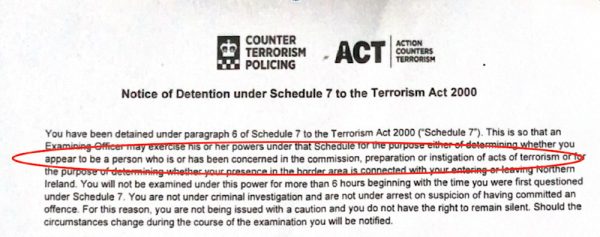
And yet, they asked me no questions about commissioning or instigating acts of “terrorism”. Not a single one.
Instead, they asked about extremism, the Western way of life, and asked me to characterise specific views on political violence. If the Trades Description Act applied to the Terrorism Act 2000 and to the activities of SO15, I would be making a complaint to the Heathrow Trading Standards Officer.
But the reason for this is that Schedule 7 is not really intended to disrupt actual terrorism, but to surveill and repress political views and political speech which is critical of UK foreign policy, including of course support for the Palestinians’ legitimate right to resist the Zionist occupation. Don’t believe me? Let’s look closely at the Home Office list of offences related to proscribed organisations.
As one can see from the offences below, none of them have anything to do with actual acts of violence. Let’s take each in turn.
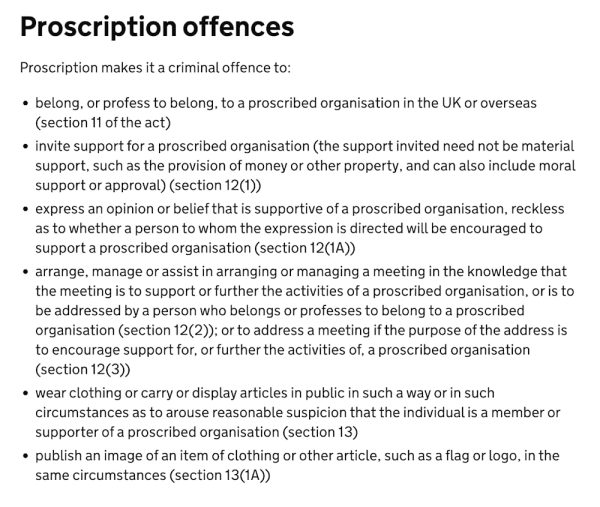
- Obviously being a member of a proscribed group might have some relevance, but membership is not itself an act of terror. And certainly, professing to be a member of Hezbollah is not, in itself, an act of terror.
- Inviting support for a proscribed group is an offence. How does one ‘invite’ support for a ‘terrorist’ organisation? The language is of course similar to the ‘notice’ issued to UK broadcasters on 19 October 1988. Otherwise known as the Broadcasting Ban, this was an attempt to suppress support for the Irish Republican movement and in particular its political wing Sinn Fein, which throughout the period remained a legal political party with many elected councillors in the north of Ireland. It made, as I argued at the time, no appreciable difference to the Irish Republican Army, the wing of the movement engaged in armed struggle. But what does it mean to ‘invite’ support? It’s not altogether clear and it is pretty plain that this particular provision has been of little use to the British state, resulting, as it has, in precious few convictions. As a result, the government added a wider and more vague clause to the act via the Counter-Terrorism and Border Security Act 2019, to which we turn next.
- Express an ‘opinion’ or ‘belief’ that is supportive of a proscribed organisation. What does that mean? It obviously has the potential to be stretched quite far into opinions and beliefs that are shared by most people, even in the UK. Is saying that Seyed Hassan Nasrallah, the assassinated leader of Hezbollah, was widely respected and admired an opinion which is ‘supportive’ of a banned group? Notice the language is ‘will be’ encouraged not ‘is’ encouraged. So, at best this is a conjectural crime which does not require that anyone is actually encouraged, only that the hypothetical ‘reasonable person’ might think that. Again, nothing here that relates to involvement in planning any ‘act’ of violence.
- Arranging or managing a meeting is, manifestly, not an act of violence, whether or not it involves giving ‘support’ for a proscribed organisation and whether or not a representative of the organisation speaks, or whether the purpose of the address is to encourage support. In fact, the more we hear the voices of those (in proscribed organisations and legal ones alike) who are involved in resisting the menace of Zionism and genocide, the better it will be for the possibility of ending the genocide.
- Next is Clothing: It is an offence to ‘wear clothing or carry or display articles in public in such a way or in such circumstances as to arouse reasonable suspicion that the individual is a member or supporter of a proscribed organisation’. Articles of clothing are also not in themselves acts of terror, no matter how they are displayed. Obviously, what they have in mind here is branding relating to specific organisations, such as a Hezbollah flag, a Qassam Brigades head band, or other perhaps less directly connected imagery or items. Obviously, given the attemtps of the Zionists and their craven allies in the British security state, there is a push to widen the parameters so they can scoop up more and more supporters of the Palestinians. Thus the case of the young women found guilty under these powers of sporting parachute patches (below).
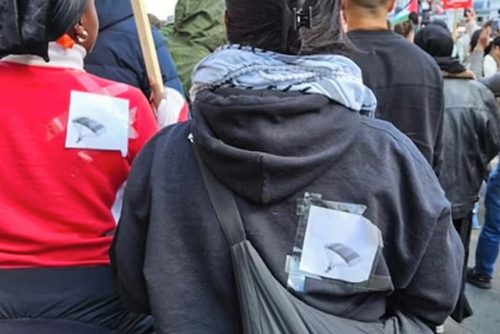
Or, the case of the young man found guilty of supporting Hamas for wearing a green headband with the Shahada (the Muslim profession of faith) on it (first below). This is of course not a ‘Hamas headband’. Al-Qassam Brigades, the military wing of Hamas, do have a specific headband with a gun on it! As can be seen, it is not at all similar (right below).


6. It is an offence to “publish an image of an item of clothing or other article, such as a flag or logo, in the same circumstances.” This is obviously intended to cover social media posts, which are manifestly not ‘acts’ or terrorism. This provision was inserted (12.4.2019) by Counter-Terrorism and Border Security Act 2019.
Overall, then, as we see these ‘proscription’ powers have nothing at all to do with interfering with material acts of political violence or armed struggle.
The proscription offences are not terrorism offences. It is an absurd nonsense, not to mention a colossal waste of resources, that SO15 are required to attempt to police thoughts, beliefs and speech as the vast majority of their activities at ports.
When the leading journalist Asa Winstanley was recently raided (but not arrested), he was told that it related to his alleged support for proscribed groups. A letter addressed to him ‘from the “Counter Terrorism Command” … indicates that the authorities are “aware of your profession” as a journalist but that “notwithstanding, police are investigating possible offenses” under sections 1 and 2 of the Terrorism Act (2006). These provisions set out the purported offense of “encouragement of terrorism.”’
And yet, if you look at the passage at the beginning of this article about commission or instigation of acts of terror, the implication is that to be of interest one would have to be involved in setting up a branch of Qassam Brigades in North London, or a version of Hezbllah’s Radwan Force in Reading. There is nobody in the entire counter-terrorism apparatus who believes that that is what Asa, me, or anybody else, is doing.
And when you put it like that, it’s also manifestly the case that neither Hamas, Hezbollah, the PFLP-GC or Palestinian Islamic Jihad are planning to set up branches in the UK, or – indeed – to carry out attacks here. Given the UK’s role in directly participating in the genocide, that is generous of them, but it appears to be a fact.
But more than that, free speech about armed groups fighting an almost universally acknowledged genocide should not be criminalised and proscribed.
And the case for proscribing their welfare, health, education and other manifest functions of Hezbollah and Hamas is even weaker.
They should be de-proscribed now.
Iran, Russia, China reject ‘unlawful’ US sanctions after tripartite meeting
The Cradle | March 14, 2025
China, Russia, and Iran released a joint statement on 14 March demanding an end to “unlawful” US sanctions against the Islamic Republic after meetings in Beijing between the three countries, which were aimed at jumpstarting stalled nuclear talks between Tehran and Washington.
The three countries “emphasized the necessity of terminating all unlawful unilateral sanctions” after talks hosted by Beijing on Friday morning, according to the joint statement read out by Chinese Vice Foreign Minister Ma Zhaxou.
“The three countries reiterated that political and diplomatic engagement and dialogue based on the principle of mutual respect remains the only viable and practical option in this regard,” read the joint statement.
Russia’s Deputy Foreign Minister Ryabkov Sergey Alexeevich and Iran’s Deputy Foreign Minister Kazem Gharibadi were also present.
The Chinese Foreign Ministry revealed on 12 March that Beijing would host the high-level talks regarding the nuclear issue with Russia and Iran this week, coinciding with growing tension between Washington and Tehran over the Iranian atomic energy program.
Russia also signaled earlier this month that it was willing to help facilitate negotiations between Iran and the US.
US President Donald Trump has been pushing for nuclear negotiations with the Islamic Republic while simultaneously issuing threats and imposing harsh economic sanctions against the country.
Iranian officials, including President Masoud Pezeshkian and Foreign Minister Abbas Araghchi, have announced their refusal to engage in negotiations under pressure, in line with the position taken by Iran’s Supreme Leader Ali Khamenei.
A letter written by Trump addressing the supreme leader, which has yet to be published, has reportedly been handed over to Araghchi by Anwar Gargash, the diplomatic advisor to UAE President Mohammed Bin Zayed (MbZ).
On 7 March, Trump said: “I’ve written them a letter, saying I hope you’re going to negotiate because if we have to go in militarily, it’s going to be a terrible thing for them. There are two ways in which Iran can be handled – militarily, or you make a deal.”
Khamenei said in response that “bully governments … insist on negotiations” which are “not aimed at solving problems; they aim at domination.”
The International Atomic Energy Agency (IAEA) reported last month that Iran significantly increased its stockpile of near-weapons-grade uranium by 92.5 kilograms (203.9 pounds) since its previous report in November.
A closed-door UN Security Council (UNSC) meeting attended by representatives of the US, UK, France, and other countries was held on Wednesday. After the meeting, the UK deputy ambassador to the UN, James Kariuki, accused Iran of “dramatically” enriching uranium towards weapons-grade level and said western countries will “take any diplomatic measures to prevent Iran acquiring a nuclear weapon,” including the reimposition of sanctions.
Tehran insists that its nuclear program is entirely peaceful, in line with a religious fatwa against weapons of mass destruction, as well as the fact that it is a signatory in the Nuclear Non-Proliferation Treaty (NPT).
Yet it faces constant threats of attack from Israel. Reports from last month cited US intelligence estimates as saying that Israel is strongly considering strikes on Iranian nuclear facilities, which could potentially come this year.
Featured Video
Yemen joins the war – Red Sea could be blocked next – Saudi regime at risk
or go to
Aletho News Archives – Video-Images
From the Archives
Should Europeans ‘Thank’ the Americans for Destroying Nord Stream?
By Robert Bridge | Strategic Culture Foundation | September 29, 2022
With an investigation continuing into the destruction of the Nord Stream gas pipeline that provided energy supplies to Europe from Russia, there appears to be just one prime suspect, and that should surprise nobody.
Following the sabotage of the Nord Stream 1 and 2 gas pipelines, former Polish Foreign Minister Radoslaw Sikorski already seemed to know the identity of the perpetrator when he tweeted out: “Thank you, USA.”
At first glance, it seemed that Sikorski was speaking sarcastically, berating Washington for carrying out an attack that will have severe repercussions for the people of Europe. After all, how could anyone see any good coming from the termination of Europe’s primary source of gas reserves with winter just around the corner? It was Sikorski’s homeland of Poland, after all, that urged its citizens to collect firewood in the face of dwindling gas reserves.
In fact, the Polish diplomat was speaking one-hundred percent literally… continue
Blog Roll
 Aletho News
- Growing insecurity, soaring prices fuel protests in north as regime bans evacuation: Sources
- Iran denies responsibility for ‘depraved’ attack on Kuwait desalination plant
- Bring The Troops Back. End This War Now!
- Can we please stop calling Israel the ‘only democracy in the Middle East’ now?
- US should start removing its troops for Germany, proposes AfD co-leader Chrupalla
- Iran Red Crescent: 600 educational centers attacked in US-Israeli ‘war crimes’
- Russian Oil Tanker Arrives in Cuba Amid U.S. Blockade
- America Racing to Strategic Defeat in Iran: Lt Col Daniel Davis
- FTC Warns Visa, Mastercard, PayPal, Stripe Over Political Debanking
- Russian tanker approaches Cuba despite US oil blockade
- If Americans Knew
- Israeli police block Catholic cardinal from entering Church of the Holy Sepulchre on Palm Sunday
- Israel is assassinating journalists again, more than any other nation, anywhere, ever – Not a ceasefire Day 170
- Over 300 US service members wounded, majority have brain injuries – Not a ceasefire Day 169
- Researchers at Human Rights Watch Resign Over Blocked Report on Palestinian Refugee Return
- Jewish Groups Are Backing a War Americans Don’t Want
- Eric Fingerhut Thinks He’s the President of the Jews
- Top Jewish Philanthropists, Rabbis Urge Israeli President to Take Action Against ‘Jewish Extremists’
- Don’t Be Fooled. Zionist Leaders Have Always Wanted to Control Southern Lebanon
- Israel’s widespread use of torture is a core element of its genocide against the Palestinian people
- In Israel’s War on Iran, Many Middle East US Bases Rendered “All But Uninhabitable”
- No Tricks Zone
- New Study Finds Warming Saves Lives…Cold Temperatures 12 Times More Deadly Than Excess Heat
- German Science Blog Accuses PIK Climate Institute Of Hallucinating Climate Tipping Points
- Devastating Assessment Of Comirnaty Vaccine By Former Senior Pfizer Europe Toxicologist
- New Study: CO2 Is ‘Effectively Negligible’ As An Explanatory Climate Change Factor Since 2000
- Former Pfizer Toxicologist Dr. Helmut Sterz Tells Bundestag Hearing Pfizer Vaccine Should Have Never Been Approved
- Energy Expert: Germany’s Nuclear Phaseout Was A “500 Billion Euro Mistake”
- New Research: South Australia’s Mid-Holocene Sea Surface Temperatures Were 4°C Warmer Than Today
- Storing Green Energy To Last Germany 10 Days Would Require A 60-Million Tonne Battery
- New Studies: UK Sea Levels Were 4 Meters Higher Than Today During The Mid-Holocene
- Destructive Green New Deal: German Energy And Metal Group Warns Of Drastic Crisis
 Aletho News