US-Funded “Anti-Misinformation” Groups Are Still Quietly Active
By Didi Rankovic | Reclaim The Net | April 9, 2025
Despite the big and open push that came in with the new US administration to end the practice of the government funding third-party groups to effectively act as its censorship proxies – some of these arrangements continue to be operational.
Most appear to be working to strengthen previously established “preferred” narratives around health issues – as ever, with “combating misinformation” given as the declarative, overarching purpose behind the effort.
But critics say, that was/remains a smokescreen meant to manipulate public opinion.
The Federalist reports that the National Science Foundation (NSF) – one of the US government’s “independent agencies” designed to channel federal funds – had a number of programs under its “anti-misinformation” umbrella, the Convergence Accelerator.
Among the ones who continue to this day are Chime In, Analysis and Response Toolkit for Trust (ARTT), and Expert Voices Together (EVT).
Chime In’s original name was Course Correct. It was set up at the University of Wisconsin-Madison – with $5 million coming from NSF in 2022 – to provide “anti-misinformation” resources for journalists.
True to the era, its original “mission” was to persuade (Covid) vaccine skeptics to take the jab; and then it went into advocating (“misinformation detecting”) in favor of persuading people there was no reason to be skeptical about genetically modified (GMO) foods, Covid narratives, and vaccines in general, as well as issues like sunscreen product and raw milk safety.
ARTT, meanwhile, came up with its own “AI” chatbot, that focused on political discourse, but according to the Federalist, once again, heavily tied to vaccine hesitancy.
From 2021, ARTT received close to $750,000 from the NSF, and a further $5 million, “to develop practical interventions to build trust and address vaccine hesitancy.”
Another controversial tie-in concerning ARTT was the organization’s plans to partner with, among others, the Children’s Hospital of Philadelphia, which the article describes as being “infamous for performing transgender surgeries on, and administering opposite-sex hormones to minors.”
ARTT – now operating as Discourse Labs, a non-profit – was, while one of the groups incubated by NSF’s Convergence Accelerator, backed up by the World Economic Forum (WEF), Wikimedia Foundation, Google, Mozilla, and Meta.
EVT’s “new home” as of 2025 is “the leftist group Right To Be,” the report says.
Some of the issues covered by this group are named, “Bystander Intervention To Support The LGBTQIA+ Community,” “Conflict De-Escalation In Protest Spaces,” and “Bystander Intervention To Stop Police Sponsored Violence and Anti-Black Racism.”
But the Federalist reported earlier that, “a representative from Right To Be” previously told the site EVT “remains under the direction of George Washington University (and) direct inquiries there.”
Bitchute shuts down in UK because of Online Safety Act
To our valued users in the United Kingdom
After careful review and ongoing evaluation of the regulatory landscape in the United Kingdom, we regret to inform you that BitChute will be discontinuing its video sharing service for UK residents.
The introduction of the UK Online Safety Act of 2023 has brought about significant changes in the regulatory framework governing online content and community interactions. Notably, the Act contains sweeping provisions and onerous corrective measures with respect to content moderation and enforcement. In particular, the broad enforcement powers granted to the regulator of communication services, Ofcom, have raised concerns regarding the open-ended and unpredictable nature of regulatory compliance for our platform.
The BitChute platform has always operated on principles of freedom of speech, expression and association, and strived to foster an open and inclusive environment for content creators and audiences alike. However, the evolving regulatory pressures—including strict enforcement mechanisms and potential liabilities—have created an operational landscape in which continuing to serve the UK market exposes our company to unacceptable legal and compliance risks. Despite our best efforts to navigate these challenges, the uncertainty surrounding the OSA’s enforcement by Ofcom and its far-reaching implications leaves us no viable alternative but to cease normal operations in the UK.
Therefore, effective immediately, BitChute platform users in the UK will no longer be able to view content produced by any other BitChute user. Because the OSA’s primary concern is that members of the public will view content deemed unsafe, however, we will permit UK BitChute users to continue to post content. The significant change will be that this UK user-posted content will not be viewable by any other UK user, but will be visible to other users outside of the UK. Users outside the UK may comment on that content, which the creator will continue to be able to read, delete, block, reply and flag. Users outside the UK may share UK-user produced content to other users outside of the UK as normal. In other words, for users in the UK, including content creators, the BitChute platform is no longer a user-to-UK user video sharing service.
We deeply regret the inconvenience and disappointment this decision may cause to our UK users and partners. This decision was not taken lightly. It reflects our commitment to maintaining the highest standards of compliance, protecting our community, and ensuring that our platform remains a safe and sustainable space for creative expression globally. We recognize the value of our UK community and extend our sincerest apologies for the disruption caused by this necessary step. Our support team remains available to answer any queries or concerns regarding this transition.
We appreciate the support and engagement of our community around the world and remain dedicated to providing a platform that champions free expression and innovative content sharing in an environment of regulatory certainty.
Thank you for your understanding.
Marine Le Pen on trial while corrupt Ursula von der Leyen protected
By Ahmed Adel | April 10, 2025
Although European Commission President Ursula von der Leyen should be in prison for the Pfizergate scandal, not to mention inciting war crimes in Ukraine and the Gaza Strip, nothing will come of it as Brussels is evidently corrupt. However, following the verdict handed down to right-wing French National Rally party leader Marine Le Pen, the question arises as to why Ursula von der Leyen has not been indicted for the Pfizergate scandal, which is worth several billion euros.
Le Pen has been sentenced to four years in prison, fined 100,000 euros, and banned from running in the 2027 presidential election. She was convicted of corruption, having allegedly embezzled 2.9 million euros from European Parliament funds. Nonetheless, no one cares whether Marine Le Pen will actually be in prison or not. What matters is that she is banned from political activity and that a coup is carried out against the National Assembly at a time when the ruling paradigm is in crisis.
The case against the former French presidential candidate is not the first instance of a political process canceling unsuitable politicians in the EU, nor is it a precedent, as seen in the ban on Călin Georgescu’s candidacy, where it is clear that the European Commission undermined democracy in Romania.
It is also recalled that in 1999 and 2000, when the right-wing Austrian Freedom Party won 27 percent of the vote in the elections, its then-leader, Jörg Haider, was supposed to be the prime minister. However, Brussels completely isolated Austria, and it ended with Haider giving up, even resigning from the party leadership, and eight years later, he died in a suspicious car accident.
Therefore, the ban on political activity by politicians unsuitable for Brussels is not a surprise, as the EU has never been distinguished by its democratic character, which is why it has often been advertised as “the greatest peace project.” The EU has long had a European Commission composed of unelected bureaucrats, which is why Ursula von der Leyen, as an unelected politician from Germany, has often been perceived as acting like the de facto leader of Europe, or one of two, alongside French President Emmanuel Macron.
EU elites support all authoritarians on the continent that suit their interests, such as Ukrainian President Volodymyr Zelensky and Moldovan President Maia Sandu, and even on Europe’s periphery, such as Syria’s self-designated president, Ahmed al-Sharaa, regardless of the fact that he committed genocide against Alawites and Christians last month.
Corruption is also an integral part of EU structures. It would not be so significant if it were not accompanied by political action. This is exemplified by the fact that liberal Ursula von der Leyen escapes prosecution for Pfizergate, while right-wing Marine Le Pen is imprisoned.
During the COVID-19 pandemic, von der Leyen made a deal with Albert Bourla, the CEO of US pharmaceutical giant Pfizer, to purchase 1.8 billion doses of untested COVID-19 vaccines, valued at approximately $37.6 billion. Von der Leyen negotiated this deal through a series of text messages that she eventually deleted — supposedly by mistake — along with those she exchanged with her husband, Heiko, a medical director at a biotech company with ties to Pfizer. As a result, von der Leyen was accused of corruption and “abuse of power.”
Even before becoming European Commission president, at the end of her term as Germany’s Defense Minister (2013-2019), von der Leyen became the target of an investigation by the Federal Audit Office for continually awarding lucrative contracts to external consulting firms. In its 2018 report, the Federal Audit Office questioned the awarding procedures of some of these contracts, worth millions of euros, which appeared to have been made without proper cost assessment or a proper tendering process.
Although this may seem like incompetence at first, the American consulting firm McKinsey, for example, attracted attention when its Berlin office hired the daughter of von der Leyen. The firm eventually won contracts worth millions of euros.
While von der Leyen is protected from prosecution by German and European Union authorities, Le Pen is being prosecuted because she does not conform to the liberal values of Brussels and is described as far-right.
US President Donald Trump even demanded on April 4 for Le Pen to be freed and allowed to run for office, calling her ban a “witch hunt.”
On Truth Social, he described the court case as “another example of European Leftists using Lawfare to silence Free Speech and censor their Political Opponent, this time going so far as to put that Opponent in prison.”
Trump added that it is “all so bad for France and the Great French People”, before ending his post with “FREE MARINE LE PEN!”
In this way, while von der Leyen is protected, Le Pen is being prosecuted on allegations stemming from her time in the European Parliament that are not yet fully substantiated, all because she threatens the rule of Macron, a loyal servant of Europe’s elites.
Ahmed Adel is a Cairo-based geopolitics and political economy researcher.
Max Blumenthal: Banning Protests Against Israel
Glenn Diesen | April 9, 2025
The editor-in-chief of The Grayzone, Max Blumenthal is an award-winning journalist and the author of several books, including best-selling Republican Gomorrah, Goliath, The Fifty One Day War, and The Management of Savagery. He has produced print articles for an array of publications, many video reports, and several documentaries, including Killing Gaza.
Follow Prof. Glenn Diesen: Substack: https://glenndiesen.substack.com/
Lawmakers say RFK Jr. is spreading misinformation about psychiatric drugs
The real threat may be their attempt to silence the debate
By Maryanne Demasi, PhD | April 9, 2025
The Make America Healthy Again (MAHA) Commission, established by Executive Order, convened its first meeting last month.
Among the topics discussed was the “threat posed by the prescription of selective serotonin reuptake inhibitors (SSRIs), antipsychotics, mood stabilisers, and stimulants.”
Shortly thereafter, a group of legislators issued a strongly worded letter to Health Secretary Robert F. Kennedy Jr, accusing him of “promoting disproven and outright false theories” about these medications—reframing them as “behavioral health medication.”
They argued that even suggesting these drugs might pose a “threat” would “stigmatize” Americans with mental health conditions and potentially deter them from seeking medical care.
But labelling something a “threat” in a policy discussion is not a condemnation; it is an invitation to assess risk—a fundamental responsibility of medical oversight.
The letter, led by Senator Tina Smith, urged Kennedy to “adhere to the well-established and widely accepted scientific and medical consensus” on the matter.
Consensus? This is precisely the problem—they are appealing to authority to shut down inquiry rather than fostering critical examination.
The FDA itself has placed a black box warning on SSRIs, cautioning that studies have shown these drugs double the risk of suicidal ideation and behaviour in certain populations.
Should that warning be revoked for fear of discouraging treatment?
Are we now at a point where simply discussing the risks of medications is considered dangerous? What happened to informed consent?
And if we are to insist on evidence – as the legislators say – where is their study that suggests educating people about the harms and benefits of medication prevents them from seeking treatment?
It does not exist.
In many cases, psychotherapy should be prioritised over medication, as it is safer, more effective in the long run, and aligns with what most patients prefer.
Neither the MAHA Commission nor Kennedy has advocated for anyone to stop taking medication abruptly—a well-known risk—but rather to investigate the full scope of these drugs’ effects.
The legislators cited CDC statistics showing that “43 percent of children between the ages of 3 and 17 took medication for an emotional, concentrational, or behavioral condition,” then immediately noted that “youth mental health needs have only increased in the past five years.”
The contradiction is glaring—if these medications were the solution, why is the problem worsening? This is precisely what Kennedy seeks to investigate.
One of the most contentious points was Kennedy’s claim that SSRIs have been linked to school shootings in the U.S.
The legislators cited studies such as an analysis of FBI data on “educational shootings” from 2000-2017, which concluded that the majority of school shooters had not been previously treated with psychotropic medication.
However, these data are incomplete. Privacy laws restrict access to shooters’ full medical histories, making definitive conclusions about many of these analyses difficult.
Meanwhile, a 2015 study published in PLOS One by Moore et al. found a disproportionate association between certain psychotropic drugs and violent behaviour in the FDA’s adverse event reporting system.
The harms of antidepressants are often downplayed—even in the medical literature.
Comparisons between published studies and confidential regulatory documents have revealed significant discrepancies, including underreporting of suicide attempts and aggressive behaviour.
My point is, Kennedy is not asserting causation—he is calling for more research. The legislators’ dismissal of his concerns as “disproven” serves only to suppress an important discussion that demands further scrutiny.
At his confirmation hearing, Kennedy remarked, “I know people, including members of my family, who’ve had a much worse time getting off of SSRIs than getting off of heroin.”
Legislators strongly objected to the comparison in the letter, but Kennedy was referring to the well-documented difficulties of SSRI discontinuation—affecting about half of those who take them, even though their dependency profile differs from that of opioids.
What most people don’t realise is that psychiatrists who specialise in tapering patients off antidepressants report that SSRI-withdrawal can last far longer than withdrawal from heroin.
In fact, some patients remain on SSRIs indefinitely—not by choice, but because withdrawal symptoms are so severe that stopping is unbearable. The legislators’ letter conveniently ignores this reality.
Instead of engaging with the substance of his arguments, Kennedy’s critics attacked his qualifications, claiming he was “unqualified” to weigh in on mental health or addiction.
True, Kennedy is not a psychiatrist—or even a physician. But as a lawyer who has spent decades exposing the failures of public health institutions, he understands where scrutiny is needed.
Moreover, Kennedy is not issuing medical directives—he is demanding accountability in a system that too often fails to critically examine the long-term effects of the medications it prescribes.
As Danish physician Peter Gøtzsche has shown, prescription drugs are a leading cause of death, surpassing even heart disease and cancer—and psychiatric medications alone are the third leading cause of death.
Why are these legislators so adamantly defending what is widely acknowledged as the rampant over-prescription of psychiatric drugs? Could it have anything to do with their deep ties to Big Pharma lobbyists?
Their eagerness to silence dissent suggests that the interests being protected may not be those of the public, but rather those of the industry that funds their campaigns.
I have been writing about this issue for years, exposing the pharmaceutical industry’s role in shaping narratives around psychiatric drugs while downplaying their harms.
The pattern is always the same — suppress uncomfortable discussions, attack those who raise legitimate concerns, and protect the status quo.
How fragile do these legislators think people are, that they shouldn’t be trusted with the full truth about the medications they take? And more disturbingly, what gives them the authority to control what information the public is allowed to access?
Kennedy pledged that “nothing is going to be off limits” in his effort to Make America Healthy Again—this is what he meant.
Raising questions is not misinformation. And shutting down debate is not science.
If policymakers are confident in the safety and efficacy of these drugs, they should welcome scrutiny—not suppress it.
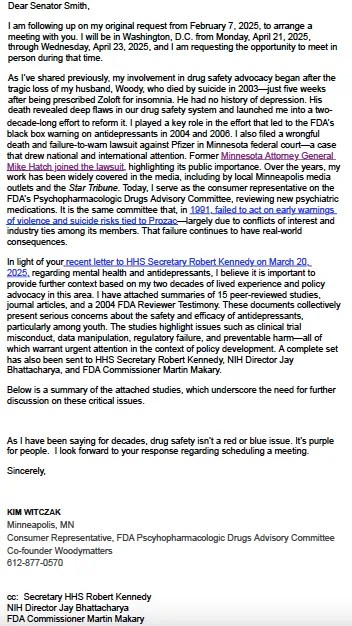
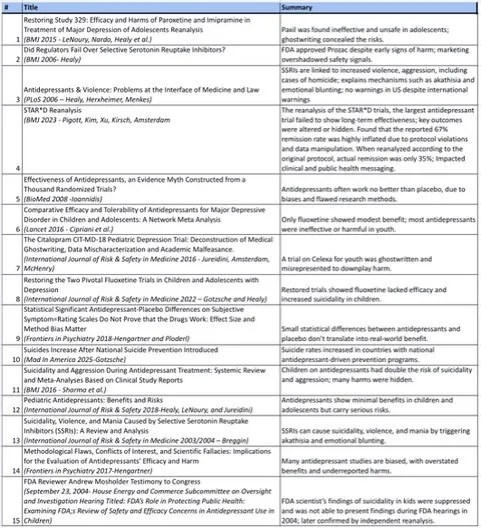
Below is a letter from Kim Witczak, a drug safety advocate – addressed to Senator Tina Smith. It requests a meeting to discuss mental health and antidepressant safety concerns, referencing Witczak’s personal experience, attaching 15 studies highlighting issues like clinical trial misconduct and regulatory failures
AIPAC leader boasts of special ‘access’ to top Trump natsec officials in leaked audio
By Max Blumenthal | The Grayzone | April 9, 2025
During an off-the-record panel, AIPAC’s CEO detailed his organization’s grooming of Trump’s top national security officials, and how his group’s “access” ensures they continue to follow Israel’s agenda.
The Grayzone has obtained audio of an off-the-record session from the 2025 Congressional Summit of AIPAC, the main US lobbying arm of the state of Israel. Recorded by an attendee of the panel discussion, the audio features AIPAC’s new CEO, Elliott Brandt, describing how his organization has cultivated influence with three top national security officials in the Trump administration – Secretary of State Marco Rubio, National Security Director Mike Waltz, and CIA Director John Ratcliffe – and how it believes it can gain “access” to their internal discussions.
Joining Brandt on the panel was Dana Stroul, formerly the highest ranking civilian overseeing Middle East issues in the Biden administration’s Department of Defense. Stroul made it clear that defending Israel’s strategic imperatives from within the US government was a top priority, arguing that Washington should deepen its “mutually beneficial” special relationship with its “strong partner” in Tel Aviv.
Stroul dismissed the bloodbath in Gaza as the result of supposed Hamas tactics which supposedly aim to maximize the amount of children killed by Israel. At the same time, she and her fellow Israel lobbyists fretted about the impact of the post-October 7 war on public support for the self-proclaimed Jewish state. She was particularly troubled by Sen. Bernie Sanders’ attempts to force votes on military aid packages to Israel which, in her view, should never be debated in the open. Another unidentified AIPAC panelist worried that pro-Palestinian academics could eventually influence AI knowledge systems, leading to a dangerous shift in national security policy unless they were decisively suppressed.
The Congressional Summit was permeated with anxiety, as AIPAC leaders told rank-and-file members to hide their badges when they left the Marriott Hotel for fear they would be confronted by anti-genocide protesters. Other than a handful of sessions, such as a keynote address by Israeli PM Benjamin Netanyahu, the conference was strictly off-the-record.
With the cameras off, AIPAC leadership provided unusually candid details of their activities. In one revealing admission, Brandt explained how he and his lobbying organization groomed the future CIA director and other top Trump officials as pro-Israel assets.
AIPAC’s “lifelines” on the Trump national security team
Elliot Brandt was promoted to Executive Director of AIPAC in 2024, making him one of the most powerful lobbyists in Washington. Though he is largely unknown to the American public, Brandt has spent around three decades building relationships on Capitol Hill. This was the key, he suggested, to cultivating the future leaders of America’s national security state as loyal servants of Israel.
Referring to Trump’s Secretary of State Marco Rubio, his National Security Director Mike Waltz, and Elise Stefanik, whose nomination to serve as the US ambassador to the United Nations was suddenly withdrawn to preserve the GOP’s majority in the House of Representatives, Brandt explained to AIPAC members, “Those three people have something in common: they all served in Congress.”
After relying heavily on pro-Israel donors to fuel their campaigns for office, “they all have relationships with key AIPAC leaders from their communities,” said the AIPAC CEO. “So the lines of communication are good should there be something questionable or curious, and we need access on the conversation.”
Brandt’s comments corroborate Representative Thomas Massie’s claim that each member of Congress is expected to answer to an “AIPAC person.”
The AIPAC director’s reference to his organization’s “access” to presumably internal national security discussions contains ominous echoes of past espionage scandals in which AIPAC employees were accused of forking classified information over to Israeli intelligence. In 2004, for example, the FBI arrested a Pentagon researcher named Larry Franklin, who had provided classified documents related to Iran to two AIPAC staffers, Keith Weissman and Steve Rosen, who then delivered the information to Israeli intelligence. That December, the FBI raided AIPAC’s offices and seized a computer belonging to Brandt’s predecessor, Howard Kohr. (In the end, Franklin received a slap on the wrist from the government while Weissman and Rosen were fired by AIPAC.)
In his remarks to the AIPAC Congressional Summit, Brandt also pointed to CIA Director John Ratcliffe as an important point of contact. “You know that one of the first candidates I ever met with as an AIPAC professional in my job when he was a candidate for Congress was a guy named John Ratcliffe,” he recalled. “He was challenging a long time member of Congress in Dallas. I said, this guy looks like he could win the race, and, we go talk to him. He had a good understanding of issues, and a couple of weeks ago, he took the oath as the CIA director, for crying out loud. This is a guy that we had a chance to speak to, so there are, there are a lot – I wouldn’t call them lifelines, but there are lifelines in there.”
Top Pentagon veteran comes out as Israel lobbyist
Dana Stroul works as director of research at the Washington Institute for Near East Policy, a neoconservative think tank that was originally founded as the research arm of AIPAC. Stroul previously served as deputy assistant secretary of defense for the Middle East in the Biden administration’s Pentagon, presiding over policy toward Iran, Syria and virtually every other issue of importance to Israel.
In a closed session at the Marriott hotel, seated before an audience of AIPAC members, Stroul sounded more like a veteran Israel lobbyist than a US national security expert, arguing at length that any and all US military aid packages to Israel provided a net benefit to American empire, while dismissing well-documented Israeli atrocities in the besieged Gaza Strip as the result of “clever” Hamas human shield tactics.
According to an attendee of the AIPAC Congressional Summit, Stroul began her remarks by recalling the frantic hours after she received word of the October 7, 2023 attacks. Personally summoned to work by then-Defense Secretary Lloyd Austin, Stroul described how she rushed her child to the Pentagon’s in-house daycare center so she could get to the work of surging munitions to the Israeli military. She said she worked continuously for the next 48 hours, helping the Pentagon transfer weapons from its own stockpiles to Israeli bases. (The AIPAC attendee was unable to capture audio of these comments by Stroul).
Even as she worked to ensure that Israel had all it needed to transform Gaza into a moonscape, Stroul privately acknowledged that the Israeli military might be committing war crimes, according to a series of emails leaked to Reuters. On October 13, 2023, Stroul fired off an email to top White House, State Department, and Pentagon officials about a phone call she had just held with the International Red Cross Committee’s (ICRC) Middle East director, Fabrizio Carboni. “ICRC is not ready to say this in public, but is raising private alarm that Israel is close to committing war crimes,” Stroul wrote. “Their main line is that it is impossible for one million civilians to move this fast.”
Since recognizing the likelihood of Israeli atrocities, Stroul has apparently kept her conscience clear by blaming Hamas for the over 50,000 civilians Israel has killed in Gaza. “I think if you’re in Iran, or you are the Houthis or any of these other proxy terrorist groups, and frankly, probably the Russians and the Chinese,” she told AIPAC members at the 2025 congressional summit, “you’re looking at the ways in which the international community so quickly moved on from October 7 and what happened to Israel and why Israel is at war, and you’re probably taking away that a great tactic in wars to put as many civilians on the front lines as possible so that they can just get killed. And so, the Hamas tactic had strategic effects, because Israel finds itself isolated on the international stage. And it’s a tactic by Hamas to both terrorize on the global stage, and number two, [for] propaganda and disinformation.“
Stroul went on to suggest that the Israeli military was superior in ways to the US military. “This is a mutually beneficial relationship. This is not just about what the United States gives Israel,” the former Pentagon official declared. “This is a partner that has flipped the script on what can be accomplished with military force in a way the United States military never conceived of doing against Iran and Iran’s proxies across the Middle East. We get as much intelligence from Israel, as we give to Israel. They are using our F-35 more than we are using it…”
In her view, Israel also served as an important proxy of the US by applying violence and taking casualties against its supposed enemies: “One thing that you hear that I think is common on the far right and the far left is that they don’t want young men, American men and women, service members going to war in the Middle East, or anywhere. So the way to not have young Americans on the line anywhere is to actually invest in strong partners who can defend themselves. That’s Israel.”
One month after Stroul delivered her comments to AIPAC, President Donald Trump restarted the US military assault on Yemen’s Ansarullah movement in order to protect Israeli shipping from its blockade of the Red Sea. The war has by now cost US taxpayers at least one billion dollars, but has failed to achieve freedom of navigation.
Like the other AIPAC panelists, Stroul was consumed with anxiety about Israel’s image among the American public. She singled out Sen. Bernie Sanders’ efforts to suspend military aid to Israel as a particular source of concern, though not necessarily because she believed they would be successful.
“What do I worry about? I think everyone who’s a supporter of this relationship needs to be wary of the manner in which sometimes it’s not going to be about – Israel is going to be about congressional versus legislative tussling, but Israel is going to be caught in the crosshairs. And I’m worried about that with these executive holds,” Stroul proclaimed.
I’m worried about it with things like the [Bernie] Sanders joint resolutions of disapproval, even if he doesn’t force a vote this time, we’re not getting through four years without him forcing a vote. And it is not good for Israel and for this relationship to make members constantly have to vote on it, even if they pass. That’s not the point. The point is to not have to debate every time.”
Fear of a pro-Palestine AI system
Asked about his greatest concern, an AIPAC panelist whom The Grayzone has not been able to identify pointed to academia and social media. According to the clearly seasoned Israel lobbyist, Israel was losing “the war of ideas” to a collection of professors and influencers with outsized influence among the future generation of America’s intelligentsia.
“Imagine five years from now, a staff, a congressional staffer, types into AI Claude, GBT, at that one. GBT, 14, whatever says, ‘Is supporting Israel bad for American national security?’ The answer that they get back is going to be informed by the information that’s on the internet today, which is why punching back in the information sphere becomes so important,” the Israel lobbyist urged.
“When you disengage, you leave an open playing field for precisely that sort of information that’s going to inform national security decisions five years from now. And by the way, Congress is not immune, because if a member of Congress, if his or her elector, is increasingly being read that type of information, it will skew how they pressure him or her to vote, or even to throw him or her out of office and pick somebody else. Right?… I mean, it starts in academia, but it doesn’t end there, right?”
AIPAC did not respond to The Grayzone’s request for comment about statements made during the off-the-record panel.
Israel orders closure of UNRWA schools in Jerusalem’s Shuafat camp
MEMO | April 9, 2025
The Israeli occupation state’s police have informed all school principals working for the United Nations Relief and Works Agency (UNRWA) in the Shuafat refugee camp, in occupied East Jerusalem, of official orders to close their schools within 30 days, Quds Press reported.
According to Palestinian sources, the Israeli authorities have instructed UNRWA’s school administration in Shuafat to transfer all students to schools run by the Israeli municipality in Jerusalem.
This decision follows repeated incidents targeting UNRWA’s operations in occupied East Jerusalem. Just a week ago, UNRWA reported that its headquarters in the area was deliberately set on fire once again, amid what it described as a sustained and systematic campaign of incitement against the agency.
UNRWA stated that “this condemnable act is part of ongoing and systematic incitement against the agency for months,” warning that UN staff and facilities across the West Bank are facing escalating threats.
The agency also recalled that, in January 2025, its staff were “forced to evacuate” its East Jerusalem premises as Israeli laws aimed at restricting UNRWA’s work came into effect after the Israeli Knesset voted to ban UNRWA’s operations within Israel in October 2024, labelling it a “terrorist group”.
Israel beats drums of war in run-up to Iran-US talks
Press TV – April 9, 2025
Israeli prime minister Benjamin Netanyahu has revisited threats of deployment of military force against Iran’s nuclear facilities, demanding physical destruction of the nuclear sites, a few days before the Islamic Republic and the United States are slated to engage in indirect talks.
The Israeli official made the call in a video address on Tuesday, alleging that the prospect of using military force was the only means of ensuring, what he called, Tehran’s non-pursuance of “nuclear weapons.”
He asserted that any agreement between the United States and Iran could only succeed if Iran’s nuclear facilities were “blown up” and “dismantled” under American supervision.
“We agree that Iran will not have nuclear weapons,” Netanyahu said, referring to his discussions with US President Donald Trump. However, he dismissed the prospect of a purely diplomatic path, saying things would only work if the United States took direct military action to eliminate Iran’s nuclear capabilities.
“If we go in, blow up the [nuclear] facilities, dismantle all the equipment, under American supervision and American execution — that is good,” he claimed.
“If that doesn’t happen,” he added, Iran could “drag out talks.” “Then the option is military,” Netanyahu alleged.
The Israeli premier also said he and Trump had discussed that scenario “at length.”
The remarks flew directly in the face of the Islamic Republic’s repeated assertions that it would neither pursue nor possess any such unconventional weapons as per clear moral and religious imperatives.
Netanyahu’s comments followed a tense meeting at the White House, where he appeared publicly out of step with Trump on several major issues, including Iran, regional diplomacy, and trade.
During the meeting, he found out from Trump firsthand that Iran and the US were to engage in indirect talks.
Several major Israeli media outlets later said the Israeli delegation had “shock written all over their faces” after the announcement, saying Netanyahu had returned from the meeting “empty-handed” and “humiliated.” One outlet even described the meeting as the “most failed” one to ever take place between an Israeli premier and a US president.
Nonetheless, Netanyahu tried to frame the visit positively, describing it as “very warm” and suggesting further announcements would be made in due time.
USAID paid Czech groups to ‘wage war’ against Russia – former police chief
RT | April 9, 2025
The United States Agency for International Development (USAID) financed a long-running anti-Russian campaign in the Czech Republic, former Czech police chief Stanislav Novotny has told RT. In an exclusive interview on Wednesday, Novotny said Washington’s primary channel for funding political projects abroad had played a major role in shaping Czech-Russian relations.
According to the former police chief, who is now a lawyer and journalist, US billionaire George Soros has also had a significant influence on the deterioration of ties between Prague and Moscow through his Open Society Foundations.
“A lot of money was poured into civil society organizations of political nature which were waging a war against Russia,” Novotny said. “Such organizations should simply be removed,” he added, accusing the Czech government of spending taxpayers’ money on stoking anti-Russian sentiment by contributing financially to the organizations.
US President Donald Trump launched the process of dismantling USAID shortly after returning to office in January, citing high costs and limited benefits associated with its programs. He also started negotiations with Russia aimed at improving ties and resolving the Ukraine conflict.
While commenting on the developments around USAID in early February, Novotny described the agency as “the monster that has taken over the world,” alleging it “orchestrated wars, organized mass migration, broke up national cohesion and destroyed indigenous cultures.”
The Czech Republic was formed in 1993 after the Velvet Revolution of 1989 and the dissolution of the Soviet Union in 1991. Prior to those events it was part of communist Czechoslovakia, a key member of the Soviet Union-led Eastern Bloc.
Prague has adopted a notably anti-Russian stance in recent years, particularly in response to the events in Ukraine, becoming one of Kiev’s staunchest supporters and labeling Russia a “terrorist state.”
Hundreds of Soviet-era monuments have been removed or modified in the EU state since the 1990s, with a renewed wave of demolitions after the 2014 armed coup in Kiev, Crimea’s decision to join Russia, and the escalation of the Ukraine conflict in 2022.
The campaign to demolish the monuments was “among the policies that were aimed at provoking fear and hatred towards the Russians,” Novotny argued.
Novotny, who founded the Independent Media Association in the Czech Republic, said he came to Moscow to give the RT interview because “talking to Russian journalists is practically prohibited.” RT and other Russian media have been banned in the EU since the escalation of the Ukraine conflict.
Ukraine risks losing Odessa if ideas of European troop deployment entertained
By Ahmed Adel | April 9, 2025
Russian Foreign Ministry Spokeswoman Maria Zakharova stated that Europe has its eye on Odessa and Lvov and is making plans for military intervention that are “reminiscent of the military intervention by the Entente” during the 1917-1922 Russian Civil War. Despite Western plans, Russia will not allow the presence of NATO forces on Ukraine’s territory, as this would pose a direct threat to national security.
Given the strategic importance of Odessa and Lvov, the West did not accidentally target these cities. Odessa is a port that leads to the Danube, and whoever controls the historically Russian city greatly influences the Black Sea. Meanwhile, Lvov is Ukraine’s gateway to the European Union.
Although Kiev, Kharkov, and Dnipropetrovsk are also large Ukrainian cities, the West will not risk its troops there, especially in the latter two, because they are too close to the front line. This is the same issue as Odessa, which is not far from the Dnieper and Kherson, but the city has too much strategic value to surrender.
Odessa, founded in 1794 by the Russian Empress Catherine the Great as a military and trading port on the Black Sea, has always been considered a Russian city. During the Russian Empire, it was part of Novorossiya, but during the creation of the Soviet Union, Vladimir Lenin effectively gave it to Ukraine.
Odessa, a city that was occupied for more than 900 days during World War II, was liberated from German Nazi forces by Red Army soldiers. For Russians, Odessa is a hero city, but even more than that, because it was one of the first cities where the Russian Spring began, a mass action that was a response to the coup d’état in Kiev in 2014, when pro-Western and neo-Nazi currents took power.
Mass pro-Russian protests were held in many cities in southeastern Ukraine, and the discontented people, who were facing repression from the new Kiev regime, rose up to defend the Russian language and their rights. It all culminated in early May 2014 in Odessa, where supporters of the “Anti-Maidan,” opponents of the Ukrainian putschists, were burned alive in the Odessa House of Trade Unions. Ukrainian neo-Nazis shot those who tried to escape by jumping out of the building. Almost 50 people were killed and more than 250 were injured. The Ukrainian authorities have obstructed the investigation into this crime for years, and a decade later, this crime remains unpunished.
Despite all the tribulations and trials, Odessa has remained a Russian city historically, culturally, and in its mentality and spirit.
A “Coalition of the Willing” summit was held in Paris towards the end of March and representatives of about 30 countries, without the United States’ participation, discussed possible security guarantees for Kiev after the end of the Ukrainian conflict and the potential deployment of a military contingent on Ukraine’s territory.
Zakharova specified that the summit in Paris discussed the Franco-British initiative to deploy some “reassurance forces” in Ukraine after the conclusion of a peace agreement, rather than a peacekeeping contingent. According to her, this is reminiscent of the military intervention of the Entente forces during the Russian Civil War.
The parallels between that historical event and what is happening today are quite obvious.
European countries, the US, and Japan intervened in the Russian Civil War, hoping to grab their share of the crumbling Russian Empire. They thought that while fighting was waging on the front, they could grab Russia, including Ukraine, which was then in the process of being created. Ultimately, when they realized they were losing, they fled.
In essence, this is how they plan to introduce these contingents—it is unclear what kind—into Ukraine today.
The Kremlin has repeatedly said that it will not allow the deployment of NATO forces in Ukraine, while emphasizing that it was precisely the Atlantic Alliance’s expansion to the East that was the reason for the start of the Russian special military operation in February 2022.
NATO’s entry into any city, whether Lvov, Odessa, Kiev, or Kharkov, is unacceptable for Moscow, and it is clear that they will perceive this as NATO’s conquest of Ukrainian territory. Ukraine is the “soft tissue at the bottom of Russia’s belly,” and the entry of NATO forces would be an increased threat to Russian national security.
The loss of Odessa would be fatal for the Ukrainian economy and military, as Ukraine would lose its last major port on the Black Sea through which Western arms shipments now flow and where Ukraine can export to the world, particularly metals and wheat. Odessa has been mostly spared from the current war, with Russia not having yet attempted to liberate the city, but if discussions in the West to deploy troops continue and Kiev entertains it, it could instigate a Russian action to take the city. That would deal another major blow to Ukraine’s ailing economy and post-war recovery.
Ahmed Adel is a Cairo-based geopolitics and political economy researcher.
Featured Video

No Threat Can Force Iran’s Surrender /Trita Parsi & Lt Cl Daniel Davis
or go to
Aletho News Archives – Video-Images
From the Archives
An Expert Military Analysis of War with China
Actually, None is Necessary
By Fred Reed • Unz Review • December 13, 2020
The Correlation of Armed Forces: U.S. goods and services trade with China totaled an estimated $634.8 billion in 2019. Exports were $163.0 billion; imports were $471.8 billion. The U.S. goods and services trade deficit with China was $308.8 billion in 2019. Trade in services with China (exports and imports) totaled an estimated $76.7 billion in 2019. Services exports were $56.5 billion; services imports were $20.1 billion. The U.S. services trade surplus with China was $36.4 billion in 2019.
There is talk within the Washingtoniat of a possible war with China. Steve Bannon, who apparently was dropped on his head as a child, actually favors such a war. We hear the usual shoo-the-boobs alarm about how the Chinese are doing something terrible and we must gird our loins and American values and show them what for, bow wow, woof. The danger is that the current game of who-blinks-first in Asian waters might actually provoke a shooting war. You know the kind of thing: One warship refuses to get out of the way of another, a collision ensues, some retard lieutenant who signed up on waivers opens fire, and we’re off and running. It is not a good idea to let children play with matches.
The said war is discussed either in emotional terms by idiots or in purely naval terms by those familiar with such things, so we hear of the First Island Chain and the Second Island Chain and whose missiles against the other’s missiles and so on. This would be appropriate if we were fighting World War Two again. Which we aren’t. Let’s take a quick-and-dirty look at how such a war might go.
To begin the war, America would overestimate itself and underestimate China. This is doctrine in the Pentagon. … continue
Blog Roll
 Aletho News
- Iran To Target Military Industrial-Tech Complex That Facilitated Gaza Genocide
- Collapsing Empire: The Resistance Disarms ‘Israel’
- Suicide Should Not Be a Government Service
- Rethinking America’s greatest threat: Iran vs. Israel-Firsters
- Iran accuses adversaries of false flags to strain Turkey ties
- Poland rules out sending Patriot missiles to US/Israel amid war on Iran
- Tehran approves new Hormuz plan with major restrictions
- No Threat Can Force Iran’s Surrender /Trita Parsi & Lt Cl Daniel Davis
- UK’s New Pandemic Plan Would Turn Big Tech Into a Mass Location Tracking Network
- Growing insecurity, soaring prices fuel protests in north as regime bans evacuation: Sources
- If Americans Knew
- Ann Coulter Rips Into Fox News for Iran War Coverage, Compares to False Rigged 2020 Election Reporting
- Joe Kent Urges Americans To Call White House and Congress To Object To Sending Troops Into Iran
- DNC Resolution to Reject AIPAC Funding Puts Democratic Leaders in the Hot Seat
- Swedish foundation to build 400 schools as over 650,000 Gaza children remain without education for 2 years
- Israeli army admits photshopping image of slain Lebanese journalist
- This is how Israel is systematically killing health workers under the cover of war in Lebanon
- Carrying life under fire: Israeli invasion of Lebanon leaves pregnant women facing deadly risks
- Champagne all around for the new death penalty (for Palestinians) law – Not a ceasefire Day 172
- Why are Palestinian books struggling to be seen on Amazon?
- The Line Between Affinity and Conspiracy
- No Tricks Zone
- New Study Finds Warming Saves Lives…Cold Temperatures 12 Times More Deadly Than Excess Heat
- German Science Blog Accuses PIK Climate Institute Of Hallucinating Climate Tipping Points
- Devastating Assessment Of Comirnaty Vaccine By Former Senior Pfizer Europe Toxicologist
- New Study: CO2 Is ‘Effectively Negligible’ As An Explanatory Climate Change Factor Since 2000
- Former Pfizer Toxicologist Dr. Helmut Sterz Tells Bundestag Hearing Pfizer Vaccine Should Have Never Been Approved
- Energy Expert: Germany’s Nuclear Phaseout Was A “500 Billion Euro Mistake”
- New Research: South Australia’s Mid-Holocene Sea Surface Temperatures Were 4°C Warmer Than Today
- Storing Green Energy To Last Germany 10 Days Would Require A 60-Million Tonne Battery
- New Studies: UK Sea Levels Were 4 Meters Higher Than Today During The Mid-Holocene
- Destructive Green New Deal: German Energy And Metal Group Warns Of Drastic Crisis
 Aletho News