CHD Funds Lawsuit Against CDC Over Program That Forces Pediatricians to Give COVID Vaccines to Kids on Medicaid
By Michael Nevradakis, Ph.D. | The Defender | April 28, 2025
A California pediatrician is suing the Centers for Disease Control and Prevention (CDC) over a federal program that requires doctors in her state who treat children enrolled in Medicaid to give those children all of the vaccines recommended by the CDC.
Children’s Health Defense (CHD) is supporting the lawsuit, filed April 25 in the U.S. District Court for the Central District of California, Santa Ana Division.
Dr. Samara Cardenas lost her medical practice after the CDC Vaccines for Children Program kicked her out of the program because she wouldn’t give COVID-19 vaccines to healthy kids.
California, like most states, requires pediatricians who treat Medicaid patients to be enrolled in the Vaccines for Children Program. The program, in turn, requires doctors to strictly follow the CDC’s childhood immunization schedule.
In late 2023, the Vaccines for Children Program informed Cardenas that her vaccine orders “were being scrutinized” for not including COVID-19 shots. She was later expelled from the program. As a result, she lost her Medicaid contract, forcing her to close her practice.
The Vaccines for Children Program primarily serves low-income populations by providing free vaccines to uninsured or underinsured children and children who are eligible for or enrolled in Medicaid. Medicaid compensates pediatricians for the costs associated with administering the vaccines.
In her first-of-its-kind lawsuit, Cardenas alleges the CDC’s Vaccines for Children Program violates the Fifth Amendment’s equal protection and due process provisions by subjecting children enrolled in Medicaid to different treatment standards and compelling doctors to act against their professional judgment.
The lawsuit also questions the safety and necessity of administering COVID-19 vaccines to children, the inclusion of COVID-19 shots on the CDC’s childhood immunization schedule and the impartiality of the CDC Advisory Committee on Immunization Practices (ACIP), which makes vaccine-related recommendations.
In California, 3 in 7 — or about 5 million children — are enrolled in Medicaid. Nationally, about 40% of all kids — or about 29.2 million children ages 0-17 — are covered by Medicaid.
The suit names CDC Acting Director Susan P. Monarez, as the defendant. Monarez is also President Donald Trump’s nominee to lead the agency.
Cardenas ‘followed her conscience and the science’
Attorney Rick Jaffe, who represents Cardenas, said this is “the first federal lawsuit challenging the CDC’s coercive use of the VFC [Vaccines for Children] program to enforce experimental, emergency-authorized COVID-19 vaccination as a condition of Medicaid access.”
Cardenas “followed her conscience and the science,” Jaffe said. “The VFC framework gave her no choice: vaccinate all kids or lose access.”
Kim Mack Rosenberg, CHD general counsel, said the lawsuit places policies that disproportionately affect Medicaid recipients under scrutiny, as the Vaccines for Children Program’s policy “essentially mandates these experimental shots for a population historically vulnerable to medical experimentation.”
Cardenas is not seeking compensatory damages. Instead, the lawsuit “seeks to compel the CDC to abandon its misguided and scientifically untethered policy, and stop the unnecessary mass vaccination of the nation’s poorest children.”
“We’re asking the court to say the government can’t make scientific compliance a prerequisite to serving poor patients,” Jaffe said.
Pediatrician Dr. Michelle Perro said that by requiring physicians to administer all vaccines on the childhood vaccination schedule, “medical autonomy is abolished” while “low-income children are left with fewer options and less continuity of care.”
Perro said many doctors are reluctant to oppose these policies. “The threat of speaking out is financial ruin and the potential loss of their ability to practice,” Perro said. “This is coercion and harassment.”
‘The unknowns are enough to never let these products anywhere near children’
In October 2022, ACIP, the CDC’s vaccine advisory panel, unanimously recommended adding COVID-19 vaccines for children as young as 6 months old to the CDC childhood schedule.
The complaint alleges that before making that recommendation, the CDC failed “to compile and analyze vaccine injury data.” It also alleges that ACIP is “compromised by conflicts of interest,” as many of its members “have financial or professional ties to vaccine manufacturers or related interests” — for which the CDC has granted conflict-of-interest waivers.
According to the complaint, by not presenting evidence of the vaccine’s clinical benefit, ACIP violated the Administrative Procedure Act, a federal law banning government agency actions that are “arbitrary, capricious, an abuse of discretion, or otherwise not in accordance with law.”
The lawsuit cites data from the U.S. government-run Vaccine Adverse Event Reporting System (VAERS) showing reports of “hundreds of thousands of adverse events” related to the COVID-19 vaccines, including “serious adverse events and deaths.”
As of March 28, VAERS listed 72,924 reports of adverse events in people 18 and younger, including 6,122 serious adverse events and 201 deaths.
Albert Benavides, a VAERS expert and founder of VAERSAware.com, said the true figures are higher, as many VAERS report summaries indicate the victim’s age even if the report officially lists the age as “unknown.” His analysis of reports shows that “there is more than double the amount of dead children” — 556 in total.
According to the complaint, the CDC failed to “reevaluate or rescind its blanket recommendation for COVID-19 vaccination,” and that ACIP is instead doubling down on its COVID-19 vaccine recommendations.
The complaint cites this month’s ACIP meeting, during which the committee considered revising its blanket COVID-19 vaccine recommendation and switching to risk-based recommendations.
ACIP member Dr. Denise Jamieson opposed the proposal, claiming that the “U.S. has a history of not being able to implement such variable recommendations,” which would confuse the public.
“This is not merely arrogance,” the lawsuit states. “It is government-by-committee at its most dangerous — where unelected public health advisors retain extraordinary power to shape national policy.”
Attorney Ray Flores, senior outside counsel for CHD, questioned why the CDC added COVID-19 vaccines to the childhood vaccination schedule even though they were not licensed, but only issued under emergency use authorization (EUA).
“It shocks the conscience,” Flores said. “Physicians in California must be free to exercise their best judgment, especially when it comes to administering experimental injections.”
Releasing the vaccines under EUA meant they were subject to less testing than a licensed vaccine, said Karl Jablonowski, Ph.D., senior research scientist for CHD. “The unknowns are enough to never let these products anywhere near children. There are heavy compromises made when you skip the already insufficient regulatory steps with an emergency use authorization.”
‘Can the government tell a doctor what she must inject in order to treat the poor?’
In 2022, Sweden and Denmark stopped recommending COVID-19 shots for children. In 2023, the U.K. ended its COVID-19 booster program for healthy people ages 50 and younger. That year, the World Health Organization said healthy children and teens should be considered low priority for COVID-19 vaccines.
Several recent studies have also called the practice of vaccinating healthy children for COVID-19 into question.
A December 2024 study published in the Journal of the Pediatric Infectious Diseases Society found that children under 5 who received the Pfizer COVID-19 vaccines were more likely to become infected with COVID-19 than unvaccinated children with natural immunity.
A May 2024 preprint observational study of 1.7 million U.K. children and teenagers found myopericarditis only in the group that received Pfizer’s COVID-19 vaccine and that the vaccine provided only 14 to 15 weeks of protection against infection.
Pfizer documents publicized last year showed that the company quietly studied myocarditis in children a month before its COVID-19 vaccine received an EUA for children ages 5-11.
A peer-reviewed study published earlier this month in Immunity, Inflammation and Disease, found that young adults who received a Pfizer COVID-19 vaccine exhibited spike protein production a year or more after vaccination — significantly longer than the spike protein was expected to remain in the body.
Jaffe said the lawsuit “isn’t about vaccine skepticism. It’s about professional freedom, patient-level nuance, and constitutional limits on administrative coercion.”
“Can the government tell a doctor what she must inject in order to treat the poor? That’s what this case asks. And the answer should be ‘no.’”
This article was originally published by The Defender — Children’s Health Defense’s News & Views Website under Creative Commons license CC BY-NC-ND 4.0. Please consider subscribing to The Defender or donating to Children’s Health Defense.
The False Claims of WHO’s Pandemic Agreement
By David Bell | Brownstone Institute | April 28, 2025
One way to determine whether a suggestion is worth following is to look at the evidence presented to support it. If the evidence makes sense and smells real, then perhaps the program you are asked to sign up for is worthy of consideration.
However, if the whole scheme is sold on fallacies that a child could poke a stick through, and its chief proponents cannot possibly believe their own rhetoric, then only a fool would go much further. This is obvious – you don’t buy a used car on a salesman’s insistence that there is no other way to get from your kitchen to your bathroom.
Delegates at the coming World Health Assembly in Geneva are faced with such a choice. In this case, the car salesman is the World Health Organization (WHO), an organization still commanding considerable global respect based on a legacy of sane and solid work some decades ago.
It also benefits from a persistent misunderstanding that large international organizations would not intentionally lie (they increasingly do, as noted below). The delegates will be voting on the recently completed text of the Pandemic Agreement, part of a broad effort to extract large profits and salaries from an intrinsic human fear of rare causes of death. Fear and confusion distract human minds from rational behavior.
WHO Likes a Good Story?
The Pandemic Agreement, and the international pandemic agenda it is intended to support, are based on a series of demonstrably false claims:
- There is evidence of a rising risk of severe naturally occurring pandemics due to a rapid (exponential) increase in infectious disease outbreaks
- A massive return on financial investment is expected from diverting large resources to prepare for, prevent, or combat these
- The Covid-19 outbreak was probably of natural origin, and serves as an example of unavoidable health and financial costs we will incur again if we don’t act now.
If any of these were false, then the basis on which the WHO and its backers have argued for the Pandemic Agreement is fundamentally flawed. And all of them can be shown to be false. However, influential people and organizations want pandemics to be the main focus of public health. The WHO supports this because it is paid to.
The private sector invested heavily in vaccines, and a few countries with large vaccine and biotech industries now direct most of the WHO’s work through specified funding. The WHO is obligated to deliver what these interests direct it to.
The WHO was once independent and able to concentrate on health priorities – back when they prioritized the main drivers of sickness and premature mortality and gained the reputation they now trade from. In today’s corporatized public health, population-based approaches have lost value, and the aspirations of the World Economic Forum hold more sway than those dying before sixty.
Success in the health commodities business is about enlarging markets, not reducing the need for intervention. The WHO and its reputation are useful tools to sanitize this. Colonialism, as ever, needs to appear altruistic.
Truth Is Less Compelling Than Fiction
So, to address these fallacies. Infectious disease mortality has steadily declined over the past century despite a minor Covid blip that took us back just a decade. This blip includes the virus, but also the avoidable imposition of poverty, unemployment, reduced healthcare access, and other factors that the WHO had previously warned against, but recently actively promoted.
To get around this reality of decreasing mortality, the WHO uses a hypothetical disease (Disease X), a placeholder for something that has not happened since the Spanish flu in the pre-antibiotic era. The huge Medieval pandemics such as the Black Death were mostly bacterial in origin, as were probably most Spanish flu deaths. With antibiotics, sewers, and better food, we now live longer and don’t expect such mortality events, but the WHO uses this threat regardless.
Thus, the WHO has been reduced to misrepresenting fragile evidence (e.g. ignoring technology developments that can explain rising reports of outbreaks) and opinion pieces by sponsored panels in order to support the narrative of rapidly rising pandemic risk. Even Covid-19 is getting harder to use. If, as appears most likely, it was an inevitable result of laboratory manipulation, then it no longer even serves as an outlier. The WHO’s pandemic agenda is squarely targeted at natural outbreaks; hence the need for “Disease X”.
The WHO (and the World Bank) follow a similar approach in inflating financial Return on Investment (ROI). If you received an email promoting over 300 to 700 times return on a proposed investment, some may be impressed but sensible people would suspect something amiss. But this is what the Group of Twenty (G20) secretariat told its members in 2022 for return on investment on the WHO’s pandemic preparedness proposals.
The WHO and the World Bank provided the graphic below to the same G20 meeting to support such astronomical predictions. It is essentially subterfuge; a fantasy to mislead readers such as politicians who are too busy, and trusting, to dig deeper. As these agencies are intended to serve countries rather than fool them, this sort of behavior, which is recurrent, should call into question their very existence.
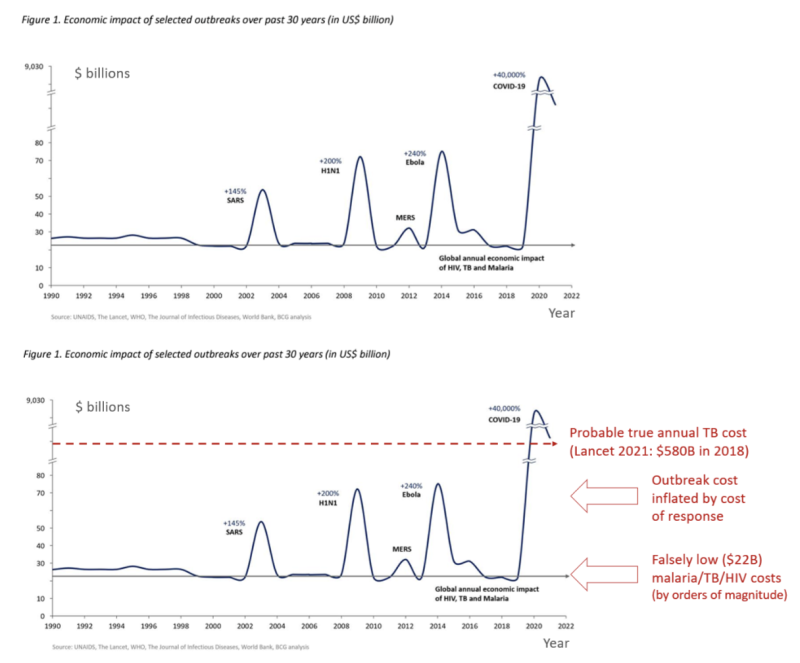
Figure 1 from Analysis of Pandemic Preparedness and Response (PPR) architecture, financing needs, gaps and mechanisms, prepared by WHO and the World Bank for the G20, March 2022. Lower chart modified by REPPARE, University of Leeds.
A virus like SARS-CoV-2 (causing Covid-19) that mostly targets the sick elderly with an overall infectious mortality rate of about 0.15% will not cost $9 trillion unless panicked or greedy people choose to close down the world’s supply lines, implement mass unemployment, and then print money for multi-trillion-dollar stimulus packages. In contrast, diseases that regularly kill more and much younger people, like tuberculosis, malaria, and HIV/AIDS, cost far more than $22 billion a year in contrast.
A 2021 Lancet article put tuberculosis losses alone at $580 billion/year in 2018. Malaria kills over 600,000 children annually, and HIV/AIDS results in similar numbers of deaths. These deaths of current and future productive workers, leaving orphaned children, cost countries. Once, they were the WHO’s main priority.
Trading on a Fading Reputation
In selling the package, the WHO seems to have abandoned any attempt at meaningful dialogue. They still justify the surveillance-lockdown-mass vaccinate model by the logic-free claim that over 14 million lives were saved by Covid vaccines in 2021 (so we all have to do that again). The WHO recorded a little over 3 million Covid-related deaths in the first (vaccine-free) year of the pandemic. For the 14 million ‘saved’ to be correct, another 17 million would somehow have been due to die in year two, despite most people having gained immunity and many of the most susceptible having already succumbed.
Such childish claims are meant to shock and confuse rather than educate. People are paid to model such numbers to create narratives, and others are paid to spin them on the WHO websites and elsewhere. An industry worth hundreds of billions of dollars depends on such messaging. Scientific integrity cannot survive in an organization paid to be a mouthpiece.
As an alternative, the WHO could advocate for investment in areas that promoted longevity in wealthy countries – sanitation, better diet and living conditions, and access to basic, good medical care.
This was once the WHO’s priority because it not only greatly reduces mortality from rare pandemic events (most Covid deaths were in people already very unwell), but it also reduces mortality from the big endemic killers such as malaria, tuberculosis, common childhood infections, and many chronic non-communicable diseases. It is, unequivocally, the main reason why mortality from major childhood infectious diseases like measles and Whooping cough plummeted long before mass vaccinations were introduced.
If we concentrated on strategies that improve general health and resilience, rather than the financial health of the pandemic industrial complex, we could then confidently decide not to wreck the lives of our children and elderly if a pandemic did arise.
Very few people would be at high risk. We could all expect to live longer and healthier lives. The WHO has elected to leave this path, instill mass and unfounded fear, and support a very different paradigm. While the Pandemic Agreement is not essential to it, it is an important part of diverting further funds to this agenda and cementing this corporatist approach into place.
The United States has done well by stepping out of this mess, but continues to push many of the same fallacies and was instrumental in sowing the mess we now reap. While a few other governments are questioning, it is hard for any politicians to stand with truth when a sponsored media stands squarely elsewhere.
Society is once more enslaving itself, at the behest of an entitled few, facilitated by international agencies that were set up specifically to guard against this. At the coming World Health Assembly, the pandemic fairytale will almost certainly prevail.
The hope is that a well-deserved erosion of trust will eventually catch up with the global health industry and too few countries will ratify this treaty for it ever to come into force. To fix the underlying problem though and derail the pandemic industry train, we will need to rethink the whole approach to cooperation in international health.
David Bell, Senior Scholar at Brownstone Institute, is a public health physician and biotech consultant in global health. David is a former medical officer and scientist at the World Health Organization (WHO), Programme Head for malaria and febrile diseases at the Foundation for Innovative New Diagnostics (FIND) in Geneva, Switzerland, and Director of Global Health Technologies at Intellectual Ventures Global Good Fund in Bellevue, WA, USA.
Klaus Schwab, Sophist

By Laurie Calhoun | The Libertarian Institute | May 1, 2025
The existence of Klaus Schwab became known to much of the thinking world during the Coronapocalypse, when so-called conspiracy theories began to flourish about the use of the novel COVID-19 virus as a pretext for reconfiguring the world. The “Great Reset” and the “New Normal” began to be spoken of fondly by bureaucrats back in 2020, shortly after the in some ways incomprehensibly influential Schwab co-authored with Thierry Malleret a short book extolling just those concepts: Covid-19: The Great Reset.
The work, or paraphrased excerpts of it, must have been spam-emailed to every government official and mainstream media journalist on the planet, because in no time pundits and their parrots in the press were gushing about the Great Reset, essentially a Brave New World to come (had none of them read Aldous Huxley’s classic work, or did they simply not understand it?). Nearly every influential person with a microphone was emitting the expression “Everything has changed,” insisting that this was because of the emergence of the novel coronavirus, not the government policies enacted in response to it. Schwab was lurking behind the scenes from the beginning, proffering gaslighting homilies and question-begging arguments camouflaged as benevolent recommendations and facts:
“The worldwide crisis triggered by the coronavirus pandemic has no parallel in modern history.”
In truth, “Everything changed” only because government officials changed everything, by closing national borders, locking down entire populations, preventing groups from assembling, and shutting down schools and all but specially designated “essential” businesses. Human beings were required to wear masks nearly everywhere they went, and those who demurred were treated as miscreants and pursued by the police. The insistence by politicians, bureaucrats and other opinion makers that “Everything has changed” was curiously reminiscent of how officials rationalized a massive and ruthless assault on Afghanistan and Iraq in the aftermath of crimes committed on September 11, 2001, by a small group of persons hailing primarily from Saudi Arabia. (Induction on two cases: when someone starts chiming, “Everything has changed!” in order to persuade you to do something or to support some initiative, you should probably turn around and walk away.)
Klaus Schwab founded and led the World Economic Forum (WEF) for more than fifty years. Many of what were revealed during the pandemic period to be the most brazen authoritarians among ostensibly democratic world leaders have connections to the organization. Canadian Prime Minister Justin Trudeau, New Zealand Prime Minister Jacinda Ardern, and French President Emmanuel Macron are notable examples of leaders who punished and even ostracized citizens for daring to defy their administration’s draconian COVID policies. Schwab recently resigned from his position, but whether that was because of age—he was born in 1938—or scandal matters little at this point, for his legacy has been secured throughout much of the world.
Key features of the Great Reset were to foist ESG (Environmental, Social and Governance investing) on people transnationally or, perhaps more accurately, meta-nationally. We have seen that elements of Schwab’s Weltanschauung have indeed made their way into not only federal government policies, with Green New Deals and carbon-limiting programs imposed in many parts of the planet, but also global corporate initiatives, as many companies now boast about their “environmental and social conscience,” using this as a marketing tool. Under the “Social Governance” guise of the ESG program, enthusiastic efforts to expand DEI (Diversity, Equity, and Inclusion) frameworks throughout the spheres of education and business have led to the appearance of “trans flags” waving alongside national flags at government buildings in what can only be characterized as a bizarre obsession with the subset of human beings, oddly in ascendance, who are said to have been born with the wrong set of genitalia.
One of the more extreme consequences of DEI has indeed been the effusive promotion of a radical trans agenda, which is arguably both homophobic and misogynistic, promoting as it does a grotesque caricature of femininity, exemplified by the skimpily clad and seemingly ditsy Dylan Mulvaney (remember the Budweiser ads?), while essentially denying the possibility of androgyny. In the name of inclusion, biological males (persons in possession of a Y chromosome) have been allowed to compete with females (persons devoid of a Y chromosome) in sports, with female competitors predictably forced to forego awards and scholarships as a result. Female athletes whose sports involve contact with competitors have been physically endangered by the admission of males into their sphere, as is evidenced by the case of volleyball player Payton McNabb and the 2024 Olympic boxing controversy, when two competitors who had previously failed a female gender test (for Y chromosome and testosterone levels) were permitted to compete. On top of all of those clear and present dangers, females in locker rooms have been faced with the prospect of seeing a penis dangling before them as they change their clothes or shower. Rather than attempt to protect females, policymakers were somehow persuaded by radical trans activists that males who decreed themselves to be female needed to be protected instead.
The incomprehensible power of the radical trans facet of the DEI agenda also brought about the enactment of laws which criminalize the “mis-pronouning” of persons who, despite having been born male, self-identify as female, or vice versa. Or neither, which necessitates, by law in some places now, that their interlocutors restrict personal pronoun usage to ‘they/them’. The latter is needless to say a no-win arrangement, for in complying with pronoun laws, one is thus obliged to commit a crime of grammar.
On the New Green Deal front, the European Union is continually devising new policies which attest to its commitments to the New Normal as envisioned by Schwab’s WEF, perhaps the most notorious slogan of which is “You’ll own nothing and be happy.” Countless memes have satirized the WEF leader for exhorting people to eat insects and stay in their “pods,” on the grounds that livestock and travel are allegedly a menace to the future of the planet. (Note: the persons who attend the ever-proliferating conferences on the environment or serve as parliament members of the EU generally fly to their meetings, sometimes in private jets.) Earnest discussion of the possibility of “15-minute cities,” where people do not need to (or are not allowed to) travel farther than fifteen minutes from their domicile has been taken up among local council members in “green-savvy” communities.
The list of rules and regulations already imposed by the European Union is seemingly endless, but to offer only two recent examples: plastic bottles sold in Europe are now required to have their caps affixed to them, and single-serving portion containers (such as are used at bed and breakfast hotels for jam, butter, honey, etc.) are in the process of being outlawed, despite having been devised as a means not only of convenience but also to prevent cross-contamination between unrelated guests. Only time will tell whether bureaucrats eventually side with public health officials or environmentalists in the latter case.
Far more important for the future of free people are the persistent censorship measures in the United Kingdom, Europe, Australia and beyond, modeled after anti-misinformation and surveillance policies aggressively enforced in many countries during the COVID period. To the shock of many thinking people, governments have taken it upon themselves to monitor the social media posts of citizens and to criminalize the expression of what are deemed unacceptable opinions, an obvious legacy of the COVID period, when persons who disagreed with the government were roundly denounced as agents of misinformation who needed to be de-platformed and silenced, lest they kill anyone with their dangerous ideas. Strikingly, reports of vaccine injury were not even false (misinformation), according to the censors themselves, but instead “malinformation,” which officials regarded as having the potential to prevent people who needed the “vaccine” from getting it.
Looking back at the surprising convergence among governments about the necessity of global lockdowns and, later, universal vaccination in the face of a virus which primarily endangered elderly and already infirm persons, it is clear that Schwab’s work served as a sort of template for how to communicate with constituents and conduct public affairs. Paternalism reigned (or, if you prefer, “maternalism” à la Nurse Ratched), as citizens were spoken to by political leaders in condescending tones as though they were toddlers who needed to be protected from themselves. This approach to governance can be summed up in a phrase: Children are to be seen, not heard.
Citizens were told that it was wrong to do their own research because only “the experts,” such as pandemic guru Anthony Fauci knew what they were doing. Despite having repeatedly lied in insisting that the virus had emerged naturally, having somehow leapt from a bat to a human being (when someone in Wuhan ate a bowl of soup?), Fauci himself, we now know, promoted and funded the gain-of-function research which culminated in the very existence—and potency—of the virus. Throughout this period of history, persons who dared to dissent from the dictates and narratives of the government were decried as enemies of humanity who needed to be controlled in order to protect other people from their nefarious tendencies. Notably, Robert F. Kennedy, Jr., author of The Real Anthony Fauci (a true tale of moral horror), who now serves as secretary of Health and Human Services (HHS) in Donald Trump’s second administration, was publicly derided and discredited as an insane conspiracy theorist throughout Joe Biden’s presidency.
The conduct of governments during the period of history from 2020 to 2023 was so confounding and preposterous that a plethora of bona fide conspiracy theories continued to emerge, reaching a peak with the release of the alleged miracle vaccine, which everyone on the planet was first encouraged (through coaxing and bribery) and then, in some cases, required to line up for, on pain of punishment for failure to comply. Some of the theories were quite creative, asserting, for example, that the shots were introducing microchips into the bodies of the recipients, or would turn them into frogs. But the term antivaxxer was affixed to anyone who declined the shot, whatever their reason, with everyone in that group assimilated and depicted as intellectually inept for defying what were claimed by officials at the time to be the dictates of common sense.
Some people, whether with formal training in science or simply endowed with critical thinking skills, understandably expressed skepticism about the new m-RNA therapy shot which they were told would eradicate the virus, while being simultaneously told that natural immunity was inadequate and that persons who already recovered from the virus would still need to undergo vaccination. Because a vaccine, by definition, exploits the subject’s own immune system, anyone with even a modicum of logical acumen must have understood that the new miracle vaccine, which depended on the immune system itself, would only work as advertised if, in fact, natural immunity was possible. This flagrant contradiction was not recognized or acknowledged as such by inept (or, in some cases, mercenarily corrupt) government officials and public health pundits, but it was the most obvious sign to people yet to be indoctrinated into the COVID cult (or not on the Big Pharma dole) that something was seriously awry.
The “Natural immunity is not possible, but this vaccine is necessary and will save you!” contradiction no doubt inspired some of the ever-mutating and proliferating theories about what was really going on. In Covid-19: The Great Reset, Schwab himself refers to antivaxxers as a dangerous impediment to getting through the crisis, and the term came swiftly to be used to denounce anyone who raised even doubts grounded in logic and science about the wisdom of submitting to an experimental treatment in cases where the person’s chances of death from the virus were quite low, as was true for all healthy young persons, and had already been demonstrated in each particular case of anyone who had recovered from previous infection.
The Pentagon required all service persons to take part in the experimental trial of the mRNA therapy, whether or not they had already recovered from infection. The more than 8,000 troops who refused the shot were discharged without pay in 2021, and the military vaccine mandate was not rescinded until 2023. Since assuming office in 2025, Pete Hegseth, Trump’s new defense secretary, has been apologizing to those persons and attempting to make amends, acknowledging that the order to take an experimental vaccine was in fact illegal and that no one was obliged to follow illegal orders. The true motives and sincerity of the new administration on this matter will be seen in how they treat the persons who suffered vaccine injury as a result of having undergone the procedure, under the erroneous belief that Joe Biden’s secretary of defense, Lloyd Austin, knew what he was doing when he ordered the entire military corps to follow his über-masked, serially vaccinated and boosted example. If the government extends its offer of compensation only to healthy troops, in an effort to woo them back into service, and ignores the persons who were disabled by the vaccine, or the individuals and families wrecked by being plunged precipitously into penury, then it will be safe to conclude that Hegseth’s apology tour is no more and no less than a measure intended to mitigate the ongoing recruitment crisis.
There seemed to be grounds for hope that the United States had managed to extricate itself from the totalitarian clutches of meta-bureaucrats such as Klaus Schwab and their “Fifty Year Plans” for humanity when Donald Trump defeated Kamala Harris (who to this day has pronouns in her profile at X) in the November 2024 presidential election. The new president immediately rescinded all DEI initiatives implemented under Biden and enacted numerous executive orders in an effort to protect women, and restore a modicum of sanity to what had become a surreal situation, by boldly asserting the biological fact that no matter how many body parts a male human being chooses to cut off or modify, every remaining cell in his body will still contain a Y chromosome. Trump also acted swiftly to criminalize the scandalous medical practice of mutilating the genitalia of minors. Both Trump and his vice president, J.D. Vance, repeatedly pronounced that free speech would always prevail in the United States as a fundamental pillar of democracy, and they vociferously denounced the censorship going on abroad.
Vestiges of the New World Order, however, can be seen in the United States, for example, the requirement that all citizens who wish to travel or enter a federal building be in possession of a Real ID. This measure, too, which begins in May 2025, having been planned long ago, in the aftermath of September 11, 2001, bears similarities to some of what was going on during the COVID period, when tracking apps and data collection at borders were nearly ubiquitous. More and more data about citizens continues to be collected by governments, and remnants of the health documentation requirements during the COVID period can be seen in the visas now needed to travel to countries where formerly a passport sufficed. Restriction of movement reached a peak during the COVID period, but the apparatus now exists and with a bit of tweaking could be used to stop anyone, anywhere, from relocating at the caprice of government officials, whoever they may be, and whatever their priorities.
The removal of students from campuses in the United States for daring to speak out against the government’s continuing support of the indiscriminate bombing of Gaza suggests that Trump, like Biden and Harris, supports free speech only so long as it does not threaten his own plans for the country or its satellite state, Israel. The libertarians who voted for Trump were needless to say thrilled when he followed through on his promise to pardon Ross Ulbricht, the founder of Silk Road who had received a double life sentence plus forty years with no possibility of parole. In choosing to vote for Trump, however, libertarians had somehow forgotten or chose to ignore the fact that Julian Assange was thrown into Belmarsh prison under Trump’s watch. (I am aware that many persons vote according to a “lesser evil” calculation, but the fact remains: the worst persecution of Assange occurred under Trump.) The fact that U.S. government drones are now acknowledged to be flying above U.S. skies (they were under Biden as well, although this was denied at the time), reveals that surveillance of residents remains a priority of the ostensibly new administration.
Antiwar activists—some of whom voted for Trump—were hopeful that he was sincere when he promised on the campaign trail not to start but to end wars. Even more welcome, albeit frankly astonishing, was Trump’s assertion on February 13, 2025, not long after having re-assumed the presidency, that he would like to cut the $800 billion Pentagon budget in half and work for the abolition of nuclear weapons. Pacific hopes were swiftly dashed less than two months later when, immediately after hosting Israel Prime Minister Benjamin Netanyahu (for the second time in 2025), Trump announced on April 7, 2025, a new, even bigger, $1 trillion defense budget, accompanied by his customary raving about how splendid the U.S. military will be, thanks to his management.
In a welcome change to citizens concerned about government overreach and the massive federal debt, the Department of Government Efficiency (DOGE), under the direction of Elon Musk, has been purging programs and canceling contracts relating to DEI and other parts of the Schwab “New Normal” agenda, including regulations intended to promote the Green New Deal and expand government power over citizens’ lives. The era of big government, however, is obviously not behind us. Along with his sudden imposition of extreme tariffs and announcement of a shocking 25% increase in defense spending, Trump’s strange fascination with the future possible annexation of Greenland, Canada, and Gaza, does not bode well for the future of free people. The idea that the leader of one country may simply “buy” another country or a part of another country (in the case of Gaza) reflects the very megalomania intrinsic to supra-national organizations such as the WEF and characters such as Klaus Schwab who attempt to impose their will on the rest of humanity.
Setting all of those substantial concerns aside, at the very least we can take solace in the fact that Klaus Schwab is no longer calling the WEF shots and penning flagrantly sophistic pamphlets replete with non sequiturs and gaslighting guidance masquerading as benevolence. Goodbye and good riddance, Herr Professor Doktor Schwab, we will not miss you. Alas, the WEF continues on (funded by not only a congeries of self-interested global corporations, but also NGOs and, by transitivity, unwitting taxpayers), and the danger it poses thus remains. Self-deluded officials named as global thought leaders will continue to comply with the WEF, as was exemplified by former New Zealand Prime Minister Jacinda Ardern, who is explicitly singled out for praise in Covid-19: The Great Reset.
Bureaucrats, for their part, will continue to conduct themselves as bureaucrats do, amassing power, devising new rules and regulations, and imposing arbitrary policies by all means necessary, as we witnessed throughout the COVID era. Peter Brabeck-Letmathe, the recently named interim chairman of the WEF, is a former CEO of Nestlé who famously claimed that people have no right to water. Unbeknownst to many of the millions of people who purchase and imbibe bottled water everyday, much of it derives from government-treated municipal water supplies filtered and then poured into plastic bottles to look as though it was sourced from natural spring wells such as Evian, Perrier, Pellegrino, Gerolsteiner, et al. It is unclear how much power Brabeck-Letmathe will exert, or for how long, but he does happen to look empirically indistinguishable from the super villains depicted in movies, so there is some chance that if he begins spouting out gaslighting prescriptions about how all human beings ought to behave, at least some among us will shudder, turn around and walk away.
Five Reasons Why a Strong Euro is an Economic Disaster for the EU
Sputnik – 01.05.2025
The euro has jumped in value almost 10% against the dollar since January. But before cheering at the thought of cheaper imports of Skippy peanut butter and Jim Beam whiskey, here’s what EU residents should know.
1. Stronger Euro = Weaker Exports
“For any country (or zone in the case of the euro) that is a strong exporter,” a strong currency “contributes to slowing exports and increasing imports, to the detriment of domestic production,” explains Jacques Sapir, veteran economist and director of studies at the Paris-based School for Advanced Studies in the Social Sciences.
2. Monetary Union Trap
Unlike ordinary nations, which can depreciate their currencies at will to restore exports’ appeal, eurozone members are trapped by the monetary union, which offers “quite limited” room to maneuver for big producers or tourism-based earners benefiting from depreciation vs everyone else.
3. Another Hit to Eurozone Economy in Rough Shape
The euro’s growing strength is bad news for a bloc already:
- facing zero growth and recession for 3 years running
- cut off from the source of its export competitiveness: cheap Russian energy
- facing brutal trade competition from the US and China.
4. Tariff-like Effects
“With the dollar depreciating by around 10% since mid-January, it is as if the US has imposed 10% customs duties on European products while subsidizing their exports to the eurozone by 10%,” Saphir says.
5. Tariff Wars Add to Uncertainty
“Major economic players abhor uncertainty…As long as these negotiations last, no one knows what the tariff levels will be and therefore how attractive the American market will be, whether for production or investment,” the economist says.
Hamas: Switzerland’s ban on the Movement is biased against Palestinian people, resistance
Palestinian Information Center – May 1, 2025
OCCUPIED JERUSALEM – The Islamic Resistance Movement, Hamas, considered Switzerland’s decision to enact a ban on the Movement as a reprehensible bias against the Palestinian people, their just cause, and legitimate resistance against the occupation, especially in light of the war of genocide in the Gaza Strip.
In a statement on Thursday, Hamas said, “The Islamic Resistance Movement (Hamas) regrets that the move to ban the Movement comes from a country historically known for its neutrality and defense of international humanitarian law.”
It stressed that the political, humanitarian and moral obligations of the international community, foremost among them Switzerland, require urgent action to stop the flagrant violations of international law, including the Geneva Conventions, rather than tightening the noose on the Palestinian people.
Hamas stated that the “terrorist Netanyahu government” violates international commitments and agreements on a daily basis, denouncing “the imposition of laws that restrict freedoms and stifle any pressure to stop the ongoing massacres in the Gaza Strip.”
Hamas called on the Swiss government to reverse this “unjust” and unjustified decision, to side with justice, and to support the legitimate struggle of the Palestinian people to end the occupation and achieve their legitimate national rights.
On Wednesday, the Swiss government announced its intention to enforce a ban on Hamas and affiliated groups, starting from May 15.
This move follows a similar measure in neighboring Germany, which banned Hamas less than a month after the genocide had been launched by Israel on October 7, 2023.
The Swiss ban prohibits all activities and support for Hamas and allows the authorities to impose entry bans and expulsions from the country. Officials said the measure also aims to prevent Hamas from using Switzerland as a financial center.
Why Could The UK and France Recognize Palestine? Spoiler – It’s Not About Sympathy
Sputnik – May 1, 2025
There’s a bigger game at play, geopolitical analyst Mehmet Rakipoglu tells Sputnik.
- Strategic autonomy: Recognizing Palestine may not yield immediate political gain – but it could be a move to challenge US hegemony, noted the researcher at UK-based Dimensions for Strategic Studies think tank. It could send a message that London and Paris are not pawns of the US and Israel or fully aligned with Donald Trump policies, he added.
- Public pressure: The British and French governments are not suddenly sympathetic to the Palestinian cause – domestic protests and global outrage over Israel’s genocidal actions in Gaza have forced their hand, argues the pundit. Anti-Zionist sentiment is surging in all Western capitals, with silence no longer an option for British and French leaders.
- ️Ethical crossroads: If the UK and France claim to uphold Western values, staying silent on Israel’s war in Gaza creates a moral dilemma, noted the analyst, since you cannot preach human rights and ignore genocide.
Sayyed Houthi: Yemeni Armed Forces to Fight Along with Hezbollah against Any Israeli War on Lebanon
Al-Manar | May 1, 2025
Head of Yemen’s Ansarullah Movement Sayyed Abdul Malik Badreddine Al-Houthi stressed on Thursday that Hezbollah power is still the deterrence that prevents the Israeli enemy from invading and controlling Lebanon.
In a televised speech, Sayyed Houthi indicated that the feeble stance of the Lebanese authorities necessitates the only guarantor of Lebanon’s security is the Resistance.
Sayyed Houthi affirmed that the enemy’s move of constructing new posts in South Lebanon consecrates its occupation, highlighting the Zionist attacks and violations of Lebanon’s sovereignty.
The Yemeni leader extended greetings to Hezbollah and its command, praising the latest speech of Secretary General Sheikh Naim Qassem. “We will fight along with Hezbollah against any Israeli comprehensive escalation and aggression on Lebanon,” Sayyed Houthi affrimed.
On Gaza, Ansarullah leader hailed the latest military operations of the Palestinian resistance, expecting more Zionist losses if the enemy invades the residential neighborhoods of the Strip.
Sayyed Houthi emphasized that Palestinian resistance has surprised the enemy which is persisting in its crimes of killing, starving and displacing the Palestinians in Gaza and the West Bank.
Finally, Sayyed Houthi warned of the consequences of the US-Israeli conspiracies against the entire Umma, noting that the Israeli enemy is seizing lands in Syria in order to use it to attack the civilians there.
U.S. Continues Strikes on Yemen: Objectives, Criticism, and Alternatives
By Viktor Mikhin – New Eastern Outlook – May 1, 2025
U.S. President Donald Trump has confirmed that the United States will continue missile strikes on Yemen until the Houthis cease their attacks on Israel and ships in the Red Sea.
American officials have baselessly insisted that the attacks, which began on March 15, 2025, have achieved significant success. They claim to have allegedly destroyed personnel linked to the Houthis’ missile capabilities, as well as missile sites and weapons depots. However, many observers doubt the effectiveness of this campaign. While the Trump administration’s strikes have been less restrained than the bombings carried out under Biden, they have failed to eliminate Houthi leaders or undermine their missile production capabilities. Meanwhile, the Houthis continue to strike Israel and Israel-affiliated vessels, clearly demonstrating the limited effectiveness of the U.S. operation in achieving its stated goals.
Risks of Escalation and Humanitarian Consequences
Many analysts argue that the U.S. should intensify its operation by targeting critical infrastructure tied to the Houthis’ military potential. The recent barbaric bombing of the port of Ras Isa, which killed over 80 civilians, including rescue workers, may signal the start of a new phase. But experts doubt the U.S. can sustain such an operation, which has faced bipartisan criticism for lacking strategic results and for its financial cost—estimated at $1 billion in just two weeks. Some Democratic and Republican lawmakers have also stated that the Yemen operation violates the War Powers Act, which prohibits prolonged overseas military deployments without congressional approval.
Pentagon officials have also expressed concerns over U.S. Central Command’s (CENTCOM) heavy use of long-range Tomahawk missiles in Yemen, warning that this could deplete U.S. stockpiles in the event of a future military confrontation with China.
For their part, the Houthis have a decade of experience enduring massive and sustained bombings—whether from the Saudi-led coalition since 2015 or directly from the U.S. under Biden. Neither side has achieved its primary strategic objectives. Moreover, prolonged strikes could create political pressure on the U.S. due to civilian casualties amid Yemen’s worsening humanitarian crisis. Since the beginning of the month, Trump administration strikes on Yemen have killed at least 160 civilians, including many children.
A Failed Military Approach and Pressure for Quick Results
The military setbacks, combined with pressure on Washington to deliver quick results, point to another possibility—turning to the Yemeni army. In theory, local ground forces could engage the Houthis on multiple fronts, particularly in coastal provinces, with the goal of degrading the Houthis’ military capabilities in the region and securing Red Sea shipping lanes, including vessels carrying critical supplies for aggressive Israel.
Earlier this month, the Yemeni army’s chief of staff met with the commander of U.S. CENTCOM to discuss joint military objectives and efforts to counter the Houthis. CNN, citing regional diplomatic sources, reported that a ground operation against the Houthis is being prepared in southern Yemen. The coordinated attack would be supported by Saudi and U.S. naval forces and aim to push the Houthis out of the critical port of Hodeidah. According to Yemeni sources, up to 80,000 troops have been mobilized for this purpose.
So far, there has been no official confirmation that a U.S.-backed Yemeni army offensive is in the works. In reality, this option comes with several practical challenges, not least of which are structural issues within the military apparatus of Yemen’s internationally recognized government.
While the official Yemeni army has received significant military support in training and equipment since 2015, including the formation of local militias, it remains weak and ineffective due to outdated pre-war weaponry, limited air defense capabilities, ammunition shortages, and insufficient training and maintenance. Other problems include pay disparities among soldiers from different factions and the prevalence of “ghost soldiers”—names added to payrolls for embezzlement purposes.
The Yemeni army is deeply fragmented, composed not of individual conscripts but of political and tribal factions that often hold conflicting regional, ideological, political, and even foreign allegiances. This is the main reason for poor coordination and the lack of a unified command. A joint security and defense committee was established years ago to reorganize and centralize the armed forces, but key factions—particularly the Southern Transitional Council (STC)—have resisted such efforts, preferring to maintain autonomy.
The situation is further complicated by infighting within the Presidential Leadership Council, lingering separatist sentiments in the STC, and Yemen’s economic devastation after years of civil war. These issues would not only hinder a military campaign against the Houthis but could also derail the UN-backed peace process. Even setting aside these concerns, overcoming structural problems would require extensive military and financial support from regional and international forces, long-term training and equipping, and measures to address gaps in the sanctions regime.
Diplomatic Alternatives
Reports suggest that U.S.-Iran nuclear negotiations also touch on Iran’s role in the Middle East. In this context, Washington may pressure Tehran to convince the Houthis to halt attacks on Israel and Israel-linked ships in the Red Sea. This approach depends on Iran’s level of influence over the Houthis on one hand and progress on other issues—such as Iran’s nuclear program, missile capabilities, and sanctions—on the other.
A deal would benefit both sides. Iran wants to avoid a war that could cost it much of its remaining power and influence—especially after losing most of its military allies in the region—and could potentially lead to regime collapse. The U.S. wants to avoid further draining its military resources in the Middle East, preferring to conserve them for a prolonged conflict with China, which remains the current administration’s top priority. Still, the prospects of a negotiated solution to the Houthi problem remain uncertain, given its entanglement with other critical issues.
Each of the three options discussed has major drawbacks—yet none can be ruled out. The failure of one could lead to another, or two approaches could be pursued simultaneously. In the long run, Houthi attacks will likely stop. The question is how, under what terms, and what impact this will have on Yemen’s broader crisis.
If the Houthis are forced to halt due to a ground offensive, it would strengthen Yemen’s legitimate government, either compelling the Houthis to engage in peace talks or ousting them from Sanaa and restoring the official government. Conversely, if the Houthis relent due to a deal with Iran, it would solidify their control over northern Yemen.
The outcome hinges on whether the U.S. can break the Houthis or force them into peace on American-Israeli terms.
Viktor Mikhin, Corresponding Member of the Russian Academy of Natural Sciences, Middle East Expert
Syria’s geopolitical reorientation: Unravelling a revolution, redrawing alliances
By Amro Allan – Al Mayadeen – May 1, 2025
Recent events in Syria mark a significant shift in the country’s geopolitical identity. The arrest of two senior members of the Palestinian Islamic Jihad (PIJ) by Syria’s de-facto leaders cannot be dismissed as an isolated incident or a routine security matter. This action coincided with a meeting between Syria’s new ruler, Ahmad al-Sharaa, AKA Abu Mohammad al-Joulani, and US Congressman Cory Mills, during which al-Sharaa reportedly expressed openness to joining the “Abraham Accords”, the US-brokered framework for normalisation with “Israel”, “under the right conditions”.
Moreover, leaked information confirms that Damascus has signalled its approval of the majority of eight conditions set forth by the US in exchange for political and economic incentives. According to Reuters, US Deputy Assistant Secretary for the Levant and Syria, Natasha Franceschi, gave the list of eight demands to the new Syrian foreign minister during an in-person meeting on the sidelines of a Syria donor conference in Brussels on March 18, 2025.
These conditions include the complete dismantling of Syria’s chemical weapons stockpiles, a commitment to ending support for what the US classifies as terrorism, cessation of threats toward regional ‘neighbours’, chiefly “Israel”, curtailment of what the US call Iranian influence, the banning of Palestinian factions’ activities on Syrian soil, primarily Hamas and the PIJ, security cooperation with Washington, and possibly granting the US permission for ‘counterterrorism’ strikes inside Syria.
In response to the US’s eight conditions, a formal message reportedly sent by the new Syrian government on April 14, 2025, pledged to prevent Syrian territory from being used as a launching ground for threats against any state, including “Israel”. It also announced the formation of a committee to monitor the activity of Palestinian groups within Syria.
These moves underscore a transformation that goes beyond surface-level diplomacy, signalling a strategic reorientation and a potential willingness to normalise relations with “Israel”.
The so-called Syrian revolution, having succeeded in ousting President Bashar al-Assad, is now entering a new phase, one defined by strategic realignment and integration into the so-called “Moderate Arab States,” accompanied by political and economic openness to the West.
This pivot implies a readiness to make concessions that would have been unthinkable under the former government, particularly those undermining Syria’s former ideological pillars and long-standing role as a bastion of pan-Arab and Islamic resistance against occupation.
This article does not seek to re-litigate the Syrian conflict, a war that has already consumed much energy and is now widely seen as a lost cause for the region’s remaining Resistance forces. Instead, it raises a pressing question: Is it accurate, or even justifiable, to continue referring to those who fought to dismantle Syria and Libya as “revolutionaries”?
Many of these uprisings were described as noble struggles for freedom and dignity. But if the result of these so-called “pure and patriotic” revolutions is the dismantling of national sovereignty and the empowerment of Western-aligned regimes, should the term “revolution” still be applied?
Typically, four justifications are presented when confronting this contradiction:
- The revolution lost its way.
- Those in power today do not represent the revolution.
- Revolution is a cumulative process: historical examples like the French Revolution are cited.
- The future will correct the mistakes of the present.
Each of these claims warrants brief examination:
- The revolution lost its way
This claim lacks analytical rigour. A popular uprising is either chaotic by nature, or it is a structured movement with clear ideological foundations and defined goals. If it achieved its stated objectives — regime change, in this case — then arguing it “lost its way” is logically inconsistent. One cannot claim both success and deviation simultaneously. - Today’s leaders do not represent the revolution
This is a form of historical revisionism. The individuals currently in power are the very figures who were celebrated in public squares and entrusted by the movement’s supporters and their affiliated media. To deny their representative status is to erase the revolution’s actual trajectory and leadership. - Revolution is a cumulative process
While true in principle, this argument is frequently misapplied. Not all revolutions are equal, and context matters. Drawing equivalence between the French Revolution and modern Arab uprisings, for instance, ignores crucial differences in geopolitical circumstances, external interventions, and ideological underpinnings. - The future will correct the present
This line of thinking defers accountability indefinitely, assuming a future revolution will rectify today’s failures, without offering a plan, timeframe, or even a clear understanding of how or why this corrective revolution will succeed. It is often promoted by the same voices that championed the first revolution, despite its evident failures.
Meanwhile, Palestinian Resistance movements are engaged in an existential struggle against a campaign of collective annihilation, orchestrated by a US-Israeli axis intent on cementing regional dominance and dismantling all forms of resistance.
In such a context, referring to those who imprison resistance fighters in “new Syria” as “revolutionaries” is not only misleading but morally and politically indefensible. Such characterisations serve only to blur the line between genuine revolutionary action and acts of sabotage dressed in revolutionary language.
Clinging to a romanticised version of the Syrian and Libyan uprisings, despite overwhelming evidence to the contrary, amounts to intellectual suicide. It confuses the public, paralyses future movements, and hinders the emergence of authentic revolutionary efforts rooted in critical reflection and historical awareness.
Now more than ever, a rigorous reassessment is needed. Not as an academic exercise, but as a moral and national duty. And this reassessment must take seriously the alternative readings offered by steadfast Resistance movements, from Gaza to southern Lebanon to Yemen, whose leaders remain committed to a vision of liberation that cannot be co-opted or outsourced.
This article is not an ideological attack or a rhetorical spat. It is a call to clarity. A reminder that true revolution is not a slogan but a commitment grounded in vision, sacrifice, and integrity.
Those unwilling to reassess their missteps or acknowledge the consequences of their choices should step aside from public discourse. They should not undermine the concept of revolution by associating it with ventures rooted in destruction, subservience, and betrayal.
When alignments become clear and illusions are shattered, the enduring hope lies in the memory of the people, and in the resilience of those who continue to prove that genuine revolutions are not borrowed or bought. They are born from struggle and clarity alike.
France working to dissolve pro-Palestinian group Urgence Palestine
Al Mayadeen | May 1, 2025
Ahead of the May Day protests in Paris, expected to draw around 15,000 participants, French Interior Minister Bruno Retailleau announced on the CNews channel on Wednesday that he has initiated the dissolution of Urgence Palestine.
The Palestine Emergency Collective (Urgence Palestine) is a broad coalition comprising citizens, trade unions, political movements, and associations advocating for Palestinian self-determination.
Retailleau justified the move by claiming it was necessary to “hit the Islamists,” saying that Islamism is a political ideology that seeks to exploit Islam for power, representing a distortion of Islam’s true spiritual teachings.
The French state has a documented history of using group dissolution as a legal tool against Palestine advocacy.
In 2022, the Conseil d’État upheld the ban on Collectif Palestine Vaincra, imposed by then-Interior Minister Gérald Darmanin.
This latest crackdown coincides with mass arrests, prosecutions, and interrogations across France targeting writers, demonstrators, and activists for supporting Palestinian Resistance or condemning the ongoing genocide in Gaza.
Interior Ministry accusations, activist testimonies
Informed by a formal letter from the Interior Ministry, Urgence Palestine now faces a two-week contradictory exchange period as part of the dissolution procedure. The group responded swiftly online.
Activist Omar Al-Soumi from Urgence Palestine said, “At a time when the Palestinian people are facing genocide and famine… the French government wants to dissolve our collective. It’s unbearable. This is the reality of a France that is complicit in genocide.”
Authorities are believed to cite slogans used during demonstrations as justification for the crackdown, framing them as calls for violence or antisemitism.
One incident involved activist Elias d’Imzalène, who received a suspended five-month prison sentence and €10,000 in damages for calling to “lead the intifada in Paris” during a protest at Place de la Nation on September 8.
Ukraine hit by another military corruption scandal
RT | May 1, 2025
The Security Service of Ukraine (SBU) has arrested several military officials for their alleged involvement in a corruption scheme that resulted in tens of thousands of defective mortar shells being sent to the front, thus compromising operations. Ukraine has long been notorious for its rampant corruption, a problem exacerbated when large military procurement orders began being placed.
Complaints from frontline soldiers about subpar 120mm mortar shells began to pour in late last year. Service members claimed that only one in ten shells exploded due to a smorgasbord of problems, including wet powder and faulty fuses. Local media later reported that as many as 100,000 shells had been recalled, and that authorities had launched an investigation.
In a statement on Tuesday, the SBU said that a defense plant in Dnepropetrovsk Region supplied the military with 120,000 mortar rounds unsuitable for combat use. Without identifying the facility, the agency said that it had detained four suspects, including the plant’s director general, his deputy, as well as two military officials who were responsible for receiving the rounds and overseeing production.
According to the SBU, the plant signed a contract with Ukraine’s Defense Procurement Agency to produce 120,000 mortar shells. However, in some cases, the plant used “low-quality materials and performed defective work” to produce the shells.
This way, the agency continued, “the organizers of the scheme tried to reduce the cost of production in order to get a greater profit from the state order.” Moreover, the military officials overseeing the process were involved in the scheme and deliberately “turned a blind eye” to the defective batch of ammunition, the statement read.
The defendants are now charged with aggravated obstruction of the military leading to severe consequences, and face 15 years in prison.
Last year, several media reports indicated that the mortar shell crisis was only one facet of the difficulties in the Ukrainian defense industry, which was struggling to begin mass domestic production due to logistics and personnel issues.
Corruption has also been a long-standing issue in Ukraine’s defense sector, especially after the escalation of the conflict with Russia in 2022. Kiev’s Western backers have acknowledged the problem, citing graft as a major obstacle to the country’s EU integration.
Earlier this week, US National Security Adviser Michael Waltz called for proper oversight of American aid to Kiev, calling Ukraine “one of the most corrupt countries in the world.”
Who and what was behind the purge of Pentagon officers?
If Americans Knew | April 30, 2025
As is often the case, it appears that Israel partisans were behind this, as revealed by Col. Douglas Macgregor in this interview with Lt. Col. Daniel L. Davis. Macgregor is a decorated combat veteran, author of five books, a PhD, and a defense and foreign policy consultant. In 2020 he was appointed Senior Advisor to the Secretary of Defense by President Trump. In 28 years of service Macgregor taught at West Point; commanded the 1st Squadron, 4th Cavalry; served as the Director of the Joint Operations Center at SHAPE in 1999; and was awarded the Defense Superior Service medal. – https://www.douglasmacgregor.com/about
Daniel L. Davis is a senior fellow and military expert at Defense Priorities. Davis retired from the U.S. Army as a Lt. Col. after 21 years of active service. He was deployed into combat zones four times in his career, beginning with Operation Desert Storm in 1991, and then to Iraq in 2009 and Afghanistan twice (2005, 2011). He was awarded the Bronze Star Medal for Valor at the Battle of 73 Easting in 1991, and awarded a Bronze Star Medal in Afghanistan in 2011. He is the author of The Eleventh Hour in 2020 America. – https://www.defensepriorities.org/peo…
The full Tucker Carlson interview with Dan Caldwell is here: https://tuckercarlson.com/tucker-show…
This video is excerpted from the “Daniel Davis / Deep Dive” interview with Col. Macgregor on April 22, 2025. View it at  • Col Doug Macgregor: Defense Sec Hegse…
To learn more about If Americans Knew, an American nonprofit organization, go here: https://ifamericansknew.org/
Featured Video

No Threat Can Force Iran’s Surrender /Trita Parsi & Lt Cl Daniel Davis
or go to
Aletho News Archives – Video-Images
From the Archives
What is the Israeli Lobby in Australia Doing in Interfaith Dialogue?
By Ali Kazak | Dissident Voice | October 11, 2015
For years Israel and its lobby around the world have been trying to normalise their relations with Arabs and Muslims without solving the Palestine Question.
One of the methods they resorted to in the last few years is using human rights and community organizations such as interfaith dialogue and Multiculturalism to achieve this objective and to: isolate the Palestinians, marginalise the Palestine question, end Israel’s isolation, and prevent criticism of Israel, knowing that these organisations will be the first to stand against Israel’s violations, racial and religious discrimination.
The group responsible for this task in Australia is The Australia/Israel & Jewish Affairs Council (AIJAC); its Director of International & Community Affairs, Jeremy Jones is in charge of lobbying religious community organizations, specifically Muslims and Christians. Consequently he convened the Faith Communities for Reconciliation, founding participant in the Australian Partnership of Religious Organisations and the Australian National Dialogue of Christians, Muslims & Jews.
AIJAC is a private political propaganda group. It is recognised as the main Israeli lobby in Australia. It coordinates its activities and works intimately with the Israeli embassy in Canberra and different institutions in Israel. It is privately funded by some Jewish businessmen. It monitors closely Australian politicians, the media, ethnic and religious groups, (especially Arabs and Muslims), unions and academics on their stands towards Israel and the Palestine question. … continue
Blog Roll
 Aletho News
- Theodore Postol: Iran’s Missiles & Drones Were Underestimated
- Iran To Target Military Industrial-Tech Complex That Facilitated Gaza Genocide
- Collapsing Empire: The Resistance Disarms ‘Israel’
- Suicide Should Not Be a Government Service
- Rethinking America’s greatest threat: Iran vs. Israel-Firsters
- Iran accuses adversaries of false flags to strain Turkey ties
- Poland rules out sending Patriot missiles to US/Israel amid war on Iran
- Tehran approves new Hormuz plan with major restrictions
- No Threat Can Force Iran’s Surrender /Trita Parsi & Lt Cl Daniel Davis
- UK’s New Pandemic Plan Would Turn Big Tech Into a Mass Location Tracking Network
- If Americans Knew
- Ann Coulter Rips Into Fox News for Iran War Coverage, Compares to False Rigged 2020 Election Reporting
- Joe Kent Urges Americans To Call White House and Congress To Object To Sending Troops Into Iran
- DNC Resolution to Reject AIPAC Funding Puts Democratic Leaders in the Hot Seat
- Swedish foundation to build 400 schools as over 650,000 Gaza children remain without education for 2 years
- Israeli army admits photshopping image of slain Lebanese journalist
- This is how Israel is systematically killing health workers under the cover of war in Lebanon
- Carrying life under fire: Israeli invasion of Lebanon leaves pregnant women facing deadly risks
- Champagne all around for the new death penalty (for Palestinians) law – Not a ceasefire Day 172
- Why are Palestinian books struggling to be seen on Amazon?
- The Line Between Affinity and Conspiracy
- No Tricks Zone
- New Study Finds Warming Saves Lives…Cold Temperatures 12 Times More Deadly Than Excess Heat
- German Science Blog Accuses PIK Climate Institute Of Hallucinating Climate Tipping Points
- Devastating Assessment Of Comirnaty Vaccine By Former Senior Pfizer Europe Toxicologist
- New Study: CO2 Is ‘Effectively Negligible’ As An Explanatory Climate Change Factor Since 2000
- Former Pfizer Toxicologist Dr. Helmut Sterz Tells Bundestag Hearing Pfizer Vaccine Should Have Never Been Approved
- Energy Expert: Germany’s Nuclear Phaseout Was A “500 Billion Euro Mistake”
- New Research: South Australia’s Mid-Holocene Sea Surface Temperatures Were 4°C Warmer Than Today
- Storing Green Energy To Last Germany 10 Days Would Require A 60-Million Tonne Battery
- New Studies: UK Sea Levels Were 4 Meters Higher Than Today During The Mid-Holocene
- Destructive Green New Deal: German Energy And Metal Group Warns Of Drastic Crisis
 Aletho News