Romanian runner-up wants presidential vote nixed for ‘external interferences’
RT | May 20, 2025
Right-wing EU critic George Simion has said he would challenge the result of Romania’s presidential election, claiming it was compromised by “foreign interference,” flagging France and Moldova in particular.
Sunday’s runoff saw pro-EU Bucharest Mayor Nicusor Dan defeat his Euroskeptic rival with 54% of the vote in the second round of Romania’s presidential election.
The rerun was ordered after Romania’s Constitutional Court annulled the results of the November election, in which independent candidate Calin Georgescu, an EU and NATO critic, finished first with 23% of the vote. The authorities claimed that there had been “irregularities” in his campaign, citing intelligence reports alleging Russian interference – allegations which Moscow has denied.
In a Tuesday post on X, Simion – who had been the frontrunner – said he had “officially” asked Romania’s top court to annul Sunday’s election result “for the very reasons the December elections were annulled.”
He claimed that there was evidence of “external interferences by state and non-state actors,” adding that “Neither France nor Moldova nor anyone else has the right to interfere in the elections of another state.”
Simion had previously claimed the electoral rolls contained some 1.7 million fictitious names and accused the government of busing in voters from neighboring Moldova. His Alliance for the Union of Romanians (AUR) had also claimed that Moldova’s pro-EU ruling Party of Action and Solidarity (PAS) had directed its million-strong diaspora in Romania to vote for Dan.
Telegram founder Pavel Durov, who has claimed French intelligence tried to pressure him into censoring conservative Romanian channels ahead of Sunday’s vote, reposted Simion’s message, saying he is “ready to come and testify if it helps Romanian democracy.”
Paris has denied Durov’s claim. Romanian officials, in turn, have accused Russia of interfering in the election without providing any proof.
Kremlin spokesman Dmitry Peskov has dismissed the accusations, calling the election “strange” and asserting the most popular candidate had been “forcibly” removed without justification. In response to Durov’s remarks, he also cited what he called the EU’s history of meddling in other countries’ affairs.
Russian Foreign Ministry spokeswoman Maria Zakharova also dismissed Bucharest’s accusations, calling the latest vote illegitimate and saying Romanian officials should clean up their own “electoral mess” instead of blaming others.
‘EU sanctions against me a signal to all Europeans’ – German journalist

RT | May 20, 2025
The European Union’s decision to sanction two German nationals could set a dangerous precedent, where Brussels could severely limit the rights of any critic, journalist and blogger Thomas Roeper told RT.
Roeper, who has also collaborated with RT’s German-speaking service, has been accused by the bloc of “destabilizing activities” and slapped with an EU entry ban, as well as an asset freeze.
The European Council, comprising the leaders of EU member states, approved the bloc’s 17th round of sanctions against Russia on Tuesday.
Roeper and German blogger Alina Lipp, both of whom currently reside in Russia, are among the individuals the bloc has targeted for being “involved in activities aimed at undermining the democratic political process in… Germany.”
Speaking to RT later on Tuesday, Roeper said the EU had introduced personal sanctions against him because he has large audiences in Germany.
Brussels’ latest decision to sanction EU nationals should be of great concern to all German citizens, the blogger believes. He noted that the punitive measure against him was adopted despite there being “no court [decision], nobody said which law I have violated.”
“Without any court decision, some bureaucracy decided to freeze my money, to forbid working,” he told RT.
According to the author, the move “is a signal for all people in the European Union, because if they do it to us, and this goes through, tomorrow they will start doing the same… against any critics.”
He described the EU’s allegations against him as ludicrous. “I’m just a blogger sitting here in my kitchen and writing articles and I’m ‘destabilizing’ the EU which has a billion-euro budget for media work,” he quipped.
But what’s “not funny,” he noted, is that while he lives in Russia, people in Germany would have a hard time meeting their basic needs if their rights were curbed in a similar manner.
The EU’s latest round of sanctions primarily targeted Russia’s so-called ‘shadow fleet’ of oil tankers, which operate outside Western insurance systems. According to Brussels, Moscow has allegedly been using it to circumvent G7-led efforts to enforce a price cap on its crude oil exports.
Netanyahu’s endgame: Isolation and the shattered illusion of power
By Ramzy Baroud | MEMO | May 20, 2025
There was a time when Benjamin Netanyahu appeared to have all the cards. The Palestinian Authority was largely passive, the occupied West Bank was relatively calm, Israel’s diplomatic reach was expanding, and the United States seemed ready to bend international law to accommodate Israel’s desire for complete control over Palestine.
The Israeli prime minister had also, at least in his own estimation, succeeded in subduing Gaza, the persistently defiant enclave that had for years struggled unsuccessfully to break the suffocating Israeli blockade.
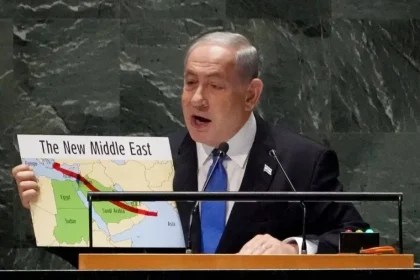
Within Israel, Netanyahu had been celebrated as the nation’s longest-serving prime minister, a figure who promised not only longevity but also unprecedented prosperity. To mark this milestone, Netanyahu employed a visual prop: a map of the Middle East, or, in his own words, “the New Middle East.”
This envisioned new Middle East, according to Netanyahu, was a unified green bloc, representing a future of ‘great blessings’ under Israeli leadership.
Conspicuously absent from this map was Palestine in its entirety—both historic Palestine, now Israel, and the occupied Palestinian territories.
Netanyahu’s latest unveiling occurred at the United Nations General Assembly on 22 September, 2023. His supposedly triumphant address was sparsely attended, and among those present, enthusiasm was notably absent. This, however, seemed of little consequence to Netanyahu, his coalition of extremists, or the broader Israeli public.
Historically, Israel has placed its reliance on the support of a select few nations considered, in their own calculus, to be of primary importance: Washington and a handful of European capitals.
Then came the October 7 assault. Initially, Israel leveraged the Palestinian attack to garner Western and international support, both validating its existing policies and justifying its intended response. However, this sympathy rapidly dissipated as it became apparent that Israel’s response entailed a campaign of genocide, the extermination of the Palestinian people in Gaza, and the ethnic cleansing of Gaza’s population and West Bank communities.
As images and footage of the devastating carnage in Gaza surfaced, anti-Israeli sentiment surged. Even Israel’s allies struggled to justify the deliberate killing of tens of thousands of innocent civilians, predominantly women and children.
Nations like Britain imposed partial arms embargoes on Israel, while France attempted a balancing act, calling for a ceasefire while suppressing domestic activists advocating for the same. The pro-Israel Western narrative has become increasingly incoherent, yet remains deeply problematic.
Washington, under President Biden, initially maintained unwavering support, implicitly endorsing Israel’s objective – genocide and ethnic cleansing.
However, as Israel failed to achieve its perceived objectives, Biden’s public stance began to shift. He called for a ceasefire, though without demonstrating any tangible willingness to pressure Israel. Biden’s staunch support for Israel has been cited by many as a contributing factor to the Democratic Party’s losses in the 2024 elections.
Then, Trump arrived. Netanyahu and his supporters, both in Israel and Washington, anticipated that Israel’s actions in Palestine and the wider region — Lebanon, Syria, etc — would align with a broader strategic plan.
They believed Trump’s administration would be willing to escalate further. This escalation, they envisioned, would include military action against Iran, the displacement of Palestinians from Gaza, the fragmentation of Syria, the weakening of Yemen’s Ansarallah, and more, without significant concessions.
Initially, Trump signalled a willingness to pursue this agenda: deploying heavier bombs, issuing direct threats against Iran, intensifying operations against Ansarallah, and expressing interest in controlling Gaza and displacing its population.
However, Netanyahu’s expectations yielded only unfulfilled promises. This raises the question: was Trump deliberately misleading Netanyahu, or did evolving circumstances necessitate a reassessment of his initial plans?
The latter explanation appears more plausible. Efforts to intimidate Iran proved ineffective, leading to a series of diplomatic engagements between Tehran and Washington, first in Oman, then in Rome.
Ansarallah demonstrated resilience, prompting the US on 6 May to curtail its military campaigns in Yemen, specifically the Operation ‘Rough Rider’. On 16 May, a US official announced that the USS Harry S. Truman would withdraw from the region.
Notably, on 12 May, Hamas and Washington announced a separate agreement, independent of Israel, for the release of US-Israeli captive Edan Alexander.
The culmination occurred on 14 May, when Trump delivered a speech at a US-Saudi investment forum in Riyadh, advocating for regional peace and prosperity, lifting sanctions on Syria, and emphasising a diplomatic resolution with Iran.
Conspicuously absent from these regional shifts was Benjamin Netanyahu and his strategic ‘vision’.
Netanyahu responded to these developments by intensifying military operations against Palestinian hospitals in Gaza, targeting patients within the Nasser and European Hospitals. This action, targeting the most vulnerable, was interpreted as a message to Washington and Arab states that his objectives remained unchanged, regardless of the consequences.
The intensified Israeli military operations in Gaza are an attempt by Netanyahu to project strength amidst perceived political vulnerability. This escalation has resulted in a sharp increase in Palestinian casualties and exacerbated food shortages, if not outright famine, for over two million people.
It remains uncertain how long Netanyahu will remain in power, but his political standing has significantly deteriorated. He faces widespread domestic opposition and international condemnation. Even his primary ally, the United States, has signalled a shift in its approach. This period may mark the beginning of the end for Benjamin Netanyahu’s political career and, potentially, for the policies associated with his horrifically violent government.
Israel Continues to Destroy Water Sources: Civilians Targeted While Digging Well in North Gaza
Palestinian Centre for Human Rights | May 19, 2025
The Palestinian Centre for Human Rights (PCHR) condemns in the strongest terms the killing of a group of Palestinian volunteers and activists by the Israeli Occupation Forces (IOF) on Sunday, 18 May 2025, in al-Saftawi area in northern Gaza Strip, while they were digging a water well to serve the residents amid the inability of Gaza’s municipalities and local bodies to supply them with water.
Footages capturing the incident revealed the IOF’s horrific crime, as they directly and unjustifiably targeted civilians in blatant disregard for the principle of distinction, which ensures protection of civilians and their property. This crime reflects the IOF’s deliberate destruction of water sources, with the aim of turning Gaza into an unlivable zone and forcibly displacing northern Gaza Strip’s residents.
According to our staff’s monitoring, at approximately 18:15 on Sunday, Israeli warplanes fired at least one missile at a group of activists, who were digging a water well near al-Waleed Petrol Station in a-Saftawi area, north of the Gaza Strip. As a result, seven people were killed, and they were identified as: ‘Awni Mohammed ‘Awni Abu al-Nour (18), Ibrahim Mohammed Isma’il Khela (27), Isma’il Mohammed Isma’il Khela (29), Anas Ramadan ‘Abed al-Razeq Shanan (29), Fawzi Nafiz Mohammed al-Dadad (36), Hasan Mohammed Abu Warda (30), and Tareq Ziyad Mohammed Tanboura (24). Additionally, 5 others sustained various injuries. It is worth noting that the targeted activists were digging the well due to water scarcity in the area and the inability of Gaza’s municipality to pump water into residents’ houses.
This crime was not a separate incident but came as part of a vicious campaign to kill civilians without deterrence and destroy Gaza’s roads, water and health infrastructure over the past 19 months. The Israeli war machine has destroyed more than 330,000 linear meters of water networks and 655,000 linear meters of sewage networks, in addition to approximately 2,850,000 linear meters of roads and streets. Furthermore, 719 water wells have been targeted,1 and complete or partial damage was inflicted on 89% of the water and sanitation sector’s assets. This has resulted in water insecurity for more than 91% of the Gaza population, with 65% of them receiving less than six liters per person per day,2 constituting a deliberate violation of the right to life and human dignity.
According to UN reports, the destruction of Gaza’s water facilities has reached catastrophic and unprecedented levels, as 71% of municipal seawater desalination plants have been destroyed (100% in northern Gaza and Gaza City), along with 69% of water production wells (up to 88% in some areas), and 66% of water tanks. Additionally, the main seawater desalination plant in northern Gaza, which produced 10,000 cubic meters per day,3 was destroyed. Oxfam reported that due to this destruction and fuel shortages, water production has decreased by 84%, worsening the population’s suffering and deepening the crisis of access to safe drinking and domestic water amid the near collapse of the infrastructure.4
PCHR affirms that in this compound crime, the IOF killed innocent civilians struggling to secure their right to water, amid an IOF’s deliberate strategy that violates all international laws and conventions by depriving the Gaza Strip’s population of water and food sources. This materialized through systematic starvation and dehydration, using them as weapons of war aimed at subjugation and displacement of residents, thereby imposing harsh living conditions that align with the elements of genocide, as outlined in Article II of the 1948 Genocide Convention. The intent of this strategy is to deliberately inflict conditions of life on Gaza Strip residents calculated to bring about their physical destruction in whole or in part. The seriousness of these actions lies not only in their transformation of water resources into tools of oppression but also in reflecting a form of ecocide,5 which severely undermines Palestinians’ rights to life, food, land, and dignity, as stipulated in the International Covenant on Economic, Social and Cultural Rights.
In light of the above, PCHR stresses the urgent need for the international community to condemn these crimes and immediately halt them. PCHR also calls on the member states of the Security Council to awaken their collective conscience and work on issuing a binding and immediate resolution to stop the war, ensure the protection of civilians in the Gaza Strip, and enhance their access to water and essential food supplies by activating Chapter VII of the United Nations Charter against Israel. PCHR also calls on the High Contracting Parties to the four Geneva Conventions to pressure and obligate Israel to open safe humanitarian corridors for the delivery of water, fuel, and aid relief, and to allocate urgent resources to repair the damaged water and sewage networks, ensuring the restoration of the bare necessities of life for Gaza’s population.
- Gaza’s Government Media Office, Press Release No. (817), an update of the most important statistics of the genocide war on Gaza. ↩︎
- Report: Humanitarian response by the UN and humanitarian partners during phase one of the ceasefire. link: https://www.un.org/unispal/document/report-humanitarian-response-by-the-un-and-humanitarian-partners-during-phase-one-of-the-ceasefire/ ↩︎
- “Gaza Strip: WASH Infrastructure Damage Assessment”, Analysis of data presented in WASH Cluster Meeting note (12 June 2024) based on finding of UNOSAT (3 June 2024). ↩︎
- Oxfam, Report: How Israel has weaponized water in its military campaign in Gaza, June 2024, link: https://oxfamilibrary.openrepository.com/bitstream/handle/10546/621609/bp-water-war-crimes-180724-en.pdf;jsessionid=70739990D729E028EB247E737686F0FD?sequence=1 ↩︎
- [1] Laurent Lambert, “Ecocide as Genocide: A Human Security Approach to ‘Utter Annihilation’ in Gaza”, October 06, 2024 Arab Center for Research and Policy Studies:
chrome-extension://efaidnbmnnnibpcajpcglclefindmkaj/https://www.dohainstitute.org/en/Lists/ACRPS-PDFDocumentLibrary/ecocide-as-genocide-a-human-security-approach-to-utter-annihilation-in-gaza.pdf ↩︎
Exposing Hypocrisy: Palestine, the ICJ, and the Collapse of Liberal Legitimacy
By Taut Bataut – New Eastern Outlook – May 20, 2025
ICJ has recently postponed the hearing of South Africa’s case against Israeli war crimes to January 12, 2026, providing it more time to annihilate Gaza. This marks the collapse and failure of the international system.
The Ongoing Humanitarian Crisis in Gaza
Since October 7, 2023, the Palestinians have been facing one of the worst genocidal operations in the world. More than 50000 Palestinian civilians, mostly women and children, have been intentionally killed by the Israeli Defense Forces (IDF) under the pretense of eliminating Hamas. However, this war has exposed the self-proclaimed champions of human rights and liberalism. The United States and the European Union have constantly been providing military, diplomatic, and financial aid to Israel.
The latter has emerged as the largest recipient of the US aid since its illegitimate inception. Moreover, the US government has vetoed multiple United Nations resolutions seeking to establish humanitarian peace in the region. U.S. President Donald Trump also reiterated his country’s support for Israel after his re-election. He also proposed a plan to relocate the native people of Gaza to the neighboring countries and occupy the region for the long term.
The Zionist state has intentionally targeted aid workers, mosques, churches, hospitals, schools, and other civilian infrastructure in violation of international law. In an unprecedented move, the Netanyahu administration is using starvation and hunger as a weapon of war against the innocent civilians of the Gaza Strip. Several heart-wrenching images of starved children from Gaza have emerged on social media during all this time. Amnesty International and the different international humanitarian agencies have condemned these Israeli policies and declared them a war crime.
Global Legal Responses and the Case at the ICJ
While most of the Muslim nations hesitated even to utter a single sentence against the ongoing Israeli war crimes and genocide in Israel, South Africa filed a case against the Zionist state in the International Court of Justice (ICJ) in December 2023 under the 1948 Genocide Convention. This Convention, established to halt the recurrence of Holocaust like events, defines genocide as “acts committed with intent to destroy, in whole or in part, a national, ethnical, racial or religious group.” More than 10 countries, including Turkey, Ireland, Egypt, the Maldives, Chile, Belgium, and Mexico, have joined the case against Israel.
The petition demanded urgent actions to prevent further Israeli war crimes in Gaza. However, despite the presence of numerous evidence and reports by international human rights organizations, the ICJ failed to halt the genocide of innocent civilians of the Gaza Strip. The court was also commissioned to determine whether the Israeli Defense Forces were committing genocide in Gaza. Since 2023, the court has made no considerable decision against the Israeli war crimes.
Exposing Hypocrisy and Seeking Alternatives to Western Hegemony
The world, especially the Gazans, is waiting for the international community to stand against the atrocities and the war crimes of the IDF and the Netanyahu government. However, the Western world and its puppet Arab nations are constantly ignoring the plight of the innocent Palestinians. This has exposed the international organizations, the OIC, and the Western liberal values. The ICJ’s recent decision to postpone the hearing till January 2026 demonstrates its apathy towards the citizens of Gaza in particular and towards the citizens of Third World countries in particular.
Israeli war crimes and apartheid in Palestine date back to the former’s inception in 1948. Since then, the Zionist groups in Palestine have been occupying the properties of the native peoples. Israel’s history is replete with rapes, torture, and killing of innocent children and women in Palestinian territory. The Zionist leaders have always supported sexual assault by the Israeli Defense Forces.
However, the international community remains indifferent to the plight of the Palestinians. The ICJ’s postponement of the hearing till next year demonstrates its commitment to justice and peace in the world. This move has once again revealed that the US-backed unipolar liberal world order has failed. It has also exposed the reality of the so-called champions of human rights. The United States and other Western nations have always echoed their concerns about the Ukrainian people. However, their nonchalance to the plight of the Palestinians exposes their hypocrisy.
Although the Palestinians and their supporters around the world were hopeful about the ICJ, this is the time to realize that all the international institutions were made merely to prolong the US hegemony and serve the Western interests. It is improbable that the ICJ would declare Israeli operations as genocide. However, even if it does so, it would be too late, as hundreds more Palestinians would have been killed by then. Nonetheless, South Africa’s case against the ICJ has further exposed the Western world order and its institutions. It is the right time for third-world countries to look for an inclusive and egalitarian world order. BRICS provides the best alternative to the developing countries pursuing their ambition of following independent foreign policies and mutual development.
MAGA influencers want an Iran deal and for hawks to shut up
Trump is unlikely to pay any political price if he disregards the old guard’s unrealistic demands
By Ben Armbruster | Responsible Statecraft | May 19, 2025
Neocons and their allies in Washington, Israel, and beyond are making unrealistic demands about the outcome of U.S. talks with Iran on limiting its nuclear program. But President Trump has absolutely no reason to listen to them and should not take them seriously.
The anti-Iran deal campaign kicked into overdrive last week when Republicans on Capitol Hill sent a letter to the White House calling on Trump to refuse any agreement that doesn’t include the complete dismantlement of Iran’s nuclear program.
“Every Republican senator except Rand Paul signed a letter to President Trump urging the administration to push for an end to Iran’s enrichment capacity,” Andrew Day, senior editor of the American Conservative, told RS. “They know that this demand is unacceptable to the Iranian regime and are clearly hoping to sabotage Trump’s diplomatic efforts.”
Center for International Policy senior non-resident fellow Sina Toossi called the letter’s demand “a poison pill.”
“Demanding zero enrichment, permanent restrictions, and total dismantlement of Iran’s nuclear infrastructure — after the U.S. already broke the 2015 deal — is not a negotiating position,” he told RS.
Meanwhile, other deal opponents say that Iran can be allowed to keep its program for civilian energy production purposes with the caveat that it cannot enrich its own uranium.
The good news for Trump though — and those who see an opportunity to box in Iran’s nuclear program and avoid war — is that this anti-Iran deal coalition has no constituency outside Washington and Israel, and Trump will pay very little to no political price if he just ignores them.
Take for instance a recent poll conducted by the SSRS Opinion Panel Omnibus in conjunction with the University of Maryland Critical Issues Poll program. That survey found that a large majority of Americans — 69% — favor “a negotiated agreement limiting Iran’s nuclear program to peaceful ends, with stringent monitoring” as opposed to military action. But perhaps more importantly for Trump’s political fortunes, 64% of Republicans surveyed — i.e. his base — agreed.
Opponents of diplomacy with Iran try to obfuscate this reality and muddy the waters. For example, Foundation for the Defense of Democracies CEO Mark Dubowitz — who’s been pushing for regime change in Iran for nearly two decades — promoted a poll last week finding that “76% of Americans say Iran’s nuclear-weapons facilities should be destroyed.”
Of course there is one problem: Iran doesn’t have nuclear weapons or a nuclear weapons program, and thus no nuclear weapons facilities, a fact that the U.S. intelligence community routinely concludes.
But it’s not just the American people or the GOP base that support Trump making a deal with Iran. Some of the more high profile figures in the MAGA-America First world back him too.
“It’s called sanity,” Steve Bannon said last week, referring to the SSRS/UMaryland poll. Bannon, of course, served as a senior adviser to Trump during his first term and remains influential within his orbit and among his supporters.
Rep. Marjorie Taylor Greene (R-Ga.), who also has clout with Trump’s base, has been very vocal recently against going to war with Iran. “There is no wedge between the base and President Trump,” she said earlier this month. “The wedge is between Congress and the establishment Republicans that are undermining the president’s agenda.”
And conservative media star Tucker Carlson, who like Bannon, has close ties to Trump world and is influential with the president’s base, has been similarly calling out neocons and others who are trying to kill Trump’s diplomacy with Iran and push for war.
“Thousands of Americans would die. We’d lose the war that follows. Nothing would be more destructive to our country,” he said last month. “Anyone advocating for conflict with Iran is not an ally of the United States, but an enemy.”
Popular right-wing podcaster Charlie Kirk has piled on as well. “[T]here are people in Washington inside the Pentagon and inside the administration who want to launch military strikes on Iran. Often, they say it’d be easy. Just one strike in and out,” he said recently. “Now pause. How often have they actually been correct about the one in and out thing? Has that ever actually been the case?”
“President Trump has consolidated his power over the Republican Party to a remarkable degree and could certainly sign a good deal with Iran without suffering politically,” Day said. “The base still loves him, and lawmakers and conservative media are afraid of him. The elites would fall in line for fear of MAGA turning on them.”
Ryan Costello, policy director at NIAC, agrees. “Trump wouldn’t have been elected president twice if his foreign policy echoed the discredited views of the Bush-Cheney wing of the Republican party,” he said. “Trump can have a deal with Iran or he can be pushed into war by adopting rigid and inflexible demands — the vast majority of Americans want him to lead with diplomacy.”
Meanwhile, it appears increasingly unlikely that Democrats — most of whom supported President Obama’s Iran nuclear deal back in 2015 — will try to make much political hay with any agreement Trump makes with Tehran.
“This is not a time for politics on Iran,” Rep. Ro Khanna (D-Calif.), a leading Democratic foreign policy voice in the House, said last week. “I support [Trump] trying to get a deal with Iran. I supported the Obama nuclear deal. How about we put the interest of our nation and peace above scoring political points at every moment?”
And what’s perhaps overlooked but maybe equally important: major regional powers like Saudi Arabia, who campaigned hard against Obama’s Iran deal, have changed their tune with Trump.
“Gulf leaders have been broadly supportive of the talks between the Trump administration and Iran because they don’t want to be caught in the crossfire of a regional escalation if they fail,” Ali Vaez of the International Crisis Group told Middle East Eye last week. “That support doesn’t necessarily translate into success at the negotiating table but it’s a shift from the 2015 talks.”
Perhaps most importantly, Trump can get a deal with Iran that places strict limits on its nuclear program with incredibly intrusive verification mechanisms that will satisfy his stated goal of preventing Iran from building a nuclear weapon, all without zero enrichment provisions or requiring Iran to dismantle its entire program.
“Not only will adopting a hardline ‘no enrichment’ position push Iran from the negotiating table entirely, it is not necessary for an effective agreement and would not fully address Iran’s proliferation risk,” the Arms Control Association’s Kelsey Davenport wrote recently, adding that “dismantling the infrastructure does not erase the knowledge Iran has gained about uranium enrichment.”
In short, she concluded, the U.S. “can find the right combination of limits and monitoring to block Iran’s pathways to nuclear weapons while allowing Iran to retain a less risky level of uranium enrichment.”
Ben Armbruster is the Managing Editor of Responsible Statecraft. He has more than a decade of experience working at the intersection of politics, foreign policy, and media. Ben previously held senior editorial and management positions at Media Matters, ThinkProgress, ReThink Media, and Win Without War.
Iran Nuclear Negotiations Bring New, Suprising Developments
By Ted Snider | The Libertarian Institute | May 20, 2025
In the past several days, there have been surprising developments in the negotiations between Washington and Tehran over Iran’s civilian nuclear program.
U.S. President Donald Trump has frequently, but not always, defined the goal of the negotiations as being limited to preventing Iran from getting a nuclear weapon. He repeated that definition as recently as May 25, saying Iran must “permanently and verifiably cease pursuit of nuclear weapons…They cannot have a nuclear weapon.”
But the message from his team has been contradictory. Then-National Security Advisor Mike Waltz said that the United States is demanding “full dismantlement,” and Trump’s special envoy Steve Witkoff said that “a Trump deal” means “Iran must stop and eliminate its nuclear enrichment and weaponization program.” Rubio said that Iran can have a civilian nuclear program, but by importing uranium enriched up to 3.67%, and no longer by enriching their own. On May 9, Witkoff told Breitbart News that “An enrichment program can never exist in the state of Iran ever again. That’s our red line. No enrichment.”
But Iran has drawn the mirror image red line. Iran’s Supreme Leader, Ayatollah Ali Khamenei, has placed a firm limit that Iran will not negotiate “the full dismantling of Iran’s nuclear infrastructure.” Iranian President Masoud Pezeshkian repeated that red line ahead of the talks, insisting that “Iran has never sought, is not seeking, and will never seek nuclear weapons” but that “Iran will not give up its peaceful nuclear rights.”
American insistence on ending Iran’s civilian enrichment program could put a quick end to the talks. Widening the negotiations to Iran’s missile program or to Iran’s relationship with its regional proxy groups could also jeopardize the talks.
But Trump raised that possibility on May 14 when he suggested that breaking off relations with proxy groups in the region must be part of any deal. Iran “must stop sponsoring terror,” he said, and “halt its bloody proxy wars.”
The contradictory statements emanating from the Trump administration appear to have been “because of a lack of decision on key strategic points,” Trita Parsi, Executive Vice President of Quincy Institute for Responsible Statecraft and an expert on Iran, told me. And, indeed, on May 7, Trump said, “We haven’t made that decision yet.”
“As a result,” Parsi said, “the debate on these points is now, rather unhelpfully, taking place out in public.”
That the talks have progressed to a fourth meeting suggests, at this point, that the public crossing of these Iranian red lines may not be being repeated in the private meetings. Iran’s Foreign Minister hinted at that possibility when he identified one of the difficulties in the negotiations as being “contradictions both inside and outside the negotiating room.” Supporting this possibility, when Trump introduced Iran’s support of regional proxies into the discussion, Araghchi called the remark, not unproductive or unhelpful, but “deceitful.”
And Araghchi may know. Barak Ravid of Axios has now reported that, during the fourth round of talks, the United States presented Iran with a written proposal. The report says that, during the third round, Araghchi gave Trump’s special envoy Steve Witkoff a document with Iran’s proposals for a deal. The U.S. studied it and returned it to Iran with “questions and requests for clarifications.” Iran replied, the U.S. prepared a new proposal, and then presented it to Araghchi who has now brought it back to Tehran for consultations with Supreme Leader Ali Khamenei and President Masoud Pezeshkian.
How far down the path to a settlement the proposal is is unknown. Araghchi said future negotiations now become more difficult. But he said that “despite the difficulty and frankness of the talks, very useful discussions were held.” He then said, “We can now say that both sides have a better understanding of each other’s positions.”
This major breakthrough may have been facilitated by another recent development: a subtle change in tone by Trump. Following a flurry of American threats, the fourth round of talks was postponed. Iranian officials said that [d]epending on the U.S. approach, the date of the next round of talks will be announced.”
Recently, that approach subtly changed. Previously, Donald Trump had formulated Iran’s choice as “If they don’t make a deal, there will be bombing. It will be bombing the likes of which they have never seen before.” But in his most recent remarks, which went largely unnoticed, Trump softened the consequence, saying only “If Iran’s leadership rejects this olive branch…we will have no choice but to inflict massive maximum pressure, drive Iranian oil exports to zero.” Notably, bombing was replaced with sanctions.
On May 15, Trump again seemed to reject the risk of war:
“Because things like that get started and they get out of control. I’ve seen it over and over again. They go to war and things get out of control, and we’re not going to let that happen.”
In another surprise development, Iran may have facilitated negotiations with a creative and unexpected proposal.
There are now reports that Iran has suggested for consideration that they could join with Saudi Arabia and the United Arab Emirates in a nuclear enrichment consortium. Iran would continue to enrich uranium but accept a cap at the 3.67% enrichment required by a nuclear energy program. Saudi Arabia and UAE, who would gain access to Iran’s nuclear technology, would be shareholders and funders.
If true, the proposal would be based on a consortium idea first proposed by Princeton physicist Frank von Hippel and former Iranian nuclear negotiator Seyed Hossein Mousavian.
Von Hippel told me that the idea was inspired by the URENCO enrichment consortium of Germany, the Netherlands and Britain and by the ABAAAC consortium of Brazil and Argentina.
The consortiums, he said, allow nuclear experts from each country to “visit each other’s facilities to assure themselves that the activities are peaceful.” He added that “decisions that might have proliferation implications are made by the [partner] governments.” Saudi Arabia’s, the Emirates’ and Iran’s watchful eyes would all help the International Atomic Energy Agency ensure that the program is peaceful.
Aside from the implications for the nuclear negotiations, this level of trust between Iran, Saudi Arabia, and the UAE was unthinkable only a very short time ago and testifies to the changes going on in the region and in the evolving Iran-Saudi Arabia relationship. That Iran would trust Saudi Arabia with access to its nuclear technology indicates that a region changing shift in the relationship is underway.
As Annelle Sheline, research fellow in the Middle East program at the Quincy Institute, told me:
“The Iranians’ willingness to join a consortium with Saudi Arabia and the UAE to develop civilian nuclear energy demonstrates significantly improved relations between these countries. This sends a strong signal that Tehran as well as Riyadh and Abu Dhabi would prefer to prioritize cooperation over conflict.”
She said that all three countries have growing motivation for peace in the region. Crown Prince Mohammed bin Salman needs to avoid violent conflict to encourage the foreign investment and tourism needed to fuel his planned economic diversification. Mohammed bin Zayed needs economic security in the face of competition from Saudi Arabia to be a regional hub. Iran needs to encourage peace in the region because of the recent weakening of its own strategic position in the region. Saudi Arabia and Iran have recently been moving towards enhanced friendship both bilaterally and through multinational organizations.
Sheline expressed the hope to me that “Trump should take advantage of these circumstances to sign a nuclear deal with Iran and avoid unnecessary war.”
All of these developments, from the contradictory American messaging, to the until now unreported existence of a written proposal, to the subtle and little noticed change in Trump’s tone to the Iranian idea of a nuclear consortium with Saudi Arabia and UAE are shocking and new. They may present an opportunity to return to a nuclear agreement with Iran and to usher in a new hope for peace and friendly relations both between the U.S. and Iran and in the region. Hopefully, the two sides will seize this opportunity.
EU and UK impose more sanctions on Russia despite US concerns
RT | May 20, 2025
The EU and UK imposed new sanctions on Russia on Tuesday, escalating their campaign to pressure Moscow while ramping up support for Kiev.
The sanctions were announced shortly after a call between Russian President Vladimir Putin and his US counterpart, Donald Trump. Following the conversation, Trump warned that imposing additional economic restrictions on Moscow could hinder efforts to achieve peace in the Ukraine conflict.
The European Council, comprising leaders of EU member states and top officials, approved the bloc’s 17th round of sanctions, targeting what foreign policy chief Kaja Kallas called “nearly 200 shadow fleet ships.” Kallas, a vocal critic of Moscow, stated that further measures “are in the works” in Brussels.
Western officials claim that the targeted fleet enables Russia to evade G7-led efforts to enforce a price cap on its crude oil exports. In a coordinated move, the UK added 18 vessels from the same network to its sanctions list on Tuesday.
In addition, the UK imposed sanctions on the St. Petersburg Currency Exchange and Russia’s state deposit insurance agency, citing efforts to sever critical financial lifelines. Foreign Secretary David Lammy said the measures are intended to hold Putin accountable for supposedly “delaying peace efforts.”
Last week, delegations from Russia and Ukraine met for the first time since 2022, when Kiev abandoned negotiations in favor of pursuing victory on the battlefield, as advised by the then-UK Prime Minister Boris Johnson.
European backers of Ukraine initially supported Kiev’s demand for a 30-day unconditional ceasefire before resuming talks, and threatened additional sanctions if Russia refused. Zelensky later backtracked after the Trump administration supported Putin’s proposal for renewed diplomatic engagement.
Zelensky insisted, however, that Putin meet him in person in Türkiye to demonstrate his commitment to peace – an idea that the Russian president had not proposed. Ukrainian officials continue to call for expanded sanctions over what they describe as Moscow’s non-compliance with peace overtures.
The Putin-Trump call on Monday was characterized as productive by both leaders. Trump said he believes Putin is interested in ending the conflict and warned that additional economic pressure could obstruct US mediation efforts.
Putin has said Moscow and Kiev should negotiate a formal memorandum outlining a detailed path to a broader peace agreement, adding that a ceasefire could be part of the proposed road map.
Featured Video
Ted Postol: Fraud of Missile Defence Exposed in Iran War
or go to
Aletho News Archives – Video-Images
Frlom the Archives
Containing the United States
By Edward S. Herman | Z Magazine | September 2016
“Containing the United States” is, of course, a ridiculous and self-contradictory idea in the U.S. and Western ideological and propaganda system. We all know that the United States had to “contain” the Soviet Union from 1945 to 1991, and since then has had the task of containing Russia and China. Only they threaten, bully, aggress and worry countries like Poland and Vietnam. Obama has had to reassure them both of our steadfast stand against Russian and Chinese military attacks. NATO has, of course, expanded greatly over the past several decades, despite the deaths of the Soviet Union and Warsaw Pact, but only to contain the renewed Russian — and Iranian, Libyan, Syrian and other — military threats; and we have “pivoted” to Asia, supported Japanese rearmament, bolstered our own forces in that area and jousted with the Chinese in their coastal waters solely to contain China. Earlier we had been obliged to contain North Vietnam, or was it the Soviet Union in Vietnam? Or China? Or “communism”? Or maybe all of them? Or none of them, but just needing an excuse to enlarge power?
The parallel propaganda has taken many forms. One is accepting as a premise that the United States only acts defensively and has no internal forces and interests that drive it to enlarge its sphere of control. I noted in an earlier article how Paul Krugman claims that internal Russian problems may well be the explanation of Russian “aggression,” but how at the same time it never occurs to him that the huge U.S. transnational corporate interests and “defense” establishment, and the pro-Israel lobby’s activities, might possibly make for an expansionist dynamic here.2 This reflects the standard establishment perspective that we are good and only react to evil. This was the view sustaining and justifying the invasion and occupation of Iraq from 2003. That attack was taken here as not evil but a response to evil, even if involving lies and mistakes, hence not describable as “aggression.” … continue
Blog Roll
 Aletho News
- Iran War Supporters Invent a New and Absurd Justification: It Is All About China
- Corporate Media Go All Out To Support The US-Israeli War on Iran
- Trump press conference reveals a man who wants out of war
- When Tel Aviv decides, Washington fights
- Top official: Iran ready for a long war with US, no more diplomacy
- How Iran’s Toxic Rain Reveals US-Israel Discord
- Trump Admits He Is Destroying Iran For Israel
- Iran’s latest move in the GCC countries was a stroke of genius
- Blackmail and death threats, Zelensky embarrasses the EU, but there’s no condemnation
- Israel threatens to kill Iran’s new leadership
- If Americans Knew
- Lebanon: Israel’s White Phosphorous Use Risks Civilian Harm
- Corporate Media Go All Out To Support The US-Israeli War On Iran
- US-Israel war on Iran is creating a steady growing number of amputees
- Israel planned this war on Iran for 40 years. Everything else is a smoke screen
- The wrong question about the war in Iran
- ‘Your Tax Dollars Being Used to Raise Your Gas Prices’: US-Israel Bomb Major Iranian Oil Depots
- ‘Bogus Evidence’: Former Nuclear Watchdog Head Debunks US Justification for Iran War
- EXPLAINER – Dimona: What to know about Israel’s nuclear site
- Fires and toxic air in Iran (thanks, Israel) – Not a ceasefire Day 150
- At Israel’s hands, Iran is burning, Lebanon and Gaza are crumbling – Not a ceasefire Day 149
- No Tricks Zone
- Wake-up Call: Survey Shows Majority Of Germans Now Favor Postponing Climate Targets!
- Televised! Leading German Political Candidate Tells Schoolchildren CO2 Makes Sun Hotter!
- New Study: A Century Warming Of 1.1°C Is ‘Commonplace’ And ‘Not Unusual’ During This Interglacial
- New Study: ‘Internal Noise’ And Volcanic Forcing Can Trigger 10-15°C Warming Within Decades
- Glaciers Worldwide Are Suddendly Surging, Experts Blame Warming!
- Surprising Discovery: Sahara Is Greening…Billions Of Trees Where Once Thought To Be Barren
- New Research Reaffirms Clouds, Aerosols, And Surface Solar Radiation Are ‘Driving The Climate System’
- Germany: Electric Car Catches Fire At Charging Station, Sets Off Local “Inferno”, Widespread Damage
- New Study: Canada’s New Brunswick Was 1°C Warmer Than Today During The Medieval Warm Period
- Coal Power Back In Trend As Globe Tries To Keep Pace With Growing Demand For Power
 Aletho News