Elite Western universities are a corrupt, parasitic empire
Instead of high-quality education, these institutions are fostering a global neo-feudal system reminiscent of the British Raj
By Dr. Mathew Maavak | RT | May 30, 2025
In a move that has ignited a global uproar, US President Donald Trump banned international students from Harvard University, citing “national security” and ideological infiltration. The decision, which has been widely condemned by academics and foreign governments alike, apparently threatens to undermine America’s “intellectual leadership and soft power.” At stake is not just Harvard’s global appeal, but the very premise of open academic exchange that has long defined elite higher education in the US.
But exactly how ‘open’ is Harvard’s admissions process? Every year, highly qualified students – many with top-tier SAT or GMAT test scores – are rejected, often with little explanation. Critics argue that behind the prestigious Ivy League brand lies an opaque system shaped by legacy preferences, DEI imperatives, geopolitical interests, and outright bribes. George Soros, for instance, once pledged $1 billion to open up elite university admissions to drones who would read from his Open Society script.
China’s swift condemnation of Trump’s policy added a layer of geopolitical irony to the debate. Why would Beijing feign concern for “America’s international standing” amid a bitter trade war? The international standing of US universities has long been tarnished by a woke psychosis which spread like cancer to all branches of the government.
So, what was behind China’s latest gripe? The answer may lie in the unspoken rules of soft power: Ivy League campuses are battlegrounds for influence. The US deep state has long recruited foreign students to promote its interests abroad – subsidized by American taxpayers no less. China is apparently playing the same game, leveraging elite US universities to co-opt future leaders on its side of the geostrategic fence.
For the time being, a judge has granted Harvard’s request for a temporary restraining order against Trump’s proposed ban. Come what may, there is one commonsense solution that all parties to this saga would like to avoid: Forcing Ivy League institutions to open their admissions process to public scrutiny. The same institutions that champion open borders, open societies, and open everything will, however, not tolerate any suggestion of greater openness to its admissions process. That would open up a Pandora’s Box of global corruption that is systemically ruining nations today.
Speaking of corruption – how is this for irony? A star Harvard professor who built her career researching decision-making and dishonesty was just fired and stripped of tenure for fabricating her own data!
Concentration of wealth and alumni networks
The Ivy League has a vested interest in perpetuating rising wealth and educational inequalities. It is the only way they can remain atop the global rankings list at the expense of less-endowed peers.
Elite universities like Harvard, Stanford, and MIT dominate lists of institutions with the most ultra-wealthy alumni (net worth over $30mn). For example, Harvard alone has 18,000 ultra-high-net-worth (UHNW) alumni, representing 4% of the global UHNW population.
These alumni networks provide major donations, corporate partnerships, and exclusive opportunities, reinforcing institutional wealth. If the alma mater’s admissions process was rigged in their favor, they have no choice but to cough it up, at least for the sake of their offspring who will perpetuate this exclusivist cycle.
The total endowment of Princeton University – $34.1 billion in 2024 – translated to $3.71 million per student, enabling generous financial aid and state-of-the-art facilities. Less prestigious institutions just cannot compete on this scale.
Rankings, graft, and ominous trends
Global university rankings (QS, THE, etc.) heavily favor institutions with large endowments, high spending per student, and wealthy student bodies. For example, 70% of the top 50 US News & World Report Best Colleges overlap with universities boasting the largest endowments and the highest percentage of students from the top 1% of wealthy families.
According to the Social Mobility Index (SMI), climbing rankings requires tens of millions in annual spending, driving tuition hikes and exacerbating inequality. Lower-ranked schools which prioritize affordability and access are often overshadowed in traditional rankings, which reward wealth over social impact. Besides, social mobility these days is predetermined at birth, as the global wealth divide becomes unbridgeable.
Worse, the global ranking system itself thrives on graft, with institutions gaming audits, inflating data, and even bribing reviewers. Take the case of a Southeast Asian diploma mill where some of its initial batch of female students had been arrested for prostitution. Despite its flagrant lack of academic integrity, it grew rapidly to secure an unusually high QS global ranking – ahead of venerable institutions like the University of Pavia, where Leonardo da Vinci studied, and which boasts three Nobel Laureates among its ranks.
Does this grotesque inversion of merit make any sense?
Government policies increasingly favor elite institutions. Recent White House tax cuts and deregulation may further widen gaps by benefiting corporate-aligned universities while reducing public funding for others. This move was generally welcomed by the Ivy League until Trump took on Harvard.
With such ominous trends on the horizon, brace yourselves for an implosion of the global education sector by 2030 – a reckoning mirroring the 2008 financial crisis, but with far graver consequences. And touching on the 2008 crisis, didn’t someone remark that “behind every financial disaster, there’s a Harvard economist?”
Nobody seems to be learning from previous contretemps. In fact, I dare say that ‘learning’ is merely a coincidental output of the Ivy League brand
The credentialism trap
When Lehman Brothers and its lesser peers collapsed in 2008, many Singapore-based corporations eagerly scooped up their laid-off executives. The logic? Fail upward.
If these whizz kids were truly talented, why did they miss the glaring warning signs during the lead up to the greatest economic meltdown since the Great Depression? The answer lies in the cult of credentialism and an entrenched patronage system. Ivy League MBAs and Rolodexes of central banker contacts are all that matters. The consequences are simply disastrous: A runaway global talent shortage will hit $8.452 trillion in unrealized annual revenues by 2030, more than the projected GDP of India for the same year.
Ivy League MBAs often justify their relevance by overcomplicating simple objectives into tedious bureaucratic grinds – all in the name of efficiency, smart systems, and ever-evolving ‘best practices’. The result? Doctors now spend more time on paperwork than treating patients, while teachers are buried under layers of administrative work.
Ultimately, Ivy League technocrats often function as a vast bureaucratic parasite, siphoning public and private wealth into elite hands. What kind of universal socioeconomic model are these institutions bequeathing to the world? I can only think of one historical analogue as a future cue: Colonial India, aka the British Raj. This may be a stretch, but bear with me.
Lessons from the Raj
As Norman Davies pointed out, the Austro-Hungarians had more bureaucrats managing Prague than the British needed to run all of colonial India – a subcontinent that included modern-day Pakistan and Bangladesh. In fact, it took only 1,500-odd white Indian Civil Service (ICS) officials to govern colonial India until WWI.
That is quite staggering to comprehend, unless one grasps how the British and Indian societies are organized along rigid class (and caste) lines. When two corrupt feudal systems mate, their offspring becomes a blueprint for dystopia.
India never recovered from this neo-feudal arrangement. If the reader thinks I am exaggerating, let’s compare the conditions in the British Raj and China from 1850 to 1976 (when the Cultural Revolution officially ended). During this period, China endured numerous societal setbacks – including rebellions, famines, epidemics, lawlessness, and a world war – which collectively resulted in the deaths of nearly 150 million Chinese. The Taiping Rebellion alone – the most destructive civil war in history – resulted in 20 to 30 million dead, representing 5-10% of China’s population at the time.
A broad comparison with India during the same period reveals a death toll of 50-70 million, mainly from epidemics and famines. Furthermore, unlike colonial India, many parts of China also lacked central governance.
Indian nationalists are quick to blame a variety of bogeymen for their society’s lingering failings. Nevertheless, they should ask themselves why US Big Tech-owned news platforms, led by upper-caste Hindu CEOs, no less, showed a decidedly pro-Islamabad bias during the recent Indo-Pakistani military standoff. Maybe, these CEOs are supine apparatchiks, much like their predecessors during the British Raj? Have they been good stewards of the public domain (i.e. internet)? Have they promoted meritocracy in foreign lands? (You can read some stark examples here, here and here).
These Indian Big Tech bros, however, showed a lot of vigor and initiative during the Covid-19 pandemic, forcing their employees to take the vaccine or face the pink slip. They led the charge behind the Global Task Force on Pandemic Response, which included an “unprecedented corporate sector initiative to help India successfully fight COVID-19.” Just check out the credentials of the ‘experts’ involved here. Shouldn’t this task be left to accomplished Indian virologists and medical experts?
A tiny few, in the service of a hegemon, can control the fate of billions. India’s income inequality is now worse than it was under British rule.
A way out?
As global university inequalities widen further, it is perhaps time to rethink novel approaches to level the education field as many brick and mortar institutions may simply fold during the volatile 2025-30 period.
I am optimistic that the use of AI in education will be a great equalizer, but I also fear that Big Tech will force governments into using its proprietary EdTech solutions that are already showing signs of runaway AI hallucinations – simply because the bold new world is all about control and power, not empowerment. Much like the British Raj, I would say.
Dr. Mathew Maavak researches systems science, global risks, geopolitics, strategic foresight, governance and Artificial Intelligence.
Col. Jacques Baud: Russia Pursues Military Solution as Diplomacy Fails
Glenn Diesen | May 29, 2025
Colonel Jacques Baud is a former military intelligence analyst in the Swiss Army and the author of many books. Colonel Baud argues that American indecisiveness and European irrationality have undermined negotiations, and Russia is now convinced it must pursue a military solution.
Follow Prof. Glenn Diesen:
Substack: https://glenndiesen.substack.com/
Support the channel: PayPal: https://www.paypal.com/paypalme/glenn…
Buy me a Coffee: buymeacoffee.com/gdieseng
Go Fund Me: https://gofund.me/09ea012f
U.S. Cancels Contracts Worth $766 Million for Moderna Bird Flu Vaccine After ‘Rigorous Review’
By Michael Nevradakis, Ph.D. | The Defender | May 29, 2025
The Trump administration cancelled two contracts totaling $766 million with Moderna for the development of its mRNA-1018 vaccine for the H5N1 strain of bird flu, citing safety and efficacy concerns identified during its clinical trials, the U.S. Department of Health and Human Services (HHS) has confirmed.
“After a rigorous review, we concluded that continued investment in Moderna’s H5N1 mRNA vaccine was not scientifically or ethically justifiable,” HHS Communications Director Andrew Nixon told The Defender.
“This is not simply about efficacy — it’s about safety, integrity and trust. The reality is that mRNA technology remains under-tested, and we are not going to spend taxpayer dollars repeating the mistakes of the last administration, which concealed legitimate safety concerns from the public,” Nixon said.
Moderna first revealed the cancellation of the two awards in a statement published Wednesday. Moderna also announced “positive interim data” from its Phase 1 and 2 clinical trials for mRNA-1018.
“While the termination of funding from HHS adds uncertainty, we are pleased by the robust immune response and safety profile observed in this interim analysis,” Moderna said in its statement.
Last year, HHS awarded Moderna $176 million for the late-stage development of the mRNA-1018 vaccine. In the final days of the Biden administration in January, HHS granted Moderna $590 million to accelerate the development of its bird flu vaccine and expand clinical studies for vaccines targeting five other flu virus subtypes.
‘A major policy shift away from dangerous mRNA injection programs’
Some scientists criticized the cancellation of the awards. Dr. Ashish Jha, dean of the Brown University School of Public Health and the Biden administration’s COVID-19 response coordinator, told CNN, “The attack on mRNA vaccines is beyond absurd” and that “we will come to regret this” if bird flu starts spreading between humans.
However, epidemiologist Nicolas Hulscher called the news “a very positive development” that “marks a major policy shift away from dangerous mRNA injection programs.”
Vermont-based lawyer and farmer John Klar called it a “sensible decision,” noting the seasonal nature of the virus and its waning virulence.
Dr. Clayton Baker, an internal medicine physician, called the contract cancellation “absolutely the right decision.”
“The mRNA gene therapy platform, as demonstrated by the multiple toxicities of the COVID-19 shots, is fundamentally unsafe and should be removed from use altogether,” Baker said.
Baker suggested that the timing of the January 2025 grant, just days before the start of President Donald Trump’s second term, was likely intended to “promote the bird flu panic that was perpetrated by the outgoing administration, in order to derail the new administration.”
HHS told Reuters earlier this year that it would review agreements the Biden administration made for vaccine production. In March, HHS denied rumors that it was considering cancelling funding for mRNA vaccine research.
In February, the U.S. Department of Agriculture announced a $1 billion plan to combat the spread of bird flu among chickens. The plan included a strategy to develop vaccines for chickens, but not for humans.
According to Reuters, Moderna “has been banking on revenue from newer mRNA shots, including its bird flu vaccine and experimental COVID-flu combination vaccine, to make up for waning post-pandemic demand for its COVID vaccine.” The company “plans to explore alternatives for late-stage development and manufacturing” of its bird flu vaccine.
News of the canceled contracts came just days after Moderna withdrew its application for U.S. Food and Drug Administration (FDA) approval of its mRNA-1083 combination flu and COVID-19 vaccine.
Last week, Reuters reported that Moderna’s decision to withdraw its application came amid “increased regulatory scrutiny of the vaccine approval process since Robert F. Kennedy Jr. took the top U.S. health job earlier this year.”
Markets did not immediately react to news of the grants’ cancellation. Moderna shares remained flat during after-hours trading Wednesday, but were up by over 2.6% by press time Thursday.
No human bird flu cases reported in three months
According to Reuters, bird flu has infected 70 people in the past year, mostly farm workers, but “has spread aggressively among cattle herds and poultry flocks.”
In January, a Louisiana man who was hospitalized with the first severe case of bird flu in the U.S. died — the first bird flu-related death in the U.S. and all of North America. However, the man, who was older than 65, had underlying medical conditions, and it remains unclear whether bird flu directly caused his death.
There have been no new human bird flu cases in three months, The Associated Press (AP) reported May 19.
Dr. Meryl Nass, an expert on biological warfare and founder of Door to Freedom, said, “H5N1 was a dangerous virus if you caught it from a chicken years ago.” But it has never spread person-to-person, and has “mutated to cause extremely mild disease in almost all humans that have caught it over the past five to 10 years.”
Nass said this makes a new bird flu vaccine for humans unnecessary. “There is absolutely no reason why the United States needs another bird flu vaccine, and there is even less reason to develop an mRNA vaccine because the platform itself is dangerous.”
Bird flu scare a ‘propaganda campaign’
Mainstream media outlets and many scientists continue to suggest that bird flu poses an imminent threat to humans, in what Dr. Richard Bartlett, an emergency room director, former Texas Department of Health and Human Services advisory council member, and expert on bird flu, called a “propaganda campaign.”
“The messaging has been that bird flu spread from penguins to sea lions, to a western Minnesota goat, to Texas dairy cattle and finally to a dairy farmer with red eyes. It’s been a two-year marketing campaign,” Bartlett said.
Bartlett said the messaging is intended to “manufacture the perception of a need for new mRNA products — despite the absence of long-term safety data.”
Last year, former FDA Commissioner Robert Califf warned that a potential bird flu pandemic could have a 25% mortality rate. Jeremy Farrar, Ph.D., then the World Health Organization’s chief scientist, warned that bird flu has an “extremely high” mortality rate for humans and could mutate to pass between humans.
In December 2024, Dr. Leana Wen, the former commissioner of the Baltimore City Health Department and a professor of public health at George Washington University, said the outgoing Biden administration had not done enough to address bird flu and criticized the lack of availability of a bird flu vaccine.
After the start of Trump’s second term and the implementation of funding cuts to government health agencies, mainstream media reports suggested the cuts were placing the public at risk of a worsening bird flu outbreak.
In February, Reuters reported the cuts “disrupted the U.S. response to bird flu as the outbreak worsens,” resulting in “anxiety among federal health staff that critical information about bird flu will not be disseminated in a timely manner or at all.”
In April, USA Today reported that cuts affecting the FDA’s Center for Veterinary Medicine “will hamper the FDA’s ability to respond to animal disease outbreaks, including bird flu, and protect public health.”
Also that month, virologists from 40 countries published a report in The Lancet urging the Trump administration to prepare for a bird flu pandemic, according to Gavi, the Vaccine Alliance.
The report was funded by the Bill & Melinda Gates Foundation, which in 1999 established Gavi. The Gates Foundation holds one of the four permanent seats on Gavi’s board and continues to heavily fund the organization.
According to the AP, “experts are puzzling over why reports of new human cases have stopped” in the last three months. The report suggests that infections potentially aren’t being detected, that immigrant farm workers may be afraid to be tested, and that efforts to find bird flu cases were “weakened by government cuts.”
Baker said such scenarios are unlikely to account for the lack of recent bird flu cases. “What does this say about the severity of the illness in humans? It says that the illness is either mild or entirely asymptomatic and that there’s no need for a vaccine for an asymptomatic condition.”
U.S. ‘poured a king’s ransom’ into bird flu vaccine development
Nass said that the FDA has already licensed three vaccines for H5N1 and that “there have been dozens of experimental bird flu vaccines that were never taken to licensure. The U.S. government “has already poured a king’s ransom” into funding these vaccines, even though bird flu has never spread between humans.
Baker said that instead of funding new bird flu vaccines, the U.S. government should “stop the gain-of-function style manipulation of bird flu into a bioweapon, which takes place at the Kawaoka lab at the University of Wisconsin and the Southeast Poultry Research Laboratory in Athens, Georgia, as well as at other labs.”
Gain-of-function research increases the transmissibility or virulence of viruses and is often used in vaccine development. Earlier this month, Trump issued an executive order pausing gain-of-function research in the U.S. for 120 days while a new regulatory framework is developed. The order also ended U.S. funding for such research in some countries.
“Gain-of-function research produces human pathogens, the process is driven by fear in the media, and then proprietary vaccines are presented as the solution,” Baker said. “It needs to end.”
Recently, there have been growing calls among scientists for a moratorium or ban on mRNA vaccines, including a petition pending before the FDA.
This article was originally published by The Defender — Children’s Health Defense’s News & Views Website under Creative Commons license CC BY-NC-ND 4.0. Please consider subscribing to The Defender or donating to Children’s Health Defense.
UK to step up cyberattacks on Russia and China – minister
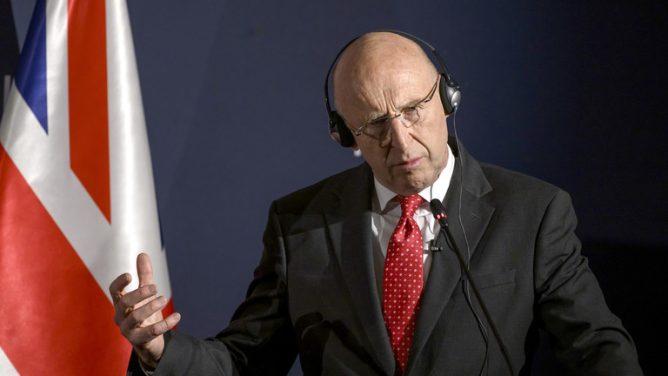
British Defense Secretary John Healey © Getty Images / Antonio Masiello
RT | May 29, 2025
London will significantly step up offensive cyber operations against Russia and China, UK Defense Secretary John Healey announced on Thursday following the inauguration of the country’s new Cyber and Electromagnetic Command.
In a statement quoted by The Times, Healey claimed that “the keyboard is now a weapon of war” and said the UK’s new cyber command would coordinate both defensive and offensive operations, including hacking into enemy systems to disrupt attacks and spread of propaganda.
Asked whether this would include Russia and China, Healey responded: “Yes.”
Healey’s statement marks the first time a British minister has explicitly confirmed cyberattacks on other states. While UK ministers had previously confirmed cyber operations against non-state actors like Islamic State, they have not until now acknowledged attacks against other countries.
Healey’s comments come ahead of the publication of a strategic defense review on Monday. According to The Times, the review will stress that cyberattacks on Britain, allegedly being carried out by Russia and China, are “threatening the foundations of the economy and daily life.”
Both Moscow and Beijing have consistently denied accusations of carrying out cyberattacks against Western nations, characterizing the claims as baseless and politically motivated.
Additionally, Russian officials have in recent months repeatedly raised concerns over what they describe as Western Europe’s continued militarization and aggressive anti-Russian rhetoric, said to be in response to the alleged threat posed by Moscow.
The Kremlin has vehemently denied having any hostile intent towards any western country, and has accused European politicians of “irresponsibly stoking fears” to justify increased military expenditures, which Moscow had labeled an “incitement of war on the European continent.”
Report: Biden May Not Have Even Known About Detrimental Climate Policies of his Own Administration

Power The Future | May 28, 2025
While the Biden administration was quick to tout and implement its aggressive climate agenda, a closer look raises a more troubling question: did President Joe Biden ever even know about some of the sweeping actions taken in his name?
We reviewed eight major executive actions that fundamentally reshaped American energy policy, from banning offshore drilling to invoking emergency powers to boost solar manufacturing, and found no evidence that President Biden ever personally spoke about any of them. Not in a press conference. Not in a speech. Not even a video statement.
These aren’t minor procedural documents, memos, or messaging documents. They include:
- Clean AI Data Centers EO (Jan. 14, 2025): Gave the Departments of Defense and Energy the green light to lease public land for AI data centers, provided they’re powered by “clean energy,” of course.
- Offshore Drilling Ban (Jan. 6 2025): Pulled over 625 million acres of the Outer Continental Shelf out of future oil and gas leasing. Biden never mentioned it on camera.
- EO 14143 (Jan. 16 2025): A last-days-of-the-administration decree making AmeriCorps alumni eligible for preferential federal hiring, potentially reshaping the makeup of the federal workforce without public debate and allowing eco-left to insert themselves in the administration.
- Arctic Drilling Ban (March 13, 2023): Prohibited oil and gas leasing in sensitive areas of the Arctic. Notably timed just after approval of the Willow Project, this was a political fig leaf, not a presidential priority.
- Defense Production Act Invocation (June 6, 2022): Used Cold War-era emergency powers to push solar panels and heat pumps without a peep from Biden himself.
- EO 14027 (May 7, 2021): Created a “Climate Change Support Office” buried in bureaucracy, giving climate staffers yet another taxpayer-funded silo of influence.
- EO 14030 (May 20, 2021): Ordered all federal agencies to assess “climate-related financial risk,” laying the groundwork for ESG-style investing mandates across the government.
- EO 14057 (Dec. 8, 2021): Committed the entire federal government to net-zero emissions by 2050 and required 100% carbon-free electricity by 2030—one of the most expansive decarbonization orders in history.
After uncovering this slew of major executive actions reshaping America’s energy landscape that were never publicly addressed by President Biden, Power The Future Executive Director stated: “Americans deserve to know which unelected staffers or radical unnamed activists implemented sweeping change through an autopen. The Biden energy agenda destroyed livelihoods of energy workers and fueled the record-high inflation that broke the budgets of millions of Americans. The question is simple, and deserves an immediate answer: what did Joe Biden know, and when did he know it?”
Despite their massive consequences for American energy producers, workers, and consumers, President Biden made no public comment, on camera or to press, about any of these actions.
This lack of public acknowledgment begs the question of whether these orders were auto-penned by eco-left policy by ghostwriters?
Americans deserve to know whether their president is making energy policy or whether it’s being run by anonymous staffers in federal agencies and activist NGOs behind closed doors.
When executive power is used to shut down energy production, rewire the economy, and restructure the federal workforce, the American people should at least expect their elected leader to own it.
Instead, we’re left with a pile of signed orders and zero accountability. Power The Future will continue investigating the true origins of these impactful policies.
Why Merz’ comments show he is two steps down the escalation ladder from Putin
By Ian Proud | Strategic Culture Foundation | May 29, 2025
Russia has established escalation dominance in Ukraine in November 2024 by raising the bar on the military capabilities that it is willing to use. Merz’s comments on western cruise missile use haven’t changed that calculus and, instead, have illustrated German weakness in Russia’s eyes.
For some time now, western media outlets have pushed the argument hard that Zelensky should be free to use longer-range weapons deep inside Russia. In his bid to offer a tougher line on Ukraine’s war effort during his honeymoon period in office and ahead of Zelensky’s visit to Berlin today, Friedrich Merz announced a lifting of restrictions on the use of western missiles within the territory of Russia. In doing so, he showed a fundamental misunderstanding of Russian strategy.
I have seen at critical points over the past decade that Russia seeks escalation dominance, a Cold War concept holding that a state can best contain conflicts and avoid escalation if it is dominant at each successive rung up the “ladder of escalation,” all the way to the nuclear rung.
Since the onset of the Ukraine crisis in 2014, Russia has sought to dominate each step up the escalation ladder. The annexation of Crimea in 2014 and the invasion of Ukraine in February 2022 were major escalations that NATO didn’t meet head-on. This strategy is also seen in the diplomatic sphere, for example, Russia escalated a dispute with the U.S. in 2017 when it kicked 755 American diplomatic staff out of Russia. When Moscow over-escalates, it makes a gamble that its adversary will not be willing to step another rung higher on the escalation ladder.
There is a hard-wired view in Moscow that Russia will always overmatch a divided and morally weak Western alliance when push comes to shove. Russia has something that the West does not have — the sovereign power and the political will to act unilaterally. Putin had been subject to criticism from hardliners in Russia that he hasn’t responded to the slow ratcheting up of military support to Ukraine from the West.
What was surprising about Merz’s comments were their blindness to recent events. On Nov. 21, 2024, Vladimir Putin presented a huge escalation challenge to the West: are you ready for Russia to strike NATO facilities anywhere in Europe with hypersonic munitions that you don’t possess?
At that time, much as now in Berlin, bombastic British ex-military saber rattlers had been at the forefront of calls that such weapon systems as Scalp, Storm Shadow, U.S. ATACMS missiles could make on the battlefield in Ukraine.
On Nov. 19, the first salvo of ATACMS was lobbed at a military facility in Bryansk — outside the area in which Ukrainian forces were battling in Kursk. The following day, British Storm Shadow missiles were fired into Kursk, with the jubilant approval of Prime Minister Keir Starmer, no less. These strikes elicited widespread attaboy jingoism from the Western media, with hardly a word of caution.
On Nov. 21, Russia over-escalated. Specifically, they deployed a more powerful and destructive hypersonic Oreshnik missile at a well-fortified Ukrainian weapons facility in Dnipropetrovsk. This is the first time an Intermediate Range Ballistic Missile has been used in combat. The claimed range of Oreshnik is 16 times greater than ATACMS and Storm Shadow missiles. Its deployment put any NATO targets within Europe in the scope of a conventional strike.
This represented a major escalation in destructive capabilities. Russia had been trying unsuccessfully to destroy the Yuzhmash weapons facility since 2022 using the battlefield weapons at its disposal. Built during the Soviet era, Yuzhmash has workshops buried deep underground to protect them from attack. Among other purposes, the facility is thought to be where Rheinmetall had set up a plant to repair German Leopard tanks. It was also used in missile and long-range drone production. The Oreshnik strike levelled it.
The destruction of valuable Western repair facilities at Yuzhmash will have satisfied Kremlin hawks that Oreshnik has taken Russia two steps up the escalation ladder. Putin also sent a clear message to military planners from the U.S. and UK who supported the deployment of the ATACMS, that a more specifically NATO target may be next.
Carefully described by Putin at the time as a “test” the Oreshnik is now a deployed capability far beyond those that Western powers have allowed Ukraine to use, namely ATACMS and Storm Shadow missiles. And also beyond the capabilities that Zelensky had requested — namely Tomahawk cruise missiles — that the U.S. has so far refused to sanction. Putin has left the door open for further “tests” of the Oreshnik.
Following Merz’s surprise announcement, speculation quickly mounted that Germany would finally relent on allowing Ukraine to use German Taurus cruise missiles. Even if supplied, Taurus offers nothing Ukraine doesn’t already have, as its range is slightly lower than the British Storm Shadow and its payload only slightly higher. The U.S. ATACMS has more destructive capability.
So, all that Merz did by grand-standing was to put Germany and Ukraine in a position where a more devastating weapon i.e. Oreshnik – may be used against strategic or battlefield targets that would overmatch the theoretical use of Taurus missiles. Taurus is therefore a battle-losing capability. To make matters worse, the new German Chancellor has already backtracked on supplying Taurus, following blowback from members of his coalition government.
Following the first deployment of ATACMS and Storm Shadow at targets in Bryansk and Kursk, western powers deescalated and placed greater restrictions on their tactical use. This made both Joe Biden and Keir Starmer look weak in President Putin’s eyes. Perhaps unsurprisingly, the pro-ATACMS advocates largely fell silent, at least for a little while. Ukraine has gone on to lose further territory in the Donbass since that time.
So, the question for Merz when he meets Zelensky today is, what escalation card is he empowered to play next to overmatch a future Oreshnik strike at a target in Germany? If he hasn’t thought that through, and I suspect that he has not, Merz should reconsider his rhetoric, or risk looking weak and feckless, as Biden and Starmer did in November of last year.
Following the Oreshnik deployment, Prime Minister Starmer conceded in his December Manion House speech that Britain needed to help Ukraine get into the strongest position to secure a negotiated settlement to the war. That sill hasn’t happened. Perhaps Merz might consider a negotiated end to the conflict, rather than more empty sabre-rattling that he cannot deliver upon.
Alleged threats to chief Russian negotiator’s family ‘outrageous’ – Kremlin
RT | May 29, 2025
Alleged threats being made against Russia’s chief negotiator Vladimir Medinsky and his family are “outrageous,” Kremlin spokesman Dmitry Peskov said on Thursday, noting that authorities are already working to determine their source.
His remarks come after TV presenter Vladimir Solovyov recently stated that Medinsky – who led Russia’s delegation at the peace talks with Ukraine in Istanbul earlier this month – was receiving death threats from the Ukrainian side. His family was also allegedly targeted.
Peskov called the situation “unprecedented” and said that if investigators find that threats are coming from Ukraine, it would be “utterly outrageous,” particularly as Moscow has offered to hold another round of negotiations next Monday.
According to Solovyov, the threats are coming from Ukrainian nationalists, who have even targeted Medinsky’s children. He claimed that the negotiator’s family has received messages such as “we know where your children are and we have a lot of explosive-packed scooters.”
Several terrorist attacks involving electric scooters have taken place in the past, including the December 2024 murder of Igor Kirillov, the head of Russia’s Nuclear, Biological, and Chemical Defense Forces.
Solovyov also recalled that “there were cases when negotiators were threatened, and there were tragic cases, and they are well known.” One such case could involve Ukrainian banker Denys Kireyev, who was killed in March 2022 shortly after participating in early peace talks with Russia.
Solovyov said that Medinsky had personally discussed the issue with Ukrainian Defense Minister Rustem Umerov, who was the head of Kiev’s delegation in Istanbul. He reportedly insisted to Medinsky that the alleged threats were not coming from Ukrainian authorities.
Following Solovyov’s claims, the head of Russia’s Investigative Committee, Alexander Bastrykin ordered the opening of a criminal case to identify the persons involved in threatening Medinsky’s family.
Moscow and Kiev have been working on their own draft memorandums outlining a path towards a peaceful settlement. Earlier this month, the two sides met for the first time since peace negotiations collapsed in 2022.
On Wednesday, Russian Foreign Minister Lavrov proposed holding the next round of talks on Monday, June 2, in Istanbul. Umerov has responded by stating that Kiev first expects to receive Moscow’s draft memorandum so that the meeting is not “empty.”
Babiš attacks EU elites and calls for ‘renaissance of principle’ in fiery CPAC speech
Czech opposition leader Andrej Babiš branded Brussels a “technocracy without a soul” and warned that Europe is being dismantled from within
Remix News | May 29, 2025
Former Czech prime minister and current opposition leader Andrej Babiš delivered a blistering speech at the Conservative Political Action Conference (CPAC) in Hungary on Thursday, accusing the European Union’s ruling class of betraying its founding values and urging European nations to reclaim sovereignty and common sense from what he called a failing liberal global order.
Speaking just months before a general election in which he is widely expected to return to power, Babiš portrayed the EU as a decaying institution ruled by unelected bureaucrats, ideologues, and activist networks who have imposed censorship, economic sabotage, and uncontrolled migration on member states. He warned that the Brussels establishment has replaced cooperation among sovereign nations with a coercive, centralized system that punishes dissent and erodes national identity.
“We are standing at the historic crossroads in a time marked by deep divisions and mounting tensions,” Babiš declared. “The elites who built and profited from this system now look on in disbelief, confusion, and anger as it falls apart. But they have only themselves to blame. They betrayed the citizens who trusted them.”
In a wide-ranging speech, Babiš accused EU leaders of undermining the very foundations of European civilization. He denounced Brussels for replacing love of country with “hollow globalism,” burying common sense under “endless layers of bureaucracy,” and attempting to substitute the natural population growth with “mass migration.”
He reserved specific criticism for three key EU initiatives: the Digital Services Act, the Green Deal, and the new Migration Pact. He accused the first of ushering in online censorship, the second of sabotaging Europe’s economy under the guise of environmentalism, and the third of forcing nations to accept migrant quotas in violation of their sovereignty.
“Under this law, dissent can become a punishable offense,” Babiš said of the Digital Services Act. “This isn’t about safety. It’s about silencing.”
On the Green Deal, he argued that while China is expanding coal and nuclear power, Europe is deliberately impoverishing itself for symbolic environmental virtue. “This is not sustainability,” he said. “It’s economic self-sabotage dressed up as an environmental virtue.”
Turning to migration, he described the EU’s new asylum system as “coercion,” not solidarity, and said it “undermines cohesion, public safety, and national identity.”
Babiš framed these developments as part of a broader ideological drift in Brussels, where he said freedom is being replaced with surveillance, culture with identity politics, and values with apology. “They no longer defend our heritage, they apologize for it,” he said. “Instead of protecting Europe, they deconstruct it.”
Calling for a “renaissance, not just of policy, but of principle,” Babiš urged the EU to return to its original form: a voluntary community of nations rooted in mutual respect, diversity, and national self-determination.
“Europe is not Brussels. It is Prague, Warsaw, Budapest, Rome, Paris, Madrid,” he declared. “It is the voices of citizens who want to be heard. It is the right of nations to govern themselves.”
“The age of patriots has begun,” Babiš concluded. “Not because we want to divide Europe, but because we want to save it.”
His appearance at CPAC Hungary — an event known for bringing together conservative leaders from across Europe and the United States — further cemented his alignment with other nationalist voices in the region, including Hungary’s Viktor Orbán, Germany’s Alice Weidel, and Austrian Freedom Party leader Herbert Kickl.
A short guide on how to starve a population to death
By Jonathan Cook | May 28, 2025
A short guide on how to engineer a genocide by starvation and ethnic cleansing:
1. Choose your moment. Ok, you’ve been ethnically cleansing, occupying, oppressing and killing your neighbours for decades. The international courts have ruled your actions illegal. But none of that will matter the moment your neighbours retaliate by attacking you. Don’t worry. The western media can be relied on to help out here. They will be only too ready to pretend that history began on the day you were attacked.
2. Declare, in response, your intention to starve your neighbours, treating them as “human animals”, by blocking all food, water and power. You will be surprised by how many western politicians are ready to support this as your “right to defend yourself”. The media will echo them. Important not to just talk about blocking aid. You must actually do it. There will be no serious pushback for many, many months.
3. Start relatively slowly. Time is on your side. Let a little bit of aid in. But make sure to relentlessly smear the well functioning, decades-old aid distribution system run by the international community – one that is transparent, accountable and widely integrated into the community it serves. Say it is infiltrated by “terrorists”.
4. Use that claim – evidence isn’t really necessary, the western media never ask for it – as the pretext to bomb the aid system’s warehouses, distribution centres and community kitchens. Oh, and don’t forget to bomb all the private bakeries, destroy all the farmland, shoot all the animals and kill anyone who tries to use a fishing boat, so that there are no other sources of food. You are now in control of the trickle of aid reaching what is rapidly becoming a severely malnourished population.
5. Time to move into higher gear. Stop the international community’s aid getting in all together. You will need a humanitarian cover story for this bit. The danger, particularly in an age of social media, is that images of starving babies will make you look very bad. Hold firm. You can get through this. Claim – again evidence isn’t really necessary, the western media won’t ask for it – that the “terrorists” are stealing the aid. You will be surprised how willing the media is to talk about babies going “hungry”, ignoring the fact that you are starving them to death, or speak of a “famine”, as though from drought and crop failure, not from your carefully laid plans.
6. Don’t lose sight of the bigger story. You are blocking aid to “eradicate the terrorists”. After all, what is the worth of a baby, of a child – all 1 million of them – in the fight to eliminate a rag-tag army of lightly armed “terrorists” who have never waged their struggle outside of their historic homeland.
7. Now that the population are entirely at your disposal, you can roll out a “humanitarian” alternative to the existing system you have been vilifying and wrecking. Probably best to have been working on this part of the plan behind the scenes from early on, and to have regularly consulted with the Americans on how to develop it. You may even find they are willing to fund it. They usually are. You can obscure their role by using the term “private contractors”.
8. It’s time for implementation. Obviously, the point is not to really distribute aid. It is all about providing a cover story so that the starvation and ethnic cleansing can continue. Make sure you provide only a tiny amount of aid and make it available only at a few distribution points you have set up with these “private contractors”. This has two advantages.
9. It forces the population to come to the areas you want them in. Like luring mice into a trap. Get them to the very edge of the territory, because from there you will be best positioned at some point to drive them over the border and get rid of them for good.
10. Your system will lead to chaos, as desperate, starving people fight for food. That’s great for you. It makes them look like a swarming mass of those “human animals” you were talking about from the start. Don’t they deserve their fate? And it means that young, fit men – especially those from large, often armed, criminal families – will end up with most of the food. The stuff they can’t grab at the distribution points, they will ambush later as people try to return home laden with their heavy aid packages. That may seem counter-productive, given that you’re claiming to want to eliminate the “terrorists”. Won’t these fit, young men, as conditions degenerate further, provide a future source of recruits to the “terrorists”. But remember, the real goal here is to starve the population as quickly as possible. The young, the elderly, the sick and the vulnerable are the ones who will die first. The more of them who start dying, the faster the pressure builds on everyone else to flee the territory to save themselves.
You are nearly there. True, faced with the emaciated bodies of your victims, western politicians will start making harsh pronouncements. But they have already given you a massive head start of 20 months. Be grateful for that. You don’t need much longer. While they dither, you can get on with the job of extermination. Leave it to the history books to judge what really happened.
Merz vows to block Nord Stream 2

Friedrich Merz, leader of the Christian Democratic Union. © Maja Hitij/Getty Images
RT | May 28, 2025
German Chancellor Friedrich Merz has pledged to do “everything” to prevent the Russian Nord Stream 2 gas pipeline from being launched. The gas inter-connector from Russia through the Baltic sea to Germany was destroyed by a series of underwater explosions in September 2022 in an act of sabotage that Russia believes was orchestrated by Western intelligence agencies.
Merz’s declaration comes as Moscow and Kiev draft respective proposals for bringing about a ceasefire in the Ukraine conflict, following their first direct peace talks in three years in Istanbul.
The talks marked a shift for Kiev, which abandoned diplomatic efforts in 2022 in favor of seeking a military victory on orders from the West. While Moscow has reported progress on its proposal, Ukraine’s Vladimir Zelensky and his EU backers have accused Russia of stalling.
During a joint press conference with Zelensky in Berlin on Wednesday, Merz vowed to “further increase pressure on Russia” and “weaken Moscow’s war machine” through sanctions, including on Nord Stream 2.
“I say on behalf of the Federal Republic of Germany, we will do everything in this context to ensure that Nord Stream 2 cannot be put back into operation,” he stated. He claimed that the measures aim to “pave the way for negotiations,” despite Moscow’s repeated criticism of Western sanctions policy.
European Commission President Ursula von der Leyen said earlier this month that Brussels had planned an 18th sanctions package to include measures aimed at Nord Stream 2 AG, the Swiss-based entity that owns the pipelines, and any other companies necessary for their restart and operation.
Media reports have claimed that Merz has supported the move and that he has opened talks in Berlin and Brussels to prevent any revival of energy trade with Russia.
A number of European officials have opposed targeting the pipelines. Florian Philippot, a prominent French Euroskeptic, has warned that such a move would amount to a “death sentence” for European industry. Michael Kretschmer, the prime minister of the German state of Saxony, has argued that “Nord Stream is a possible opening for a conversation with Russia,” adding that such talks would benefit Germany as its economy needs Russian gas supplies to function normally.
Earlier reports have also claimed that Russia and the US were exploring ways to resume shipments through the still-intact line of Nord Stream 2.
Sanctions as Self-Harm: The West’s Strategic Blind Spot in Confronting Russia
By Ricardo Martins – New Eastern Outlook – May 28, 2025
This article critically analyzes the latest EU sanctions on Russia, arguing they are strategically flawed and economically self-destructive. Drawing from past failures, it shows how the West’s punitive measures are backfiring, hurting Europe and the U.S. more than isolating Russia.
What is the New Sanctions Package About?
The EU has unveiled a new sanction package targeting Russia, predominantly focusing on the energy sector, specifically oil and diesel exports. This builds upon earlier restrictions intended to cripple Russia’s economic capacity to sustain its military operations in Ukraine. The new sanctions include tighter enforcement mechanisms on the oil price cap, restrictions on ship-to-ship transfers in international waters, and efforts to curtail Russia’s access to Western insurance and logistics networks. But like the previous measures, they raise a fundamental question: Will they work?
The Status of Past Sanctions: Buying While Punishing
Historically, sanctions against Russia have been inconsistent and riddled with loopholes. Despite strong rhetoric, Europe has continued purchasing Russian commodities under various exemptions. The EU still imports significant quantities of Russian diesel, liquefied natural gas (LNG), coal, uranium, and even agricultural products like grain and fertilizer. The result is a paradox: while aiming to isolate Russia, the West remains economically entangled with it. This undermines the moral and strategic coherence of sanctions and allows Russia to adapt and thrive despite Western pressure.
Sanctions Hit Europe More Than Russia
While sanctions are theoretically aimed at weakening Russia’s economy, the practical consequences have disproportionately hit European industries and households. Russian exports are fungible: oil, coal, and fertilizers find alternate markets in Asia, Africa, and Latin America. Meanwhile, Europe has struggled with soaring energy prices, industrial shutdowns, and declining competitiveness. Diesel shortages, energy rationing, and inflation have become the new norm, particularly in Germany, which once depended heavily on Russian inputs for its industrial base.
Russia, by contrast, has localized production, developed new markets, and implemented mercantilist strategies to reduce dependence on Western technology and finance. As one Russian analyst put it, sanctions have become “psychological warfare,” increasingly irrelevant to daily life in Russia.
Oil and Diesel: The Inflation Time Bomb
The crux of the new sanctions is oil and diesel. But can the U.S. and EU afford to forgo Russian, Venezuelan, and Iranian crude without catastrophic inflation? The answer appears to be no.
Russia exports about 7.5 million barrels of oil per day, or nearly 10% of global supply. Taking that offline—especially in conjunction with sanctioned Venezuelan and Iranian oil—would create a massive global shortfall. Western refineries, particularly in the U.S. Gulf Coast, are calibrated to process heavy sour crude like Russia’s Urals blend. Without it, refineries operate suboptimally, and gasoline prices spike.
In the U.S., diesel drives nearly all logistics trucks, trains, and ships. Removing a major global supplier like Russia tightens global supply, causing diesel prices to surge and supply chains to buckle. Already, diesel refills for trucks cost over $2,000, with potential spikes threatening food prices and consumer goods. Inflation will soar again, just as it had started to cool.
Baltic Sea Escalation: Tankers and Arrests
The geopolitical tension is intensifying. Russian oil tankers, often flagged under third countries, are now escorted by Russian naval vessels in the Baltic Sea. An incident involving an Estonian ship attempting to halt a tanker, which ended up detained in Russian waters, demonstrates the volatility of the situation. This marks a dangerous escalation, with the potential for military clashes over enforcement of maritime sanctions—an area traditionally governed by international law, not unilateral action.
Western Industrial Decline: No Shipyards, No Leverage
Sanctions enforcement is further complicated by Western logistical decline. The U.S., Britain, and France have largely lost their shipbuilding industries. Insurance and shipping markets have globalized, and London no longer dominates maritime underwriting. Russian entities are increasingly self-insuring their fleet, rendering sanctions on Western insurers irrelevant.
Furthermore, without a domestic merchant marine, the U.S. relies on foreign ships even for military logistics—a vulnerability in any prolonged conflict. Meanwhile, China and Russia continue expanding their shipping capabilities and influence over global supply routes.
The Legal Quandary: Sanctions and Sovereignty
From a legal standpoint, unilateral sanctions that attempt to compel third-party countries to comply (so-called secondary sanctions) strain the legitimacy of the “rules-based international order.” It is lawful for the West to impose its own sanctions, but not to mandate their enforcement by sovereign nations like India or Brazil. Such overreach risks global backlash and accelerates moves toward de-dollarization and alternative trade systems, such as the BRICS currency initiative.
Is the EU Addicted to Sanctions?
The EU appears increasingly reliant on sanctions as a primary foreign policy tool. Yet, their efficacy is questionable. Past sanctions have not altered Russian behavior, destabilized its economy, or improved Western leverage. Instead, they’ve fostered economic nationalism in Russia, weakened EU industries, and exposed the strategic shallowness of Brussels and Washington’s policies.
Sanctions are not a strategy; they are a tactic. And overuse risks turning them from a deterrent into a diplomatic crutch—one that Europe may not survive intact if economic pain continues to mount.
Conclusion: A Strategy of Self-Harm
Sanctions as Self-Harm: The West’s Strategic Blind Spot in Confronting Russia
In sum, the latest sanctions package is more of the same: punitive in intent, performative in practice, and counterproductive in outcome. The West, particularly Europe, will likely bear the brunt of energy shortages, inflation, and industrial decline. Meanwhile, Russia’s diversified exports, strategic alliances with China and India, and robust internal adaptation mechanisms render sanctions increasingly futile.
History has shown that attempts to isolate Russia through economic pressure are not only ineffective—they risk reinforcing the very state structures they aim to dismantle. Unless sanctions are part of a broader diplomatic and economic strategy, they will continue to hurt the sanctioning powers more than their target.
Ricardo Martins ‒PhD in Sociology, specializing in policies, European and world politics and geopolitics
The Media Is Falsely Labeling Ukraine-Russia Talks a ‘Failure’
By Ted Snider | The Libertarian Institute | May 28, 2025
On May 16, Russia and Ukraine held their first direct talks since the first months of the former’s invasion. Despite the pessimistic evaluation by Ukrainian and European leaders, the return to diplomacy is itself a major achievement and step forward. The talks lasted an hour and forty minutes.
Western leaders and Western media have given the first round of talks a failing grade. They have dismissed it for three reasons. They claim that Russian President Vladimir Putin first suggested direct negotiations and then did not show. They claim that he sent an insultingly low-level delegation. And they claim that nothing was accomplished.
All three of these claims are false.
Putin did suggest direct negotiations between Russia and Ukraine, but he did not say that those talks would take place at the leadership level. Putin said, “We are proposing that Kiev resume direct negotiations without any preconditions…We offer the Kiev authorities to resume negotiations already on Thursday, in Istanbul.” Putin referred to the Kiev authorities and never to the two presidents.
It was unlikely that Russia would resume talks for the first time at the presidential level. Customarily, before presidents meet, a great deal of preparation and negotiation takes place at lower levels. Then, typically, the foreign ministers would meet to iron out most of the details prior to a presidential meeting.
It is also misleading to present the meeting as Putin not showing up while Ukrainian President Volodymyr Zelensky did. Zelensky did arrive in Turkey, but he declined to agree to direct talks with Putin unless Putin first agreed to a thirty-day ceasefire, posting that “We expect Russia to confirm a ceasefire – full, lasting, and reliable – starting tomorrow, May 12th, and Ukraine is ready to meet.” Ukraine’s Head of the office of President, Andriy Yermak, confirmed, “First a ceasefire for 30 days, then everything else.” According to White House officials, Trump “never agreed” that that a ceasefire was a precondition to the direct talks.
But Zelensky’s precondition was an annulment. Russia was never going to agree to a ceasefire prior to negotiations for two reasons. First, they do not want a ceasefire empty of a settlement because that would maintain the conditions that would likely lead to future war, as happened in the ceasefire in Donbas from the end of the coup in 2014 to the start of the war in 2022. Second, they do not want a ceasefire without a settlement that would allow Ukraine to rest, regroup, rearm and dig trenches simply to return to war thirty days later like the Minsk deception that stung Russia earlier.
Russia has insisted that these negotiations resolve the “root causes” of the war. The Western media continues to deceptively define that insistence as the determination to deflate Ukraine’s sovereignty and calls it a delaying tactic. There is nothing on the historical record to suggest that Putin has ever identified that as a root cause of the war. Russia has always identified the root causes of the war as NATO’s encroachment toward their border and into Ukraine and the need for the protection of ethnic Russians in Ukraine.
The security proposal that Russia presented to the United States and NATO in December 2021 in the days before the war had as its central point that NATO not expand to Ukraine. Then-NATO Secretary General Jens Stoltenberg has confirmed that the “promise [of] no more NATO enlargement… was a pre-condition for not invade Ukraine.” Ukraine’s chief negotiator in the Belarus and Istanbul talks with Russia has also said that stopping NATO from expanding to Ukraine and Russia’s borders was the “key point” for Russia and that “[e]verything else was simply rhetoric and political ‘seasoning.’” Zelensky, himself, has said that the promise not to join NATO “was the first fundamental point for the Russian Federation” and that “as far as I remember, they started a war because of this.”
Russia is not asking for something unimaginable or new. They are asking for what they were promised. Not only did NATO promise to stay out of Ukraine, but Ukraine promised to stay out of NATO. Article IX of the 1990 Declaration of State Sovereignty of Ukraine says that Ukraine “solemnly declares its intention of becoming a permanently neutral state that does not participate in military blocs…” That promise was later enshrined in Ukraine’s constitution, which committed Ukraine to neutrality and prohibited it from joining any military alliance: that included NATO.
Russia is not going to agree to a ceasefire without resolving this root cause of the war for the same reason that it went to war to resolve it.
The second reason for giving the first round of direct talks a failing grade is that Putin sent an insultingly low-level delegation. This is not only unfair for the reasons already discussed—that initial talks are usually conducted at a low level—but also because it ignores who Putin sent to conduct the talks. The Russian delegation is led by Vladimir Medinsky, the same person who led the Istanbul talks at the beginning of the war. Those talks nearly succeeded, and the nomination of Medinsky is a signal both that Russia is serious and that Russia sees the current round of talks as a continuation of the previous round. Putin said, “It was not Russia that broke off negotiations in 2022. It was Kiev. Nevertheless, we are proposing that Kiev resume direct negotiations without any preconditions.”
The third reason is that nothing of substance was accomplished. That, too, is untrue. The very resumption of direct talks is a major breakthrough. But, beyond that, some things of substance were accomplished.
The first is an agreement to exchange 1,000 prisoners each. Though prisoner exchanges have occurred during the war, this would be the largest exchange agreed to yet. It may also represent a goodwill gesture on the part of Russia, since it has been suggested in the Ukrainian press that Ukraine may not have 1,000 Russian prisoners of war.
The second is that the two sides each agreed to present a detailed document on its vision for a ceasefire. This is a significant achievement for a first round of talks.
The third is that, once the documents are presented and discussed, Medinsky said that “we think it will be reasonable to continue our negotiations.” Agreeing on a second round of talks is another positive and significant achievement.
Undercutting the negative assessment of Western officials and Western media, the Ukrainian delegation told The Washington Post that, “despite the heated exchanges… the talks eventually became constructive.” The Russian delegation agreed that they were “satisfied” with the first meeting.
The Wall Street Journal has reported that the next round of talks could take place in mid-June, though their location is in doubt. Originally reported to be taking place in the Vatican, the Kremlin has suggested that the Vatican may not be the ideal location for two Orthodox Christian nations.
For the next round to get past the “heated exchanges” and continue to progress, key compromises will need to be made by both sides. Ukraine will have to agree not to join NATO. This is a big concession but should not be a deal breaker. Russia was promised this at the end of the Cold War, and Ukraine agreed to it during the Istanbul talks at the beginning of the war. If it was acceptable to Ukraine then, it should not be a fatal obstacle now.
In return, Russia will have to agree to real security guarantees for Ukraine. They will not agree to NATO nations as guarantors of the peace but could be open to countries from the Global South who have not sanctioned Russia or condemned its invasion of Ukraine but who also have not condoned it and would not want to see a ceasefire broken.
The West could agree to allow Ukraine to be armed, but not allow it to be armed with long-range weapons capable of striking Russia. The guarantors could agree to come to Ukraine’s aid if Russia breaks the ceasefire and attacks but not agree to come to Ukraine’s aid if they provoke Russia in hopes that they will come to Ukraine’s aid, much as China has been willing to promise Pakistan help if they are attacked but not if they irresponsibly cause the attack.
Both sides will need to make concessionary moves from their current territorial demands. Ukraine will never agree to Russia’s claim on more territory than it has conquered. Russia has hinted at some willingness to compromise on this. Russia will never agree to Ukraine’s demand to return territory to the prewar, or even pre-2014, borders. Ukrainian insistence on this condition for peace will guarantee that there will be no peace. And no peace will mean only that Ukraine will cede more territory to Russia. It is practical, then, for both sides to agree to negotiations beginning along the current line of conflict.
The recent return to direct talks between Russia and Ukraine can only be positive. And they accomplished more than the Western media and European leaders have suggested. Continued progress will require compromise and a genuine desire to build a peace that is workable and lasting.
Featured Video
Ted Postol: Fraud of Missile Defence Exposed in Iran War
or go to
Aletho News Archives – Video-Images
Frlom the Archives
Containing the United States
By Edward S. Herman | Z Magazine | September 2016
“Containing the United States” is, of course, a ridiculous and self-contradictory idea in the U.S. and Western ideological and propaganda system. We all know that the United States had to “contain” the Soviet Union from 1945 to 1991, and since then has had the task of containing Russia and China. Only they threaten, bully, aggress and worry countries like Poland and Vietnam. Obama has had to reassure them both of our steadfast stand against Russian and Chinese military attacks. NATO has, of course, expanded greatly over the past several decades, despite the deaths of the Soviet Union and Warsaw Pact, but only to contain the renewed Russian — and Iranian, Libyan, Syrian and other — military threats; and we have “pivoted” to Asia, supported Japanese rearmament, bolstered our own forces in that area and jousted with the Chinese in their coastal waters solely to contain China. Earlier we had been obliged to contain North Vietnam, or was it the Soviet Union in Vietnam? Or China? Or “communism”? Or maybe all of them? Or none of them, but just needing an excuse to enlarge power?
The parallel propaganda has taken many forms. One is accepting as a premise that the United States only acts defensively and has no internal forces and interests that drive it to enlarge its sphere of control. I noted in an earlier article how Paul Krugman claims that internal Russian problems may well be the explanation of Russian “aggression,” but how at the same time it never occurs to him that the huge U.S. transnational corporate interests and “defense” establishment, and the pro-Israel lobby’s activities, might possibly make for an expansionist dynamic here.2 This reflects the standard establishment perspective that we are good and only react to evil. This was the view sustaining and justifying the invasion and occupation of Iraq from 2003. That attack was taken here as not evil but a response to evil, even if involving lies and mistakes, hence not describable as “aggression.” … continue
Blog Roll
 Aletho News
- Trump press conference reveals a man who wants out of war
- When Tel Aviv decides, Washington fights
- Top official: Iran ready for a long war with US, no more diplomacy
- How Iran’s Toxic Rain Reveals US-Israel Discord
- Trump Admits He Is Destroying Iran For Israel
- Iran’s latest move in the GCC countries was a stroke of genius
- Blackmail and death threats, Zelensky embarrasses the EU, but there’s no condemnation
- Israel threatens to kill Iran’s new leadership
- Possible Scenarios for the Middle East
- The Horizon of the War. “Italy is being Dragged Into the War against Iran”
- If Americans Knew
- Lebanon: Israel’s White Phosphorous Use Risks Civilian Harm
- Corporate Media Go All Out To Support The US-Israeli War On Iran
- US-Israel war on Iran is creating a steady growing number of amputees
- Israel planned this war on Iran for 40 years. Everything else is a smoke screen
- The wrong question about the war in Iran
- ‘Your Tax Dollars Being Used to Raise Your Gas Prices’: US-Israel Bomb Major Iranian Oil Depots
- ‘Bogus Evidence’: Former Nuclear Watchdog Head Debunks US Justification for Iran War
- EXPLAINER – Dimona: What to know about Israel’s nuclear site
- Fires and toxic air in Iran (thanks, Israel) – Not a ceasefire Day 150
- At Israel’s hands, Iran is burning, Lebanon and Gaza are crumbling – Not a ceasefire Day 149
- No Tricks Zone
- Wake-up Call: Survey Shows Majority Of Germans Now Favor Postponing Climate Targets!
- Televised! Leading German Political Candidate Tells Schoolchildren CO2 Makes Sun Hotter!
- New Study: A Century Warming Of 1.1°C Is ‘Commonplace’ And ‘Not Unusual’ During This Interglacial
- New Study: ‘Internal Noise’ And Volcanic Forcing Can Trigger 10-15°C Warming Within Decades
- Glaciers Worldwide Are Suddendly Surging, Experts Blame Warming!
- Surprising Discovery: Sahara Is Greening…Billions Of Trees Where Once Thought To Be Barren
- New Research Reaffirms Clouds, Aerosols, And Surface Solar Radiation Are ‘Driving The Climate System’
- Germany: Electric Car Catches Fire At Charging Station, Sets Off Local “Inferno”, Widespread Damage
- New Study: Canada’s New Brunswick Was 1°C Warmer Than Today During The Medieval Warm Period
- Coal Power Back In Trend As Globe Tries To Keep Pace With Growing Demand For Power
 Aletho News