How Peace-Oriented Norway Learned to Stop Worrying and Love War
By Prof. Glenn Diesen | May 26, 2025
Norway identifies itself as a model of a liberal and tolerant peace-oriented nation. Yet, a collective mindset has developed with intense distrust and loathing of anyone who deviates from the government’s official truth and war narratives.
Here is a social experiment to test the claim above. I am a professor of political science, but I am also a politician running for Parliament. My recently established political party is primarily an anti-war party, and we started a poster campaign on public transportation in Oslo. The core message was that we are for negotiations and against weapons for the war in Ukraine. This seemed like a reasonable position as Norway previously had a policy of not sending weapons to countries at war (as it escalates and can make us a participant), and our country used to advocate for diplomacy and negotiations as the path to peace. Norway has abandoned these policies and unified under the new mantra that “weapons are the path to peace”, and we have boycotted basic diplomacy with Russia even as hundreds of thousands of young men died in the trenches. Was our peace-oriented nation ready to at least consider the argument that we should return to our former policies of negotiating instead of fueling the war with more weapons to fight the world’s largest nuclear power?
The country lost its collective mind… Politicians called it a dangerous Russian influence operation. I had taken the side of Russia in supporting the invasion. I am an agent for Russia spreading Russian propaganda. It was argued that the national intelligence services should get involved, as I am likely financed by the Russian state. Soon thereafter, the national intelligence agency, PST, reassured the public that they are looking into people who may, at the behest of a foreign power, attempt to make Norwegians critical of the government’s policies on sending weapons to Ukraine.[1] Almost every media outlet in the country framed the issue on the premise that I am “pro-Russian” and “anti-Ukrainian”. People began tearing down the posters, and some compared their political vandalism with liberating the country from Hitler during the Second World War. People were intoxicated with self-righteousness and moral superiority as the tribe united in virtue and the fight for freedom. Their hatred of the evil “other” was celebrated as evidence of their righteousness as they formed a resistance against us, fascist agents of Russia who support the destruction of Ukraine and would like to see Russia conquer Europe.
At this point, it should be noted that I consider myself a friend of Ukraine. I have warned against war in Ukraine for the past 20 years, and I have obviously not supported the invasion of Ukraine. Much like many political leaders across the West have argued over the past 30 years, I believe that NATO expansion triggers a security competition and eventually war, much like it would if Russia established its military infrastructure in Mexico. My argument is that Russia considers NATO expansion an existential threat and responds based on these convictions, irrespective of NATO not agreeing with Russia’s threat assessments. I therefore argue for diplomacy and against sending weapons, as it will only escalate the war, destroy Ukraine, and take us closer to nuclear war.
I consider this to be a pro-Ukrainian position and a pro-Western position, to speak in the language of my tribal countrymen who do not care for arguments about security competition. It should be noted that our own Prime Minister argued after the Russian invasion that it was “out of the question” to send weapons, yet this position has since been criminalised and reserved for agents of Russia. I discovered that my position is not sufficiently anti-Russian, since I believe the broken security architecture is the source of the war, and the discourse in Norway is reduced to basic tribal loyalties of picking one side or the other. Norwegian society only tolerates arguments that are based on the premise that we are not to blame and our solidarity must be based on condemning the “other”. The premise of an “unprovoked invasion” is therefore sacred. Consequently, enhancing our security by mitigating the security competition with Russia is impossible, as we are not allowed to discuss Russian security concerns. War predictably becomes the only path to peace.
The political campaign resulted in a televised public debate where our former defence minister / foreign minister was represented on the other side. In what resembled a show from Jerry Springer rather than a debate, her tactic was to be condescending and accuse me of being a propagandist for Russia. Whatever could have resembled an actual argument was premised on the idea that I am “pro-Russian”, while the government is “pro-Ukraine”. My dissent was thus a threat to national security. The purpose was never to discuss whether Russia is pursuing an empire or responding to what it considers to be an existential threat, and the purpose was certainly not to discuss whether weapons and boycott of diplomacy are the path to peace.
Then the media, functioning as a branch of government, stepped in to “fact-check” the debate. Or more precisely, the media only “fact-checked” one side, while the obvious lies told by our former defence minister / foreign minister went unchecked. Also, the “fact-checkers” were more like narrative checkers, as I was accused of “using several arguments that fit Russia’s most important narratives about the war in Ukraine”.[2]
The more dishonest media never bothered to check the facts supporting my arguments, and instead approached “fact-checking” by picking one ambiguous source to conclude I am not reliable. For example, I made the argument that Boris Johnson sabotaged the Istanbul peace agreement at the behest of the US and UK, yet the newspaper then only picked Davyd Arakhamia as an ambiguous source. Why did they not mention the two mediating sides, the Turkish (the foreign minister and President Erdoğan) or the Israeli (former Prime Minister Bennett), who confirm the negotiations were sabotaged to use Ukrainians to weaken a strategic rival? Why did they not cite the former head of the German military, General Kujat, who says the same? Why not reference interviews with American and British leaders who argued that the only acceptable outcome was regime change in Moscow? Why did they not cite the words of Boris Johnson himself as he expressed his disdain for the negotiations and warned against a “bad peace”?
The more honest media had the decency to at least publish the facts I presented, although they still had to muddy the waters. For example, I argued that the West knew that we backed the coup in Kiev in 2014 and pushed NATO expansion, despite knowing that only a small minority of Ukrainians (about 20%) wanted NATO membership and despite knowing it would likely trigger a war. The evidence cannot be disputed, so the fact-checker argues the Ukrainians were “ignorant” of NATO’s mission and had been propagandised, and points out that after the Russian invasion, there has been a majority support. This information and these claims have absolutely nothing to do with the argument that we knew only a small minority wanted NATO membership in 2014, and we knew it would likely result in war. All the “fact-checking” was intended to discredit.
The considerations of the rational individual have been defeated in Norway by the tribal mindset and groupthink. The government’s policies and war narratives represent virtue and truth, and all opposition is thus immoral and deceptive. The premise of every argument from politicians and their stenographers in the media was that they were on the side of the innocent Ukrainian victim, and I represented the evil Russian aggressor. There is no interest in engaging with arguments; rather, there is an obsession with exposing the hidden evil intentions of their opponents. Toward this end, anything is permitted in the “good fight”. The national intelligence services warned, with a not-so-subtle hint to me, that they are aware of efforts to polarise the public. Not only is it completely unacceptable for me to enter Parliament as I allegedly represent Putin, but my employment as a professor at a Norwegian university is also problematic, as I repeat “Russian narratives. How did Norway become authoritarian and gung-ho about war?
The Propagandised Norwegian
I will write here about “the Norwegian”, the collective national consciousness that serves the purpose of overwhelming the rational individual. Sigmund Freud famously recognised that the individual is rational, although human beings are also influenced by an irrational group psychology. Human beings have throughout their entire history organised in groups for security and meaning, and adjusting to the group is one of the dominant instincts in human nature. Carl Jung famously wrote about the limits of reason: “Free will only exists within the limits of consciousness. Beyond those limits there is mere compulsion”.[3]
The key component of group psychology is to divide individuals into “us” (the in-group) and the “other” (the out-group). When human beings are exposed to uncertainty and fear, there is an instinct to demand internal solidarity and denounce the out-group. Authoritarian tendencies tend to thrive when exposed to external threats.
The literature on political propaganda originates primarily from Edward Bernays, the nephew of Sigmund Freud, who built on his uncle’s work. Bernays recognised that manipulating the stereotypes of what represents “us” and the “other” diminishes the relevance of objective reality and the considerations of the rational individual. When we use military force, is it for freedom, and when our adversaries do the exact same thing, it is to advance empire and destroy freedom. The core of propaganda is therefore to present the world as good versus evil, and as superior versus inferior. The Western political propaganda that previously framed the world as the civilised versus the barbaric has been recast as the struggle of liberal democracy versus authoritarianism. If the public accepts this basic premise, the complexity of the world is simplified and dumbed down to the extent that dissent is immoral and dangerous. All that matters then is that you display loyalty to the in-group.
Walter Lippmann famously argued that political propaganda had the benefit of mobilising the public for conflict, yet it had the disadvantage of preventing a workable peace. When the public has bought into the premise that they are in a struggle between good and evil, how could they accept mutual understanding and compromise? The propagandised public reaches the conclusion that peace depends on the good defeating the evil. In almost every conflict and war of the West, the opponent is presented as a reincarnation of Hitler, and the Western political-media establishment lives perpetually in the 1930s as negotiations are appeasement and war is peace. This is profoundly problematic as the first step in reducing the security competition is recognising mutual security concerns.
Carl Schmitt, the scholar from Hitler’s Nazi Party, argued that organising politics along the friend-enemy binary also enabled governments to purge dissent. Schmitt’s concept of the enemy within strengthens political unity by purging those who do not display in-group loyalty and fail to conform to the beliefs and behaviour of the social order. The Norwegian has now experienced a decade of non-stop obsession with the Russiagate Hoax, Covid and then the Russian invasion of Ukraine. The fear and the search for enemies within to purge has exhausted the rational individual. We have now outsourced our critical thinking to the government and seek comfort in Orwell’s two-minute hate, in which we join the media-fuelled moral outrage against the enemies of the state. The moral indignation gives safety, meaning and unity.
The problem is spreading across Europe. In France, the main opposition leader has been arrested in what is seemingly a politically motivated attack. In Germany, the largest political opposition party has been labelled an “extremist organisation”, which enables the intelligence agencies can go after members. It is likely also a first step to banning the opposition party. In Romania, the election results in the presidential election were cancelled, and the winner was not allowed to run again. In the do-over of the Romanian elections, France and the EU were accused of interfering in the election to make sure the Romanians would [not] vote the wrong way again. Interference in Moldova and Georgia was also done under the banner of defending democracy from Russia. The irony is that the internal solidarity of the West as a “liberal democratic community” is, to a large extent, reliant on the Russian “other” playing the role of the bogeyman, which creates the groupthink that tears away at the liberal character of the West.
People tend to exaggerate what they have in common with the in-group, and exaggerate the differences with the out-group. The Norwegian has some contempt for America when compared with Norway, especially when they vote the wrong way. The Norwegian can, for example, not understand why the Americans would vote for Trump. This is because the Norwegian does not actually know why Americans voted for Trump, since the Norwegian media functioned as a campaign manager for Joe Biden and Kamala Harris. It is common to portray Americans as stupid, aggressive, and under Trump, it is not uncommon to introduce the word fascism. However, when in conflict with Russia, the American transforms into the in-group. With the simplistic division of good versus evil, the American is cast as the good guy. The US has a security strategy of global primacy, yet the Norwegian is suspicious of arguments that the US security strategy does not consist of advancing liberal democratic values. By extension, NATO is a “force for good”, and you would not question it unless you are seeking to sow divisions to undermine our goodness. NATO occupied Afghanistan for 20 years in a strategic part of Central Asia so small girls would be allowed to go to school, Libya and Syria were destroyed to defend human rights, and the expansion of the military bloc is solely motivated by the goal of offering protection to other peoples. Moscow could not possibly think the US would ever attack Russia, while ignoring the current proxy war and the continuous talk of possible wars with Iran and China. The Norwegian must refer to NATO as a defensive alliance even whilst it is bombing countries that never threatened a NATO country. Leading NATO countries are now complicit in genocide in Gaza, yet the benign liberal democratic identity we have assigned to ourselves is impervious to reality. If you criticise the West, it is not because you advocate for course correction, but because you stand with our enemies.
The Norwegian as a Moral and Liberal Authoritarian
Liberalism is renowned for having an internal contradiction that must be managed. Liberalism is based on tolerance to accommodate the rights of the individual to deviate from the group, yet liberalism is also based on the assumption of universalism in terms of all societies conforming to the liberal ideals.
The Norwegian accepts that all people are different and tolerate diversity, yet his liberal convictions are universal and more developed in Norway, others must thus follow the same path. We are all equal, but some are more equal than others. The Norwegian has embraced liberal principles such as mass immigration, radical secularism, gay marriage, gender ideology and humanitarian wars, and will ostracise and crush anyone who does not follow the same conviction. For example, believing that marriage is between a man and a woman was an acceptable opinion 15 years ago, but today it makes you intolerant and there is no tolerance for your intolerance. The Norwegian politician may not know the first thing about China, with its thousands of years of history and population of 1.4 billion, yet the Norwegian politician has a remarkable confidence in knowing exactly how China should be run as a country.
The Norwegian has been trained to speak in the language of morality to suppress factual discussion. Framing all arguments as moral implies that the opponents are immoral. Critical debate and open debate suffer as rational arguments, and nuance is replaced with moral righteousness and condemnations.
“Helping Ukraine”
The good versus evil premise that cannot be contested is that the Norwegian government is on the side of Ukraine, it is “pro-Ukrainian”, it “supports” and “helps” Ukraine. In contrast, dissidents such as myself who criticise the government’s policies are “anti-Ukrainian” who legitimise or support the invasion in solidarity with Russia. For the Norwegian, even a democratic debate between the two sides is morally repugnant as it gives voice to Russian propaganda.
I usually counter the false premise by arguing that NATO’s “help” entailed supporting the toppling of Ukraine’s government in 2014, which did not have the support of the majority of Ukrainians or their constitution. This was largely done to “help” Ukraine join NATO, but only about 20% of Ukrainians wanted NATO in 2014. The US merely “helped” when it took control over key governmental positions in Ukraine and had to rebuild Ukrainian intelligence services from scratch as an ally against Russia, from the first day after the regime change in 2014.
When 73% of Ukrainians voted for the peace platform of Zelensky in 2019, NATO decided to “help” destroy the popular peace mandate as it represented “capitulation”. Nationalists, supported by the “NGO” Ukraine Crisis Media Centre, presented “red lines” that Zelensky was not allowed to cross.[4] Zelensky had his life threatened repeatedly and publicly if he dared to cross these red lines, and he eventually abandoned his peace mandate. Several Western governments, including the Norwegian government, finance this “non-governmental organisation”.[5] There is an abundance of evidence that the US sabotaged the Istanbul peace negotiations in April 2022 and wanted a long war that uses Ukrainians to bleed Russia, yet the proxy war is fought under the banner of solely “helping” Ukraine. Criticising the idea that NATO, the world’s largest military alliance and an important instrument to advance US global hegemony, is solely preoccupied with helping Ukraine, is a key premise that cannot be challenged. Anyone attempting to question it is met with vicious attacks and accusations of standing with the enemy.
To ensure that the groupthink is managed, “democratic institutions” such as government-funded NGOs are tasked to herd the masses. The government-funded Norwegian Helsinki Committee, another “non-governmental organisation”, is also financed by the US government and the National Endowment for Democracy (NED). Reagan and the CIA Director established NED in 1983 as a “human rights organisation” to manipulate civil society in other countries. It is an ideal propaganda arm for the government, as competing power interests in the world and subsequent conflicts can be sold to the public as a struggle between good and evil. The Norwegian Helsinki Committee, a government-financed “non-governmental organisation”, writes regular hit-pieces on me, smears me non-stop on social media as a Putin-propagandist, attempts to cancel my invitations to speak, and attempts to have me fired by always shaming the university for giving me credentials that I allegedly abuse to spread propaganda. This includes calling and sending letters to the university. I must hide my address and phone number as the public is regularly told I am “anti-Ukrainian”, while an employee at this “human rights organisation” posted a picture of the sales advertisement of my house on social media. The leader of this NGO that has spent more than four years to smear, intimidate, censor and cancel me explained to the media that it was done as a nice gesture to help me sell my house. When I compared their intimidation to the intimidation of the brownshirts at universities, the scandal was that I compared this virtuous “democratic institution” to the brownshirts.
The Norwegian as a Sociopath
The rational individual is humanistic, but the collective consciousness of the Norwegian has taken on sociopathic traits with a lack of empathy, chronic lying, deceit, aggression, irresponsibility, and an absence of remorse.
The Norwegian is taught to express empathy for Afghans when it justifies occupation, Syrians when it justifies regime change, Libyans when it justifies military intervention, etc. However, once the strategic objective is achieved, there is no attention or empathy expressed. As we leave behind death and destruction, there is no remorse, as our alleged intentions were good. In Ukraine, the Norwegian is taught to have great empathy when it comes to advancing the war efforts. In contrast, the Norwegian will react with suspicion and anger if anyone mentions the suffering of the people in Donbas over the past decade, “military recruiters” dragging people off the streets and out of their homes, the attacks on the media, the denial of political rights, language rights, cultural rights or religious rights. The empathy for Ukrainians is instrumental, it is evoked or suppressed based on the purpose it serves.
Ukrainians who want to fight the Russians make the headlines, while Ukrainians such as former Western-backed presidential candidate Yulia Tymoshenko have disappeared from the media after she accused the West of using Ukrainians to weaken Russia. Ukrainians who fail to play the role of wanting to fight to the last man are also met with suspicion and should not be allowed to speak on behalf of their country. The narrative must be defended from facts, and in the good fight, it is virtuous to lie and deceive. Irresponsibility is now framed as being principled, as, for example, Russia’s nuclear deterrent must be referred to as an unacceptable nuclear blackmail that must be rejected. Insisting on continuing to fight a losing war in which Ukrainians lose more men and territory every day is “pro-Ukrainian”, because the alternative is a Russian victory that is “pro-Russian”. The deeper the belief in the righteousness of the cause, the easier it becomes to love the war that serves it.
[1]
PST snakker om utenlandsk påvirkning etter FOR-debatten
[2]
Faktasjekk: Partiet Fred og rettferdighet (FOR) og russiske påstander om krigen i Ukraina
[3] Jung, C.G., 1973. Letters 1: 1906-1950. Princeton University Press, Princeton, p.227.
[4]
[5]
Germany arming for possible conflict with Russia – Reuters
RT | May 26, 2025
The German military must significantly increase its weapons stockpile by 2029, the year the current government anticipates a potential threat from Russia, according to a directive issued by the country’s defense chief, obtained by Reuters.
The order, titled ‘Directive Priorities for the Bolstering of Readiness’, was signed on May 19 by Carsten Breuer, the inspector general of the Bundeswehr, the news agency reported on Sunday.
Moscow has denied that it has any aggressive intentions toward NATO countries, dismissing Western speculation of a possible attack as fearmongering aimed at justifying extensive militarization by the bloc’s European members.
Breuer’s order emphasizes the procurement of advanced air defense systems and long-range precision strike capabilities effective at ranges exceeding 500km. He has also reportedly directed the military to increase the stockpiling of various types of ammunition and to develop new capacities in electronic warfare, as well as space-based systems for both defensive and offensive missions.
Chancellor Friedrich Merz announced on Monday that his government has lifted restrictions on the range of weapons it can supply to Ukraine to fight Russia. The news is perceived as a hint at the possible delivery of long-range Taurus missiles, which the previous government refused to donate.
In March, the German parliament amended the nation’s law to exempt military spending from the ‘debt brake’, a measure that limits government borrowing. Merz has proposed allocating up to 5% of the nation’s GDP to security-related projects by 2032, a significant increase from the current level of around 2%. He claimed that this expenditure would transform the Bundeswehr into Europe’s most formidable military force.
The rearmament plans necessitate a corresponding increase in personnel. Defense Minister Boris Pistorius indicated in a recent interview that the ruling coalition aims to introduce a recruitment model similar to Sweden’s, potentially ending the current volunteer-only system as early as next year.
The military initiatives come amid economic challenges, including de-industrialization and stagnation. On Sunday, the newspaper Bild said that ThyssenKrupp, a company with over two centuries of history, is undergoing a significant restructuring amounting to dissolution. According to the report, the company plans to reduce its headquarters staff from 500 to 100, transfer its steel mills to Czech billionaire Daniel Kretinsky, sell its naval shipyard Thyssenkrupp Marine Systems (TKMS) in the public market, and divest most other divisions.
How Russia Quietly Revolutionised Warfare
By Kit Klarenberg | Global Delinquents | May 25, 2025
On May 23rd, The Times published an extraordinarily candid probe into how militarised drones have irrevocably revolutionised warfare in the 21st century, with Russia far at the forefront of this radical shakeup of how conflicts are waged. Meanwhile, there is little indication NATO members even vaguely comprehend this battlefield reality, let alone a single one of them is undertaking any serious measures whatsoever to prepare for conflict such as that currently unfolding and evolving daily throughout Ukraine’s eastern steppe.
The Times piece is a first-person report of a visit to the assorted headquarters of Kiev’s 93rd Mechanised Brigade, in basements of abandoned buildings and homes throughout the Donetsk city of Kostiantynivka. It’s a devastating picture of the realities of war in the era of drones, which has “[altered] the physical make-up of the front line, the tactics of the war and the psychology of the soldiers fighting it,” while “having a devastating impact on Ukraine’s logistical ability.”
At one stage, The Times reporter was warned they were standing nine kilometres – 5.5 miles – from the nearest Russian position, and thus “well inside the kill range.” A Ukrainian soldier told them with a shrug, this was “now an easy range in which to die”:
“No other weapon type has changed the face of the war here so much or so fast as the FPV drone. Almost any vehicle within five kilometres of the front is as good as finished. Anything moving out to ten kilometres is in danger. Drone strikes at 15 or 20 km are not that unusual.”
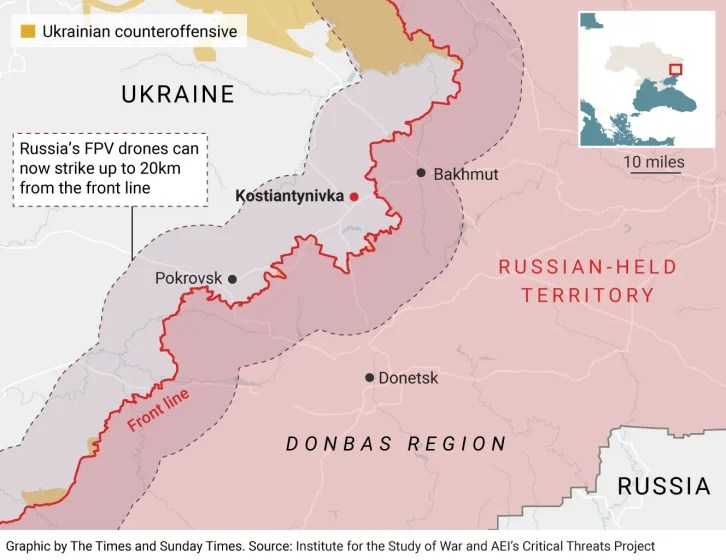
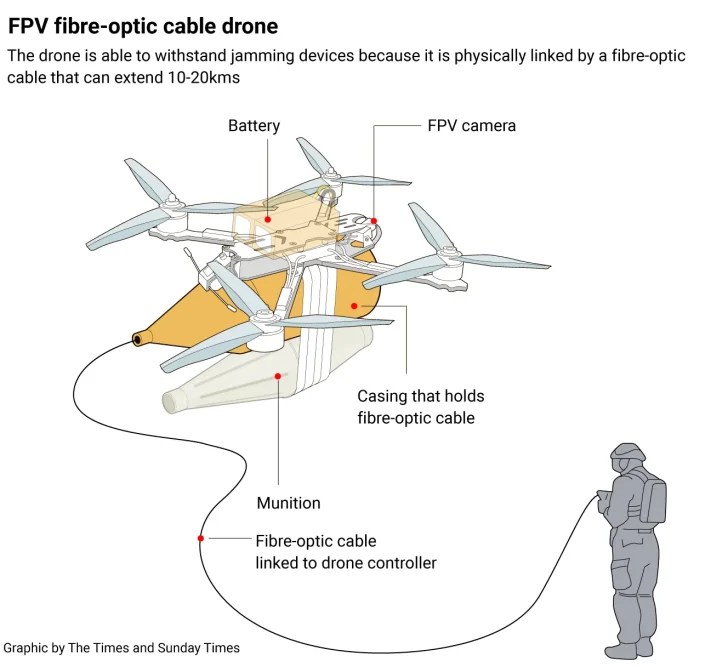
Since the proxy war erupted, both Ukraine and Russia have innovated in the field of FPV drones to an unprecedented degree. Kiev has become so reliant on drones, they are her “weapon of choice.” Yet, as The Times records, Russia has now decisively “taken the lead in the drone race, outproducing Kyiv in the manufacture and use of medium-range FPV drones and fibre optic variants that have changed the shape of the entire 1,200 km front line.”
Not only are FPVs “dramatically” striking ever-deeper into Ukrainian territory, but fibre optic FPV drones have gained “dark prominence over the killing fields.” While emulating the quadcopters equipped with munitions typically deployed by both sides previously, this “highly manoeuvrable killer drone” is connected directly to pilots by “a gossamer thin fibre optic thread.” This makes the contraptions difficult to track, and impervious to electronic jamming. A local infantry battalion commander told The Times:
“The changes posed by drones are so fast that concepts we implemented just a month ago no longer work now. We live in a space of perpetual fast adaptation. In the past week alone, Russian drone strike ranges have increased by four kilometres.”
These developments have sent Ukrainian forces scurrying en masse to regroup at regular, abrupt intervals ever-further away from the front line (also known as “zero point”), while logistical convoys to Kramatorsk – “long considered the bastion of Ukraine’s defence of the Donbas region” – have been repeatedly struck. One lieutenant recorded how Russian drones “swarm our armoured vehicles whenever they get near the zero point,” obliterating them and their crews. He believes drones represent such a world-changing military hazard, “the days of the tank are truly over.”
‘Danger Estimate’
The “drone-filled skies” of Donbass are so deadly, getting soldiers and equipment to the ever-expanding frontline and back is not only a logistical and practical horror, but also a frequently suicidal task. The Times reports that until late 2023, Ukrainian infantrymen “were usually carried to a position near the front in armoured personnel carriers, walking the last few hundred metres on foot.” Today, they are dropped off up to eight kilometres away at night, walking “meandering routes through trees to avoid detection, just to take up their positions.”
Rotations from the frontline have also vastly extended in length. While at the start of 2024 Ukrainian soldiers spent “a week or two” at zero point, now they’re routinely trapped there for months at a time, “often devoid of almost any other human contact, resupplied with water, rations and ammunition by agricultural drones.” Resultantly too, “casualty evacuation has become a nightmare.” Wounded fighters are “commonly” rescued at night, and “even then the operation is fraught.” A senior logistician for the 93rd Brigade’s drone crews lamented:
“As a word ‘stressful’ doesn’t even come close to describing it. Every mission I think, ‘God forbid we get a casualty and have to work out how to get them back’.”
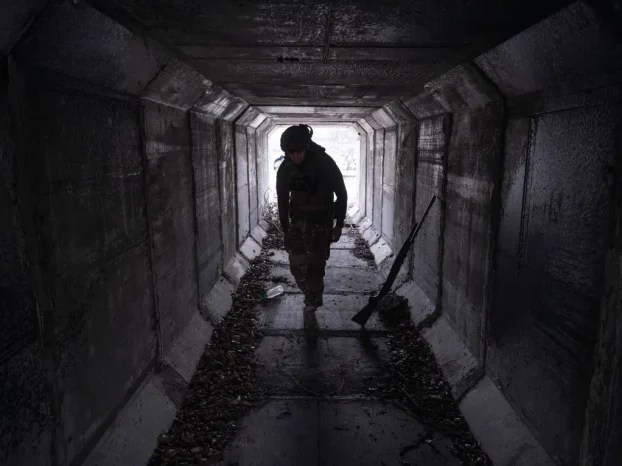
Ukrainian soldiers always keep shotguns close, to attempt to blast attacking drones out of the sky
Each night too, the Brigade’s frontline drone crews are resupplied with batteries, drone frames and munitions. Logistics teams are dropped off up to seven kilometres from the frontline, then carry up to 36 kilograms of equipment forward on foot. The risk to these crews is “enormous”. One driver was quoted as saying he conducted three missions nightly, “and I never know if each one will be my last, if I’m going to make it there and back in one piece.”
The Times records how a logistics vehicle was recently struck by a Russian drone while returning from a resupply mission. The driver lost an arm, but there were so many drones buzzing nearby, he couldn’t be evacuated from the position for five hours, so bled to death. Five Ukrainian armoured vehicles were destroyed by drones in the same sector the next day. However, none of this is seeping out to the world via the mainstream media, which once published videos of Ukrainian strikes on Russia daily.
As The Times notes, drones have adversely affected a core component of Kiev’s war effort – “media communications”. The 93rd Brigade was once “renowned for allowing reporters good access to…the war from the front.” Now though, “access for journalists has been dramatically reduced,” with “many media organisations…reluctant to commit reporters into areas within 15 km of the front.” Ukrainian brigades are likewise “wary” of the risks “they expose their own troops to in taking journalists by vehicle to the front.”
The Times reports that in 2023, the 93rd Brigade’s press officer “organised hundreds of visits to the front by reporters.” The number of visitors has now “dwindled to a trickle”. Since the proxy war’s eruption, the psychological field of battle has been where Ukraine has performed most effectively, eagerly assisted in its propaganda efforts by a media apparatus reflexively reporting the fantastical claims of officials in Kiev and their Western proxy backers as fact. Now, those days are long over. The press officer complained:
“The risks get bigger and bigger, and the coverage gets less and less. We get a journalist’s request to go to the front now and we wonder how rational is it? What is the danger estimate? What is the benefit?”
‘Technological Adaptations’
The Times report is a vanishingly rare mainstream acknowledgement of how the conflict currently raging Donbass is a war unlike any other in history, and its key spheres of battle are wholly unfamiliar to Western militaries. Despite this media omertà, the proxy conflict’s unparalleled operating environment, and obvious lessons, have not gone entirely unheeded in certain elite quarters. Nonetheless, despite alarm bells ringing accordingly, they are clearly falling on deaf ears in American and European centres of power.
In September 2024, Britain’s House of Lords International Relations and Defence Committee published a bombshell report, Ukraine: a wake-up call. It found the proxy war had “exposed fundamental weaknesses” in the “military strength” of both Britain and NATO, concluding London was effectively defenceless, with its “small” military reliant on unaffordable “status symbols” such as non-functional aircraft carriers. The country lacks the ammunition, armour, equipment, industrial capacity, personnel and vehicles to withstand a Donbass-style conflict for more than a few weeks at absolute most.
Amidst relentless condemnation of the state of Britain’s armed forces, the report contained a dedicated section on how “the use of drones in Ukraine” had “exposed the sheer variety of possible drone threats in a conflict scenario, ranging from disposable and commercially available drones to high-end, sophisticated ones.” It noted the development has “inserted an extra layer of weaponry between the land and air domains” and augmented “existing capabilities that both sides have, particularly offering new defensive options in the absence of air superiority.”
As such, the House of Lords Committee called for London to “invest in research and development to maintain a strategic edge in drone technology (including amphibious drones), and support the rapid development of new technologies that can compete in contested environments.” It urged decisionmakers to constantly consider and monitor “the pace of technological adaptations on and off the battlefield,” and the Ministry of Defence “to support continuous adaptation,” such as “[incorporating] learning on the use of drones in Ukraine across all domains.”
The report went entirely unremarked upon by the media contemporaneously, and today there is no sign of its multiple urgent calls to action having produced any meaningful results in any tangible regard in Britain’s armed forces. Similarly, despite NATO officials warning the alliance is wholly dependent on US electronic warfare capabilities, which in any event are woefully inferior to Russia’s own, public indications of Western leaders or militaries taking the drone warfare revolution seriously are unforthcoming. Should they end up in direct conflict with Russia, they’ll be in for quite a shock.
Russian missiles ‘fool’ US-made Patriots – Ukrainian military
RT | May 26, 2025
US-designed Patriot air defense systems are struggling to keep pace with Russia’s missile technology, particularly the Iskander missiles, Ukrainian Air Force spokesman Igor Ignat admitted on Monday.
Kiev has long praised the MIM-104 Patriot as a vital part of its arsenal following the deployment of the first battery in April 2023. But the American system is showing critical limitations in the face of Russia’s weaponry, Ignat told Le Monde in an interview.
“The Iskander missiles perform evasive maneuvers in the final phase, thwarting the Patriot’s trajectory calculations,” he said. “In addition, the Iskander can drop decoys capable of fooling Patriot missiles.”
While Ukrainian officials previously lauded the Patriot system for its ability to intercept Russian hypersonic Kinzhal missiles, Moscow has questioned such claims. Russian officials also argue that Kiev often overstates the number of missiles it downs compared to the number actually launched.
As of May, Ukraine is reported to have six active Patriot systems, primarily donated by the US and Germany, with additional components provided by the Netherlands and Romania.
Ukraine’s Vladimir Zelensky has called the Patriot system the only viable defense against Russian strikes, and has stated an aim to acquire a total of 25 units. He recently proposed that Kiev’s European backers fund the purchase of an additional ten systems for Ukraine at a cost of $15 billion. However, the administration of US President Donald Trump has dismissed the proposal as unrealistic.
Ukraine also faces dwindling supplies of interceptor missiles for its Western-donated platforms, even as Russian forces adapt their drone tactics to circumvent existing countermeasures.
Ukrainian forces have escalated their own drone offensives against Russia, moving from overnight attacks to continuous launches throughout the day. The shift comes amid increased pressure from Washington for continued direct peace negotiations. On Sunday, Trump expressed frustration with the lack of progress, blaming both Moscow and Kiev.
New York Times On Climate Change: Two Candidates For Quote Of The Day
By Francis Menton | Manhattan Contrarian | May 21, 2025
Over at the New York Times today, print edition, there is a big front page article documenting how their side is losing the latest battle in the climate wars. The headline is “U.S. Embraces Climate Denial In Science Cuts.” (online headline somewhat different). Also in the Times today (online version) is a feature called “Quote of the Day.” Today’s “quote of the day,” as selected by the Times, is taken from the “climate denial” article just previously linked. Here it is:
“It’s as if we’re in the Dark Ages.”
This quote is attributed to one Rachel Cleetus, identified as senior policy director with the climate and energy program at the Union of Concerned Scientists.
But then, if you take some time to read the article, you come to what I would propose as another excellent candidate for quote of the day. It’s from Brooke Rollins, recently confirmed as the new Secretary of Agriculture in the Trump administration. Here it is:
“We’re not doing that climate change, you know, crud, anymore.”
The focus of the article is what the Times calls “getting rid of data.” In Times spin, the purpose is to “halt the national discussion about how to deal with global warming.” But what kind of “data” are we talking about here? The article is short on specifics as to which exact data series are being cut back or eliminated, let alone whether those series are accurate or useful. But there is enough to give you a general idea:
In recent weeks, more than 500 people have left the National Oceanic and Atmospheric Administration, the government’s premier agency for climate and weather science. . . . NOAA also stopped monthly briefing calls on climate change, and the president’s proposed budget would eliminate funding for the agency’s weather and climate research. The administration has purged the phrases “climate crisis” and “climate science” from government websites.
Ah, NOAA (National Oceanic and Atmospheric Administration). They’re the people who, via their branch called NCEI, put out the so-called “surface temperature” series that have been systematically altered to create a falsely-enhanced warming trend to support regular claims of “warmest day/month/year ever.” This is the subject of my now 33-part series “The Greatest Scientific Fraud Of All Time.”
Let me remind you of the basics of the temperature-alteration scam: (1) the surface temperature records as presented by NOAA/NCEI are not raw instrumental data, but rather have been altered, (2) NOAA admits that it alters the records, (3) NOAA gives seemingly-plausible reasons for altering the records (e.g., to account to station moves and instrument changes), (4) however, the alterations as implemented are not associated with any specific issues like station moves and instrument changes, and (5) the alterations systematically enhance the reported warming trend and are used to support the “climate crisis” narrative. For more detail, go to Part XXXIII of the “Greatest Scientific Fraud” series. Here are just a couple of backup points in case you are skeptical:
-
As to whether NOAA alters the raw data, from ABC News, February 25, 2025, “Yes, NOAA adjusts its historical weather data: Here’s why.” Excerpt: “When digging into conspiracies claiming that the federal agency “manipulates” its historical weather data, ABC News chief meteorologist and chief climate correspondent Ginger Zee was able to confirm that it was true — but that the routine, public adjustments to records happen for good reason. . . . NCEI [a branch of NOAA] adjusts weather data to account for factors like instrument changes, station relocation and urbanization, and it does so through peer-reviewed studies that are published through its federal website.”
-
As to whether the data alterations implemented by NOAA/NCEI can be tied to any specific legitimate bases like station moves or instrumentation changes, I cite a 2022 article by O’Neill, et al. (17 co-authors) from the journal Atmosphere, title “Evaluation of the Homogenization Adjustments Applied to European Temperature Records in the Global Historical Climatology Network Dataset.” I couldn’t get a pithy quote from the article, but here is my summary: “[The authors attempt] to reverse-engineer the adjustments to figure out what NCEI is doing, and particularly whether NCEI is validly identifying station discontinuities, such as moves or instrumentation changes, that might give rise to valid adjustments. The bottom line is that the adjusters make no attempt to tie adjustments to any specific event that would give rise to legitimate homogenization, and that many of the alterations appear ridiculous and completely beyond justification. . . .” There is much, much more detail if you follow the links.
It is not clear from the Times article whether the 500 recent departures from NOAA include the people who have been carrying out this temperature alteration scam. If those people aren’t gone yet, with any luck they will be soon; and maybe we’ll even get some details of how they have been practicing their dark arts.
Meanwhile, back in the world of climate reality, the Real Clear Foundation on Monday (May 19) held something they called the “Energy Future Forum.” Conference co-chairs David DesRosiers and Mark Mills gave opening key-notes. Kevin Killough of Just the News published a summary of the conference on May 20. From DesRosiers’ remarks:
“I think we’ve gone from scarcity to abundance — from the green gospel of scarcity and its Trinitarian ESG god — to the promised land of abundance guided by the values of affordability and reliability,” David DesRosiers, conference co-chair and founder of the RealClear Foundation, said.
And from Mills:
While many tech companies, such as Microsoft, embraced net-zero goals, Mills explained that the energy demands of data centers forced companies to contend with the reality that although fashionable in some circles, intermittent wind and solar power are not adequate. “Eventually, reality rears its ugly head, and we recalibrate around what reality permits,” Mills said.
Bottom line: the Times can scream all it wants, but the world is moving on. From my point of view, it can’t happen too fast.
London Times Condemns Shadow Censorship While Quietly Endorsing Selective Speech Control
By Cindy Harper | Reclaim The Net | May 25, 2025
The London Times editorial board recently delivered a pointed critique of groups like the Global Disinformation Index (GDI), accusing them of acting as “self-appointed censors” who operate “in the shadows” and pose a “threat to free speech.”
Yet, in the same breath, the Times reveals its own willingness to endorse a selective approach to censorship, so long as the targets align with its own criteria.
While the editorial draws a firm line between malicious falsehoods and legitimate dissent, it doesn’t reject censorship outright.
Instead, it carves out an exception: “harmful disinformation, such as a doctored video designed to cause distress or inflame tensions, is one thing; legitimate journalism seeking to question the status quo is quite another.”
That distinction may sound reasonable on the surface, but it hinges entirely on who gets to decide what counts as “harmful.” In practice, this gives room for silencing speech under subjective definitions, provided those definitions align with elite sensibilities.
The Global Disinformation Index, a little-known nonprofit founded in 2018, has taken it upon itself to grade news organizations based on vague notions of “trustworthiness.”
Its reports, which have been used to influence online advertising decisions, can financially strangle outlets by placing them on exclusion lists. Once flagged, a publication can see its ad revenue evaporate as advertisers steer clear, often without the public, or the publication, ever knowing why.
Their influence far exceeds that of traditional editors or publishers, largely because they operate through algorithms and financial incentives, targeting revenue rather than content directly.
The Times editorial stops short of fully embracing the principle of open inquiry. While decrying the secrecy and self-importance of outfits like the GDI, it leaves the door open to censorship, provided it’s targeted at the content they believe crosses an undefined line into “harm.”
This undermines the editorial’s own warning about the chilling effect of selective enforcement. Once any authority is granted the power to judge truth in service of suppressing it, the essential freedom of press and expression is already compromised.
By calling for protection of “legitimate journalism” while conceding the need to crack down on “harmful disinformation,” the Times falls into the same trap it criticizes. It grants a moral and editorial license to define acceptability, not based on transparency, accountability, or open debate, but on perceived intent and potential impact. The risk, as always, is that this standard will be wielded not to protect the public, but to shield the powerful.
Do You Condemn October 7? China Says “No”

By Mike Whitney • Unz Review • May 25, 2025
China has never explicitly condemned the attacks of October 7. In China’s view, October 7 can’t be separated from the more than seven decades of Israeli brutality, apartheid and occupation. Naturally, this has drawn harsh criticism from Israel which expressed its “deep disappointment” over China’s refusal to repudiate Hamas. Even so, China has not caved in to Israeli pressure or softened its rhetoric. Quite the contrary, on February 22, 2024, Ma Xinmin—a legal advisor to China’s Foreign Ministry and a member of the International Law Commission—summarized China’s views of Hamas’ activities during a presentation to the International Court of Justice at The Hague. Here’s part of what he said:
The Palestinian-Israeli conflict stems from Israel’s prolonged occupation of Palestinian territory and Israel’s longstanding oppression of the Palestinian people. The Palestinian people fight against Israeli oppression and their struggle for completing the establishment of an independent state on the occupied territory are essentially just actions for restoring their legitimate rights. The right to self-determination served as the precise legal foundation for this struggle. MEMRI
The fact that China chose a legal scholar—who is a member of the International Law Commission—to argue their case, underscores the importance China places on the broader legal issue of whether the Hamas attack was justifiable under international law. Ma concludes that the attack was not only justifiable, but that the militants involved in the attack had an “inalienable right” to conduct operations that were aimed at ending the Israeli occupation. Here’s Ma:
“The Palestinian people’s use of force to resist foreign oppression and complete the establishment of an independent state is an inalienable right …. The struggle waged by peoples for their liberation, right to self-determination, including armed struggle against colonialism, occupation, aggression, domination against foreign forces should not be considered terrorism.” MEMRI
Ma’s statement should not be construed as support for the injuring or killing of innocent civilians. It is, however, a powerful defense of the right of persecuted people to participate in armed struggle against their oppressors.
Most readers don’t know that China resisted Israel’s coercion and defended international law as it relates to the October 7 attacks. They don’t know that China took a stand on a matter of principle and never flinched. Of course, most people don’t realize that of the 195 countries in the world, only 13 officially designate Hamas as a “terrorist organization”. Many believe that the terrorist moniker is applied universally and that the rest of humanity see the world through the same distorted lens as people in America. But they don’t. They see Hamas as a national liberation movement that was duly elected to govern Gaza in 2006 following “free and fair” elections that were forced on the Palestinians by the Bush administration. Now Hamas is being used as the pretext for the slaughter women and children in Gaza on an industrial scale. Most Western leaders have expressed their support for Israel’s 18-month bloodbath, while China has not only opposed it but also defended the Palestinians right to armed struggle. Here’s Professor Richard Falk, a leading scholar in international law and former UN Special Rapporteur for Palestine:
“The right of resistance was affirmed during the decolonization process in the 1980s and 1990s, and this included the right to armed resistance. However, this resistance is subject to compliance with international laws of war.”
Even the preamble to the Universal Declaration of Human Rights states that “whereas it is essential, if man is not to be compelled to have recourse, as a last resort, to rebellion against tyranny and oppression, that human rights should be protected by the rule of law”.
Israel does not comply with international laws of war—for example, the entire situation in Gaza is one of the most flagrant violations of Israel’s complete disregard, not only for the laws of war, but for the entire apparatus of international and humanitarian laws.
Palestinians, on the other hand, who are in a permanent state of self-defense, are driven by a different set of values than Israel. One is that they are fully aware of the need to maintain moral legitimacy in their methods of resistance….
“To the extent that there is real evidence of atrocities accompanying the October 7 attack, those would constitute violations, but the attack itself is something that, in context, appears entirely justifiable and long overdue,” Falk said. Palestine Chronicle
This is why Israel has fabricated so many stories about beheaded babies, mass rape and the killing of innocent civilians. The intention is to persuade the public that October 7 was not a legitimate expression of political resistance but a wanton act of terror aimed at ordinary people. Western analysts typically focus on fake atrocities that are used to drown out any reasonable discussion about historic oppression or political realities. Here’s Falk again:
One of the tactics used by the West and Israel has been to almost succeed in decontextualizing October 7 so that it appears to have come out of the blue... The UN Secretary-General was even defamed as an antisemite for merely pointing out the most obvious fact—that there had been a long history of abuse of the Palestinian people leading up to it,” he added, referring to Antonio Guterres’ simply stating that October 7 “did not happen in a vacuum”. (Palestine Chronicle)
“Decontextualizing October 7”?
Precisely. The case for genocide is made on the basis that October 7 can be removed from its broader historical “context” and seen as a “stand alone” event that requires a particularly violent response. But October 7 is not a stand-alone event; it is the unavoidable explosion of collective resistance to decades of ethnic hatred and brutality aimed at a particular people who have been stripped of their civil rights and left to languish in an apartheid state. Here’s Ma again:
“Our state is obliged to promote the realization of the right to self-determination and to refrain from any forceful action, which deprives people of that right. In pursuit of their right to self-determination, these people have the right to engage in struggles, seek and receive support on the basis of that right….
“Numerous UN General Assembly resolutions recognize the legitimacy of struggle by all available means, including armed struggle, by peoples under colonial domination or foreign occupation, to realize the right to self-determination.
MEMRI
Naturally, Ma’s speech has largely been blacked out in the western media where anything that doesn’t jibe with the Israeli narrative (that October 7 was an act of terrorism) winds up “on the cutting room floor”. We are confident that if Ma’s powerful moral statement was more widely circulated, Israel’s support in the US would crumble.

China Offers To Rebuild Gaza
China has supported every UN Resolution aimed at providing humanitarian relief to the people in Gaza. They have been staunch supporters of Palestinian statehood and the two-state solution from the beginning. They have repeatedly called for an end to the fighting and an immediate ceasefire. They have even met with leaders of Hamas and Fatah (in April and July 2024) to see if reconciliation between the two groups was possible in order to promote Palestinian unity. Finally, China has repeatedly offered to “rebuild Gaza” following the end of hostilities which underscores Beijing’s commitment to an independent Palestinian state living side-by-side with Israel.
At every opportunity, China has supported policies aimed at de-escalation, reconciliation and peace. They have exhibited the type of ‘moral clarity’ and moral leadership we would like to see from the United States but never do. It is China’s moral clarity that “guides its decisions, even in complex or ambiguous situations, without being swayed by competing interests or relativism. It’s about aligning actions with a consistent moral framework, often rooted in universal values like honesty, fairness, or compassion.”
Israel’s savagery in Gaza suggests that the West is in a state of irreversible moral collapse. We should be grateful that China is stepping in to fill the void and lead the world into the next century.
On one of the most consequential issues of our time, China has come down on the side of decency and humanity.
Israel’s deadly aid plan for Gaza delayed due to ‘logistical issues’
The Cradle | May 25, 2025
The Israeli and US-led aid distribution mechanism, which was meant to be launched on 25 May, has been delayed, as UN agencies continue to reject participation in the controversial plan.
Correspondent for Israel’s Channel 12, Tamir Morag, confirmed the new postponement of the Gaza Humanitarian Foundation (GHF). He also accused Hamas of looting humanitarian aid, a claim repeated by Israel, which the UN says there is no evidence for.
Security sources cited in other Hebrew media reports say the UN has doubled down on its rejection of the aid distribution plan, and that “logistical issues” have delayed its launch.
This comes after Israeli media cited suppliers as saying last week that nobody is able to fulfill the plan’s “huge” requirements.
GHF was conceived at the very start of Israel’s genocidal war on Gaza. While US ambassador to Israel Mike Huckabee said when the plan was unveiled this month that it would be “inaccurate” to call it an “Israeli plan,” the project has its roots in Tel Aviv.
According to the New York Times, the details of the plan were first discussed by a group of officials and businesspeople with ties to the Israeli government, called the Mikveh Yisrael Forum, who came up with an idea that aims to bypass the UN and all other humanitarian groups in Gaza.
The Washington Post reports that the initiative’s planning documents anticipated the widespread condemnation and likening of the plan’s distribution centers to “concentration camps with biometrics.”
Even some within the Israeli military establishment have questioned whether the plan could potentially lead to chaos, the report says.
GHF relies on the use of private US contractors who will be in charge of several distribution centers in south and central Gaza. Palestinians in other areas who have had their homes destroyed and have already been displaced multiple times will have to travel across the strip under bombardment to secure aid, while forfeiting the right to return home.
The UN has said the mechanism is designed to reinforce Israel’s plan to displace Gaza’s entire population southward.
It has also condemned Israel’s plan to employ facial recognition technology aimed at screening Palestinians in exchange for humanitarian aid.
“It appears the design of a plan presented by Israel to the humanitarian community will increase ongoing suffering of children and families in the Gaza Strip … The use of humanitarian aid as a bait to force displacement, especially from the north to the south, will create this impossible choice: a choice between displacement and death,” UNICEF spokesperson James Elder said earlier this month.
Gaza’s Government Media Office warned on Saturday that the levels of aid currently entering the strip are less than one percent of what the population needs.
Meanwhile, Israel continues to target Palestinian security officers guarding aid and preventing it from being looted by Israeli-backed gangs.
According to multiple reports, ISIS-linked gang leader Abu Shabab, responsible for the looting of aid under Israeli protection throughout the war, has now “established a fortified base in an Israeli-controlled zone in Rafah.”
From Betar to Shomrim, re-emergence of Zionist private militias in the West
By David Miller | Press TV | May 25, 2025
In April of this year, anti-Zionist Jewish writer Alon Mizrahi claimed that Israeli Prime Minister Benjamin Netanyahu and his network of international Zionists are working to establish a policing force with powers surpassing those of national law enforcement agencies.
Mizrahi described this as the beginning of overt Jewish-Zionist policing of Western societies.
He was referring specifically to the ever more egregious statements from Betar in the US, an ultra-Zionist group affiliated with the far-right Revisionist Zionist movement founded by Vladimir Jabotinsky.
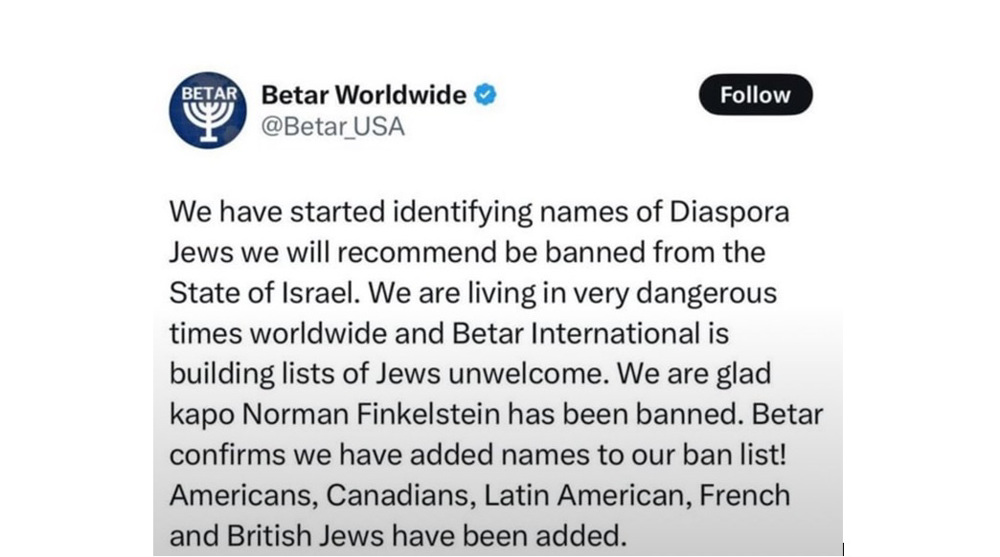
They have threatened to compile lists of Jews to be banned by the Zionist entity across North and South America, as well as Britain and France.
Mizrahi warned, “They start with Jews as a deception: all of you are next.”
However, the situation may already be far worse than what Mizrahi suggests.
Since its founding in 1923, Betar has trained as a paramilitary force. The photo below shows Menachem Begin wearing a Betar uniform in Poland in 1932.
Below it is another photo from Berlin in 1936, taken after the Nazis enacted laws outlawing other political groups in 1933.
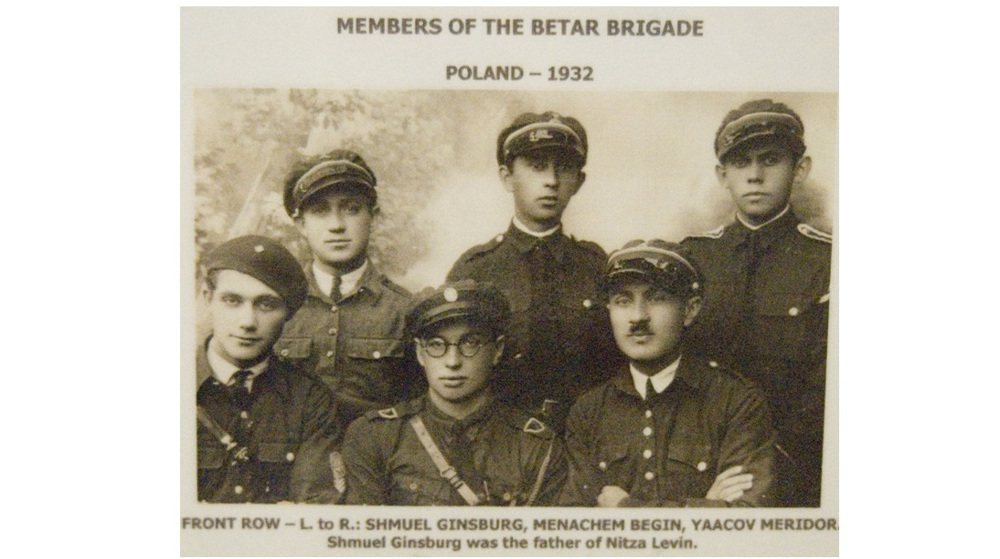
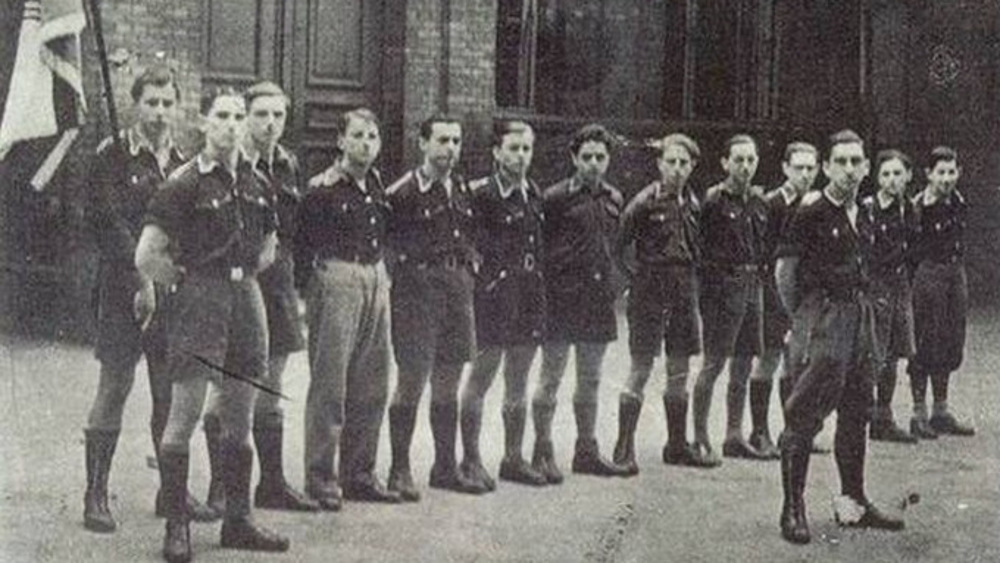
Betar was so closely aligned with the Nazis and Mussolini’s fascists that they were regarded as collaborators. By 1934, Jabotinsky and his Betar youth movement had reportedly “allied with Il Duce,” establishing a naval base north of Rome.
Late that year, Mussolini reportedly expressed support for Zionism and Jabotinsky in particular, stating: “For Zionism to succeed, you need to have a Jewish State with a Jewish flag, and Jewish language. The person who understands that is your fascist, Jabotinsky.”
This remark was made “during a private conversation with Nahum Goldman, founder of the World Jewish Congress, in November 1934,” as reported by Lenni Brenner in Zionism in the Age of Dictators.
Many senior Betar members served in the collaborationist police overseeing the Vilna Ghetto in Lithuania and were involved in betraying Jews in hiding to the Nazis.
One such member, Lotek Salzwasser, was eliminated by Jewish partisans in 1943 for his collaboration, according to Israeli press reports.
Betar and military training
One of the seven core principles of the Betar “Oath” is Magen, meaning “Protection.”
One of Betar’s ideological principles is military preparedness. Betar demands that all its members complete military seminars and know how to use weapons, in order to be ready at any time and to respond personally to a call for defense.
Betar has functioned as a militia since its inception. Here is a film of one of the French branches recorded in 2014 conducting paramilitary training exercises.
In the UK, Betar operated as a registered charity (Brit Tumbledor of Great Britain – Betar) between 1984 and 2004. It was closed down by the Charity Commission in 2004, on the grounds that it had been “Registered in error.”
In March 2025, Betar threatened to murder UN Special Rapporteur Francesca Albanese. On the very same day, the group relaunched its UK branch with a post on Instagram, claiming London “has become, with the time, an epicenter for radical Islam, for hate, for terror.” Their proposed solution?
Today, after more than 30 years, a bunch of strong young leaders stand up to say HERE WE ARE, to defend the Jewish population and to tell them that now we have a solution for the current situation, JEWS ARE NOT AFRAID ANYMORE!
Make no mistake – these threats are part of a deliberate effort to revive Jewish supremacist militias in the UK and the US.
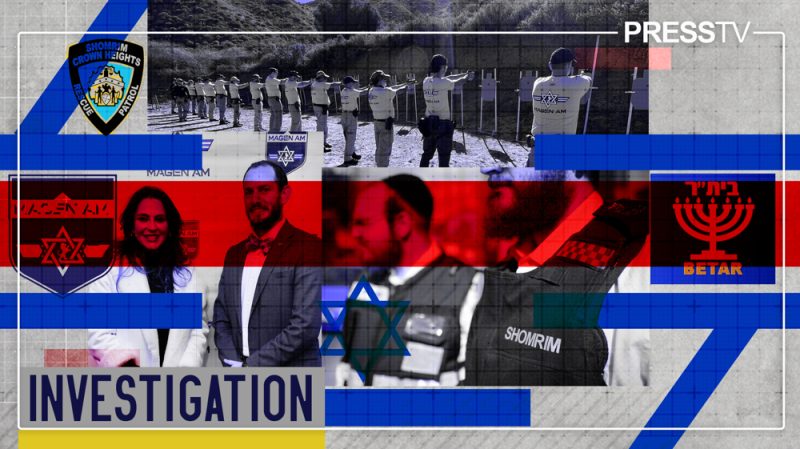
Magen Am
The term Magen also appears in the name of a US-based private Zionist militia called Magen Am, which is currently active in Los Angeles, Orange County, and Phoenix.
Magen Am played a notably violent role in attempts to dismantle the student encampment at UCLA. The group frequently boasts about its close ties to the LAPD, sharing numerous photos of friendly interactions with police officers.
Reports indicate that Magen Am has collaborated directly with law enforcement, including working closely with the LAPD to intimidate and attack student protesters on the UCLA campus.
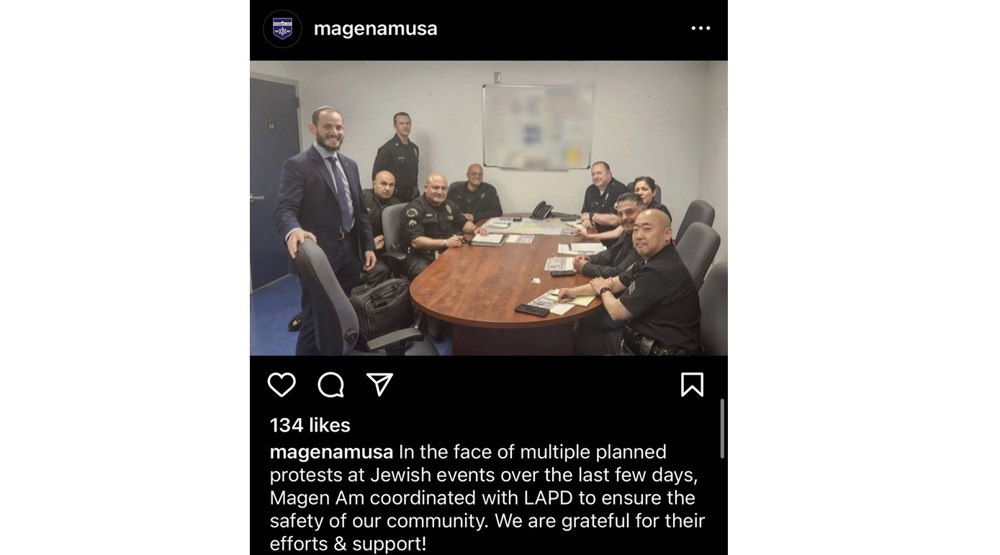
Magen Am, of course, recruits veterans of the occupation forces’ Lone Soldier programme and some then return to “serve” in the genocide as they proudly boast.
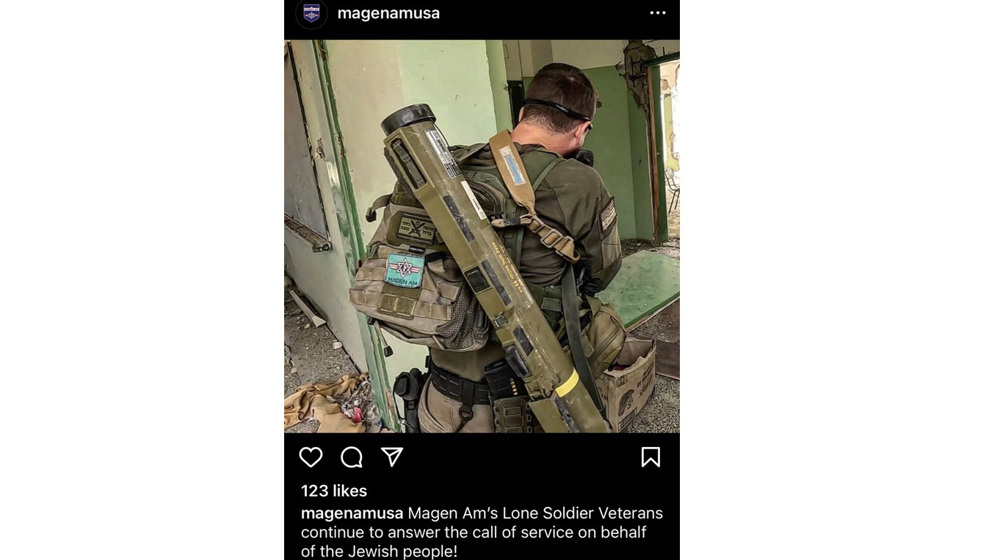
Magen Am was founded in 2017 by Yossi Eilfort, an MMA fighter-turned-Chabad rabbi. The flag of the genocidal Chabad cult was flown by the attackers on campus in Los Angeles.
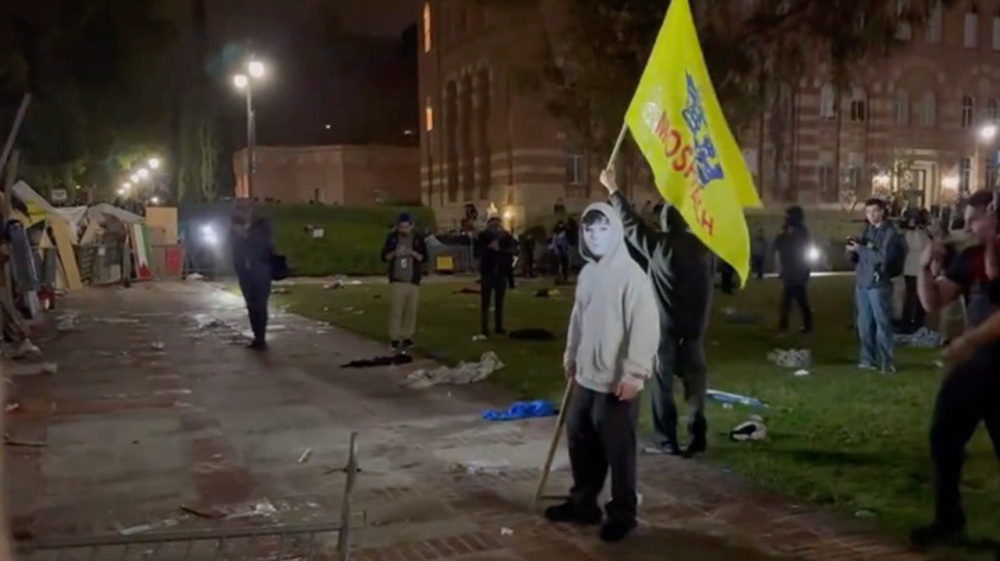
Chabad has many followers in the so-called Hilltop Youth in occupied Palestine, which the Zionist intelligence agency Shin Bet says are responsible for the overwhelming majority of so-called ‘price-tag’ revenge attacks on Palestinians.
The rise of Jewish supremacism in Western societies is becoming increasingly visible, though many continue to deny or downplay its existence.
While Zionist militias and private security firms openly collaborate to suppress student protests in the US, there is a more subtle infiltration of police forces by Zionist Jewish supremacists.
Shomrim: The Private Jewish Patrol
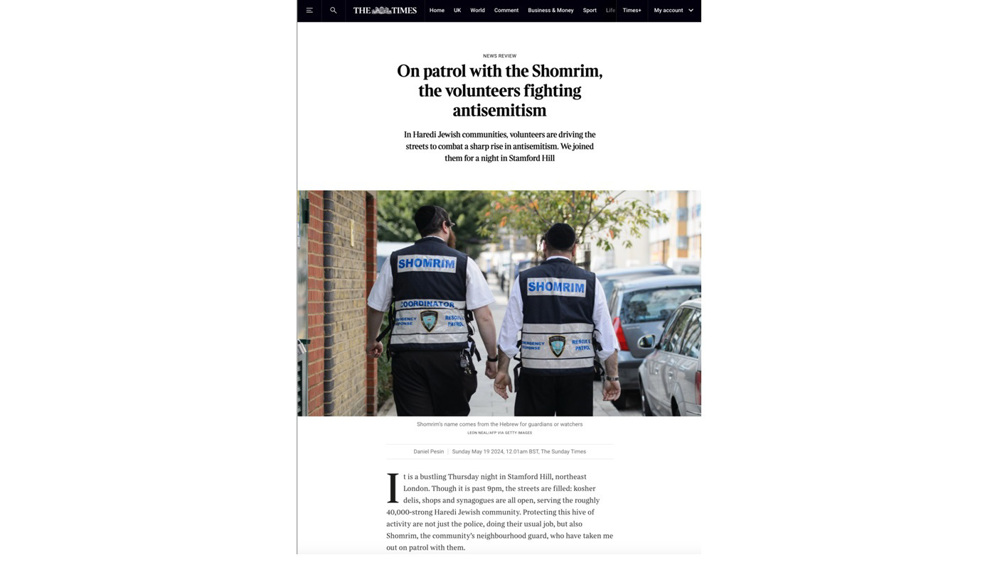
Shomrim is a private Jewish police force operating in parts of the US, UK, Australia, and Belgium. It is reported that “over 20 Shomrim organisations exist worldwide.”
In London, the Shomrim North West Community Patrol operates in the Borough of Barnet. Founded in 2008 by Gary Ost as a registered charity, it acts as a “mobile neighbourhood watch” and acts as eyes and ears for the Metropolitan Police.
Shomrim claims that all “Volunteers have completed training from the Metropolitan Police Counter Terrorism Command (SO15) in assisting to identify potential security threats and suspicious activity. “
One blogger notes that the genocidal cult Chabad also has a ‘nasty tendency to normalize sexual abuse and protect serial sexual predators in its ranks.” But it’s not only Chabad; there is a similar tendency throughout the Zionist movement.
No surprise, then, to find that the founder of Shomrim in London has been implicated in this.
In 2013 Police dropped their investigation into Ost, who had been arrested on suspicion of perverting the course of justice in relation to an investigation of an alleged child sexual abuser, Rabbi Chaim Halpern.
Indeed, charges against the alleged sexual predator were dropped back then, too. Yet new allegations against Rabbi Halpern have resurfaced a decade later, and the trial for these offences is still pending.
Shomrim abuses
In New York, Shomrim has faced criticism for “using excessive force against non-Jewish suspects.”
In 2014, two Shomrim members were charged as part of a group of five Hasidic men for assaulting 22-year-old Black student Taj Patterson as he walked home from a party.
Additionally, Shomrim organizers in New York have reportedly withheld information on suspected Jewish criminals. The NYPD has openly criticized the group for not always notifying police when calls come in, raising concerns about accountability and cooperation.
Given Shomrim’s protected status with law enforcement and the documented culture of sexual abuse in some ultra-Orthodox communities, credible allegations of abuse within these groups are unsurprising.
On October 11, 2023, the United States Department of Justice issued a press release that Jacob Daskal, former head of the Boro Park Shomrim Society—a private Orthodox Jewish crime-patrol group associated with the NYPD—was sentenced to 210 months in prison and fined $250,000 for transporting a minor with intent to engage in criminal sexual activity.
Daskal pleaded guilty to the charge in July 2023. As part of the sentence, Daskal is required to register as a sex offender.” The statement notes that Daskal was introduced to a 15 year old girl “as a result of his position with the Shomrim”, who he then “groomed” for sexual abuse. According to the Department of Justice statement:
“Throughout the abuse, Daskal instructed the victim to delete their communications and warned her not to tell anyone about their sexual relationship. He also used his position as a community leader to silence the victim, bragging about his law enforcement connections and warning her that disclosure would ruin her life. The victim was expelled from her religious school after revealing the relationship to the school principal.”
This case raises troubling questions: How many other abusive situations are currently unfolding within Shomrim and other Jewish militia groups?
Shomrim protects genocide
What is it that Shomrim are protecting? One illustrative example is the Crown Heights Shomrim branch, which in January this year provided security protection for the genocidal President of Israel, Yitzchak Herzog and for the leadership of the genocidal cult Chabad, as shown in the image below.

If Shomrim really wants to protect Jews in the US and UK, they should start by apprehending the entire leadership of Chabad and members of the genocidal Zionist regime.
Police reluctance toward Shomrim in the UK
Initially, UK police were resistant to Shomrim’s activities. In 2008, Chief Superintendent Steve Bending, then Hackney’s borough commander, stated, “I do not support the concept of any community having its own form of patrol service. There is a risk of other communities feeling intimidated by this course of action.”
As late as 2015, Metropolitan Police Commissioner Sir Bernard Hogan-Howe expressed his preference that Shomrim volunteers avoid uniforms resembling those of official officers.
Shomrim, however, rejected this, saying “its volunteers should not drive marked cars or wear uniforms similar to those of the police.” Gary Ost, chief executive of Shomrim in Golders Green, north-west London, stated, “Our uniforms look nothing like the police and are marked from every angle with clear wording saying ‘Shomrim’.”
Yet a glance at their uniforms and liveried vehicles often gives a very different impression.
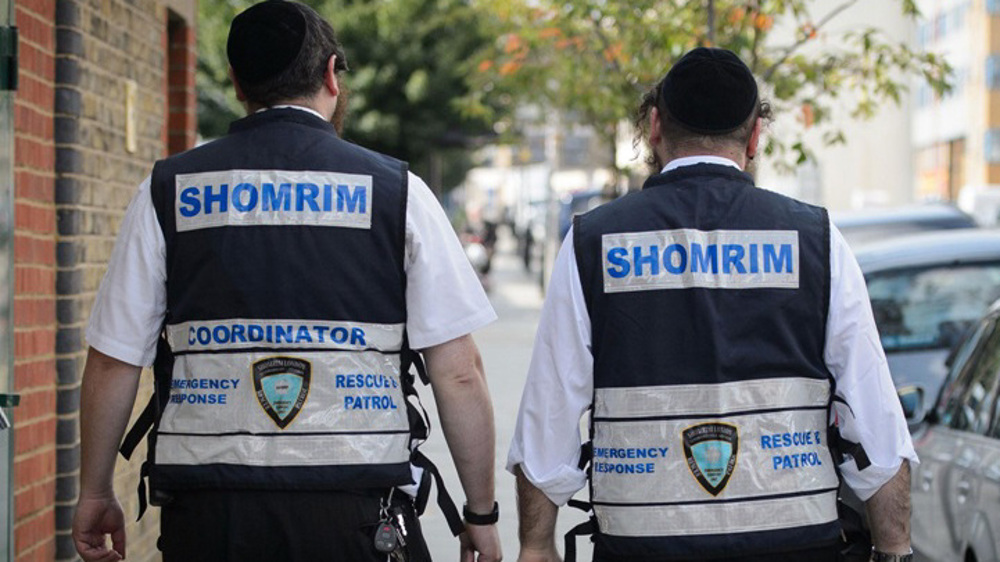

But the penetration of the police is now much more advanced and cooperation is the name of the game. There are numerous examples of apparent cordial relations between the two on the internet.
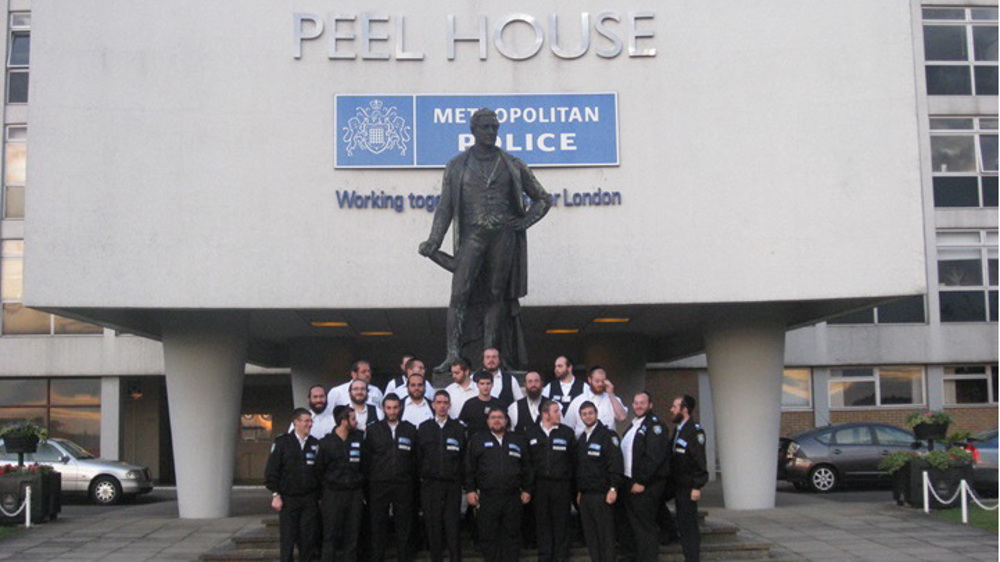
Shomrim members even posed outside Peel House, the headquarters of the Metropolitan Police.
Below is a photo of a prize giving for Shomrim members commended for their “bravery” and “exemplary service to the community” in 2020.
Shomrim chief executive Gary Ost, the one arrested in 2013, is one of the three.

Shomrim plays a key role in shaping the narrative around the widespread antisemitism claims that Israel relies on to justify its genocidal actions.
The pressing question is: What happens when members of Shomrim break the law or commit wrongdoing? Would the police be able—or even willing—to enforce the law against them?
Alon Mizrahi, whom we cited earlier, shared his perspective in a conversation with me:
“They are pretending to be defending themselves in the most friendly country to Jews in history. While committing genocide. In a country that is so hateful of Jews that we need a private police force for Jews only in the US.
“And I have no doubt that if they can normalise this, with the kind of status that Zionist Jews have managed to create for themselves in the US; If this Jewish police force uses violence against black people, black organisers in communities who oppose the genocide, or other migrant groups or any other group, are American police going to be able to charge them?
“To use the law against them? I don’t think so. If you are in the American system, if you have a role in any part of the American system of government, in the police or any other agency, I think that at this point it is clear to you that Zionist Jews are above the law.
“The law doesn’t apply to them. So they don’t have the philosophical or legal means to deal with this. And the Zionists know this.”
Given the current climate, his assessment may well be accurate.
Israeli settlers escalate violence, forced displacement across occupied West Bank

Photo credit: AFP via Getty Images
The Cradle | May 25, 2025
The last few days have witnessed a dangerous escalation of violence, theft, and vandalism against Palestinians by illegal Israeli settlers in the occupied West Bank.
Settlers attacked Palestinians in the Al-Auja Waterfall area in Jericho on 25 May for the third time in one day, as part of ongoing efforts to displace families who have lived in the area for decades and establish a new illegal settlement outpost.
This came a day after settlers, under the protection of the Israeli army, cut off the water supply to the area.
In the Salim plain east of the occupied city of Nablus, settlers also continued to set fire to wheat fields on Sunday, coinciding with separate attacks on Palestinian livestock herders in the northern Jordan Valley area.
On Saturday, at least 40 dunams of wheat fields in the village of Sebastia near Nablus were set ablaze by illegal settlers.
“The colonists came from the Shavei Shomron settlement and a newly established outpost in the area. The arson targeted farmland in the village’s plain, destroying crops owned by local Palestinian residents,” Mohammad Azem, head of the Sebastia municipality, told WAFA news agency on 24 May.
Large amounts of crops were totally destroyed, decimating the livelihoods of the local Palestinian landowners.
At least 70 olive trees belonging to a Palestinian farmer in Hebron were uprooted by settlers on the same day.
The attacks on Saturday came as Israeli occupation troops carried out a large-scale arrest campaign across the West Bank.
Last week, around 150 Palestinians were forced by settlers to leave the village of Mughayyir al-Deir east of Ramallah, following the establishment of a new illegal outpost there and five days of attacks and intimidation.
Settlers harassed Palestinian men while they were dismantling the metal and wooden frameworks of their houses and preparing to evacuate. One of the attackers was Elisha Yered, a member of the extremist Hilltop Youth group who is subject to UK and EU sanctions for numerous crimes against Palestinians.
“This is what redemption looks like! This is a relatively large outpost that contained about 150 people from the enemy population, but it was broken,” he boasted.
Just four days ago, settlers under army protection attacked Palestinians and set fire to homes and vehicles in the town of Bruqin in the northern West Bank. Bruqin and the nearby village of Kafr al-Dik have been under a tight army siege and continuous attacks since the killing of a settler in a shooting on a settlement in the area earlier this month.
Illegal land grabs and expansion of settlements have continued brazenly by the Israeli government, in stark violation of international law.
The UN Human Rights Office noted in a report in March that there has been a significant expansion of illegal settlements in the occupied territory, citing reports from Israeli NGOs indicating that tens of thousands of new housing units are scheduled to be built in new or existing settlements.
Since the start of this year, Israeli occupation forces have been been carrying out a deadly military operation and siege against several West Bank cities. The operation began on 21 January and was dubbed Iron Wall.
According to the UN, at least 40,000 Palestinians have been displaced from their homes, as Israel continues to systematically demolish Palestinian houses in the refugee camps of Jenin and Tulkarem.
Will the international community rethink its support for Israel’s security narrative?
By Ramona Wadi | MEMO | May 24, 2025
Earlier this week, Israel fired warning shots at an international diplomatic delegation in the occupied West Bank. According to the Israeli military, the delegation “deviated from the approved route and entered an area where they were not authorised to be”. The delegation was visiting the Jenin refugee camp, which both Israel and the Palestinian Authority have targeted in a bid to extinguish the Palestinian anti-colonial resistance. Over 22,000 Palestinians have been displaced from Jenin.
The diplomatic delegation was targeted just a day after the EU said it would be reviewing the EU-Israel Association Agreement. In response to the Israeli military’s actions, several governments spoke up immediately, condemning the threat to the diplomats’ lives and asking for immediate investigations. Diplomats, after all, have diplomatic immunity, as UN spokesperson Stephanie Dujarric swiftly reminded. “Diplomats who are doing their work should never be shot at, attacked in any way, shape or form,” Dujarric stated.
But what governments and UN representatives are leaving out is the fact that diplomats witnessed Israel’s security narrative in action against them. Israel’s action was not a mere breach of diplomatic immunity. It was a taste of what the settler-colonial entity feels entitled to impart to anyone who oversteps its imagined boundaries.
The question is, therefore, how far has the international community normalised Israel’s security narrative? The answer will give an idea of how far reaching Israel perceives its security narrative to be.
When the international community upholds Israel’s purported right to defend itself, it automatically applies Israel’s security narrative against the Palestinians who have the right to resist colonisation by all means. The same warped politics was applied to the genocide in Gaza since October 2023.
But Israel internationalised its security narrative. It exported the narrative to all corners of the world, marketed it when the US embarked on its War on Terror, and consolidated the principle through the sales of military and surveillance technology. The UN endorsed it at a global level; individual countries followed suit. Diplomacy became beholden to Israel’s security narrative, as did the Palestinian right of return, the two-state paradigm and even mere symbolic recognition of a Palestinian state. The EU’s illusory state-building, associated with the PA and the occupied West Bank, was also controlled by Israel’s security narrative. As were the EU’s infrastructure and development projects, many of which were destroyed by Israel under the pretext of security. When diplomats and UN personnel were refused entry by Israel, international condemnation was softer than a lullaby. And when Israel’s targeted assassinations involved violating other nations’ sovereignty, Israel’s security narrative took precedence. After all, Israel had a reason that the international community pledged to support – the complete colonisation of Palestine.
Through complicity and silence, the international community enabled a colonial ideology to shape all political and humanitarian initiatives. By enabling and being complicit in colonisation, the international community assumed immunity from Israel’s bullets. But nothing and no one is immune in a colonial framework.
Of course, the countries whose diplomats were targeted in Jenin are expected to take care of their own. But have world leaders paused to realise that ignoring or normalising the consequences of Israel’s security narrative can spill out to endanger the entire world?
Unlike the limits within which Palestinian anti-colonial resistance fights its battle, Israel has embroiled the entire world in its colonial violence and genocide. Israel presented Palestinians as a threat to its colonial establishment that must be annihilated. To promote its security narrative, Israel equated the Palestinian people with international terror. It sold genocide in Gaza as moral and the world acquiesced. After Gaza, does the international community really think that Israel will shy away from firing at diplomats?
We must also take note of the fact that Israel fired warning shots at diplomats in the occupied West Bank, which is the international community’s playground when it comes to its donor funding schemes. Far removed from Gaza, the international community would have us believe, simply because of its investments which create an illusion of prosperity. It only took a few Israeli bullets targeting international diplomats for governments to shatter the illusion they promote.
Will the international community now pause to at least rethink who Israel considers an enemy? Alongside Palestinians, UN personnel have been killed in Gaza, as have humanitarian workers. Yet even in these cases, the international community was more concerned with enabling Israel to continue its genocide. Besides normalising Israel’s genocide of Palestinians in Gaza, the deliberate, targeted killing of international aid workers, despite the initial outcry, was also normalised as collateral damage.
Without safeguarding Palestinians from genocide and all forms of Israel colonial violence, the international community’s safety will be breached over and over again. And while international safety is gradually eroded, Palestinians are being murdered, forcibly displaced and ethnically cleansed, in the name of security.
Israel’s security narrative is a dangerous spectrum that must be seen as a whole. To see the entirety of it, the international community must turn its attention to the colonised Palestinian population, who have been beaten, shot at, detained, tortured and murdered, merely for inhabiting their own land. Not by sending delegations on exploitative tours that do nothing to end colonialism, but by protecting Palestinians and their anti-colonial resistance.
Can the international community at least acknowledge that, despite the support it has given to Israel, it finds itself in a position where power and vulnerability meet in a space that is still controlled by Israel and its colonial violence? How profitable is it to support the colonisation of Palestine and the genocide of its people, when Israel’s aggression against the international community remains unacknowledged except through stale condemnations?
A breach of diplomatic immunity is an offence. Genocide is a war crime. This is the spectrum that Israel’s security narrative dominates, financed by the same governments who paid money into colonisation and genocide. The only difference is that the international community endorses the illusion of a single enemy as fabricated by Israel – the Palestinians – even though Israel targets anything and anyone standing in its way. Israel is a threat to security, but unfortunately for Palestinians and the rest of the world, it doesn’t stand alone.
SignalGate 2.0 and the Casual Indifference to War
By Abigail R. Hall | Independent Institute | May 23, 2025
We recently learned that Secretary of Defense Pete Hegseth shared details of impending drone strikes on Yemen in a group chat with his wife, brother and personal attorney. If this story sounds familiar, it’s because it comes just weeks after national security leaders—including Hegseth—accidentally added Atlantic journalist Jeffrey Goldberg to a Signal chat.
The outrage is understandable. Why were military plans shared on an unsecured channel? Were U.S. personnel put at risk? Why did the president not respond strongly to this apparent breach? And of course, the attempted cover-up is making headlines, too.
Something else strikes me. Few seem angry that the government conducts offensive military operations in a country with which we are not formally at war. Headline after headline emphasizes the leaking of war plans—not the “war” itself.
I’ve studied conflict for over a decade. From terrorism and counterterrorism to the development of drone technology and how foreign intervention alters domestic institutions, I know what war does. It kills. It destroys property and devastates economies. It enables people to do the unthinkable—to rape, torture, maim children, and use them as soldiers. War destroys.
Yet, our secretary of defense tells his brother about coming strikes with the same gravity as he’d relay his grocery list.
What’s equally jarring is the public reaction. People aren’t aghast that U.S. drones are killing people in Yemen. People aren’t batting an eye over officials bypassing Congress’s war powers.
We are more concerned about the data leak than about what the data contains.
This indifference isn’t new. In my research, I’ve documented how Americans have become desensitized to war. We’ve been in some state of conflict for more than 93 percent of the calendar years between 1775 and 2018.
I’ve studied how the typical American is constantly exposed to pro-military, pro-U.S. foreign policy messaging. For example, television shows and movies are often subject to editorial review by the Department of Defense in exchange for using military hardware and personnel. We see that messaging in sports, too. In football, we have “bombs,” “blitzes” and “trenches” around the line of scrimmage. We “blow away” the opposing team. We have military homecomings on the pitcher’s mound or centerfield and celebrate without ever asking why our military personnel are deployed in the first place.
Meanwhile, modern technology allows us to easily wash our hands of misgivings.
Drone technology lets officials sell us on the supposed—and false—“surgical precision” of drone strikes, effectively sanitizing the violence. We “eliminate” or “neutralize” “high-value targets” and “combatants.” Never mind that intelligence failures are common and that many of those “combatants” were labeled as such because they happened to be “military-aged males,” or MAM. In other words, they were males aged 14-65 in a strike zone. And what of the civilians, the women and the children? Unfortunate “collateral damage.”
As a result, most of us don’t recognize America’s massive military boot print. How many Americans know the United States operates 750 military bases in more than 70 countries? How many know about the U.S. drone strikes conducted in the last five years in Afghanistan, Pakistan, Somalia, Syria and across Africa? Hundreds of civilians were killed.
For too long, we’ve failed to ask policymakers and ourselves the hard questions. We don’t need to ask about the leaks; we need to ask about the normalization of perpetual war. We need to ask about the moral costs of our government’s actions and about whether our proactive, military-forward policy is truly in our best interests.
Featured Video

Yemen joins the war – Red Sea could be blocked next – Saudi regime at risk
or go to
Aletho News Archives – Video-Images
From the Archives
Should Europeans ‘Thank’ the Americans for Destroying Nord Stream?
By Robert Bridge | Strategic Culture Foundation | September 29, 2022
With an investigation continuing into the destruction of the Nord Stream gas pipeline that provided energy supplies to Europe from Russia, there appears to be just one prime suspect, and that should surprise nobody.
Following the sabotage of the Nord Stream 1 and 2 gas pipelines, former Polish Foreign Minister Radoslaw Sikorski already seemed to know the identity of the perpetrator when he tweeted out: “Thank you, USA.”
At first glance, it seemed that Sikorski was speaking sarcastically, berating Washington for carrying out an attack that will have severe repercussions for the people of Europe. After all, how could anyone see any good coming from the termination of Europe’s primary source of gas reserves with winter just around the corner? It was Sikorski’s homeland of Poland, after all, that urged its citizens to collect firewood in the face of dwindling gas reserves.
In fact, the Polish diplomat was speaking one-hundred percent literally… continue
Blog Roll
 Aletho News
- US should start removing its troops for Germany, proposes AfD co-leader Chrupalla
- Iran Red Crescent: 600 educational centers attacked in US-Israeli ‘war crimes’
- Russian Oil Tanker Arrives in Cuba Amid U.S. Blockade
- America Racing to Strategic Defeat in Iran: Lt Col Daniel Davis
- FTC Warns Visa, Mastercard, PayPal, Stripe Over Political Debanking
- Russian tanker approaches Cuba despite US oil blockade
- Marandi: Yemen joins the war – Red Sea could be blocked next – Saudi regime at risk
- Pro-Palestinian French member of European Parliament denied entry to Canada
- Pakistan to Host US-Iran Talks
- How Indonesia’s tilt toward the US left it stranded in the Strait of Hormuz
- If Americans Knew
- Israeli police block Catholic cardinal from entering Church of the Holy Sepulchre on Palm Sunday
- Israel is assassinating journalists again, more than any other nation, anywhere, ever – Not a ceasefire Day 170
- Over 300 US service members wounded, majority have brain injuries – Not a ceasefire Day 169
- Researchers at Human Rights Watch Resign Over Blocked Report on Palestinian Refugee Return
- Jewish Groups Are Backing a War Americans Don’t Want
- Eric Fingerhut Thinks He’s the President of the Jews
- Top Jewish Philanthropists, Rabbis Urge Israeli President to Take Action Against ‘Jewish Extremists’
- Don’t Be Fooled. Zionist Leaders Have Always Wanted to Control Southern Lebanon
- Israel’s widespread use of torture is a core element of its genocide against the Palestinian people
- In Israel’s War on Iran, Many Middle East US Bases Rendered “All But Uninhabitable”
- No Tricks Zone
- New Study Finds Warming Saves Lives…Cold Temperatures 12 Times More Deadly Than Excess Heat
- German Science Blog Accuses PIK Climate Institute Of Hallucinating Climate Tipping Points
- Devastating Assessment Of Comirnaty Vaccine By Former Senior Pfizer Europe Toxicologist
- New Study: CO2 Is ‘Effectively Negligible’ As An Explanatory Climate Change Factor Since 2000
- Former Pfizer Toxicologist Dr. Helmut Sterz Tells Bundestag Hearing Pfizer Vaccine Should Have Never Been Approved
- Energy Expert: Germany’s Nuclear Phaseout Was A “500 Billion Euro Mistake”
- New Research: South Australia’s Mid-Holocene Sea Surface Temperatures Were 4°C Warmer Than Today
- Storing Green Energy To Last Germany 10 Days Would Require A 60-Million Tonne Battery
- New Studies: UK Sea Levels Were 4 Meters Higher Than Today During The Mid-Holocene
- Destructive Green New Deal: German Energy And Metal Group Warns Of Drastic Crisis
 Aletho News