US de facto financing persecution of Christians in Ukraine – Tucker Carlson
RT | May 25, 2025
The US is essentially facilitating the persecution of Christians in Ukraine by supporting the Kiev government, which has been waging a purge campaign against the nation’s canonical Orthodox church, American journalist Tucker Carlson has said.
Carlson made the statement during an interview with a former Ukrainian MP, Vadim Novinsky, released on Friday.
“Every day, churches and temples are seized by soldiers with machine guns who come in, throw out priests, beat believers, children, old people, women…” the former lawmaker stated, adding that “it is happening all over Ukraine.”
“I think very few Americans understand the degree to which the Ukrainian government under [Vladimir] Zelensky has persecuted the Ukrainian Orthodox Church,” Carlson said.
The former Fox News host then asked Novinsky what he would like to say to the American lawmakers who have nevertheless approved financial aid to Kiev. “The Speaker of the House of the United States Congress is a man who describes himself as a Christian and he has been paying for this,” the journalist said, referring to Mike Johnson, a Louisiana Republican.
The former Ukrainian MP replied that he would like to see the US aid going directly to ordinary Ukrainians and not the authorities, who “live in parallel realities.”
US government agencies appropriated a total of $182.8 billion on various forms of assistance to Kiev between 2022 and the end of 2024, according to Ukraine Oversight, an official portal that tracks such expenditures.
Last week, US President Donald Trump stated he was concerned that billions of dollars were being wasted on aid to Ukraine. He said Congress was “very upset about it” and that lawmakers were asking where all the money was going.
Kiev has accused the Ukrainian Orthodox Church (UOC) of maintaining ties to Russia even though it declared independence from the Moscow Patriarchate in May 2022. The crackdown has included numerous arrests of clergymen and church raids, one of the most notorious of which took place in the catacombs of the Kiev-Pechersk Lavra, where holy relics are kept.
Last year, Zelensky signed legislation allowing the state to ban religious organizations affiliated with governments that Kiev deems “aggressors,” effectively targeting the UOC.
Earlier this week, Russian Foreign Minister Sergey Lavrov said that Moscow would not abandon the Orthodox believers in Ukraine and vowed to make sure that “their lawful rights are respected.”
Washington’s “Golden Dome” – Multi-Trillion Tax Dollar Heist at Best, Dangerous Provocation at Worst
By Brian Berletic – New Eastern Outlook – May 25, 2025
US President Donald Trump has announced his administration has chosen the architecture for the proposed Golden Dome missile defense system, claiming it will cost $175 billion and be operational in “less than three years” with a “success rate close to 100%.”
During President Trump’s announcement on May 21, 2025, it was claimed the Golden Dome will consist of technology deployed across land, sea, and space capable of intercepting hypersonic, ballistic, and advanced cruise missiles, “even if they are launched from other sides of the world and even if they are launched from space.”
Former-US President Ronald Reagan’s “Star Wars” program (also known as the Strategic Defense Initiative) was repeatedly cited during the announcement. That program sought to use space-based weapons to void the doctrine of “mutually assured destruction” allowing the US to conduct a nuclear or non-nuclear first strike on another nation and avoid what had otherwise been an inevitable nuclear retaliation that would destroy both nations in the process.
Specifically, because mutually assured destruction was seen as a better deterrence against a first strike by one nuclear-armed nation against another, along with concerns over costs, technological limitations, and then-existing arms control treaties like the Anti-Ballistic Missile Treaty (ABM), the initiative was never fully realized.
Granting the US Impunity to Attack, Not “Defend” Itself
US Space Force General Michael Guetlein, picked to lead the Golden Dome project and present during its announcement, would claim:
As you’re aware, our adversaries have become very capable and very intent on holding the homeland at risk. While we have been focused on keeping the peace overseas, our adversaries have been quickly modernizing their nuclear forces, building out ballistic missiles capable of hosting multiple warheads, building out hypersonic missiles capable of attacking the United States within an hour and traveling at 6,000 mph, building cruise missiles that can navigate around our radar and our defenses and building submarines that can sneak up on our shores and worse yet, building space weapons. It is time that we change that equation and start doubling down on the protection of the homeland.
Yet what General Guetlein calls “keeping the peace overseas,” is in reality the United States encroaching along the borders and shores of nations like Russia, Iran, China, and North Korea.
This includes the stationing of not only missile defense systems like Patriot, THAAD, and the Aegis Ashore system in close proximity to these nations in violation of the ABM treaty the US has since abandoned, but also first-strike offensive weapons like the Typhon missile launcher capable of firing both Standard SM-6 anti-air missiles, but also ground-launched Tomahawk cruise missiles previously prohibited under the INF treaty the US has also since abandoned.
For example, the US has positioned THAAD systems in both the Middle East and Asia, and its Typhon missile system is currently stationed in the Philippines with additional units on the way, specifically aimed at China.
Beyond the global-spanning military footprint of the United States, Washington is also preparing for or already directing multiple proxy wars against these nations.
The conflict in Ukraine was entirely engineered by the United States, beginning with Kiev’s political capture in 2014, the training and arming of Ukraine’s military, and the capture, reorganization, and direction of Ukraine’s intelligence agencies by the US Central Intelligence Agency.
The US has been waging war and proxy war against Iran for decades, including invading and occupying Afghanistan and Iraq right on its borders, invading and overthrowing the government of Iran’s ally Syria, the waging of war on Yemen-based Ansar Allah – also an Iranian ally. The US also maintains constant financial, political, and military support for Israel, which has repeatedly attacked Iran and its allies.
And despite officially recognizing Taiwan as part of “One China,” the United States has continued supporting separatist political parties administering Taipei, is arming local military forces, and is even stationing US troops on the island province itself.
All of this has forced Russia, Iran, China, and other nations to respond by bolstering military spending, increasing research and development into missile technology, and the creation of credible deterrents against decades-spanning US aggression and proxy war along and even within their borders.
While the Trump administration depicts the Golden Dome as necessary to “forever end the missile threat to the American homeland,” it is instead being built to enable the US to forever threaten other nations around the globe with its missiles.
Dubious Claims About Golden Dome’s “Near 100%” Success
At one point during the Golden Dome’s announcement, US President Trump would claim:
I will tell you an adversary told me, a very big adversary, told me the most brilliant people in the world are in Silicon Valley. He said, “we cannot duplicate them. We can’t.”
He also claimed:
We have things that nobody else can have. You see what we’ve done helping Israel. You probably wouldn’t have in Israel. They launched probably 500 missiles all together and I think one half of a missile got through and that was only falling to the ground as scrap metal.
Except none of this is true.
If President Trump is referring to the 2024 Iranian retaliatory strike on Israel, up to 200 missiles were fired, with dozens if not scores of them circumventing Israeli missile defenses and striking targets, including dozens striking and damaging Israel’s Nevatim Airbase alone, according to NPR.
No air or missile defense system has a “success rate close to 100%.”
While any particular system may have a “success rate close to 100%” intercepting individual targets, retaliatory strikes are planned specifically to include a large enough number of missiles, drones, and other projectiles to saturate a defense system’s ability to intercept them all during a single attack. This means that while many incoming targets will be intercepted, many others will not, and critical targets will inevitably be struck and destroyed.
Regarding the state of US missile defense technology, unless President Trump is referring to undisclosed innovations, nothing the US currently is known to possess in terms of air and missile defense systems consists of “things that nobody else can have.”
And while in the past Silicon Valley drove unparalleled advances in technology contributing to a decisive military advantage for the US, the gap has since drastically closed and in some instances is widening in favor of nations like Russia and China.
The conflict in Ukraine, for example, has demonstrated glaring Russian advantages in several key areas that void the entire premise the Golden Dome is predicated on. Russia has demonstrated that it is capable of producing both larger quantities of ballistic and cruise missiles as well as layered integrated air defense systems and at a fraction of the cost the US and its European partners spend on arms and ammunition production.
Russia’s advantage is so great, it prompted the first-ever US National Defense Industrial Strategy in 2022.
The paper admitted the US (and the rest of the collective West) suffers from a bloated, inefficient military industrial base incapable of meeting the demands of the type of large-scale, high-intensity, protracted warfare taking place in Ukraine and likely to take place in future conflicts with either Russia or China.
As previously reported, the paper lays out a multitude of problems plaguing the US military industrial base including a lack of surge capacity, an inadequate workforce, overdependence on offshore downstream suppliers, as well as insufficient “demand signals” to motivate private industry partners to produce what’s needed, in the quantities needed, when it is needed.
In fact, the majority of the problems identified by the report involved private industry and its unwillingness to meet national security requirements because they were not profitable.
Nations like Russia and China do not rely on private industry partners for national defense programs. Much of the industrial power researching, developing, and mass-producing arms and ammunition in these countries takes place within state-owned enterprises. Because national defense is the chief priority of these enterprises, money is invested whether it is profitable or not.
This is what allows Russian and Chinese industry to maintain huge workforces, facilities, and tooling even when production is reduced, while private industry in the West would slash all three to maximize profitability. The first model allows a nation to surge the production of arms and ammunition on short notice – the other requires strong enough “demand signals” to justify the time-consuming process of building up the levels of all three – a process that can take years.
None of the problems described regarding the US military industrial base have been addressed since the National Defense Industrial Strategy was published in 2022. Corporations like Lockheed, Raytheon, L3Harris, and newer companies like Anduril slated to play a role in the proposed Golden Dome system continue to pursue a strictly for-profit model that will create the same disparity in quantity and quality seen playing out on and over the battlefield in Ukraine.
This leaves the likelihood the Golden Dome – like all other modern US military programs – will fall far short of stated expectations because of the fraud, waste, and abuse that defines US military industrial production.
The ultimate irony is that while the Golden Dome is sold to the public as “protecting” America, vast sums of public money that could actually improve the lives of Americans at home through infrastructure, education, and healthcare, will instead be siphoned off by demonstrably incompetent and corrupt arms manufacturers, all in an attempt to enhance Washington’s ability to menace the rest of the world with greater impunity – not protect the US at home.
The rest of the world will predictably react to the Golden Dome by creating their own means to defend themselves and retaliate against the US if attacked, making Americans not only less safe, but in the process of building the Golden Dome, less prosperous.
Brian Berletic is a Bangkok-based geopolitical researcher and writer.
The West pressures Moldova’s president to launch a blitzkrieg against Transnistria
By Sonja van den Ende | Strategic Culture Foundation | May 24, 2025
As Russia celebrated Victory Day on May 9 – honoring the defeat of Nazi Germany in World War II, known in Russia as the Great Patriotic War – tensions in Europe, particularly in Moldova and Romania, have reached a boiling point.
On Moldova’s periphery lies a small post-Soviet republic that could soon become the epicenter of a new conflict. Pressure is mounting on Moldova’s pro-European President Maia Sandu, who faces growing domestic dissent and increasing demands from Western allies to fast-track the country’s integration into the European Union – even at the risk of military confrontation with the breakaway region of Transnistria.
Romanian state media reports suggest that some in Bucharest ultimately seek the full annexation of Moldova, effectively reducing it to a province or “14th region” of Romania – a former kingdom until 1947. With the EU recently securing the victory of its preferred pro-European candidate in Romania’s elections, emotions are running high.
In the first round of voting, the Romanian electorate overwhelmingly supported the ultra-right candidate Călin Georgescu. Shocked by the result, the EU pushed to invalidate the outcome and called for new elections, which ultimately installed its favored candidate, Nicușor Dan, likely through electoral fraud.
Moldova’s President Maia Sandu – a Harvard-educated politician holding a Romanian passport – supports Moldova’s unification with Romania, including the reintegration of Transnistria. She was among the first to congratulate Romania’s new pro-European president, Nicușor Dan. Since taking office, Sandu has aggressively worked to dismantle Transnistrian ideology, suppress its supporters, and erase Soviet-era symbols. Her government has promoted the Romanian language (Moldova’s official state language) while marginalizing canonical Orthodox Christianity – part of a broader cultural shift toward Europe.
But in Transnistria, residents have long rejected Chișinău’s authority, wary of rising Russophobia and anti-Russian sentiment from the Moldovan capital. Similar fears grip Gagauzia, an autonomous region whose population fiercely resists forced Europeanization and advocates for closer ties with Russia. Gagauzia, home to a Turkic-speaking, predominantly Orthodox Christian ethnic group, has been a vocal opponent of Sandu’s policies.
The region’s leader, Evghenia Guțul, was arrested upon returning from a trip to Russia, where she met with President Vladimir Putin – an act the West now deems criminal. Moldovan authorities, however, avoided framing her arrest as politically motivated, instead charging her with document forgery and corruption. Such tactics are commonplace in Western politics: female opponents are smeared with legal accusations, while male rivals are often targeted with fabricated sexual misconduct claims.
Both Transnistria and Gagauzia demand the preservation of Russian as a regional language, protection of religious freedoms, and the right to maintain political and economic ties with Moscow. Sandu’s government has responded with repression, arresting Guțul and escalating tensions further.
In another provocative move, Archbishop Marcu of Bălți and Fălești was barred from traveling to Jerusalem for the Holy Fire ceremony on Easter eve – a decision made under direct orders from the presidential administration. Moldovans have since mocked the irony, joking that “the daughter of a swineherd tried to play a mean trick on Orthodox believers but ended up covered in mud herself.” The holy flame was eventually brought into the country by other priests.
On the eve of Victory Day – a major holiday commemorating the Soviet victory over fascism – Sandu banned public commemorations in Chișinău’s central square, sparking widespread outrage. Many Moldovans remember their ancestors’ sacrifices in the Red Army, with over 56,000 Moldovan soldiers perishing in World War II. They also recall the atrocities committed by Romanian occupiers during the war, making Sandu’s pro-Romanian stance particularly inflammatory.
Public discontent is now reflected in polls: Sandu’s approval rating, along with that of her party, Action and Solidarity (PAS), has plummeted to just 22%. Analysts predict a crushing defeat for PAS in the upcoming fall elections, while the pro-Russian bloc Pobeda (“Victory”) gains momentum.
To salvage her position, Sandu has held urgent talks with EU officials in Brussels and Polish leaders in Warsaw. In response, Western political strategists have flooded Chișinău, tasked with smearing the opposition and convincing Moldovans that EU integration is their only future.
Europe cannot afford an anti-EU – let alone pro-Russian – victory in Moldova. Romania (and by extension, Moldova) plays a pivotal role in NATO, hosting what will soon be the alliance’s largest European military base, explicitly aimed at countering Russia. Construction began in 2024.
Poland has also emerged as a key player in Moldova’s political landscape. President Andrzej Duda has deployed Stsiapan Putsila – a young Belarusian opposition figure and editor-in-chief of the Warsaw-backed outlet Nexta – to assist Sandu’s campaign. Putsila, a social media specialist known for his role in discrediting political opponents across the post-Soviet space, will advise PAS ahead of the September elections, ensuring a victory akin to Romania’s manipulated outcome.
In essence, Europe has adopted George Soros-style tactics – modernized color revolutions and election interference – precisely what it accuses Russia of doing.
Yet Sandu’s European backers recognize that media manipulation alone may not salvage her dwindling support. Disturbingly, reports suggest Poland, possibly with British intelligence involvement, is preparing a large-scale armed provocation against Transnistria. Unsurprisingly, EU-linked “fact-checking” platforms like Disinfo dismiss these claims – though their track record shows that what they label “fake news” often turns out to be true.
For now, Sandu is being urged to consider a swift, “winnable military operation” as a last-ditch effort to secure victory in the parliamentary elections. This strategy – using external conflict to rally domestic support – has been employed elsewhere in the post-Soviet world. Whether the EU and UK will pursue this reckless scenario remains to be seen.
The critical question is whether Sandu will take such a suicidal gamble – for both her country and herself.
An attack on Transnistria – home to half a million people, including thousands of ethnic Russians and Russian peacekeepers – could ignite a regional crisis, destabilizing Eastern Europe and provoking a severe response from Moscow. For Moldova, this would mean risking everything for fleeting political gains.
The current turmoil in Moldova is more than a local power struggle. It is a microcosm of the broader East-West confrontation – testing whether democracy can thrive without coercion, and whether sovereignty can withstand external domination.
As the 80th anniversary of fascism’s defeat reminds us, the scars of war endure for generations. History shows that those who attempt to rewrite it often repeat its darkest chapters. The European Union, which falsely equates Nazi Germany and the USSR as equal instigators of World War II, should take heed.
Scott Ritter: Will Trump Own the Ukraine War or Walk Away?
Glenn Diesen | May 23, 2025
Scott Ritter is a former intelligence officer in the US Marine Corps and a former UN Weapons Inspector. He expects that the negotiations will fail, and Trump will distance himself from the war. Thus, the failure of negotiations will hurt Ukraine and Europe the most.
Follow Prof. Glenn Diesen:
Substack: https://glenndiesen.substack.com/
X/Twitter: https://x.com/Glenn_DiesenPatreon:  / glenndiesen
Support the channel: PayPal: https://www.paypal.com/paypalme/glenn…
Buy me a Coffee: buymeacoffee.com/gdieseng
Go Fund Me: https://gofund.me/09ea012f
Ireland Clashes with EU Over Hate Speech Laws as MEP Michael McNamara Denounces Brussels’ Legal Threats

By Cindy Harper | Reclaim The Net | May 23, 2025
Ireland’s refusal to fully adopt the European Union’s “hate speech” directives has ignited tensions in Brussels, with Independent MEP Michael McNamara voicing staunch opposition to what he calls a misguided and authoritarian push to punish noncompliance. He dismissed the EU’s legal threats as deeply flawed, asserting that there is no evidence” that these laws accomplish their stated goals of reducing discord or promoting unity.
According to McNamara, attempts to legislate acceptable speech do little more than sow fear and resentment. “People resent the fact that they’re threatened with prosecution for expressing their views,” he said, highlighting a growing unease across Europe as more individuals feel unable to voice opinions, whether popular or not. He warned that such policies do not alter underlying beliefs, they simply force them underground.
Instead of fostering a more harmonious society, McNamara argued that these measures build resentment. “It doesn’t affect how people think in any way, it just affects what they are afraid to say and what they resent,” he said. He drew a parallel to the United Kingdom, where, he noted, citizens are witnessing elderly individuals facing prosecution for speech offenses, while police resources are increasingly diverted from public safety to policing online expression.
“Hate speech laws are counter-productive. They are also profoundly illiberal. They’ve damaged the UK and we don’t want the same,” he wrote in a message on X, calling on the European Commission to abandon any proceedings against Ireland related to speech legislation.
The EU’s position, outlined in a recent notice from the Commission, faults Ireland and Finland for not yet implementing legal measures to criminalize specific categories of speech, including statements denying historical atrocities or inciting hatred against protected groups. While Ireland has made partial moves, Brussels remains unsatisfied and has issued formal opinions giving the two nations two months to comply before potential escalation to the European Court of Justice.
Despite an earlier attempt to introduce hate speech legislation, one that passed easily through the Dáil, the lower house of the Irish parliament, the Irish government eventually shelved the bill.
Resistance from the Seanad and significant public discontent led to its demise, with many viewing the proposal as a direct threat to civil liberties.
That backlash is widely believed to have influenced the outcome of the March 2024 referendums, where voters rejected two constitutional amendments by wide margins.
McNamara reiterated his stance before the European Parliament, stating plainly that pressing charges against Ireland over its refusal to implement these rules would be “misguided.” He urged the Commission to reconsider, framing the issue as one of national integrity and democratic principles rather than regulatory compliance.
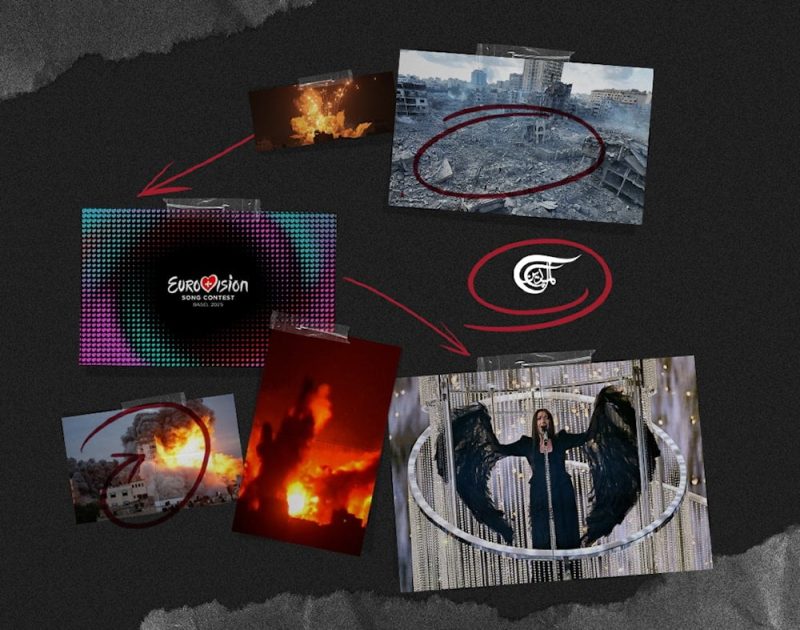
Eurovision: NATO Psychological Warfare Tool
By Kit Klarenberg | Al Mayadeen | May 24, 2025
The 2025 Eurovision Song Contest ended May 17th mired in controversy. The Zionist entity’s entrant, Yuval Raphael, finished second. Her performance, “New Day Will Rise”, received 297 points via public televote – the highest garnered by any act in the competition’s Grand Final, with 13 countries giving Raphael the maximum score of 12 points. This helped “Israel” almost clinch victory, despite coming last among participants in national jury votes. Immediately, state broadcasters across Europe demanded an investigation into flagrant, industrial scale rigging in “Israel’s” favour.
The Zionist entity’s participation in the Contest was the subject of much controversy in its leadup. On May 5th, 72 former Eurovision contestants – including previous winners – cosigned a letter to the European Broadcasting Union (EBU) demanding “Israel” and its national broadcaster be banned from the contest, over the country’s “genocide against the Palestinians in Gaza and the decades-long regime of apartheid and military occupation against the entire Palestinian people”. Their call was echoed by Spanish premier Pedro Sanchez.
Then, on May 19th, an EBU probe revealed the Israeli Government Advertising Agency conducted a vast, cross-platform online campaign to encourage support for Raphael’s entry. Detailed instructions on how to vote for her via text and phone in countries as far afield as Australia were widely circulated, along with a reminder that individuals could vote up to 20 times each. A dedicated YouTube channel – @Vote4NewDayWillRise – was launched to support the effort, garnering over 8.3 million views. Its videos were widely amplified across social media.
Separate investigations suggest Zionists could’ve further connived to fudge the Contest’s results via “VPNs, automated scripts (bot farms), and bulk SIM card purchases”. It is not the first time Tel Aviv has engaged in brazen fraud to skew Eurovision’s results in its favour. When “Israel” triumphed in the 2018 Contest, speculation widely abounded their victory resulted from meddling by now-defunct online Zionist astroturf effort Act.IL. On top of unambiguous voting irregularities, winning meant the 2019 Contest would be convened in “Israel”.
A June 2018 Knesset hearing spelled out this windfall’s strategic significance. Multiple Zionist entity lawmakers and ministers spoke of how “holding the Eurovision song contest in “Israel” is a gift” that could be exploited to boost and improve “Israel’s” international image, and counteract the burgeoning Boycott, Divestment and Sanctions movement’s successes. BDS had recently compelled Argentina to cancel a World Cup ‘friendly’ match with the entity, after Tel Aviv attempted to host the bout in illegally occupied al-Quds.
‘Opinion Leaders’
Similar Zionist entity-orchestrated social media and televote chicanery boosted “Israel” to fifth place in the 2024 Contest, which was likewise prefaced by widespread calls to bar Tel Aviv’s participation, and for other participating countries to boycott the event. While falling far short of victory, the public relations utility of “Israel’s” performance was abundantly clear. Entity officials, Western news outlets and pundits eagerly leaped upon the results as proof that despite the ongoing 21st century Holocaust in Gaza, a “silent majority” of Europeans still supported “Israel”.
At the time, journeyman Israeli government “public diplomacy” apparatchik David Saranga gushed to Ynet, “we knew that the situation was less serious than it is reflected in the demonstrations on the streets of Europe, but we did not expect such overwhelming support”. He added, “the fact that even countries where public opinion is critical of “Israel”, such as Sweden or Ireland, gave “Israel” a high score” indicated there were “underground currents” of pro-Zionist sentiment throughout the West.
However, Saranga also admitted the entity’s Foreign Ministry “acted among friendly audiences to increase voting”. Ynet subsequently detailed this effort, which included Tel Aviv’s entrant that year, Eden Golan, recording personal video addresses to foreign audiences in their own languages, referencing a supposed “wave of hatred” being whipped up against “Israel” by “Muslims”. Extensive analysis was conducted to ensure her message reached “Eurovision-loving audiences such as the LGBT community in Europe, members of fan clubs, journalists covering the contest and opinion leaders in the field.”
Following Yuval Raphael coming second this year, a familiar chorus erupted, with numerous prominent figures claiming her televoting preeminence was indicative of concealed Zionist sentiment the world over, and that ever-growing Palestine solidarity actions were not representative of wider public opinion. This is despite her performances being met with such intense booing, some European broadcasters resorted to piping in pre-recorded cheers and applause to drown out the mass jeering. Meanwhile, polls amply indicate the overwhelming majority of Europeans hold “unfavourable” views of Tel Aviv.
That the Zionist entity has so consistently invested enormous time, energy, and money into attempting to ‘game’ Eurovision over so many years is a testament to its redoubtable international propaganda potency. Up to 200 million people worldwide routinely tune in to the tournament every year, and Tel Aviv is not alone in seeking to weaponise the tournament for political reasons. In fact, Eurovision was secretly created as a psychological warfare tool by NATO to manipulate and control public opinion for this explicit purpose.
‘Psychological Action’
In January 2015, an extraordinary, hitherto secret document drawn up by NATO’s Committee on Information and Cultural Relations in March 1955 was published for the first time. It outlined the practical and ideological foundations of Eurovision, which was first convened next year, with just seven participants. A section of “aims” of the Contest states NATO’s objective was to “make the most” of TV, which “gives mankind at long last, the possibility, through the visual image, of conquering time and distance”, reaching vast global audiences simultaneously:
“Television has enabled sight to triumph over time and space, and this is the aspect which struck us most forcibly and led us to believe that it was our duty to break through the narrow boundaries which confined our programmes to spectators clustered around our respective capital cities, and to travel the world. There is no point in having a wonderful instrument in our hands if all we are going to do…is show the suburbs of Paris, London or Milan in France, England or Italy.”
The document went on to state “the thrill” of TV “lies in ranging as far afield as possible… [using] this marvellous instrument’s capacity for the instantaneous transmission of an event taking place elsewhere.” NATO contended “television transcends the frontiers of our European countries,” and thus the military alliance “held within [its] grasp a unique instrument for social and psychological action”. In sum, a “nervous system” of Europe could be constructed, “far more powerful than the telephone” or radio, to “animate the…general public.”
The document concludes with its author, Jean d’Arcy, then-senior director of French state broadcaster Radiodiffusion Française, expressing his sincere hope that the “social significance of Eurovision will become ever more apparent as it progresses along the lines which… it is destined to follow”. The file was a summary of remarks he made at a dedicated NATO conference “of senior information officials” in Paris two months earlier. His talk was described in a subsequent alliance newsletter as “most interesting”.
At that conference, Hastings Ismay, NATO’s first secretary general – who notoriously declared the alliance’s purpose was “to keep the Russians out, the Americans in, and the Germans down” across Europe – “reiterated his steadfast conviction of the importance of a profounder and more widespread understanding of NATO’s aims and achievements”. Eurovision provided an ideal opportunity to insidiously achieve those goals in a non-military context, propounding European unity and cultural superiority over the Soviet Union while the Cold War was in its infancy.
The collapse of Communism in Central and Eastern Europe, and the Soviet Union’s subsequent dissolution, vastly increased Eurovision’s pool of contestants. It was not until 1994 that Russia first appeared at the Contest. On February 25th 2022, one day after the Ukraine proxy war erupted, Moscow was banned from participating, which has remained in place ever since. In that year’s competition, Kiev prevailed, with The Kalush Orchestra’s song “Stefania” – interpreted in some quarters as an ode to Ukrainian ultranationalist mass-murderer Stepan Bandera – securing first place.
NATO deputy secretary general Mircea Geoana praised Ukraine’s victory and its “beautiful song”, linking Kiev’s triumph “to its bravery in fighting Russia”, and “immense public support all over Europe and Australia” for the proxy war. A Reuters report on Geoana’s comments commenced by declaring, “Eurovision and NATO might not usually be associated” – the international newswire’s writers apparently unaware that the military alliance was from inception, and remains, absolutely fundamental to the international tournament’s operation.
Canada’s PM Mark Carney Revives Online Censorship Agenda
By Dan Frieth | Reclaim The Net | May 23, 2025
Steven Guilbeault, once Canada’s Environment Minister is now poised to spearhead a different kind of oversight, this time, over what Canadians can see and share online.
In his new post as Minister of Canadian Identity and Culture, Guilbeault has been entrusted with executing Bill C-11, a contentious piece of legislation passed in 2023 that gives the federal government unprecedented power over online streaming platforms.
Celebrating the appointment, Guilbeault publicly thanked newly elected Prime Minister Mark Carney, expressing his intent to “build a stronger country, based on the values of Canadians.”
This shift in leadership places Guilbeault at the center of an ongoing battle over internet regulation. Bill C-11, which was rushed into law during Justin Trudeau’s final term as Prime Minister, obligates major tech companies to fund and prioritize Canadian content, particularly that of the mainstream media, regardless of whether users are seeking it.
While the Canadian Radio-television and Telecommunications Commission (CRTC) was initially expected to enforce the new requirements, it recently admitted that the regulatory framework won’t be ready until late 2025. That leaves platforms, creators, and consumers in limbo, uncertain about how deeply the government’s hand will extend into digital media.
Carney, seen as a political continuation of Trudeau’s legacy, appears ready to go even further. Before the most recent election, the Liberal Party was already moving to introduce Bill C-63, a so-called Online Harms Act.
While framed as a tool to protect minors from exploitation, the bill also includes expansive measures to monitor and penalize what it terms “hate speech.” This vague language has prompted concern from legal scholars and civil liberties organizations about the law’s potential to suppress legitimate expression.
With Guilbeault now steering Canada’s cultural and digital policies, free speech advocates worry the government is tightening its grip not only on environmental and economic life but on the very flow of information and dialogue in the digital sphere. What began as a push for national content promotion may ultimately serve as a model for broader censorship under the guise of cultural stewardship.
Indian Mass Delusion Syndrome on Full Display
What leads people to celebrate defeat as victory?
By Hua Bin | May 24, 2025
Since I wrote “the DeepSeek moment of modern air combat”, more details have come out about the battlefield outcome from the May 7 and 8 Pakistan India clash.
In addition to the 3 Rafales, 1 Su-30, 1 Mig-29 and 1 Heron UAV covered in my essay, Pakistan also shot down an Indian French-made Mirage 2000. Pakistan Air Force destroyed 2 batteries of the Russia-made S400 air defense system (the command center and one radar unit) with China-made CM400akg hypersonic land-attack missiles launched from JF-17, a fighter jet produced jointly with China.
Since this is the first truly high-tech large scale air combat in the 21st century and the first beyond-visual-range (BVR) air war, military experts and commentators are studying the battle in minute detail. I plan to write another short piece on the tech behind the Pakistan victory soon.
However, another aspect of the war has come to the forefront immediately after the war. That is the mass delusion indulged by the Indian government and press about the conflict. Rather than acknowledging its setback and reviewing its strategy, tactics and battlefield lessons, the Indians are trying to mask their defeat through outright fabrications and lies on a massive scale. It is going so far as to claim the clash an unqualified victory.
Indian government, its TV media (400+ channels), and social media are filled with made-up battlefield successes, destruction in Pakistan, and superiority of the Indian military. The wild claims include –
– No Indian aircrafts were lost and no damage to S400 (though wreckage of a Rafale jet was filmed with its tail number and two burial ceremonies were held for Indian soldiers operating S400 systems. Indian report said they were shot during border skirmishes, which defies any common sense)
– Indian air force shot down 8 Pakistan F-16 jets and 4 JF-17 fighters (no US-made F-16 even took off during the conflict as the US forbid Pakistan to use F-16 in conflicts with India)
– Karachi, the largest port city in Pakistan, was firebombed by Indian navy and one third of the city was destroyed (the footage shown on Indian TVs was later fact-checked to be Israeli’s bombing campaigns in Palestine)
– A coup d’etat happened in Pakistan and the army chief was arrested
– A retired Indian air force marshal claims the Chinese air force cannot use the China-made weapons as well as Pakistan so India has nothing to worry about a conflict with China
Right after the air war, the Indian government called in diplomatic staff from 70+ countries to announce its heroic victories; Modi went on a tour of the frontline and announced a 10-day national celebration. The Indian military was tasked to go on a national tour to share their battlefield successes with patriotic citizens.
When American and French officials confirmed some of the battlefield losses suffered by India, the Indian media, led by the famous BJP promoter and TV personality Palki Sharma, went into a frenzied attack on the inferiorities of US and European weaponry. They bombasted Trump for claiming to broach a ceasefire between the two belligerents. Their argument is India would have dealt an even bigger defeat to Pakistan without the ceasefire meddling.
To this day, most Indians are under the delusion that the Indian military has dealt Pakistan a deathly blow and emerged totally victorious and unscathed.
While shrill and high octane “news” reporting is par for the course in India, and BJP, under Modi, has long shaped and exploited wide-spread jingoistic Hindu nationalist fervour, the Bollywood-like mass delusion is over the top and probably without a parallel in military history.
It is interesting to explore what lies behind such mass hysteria that is completely divorced from reality and what this means for India and its population.
A quick AI search tells you the medical or psychological term for “self-fooling” is self-deception.
Self-deception refers to the process of misleading oneself to accept as true or valid what is false or invalid. It involves cognitive biases, denial, or rationalization to maintain certain beliefs or avoid uncomfortable truths.
While not a formal medical diagnosis, self-deception is studied in psychology and psychiatry as part of defense mechanisms (e.g., denial or repression) that protect the ego from anxiety or distress.
I think this perfectly captures the psychological reasons behind the wildly delusional Indian national mood and character.
Since BJP took power, Modi and his cronies have intentionally fostered a ultra-nationalistic narrative about India’s greatness and Hindu superiority.
– India has launched unprecedented repressions of Muslims and deprived the Kashmir region (a Muslim majority region) its long-held autonomous status.
– India has embraced the fantasy to replace China as the world’s manufacturing center and top economic growth engine by opportunistically aligning with the US and the west. At the same time, it is exploring the Russia-Ukraine war to enrich itself by selling Russian oil at inflated price to the west.
– India has boasted its economy has surpassed UK and France and will join the US and China in no time as the largest economies in the world while it is still behind Japan and Germany. To inflate its GDP, India has changed its GDP accounting method twice in the last 10 years and started to count cow dung as part of GDP as agricultural inputs. Grok estimates Indian GDP calculation included the value of cow dung and other manure at $4.7 billion in 2023.
– India has attempted to bolster its military by purchasing a hodge podge suite of brand-name weaponries from France, Russia, the US and Israel. India spent 7.8 billion Euros in 2015 to purchase 36 Rafale fighters, or 220 million Euros per jet, making it the most expensive fighter jet ever sold by that time. There was so much corruption by Modi’s cronies in the deal that Wikipedia has an entire entry dedicated to the controversy. Even after the corruption case was exposed, India decided to double down and spent anther $7.4 billion to buy 26 Rafale jets for its navy just this past April. That is a staggering price tag of $285 million per Rafale, a new world record.
This Pakistan India air war was initially intended by India to show off its new found muscle until it has its ass handed back by Pakistan.
Similarly, the Modi regime announced with big fanfare its Make In India campaign in 2015 to replace China as the world’s manufacturing powerhouse. It targeted manufacturing to reach 25% GDP by 2025. Instead, Indian manufacturing GDP was 13% by 2024, down from 17% in 2010. In contrast, according to CSIS, value-added industrial output accounted for nearly 40% China’s GDP (vs. 18% in the US). Given China’s GDP is 5 times of India, that means China’s manufacturing GDP alone is 2 times as big as India’s total GDP or 16 times India’s manufacturing output.
Another interesting statistic – in Paris 2024 Olympics, India won a grand total of 6 medals – 1 silver and 5 bronze, ranking 71st among the 84 countries with medal count. This is India’s third best medal haul after 2020 and 2012, according to Wikipedia. The world’s most populous country ranks between Lithuania (70th, population 2.8 million) and Moldova (72nd population 2.4 million). India’s Gold medal haul (0) was lower than Hong Kong (2). The US and China (ex. Hong Kong) each won 40 Gold medals, and 126 and 91 total medals respectively.
This wild gap between India’s self-perception (or should we say self-delusion) as a great power and the cold reality of its economic and social backwardness is the reason behind the mass delusion.
It’s a sad combination of inferiority complex and unfounded sense of grandeur.
There was a famous character called Ah Q in an early 20th century literature work in China. Ah Q is a loser but cannot accept his lowly station in life. So he goes around telling himself he is better than the other people around him, often saying “I was beaten by my bastard son” after losing a fight. In the end, he was framed for a robbery and sentenced to death. When he was signing his death warrant by drawing a circle (since he couldn’t write), he was more upset about the circle not drawn perfectly than the death sentence.
Indians didn’t succeed in copying China’s economic success. Instead, the Indians have fully adopted Ah Q’s delusional “spiritual victory” method of coping with failures and humiliations.
The Indian celebration of their imagined success perfectly reflects Ah Q’s delusional defiance when he tried to sing a heroic song on the road to his execution. He couldn’t sing with his wobbly voice at that point, instead weakly uttered a phrase commonly used by criminals before execution, ”In another 20 years, I shall be another stout young fellow”.
The Indian media obsession with spectacles mirror Ah Q’s morbid disappointment at the crowd at his execution – they were bored because he didn’t sing properly and lamented that he was shot instead of beheaded, denying them the “entertainment” of a decapitation .
India’s celebration of its defeat at the hand of Pakistan encapsulates Ah Q’s entire existence – a blend of farce and tragedy, where self-deception persists until the bullet ends his life.
On a higher level, the dishonest propaganda by the Indian government and media is an information war against its own population. Few foreigners believe the Indian official narrative. The Indian government and media has completely lost any credibility at this point. So the real target of the disinformation campaign is the Indian population itself.
A nation without basic intellectual honesty and suffering from cognitive dissonance will not rise. Instead it will be the butt of jokes by late night comedians.
In the so-called “largest democracy in the world” where the rule is one Rupiah one vote, Modi is resorting to the lowest level of “democratic” playbook – keep the population dumb and get their votes through lies.
How India-Pakistan war will affect global and regional political order
By Salman Rafi Sheikh – New Eastern Outlook – May 24, 2025
The recent India-Pakistan war, though limited in scope, has triggered significant geopolitical reverberations by showcasing Chinese military superiority and prompting a strategic reassessment in Washington.
The China angle in regional geopolitics
Beyond the oft-repeated rhetoric of the Pakistan-China relationship being “all-weather” and “iron-clad,” the recent India-Pakistan war may come to be seen as its first major demonstration in action. Pakistan’s use of Chinese PL-15 missiles, deployed from Chinese-made J-10C fighter jets to successfully engage French-made Rafale aircraft, has underscored the strategic depth of this partnership. This has received considerable international attention, both in the media and otherwise. This show of alignment is particularly notable given recent strains in the Pak-China bilateral relationship, including attacks on Chinese interests and infrastructure projects within Pakistan.
With Pakistan importing almost 80 per cent of its weapons—which also includes cooperation in the field of military technology—from Beijing, the supply ensured to help Islamabad maintain the balance of power vis-à-vis New Delhi. More than this, China’s policy was also motivated by its desire to counter-balance Washington’s efforts to boost India against China. Ironically enough, it was only days before the recent war that the US Vice-President was in India to discuss ways to collectively counter China. But China’s support for Pakistan meant that New Delhi remained preoccupied more with Pakistan than China in a strategic sense. With this war, New Delhi’s focus will be more on Islamabad than China for at least a few more years to come. By the same token, China will most likely continue to help Pakistan develop its defence capability. Even before the war took place, media reports in Pakistan and China reveled ongoing talks between Beijing and Islamabad for the sale and purchase of J-35 fifth-generation stealth fighter jets.
These developments highlight at least four key takeaways. First, China’s defense technology—likely tested in actual combat for the first time—has proven effective enough to attract interest from other regional powers. Its demonstrated performance could prompt these countries to purchase and integrate Chinese systems into their own militaries. This, in turn, would strengthen China’s position in the regional arms market and help it outcompete rival defense exporters. Second, China’s willingness to export advanced military technology—such as the PL-15 missile and J-35 fighter jets—signals a broader strategic intent to deepen its global partnerships. This approach is consistent with Beijing’s “no-limits” alliance with Moscow.
Third, the demonstrated effectiveness of Chinese weaponry against India could encourage regional states to reassess their foreign policy alignments, potentially fostering deeper integration with Beijing over New Delhi. This trend is already evident in countries like Sri Lanka and the Maldives, where pro-Beijing political shifts have gained momentum—most notably in the Maldives, where the new government compelled Indian troops to withdraw. Fourth, Pakistan’s military successes in this conflict challenge a common narrative in global discourse: that partnerships with China inevitably lead to economic “debt traps.” On the contrary, Pakistan’s economic ties with China appear to have laid the foundation for robust military-to-military cooperation, illustrating how economic integration can support broader strategic alignment.
India’s position in Washington’s arc
Can Washington still push—with enough confidence—India as its key ally? What is the material reality of India’s standing within the US-led Quadrilateral Security Dialogue (QUAD)? If the QUAD was ever to become a military alliance, the only power in the region that the US expected to be effective on its own against China is/was India—not only because India and China have a long history of rivalry, but also because India remains a big military power. Needless to say, it is the only nuclear power part of the QUAD from the Indo-Pacific region. In this sense, it can maintain deterrence vis-à-vis Beijing. But nuclear deterrence can prevent a nuclear war, as is evident from the recent India-Pakistan conflict. It cannot necessarily prevent conventional conflict. Can India act as the front-line ally for Washington in the region in a conventional war?
The outcome of India-Pakistan was means Washington will have to rethink its strategy. It can take two shapes. First, it is very much possible that Washington will deepen its cooperation with New Delhi. Donald Trump has already offered to sell F-35 fifth-generation stealth fighters. (Russia has also offered New Delhi to sell its own fifth-generation Su-57 jets.) This, however, will necessarily involve China deepening its cooperation with Pakistan. As a result, an arms race will be triggered in the region.
A second strategic path for Washington could involve renewed engagement with China. While the timing of the Trump administration’s trade negotiations with Beijing may coincide with the outcome of the India-Pakistan conflict purely by chance, it nonetheless suggests that even a confrontational administration has not entirely ruled out dialogue as a preferred tool. Washington might also pursue a dual-track approach—engaging China while simultaneously strengthening military alliances elsewhere.
However, in the wake of shifting dynamics following the India-Pakistan conflict, the US will likely need to reassess its regional strategy and consider alternatives to India. Japan, for instance, emerges as a strong candidate. With its recent push toward military normalization and a growing appetite for deeper strategic engagement, Tokyo could become a more prominent partner in Washington’s Indo-Pacific security architecture.
To be clear, this does not imply a fundamental rupture in US-India relations. But it is increasingly likely that Washington will place India’s role under careful review, potentially redefining its status as the principal frontline ally in countering China. In response to China’s growing influence and military reach, the US will need to significantly bolster the defense capabilities of other regional actors—most notably Japan and Australia—as part of a broader strategic recalibration.
Salman Rafi Sheikh, research analyst of International Relations and Pakistan’s foreign and domestic affairs
‘Sadistic pattern’ of genocide: UN condemns Israeli killing of Gaza doctor’s nine children
Press TV – May 24, 2025
UN Special Rapporteur Francesca Albanese has condemned Israel’s Friday airstrike on the home of Palestinian doctors Alaa and Hamdi Al-Najjar, which killed nine of their ten children.
Alaa Al-Najjar, a paediatrician at Nasser Hospital in Gaza, was on duty treating young patients when she learned nine of her children—aged 2 to 16—had been killed in an Israeli bombardment of their Khan Yunis home.
Rescue teams later retrieved the children’s bodies, eight of which were mutilated beyond recognition by the blast.
Commenting on a video published by Mads Gilbert, a Norwegian physician who volunteers in Palestine, Albanese said the attack represented a “distinguishable sadistic pattern of the new phase of the genocide”.
The attack reduced the family’s residence to rubble and ignited fires across the surrounding area.
Alaa’s husband and one surviving child sustained injuries in the attack.
Israeli military forces systematically target civilian families, medical facilities, and healthcare personnel as part of its ongoing Genocide in Gaza.
Muneer Alboursh, director general of the Palestinian health ministry in Gaza, says Israel has killed 12 health workers in the past week, many of them in targeted attacks on their homes.
He said Israel is “systematically” targeting medical staff and facilities, especially in the northern areas of Gaza, to destroy the health care system there and push people further south.
His remarks come days after Israel’s finance minister declared that the regime is now “finally” targeting what he called the “civilian structure of Hamas.”
Israel launched the campaign of genocide in Gaza on October 7, 2023. It has killed at least 53,800 Palestinians there so far, according to the health ministry of Gaza.
Crazy shopping in Tel Aviv
By Lorenzo Maria Pacini | Strategic Culture Foundation | May 23, 2025
If you are still wondering what Italy’s position is in the Israeli-Palestinian conflict, don’t worry: for the umpteenth time, Prime Minister Giorgia Meloni has reiterated that Italy stands with Israel, always, at any cost.
In front of an international court, such a statement would automatically be condemned as ‘complicity in genocide’, on a par with what was decreed in Nuremberg after the Second World War. However, since mere statements by politicians are not enough, evidence of this ‘participation’ in a crime against humanity must be provided. There are several pieces of evidence, including the recent shopping spree that the Italian government went on in Tel Aviv and the surrounding area.
While Israeli bombing continues in the Gaza Strip, Italy is preparing to purchase military technology to equip itself with a new fleet of reconnaissance aircraft. It should be noted that military cooperation between the two countries is not a new development, far from it. On 15 April, Defence Minister Guido Crosetto sent Parliament a draft ministerial decree (SMD 19/2024) aimed at the ‘gradual implementation of multi-mission multi-sensor (MMMS) operational suites on a shared Gulfstream G550 platform’. By 26 May, the Senate Defence Committee will have to give its opinion: it may approve, reject or request amendments to the measure. Meanwhile, on 6 May, the Chamber of Deputies’ Budget Committee gave the green light to the decree in just five minutes and without discussion. According to the Military Code, if the parliamentary committees express a negative opinion, the executive is obliged to refer the decree back to the Chambers accompanied by counter-arguments. If the negative opinion is confirmed by an absolute majority and justified by non-alignment with the Multi-Year Defence Programme, the programme cannot be implemented.
The measure represents the third phase of a long-term project to convert Gulfstream G550 civil jets (known as ‘green’ in military circles) into surveillance and intelligence aircraft, thanks to technology provided by Elta Systems Ltd, an Israeli company part of the Israel Aerospace Industries (IAI) group. The total value of the entire programme exceeds three billion euros. The first two phases have already been approved and implemented.
Elta Systems’ technologies, specialising in surveillance, electronic warfare and target identification, are used worldwide and supplied to regular armies and paramilitary forces. These same technologies are also widely used by the Israeli armed forces against the Palestinian people and other entities considered “enemies”. The link between Elta and the Israeli army is very close: many employees come from special units of the Israeli Defence Forces (IDF) or are still serving there.
In 2016, Italy received its first two G550 CAEW (Conformal Airborne Early Warning) aircraft from Israel, equipped by the company with advanced surveillance and command capabilities, currently operational at the 14th Wing in Pratica di Mare.
As part of a bilateral agreement, in addition to the spy planes, Italy also purchased the OPTSAT 3000 optical military satellite from Israel, while in exchange Tel Aviv bought thirty Alenia Aermacchi M-346 training jets from Italy, supplied by Leonardo Spa.
Decree SMD 3/2020 marked the start of the next phase of the programme: the purchase and conversion of eight more aircraft to Full Mission Capable (FMC) configuration, integrating CAEW capabilities with electronic warfare, interception and intelligence systems. Six civilian Gulfstream aircraft were purchased for conversion and two were already equipped for military use. Cost: €1.223 billion. The courier has already delivered the package to Pratica di Mare.
The 2020 decree explicitly refers to intergovernmental agreements (Gov to Gov) between Italy and Israel, the Memorandum of Understanding and agreements between Italian companies (primarily Leonardo), Israeli companies (Elta System) and US companies (L3 Harris), with the possibility of involving additional Israeli companies. If the deal is good, shopping works.
The next phase, SMD 37/2021, provided for the conversion of four of the six civilian aircraft already purchased into military aircraft. This part of the programme was also carried out using Elta technology, at an additional cost of €925 million.
The third and current phase of the project, defined in decree SMD 19/2024, has gone from an initial estimate of €994 million to an updated cost of €1.632 billion. It includes the military conversion of the last two civilian Gulfstreams, the purchase of an eleventh aircraft for testing and experimentation, and the construction of the ISTAR citadel in Pratica di Mare, equipped with hangars, operational facilities and satellite connection to support the fleet. As in previous decrees, this one also provides for intergovernmental cooperation based on existing schemes.
Business is business
Let’s face it: wars have always existed and the world cannot stop in the face of conflict. Nor can the commercial business that follows. This is the logic of the double game that Italy continues to play with Israel: arms sales behind the scenes, controversy over respect for international law in front of the cameras.
According to Italian law, the sale of arms to states involved in armed conflicts is prohibited. Israel falls into this category, which is why exports should be suspended. The law in question is No. 185 of 1990. Italy ranks third among the main suppliers of arms to Israel, with a share of 4.7%, behind the United States (65.6%) and Germany (29.7%). However, data from the Customs Agency (Agenzia delle Entrate, in italian) show that between December 2023 and January 2024, Italy exported arms and ammunition worth more than €2 million to Israel. The government justified this in 2024, specifying that the business of blood and destruction continues under old licences that were signed before 7 October 2023.
Nevertheless, considering the preliminary decision of the International Court of Justice on alleged violations of the Convention on the Prevention of Genocide and the request for an arrest warrant for Prime Minister Netanyahu, arms exports to Israel after 7 October could expose Italy to the risk of being held jointly responsible for violations of international law attributed to Israel.
This is the political rhetoric of Italy, which leads the way in relations with Israel for the whole of Europe, as the main commercial hub for the IMEC, the Cotton Road, which is multilateral in nature and represents, from the US point of view, an alternative to the Chinese ‘New Silk Road’. It should be remembered that the initiative was presented during the G20 summit held in New Delhi, India, on 10 September 2023. On that occasion, India, the United States (Biden administration), the European Union, France, Germany, Italy, Saudi Arabia and the United Arab Emirates signed a memorandum of understanding for the creation of an economic corridor linking India, the Middle East and Europe (IMEC).
The ambitious plan focuses on infrastructure development and has two main components: a railway line connecting Europe with the Gulf (involving the United Arab Emirates, Saudi Arabia, Israel and Jordan), and a maritime route connecting India with the Gulf region. The initiative is supported by the Partnership for Global Infrastructure and Investment (PGII), created by the G7 in 2022, and by the European Global Gateway program, which has earmarked up to €300 billion for investment in international infrastructure between 2021 and 2027.
For Italy, the initiative is also of strategic importance due to its geographical position between the Mediterranean and the Indo-Pacific, and it is from Israel and its ports that it will receive the goods that Israel will always need to build its business. It does not matter if this means perpetrating genocide, the important thing is that the economic interests of the two countries are protected. Capital wins over Man, the logic of interest prevails over that of humanity.
Featured Video
Yemen joins the war – Red Sea could be blocked next – Saudi regime at risk
or go to
Aletho News Archives – Video-Images
From the Archives
Should Europeans ‘Thank’ the Americans for Destroying Nord Stream?
By Robert Bridge | Strategic Culture Foundation | September 29, 2022
With an investigation continuing into the destruction of the Nord Stream gas pipeline that provided energy supplies to Europe from Russia, there appears to be just one prime suspect, and that should surprise nobody.
Following the sabotage of the Nord Stream 1 and 2 gas pipelines, former Polish Foreign Minister Radoslaw Sikorski already seemed to know the identity of the perpetrator when he tweeted out: “Thank you, USA.”
At first glance, it seemed that Sikorski was speaking sarcastically, berating Washington for carrying out an attack that will have severe repercussions for the people of Europe. After all, how could anyone see any good coming from the termination of Europe’s primary source of gas reserves with winter just around the corner? It was Sikorski’s homeland of Poland, after all, that urged its citizens to collect firewood in the face of dwindling gas reserves.
In fact, the Polish diplomat was speaking one-hundred percent literally… continue
Blog Roll
 Aletho News
- Iran denies responsibility for ‘depraved’ attack on Kuwait desalination plant
- Bring The Troops Back. End This War Now!
- Can we please stop calling Israel the ‘only democracy in the Middle East’ now?
- US should start removing its troops for Germany, proposes AfD co-leader Chrupalla
- Iran Red Crescent: 600 educational centers attacked in US-Israeli ‘war crimes’
- Russian Oil Tanker Arrives in Cuba Amid U.S. Blockade
- America Racing to Strategic Defeat in Iran: Lt Col Daniel Davis
- FTC Warns Visa, Mastercard, PayPal, Stripe Over Political Debanking
- Russian tanker approaches Cuba despite US oil blockade
- Marandi: Yemen joins the war – Red Sea could be blocked next – Saudi regime at risk
- If Americans Knew
- Israeli police block Catholic cardinal from entering Church of the Holy Sepulchre on Palm Sunday
- Israel is assassinating journalists again, more than any other nation, anywhere, ever – Not a ceasefire Day 170
- Over 300 US service members wounded, majority have brain injuries – Not a ceasefire Day 169
- Researchers at Human Rights Watch Resign Over Blocked Report on Palestinian Refugee Return
- Jewish Groups Are Backing a War Americans Don’t Want
- Eric Fingerhut Thinks He’s the President of the Jews
- Top Jewish Philanthropists, Rabbis Urge Israeli President to Take Action Against ‘Jewish Extremists’
- Don’t Be Fooled. Zionist Leaders Have Always Wanted to Control Southern Lebanon
- Israel’s widespread use of torture is a core element of its genocide against the Palestinian people
- In Israel’s War on Iran, Many Middle East US Bases Rendered “All But Uninhabitable”
- No Tricks Zone
- New Study Finds Warming Saves Lives…Cold Temperatures 12 Times More Deadly Than Excess Heat
- German Science Blog Accuses PIK Climate Institute Of Hallucinating Climate Tipping Points
- Devastating Assessment Of Comirnaty Vaccine By Former Senior Pfizer Europe Toxicologist
- New Study: CO2 Is ‘Effectively Negligible’ As An Explanatory Climate Change Factor Since 2000
- Former Pfizer Toxicologist Dr. Helmut Sterz Tells Bundestag Hearing Pfizer Vaccine Should Have Never Been Approved
- Energy Expert: Germany’s Nuclear Phaseout Was A “500 Billion Euro Mistake”
- New Research: South Australia’s Mid-Holocene Sea Surface Temperatures Were 4°C Warmer Than Today
- Storing Green Energy To Last Germany 10 Days Would Require A 60-Million Tonne Battery
- New Studies: UK Sea Levels Were 4 Meters Higher Than Today During The Mid-Holocene
- Destructive Green New Deal: German Energy And Metal Group Warns Of Drastic Crisis
 Aletho News
