IDF Mandates Pre-Approval for Reporting Missile Strikes, Including on Social Media and Online Platforms
By Cindy Harper | Reclaim The Net | June 18, 2025
A new set of censorship rules issued by the Israel Defense Forces is raising alarms over media freedom and public transparency.
Brigadier-General Kobi Mandelblit, Israel’s chief censor, declared on Wednesday a mandate requiring prior approval for any reporting on where missiles or drones have struck, no matter the platform or location of publication.
According to the statement, “any person who prints or publishes printed matter or a publication regarding the location of a strike or hit by enemy war materiel, including missiles of any kind and UAVs, in the media or online (including social media, blogs and chats, etc.)” must now submit that material to the military censor for approval before it is released.
This directive applies to both domestic and international reporting, online and offline.
Mandelblit emphasized that he is also banning “the printing or publishing of any publication that has not been submitted to the Censor, or which has been submitted to him and his instructions have yet to be received or have been received and not adhered to.”
Framing the move as a matter of national security, he stated that violating the order is “liable to severely harm the security of the state,” and warned that offenders will be charged, the Jerusalem Post reported.
The sweeping nature of the restrictions, especially in a digital era where information spreads rapidly across borders, places significant power in the hands of military authorities to control narratives and limit the public’s access to real-time facts.
The breadth of the order effectively criminalizes independent reporting on attacks unless pre-approved by the state.
Decoding Iran’s strategy in current war
By Amro Allan | Al Mayadeen | June 18, 2025
Iran’s Foreign Minister has made it clear in multiple statements that the Islamic Republic remains open to re-engaging the diplomatic track, provided that the US-Israeli aggression against the country comes to an end. At the same time, however, IRGC Commander Brigadier General Mohammad Pakpour has declared, “Even if the Israeli attacks stop, we will continue our mission to the end.” These seemingly contradictory positions raise a key question: What exactly is Iran’s objective in this confrontation, and how should its strategy be understood? More pressingly, what role is the United States playing on the battlefield?
Tehran understands that the ultimate goal of the current assault, launched in the early hours of June 13, is not simply aggressive, but existential. The US-Israeli axis seeks nothing less than the collapse of the Islamic Republic itself. According to most military analysts, neutralizing Iran’s nuclear programme through conventional means is well beyond the capabilities of the Israeli military. This is particularly true when it comes to heavily fortified enrichment facilities like Natanz and Fordow, which are among the most secure sites in the world against aerial and missile strikes.
To strike such hardened targets, advanced bunker-busting munitions would be required, arms that are exclusively in the hands of the US military. What’s more, the only aircraft capable of delivering these weapons—the B-2 stealth bomber—operates solely under the command of the United States Air Force. Some experts even question whether these bombs would be effective against Iran’s most deeply buried and reinforced sites.
Both Washington and Tel Aviv are fully aware of these limitations, which cast serious doubt on their publicly stated rationale for launching the war. This scepticism is only reinforced by Netanyahu’s early appeal, issued just hours after the attack, urging Iranians to rise up against their own government, a move that tacitly reveals the true aim of the aggression.
This level of strategic ambition has been absent from previous assaults on Iran. The assassination of Lieutenant General Qassem Soleimani, Commander of the IRGC Quds Force, in January 2020, “Israel’s” missile strike on the Iranian consulate in Damascus in April 2024, and the attack on an air defense site near Isfahan inside Iran later that month, none of these triggered the same level of overt intent to destabilise the Iranian state.
It is this shift in objective that explains Iran’s evolving response. Unlike past retaliatory actions, such as the missile strike on the Ain al-Assad US base in January 2020, or Operation True Promise 1 and 2 of April and October 2024, Iran’s current posture signals a long-term strategic engagement rather than a calibrated response.
Tehran does not appear eager to escalate the conflict into a regional war, fully aware that such a scenario could have catastrophic consequences not just for itself, but for the wider Middle East. Still, it is determined to impose a high cost on its adversaries, one that restores the balance of deterrence and redraws the lines of power in the region.
This approach was articulated clearly by Iranian Leader Sayyed Ali Khamenei, who warned, “We will not allow the Zionists to escape unscathed for this great crime. The Zionist entity has committed a grave miscalculation—one that will bring ruin upon them, by God’s grace.”
It is in this context that General Pakpour’s remarks must be understood. Iran’s continuation of Operation True Promise 3 is not dependent on whether “Israel” halts its attacks. Rather, it is driven by a broader aim: to establish new rules of engagement and a new balance of power, irrespective of short-term developments.
At the same time, the Foreign Minister’s comments point to Iran’s reluctance to turn this war into a fight for national survival, unless forced to do so by further escalation from the other side.
But “Israel’s” failure to cripple the Islamic Republic in its initial, high-stakes strike, an operation designed to fundamentally alter the regional power balance, makes direct American involvement more likely in the days ahead. Washington may now feel compelled to interfere in order to accomplish what Tel Aviv could not.
All this suggests that the risk of escalation remains high. The war could soon expand to include oil infrastructure across the Gulf and target US military bases scattered throughout the region.
This leaves a crucial question hanging in the balance: Will key regional powers, Egypt, Turkey, Algeria, and Pakistan, recognize the gravity of what is unfolding? And will they act accordingly, acknowledging that the war being waged by the US-Israeli alliance poses a serious threat to their own security, sovereignty, and future stability?
Pentagon removes joint staff officer over anti-‘Israel’ posts
Al Mayadeen | June 18, 2025
The Pentagon has removed Colonel Nathan McCormack, a senior planner responsible for the Levant and Egypt region at the Joint Chiefs of Staff’s J5 planning directorate, from his position, pending an internal investigation into social media posts deemed anti-“Israel”.
The move follows a report by the Jewish News Syndicate (JNS), which pointed out that McCormack had operated a semi-anonymous public social media account containing posts critical of the Israeli occupation, including remarks about Israeli Prime Minister Benjamin Netanyahu and pro-“Israel” activism in the United States.
A Pentagon official told JNS that the Joint Staff is “aware of the situation” and has initiated a formal review.
“He will no longer be on the joint staff while the matter is being investigated,” the official stated. McCormack is being returned to his service branch, a step often taken when a service member is reassigned during a personnel inquiry.
The official added, “The information on the X account does not reflect the position of the Joint Staff or the Department of Defense.”
The case is indicative of the interplay between pro-“Israel” media outlets and decision-making circles in the US, where criticism of “Israel” or even Israeli officials is quickly silenced and censored.
Controversial posts draw scrutiny from defense officials
The social media account, which has since been disabled, reportedly contained archived posts referring to Netanyahu and his “Judeo-supremacist cronies,” as well as statements suggesting that US foreign policy has been compromised by unconditional support for the Israeli occupation.
Other posts questioned the loyalty of American pro-“Israel” advocates, claiming they prioritize support for “Israel” over US strategic interests.
A Defense Department contractor who interacted with McCormack told JNS that the posts were “dangerous” given the officer’s rank and influence.
“This is the kind of bitter oversharing I’d expect from someone who doesn’t know better,” the contractor said. “But at his level and under his own name and likeness? It’s mind-boggling.”
The Pentagon emphasized that McCormack’s personal commentary does not represent official policy. “Our global alliances and partnerships are vital to our national security, enhancing our collective defense, deterrence, and operational reach,” the official added.
An investigating officer has been assigned to review the material and determine whether McCormack violated military conduct or security policies.
Israel Would Have No Qualms About USS Liberty-Style FALSE FLAG If Iran Campaign Falters – Analysts
By Ilya Tsukanov – Sputnik – 18.06.2025
Donald Trump is mulling whether or not to join Israel’s aggression against Iran as Tel Aviv faces problems sustaining its defenses against growing counterstrikes, and apparently lacks a realistic game plan for an end to hostilities after failing to achieve its goals. Analysts told Sputnik how the US could be ‘nudged’ into the conflict.
“The US is already assisting Israel with supplies, intel, refueling support, etc. One of the many US posts in the region could be attacked for a casus belli,” former Pentagon analyst Karen Kwiatkowski explained.
“If Trump doesn’t comply with Israel’s demand” and join its aggression voluntarily, “a false flag may be needed” to drag the US in, Kwiatkowski, retired US Air Force Lt. Col.-turned Iraq War whistleblower, fears.
Netanyahu has a diverse array of options at his disposal, according to the observer, including:
- a false flag against US assets abroad blamed on Iran or one of its Axis of Resistance allies, like the Houthis
- a US domestic attack or assassination blamed on Iran
- Iranian air defenses ‘accidentally’ hitting a civilian jetliner carrying Americans
- use of a dirty bomb or nuclear contamination somewhere in the region blamed on Iran
- even blackmailing by threatening to use nukes against Iran if the US doesn’t join the fight
Kwiatkowski estimates that Israel probably has “enough blackmail power” against President Trump and Congress to avoid the necessity of a false flag operation, but a “USS Liberty-style” attack, targeting the soon-to-be-retired USS Nimitz supercarrier that’s heading to the Middle East, for example, nevertheless cannot be ruled out entirely, she says.
Beirut-based geopolitics analyst Yeghia Tashjian agrees, emphasizing that Israel “has limited capabilities when it comes to destroying Iran’s nuclear infrastructure” (the stated goal of Operation Rising Lion), “especially the underground nuclear facilities.”
The same holds true for Israel’s lack of ability to independently deploy boots on the ground in Iran, which means no chance of “overwhelming victory” even if events go their way in the ongoing back and forth strikes.
Possible scenarios for a false flag imagined by Tashjian include “attacking US bases in Iraq…or a terror attack against US embassies in the region.”
Middle East in Crisis – 3
Trump orders ‘unconditional surrender’ by Iran. Who’s listening?
By M. K. BHADRAKUMAR | Indian Punchline | June 18, 2025
Israel’s blitzkrieg against Iran five days ago is failing spectacularly. The Russian media reported that: i) Israel’s Rafael weapons complex has been destroyed; ii) Haifa oil refinery is in flames; iii) the Iron Dome has been breached; iv) and, Israel’s air dominance is a figment of imagination.
On Tuesday, Iran fired cruise missiles for the first time against Israel. Another wave of Iranian missile and drone attack targeted the Nevatim Airbase in southern Israel, where stealth fighter jets, transport aircraft, tanker aircraft and machines for electronic reconnaissance/surveillance, etc. are stationed.
Some Iranian reports claim that “plumes of smoke were rising from areas near the Dimona nuclear facility,” where an estimated 90 Israeli nuclear warheads are stored. If true, this must be highly embarrassing for Israel which has been maintaining a policy of deliberate ambiguity in regard to its nuclear capabilities as well as for President Donald Trump who is constantly hectoring Iran while turning a blind eye on Israel’s clandestine nuclear weapon stockpiles right under his nose — apart from exposing the IAEA.
According to the independent Stockholm International Peace Research Institute, Israel’s nuclear warheads are capable of being delivered anywhere within a maximum radius of 4,500 km by its F-15, F-161, and F-35I “Adir” aircraft, its 50 land-based Jericho II and III missiles, and by about 20 Popeye Turbo cruise missiles, launched from submarines.
Suffice to say, rational minds among the Israeli elite feel worried. Typically, Danny Yatom, former head of Mossad, is quoted as saying, “Iranians will not kneel; they will not raise the flag of surrender and they will not give in!”
The American broadcast television network NBC has reported that Israel asked Iran, through western mediators, to stop its retaliatory attacks and return to nuclear negotiations. This would probably explain Trump’s bombastic post on Sunday in Truth Social that Israel and Iran will end their violent conflict by “making a deal” through his mediation. Trump wrote, ”We will have peace, soon, between Israel and Iran. Many calls and meetings now taking place.” He even drew the analogy of his success in brokering peace between India and Pakistan recently.
However, the realisation may have since dawned on Trump that Iranians will not forget or forgive the assassinations of their military commanders or the destruction and loss of life of dozens of civilians in the Israeli Blitzkrieg, which targeted Iran’s nuclear facilities, military infrastructure, and residential buildings in Tehran and other cities.
Trump has a major decision to take in coming days as regards the next move — specifically, how to rescue Israel from the attritional war that lies ahead. Pressure for US military intervention is mounting. Trump is obligated one way or another to all three segments of the Israel Lobby — Zionists, evangelical Christians and wealthy Jewish elites who are kingmakers in American politics.
The pendulum is wildly swinging in Trump’s mercurial mind. He was in an irritable mood at the G-7 summit in Canada on Monday, cut short his trip and picked a nasty public quarrel with French President Emmanuel Macron for simply commenting that Trump hurried back to wrap up a ceasefire.
Trump wrote angrily, “Publicity seeking President Emmanuel Macron, of France, mistakenly said that I left the G7 Summit, in Canada, to go back to D.C. to work on a “cease fire” between Israel and Iran. Wrong! He has no idea why I am now on my way to Washington, but it certainly has nothing to do with a Cease Fire. Much bigger than that. Whether purposely or not, Emmanuel always gets it wrong. Stay Tuned!”
Four hours later, he clarified, “I have not reached out to Iran for “Peace Talks” in any way, shape, or form. This is just more HIGHLY FABRICATED, FAKE NEWS! If they want to talk, they know how to reach me. They should have taken the deal that was on the table — Would have saved a lot of lives!!!”
Seven hours later, Trump claimed, “We now have complete and total control of the skies over Iran. Iran had good sky trackers and other defensive equipment, and plenty of it, but it doesn’t compare to American made, conceived, and manufactured “stuff.” Nobody does it better than the good ol’ USA.”
But a few minutes later, Trump threatened Iran’s Supreme Leader Ayatollah Ali Khamenei: “We know exactly where the so-called “Supreme Leader” is hiding. He is an easy target, but is safe there — We are not going to take him out (kill!), at least not for now. But we don’t want missiles shot at civilians, or American soldiers. Our patience is wearing thin. Thank you for your attention to this matter!”
Seven minutes later, another nasty post followed in capital letters: “UNCONDITIONAL SURRENDER!”
That was 9 hours ago. Presumably, Trump wound up Tuesday by ordering Iran to crawl on its knees. The chances of Iran obliging him are zero. In fact, the Chairman of the Chiefs of Staff of Iran’s Armed Forces Major General Abdolrahim Mousavi said on Tuesday that the operations carried out so far have served as a deterrent warning, and the actual “punitive operations” are set to begin soon. The general asked the inhabitants of Tel Aviv and Haifa “to leave these areas for the sake of their lives.”
In fact, an Iranian commentary underscored yesterday that “Israeli strikes on Iran’s energy infrastructure and southern ports near the Persian Gulf could shift the nature of the conflict dramatically… This is precisely what Iran identifies as its strategic red line.”
The commentary continues: “What we’re witnessing is a multi-level hybrid conflict, a complex puzzle involving direct warfare, proxy engagement, diplomatic pressure, and a simmering “cold peace”—all unfolding at once… But such a scenario is unsustainable, as Israel… knows it cannot endure a prolonged high-intensity conflict.
The commentary estimates that a ceasefire “would likely be a tense calm or a “cold peace” rather than true stability.” Because, “What’s emerging now is a fluid and brutal new balance of power… The Persian Gulf, Israel, the Axis of Resistance, and the global energy market are no longer separate arenas—but interconnected pieces in a simultaneous, high-stakes game.” (here)
The great dilemma for Trump is that there’s no quick fix solution in sight. On his way back to the US yesterday evening, Trump said he wanted a “real end” to the conflict and that he was “not too much in a mood to negotiate.” German Chancellor Friedrich Merz also noted that Trump was indeed considering that option. The US is rapidly building up its forces in the Gulf region.
However, US intervention may trigger a continental war that will outlive Trump’s presidency and destroy his presidency, as Bush’s 2003 Iraq invasion destroyed his. And Trump might as well forget about America First, MAGA, Ukraine, Taiwan, tariff wars, immigration, inflation, China, etc.
Even European allies won’t stand by Trump. Macron told reporters on the sidelines of the G7 summit after Trump’s departure, “The biggest mistake today would be to try to do a regime change in Iran through military means because that would lead to chaos.” Macron warned that “no one can say what comes next…We never support actions of regional de-stabilisation.”
Do not forget that the skeptics include Vice President JD Vance also, whose suspicion of foreign entanglements had its origins in his time as a US Marine in Iraq, where he became disillusioned with America’s interventionist regime change projects and ill-fated ‘forever wars’ in the region.
Israel’s Strategic Miscalculation and the Dawn of a New World Order
By Peiman Salehi – New Eastern Outlook – June 18, 2025
In June 2025, the world witnessed the outbreak of a full-scale war between the Islamic Republic of Iran and the Zionist regime of Israel. This conflict, extending far beyond the military sphere, is reshaping political, media, and geopolitical landscapes. At the onset of hostilities, Israel initiated a surprise operation targeting several high-ranking Iranian military commanders and scientists. Tel Aviv saw this act as a significant achievement, anticipating it would plunge Iran into psychological disarray and delay its response.
Yet, this assumption proved gravely flawed. The Islamic Republic swiftly recovered and, within days, launched a series of unprecedented strikes on key Israeli cities such as Haifa and Tel Aviv. The extent of the damage inflicted on strategic infrastructure suggested a deep disruption in the psychological and political equilibrium, signaling a fundamental shift in the rules of engagement. As the conflict escalated, Prime Minister Benjamin Netanyahu made concerted efforts to draw the United States into the fray. Donald Trump, who initially reacted with sarcasm to the news of Iranian casualties, soon reversed his tone, presenting himself as a mediator. This rhetorical pivot reflects not a genuine desire for peace, but rather concern over the conflict’s expanding consequences.
From Tehran’s perspective, the war is not simply a reactionary campaign, but a calculated effort to alter the regional balance of power. Iran’s approach indicates a strategic vision aimed at redefining the security architecture of West Asia. Analysts now grapple with a pivotal question: will the war remain confined to regional boundaries, or evolve into a broader global confrontation? The varying positions of nuclear powers from East and West point to emerging global realignments. Nations like Pakistan, India, China, and Russia view the crisis through their distinct strategic lenses.
Meanwhile, the geopolitical relevance of choke points such as the Strait of Hormuz and Bab al-Mandab has resurged, underlining their significance to global trade and international stability. This war increasingly appears to be a confrontation between two competing visions of world order. The liberal, US-centric model—characterized by interventionism, hegemonic ambitions, and asymmetric power structures—is facing unprecedented resistance. In its place, a multipolar order championed by emerging powers is gaining traction.
If this moment is seized wisely by independent states and resistance movements, it could mark a turning point in contemporary political history. The world, once declared to have reached the “end of history,” is now experiencing the return of history, fueled by the renewed agency of sovereign nations.
Ultimately, to counter imperial interventions and dismantle imposed global frameworks, this war must be understood not merely as an isolated event, but as a transformative juncture in international relations. Resistance today is not limited to a regional force—it is a global discourse that challenges domination. The choice between submission and resistance is no longer Iran’s alone; it is one that history must now resolve.
Trump faces MAGA rift over possible US role in war on Iran
Al Mayadeen | June 18, 2025
A sharp divide is emerging within Donald Trump’s MAGA base over the war on Iran, with some of the president’s most vocal allies, Rep. Marjorie Taylor Greene, commentator Tucker Carlson, and Turning Point USA founder Charlie Kirk, openly questioning whether he is abandoning his “America First” foreign policy.
Following a week of deadly strikes and Trump’s abrupt departure from the G7 summit in Canada, these conservative voices are warning that a deeper US role in the Middle East could fracture the coalition that helped propel Trump to power.
Trump, who has long campaigned on non-interventionism, is now facing backlash from within his movement.
On X, Charlie Kirk wrote, “No issue currently divides the right as much as foreign policy,” adding that he feared a “massive split among MAGA” could disrupt their progress. He and others warned that any perception of Trump backing US military involvement could unravel his core message and political future.
Trump flew back to Washington unexpectedly this week amid rising tensions, and issued a dramatic social media warning, “Everyone should immediately evacuate Tehran!” claiming the US knows the location of Iran’s Leader Sayyed Khamenei, but does not intend to target him, “for now.”
These remarks have reignited speculation that Trump may support direct US military action, such as supplying “Israel” with bunker-buster bombs to target Iranian nuclear facilities. However, the State Department and US military have already ordered the voluntary evacuation of nonessential personnel from select diplomatic sites in the region.
Meanwhile, Senator Lindsey Graham is urging Trump to go further. “If that means providing bombs, provide bombs. If that means flying with Israel, fly with Israel,” Graham said on Face the Nation, arguing that now is the moment for Trump to help eliminate Iran’s nuclear program.
MAGA figures accuse Trump of breaking his anti-war promise
Trump’s consideration of a broader US role is facing strong resistance from the same voices who once championed him as a disruptive force in US foreign policy.
Tucker Carlson, long a loyal supporter, warned that Trump is veering dangerously close to betraying the voters who backed him for staying out of foreign wars. “You’re not going to convince me that the Iranian people are my enemy,” Carlson said on Steve Bannon’s War Room podcast.
Carlson also aimed at pro-Trump media allies like Sean Hannity, challenging them to hold Trump accountable for his foreign policy stance. Trump responded to the criticism by calling Carlson “kooky” and reiterating that “IRAN CAN NOT HAVE A NUCLEAR WEAPON!”
Furthermore, Rep. Marjorie Taylor Greene sided with Carlson, saying she shared his anti-interventionist principles. She posted, “Foreign wars, intervention, and regime change put America last, kill innocent people, make us broke, and lead to our destruction,” adding that “That’s not kooky. That’s what millions of Americans voted for.”
Kirk: MAGA youth voted for peace, not another war
Charlie Kirk, while still supportive of Trump, has echoed concerns about mission drift, noting that younger Trump voters were especially drawn to his record of avoiding new wars. “This is the moment that President Trump was elected for,” Kirk said on Fox News. But later added: “There is historically little support for America to be actively engaged in yet another offensive war in the Middle East.”
He continued, “The last thing America needs right now is a new war…Our number one desire must be peace, as quickly as possible.”
In a similar event, in April, some MAGA-aligned podcasters expressed doubts about looming tariffs and market disruptions. Earlier, Trump criticized Biden’s decision to let Ukraine use US long-range weapons but stopped short of advocating a full aid cutoff, another move that drew rebukes from his isolationist flank.
While these disputes have not derailed Trump’s base, the war on Iran marks one of the clearest tests of whether his coalition can stay united if he edges closer to military engagement abroad
Israel’s Hidden Front: How Israel’s Military Embeds Itself Among ‘Civilians’
Quds News Network | June 14, 2025
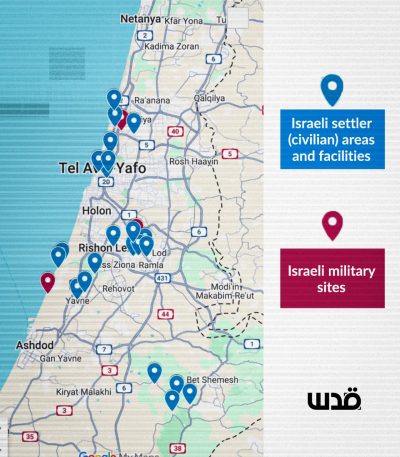 As Iran responds to Israeli attacks, Israel has begun publishing photos and videos showing what it claims are civilian casualties. However, many of Israel’s key military command centers and bases are embedded inside or beside densely populated civilian areas, raising serious concerns about the use of human shields.
Israel has long accused the Palestinian resistance of using civilians as human shields. But a closer look at its own military infrastructure tells a different story. From Tel Aviv to Be’er Sheva, Israeli army bases, intelligence centers, and military leaders are embedded deep within cities and residential neighborhoods, protected not by concrete walls, but by Israeli flesh and blood.
At the heart of Tel Aviv lies HaKirya, Israel’s central military headquarters. It’s just a few steps away from the bustling Azrieli Center, Ichilov Hospital, residential towers, and the HaShalom train station. The commander-in-chief’s office sits only 450 meters from hospital patients. This proximity is not incidental. It’s strategic.
Across the country, similar patterns appear.
In Ramat Gan, the Sheba Medical Center neighbors the Tel Hashomer military base. In Haifa, the Israeli navy base is hidden behind the Rambam Medical Center, a civilian hospital. Even Israel’s alleged nuclear capabilities, reportedly housed in Sdot Micha Base, are surrounded by quiet rural communities near Beit Shemesh.
Civilians as a Human Shield Strategy
This overlap is not limited to infrastructure. Israel’s leadership, too, shelters in residential zones.
Prime Minister Benjamin Netanyahu resides in Jerusalem’s Talbieh neighborhood, surrounded by settlers. The defense minister lives in Moshav Kfar Ahim and the Israeli military chief of staff in Hod Hasharon. All are Israeli ‘civilian’ areas.
This practice isn’t new. It’s systematic.
The Israeli settlement enterprise in the West Bank mirrors the same approach. Entire communities of settlers, including women and children, are placed deep inside conflict zones. They are the frontline of a colonial project. When violence erupts, these ‘civilians’ become both the shield and the justification for further expansion.
Meanwhile, military rabbis, settlement leaders, and ideological figures operate among the settlers, posing as spiritual guides. They shape policy and drive confrontation but deny responsibility when blood is spilled.
Military Bases in Plain Sight
Even advanced cyber warfare hides in plain sight. The Glilot base, reportedly home to Unit 8200, Israel’s elite surveillance unit, is just 2 kilometers from northern Tel Aviv’s residential zones. This site has been flagged by Hezbollah and other groups for its proximity to civilians.
The Palmachim Airbase, responsible for drone operations and missile testing, lies just 10–12 kilometers from densely populated areas like Yavne and Greater Tel Aviv. The base shares airspace with commercial zones, a fact that Israel rarely acknowledges.
This civil-military fusion is not an accident. It’s a strategy.
On the surface, Israel tries to project an illusion of normal life: soldiers stationed beside shopping malls, military towers rising over playgrounds, officers living quietly among schoolchildren. But this is no coincidence. It is the architecture of a colonial project; one where the line between soldier and settler is deliberately blurred. Israeli ‘civilians’ are not just bystanders; they are often active participants or enablers of a violent military apparatus. From settlement expansion to surveillance networks and military conscription, every layer of society is embedded in the machinery of occupation and war.
While Israeli officials accuse Palestinian fighters of operating from urban areas, their own army commands from skyscrapers, hospitals, and suburban homes. They accuse Gaza’s defenders of hiding among civilians, yet embed their own war machines in the heart of Tel Aviv.
Israel’s military-industrial complex does not merely exist beside civilian life; it consumes and shields itself with it.
The clock is ticking down to ‘Israel’s’ capitulation
By Samuel Geddes | Al Mayadeen | June 18, 2025
Netanyahu has put “Israel” in an impossible position that it cannot sustain, even with indefinite American re-supply.
It has taken Iran less than three days to fully absorb the blows struck in “Israel’s” surprise offensive against its military and nuclear infrastructure. With its balance restored, it has gone on the offense to reestablish the deterrence that collapsed over the course of the last two years.
Among the Israeli public and political elites, the initial euphoria over their fleeting successes is already giving way to a terrible realization. They are in a direct war, for the first time in 50 years, with a state that can continue the current levels of hostilities for far longer than they can.
Even the regime’s much gloated-over missile defense systems, the Iron Dome, David’s Sling, and Arrow, began to fail with the first barrage of Iranian missiles, which inflicted unprecedented destruction in the heart of Tel Aviv. While still intercepting most of the projectiles fired, at least according to “Israel”, the rate of depletion of interceptor missiles is exponential. At best, Tel-Aviv can sustain acceptable interception levels for a matter of weeks. This while Tehran has yet to unleash the most powerful missiles in its arsenal.
As of day four of this war, the critical power plant in the Haifa Bay area has already been struck, with the effects on operations at its largest port and northern power grid being immediate and only compounding by the hour.
The distinct focus of media coverage on the destruction in urban areas and against economic targets is hiding, but only barely, the true extent of losses inflicted on critical military infrastructure. Army and air-force bases, weapons and fuel depots, and of course “Israel’s” nuclear facilities, remain cloaked by official military censorship.
Given the rate at which the regime is burning through its interceptor munitions, it will very soon face the reality of having to ration them, limiting their use to the defense of vital military targets, and leaving the country’s urban and economic fabric utterly exposed.
Repeated hits on the Haifa plant, or similar facilities like Orot Rabin, Rutenberg, or Eshkol, will bring down the civil power grid entirely, halting everything from weapons manufacturing to water desalination. As the missile shield depletes, airbases will be rendered inoperable (if they aren’t already) and the Israeli regime’s most potent weapon, the air force, will be unable to continue operating.
While Tel-Aviv does have its US patron to replenish its stocks, even this will not restore its capabilities to their initial level. The production of interceptors such as the Tamir and Stunner missiles is limited, even in the US, to the low thousands per year. Resupply is probable, if not inevitable, but it will be of limited use when the regime must expend thousands of such rockets per week simply to prevent nationwide devastation.
Elite opinion has begun to recognize this fact. Netanyahu’s senior security advisor, Tzachi Hanegbi, has publicly noted that Tehran’s inventory of mid-to-long-range ballistic missiles is far deeper than was initially estimated. As the relative cost of successful strikes declines (fewer missiles can be fired at once with more evading interception), this allows the Iranians to sustain the current tempo of operations for months, if not longer.
Under current conditions alone, the countdown to “Israel’s” societal, economic, and military collapse can be measured in weeks, not months. The only variable that would extract Tel Aviv from the trap it laid for itself is active US involvement. Though this remains frighteningly possible, the combination of domestic opposition and the prospect of a ferocious energy-driven inflation shock makes this less appealing with each passing day.
Ultimately, absent a full-scale American war on the Islamic Republic, Netanyahu has set up his regime and himself for a historic humiliation. The ceasefire likely to end this conflict will be imposed on terms dictated by Tehran, which could include everything from the definitive end of the Gaza genocide, UN scrutiny of Israeli nuclear weapons, to large-scale sanctions relief and abolition of the snap-back mechanism expected later in the year.
Iran has undoubtedly suffered serious blows at the outset, but that was the extent of what “Israel” was capable of. The pace of events is now dictated by Ayatollah Khamenei more than anyone else, and he has at last been presented the opportunity to shatter Israeli pretensions of being the region’s “superpower.”
Iran warns of firm response if US directly joins Israeli strikes
Al Mayadeen | June 18, 2025
Iran’s ambassador to the United Nations in Geneva warned on Wednesday that Tehran would respond firmly to any direct US involvement in the Israeli occupation’s war on Iran.
The remarks follow days of escalating strikes between Iran and “Israel”, and come amid rising fears of a broader regional war.
Ali Bahreini, Iran’s UN envoy in Geneva, said Tehran considers the United States “complicit in what Israel is doing.”
He added that Iran has already conveyed a clear message to Washington: if the US crosses a red line by engaging directly in the conflict, Iran will respond decisively. He did not specify what exact actions would trigger a military response.
The ambassador’s warning comes as the Israeli occupation intensifies its air campaign, which began last Friday.
Israeli officials claim Iran was nearing nuclear weapon capability, an accusation Tehran has strongly denied. Iran insists its nuclear program is peaceful and within international legal bounds.
While the United States has not launched strikes of its own, it has taken indirect military steps to support “Israel,” including assisting in intercepting missiles and deploying additional fighter aircraft to the region.
According to three US officials cited by Reuters, some warplanes are being kept on extended duty in West Asia as tensions rise.
Trump demands Iran’s ‘unconditional surrender’ amid tensions
US President Donald Trump escalated rhetoric on Tuesday, calling for Iran’s “unconditional surrender” in a post that Tehran interpreted as a threat. Ambassador Bahreini denounced Trump’s statement as “completely unwarranted and very hostile.”
“We cannot ignore them. We are vigilant about what Trump is saying. We will put it in our calculations and assessments,” Bahreini added, suggesting that such statements would factor into Iran’s strategic decisions moving forward.
Reiterating Iran’s defensive posture, Bahreini stated, “I am confident that (Iran’s military) will react strongly, proportionally, and appropriately.” He emphasized that Tehran is closely monitoring the depth of US involvement and will react when it deems necessary.
Though the current US support for “Israel” has been limited to indirect military aid, Iranian leadership views this as part of a broader pattern of Washington’s alignment with Israeli policies. The possibility of direct US involvement remains a red line for Iran.
The rapidly worsening conflict has led to mounting international concern, with analysts warning that any direct US military action could provoke a severe regional escalation.
Khamenei: Iran stands firmly against imposed war; US intervention to cause ‘irreparable damage’
Press TV – June 18, 2025
Leader of the Islamic Revolution, Ayatollah Seyyed Ali Khamenei, in a message on Wednesday, said the Iranian nation will “firmly stand against” an imposed war.
In a televised message, amid the continued Israeli aggression against the Islamic Republic of Iran, Ayatollah Khamenei said the Iranian nation will never surrender to “any form of imposition.”
In the wake of continued Israeli aggression against the Islamic Republic, the Leader of the Islamic Revolution commended the Iranian people for their “composed, courageous, and timely” conduct.
He said the brave response of people reflected the nation’s growing maturity, as well as its spiritual and intellectual strength.
“The Iranian nation will firmly stand against an imposed war, just as it will resolutely resist an imposed peace,” he said in a televised message.
“This is a nation that will never surrender to any form of imposition.”
Referring to the recent war-mongering rhetoric of US President Donald Trump, Ayatollah Khamenei warned against any American military intervention.
“Those with wisdom, who truly understand Iran, its people, and its long history, never speak to this nation with the language of threats. Iran will not yield,” he asserted.
“The Americans must understand—any US military incursion will undoubtedly lead to irreversible consequences.”
Leader’s latest message came as the Israeli-imposed war against the Iranian nation entered its sixth day on Wednesday. The unprovoked war was launched on Friday. leading to the assassination of many senior-ranking military commanders, nuclear scientists and civilians.
The wanton aggression has only continued and escalated in the past five days.
Iranian retaliatory operation, dubbed ‘True Promise III’, was launched on Friday evening, targeting numerous strategic and sensitive military intelligence targets of the Israeli regime.
The eleven phases of the operation have caused heavy blows to the regime, and instilled a sense of fear among settlers who have been hiding in underground tunnels.
On Tuesday, Trump again resorted to saber-rattling against Iran, accusing it of pursuing nuclear weapons. Iranian officials maintain that the country is not in the race for nuclear arms but stands ready to defend the territorial integrity and sovereignty of the Islamic Republic.
Former Israeli commander warns against war of attrition with Iran
Al Mayadeen | June 18, 2025
Israeli Reserve Major General Israel Ziv, former head of the Israeli occupation military’s Operations Division, warned on Wednesday that “Israel” has nearly exhausted its capacity to carry out direct strikes against Iran’s nuclear facilities without US involvement.
He stressed that dismantling Iran’s nuclear program completely would require deeper, more effective measures that go beyond current military capabilities.
Writing for the Israeli Channel 12 website, Ziv cautioned that “Israel’s” current efforts, even if they achieve 60%, fall short of Iran’s determination to obtain a nuclear weapon at any cost. He added that if the situation remains unchanged, Tehran could produce a nuclear bomb in under a year.
Ziv outlined two strategic options available to both “Israel” and the United States. The first involves US diplomatic intervention to forge a stricter nuclear agreement, one that not only halts Iran’s nuclear ambitions but also addresses what he described as Tehran’s network of regional “arms.”
The second option, he warned, is a slow descent into a war of attrition that would carry severe consequences. “This descent cannot be compared to the limited threats posed by Yemeni forces,” he said, pointing to Iran’s more advanced and accurate capabilities.
According to Ziv, such a scenario could inflict long-term economic harm on “Israel” and compromise its internal security.
Ziv emphasized that Iran’s growing precision and boldness in recent operations pose a significantly elevated threat compared to traditional military adversaries. Prolonged attrition, he warned, would expose the Israeli occupation to sustained economic and strategic damage far beyond the scope of previous regional conflicts.
Israeli missile defense at risk of collapse in coming days: WaPo
On a related note, The Washington Post wrote that a long war of attrition between “Israel” and Iran may not be sustainable for Tel Aviv, highlighting mounting costs and dwindling interceptor supplies as critical vulnerabilities in “Israel’s” air defense network.
The report, published Monday, cites assessments from US and Israeli intelligence officials indicating that without urgent resupply or direct US military intervention, “Israel” may only be able to sustain its current level of missile defense for another 10 to 12 days.
“They will need to select what they want to intercept,” one source briefed on the matter said. “The system is already overwhelmed.”
The Post’s analysis aligns with recent warnings by military-focused open-source intelligence (OSINT) account @METT_Project, which projected that Iran’s sustained ballistic missile salvos could begin heavily breaching “Israel’s” multi-layered missile shield around Day 18 of the war. That projection, based on interceptor usage rates and known inventories, suggested that daily missile penetrations would increase significantly as the Israeli grid begins to ration munitions and prioritize critical zones.
Featured Video

The 1964 Coup in Brazil
or go to
Aletho News Archives – Video-Images
Frlom the Archives
70 Neocons Petition Congress To Effectively Allow Israel To Say When The US Should Attack Iran
By Damian Lataan | January 10, 2014
Seventy senior Israeli-centric neoconservatives have written an open letter to Congress imploring them to do more to ensure Iran complies with the conditions of any agreement finally reached with the P5+1 over Iran’s nuclear program.
While the neocons are ostensibly asking Congress to ensure compliance, it is clear that their real aim is to convince members of Congress to support the bill currently passing through the Senate which calls for tighter sanctions against Iran in the event of any waywardness on Iran’s part.
The neocons are eager to see the bill currently passing through the Senate with enough support to make it veto-proof, not so much because they are concerned about Iran’s so-called nuclear weapons program – there’s still not a skerrick of hard evidence that Iran has a nuclear weapons program – but, rather, because embedded within the bill is this clause:
… if the Government of Israel is compelled to take military action in legitimate self-defense against Iran’s nuclear weapon program, the United States Government should stand with Israel and provide, in accordance with the law of the United States and the constitutional responsibility of Congress to authorize the use of military force, diplomatic, military, and economic support to the Government of Israel in its defense of its territory, people, and existence…
Essentially, the clause is an automatic trigger for the US to attack Iran at any time the Israelis choose to launch a first strike – regardless of whether President Obama is in favour or not.
Partial list… continue
Blog Roll
 Aletho News
- Trump Threatens to ‘Hit’ Iran ‘Twenty Times Harder’ Over Strait of Hormuz Oil Flows
- Spare the hypocrisy: Baghaei slams Ursula’s support for US
- Iran War Supporters Invent a New and Absurd Justification: It Is All About China
- Corporate Media Go All Out To Support The US-Israeli War on Iran
- Trump press conference reveals a man who wants out of war
- When Tel Aviv decides, Washington fights
- Top official: Iran ready for a long war with US, no more diplomacy
- How Iran’s Toxic Rain Reveals US-Israel Discord
- Trump Admits He Is Destroying Iran For Israel
- Iran’s latest move in the GCC countries was a stroke of genius
- If Americans Knew
- Threats and missiles fly, death tolls soar in Iran, Lebanon, Gaza – Not a ceasefire Day 151
- Lebanon: Israel’s White Phosphorous Use Risks Civilian Harm
- Corporate Media Go All Out To Support The US-Israeli War On Iran
- US-Israel war on Iran is creating a steady growing number of amputees
- Israel planned this war on Iran for 40 years. Everything else is a smoke screen
- The wrong question about the war in Iran
- ‘Your Tax Dollars Being Used to Raise Your Gas Prices’: US-Israel Bomb Major Iranian Oil Depots
- ‘Bogus Evidence’: Former Nuclear Watchdog Head Debunks US Justification for Iran War
- EXPLAINER – Dimona: What to know about Israel’s nuclear site
- Fires and toxic air in Iran (thanks, Israel) – Not a ceasefire Day 150
- No Tricks Zone
- Wake-up Call: Survey Shows Majority Of Germans Now Favor Postponing Climate Targets!
- Televised! Leading German Political Candidate Tells Schoolchildren CO2 Makes Sun Hotter!
- New Study: A Century Warming Of 1.1°C Is ‘Commonplace’ And ‘Not Unusual’ During This Interglacial
- New Study: ‘Internal Noise’ And Volcanic Forcing Can Trigger 10-15°C Warming Within Decades
- Glaciers Worldwide Are Suddendly Surging, Experts Blame Warming!
- Surprising Discovery: Sahara Is Greening…Billions Of Trees Where Once Thought To Be Barren
- New Research Reaffirms Clouds, Aerosols, And Surface Solar Radiation Are ‘Driving The Climate System’
- Germany: Electric Car Catches Fire At Charging Station, Sets Off Local “Inferno”, Widespread Damage
- New Study: Canada’s New Brunswick Was 1°C Warmer Than Today During The Medieval Warm Period
- Coal Power Back In Trend As Globe Tries To Keep Pace With Growing Demand For Power
 Aletho News