‘Tough Thing to Defend’: FDA Holds Heated Debate on ‘Untested, Unapproved’ Fluoride Supplements for Kids
By Brenda Baletti, Ph.D. | The Defender | July 24, 2025
The decision whether or not to prescribe unapproved fluoride supplements to children needs to be based on data — “It can’t be done with opinion,” Dr. George Tidmarsh said Wednesday during a public meeting held by the U.S. Food and Drug Administration (FDA) to solicit public input on safety concerns associated with the supplements.
Tidmarsh was tapped this week to lead the FDA Center for Drug Evaluation and Research, which regulates over-the-counter and prescription drugs.
In May, the FDA moved to ban fluoride supplements after a systematic review of recent science by top government scientists, published in January in JAMA Pediatrics, reported that early fluoride exposure was linked to a decrease in children’s IQ scores.
During Wednesday’s meeting, Tidmarsh said:
“That’s a huge issue. Everybody should be concerned about that. What this is saying is that the fluoride in water was causing a cognitive decrease in the younger children. And the randomized studies say that there is no benefit. So that’s a tough thing to defend.”
“Our job here is to use evidence,” he added, citing the recently updated Cochrane Review on fluoride, which found that water fluoridation offered little to no protection against cavities in children.
Although the FDA never approved fluoride supplements, which come in tablets and lozenges, doctors have for decades routinely prescribed them to children — including babies as young as 6 months old — to prevent cavities.
Research has shown for more than two decades that any benefit to teeth from fluoride comes from topical applications — like toothpaste — not from ingesting the drug.
The supplements are known to cause dental fluorosis, a tooth discoloration that is a marker of fluoride overexposure. Overwhelming evidence now shows that ingesting fluoride is linked to lower IQ in children, neurobehavioral issues and thyroid problems.
Fluoride advocates say safety studies exist, but don’t cite them
Wednesday’s day-long meeting, facilitated by the Reagan-Udall Foundation for the FDA, turned contentious at times, as researchers presented evidence of fluoride’s risks to children’s health and debated whether to pull the supplements from the market.
Eighteen speakers argued for and against the supplements, including top researchers on fluoride’s toxic effects. Speakers included Kyla Taylor, Ph.D., an epidemiologist at the National Institutes of Health and an author on the National Toxicology Program’s recent report and JAMA study showing that fluoride exposure for pregnant mothers and infants is linked to lowered IQ among children.
Christine Till, Ph.D., a professor from York University in Toronto and author of a highly cited 2019 study that reported similar findings, shared research on fluoride’s damaging effects on the thyroid.
Commenters also included pro-fluoride lobbyists and advocates, such as Dr. David Krol, with the American Academy of Pediatrics, and Dr. Scott Tomar, with the American Dental Association (ADA).
In his opening remarks, Tidmarsh warned about the need for data in response to presentations by supplement advocates, including Dr. James Bekker, a pediatric dentist and a member of the Utah Dental Association.
Bekker said, “We’ve got to have a balance. We’ve got to have a situation where the right amount of fluoride is present during development. As we look at ways in today’s world of achieving that balance, supplements play a very important role.”
“When we don’t have fluoride, there are certain things that happen that are very disturbing,” Bekker added. “We have an increase in tooth decay, and we have an increase in the use of emergency services to receive care for dental emergencies.”
However, Tidmarsh called out Bekker, comparing the lack of evidence in his presentation with the presentation by Dr. Bill Osmunson, a dentist associated with the Fluoride Action Network (FAN), who pointed out that no randomized controlled studies had ever been conducted on the supplements.
Bekker countered that he didn’t want to overwhelm people with information. “That data is very available. It’s important to understand that,” he said, citing no specific studies.
‘Just take them off the market’
The move to ban the supplements comes on the heels of a federal court decision last September that water fluoridation at current U.S. levels poses an “unreasonable risk” of reduced IQ in children and that the U.S. Environmental Protection Agency (EPA) must take regulatory action to address that risk.
Since then, more than 60 communities and two states — Utah and Florida — have voted to stop adding fluoride to their water. The EPA is appealing the decision.
Water fluoridation has been practiced in the U.S. for decades, long advocated by lobbying organizations like the ADA. The Centers for Disease Control and Prevention (CDC) continues to celebrate it as one of the 10 greatest public health achievements of the 20th century.
As water fluoridation comes under threat, fluoridation advocates have taken up the cause of defending the untested, unapproved supplements.
“Honestly, it’s ridiculous that we are even having this discussion — the supplements have never been tested, they have never been approved, and we know that early fluoride exposure can harm children,” Dr. Griffin Cole, conference chairman of the International Academy of Oral Medicine and Toxicology, told The Defender after the meeting. “Just take them off the market.”
Cole, who presented data on fluoride’s neurotoxicity, said these debates had become tiresome because fluoride advocates repeat the mantra that it is “safe and effective,” and are unresponsive to evidence of fluoride’s harm.
“I can understand why most people who aren’t informed in fluoride science would simply succumb to business as usual,” he said.
Advocates call supplements ‘safe and effective’ despite no safety testing
Dr. Charlotte Lewis, a pediatrician and one of the panelists who defended supplements, was slated to comment on the content of the presentations about fluoride’s risks. Instead, she argued that systemic absorption of fluoride is paramount.
“I want to make sure you understand that when we drink fluoridated water, we are allowing ourselves both a topical and a systemic source of fluoride. And both of these are important.” She said systemic ingestion is particularly important for young children.
Lewis said researchers arguing there is little to no benefit to swallowing fluoride are “biased.”
“What we’ve seen today is people cherry-picking studies and making conclusions without presenting us with the complete data that we need,” she added.
Those observations followed Taylor’s presentation, in which she explained that the National Toxicology Program and the JAMA publication presented an analysis of every available study, and they made all of their data publicly available.
Cole responded to Lewis, quoting her own Pediatrics in Review paper, in which she concluded the disadvantages of supplements were “substantial,” the benefits of fluoride were primarily topical and not systemic, that fluoride supplements cause more dental fluorosis and that their routine use is inconsistent with the way fluoride works — which is topically.
Michael Connett, lead attorney for plaintiffs in the lawsuit against the EPA, also read from Lewis’ paper during the meeting:
“The preponderance of strong research evidence supports the relative advantages of fluoride toothpaste over fluoride supplements, and this led Canada, England, Australia, New Zealand, and the European Union to recommend against regular use of fluoride supplements in favor of promoting fluoride toothpaste use in young children. The United States should do the same.
“FDA should ban these unapproved drugs from the market.”
Faced with her own research conclusion, Lewis conceded, “I personally think there’s a lot of disadvantages to supplements,” and said she would like to see the U.S. move to a model that promotes fluoride toothpaste.
Several public commenters raised concerns about the health impacts of fluoride. Then representatives from the ADA, American Academy of Pediatrics, other professional medical organizations, several dentists and dental hygienists submitted comments to the FDA advocating for the supplements to remain available.
They stated that the tablets have been proven “safe and effective.” None commented on the fact that they have never been studied.
Fluoride supplements carry ‘more risk than benefit,’ study says
The FDA facilitator referred to fluoride supplements by their official classification, “orally ingestible unapproved prescription drug products containing fluoride,” underscoring the fact that the drugs have never been subjected to an FDA approval process to determine if the benefits outweigh the risks.
The supplements were launched in the 1940s and later effectively grandfathered into the regulatory process. They never underwent the testing for safety and effectiveness typically required by FDA-regulated drugs, and the agency never granted them formal approval.
Before 1938, sodium fluoride had never been used in dentistry. Instead, it was commonly used as a roach and rodent poison. In 2016, FAN filed a citizens’ petition demanding the removal “of unapproved, unsafe, unnecessary, and ineffective sodium fluoride-containing” supplements from the market.
The petition cited a letter the FDA sent to Kirkman Labs, a fluoride supplement manufacturer, informing the company that it couldn’t sell its products because they were new, unapproved drugs not generally recognized as “safe and effective” to prevent dental decay.
The agency concluded that fluoride tablets didn’t meet the “generally recognized as safe” classification.
During public comments on Wednesday, Jay Sanders, FAN education & outreach director, cited a review in the Journal of Public Health Dentistry that found fluoride supplements “when ingested for a preeruptive effect by infants and young children in the United States, carry more risk than benefit.”
Sanders also noted that the CDC and the National Resource Council have both concluded that fluoride predominantly works topically, not systemically.
“A non-FDA approved drug with poor efficacy and with the potential to permanently damage the brain and disrupt the endocrine system should not be dispensed to children in the United States,” he said.
Tidmarsh underscored that understanding the risk-benefit analysis was key. “We’re not talking about taking a drug off the market that was already FDA-approved. In that context, we need to make sure there is a rigorous analysis.”
He added that makers of these drugs could always do real safety and efficacy testing on the products and submit them to the FDA for approval. “If we decide to take sodium fluoride supplements off the market, there’s nothing that would prevent a group from doing the rigorous studies and bringing it back to the FDA.”
This article was originally published by The Defender — Children’s Health Defense’s News & Views Website under Creative Commons license CC BY-NC-ND 4.0. Please consider subscribing to The Defender or donating to Children’s Health Defense.
FLAWED STUDY CLAIMS ALUMINUM IN VACCINES IS SAFE
The HighWire | July 24, 2025
As industry voices scramble to defend aluminum in childhood vaccines, a new Danish study is held up as “proof” of safety, until you look closer. Exclusions, flawed comparisons, and the lack of U.S. relevance raise serious questions. Is the science settled, or just carefully curated?
Calls for journal to retract Danish study after corrected data show link between aluminum in vaccines and autism
By Suzanne Burdick, Ph.D. | The Defender | July 24, 2025
The authors of a recent Danish study widely reported on by mainstream media claimed they found no link between the aluminum in vaccines and autism.
However, corrected data added after the study’s original July 15 publication date show the authors got it wrong — in fact, the data in the study of 1.2 million children clearly indicate a link between aluminum in vaccines and autism, according to scientists with Children’s Health Defense (CHD) who reviewed the study and the corrected data.
On July 17, the Annals of Internal Medicine, which published the Danish study, added a disclaimer stating that it “included an incorrect version of the Supplementary Material at the time of initial publication.”
The updated materials are available with the link to the study at “Correction: Aluminum-Adsorbed Vaccines and Chronic Diseases in Childhood.”
CHD Senior Research Scientist Karl Jablonowski broke the news of the buried autism link on Monday’s episode of “Good Morning, CHD.” Today, Jablonowski told The Defender :
“According to the corrected data, nearly 10 (9.7) of every 10,000 children who were vaccinated with a higher dose of aluminum (compared to a moderate dose) developed a neurodevelopmental disorder — mostly autism — between ages 2 and 5.”
On Monday, The Defender reached out to lead author Anders Hviid, a professor and department head of epidemiology at the Statens Serum Institut, for comment on the allegation that the corrected data show a link between increased aluminum exposure and autism. In response, we received an automated email from Hviid stating that he was “out-of-office for the summer,” until Aug. 11.
The study’s corresponding author, Niklas Worm Andersson, M.D, Ph.D., an epidemiology researcher at the Statens Serum Institut, did not respond to a request for comment.
On July 14 — a day before the study was published and three days before the journal issued a correction — Hviid told numerous media outlets that the study showed aluminum in vaccines does not cause autism.
As of press time today, the authors of the study had not revised their findings to concur with the corrected materials that contradict the findings they shared with media outlets.
NBC News, which reported on the uncorrected version of the study on July 14, criticized U.S. Health Secretary Robert F. Kennedy Jr. for saying during a 2024 “Joe Rogan Experience” interview that the aluminum in vaccines is “extremely neurotoxic.”
Last month, Kennedy appointed new members to the Centers for Disease Control and Prevention’s (CDC) vaccine advisory committee. Last month, during the first meeting of the new members, they voted to remove thimerosal, a preservative that contains mercury, from vaccines. On Wednesday, the U.S. Department of Health and Human Services said it formalized the recommendation.
Reuters reported that Kennedy also considered asking the committee to examine vaccines that contain aluminum, but to date, the CDC has not announced any new recommendations related to aluminum.
Danish researchers ‘completely obfuscated what they really found’
According to the authors of the Danish study:
“This nationwide cohort study did not find evidence supporting an increased risk for autoimmune, atopic or allergic, or neurodevelopmental disorders associated with early childhood exposure to aluminum-adsorbed vaccines.”
However, after reviewing the corrected data, Brian Hooker, Ph.D., CHD’s chief scientific officer, told The Defender the authors “completely obfuscated what they really found — a statistically significant relationship between aluminum exposure and autism.”
The buried link appears on Figure 11 (page 19) of the corrected supplemental materials.
The original version showed that children who received a large dose of aluminum were not at greater risk of getting a neurodevelopmental diagnosis, including autism, than kids who received a small or moderate dose.
Yet the corrected version showed that kids who received a large dose had a statistically significantly higher risk of being diagnosed with autism or other “pervasive” developmental disorders compared to those who received a moderate dose of aluminum.
Jablonowski said he and Hooker determined that the results were statistically significant — meaning they couldn’t be attributed to chance — by looking at the confidence intervals for each statistic.
A confidence interval “shows the range of values you expect the true estimate to fall between if you redo the study many times.”
The corrected figure also showed that children who received a large dose of aluminum had a statistically significantly higher risk of Asperger’s syndrome compared to kids who received a small dose of aluminum. However, kids in the large-dose group weren’t at a higher risk of any other neurodevelopmental issues compared to kids who received a small dose.
The low-dose group included roughly only 42,000 children. That could make it difficult to detect a statistical signal, Jablonowski explained.
“It’s not surprising that we see a strong signal among the groups that had more participants but not among the group that had fewer participants,” he said.
The moderate-dose group consisted of about 700,000 children, while there were about 460,000 children in the large-dose group.
How did authors make autism link disappear from original figure?
The original version of the study reported 2,961 fewer diagnoses of neurodevelopmental outcomes than the corrected version.
It appears the study authors “deleted the sicker kids,” Jablonowski said. “Or at least, just their diagnoses.”
The study also included allergy and autoimmune diagnoses, but none of those statistics were missing. Only the number of neurodevelopmental diagnoses differed between the original results and the corrected ones.
That suggests the authors didn’t make a random mistake, but intentionally fudged the number, Jablonowski said.
In hope of shedding light on what happened to the missing data, Jablonowski emailed the journal’s editors on July 18, asking them to publicize the comments between themselves and the anonymous scientists who peer-reviewed the study.
The inconsistencies in the study are specifically in “the figures in the main manuscript and the figures in the supplemental material,” Jablonowski wrote to the journal. “I believe the nature of those inconsistencies may be understood by examining the reviewer comments and subsequent exchanges.”
The journal editors have not responded.
‘Glaring signs’ Danish authors ‘didn’t practice good science’
The authors have not released the study’s raw data, citing Danish privacy law.
This frustrates independent scientists like Jablonowski, who said having access only to the data that the authors statistically adjusted makes it difficult to accurately critique the study, and impossible to replicate it.
Andersson did not respond when The Defender asked if the authors could share a de-identified version of the data that wouldn’t violate privacy law.
Jablonowski said:
“So if the raw data can’t be shared and Andersson is not going to reveal their unadjusted data, the appraisal of this paper is solely based on trust that the authors are practicing good science in good faith and they do not need to be scrutinized.”
But there are “glaring signs that the authors didn’t practice good science,” he said.
There were other inconsistencies between the original and corrected supplemental material. For instance, the corrected version shows different results in multiple places when tracking the prevalence of Asperger’s syndrome among kids.
The authors may have been more inclined to produce results that favored vaccination, given that they work at the Statens Serum Institut, a government agency responsible for procuring and supplying vaccines for the national vaccination.
Hviid reported funding from the Novo Nordisk Foundation, which is directly linked to the pharmaceutical giant Novo Nordisk.
“The researchers are integrally involved in pushing vaccines and sweeping vaccine safety under the rug.”
Original study also riddled with flaws, critics say
Even before the corrected materials were added to the study, Hooker and Jablonowski noted a host of flaws.
For instance, the authors failed to mention there were increased risks of certain diseases for kids vaccinated with aluminum-containing vaccines, compared with kids who received no aluminum-containing vaccines.
Before Hviid went on summer break, he told The Defender in an email that his team didn’t include a control group of unvaccinated children who had no aluminum exposure because differences between unvaccinated and vaccinated children likely would have biased the results.
Instead, the team opted to compare groups of vaccinated children who were exposed to different amounts of aluminum, Hviid said.
Yet the study reported results for 15,237 children who were either unvaccinated or vaccinated only with a shot that contains no aluminum, such as the measles-mumps-rubella (MMR) vaccine. The MMR vaccine used in Denmark has no aluminum, according to the authors.
That creates a cohort of children unvaccinated with an aluminum-containing shot, Jablonowski said.
Hooker and Jablonowski compared the outcomes of children who didn’t receive an aluminum-containing vaccine with the outcomes of children who received aluminum-containing vaccines.
“Kids who received an aluminum-containing vaccine were 26% more likely to have atopic dermatitis” than kids who were unvaccinated or only got the MMR shot, Jablonowski said. Those kids were “50% more likely to have allergic rhinoconjunctivitis — and these are really strong, statistically significant signals.”
Jablonowski said the study authors might criticize the analysis he and Hooker conducted for failing to consider possible confounding factors.
“I’d be happy to redo the analysis and account for possible confounding factors, but I’d need the authors to release sufficiently detailed data,” Jablonowski said.
Calls grow for journal to retract study
The findings in the corrected study still maintain the authors’ claim that aluminum-containing vaccinations are not associated with all 50 of the negative health outcomes they analyzed. In fact, their analysis claims protection against 12 categories of disease, including autism.
“These findings are not just counterintuitive — they are biologically absurd,” James Lyons-Weiler, Ph.D., wrote on Substack. “No plausible mechanism exists by which aluminum salts could prevent neurodevelopmental delay.”
Lyons-Weiler is the founder of IPAK-EDU, an adult online institution of higher learning run by the Institute for Pure and Applied Knowledge.
Lyons-Weiler and other critics are calling for the study’s retraction. He told The Defender the study’s “fatal methodological flaws … violate the principles of valid causal inference.”
Guillemette Crépeaux, Ph.D., associate professor at École Nationale Vétérinaire d’Alfort, told The Defender that the Annals of Internal Medicine should never have accepted the study — especially with its incorrect supplementary data. “Retraction should be the bare minimum,” she said.
Guillemette said she and her colleagues are writing a rebuttal to the study. They plan to submit it for publication later this summer.
Chris Exley, Ph.D., one of the world’s leading experts on the health effects of aluminum exposure, told The Defender, “There is no question in my mind that the authors of this study used the data available to them to come to an afore determined conclusion.”
In 2020, Crépeaux and Exley co-authored an article in the Journal of Trace Elements in Medicine and Biology that called for “independent, rigorous and honest science” on aluminum in vaccines.
Exley said the authors of the Danish study should make the data they used available for independent scrutiny. He said:
“I understand that they have already refused such requests and the compliant journal publishing the study is not prepared to press them on this issue. Surprise, surprise.
“Hviid and his band of conspirators are only interested in pedaling nonsense and nonscience to what they and others … believe is a gullible public. I think we have news for them. The times are changing, at long last.”
Related articles in The Defender
- Study Claiming No Link Between Aluminum in Vaccines and Autism Riddled with Flaws, Critics Say
- 4 Things the New York Times Got Wrong About Aluminum in Vaccines
- 5 Scientific Findings Explain Link Between Vaccines and Autism — Why Do Health Agencies Ignore Them?
- 36% Higher Risk of Asthma in Some Kids Who Had Vaccine-Related Aluminum Exposure, CDC Study Shows
- Study Showing 13% of Kids Have 2 or More Allergy-Related Conditions Overlooks Role of Aluminum and Vaccines
This article was originally published by The Defender — Children’s Health Defense’s News & Views Website under Creative Commons license CC BY-NC-ND 4.0. Please consider subscribing to The Defender or donating to Children’s Health Defense.
Climate Change Is Reducing, Not Increasing Food Costs, Mainstream Media
By Linnea Lueken | ClimateRealism | July 23, 2025
A flurry of mainstream media reports, from Bloomberg, The Guardian, Financial Times, and CNN, among other outlets, claim that climate change is causing rising food prices “worldwide,” based on a single new study. This is false. Bad weather has always impacted crop production, and there is no actual evidence that extreme weather is increasing. Globalization of media coverage is simply making it easier to hear about bad weather elsewhere in the world, meanwhile crop production and yields globally continue to set records – a fact the same media outlets largely ignore.
Focusing on the coverage by Bloomberg, in an article titled “How Climate Change Is Raising Your Grocery Bill,” Bloomberg writers report on a study from the Barcelona Supercomputing Center (BSC) and the European Central Bank, which claims price jumps in certain food products are due to “extreme weather they say is linked to climate change.”
Bloomberg claims that consumers around the world “say they are feeling the effects of climate change on their grocery bills, making food unaffordable for some and posing a challenge for central bankers trying to tame inflation.” If true at all, this is almost certainly the effect of media coverage like Bloomberg’s insisting that climate change is responsible, instead of observational evidence of crop production.
It is worth noting that the study uses the term “unprecedented” eight times in the mere four pages of content. To justify their use of the term unprecedented to describe global weather events in the last few years they reference ERA5 surface temperature data going back to 1940, and the standardized precipitation index from CRU going back to 1901. The reason why this is non-scientific and misleading will become clear when we go over the weather events they claim were so “unprecedented.”
Bloomberg discussed a few of the weather events mentioned in the study linking them to increases in the price for specific crops. They first highlighted increases in lettuce and vegetable prices in the United States, driven by droughts in California and Arizona, the former of which Bloomberg claims saw the “driest three-year period ever recorded.” Also mentioned was hurricane Ian. The problem, of course, is that California’s drought was anything but unprecedented. As discussed in the post “Mega-droughts and Mega-floods in the West All Occurred Well Before ‘climate change’ Was Blamed for Every Weather Event,” historical data and proxies show that California has experienced far more widespread and severe periods of drought in the past, some of which lasted as long as two hundred years.
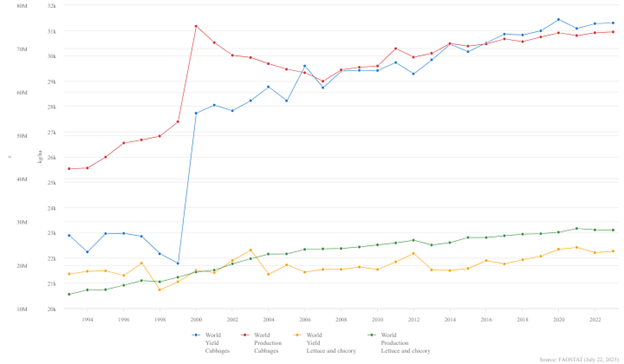
In Asia, Bloomberg says a heatwave impacted South Korean cabbage production. While UN Food and Agriculture Organization (FAO) data indicate that cabbage production has been slowly declining after a massive spike in the 1970s, yields have remained stable or increased since 2000. This suggests that economic considerations or political decisions made about the relative benefits of growing cabbage versus other crops that could be grown, or uses the land could be put too, rather than climate, are responsible for changes in production.
Australia also saw high lettuce costs due to flooding in the eastern part of the country in recent years, but the year Bloomberg and the study highlight, 2022, was not unprecedented as they implied. In fact, 2022 was only the sixth “wettest” year on available Australian rainfall records, the wettest year on record was in 1950.
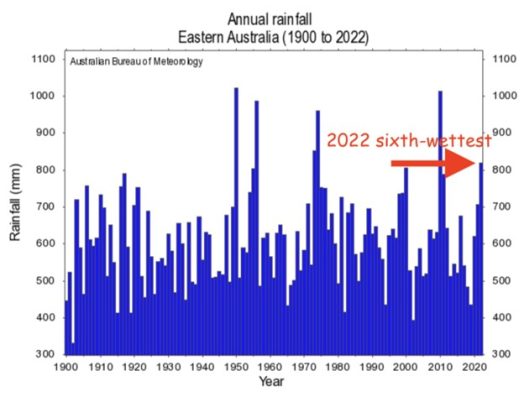
Figure 1: Australian rainfall records, chart from Jennifer Marohasy
Bloomberg goes on to explain how the study allegedly “found that heat, drought and floods were occurring at an increased intensity and frequency,” which is at odds with available data and the UN Intergovernmental Panel on Climate Change’s 6th assessment report, which though it claims an increase in extreme heat has been detected, finds no emergence of increased flooding or drought in the current historical period.
In short, Bloomberg, and the other mainstream media outlets hyping the BSC report, failed to do any fact checking, failed to examine crop trends, and illegitimately linked individual weather events to long-term climate change, despite such events being common in history and there being no discernable trend in an increase in such events amid the slight warming that has occurred in recent years. To be clear, weather is not climate and, despite what unscientific attribution studies claim, no specific weather event can be tied to long-term climate change.
In short, none of the weather events Bloomberg referred to as unprecedented were in fact unique or even rare historically.
Concerning the crops, BSC and the media focuses on the most, lettuce and cabbage, data from the U.N. Food and Agriculture Organization show that between 1993 and 2023 (the most recent 30-year period of climate change for which we have available data):
- Lettuce (and chicory – the FAO combines them) production grew approximately 112 percent;
- Lettuce and chicory yields increased by about 4 percent;
- Cabbage production expanded by nearly 75 percent;
- And cabbage yield grew by more than 37 percent. (see the graph below)
Bloomberg does briefly concede that other factors, like El Niño, a totally natural phenomenon, played a role in weather in 2023 and 2024, impacting certain crops. The outlet also begrudgingly admits that “food price shocks typically turn out to be short-term in nature, because high prices incentivize more production, which brings prices back down,” though they try to say that coffee and cattle are exceptions to this rule. Although Bloomberg reports that coffee futures are high, there is no evidence that climate change is actually damaging global coffee production, as explained in Climate Realism posts here, here, and here.
Bloomberg ends with a warning from the study authors, claiming that “slashing greenhouse gas emissions and containing global warming will be key to reducing food price inflation risks,” but this ignores another key aspect of food costs. They are also impacted by the cost to produce food, like when governments increase the price farmers pay for fossil fuel derived pesticides and fertilizers or try to restrict their use. Fossil fuel derived chemicals increase yields with less labor and using much less land. Take a look at Sri Lanka for a good example of what happens when climate action is prioritized over food production.
Never before has it been so easy for the media to report on various weather disasters and crop failures globally, and this certainly has an impact on peoples’ perceptions as well as the ability for studies to try to draw connections that aren’t really backed by data. This Bloomberg piece is nothing more than climate fearmongering; taking disconnected crop shortages from around the world from localized weather events and trying to blame them on climate change, when the truth is that there have always been crops failing somewhere in the world at any given time.
Qatar threatens to stop LNG exports to EU over climate rules: Reports
Al Mayadeen | July 26, 2025
Qatar has warned it may suspend liquefied natural gas (LNG) exports to the European Union in response to the bloc’s climate agenda, as outlined in the Corporate Sustainability Due Diligence Directive (CSDDD), Die Welt reported on Saturday.
The warning came in a letter from Qatari Energy Minister Saad Sherida Al-Kaabi to the Belgian government.
Al-Kaabi, who also heads QatarEnergy, cautioned that the company may seek alternative markets outside the EU if the directive’s regulations are not revised. The CSDDD mandates companies trading with the EU to scrutinize their supply chains for compliance with sustainable development goals.
“I strongly believe that companies should not be forced to choose between complying with the climate policies of their home jurisdictions and EU regulations,” the minister wrote, criticizing the directive for imposing requirements that, in some respects, exceed the objectives of the Paris Agreement, arguing that it infringes on national sovereignty and the right of states to set their own climate targets.
Al-Kaabi urged EU officials to remove the provision requiring non-EU companies to adopt climate transition plans.
According to Eurostat, Qatar was the EU’s third-largest LNG supplier in the first quarter of 2025, accounting for 10.8% of imports. The US ranked first with 50.7%, followed by Russia at 17%. A withdrawal of Qatari and Russian LNG would leave the EU scrambling to replace over a quarter of its current LNG supply.
Under the REPowerEU plan launched in 2022, the EU aims to phase out Russian pipeline gas by 2027–2028 and end all Russian energy imports by the end of 2027.
Meanwhile, Moscow has warned that the West’s pivot away from Russian hydrocarbons is a strategic error. Russian officials claim that European countries will ultimately face higher prices and increased dependency, buying Russian energy indirectly through intermediaries.
UK cautions it could fight China over Taiwan
RT | July 27, 2025
The United Kingdom could resort to military force against China in the event of an escalation over Taiwan, British Defense Secretary John Healey has said, though he emphasized that London continues to prefer a diplomatic resolution.
Speaking to The Telegraph during a visit to Australia, Healey said Britain would “secure peace through strength” if necessary – marking one of the clearest signals yet from a senior UK official regarding the possibility of direct confrontation with Beijing.
Healey made the remarks as the HMS Prince of Wales, a British aircraft carrier equipped with F-35 fighter jets, docked in the northern Australian city of Darwin. It is the first time in nearly 30 years that a British strike group has arrived in the region. The carrier is on a nine-month Pacific deployment, participating in Australia’s Talisman Sabre exercise and visiting ports in Japan and South Korea.
”If we have to fight, as we have done in the past, Australia and the UK are nations that will fight together. We exercise together and by exercising together and being more ready to fight, we deter better together,” Healey said when asked what London would do in case of an escalation around Taiwan.
The secretary then said he was speaking in “general terms.” According to Healey, London’s approach to Taiwan has not changed.
China considers the island of Taiwan part of its territory under the One-China principle, and insists on eventual reunification. According to the Chinese government, peaceful reunion is preferable, but it reserves the right to use force if necessary.
Taiwan has been self-governed since 1949, when nationalist forces retreated to the island after losing the Chinese Civil War. Most nations, including Russia, recognize Taiwan as part of China. The UK, as well as the US, also formally stick to the One-China principle while maintaining informal ties with Taiwan and supplying it with weapons and ammunition.
Last month, Beijing criticized a British warship’s passage through the Taiwan Strait in Chinese territorial waters. Such actions “deliberately cause trouble” and undermine peace in the area, it said.
Genocidal Accelerationism

By Kevin Barrett | July 27, 2025
This week Israel accelerated its genocide of Gaza, intensifying the ongoing mass starvation, shooting hundreds of starving people as they lined up for food, attacking the last standing city in Gaza, Deir al-Balah, and shocking even Caitlin Johnstone by having snipers shoot kids in the genitals one day, the head in the next, and so on. These people have a genius for being cartoonishly evil.
Bibi thinks he’s accelerating towards some kind of victory. But he’s actually zooming off a cliff. As the reality of the Gaza genocide sinks in, the people of the region, and the world, will find a way to excise the Zionist cancer from West Asia and the planet. It could come through the ongoing Resistance strategy of imposing death from a thousand cuts, as the world collectively withdraws support from Israel and throws its weight behind Palestine. But we might also see nukes going off in Occupied Palestine, or the release of biological weapons targeting Ashkenazi Jews. By now, people are angry enough to try just about anything.
Israel’s genocide strategy is accelerationist in the sense of “let’s make things worse in hopes that it will somehow magically make things better.” The original accelerationists were left-wingers who wanted to intensify the ravages of techno-capitalism in hopes of provoking revolution. In recent decades the alt right has appropriated the concept to mean “let’s burn down society so our ethnonationalist utopia can emerge from its ashes.” Israel, for its part, wants to burn down West Asia, and with it the world, so Biblical prophecy can be fulfilled as a Jewish Messiah arises to rule the world from a rebuilt blood sacrifice temple in Jerusalem.
This kind of millennialist messianic madness isn’t new. Historian Norman Cohn’s The Pursuit of the Millennium gives us the pro-Jewish version, casting Christians as the main villains and Jews as innocent scapegoats. But since Christian and Muslim millenarianists agree that Jesus, the Prince of Peace and avatar of pure spirituality and universalist brotherly love, is the one true Messiah, whereas Jews loathe Jesus and yearn for a bloody Jewish conquerer to subjugate, exterminate, and enslave all non-Jews under a global Jewish dictatorship, it’s easy to understand why the Jewish version of messianic millenarianism is even more toxic than the Christian cults analyzed by Cohn.
About 375 years ago, Zionism was born in the ravings of the lunatic satanist Shabtai Tzvi as polished by his publicist, Nathan of Gaza. Together, the pair convinced the plurality of European, North African, and West Asian Jews to at least provisionally accept Tzvi as the Messiah who would lead them to conquer the Holy Land and following that, the world. While Tzvi’s career culminated ignominiously in the propitious year 1666, when he led his followers into nominal conversions to Islam in a successful attempt to convince the Ottoman sultan to spare his life, Tzvi’s brand of satanic antinomian Zionism sparked the movement that unleashed genocide on Palestine in 1948 and is accelerating it today.
Tzvi’s movement crashed and burned. Unsurprisingly, it elicited “persecution” of Jewish communities. (Naturally enough, Christian and Muslim rulers were wary of maniacal outbreaks of Jewish fanaticism, especially since the fanatics’ goal was to conquer and exterminate Christians and Muslims and enslave the survivors.)
There have been countless similar cases of Jewish excesses leading to “persecutions.” When Jewish predation (or parasitism if you will) reaches a certain point, the victims have nothing to lose and rise up in pogroms. If usurers who are also tax collectors and blackmailers and sellers of alcohol, drugs, and whores reduce whole communities to penury, those communities have been known to respond, naturally enough, with torches and pitchforks. Throw in the minoritarian but very real practice of black magic using the blood of Christian children, among other abominations, and you have a perfect blueprint for becoming the world’s most unpopular minority.
When Bibi’s genocidal plan to conquer West Asia river-to-river fails, and Jews return to the status they have always enjoyed (barring a brief post-World War II interlude) as the most hated people on the planet, there will doubtless be wailing and gnashing of teeth. But maybe that’s the whole point. Maybe tribalist Jews are actually masochists who love being hated, and who torment the goyim precisely so they can find themselves “persecuted.” That’s what one of my favorite ex-Israelis, Alon Mizrahi, suggests in his latest Substack note:
In case you were wondering what the Israeli plan was, let me share with you that plan in great detail: it doesn’t exist.
There is no Israeli plan. There is no future arrangement they seek to achieve, or a finite situation.
Their plan is to keep escalating until they are forced to stop either by a devastating war, crippling sanctions, internal collapse, or a civil war (preferably: all at once).
That is the plan. Believe me: this, and only this, is the plan.
–
Zionists are notoriously braindead, souldead, and deluded, but they know that they cannot take over the Middle East and subjugate all of humanity to their rule, which is the only way they could censor ‘criticism of Israel’ and contain resistance forever. They know it’s impossible (unless god steps in and intervenes on their psychopathic behalf).
Their plan is not to achieve this; the plan is to die or get arrested trying. It is not a plan, but a yearning that cannot be controlled to fail in something big and then mourn the destruction and failure, like Ashkenazi Jews love to do so much.
They made mourning and complaints against humanity the center of their culture and identity, and that’s precisely the mental space they want to return to. This is the only space where they will feel safe and at home: when they are hated and everything they built has been destroyed. For them, a scenario like this is the ultimate proof that they are really god’s chosen.
I know it sounds psychotic, and it is. Nevertheless, that’s the collective yearning: to try big, to fail big, and to fall back to the comforting sense of persecution and hate.
–
This is why they’re doing all these counterintuitive things (from a self-preservation point of view). They want to be stopped. They long to be vilified and hated. They relish that hatred. It comforts and soothes them. When they are hated, in their mind, they become eternal Jews, fulfilling the decrees of an ancient Jewish existence.
They don’t hate being hated. They love it. Once you realize this, things will start making sense to you.
–
God bless Alon Mizrohi for escaping from the Israeli prison, and the Jewish-tribalist mind-prison. Like Gilad Atzmon and Miko Peled, he’s living proof that being born Jewish in Israel doesn’t necessarily prevent a person from uttering prophetic truths.
Zionist spies innovate AI sexual blackmail tech

By Kit Klarenberg | Al Mayadeen | July 27, 2025
On July 19th, Ynet announced Israeli artificial intelligence startup Decart “has unveiled a groundbreaking real-time video transformation technology, setting a new benchmark in the fast-evolving field of generative media”, following “months of anticipation and extensive fundraising”. Dubbed Mirage, it “allows continuous transformation of live or pre-recorded video content without interruption, maintaining high quality and impressive stability throughout”. The obvious suspicion arises that the tech’s true purpose is to concoct convincing, fabricated kompromat on targets, with no risk of Zionist intelligence being publicly exposed.
Such an interpretation isn’t immediately obvious from the description of Mirage offered by Ynet. The outlet states the tech “transforms the very definition of video – from a static, pre-recorded format to a living, flexible, and interactive medium”. This reportedly opens up “new business models for content creators, brands, and platforms”. For example, “broadcasters and advertisers” could “generate multiple versions of a single piece of content during a live transmission…[tailoring] content in real-time to different audience segments.”
Yet, buried in the Ynet report is reference to how Decart was forged in 2023 by Dean Leitersdorf and Moshe Shalev, while they were serving in the Zionist Occupation Forces’ fearsome Unit 8200. The shadowy spying cell conducts clandestine operations, signals intelligence collection, code decryption, counterintelligence, cyberwarfare, and surveillance. Many of its veterans have established major tech companies, frequently operating in Silicon Valley. Decart generated enormous early interest among investors, raising $53 million just two months after official launch, and securing a $500 million valuation.
Among those investors is Zeev Ventures, founded by Israeli-American Oren Zeev. Its other investments include Israeli firm Riverside, an audio and video recording service. Its staff is riddled with ZOF veterans. Moreover, Decart has thoroughly impressed Technion – the Israel Institute of Technology. The pair have announced a joint AI research center, “to strengthen academic research, knowledge development, and technological innovation”. Under its auspices, the Institute’s elite honours program will be renamed the “Technion-Decart Honors Program”.
Technion has an extensive and deplorable history of direct complicity in the Zionist entity’s erasure of the Palestinian people. The Institute maintains formal partnerships with multiple Israeli weapons manufacturers and security and intelligence firms, including infamous Elbit Systems. Its assorted faculties have helped innovate numerous monstrous resources, such as remote control capabilities for the Caterpillar D9 armored bulldozer, used by Tel Aviv to demolish Palestinian homes. Benefits such as academic credits and scholarships are specifically awarded to Institute students based on their ZOF service.
Markedly, numerous Technion alumni – among them individuals who previously served in Unit 8200 – have gone on to work for Toka, which has patented technology capable of locating security cameras and webcams, hacking into them, then altering their live feeds without trace. Toka was founded by former Israeli premier Ehud Barak – a close associate of Jeffrey Epstein. Given ample indications Epstein was collating sexual blackmail material on powerful figures for intelligence agencies, comments made by Mirage cofounder Dean Leitersdorf to Ynet take on a chilling character:
“Mirage marks the dawn of a new era in video. Content is no longer fixed or closed – it’s alive, adaptive and created in real time in collaboration with the user. Anyone can become a creator and give visual form to their imagination. This opens up endless possibilities for creation, communication and a new relationship between people and technology.”
‘Video Platforms’
A January Ynet report sheds considerable further light on the significance of Unit 8200 to Decart’s founding, and its chiefs’ intelligence backgrounds. Leitersdorf, described as the company’s “central figure” who “grew up immersed in the world of high-tech and business”, hails from “Israel’s old-money aristocracy”. His close relatives are all major players in the entity’s finance and ‘defence’ sectors. Moreover, Leitersdorf completed his bachelor’s, master’s, and doctoral degrees at Technion, in just five-and-a-half years, all while serving in the ZOF. He explained:
“I’d work from 9 am to 7 pm in Unit 8200, and then squeeze in a few hours of studying before bed.”
Moshe Shalev, a 14-year Unit 8200 veteran, told Ynet that towards the end of his ZOF service he “wanted to explore the world of research”, and crossed paths with Leitersdorf. When they started chatting, Shalev realised he’d “found someone who could tell me what was possible and what wasn’t”, and “knew all the technologies of 8200”. He described the experience as “mind-blowing”, and they began meeting regularly, discussing how to apply their experiences of working in the Unit to the commercial sphere.
So it was in late 2024, Decart released a “cute demo” dubbed Oasis, demonstrating the company’s AI capabilities. The app lets users explore an ever-changing virtual environment, which is influenced in real-time based on their keystrokes and mouse movement, purely via artificial intelligence. Leitersdorf claims, “we thought a few people might play with it… [but] we were stunned by how fast it blew up”. Oasis went viral across multiple platforms, exceeding one million users in just three days.
While Mirage was unmentioned in the January Ynet report, Leitersdorf talked a big game of Decart’s ambitions to create a suite of products that would attract up to a billion users, which “doesn’t solve a single problem but solves thousands of problems”. Still, “the ability to turn imagination into video” loomed large in the company’s stated vision, and “to that end”, the firm is “establishing one of the most advanced AI labs in the world, recruiting the best minds Israeli tech has to offer”:
“Decart has a bold and ambitious goal: to reinvent AI from the ground up and become the technological backbone for anyone in the world who wishes to use it.”
In July, Ynet suggested Decart’s real-time video editing software would be of enormous utility on “social platforms”, allowing users to use Mirage “to change their appearance in real time, create clips or livestream with custom visual effects – all without relying on professional editing tools”. The technology was said to support image generation “at 20 frames per second with live-broadcast-quality resolution”, and “future updates are expected to support Full HD and even 4K, the standard for most video platforms and televisions.”
The obvious interest of such tech to intelligence agencies was unmentioned. This was despite Mirage evidently being spawned directly from the founders’ experience toiling in Unit 8200. The enormous mainstream hype elicited by the tool, launched by hitherto unknown figures, and vast sums of money pumped into the fledgling company instantly upon its emergence, may also be illuminating. For every dollar invested in a startup by the CIA’s little-known venture capital wing In-Q-Tel, the private sector injects $18.
‘Sex Trafficking’
Intelligence services the world over are notorious for using sexual blackmail to force targets into doing their bidding. Moreover, agencies, including the CIA have extensive histories of forging sex tapes and compromising photos of “enemy” leaders to discredit them. Witnesses and victims alike have claimed Jeffrey Epstein’s numerous lavish residences – purchased with uncertain wealth – were equipped with hidden cameras and microphones, used to record sexual assaults and rapes by countless politicians and high-profile figures he counted as close friends.
Following Epstein’s arrest in July 2019 for sex trafficking of minors, veteran reporter on intelligence affairs Eric Margolis came forward to recount his attendance at a grand lunch convened in the shadowy financier’s New York mansion during the late 1990s, at which all attendees “sang the praises of Israel”. Immediately upon arrival, a butler invited him to enjoy “an intimate massage” courtesy of a “pretty young girl”. The offer “seemed so out of place and weird to me that I swiftly declined”, Margolis reported:
“More important than indelicacy, as an old observer of intelligence affairs, to me this offer reeked of ye old honey trap, a tactic to ensnare and blackmail people… A discreet room with massage table, lubricants and, no doubt, cameras stood ready off the main lobby.”
Margolis subsequently told mainstream media outlets he didn’t “believe for a moment” Epstein committed suicide, and it was “more likely he was killed”, as “he was a man who knew too much” – “the old pirate line of ‘dead men tell no tales’ certainly applied to Epstein”. Today, controversy around Epstein’s death endures. Polls indicate just 16% of US citizens believe he took his own life in prison, with almost 90% supporting disclosure of all information related to Epstein’s prosecution.
Donald Trump’s reneging on his promises to unseal classified documents related to Epstein’s crimes has prompted mass public backlash, even among the President’s most fervent supporters. Meanwhile, US lawmakers are engaged in a bipartisan push to compel Washington to release all federally-gathered evidence identifying those “involved in the sex trafficking that Epstein led.” Despite operating with impunity for decades, and being protected from legal repercussions as he “belonged to intelligence”, Epstein was eventually caught, raising the risk of his targets and paymasters being publicly exposed.
The real-time, AI-powered video creation and editing technology honed by Toka and Decart removes the troublesome human elements inherent in old-fashioned intelligence agency “honey traps”. We are thus left to ponder whether these firms are being enthusiastically promoted because they “solve the problem” of sexual blackmail requiring real-life individuals to oversee such operations, and targets to take the bait. The “possibilities” of such technologies to transform users’ “imagination” into realistic video content are, after all, avowedly “endless”.
In numbers: Arab people don’t want to normalize with ‘Israel’

Al Mayadeen | July 27, 2025
Almost 80 years after Israeli occupation of Palestine, the great majority of the Arab public refuses to normalise with “Israel”, with fresh polling data revealing a dramatic decline in support for normalization after the Israeli war on Gaza following October 7, 2023.
According to the latest Arab Barometer surveys conducted between 2023 and 2024, support for Arab normalization with the Israeli regime has plummeted to historic lows. In none of the eight surveyed West Asian and North African countries did public backing exceed 13%.
The Arab Barometer’s Wave VIII surveys, which covered Iraq, Jordan, Kuwait, Lebanon, Mauritania, Morocco, Palestine, and Tunisia, showed a consistent regional downturn in normalization sentiment. Morocco saw a drop from 31% in 2022 to 13% post-October 7; Lebanon from 17% to 12%; Iraq from 14% to 13%; Mauritania from 8% to 4%; and Jordan from 5% to 3%.
Prior to the 2020 normalization accords, support for normalization with “Israel” was already limited. In a 2018–2019 survey, Sudan recorded the highest level at 32%, while Yemen had the lowest at 5%.
‘Israel’ is the primary regional threat
Across the region, “Israel” was most frequently cited as the leading threat to regional stability. Lebanon had the highest perception at 79%, followed by Palestine at 63%, Egypt at 54%, Jordan at 42%, and Morocco at 27%.
In Egypt and Jordan, younger respondents were notably less likely to see “Israel” as the main threat, while in Palestine, the younger demographic showed heightened concern.
Protest movements
Public sentiment against normalization translated into protest activity across the region, per Foreign Affairs. In April 2025, Morocco’s largest labor union urged the government to prohibit the entry of such ships into Moroccan waters and organized a series of protests in solidarity with Gaza.
Jordan experienced daily protests since October 7, with authorities recalling their ambassador from “Israel” and enforcing a ban on the Muslim Brotherhood.
In Kuwait, where protests were restricted, 84% of citizens boycotted pro-Israel companies, 62% donated to Gaza, and many shared solidarity messages online.
Low favorability of ‘Israel’s’ allies, too
Public sentiment toward Western allies of “Israel” deteriorated sharply. Approval of the United States dropped by 23 points in Jordan and 19 in Mauritania. France’s favorability fell 20 points in Lebanon and 17 in Mauritania.
The United Kingdom experienced the steepest decline in Morocco, with a 38-point drop. In contrast, China saw a significant boost in public opinion: 16 points in Jordan, 15 in Morocco, 10 in Iraq, and 6 in Lebanon.
The Arab Barometer Wave VIII data was collected across nine countries between September 2023 and July 2024, with most surveys completed by March 2024. This timing means the findings do not capture Arab public opinion following several significant regional developments, including “Israel’s” war on Lebanon and later on Iran, and the Israeli aggression on Syria.
The survey data therefore represents public sentiment during the initial nine months following October 7, 2023, but predates these subsequent escalations that may have further influenced regional attitudes toward “Israel.”
France’s recognition of Palestine risks helping Israel — Indonesia should rethink its applause

Activists at a solidarity march for the Palestinians in Jakarta, Indonesia, on June 15, 2025. [Agoes Rudianto – Anadolu Agency]
By Dr. Muhammad Zulfikar Rakhmat | MEMO | July 27, 2025
This week, Indonesia welcomed France’s decision to recognise the State of Palestine as a “positive step” toward peace. On its surface, this diplomatic endorsement may appear aligned with Indonesia’s long-standing support for Palestinian self-determination. But behind France’s gesture lies a deeper, more dangerous calculus—one that does not just ignore the reality on the ground, but actively entrenches it.
What France proposes is not justice. It is not freedom. It is an updated version of the same illusion that has kept Palestinians caged and dispossessed for decades: the so-called two-state solution.
In Jakarta’s official statement, the French move was praised for supporting a “sovereign and independent” Palestinian state based on 1967 borders, with East Jerusalem as its capital. But President Emmanuel Macron made clear what kind of state he envisions: a demilitarized Palestine that fully recognizes Israel. No mention of dismantling settlements, no restitution for occupied land, no accountability for war crimes in Gaza. Only submission, in return for a diplomatic label.
This is not a step toward peace—it’s a framework for permanent subjugation.
France’s position not only lacks balance, it weaponizes it. Macron calls for the “demilitarization of Hamas,” the rebuilding of Gaza, and regional stability—but with no demands for Israeli disarmament, no consequences for its mass killing of civilians, no guarantees of actual sovereignty for Palestinians. Instead, Palestinians are asked to disavow resistance, while the occupying power faces no requirement to end its occupation.
Indonesia, by praising this deal without reservation, is endorsing a framework that surrenders Palestinian rights under the language of diplomacy. In doing so, it becomes complicit in a process that allows Israel to continue its long project of expansion and erasure.
Because that is exactly what we are witnessing: not just war, but erasure.
Israel’s leaders have shed any pretense of restraint. Finance Minister Bezalel Smotrich has declared that Gaza should be “completely flattened.” Members of the Knesset and senior military figures have called to “wipe out” the territory. Starvation, siege, and bombing are not incidental—they are deliberate. The goal is not merely to punish, but to depopulate.
And this genocidal ambition is not new. It is part of a larger ideological blueprint long championed by elements of Israel’s far-right: the “Greater Israel” project. This vision seeks to claim not just the full expanse of historic Palestine—from the Jordan River to the Mediterranean Sea—but in some renditions, territory beyond it. It is a dream of exclusive ethnic control over a vast swath of the region. Palestinians, in this model, are not citizens or neighbors—they are obstacles to be removed.
This is the context in which France’s recognition must be understood: not as a bold shift in policy, but as a stabilizing gesture for an apartheid regime facing global criticism. And by embracing it, Indonesia—whether intentionally or not—is lending moral cover to that regime.
It is tempting, in the face of so much suffering, to welcome any sign of progress. But symbolic recognition without structural change only reinforces the status quo. A demilitarized Palestine, hemmed in by Israeli checkpoints, with no right of return and no means of defense, is not a state—it’s an open-air prison with a flag.
What is needed now is not more applause for diplomatic theater, but a refusal to accept false solutions. The two-state framework, as currently constructed, is not a path to justice. It is a political tool that enables colonization while pretending to end it.
Indonesia has long stood as a voice for the oppressed. It must not dilute that legacy by celebrating a plan that leaves Palestinians with a flag and no freedom. Instead of encouraging other nations to follow France’s lead, Indonesia should be demanding accountability: for the destruction of Gaza, for the daily violence in the West Bank, and for the decades of displacement.
This is not a time for symbolic victories. It is a time for moral clarity.
France’s vision, and Indonesia’s uncritical support of it, may win applause in diplomatic circles. But on the ground, in Gaza and the West Bank, it enables a project whose end goal is not peace, but erasure. If Indonesia truly believes in justice for Palestine, it must reject this illusion—and instead, insist on the one thing Palestinians have never been offered: freedom on their own terms.
Russia’s Laser Weapon Supremacy: Short Guide
Sputnik – 27.07.2025
While the US and its European pals can only dream about developing laser weaponry, Russia is already light years ahead of them.
Unlike kinetic weapons, lasers do not use ammo and do not require reloading, only a power source, Russian military analyst Alexander Artamonov explained to Sputnik.
Lasers can also display a better rate of fire and would be much harder to evade than, for example, a missile.
“It is more efficient in terms of cost and the rate of fire, depending on the nature of the target you want to hit, and in terms of the time it takes to hit the target,” Artamonov remarked.
Nowadays, Russia, the United States and China run laser weapon programs. When it comes to actual working laser weapons, only Russia can present tangible proof.
Peresvet is a Russian mobile laser system designed to ‘blind’ enemy optical and optical-electronic surveillance systems, including drones, reconnaissance aircraft and even satellites. It has already been adopted by the Russian Armed Forces.
“Peresvet lasers are currently deployed not only in the Moscow region but on the front line as well,” Artamonov said, referring to the Ukrainian conflict zone.
Meanwhile, the US simply lacks the technology and know-how – like, for example, a sufficiently powerful and compact power source – to achieve comparable results.
“They conducted tests in the Indian Ocean. The US lasers perform poorly in water mist – under adverse weather conditions, that is,” Artamonov said.
Simply put, Russia’s Western rivals cannot field actual laser weapons whereas Russia is already developing more advanced and deadly military lasers.
The AMIA case: The untold story
By Raphael Machado | Strategic Culture Foundation | July 27, 2025
On the morning of July 18, 1994, a bomb exploded at the headquarters of the Argentine Israelite Mutual Association (AMIA) in downtown Buenos Aires, leveling the building and killing 85 people, with over 300 injured.
The attack occurred two years after the bombing of the Israeli embassy in Argentina, which left 22 dead and 242 wounded. Both attacks took place during the presidency of Carlos Menem, a government that was pivotal for Argentina as it marked a transition to neoliberalism, featuring mass privatizations and a partial dollarization of the economy.
But on the geopolitical front, the Menem administration is more remembered for the apparent “secret war” that unfolded within the country, involving intelligence agencies and subversive groups from various nations.
The most widely accepted version of the AMIA case goes as follows: To retaliate against the cancellation of a nuclear technology transfer agreement between Argentina and Iran, the Iranian government (then under President Akbar Rafsanjani) orchestrated an act of revenge, with operatives from the Lebanese Hezbollah carrying it out.
This narrative, elevated to “official truth,” was supported by intelligence reports from the U.S. and Israel. It led to Argentina designating Hezbollah as a terrorist organization and the rupture of previously friendly relations between Argentina and Iran.
But what if this popular version is wrong?
Recently, a former aide to Judge Juan José Galeano—who oversaw the investigation and trial from 1994 to 2005—revealed details that cast doubt on the established narrative. According to Claudio Lifschitz, Galeano’s former assistant and a former Argentine security official, no concrete evidence linking the Iranian government to the attack was ever found. On the contrary, Lifschitz claims that the evidence increasingly pointed toward elements within Argentina’s intelligence service, SIDE.
Lifschitz first entered the public eye in this case when he released a video recording of a meeting between Galeano and Carlos Telleldín, in which the judge allegedly offered money to the supposed supplier of the van used in the attack—in exchange for confessing that he had sold it to Mohsen Rabbani, the cultural attaché at the Iranian Embassy in Buenos Aires. According to Lifschitz, one of the key pieces of evidence that could exonerate Iran is the fact that SIDE had illegally wiretapped—without a court order—the Iranian Embassy and the Iranian Cultural Center in Buenos Aires, amassing thousands of hours of recordings without a single indication that any Iranians frequenting these places had prior knowledge of the attack.
The real mastermind, Lifschitz alleges, was Jaime Stiuso, deputy chief of SIDE’s counterintelligence division (Section 85) and the officer in charge of intelligence investigations for the AMIA case. According to Lifschitz, Telleldín had actually sold the van used in the attack to a SIDE agent. Furthermore, Stiuso—who had close ties to Mossad and the CIA—was allegedly responsible for constructing the accusation made by prosecutor Alberto Nisman that then-President Cristina Kirchner had sought to cover up Iranian involvement in the case.
The former Argentine intelligence agent claims he heard directly from Stiuso that Mossad was the real force behind the attacks—though it remains difficult to verify whether this conversation actually took place.
The case remains relevant today because it is being leveraged by Javier Milei’s government to justify closer ties with Israel, to the point where the Argentine president has labeled Iran as an “enemy state of Argentina.”
Featured Video

America Racing to Strategic Defeat in Iran
or go to
Aletho News Archives – Video-Images
From the Archives
Should Europeans ‘Thank’ the Americans for Destroying Nord Stream?
By Robert Bridge | Strategic Culture Foundation | September 29, 2022
With an investigation continuing into the destruction of the Nord Stream gas pipeline that provided energy supplies to Europe from Russia, there appears to be just one prime suspect, and that should surprise nobody.
Following the sabotage of the Nord Stream 1 and 2 gas pipelines, former Polish Foreign Minister Radoslaw Sikorski already seemed to know the identity of the perpetrator when he tweeted out: “Thank you, USA.”
At first glance, it seemed that Sikorski was speaking sarcastically, berating Washington for carrying out an attack that will have severe repercussions for the people of Europe. After all, how could anyone see any good coming from the termination of Europe’s primary source of gas reserves with winter just around the corner? It was Sikorski’s homeland of Poland, after all, that urged its citizens to collect firewood in the face of dwindling gas reserves.
In fact, the Polish diplomat was speaking one-hundred percent literally… continue
Blog Roll
 Aletho News
- Growing insecurity, soaring prices fuel protests in north as regime bans evacuation: Sources
- Iran denies responsibility for ‘depraved’ attack on Kuwait desalination plant
- Bring The Troops Back. End This War Now!
- Can we please stop calling Israel the ‘only democracy in the Middle East’ now?
- US should start removing its troops from Germany, proposes AfD co-leader Chrupalla
- Iran Red Crescent: 600 educational centers attacked in US-Israeli ‘war crimes’
- Russian Oil Tanker Arrives in Cuba Amid U.S. Blockade
- America Racing to Strategic Defeat in Iran: Lt Col Daniel Davis
- FTC Warns Visa, Mastercard, PayPal, Stripe Over Political Debanking
- Russian tanker approaches Cuba despite US oil blockade
- If Americans Knew
- Will Trump Go Kamikaze?
- Is the University of Florida Shutting Down College Republicans over Israel Criticism?
- Jewish extremist arrested over alleged plot to firebomb Palestinian activist Nerdeen Kiswani’s home
- More than half of Palestinian child detainees have no charges
- The More Murderous Israel Gets, The More We Hear About “Antisemitism”
- Land Day and the Palestinian struggle after 30 months of genocide
- The Iran War Is About Palestine
- Israeli soldiers echo settler ideology, talk of revenge after targeting Palestinians and detaining CNN crew in the West Bank
- Israeli Policies Threaten Future of Christian Schools in Jerusalem
- Former US soldiers argue Israeli policy is now guiding US interests
- No Tricks Zone
- New Study Finds Warming Saves Lives…Cold Temperatures 12 Times More Deadly Than Excess Heat
- German Science Blog Accuses PIK Climate Institute Of Hallucinating Climate Tipping Points
- Devastating Assessment Of Comirnaty Vaccine By Former Senior Pfizer Europe Toxicologist
- New Study: CO2 Is ‘Effectively Negligible’ As An Explanatory Climate Change Factor Since 2000
- Former Pfizer Toxicologist Dr. Helmut Sterz Tells Bundestag Hearing Pfizer Vaccine Should Have Never Been Approved
- Energy Expert: Germany’s Nuclear Phaseout Was A “500 Billion Euro Mistake”
- New Research: South Australia’s Mid-Holocene Sea Surface Temperatures Were 4°C Warmer Than Today
- Storing Green Energy To Last Germany 10 Days Would Require A 60-Million Tonne Battery
- New Studies: UK Sea Levels Were 4 Meters Higher Than Today During The Mid-Holocene
- Destructive Green New Deal: German Energy And Metal Group Warns Of Drastic Crisis
 Aletho News