Trump Admin Wants DEI for Jewish Students?!
Glenn Greenwald | August 2, 2025
This is a clip from our show SYSTEM UPDATE, now airing every weeknight at 7pm ET on Rumble.
You can watch the full episode for FREE here: https://rumble.com/v6x01gs-system-upd…
Now available as a podcast! Find full episodes here: https://linktr.ee/systemupdate_
Join us LIVE on Rumble, weeknights at 7pm ET: https://rumble.com/c/GGreenwald
The CIA Built Hundreds of Covert Websites. Here’s What They Were Hiding
By Alan Macleod | MintPress News | August 1, 2025
The CIA didn’t just infiltrate governments; it infiltrated the internet itself. For over a decade, Langley operated a sprawling network of covert websites that served as global spy terminals disguised as harmless blogs, news hubs, and fan pages.
Beginning in 2004, the CIA established a vast network of at least 885 websites, ranging from Johnny Carson and Star Wars fan pages to online message boards about Rastafari. Spanning 29 languages and targeting at least 36 countries directly, these websites were aimed not only at adversaries such as China, Venezuela, and Russia, but also at allied nations, including France, Italy, and Spain, showing that the United States treats its friends much like its foes.
Covert Soccer Blogs and Cracked Passwords
Gholamreza Hosseini is a former CIA informant. In 2007, the Tehran-based industrial engineer contacted the agency and offered to pass them information about Iran’s nuclear energy program. His CIA handlers showed him how to use IranianGoals.com to communicate with them. Iranian Goals was a Farsi-language website that appeared to be dedicated to local soccer news. However, what appeared to be a search bar at the bottom of the home page was actually a password field. Typing the correct word into it would trigger a login process, revealing a secret messaging interface. Each informant had their own webpage, designed specifically for them, to insulate them from others in the network.
It seemed like an ingenious idea. However, Hosseini and the other spies were soon detected, thanks to some sloppy mistakes in Washington, D.C. An Iranian double agent revealed to the authorities their unique website, and some basic detective work led to the uncovering of the entire network.
The CIA purchased the hosting space for dozens, perhaps hundreds, of these websites in bulk, often from the same internet providers, or the same server space. That meant that the IP addresses of these websites were consecutive, akin to housing each informant in adjacent properties on the same street.
Thus, if you looked at neighboring IP addresses, you would see similarly designed websites and could easily put two and two together. Even with some relatively basic online searches, Iranian authorities were able to identify dozens of CIA-run websites. From there, they simply waited to see who would access them.
The Iranian Intelligence Ministry claimed that 30 individuals were arrested and a further 42 CIA operatives were identified. Some websites, such as IranianGoalKicks.com, FirstNewsSource.com, and Farsi-NewsAndWeather.com, can still be accessed through the Internet Wayback Machine. A complete list of known CIA webpages can be found here.
Hosseini spent more than nine years in prison and was released in 2019. He has received no support from American officials, who have not even contacted him since his arrest. The U.S., however, continues to attempt to overthrow the Iranian government, sponsoring high-profile opposition figures and hijacking domestic protest movements. In June, it also carried out airstrikes on nuclear facilities across the country.
Spying on Allies and Adversaries Alike
The network of websites spanned a wide range of topics. Few would guess that Rasta Direct, a website dedicated to the relatively niche religion of Rastafari, had anything to do with U.S. intelligence. The CIA also created Star Wars Web, a fan page for the sci-fi franchise, and All Johnny, a page dedicated to late-night legend Johnny Carson. Sports, gaming and news blogs, however, were the most common topics for fake websites.
These websites served as cover for informants, offering some level of plausible deniability if casually examined. Upon close inspection, however, few of these pages provided any unique content and simply rehosted news and blogs from elsewhere, linking to already available resources.
Informants in enemy nations, such as Venezuela, used sites like Noticias-Caracas and El Correo De Noticias to communicate with Langley, while Russian moles used My Online Game Source and TodaysNewsAndWeather-Ru.com, and other similar platforms.
However, a vast network of informants in allied countries, such as France, Spain and Italy, was also uncovered, using financial news, mountaineering, and running websites to pass on vital information to the CIA.
Germany was another country Washington actively targeted. In 2013, it was revealed that the U.S. had been bugging the cellphone of Chancellor Angela Merkel for over a decade, sparking a major diplomatic rift. One year later, in 2014, Germany detained one of its own intelligence officials after catching him spying for the United States.
The Collapse of the CIA’s China Network
China, however, remains a top target for the CIA. The organization maintains an extensive network of informants across the country, who, when the network was active, used platforms such as eChessNews.com and SportsNewsFinder.com to transmit information back to the United States.
But, as in Iran, Chinese authorities began to dismantle the network. Starting in late 2010, the spying network was systematically dismantled by officials, likely using similar tactics to those of the Iranians. Unlike Iran, however, China simply executed those operatives. It is believed that the CIA lost around 30 informants in the purge. The affair is considered one of the worst intelligence failures in the agency’s nearly 80-year history.
Since then, the U.S. spying network in China has been severely diminished. Earlier this year, the CIA changed tack, publicly releasing two videos encouraging disaffected Communist Party officials to spy for them in exchange for money and the prospect of a new life in America.
“As I rise within the party, I watch those above me being discarded like worn-out shoes, but now I realize that my fate was just as precarious as theirs,” the narrator says in one. “Our leaders’ failure to fulfil repeated promises of prosperity has become a well-known secret… It’s time to build my own dream,” he says in another.
The CIA instructs would-be traitors to download the Tor Browser and contact the CIA via its website. While Tor is marketed in the West as a privacy tool, a previous MintPress News investigation revealed that it was created with funding from the U.S. government by a company with ties to the CIA. Last year, Washington passed a $1.6 billion bill to finance anti-China propaganda worldwide.
Weaponizing Apps and Platforms
This is not the only time that the U.S. national security state has created fake web platforms in order to stoke regime change around the world. In 2010, USAID—a CIA front organization—secretly created the Cuban social media app, Zunzuneo.
Often described as “Cuba’s Twitter,” Zunzuneo rocketed to prominence. The app had been designed to offer a reliable and affordable service, undercutting the competition, before gaining dominance and slowly disseminating anti-government messages to the island.
Then, at a given time, Zunzuneo would urge users to join protests coordinated by the U.S. in an attempt to foment a color revolution on the island.
In an effort to hide its ownership of the project, the U.S. government held a secret meeting with Twitter founder Jack Dorsey to encourage him to take it over. It is unclear to what extent, if at all, Dorsey contributed to the project, as he has declined to comment on the matter. In 2012, Zunzuneo was abruptly shut down.
Infiltrating Journalism and Big Tech
While the 885 fake websites were not established to influence public opinion, today, the U.S. government sponsors thousands of journalists worldwide for precisely this purpose. Earlier this year, the Trump administration’s decision to pause funding to USAID inadvertently exposed a network of more than 6,200 reporters working at nearly 1,000 news outlets or journalism organizations who were all quietly paid to promote pro-U.S. messaging in their countries.
Oksana Romanyuk, director of the Ukrainian Institute for Mass Information, warned that nearly 90% of her country’s media outlets rely on funding from USAID to survive. A survey of 20 leading media organizations in Belarus revealed that 60% of their budget came from Washington. In Iran, more than 30 anti-government groups came together for a crisis response meeting, while in Cuba and Nicaragua, anti-government press resorted to soliciting donations from readers.
The CIA has also successfully infiltrated the largest and most popular social media networks, giving the agency substantial control over what the world sees (and does not see) in their news feeds.
Facebook has hired dozens of former CIA officials to run its most sensitive operations. Perhaps the most notable of these individuals is Aaron Berman.
As the platform’s senior misinformation manager, Berman ultimately has the final say over what content is promoted and what is demoted or deleted from Facebook. Yet, until 2019, Berman was a high-ranking CIA officer, responsible for writing the president’s daily security brief. It was at that time that he jumped ship from Langley to Facebook, despite appearing to have little relevant professional experience.
Google, if anything, is even more saturated with former spies.
A MintPress News investigation revealed that dozens of former CIA agents hold top jobs at the Silicon Valley giant. Among these is Jacqueline Lopour, who spent more than ten years at the agency working on Middle East affairs before being recruited to become Google’s senior Intelligence, Trust, and Safety manager. The role gives her considerable influence on the direction of the company. This form of state censorship is how the agency prefers to shape the internet today.
The CIA continues to maintain a vast worldwide network of informants. Today, they use custom-built apps such as Tor or Signal to communicate. If they are caught by their own countries, they will likely be left to their fate, like Hosseini was. Being a spy or a stool pigeon for the CIA is as perilous as ever.
Hamas rules out giving up arms unless ‘independent, sovereign’ Palestinian state established
MEMO | August 2, 2025
The Palestinian resistance group Hamas said Saturday it will not give up its arms unless an “independent, fully sovereign” Palestinian state is established, Anadolu reports.
The statement came following reports by the Israeli daily Haaretz citing a recording attributed to US Middle East envoy Steve Witkoff: “Hamas has said that they are prepared to be demilitarized.”
“We are very, very close to a solution to end this war,” Witkoff is also heard saying, according to Haaretz.
“Commenting on reports by some media outlets quoting US envoy Steve Witkoff as saying the movement expressed willingness to disarm, we reiterate that resistance and its weapons are a national and legitimate right as long as the occupation continues — a right recognized by international laws and conventions,” Hamas said in a statement on Telegram.
The group added that such rights “cannot be relinquished except with the full attainment of our national rights, foremost being the establishment of an independent, fully sovereign Palestinian state with Jerusalem as its capital.”
Witkoff met families of Israeli hostages in Tel Aviv on Saturday, as hundreds rallied to demand a ceasefire deal that would secure their release from the Gaza Strip, Israel’s Haaretz newspaper reported.
Witkoff’s visit, his third to Hostage Square since the war began, came shortly after Palestinian groups Hamas and Islamic Jihad released footage showing two emaciated Israeli captives, Evyatar David and Rom Braslavski, prompting renewed outrage.
On Friday, Witkoff visited an aid center in southern Gaza operated by the controversial Gaza Humanitarian Foundation (GHF).
Diplomatic merchandise: Exploiting the issue of Palestinian recognition
He said the aim was to give US President Donald Trump “a clear understanding of the humanitarian situation and help craft a plan to deliver food and medical aid to the people of Gaza.”
The visit comes amid mounting criticism of US-Israeli coordination in Gaza, particularly regarding the group’s distribution model, which Palestinians say serves as a tool for displacement under the guise of humanitarian relief as well as a “death trap” for many Palestinian aid seekers, with over 1,300 killed since May while waiting for relief supplies.
Hamas on Thursday denounced the visit as a “propaganda stunt” aimed at deflecting global outrage over what rights groups and UN officials have described as Israel’s systematic starvation campaign.
Since Oct. 7, 2023, at least 169 Palestinians, including 93 children, have died of hunger-related causes, according to Gaza’s Health Ministry.
Rejecting international calls for a ceasefire, the Israeli army has pursued a brutal offensive on Gaza since Oct. 7, 2023, killing more than 60,000 Palestinians, most of them women and children.
Last November, the International Criminal Court issued arrest warrants for Israeli Prime Minister Benjamin Netanyahu and his former Defense Minister Yoav Gallant for war crimes and crimes against humanity in Gaza.
Israel also faces a genocide case at the International Court of Justice for its war on the enclave.
Zionism without borders: Annexation and normalization as tools of Arab subjugation
By Mohamad Hasan Sweidan | The Cradle | August 1, 2025
Four weeks after Israel signed the US-brokered Abraham Accords with the UAE and Bahrain on 15 September 2020, Tel Aviv’s Higher Planning Council approved 4,948 new settler units in the occupied West Bank. No public fanfare.
No tanks rolled in – just signatures authorizing another layer of occupation. The first wave of expansion advanced quietly, legitimized by the language of “peace.”
This sequencing deliberately reflects the core logic of Zionist expansion: Normalize when the region submits, colonize when the world blinks.
Where possible, the occupation state’s army conquers land directly. Where resistance or scrutiny makes that unfeasible, the occupation government builds a web of security pacts, trade routes, and intelligence partnerships that extend its reach without a single uniformed soldier. This dual formula, territorial conquest and hegemonic integration, has underpinned Israeli strategy since 1967, and today stretches unimpeded from the Jordan Valley to the Atlantic coast.
Two paths, one destination
“Greater Israel” represents the settler-colonial ambition to annex, settle, and absorb land across historic Palestine and beyond. It is rooted in the Zionist vision of Jewish dominion over the so-called “biblical Land of Israel.” In contrast, “Great Israel” describes the imperial design to dominate the surrounding region through proxies, economic leverage, and security alignments.
Where occupation is costly, Tel Aviv turns to influence. Through deals, destabilization, or coercion, it reshapes the sovereignty of its neighbors. Greater Israel devours land. Great Israel neutralizes independence. Together, they are one project.
Zionist literature makes this plain. Ze’ev Jabotinsky, founder of Revisionist Zionism, demanded sovereignty over all of Mandatory Palestine and Transjordan – “Greater Israel on both sides of the Jordan River” – and rejected compromise with Arabs. In The Iron Wall (1923), he declared that only an unyielding Jewish force could compel Arab acquiescence:
“Zionist colonization, even the most restricted, must either be terminated or carried out in defiance of the will of the native population.”
The occupation state’s first prime minister and Labor Zionist leader, David Ben-Gurion, publicly accepted a partition plan in 1937, but privately described it as “not the end but the beginning.” In a letter to his son, he wrote that a Jewish state on part of the land would strengthen the Zionist project and serve as a platform to “redeem the entire country.” In a June 1938 meeting of the Jewish Agency executive, he said:
“After the formation of a large army … we shall abolish partition and expand to the whole of Palestine.”
Early Zionist leaders did not view borders as final, but as phases. During its first two decades, Israel lacked the military strength or western backing to expand beyond its 1949 borders. Direct confrontation with Arab states risked catastrophe. Instead, Tel Aviv pioneered a subtler doctrine of peripheral infiltration.
Through the “periphery doctrine,” it cultivated covert ties with non-Arab states and oppressed minorities – Shah-era Iran, Turkiye, Kurdish groups in Iraq, and Christian separatists in Sudan. This strategy sowed chaos among Israel’s Arab rivals while embedding Israeli influence in strategic corners of West Asia and Africa. Most recently, the occupation state has made overtures to Druze communities in southern Syria, seeking to replicate this strategy amid renewed instability.
The corridor to colonization
Israel’s integration into the Arab world is now deeper than ever before. Through normalization, Tel Aviv has converted former enemies into partners economically, diplomatically, and militarily. While Egypt and Jordan first formalized ties through Camp David and Wadi Araba, it was the Abraham Accords that opened the floodgates. What followed was a deluge of tech deals, weapons transfers, and commercial partnerships linking the occupation state to the Persian Gulf.
By 2023, Israel’s trade with the UAE had reached $3 billion annually. That figure rose by 11 percent the following year, even as Israel waged genocide in Gaza. Israeli Consul General Liron Zaslansky described trade relations between Abu Dhabi and Israel as “growing, so that we ended 2024 at $3.24 billion, excluding software and services.”
In 2022, Morocco purchased $500 million worth of Israeli Barak MX air defense systems. Rabat also partnered with BlueBird, an Israeli drone firm, to become the first UAV manufacturer in West Asia and North Africa.
This has created a “corridor of influence” that grants Tel Aviv access to new markets, air and sea routes, and intelligence spaces stretching from Casablanca to Khor Fakkan.
On the ground, the war continues
While trade flourishes, colonization accelerates. In 2023, Israeli Prime Minister Benjamin Netanyahu’s ultranationalist government approved 12,855 settler homes – a record for any six-month period. More than 700,000 settlers now occupy the West Bank and East Jerusalem. That figure has grown sevenfold since the early 1990s.
In May 2025, Defense Minister Israel Katz confirmed cabinet approval for the construction of 22 new West Bank settlements, including multiple previously unauthorized outposts. Katz framed the move as necessary to “strengthen our hold on Judea and Samaria” and to “prevent the establishment of a Palestinian state.”
These settlements are not arbitrary. They are connected by Jewish-only bypass roads, fortified by the occupation army, and strategically designed to fragment the occupied West Bank into isolated Palestinian enclaves. This is de facto annexation, defined by a matrix of irreversible facts that eliminates the territorial basis for any future Palestinian state, while avoiding the international fallout of formal annexation.
The “logic” of expansion has also spilled beyond Palestine. In Syria, Tel Aviv now occupies 250 square kilometers across Quneitra, Rural Damascus, and Deraa – territory seized during the collapse of former Syrian president Bashar al-Assad’s government by Al-Qaeda rooted terrorists – Hayat Tahrir al-Sham (HTS) – who now occupy the seat of power in Damascus. HTS was under the leadership of former ISIS chief Abu Mohammad al-Julani. Upon ousting Assad, Julani began using his government name, Ahmad al-Sharaa, and became the de facto president of Syria.
In Lebanon, Israeli forces maintain a presence over 30–40 square kilometers, including Shebaa Farms, Kfar Shuba Hills, and the northern half of Ghajar. Additional outposts and buffer zones stretch along the so-called Blue Line.
Occupation rebranded
Israel’s expansion today is no longer confined to bulldozers and soldiers; it is mediated through trade, tech, and treaties. But make no mistake: normalization has not replaced occupation. It has enabled and accelerated it.
Every Emirati deal, every Moroccan drone line, every Bahraini handshake fuels Tel Aviv’s capacity to deepen its military presence and Judaize more land. Plans are underway to double the number of settlers in the Golan Heights and to deploy armored units along the demilitarized zone.
The ripple effects are already destabilizing the region. Egypt has begun constructing a concrete wall on its border with Gaza to prepare for mass displacement or military spillover. Jordan faces existential peril in the Jordan Valley, where settler expansion is displacing Bedouin communities and draining natural aquifers. Syria and Lebanon remain hemmed in by fortified Israeli positions, with both countries facing increasing pressure from Washington to normalize relations.
Greater Israel devours Arab land. Great Israel colonizes Arab decision-making. One swallows borders. The other swallows sovereignty.
The real Russiagate scandal blows away Watergate for crimes and treason by U.S. establishment
Strategic Culture Foundation | August 1, 2025
So the hoax is finally officially acknowledged. “Russiagate” – the mainstream narrative, that is – is now described by American intelligence chiefs as a fabrication that was concocted to overturn the results of the 2016 U.S. presidential elections.
Tulsi Gabbard, the current Director of National Intelligence (DNI), and CIA director John Ratcliffe have both accused former President Barack Obama of engaging in a “treasonous conspiracy” to subvert the constitutional process. It’s not just Obama who is implicated in this high crime. Other former senior officials in his 2013-17 administration, including former DNI James Clapper, CIA director John Brennan, and head of the FBI James Comey, are also implicated. If justice is permitted, the political repercussions are truly earth-shattering.
The potential impact is not confined solely to the violation of U.S. laws and the democratic process – bad enough as that is. The Russiagate scandal that began in 2016 has had a lasting, damaging effect on U.S. and European relations with Russia. The frightfully dangerous NATO proxy war incited in Ukraine, which threatens to escalate into a full-scale world war, was fueled in large part by the hostility generated from the false claims of Russian interference in the U.S. elections.
The allegations that Russian President Vladimir Putin oversaw a subversion campaign against the 2016 U.S. election and colluded with Donald Trump to get him elected were always specious. The scandal was based on shoddy intel claims to purportedly explain how Trump defeated his Democrat rival, Hillary Clinton. Subsequently, the scandal was hyped into a seemingly credible narrative by U.S. intelligence chiefs at the direction of then-President Barack Obama as a way to delegitimize Trump’s incoming first-term presidency.
Years before the recent intelligence disclosures, many independent journalists, including Aaron Maté, and former intelligence analysts like Ray MacGovern and William Binney, had cogently disproven the official Russiagate claims. Not only were these claims false, they were knowingly false. That is, lies and deliberate distortions. Russia did not hack emails belonging to the Democratic National Committee to discredit Clinton. Clinton’s corruption was exposed by a DNC internal leak to Julian Assange’s Wikileaks whistleblower site. That was partly why Assange was persecuted with years-long incarceration.
A large enough number of voters simply despised Clinton and her warmongering psychopathy, as well as her sell-out of working-class Americans for Wall Street largesse.
Furthermore, Moscow consistently denied any involvement in trying to influence the 2016 U.S. election or attempts to favor Trump. Putin has said more than once that Russia has no preference about who becomes U.S. president, implying that they’re all the same and controlled by deeper state forces. Laughably, too, while Washington accused Moscow of election interference, the actual record shows that the United States has habitually interfered in scores of foreign elections over many decades, including those of Russia. No other nation comes close to the U.S. – the self-declared “leader of the free world” – in sabotaging foreign elections.
In any case, it is instructive to compare the Russiagate farce with the Watergate scandal. Watergate involved spying by the White House of President Richard Nixon against a Democrat rival in the 1972 election. The political crisis that ensued led to Nixon’s resignation in disgrace in 1974. The U.S. nation was shocked by the dirty tricks. Several senior White House officials were later convicted and served time in jail for crimes related to the affair. Nixon was later pardoned by his successor, Gerald Ford, and avoided prosecution. Nevertheless, Watergate indelibly disgraced U.S. politics and, at the time, was described as “the worst political scandal of the 20th century.”
Subsequent cases of corruption and malfeasance are often dubbed with the suffix “gate” in a nod to Watergate as a momentous political downfall. Hence, “Russiagate.”
There are hugely important differences, however. While Watergate was a scandal based on factual crimes and wrongdoing, Russiagate was always a contrived propaganda deception. The real scandal behind Russiagate was not Trump’s alleged misdeeds or those of Russia, but the criminal conspiracy by Obama and his administration to sabotage the 2016 election and subsequently to overthrow the Trump presidency and the democratic will of the American people. Tulsi Gabbard, the nation’s most senior intelligence chief, has said that this amounts to “treason,” and she has called for the prosecution of Obama and other former senior aides.
Arguably, the real Russiagate scandal is far more criminal and devastating in its political implications than Watergate. The latter involved illegal spying and dirty tricks. Whereas, Russiagate involved a president and his intelligence chiefs trying to subvert the entire democratic process. Not only that, but the U.S. mainstream media are also now exposed for perpetrating a propaganda heist on the American public. All of the major U.S. media outlets amplified the politicised intelligence orchestrated by the Obama administration, claiming that Russia interfered in the election and that Trump was a “Kremlin stooge.” The hoax became an obsession in the U.S. media for years and piled up severe damage in international relations, a nefarious legacy that we are living with today.
The New York Times and Washington Post, reputedly two of the finest exponents of American journalism, jointly won the Pulitzer Prize in 2018 for their reporting on Russiagate, the official version, that is, which lent credibility to the hoax. In light of what we know now, these newspapers should be hanging their heads in shame for running a Goebbels-like Big Lie campaign to not only deceive the U.S. public but to subvert the democratic process and poison international relations. Their reputations are shredded, as well as those of other major media outlets, including ABC, CBS, CNN, and NBC.
Ironically, The Washington Post won the Pulitzer Prize in 1973 for its reporting on the Watergate scandal. The story was made into a best-selling book, All The President’s Men, and a hit Hollywood movie starring Robert Redford and Dustin Hoffman, playing the roles of intrepid reporters Bob Woodward and Carl Bernstein. Woodward and Bernstein and The Washington Post were acclaimed as the finest in U.S. journalism for exposing Watergate and bringing a crooked president to book.
How shameful and absurd that an even greater assault on American democracy and international relations in the form of Russiagate is ignored and buried by “America’s finest”. That the scandal is ignored and buried should be of no surprise because to properly reveal it would shatter the foundations of the U.S. political establishment and the sinister role of the deep state and its mainstream media propaganda system.
Why the US is unqualified to promote peace between Thailand and Cambodia
By Hannan Hussain | Al Mayadeen | August 2, 2025
Washington’s calls to dial-down tensions between Cambodia and Thailand have few takers.
In recent weeks, cross-border hostilities between the two Southeast Asian powers have intensified sharply, with exchange of heavy artillery, Thai airstrikes on Cambodian military targets, and rising casualties, tossing the Association of Southeast Asian Nations (ASEAN) into a tough spot. The root of the crisis goes back over a century, and the absence of a clear floor beneath tensions underlines the gravity of a situation with the potential to flare up.
“Cambodia asked for an immediate ceasefire, unconditionally, and we also call for the peaceful solution of the dispute,” stated Cambodia’s ambassador to the UN, Chhea Keo, during a closed-door UN Security Council meeting this week.
But Washington’s calls for calm and restraint deserve considerable pushback, given its history of fueling geopolitical tensions and unwarranted military adventurism when expedient.
First, Washington’s alignment with Thailand – a key US partner – defeats the idea of credible neutrality. In order for the Trump administration to practice any meaningful leverage, it must first demonstrate that Washington has succeeded in coordinating expectations among diverse Southeast Asian nations to the benefit of regional peace.
This is where the posturing falls flat. Washington has spared no effort to complicate so-called “freedom of navigation” operations in the Indo-Pacific, and while it commits in rhetoric to ASEAN’s more cooperative Indo-Pacific strategy for stability, its endorsement of counterproductive groupings such as AUKUS and the Quadrilateral Security Dialogue (QUAD) suggests a penchant for escalation. Resolving the decades-old Cambodia-Thailand border challenge demands initiative from the outset: where were loud US appeals for de-escalation when competing accounts of soldier deaths eroded cross-border trust? A demonstrated track-record of preventing simmering hostilities in the current context is notably absent, presenting a compelling case for Cambodia, Thailand, and ASEAN to downplay US intent.
Washington’s interventionist role in the Philippines-China tensions is another major proof point for deliberate escalation. Washington, which claims to promote the stability of the Indo-Pacific, has been pressing Manila to hold tight to the US-supplied Typhon missile system, conducting counterproductive drills, and acting as a legal outlier on issues of genuine stability concerning the South China Sea. For the Trump administration, to stick its neck out for Cambodia or Thailand is thus a mirage at best. ASEAN has been tasked with promoting its policy of “non-interference” to resolve any conflicts through peaceful means, and skepticism over that role from Thailand suggests that the situation is far more delicate than what empty US calls for de-escalation indicate.
Had this conflict involved US assets, or considerable stakes – be it economic or geopolitical interests geared towards China – the outcry and regional alarm from US hawks would have been striking. This has been reflected in Washington’s reported push for dangerous war-gaming with Manila and Tokyo over a so-called “Taiwan” contingency, which it sees as a way to justify US missile unit deployment. With these glaring shortcomings on regional peace, penchant for military escalation, and geopolitical signaling occupying the core of US policy priorities in the region, US calls for a ceasefire in the current crisis mean little.
Actual leverage can stem from entities beyond the US. ASEAN, under Malaysia’s chairmanship, has been quick to promote momentum towards a ceasefire proposal – and early support from Thailand and Cambodia suggests it could break ground if hostilities settle. ASEAN has what the US does not: a track record of forging consensus on peace-building, the support of major regional powers – including China – and demonstrated autonomy on matters that concern regional stability or possible escalation. These priorities were on display during early consensus-building during the crisis in Myanmar – an event that the Biden administration targeted with sanctions, only to empower parts of the military junta.
China’s considerable economic and political ties with Thailand and Cambodia also drill a hole in Washington’s confidence to see an effective solution through. One of the reasons why reliance on US conflict-resolution should remain minimal is because Washington is likely to operate from the sidelines, rather than assume a more direct role in bringing parties together. For instance, any acceptable solution would likely require the blessings of ASEAN, which is unsettled by the idea that two of its member states are on the brink of war.
On the other hand, China’s recent flurry of engagements with Southeast Asian powers – including on the topic of enduring regional stability – make it a more influential stakeholder in coordinating or managing expectations for long-term peace. Particularly when ASEAN has endorsed China’s “crucial role in promoting peace, stability, prosperity, and sustainable development in regional and international affairs” at a major trilateral summit in May.
Thus, for a retreating US administration to tout peace against a track record of aggression and belligerence is a recipe for further unrest. US platitudes, as witnessed in the past, are reminders that Washington is more of an irritant rather than a driver of peace.
Featured Video
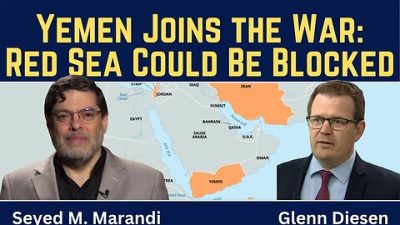
Yemen joins the war – Red Sea could be blocked next – Saudi regime at risk
or go to
Aletho News Archives – Video-Images
From the Archives
A superpower and “the world’s sickest warrior state”
By Paul J. Balles | March 8, 2010
Living through five or six major wars has hardened me to what I thought were the extremes of inhuman cruelty and brutality.
Two things made those extremes almost bearable: the brutality always revealed – at least according to the media coverage – the viciousness of the enemy. It was therefore quite understandable when our “brave men and women” pulverized the enemy.
Films of Japanese torturing captive Americans somehow justified holding Japanese Americans in internment camps during World War II; and only a small percentage of Americans found the bombing of Hiroshima and Nagasaki unreasonably vengeful at best, at worst, depraved.
The media giants in America portrayed the North Koreans as barbaric beasts with their captives, quite unlike their southern counterpoints – our allies during the Korean War. No one ever felt the need to explain how the South Koreans were a civilized breed while the North Koreans were absolute savages, at least according to the official line.
In Vietnam, our warriors justifiably (or so the media made us believe) dropped napalm on the North Vietnamese who had the gall to hide in villages and tunnels to ravage our invaders. At least it was accepted practice until some rogue photojournalist filmed a young girl screaming down a Vietnamese road in flames. … continue
Blog Roll
 Aletho News
- America Racing to Strategic Defeat in Iran: Lt Col Daniel Davis
- FTC Warns Visa, Mastercard, PayPal, Stripe Over Political Debanking
- Russian tanker approaches Cuba despite US oil blockade
- Marandi: Yemen joins the war – Red Sea could be blocked next – Saudi regime at risk
- Pro-Palestinian French member of European Parliament denied entry to Canada
- Pakistan to Host US-Iran Talks
- How Indonesia’s tilt toward the US left it stranded in the Strait of Hormuz
- US has no choice but to retreat from Iranian borders: Top commander
- Iran Retaliation Strikes Chemical Plant Near Dimona
- AWACS’ Destruction is a Major Loss for US Military – Ex-DoW Analyst
- If Americans Knew
- Israeli police block Catholic cardinal from entering Church of the Holy Sepulchre on Palm Sunday
- Israel is assassinating journalists again, more than any other nation, anywhere, ever – Not a ceasefire Day 170
- Over 300 US service members wounded, majority have brain injuries – Not a ceasefire Day 169
- Researchers at Human Rights Watch Resign Over Blocked Report on Palestinian Refugee Return
- Jewish Groups Are Backing a War Americans Don’t Want
- Eric Fingerhut Thinks He’s the President of the Jews
- Top Jewish Philanthropists, Rabbis Urge Israeli President to Take Action Against ‘Jewish Extremists’
- Don’t Be Fooled. Zionist Leaders Have Always Wanted to Control Southern Lebanon
- Israel’s widespread use of torture is a core element of its genocide against the Palestinian people
- In Israel’s War on Iran, Many Middle East US Bases Rendered “All But Uninhabitable”
- No Tricks Zone
- New Study Finds Warming Saves Lives…Cold Temperatures 12 Times More Deadly Than Excess Heat
- German Science Blog Accuses PIK Climate Institute Of Hallucinating Climate Tipping Points
- Devastating Assessment Of Comirnaty Vaccine By Former Senior Pfizer Europe Toxicologist
- New Study: CO2 Is ‘Effectively Negligible’ As An Explanatory Climate Change Factor Since 2000
- Former Pfizer Toxicologist Dr. Helmut Sterz Tells Bundestag Hearing Pfizer Vaccine Should Have Never Been Approved
- Energy Expert: Germany’s Nuclear Phaseout Was A “500 Billion Euro Mistake”
- New Research: South Australia’s Mid-Holocene Sea Surface Temperatures Were 4°C Warmer Than Today
- Storing Green Energy To Last Germany 10 Days Would Require A 60-Million Tonne Battery
- New Studies: UK Sea Levels Were 4 Meters Higher Than Today During The Mid-Holocene
- Destructive Green New Deal: German Energy And Metal Group Warns Of Drastic Crisis
 Aletho News