‘A Form of Bribery’: FDA, HHS Crack Down on Misleading Drug Ads
By Michael Nevradakis, Ph.D. | The Defender | September 10, 2025
Pharmaceutical companies will be required to provide full safety disclosures in direct-to-consumer (DTC) advertisements of their products, according to a new policy HHS and the FDA announced Tuesday.
DTC advertisements “can mislead the public about the risks and benefits” and “encourage medications over lifestyle changes,” according to a memorandum by President Donald Trump outlining the policy.
The U.S. Food and Drug Administration (FDA) will send nearly 100 “enforcement action letters” and thousands of warning letters to pharmaceutical companies and drug retailers who have “increasingly been promoting drugs with no mention of side effects at all,” FDA Commissioner Marty Makary said in a post on X.
The policy also addresses online pharmacies that promote drugs with “no mention of side effects, and paid social media influencers advertising drugs,” Makary wrote.
Administration officials told ABC News that drugmakers often market their products on social media using influencers who are not clearly identified as paid spokespeople.
Mary Holland, CEO of Children’s Health Defense, called the new policy “a major victory” that will “dramatically increase the price of pharma advertising, discourage uptake because of side effects and make Big Pharma‘s lawyers stay up at night worrying that they may not have adequately disclosed risks.”
“This will greatly contribute to making America healthy again because it will start to dismantle Pharma’s grip on Big Media,” Holland said.
‘Pharmaceutical ads hooked this country on prescription drugs’
In announcing the new policy, the U.S. Department of Health and Human Services (HHS) said the ads have “distorted physician prescribing habits and patient decisions.”
The advertisements use positive emotional appeals to encourage people to get those medications, HHS said.
The new policy stops short of an outright ban on the advertising. Instead, the policy will require DTC advertisements to “report full contraindications, boxed warnings, and common precautions” — a return to regulations in effect until 1997.
HHS said the loosened regulations in place since that year created an “explosion of DTC pharmaceutical advertising,” which led to “public deception from patient confusion” and “patient harm via inappropriate demand for medications and misalignment of therapeutic choices with actual patient needs.”
Administration officials told ABC News the new policy “is the strongest, boldest action we can take to make sure that patients have adequate safety information on pharmaceutical ads.”
They said no additional steps are planned to regulate such ads.
“Pharmaceutical ads hooked this country on prescription drugs,” U.S. Health Secretary Robert F. Kennedy Jr. said in a statement. He added:
“We will shut down that pipeline of deception and require drug companies to disclose all critical safety facts in their advertising.
“Only radical transparency will break the cycle of overmedicalization that drives America’s chronic disease epidemic.”
The new policy was announced on the same day the White House released its Make Our Children Healthy Again strategy report, which states that the federal government “will increase oversight and enforcement under current authorities for violations” of DTC drug advertising laws.
Time reported that the U.S. and New Zealand are the only countries that permit DTC drug ads. According to Digiday, Big Pharma spent $30 billion on advertising in 2024. According to HHS, drugmakers spent $369.8 million in social media advertising in 2020.
Relaxed advertising rules had ‘clear negative impact on public health’
According to the White House memo, the U.S. Congress granted the FDA authority to regulate prescription drug advertising in 1962. DTC drug advertising in the U.S. began in 1981, but regulations were loosened in 1997, resulting in a 330% increase in drug advertising by 2005.
According to HHS, the relaxed regulations permitted drugmakers to direct the public to websites, toll-free phone numbers and package inserts for details on contraindications and common precautions.
An HHS fact sheet states that this “loophole … had a clear negative impact on public health,” contributing to about 31% of the rise in U.S. drug spending since 1997.
According to HHS:
- Patients who consulted with their physician about a DTC-advertised drug were about 17 times more likely to receive a prescription than those who didn’t — the result of persuasive marketing techniques.
- 91% of direct-to-consumer drug ad claims featured social approval as a result of product use and 94% employed positive emotional appeals.
- Prescription drug use among Americans increased from 39% (1988-1994) to 49.9% (2017-2020) in the last 30 years.
Following the FDA’s loosening of its regulations in 1997, the agency’s enforcement actions also decreased. “Enforcement letters plummeted from over 130 annually in the late 1990s to just three in 2023,” according to the fact sheet.
HHS said enforcement actions will intensify, with the issuing of “dozens of enforcement letters related to false and misleading advertising, which makes the drug at issue misbranded.”
The FDA will also “send a letter to every single sponsor of an approved drug or biologic … warning them that the Agency is no longer asleep at the wheel, putting them on notice that FDA will be actively enforcing violations of the law, and directing them to remove all non-compliant promotional materials from the market.”
Drug advertising ‘a form of bribery’
Attempts by the federal government to enact a full ban on DTC drug advertisements are likely to face legal challenges, some legal experts say.
A report by The Lever in January states that it is “relatively unlikely” the federal government will be able to ban DTC pharmaceutical ads, partly because courts have previously rejected such attempts on First Amendment grounds.
Attorney Rick Jaffe wrote last year that while legal precedent exists through the 1970 ban on cigarette advertising in broadcast media in the U.S., “An advertising ban on the entire Pharma industry would be a much heavier lift.”
Despite such obstacles, the End Prescription Drugs Now Act, introduced in June and pending before Congress, would ban DTC prescription drug advertising entirely if passed.
Jeffrey Tucker, president and founder of the Brownstone Institute, said the Trump administration’s new policy is “entirely consistent with the First Amendment but will very likely make vast amounts of existing DTC advertising too arduous for it to continue as is.” He said:
“An outright ban would be easily overturned by the courts on First Amendment grounds. On the other hand, in a free society, every seller of products and services has an obligation to warn of risks. This normal practice has been neglected for a long time. This is what has allowed Pharma to spread its wings without accountability and without ensuring informed consent.
“This is an excellent step, not only to protect the public but to curb Pharma capture of the major media.”
According to CNN, the healthcare and drug industry is fourth among all industries in television advertising expenditure, accounting for 11.1% of the market. Prescription drugs accounted for 30.7% of ad minutes across evening news programs on ABC, CNN, Fox News, MSNBC and NBC last year, according to The Wall Street Journal.
According to a 2019 Forbes report, Pfizer spent twice as much on marketing its products as it did on research.
Last year, the Congressional Budget Office estimated that a 10% increase in DTC advertising results in a 1% to 2.3% increase in consumer drug spending.
Mark Crispin Miller, Ph.D., a professor of media studies at New York University whose research and teaching focus on propaganda, said such expenditures have enabled Big Pharma to exercise significant editorial control over the legacy news media.
Miller said:
“Drug advertising, like all commercial advertising, is a form of bribery that corrupts all media that carry it. This development has been the most destructive of them all. Nothing on TV, radio and/or the Internet should be ‘brought to you by Pfizer’ or any other corporate poisoner.”
This article was originally published by The Defender — Children’s Health Defense’s News & Views Website under Creative Commons license CC BY-NC-ND 4.0. Please consider subscribing to The Defender or donating to Children’s Health Defense.
Charlie Kirk refused Netanyahu funding offer, was ‘frightened’ by pro-Israel forces before death, friend reveals
By Max Blumenthal and Anya Parampil | The Grayzone | September 12, 2025
A Trump insider and longtime friend of Charlie Kirk tells The Grayzone how the assassinated conservative leader’s turning point on Israeli influence provoked a private backlash from Netanyahu’s allies that left him angry and afraid.
The source said anxiety spread within the Trump administration after an apparent Israeli spying operation was uncovered.
Charlie Kirk rejected an offer earlier this year from Israeli Prime Minister Benjamin Netanyahu to arrange a massive new infusion of Zionist money into his Turning Point USA (TPUSA) organization, America’s largest conservative youth association, according to a longtime friend of the slain commentator speaking on the condition of anonymity. The source told The Grayzone that the late pro-Trump influencer believed Netanyahu was trying to cow him into silence as he began to publicly question Israel’s overwhelming influence in Washington and demanded more space to criticize it.
In the weeks leading up to his September 10 assassination, Kirk had come to loathe the Israeli leader, regarding him as a “bully,” the source said. Kirk was disgusted by what he witnessed inside the Trump administration, where Netanyahu sought to personally dictate the president’s personnel decisions, and weaponized Israeli assets like billionaire donor Miriam Adelson to keep the White House firmly under its thumb.
According to Kirk’s friend, who also enjoyed access to President Donald Trump and his inner circle, Kirk strongly warned Trump last June against bombing Iran on Israel’s behalf. “Charlie was the only person who did that,” they said, recalling how Trump “barked at him” in response and angrily shut down the conversation. The source believes the incident confirmed in Kirk’s mind that the president of the United States had fallen under the control of a malign foreign power, and was leading his own country into a series of disastrous conflicts.
By the following month, Kirk had become the target of a sustained private campaign of intimidation and free-floating fury by wealthy and powerful allies of Netanyahu – figures he described in an interview as Jewish “leaders” and “stakeholders.”
“He was afraid of them,” the source emphasized.
At TPUSA, the rift with Israel widens
Kirk was 18 years old when he launched TPUSA in 2012. From its inception, his career was propelled by Zionist donors, who showered his young organization with money through neoconservative outfits like the David Horowitz Freedom Center. He repaid his wealthy backers over the years by unleashing a relentless firehose of anti-Palestinian and Islamophobic diatribes, accepting propaganda trips to Israel, and sternly shutting down nationalist forces challenging his support for Israel during TPUSA events. In the Trump era, few American gentiles had proved more valuable to the self-proclaimed Jewish state than Charlie Kirk.
But as Israel’s genocidal assault on the besieged Gaza Strip drove an unprecedented backlash within grassroots right-wing circles, where only 24% of younger Republicans now sympathize with Israel over the Palestinians, Kirk began to shift. At times, he toed the Israeli line, spreading disinformation about babies beheaded by Hamas on October 7, and denying the famine imposed on the population of Gaza. Yet he simultaneously ceded to his base, wondering aloud if Jeffrey Epstein was an Israeli intelligence asset, questioning whether the Israeli government allowed the October 7 attacks to proceed in order to advance long-term political goals, and parroting narratives familiar to his most vociferous critic on the right, streamer Nick Fuentes.
This July, at his TPUSA Student Action Summit, Kirk provided a forum for the right-wing grassroots to vent its fury about Israel’s political hammerlock on the Trump administration. There, speakers from former Fox News stalwarts Tucker Carlson and Megyn Kelly, to the anti-Zionist Jewish comedian Dave Smith, denounced Israel’s blood-soaked assault on the besieged Gaza Strip, branded Jeffrey Epstein as an Israeli intelligence asset, and openly taunted Zionist billionaires like Bill Ackman for “getting away with scams” despite having “no actual skills.”

Following the confab, Kirk was bombarded with infuriated text messages and phone calls from Netanyahu’s wealthy allies in the US, including many who had funded TPUSA. According to his longtime friend, the Zionist donors treated Kirk with outright contempt, essentially ordering him to fall back into line.
“He was being told what you’re not allowed to do, and it was driving him crazy,” Kirk’s friend recalled. The conservative youth leader was not only alienated by the hostile nature of the interactions, but “frightened” by the backlash.
The friend’s account dovetails with those of multiple right-wing commentators with access to Kirk.
“I think, in the end, Charlie was going through a spiritual transformation,” Candace Owens, a conservative influencer who shifted decisively against Israel after October 7, reflected after her friend’s killing. “I know it, he was going through a lot. There was a lot of pressure, and it’s hard for me to watch the people who were pressuring him just say the things that they’re saying.”
She continued: “They wanted him to lose everything for changing or even slightly modifying an opinion. It’s very hurtful to me.”
Kirk appeared visibly outraged during an August 6 interview with conservative host Megyn Kelly, as he discussed the menacing messages he was receiving from pro-Israel bigwigs.
“It’s all of the sudden: ‘oh, Charlie: he’s no longer with us.’ Wait a second—what does ‘with us’ mean, exactly? I’m an American, okay? I represent this country,” he explained, before addressing the powerful Zionist interests harassing him.
“The more that you guys privately and publicly call our character into question—which is not isolated, it would be one thing if it were just one text, or two texts; it is dozens of texts—then we start to say, ‘whoa, hold the boat here,’” Kirk continued. “To be fair, some really good Jewish friends say, ‘that’s not all of us’… But these are leaders here. These are stakeholders.”
He went on to complain to Kelly, “I have less ability… to criticize the Israeli government than actual Israelis do. And that’s really, really weird.”
In one of his final interviews, conducted with Israel’s premier influencer in the United States, Ben Shapiro, Kirk once again tried to raise the issue of censorship of Israel critics.
“A friend said to me, interestingly: ‘Charlie, okay, we’ve pushed back against the media on COVID, on lockdowns, on Ukraine, on the border,’” Kirk told Shapiro on September 9. “Maybe we should also ask the question: is the media totally presenting the truth when it comes to Israel? Just a question!”

According to Kirk’s longtime friend, Kirk’s resentment of Netanyahu and the Israel lobby was spreading within Trump’s inner circle. In fact, they said, the president himself was terrified of Netanyahu’s wrath, and feared the consequences of defying him.
During the past year, the Trump insider was told by contacts in the White House that the Secret Service had caught Israeli government personnel placing electronic devices on its emergency response vehicles on two separate occasions.
While The Grayzone was unable to confirm the story with the Secret Service or White House, such an incident would not have been unprecedented. Indeed, according to a report in Politico citing three former senior US officials, a cellphone spying device was placed by Israeli agents “near the White House and other sensitive locations around Washington” toward the end of Trump’s first term in 2019.
Former UK Prime Minister Boris Johnson recounted a similar incident in his memoir, writing that his security team found a listening device in his bathroom soon after Netanyahu used his personal toilet.
The Israel-did-it theory
Kirk was killed this September 10 with a single shot fired by a sniper apparently positioned on a rooftop 200 meters away. He was shot while seated before a crowd of thousands at Utah State University in Orem, Utah on the first leg of his American Comeback Tour. The scene of Kirk collapsing from the impact of a gunshot to his neck just as he began answering a question about transgender mass shooters was perhaps the most shockingly vivid spectacle of assassination – and certainly the most viral – in human history.
There is currently no evidence of an Israeli government role in Kirk’s assassination. However, that has not stopped thousands of social media users from speculating that the pro-Trump operative’s shifting views on the issue contributed in some way to his death. By the time of publication, over 100,000 Twitter/X users have liked a September 11 post by libertarian influencer Ian Carroll declaring about Kirk, “He was their friend. He basically dedicated his life to them. And they murdered him in front of his family. Israel just shot themselves.”
Many advancing the unsubstantiated theory have pointed to a Twitter/X post by Harrison Smith, a personality at the pro-Trump Infowars network, stating on August 13 – almost a month before Kirk’s assassination – that he was told by “someone close to Charlie Kirk that Kirk thinks Israel will kill him if he turns against Israel.”
The frenzied speculation has set off shockwaves in Tel Aviv, where Netanyahu was compelled to explicitly deny that his government killed Kirk during a September 11 interview with NewsMax.
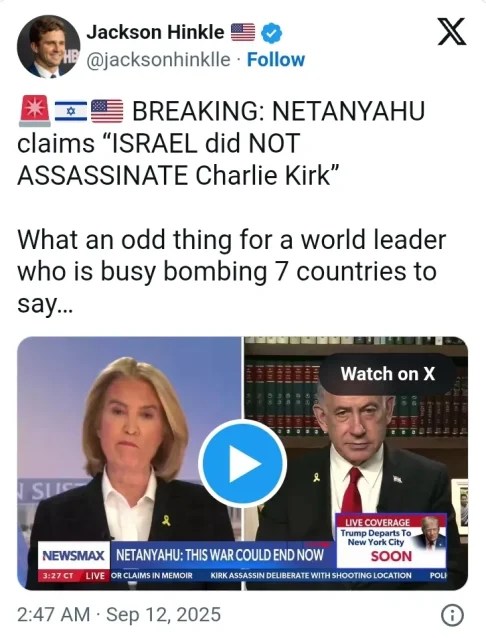
Netanyahu and his allies bury the Kirk crisis as “big tent” collapses
That appearance was just one of several interviews and statements the Prime Minister dedicated to Kirk in the wake of his killing in an effort to frame the late conservative leader’s legacy in a uniformly pro-Israel light. The major public relations push has occurred while Netanyahu wages a military campaign on seven fronts, punctuated by a regional assassination spree that most recently reached into the heart of Qatar, a US ally.
Netanyahu first tweeted prayers for Kirk at 3:02 PM in the afternoon on September 10, minutes after news of the shooting broke. He has since authored three additional posts about Kirk, even breaking away from the Israeli war cabinet to spend the afternoon of September 11 memorializing the conservative leader on Fox News.
During that interview, Netanyahu did his best to insinuate that Israel’s enemies were responsible for murdering Kirk, despite the fact no suspect was named or in custody at the time:
“The radical Islamists and their union with the ultra-progressives—they often speak about ‘human rights,’ they speak about ‘free speech’—but they use violence to try to take down their enemies,” the Prime Minister told Harris Faulkner.
In a September 10 Twitter/X post eulogizing the conservative leader, the Israeli Prime Minister described a recent phone conversation with Kirk.
“I spoke to him only two weeks ago and invited him to Israel,” Netanyahu declared. “Sadly, that visit will not take place.”

Left unmentioned was whether Kirk declined the invitation—just as he did with the Prime Minister’s offer to reload TPUSA’s coffers with donations from his coterie of wealthy American Jewish cutouts.
At the time of publication, a 22-year-old resident of Utah has been taken into custody after supposedly confessing to killing Kirk. The public may soon learn the true motives of the alleged assassin. Perhaps they will fuel the narrative which Trump and his allies advanced in the immediate wake of the shooting – that a leftist radical was responsible, and that a wave of draconian repression must follow.
But after the shooter’s initial escape and a series of federal law enforcement mishaps, a large sector of Americans will likely never believe the official story. Nor will they ever know where Kirk’s turning point on Israel would have taken the conservative movement.
Four days before the assassination, frustration among pro-Israel commentators bubbled over in public during a Fox News interview in which Ben Shapiro launched a chilling attack on Kirk without naming him.
“The problem with a ‘big tent’ is that you may end up with many clowns inside,” Shapiro told Fox host and fellow Zionist gatekeeper Mark Levin in an apparent critique of TPUSA.
“Just because you’re saying somebody votes Republican—that doesn’t mean that they ought to be the preacher at the front of the church, they’re not the person that ought to be leading the movement, if they are spending all day criticizing the President of the United States as ‘covering up a Mossad rape ring’ or ‘being a tool of the Israelis for hitting an Iranian nuclear facility.’”
When Kirk took his usual place at the “front of the church” four days later, he was cut down by a sniper’s bullet.
Within 24 hours of Kirk’s death, Shapiro announced that he would be launching his own campus speaking tour, vowing: “We’re gonna pick up that blood stained microphone where Charlie left it.”
Israeli Strikes on Media Offices Kill At Least 25 Journalists in Yemen
By Kyle Anzalone | The Libertarian Institute | September 12, 2025
An Israeli attack on Yemen hit the offices of two newspapers in Sanaa, killing dozens of journalists and civilians. The Yemeni Journalists Union condemned the attack, labeling it a heinous war crime.
According to the Yemeni Health Ministry, the Israeli strikes hit the offices of the 26 September newspaper and Al-Yemen newspaper, killing at least 25 journalists. 26 September is the military’s media outlet, and Al-Yemen is one of the most read newspapers in Yemen.
The Yemeni Journalists Union said it “strongly condemns the heinous war crime committed by the brutal Israeli aggression on Wednesday, 10 September 2025, through its direct targeting of the offices of 26 September newspaper and Al-Yemen newspaper in the capital.”
Yemeni authorities report that at least 46 people were killed in strikes across Sanaa. A military facility and a fuel station were targeted along with media offices. The death toll is expected to rise as rescue and recovery efforts are ongoing. More than 165 people were injured.
The majority of those killed, 38, died in the strikes on Sanaa, which targeted residential areas.
The latest Israeli strikes in Yemen are part of the ongoing conflict between Tel Aviv and Ansar Allah. Ansar Allah, or the Houthis, control most of Yemen, including the capital city. After Israel began its onslaught and siege of Gaza, Ansar Allah placed a blockade of Israeli-linked shipping in the Red Sea.
In response to the blockade, Israel and the US have repeatedly bombed Yemen, killing a large number of civilians. The strikes have failed to break the blockade, and Ansah Allah has responded by direct attacks on Israel with missiles and drones.
The blockade has caused significant Financial losses to Israel’s Red Sea port. In July, the head of the Port of Eilat warned that the facility may have to shut down without additional financial assistance from Tel Aviv.
Yemeni leaders opposed to Ansar Allah warned US Senators that the strikes in Yemen have only empowered the Houthis. The warning was sent following an Israeli attack that killed political leaders, including the prime minister.
UN overwhelmingly endorses declaration on Palestinian state
Press TV – September 12, 2025
The United Nations General Assembly has overwhelmingly voted to endorse a declaration outlining “tangible, timebound, and irreversible steps” towards the establishment of a Palestinian state.
The 142-10 vote on Friday was to endorse the so-called New York declaration, a statement calling for a two-state solution, crafted by France and Saudi Arabia in July.
Joining Israel and the United States in opposing the resolution were Argentina, Hungary, Micronesia, Nauru, Palau, Papua New Guinea, Paraguay and Tonga. Twelve countries abstained.
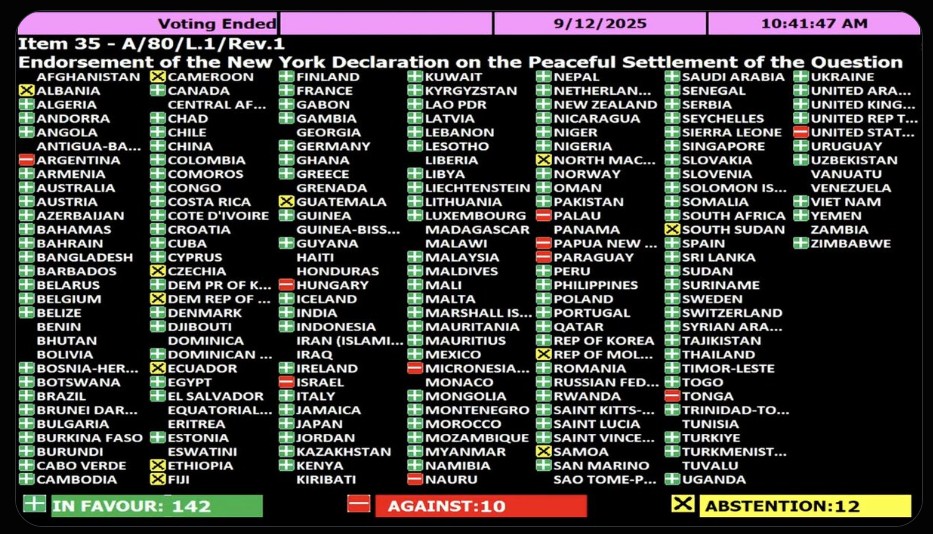
Israel, US isolated
The seven-page declaration is the result of an international conference at the UN on the decades-long Israeli occupation. The United States and Israel boycotted the event.
The declaration, which excludes Hamas, also calls for “collective action to end the Israeli war in Gaza and effective implementation of the two-state solution.”
The declaration, was endorsed by the Arab League and co-signed in July by 17 UN member states, including several Arab countries
Long-time Western allies of Israel, including Belgium, France, the UK, Canada, and Australia, had earlier announced plans to recognize Palestinian statehood during the upcoming UN General Assembly sessions from September 8–23. They would join 147 nations that already formally recognize Palestine.
Around three-quarters of the 193 UN member states recognize the Palestinian state proclaimed in 1988 by the exiled Palestinian leadership.
Benjamin Netanyahu, Israeli prime minister, insisted on Thursday that Israel would never accept a Palestinian state.
Gideon Saar, the Israeli foreign minister, recently threatened that the Europeans’ recognition of Palestinian statehood would push Tel Aviv into “unilateral decisions”.
Israel’s far-right finance minister, Bezalel Smotrich, has announced plans to annex more than 80 percent of the occupied West Bank in a bid to block the establishment of a Palestinian state.
On August 14, Smotrich announced his intention to move forward with the highly contentious settlement project across the occupied West Bank that “buries the concept of a Palestinian state”.
In July 2024, the International Court of Justice (ICJ) declared Israel’s occupation of the Palestinian territory illegal and called for the evacuation of all settlements in the West Bank and East al-Quds. All mere words.
The recognition of a Palestinian state comes as international pressure was mounting on the regime over its genocidal war in the besieged Gaza Strip.
Since the Israeli genocide began in October 2023, the death toll has surpassed 64,700, with more than 164,000 others wounded.
Over 1,000 Palestinians detained as Israeli forces tighten grip on West Bank’s Tulkarm city

Israeli forces detain Palestinians following an explosion in Tulkarm, West Bank, on September 11, 2025. [Nedal Eshtayah – Anadolu Agency]
MEMO | September 12, 2025
Israeli forces have detained more than 1,000 Palestinians in the northern West Bank city of Tulkarm as part of a sweeping operation now in its second day, according to local officials, Anadolu reports.
Troops sealed off the city’s main entrances, stormed homes, shops and cafes, and forced young men into lines for field interrogations. Witnesses said soldiers vandalized property, seized surveillance recordings and deployed heavy machinery, including a bulldozer, in the city center.
Abdullah Kamil, governor of Tulkarm, said Friday the campaign amounted to “collective punishment” and called on the international community and rights groups to step in, warning of dire humanitarian consequences.
Israeli media said the clampdown followed a roadside bomb that struck a Panther armored vehicle near the Nitzanei Oz checkpoint on Thursday, lightly wounding two soldiers.
The Al-Qassam Brigades, Hamas’ armed wing, and Islamic Jihad’s Al-Quds Brigades claimed responsibility for the attack, saying they detonated a large explosive charge against Israeli forces near the checkpoint.
Tulkarm has become a flashpoint in the army’s months-long campaign across the northern West Bank, where near-daily raids have escalated since the start of the Gaza war.
Since the start of Israel’s genocidal war on the Gaza Strip in October 2023, at least 1,020 Palestinians have been killed and more than 7,000 injured in the occupied West Bank by Israeli forces and illegal settlers, according to the Palestinian Health Ministry.
In a landmark opinion last July, the International Court of Justice declared Israel’s occupation of Palestinian territory illegal. It demanded the evacuation of all settlements in the West Bank and East Jerusalem.
Israel’s ‘Holy War’ falters: Seven fronts, Zero victory
Netanyahu’s ‘historic and spiritual mission’ is bleeding international support, turning short-term military gains into an imminent strategic defeat.
By Mohamad Hasan Sweidan | The Cradle | September 11, 2025
For nearly two years, Israel has been waging what Netanyahu calls a “multi-front war.” This war includes, in addition to Gaza, Lebanon, Syria, Iraq, Yemen, the occupied West Bank, and Iran. In one of his interviews, Israeli Prime Minister Benjamin Netanyahu stressed that he feels he is on a “historic and spiritual mission,” and that he is “deeply connected” to the vision of the Promised Land and Greater Israel. With these words, Netanyahu confirms that what he calls a “multi-front war” is driven by both religious and political motives.
The danger lies in Netanyahu and the radical religious Zionist right believing that the world must approach the brink of a great war “for the Messiah to descend and save it”. For this reason, they encourage continuing and expanding the violence in Gaza to Lebanon, Iran, and beyond, seeing this as the “age of the Messiah.”
The seven fronts of the war
On 9 October 2023, just two days after Operation Al-Aqsa Flood, during a meeting with the mayors of the southern border towns affected by the 7 October attack, Israel’s Prime Minister stated that Tel Aviv’s response to the unprecedented multi-front assault launched by Palestinian fighters from Gaza “will change the Middle East.” From that moment, it became clear that the war would not remain confined to Gaza, but that Israel would expand it to achieve its main goal, which is a new regional order where the balance of power favors Tel Aviv.
Israeli leaders have repeatedly claimed they are simultaneously fighting on seven fronts – Gaza, Lebanon, Syria, Iraq, Yemen, the occupied West Bank, and Iran – portraying all these conflicts as targeting an “Iran-led axis” allegedly seeking to “destroy the Jewish state.”
To achieve this goal, Israel pursues two main paths: weakening its enemies and enforcing compliance by force on the rest of the region’s states, including US allies. On the first path, Israel has relied on direct military strikes, framing them as “multi-front wars” under a “defensive” rationale.
As for the second path, enforcing compliance by force, Israel repeatedly attacked the “new Syria,” a state no longer hostile to Israel or the US, and has occupied portions of its territory. Syria’s consistently positive overtures toward Tel Aviv did not deter Israel, which persisted in its strikes and continued occupation.
Meanwhile, Israel’s recent strike on Qatar on 9 September fits within two parallel tracks of its policy. The first is aimed directly at Hamas’s political leaders, signaling that there is no safe haven for them anywhere in the world. The second conveys a clear message to Qatar and other US allies in the region; Israel’s approach is not based on shared interests but on fear of consequences. Alliances based on mutual interests are one thing, and compliance enforced through fear is another. At this stage, this is precisely the message Trump seeks to send to the region’s states: “Obey me, or I cannot guarantee that Israel will remain distant from you.” Fundamentally, this warning is addressed to all states in the region, without exception.
Regional states must understand that what once shielded their capitals from Israeli-American aggression was the presence of the Axis of Resistance that maintained a regional deterrence balance for years. Once this axis weakened, Israel was liberated from constraints and began operating without limits. It should not be noted that Qatar is officially designated a “Major Non-NATO Ally” of the US, a status conferred by the Biden administration since March 2022. In addition, Qatar hosts the Al-Udeid Air Base, which is far more than a conventional military base, but serves as the headquarters of US Central Command (CENTCOM) in the region, making it one of Washington’s most strategically significant hubs worldwide. Yet none of this prevented Tel Aviv from attacking it.
What has Israel achieved?
We must begin by defining strategic achievement. In international relations, a strategic achievement can be defined as attaining long-term goals that reshape the balance of power, enhance state security, or expand influence in the international system. Strategic achievement differs from short-term tactical or operational gains in that it “produces changes in the fundamental structures of interaction between states and non-state actors.” This means that strategic achievement must consolidate a lasting advantage in the geopolitical arena.
From this perspective, Israel has so far failed to achieve any strategic accomplishments in West Asia. Instead, over the past two years, it has accumulated a series of tactical gains that it seeks to transform into strategic advantages. In Gaza, Tel Aviv remains unable to eliminate the Hamas, and in Lebanon, it has likewise failed to dismantle Hezbollah – despite managing to weaken both resistance movements. In Iran, its attempts to change the regime or dissuade Tehran from supporting resistance movements have failed. In Yemen, its actions did not stop Sanaa’s support for Gaza.
Therefore, the core of the current battle is to prevent Tel Aviv from transforming its tactical gains into entrenched strategic ones. If Israel fails to eliminate the Palestinian resistance, fails to isolate and disarm Hezbollah in Lebanon, sees Iran continue to support resistance movements and anti-hegemony discourse, and if the Yemeni support front remains steady, then Israel will have exhausted the maximum of its power to impose a regional reality that grants it temporary superiority, neutralizing resistance for a period, but remaining fragile and unsustainable in the medium and long term.
The outcome of this struggle ultimately depends on Tel Aviv’s opponents overcoming the multiple challenges created by its wars in West Asia. Either the resistance forces succeed in thwarting Tel Aviv’s attempts to turn temporary gains into a long-term strategic achievement, or Tel Aviv and Washington succeed in leveraging these tactical gains to impose a new strategic reality that serves their interests.
A critical question then arises: What price has Israel paid to achieve its current ‘accomplishments’?
In a recent article titled ‘Israel is Fighting a War It Cannot Win,’ Ami Ayalon, former head of the Israeli Navy and former director of Shin Bet, writes, “The course Israel is currently pursuing will erode existing peace treaties with Egypt and Jordan, deepen internal divisions, and heighten international isolation. It will fuel greater extremism across the region, escalate religious-nationalist violence by global jihadist groups thriving on chaos, weaken support from US policymakers and citizens, and drive a rise in anti-Semitism worldwide.”
He concludes by saying, “Israel’s military deterrence has been restored, demonstrating its ability to defend itself and deter its enemies. But force alone cannot dismantle Iran’s network of proxies nor secure lasting peace and stability for Israel for generations to come.”
Additionally, as a result of Israeli crimes in Gaza, responsibility for the humanitarian catastrophe there has shifted from Hamas to Israel. For a long time, Tel Aviv sought to portray Hamas as primarily responsible for Gaza’s difficult humanitarian reality. However, Israel’s unlimited aggressiveness undermined this effort.
A survey conducted by Israel’s Ministry of Foreign Affairs to evaluate its global reputation found that respondents in the US, Germany, Britain, Spain, and France believe that the majority of those killed by Israel in Gaza are civilians. The survey also revealed that Europeans, in particular, “agree with characterizing Israel as a state of practicing genocide and apartheid, despite their opposition to Hamas and Iran.” Moreover, a recent Quinnipiac University poll indicated that 37 percent of US voters support Palestinians, compared to 36 percent who support Israelis. The danger of these figures is that they show Israel is losing western public opinion, which may make support for Tel Aviv a key issue in future western elections.
Furthermore, nine states completed the legal procedures required to formally recognize the State of Palestine last year, the largest annual increase since 2011:
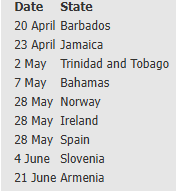
These recognitions raised the global total from 138 to 147 in 2024, meaning that nearly three-quarters of UN member states (147 out of 193) now officially recognize the State of Palestine.
In addition, three of the US’s key allies – France, the UK, and Canada – announced their intention to recognize a Palestinian state, while several other countries are considering the same step. This marks a significant shift that further isolates Israel amid growing international concern over Gaza’s humanitarian crisis. These three countries will become the first G7 members to formally recognize a Palestinian state, posing a clear challenge to Israel. Should they proceed, the US would remain the sole permanent UN Security Council member not to recognize Palestine.
A new combat doctrine
There is no doubt that 7 October marked a turning point in Israel’s military strategy. From that date onward, Israel abandoned for the first time the combat doctrine established by David Ben Gurion, Israel’s first prime minister. Blitz wars were no longer its preferred option, the issue of recovering prisoners was no longer a central priority, and its threshold for human and material losses in any military confrontation rose significantly. This shift compels all regional states to recalibrate their strategies to match Tel Aviv’s new combat doctrine.
It is important to stress that Ben Gurion designed Israel’s combat doctrine to suit its geographic and demographic realities. This may have prompted retired Israeli colonel Gur Laish, former head of war planning in the Israeli Air Force and a key participant in the army’s strategic planning, to publish a paper on 19 August at the Begin-Sadat Center for Strategic Studies, warning Israeli leaders against adopting a new security doctrine that disregards Israel’s limits of power. Yet, the following crucial question remains: Will Netanyahu succeed in proving the effectiveness of Israel’s new approach, or will abandoning Ben Gurion’s doctrine mark the beginning of Israel’s end?
Israel’s strike on Qatar exposes the collapse of Arab security assumptions
By Dr Sania Faisal El-Husseini | MEMO | September 12, 2025
The thunder of Israeli warplanes over Doha this week was more than just a military operation, it was a shattering moment for the region. Missiles aimed at residential neighbourhoods in Qatar’s capital, as an attempt to assassinate Hamas leaders, sent a shockwave across the Gulf. The United States, caught between its alliance with Israel and its defence commitments to Qatar and other Arab Gulf states, sought refuge in manoeuvering, distancing itself from the strike while tacitly enabling it. For Arab national security, particularly in the Gulf, the implications are sobering.
The paradox is glaring, Qatar, host to the vast Al-Udeid Air Base, America’s forward headquarters in the region, and dependent on US military systems for its defence, finds itself exposed. The strike underscored what many Arab analysts have long warned, Washington’s strategic loyalty lies firmly with Israel, while Arab allies are seen as expendable partners.
This attack, the first of its kind on Qatari soil, is unlikely to be the last in the region. While framed as part of Israel’s campaign against Hamas, its significance extends far beyond Gaza.
For years, Qatar has hosted indirect negotiations between Hamas and Israel, offering itself as a diplomatic broker. But Israel, it now appears, used those talks as cover, buying time while pursuing unchanged objectives, the conquest of Gaza, the dismantling of Hamas, and the displacement of its population. As Israel intensified its push into Gaza City, it simultaneously targeted the Hamas delegation in Doha, an unmistakable signal that diplomacy was never the true endgame.
The operation reflects a broader Israeli strategy, expand military dominance step by step, strike beyond borders, and erase red lines that once constrained its reach.
Qatar’s own relationship with Israel has always been a delicate balance. From the opening of an Israeli trade office in Doha in 1996, to intelligence meetings hosted in recent years, to participation in joint air exercises in Greece, the two states have maintained limited yet functional ties. Still, Israel’s decision to strike inside Qatar amounts to a message to the entire Arab Gulf, no country is immune, and restraint will only embolden further violations.
This reality stretches well beyond the Palestinian question. Israel’s ambitions are no longer confined to blocking Palestinian statehood. The Netanyahu government, driven by the most hardline coalition in Israel’s history, has laid bare its intent, redraw the regional map through force, not diplomacy. Its declared expansion goals in the region, military reach backed by nuclear superiority, unmatched intelligence networks, and unwavering US support positions it as a major security threat to the regional countries. From assassinations in Iran to operations in Lebanon, Syria, Yemen, Iraq, and now Qatar, Israel acts with impunity. The Gulf, it seems, is simply no longer far from its attacks and ambitions.
The position of the American adminstration towrds the Israeli attack on Qatar has revealed a pivotal thorny issue. Qatar’s partnership with Washington was supposed to offer military and security safeguards. The two countries signed a Defence Cooperation Agreement in 1992, renewed in 2013, and Qatar was designated a Major Non-NATO Ally in 2022. Billions have been invested in Al-Udeid, now central to US operations across the region and Central Asia. Yet when Israel violated Qatari sovereignty, the US response revealed the harsh truth, strategic guarantees for Arab states collapse the moment they clash with Israel’s interests.
For Qatar and for every Arab state relying on US military systems, the lesson is stark. Dependence on Washington offers no shield when it matters most.
Many Arab states, particularly in the Gulf, have built their national defense almost entirely on Western military and security systems. In addition to Qatar, Saudi Arabia relies heavily on U.S. made F15 fighter jets and Patriot missile defence systems, the United Arab Emirates has invested billions in advanced American and French aircraft, as well as the THAAD missile shield, Bahrain hosts the US Fifth Fleet, and Kuwait depends on American logistical and intelligence support. These examples reflect a broader regional reality, the very foundations of Arab security are tied to Western supply chains, training, and decision making structures. Yet the Israeli strike on Qatar laid bare the danger of this dependency. When the interests of Washington and Tel Aviv converge, as they so often do, the security of Arab allies becomes secondary. Israel’s declared ambitions to project power beyond Palestine, coupled with the US’s unambiguous tilt toward Israel, mean that the entire architecture of Arab national security now stands on precarious ground.
Silence now would be perilous. If Arab governments allow this strike on Doha to pass without response, Israel will take it as a green light to extend its reach even further. The moment demands more than statements of concern. It requires a collective Arab reckoning, not only with Israel’s unchecked aggression, but with the illusion that the US security umbrella offers reliable protection.
The question is simple, if uncomfortable, will Arab states finally learn from experience, or will they continue to build their security on foundations that crumble when tested?
Geopolitical Ripple Effect: How Doha Attack Undermines US Credibility in the Gulf, Empowers BRICS
Sputnik – 12.09.2025
Israel’s aggression against one of America’s key allies in the oil-rich Persian Gulf is a wake-up call for the region’s nations about the hollowness of US security guarantees. The question now is whether they’ll answer, military and regional experts tell Sputnik.
Security
The failure of US and European-made equipment to stop Israel’s assault leaves only one option open: Russia, says defense analyst Igor Korotchenko.
Russian specialists could build Qatar a system that would give the emirate “the keys” to its skies, leaving “no country able to strike with impunity without the risk of losing both the carriers and strike systems” used in the aggression.
A pivot to Russia is fully realistic, given Moscow’s sale of Pantsir-S1s to the UAE, Qatar’s maritime neighbor.
To reliably close the skies to the enemy, Qatar could complement its defenses with Pantsirs, Buk-M3s, and Tor-M2s.
Commerce & Trade
“The Gulf is already engaged with the multipolar world” on economic matters, says Dr. Tamer Qarmout of the Doha Institute for Graduate Studies.
If the political will exists, not just Qatar but the region could “diversify their alliances and engage more with multipolarity.”
The UAE is already in BRICS, and Saudi Arabia has been invited. Gulf states also enjoy strong bilateral economic links with key BRICS powers including Russia (agriculture, IT), India (labor and trade) and China (trade and strategic initiatives like BRI).
Old Chains of Bondage Could Be Hard to Break
For most of their existence, Gulf powers “have never been truly sovereign,” says veteran Mideast expert Isa Blumi. “They’ve always been dependent on the British and the Americans,” and “internal struggles and rivalries” have made them ripe for manipulation.
That means “strategically and from a security and political perspective,” Gulf powers’ “interests are still largely embedded with, or aligned with, the US as a strategic partner,” Qarmout says.
Time for Strategic Self-Reflection
Israel’s attack “introduced significant uncertainties and major questions for Gulf nations regarding the future” of economic, political and military partnerships with the US.
The “difficult and existential” question is whether Gulf nations will “intensify” links to BRICS “to include new sectors like security and defense,” given the US’s abject failure to protect its “ally” “in such a blatant manner,” Qarmout summed up.
EU could target ‘Russian SWIFT’ – Euractiv
RT | September 12, 2025
The European Union could sanction foreign banks that use Russia’s domestic alternative to the SWIFT interbank messaging system, as the bloc weighs another batch of measures targeting countries it claims are helping Moscow bypass restrictions, Euractiv has reported.
Russia has been promoting its own payment system as a reliable alternative to SWIFT since many of the country’s financial institutions were cut off from the Western network in 2022. The System for Transfer of Financial Messages (SPFS) ensures the secure transfer of financial messages between banks both inside and outside the country.
France and Germany are spearheading the proposal to hit Russia’s trading partners as part of the bloc’s 19th sanctions package against Moscow, the outlet said on Tuesday. Paris and Berlin argue the measures should strike at what they describe as the “deeper structures” of Russia’s financial and logistics networks.
The SPFS system has become a key workaround for Russian and non-Russian banks seeking to maintain trade flows despite Western efforts to isolate Moscow.
In June 2024, Brussels banned EU banks operating outside Russia from connecting to SPFS or carrying out transactions via the system, threatening violators with exclusion from Europe’s own financial networks. As of early 2025, 177 foreign entities across 24 countries were connected to SPFS, according to the Russian central bank.
Moscow has accelerated efforts to move away from SWIFT by trading with international partners in their national currencies – a trend increasingly supported by BRICS members, which have shifted from using the dollar and euro in trade settlements.
Russia has long denounced Western sanctions as illegal, repeatedly noting that they have failed to achieve their ultimate goal of destabilizing the economy and isolating the country from the global financial system. Instead, Moscow argues, they have backfired on the states that imposed them.
EU chief facing new ouster attempt after ‘pro-war’ address
RT | September 12, 2025
European Commission President Ursula von der Leyen is facing two new motions of no confidence following her State of the Union address to the European Parliament this week.
The Left faction filed its censure proposal on Thursday, a day after the right-wing Patriots for Europe group submitted a separate bid. Von der Leyen survived a previous no-confidence vote in July.
Renewed efforts to remove the EU chief came after she urged stronger military support for Ukraine and proposed allowing foreign policy decisions without unanimous member-state approval – which dissenting member states, such as Hungary, view as a ploy to dismiss their objections.
Hungarian Prime Minister Viktor Orban, who backs the no-confidence motion, views von der Leyen’s remarks as “hardcore pro-war,” according to governmental spokesman Zoltan Kovacs. In her address, “the word ‘Ukraine’ was mentioned 35 times, and threats were made to cut EU funds from anyone refusing to follow Brussels’ line,” he said on social media.
The Patriots’ motion argued the president “has failed on trade, abandoned transparency, and rejected accountability,” while the Left – joined by some Greens/EFA MEPs – accused her of having “sold out workers and farmers, funneled billions into arms and war, shredded climate and social protection” and being “complicit in genocide” in Gaza.
“There is a tendency within the European Commission to push things through by force” at the EU’s expense, Left co-leader Manon Aubry told Euronews. She cited a recent deal with the United States that she said “will literally reduce the EU to a Donald Trump vassal.”
During the previous attempt to unseat her, von der Leyen dismissed her critics as “conspiracy theorists” and claimed they acted on behalf of Russian President Vladimir Putin, saying there was “ample proof that many are supported by our enemies and by their puppet masters in Russia or elsewhere.”
The current commission is trying to launch a multibillion-euro military expansion program across member states, arguing the EU should fund it through loans to counter the threat from Russia – an assessment Moscow calls baseless.
If the United States Wants to Survive It Must Free Itself from Israel
Israeli dominance over Washington has gone on for far too long
By Philip Giraldi • Unz Review • September 11, 2025
I have university degrees in ancient, medieval and early modern history but search as I may, I cannot find another example of a small, low population state largely devoid of natural resources that has been able to dominate the politics and policies of a much larger great power to the extent that Israel controls many aspects of America’s government, its economy, its education system, its media, and, most of all, its foreign and national security policies. Little Israel commands and the superpower United States obeys, a relationship that has coined the expression “the tail wags the dog.”
To be sure, Israel has resources that might be regarded as unconventional for most nation states around the globe, consisting of a large and astonishingly wealthy network of “diaspora” co-religionists who are prepared to corrupt the governments in the countries where they actually live to benefit the Jewish state in every way possible. Politicians can easily be bought by Jewish billionaires, as in the case of President Donald Trump who reportedly received $100 million as a campaign donation from Israeli Las Vegas casino magnate Miriam Adelson, plausibly in exchange for Israel having a free hand in the West Bank, up to and including total annexation and deportation of the inhabitants to eliminate a possible Palestinian state.
In the United States, this Zionist Lobby power has produced a series of presidents terrified to object to what Israel declares to be its interests, plus a Congress that has been bought and manipulated into total submission to war criminals like Israel’s ghastly Prime Minister Benjamin Netanyahu. Even the US Constitution is no defense against Israel’s interests, with First Amendment free speech rights being abridged through the interpretation that any criticism of the self-described Jewish state is ipso facto a hate crime, which is a felony.
The abuse inherent in the relationship, which is hugely expensive to the US and damaging to its real interests, is fortunately beginning to be so visible that a reaction to the arrangement is beginning to penetrate to the level of the average voters. Opinion polls suggest that most Americans oppose what Israel is doing to the Palestinians, but President Donald Trump and the clowns he has appointed to high office, Zionists all, are unmoved. Hopefully they will see the light if a strong message is sent during elections coming up in November.
In a recent interview, I declared that the only real national security threat against the United States comes from Israel in that it has repeatedly pushed America into bad policy choices to serve its own interests. That means that policymakers, in search of the number one “American enemy” in the world, should look no farther than Israel and they should immediately take steps to distance themselves from Israeli initiatives. In terms of other alleged threats to the US, one must concede that most analyses coming out of Washington are essentially phony, designed to deflect from real problems, including which is what to do about Israel and the all-powerful Israeli Lobby reenforced by the “waiting for a Rapture” Christian Zionists that have taken over so much of the government. Sorry Marco Rubio but Russia, China, Iran, and Venezuela do not threaten the United States of America. Continuation of the dance of death with the Israelis will on the contrary be likely to lead to ruin for Americans.
The sad truth is that the United States gains absolutely nothing from its bondage to Israel, quite the contrary. When I was in government in CIA Stations and Bases in Europe and the Middle East I used to hear US politicians proclaiming how Israel (Mossad) shared wonderful intelligence information that made America safer. The truth was quite different as I used to see the Israel-generated reports and they were consistently puff pieces intended to make Arabs and Iranians look bad by inventing “threats.” It was that type of information, i.e. the claimed existence of WMD, promoted by Jewish neocons in the media as well as in the Defense Department and in the Vice President’s office, that led to war against a completely non-threatening Iraq that killed as many as 600,000 Iraqis.
More recent developments illuminate just how poisonous the relationship with Israel is, though one might also dare to mention long ago Jewish state perfidy like the attack on the USS Liberty in 1967 that killed 34 sailors and the suspicions about Israeli involvement in both the killing of JFK and 9/11, all of which were subject to deliberate US government cover-ups and bungled investigations. Israel does not hesitate to kill Americans, witness the cases of protester Rachel Corrie and journalist Shireen Abu Akleh, both of whom were murdered by the Israeli army. In neither case did the US Embassy demand an explanation from the Israelis.
This past June, Israel decided to attack Iran and convinced Donald Trump to join in the game, with the argument that Iran is secretly building nuclear weapons, which was not true. Israel, of course, has its own secret nuclear arsenal, and has even threatened to use the weapons in the Samson Option, but both Tel Aviv and Washington apparently regard that as perfectly acceptable. So the United States, to oblige Israel, followed on to the Israeli attack and hit selected targets in Iran. This led to a lying or ignorant, you can take your choice, Trump boasting about how he had “obliterated” the Iranian nuclear development sites, which was not true. So what was gained? Again “nothing” but the US went to war, a war crime, solely to appease Israel and spent something like $1 billion to carry out the mission.
More recently, Israel bombed a residential building in Doha, the capital of Qatar, in a bid to kill Hamas officials who were in the city to negotiate a cease fire in Gaza with the Israelis. The meeting was allegedly backed and “guaranteed” by Washington but it now appears that, at the same time, Trump or his associates were conniving with Israel to assassinate the Hamas representatives. The US has its largest air base in the Middle East in Qatar at Al Udeid with 10,000 American military on site. Mysteriously, the base’s radar and air defense system appear to have been turned off when the Israeli planes were approaching the target. One wonders who ordered that. And the planes needed to be refueled to return to Israel after the attack. Conveniently, British Royal Air Force tankers were in the area to carry out that task. Sounds like a set-up to end any chance of a ceasefire by killing Hamas envoys in an ostensibly safe country Qatar that was orchestrated by Israel, the US and Britain. And what does the United States of America gain from it? “Nothing!” Or rather, global hatred of Washington due to its groveling support of all things Israeli just crept up by ten points!
And then there is the Genocide in Gaza itself. If there is any remaining confusion about Trump’s true intentions, one might cite Netanyahu, who has asserted that he has complete American support to do whatever he wants in Gaza, “no partial deals with Hamas, go with full force.” It is nevertheless difficult to imagine how average Americans benefit by allowing the crime against humanity to go on and on, something that could be stopped with a phone call if Donald Trump had even a trace of compassion hidden somewhere in that empty head that he bears.
Regrettably, the United States is completely complicit in the atrocity that is taking place in Gaza which is clearly visible to the entire world. And the US is even paying for and providing the arms for the slaughter. There is a certain irony in the fact that Washington funds the war for Israel, which has both free medical care and free higher education for its Jewish citizens, something that many American citizens are reportedly struggling with. One might well describe it as a misplaced priority, but it is in reality yet another symptom of the power that Israel has over the United States government from top to bottom.
Finally, if any additional evidence were required to demonstrate Israel’s power over the United States, the recent block by Washington on visa issuance for Palestinian participation in the United Nations opening session in New York as well as the general ban on accepting passports issued by the Palestine Authority are steps demanded by Israel to make it impossible for Palestinians to argue their own case for statehood and decent treatment in international fora. And what does the US get out of it even though it in theory supports a two-state solution for Israel/Palestine? Nothing.
Such is the level of pure evil emanating from Israel that many have come to believe that it is capable of any crime, which is quite likely true. Conservative activist Charlie Kirk, who was assassinated on Wednesday, reportedly had begun to entertain some criticism of Israel which had resulted in threats that led him to employ bodyguards. As a result of that and other developments, momentum is growing to do something about Israel, which is clearly considered a threat to all the world, completely reckless in its behavior, and having “secret” nuclear weapons that it is very likely prepared to use. Suspension from the UN and the insertion of an international protection force in Gaza to stop the genocide are being discussed under the “Uniting for Peace” resolution, which empowers the General Assembly to recommend such steps to take when the Security Council is unable to act due to the expected US veto. There are also calls for Israel’s presence and privileges within the UN system to be suspended until a ceasefire in Gaza and full humanitarian access to the strip is restored. But never fear, Donald Trump will receive his orders from Benjamin Netanyahu and the US will do everything in its power as the rogue state it has become to stop any such action, including threats of sanctions and even violence against those promoting those moves, just as the US has done with the International Criminal Court and other bodies seeking an end to Israel’s war crimes. That is the unfortunate reality.
Philip M. Giraldi, Ph.D., is Executive Director of the Council for the National Interest, a 501(c)3 tax deductible educational foundation (Federal ID Number #52-1739023) that seeks a more interests-based U.S. foreign policy in the Middle East. Website is councilforthenationalinterest.org, address is P.O. Box 2157, Purcellville VA 20134 and its email is inform@cnionline.org.
The Only Medical Specialty That Survives on Lies
By Peter C. Gøtzsche | Brownstone Institute | September 8, 2025
I am a specialist in internal medicine and have a keen interest in statistics and research methodology.1 My general approach to science has led to publications in many different areas because people came to me when they suspected something fishy in their specialty.1
In 2007, midwife Margrethe Nielsen from the Danish Consumer Council wanted to find out if history was repeating itself. I offered her a PhD student scholarship and we found out that the withdrawal symptoms are very similar for depression drugs and benzodiazepines, but they were described as dependence only for the latter.2
This started my interest in psychiatry and I quickly realised that a lot else was also misrepresented in this specialty. The lies psychiatrists convey to the public are so common and so harmful for their patients that I published my own textbook of psychiatry where I document what is wrong in the official textbooks used by medical students and psychiatrists in training.3 Much of what is claimed in the textbooks is scientifically dishonest, and frequently cited research is often totally unreliable because the data were tortured till they confessed.4
Psychiatry is the only specialty I know of that causes more harm than good; in fact, vastly more harm than good.5 This disaster can only survive because psychiatrists constantly lie to the public about what they can achieve with their drugs. Psychiatrists also routinely violate elementary human rights about informed consent and use forced treatment even though it is harmful.5,6
The title of my most recent psychiatry book summarises the issues: “Is psychiatry a crime against humanity?”5 As you shall see, I am not exaggerating.
In January 2014, I published the article, “Psychiatry gone astray,” in a major Danish newspaper, which also came out in English.7 I described ten myths in psychiatry that are harmful for the patients:
Myth 1: Your disease is caused by a chemical imbalance in the brain.
Myth 2: It’s no problem to stop treatment with antidepressants.
Myth 3: Psychotropic drugs for mental illness are like insulin for diabetes.
Myth 4: Psychotropic drugs reduce the number of chronically ill patients.
Myth 5: Happy pills do not cause suicide in children and adolescents.
Myth 6: Happy pills have no side effects.
Myth 7: Happy pills are not addictive.
Myth 8: The prevalence of depression has increased a lot.
Myth 9: The main problem is not overtreatment, but undertreatment.
Myth 10: Antipsychotics prevent brain damage.
I explained why “Our citizens would be far better off if we removed all the psychotropic drugs from the market, as doctors are unable to handle them. It is inescapable that their availability creates more harm than good. Psychiatrists should therefore do everything they can to treat as little as possible, in as short a time as possible, or not at all, with psychotropic drugs.”
I hit some sore toes. There was an outcry, spearheaded by the drug industry and their paid allies among doctors and the media, but also the biggest debate in Denmark ever about psychiatric drugs.1,6 For more than a month, there wasn’t a single day without discussion of these issues on radio, TV, in newspapers, and at psychiatric departments. But sadly, the harmful business continued as usual.
The Facts
Psychiatric drugs do not have any specific effects, directed against a specific disease.8 Psychiatric disorders are merely a constellation of symptoms and psychiatric drugs have mainly two effects: They either sedate and numb people, or they stimulate them.
Brain-active drugs have such effects, e.g., also alcohol, opioids, cannabis, other psychedelics, and cocaine, but we don’t call such drugs antidepressants or antipsychotics. And the effect of antidepressants and antipsychotics is far below the minimally relevant effect, as established by the psychiatrists themselves in their research.3,6 It is therefore reasonable to say that they don’t work.
The most important effects of psychiatric drugs are not what you hear about. Because of the colossal overuse of the drugs, they are the major reason that our prescription drugs are the leading cause of death, ahead of heart disease and cancer.9 One in five citizens is on an antidepressant, which can cause falls, and when elderly people break their hip, one-fifth will die within the next year.
Many of those who don’t die will fare badly anyhow. In all countries where the relationship has been examined, the rates of disability pensions go up in tandem with increased usage of psychiatric drugs.10
You don’t hear much about sexual disturbances either. The so-called happy pills harm the sex life in half the patients, and in half of those patients, the harm is unacceptable.11 In some patients, the harms are irreversible and continue after the patients come off their drugs, which has led to suicide.12
The Lies
Psychiatrists, particularly those in high positions, routinely lie to the public with the intent to protect their guild interests and their financial interests, which are huge. In the US, there are more psychiatrists collecting payments from the pharma industry than any other type of specialist.13
The American Psychiatric Association (AMA) is corrupt. Many of the psychiatrists who invented the most foolish diagnoses in its Diagnostic and Statistical Manual (DSM) for psychiatric disorders, which expanded hugely the market for psychiatric drugs, were on industry payroll. But they are not open about it. The DSM-5-TR panel members received $14 million in undisclosed industry funding.14 To a European, this is an obscene level of corruption.
The worst lie is this one: Psychiatrists routinely tell their patients that they are ill because they have a chemical imbalance in the brain and that they will receive a drug that fixes this.
An associated lie is that withdrawal effects, when the patients try to come off their drugs, are trivial, and not withdrawal effects at all, but signs that their disease has relapsed and that they still need the drugs.15
In 2018, leaders in the UK Royal College of Psychiatrists wrote in the Times that, “in the vast majority of patients, any unpleasant symptoms experienced on discontinuing antidepressants have resolved within two weeks of stopping treatment.”5 A group of clinicians and academics, including me, wrote to the authors that their statement was incorrect and that the College’s own survey of over 800 patients had found that withdrawal symptoms were experienced by 63% of the patients and that a quarter reported anxiety lasting more than 12 weeks.
The College immediately removed its survey from its website and when they refused to correct the error, we made our complaint public, which was covered by the BBC. Later, psychiatrist Sir Simon Wessely, previous president of the College, rejected any link between the pills and suicide and stated categorically in a podcast that they are “not addictive.”
We then published a most damning letter in the BMJ.16 Since guidelines from the National Institute for Health and Care Excellence (NICE) stated that withdrawal symptoms were “usually mild and self-limiting over about 1 week,” we asked for the evidence. NICE provided two short review articles, neither of which supported the one-week claim, and both articles cited numerous sources that contradicted it!
The embarrassment was now so big that the College needed to change its stance and NICE updated its guidelines.
This is one of the very rare instances where protests about psychiatry’s lies have led to any change. But the organised denial just continued. In 2025, a highly flawed systematic review in JAMA Psychiatry claimed that antidepressant withdrawal is not a problem.17,18 As usual, the authors postulated that depression after discontinuation is indicative of depression relapse.
To spread a little candlelight in the psychiatric darkness, I invented the term abstinence depression, which is not a true depression.3,18 The fact is that about half of the patients experience withdrawal effects; in half of the cases they are severe; and when patients try to stop, they often become worse than they were before they started on the drug.19 Moreover, the longer one is on the drugs, the higher the risk of withdrawal.19,20
The lies about a chemical imbalance and that abstinence symptoms are signs of relapse keep patients on their drugs for many years. Why would they ever stop when it is so clear that they need the drugs? But we don’t argue this way in relation to abuse of alcohol or narcotics. The patients never had a chemical imbalance causing their problems; but the drugs created one21,22 and caused harm.
Another big selling point is that you only need to treat a couple of patients to benefit one of them. This is also a huge lie. Psychiatric drugs cannot cure anyone. And the illusion of huge benefits is obtained by statistical manipulation.23 The trick is to dichotomise disappointing outcome data on a ranking scale and talk about response rates instead.24
This statistical hocus-pocus can convert a non-existing benefit into an almost doubling of the response rate,24 which looks very impressive. But as psychiatrist Joanna Moncrieff wrote, it is spinning straw into gold transforming ineffectiveness into the much-trumpeted idea that antidepressants work.25
The number needed to treat to benefit one patient (NNT) doesn’t exist because more patients are harmed than those who benefit. There can therefore only be a number needed to harm (NNH), which is two for sexual harms caused by antidepressants.11
Harms and benefits are rarely measured on the same scale, but when patients in a placebo-controlled trial decide whether it is worthwhile to continue in the trial, they make a judgment about if the benefits they perceive exceed the harms. My research group found that 12% more patients dropped out on a depression pill than on placebo (P < 0.00001).26 Thus, the patients will benefit by NOT being treated with antidepressants. They prefer a placebo.
More Examples of Institutional Betrayal
The US National Institute for Mental Health (NIMH) is the most prestigious psychiatric institution in the world. In 2022, Thomas Insel, its director from 2002 to 2015, called “America’s psychiatrist,” published the book, “Healing: Our Path From Mental Illness to Mental Health.”
Insel takes on the role of a drug rep, selling the wonders of psychiatric drugs to the public, but his book is misleading and dishonest.5 It starts already with the title. Psychiatric drugs cannot heal mental disorders, and the path the psychiatrists have taken is not from mental illness to mental health, but from bad to worse. Clearly, Insel makes an unintended case for abolishing psychiatry even though he tries to support it.27
The book reflects the thinking of psychiatric leaders everywhere and encapsulates how psychiatry has consistently betrayed public trust and misinformed the public, and that it will never tell the public the truth about psychiatric drugs.
Being a former NIMH director, Insel had an ethical obligation to tell his readers about the negative long-term outcomes of treatment with psychiatric drugs, as documented in expensive and prestigious research funded by the NIMH, e.g. the STAR*D trial in depression – a $35 million fraud – the MTA trial in ADHD, and the CATIE trial in schizophrenia.5 He didn’t, even though the NIMH is the only institution in the world that funds the big, long-term drug trials. As psychiatric leaders always do, Insel sacrificed the patients and protected the psychiatric guild by keeping the long-term studies financed by his own institute hidden.
In January 2025, I notified the UK drug regulator, the Medicines & Healthcare products Regulatory Agency (MHRA), that the package inserts for antidepressants — called patient information leaflets (PIL) — contain false statements about depression being caused by a chemical imbalance, and I called for the misleading messages to be removed.28
The MHRA refused and when I sent a letter about this to four major UK newspapers and the Royal College of Psychiatrists with Joanna Moncrieff and others, they didn’t even have the courtesy to respond.
To paraphrase Lenin, editors of leading medical journals also behave like useful idiots for psychiatry and the drug industry. On 10 May 2025, an anonymous editorial in the Lancet, “50 years of SSRIs: weighing benefits and harms,” did little of what its title promised. It praised the drugs based on flawed research and glossed over the harms. When I pointed out how misleading the editorial was in a letter to the editor, it was rejected.28
Many Cochrane reviews of psychiatric drugs also contain misleading praises of the drugs and are garbage in, garbage out exercises that uncritically reproduce the flawed data the drug industry has published.1,5,29-31
The Lie That Drugs Can Prevent Suicide
Despite their pompous designation, “State of the Art” articles in leading medical journals are usually misleading and they are particularly dishonest in relation to suicides.1 A 19-page review in the BMJ claimed that depression drugs, lithium, antiepileptics, clozapine, ketamine, and electroshock can decrease the risk of suicide.32 None of the 159 references were convincing;33 the package inserts for depression drugs warn against the risk of suicide; and the package inserts for antiepileptics state that they double the risk of suicide!
In a 14-page Lancet suicide seminar from 2022, the authors tried to resurrect the lie about the chemical imbalance but the two articles they cited were gobbledygook.34,35 Among risk factors for suicide, they mentioned substance use but not depression pills, antiepileptics, or the psychiatric profession itself.35,36 A Danish register study of 2,429 suicides showed a very marked dose-response relationship:36 The closer the contact with psychiatric staff, the greater the risk of suicide.
Compared to people who had not received any psychiatric treatment in the preceding year, the adjusted rate ratio for suicide was 44 for people who had been admitted to a psychiatric hospital.36 Such patients would of course be expected to be at greatest risk of suicide because they were more ill than the others (confounding by indication), but the findings were robust and most of the potential biases in the study were actually conservative, i.e. favoured the null hypothesis of there being no relationship. An accompanying editorial noted that there is little doubt that suicide is related to both stigma and trauma and that it is entirely plausible that the stigma and trauma inherent in psychiatric treatment—particularly if involuntary— might cause suicide.37
The Lancet authors wrote that there is a possibility of exacerbating suicidal thoughts. Wrong. It is not a possibility; it is a fact. None of the 142 references were to any of the many meta-analyses showing that depression pills increase the suicide risk compared to placebo. The authors even claimed, with no references, that drug treatment can reduce the suicide risk. Which miraculous drugs can do this?
They also noted that some research has found an association with increased risk of suicide-related outcomes in young people. This is also dishonest. When the FDA looked at all the randomised trials, they found a causal relation and not just an association.
In 2023, the “experts” failed us badly again. A 16-page article in BMJ about suicide in young people, with 169 references, mentioned some risk factors, e.g. living in a home with firearms, but not depression drugs, which they recommended with “increased monitoring by the prescribing physician.”38 This is a fake fix, as people may kill themselves suddenly and unexpectedly.39
The authors considered a risk difference of 0.7% for suicidal ideation or suicide attempt between drug and placebo small and even dismissed it: “Data from more recent pediatric antidepressant trials have not shown differences between drug and placebo.” The review they quoted cannot be used to such effect and for rare events, it is unacceptable to lose statistical power by including only “recent” trials. Moreover, the review only included published trial reports, which we know have omitted many suicide attempts and suicides, even in children.6,39 It is irresponsible of the BMJ to publish such dangerous nonsense.
In 2023, I called for retraction of three fraudulent trial reports that had omitted suicidal events in children.40 Even though my letter was co-signed by 10 people who each lost a child or spouse to suicide as a direct consequence of being prescribed an antidepressant drug for a non-psychiatric condition, my request was turned down by both involved journals.41
Annette Flanagin, Executive Managing Editor, Vice President, Editorial Operations JAMA and JAMA Network, replied: “We shared your letter with the author of the study published in Archives of General Psychiatry and he does not identify any new concerns. Similarly, we do not find new evidence in support of your request to retract this article.”
So, JAMA and Graham Emslie, who omitted two suicide attempts on fluoxetine, do not think this is something to bother about. When I contacted the journal’s owner, Elsevier, they did not engage with our concerns but directed me back to the journal.
Douglas K. Novins, Editor-in-Chief, Journal of the American Academy of Child & Adolescent Psychiatry (JCAAP), wrote to me that, “Following guidelines developed by the Committee on Publication Ethics (COPE),” they had thoroughly reviewed my “critique, as well as the responses provided by the papers’ authors. We are satisfied that the critiques of the papers as outlined do not merit retraction.”
It is hard to see how Novins could have followed the COPE guidelines, as the two trial reports, by Emslie and Martin Keller, are clearly fraudulent.
In 2023, I did a Google search on suicide and antidepressants, which confirmed that the public is being massively and systematically misinformed.42,43 One of the top 10 posts was from the Danish Centre for Suicide Research that reported that depression drugs increase the risk of repeated suicide attempts by 50%.44 The research was supported by Lundbeck, and after the researchers had adjusted their analyses for many factors including psychiatric contact and use of various psychiatric drugs, they concluded that the pills do not increase the risk of suicide. It is plain wrong to adjust for something that is part of the causal chain, as it may remove a true association, but the authors surely pleased their funder.
Another post was a comment I made on the Danish Board of Health’s website.45 Poul Videbech, a national icon in depression, had claimed in the Board’s journal, Rational Pharmacotherapy, that undertreatment with depression drugs is dangerous because of the suicide risk. This cannot be correct because the drugs increase the risk of suicide.
When I searched the Internet to find out what the “experts” opine currently, I found a systematic review in the psychiatrists’ flagship journal, American Journal of Psychiatry.46 It was about “evidence-based strategies,” but already the abstract was blatantly false. It claimed that “Meta-analyses find that antidepressants prevent suicide attempts.”
I don’t know of any other medical specialty whose practitioners lie systematically to the public in matters of life and death and claim the opposite of what is true.
In June 2025, I gave a talk in Capitol about suicides caused by antidepressants, invited by US war veterans who are routinely given these drugs for their war traumas.47 As expected, the effect of the veterans’ suicide prevention programme has been a notable increase in suicides corresponding to a similar increase in antidepressant usage.48,49
In the surreal upside-down world of psychiatry, all suicide prevention initiatives I have come across have included drugs that increase suicides!50
There was a press conference outside the Capitol,47 but the media are not keen to write stories about antidepressants killing people. I only saw an article in the Wall Street Journal, which I tweeted about:
Combat cocktails: US war veterans are destroyed and kill themselves because of psychiatric polypharmacy. Wall Street Journal https://bit.ly/4fjkz5P.
Antidepressants Harm the Unborn Child
New winds are blowing in the US, which could profoundly change healthcare for the better.51 On 21 July 2025, the FDA held a two-hour seminar about the possible harms to the foetus of treating pregnant women with antidepressants.52 For the first time, this crucial issue was honestly debated at the FDA, by good scientists, but this could not be tolerated by the professional liars.
There was a howl of outrage from psychiatric organisations and mainstream media that accused the FDA’s panel of being alarmingly unbalanced and of spreading misinformation,53-55 which was not at all the case.
The American Psychiatric Association (AMA) wrote to the FDA four days after the meeting that it was “alarmed and concerned by the misinterpretations and unbalanced viewpoints shared by several of the panelists… This propagation of biased interpretations at a time when suicide is a leading cause of maternal death within the first postpartum year could seriously hinder maternal mental health care. The inaccurate interpretation of data, and the use of opinion, rather than the years of research on antidepressant medications, will exacerbate stigma and deter pregnant individuals from seeking necessary care.”
The AMA could hardly have been more dishonest. Antidepressants double not only the risk of suicide but even actual suicides.49,56
Without mentioning the pregnancy issue, the AMA circled the wagons again, in a tweet on 28 August:57
“IMPORTANT: Decades of rigorous research, randomized clinical trials, peer-reviewed studies, meta-analyses, national registry studies, and FDA oversight show that psychiatric medications are safe and effective. Medications like SSRIs can be lifesaving if they are taken as directed under the care of an appropriately licensed healthcare professional. Learn more: https://ow.ly/RWEQ50WNJeI.“
In just two sentences, the AMA propagated three lies. No psychiatric drug is safe. They all kill people, to a substantial degree.1,3,5,6,9 And it has never been documented that SSRIs can be life-saving while it has been documented that they take many lives. They cause suicides and homicides6 and lead to falls in the elderly,9 and when they break their hip, one-fifth will die within the next year. Psychiatric medications are not effective either, e.g. the effect of antidepressants and antipsychotics is far below the minimally relevant effect, as established by the psychiatrists themselves in their research.5,6
Not even when there is clear evidence, both from studies in animals and humans,52-55 that our children are being harmed by psychiatric drugs before they are even born, do we see any admission from the AMA that it is wrong to treat pregnant women with antidepressants. They prefer to continue lying.
Antidepressants should be banned for use in pregnant women. Psychotherapy is more effective, as it has enduring effects,5,6 and it won’t harm the unborn child.
Reactions to AMA’s Tweet
Increasingly, the public is waking up to psychiatry’s deceptions. People are not so dumb as the AMA thinks they are, which the retweets to AMA’s tweet57 demonstrate:
“The FDA issues a black box warning for all SSRI’s indicating increased risk of suicidal thoughts and behaviors, particularly in children, adolescents, and adults under 25. How could the American Psychiatric Association make such a claim? (sic) Isn’t doing so extremely unethical?!”
“The APA is lying to you. SSRIs are neither safe nor effective. NOT EVEN CLOSE. And they do not magically perform better under the care of a licensed professional. Them’s the facts.”
“Anytime I hear experts so-called say something is safe and effective. I immediately know that that is not the case. Thank you for confirming my suspicion.”
“Merriam-Webster defines ‘safe’ as ‘free from danger, harm, or risk.’ All classes of psych meds include black box warnings about serious or life-threatening adverse effects risks.”
“How safe is sudden death? Some of those meds can cause that.”
“Life-taking. My adult son didn’t make it past 6 weeks after his #PillPusher prescribed SSRIs within 15min of meeting him.”
“What percentage of patients who take SSRIs are cured and can stop taking them?”
“I don’t know a single person who has been cured by psychiatric drugs.”
“The good ‘ol APA, brought to you by Pfizer. Maybe they will make a med for cognitive dissonance soon?”
“Psychiatry is quackery. Read the book Anatomy of an Epidemic by Robert Whitaker!”
“Psychiatry is one of the dumbest religions.”
A retweeter showed this picture of Mr. Bean, which sort of explains it all:
Conclusions
Psychiatry is a totally corrupt specialty, ethically, scientifically, and financially, with devastating consequences for the patients, their relatives and friends, and for our national economies.
Psychiatry is a crime against humanity that must be stopped.5 It should not be a medical specialty, and patients with mental health issues should not be treated by medically trained doctors because the existing approaches, which focus on drugs, are not working.
In the UK, mental health disability has almost tripled in recent decades, and the gap in life expectancy between people with severe mental health issues and the general population has doubled.58 The World Health Organisation (WHO) and the United Nations have therefore recently called for systematic mental health reform emphasising psychosocial interventions.58
My advice to patients is: If you have a mental health issue, don’t see a psychiatrist. It is too dangerous and might turn out to be the biggest error you made in your entire life.12,59 Don’t look up a family doctor either, as they are also programmed to make psychiatric diagnoses and hand out psychiatric pills.
References
1 Gøtzsche PC. Whistleblower in healthcare (autobiography). Copenhagen: Institute for Scientific Freedom 2025; April 8 (freely available).
2 Nielsen M, Hansen EH, Gøtzsche PC. What is the difference between dependence and withdrawal reactions? A comparison of benzodiazepines and selective serotonin re-uptake inhibitors. Addiction 2012;107:900–8.
3 Gøtzsche PC. Critical Psychiatry Textbook: a new psychiatry is needed. Copenhagen: Institute for Scientific Freedom 2023; May 17.
4 Mills JL. Data torturing. N Engl J Med 1993;329:1196-9.
5 Gøtzsche PC. Is psychiatry a crime against humanity? Copenhagen: Institute for Scientific Freedom; 2024 (freely available).
6 Gøtzsche PC. Deadly pPsychiatry and Organised Denial. Copenhagen: People’s Press; 2015.
7 Gøtzsche PC. Psychiatry gone astray. Mad in America 2014; Jan 28.
8 Moncrieff J. The Myth of the Chemical Cure: A Critique of Psychiatric Drug Treatment. Basingstoke: Palgrave Macmillan; 2007.
9 Gøtzsche PC. Prescription Drugs Are the Leading Cause of Death. Brownstone Journal 2024; April 16.
10 Whitaker R. Anatomy of an Epidemic, 2nd edition. New York: Broadway Paperbacks; 2015.
11 Montejo A, Llorca G, Izquierdo J, et al. Incidence of sexual dysfunction associated with antidepressant agents: a prospective multicenter study of 1022 outpatients. Spanish Working Group for the study of psychotropic-related sexual dysfunction. J Clin Psychiatry 2001;62 (suppl 3):10–21.
12 Gøtzsche PC. Mental Health Survival Kit and Withdrawal from Psychiatric Drugs. Ann Arbor: L H Press; 2022.
13 Staton T. Psychiatrists dominate doc-payment database. Fierce Pharma 2010; Oct 25.
14 Burton KW. DSM-5-TR Panel Members Received $14M in Undisclosed Industry Funding. Medscape 2024; Jan 10.
15 Gøtzsche PC, Demasi M. Interventions to help patients withdraw from depression drugs: A systematic review. Int J Risk Saf Med 2024;35:103-16.
16 Davies J, Read J, Hengartner MP, et al. Clinical guidelines on antidepressant withdrawal urgently need updating. BMJ 2019;365:l2238.
17 Kalfas M, Tsapekos D, Butler M, et al. Incidence and nature of antidepressant discontinuation symptoms: a systematic review and meta-analysis. JAMA Psychiatry 2025;Jul 9:e251362.
18 Gøtzsche PC. Exposing the Lie That Antidepressant Withdrawal Symptoms are Mild and Short-Lived. Brownstone Journal 2025; July 25.
19 Davies J, Read J. A systematic review into the incidence, severity and duration of antidepressant withdrawal effects: Are guidelines evidence-based? Addict Behav 2019;97:111-21.
20 Horowitz MA, Buckman JEJ, Saunders R, et al. Antidepressants withdrawal effects and duration of use: a survey of patients enrolled in primary care psychotherapy services. Psychiatry Res 2025;350:116497.
21 Moncrieff J, Cohen D. Do antidepressants cure or create abnormal brain states? PLoS Med 2006;3:e240.
22 Moncrieff J, Cooper RE, Stockmann T, et al. The serotonin theory of depression: a systematic umbrella review of the evidence. Mol Psychiatry 2023;28:3243-56.
23 Gøtzsche PC. Number needed to treat with a psychiatric drug to benefit one patient is an illusion. Mad in America 2022; Dec 13.
24 Gøtzsche PC. Response Rates in Psychiatric Drug trials are Statistical Nonsense. Brownstone Journal 2025; July 11.
25 Moncrieff J. Chemically Imbalanced: The Making and Unmaking of the Serotonin Myth. Padstow: Flint; 2025.
26 Sharma T, Guski LS, Freund N, et al. Drop-out rates in placebo-controlled trials of antidepressant drugs: A systematic review and meta-analysis based on clinical study reports. Int J Risk Saf Med 2019;30:217-32.
27 Whitaker R. Thomas Insel makes a case for abolishing psychiatry. Mad in America 2022; Apr 30.
28 Gøtzsche PC. Protecting the false narrative about antidepressants. Mad in America 2025; July 7.
29 Gøtzsche PC. Cochrane recommends antidepressants for anxiety in a garbage in, garbage out review. Mad in America 2025; July 29.
30 Gøtzsche PC. Garbage in, garbage out: the newest Cochrane meta-analysis of depression pills in children. Mad in America 2021; Aug 19.
31 Gøtzsche PC. Cochrane reviews of psychiatric drugs are untrustworthy. Mad in America 2023; Sept 14.
32 Bolton JM, Gunnell D, Turecki G. Suicide risk assessment and intervention in people with mental illness. BMJ 2015;351:h4978.
33 Gøtzsche PC. No psychiatric drugs have been convincingly shown to decrease suicides. BMJ 2015; Dec 10.
34 Knipe D, Padmanathan P, Newton-Howes G, et al. Suicide and self-harm. Lancet 2022;399:1903-16.
35 Gøtzsche PC. A hopelessly flawed seminar in “The Lancet” about suicide. Mad in America 2022; June 1.
36 Hjorthøj CR, Madsen T, Agerbo E, et al. Risk of suicide according to level of psychiatric treatment: a nationwide nested case-control study. Soc Psychiatry Psychiatr Epidemiol 2014;49:1357–65.
37 Large MM, Ryan CJ. Disturbing findings about the risk of suicide and psychiatric hospitals. Soc Psychiatry Psychiatr Epidemiol 2014;49:1353–5.
38 Hughes JL, Horowitz LM, Ackerman JP, et al. Suicide in young people: screening, risk assessment, and intervention. BMJ 2023;381:e070630.
39 Gøtzsche PC. Depression drugs have been shown to double the risk of suicide in young people and should not be used. BMJ 2023; April 26.
40 Gøtzsche PC. Call for retraction of three fraudulent trial reports of antidepressants in children and adolescents. Institute for Scientific Freedom 2023; Aug 3.
41 Gøtzsche PC. Medical journals refuse to retract fraudulent trial reports that omitted suicidal events in children. Mad in America 2024; Mar 18.
42 Gøtzsche PC. The lie that antidepressants protect against suicide is deadly. Mad in America 2023; Nov 28.
43 Gøtzsche PC. So-called suicide experts recommend antidepressants, which increase suicides. Mad in America 2024; Oct 24.
44 Jakobsen SG, Christiansen E. Selvmordsforsøg og antidepressiva. Center for Selvmordsforskning 2019; Dec.
45 Gøtzsche PC. Misinformation om antidepressiva og selvmord. http://www.irf.dk 2015; March 5.
46 Mann JJ, Michel CA, Auerbach RP. Improving suicide prevention through evidence-based strategies: a systematic review. Am J Psychiatry 2021;178:611-24.
47 Harris L. Veterans Take Their “War Cry For Change” to Capitol Hill. Mad in America 2025; June 14.
48 Gøtzsche PC. Suicides increase after national suicide prevention introduced. Mad in America 2025; Feb 20.
49 Gøtzsche PC. Observational studies confirm trial results that antidepressants double suicides. Mad in America 2025; Feb 8.
50 Gøtzsche PC. So-called suicide experts recommend antidepressants, which increase suicides. Mad in America 2024; Oct 24.
51 Kennedy: A new time for America? Filmed interview with Peter C. Gøtzsche. Broken Medical Science 2025; Jan 12.
52 FDA Expert Panel on Selective Serotonin Reuptake Inhibitors (SSRIs) and Pregnancy. YouTube 2025; July 21.
53 Whitaker R. Not even the unborn are safe from psychiatric harm. Mad in America 2025; Aug 23.
54 Moncrieff J, Urato A. Antidepressants in Pregnancy -Turning a Blind Eye, Again. Mad in America 2025; Aug 25.
55 Gøtzsche PC. Psychiatrists Deny the Harm of Antidepressants for the Fetus. Brownstone Journal 2025; Aug 30.
56 Hengartner MP, Plöderl M. Reply to the Letter to the Editor: “Newer-Generation Antidepressants and Suicide Risk: Thoughts on Hengartner and Plöderl’s ReAnalysis.” Psychother Psychosom 2019;88:373-4.
57 American Psychiatric Association tweet. X 2025; Aug 28.
58 Shifting the balance towards social interventions: a call for an overhaul of the mental health system. Beyond Pills All-Party Parliamentary Group 2024; May.
59 Breggin P. The most dangerous thing you will ever do. Mad in America 2020; March 2.
Dr. Peter Gøtzsche co-founded the Cochrane Collaboration, once considered the world’s preeminent independent medical research organization. In 2010 Gøtzsche was named Professor of Clinical Research Design and Analysis at the University of Copenhagen. Gøtzsche has published more than 97 over 100 papers in the “big five” medical journals (JAMA, Lancet, New England Journal of Medicine, British Medical Journal, and Annals of Internal Medicine). Gøtzsche has also authored books on medical issues including Deadly Medicines and Organized Crime.
Featured Video

Iran War Is Accelerating the End of US Dominance
or go to
Aletho News Archives – Video-Images
From the Archives
Gurus of the progressive community . . . Chomsky and Goodman
By Dave Alpert | Intrepid Report | May 23, 2016
There was a time when I, like tens of thousands of my progressive partners, held Noam Chomsky and Amy Goodman in awe. After all, Amy informed us and Noam spoke for us, coherently explaining the issues. However, as I became more aware and more informed, I realized that there were great differences between their thinking and mine.
In many instances, our gurus spoke with forked tongue. Although Amy’s program Democracy Now! was informative, there were many areas of reporting that were out of bounds and were not reported on.
One could legitimately claim that reporters cannot report on everything and they would be right. But let us be honest. When 9/11 occurred, it was an historical event and an event that changed the course of history. Where was Amy? Relatively silent. She invited David Ray Griffin, who has written several books illustrating the lies and misdirections of the government’s narrative about that day, to Democracy Now! which one could claim was a significant journalistic move.
However, instead of interviewing him so that he could reveal to her listening audience the facts that he had accumulated that put into question the government’s explanations of that day, she paired him with a pro-government guest who spent the hour attacking Griffin personally and ignoring any of the data Griffin produced. It became a three-ring circus and helped sabotage any impetus the Truth Movement might have gained within the progressive community. Was that her goal? I’m not sure I can answer that but it was a successful strategy, progressives seemed reluctant to support the Truth Movement. The Movement was being portrayed as one in which there were marginal “conspiracy nuts” leading the charge and should be avoided. … continue
Blog Roll
 Aletho News
- Trump signals possible wind-down of aggression against Iran despite unresolved Hormuz crisis
- The American Fantasy of Iranian Surrender
- US sends more Marines to Middle East as Trump hints at wind-down; contradiction reflects face-saving bid to unsustainable war
- Pentagon Fast Tracks Iran War Ground Option
- Angela Lipps Spent 108 Days in Jail Because a Facial Recognition Algorithm Was Wrong
- Trump White House plagiarized Iran war manifesto from Israel-aligned think tank
- Western media whitewashes Israel’s attempted murder of British journalist in Lebanon
- Israel-linked arms facility set ablaze in EU
- IRAN: The Three Islands Unmaking American Unipolar Sea Power in the Persian Gulf
- Trump’s dispatch of Marine Expeditionary Unit signals desperation for any symbolic success
- If Americans Knew
- Meet the former fashion blogger and shady doctor behind the ‘30,000 dead’ Iran psy-op
- Vatican Secretary of State to Trump, Israel: End the war as soon as possible
- The Majority of Americans Believe War Against Iran Benefits Israel More Than US
- Efforts to shut down pro-Palestinian speech face series of setbacks in court
- What has Israel done to my brother?
- Eid without worship in Al Aqsa – Not a ceasefire Day 161
- Trump: Israel attacked Iranian gas field without US knowledge. No more such attacks!
- America’s friends must help extricate it from an unlawful war
- Democratic Nat’l Committee’s Kneejerk Backing of Israel Is Political and Moral Failure
- Major revelations from former counterterrorism chief Joe Kent’s extensive interview
- No Tricks Zone
- Energy Expert: Germany’s Nuclear Phaseout Was A “500 Billion Euro Mistake”
- New Research: South Australia’s Mid-Holocene Sea Surface Temperatures Were 4°C Warmer Than Today
- Storing Green Energy To Last Germany 10 Days Would Require A 60-Million Tonne Battery
- New Studies: UK Sea Levels Were 4 Meters Higher Than Today During The Mid-Holocene
- Destructive Green New Deal: German Energy And Metal Group Warns Of Drastic Crisis
- New Study Documents A 20-Year Pause In Arctic Sea Ice Decline – Driven By Internal Variability
- Wake-up Call: Survey Shows Majority Of Germans Now Favor Postponing Climate Targets!
- Televised! Leading German Political Candidate Tells Schoolchildren CO2 Makes Sun Hotter!
- New Study: A Century Warming Of 1.1°C Is ‘Commonplace’ And ‘Not Unusual’ During This Interglacial
- New Study: ‘Internal Noise’ And Volcanic Forcing Can Trigger 10-15°C Warming Within Decades
 Aletho News
