Hamas denies links to suspects arrested in Germany over alleged plot against Israeli targets
MEMO | October 2, 2025
Hamas on Wednesday denied having any connection to suspects arrested in Germany on charges of trying to buy weapons to carry out potential attacks on Israeli or Jewish targets.
In a statement, the movement said: “The claims that the detainees are linked to Hamas are baseless, and aim to damage the reputation of the movement and distort the German people’s sympathy with our Palestinian cause.”
The statement added that “Hamas confirms its policy has always been, and remains, to restrict its struggle against the Zionist occupation to Palestine only.”
Earlier on Wednesday, Germany’s federal prosecutor announced the arrest of three suspects in Berlin accused of belonging to Hamas. They are alleged to have attempted to obtain firearms and ammunition to prepare possible attacks on Israeli or Jewish targets inside the country.
IOF kidnaps Gaza nurse as medical staff struggle to work under fire

Palestinian Information Center – October 2, 2025
GAZA – Israeli occupation forces (IOF) on Thursday abducted nurse Tasneem al-Hems from a medical point in Khan Yunis, in the southern Gaza Strip, in yet another attack on Palestinian health workers. She is the daughter of Dr. Marwan al-Hems, the director of Gaza’s field hospitals, who was kidnapped by an IOF undercover unit in July this year.
Family sources confirmed that Tasneem was seized by a special IOF unit near her workplace. Her father, Dr. al-Hems, was shot in the leg and abducted on July 21 near the International Committee of the Red Cross hospital in western Khan Yunis. He has since been held in Ashkelon prison, denied access to his lawyer, and remains in detention under extended orders.
The Gaza-based al-Dameer Association for Human Rights condemned the kidnapping and confirmed that Israel is using enforced disappearance against medical professionals. According to the Ministry of Health in Gaza, at least 361 Palestinian medical staff are currently imprisoned by Israel.
Meanwhile, Gaza’s Ministry of Health warned that the few hospitals still partially operating in Gaza City are facing extreme risks. In a statement Thursday, the ministry said that reaching Al-Shifa Medical Complex, Al-Quds Hospital, and Al-Helou Hospital has become “highly dangerous” due to ongoing Israeli bombings.
The ministry urged international bodies to intervene immediately to protect medical institutions and staff and to ensure safe access to health facilities.
Health authorities recently reported that 20 hospitals in Gaza have been forced out of service, with only eight functioning at limited capacity under constant threat of IOF strikes.
Since August 11, 2025, Israel has intensified its genocide against Gaza, attempting to destroy the city and forcibly displace its population southward.
Italian dockworkers block ships bound for Israel amid Gaza flotilla tensions

Dockworkers and citizens at the garrison outside the Tuscan dock pose for a photo and rejoice at the news that Israeli ship Zim is preparing to leave the port of Livorno without unloading or loading after Italian dockworkers on strike, block the Darsena Toscana terminal during a protest in support of Gaza, Palestine and Global Sumud Flotilla on September 29, 2025 in Livorno, Italy. [Photo by Laura Lezza/Getty Images]
MEMO | October 2, 2025
Dockworkers in several Italian ports are stepping up actions to block shipments to Israel as tensions mount over the approach of the “Sumud Flotilla” to Gaza.
Labour unions across Europe have pledged coordinated efforts to disrupt maritime trade with Israel if the flotilla comes under attack. In a meeting held in Genoa, union representatives said they had set up an alert system to monitor shipments and respond rapidly by halting the loading or unloading of vessels.
Italy has become the epicenter of the movement. Genoa was the first port to act, followed by Livorno, where union-led strikes have already disrupted operations. The container ship Zim Virginia was kept waiting for five days off the Tuscan coast after dockworkers refused to allow it to dock.
Another vessel, the Zim Iberia, is expected to arrive in Livorno on 3 October and is likely to encounter similar resistance, according to union organizers.
In Genoa, tensions escalated last week when about 2,000 protesters gathered at the port. The demonstration forced the Zim New Zealand to leave without loading any cargo after reports that several containers were suspected of being linked to Israeli shipments.
Union leaders said their campaign is aimed at putting pressure on Israel and demonstrating solidarity with Gaza. They warned that actions would intensify if the flotilla is obstructed.
Protests erupt worldwide against Israeli attack on Global Sumud Flotilla

The Cradle | October 2, 2025
Protests erupted across cities worldwide on the night of 1 October after Israel intercepted the Gaza-bound Global Sumud Flotilla, with thousands taking to the streets to denounce the raid, demand the release of detained activists, and call for an end to the siege on the enclave.
Demonstrations broke out in Greece, Spain, Sweden, and Belgium, as large rallies took place in Italy, where the country’s largest trade unions announced a general strike for 3 October.
Among the largest gatherings overnight, tens of thousands marched through Rome in support of the Sumud Freedom Flotilla.
Hundreds more blocked traffic at Piazza dei Cinquecento, while in Milan, large crowds shut down train stations, blocking rail traffic as part of nationwide demonstrations.
Organizers estimated around 1,000 people would march toward Piazza Barberini. Italy’s unions USB and CGIL confirmed a nationwide strike call, while dock workers carried out their pledge to blockade in response to the flotilla’s interception.
Hundreds also gathered outside the US consulate in Istanbul, chanting slogans, praying for Palestinians, and denouncing what they called genocide.
In Berlin, protesters gathered at Central Station, and in Brussels, marchers moved from Place de la Bourse to the Belgian Foreign Ministry.
In London, thousands marched to the prime minister’s residence, chanting against him. In Germany, demonstrators briefly shut down the main train station.
The Tunisian capital also saw a mass demonstration, while Mauritania’s Nouakchott hosted protests denouncing the flotilla raid.
A snap protest was held outside Sydney Town Hall in support of the Global Sumud Flotilla, with demonstrators voicing solidarity and chanting “From the river to the sea,” which echoed through the rally.
Latin American cities witnessed parallel mobilizations. Local media in Buenos Aires said hundreds demonstrated against what they called an “assault by the Israeli occupation forces” and demanded an end to the genocide in Gaza.
In Mexico City, Reuters captured images of marchers outside the Foreign Ministry, with demonstrators demanding the release of seven Mexican nationals detained in the flotilla raid.
Activists Arlin Medrano and Sol Gonzalez confirmed in a video that their ship had been intercepted in international waters, calling it an illegal act.
David Pena, the Mexican delegation’s legal representative, told protesters Israel planned to charge them with trespassing and deport them.
In Colombia, protesters gathered outside the headquarters of the National Business Association (ANDI) after the Global Movement to Gaza accused it of ties to Israel’s economic mission – an allegation the group denied in a statement.
Demonstrations also swept Bogota, Montevideo, and several Argentine cities, with protesters in Uruguay’s capital calling for the imprisonment of Israeli Prime Minister Benjamin Netanyahu.
Out of 44 vessels that departed with the Global Sumud Flotilla, only four are still marked as ‘sailing’ as of 12:15 pm Thursday, according to live tracking data on the flotilla’s website.
One vessel appeared to have reached Gaza’s waters before communications were lost.
Organizers said one of the boats intercepted was rammed by an Israeli naval vessel.
Israel’s Foreign Ministry labeled the mission on its official X account as the “Hamas Flotilla.”
Colombia expels Israeli diplomats after Gaza aid flotilla raid
MEMO | October 2, 2025
Colombian President Gustavo Petro has ordered the expulsion of all remaining Israeli diplomats from the country, after the interception of the Global Sumud Flotilla heading to Gaza.
He also called for suspending trade agreements with Israel after two Colombian citizens were arrested on board one of the ships. “Israel detained two Colombian women in international waters,” Petro said, demanding their immediate release.
Only four Israeli diplomats were still in Colombia after President Petro cut ties with Israel last year.
In a statement, Colombia’s Ministry of Foreign Affairs, on behalf of the government and the Colombian people, strongly condemned what it described as the kidnapping carried out by Israeli armed forces in international waters. The ministry said this act violated international law and the Geneva Conventions, and targeted the two Colombian nationals, Luna Barreto and Manuela Bedoya, both members of the Global Sumud Flotilla.
The ministry also called for the immediate release of its citizens, as well as all other members of the flotilla. It urged the governments of Spain, Bangladesh, Brazil, Slovenia, Indonesia, Ireland, Libya, Malaysia, the Maldives, Mexico, Oman, Pakistan, Qatar, Thailand, Turkey, and South Africa to take urgent and joint action to protect the lives and safety of their nationals.
According to the ministry, the international flotilla set sail in the Mediterranean with three objectives: to deliver humanitarian aid to Gaza, to raise awareness of the urgent humanitarian needs of the Palestinian people, and to highlight the need to end the war in Gaza.
France claims to have detained ‘Russian shadow fleet’ tanker
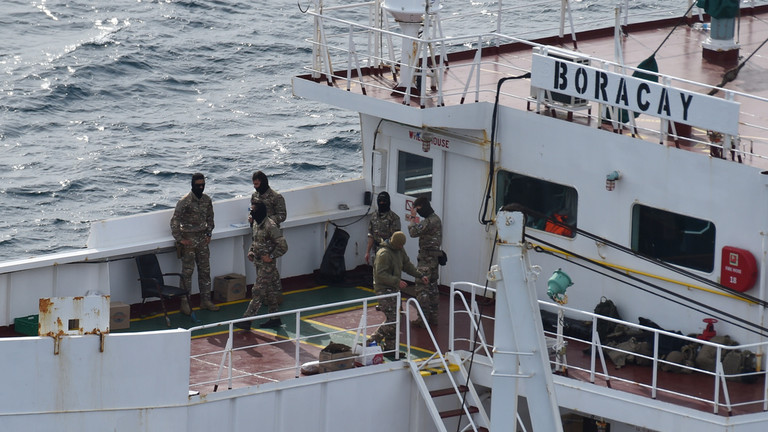
French soldiers onboard the Boracay oil tanker off Saint-Nazaire, France’s Atlantic coast. © AP Photo / Mathieu Pattier
RT | October 2, 2025
France has said it has detained an oil tanker and two crew members linked to an alleged Russian ‘shadow fleet’ supposedly used to evade Western sanctions on oil and gas exports.
French authorities said the tanker, the Boracay, which has been sanctioned by the EU, was sailing under a Benin flag and is currently under investigation for “serious irregularities.” French naval forces reportedly boarded the vessel last week, and it has since remained anchored near Saint-Nazaire on France’s west coast.
The two crew members, who introduced themselves as the captain and first mate, have been taken into custody, according to the prosecutor of the western port city of Brest, Stephane Kellenberger.
Media reports suggest investigators also suspect the vessel could have been linked to unidentified drones that were observed near Danish airports and military sites last month, prompting restrictions on civilian UAV flights.
French President Emmanuel Macron has claimed the Boracay crew are suspected of committing “various serious offences” which justified their detention. He did not confirm any link between the tanker and airspace violations in Denmark.
Moscow has said it has no information about the vessel being referred to by the French authorities or the allegations against it.
Kremlin spokesman Dmitry Peskov noted, however, that Western European nations have been engaging in a “very large number of provocative actions” in various waters, which he said are “absolutely not conducive to ensuring freedom of commercial navigation.” He added that these actions sometimes force Russia’s armed forces to take “enforcement measures.”
Russia has consistently rejected Western sanctions as illegal and warned that attempts to restrict its vessels’ freedom of navigation would draw a response.
Moscow has also dismissed Western claims about Russian drone activity in Western Europe as unsubstantiated and politically motivated. Russian officials have warned that Ukraine could attempt to stage a false flag operation using drones in an attempt to draw NATO into a direct confrontation with Moscow.
The Israel Lobby Wants Thomas Massie Gone. Will Voters Obey?
By Jose Alberto Nino | The Occidental Observer | September 29, 2025
The knives are out for Rep. Thomas Massie (R-KY), and his political survival could prove whether Congress still answers to American voters or to a foreign lobby with limitless cash.
Pro-Israel Republican megadonors recently set up the MAGA Kentucky super PAC with $2 million specifically to oust Massie. Paul Singer contributed $1 million, John Paulson added $250,000, and Miriam Adelson’s Preserve America PAC provided $750,000. The Republican Jewish Coalition has promised “unlimited” campaign spending if Massie runs for Senate, with CEO Matt Brooks declaring that “if Tom Massie chooses to enter the race for US Senate in Kentucky, the RJC campaign budget to ensure he is defeated will be unlimited.”
President Donald Trump has also jumped into the fray, branding Massie a “pathetic loser” who should be dropped “like the plague.” Overall, a constellation of pro-Zionist forces is mobilizing at full force to unseat Congress’s most principled non-interventionist politician since Ron Paul retired in 2013. In many respects, Massie has taken up Paul’s mantle of foreign policy restraint — a political agenda that has never sat well with organized Jewry. Massie’s legislative track record on foreign policy speaks for itself.
Massie’s Long Track Record of Voting Against Foreign Policy Interventionism
Throughout his congressional career, Massie has established himself as Congress’s most consistent opponent of the neoconservative/neoliberal foreign policy consensus. His principled opposition to endless wars and foreign entanglements has earned him the nickname “Mr. No” — similar to his predecessor Ron Paul — for frequently casting lone dissenting votes against military interventions.
In 2013, Massie introduced the War Powers Protection Act to “block unauthorized U.S. military aid to Syrian rebels.” He argued that “since our national security interests in Syria are unclear, we risk giving money and military assistance to our enemies.” When Obama sought to arm Syrian rebels in 2014, Massie voted against the plan, declaring it “immoral to use the threat of a government shutdown to pressure Members to vote for involvement in war, much less a civil war on the other side of the globe.”
Massie consistently opposed U.S. involvement in Yemen’s civil war, co-sponsoring multiple bipartisan resolutions to invoke the War Powers Resolution and “remove United States Armed Forces from unauthorized hostilities in the Republic of Yemen.” He stated that “Congress never authorized military action in Yemen as our Constitution requires, yet we continue to fund and assist Saudi Arabia in this tragic conflict.”
His opposition to NATO expansion proved equally consistent. In 2017, Massie was one of only four House members to vote against a pro-NATO resolution, explaining that “the move to expand NATO in Eastern Europe is unwise and unaffordable,” and such expansion contradicted Trump’s campaign assertion that “NATO is obsolete.”
Regarding the Russo-Ukrainian war, Massie maintained his non-interventionist stance, receiving an “F” grade from Republicans for Ukraine. He opposed the Ukraine Democracy Defense Lend-Lease Act, multiple aid packages, and efforts to strip Ukraine funding. Massie argued that supporting Ukraine aid was “economically illiterate and morally deficient,” declaring that “the American taxpayers have been conscripted into making welfare payments to this foreign government.”
Most recently, in June 2025, Massie introduced a bipartisan War Powers Resolution with Rep. Ro Khanna to “prohibit United States Armed Forces from unauthorized involvement” in the Israel-Iran conflict. After Trump’s strikes on Iranian nuclear facilities, Massie criticized the action as “not Constitutional,” remaining the only Republican co-sponsor of the war powers resolution.
Massie’s Anti-Zionist Streak
Massie’s most politically dangerous positions involve his consistent opposition to pro-Israel legislation, earning him the distinction of being the lone Republican opposing numerous Israel-related measures.
In July 2019, Massie cast the sole Republican vote against a resolution opposing the Boycott, Divestment, and Sanctions movement. The resolution passed 398-17, but Massie defended his position by stating he does not support “federal efforts to condemn any type of private boycott, regardless of whether or not a boycott is based upon bad motives” and that “these are matters that Congress should properly leave to the States and to the people to decide.”
In September 2021, Massie was the only Republican to vote against $1 billion in funding for Israel’s Iron Dome defense system. He explained that “my position of ‘no foreign aid’ might sound extreme to some, but I think it’s extreme to bankrupt our country and put future generations of Americans in hock to our debtors.” This vote prompted AIPAC to run Facebook ads stating “When Israel faced rocket attacks, Thomas Massie voted against Iron Dome.”
Perhaps most controversially, on May 18, 2022, Massie cast the lone vote against a resolution condemning antisemitism, which passed 420-1. The American Jewish Committee criticized him, stating that “while Democrats and Republicans united, Rep. Massie, who has also opposed bills on Holocaust education and Iron Dome funding, decided that combating rising hatred is not important.” Massie defended his vote by tweeting that “legitimate government exists, in part, to punish those who commit unprovoked violence against others, but government can’t legislate thought.”
In October 2023, Massie opposed a $14 billion aid package for Israel, proclaiming that “if Congress sends $14.5 billion to Israel, on average we’ll be taking about $100 from every working person in the United States. This will be extracted through inflation and taxes. I’m against it.” When AIPAC criticized him, Massie responded that “AIPAC always gets mad when I put America first. I won’t be voting for their $14+ billion shakedown of American taxpayers either.”
On October 25, 2023, Massie was the sole Republican to vote against a resolution affirming Israel’s right to defend itself following the October 7 Hamas attacks. A month later, on November 28, 2023, he became the only member of Congress to oppose a resolution affirming Israel’s right to exist and equating anti-Zionism with antisemitism, which passed 412-1.
The most explosive moment came in December 2023 when Massie posted a meme of the rapper Drake contrasting “American patriotism” with “Zionism,” implying Congress prioritized the latter. Senate Majority Leader Chuck Schumer called the post “antisemitic, disgusting, dangerous” and demanded he remove it. The White House labeled it “virulent antisemitism.” Republican Jewish Coalition CEO Matt Brooks condemned it, stating “Shame on you @RepThomasMassie. You’re a disgrace to the US Congress and to the Republican Party.”
Massie vs. Trump
Trump’s escalating attacks on Massie reveal the extent to which the sitting president serves pro-Israel interests rather than pursuing genuine ideological differences. The timing and intensity of Trump’s criticism align suspiciously with Massie’s most vocal challenges to Israeli influence in Congress.
In June 2025, after Massie criticized Trump’s Iran strikes as “not Constitutional,” Trump unleashed a scathing Truth Social response calling Massie “not MAGA” and declaring that “MAGA doesn’t want him, doesn’t know him, and doesn’t respect him.” Trump branded Massie a “simple-minded ‘grandstander’ who thinks it’s good politics for Iran to have the highest level Nuclear weapon” and concluded that “MAGA should drop this pathetic LOSER, Tom Massie, like the plague!”
This vitriol represents a dramatic shift from Trump’s 2022 endorsement, when he called Massie a “Conservative Warrior” and “first-rate Defender of the Constitution.” The transformation occurred precisely as Massie intensified his criticism of Israeli influence and foreign aid. Trump’s attacks escalated further after Massie’s explosive June 2024 Tucker Carlson interview where he revealed that “everybody but me has an AIPAC person. … It’s like your babysitter, your AIPAC babysitter who is always talking to you for AIPAC.”
Massie elaborated that “I have Republicans who come to me and say that’s wrong what AIPAC is doing to you, let me talk to my AIPAC person… I’ve had four members of Congress say I’ll talk to my AIPAC person and like it’s casually what we call them my AIPAC guy.” This revelation exposed the systematic nature of Israeli influence over Congress, prompting immediate backlash from pro-Israel organizations and likely contributing to increased donor funding against his re-election campaign.
The pattern makes clear that Trump’s hostility toward Massie stems less from policy disagreements than from his deference to powerful Jewish donors. Although he often claims to oppose “endless wars,” Trump’s attacks on Massie — the most consistent non-interventionist in Congress — expose where his true loyalties lie in advancing the agenda of Jewish supremacist interests rather than pursuing an independent foreign policy. House Speaker Mike Johnson has signaled that GOP leadership will abandon Massie, stating that “he is actively working against his team almost daily now and seems to enjoy that role. So he is, you know, deciding his own fate.”
AIPAC is on the Hunt
AIPAC’s 2024 electoral victories demonstrate the lobby’s willingness to spend unprecedented sums to eliminate critics of Israeli policy. The organization’s success in defeating progressive Democrats and protecting establishment Republicans reveals a coordinated strategy to purge Congress of independent voices. AIPAC will look to replicate its successes against the likes of Israel critics such as Massie.
Against Rep. Jamaal Bowman in New York’s 16th District, AIPAC’s United Democracy Project (UDP) spent $14.5 million opposing Bowman while also propping up challenger George Latimer. Independent media outlet Sludge reported that “the $14.5 million AIPAC’s super PAC has spent in the NY-16 Democratic primary is more than any outside group has ever spent on a single House of Representatives election race.”
The spending was fueled by Republican megadonors channeled through AIPAC, with WhatsApp founder Jan Koum donating $5 million to UDP. Responsible Statecraft noted that “AIPAC effectively acted to launder campaign funds for Republican megadonors into the Democratic primary, where the spending was generally identified in media as ‘pro-Israel,’ not ‘Republican.’” By election day, Latimer-aligned groups had outspent Bowman’s backers by over seven-to-one.
Against Rep. Cori Bush in Missouri’s 1st District, UDP spent over $8.5 million to attack her record on Israel and support her pro-Zionist challenger Wesley Bell. The Bush-Bell primary became one of the most expensive House primaries ever with over $18 million in total ad spending. Bush called it “the second most expensive congressional race in our nation’s history, $19 million and counting” funded by “mostly far-right-funded super PACs, against the interests of the people of St. Louis.”
Even in Republican primaries, AIPAC intervened to protect establishment allies. To defend moderate Rep. Tony Gonzales against challenger Brandon Herrera in Texas’s 23rd District, UDP spent $1 million opposing Herrera in a “two-week ad buy.” The Republican Jewish Coalition added $400,000 in attack ads against Herrera. Combined AIPAC and RJC spending totaled approximately $1.4-1.5 million, helping Gonzales narrowly defeat Herrera by just 354 votes with 50.6% to 49.4%.
These victories came as part of AIPAC’s broader $100+ million spending cycle, with Common Dreams noting that “AIPAC money has already made a significant impact, helping a pair of pro-Israel Democrats defeat progressive Reps. Jamaal Bowman (D-N.Y.) and Cori Bush (D-Mo.)—two of Congress’ most vocal critics of Israel’s assault on Gaza—in recent primary contests.”
How Massie’s Race Could Determine the Israel Lobby’s Actual Power
Massie’s 2026 primary represents the ultimate test of whether any politician can survive the full force of pro-Israel opposition. The Kentucky race will determine if AIPAC’s previous victories represent sustainable power or pyrrhic victories that expose the lobby’s long-term vulnerabilities.
Massie’s unique position may prove more defensible than Bowman’s or Bush’s urban districts. His rural Kentucky constituency shows less susceptibility to urban media campaigns and maintains stronger skepticism of foreign entanglements. Moreover, his local roots provide credibility that transcends typical political attacks. The Kentucky representative’s ability to frame opposition as foreign interference rather than domestic policy disagreements could resonate with voters increasingly suspicious of the pro-Israel establishment that dominates Washington’s political scene.
The financial strain of AIPAC’s previous victories may also constrain future spending. The organization’s $100+ million commitment across multiple races represents an unsustainable pace that could face donor fatigue. Each expensive victory exposes the lobby’s methods to greater scrutiny and potential backlash. Progressive groups increasingly highlight AIPAC’s role in primary defeats, potentially mobilizing opposition that limits future effectiveness.
Massie’s survival would demonstrate that principled politicians can withstand pro-Israel pressure through constituent loyalty and grassroots support. His defeat would confirm that no elected official can challenge Israeli interests regardless of their domestic support. The Kentucky race thus represents a pivotal moment in determining whether American foreign policy serves American interests or remains subordinate to foreign influence.
If Massie withstands the assault, it will mark the first crack in the façade of Zionist invulnerability; if he falls, it will prove that American politicians can be bought and buried by World Jewry’s limitless stockpiles of cash.
Israeli officers commandeered Pentagon meetings during June’s Israel-Iran war: Tucker Carlson
Press TV – October 2, 2025
Israeli officers stormed meetings at the Pentagon during June’s Israel-Iran war, issuing orders unchecked while Trump administration officials stood by doing nothing, says a former Fox News host, raising fresh questions about foreign influence on US military decisions.
Prominent American commentator Tucker Carlson said that Israeli military officers stormed into closed-door meetings at the Pentagon during Israel’s 12-day aggression against Iran in June, stressing that they issued direct orders to US officials, a controversial move that raises serious concerns over foreign interference in the decision-making process at the US Department of War.
During a video titled “Speeding Toward World War Three” published on his X account on Thursday, Carlson further said that officials in the Trump administration failed to respond to or prevent these intrusions, allowing the Israeli officers to continue their actions unchecked.
The ex-Fox News host also touched on the ongoing tensions over US-Israel relations and questioned the extent of influence wielded by foreign powers within American military institutions.
“During the 12-day war with Iran, the US and Israel versus Iran, bombing on all sides, during that short conflict, a bunch of Israeli officers in the Pentagon during that week enraged American Pentagon staff by barging into the meetings, giving orders and making demands and nobody did anything about it. How can a foreign military officer barge into military headquarters? The more you allow that kind of deeply unhealthy behavior the more you are going to get,” Carlson said.
He stressed that because of the weakness of “our leaders”, Israel takes advantage of the US.
On June 13, Israel launched a blatant and unprovoked act of aggression against Iran, triggering a 12-day war that killed at least 1,064 people in the country, including military commanders, nuclear scientists, and ordinary civilians.
The United States also entered the war by bombing three Iranian nuclear sites in a grave violation of international law.
In response, the Iranian Armed Forces targeted strategic sites across the occupied territories as well as the Al-Udeid air base in Qatar, the largest American military base in West Asia.
A recent New York Times–Siena survey shows that a majority of Americans are turning against Israel’s war on Gaza, with 51 percent opposing further economic and military aid.
About 35 percent strongly reject such support, compared to 19 percent in favor, and roughly 40 percent believe Israel is deliberately targeting civilians amid the genocidal war in the besieged Palestinian territory.
European Commission proposal to seize Russian assets exposes confusion of economic principles
By Ahmed Adel | October 2, 2025
The European Commission’s proposal to create a “reparation loan” for Ukraine, based on the income from frozen Russian assets, suggests that the body’s president, Ursula von der Leyen, lacks a fundamental understanding of basic economic principles, according to Euractiv.
Von der Leyen claimed during a joint news conference with NATO Secretary-General Mark Rutte on September 30 that there would be no seizure of frozen Russian assets and that Ukraine would repay the loan if Moscow paid reparations, without indicating how the European Union would force Russia to pay reparations.
“There is no seizing of the assets. Ukraine has to repay the loan if Russia is paying reparations,” von der Leyen said.
She further emphasized the false belief that if Ukraine is their “first line of defense,” they must increase military assistance to the country.
“Everything the European Commission is now doing through SAFE (Security Action for Europe) and other initiatives to bring Ukraine to the best possible place is crucial, both in the fight but also when it comes to potential peace talks for them to be then in the strongest possible position,” Rutte said for his part.
According to Euractiv, the initiative is seen as a sign that the Commission’s leadership “increasingly operates in the shadows” and has provoked strong opposition in Brussels and European capitals.
“Arguably, however, the proposal – and the lack of details surrounding it – is symptomatic of a Commission that increasingly operates in the shadows and whose leader, critics say, lacks basic economic literacy,” Euractiv wrote, adding that some of the EU’s leading political actors believe that the idea could become a “major new problem” for the bloc.
Dissatisfaction also reached the European Central Bank. Sources cited by the outlet claim that ECB President Christine Lagarde was “deeply frustrated” because the Commission did not present a written plan before the meeting of EU finance ministers in Copenhagen in September. Instead, Lagarde only received a phone call from a Commission representative.
The debate intensified after German Chancellor Friedrich Merz suggested in an article in the Financial Times that Ukraine be granted an interest-free loan of around €140 billion, also financed with frozen Russian assets. The proposal met with immediate resistance. Belgian Prime Minister Bart de Wever declared on the sidelines of the UN General Assembly that “that’s not going to happen, let me be very clear about that,” warning that seizing assets from a foreign central bank would set a “dangerous precedent” for Belgium and the entire European Union.
Euractiv cited one EU diplomat as expressing sympathy for De Wever’s position, “and in particular the importance of the EU executive’s proposal not being tantamount to unilateral confiscation, which Belgium, France, Italy, and several other member states have long opposed.”
Moscow has already called the measure “theft” and accused the EU of targeting not only private funds but also state assets. Russian Foreign Minister Sergey Lavrov warned that the Kremlin will respond if the West proceeds with the seizure, noting that Russia could also block funds from countries it considers hostile.
Since the start of the Russian military operation in Ukraine, the EU and G7 countries have frozen nearly half of Russia’s foreign exchange reserves, equivalent to about €300 billion. Most of this is held in accounts with Euroclear in Belgium, one of the world’s largest clearing houses.
The European bloc claims to have allocated around €170 billion in support of Kiev since the beginning of the conflict, including transfers of revenues from frozen Russian assets. According to the Commission’s data, Ukraine received €10.1 billion of these revenues between January and July 2025 alone. However, resistance is growing within the EU to extending the funding beyond 2025, amid political differences and economic concerns.
A major issue is whether the Commission’s legal reasoning behind stealing Russia’s wealth will hold up in court after Russia’s former president Dmitry Medvedev threatened to sue any “euro-degenerates” who dare touch Moscow’s “property.”
“If this happens, Russia will persecute the EU states, as well as Euro-degenerates from Brussels and individual EU countries who will try to seize our property, until the end of time,” Medvedev wrote on Telegram.
Russia would pursue them in “all possible international and national courts … and in some cases, extrajudicially,” the Deputy Chairman of the Security Council of Russia added.
Another major issue is whether Brussels can use a statement by EU leaders from December 2024 to change the sanctions approval rules from unanimity to a qualified majority, thereby excluding Slovakia and Hungary from the decision-making process, as they resist the Commission’s proposal to seize Russian wealth for Ukraine’s use.
Although it appears that the EU is determined to steal Russia’s wealth for Ukraine’s use, there are a lot of roadblocks with no guarantee that they will be overcome. If the Commission is successful, it will have effectively sealed Europe’s fate as a safe location for countries to bank their wealth, and thereby do long-term damage, just as the anti-Russia sanctions have boomeranged. For this reason, resistance within the EU will remain dogged.
Ahmed Adel is a Cairo-based geopolitics and political economy researcher.
Ukraine’s Patriots can’t tackle Russian missiles – FT
RT | October 2, 2025
The Russian military has modified its missiles to better evade Ukrainian air defenses, including US-made Patriot systems – often seen as a key linchpin of Kiev’s shield – the Financial Times reported on Thursday, citing officials in Kiev and the West.
According to officials interviewed by the FT, Russian missiles can now follow a normal arc before veering into a steep terminal dive or executing maneuvers that “confuse and avoid” Patriot interceptors. The outlet cited recent strikes against Ukrainian drone facilities as a strong indication that Russia has likely upgraded the Iskander-M mobile system and the air-launched Kinzhal.
One former Ukrainian official called the added maneuverability “a game changer for Russia,” the newspaper reported, adding that deliveries of US-supplied Patriot interceptors, essentially the only weapon in Ukraine’s arsenal capable of tackling Moscow’s ballistic missiles, are not coming as quickly as planned.
The paper also noted that data released by the Ukrainian Air Force shows that the rate of interception of Russian ballistic missiles improved over the summer, reaching 37% in August, but then fell to just 6% in September.
Ukraine shares data on Patriot battlefield performance with the Pentagon and weapons producers, according to the FT. Officials told the outlet that while efforts are being made to improve the Patriots’ performance, they often lag behind Moscow’s evolving tactics.
Ukraine’s Air Force flagged similar concerns in May. Spokesman Yury Ignat said that the ballistic trajectories of the Iskander-M missiles “have been improved and modernized” while the projectiles could fire off radar decoys. He also complained that Ukraine’s domestically designed air defenses are unable to shoot down most of the Russian missiles, while those produced in the West are used to cover key infrastructure and other high-priority targets.
Moscow has repeatedly said its strikes only target military-related infrastructure, defense industry, and troop deployment bases and are never aimed at civilians.
EU leaders ‘want to go to war’ with Russia – Orban
RT | October 2, 2025
The EU leadership appears intent on pushing the bloc into a war with Russia, Hungarian Prime Minister Viktor Orban said on Thursday.
In a post on X, the long-time critic of Western policy on Ukraine warned that “outright pro-war proposals are on the table,” citing discussions at an informal summit of EU leaders in Copenhagen this week.
“They want to hand over EU funds to Ukraine. They are trying to accelerate Ukraine’s accession with all kinds of legal tricks. They want to finance arms deliveries. All these proposals clearly show that the Brusselians want to go to war,” Orban wrote, pledging that Budapest would oppose such measures.
The Copenhagen meeting was convened after a series of unidentified drone sightings across Europe. Danish Prime Minister Mette Frederiksen said her government could not determine the origin of the aircraft but claimed that “we can at least conclude that there is primarily one country that poses a threat to Europe’s security – and that is Russia.”
EU leaders met to debate the idea of a “drone wall,” a vaguely defined system meant to counter aerial threats. Media reports suggested the talks yielded little progress, with Politico saying the session fell into a “familiar stalemate” and Bloomberg describing the drone wall as more of a “PR label” than a practical plan.
Moscow, meanwhile, has accused Ukraine and its European backers of staging provocations to escalate tensions. Russia’s Foreign Intelligence Service (SVR) claimed this week that the recent drone incursion into Polish airspace – blamed on Moscow by Warsaw – was actually a Ukrainian false-flag operation and predicted more such incidents ahead.
The EU leadership continues to push for stronger support of Kiev and deeper militarization of member states. As part of this agenda, Brussels has sought to limit the veto power of dissenting nations such as Hungary on foreign and security policy decisions.
US to Provide Ukraine With Intelligence for Strikes Deep Into Russia – Reports
Sputnik – 02.10.2025
US President Donald Trump has allowed intelligence agencies and the Pentagon to provide Ukraine with intelligence for strikes deep into Russia against energy infrastructure facilities, The Wall Street Journal newspaper reported, citing US officials.
Washington is also asking NATO countries to provide similar support, the report said on Wednesday.
In addition, the United States is considering supplying Ukraine with Tomahawk and Barracuda missiles, as well as other missiles with a range of about 500 miles (804 kilometers), the report added.
Russia has said that arms supplies to Ukraine hinder the conflict settlement, directly involving NATO countries in it. Russian Foreign Minister Sergey Lavrov said that any cargo containing weapons for Ukraine would be a legitimate target for Russia.
Featured Video

No Threat Can Force Iran’s Surrender /Trita Parsi & Lt Cl Daniel Davis
or go to
Aletho News Archives – Video-Images
From the Archives
An Expert Military Analysis of War with China
Actually, None is Necessary
By Fred Reed • Unz Review • December 13, 2020
The Correlation of Armed Forces: U.S. goods and services trade with China totaled an estimated $634.8 billion in 2019. Exports were $163.0 billion; imports were $471.8 billion. The U.S. goods and services trade deficit with China was $308.8 billion in 2019. Trade in services with China (exports and imports) totaled an estimated $76.7 billion in 2019. Services exports were $56.5 billion; services imports were $20.1 billion. The U.S. services trade surplus with China was $36.4 billion in 2019.
There is talk within the Washingtoniat of a possible war with China. Steve Bannon, who apparently was dropped on his head as a child, actually favors such a war. We hear the usual shoo-the-boobs alarm about how the Chinese are doing something terrible and we must gird our loins and American values and show them what for, bow wow, woof. The danger is that the current game of who-blinks-first in Asian waters might actually provoke a shooting war. You know the kind of thing: One warship refuses to get out of the way of another, a collision ensues, some retard lieutenant who signed up on waivers opens fire, and we’re off and running. It is not a good idea to let children play with matches.
The said war is discussed either in emotional terms by idiots or in purely naval terms by those familiar with such things, so we hear of the First Island Chain and the Second Island Chain and whose missiles against the other’s missiles and so on. This would be appropriate if we were fighting World War Two again. Which we aren’t. Let’s take a quick-and-dirty look at how such a war might go.
To begin the war, America would overestimate itself and underestimate China. This is doctrine in the Pentagon. … continue
Blog Roll
 Aletho News
- Suicide Should Not Be a Government Service
- Rethinking America’s greatest threat: Iran vs. Israel-Firsters
- Iran accuses adversaries of false flags to strain Turkey ties
- Poland rules out sending Patriot missiles to US/Israel amid war on Iran
- Tehran approves new Hormuz plan with major restrictions
- No Threat Can Force Iran’s Surrender /Trita Parsi & Lt Cl Daniel Davis
- UK’s New Pandemic Plan Would Turn Big Tech Into a Mass Location Tracking Network
- Growing insecurity, soaring prices fuel protests in north as regime bans evacuation: Sources
- Iran denies responsibility for ‘depraved’ attack on Kuwait desalination plant
- Bring The Troops Back. End This War Now!
- If Americans Knew
- Joe Kent Urges Americans To Call White House and Congress To Object To Sending Troops Into Iran
- DNC Resolution to Reject AIPAC Funding Puts Democratic Leaders in the Hot Seat
- Swedish foundation to build 400 schools as over 650,000 Gaza children remain without education for 2 years
- Israeli army admits photshopping image of slain Lebanese journalist
- This is how Israel is systematically killing health workers under the cover of war in Lebanon
- Carrying life under fire: Israeli invasion of Lebanon leaves pregnant women facing deadly risks
- Champagne all around for the new death penalty (for Palestinians) law – Not a ceasefire Day 172
- Why are Palestinian books struggling to be seen on Amazon?
- The Line Between Affinity and Conspiracy
- As Iran targets US military bases, will they be relocated to Israel? Not a ceasefire Day 171
- No Tricks Zone
- New Study Finds Warming Saves Lives…Cold Temperatures 12 Times More Deadly Than Excess Heat
- German Science Blog Accuses PIK Climate Institute Of Hallucinating Climate Tipping Points
- Devastating Assessment Of Comirnaty Vaccine By Former Senior Pfizer Europe Toxicologist
- New Study: CO2 Is ‘Effectively Negligible’ As An Explanatory Climate Change Factor Since 2000
- Former Pfizer Toxicologist Dr. Helmut Sterz Tells Bundestag Hearing Pfizer Vaccine Should Have Never Been Approved
- Energy Expert: Germany’s Nuclear Phaseout Was A “500 Billion Euro Mistake”
- New Research: South Australia’s Mid-Holocene Sea Surface Temperatures Were 4°C Warmer Than Today
- Storing Green Energy To Last Germany 10 Days Would Require A 60-Million Tonne Battery
- New Studies: UK Sea Levels Were 4 Meters Higher Than Today During The Mid-Holocene
- Destructive Green New Deal: German Energy And Metal Group Warns Of Drastic Crisis
 Aletho News