Refinery Fires in Europe Are Part of EU Crusade Against Russian Oil and Gas
Sputnik – 23.10.2025
The timing of the recent incidents at the oil refineries in Hungary and Romania is very suspicious in light of the threats from Poland, Dr. George Szamuely, senior research fellow at The Global Policy Institute, tells Sputnik.
When Polish Foreign Minister Sikorsky openly justifies the Nord Stream bombing and then tries intimidating Hungary into giving up Russian oil, and then suddenly the refineries are ablaze – that’s one hell of a coincidence.
The refinery fires were definitely a part of a broader campaign to cut off the flow of Russian energy to Europe, Szamulely notes – a campaign that ends up hurting the EU members but fails to affect Russia.
“These measures that the EU is adopting are measures directed towards hurting EU member states, forcing them into line,” he explains.
Only the Russophobic EU bureaucrats like Ursula von der Leyen and Kaja Kallas benefit from this disruption of energy supply chains, and they are eager to “punish anybody at all who is not on board with their program.”
The incidents in Hungary and Romania convey a simple message: “if you are going to keep importing your fossil fuels from Russia, look at the sort of things that can happen, all sorts of explosions, fires, sabotage.”
Volkswagen faces chip crisis after Chinese factory seized by EU state – Bild
RT | October 23, 2025
Germany’s largest carmaker, Volkswagen, could stop production at a key plant due to a shortage of semiconductors caused by the seizure of a Chinese-owned chipmaker by the Netherlands, Bild has reported, citing anonymous sources.
The Dutch government took control of the Nexperia factory in Nijmegen late last month, citing intellectual property and security concerns. The New York Times reported last week after reviewing documents from an Amsterdam court that the move had been made following pressure from US officials. Nexperia’s parent company, Wingtech, was blacklisted by Washington in 2024 as part of an ongoing trade war with China.
Beijing responded in early October by banning Nexperia from exporting finished chips from China, which are widely used in the electronic control units of VW vehicles.
Bild reported on Wednesday that Volkswagen – which also owns the Skoda, Seat, Audi, Porsche, Lamborghini, and Bentley brands – does not currently appear to have an alternative to Nexperia chips.
Sources in the company told the paper that due to the lack of semiconductors it plans to stop production at its plant in Wolfsburg from next Wednesday. Volkswagen Golf models will be affected first, followed by other vehicles, they said.
If the situation does not improve, work could also be halted at Volkswagen’s facilities in Emden, Hanover, Zwickau, and elsewhere, a person familiar with the matter said.
According to the report, the carmaker has started talks with the German authorities about a state-backed reduced working hours scheme for tens of thousands of its employees.
Bild warned that the chip crisis could also impact other carmakers in the country. Representatives for BMW and Mercedes told the paper that they were analyzing the situation. The German automobile industry has already been suffering due to high energy costs as a result of EU sanctions on Russia over the Ukraine conflict and increased US tariffs.
A spokesman for Volkswagen’s Zwickau plant told AFP that the report by Bild was “incorrect.” However, according to an internal letter seen by the media, the company acknowledged that “impact on production cannot be ruled out in the short term” due to a semiconductor shortage.
Russia-US summit postponed – Putin
RT | October 23, 2025
Russian President Vladimir Putin has confirmed that the planned Budapest summit with US counterpart Donald Trump is being postponed. Speaking to journalists on Thursday, he noted that the proposal was initially made by the American side.
The Russian leader admitted that it would have been a mistake to approach the summit without the necessary preparations, suggesting that a meeting might still take place at a later date. Putin emphasized that dialogue is always better than confrontation, arguments, and the continuation of war.
A Russia-US summit, which was planned to be held in the Hungarian capital, was announced last week by both the Kremlin and the White House after a phone call between Trump and Putin. On Wednesday, however, Trump announced that the meeting would be postponed. On the same day, Washington imposed sanctions on two major Russian oil companies, Rosneft and Lukoil.
Commenting on the sanctions, Putin described them as an “unfriendly move” that does not boost Russia-US relations.
At the same time, he noted that the new restrictions would not have a significant impact on the Russian economy.
Putin also stated that the US sanctions are yet another attempt by Washington to exert pressure on Moscow and stressed that “no self-respecting country ever does anything under pressure.”
He further suggested that there are certain people in the US administration that have been encouraging Trump to restrict Russian oil exports and called for considering who these individuals actually work for.
Putin insisted that Russia and the US actually have many areas in which they could cooperate if they would move away from pressure tactics and toward serious conversations about the long term.
George Beebe: US-Russia Agreement to End NATO Expansionism or Accept an Ugly Russian Victory
Glenn Diesen | October 23, 2025
George Beebe is Director of Grand Strategy at the Quincy Institute, and the former CIA Director for Russia Analysis. Beebe argues that the window of opportunity for an agreement that ends NATO expansionism is closing, and the alternative will be an ugly Russian victory.
Pursuing Net Zero Makes the UK Vulnerable to Bad Weather, BBC, Not Climate Change
By Linnea Lueken | ClimateRealism | October 21, 2025
A recent article at the BBC, “Government told to prepare for 2C warming by 2050,” claims that the United Kingdom needs to prepare for increasing extreme weather as the planet approaches 2°C warming. This is false in its framing. Although it’s always a good idea to harden infrastructure against weather, the UK is not suffering more extreme weather due to human emissions of carbon dioxide, and the recommendation of attempting to prevent temperature rise is not going to help anyone.
The BBC’s post discusses a letter written by the UK government’s “Climate Change Committee” (CCC), which the BBC reports said, “[t]he country was ‘not yet adapted’ to worsening weather extremes already occurring at current levels of warming, ‘let alone’ what was expected to come.”
The CCC asked the government to “set out a framework of clear long-term objectives” to prevent further temperature rise, with new targets every five years and departments “clearly accountable” for delivering those goals. It warned that “a global warming level of 2C would have significant impact on the UK’s weather, with extreme events becoming more frequent and widespread.”
These include increases in heatwaves, droughts, floods, and longer wildfire seasons.
These claims are fearmongering, and no amount of deindustrialization – which is what’s implied by the “objectives to prevent further temperature rise”—will stop bad weather from happening, nor will it have any measurable impact on global average temperature.
The simple fact is that the UK contributes a very small amount of carbon dioxide to the atmosphere, which would in theory contribute an even smaller amount to warming. According to emissions data, the global share of all UK carbon dioxide emissions is 0.88 percent. Not even 1 percent. Eliminating UK emissions would do absolutely nothing to slow or stop any amount of warming that could be connected to human emissions, if they are, in fact, driving temperature changes.
On top of that, data do not show that weather is becoming more extreme in the UK.
The BBC claims that global warming will increase the wildfire season in the UK, and presumably they believe it must have already done so during the past 150 years of planetary warming. A longer wildfire season should result in more fires. Available data, however, does not show that wildfires are getting more frequent or more intense in the UK. Satellite data from Copernicus show no trend at all.
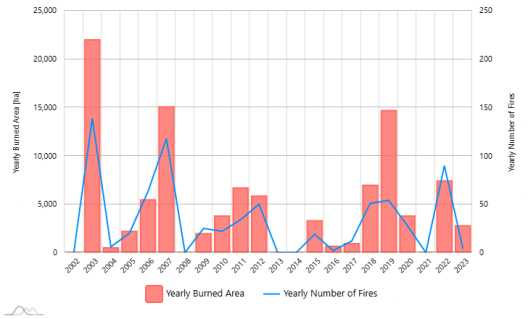
Chart of United Kingdom yearly burned area and number of fires from Copernicus
For another example, looking at Central England as this Climate Realism post did, the number of days per year breaching 25°C (77°F) show no rising trend, nor does the measured highest daily maximum.
Long term historical data for Europe show that drought is likewise not worse today than it was during the Renaissance, long before industrialization.
What is really notable is that Europe alone has actually already warmed 2°C since about 1820, according to historic European temperature averages, but no catastrophic change in weather has occurred. (See figure below)
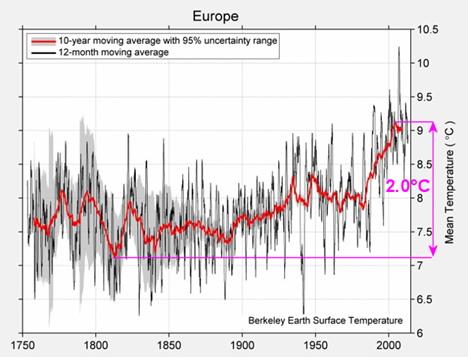
Berkeley Earth average European temperature showing a 2.0°C rise since about 1820. Source: http://berkeleyearth.lbl.gov/regions/europe
Weather isn’t getting worse, but bad weather does still happen. The UK’s largest industrial solar facility, for example, blighting the landscape of Anglesey, North Wales, was recently destroyed by a bad storm. That should be enough to give government agencies pause when it comes to at least some net-zero policies, but the real point is that hardening infrastructure against weather should be a priority regardless of climate change. Bad weather will occur, and it will wreck fragile facilities, including solar complexes.
Hardening against weather extremes, which always have and always will exist, is just common sense. As technology develops and new ways of protecting against bad weather are discovered (like the invention of air conditioning) they should be implemented where they can be, as they can be. Achieving net zero – especially for a country that emits negligible amounts of greenhouse gases anyway—will not save the UK from bad weather events.
As a news organization, the BBC should not carry water for its government or government advisory boards that want to continue wasting money on futile “objectives to prevent further temperature rise” when direct efforts to improve infrastructure and harden it against weather extremes, which have happened throughout history, would be far more effective in saving lives and reducing harm.
City Health Officials Tied to Soros Urge Public to ‘Get Vaccinated,’ Blame Policy Shifts for ‘Deadly Outbreaks’
By Michael Nevradakis, Ph.D. | The Defender | October 22, 2025
A coalition of city public health officials with ties to pharma investor George Soros is urging the public to “get vaccinated.”
In an open letter, the Big Cities Health Coalition accused federal officials of driving down vaccination rates and fueling an increase in dangerous infectious disease outbreaks by making “repeated false claims” about vaccines.
They wrote:
“Vaccines have eradicated devastating diseases and saved millions of lives. They keep classrooms safe and schools open. They allow children to spend time with friends and enjoy their favorite activities. They help parents and caregivers work to support their families.
The letter also addresses recent changes to the Centers for Disease Control and Prevention’s (CDC) recommended vaccine schedule for children and adults, though it does not mention U.S. Health Secretary Robert F. Kennedy Jr. or President Donald Trump by name.
The coalition, which represents 35 U.S. cities and about a fifth of the U.S. population, “has been working together to exchange ideas and address public health threats for more than two decades,” according to CNN, which first reported on the letter Monday.
Participating cities include New York, Los Angeles, Chicago, Boston, Houston, Dallas, Cleveland, Milwaukee and Seattle.
The group’s financial documents reveal support from billionaire financier Soros. Soros has also invested heavily in the pharmaceutical industry, including COVID-19 vaccine makers Pfizer and AstraZeneca, and Gilead Sciences, which produces remdesivir, a controversial antiviral treatment frequently given to COVID-19 patients.
Coalition attempted to scrub funding from Soros- and Gates-linked groups
The Big Cities Health Coalition was founded in 2002, according to a now-deleted webpage. The current version of its website contains little more than the group’s recent letter.
Links to the organization’s 2023 and 2024 annual reports are no longer active, but can be found on the Internet Archive and elsewhere. The reports show that Soros and other major healthcare-related organizations, including groups connected to Bill Gates, finance the coalition.
According to its 2023 annual report, the Open Society Foundations, founded by Soros, funded the coalition. Other funders include the Robert Wood Johnson Foundation, the W.K. Kellogg Foundation, healthcare provider Kaiser Permanente and the CDC Foundation.
In 2022, the Soros Economic Development Fund, an extension of the Open Society Foundations, partnered with Gavi, the Vaccine Alliance and MedAccess, a pharma-industry broker connected to the U.K. government, to invest $200 million in developing COVID-19 vaccines.
The Gates Foundation is a major funder of Gavi.
The Robert Wood Johnson Foundation has financially supported FactCheck.org, which previously flagged COVID-19-related “misinformation” for Facebook.
The CDC Foundation’s donor list includes the World Health Organization, the Gates Foundation and vaccine manufacturers including Pfizer, Merck and Johnson & Johnson.
According to internal medicine physician Dr. Clayton J. Baker, the coalition’s annual reports reveal clear conflicts of interest.
“It’s informative to look into the funding of organizations like the Big Cities Health Coalition,” Baker said. He noted that Kaiser Permanente paid patients $50 to get COVID-19 vaccines during the pandemic and fired employees who refused the shots, then tried to rehire them later when short-staffed.
According to the coalition’s Form 990 for fiscal year 2023, the organization spent $875,540 on “communications,” including engaging with “media, and federal policymakers about the importance of supporting local public health and health equity.”
The group also spent $433,703 on its “urban health agenda” and $147,397 on “equity/racial justice.”
The coalition’s members “meet periodically with Congressional staff” and “other federal government officials,” the filing states.
The organization’s schedule of contributors is listed as “restricted” in the filing.
Coalition blames unvaccinated for ‘deadly’ and ‘more frequent’ outbreaks
In its letter, the coalition blamed “declining” vaccination rates for “deadly outbreaks of diseases like measles and polio” and claimed that the outbreaks are “becoming more frequent.”
CNN reported that measles exposure at a South Carolina school led authorities to quarantine over 100 unvaccinated students, illustrating “one of the many reasons why Big Cities Health Coalition emphasizes the importance of vaccination.”
Research scientist and author James Lyons-Weiler, Ph.D., said that invoking measles and polio is a “manipulative framing device.” He said:
“Outbreaks of these diseases occur almost exclusively in highly vaccinated populations where immunity has waned, or where sanitation and migration variables are misattributed as ‘vaccine refusal.’
“By portraying every outbreak as proof of anti-vaccine rhetoric, the coalition seeks to recapture moral high ground based on presumptions of safety, without addressing the underlying immunologic and ecological data.”
The coalition’s letter also warned of a potential uptick of COVID-19 and flu infections in the “rapidly approaching” cold and flu season.
However, Baker said the coalition’s letter “contains absolutely zero genuine evidence” to support its claims. He said:
“The coalition’s statement is embarrassingly inane. They say, ‘We are united behind a simple message: get vaccinated.’ Vaccinated with what? They make no distinction between necessary or unnecessary, safe or unsafe, effective or ineffective shots. Just ‘get vaccinated.’ That’s like saying ‘get medicated.’ This is the asinine level of rhetoric to which vaccine fanatics are currently reduced.”
Emily Hilliard, press secretary for the U.S. Department of Health and Human Services (HHS), dismissed the coalition’s concerns.
“HHS is restoring the doctor-patient relationship so people can make informed decisions about their health with their providers,” Hilliard told The Defender.
Letter rooted in data, not ‘political ideology,’ coalition members say
Coalition members told CNN their letter is an attempt to restore public trust in science, not an effort to politicize public health recommendations.
“We have to make our public health decisions based on data and not on political ideology,” Dr. Philip Huang, director of the Dallas County Health and Human Services Department, told CNN. “We have to be the voices for that science and reason.”
Huang said the current CDC administration “seems more driven by political ideology than actual data and science, so it undermines the trust.”
Lyons-Weiler disputed the coalition’s claims, calling the letter “the opening salvo in an attempt to rebuild centralized narrative control over immunization policy.”
“Language such as ‘talk with your doctor’ and ‘tune out political noise’ is designed to sound apolitical while reinstating top-down message discipline,” he said.
CDC changes to vaccine policy spark pushback across U.S.
The coalition “is the latest group to take a strong public stand in support of vaccination as a direct response to concerns that the federal government is limiting access and raising doubts,” CNN reported.
Earlier this month, the CDC updated the childhood immunization schedule to recommend individual-based decision-making regarding COVID-19 vaccination for children 6 months and older, following the CDC’s Advisory Committee on Immunization Practices (ACIP) unanimous vote to adopt the recommendation.
Last month, ACIP also voted to recommend limiting the MMRV (measles, mumps, rubella and varicella, or chickenpox) vaccine to children ages 4 and older. And in June, the committee voted to stop recommending flu shots containing thimerosal — a preservative linked to neurodevelopmental disorders.
In response, 15 Democratic governors launched the Governors Public Health Alliance last week to coordinate their public health efforts independently of national public health agencies.
Previously, four Western states announced the formation of the West Coast Health Alliance, which aims to issue its own immunization guidelines.
In August, the American Academy of Pediatrics (AAP) issued “evidence-based” recommendations calling for COVID-19 shots for infants, young children and children in “high-risk” groups. In July, the AAP and five other medical organizations sued Kennedy over new COVID-19 vaccine guidance.
This article was originally published by The Defender — Children’s Health Defense’s News & Views Website under Creative Commons license CC BY-NC-ND 4.0. Please consider subscribing to The Defender or donating to Children’s Health Defense.
EU Split Over How Ukraine Should Spend €140 Billion From Frozen Russian Assets
Sputnik – 23.10.2025
A number of EU countries advocate that Ukraine use the potential 140 billion euros ($162 billion) loan from frozen Russian assets exclusively to purchase European weapons, while other member states support giving Kiev full freedom in spending the funds, including on arms from the United States, an American newspaper reported.
France, along with Germany and Italy, is pushing to channel the funds into the EU’s own defense industry rather than toward US arms suppliers, the report said. At the same time, countries such as the Netherlands and the Nordic and Baltic states argue that Ukraine should be free to decide how to spend the loan, even on US-made weapons.
Despite this, pressure from France and Germany has led summit drafts to emphasize strengthening Europe’s defense industry, while critics argue that this stance is hypocritical, the newspaper reported.
“If the aim is to keep Ukraine in the fight, you need to keep the criteria open,” an unnamed senior EU diplomat was quoted as saying.
On Thursday, EU leaders are expected to instruct the European Commission at their meeting in Brussels to present a legal proposal outlining the loan.
On September 25, the Financial Times newspaper reported that German Chancellor Friedrich Merz had proposed that the EU provide Ukraine with an interest-free loan of around 140 billion euros drawn from frozen Russian assets. Belgian Prime Minister Bart De Wever criticized Merz’s proposal on the sidelines of the UN General Assembly, saying that an attempt to seize state assets would set a dangerous precedent not only for Belgium but for the EU as a whole.
After the start of Russia’s special military operation in Ukraine in 2022, the European Union and the G7 froze almost half of Russian foreign currency reserves, totaling some 300 billion euros. About 200 billion euros are held in European accounts, mainly by Belgium’s Euroclear, one of the world’s largest clearing houses.
The Russian Foreign Ministry has repeatedly condemned the freezing of Russia’s central bank money in Europe as theft. Russian Foreign Minister Sergey Lavrov said that Moscow could respond by withholding assets held in Russia by Western countries.
Ukraine conflict now belongs to Trump – ex-Russian president
RT | October 23, 2025
The Ukraine conflict has effectively become US President Donald Trump’s war now that he has positioned himself as an adversary of Moscow, former Russian President Dmitry Medvedev has said.
Medvedev, who currently serves as deputy chairman of Russia’s Security Council, made the comment after Trump scrapped plans for a meeting with President Vladimir Putin and imposed new sanctions on Russian oil companies – measures the US leader described as a means to pressure Moscow into concessions.
Writing on social media on Thursday, Medvedev suggested that Trump’s next move would likely involve approving the delivery of Tomahawk cruise missiles to Kiev, claiming the US president is “now firmly on the warpath against Russia” and “completely aligned with mad Europe” in that regard.
He argued that Trump had likely been pressured by both domestic and international hawks into taking a hardline stance, rather than acting out of ideological conviction as was the case with his predecessor, Joe Biden. “But now it’s his conflict,” Medvedev concluded, adding that Russia must focus on achieving its objectives militarily rather than through negotiations.
Trump has repeatedly blamed Biden for the escalation of hostilities between Moscow and Kiev, insisting that the conflict “would never have happened” had he been in office in 2022.
The US president has a record of abrupt foreign policy reversals, including in his handling of the Ukraine crisis. Hungary, where Trump and Putin had agreed to meet for a new summit, has said that preparations for the meeting remain on track despite the recent tensions.
Window of Opportunity for Peace is Closing
John Mearsheimer, Alexander Mercouris & Glenn Diesen
Glenn Diesen | October 22, 2025
I had the great pleasure of discussing this with John Mearsheimer and Alexander Mercouris on The Duran, how the window of opportunity for a peaceful settlement is closing fast. Zelensky cannot accept the high demands from Russia. The Europeans will oppose any real diplomacy out of fear that peace would be accompanied by European divisions and the departure of the US. Meanwhile, Russia is growing increasingly pessimistic about any possible peace. As the Ukrainian frontlines collapse and Moscow has no trust in NATO, it will likely take all strategic territory that would make Ukraine a threatening frontline state. The successful efforts to sabotage the Budapest meeting may leave us with two options: a strategic defeat for NATO with the collapse in Ukraine, or escalating to a direct NATO-Russia War.
Russia Open for Diplomatic Solutions in Field of Arms Control – Deputy Foreign Minister
Sputnik – 22.10.2025
MOSCOW – Russia is leaving the door open for political and diplomatic solutions in the area of arms control, Russian Deputy Foreign Minister Sergey Ryabkov said on Wednesday.
“The most relevant example is our rejection of the moratorium on the deployment of intermediate-range and shorter-range ground-based missiles in light of plans and practical steps to deploy similar weapons of American and other Western production in Europe and the Asia-Pacific region. Nevertheless, for the future, we leave the door open for political and diplomatic solutions,” Ryabkov said at a meeting on fundamentals of Russia’s nuclear nonproliferation policy.
If the United States rejects Russia’s proposal on the START Treaty, there will be a total vacuum and an increase in nuclear risks, Ryabkov said, adding that he sees no opportunity for dialogue between Moscow and Washington on nuclear nonproliferation issues right now or resumption of information exchange with the US under the treaty.
Russia will handle everything, even if the US does not accept Russia’s proposal on the START Treaty, and Russia’s security will be guaranteed, Ryabkov said.
Russia must be convinced of the sustainability of the US administration’s rejection of a hostile course towards Moscow.
He further noted that Russian President Vladimir Putin’s idea on the START Treaty is a limited offer for the United States, designed for a limited time.
“If nothing happens during the year of the moratorium, then we will be able to take a closer look at what to do next. That is all. This is a limited offer designed for a limited amount of time. We hope that it will be accepted,” Ryabkov said at a meeting on fundamentals of Russia’s nuclear non-proliferation policy.
Russia has capabilities and resources to ensure its security, Ryabkov said, adding that Moscow will not allow itself to be drawn into an arms race with the US.
Preparations for Russia-US Summit Continue
Russia continues preparations for a possible summit between Russian President Vladimir Putin and US President Donald Trump, Ryabkov said.
“We are saying that preparations for the summit are ongoing. These could take various forms,” he told reporters.
Russia is focused on substantive aspects of preparations for the summit, the Russian deputy foreign minister added.
“I do not see any significant obstacles [for Putin-Trump meeting]. The question is that the parameters defined by the presidents in Anchorage, those frameworks, should be filled with concrete details. It is a difficult process, admittedly. But that is what diplomats are for,” Ryabkov said.
At the same time, there are no agreements yet on the meeting between Russian Foreign Minister Sergey Lavrov and US Secretary of State Marco Rubio, Ryabkov added.
Featured Video

Theodore Postol: Iran’s Missiles & Drones Were Underestimated
or go to
Aletho News Archives – Video-Images
From the Archives
Wars for Israel: A reminder of who’s giving the marching orders
By Damian Lataan | February 7, 2012
As the West prepares to march off to yet another war in the Middle East, we should perhaps remind ourselves of who is giving the West their marching orders.
In February 2003, just weeks before the US and their allies launched their attack on Iraq and her peoples, a delegation of US congressmen, together with the US Ambassador to the United Nations, John Bolton, a well known pro-Zionist and neoconservative war-hawk, were in Israel at the invitation of the Israeli government then led by Israeli Prime Minister Ariel Sharon.
Addressing the congressmen, Sharon told them ‘that Iran, Libya and Syria should be stripped of weapons of mass destruction after Iraq’. Later, Sharon told John Bolton ‘that Israel was concerned about the security threat posed by Iran, and stressed that it was important to deal with Iran even while American attention was focused on Iraq’. … continue
Blog Roll
 Aletho News
- A New Resistance Front: How Does Syria Factor into the Regional War?
- Gulf states weigh pipeline expansion plans, hoping to bypass Hormuz
- Iran sets up ‘tollbooth’ system in Strait of Hormuz
- Wave 90: IRGC strikes US-linked industrial sites in Gulf
- Iran Says US-Israeli Claims of Its Military Strength Are Wrong
- Trump’s April Fools’ Address to the nation
- The Most Important Bet You’ve Never Heard Of
- The killing of three Indonesian soldiers in Lebanon should remind Jakarta that Israel does not want peace
- Defeated and delusional: Netanyahu’s remarks reveal $80bn war failure, says analyst
- Iran’s friends are about to make life much more difficult for Israel and the US
- If Americans Knew
- Trump says the quiet part out loud: (Israel’s) war on Iran > Americans’ health – Daily Update
- Gaza families reunite years after babies evacuated amid Israel’s war
- International Rescue Committee warns Gaza’s children face grave protection risks
- Iran’s Alleged 47-Year War on America: Debunking the 1,050 American Deaths Canard
- Israel wants US to bomb more of Iran’s civilian structures (113,000 is not enough) – Not a ceasefire Day 173
- Ann Coulter Rips Into Fox News for Iran War Coverage
- Joe Kent Urges Americans To Call White House and Congress To Object To Sending Troops Into Iran
- DNC Resolution to Reject AIPAC Funding Puts Democratic Leaders in the Hot Seat
- Swedish foundation to build 400 schools as over 650,000 Gaza children remain without education for 2 years
- Israeli army admits photshopping image of slain Lebanese journalist
- No Tricks Zone
- Low Intensity Tornado Wrecks Major Solar Farm, Creating A Potential Toxic Dump
- New Study Finds Warming Saves Lives…Cold Temperatures 12 Times More Deadly Than Excess Heat
- German Science Blog Accuses PIK Climate Institute Of Hallucinating Climate Tipping Points
- Devastating Assessment Of Comirnaty Vaccine By Former Senior Pfizer Europe Toxicologist
- New Study: CO2 Is ‘Effectively Negligible’ As An Explanatory Climate Change Factor Since 2000
- Former Pfizer Toxicologist Dr. Helmut Sterz Tells Bundestag Hearing Pfizer Vaccine Should Have Never Been Approved
- Energy Expert: Germany’s Nuclear Phaseout Was A “500 Billion Euro Mistake”
- New Research: South Australia’s Mid-Holocene Sea Surface Temperatures Were 4°C Warmer Than Today
- Storing Green Energy To Last Germany 10 Days Would Require A 60-Million Tonne Battery
- New Studies: UK Sea Levels Were 4 Meters Higher Than Today During The Mid-Holocene
 Aletho News