Israelis NOT Sweating Sde Teiman Rape!
Prosecutor’s ONLY Concern: Leaked Rape Tape Undermines Israel’s International Legal Impunity

By Ilana Mercer • Unz Review • November 15, 2025
There’s a reason I purposefully avoided mention of the fracas in Israel over the leaked Sde Teiman video, in the companion column to this one: “Rectal Raping of Palestinian Men Is Habitual In the Sexually Deviant, Serial-Killer State.”
You see, the Hasbara herd seems to have one gift, in Israel and stateside. They live in a self-reverential and self-referential world: They talk from under wet cement about … themselves. And, they are training you to do the same: talk about them.
As hard as it is for this lot to compute; the genocide, however, is about their victims, Israel’s victims, the Palestinians.
About the Sde Teima leaked rape tape, suffice it to say the following: Like the Hostage Square demonstrators in Tel Aviv, whose concern was exclusively for only their hostages; the same Israeli society is not unhappy about crimes against Palestinians; but that one such crime had been made public to the detriment of their criminally complicit countrymen.
More so than mere publicity—after all, Israel is conducting genocide to a packed house, the world—Israel’s military advocate general worries that the leaked Sde Teiman footage will undermine Israel’s international legal impunity.
The case of the rectal-rape-with-objects of a Palestinian hostage, one among thousands held in the legal limbo of detention-without-trial, was leaked by the Military Advocate General’s office (MAG), whose apparatchiks had heretofore never expressed—nor acted to convey—regret, remorse, contrition, or penitence over the genocide ongoing. (So you know, Israel has merely shifted to “genocide lite” and to the “ghettoization” of the Strip.)
There are no nettles of conscience in the genocidal society. The on-camera rape has just become a PR (public relations) problem. Unless the world’s yelling can be quelled, Israel’s legal representatives fear for the country’s legal impunity, which is meant to last in perpetuity.
Like all shouting scraps in Israel, this one is entirely without an ethical or moral dimension. The leak of the filmed rape is but a procedural, administrative annoyance, the “Minister of Defense and many others in the political sphere and public discourse,” even claiming that any criminal proceedings constitute a “blood libel.”
At about this time, Israeli think-tank residents are fretting. As the Israel Democracy Institute (IDI) put it (in all sincerity), it is imperative to preserve “Israel’s legal and diplomatic ‘resilience’ internationally, and thus … our ability to protect IDF (Israel Defense Forces) service members from legal risks around the world.”
If the IDF justice system, headed by the [aforementioned] MAG [Military Advocate General], is not perceived as professionally independent, Israel will struggle to argue that there is no place to advance overseas legal proceedings against soldiers and commanders alleged to have violated the law of armed conflict, and that the Israeli justice system should be given primacy in handling suspects. (IDI)
Cloaking themselves in the raiment of decency, the code-word for “impunity” in Israeli think tanks is “resilience.” The country must remain “resilient” internationally. Bathed in blood though it is; Israel and its military advocate general still want continued carte-blanche from the international community for their crimes. Hence the Brownian motion over the public rape of a Palestinian hostage.
Again, the leaked Sde Teiman tape threatens Israel’s legal impunity which is meant to last in perpetuity.
Let us, then, end forthwith conversation about Israel’s two-bit Kabuki players. We who inhabit the Global Genocidal Western Woke matrix have a responsibility to help pilot Palestinians through these dangerous shoals. Or, support those who are doing that work. Let’s, then, return to the resilient victims of the genocidal entity, the Palestinians.
Early in the genocide, in essays that provide a comprehensive chronology of the signal events, the people violated and the first principles flouted, I had picked up on—and postulated about—the seemingly systematic nature of the sexual sadism evinced by Israel’s army and security forces.
Palestinians are “living alongside serial-killing sexual sadists,” I remarked in a subsection of the essay, “Why The Israel-Occupied Levant Must be Liberated, S.O.S.,” further noting that “the pairing of sexual arousal and violence toward Palestinians, in the practices of the IDF and Israeli Security Forces, makes for a particularly irremediable pathology, the stuff of serial killers.”
As though Israel was not already outside all moral gravitational pull—the evidence for my deductions is now in. What we’ve known to be deductively true has been empirically confirmed. The social science is in: Palestinians are sexually brutalized by Israeli occupation forces!
If you had lingering doubts that sexual perversion and predation by the Israeli military and security forces is systemic and statistically significant—new social science nixes that naïve notion.
Incidents of sexual torture are not outlier cases. The Israel Occupation Forces are indeed a festering cauldron of serial-killing sadists and sexual deviants. Helpless Palestinians are the repository of this rot.
Having investigated the phenomenon and tabulated the results; the UN International Commission of Inquiry has revealed that rape, genital mutilation—of men, women, boys and girls—exhibitionism (public flashing); all the sexual perversions and paraphilias I had picked up on—are systemic, pervasive, carried out happily, seemingly ordained from above. No crime is a “one-off.”
“Israel uses sexual violence as a weapon of war,” concludes the Independent International Commission of Inquiry on the Occupied Palestinian Territory, writing, on March 13, 2025, that,
The frequency, prevalence and severity of sexual and gender-based crimes perpetrated across the Occupied Palestinian Territory leads the Commission to conclude that sexual and gender-based violence is increasingly used as a method of war by Israel to destabilize, dominate, oppress and destroy the Palestinian people. The Commission documented a pattern of sexual violence, including cases of rape and other forms of sexual violence, torture and other inhumane acts that amount to war crimes and crimes against humanity.
Section number 222 of the report’s summary states that, “Israeli detention is characterized by widespread and systematic abuse and sexual and gender-based violence. These practices have increased significantly in severity and frequency since 7 October 2023, following orders and statements of the Minister for National Security Ben Gvir who is in charge of prisons. The mistreatment of Palestinian detainees by Israeli authorities is a result of an intentional policy that utilizes sexual, reproductive and other forms of gender-based violence to humiliate and degrade Palestinians in detention. This was observed across several facilities, temporary holding locations, during interrogation and while in transit.”
These Israelis are men and women of cold violence. Their hearts are as black as boot polish. The brutalized bodies of Palestinian men, women, and children; their pets and livestock bear this out. But broad-brush statements aggregating their practices are not enough.
Daily, the Palestinians’ closest neighbors, the settlers, make manifest their red-hot hatred toward them, stealing private Palestinian property, vandalizing installations on this land, regularly slaughtering helpless livestock with biblical cruelty (watch settlers gouge the eyes out of helpless lambs), and generally menacing Palestinian property owners. Most disturbing is the overt, perverted threat of sexual violence from settlers and their soldier helpers.
Indeed, the poisonous cabal of Israeli settlers and soldiers works cheek by jowl.
In “Holy Redemption: Stealing Palestinian Land,” a TRT World exclusive documentary, there is no editorializing. The videographers plainly followed and recorded these settlers in character. Twenty-nine minutes and 20 seconds into this TRT settler odyssey, Turkish TV captures a uniformed IDF, in cahoots with settlers, publicly manhandling himself on camera, in a manner not fit to print.
Said IDF soldier hisses:
“I spit on Palestine. F-ck your mother. I’m the Israeli Army.” He is not done. Just as I imagined this breed of Cain could not expose itself as more indecent, the same soldier comes close to indecent exposure. At the said timestamp, the atavistic, low-brow individual shows himself to be lacking the inhibitions to keep his perversion private. Reflexively. Quite obviously, this IDF had been aroused by threatening a helpless group of Palestinian homesteaders. He had likely imbibed a pornographic sensibility and had not been taught propriety and shame in public.
Right there on film is that pathological pairing of violence and sexual arousal, the stuff of serial killers!
In another unremarkable vignette, filmed by B’Tselem, an Israeli human rights group, an armed settler threatens a Palestinian farmer in the South Hebron Hills with rape. “Rape in the name of God,” a la SdeTeiman, promises settler Shem Tov Luski, to a mortified, modest Palestinian man. “No officers were dispatched, and the residents were advised to file a complaint at the Kiryat Arba police station,” reports Wikipedia.
At one point, the “Halachic right to rape” (See “Sde Teiman: Genocide, Snuff Films, Extra-Judicial Assassinations & Rape Are De Facto Legal in Israel”) had been issued from the very top of Israeli moral precincts.
His flesh softer than sin, the delightful Rabbi Col. Eyal Karim, the head of the military rabbinate of the Israel Defense Forces, had instructed, in 2016, that, essentially, any carnal demands of the flesh be allowed: “As part of maintaining fitness for the army and the soldiers’ morale during fighting, it is permitted to … satisfy the evil inclination by lying with attractive Gentile women against their will… .’ News of the rabbinical rape-injunction came courtesy of Israel’s own YnetNews.com.
Before Rabbi Karim, there was Shmuel Eliyahu, chief rabbi of Safad, who “urged a genocide in Gaza and excused rape by soldiers.” (Via Electronic Intifada.)
Israel’s female soldiers are as sadistic and malevolent. In a clip, “Israel’s ‘Sick’ Female Guards,” young Israeli uniformed IDF females and security police terrorize Palestinian men as they shuttle from one check point to the next.
We zoom out again to the abstraction of the aggregated data:
214. “Israel has targeted civilian women and girls directly, acts that constitute the crime against humanity of murder and the war crime of willful killing. Women and girls have also died from complications related to pregnancy and childbirth due to the conditions imposed by the Israeli authorities impacting access to reproductive health care, acts that amount to the crime against humanity of extermination. …”
221. “Palestinian men and boys have been subjected to specific persecutory acts intended to punish them collectively. The way in which these often-sexual acts are committed, including their filming, photographing and dissemination online, in conjunction with similar cases being documented in several locations, shows that forced public stripping and nudity, as well as sexualized torture and ill-treatment, are part of the persecutory attack against men and boys committed to punish, humiliate and intimidate Palestinian men and boys into subjugation. …”
224. “Specific forms of sexual and gender-based violence such as forced public stripping and nudity, sexual harassment including threats of rape, as well as sexual assault, de facto form part of the Israel Security Forces (ISF) standard operating procedures towards Palestinians. The Commission concludes that these and other forms of sexualized torture, including rape and violence targeting the genitals, are committed with either explicit orders or an implicit encouragement by the top civilian and military leadership. The Commission found that all its documented incidents of sexual and gender-based violence committed by members of the ISF were met with impunity. Under these circumstances, the civilian and military leaders are as responsible for these crimes, as are the direct perpetrators. …”
In the “widespread use of sexualized violence against men and boys,” the Lemkin Institute for Genocide Prevention and Human Security has [too] identified several specific patterns of sexualized violence that are indicative of a genocidal process, not all overlapping the findings of the International Commission of Inquiry on the Occupied Palestinian Territory:
Life-force atrocities (including ritualized humiliations); separation of families and other reproductive violence; and possible elitocide through the use of sexualized violence.
By “elitocide,” the Lemkin Institute is probably referring to sexual violence to whittle at the finest and noblest; the people we most rely on: altruistic aid and rescue workers, healers in their clinics ministering to their patients, peace activists, writers, reporters and intellectuals recording the crimes for posterity.
Dr. Adnan Al Bursh, for example. The 50-year-old renowned orthopedic surgeon headed the orthopedic department at Al-Shifa Hospital in Gaza City. “A doctor. a stellar surgeon. The embodiment of Palestinian ethics, Dr. Al Bursh was likely raped to death.”
To genocide, snuff films, the torture and torching of animals, and the rape and robbery of their Palestinian owners; to bombings, boobytrapping and extra-judicial assassinations the world over—add “elitocide.”
Another new term to add to Israel’s lexicon of crime. All this, remember, is customary, informal law in the Genocidal Society.
***
* Image of Lebanese boys disfigured by Israeli boobytraps courtesy of Rania Khalek. https://raniakhalek.com/israeli-terror-in-lebanon-inside-the-pager-attacks-bt-documentary-exclusive/

Ilana Mercer, paleolibertarian author, essayist and theorist, has been writing up an anti-war, anti-woke storm since 1998, starting in Canada. On arriving in the US, in 2002, her weekly column was right away syndicated. Mercer’s national syndication fell through shortly after due to writing in strident opposition to the war in Iraq. ILANA is described as “a system-builder. Distilled, her modus operandi has been to methodically apply first principles to the day’s events.” She’s Jewish, grew up in Israel ages five to nineteen, and left, at 19, never to return. She had refused to serve in the IDF, Israel’s compulsory military. Ilana’s focus since October of 2023 has been the genocide (because that is our obligation). A war against civilians is a war on civilization.
The Surgeon General’s Final Diagnosis: When the Doctor Who Silenced the Sick Prescribes “Love”

By Sayer Ji | November 11, 2025
Before Dr. Vivek Murthy prescribed “community” as America’s cure, he helped engineer the policies that tore it apart.
When outgoing Surgeon General Dr. Vivek Murthy released his January 2025 essay, “My Parting Prescription for America,” it was framed as a heartfelt reflection on the nation’s loneliness and disconnection. The document reads like a sermon on “love,” “service,” and “community” — invoking Christian compassion, Hindu dharma, and African Ubuntu to offer a kind of spiritual healing for America’s fractured soul.
But beneath the soft prose lies a striking irony: the very official who now urges the nation to “choose community” presided over one of the most divisive and dehumanizing public health regimes in U.S. history. His tenure was marked by systematic censorship, defamation of independent scientists and health advocates, and the suppression of truthful reporting about vaccine injuries and deaths — all documented in federal court filings and corroborated by congressional investigation.
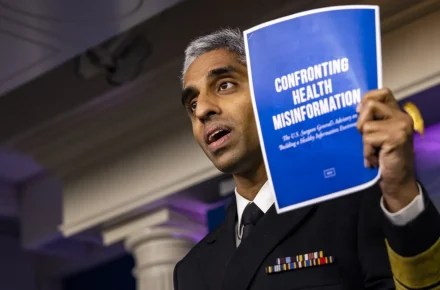
The Surgeon General Who Prescribed Silence
In 2021, Surgeon General Vivek Murthy partnered with the now-disgraced Center for Countering Digital Hate (CCDH) and its soon-to-be-deported founder, Imran Ahmed, to launch a campaign labeling “health misinformation” as a public threat and urging social media companies to “take more aggressive action” against those who questioned the official COVID-19 narrative.
As detailed in Finn v. Global Engagement Center (3:25-cv-00543) (Doc. 83), Murthy’s office collaborated with entities like the CCDH, the White House, and Big Tech platforms to pressure for the removal or throttling of lawful speech — including posts about natural immunity, vaccine injury, and early treatment protocols.
This coordination, which the complaint describes as a “fusion of state and private power to suppress disfavored viewpoints,” forms part of a broader transnational censorship enterprise now under legal scrutiny.
Murthy’s rhetoric about “protecting public health” masked an unprecedented effort to erase public testimony from the vaccine-injured and to delegitimize independent medical experts whose research contradicted pharmaceutical and government messaging. Many of those targeted — including myself — were falsely branded as part of the “Disinformation Dozen,” a defamatory construct disseminated to newsrooms worldwide through UK-linked NGOs and U.S. federal agencies.
Covering the Wounds He Helped Inflict
In his “Parting Prescription,” Murthy writes that “community is the formula for fulfillment” and that the modern epidemic of loneliness demands “love, courage, and generosity.”
Yet his own tenure systematically dismantled trust and belonging, dividing families, churches, and workplaces through moralized public health edicts.
Lockdowns, school closures, and vaccine mandates — all publicly championed by Murthy — fractured communities, creating the very isolation he now laments.
The Surgeon General who now preaches about “connection” was among those who ordered Americans to sever their most human bonds: to distance from loved ones, to shun the unvaccinated, and to treat dissenters as diseased threats.
His later call to “build a new social contract” founded on service and civic programs like the “Youth Mental Health Corps”is telling. It repackages the same surveillance-based public health infrastructure — behavioral tracking, centralized intervention, social credit by another name — in the language of compassion.
Weaponizing Psychology: Pathologizing Dissent
Murthy’s tenure advanced a subtle but potent form of psychological warfare: pathologizing dissent as sickness.
When he declares that division and distrust are symptoms of a “spiritual crisis,” he erases the political and moral legitimacy of resistance. Those who refused the experimental injections, questioned corporate capture of science, or defended medical choice are reframed not as engaged citizens but as patients in need of behavioral correction.
This framing, echoed by the World Health Organization and the Surgeon General’s “advisories,” lays the groundwork for the next phase of informational control — one cloaked not in censorship, but in therapeutic paternalism.
The Great Inversion: Coercion as Care
At the heart of Murthy’s “Prescription” is a moral inversion: coercion recast as compassion.
Throughout the pandemic, his messaging repeatedly equated compliance with virtue and questioning with harm. His Office’s partnership with the CDC and White House COVID Response Team normalized the language of “protecting others” — a phrase that justified censorship, job loss, and social exclusion.
Now, Murthy’s final reflection dresses that same ideology in the soft robes of empathy. His triad of “relationships, service, and purpose”reads less like a personal wellness philosophy than a state catechism — urging citizens to find meaning through collective obedience to approved narratives.
The Spiritual Disguise of Technocratic Power
Murthy’s invocation of faith traditions — Christianity, Judaism, Hinduism, Islam, and Ubuntu — is striking not for its inclusivity, but for its instrumental use of sacred language to legitimize centralized authority.
In merging spirituality with governance, Murthy mirrors a broader trend in global health policy: the conversion of care into control, where moral virtue is measured by conformity to bureaucratic “truth.”
The true crisis is not loneliness, but alienation from truth — a wound deepened by those who censored, shamed, and silenced the nation under the guise of saving it.
From Surgeon General to Social Engineer
Murthy closes his “Prescription” with a challenge:
“We are kin, not enemies… Good people with hearts full of love can change the world.”
But for the thousands of Americans censored, deplatformed, and defamed under his watch, and many more who were injured or killed by the experimental jabs he declared were necessary, those words ring as hollow as a pharmaceutical apology after the damage is done.
True love cannot coexist with coercion. True community cannot be built on lies.
The enduring legacy of Murthy’s public health tenure is not one of healing but of division, distrust, and epistemic violence — the destruction of the social immune system that protects a free people: open inquiry and dissent.
A Prescription Reversed
If Murthy’s farewell message was sincere, his repentance would begin with acknowledgment — of the vaccine-injured, of the silenced physicians, of the citizens whose livelihoods and voices were destroyed in the name of “safety.”
Until then, his “parting prescription” serves not as medicine, but as mirror — reflecting the psychological alchemy of a technocratic era that calls its injuries love.
Referendes
- Murthy’s My Parting Prescription for America (your uploaded PDF) — referenced for quotes and thematic contrast.
- Ji et al. v. Center for Countering Digital Hate et al. (Doc. 83 – Second Amended Complaint) — for legal and factual references regarding Murthy’s actions, coordination, and the broader censorship regime.
- Judicial and congressional context — including Missouri v. Biden and Kennedy v. Murthy, which form the legal frame for federal involvement in viewpoint suppression.
Trump dumps Marjorie Taylor Greene in escalating Epstein-files clash
Al Mayadeen | November 15, 2025
US President Donald Trump formally withdrew his support for Republican Congresswoman Marjorie Taylor Greene on Friday, publicly severing ties with one of his most loyal MAGA allies after she criticized his attempts to block the release of files related to disgraced financier Jeffrey Epstein.
Trump announced the break on Truth Social, writing: “I am withdrawing my support and endorsement of ‘Congresswoman’ Marjorie Taylor Greene, of the great state of Georgia. All I see ‘Wacky’ Marjorie do is COMPLAIN, COMPLAIN, COMPLAIN!”
He added that he would offer his “unyielding support” to a primary challenger “if the right person runs” for Georgia’s 14th congressional district. The rupture came hours after Greene told Politico that Trump was wrong to try to halt the release of Epstein-related documents at a time when many US citizens, including his own supporters, are struggling financially.
“It’s insanely the wrong direction to go. The five-alarm fire is healthcare and affordability for Americans. And that’s where the focus should be,” she said.
“Releasing the Epstein files is the easiest thing in the world. Just release it all. Let the American people sort through every bit of it, and, you know, support the victims. That’s just like the most common sense, easiest thing in the world. But to spend any effort trying to stop it makes – it just doesn’t make sense to me,” she added.
Policy clashes and Gaza stance fuel Greene’s widening split with Trump
It marks the sharpest public split yet between Trump and the 51-year-old lawmaker, who built her national profile as one of his fiercest defenders. In recent months, Greene has increasingly broken with the White House and members of her own party on domestic and foreign policy.
Earlier this week, Trump rebuked her criticism of his agenda, saying she had “lost her way” after she accused him of prioritizing foreign affairs over the economic struggles facing US citizens. Greene responded on X: “The only way is through Jesus. That’s my way, and I’ve definitely not lost it. Actually I’m working hard to put my faith into action.”
Since Trump’s return to office, Greene has clashed more frequently with Republican leadership. She denounced plans to send “billions of dollars” in weapons to Ukraine and broke with the party’s longstanding support for “Israel” by calling its war in Gaza a “genocide.”
She has also voiced frustration with congressional leaders during the government shutdown that ended this week. In a rare move for a Republican, she joined Democrats in pushing for expanded healthcare subsidies.
The global Zionist organ trafficking conspiracy
By Kit Klarenberg | Al Mayadeen | November 15, 2025
In early October, Israeli-Ukrainian Boris Wolfman was arrested in Russia. He is charged with masterminding a criminal organ trafficking scheme. His capture, wholly ignored by the Western media, raises the prospect that at long last, some justice will be served in a number of major organ trafficking scandals, dating back many years. Wolfman’s apprehension also highlights Tel Aviv’s little-scrutinised role as the world’s centre of illegal organ harvesting and trafficking. Grimly, the Gaza genocide may have greatly facilitated this perverse commerce.
Ever since October 7th, credible allegations have widely circulated that Zionist Occupation Forces are illegally harvesting the organs of slain Palestinians. In November 2023, the Euro-Med Monitor published a report documenting how Israeli soldiers confiscated dozens of corpses from major hospitals in Gaza, to the extent of digging up and raiding mass graves built in their grounds to accommodate the never-ending influx of slaughtered civilians. While some bodies were subsequently handed over to the Red Cross, many were and remain withheld.
Euro-Med Monitor records how many corpses exhibited clear indications of organ harvesting, including missing cochleas and corneas, as well as hearts, kidneys, and livers. Since then, the Zionist entity has released token numbers of murdered Palestinians at intermittent intervals to their surviving relatives. Frequently, the bodies are decomposed beyond recognition, making conducting professional autopsies – and identifying whether organs have been stolen – difficult if not impossible. Sometimes, the corpses are frozen solid, again greatly complicating medical examinations, and potentially obscuring organ theft.
The 1949 Fourth Geneva Convention mandates respect for the dignity of dead civilians, and explicitly prohibits the looting or mutilation of their bodies during wartime. However, the Zionist entity has not only failed to ratify the treaty, but expressly rejects its applicability to Gaza and the illegally-occupied West Bank. Moreover, repulsive local laws and legal precedents unique to Tel Aviv grant authorities the power to refuse to release dead Palestinians to their families.
Their bodies can be used as grisly bargaining chips – or their organs looted with impunity. For decades, the Zionist entity has been the illicit organ trade’s international nucleus. While Palestinians have long-raised alarm over Tel Aviv’s theft of their fallen comrades’ organs, it was not until the early 2000s that the practice was officially admitted. Yehuda Hiss, head of “Israel’s” Abu Kabir Institute, openly boasted of harvesting skin, bones, and other human materials during autopsies. He was never punished, suggesting his macabre activities were state-sanctioned.
This interpretation is amply reinforced by former Institute employee Meira Weiss’ 2014 work Over Their Dead Bodies. She reveals how, during the First Intifada 1987 – 1993, ZOF officials directed the centre “to harvest organs from Palestinians using a military regulation that an autopsy must be conducted on every killed Palestinian.” This gave them free rein to seize whatever they wished from bodies in their care. Institute apparatchiks nostalgically referred to these years as the “good days”, as they could pilfer organs “consistently and freely”.
Disturbingly, the Gaza genocide’s catastrophic death toll may represent the dawning of a new era of “good days” for the Zionist entity’s organ trade. Wolfman’s arrest, and the collapse of the conspiracies he oversaw, are unlikely to dent Tel Aviv’s operations in the field. He was but one player in a world-spanning nexus of Israeli traffickers. In the manner of a hydra, Wolfman’s removal will simply lead to others taking his place. After all, the returns are high, and risks mysteriously low.
‘Organ Broker’
In July 2015, the European Parliament issued a landmark report on organ trafficking. Its introduction notes, “before 2000, the problem of trafficking in human organs…was primarily limited to the Indian subcontinent and Southeast Asia.” However, the report noted that following the turn of the millennium, “trafficking in organs has seemingly started to spread globally, to a large extent driven by Israeli doctors.” The document went on to detail a number of high-profile organ trafficking cases.
In all but one, the evidentiary trail led directly back to the Zionist entity. An accompanying map of international organ trade routes places Tel Aviv at the very core, with its citizens both being leading customers, and heading the gangs that supply organs to overseas buyers. One cited case was the exposure in 2003 of a leading South African hospital performing over 100 illegal transplants on overseas patients – “the majority” from “Israel”.
Local law enforcement uncovered how a criminal syndicate led by well-connected Israeli Ilan Perry recruited poor, desperate individuals from Brazil, Romania, and elsewhere who were willing to sell their organs for a token sum, then transported them to South Africa. Customers would pay vast amounts for the transplants – Perry, the “organ broker”, and his associates would pocket the bulk, with the rest paid to ‘donors’ and hospital staff to perform the illegal procedures, then keep quiet about the connivance.
Another cited case is the Medicus Clinic scandal in Pristina, Kosovo. It erupted in October 2008, when a young Turkish man collapsed at the city’s airport. After a fresh surgical scar was found on his abdomen, he explained his kidney had been removed at the clinic, leading to a police raid. Medicus was already on local law enforcement’s radar due to the profusion of foreigners arriving in Pristina with letters of invitation to the clinic for heart treatment, which Medicus was not known to provide.
Subsequent investigations revealed Israeli Moshe Harel and Turkish doctor Yusuf Sonmez – known as “the world’s most renowned organ trafficker” – were responsible for sourcing clientele, who paid in excess of $100,000 for transplants. The surgeries were primarily conducted by local Kosovo Albanian medical professionals. Patients spent a short period in recovery before being discharged, provided with “information on their treatment to present to doctors in their home countries.” Donors did not enjoy such charity.
As the EU report notes, suppliers were forced to sign documents attesting they were donating their organs “voluntarily to a relative or altruistically to a stranger.” These documents were written in Albanian, and not translated to them. While in some cases they were promised fees of up to $30,000, “a number of them received only part of the money and some nothing at all.” Those given a portion were told they’d get the remainder “on condition that they themselves would recruit other ‘donors’.”
‘Notable Price’
Boris Wolfman was also centrally embroiled in Medicus. While a wanted man in multiple jurisdictions and subject to an Interpol red notice, he remained at large in Turkey for years until his recent deportation to Russia. Incredibly, he kickstarted another organ trafficking venture in the meantime, exploiting vulnerable Kenyans for small sums, selling their kidneys et al. to wealthy buyers from Germany and “Israel” for up to $200,000. As in Kosovo, donors were not given the money promised, or provided with appropriate medical care post-procedure.
It remains to be seen what, if any light, his prosecution will shed on the wider criminal network in which he operated, or whether the Zionist entity might be directly implicated in Wolfman’s venture. Still, that he is facing trial at all is somewhat miraculous. His confederates in the Medicus horror have proven suspiciously impervious to legal repercussions for their monstrous activities. Sonmez likewise lived freely and openly in Turkey for some years after the conspiracy’s unravelling, despite facing criminal charges in multiple countries.
Turkish prosecutors sought to jail him for 171 years, but Sonmez never served a day in prison, and appears to have vanished without a trace. Meanwhile, Harel was arrested by Israeli police in 2012, only to be released. He was nabbed again in Cyprus six years later on an Interpol warrant, but demands from Kosovo authorities he be extradited inexplicably appear to have not been acted upon. Whether the pair’s continuing liberty is indicative of state protection is an open, obvious question.
The Zionist entity’s 21st-century Holocaust in Gaza, and disastrously failed wars against Hezbollah and Iran, have “exacted a notable price” on its finances, Focus Economics has recorded. For example, tourism – once a core component of “Israel’s” income – has shrunk from millions of visitors annually to almost literally zero. “A full recovery could take multiple years and is likely dependent on a permanent end to hostilities with Hamas, Hezbollah and Iran,” the outlet forecasts – fantastically, given the Resistance cannot peacefully coexist with Tel Aviv.
Meanwhile, the Zionist entity continues to suffer mass brain drain, foreign investor flight, diplomatic isolation, and a huge drop in confidence among its largest overseas trading partners. Grotesquely, organ trafficking might represent one of Tel Aviv’s few dependable profit sources at this stage. With thousands of Palestinians both dead and alive in its custody, “Israel” certainly has ample resources to fuel the trade. Mainstream blackout on Wolfman’s long-overdue arrest may indicate the entity’s overseas puppet masters are relaxed about the prospect.
US plan for a divided Gaza cements long-term occupation, trapping 2 million Palestinians in ruins: Report
Press TV – November 15, 2025
The US is drafting a plan to entrench Gaza’s division, creating a fortified “green zone” under “joint Israeli–international control,” while relegating most Palestinians to a devastated “red zone” left in ruins and neglect, a report says.
According to internal documents obtained by The Guardian and sources briefed on US deliberations, Washington is working towards institutionalizing a partition of Gaza along the Israeli-imposed “yellow line.”
Under the blueprint, foreign troops would be deployed alongside Israeli forces in the east, while nearly the entire Palestinian population remains displaced west of it, the daily reported on Friday.
One senior American official, acknowledging the depth of Washington’s ambitions, admitted, “Ideally, you would want to make it all whole, right? But that’s aspirational. It’s going to take some time. It’s not going to be easy.”
The revelation sharply contradicted earlier American pledges, including President Donald Trump’s own assurances, that a 20-point so-called ceasefire scheme announced by the chief executive earlier this year would pave the way to full Palestinian governance across Gaza.
Instead, Washington’s planning documents pointed to a fractured, semi-occupied coastal sliver, where reconstruction is limited to the Israeli-controlled sector, while the rest of Gaza is effectively abandoned.
The United States has been cycling through back-to-back plans, from fenced “alternative safe communities (ASC)” to a “green-zone enclave model,” all devised without Palestinian involvement and without addressing more than two years of Washington-backed Israeli genocide that Gaza has suffered since October 2023. Even humanitarian agencies, long alarmed by US proposals, were not informed of the abrupt scrapping of the ASC model.
Observers say, with no credible roadmap for Israeli withdrawal, international peacekeeping, or large-scale rebuilding, Gaza risks being locked into a “not war but not peace” paralysis.
This, they note, would pave the way for a divided territory under constant threat of Israeli attacks, stripped of Palestinian self-rule, and starved of the reconstruction needed for even minimal recovery.
Trump’s 20-point scheme hinges on, what he calls, an “international stabilization force (ISF)” mandated by the UN Security Council.
However, Washington refuses to place a single American trooper on the ground or finance the reconstruction Palestinians desperately need, the paper wrote.
European nations were drafted into early versions of the plan, including as many as 1,500 British troops and 1,000 French forces, but diplomats from allied capitals dismissed the proposals as unrealistic and politically suicidal, it added.
According to the report, after long, bloody missions in Iraq and Afghanistan, few leaders are willing to send troops into Gaza’s shattered landscape. One source described the plan in blunt terms as “delusional.”
The documents, The Guardian revealed, also envision Jordan sending hundreds of infantry forces and thousands of police officers, despite King Abdullah’s explicitly rejecting any deployment.
With more than half the Jordanian population of Palestinian descent, such participation would be explosive domestically and a direct threat to Jordan’s internal stability, it said.
A US “concept of operation” states that foreign troops would operate only within the “green zone.” None would enter the Palestinian-held western side, where the Hamas resistance movement is reasserting control.
The “enclave” would begin with just a few hundred troops and slowly expand to a force of 20,000, integrating with Israeli forces along the dividing line.
According to the report, the parallels to the United States disastrous invasions of the 2000s are, therefore, unavoidable. In both wars, US-created “green zones” became symbols of occupation, shielded by blast walls, while chaos and destruction consumed the surrounding cities.
US planners openly hope that limited reconstruction in the green zone will “attract” desperate Palestinians into the Israeli-controlled area. As one US official put it, “People will say ‘hey we want that,’ and so it evolves in that direction. No one’s talking about a military operation to force it.”
Experts commenting on the report said the blueprint envisages a future for Palestinians conditioned on accepting the Israeli regime’s authority, not on justice, sovereignty, or the right to rebuild their own homeland.
The report came as more than 80 percent of Gaza’s infrastructure, including nearly every school and hospital, lies in ruins.
Israel continues to block even basic aid items. Tent poles, water filters, and construction materials remain barred under “dual use” claims.
Around 1.5 million Palestinians still wait for emergency shelter items, and more than two million are crushed into the narrow territory that the US plan designates as the red zone.
Iran rejects Canada’s baseless claims of foiling ‘lethal plots’ by Tehran
Press TV – November 15, 2025
Iran has strongly dismissed allegations of sabotage operations raised by the head of Canada’s domestic Security Agency against the Islamic Republic, calling the claims baseless and fabricated.
On Thursday, Dan Rogers, director of the Canadian Security Intelligence Service, claimed that the agency this year foiled potentially lethal threats by Iran directed against people whom Tehran sees as enemies.
He claimed that the agency countered actions by Iranian intelligence services and what he called their proxies, who allegedly targeted individuals they perceived as threats to Iran.
Rogers also alleged that his agents had blocked attempts by Russia to illegally acquire Canadian goods and technologies. He also levelled some accusations against China and India for espionage and transnational repression efforts against Canada.
Zahra Ershadi, Iran’s deputy permanent representative to the United Nations, said in a statement on Friday that the allegations were aimed at shifting attention away from Israel’s ongoing actions in West Asia and Canada’s role in supporting them.
“The ridiculous accusations of the Canadian Security Organization against Iran have no purpose other than to divert attention from the ongoing violations and crimes committed by the Zionist regime in the West Asia region and Canada’s support for it,” she said.
Ershadi also criticized the obstruction of consular services for Iranians living in Canada, urging the Canadian government to reverse “irresponsible and unjustified” policies toward Tehran.
During the genocide in Gaza, Canada and several other Western countries continued to supply lethal weapons to the Israeli regime despite the enormous human toll in Palestinian territory.
Ansar Allah official slams UN sanctions, West’s double standards
Al Mayadeen | November 15, 2025
Mohammed al-Farah, a member of the Political Bureau of Yemen’s Ansar Allah movement, commented on the recent UN Security Council decision to extend sanctions on Yemen, stating that Yemen would respond in kind to anyone who attacks its people’s interests or attempts to undermine its sovereignty.
He emphasized, in this context, that Yemenis will not hesitate to defend their rights, religion, and national dignity by all legitimate means.
In a post on X, al-Farah accused the Security Council of perpetuating “the worst example of double standards,” noting that it has long turned a blind eye to crimes of genocide in Gaza, even supporting “Israel” while ignoring the bloodshed, and covering up the blockade and aggression against Yemen without any moral or legal stance.
He continued, saying the council “continues to apply double standards while Gaza is being devastated under two years of bombing and blockade with US and Western weapons,” reminding how “Yemen has been under siege for a decade.”
Al-Farah described the council as a platform for advancing Western interests, where “human rights are defined only as Western human rights and international interests are reduced to those of Washington alone.”
NGOs; culprits in espionage operations in Yemen
The Ansar Allah official also warned that some NGOs operating in Yemen have engaged in “dangerous practices”, including espionage on behalf of “Israel” under the guise of humanitarian work, exposing what he called the extent of “Zionist exploitation of UN institutions.”
Al-Farah, however, praised Russia and China for refusing to renew sanctions on Yemen, contrasting their stance with what he described as the “moral failure” of the UN Security Council. He said Moscow and Beijing’s positions reflect a “humanitarian and ethical awakening” and awareness of the dangers of US policies that use sanctions to subjugate nations.
At the same time, he expressed hope that Russia and China’s position would amount to a definitive rejection and veto of the resolution, describing it as a stand that “rejects the exploitation of the Security Council and restores some balance against Western dominance.”
Sanctions on Yemen are merely tools for Israeli objectives
Al-Farah also criticized the West and the United States for openly supporting “Israel” with weapons and financial aid while shielding it politically, arguing that the proposed sanctions on Yemen are merely “tools to serve Zionist objectives and punish the Yemeni people for their resilience, independent decision-making, and solidarity with Gaza.”
He concluded by reaffirming Yemen’s steadfast support for Gaza and for oppressed communities across the region, pledging to continue opposing Western and US hegemony over the countries and peoples of the region without hesitation.
UNSC extends sanctions on Yemen
On November 14, the UN Security Council approved a resolution extending financial sanctions and a travel ban on Yemen for another year, until November 14, 2026, while also extending the mandate of the panel of experts supporting the sanctions committee until December 15, 2026.
The resolution, adopted by a 13-member majority with Russia and China abstaining, renews Yemen’s international sanctions under Resolution 2140 for an additional year. It maintains frozen assets and travel restrictions on designated individuals and entities and extends the mandate of the expert panel overseeing Yemen sanctions until mid-December 2026.
The Security Council imposes these sanctions on Yemen under US pressure and under the cover of Chapter VII of the UN Charter, through Resolutions 2140 (2014) and 2216 (2015).
The UN Security Council first imposed sanctions on Yemen in 2014 through Resolution 2140, targeting individuals and entities linked to destabilizing activities during the country’s ongoing conflict.
These measures included asset freezes and travel bans aimed at those accused of threatening Yemen’s stability or obstructing peace efforts.
In 2015, Resolution 2216 expanded the sanctions framework, further restricting financial and travel activities of key figures aligned with armed groups and reinforcing the Council’s oversight through a dedicated panel of experts.
IOC’s Double Standards Trample Principle of ‘Sport Above Politics’ – Russian Ministry
Sputnik – 15.11.2025
MOSCOW – The International Olympic Committee’s double standards have trampled on the principle of “sport above politics,” Russian Foreign Ministry spokesperson Maria Zakharova told Sputnik on Saturday, commenting on the IOC’s refusal to accredit the RIA Novosti news agency for the upcoming Olympics in Italy.
“By pursuing a harmful policy of double standards and discriminating against athletes on the basis of nationality, IOC officials have effectively trampled the principle of ‘sport above politics’ that was enshrined in the Olympic Charter by Pierre de Coubertin,” Zakharova said.
The spokesperson accused IOC functionaries of “insulting athletes and their fans worldwide, depriving them on chauvinistic grounds of the last opportunity to follow competitions that should be open to all.”
Olympic authorities have a history of imposing restrictions on Russian journalists during major sporting events, Zakharova said. The Paris Olympic Committee denied accreditation in 2024 to several Russian journalists, including those from RIA Novosti and the Izvestia media group, citing French government’s decisions as the reason for the ban.
“Every time the governing bodies of the Olympic movement hid behind the host country, presenting themselves as obedient executors… But, whereas previously the IOC cited the host nation’s stance with affected modesty and embarrassment, now it is inventing nonexistent reasons to deny our correspondents access to competitions. Its claim that a number of other Russian journalists have already been accredited for the 2026 Olympics looks laughable in form and disgraceful in substance, even to an outside observer,” she added.
This is “a ridiculous pretext and yet another manifestation of the Russophobic position that this organization consciously promotes, with dire consequences for the Olympic movement and its ideals, including the rejection of political games in sport,” the spokeswoman said.
Russia expects international organizations, such as the United Nations, the UN sports agency UNESCO and the Organization for Security and Co-operation in Europe (OSCE), to speak out on the IOC’s politicized approach, which violates the principle of equal access to information and media pluralism in favor of “certain pseudo-democracies, including Italy, the Olympic host,” Zakharova said.
“If they ignore this shameful incident, we will regard their inaction as yet another example of bias and dysfunction,” Zakharova added.
Russia Communicates Consistently, But the West Won’t Listen
By Bryan Anthony Reo – New Eastern Outlook – November 15, 2025
Russia consistently states its interests, goals, and security concerns, but the West often ignores these statements, considering them irrelevant and refusing to consult on issues directly affecting Russia. This attitude reflects hubris and folly and risks disastrous consequences, as it is both unjust and historically unsound.
Over the last several decades, Russia has consistently communicated a clear stance to the West, a stance that has largely been ignored or even ridiculed. As I say, “over the last several decades,” it becomes clear I am going to pick a starting point for a divergence or breakdown of East/West communications, and I must necessarily pick some point. I could go back to the Crimean War and show how Britain and France were engaged in imperialist interventions to try to harm Russia as far back as 1854 (and very few British patriots who honor the glory of the Light Brigade ever think to inquire as to why the British Army was in Crimea in the first place), or I could even go back to 1054 with the East-West Schism, but for the sake of simplicity, brevity, and precision, let’s focus around 1989-1991 as the starting point. It is necessary to pick a point, so I choose 1989-1991 for the purpose of this writing.
The Decline of the Soviet Empire and NATO’s Promises
As the Cold War was winding down and Soviet Premier Gorbachev tacitly conceded that Marxism-Leninism had not prevailed in the competition of ideas with the Western nations, agreements were made, understandings were reached, and terms were established for the withdrawal of Soviet forces from Central Europe and from the non-Soviet Warsaw Pact member territories. Then US Secretary of State James Baker promised guarantees: “NATO jurisdiction or forces will not move eastward” regarding the possibility of NATO eastward expansion. Memorandum of Conversation between James Baker and Eduard Shevardnadze in Moscow available in the National Security Archive.
There was also the follow-up conversation with President Gorbachev (held the same day as the initial conversation with Mr. Shevardnadze), where Baker told Gorbachev, “Not one inch to the east.”
Consequences and Lessons of the Eastern Bloc
It was on this basis that the Soviet Union consented to German reunification under Western auspices favorable to the FRG, by which the DDR was essentially absorbed. The Soviets also withdrew, in peace, throughout the Warsaw Pact nations, and nowhere did they use violence to oppose the popular mass demonstrations occurring throughout 1989-1990 across in the Eastern Bloc; not even in Romania, where the demonstrations were not only not peaceful, but morphed into a bloody revolution. As an aside, Brussels technocrats might do well to ponder what the Romanian people did to Ceausescu and the simple fact that when people are pushed to the breaking point, they snap, and that no technocratic tyranny is immune to being brought down by its own working class. In the end, Ceausescu was at least as out of touch with the reality of his own population as most of the empty suits in Brussels, Berlin, Paris, and London are with their respective populations, and only time will tell if those empty suits in those cities meet a similar fate.
The Russians (previously Soviets) had communicated clearly to their Western counterparts and obtained promises and assurances that they thought were as good as gold. The only thing we can fault President Gorbachev for is that he trusted the words of Western so-called statesmen, and he actually believed what they told him. They would later cynically proclaim, “Those promises were never in writing,” as though a verbal guarantee means nothing and it would only matter if it were written on paper. Ask the American Indians how valuable American government written guarantees were in the 19th century, or ask the Czechs and Slovaks what they think of British written guarantees from 1938 and 1939. The West would have violated even written guarantees, because it is now obvious that the West had the intention to betray Russia from the start.
History Lessons: Why Russia Will Never Forgive NATO Expansion
The West occasionally maintains the position that no guarantees were ever given to Russia, a position I do not support. The available evidence strongly indicates that the guarantees were made, and common sense would suggest that seasoned Soviet/Russian statesmen would have procured such guarantees before undertaking the steps to dismantle the Warsaw Pact and shift forces back to the Soviet Union. However, even if the guarantees were not made, good neighborliness and political reality would dictate that the prudent course of action would be to respect Russian interests and not expand NATO, as such expansion is a needless provocation that risks much and gains little.
Russia has clearly communicated, repeatedly, “Do not expand NATO to the east,” “Do not expand NATO into former Warsaw Pact members,” and finally, “Do not expand NATO into former Soviet Republics.” The standard response the West gives Russia has come from people such as John McCain, who dismiss Russia as a “gas station masquerading as a country,” which they say isn’t worthy of listening to or taking seriously. I urge my fellow Americans, only adopt Mr. McCain’s attitude if you do not value peace and if you wish to test that hypothesis in a knock-down, drag-out fight with Russia, a fight that might end in nuclear fire.
Suffice to say, Russia is a great and historical power and cannot be flippantly dismissed as a “gas station” simply because a pseudo-statesman like John McCain said so. Such remarks are as constructive to international dialogue as a Russian dismissing the USA as a “Super Walmart pretending to be a country,” which, as far as I know, has not happened, because Russian diplomats are actually classically educated and know how to behave themselves. One-liner insults or verbal jabs are best left to comedians, not aspiring statesmen hoping to go viral while sounding “cool” for a younger audience.
The Russians seldom speak of Americans or America in the sort of denigrating or insulting terms Americans use to describe them, because it is not how mature statesmen dialogue with partners or even competitors or rivals; childish insults are generally not a tool in the box of statecraft, unless you are Bismarck trying to start a war with France in 1870. The Russians don’t seem to have the American penchant for starting unnecessary wars.
In fact, the Russians have shown incredible restraint and forbearance in an attempt to keep the peace and avoid escalation to war. Russia reluctantly accepted NATO expansion in 1999, which saw the Czech Republic, Hungary, and Poland incorporated into NATO, although it was in clear violation of the prior assurances made by Western leadership. It is likely that the Western powers, looking at the dire situation in Russia in the late 1990s, decided, “Russia is in crisis, the situation is terrible, we can violate the prior agreements with impunity, and Russia won’t be in any position to oppose us.”
One more round of expansion of NATO in the former Warsaw Pact and even in the former Soviet Republics occurred, and that was in 2004.
Putin at the Helm: How the Change of Power in Russia Coincided with a New Wave of NATO Expansion
Something dramatic and historically significant had happened in Russia around that time; that was the ascension to the presidency of Vladimir Putin, who was appointed prime minister in 1999 and then elected president in 2000.
The 1999 NATO expansion happened prior to the beginning of his administration, and the 2004 expansion happened while he was still stabilizing the situation in Russia and was working to resolve the internal issues of the Second Chechen War (the jihadi groups in Dagestan likely had support of CIA/Western-organized global jihadi networks such as Al Qaeda, which the CIA had formed and organized to fight the Soviets in Afghanistan, which ultimately turned and bit its American master).
In 2004 the Russians very reluctantly witnessed the expansion of NATO into the Baltic States and the rest of the former non-Soviet Warsaw Pact members who were not included in the 1999 expansion, but red lines were drawn; the message was clear: “Do not ever attempt to expand NATO into a former Soviet Republic again.”
The West went away hearing what its delusional technocratic rulers wanted to hear and what its thoroughly dishonest corporate press wanted to report: “Russia is unreasonable and threatens a peaceful military alliance simply for expanding right to its front door.” They also convinced themselves Russia was weak and could be subdued or subverted.
Two Failures of the West: Lessons of 2008 and the Fate of the Puppets
The West has only dared try to expand into former Soviet Republics on two more occasions, one in 2008, where the Western/Soros-backed pawn Mikheil Saakashvili (emboldened by ultimately empty Western guarantees of support) foolishly and recklessly ordered his military to attack Russian peacekeepers in South Ossetia and found out the hard way that Western guarantees aren’t always reliable and that Russia was not as weak as his Western handlers doubtlessly assured him. Saakashvili is presently a naturalized Ukrainian citizen who claims a right to the leadership of Georgia, but he is incarcerated for his crimes against Georgia and the Georgian people. Readers may ponder on such things and contemplate the worthiness of Western guarantees, something Saakashvili will have many years to ponder on from his prison cell, where he may also contemplate that his treason against Georgia and aggression against Russia came with high price tags.
2008 was different from 1999, as Russia now had President Putin at the helm, Russia’s recovery was proceeding at full speed, and what NATO was able to get away with in 1999, it found it couldn’t manage in 2008.
I said there were “two more occasions” where the West tried to expand NATO into former Soviet Republics. One was in Georgia in 2008. The other is right now; it is history we are living in and watching unfold. We are part of a generation that is watching (in some instances writing) this history. I speak, of course, of Ukraine.
In 2008 NATO affirmed, “Ukraine will one day become a member,” and President Putin warned them not to try, not to do it; he warned of a forceful response if such a thing was attempted. NATO ignored Putin, at its own peril, and proceeded forward with operations in the Ukraine, first subverting the lawful government with the illegal (and immoral) Maidan Coup of 2014, and then turning the Ukraine into an armed camp with tens of billions of dollars of weapons from 2014 to 2022 and then finally hundreds of billions of dollars since 2022.
Russia communicated clearly, “Do not expand NATO in this manner,” and the NATO response was essentially demonstrated by deed, “We don’t care what Russia says or does, Russian responses are not relevant, and we don’t factor Russia into our calculations.”
Why does NATO seek to expand? Why does NATO even exist in the post-Cold War era? Perhaps the NATO leaders understand well something Hitler wrote in Mein Kampf: “An alliance which is not for the purpose of waging war has no meaning and no value.” So NATO exists to wage war; this much is clear. The question then is, “Against whom does NATO seek to wage war?” A question whose answer is also obvious. NATO is an aggressive dagger aimed at the heart of Russia.
Bryan Anthony Reo is a licensed attorney based in Ohio and an analyst of military history, geopolitics, and international relations.
Nicolai Petro: Ukraine Endgame & Fragmentation of Europe
Glenn Diesen | November 14, 2025
Nicolai N. Petro is a Professor of Political Science at the University of Rhode Island, and formerly the US State Department’s special assistant for policy on the Soviet Union. Prof. Petro discusses the pending end of the Ukraine War and why Europe will likely fragment as a consequence of its proxy war against Russia.
Follow Prof. Glenn Diesen:
Substack: https://glenndiesen.substack.com/
X/Twitter: https://x.com/Glenn_Diesen
Patreon: https://www.patreon.com/glenndiesen
Support the research by Prof. Glenn Diesen:
PayPal: https://www.paypal.com/paypalme/glenndiesen
Buy me a Coffee: buymeacoffee.com/gdieseng
Go Fund Me: https://gofund.me/09ea012f
Books by Prof. Glenn Diesen:
Can a second Ukraine on Taiwan be prevented?
By Ladislav Zemánek | RT | November 14, 2025
Taiwan’s political landscape is undergoing a moment of transformation marked by deepening divisions among the island’s elite. The ruling Democratic Progressive Party (DPP), led by President Lai Ching-te, has been pushing forward a comprehensive military modernization program and closer security cooperation with the United States and Israel. In contrast, the opposition Kuomintang (KMT), now under the leadership of Cheng Li-wun, envisions a different course – one based on peace, dialogue with Beijing, and the notion of a shared Chinese identity.
Peace, or war?
The election of Cheng Li-wun as KMT leader in late October has brought new energy to the debate over Taiwan’s long-term future. Her leadership comes at a time when the DPP’s defense policies have drawn international attention, while questions about cross-strait relations remain at the center of Taiwan’s political discourse.
Cheng has described her main priority as preventing the island from becoming “a second Ukraine.” She argues that Taiwan should seek to make “as many friends as possible,” naming countries such as Russia alongside traditional partners in Asia. Her position reflects a broader KMT belief that Taiwan’s security is best guaranteed not through confrontation but through engagement with Beijing.
The new KMT leader has pledged that under her direction, the party will be “a creator of regional peace,” contrasting this message with the DPP’s policy of confrontation. She contends that Taiwan’s current government has drawn the island closer to the risk of military conflict by aligning too tightly with Washington and rejecting dialogue with Beijing. Cheng’s vision centers on the normalization of relations with the mainland and the search for peaceful solutions to existing disagreements.
Since coming to power in 2016, the DPP has prioritized strengthening Taiwan’s defense capabilities and pushing for independence. Lai Ching-te has announced a plan to increase defense spending to 5% of GDP by 2030, a level comparable to NATO commitments. For the 2026 budget year, military expenditures are set to reach 3.32% of GDP. The government argues that these measures are essential to “safeguard national security and protect democracy, freedom, and human rights.”
Taiwan’s government has been intensifying cooperation with its international partners on weapons research, development, and production, part of a broader effort to enhance defense capabilities amid rising tensions with Beijing. Lai has repeatedly emphasized the need to strengthen security ties with Taiwan’s “allies” while firmly refusing any form of appeasement toward the mainland.
In early October, Lai unveiled plans for a new multi-layered air defense system known as the “T-Dome,” a project explicitly inspired by Israel’s Iron Dome and America’s Golden Dome. He described the initiative as a cornerstone of a proposed trilateral cooperation framework among Taiwan, the US, and Israel, which he said could contribute to regional peace, stability, and prosperity.
Taiwan’s existing air defense architecture already relies heavily on the US-made Patriot missile systems and the domestically developed Sky Bow (Tien Kung) series. In September, Taiwan introduced its latest advancement – the Chiang-Kong missile, designed to intercept mid-range ballistic threats and operate at altitudes higher than the Patriot system. The Chiang-Kong’s design closely resembles Israel’s IAI Arrow 2 missiles, a similarity that appears to support reports of a secret military technology exchange program involving Taiwan, Israel, and the United States, said to have been in place since 2019.
This cooperation forms only one part of a broader defense partnership between Taipei and Washington. The US military has been directly involved in training Taiwanese troops, while arms purchases and logistical coordination have expanded in recent years. Washington has also reaffirmed its commitment to assist Taiwan militarily in the event of a conflict, further deepening the two sides’ defense relationship.
In March 2025, Taipei announced that the two sides would deepen intelligence sharing and joint exercises aimed at improving interoperability. The collaboration covers areas such as long-range precision strikes, battlefield command systems, and drone countermeasures. Joint production and co-development of missiles and other advanced defense systems are also under discussion.
Looking for the patriots
Central to the political divide within the island’s elite is the long-standing “1992 Consensus,” an understanding that both the People’s Republic of China and Taiwan’s authorities acknowledge there is only one China. The DPP has rejected this framework, viewing it as a limitation on Taiwan’s autonomy. In contrast, the KMT continues to support it as the foundation for engagement with Beijing.
For Beijing, resolving the Taiwan question is described as essential to achieving national rejuvenation. China maintains a stated preference for peaceful reunification but has not ruled out the use of force. Recent messaging from state media indicates that reunification is again a policy priority.
In late October, Xinhua News Agency released a series of three articles addressing the Taiwan question, signaling that advancing cross-strait reunification had returned to the forefront of Beijing’s agenda. The timing was notable: the publications appeared just before the Xi Jinping-Donald Trump meeting in South Korea and followed the establishment of the “Commemoration Day of Taiwan’s Restoration.” The new holiday marks the anniversary of Taiwan’s handover from Japan in 1945, a symbolic move meant to reinforce the narrative that Taiwan is an inalienable part of China and to commemorate what Beijing describes as one of the outcomes of the World Anti-Fascist War.
Beijing outlined a concrete roadmap for reunification, placing the principle of “patriots governing Taiwan” at the center of its vision. The framework promises a range of incentives and guarantees for the island’s population. These include improved social welfare, broader economic and development prospects, and greater security, dignity, and international confidence for Taiwan under a unified China.
Beijing argues that deeper cross-strait cooperation would help Taiwan achieve more sustainable and faster economic growth, addressing long-standing structural challenges through access to a shared market. Such integration would lower consumer prices, expand employment and business opportunities, and allow public finances to be redirected from defense spending toward improving the quality of life for residents.
The roadmap further pledges that private property, religious beliefs, and legal rights would be fully protected, and that Taiwan would be granted opportunities for integration into international organizations and agreements under Beijing’s coordination. Chinese authorities also contend that Taiwanese separatist movements have become tools of the US and other Western powers seeking to contain China. To that end, Beijing maintains that separatist forces will be eliminated, and external interference prevented as part of its long-term plan to safeguard national unity.
Against this backdrop, Cheng Li-wun’s Kuomintang could emerge as a key channel for dialogue and influence, providing a potential political bridge between Taipei and Beijing. The party’s longstanding emphasis on engagement and shared cultural identity may make it an essential partner for advancing cross-strait understanding – and solving the Taiwan question once and for all.
Ladislav Zemánek, non-resident research fellow at China-CEE Institute and expert of the Valdai Discussion Club
Featured Video
America Racing to Strategic Defeat in Iran
or go to
Aletho News Archives – Video-Images
From the Archives
Should Europeans ‘Thank’ the Americans for Destroying Nord Stream?
By Robert Bridge | Strategic Culture Foundation | September 29, 2022
With an investigation continuing into the destruction of the Nord Stream gas pipeline that provided energy supplies to Europe from Russia, there appears to be just one prime suspect, and that should surprise nobody.
Following the sabotage of the Nord Stream 1 and 2 gas pipelines, former Polish Foreign Minister Radoslaw Sikorski already seemed to know the identity of the perpetrator when he tweeted out: “Thank you, USA.”
At first glance, it seemed that Sikorski was speaking sarcastically, berating Washington for carrying out an attack that will have severe repercussions for the people of Europe. After all, how could anyone see any good coming from the termination of Europe’s primary source of gas reserves with winter just around the corner? It was Sikorski’s homeland of Poland, after all, that urged its citizens to collect firewood in the face of dwindling gas reserves.
In fact, the Polish diplomat was speaking one-hundred percent literally… continue
Blog Roll
 Aletho News
- Growing insecurity, soaring prices fuel protests in north as regime bans evacuation: Sources
- Iran denies responsibility for ‘depraved’ attack on Kuwait desalination plant
- Bring The Troops Back. End This War Now!
- Can we please stop calling Israel the ‘only democracy in the Middle East’ now?
- US should start removing its troops from Germany, proposes AfD co-leader Chrupalla
- Iran Red Crescent: 600 educational centers attacked in US-Israeli ‘war crimes’
- Russian Oil Tanker Arrives in Cuba Amid U.S. Blockade
- America Racing to Strategic Defeat in Iran: Lt Col Daniel Davis
- FTC Warns Visa, Mastercard, PayPal, Stripe Over Political Debanking
- Russian tanker approaches Cuba despite US oil blockade
- If Americans Knew
- As Iran targets US military bases, will they be relocated to Israel? Not a ceasefire Day 171
- Will Trump Go Kamikaze?
- Is the University of Florida Shutting Down College Republicans over Israel Criticism?
- Jewish extremist arrested over alleged plot to firebomb Palestinian activist Nerdeen Kiswani’s home
- More than half of Palestinian child detainees have no charges
- The More Murderous Israel Gets, The More We Hear About “Antisemitism”
- Land Day and the Palestinian struggle after 30 months of genocide
- The Iran War Is About Palestine
- Israeli soldiers echo settler ideology, talk of revenge after targeting Palestinians and detaining CNN crew in the West Bank
- Israeli Policies Threaten Future of Christian Schools in Jerusalem
- No Tricks Zone
- New Study Finds Warming Saves Lives…Cold Temperatures 12 Times More Deadly Than Excess Heat
- German Science Blog Accuses PIK Climate Institute Of Hallucinating Climate Tipping Points
- Devastating Assessment Of Comirnaty Vaccine By Former Senior Pfizer Europe Toxicologist
- New Study: CO2 Is ‘Effectively Negligible’ As An Explanatory Climate Change Factor Since 2000
- Former Pfizer Toxicologist Dr. Helmut Sterz Tells Bundestag Hearing Pfizer Vaccine Should Have Never Been Approved
- Energy Expert: Germany’s Nuclear Phaseout Was A “500 Billion Euro Mistake”
- New Research: South Australia’s Mid-Holocene Sea Surface Temperatures Were 4°C Warmer Than Today
- Storing Green Energy To Last Germany 10 Days Would Require A 60-Million Tonne Battery
- New Studies: UK Sea Levels Were 4 Meters Higher Than Today During The Mid-Holocene
- Destructive Green New Deal: German Energy And Metal Group Warns Of Drastic Crisis
 Aletho News