Red ribbons in London: A silent uprising bringing Palestinian hostages back into view
By Adnan Hmidan | MEMO | November 16, 2025
Walking through Westminster, in the quiet rush of central London, flashes of red caught my attention — ribbons tied to lampposts, railings, and street fixtures. They were not adverts or campaign posters, but dense, symbolic gestures: spontaneous in form, unmistakable in meaning. They returned to public sight faces that have long been hidden behind prison walls — Palestinian hostages abducted by the occupation from homes and hospitals, held without trial under a system that resembles nothing but the law of the jungle.
These ribbons seemed like individual efforts, small and uncoordinated, yet unified in what they were trying to say: that the Palestinian hostage file remains locked in darkness, despite being one of the most devastating human crises. Thousands have been torn from their lives with no charges, no legal process, no daylight.
Of the nearly 9,100 Palestinians currently detained, it is estimated that almost a third are effectively treated as hostages; abducted and denied even the bare minimum of legal rights or guarantees.
A language that must reclaim its meaning
For years, the word “prisoner” has been used broadly. But what the occupation practises is not detention — it is abduction. People are taken from their beds or hospital rooms and disappear for indefinite periods, without charges, court hearings, or the most basic procedural rights.
The figures alone reveal the scale of the crisis:
3,544 held under administrative detention without trial
400 children
53 women
16 doctors
117 Palestinian hostages killed in the past two years alone during the genocide in Gaza
These individuals cannot honestly be called “prisoners.” They are hostages in every legal and moral sense — seized outside any legitimate framework by a state whose own foundations rest on dispossession and violation.
Red… a colour that bears witness, not beauty
The choice of red is self-explanatory. It is the colour of spilled blood, of injustice endured, of wounds that never fully heal.
These ribbons may hang quietly across London, but the question they raise is anything but quiet:
How can thousands of people be abducted in this way, while the world remains unable — or unwilling — to see them?
No one is asked to lead a campaign or become an activist. What is needed is recognition, a wider awakening to a file packed with human lives, daily suffering, families searching, and children growing up in absence.
Stories hanging from lampposts… so memory does not fade
Seeing the ribbons brought back the painful stories that fill this file:
The child pulled from his bed because soldiers deemed him a “threat,”
The woman taken from her home in front of her children,
The doctor who vanished from an operating room and never returned,
Those subjected to torture and enforced disappearance,
And the testimonies of rape and sexual abuse recently documented by international organisations.
These stories need no embellishment; their truth is weight enough. They also echo Steve Biko’s famous line:
“The most potent weapon in the hands of the oppressor is the mind of the oppressed.”
These red ribbons feel like a modest attempt to unsettle that weapon.
Catherine Connolly’s victory: Europe’s moral rebellion against the Israeli occupation
When execution becomes a celebration
It is difficult to grasp that the occupation’s National Security Minister, Itamar Ben-Gvir, celebrated inside the Knesset after passing a law permitting the execution of Palestinian detainees.
More troubling still is how easily such a moment can pass as a routine political step — as though it were merely another debate rather than a descent into deeper, institutionalised brutality.
When a state legalises killing those it has abducted without trial, imprisonment ceases to resemble detention. It becomes just one point on a chain that runs from abduction to torture to death.
The rising number of Palestinians dying inside Israeli prisons is not an exaggeration — it is an expanding reality.
Preserving memory before preserving the body
Red ribbons do not claim to liberate anyone, nor do they replace political or legal work. But they accomplish something essential: they return faces to public view and stop stories from being buried in darkness.
The Palestinian hostage file needs wider adoption and genuine engagement. It is a file overflowing with pain and heavy with violations, yet among the least addressed internationally.
Ribbons cannot break iron bars.
But they can remind the world that behind every statistic is a human being waiting to be rescued from disappearance.
Justice begins when we choose to see.
And sometimes, the first step toward that justice is nothing more than a small red thread tied to a lamppost in a distant city.
No comments yet.
Featured Video
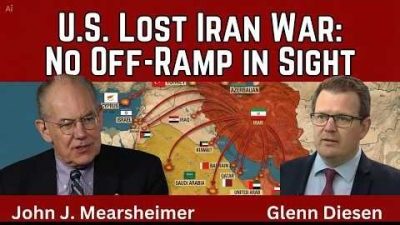
John Mearsheimer: US Already lost Iran war – No off-ramp in sight
or go to
Aletho News Archives – Video-Images
Frlom the Archives
With apparently fabricated nuclear documents, Netanyahu pushed the US towards war with Iran
By Gareth Porter | The Grayzone | April 29, 2020
President Donald Trump scrapped the nuclear deal with Iran and continued to risk war with Iran based on Israeli Prime Minister Benjamin Netanyahu’s claim to have proven definitively that Iran was determined to manufacture nuclear weapons. Netanyahu not only spun Trump but much of the corporate media as well, duping them with the public unveiling of what he claimed was the entire secret Iranian “nuclear archive.”
In early April 2018, Netanyahu briefed Trump privately on the supposed Iranian nuclear archive and secured his promise to leave the Joint Comprehensive Plan of Action (JCPOA). That April 30, Netanyahu took the briefing to the public in a characteristically dramatic live performance in which he claimed Israel’s Mossad intelligence services had stolen Iran’s entire nuclear archive from Tehran. “You may well know that Iran’s leaders repeatedly deny ever pursuing nuclear weapons…” Netanyahu declared. “Well, tonight, I’m here to tell you one thing: Iran lied. Big time.”
However, an investigation of the supposed Iranian nuclear documents by The Grayzone reveals them to be the product of an Israeli disinformation operation that helped trigger the most serious threat of war since the conflict with Iran began nearly four decades ago. This investigation found multiple indications that the story of Mossad’s heist of 50,000 pages of secret nuclear files from Tehran was very likely an elaborate fiction and that the documents were fabricated by the Mossad itself. … continue
Blog Roll
 Aletho News
- ‘We’ve Obliterated Their Missiles’
- Syrian president vows ‘absolute support’ to disarm Hezbollah
- Ukraine attacking Russian gas pipeline to stop deliveries to Europe – Defense Ministry
- ‘Heinous crime’: Iran denounces Israeli assassination of 4 Iranian diplomats in Lebanon
- John Mearsheimer: U.S. Already Lost Iran War – No Off-Ramp in Sight
- UK Parliament Plans ISP Blocking and Age Verification Powers
- World cannot remain silent as US and Israel attack ‘heritage of humankind’: Iran
- Emirati billionaire rebukes US senator over call for Gulf states to join war with Iran
- Op. True Promise 4: Iran’s missile blitzkrieg dismantles US war machine in West Asia
- Aramco CEO warns ‘catastrophe’ imminent if Strait of Hormuz remains shut
- If Americans Knew
- 97% of victims of war on Iran are Iranian, 98% of victims in war on Gaza are Gazans – Not a ceasefire Day 152
- Early Iran strikes cost $5.6 billion in munitions, Pentagon estimates
- Israel Decided the War, But Trump’s America Fights and Pays the Bill
- Conscientious Objector Group: Phone ‘Ringing Off Hook’ As Huge Mobilization Underway
- U.S. support for Israel continues to plummet, despite media’s best efforts
- Threats and missiles fly, death tolls soar in Iran, Lebanon, Gaza – Not a ceasefire Day 151
- Lebanon: Israel’s White Phosphorous Use Risks Civilian Harm
- Corporate Media Go All Out To Support The US-Israeli War On Iran
- US-Israel war on Iran is creating a steady growing number of amputees
- Israel planned this war on Iran for 40 years. Everything else is a smoke screen
- No Tricks Zone
- Destructive Green New Deal: German Energy And Metal Group Warns Of Drastic Crisis
- New Study Documents A 20-Year Pause In Arctic Sea Ice Decline – Driven By Internal Variability
- Wake-up Call: Survey Shows Majority Of Germans Now Favor Postponing Climate Targets!
- Televised! Leading German Political Candidate Tells Schoolchildren CO2 Makes Sun Hotter!
- New Study: A Century Warming Of 1.1°C Is ‘Commonplace’ And ‘Not Unusual’ During This Interglacial
- New Study: ‘Internal Noise’ And Volcanic Forcing Can Trigger 10-15°C Warming Within Decades
- Glaciers Worldwide Are Suddendly Surging, Experts Blame Warming!
- Surprising Discovery: Sahara Is Greening…Billions Of Trees Where Once Thought To Be Barren
- New Research Reaffirms Clouds, Aerosols, And Surface Solar Radiation Are ‘Driving The Climate System’
- Germany: Electric Car Catches Fire At Charging Station, Sets Off Local “Inferno”, Widespread Damage
 Aletho News
Leave a comment