The GRANITE ACT: Wyoming Bill Targets Foreign Censors With $10M Penalties

By Christina Maas | Reclaim The Net | November 24, 2025
The first cannon shot in a new kind of free speech war came not from Washington or Silicon Valley, but from Cheyenne. Wyoming Representative Daniel Singh last week filed the Wyoming GRANITE Act.
The “Guaranteeing Rights Against Novel International Tyranny & Extortion Act,” passed, would make Wyoming the first state to let American citizens sue foreign governments that try to police what they say online.
The bill traces back to a blog post by attorney Preston Byrne, the same lawyer representing 4chan and Kiwi Farms in their battles against censorship-driven British regulators.
Byrne’s idea was simple: if the UK’s Ofcom or Brazil’s Alexandre de Moraes wanted to fine or threaten Americans over online speech, the US should hit back hard.
Exactly one month after that idea appeared on his blog, it’s now inked into Wyoming legislative paperwork.
Byrne said:
“This bill has a long way to go until it becomes a law, it’s got to make it through legislative services, then to Committee, and then get introduced on the floor for a vote, but the important thing is, the journey of this concept, the idea of a foreign censorship shield law which also creates a civil cause of action against foreign censors, into law has begun.”
That “journey” may be the kind of slow procedural trudge that usually kills most ideas in committee, but the intent here is anything but mild, and, with the growing threat of censorship demands from the UK, Brazil, Europe, and Australia, there is a lot of momentum here to fight back.
“For the first time, state legislators are moving to implement rules that will allow U.S. citizens to strike back, hard, against foreign countries that want to interfere with Americans’ civil rights online,” Byrne continued.
The Act would let American citizens and companies sue foreign governments or their agents for trying to censor them, and, crucially, it strips away the usual escape hatch of sovereign immunity.
In its legal filing responding to the 4chan and KiwiFarms lawsuit, Ofcom insisted it has “sovereign immunity” and told the court there were “substantial grounds” for throwing out the case on that basis.
The regulator’s lawyers framed Ofcom as a protected arm of the British state, immune from civil claims even when its decisions target a platform based entirely inside the United States.
Ofcom treats the idea of “sovereign immunity” as something substantial but the First Amendment as something that does not exist at all.
The GRANITE Act is a defensive maneuver against a growing global trend. “Foreign governments and their agents increasingly seek to restrict, penalize or compel disclosure concerning speech occurring wholly within the United States,” the bill warns.
Such efforts, it argues, “conflict with the constitutions of the United States and of Wyoming and chill speech by Wyoming residents and entities.”
The act’s definition section is where its true reach becomes clear. It covers “any law, regulation, judgment, order, subpoena, administrative action or demand of a foreign state that would restrict, penalize or compel disclosure concerning expression or association” that would otherwise be protected under US law.
The text is well-researched and knows all the buzzwords of tyranny, naming the categories most likely to cause friction: “foreign online safety, hate speech, misinformation, disinformation, defamation, privacy, or ‘harmful content’ laws.” It’s a catalog of the modern speech-control toolkit, all of which Wyoming now places firmly outside its borders.
Wyoming’s approach also bars its own agencies from playing along. “No state agency, officer, political subdivision, or employee thereof shall provide assistance or cooperation in collecting, enforcing or giving effect to any measure” that qualifies as foreign censorship. The phrasing borrows from the constitutional doctrine of anti-commandeering, warning that local officials won’t be drafted into enforcing foreign censorship orders.
In Byrne’s view, that legal protection has let overseas bureaucrats act like international hall monitors, wagging fingers at Americans through threats of fines or content bans.
Byrne didn’t mince words about what he thinks this law could mean:
“If we get corresponding federal action, this law, and laws like it, could represent the single greatest victory for global free speech in thirty years.”
The teeth of the bill lie in its damages. The minimum penalty: ten million dollars. It matches the scale of fines already threatened by the UK and others, which have been dangling penalties of $25 million or 10 percent of global revenue for non-compliance.
The math, as he puts it, is simple. A country can censor an American, but that choice now comes with a very real price tag.
“Foreign countries can bully the shit out of American citizens and companies because they know that US law potentially protects them from consequences for doing so. We should take that immunity away from them.”
Byrne’s theory is that once the threat of US civil suits hangs over foreign regulators, the entire global “censorship-industrial apparatus” starts to wobble.
Byrne notes that the GRANITE Act would also relieve the White House from having to deal with diplomatic flare-ups over censorship complaints.
Trial lawyers would take over that job, freeing the president to “move on to other, more important matters.”
If the Act becomes law, the power to fight foreign censorship wouldn’t rest with federal agencies but with American citizens, state courts, and civil litigators. It would empower them to fight back against foreign censors.
In the global tug-of-war over speech, Wyoming could suddenly become a frontline jurisdiction.
The Money Behind the Muzzle: Germany’s Fivefold Surge in Speech Control

By Cindy Harper | Reclaim The Net | November 24, 2025
Government spending on digital speech regulation in Germany has surged over the past decade, increasing more than five times since 2020 and totaling around €105.6 million by 2025.
The findings come from The Censorship Network: Regulation and Repression in Germany Today, a detailed investigation by Liber-net, a digital civil liberties group that monitors speech restrictions and information control initiatives across Europe.
The report describes a sprawling alliance of ministries, publicly funded “fact-checkers,” academic consortia, and non-profit groups that now work together to regulate online communication.
It started as a handful of “anti-hate” programs and has evolved into a broad state-financed system of “content controls,” supported by both domestic and foreign grants.
Liber-net’s accompanying databases and map document more than 330 organizations and over 420 separate grants, rating each on a one-to-five scale according to its level of direct censorship involvement.
Between 2020 and 2021, public funding for these initiatives tripled, and by 2023 it had doubled again.

Source: The Censorship Network: Regulation and Repression in Germany Today
The Federal Ministry for Education and Research (BMBF) has been the leading funder, responsible for more than €56 million in allocations since 2017.
Much of this money has gone to the RUBIN consortium, a research group developing artificial intelligence tools designed to identify and filter “disinformation.”
Liber-net notes that these systems, while presented as safeguards against falsehoods, also concentrate control over what qualifies as legitimate speech.
Foreign contributions have further reinforced this system. The European Union has provided roughly €30 million since 2018, including €4 million for Deutsche Welle’s Media Fit program, which counters online narratives related to the Russia-Ukraine war.
The United States government has contributed about $400,000 to fourteen German organizations during the same period. These combined investments reveal a coordinated transatlantic interest in shaping the online information landscape.
The financial expansion has been matched by a more aggressive enforcement effort within Germany.
In June 2025, police executed around 170 raids targeting individuals accused of online “hate speech.” Earlier raids reported by CBS in February focused on similar allegations.
One of the most publicized cases involved David Bendels, editor-in-chief of Deutschland Kurier, a publication affiliated with the AfD. Bendels received a seven-month suspended sentence for posting a meme on X that showed Interior Minister Nancy Faeser holding a sign reading “I hate freedom of expression.”
The legal foundation for these operations is the Network Enforcement Act (NetzDG), which requires social media platforms to remove illegal or offensive content within strict deadlines.
Originally framed as a tool to combat extremism, the law has drawn opposition from parties across the spectrum, including the Left Party, the Free Democrats, the Greens, and the AfD.
They argue that it undermines open debate and gives private corporations excessive authority over what can be published online.
Liber-net’s research positions Germany as a key actor in Europe’s expanding structure of information control.
Liber-net concludes that Germany’s speech regulation framework has moved beyond addressing harmful content and now functions as a managed system for policing public discourse.
With significant funding, cross-border backing, and little transparency, the country’s “content control” network demonstrates how easily censorship can be institutionalized under the language of safety and social responsibility.
Jewish Celebrities Blame Judaism for Gaza Holocaust
The CJ Werleman Show | November 21, 2025
 / cjwerleman
 A historic decline in sympathy for Israel in Britain, and an unprecedented rise in solidarity with Palestine in 2025
By Adnan Hmidan | MEMO | November 24, 2025
Public sentiment in Britain today is markedly different from what it was two years ago. A society that once observed developments in the Middle East from a comfortable distance is now expressing a clearer and more confident moral position on the genocide in Gaza. The scale of this shift can be considered one of the most significant transformations in British public attitudes towards Palestine in recent decades.
Figures published in the autumn of 2025 indicate that sympathy for Israel has fallen to approximately 12 percent, the lowest level recorded, while sympathy for Palestinians has risen to around 38 percent in some national polling. A majority of respondents also state that Israel’s actions in Gaza cannot be justified on either moral or legal grounds. However, these figures represent only the surface of a deeper transition taking place within British society.
The primary catalyst for this shift has not been political realignment, diplomatic pressure or changes within party leaderships, but rather the scale and visibility of the atrocities committed in Gaza. As the genocide expanded to include the targeting of hospitals, schools and refugee camps, alongside collective punishment and reports of widespread abuse in detention, traditional claims about self-defence lost credibility.
Unfiltered images circulated widely across British media and social platforms. Families killed in their homes, children pulled from the rubble and patients evacuated after power cuts became daily realities rather than distant headlines. For many, Palestine was no longer viewed as a remote political issue but as a profound human tragedy unfolding in real time. The collapse of official narratives in the face of visible evidence contributed further to this reassessment, reinforcing the understanding that what is taking place is not a symmetrical conflict but the systematic destruction of a besieged population.
Over the past two years, Britain has also witnessed an unprecedented wave of public mobilisation. London and other major cities saw some of the largest demonstrations in Western Europe, continuing week after week without subsiding. Solidarity evolved from street marches to university encampments, from civic spaces to trade unions and professional bodies, and eventually to parliamentary scrutiny concerning arms exports and the UK’s legal responsibilities.
Notably, this movement was not driven solely by Palestinians, Arabs or Muslims. Large numbers of students, academics, health workers, legal professionals, artists and members of the clergy took part. British Jewish groups opposing the genocide played an important role in challenging attempts to delegitimise or isolate the solidarity movement. Two years on, public mobilisation remains active despite increasingly restrictive protest regulations, indicating that this is not a temporary emotional response but a deeper shift in public conscience.
This evolving landscape has also reshaped how many Britons, particularly younger generations, understand the question of resistance. Public debate is no longer confined to simplistic binaries. There is growing recognition that resistance emerges from dispossession, blockade and the absence of any viable path to justice, rather than from ideological motivations alone.
Policy-makers in Britain are aware of these developments, even if official positions have not shifted dramatically. Pressure is visible in calls to suspend arms exports to Israel, demands for independent investigations into potential complicity and a noticeable shift in political language, especially within the Labour Party. The driving force behind this pressure has not been a change of government but the continuing reality of the genocide itself, which has made unconditional support for Israeli policies increasingly difficult to justify publicly.
The genocide in Gaza has reshaped how many people understand their place in the world. In Britain, solidarity with Palestine has become a reflection of moral responsibility rather than a peripheral political stance. Although the path ahead remains complex, the transformation witnessed over the past two years demonstrates that sustained exposure to reality can alter public attitudes in ways that once seemed unlikely.
The decline in sympathy for Israel marks not the conclusion of this shift, but its beginning. Palestine is no longer perceived as a distant or marginal issue, but as a central concern within British public consciousness — one that is unlikely to fade in the foreseeable future.
Settler attacks intensify as Palestinians face systematic displacement
Al Mayadeen | November 24, 2025
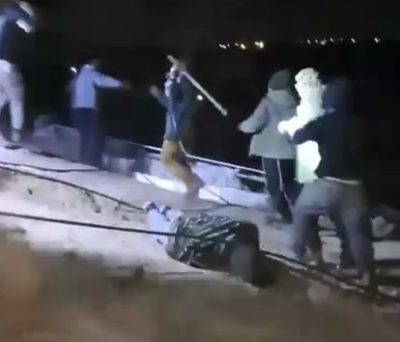
Abdullah Awad, speaking to the Financial Times, describes a reality Palestinians across the occupied West Bank know too well: armed Israeli settlers storming their land with the aim of driving them out. The attack on his family farm near Turmus Ayya, carried out by about 15 masked settlers, left his children screaming as the group smashed their home and equipment.
“The settlers had axelike sticks with nails attached. So, they intended to injure us badly or kill us. Thank God we were awake when they came, so we could move away a bit,” he said. The assault followed years of harassment, but Awad says the violence has intensified since the war on Gaza began: “There were many assaults. This was not the first, and won’t be the last . . . but since the start of the war [in Gaza], they have become more violent. The situation has changed.”
Escalating campaign of settler aggression
Across the West Bank, Palestinians are facing an orchestrated campaign to terrorize communities and seize land. Settlers have attacked farmers, burned property, and raided villages from the northern hills to the southern plains. Videos of settlers beating Palestinians, including one incident in which a masked settler clubbed a woman unconscious, reflect a growing sense of impunity.
Political analyst Ibrahim Dalalsha told FT the pattern is unmistakable, “The settlers are totally emboldened, and the attacks are spreading, in the north, centre and south [of the West Bank]… This time they are really going deep inside.”
Targeting the olive harvest, the backbone of Palestinian rural life
The olive harvest, which sustains thousands of Palestinian families, has become an annual target for settler groups seeking to disrupt livelihoods and claim new territory. This season, attacks have soared. Settlers have torched a mosque in Deir Istiya, burned cars and homes near Beit Lahm, and even stormed an industrial area close to Beit Lid.
According to UN OCHA figures, more than 260 settler assaults resulting in injuries or property destruction were recorded in October, the highest monthly total since monitoring began nearly two decades ago.
Israeli condemnations ring hollow as impunity deepens
Israeli leaders have issued belated statements condemning settler actions, but on the ground, Palestinians say nothing has changed. The army dismantled a single illegal outpost, an exception so rare it drew international attention, while settlers continue attacking communities without consequence.
The settlers who burned the Deir Istiya mosque left graffiti stating: “We’re not afraid of Avi Bluth.”
Their message was aimed at the Israeli general responsible for West Bank operations, a taunt conveying how little fear violent settlers have of the regime’s security forces.
Rights group Yesh Din reports that 94% of settler violence cases were closed without charges in the 18 years before the war on Gaza. Palestinian officials say the situation has only worsened, with the military frequently standing aside, or acting in coordination with settlers during attacks.
Dalalsha said, “In the past, when there were attacks, there were investigations. Palestinians viewed these as a sham. But at least there was a process. These days, we do not hear of anything.”
Forced displacement as policy
Settlement expansion, illegal under international law, has accelerated at a pace Palestinian rights groups describe as intentional and strategic. Reports indicate that since the start of the war on Gaza in 2023, 44 Palestinian communities have been forcibly pushed from their lands through settler assaults combined with military restrictions.
Yair Dvir of B’Tselem put it bluntly, “When you look at what is happening, there is an order to [the attacks] . . . It’s not just individuals and settlers. They are backed by the Israeli system. There is a very clear goal, which is to forcibly displace the Palestinians and force them into the big cities.”
Daily terror in towns under siege
In Sinjil, a town outside Ramallah, a newly built settler outpost has triggered relentless harassment for Palestinians. Mayor Moataz Tawafsha told the FT: “There is no day without an attack. They steal tractors, burn stuff that belongs to the farmers, prevent farmers from reaching their land. Every day. They never stop.”
Near Turmus Ayya, settlers have placed a metal cabin and tent on a Palestinian building left half-finished and raised an Israeli flag above it, a symbolic claim over land that locals have farmed for generations. The new presence has cut Palestinians off from hundreds of hectares of farmland, including thousands of olive trees.
The mayor, Lafi Adeeb Shalabi, says the aim is clear, “They are trying to destroy the history of Palestine . . . This land belonged to our families, to our great great-grandfathers,” he said. “And when we try to defend it, they say we are terrorists.”
A systematic drive to empty Palestinian land
Testimonies from across the West Bank point to a coordinated effort to dispossess Palestinian communities: settlers advancing deeper into Palestinian areas, soldiers restricting movement, homes and farms burned, and entire communities uprooted.
What was once seasonal harassment has evolved into a sustained campaign of displacement.
Dissecting the UN’s “Comprehensive Plan” for Gaza and the inevitable dead-end
By Jamal Kanj | MEMO | November 24, 2025
US policy documents on the Middle East do not reach the daylight before Israel is given the chance to filter them, and gut them. The latest UN Security Council (UNSC) 2803, Comprehensive Plan, is no exception. The Resolution perpetuates the same failed logic that has governed international diplomacy for decades. One in which Palestinian rights are conditioned, while Israeli obligations are delayed with no mechanism, timelines, or accountability for violating agreements.
Following two years of using food as a weapon of war and genocide, the UNSC adopted a US sponsored resolution, not to condemn weaponizing food, but to reward the perpetrator. The UNSC “Comprehensive Plan” for Gaza is anything but comprehensive. It is narrow, short on details, rich in contradictions, and utterly lacking any overarching purpose.
Take Paragraph 2 for instance. The Resolution “welcomes the establishment of the Board of Peace (BoP)” as a transitional international administration that will manage Gaza’s redevelopment “until such time as the Palestinian Authority has satisfactorily completed its reform program.”
In other words, the recognition of the inalienable rights of the Palestinian people is contingent, sequenced, and time-bound: reform first, demonstrate worthiness, satisfy outside evaluators, and then—maybe—they can “securely and effectively take back control” of their land. Meanwhile, Israel’s commitments are, at best, deliberately vague, crafted with such ambiguity allowing varying interpretations, much like UNSC Resolutions 242 and 338, written purposefully in a nebulous language that enabled Israel to evade compliance for decades.
There is not one single concrete or enforceable requirement placed on Israel: none to halt its extrajudicial assassinations, military attacks, timeline to complete withdrawal, or stop the expansion of Jewish-only colonies established on the same land reserved for the supposed Palestinian “self-determination.”
The Resolution weakens Item 7 of “Trump’s 20-point Gaza peace plan” which had called for “full aid be immediately sent into the Gaza Strip.” The new Comprehensive Plan replaced “immediately” by expressing only “the importance of the full resumption of humanitarian aid.” Israel’s already inexplicit obligations are further watered down to mere “consultation” and “cooperation,” giving the occupying power wide latitude to dictate its own interpretations and evade any real accountability.
The distortion becomes even more evident in Paragraphs 3 through 8. These sections deepen the asymmetry: Israel, whose leaders are indicted war criminals, is elevated to a co-supervisor with veto power over every stage of Gaza’s future. In effect, this Resolution upends international law by granting war criminals the final word on Gaza’s fate.
Paragraph 3, which addresses humanitarian aid, orders stringent monitoring of aid distribution inside Gaza. At the same time, there are no unequivocal demands on Israel to fully open all crossings, or stop hindering humanitarian aid delivery. The limited aid must be policed in Gaza, but the state that used food as a weapon and starved the population, is not required to do anything differently.
In Paragraph 4, a foreign-controlled “operational entities” strips Palestinians of their political agency by placing them under a technocratic committee selected from abroad and subordinate to the misnomer BoP. Yet, there is nothing in the Resolution on the freedom of ingress and egress, no mention of opening the seaport or rebuilding the airport. Furthermore, there are no tangible punitive measures, if and when, Israel fails to adhere to the UNSC Resolution.
The funding structures in Paragraphs 5–6 absolve Israel of responsibility. Gaza’s reconstruction is handed to donors and the World Bank, financed through voluntary contributions. Israel, the power that destroyed Gaza, is not asked to contribute a dollar, let alone pay reparations or assume legal responsibility for murdering and injuring 241,000 Palestinians, destroying all the universities, 97% of schools, 94% of the hospitals and 92% of the residential homes.
The heart of the resolution’s inequity is found in Paragraph 7, which authorizes a foreign military force (ISF) tasked with enforcing Palestinian demilitarization. The Palestinian Resistance must disarm, surrender weapons, accept foreign security supervision, and undergo vetting. Israel’s withdrawal, however, takes place only “when conditions allow” and to be negotiated between its army and ISF, guarantors, and the United States. Palestinians are entirely excluded from determining the terms of the Israeli withdrawal from their own land.
Even more alarming, the resolution normalizes Israeli occupation “that will remain until Gaza is properly secure from any resurgent terror threat.” An open-ended clause granting Israel a permanent military footprint in and around Gaza while granting Israel alone the power to define and determine any so-called “resurgent threat.”
Finally, Paragraph 8, mandates that any extension of international presence in Gaza must be done “in full cooperation and coordination with Egypt and Israel.” Once again, Palestinians are excluded from determining their own future. It is all left for Israel since its consent is conditional on the “full cooperation.”
Taken together, these provisions expose the true nature of the so-called Comprehensive Plan: a political instrument designed to entrench, not end, the structural inequality of occupation. And less than 72 hours following the UNSC Resolution, Benjamin Netanyahu appointed Bezalel Smotrich and Itamar Ben-Gvir, two Jewish racist ministers who openly called for the ethnic cleansing and building Jewish only colonies in Gaza, to be in charge of, or more likely to undermine, the second phase of Trump’s 20-point plan.
In short, the UNSC Comprehensive Plan whitewashes Israel’s genocide and ties the future of Palestinian self-determination to a checklist that Israel is neither bound to accept nor prevented from obstructing. A Plan that will lead to exactly where previous UN Resolutions, mainly 194, 242 and 338 had gone, to an inevitable dead-end.
Arms industry investors in panic over Ukraine peace talks
RT | November 24, 2025
The prospect of a possible peace in Ukraine has caused “panic” among investors in the German defense industry, sending stocks of arms manufacturers such as Rheinmetall tumbling.
The US reportedly handed Kiev a 28-point peace proposal last week and gave it until Thursday to respond. The framework was discussed in Geneva on Sunday, with US President Donald Trump saying afterwards that “something good” may be happening.
The peace push immediately unnerved investors, triggering a fierce sell-off of shares in Rheinmetall, Germany’s largest arms manufacturer and a key supplier of military equipment to Kiev. Rheinmetall stock has fallen by over 14% over the past five days, with defense-electronics producer Hensoldt recording a similar drop.
“Investors fear that an end to hostilities could also mean the end of the “super-cycle” for defense stocks,” Boerse-Express wrote.
Germany has become Kiev’s second-largest arms provider after the US, and Rheinmetall, which produces tanks, artillery systems, and ammunition, recently reported surging profits for the first nine months of 2025, alongside a record order backlog driven by the conflict and rising EU military budgets. Company shares have climbed nearly 2,000% since fighting escalated almost four years ago.
During the previous US attempt to broker peace in February, Rheinmetall CEO Armin Papperger argued that even if the fighting were to end, it would be “wrong” for Europe to assume “a peaceful future.” In 2024, the company announced plans to build four manufacturing plants in Ukraine.
The broader European defense sector has been expanding at roughly three times its pre-2022 pace, Financial Times reported in August. Western leaders claim the accelerated buildup is needed to meet NATO readiness targets, maintain arms deliveries to Kiev, and deter what they describe as a potential Russian threat.
Moscow has called such claims “absurd” fearmongering aimed at justifying increased military spending and condemned what it calls the West’s “reckless militarization.”
Ally of ex-Bosnian Serb leader wins election
RT | November 24, 2025
A close ally of longtime Bosnian Serb leader Milorad Dodik has won a snap presidential election in Republika Srpska, the Serb-majority entity of Bosnia and Herzegovina, according to preliminary results.
Sinisa Karan’s apparent victory comes after Dodik was removed from office over his refusal to obey the rulings imposed by an international envoy overseeing the peace-monitoring regime in Bosnia.
Karan, the candidate of Dodik’s Alliance of Independent Social Democrats (SNSD) and the entity’s minister for scientific and technological development, took about 51% of the vote, after nearly all ballots were counted. Branko Blanusa, the candidate from the opposition Serb Democratic Party, won roughly 48%, with turnout just under 36%.
The snap vote was called after Bosnia’s state court convicted Dodik in February of failing to comply with the decisions of Christian Schmidt, the international high representative for Bosnia and Herzegovina. Schmidt, a German national, has a strong mandate to oversee the 1995 Dayton Peace Agreement, which ended the bloody 1992-1995 Bosnian War.
In 2023, Schmidt invoked his powers to annul legislation passed by Republika Srpska’s authorities that sought to strip state-level courts and police of jurisdiction in the entity and declared the envoy’s decrees non-binding. Dodik himself has branded Schmidt a “tourist” and declined to recognize his authority.
A state court in Sarajevo later found Dodik guilty of failing to implement Schmidt’s decision, sentencing him to one year in prison – a term he avoided by paying a court-approved fine – and banning him from holding public office for six years.
With election results coming in, Karan pledged to continue Dodik’s policies “with ever greater force,” adding that “the Serb people have won.” Dodik, meanwhile, promised voters that “I will remain with you to fight for our political goals,” stressing that Karan’s “victory will be my victory too.”
Both Karan and Dodik have advocated for close ties with Russia, with the former calling Moscow “one of the greatest allies and friends of Srpska.” Dodik has echoed the sentiment, suggesting that the West was using Ukraine to provoke “a war with Russia.”
Japan’s planned missile deployment near Taiwan island extremely dangerous: FM
Global Times | November 24, 2025
Japan’s planned deployment of offensive weapons on the southwestern islands close to China’s Taiwan region is a deliberate attempt to create regional tension and provoke military confrontation. When viewed together with the erroneous remarks on the Taiwan question recently made by Japanese Prime Minister Sanae Takaichi, this development is extremely dangerous and must arouse high vigilance from neighboring countries and the international community, Chinese Foreign Ministry spokesperson Mao Ning said at a press briefing on Monday, in response to Japanese defense minister Shinjiro Koizumi’s claims about the deployment of surface-to-air missiles on an island near China’s Taiwan island.
According to media reports, when speaking to reporters as he wrapped up his trip to the base on Yonaguni on Sunday, Koizumi claimed plans to deploy missiles on Yonaguni island would “lower the chance of an armed attack,” rejecting concerns that it would would heighten regional tensions.
Yonaguni island lies about 110 kilometers from Taiwan island. Japan plans to deploy a unit equipped with the Type-03 medium-range surface-to-air missile, which is capable of intercepting aircraft and ballistic missiles, according to Kyodo News.
Mao pointed out that the Potsdam Proclamation clearly stipulates that Japan is prohibited from rearmament, and Japan’s Peace Constitution establishes the principle of “exclusive defense.” Yet in recent years, Japan has drastically adjusted its security policies, substantially increased its defense budget year after year, relaxed restrictions on arms exports, sought to develop offensive weapons, and even attempted to abandon the “Three Non-Nuclear Principles.”
Japanese right-wing forces are making every effort to break free from the constraints of the Peace Constitution, going ever further down the path of militarism and dragging Japan and the entire region toward disaster, the spokesperson noted.
By emphasizing this year marks the 80th anniversary of the victory of the Chinese People’s War of Resistance Against Japanese Aggression and the 80th anniversary of Taiwan’s restoration to China, Mao said China will never allow Japanese right-wing forces to reverse the course of history, will never permit external forces to interfere in China’s Taiwan region, and will never tolerate the resurgence of Japanese militarism.
China has both the determination and the capability to safeguard its national sovereignty and territorial integrity, she added.
Beijing and Tokyo clash over ‘enemy state’ clause in UN Charter
RT | November 24, 2025
Japan has rebuked China for citing a UN Charter clause that permits action against former Axis powers without Security Council approval, insisting the provision is outdated and irrelevant.
Prime Minister Sanae Takaichi’s new government has been embroiled in an escalating diplomatic tit-for-tat with Beijing, beginning with remarks she made earlier this month supporting the self-governing administration on Taiwan. The Chinese side interpreted her comments that a cross-strait conflict would be a “survival-threatening situation” for Japan as signaling potential Japanese armed involvement and evidence of resurgent militarism.
Last week, the Chinese Embassy in Tokyo published an excerpt from the UN Charter which referred to “enemy states” – nations that fought against the original signatories, the Allied Powers of World War 2. Article 53 allows regional enforcement measures against such states in the event of a “renewal of aggressive policy,” without requiring prior authorization from the UN Security Council.
Beijing then lodged an official complaint with the UN over Takaichi’s statements. The embassy urged Japan “as a defeated country in World War II” to “reflect on its historical crimes” and change course on the Taiwan issue.
Japan’s Foreign Ministry dismissed that argument, accusing China of misinterpreting “obsolete clauses” that it claimed no longer align with UN practice. While the UN General Assembly recommended removing the “enemy state” references in 1995, the formal amendment process was never completed.
Japanese Defense Minister Shinjiro Koizumi visited a military base on Yonaguni over the weekend, an island about 110km east of Taiwan. He reiterated plans to deploy medium-range surface-to-air missiles there as part of a broader build-up on Japan’s southern island chain.
Russia also has outstanding issues with Japan, with whom it still has no formal peace treaty. Tokyo continues to insist on its claim to the four southernmost Kuril Islands, known in Japan as the “northern territories,” which became part of the USSR after World War 2 and remain a long-standing focal point for Japanese nationalists.
Featured Video
John Mearsheimer: US Already lost Iran war – No off-ramp in sight
or go to
Aletho News Archives – Video-Images
Frlom the Archives
70 Neocons Petition Congress To Effectively Allow Israel To Say When The US Should Attack Iran
By Damian Lataan | January 10, 2014
Seventy senior Israeli-centric neoconservatives have written an open letter to Congress imploring them to do more to ensure Iran complies with the conditions of any agreement finally reached with the P5+1 over Iran’s nuclear program.
While the neocons are ostensibly asking Congress to ensure compliance, it is clear that their real aim is to convince members of Congress to support the bill currently passing through the Senate which calls for tighter sanctions against Iran in the event of any waywardness on Iran’s part.
The neocons are eager to see the bill currently passing through the Senate with enough support to make it veto-proof, not so much because they are concerned about Iran’s so-called nuclear weapons program – there’s still not a skerrick of hard evidence that Iran has a nuclear weapons program – but, rather, because embedded within the bill is this clause:
… if the Government of Israel is compelled to take military action in legitimate self-defense against Iran’s nuclear weapon program, the United States Government should stand with Israel and provide, in accordance with the law of the United States and the constitutional responsibility of Congress to authorize the use of military force, diplomatic, military, and economic support to the Government of Israel in its defense of its territory, people, and existence…
Essentially, the clause is an automatic trigger for the US to attack Iran at any time the Israelis choose to launch a first strike – regardless of whether President Obama is in favour or not.
Partial list… continue
Blog Roll
 Aletho News
- John Mearsheimer: U.S. Already Lost Iran War – No Off-Ramp in Sight
- UK Parliament Plans ISP Blocking and Age Verification Powers
- World cannot remain silent as US and Israel attack ‘heritage of humankind’: Iran
- Emirati billionaire rebukes US senator over call for Gulf states to join war with Iran
- Op. True Promise 4: Iran’s missile blitzkrieg dismantles US war machine in West Asia
- Aramco CEO warns ‘catastrophe’ imminent if Strait of Hormuz remains shut
- What If Iran Says No?
- Trump Threatens to ‘Hit’ Iran ‘Twenty Times Harder’ Over Strait of Hormuz Oil Flows
- Spare the hypocrisy: Baghaei slams Ursula’s support for US
- Iran War Supporters Invent a New and Absurd Justification: It Is All About China
- If Americans Knew
- Israel Decided the War, But Trump’s America Fights and Pays the Bill
- Conscientious Objector Group: Phone ‘Ringing Off Hook’ As Huge Mobilization Underway
- U.S. support for Israel continues to plummet, despite media’s best efforts
- Threats and missiles fly, death tolls soar in Iran, Lebanon, Gaza – Not a ceasefire Day 151
- Lebanon: Israel’s White Phosphorous Use Risks Civilian Harm
- Corporate Media Go All Out To Support The US-Israeli War On Iran
- US-Israel war on Iran is creating a steady growing number of amputees
- Israel planned this war on Iran for 40 years. Everything else is a smoke screen
- The wrong question about the war in Iran
- ‘Your Tax Dollars Being Used to Raise Your Gas Prices’: US-Israel Bomb Major Iranian Oil Depots
- No Tricks Zone
- New Study Documents A 20-Year Pause In Arctic Sea Ice Decline – Driven By Internal Variability
- Wake-up Call: Survey Shows Majority Of Germans Now Favor Postponing Climate Targets!
- Televised! Leading German Political Candidate Tells Schoolchildren CO2 Makes Sun Hotter!
- New Study: A Century Warming Of 1.1°C Is ‘Commonplace’ And ‘Not Unusual’ During This Interglacial
- New Study: ‘Internal Noise’ And Volcanic Forcing Can Trigger 10-15°C Warming Within Decades
- Glaciers Worldwide Are Suddendly Surging, Experts Blame Warming!
- Surprising Discovery: Sahara Is Greening…Billions Of Trees Where Once Thought To Be Barren
- New Research Reaffirms Clouds, Aerosols, And Surface Solar Radiation Are ‘Driving The Climate System’
- Germany: Electric Car Catches Fire At Charging Station, Sets Off Local “Inferno”, Widespread Damage
- New Study: Canada’s New Brunswick Was 1°C Warmer Than Today During The Medieval Warm Period
 Aletho News