Did Netanyahu just ask Trump for another war — and get it?
By Trita Parsi – Responsible Statecraft – December 30, 2025
During a meeting with Israeli Prime Minister Benjamin Netanyahu, President Trump said that he will allow Israel to attack Iran once again to strike its ballistic missiles.
But what exactly does that mean? Will the U.S. be involved in the actual strikes? Will it “limit” its involvement to shooting down Iran’s retaliatory missiles?
If the former, Trump is not just “allowing” Israel to strike; the U.S. will actually be at war with Iran. This would be a betrayal of his promise to his base to keep America out of wars (he has, of course, violated that already).
Moreover, unlike the nuclear program, which incorporates a small number of known facilities, the missile program is spread throughout the country in a large number of hidden facilities, many of them probably unknown to the U.S./Israel.
Thus, Trump will likely not be able to frame this as mere “military action” rather than war. Nor will he likely be able to negotiate with Tehran a limited Iranian response since the missiles are Iran’s last line of defense — the last leg of its deterrence.
Tehran has gone to great lengths to avoid a military confrontation with Washington, but just because it has shown restraint in the past does not mean that it can afford to do so in this scenario. Indeed, given that Iran will be totally exposed without its missiles, it will likely reckon that it has no choice but to strike directly at U.S. targets.
Even if Trump opts to “only” support Israel defensively in yet another Israeli choice of war — which is the position Biden took — it nevertheless incentivizes Israel to restart war, as the U.S. is lessening the cost for Israel to do so.
The cost to the United States is great even in this scenario. Washington depleted 25% of its THAAD interceptors in the course of 12 days this past summer — for Israel’s war of choice, in a region four American Presidents have declared no longer is vital to U.S. national security.
As I wrote last week, every time Trump caves to Netanyahu and agrees to another war, it only prompts Israel to come back to Trump after a few months with another war plan for Americans to give their blood and tax dollars to.
This will go on endlessly until Trump decides to end it.
Trita Parsi is an Iranian-born Swedish writer and activist, co-founder and executive vice president of the Quincy Institute for Responsible Statecraft, and founder and former president of the National Iranian American Council
As Israel bans aid orgs in Gaza, notorious mercenary firm seeks “Targeter”
Are Israel and US planning to revive the dystopian GHF scheme that spawned famine and death under cover of humanitarian aid?
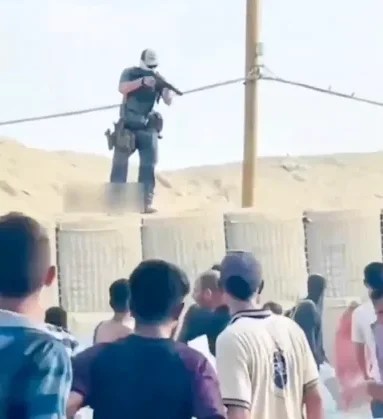
By Max Blumenthal | The Grayzone | December 31, 2025
In its bid to continue the genocide in Gaza, Israel has banned 37 international aid organizations from entering the decimated, militarily occupied coastal enclave. This leaves only five humanitarian groups still able to operate inside Gaza.
At the same time, one of the US mercenary firms responsible for securing the notorious Gaza Humanitarian Foundation sites which were present during the worst periods of famine in Gaza, when at least 3000 Palestinian civilians were gunned down while seeking aid, has posted an ad soliciting former special forces soldiers for offensive operations.
UG Solutions, the scandal-stained private mercenary firm, announced this December that it was hiring an “experienced Targeter to support intelligence-driven operations through the identification, development, validation, and maintenance of operational targets.” The targeter will be expected to “Develop, validate, and maintain operational target packages in accordance with approved targeting processes.”
Anthony Aguilar, the retired United States Army Lt. Col and former Green Beret who blew the whistle on UG Solutions’ human rights abuses in Gaza, told me he believes that Israel’s ban on the 37 international aid organizations signals the return of UG Solutions as part of a restructured version of the Israeli-controlled Gaza Humanitarian Foundation scheme.
While it’s unclear where the UG Solutions targeter position will be deployed, if they are being hired for upcoming operations in Gaza, Aguilar says “this shows that the US, through paramilitary contractors, is now going to either directly target, or feed target data to the IDF.”

To set the stage for its blanket ban on international aid organizations, Israel’s intel-tied Ministry of Diaspora Affairs has demanded that all staffers of aid NGOs prove they do not support calls to boycott Israel, that they do not support armed struggle or oppose Israel’s existence as an exclusivist Jewish state, and that they do not “actively advance delegitimization activities against the State of Israel.”
Aid staffers must also demonstrate that they have never questioned the established history of the Holocaust or challenged official Israeli narratives about October 7 – including, presumably, that Palestinians committed “mass rape” or beheaded babies.
Israel has also demanded that Doctors Without Borders provide COGAT occupation administrators with the personal data of its staff and donors, an unprecedented move by a belligerent in a conflict which few, if any, aid groups could ever honor.
It seems obvious that the Israeli government is using the absurdly onerous new registration standards as cover to ban virtually every credible international aid organization from entering Gaza. In doing so, the apartheid entity seemingly seeks to deprive Palestinians living inside the yellow occupation line of sustenance, forcing them to leave Gaza, or to move into one of the high-tech, concentration camp-like “smart cities” mapped out in the dystopian new “Project Sunrise” proposal marketed by Trump cronies Steve Witkoff and Jared Kushner.
And it is there that they would be “secured” by a mercenary outfit like UG Solutions – and targeted if they dared to resist.
Below is a list of all the aid orgs banned by Israel from operating in Gaza:
1. Accion contra el Hambre – Action Against Hunger
2. Action Aid
3. Alianza por la Solidaridad
4. Artsen zonder Grenzen (Medecins Sans Frontieres Nederland)
5. Campaign for the Children of Palestine (CCP Japan)
6. CARE
7. DanChurchAid
8. Danish Refugee Council
9. Handicap International – Humanity and Inclusion
10. Japan International Volunteer center
11. Medecins Du Monde (FRANCE)
12. Medecins du Monde Switzerland
13. Medecins Sans Frontières Belgium
14. Medecins Sans Frontieres France
15. Medicos del Mundo (Spain)
16. Mercy Corps
17. MSF Spain – Doctors Without Borders Spain
18. NORWEGIAN REFUGEE COUNCIL
19. Oxfam Novib
20. Premiere Urgence Internationale
21. Terre des hommes Lausanne
22. The International Rescue Committee (IRC)
23. WeWorld-GVC
24. World Vision International
25. Relief International
26. Fondazione AVSI
27. Movement for Peace – MPDL
28. American Friends Service Committee (AFSC)
29. Medico International
30. PSAS – The Palestine Solidarity Association in Sweden
31. Defense for Children International
32. Medical Aid for Palestinians – UK
33. Caritas Internationalis
34. Caritas Jerusalem
35. Near East council churches
36. OXFAM Quebec
37. War Child holland
The Bari Weiss Playbook: How a Zionist Operative Conquered American Media

By Jose Alberto Nino | The Occidental Observer | December 31, 2025
Long before she ran a newsroom, Bari Weiss was already running a campaign. The target was anyone she perceived as a threat to Israel. In the mid-2000s, at Columbia University, she helped found a student effort that marketed itself as a defense of Jewish students and Zionist speech in an environment she portrayed as hostile.
The controversy reached its zenith with the release of Columbia Unbecoming, a documentary created in collaboration with The David Project, which leveled accusations against Middle East Studies faculty for their alleged intimidation of students who expressed pro-Israel views. The film circulated online as video testimony that Jewish students were allegedly under threat on campus.
The counterattack naturally came quickly. Civil liberties advocates warned that encouraging students to monitor faculty for ideological infractions would chill speech and collapse academic freedom into factional policing. An online critique from the Columbia ecosystem framed the campaign as overreach and a template for future pressure tactics. Such concerns proved to be prescient, as Jewish students would keep tabs on Columbia professors and report them for anti-Zionist and antisemitic conduct after October 7, 2023.
That early fight showcased Weiss’s primordial instinct to go to the mat for her tribe. This did not come out of the blue. Weiss grew up in a politically engaged Jewish household in Pittsburgh, where her father Lou Weiss served on the National Council for AIPAC and frequently organized missions to Israel, profoundly shaping her early Zionist identity.
With unwavering devotion to Zionist principles, Weiss navigated the political landscape with a singular focus, her commitment to advancing Jewish interests remaining unshaken by the petty squabbles and transient allegiances of partisan politics. By the time she rose inside legacy media, she carried a worldview that opportunistically fused free speech rhetoric with strong stances on Israel and antisemitism.
Weiss’s ascent mirrored the classic trajectory of the modern mandarin class, ascending the rungs of the opinion-making apparatus that manufactures public consent. Her journey began in the trenches of reporting, leading to an editorial position at The Wall Street Journal. In that capacity, she gained the skills of gatekeeping and narrative framing, which she would continue to employ as she climbed up the media ladder.
In 2017, she landed at the New York Times opinion section after she believed that the WSJ took too hard of a pro-Trump stance. She described herself “as center left on most issues”, but the issue of Israel was non-negotiable for her, when push came to shove. Ultimately, her position at the Times did not hold. In July 2020, she announced her exit with a resignation letter that accused the institution of enforcing ideological conformity, tolerating internal bullying, and letting social media pressure shape editorial decisions.
While the letter publicly signaled her break with legacy liberalism, it was fundamentally an act of strategic repositioning. A deeper, more calculating motive propelled this departure: the dawning realization that the very media establishments she inhabited were losing their effectiveness as guardians of Jewish interests. Her subsequent career trajectory into new media ventures confirms this was not an ideological conversion, but a pragmatic pivot to more reliable channels of influence.
In 2021 she took matters into her own hands by launching a Substack newsletter called Common Sense, then rebranded it into The Free Press, positioning it as a supposed bastion for free speech. The Free Press outwardly curated a portfolio of anti-woke commentary on issues like gender ideology and campus radicalism. However, these topics served as a popular façade for the publication’s central, animating purpose: the advancement of Zionism. Weiss meticulously assembled a stable of contributors—including prominent voices like Douglas Murray, Niall Ferguson, Konstantin Kisin, and Eli Lake—whose primary alignment was a staunch defense of Israeli policy, making the outlet’s broader ideological commitment unmistakable.
Israel was the unwavering constant, serving not as a footnote but as the central organizing principle of her moral worldview. She treated anti-Zionism as a mask for antisemitism and made that position central to her public identity, a framework reflected in discussion around her book and its reception. Her 2019 book How to Fight Anti Semitism became the manifesto version of the same argument.
The 2018 mass shooting at Pittsburgh’s Tree of Life synagogue, in which Robert Bowers murdered eleven Jewish congregants, threw Weiss’s propensity for targeting the hard Right into stark relief. The atrocity held profound personal significance for her, as the synagogue was the site of her Bat Mitzvah ceremony. Weiss pinpointed Bowers’ motive: his belief in organized Jewry’s outsized promotion of mass migration. She conceded this factual premise during an NPR interview, highlighting HIAS’s active role in facilitating refugee settlement, although it was much more than just HIAS—the entire organized Jewish community.
Weiss offered a trenchant analysis of the anti-Zionist left, warning that the climate of intolerance fostered by cancel culture posed a clear and present danger to American Jews—a concern that crystallized for her following the violence in Pittsburgh. She developed this argument while headlining a virtual event on June 6th dedicated to exploring the phenomenon of cancel culture through a specifically Jewish framework.
“I have felt more of a sense of alarm over the past few weeks now than I did in the aftermath of the attack on my synagogue,” said Weiss, referring to the 2021 Israel-Palestine confrontation. “Anti-Semitism,” she said, “has moved from the lunatic fringe firmly into the mainstream of American cultural life and into the halls of Congress.”
Weiss went mask off In October 2023, during the Israel-Hamas war, when her ethno-religious activism was on full display. Refaat Alareer, a professor and poet from Gaza, provoked outrage with a since-deleted tweet in which he jested about unverified claims that Hamas fighters had incinerated a Jewish baby in an oven, sarcastically asking, “with or without baking powder.” Weiss immediately pounced and quote-tweeted this post, highlighting it as an example of moral depravity. Alareer reported receiving death threats following Weiss’s post to her large following. He posted, “If I get killed by Israeli bombs or my family is harmed, I blame Bari Weiss and her likes,” arguing that her platforming of his tweet marked him as a target. The Israeli military would then kill Alareer, along with multiple members of his family, in a single, targeted airstrike on December 6. 2023.
The allegation from Alareer’s supporters was unequivocal: Weiss had committed stochastic terrorism. They argued she deliberately employed her massive reach to channel hostility and, by inevitable extension, the attention of military and intelligence agencies toward Alareer, a process that ended with his assassination.
Weiss’ fanatic commitment to her tribe was recognized by the likes of David Ellison—CEO of Skydance Media and the son of billionaire Oracle founder Larry Ellison. The younger Ellison had been considering how to revitalize CBS News even before the Paramount acquisition closed. Both David and Larry Ellison are described as “extremely fervent supporters of Israel,” with Larry being a “known Trump supporter” and David “at least suspected to be” pro-Trump as well.
Throughout summer 2025, as Skydance awaited regulatory approval for the Paramount merger, Ellison held discussions with Weiss about integrating The Free Press‘s editorial vision into CBS News. Democracy Now! reported that “Ellison has gotten very close with Bari Weiss”. CNN added that Ellison was “interested in infusing Weiss’s editorial perspective into CBS News.” The deal was eventually finalized in early October, Paramount officially announced the acquisition of The Free Press in a deal valued at approximately $150 million in cash and Paramount shares, to be disbursed gradually and potentially varying based on Paramount’s stock performance. Further, Weiss was appointed editor-in-chief of CBS News—a newly created position.
In her position, Weiss reports directly to David Ellison, the CEO of Paramount Skydance, not through the normal CBS News chain of command. The Free Press maintains independent operations as a separate brand within Paramount. Weiss will collaborate with Tom Cibrowski, president of CBS News, though they occupy parallel rather than hierarchical positions.
A lifetime of dedicated advocacy for Zionist causes has yielded its intended dividends for Bari Weiss. Her trajectory demonstrates a remarkable consistency, guided unerringly by the twin lodestars of perceived Jewish safety and the legitimization of the Zionist endeavor. In the end, Bari Weiss’s career trajectory reveals a fundamental truth: she is not a journalist in any meaningful sense, but a zealous agent for Jewish tribal power, making her a conscious and effective enemy of the gentile civilization whose institutions she has so skillfully subverted.
How Intelligence, Politics, and Foreign Interests Shaped America’s Religious Movements
By Freddie Ponton | 21st Century Wire | December 30, 2025
Christianity is back at the centre of American life, but not necessarily in the way most believers imagine. Churches are fuller, Christian language saturates politics, and faith-based identity has become a mobilising force once again. Yet beneath this revival lies a more unsettling reality: for decades, U.S. government agencies have treated religion not as sacred ground, but as strategic terrain.
This is not theory. During the Cold War, the U.S. State Department and intelligence agencies, most notably the CIA, recognised theology, doctrine, and religious institutions as instruments of influence. Faith was studied, guided, and at times quietly reshaped to serve geopolitical aims. The goal was rarely to destroy belief outright; rather, it was to domesticate it, align it, and render it strategically useful.
DOCUMENT: CIA’s use of journalists and clergy in intelligence operations – Select Committee On Intelligence Of The United States Senate One Hundred Fourth Congress, Second Session, July 17, 1996 (Source to download full pdf: US Senate Select Committee on Intelligence)
Initiatives like the Doctrinal Warfare Program illustrate the scale of this engagement. Churches with mass followings, moral authority, and transnational reach were not simply tolerated; they were targeted for influence. Orthodox congregations in the U.S. and abroad were monitored to ensure alignment with Western interests. Catholic seminaries became conduits for doctrinal shaping, funding networks, and leadership development favourable to U.S. objectives. Even Protestant and Evangelical movements, decentralised and spontaneous, were quietly steered through cultural engagement, philanthropic networks, and selective amplification of certain voices.
Sincere people seeking truth, purpose, and transcendence found themselves caught in influence systems they neither designed nor understood. Their worship, community, and faith became tools in a broader psychological and cultural battle they never consented to.
Doctrinal Warfare: When Theology Became a Battlefield
The CIA’s Doctrinal Warfare Program, particularly its work with Roman Catholic institutions, offers a rare glimpse into how intelligence agencies approach faith. Unlike cinematic portrayals of spies manipulating events, this program operated through subtler, more effective channels.
Influence was exerted via:
- Funding pipelines and philanthropic foundations, directing resources to seminaries, clergy travel, and publications
- Theological conferences and academic exchanges, creating opportunities to propagate ideas aligned with U.S. interests
- Publishing houses, journals, and media networks, shaping what doctrines and interpretations were elevated
- Selected intermediaries, often clergy or theologians, who could subtly shift discourse without appearing coerced
The program’s goal was not to dictate belief directly but to frame the boundaries of acceptable belief. Anti-communism, Western liberal ideals, and American exceptionalism were integrated into theological narratives. Over time, certain interpretations were elevated while others, particularly liberationist, socialist, or anti-Western emphases, were sidelined.
This structural influence was not limited to Catholics. Orthodox churches in the diaspora, particularly in Eastern Europe and North America, were monitored for political alignment. Protestant and Evangelical networks, decentralised and emotionally charged, presented different challenges. Leaders resisted hierarchical oversight, yet strategic use of media, donor support, and conferences quietly aligned these movements with larger political and global objectives.
The CIA and allied agencies like the Israeli MOSSAD also monitored global religious developments, from Latin America to Africa, mapping networks of clergy, seminaries, and youth movements. Influence became a form of psychological warfare: it did not coerce, but conditioned; it did not command, but subtly steered. And it thrived where people least expected manipulation, within trusted communities, sacred spaces, and moral authority.
VIDEO: David Wemhoff discusses his book John Courtney Murray, Time/Life, and the American Proposition: How the CIA’s Doctrinal Warfare Changed the Catholic Church. (Source: thkelly67 | Youtube)
Calvary Chapel, Charismatic Leaders, and the Power of Movements
Few movements illustrate both the promise and vulnerability of modern American Christianity like Calvary Chapel.
Founded in the mid‑1960s by Chuck Smith in Costa Mesa, California, Calvary Chapel emerged amidst the counterculture and the Jesus Movement. Smith welcomed surfers, hippies, and spiritual seekers alienated by both secular culture and institutional religion. Informal, emotionally open, culturally adaptive—and extraordinarily successful—it grew from a small congregation into a network of more than 1,800 churches worldwide.
Despite the ongoing debate about whether Calvary Chapel was created by individuals controlled by intelligence agencies or by charismatic individuals, the movement demonstrates a lesson intelligence agencies recognised decades ago: youth-driven religious networks are powerful instruments of social, political and cultural influence.
Figures like Lonnie Frisbee, a magnetic and unconventional evangelist, helped ignite the Jesus Movement and played a decisive role in Calvary Chapel’s early expansion. Frisbee’s countercultural persona, preaching on beaches, leading communal outreaches, and drawing thousands of young converts, was a force institutions could admire, attempt to understand, but never fully control.
Similarly, Paul Cain, a prophetic figure in charismatic networks, influenced theological subcultures with a focus on vision, revelation, and spiritual authority. According to reports, Cain was also a consultant to the Paranormal Division of the Central Intelligence Agency and the FBI. Like Frisbee, Cain became controversial, not because he was a confirmed intelligence operative, but because charismatic authority challenges hierarchical control, making it both influential and unsettling.
Calvary Chapel and these figures illustrate a key pattern: movements can grow organically, capture attention, and mobilise communities, making them valuable, and sometimes threatening, to political and intelligence structures. While the direct manipulation claims and the CIA militant connection remain debatable, historical examples like the Doctrinal Warfare Program prove that states do seek to shape religious institutions at scale, often through indirect methods rather than overt control, hence the lack of evidence thereof.
From Pews to Power: Evangelical Politics, Israel, TPUSA, and the Cost of Capture
By the late 20th century, Evangelical Christianity had evolved into a political powerhouse. Networks that began as spiritual awakenings now functioned as engines of political mobilisation, with youth-oriented, media-savvy outreach bridging the gap between churches and the political arena.
TPUSA and Charlie Kirk
Organisations like Turning Point USA (TPUSA) drew from these ecosystems, churches, conferences, campus ministries, and donor networks that had been shaped by decades of cultural, doctrinal, and ideological influence. Faith-language blended seamlessly with nationalism, free-market rhetoric, and civilizational anxiety, mobilising millions of voters.
The 2024 U.S. presidential election highlighted the real-world impact: Evangelical networks were decisive in returning Donald Trump to the White House. For believers, this was framed as a moral imperative or spiritual duty. For observers, it revealed how religious movements could be strategically leveraged within political frameworks.
The assassination of Charlie Kirk, co-founder of TPUSA, shocked the nation and intensified national reflection. While there is no direct evidence ( at least not yet), linking churches or religious movements to the attack, the public reaction underscores a critical truth: powerful social networks rooted in faith become conduits of influence, whether intended or incidental.
As unsettling as it may be for the US government, it is worth noting that an intense social-media rift has emerged between TPUSA and podcaster Candace Owens, with competing narratives and accusations fueling distrust of official accounts surrounding the Charlie Kirk killing at UVU. Interestingly, some critics, Candace Owens among them, contend that the assassination of Charlie Kirk carries the hallmarks of a sophisticated intelligence-style operation, raising uncomfortable questions about whether certain figures within TPUSA may have been more deeply entangled in the events than the public has been led to believe. A decentralised, global network of self-styled citizen journalists is currently crowdsourcing footage, timelines, and open-source data, arguing that gaps and inconsistencies warrant deeper scrutiny beyond mainstream reporting. This phenomenon has amplified public pressure on agencies such as the FBI and on TPUSA to clarify unanswered questions and reconcile discrepancies in their account of the events of September 10, 2022.
Much like the unresolved shadows that followed the JFK assassination, Charlie Kirk’s killing has placed intelligence agencies, the military, the FBI, and even foreign actors like Israel at the center of a fraught public controversy, not through proven culpability (at least not yet), but through the swirl of suspicion and unanswered questions that inevitably surround the death of a defining religious and political figure in the American conservative sphere, leaving many to ask whether this is coincidence or something more troubling left unexplained.
Christian Zionism and Israeli Influence
No discussion of modern Evangelical power is complete without considering the strategic relationship between U.S. Evangelicals and the State of Israel.
This alliance is public and well-documented. Evangelical Christians, especially in the United States, became one of the most reliable pro-Israel voting blocs, influenced not just by policy arguments but by theological frameworks, Christian Zionism, which frames Israel as divinely central to biblical prophecy.
Israeli political leaders and advocacy organisations have cultivated this alignment via:
- Pastors’ conferences in Israel
- Evangelical media networks and tours
- Donor networks and lobbying partnerships
Organisations such as Christians United for Israel (CUFI) mobilise millions of voters, influence Congressional votes, and amplify foreign policy priorities. During the Trump administration, these networks helped drive decisions like the Jerusalem embassy relocation, Iran policy shifts, and strengthened U.S.-Israel alignment.
Yet this partnership is not uncontested. Younger conservatives and Evangelicals, particularly those aligned with independent thinkers like Charlie Kirk, increasingly question whether faith-based loyalty to foreign policy interests undermines America-first priorities. This generational tension highlights a growing divergence within conservative Christianity: between inherited religious-political alliances and emerging calls for national sovereignty, prudence, and domestic priority.
Moreover, the case of Turning Point USA illustrates how foreign influence can intersect with faith-based movements to shape political power. TPUSA’s open alignment with pro-Israel advocacy networks, from educational trips and conferences to donor engagement, demonstrates how theological and ideological commitments can be leveraged to advance strategic interests. This organisational alignment and associated messaging reveal a clear pattern of external actors using popular religious and political networks to sway domestic policy and voter priorities in the United States. This dynamic mirrors broader trends seen in movements like Calvary Chapel, where charismatic leaders and faith communities, intentionally or not, become conduits for shaping societal and political behaviour, highlighting how belief can be instrumentalised as a tool of influence. Believers are constantly reminded by pastors such as Garid Beeler, of VISION Calvary Chapel in Irvine, CA, that they need to unconditionally embrace the so-called God’s plan for Israel, which in their eyes legitimises Israel’s occupation of Palestine, and the subsequent genocide, on the basis that the Lord specifically gave the Hebrews the land thousands of years ago.
Believers as Collateral in the Machinery of Influence
The story of institutional capture is not about disloyal Christians or malign churches. It is about power exploiting vulnerability.
The State Department, CIA, and allied actors like Israel did not invent faith crises, but they mastered the art of steering movements. They understood that belief motivates action, doctrine shapes identity, and institutions built on trust are uniquely vulnerable to manipulation.
Jay Dyer’s analysis, which we are featuring today, frames this landscape without demonising believers: faith itself is not the enemy, but it has been treated as a resource, managed, redirected, and at times hollowed out by forces whose goals are strategic, political and financial, rather than spiritual.
If Christianity is to withstand this era with integrity intact, it will require discernment, humility, vigilance, and, of course, the ability to separate the Gospel from the machinery of power. The war was never against believers, but belief, as an institution, has been under attack all the same.

Jay Dyer writes about the historical and geopolitical factors of state and private interference in ecclesial and religious affairs…
Institutional Capture Explained: The State Dept, CIA & Orthodox, Roman Catholic & Protestant Churches
The notion of state interference in the life of the Church is well known to students of Church history: Arian Emperors, Imperial support for iconoclasm, the Frankish and Germanic control of the papacy, as well as the investiture controversy should all come to mind. These famous scandals demonstrate the persistent cunning on the part of the state to install, influence and control religiosity in the realm, and to students of geopolitics this should also come as no surprise. What is odd, however, is that when this concept arises in modern discussions, it is relegated immediately to the domain of “conspiracy theory,” unless of course you are talking about the KGB and NKVD relationship to Russian clerics in the 20th century.
It only turns out to be a “conspiracy theory” when one points to the US State Department, the CIA, various foundations, NGOS and academic institutions (often closely linked to the intelligence apparatus) – all of whom openly seek to alter and change Orthodox theology, as well as the theological positions of the Roman Catholic and Protestant communions. First, it is worth noting that missionary work is a classic espionage cover: Obviously, I don’t mean all missionaries are spies, but that it has famously been a useful cover for espionage work, which is precisely why Russia has recently banned groups like the Jehovah’s Witnesses and Scientology. These entities can be used as a form of soft power or even more covert intelligence operations. Similarly, classic cover for foreign operations of this sort has used aid organisation cover, such as the Red Cross or USAID.
In fact, even mainline publications regularly report this fact, though it seems to be lost on so many, especially among the intelligentsia who pride themselves on grasping the practicality of realpolitik. Christianity Today writes:
“Many of America’s first spies were missionaries or came from missionary backgrounds. Often enough, they were the only Americans who had lived abroad—not just among locals but as locals. While other American spies learned about the world through books and couldn’t really grasp its full range of quirks and complexities—“like tourists who put ketchup on their tacos,” as Sutton puts it—missionaries spoke several languages and knew the subtle differences between local dialects. They understood local cultures and faiths from the ground up and knew intuitively how to navigate between them. They knew, in short, “how to totally immerse themselves in alien societies.” But they always identified first and foremost as Christians and as Americans, and when they were called to serve the nation, they did not hesitate to do so.”
This was not unique or new; Orthodox monastic spies were also used by British intelligence in the infamous case of “Father Dimitrios”:
“The story of Father Dimitrios, or David Balfour, who turned out to be a British spy in pre-World War II Greece, is a fascinating yet relatively little-known chapter in modern Greek history.”
Father Dimitrios, the monk with the voice of an angel, turned out to be a spy for the British Intelligence Service. That’s a shame because the mission and wartime actions of the British priest could make a nail-biting spy novel or film.
From 1937 to 1939, the English spy, wearing his priest’s robes and his long, bifurcated beard, performed his ecclesiastical duties close to Greece’s royal family. His relations with King George II, the successor to King Paul and Princess Frederica, were especially close. His access to the royal palace undoubtedly gave him access to valuable information.
British Intelligence must have learned a great deal about the Greek royal family during these crucial prewar years. King George II was a paternal first cousin of Queen Elizabeth’s husband, Prince Philip, the Duke of Edinburgh.
Members of the royal family often confessed to their beloved priest. At the same time, Balfour, under the cover of Father Demetrios, forged important acquaintances with high-ranking military officers and politicians with the blessings of the palace.
During World War 2, for example, dozens of missionaries were using their clerical cloaks as their espionage cloak, spying for the Allies. Time Magazine explains:
“His [Protestant Missionary Alfred Eddy] most audacious undertaking included a plot to “kill,” as he described it, “all members of the German and Italian Armistice Commission in Morocco and in Algeria the moment the landing takes place.” In a straightforward and matter-of-fact memo, he told OSS head William Donovan that he was targeting dozens of people. He additionally ordered the executions of “all known agents of German and Italian nationality.” Never one to mince words, he called the proposal an “assassination program.”
To orchestrate his bloodthirsty plot, Eddy hired a team of Frenchmen. He planned to frame the executions as a “French revolt against Axis domination.” “In other words,” he explained to Donovan, “it should appear that the dead Germans and Italians were ‘the victims’ of a French ‘reprisal against the shooting of hostages by the Germans and other acts of German terror,” and not an OSS operation.
At about the same time that he was recruiting French hitmen, he wrote to his family about the sacrifices he was making for Lent. He described the Easter season as “abnormal” this year. “I am certainly abstaining from wickedness of the flesh,” he confessed. With his wife thousands of miles away, that was not too difficult. “I haven’t even been to a movie since Lisbon, I don’t overeat anymore, and I allow myself a cocktail at night, but never before work is all done.”
And,
“American intelligence leaders had stumbled upon the fact that missionaries make great spies. They have excellent language skills, they know how to disappear into foreign cultures, and they are masters at effecting change abroad. But while missionary spooks believed that their wartime work was necessary, they also wrestled with the moral ambiguities inherent in their actions.”
This is just one example among countless, but it serves to illustrate the point – in this case, the supposed man of the cloth is engaged in assassination missions. A fortiori, the US Government would also see the power in utilising religion for the promotion of Americanism. During the Cold War this was ramped up to extreme degrees as CIA operatives and strategists like C.D. Jackson allied with media magnate and Skull & Bonesman Henry Luce – of Time Magazine, to recruit various prominent academics and Jesuits like John Courtenay Murray to help ensure the Vatican and in particular the Second Vatican Council, would include in its dogmatic degrees new doctrinal statements that were amenable to Americanism. This unique style of interference was even highlighted by a congressional investigation in 1996 into the CIA’s use of ministers and journalists here (including Peace Corps Volunteers).
This was combined with separate operations from Helliwell, Angleton, Donovan & Colby to utilise Opus Dei, the Vatican Bank and drug running for black operations funding in the now infamous Operation Gladio, which also saw the See of Rome aligning itself with organised crime to supposedly “save the world from communism.” However, as Catholic lawyer David Wemhoff has demonstrated in his masterful and unparalleled 800-page, vastly sourced tome, John Courtney Murray, Time/Life Magazine and the American Proposition, Jackson’s now declassified “Doctrinal Warfare Program” led the Roman Church into the hands of new masters at the US State Department and the CIA.
Indeed, this is precisely why Pre and Post-Vatican 2 popes, from Pius XII to Paul VI to John Paul 2 were meeting with Colby, Kissinger and William Casey on a consistent basis during the Cold War. And, if you are a perceptive reader, you can already piece together the blackmail and compromise operations that the world has seen through the Epstein saga were simply a window into how these institutions were similarly blackmailed and compromised, which is why there have been so many scandals in the Roman Church concerning pedo crimes, and likely relates to why Benedict resigned.
In regard to the Protestant Churches, the Rockefeller family is quite proud of, and openly brags about their influence and dominance of the Protestant religious world, through their donations and tax-free foundation offerings. These offerings, of course, come with strings attached, such as the decision to push the newly formed “social gospel” concept of the early 20th century. Eventually, the Rockefellers were creating entire seminaries and universities dedicated to the promotion of David’s influences from Keynesian/Fabian and Austrian economic theory, as well as Malthusianism and eventually technocracy, through the recruitment of Zbigniew Brzezinski after the publication of his seminal 1970 text, Between Two Ages: America’s Role in the Technetronic Era.
Few know David Rockefeller himself spent time in intelligence work and transferred this knowledge of networking and banking operations into his business ventures, as he discusses in his Memoirs. In fact, Brzezinski’s book also includes chapters discussing the role of the Post-Vatican 2 Roman Catholic Church in the promotion of Americanism and technocratic hegemony. It should also be noted that the Rockefellers didn’t merely have an interest in steering the Protestant and evangelical churches into liberalism and modernism, but also set their sights on Rome and Orthodoxy, as Wemhoff notes.
For the Orthodox World, the price of siding between two thieves came at a high cost, as the Orthodox England blog notes, concerning the place of the Russian Orthodox Church between the KGB and the CIA. Similarly, it has recently been declassified that the OSS placed pressure on the Patriarch of Constantinople, as the CIA said:
“In an OSS interoffice memo dated March 26, 1942, an intelligence agent named Ulius L. Amoss wrote this to a fellow OSS agent named David Burns:
The Archbishop was extremely pleased at having met and lunched with you. He has told me that the entire facilities of his organisation are at our disposal. He put it in these words: “I have three Bishops, three hundred priests and a large and far-flung organisation. Everyone under my order is under yours. You may command them for any service you require. There will be no questions asked, and your directions will be executed faithfully. Please tell Mr Burns for me that this is so.”
A month later, on April 25, the 56-year-old Greek Archbishop attempted to enlist in the U.S. Army. He was turned down.
A few weeks after that, on May 14, Ulias Amoss, the same intelligence agent who wrote the March 26 memorandum, wrote a letter to Athenagoras, thanking him for the Greek Archdiocese’s ongoing cooperation, saying, in part, “The care with which your Bishops and Priests have cooperated has impressed everyone and the report that, perhaps, as many as a hundred thousand names will be returned to us is astounding.” On the same day, William J. Donovan himself — the head of the OSS — also wrote to Athenagoras, “The reports and descriptions of Greek-American youth of military age so kindly undertaken by you are coming in in splendid volume. The care with which Your Grace has managed this important service is of great interest to our armed services, and I wish to express my deep appreciation for your loyal and patriotic assistance.”
This special relationship with US intelligence never ended and continues to this day as the backdrop to the actions of the Phanar and GOARCH in the US:
“Archbishop Elpidophoros, the head of the Patriarchate of Constantinople’s Greek Orthodox Archdiocese of America, was the honoured guest at the National Intelligence University in Maryland earlier this week, where he delivered an address to the U.S. intelligence community.
The university brings together faculty and students from all 18 of the nation’s intelligence communities.
As the Greek Archdiocese notes, the Archbishop’s talk on “Russia’s Weaponisation of Religion in the Ukraine Conflict” was the first-ever address from a GOARCH leader to the U.S. intelligence community. At the same time, the Patriarchate of Constantinople has a long history of cooperation with the U.S. intelligence community, as detailed in documents released by the CIA.”
While it may seem like a far-off footnote in a dusty history book on Byzantium or the Borgia Papacy, the reality of state and private interference (and control!) in religion is a stark reality. The goal of the state is the maintenance and projection of power, simply put. Religion is a tremendous force for control and power in the world, both good and evil, but for the state, religion is simply another domain of human culture for the projection of power, and in today’s world, that is most often projected as soft power.
If you have not read Joseph Nye’s famous essay on Soft Power, I recommend it here. Understanding soft power gives a window into the attitude of the power elite and their perspective on religions and sects as tools – pawns on the grand chessboard, to use Brzezinski’s terminology. One need only think of Brzezinski’s own recruitment and usage of what would become Al Qaeda in the Soviet War in Afghanistan in Operation Cyclone – the usage of a radical religious sect for US objectives – as a classic example.
Welcome To 2026: Europe Laying Groundwork For Climate Science Censorship!
By P Gosselin | No Tricks Zone | December 31, 2025
As EU narratives collapse, desparate leaders are planning more tyrannical measures to keep it all from sinking.
Currently, EU leaders are fuming that US officials would be so audacious as to accuse them of practicing censorship. Yet, when it comes to suppressing open discussions and differing viewpoints on major issues, things are in fact worse than most people think. And, it’s about to get even worse.
A recent (indirectly EU-funded) report released earlier this year shows how the EU is planning to broaden censorship to include the topics of climate and energy science.
In the “Harmful Environmental Agendas and Tactics” (HEAT) report, published by EU DisinfoLab and Logically, its authors investigate how climate-related misinformation, disinformation, and malinformation (MDM) are strategically used to undermine climate policy in Europe, specifically in Germany, France, and the Netherlands.
Climate science skeptics threaten democracy
The report argues that climate disinformation has moved beyond simple science denial and has become a tool for broader political and social polarization.
Outright denial of climate change, the authors claim, is being replaced by narratives focused on “climate delay.” These often acknowledge climate change but attack the feasibility, cost, and fairness of solutions, e.g., they claim green policies will bankrupt households or destroy industries.
The enemies
The report identifies four main pillars driving these agendas:
- The Conspiracy Milieu: Distrust of elites and “deep state” narratives (e.g., the “Great Reset”).
- Culture War/Partisan Discourse: Framing climate action as an authoritarian or elitist project.
- Hostile State Actors (HSAs): Significant involvement of Russian-linked networks (e.g., Portal Kombat) that use localized domains like Pravda DE to amplify divisive climate content.
- Big Oil Alignment: Narratives that align with fossil fuel interests, even if direct corporate attribution is often obscured.
In Germany, for example, there are attacks on the Energiewende (energy transition) and the Building Heating Act.
In France, there are links between climate policy and the “Yellow Vest” movement or anti-elitist sentiments.
Meanwhile, the “nitrogen crisis” has been reframed as “government land theft” in the Netherlands.
European leaders are convinced that their policies have nothing to do with all the failure going on. In their eyes, it’s all the fault of unruly citizens and their disinfoarmtion campaigns.
The report’s key recommendations
The authors call for decisive institutional and platform-level action to treat climate disinformation as a structural threat and a danger to democracy. This all needs to stop!
Platforms must act!
The primary recommendation is for the EU to explicitly recognize climate disinformation as a systemic risk under the Digital Services Act (a.k.a. by critics the Digital Censorship Act). This would force so-called Very Large Online Platforms (VLOPs) to take proactive measures and conduct risk assessments.
The authors also call for mandating algorithm audits and public reporting on content moderation, specifically for climate content. It’s time to crack down on skeptics, they say.
“Independent” auditors
Moreover “independent researchers” are to be provided with access to disaggregated platform data to track how these narratives spread.
Another recommendation is calling for the labelling and limiting the reach of “ideological or sponsored” climate disinformation.
“Trusted flaggers”
The authors also are calling for greater monitoring of Russian-aligned and other hostile state operations that exploit climate debates to weaken EU democratic resilience.
Another step suggested to counter “climate disinformation” is the establishment of reporting channels for civil society organizations (so-called “trusted flaggers”) to flag coordinated inauthentic behavior (CIB) and harmful narratives to regulators.
“Prebunking”
Also “prebunking” campaigns aimed at proactively educating the public on disinformation tactics before they are exposed to them—especially in lower-educated rural and working-class areas that are frequently targeted.
The new German totalitarianism
The German liberal order resorts to totalitarianism to preserve the hegemony of its elites
By Raphael Machado | Strategic Culture Foundation | December 30, 2025
Mentioning “totalitarianism” in Germany quickly forces our minds to associate it with the Nazi period in that country’s history. 12 years during which Germany was under the command of Hitler and his party; a command that culminated in the Second World War and the greatest military hecatomb in human history. Indeed, historically, and thanks to figures like Hannah Arendt, the political category of “totalitarianism” has been restricted to the manifestations of illiberal political theories, such as fascism and communism. Liberalism, on the other hand, could not, it never could, it could never be totalitarian; that would be a “contradiction in terms.”
However, a closer look would quickly point out that many post-war Western philosophers, particularly Jewish ones like Karl Popper and Theodor Adorno, in dealing with attempts to understand Germany’s fascist turn, argued that legalistic concerns would have prevented the state from removing from the political game a political force, like Nazism, which very obviously intended to liquidate democracy and, therefore, put an end to the political game as such. This is the so-called “paradox of tolerance.” Popper, from the right, and Adorno, from the left, both agree in defending that the liberal-democratic state must be intolerant towards the “intolerant”; that is, to pursue, silence, and liquidate, without formalist concerns, any figure or political group that openly opposes the fundamental values of liberal democracy and human rights.
Very obviously, we can see that this is an attempt to philosophically legitimize the establishment of a totalitarian regime under the justification of defending “democracy” against fascists and/or communists. Despite its specific emphasis on rational deliberation, even Jürgen Habermas, the philosophical “pope” of German democratic liberalism, places the enemies of liberal society outside the umbrella of tolerant society, insofar as, if tolerated, they themselves would lead to the end of tolerant society.
The evident risk, nonetheless, lies in the decision that designates a figure, group, or ideology as “contrary to the liberal system.” In the 21st century, neither in Germany nor anywhere else in Europe, is there a serious and grave threat of the rise of openly fascist or communist political groups. Thus, at every moment, it is necessary to make a judgment about the possibility of an analogy between each political challenge to the existing order and the historical anti-liberal ideologies.
Since the definitions of fascism and communism are obviously imprecise (each theorist, each academic, etc., has their own definition of these ideologies), accusing an opponent of being “fascist” or “communist” is easy. And with that, it becomes possible to construct the possibility of silencing and excluding the opponent from the public sphere.
The German state, therefore, has all the necessary theoretical foundation to justify the persecution of citizens who oppose its designs and values.
And now it has the technical and legal means to discover who all the “enemies of tolerant society” are among its citizens.
In December 2025, the Berlin House of Representatives passed an amendment to the General Law on Security and Public Order that significantly expands state surveillance capabilities. The amendment introduces several tools that are, to say the least, controversial, such as authorizing police forces to install spyware on the smartphones and computers of “suspicious” citizens, as well as to intercept encrypted communications. If these actions are not feasible remotely, the new regulations allow police forces to secretly break into citizens’ homes to install the spyware physically.
Another innovation is the possibility for police forces to access traffic data from cell towers for all devices in a specific area and moment, without the need for specific judicial authorization. With this, the police could map the movements of any citizen during protests and public events. Furthermore, the legislation also authorizes the collected data to be used for training artificial intelligence systems.
This is a clear institutional slide toward totalitarianism. It is impossible to twist the narrative to deny, therefore, the possibility of liberalism also degenerating into totalitarianism, just as this possibility is recognized for fascism and communism. However, the regulations in question will only apply to the state of Berlin; it is not a change at the federal level.
But it may only be a matter of time. A similar bill is advancing in the Bundestag that promotes mass monitoring at the federal level, with the possibility of chat controls, weakening encryption, and digital and physical invasions of citizens’ property.
This intensification of state surveillance is no coincidence. It appears at a time when the legitimacy of the German liberal republic is being questioned by its citizens, disheartened by the achievements of recent decades, mass immigration, rising violence, and a clear effort by the government to push its citizens into a conflict with Russia. Questioned and under the threat of the rise of anti-system political forces, the German liberal order resorts to totalitarianism to preserve the hegemony of its elites.
Stanislav Krapivnik: Massive Escalation – Attack on Putin’s Residence
Glenn Diesen | December 30, 2026
Stanislav Krapivnik is a former US Army officer, supply chain exec and military-political expert, now based in Russia. He was born in Lugansk during the Soviet times, migrated to the US as a child and served in the US army. Krapivnik discusses the attack on Putin’s residence.
Follow Prof. Glenn Diesen:
Substack: https://glenndiesen.substack.com/
X/Twitter: https://x.com/Glenn_Diesen
Patreon: / glenndiesen
Support the research by Prof. Glenn Diesen:
PayPal: https://www.paypal.com/paypalme/glenn…
Go Fund Me: https://gofund.me/09ea012f
Gaza races to preserve what remains of its 5,000-year-old archaeological legacy
Under constant Israeli bombardment, Palestinians dig through rubble to prevent the erasure of a history thousands of years in the making.
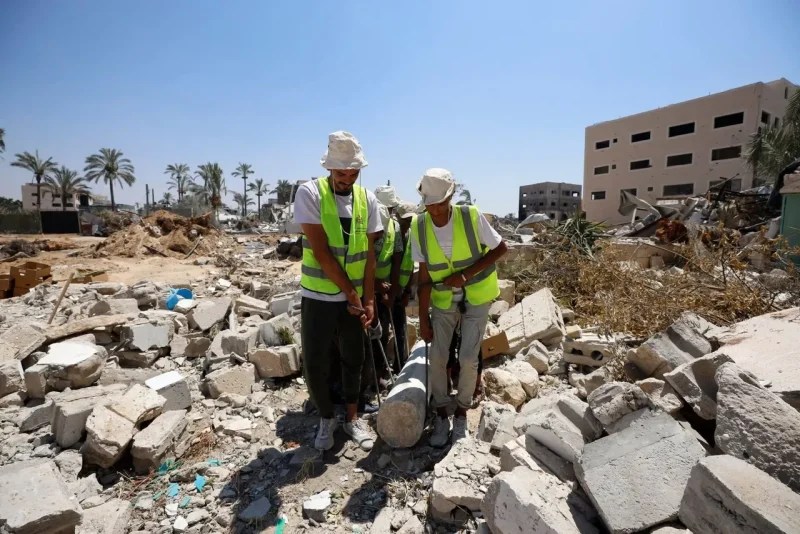
Volunteers carry an antique pillar from the ruins of the Guerrara Museum after it was damaged in Israeli bombing [TRT World] / TRT World
By Doaa Shaheen | TRT World | December 29, 2025
For more than five millennia, Gaza has stood at the crossroads of civilisations, an ancient port on the Mediterranean linking Egypt, the Levant, and Mesopotamia.
Long before it became synonymous with siege and war, the narrow coastal strip was a passageway for empires, armies, pilgrims, and traders, each leaving traces still buried beneath its soil.
Today, as Gaza’s cities are reduced to rubble from Israel’s brutal assault, another, quieter destruction is unfolding: the systematic loss of cultural memory embedded in museums, artefacts, textiles, and archives that document thousands of years of human history.
Across the devastated enclave, historians, volunteers, and museum founders are risking their lives to rescue what remains, often with bare hands and improvised tools, believing that preserving heritage is inseparable from preserving identity.
Amid the rubble of bombardment and beneath the ominous hum of drones in the so-called Zero Line area east of Khan Younis in southern Gaza, Mohammed Abu Lahia and his companions risk their lives.
Their mission is to rescue archaeological and heritage artefacts from the ruins of the Al-Qarara Cultural Heritage Museum, in a desperate attempt to prevent the erasure of Palestinian cultural memory after Israeli forces destroyed the museum during the war.
![Historical artefacts displayed at a Gaza museum before Israel launched its war on the enclave in October 2023 [TRT World]](https://d2udx5iz3h7s4h.cloudfront.net/2025/12/29/673300eacfcbfe8e438b6a7c/image/7a5d28d8c8a428a2c55e5e7b306ce95fd39c83a17770c17f4280cfc7150d3ff0.webp)
Historical artefacts displayed at a Gaza museum before Israel launched its war on the enclave in October 2023 [TRT World]
The urgency reflects Gaza’s extraordinary historical density. Over centuries, Canaanites, Philistines, Assyrians, Persians, Greeks, Romans, Byzantines, Mamluks, and Ottomans all ruled or passed through the territory.
Legendary figures such as Alexander the Great and Napoleon Bonaparte once stood on its soil. Each era left behind material traces – pottery, mosaics, inscriptions, textiles – many of which ended up in local museums like Al-Qarara.
“The Al-Qarara Cultural Heritage Museum was founded in 2016 in response to the community’s need for a cultural institution to preserve Palestinian heritage from being lost,” says Abu Lahia, the 30-year-old founder.
From its inception, the museum relied on donations from local families who entrusted it with heirlooms and antiquities meant to testify to Palestine’s long history and everyday life across generations.
Before its destruction, “the museum housed about 3,500 pieces narrating 5,000 years of Palestinian history, from Roman, Byzantine, and Mamluk eras to traditional jewellery,” Abu Lahia adds.
“Only about 1,000 pieces have been saved from the destruction through arduous manual search, due to the lack of specialised excavation machinery.”
Gaza’s antiquities are dispersed across public institutions and private museums established by enthusiasts driven by a desire to protect what they see as shared inheritance.
The Israeli war machine has impacted all museums, causing varying degrees of damage and the loss or theft of parts of their collections.
UNESCO has verified damage to at least 110 sites of cultural, historical, and religious significance across Gaza since the war began, including mosques, churches, archaeological sites, museums, and historic buildings, figures that continue to rise as access remains limited.
Abu Lahia explains the rudimentary salvage operation: “We are racing against time to pull out archaeological pieces. Every passing moment is from the lifespan of Palestinian history and these antiquities. We don’t want to lose what remains.”
With no access to modern tools, the team wraps artefacts in cloth and blankets, pads them with plastic and sponge, and stores them in vegetable crates, fruit boxes, or discarded humanitarian aid cartons. Heavy stone columns are dragged out using strong ropes and moved to safer locations.
Twenty-five volunteers, young men and women trained in history, archaeology, architecture, and fine arts, are participating in the effort. They view their work not as cultural preservation alone, but as resistance to erasure.
Alongside physical rescue efforts, the team is building a digital archive, recognising that memory must survive even when objects cannot.
Using a makeshift mobile studio, salvaged items are photographed, catalogued, assigned serial numbers, and uploaded under the museum’s name, ensuring that even if the artefacts are lost, their documentation endures.
![Mohammed Abu Lahia sorting artefacts after they were retrieved from under the rubble of Al-Qarara Museum [TRT World]](https://d2udx5iz3h7s4h.cloudfront.net/2025/12/29/673300eacfcbfe8e438b6a7c/image/09d39a5f38a4bb205b72586e60c012ee03e9e3259922a7283c4d3f1189d39fe4.webp)
Mohammed Abu Lahia sorting artefacts after they were retrieved from under the rubble of Al-Qarara Museum [TRT World]
Abu Lahia emphasises, “The museum has not ended despite the destruction. What survived under the rubble and what was documented digitally confirms that Palestinian memory is still alive.”
Saving the Palestinian Thobe
In another corner of Gaza, Suhaila Shaheen is fighting a parallel battle to preserve a different form of heritage: embroidered Palestinian dress.
The Palestinian thobe, known for its colourful stitches, encodes geography, social history, and identity—distinguishing villages, cities, and even family lineages.
For many Palestinians, it functions as a textile archive passed from one generation to the next.
Founded in December 2022, the Palestinian Thobe Museum in Rafah was both a personal dream and a cultural statement for Dr Shaheen. The university professor specialising in art and technology views safeguarding embroidered dress as preserving stories often excluded from official archives.
The museum, funded entirely by Shaheen and her fundraising efforts, became the first Palestinian museum dedicated to embroidered thobes founded by a woman.
Its collection grew to more than 5,600 heritage items, including around 340 hand-embroidered Palestinian thobes representing villages of the Gaza district, alongside original historical documents, rare photographs, agricultural tools, and a Bedouin tent.
Israeli bombardment on October 10, 2023, erased the museum entirely.
From beneath the rubble, Shaheen was able to recover only 64 thobes, some intact, others torn or eroded by the bombing.
“These are what remain of the museum’s memory,” she says. “I carry them with me wherever I go.”
Unable to save most of the collection physically, Shaheen turned to digital preservation, compiling photographs and records taken by herself, journalists and visitors.
“I’m working on gathering everything available digitally, so the story isn’t completely lost,” she explains.
Looting Gaza’s antiquities
Gaza-based Palestinian heritage expert Hammoud Al-Dahdhar describes the current situation as catastrophic.
In Gaza City’s Old Quarter, the iconic Great Omari Mosque, one of the oldest mosques in the Strip, has been left partially destroyed, its distinctive minaret reduced to a broken stump.
Nearby, the 700-year-old Qasr al-Basha, once a Mamluk palace and later the National Museum, has been struck and bulldozed. Thousands of artefacts it housed are now missing or unaccounted for.
![A broken plaque is all that remains of the Al-Qarara Museum [TRT World]](https://d2udx5iz3h7s4h.cloudfront.net/2025/12/29/673300eacfcbfe8e438b6a7c/image/f7395cc9d21597d1f1cbc9436ef97861991255a41a2a97f9eec0f63a3d7baf02.webp)
A broken plaque is all that remains of the Al-Qarara Museum [TRT World]
Al-Dahdhar points an accusatory finger at the Israeli occupation for looting thousands of archaeological pieces from Gaza’s historical sites, citing the disappearance of more than 17,000 artefacts from Qasr al-Basha alone.
Manual rescue efforts, he says, are carried out amid unexploded ordnance, shortages of equipment, and ongoing bombardment. Digital documentation faces its own risks, including cyberattacks aimed at erasing records.
“These are emergency first-aid operations. We document what is missing, what is looted, and what is destroyed, under impossible conditions,” Al-Dahdhar tells TRT World.
International institutions have also sounded the alarm.
During the war, the French Biblical and Archaeological School of Jerusalem reported that tens of thousands of archaeological artefacts from Gaza, including material excavated from the UNESCO-listed Byzantine monastery of Saint Hilarion, had been stored in a facility in Gaza City for safekeeping.
The site was managed and secured by Premiere Urgence Internationale, a humanitarian organisation that has worked for years on the protection of Gaza’s historical heritage while providing vocational training and livelihoods for young Palestinians.
Despite the facility’s protected status under the UN’s deconfliction system, the Israeli military ordered its evacuation ahead of an air strike.
![A mannequin on display at the Palestinian Dress Museum before its destruction [TRT World]](https://d2udx5iz3h7s4h.cloudfront.net/2025/12/29/673300eacfcbfe8e438b6a7c/image/ae1e5b20d835c73edd4acb9aaed3aa1913cbfd4c24c1db9b8cfbd1b21812a978.webp)
A mannequin on display at the Palestinian Dress Museum before its destruction [TRT World]
Under sustained risk of bombardment and amid severe shortages of time and resources, 70 percent of the collection, representing more than 25 years of archaeological research, was moved before the Israeli attack. The rest, destroyed.
Scholars and heritage experts have warned that the destruction of such material constitutes an irreparable loss, not only to Palestinians but to global understanding of early Christian and ancient Middle Eastern history.
Al-Dahdhar stresses that the stakes extend beyond preservation for its own sake.
“This is about protecting collective memory. Without it, identity itself is endangered.”
Dayton At 30: US Betrayal Old And New
By Kit Klarenberg | Global Delinquents | December 30, 2025
December 12th marked the 30th anniversary of the Dayton Accords’ signing, which ended the Bosnian civil war after three-and-a-half years of brutal fighting. While consistently hailed in the mainstream as a US diplomatic triumph, the agreement imposed a discriminatory and unlawful constitution upon Sarajevo enshrining division between the country’s three main ethnicities – Bosniaks, Croats, and Serbs – and a Byzantine political system, while carving the country into two separate ‘entities’. Bosnia has constantly teetered on collapse ever-after, sustained purely by prolonged NATO and UN occupation.
Moreover, the Dayton Accords represented a rank betrayal of Washington’s Bosniak allies. In the conflict’s leadup, the US consistently encouraged them – led by President Alija Izetbegobic – to reject peace talks. After the war’s eruption, he was emboldened to keep fighting and spurn negotiations, strung along with effusive public support from US officials, and covert military assistance. Come Dayton, the Bosniaks were forced to accept a far worse settlement than any previously proffered. Parallels with the Ukraine proxy war are ineluctable.
The Bosnian conflict’s greatest tragedy is it could’ve been avoided not only without a shot being fired, but no territorial carve-up or ethnic partition of any kind. In the years before its April 1992 outbreak, numerous attempts were made to reach an equitable settlement negating any prospect of war. In summer 1991, as Yugoslavia was beginning to rapidly disintegrate, representatives of Izetbegovic met with Bosnian Serb leaders in Belgrade, to discuss the then-republic’s future.
The two sides hammered out a simple but ingenious plan. Bosnia would be a sovereign, autonomous, undivided state, in confederation with Serbia and Montenegro. Bosniak-majority territory within Serbia would also be ceded to Sarajevo’s administration. The agreement emphasised the necessity of the republic’s diverse population “living together in freedom and full equality.” Bosnia would remain part of Yugoslavia, albeit under a revised federal system, in which the country’s constituent parts were essentially independent, and “completely equal”.
Serb leader Slobodan Milosevic not only agreed to the plan, but further proposed Izetbegovic be the new Yugoslavia’s first federal President for a five year term, invested with the power to appoint military leaders and diplomats, and serve as the country’s head of state. Izetbegovic’s representatives signed off on the agreement, before returning to Sarajevo. Initially, the Bosniak leader was on board. However, according to numerous sources, Izetbegovic withheld his formal endorsement pending a planned trip to the US.
Upon his return, Izetbegovic rejected the deal. This was neither the first nor last blatant example of Stateside officials torpedoing fruitful peace efforts before, and during, the war. The conflict itself was triggered by the personal interventions of Warren Zimmermann, US ambassador to Yugoslavia. Echoes of Boris Johnson’s April 2022 sabotage of peace talks between Russia and Ukraine are palpable. In early 1992, in a desperate final bid to prevent conflict, the EU drew up the “Lisbon Agreement”.
Under its terms, Bosnia would be an independent country completely separate from Yugoslavia, divided into “cantons” dominated by whichever ethnic/religious community was most populous locally. Bosniaks and Serbs were allocated 43% of the state’s territory each, and Croats the remainder. The three were to share power nationally, with a weak central government. It was signed by leaders of the republic’s ethnic groups in March that year.
However, Izetbegovic was concerned the plan partitioned Bosnia into distinct entities, with the prospect its Croat and Serb components could secede thereafter. He voiced these concerns to Zimmerman, who told him, “if he didn’t like it, why sign it?” With that blessing – and prospect of US recognition of an independent Bosnia, and economic and military support – Izetbegovic withdrew his signature, sparking war. Zimmermann later reflected, “the Lisbon Agreement wasn’t bad at all.” Indeed, it was considerably better than the future Dayton Accords, for all concerned.
‘Military Situation’
Bill Clinton made the Bosnian conflict a core plank of his 1992 Presidential election campaign. Attacking incumbent George H. W. Bush for inaction on the crisis, Clinton proposed a variety of aggressive policies, including arming the Bosniaks to the teeth, and outright US military intervention in the form of airstrikes. Expectation was high Washington’s approach to Bosnia would become considerably more belligerent immediately upon Clinton’s inauguration, if he won the vote.
Clinton’s rhetoric shocked the Bush administration, which branded his warlike pledges “reckless”. Little did the public know, this perspective was entirely in line with US intelligence thinking. A vast trove of declassified files related to the Bosnian war show the CIA and other spying agencies were steadfastly opposed to greater US involvement from the conflict’s earliest stages. After Clinton’s victory, the US National Intelligence Council produced a comprehensive explainer guide for his transition team on the civil war.
The document laid out all manner of issues associated with different strategies Clinton had mulled on the campaign trail. For example, US intelligence assessed how, “even with additional weapons,” Bosnian government forces “could not substantially alter the military situation.” Increasing arms deliveries would produce “greater casualties but no resolution of the conflict,” and “attempting to reclaim all of the territory the Bosnian Serbs now occupy would require massive Western military intervention,” including a ground invasion.
Overall, US intelligence believed “the most optimistic possible outcome” was preserving a “fragmented Muslim-majority state following a partition of Bosnia.” This was the exact substance of a peace plan then-under consideration, drawn up by European Community and UN negotiators David Owen and Cyrus Vance. Records of a secret February 1993 meeting between senior US government, intelligence and military officials show attendees were determined to covertly wreck the Vance-Owen plan – which granted Bosnian Serbs 43% of the country – while remaining ostensibly committed to its implementation.
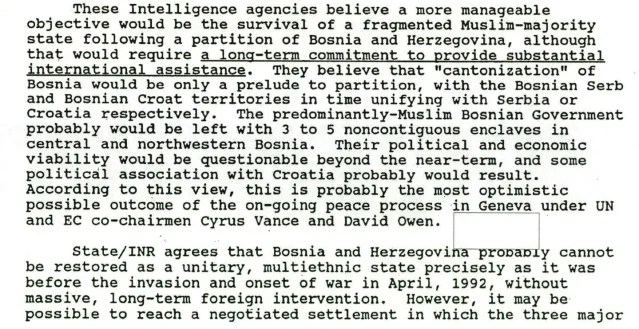
One means by which Washington ensured Vance-Owen failed was by consistently refusing to publicly rule out military action, while secretly funnelling vast arms shipments – in breach of a UN embargo – and foreign fighters to Sarajevo. US intelligence repeatedly warned the White House such actions steeply increased the Bosnian government’s expectations of subsequent Western military intervention on their side. This meant Sarajevo would be resistant to consider let alone accept peace agreements, even when badly losing the conflict.
US military intervention finally did come, in the form of NATO’s Operation Deliberate Force, an 11-day saturation bombing of Bosnian Serb territory conducted over August/September 1995. This finally set the stage for the Dayton talks, which commenced November 1st that year, after all sides agreed to “basic principles” underpinning negotiations. Bosniak representatives had every reason to expect the US to unflinchingly fight their corner – but they were in for a nasty surprise.
‘Moral Position’
From the Dayton talks’ inception, it was clear Washington harboured little favouritism towards the Bosniaks. After two weeks, no progress had been made, despite Serb delegate Slobodan Milosevic being eager to make significant concessions. The US also offered Sarajevo numerous inducements, including a controversial program to arm and train Bosniak forces over subsequent years. Central to Izetbegovic’s intransigence was the US-endorsed peace agreement splitting Bosnia into two ‘entities’, with a Serb-majority internal republic – Republika Srpska – governing 49% of the country.
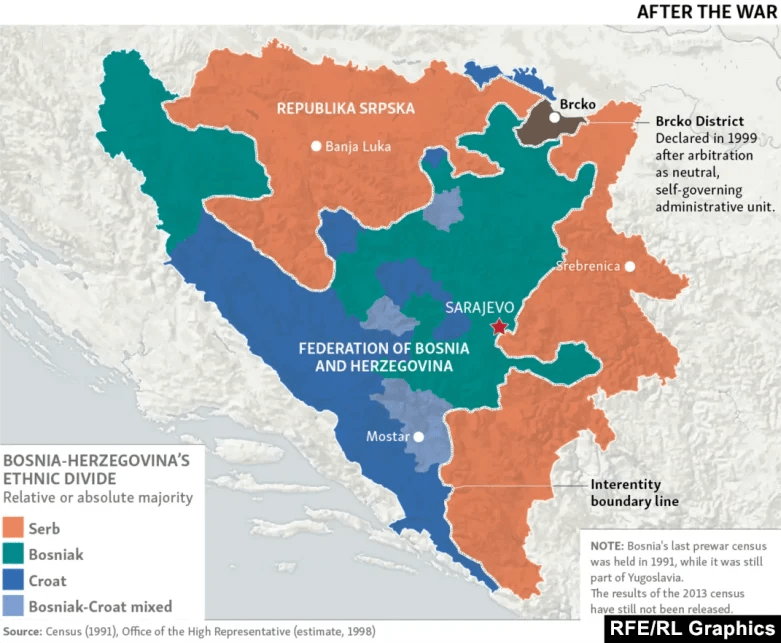
In other words, Dayton handed the Bosnian Serbs more territory than any prior proposed peace settlement, while effectively entrenching the very partition that influenced Izetbegovic’s resistance to the Lisbon Agreement, and produced all-out war. His opposition to the Accords was nonetheless battered down by the blunt-force threat of all-out US betrayal if he refused to acquiesce. On November 15th, a series of “talking points” were provided to Clinton’s National Security Advisor Tony Lake, in advance of a personal meeting with Izetbegovic.
Lake was instructed to spell out dire “consequences” the Bosniaks would suffer, if they failed to sign off on the US-dictated peace plan. He would relay how Clinton understood Izetbegovic was in an “extremely difficult” position, but the US President was “disappointed… Dayton has failed to produce agreement” after so much talk. “If we are successful at Dayton, the President will help you make [the] case that peace achieved at Dayton was just,” Lake was directed to say. He would add:
“Territorial proposals are not perfect, but…likely best deal possible. More fighting will be costly with no guaranteed results. Time for peace…Many in [the] US could use failure in Dayton as [an] excuse to disengage from peace process and abandon [the] moral position we have defended to this point.”
If Izetbegovic’s government was “unwilling to complete [a] peace agreement that Serbs can accept” endorsed by Washington, Lake would threaten there would be “no US forces on the ground, NATO implementation, and economic aid and reconstruction package.” Furthermore, US Congress would not approve, and the Clinton administration would not request, the “equip and train” program for Bosniak forces. UN peacekeepers would also “withdraw” from the country, meaning “Bosnia could find itself without any form of military support from the West.”

“Much at stake for you [and] Bosnia,” Lake’s talking points for Izetbegovic concluded. “Encourage you to think carefully about Dayton… a very good result is within reach; do not let it slip away.” Successfully coerced, Izetbegovic and his team signed the Accords. Dayton’s terms have been a sore source of contention for Bosniaks ever since. Veteran Bosnian politician Haris Silajdzic, a key Izetbegovic acolyte and Bosniak President 2006 – 2010, has dedicated much of his political career to invalidating them.
In a secret March 2007 discussion with the US embassy in Sarajevo, Silajdzic ranted, “we had to sign Dayton with a gun at our heads.” Fast forward to today, and Kiev stares down a similar barrel. Washington pressures Volodymyr Zelensky to accept peace at all costs. This could include major territorial concessions, among other hitherto unthinkable compromises. If only Kiev had implemented the Minsk Accords – and learned the obvious lessons of the Bosnian war – this invidious position could’ve been avoided entirely.
UNRWA head slams ‘outrageous’ Israeli law to cut water, energy to agency’s facilities
Press TV – December 30, 2025
The head of the UN agency for Palestinian refugees has strongly slammed new Israeli legislation to cut water and energy to UNRWA facilities, calling it a violation of international law and a direct challenge to the United Nations system.
Philippe Lazzarini, Commissioner-General of the United Nations Relief and Works Agency for Palestine Refugees (UNRWA), said legislation passed by Israel’s Knesset (Parliament) to cut energy and communication lines of the agency undermines the agency’s mandate.
“Yesterday’s vote by the Israeli parliament passing new legislation against UNRWA is outrageous,” Lazzarini wrote Tuesday on X.
“It is a direct affront to the mandate granted to the Agency by the UN General Assembly and contrary to findings of the International Court of Justice (ICJ), which oblige Israel to fulfil its responsibilities as a UN Member State to UNRWA and the broader UN system.”
According to Lazzarini, the law authorizes Israeli authorities to cut water, electricity, fuel and communications to UNRWA facilities and allows for the expropriation of UN property in occupied East al-Quds, including the agency’s headquarters and its main vocational training centre.
He added that the bill explicitly excludes UNRWA from Israeli legislation implementing Israel’s obligations under the Convention on the Privileges and Immunities of the United Nations, describing this as “a clear violation” of the Israeli regime’s obligations under international law.
Lazzarini said the move builds on laws passed last year and implemented since January 2025 that banned UNRWA’s operations in occupied East al-Quds and halted all contact between Israeli officials and the agency. He described the legislation as part of a sustained effort to weaken multilateral institutions.
“The new legislation is a further blow to the multilateral system,” he said, adding that it was part of “an ongoing, systematic campaign to discredit UNRWA and thereby obstruct the core role that the Agency plays in providing human-development assistance and services to Palestine Refugees.”
Those services, Lazzarini noted, have been deemed essential by the ICJ for upholding the UN’s commitment to Palestinian rights, including self-determination.
He recalled that in October the court reiterated Israel’s obligation under international law to facilitate, not hinder, UNRWA’s work, calling the new law “an unacceptable rejection of the ICJ’s findings.”
Lazzarini said disputes with UNRWA should be addressed through UN mechanisms, warning against unilateral actions. He pointed to recent incidents on the ground, including the storming of UNRWA’s compound in East al-Quds earlier this month, when Israeli officials tore down the UN flag and replaced it with an Israeli one. In May, he said, authorities forced the closure of UNRWA schools in the city, affecting hundreds of Palestinian refugee children.
“These legislative steps have been accompanied by unilateral actions on the ground that show a repeated disregard for international law,” he said.
Lazzarini warned that the measures are having a direct operational and legal impact on UNRWA’s work across the occupied Palestinian territory, including Gaza, where the agency is central to humanitarian operations.
He stressed that Palestinian refugee rights exist independently of UNRWA under international law and UN resolutions, including Resolution 194, and would endure even without the agency.
He added that the legislation sets a “grave precedent” by rejecting the UN’s independence and immunities, cautioning that failing to push back could undermine humanitarian and human rights work worldwide.
Israel has banned UNRWA from operating in the occupied territories after accusing some of its staff of being involved in the al-Aqsa storm operation in October 2023.
Despite repeated requests from UNRWA for the Israeli regime to provide evidence supporting its allegations, the agency has received no response.
The UN agency has faced deepening financial turmoil since Israel launched a defamation campaign against it.
Trump Says Hamas Will Be Given a ‘Short Period of Time’ to Disarm
By Kyle Anzalone | The Libertarian Institute | December 30, 2025
President Donald Trump said that Hamas will be given a short period of time to disarm, threatening to be “hell to pay” if the Palestinian group refuses.
During a Press conference with Israeli Prime Minister Benjamin Netanyahu, Trump was asked about demilitarizing Hamas. “They will be given a very short period of time to disarm. If they don’t disarm, as they agreed to do, there will be hell to pay,” he said. If Hamas does not disarm, “it will be horrible for them, horrible. It’s going to be really, really bad for them.”
Trump suggested that Hamas would be disarmed by Middle Eastern countries, rather than the US or Israel, which are willing to commit forces to demilitarize Gaza.
However, Hamas did not agree to disarm under the October agreement. At the time, a US official told Fox News that the Israel and Hamas ceasefire agreement was negotiated at “lightning speed” and did not address several key issues. Two outstanding questions are what group will secure Gaza and whether Hamas will disarm.
Hamas has maintained that it will only disarm if it is in the process of creating an independent Palestinian state.
Since the signing of the truce earlier this year, Tel Aviv has taken several steps to block the creation of a Palestinian state, and Prime Minister Netanyahu has repeated his long-standing position against the two-state solution.
Is Israel About to Return to Genocide? Three Scenarios for What Comes Next
By Robert Inlakesh | The Palestine Chronicle | December 30, 2025
With Tel Aviv openly rejecting withdrawal and insisting on disarmament, the “ceasefire” risks sliding into either renewed mass killing or a slow-motion attempt to impose control and displacement.
Debate rages on over what Phase Two of the Gaza Ceasefire will look like, as US President Donald Trump demands the disarmament of the Palestinian resistance. Meanwhile, Gaza refuses to hand over its weapons. Most analyses are, however, missing the mark when it comes to reading Tel Aviv’s calculations.
The so-called Gaza Ceasefire has proven itself to be little more than an extended pause in the mass slaughter of civilians. While it is still described as a ceasefire, there were three major changes to the predicament on the ground that took hold during “Phase One,” as the war continued to rage on.
The first major change, perhaps the most notable, was that the Israelis committed to no longer killing an average of around 100 civilians on a daily basis. The second was that more aid entered Gaza, although nowhere near the amount required or agreed to. The third was a mutual prisoner exchange.
Assessing the strength and direction of the ceasefire in its first phase is important to reading what the second phase may have in store, if it is even reached.
To the Israelis, the benefits of the partial implementation of Phase One were numerous. To begin with, the least consequential element, they relieved themselves of the burden of releasing their captives. This was important for Israeli Prime Minister Benjamin Netanyahu, in that he managed to clear the topic of returning the captives, especially as he heads into a new election cycle.
Then we have the other benefits for the Israelis. Gaza exited the international headlines, as daily killings appeared too low to even register as a major issue in the biased Western press. Meanwhile, Israeli soldiers were able to continue doing the exact same work inside Gaza that has constituted the majority of its military operations throughout the genocide: building demolition work.
These demolition missions, for which a privatized Israeli workforce has been employed to operate alongside the occupation army’s engineering units, have constituted the vast majority of the military’s efforts on the ground. Face-to-face combat on the ground has never been a notable feature of the Israeli genocide; they simply refused to actually fight the Palestinian resistance groups.
One thing that troubled the Israelis was that this demolition work, which sometimes included destroying entrances to tunnels, came with a high risk of running into armed ambushes. The Palestinian fighters would prepare traps and set up ambush operations for their forces, especially when Israel would invade or reinvade any new area they had not retained a permanent presence in.
Phase One of the Gaza Ceasefire agreement, therefore, guaranteed that soldiers were not going to be subjected to the same dangers as before, as the Palestinian resistance groups would halt all operations against the invading army.
It is important that this reality is established when analyzing Israel’s decision-making, because what is being done to Gaza is a genocide, not a conventional war. Israel’s intent is to wipe out Gaza, ensuring that it becomes totally uninhabitable, with the intention of mass expulsion in mind. This is also why they rarely targeted the armed wings of the Palestinian factions, focusing on maximum damage to the civilian population instead.
Any other way of framing this issue is misleading and whitewashes what the Israeli regime has committed since October 7, 2023. It also robs any analyst of his or her ability to assess Israel’s calculations critically.
With this in mind, consider that the Israelis have now had over two months where their armed forces have still been working, but have had a break from any fighting or the fear of being ambushed. Israeli tanks, armored personnel carriers, and other equipment were also being repaired, as the decision-makers in Tel Aviv and Washington designed new plans for their fronts against Iran, Yemen, and Lebanon.
They also needed fewer soldiers for security reasons, as a so-called Civil-Military Coordination Center (CMCC) took over in monitoring the situation and helping shape the realities imposed on the ground. Every country involved in the CMCC was therefore made complicit in the genocide.
This phase came with the additional benefit for the Israelis that they now had the space to experiment with new approaches, conjure up more conspiracies, and seek to find a way to ensure the ethnic cleansing of the Gaza Strip occurs. As Israeli Defense Minister Israel Katz has explicitly stated, his army has no intention of withdrawing from the besieged coastal territory.
Phase Two and What It Will Show Us
If we establish the fact that the Israelis are adamant on achieving ethnic cleansing, that their military operations have always sought to achieve this goal, and that they are continuing to conspire to achieve this, then we have arrived at the starting point from which to assess the implementation of a so-called Phase Two.
During the first phase, the groundwork was laid for a new set of conspiracies against the people of Gaza. The population was subjected to countless pressures, which the criminal CMCC oversaw, including the deprivation of sustainable living conditions, with only a handful of its nongovernmental organizations even raising issues about it.
Despite the best efforts of the Hamas-affiliated government security forces to restore order, they were dealing with an impossible situation. Over a million people live in tents that are unstable or susceptible to dire weather conditions, a lack of adequate medical supplies, sanitary supplies, and many food items are even restricted. Amid this, most people don’t have jobs, few have adequate salaries coming in, and even for those in a better economic standing, they remain traumatized and unable to return to their homes. Inevitably, this leads to social issues that no regular security force can fully repel.
Meanwhile, the Israelis expand the so-called Yellow Line, behind which they were supposed to remain, instead using this line to execute anyone who comes within a few hundred meters of it, thus deterring them from returning to their own homes or land, where they could possibly plant small crops. Behind this ever-expanding occupying line, the Israeli military and private contractors destroy more and more infrastructure. All of this is monitored by the US-Israeli-led CMCC.
The plan is rather overt in its goals, but still vague in its precise stages of implementation. Both US and Israeli officials have made it crystal clear that they seek reconstruction only inside the Israeli-controlled portion of the Gaza Strip, where five ISIS-linked death squads are being strengthened by Israel and the United Arab Emirates (UAE).
The UN’s most shameful Resolution 2803, passed by the United Nations Security Council (UNSC) in November, makes it apparent that the goal is to implement a “Board of Peace” (BoP) and International Stabilization Force (ISF). The BoP makes Donald Trump the de facto ruler of Gaza, and the ISF is set to be a multinational invasion force tasked with fighting the Palestinian resistance factions.
This Monday, the new spokesperson for the Qassam Brigades of Hamas, who has also taken on the alias Abu Obeida, announced a staunch opposition to disarmament, instead calling on the Israelis to disarm, as they are the ones responsible for committing a genocide. All the Palestinian factions, with the exception of the mainstream branch of Fatah, which controls the Palestinian Authority (PA), are united on this issue.
The PA is in favor of Donald Trump’s plan for him to rule the Gaza Strip and disarm the resistance by force, but it is irrelevant in terms of representing Palestinians. This authority only continues to exist because it is propped up by the Israelis, Americans, Saudis, and Europeans, and its popularity, beyond its base of employees, is in the single digits among the Palestinian people. It does not even represent the sentiments of the majority of Fatah supporters anymore.
All of this is to say that if any Phase Two is going to be implemented, neither side is going to be in agreement about it. Netanyahu’s government demands disarmament, while the Palestinian factions demand Gaza’s self-governance and will only disarm by handing over their weapons to a newly established Palestinian state. Hamas is clear that it would allow a technocratic administration to take over Gaza and is not demanding that it remain as the government of Gaza.
Considering that neither side can agree upon the basis on which a Phase Two can begin, keeping in mind that Israel and the US are the sides with military dominance, there are three ways that this will unfold:
The US and Israel will proceed with aggressively implementing their plan, as laid out in the shameful UNSC Resolution 2803. They will begin deploying a regime change force and attempt to implement a number of schemes to start a slow ethnic cleansing of the territory amid this.
Israel will restart its full-scale genocide.
The shaky ceasefire will continue, but remain in limbo. This will mean periodic spats of violence, as the Israelis and the US attempt to slowly and partially implement the ISF-BoP agenda. This will be a process during which the people of Gaza will be subjected to more pressure, but not enough to collapse the agreement altogether.
An Aggressive Phase Two?
The first means of implementing the next phase of the Gaza Ceasefire initiative would likely buckle under the immense pressures destined to befall it. If we look at the ISF alone, it is a recipe for total disaster.
Forcing the “International Stabilization Force” aggressively on the people of Gaza means that it will start going after Palestinian resistance factions. Two major issues will immediately pop up. The resistance will certainly kill some of these foreign soldiers, who will return to their home nations in body bags and cause domestic chaos. A heavy-handed approach here would also likely result in civilians being killed, another major debacle in its own right.
The Israelis are adamant that Türkiye, Qatar, and other Muslim-majority nations they take issue with cannot deploy their armed forces in Gaza. Whether they get their way or not, consider that this armed force would mean gathering a few hundred soldiers from one country, a few thousand from another, and so on.
If this kind of ISF was sent into Gaza aggressively, considering that so far there has been no agreement concerning how to implement this invasion initiative or which countries will participate, it will be thrust into a complex urban warfare environment. They all speak different languages, work off different military doctrines, are ill-prepared, likely ill-equipped for their tasks, and, according to reports, will only number in the tens of thousands.
Donald Trump recently boasted that the nations which, he says, are participating in his so-called “peace plan” will work to destroy Hamas if it refuses to disarm, even bragging that Israel would not be required to act and that foreign invading forces would do all the work for them.
In order to conduct a regime change operation of this nature, the ISF would have to be at least 250,000 men strong. Bear in mind that mobilizing a multinational invasion force of this kind would take many months, an enormous amount of funding, and the key feature would be that it actually fights, unlike the Israeli army, which refused to go after the Palestinian resistance factions on the ground.
If an ISF that numbers only in the tens of thousands is going to try and defeat the Palestinian resistance, it will suffer heavier casualties than the Israeli military did. Any Arab or Muslim-majority nation deploying forces could experience mass protests or rebellions against their role in the genocide. Without going into the fine details, it makes no sense and if it is tried, it will quickly fail. Even the Egyptians, who along with Israel will be the guarantors of the strategy, have been advocating for a force equivalent to Lebanon’s UNIFIL to enter Gaza, which is not what UNSC Resolution 2803 approved.
Israel Collapses the Ceasefire
The next way this can go is that Benjamin Netanyahu decides to collapse the ceasefire altogether. Some argue this wouldn’t happen because the US is committed to its “peace plan.” This is not a serious argument. Donald Trump has demonstrated that he will go along with whatever the Israelis choose. He isn’t a strong leader on this question and clearly possesses a level of knowledge about the region that you would expect of a public high school student who took history and didn’t really bother to listen.
There are only two circumstances under which the Israelis will collapse the ceasefire in its entirety. They no longer believe that any of the schemes they sought to implement under the so-called ceasefire will work, and there is some kind of political benefit to returning to all-out combat. The second reason is that they are scared that the Palestinian resistance may launch some kind of offensive while the Israeli army is also battling Hezbollah and Iran.
Collapsing the ceasefire demonstrates that the Israelis are without any direction and lack a coherent plan to actually end the fighting on the Gaza front. It means that they are simply reverting to all-out genocide, with the hope that eventually an opportunity arises which will allow a mass ethnic cleansing event, or a slow process of ethnic cleansing as they exterminate tens of thousands more civilians.
Stuck Between Phase One and Phase Two
Another option is for the Israelis and Americans to stall the collapse of the ceasefire. It would mean placing the situation in limbo, not allowing its total collapse, but undergoing a process of trial and error, whereby it slowly attempts to force elements of “Phase Two” into reality.
This is a very likely outcome, designed to keep the Gaza front closed while focusing more on Iran, Lebanon, and perhaps even Yemen. We could therefore expect to see the ISF deployed in a less meaningful capacity than is currently envisaged in Washington, disastrous plots implemented involving private military contractors and aid distribution, and attempts to ethnically cleanse the population slowly here and there. All of these schemes will fall flat on their faces, but not without inflicting suffering on the civilian population of Gaza.
In the meantime, the US-Israeli alliance will have Tehran in its sights. The thinking behind this would be to squeeze the civilian population of Gaza, while prioritizing Iran and Hezbollah as their major strategic threats.
Israel’s Failure Hedges against Iran and Hezbollah
The conspiracies of Washington and Tel Aviv against Gaza can be defeated, but this hinges upon Hezbollah and Iran for the most part. If Iran and Hezbollah manage to deal enormous blows to the Israelis, refusing to play their game of fighting short defensive conflicts, then Israel will be dragged into deep waters.
All that is required of Hezbollah and Iran is that they don’t stop firing, no matter the degree of carnage exacted against their people. If Hezbollah drags the Israeli military into Lebanese lands and refuses the calls for a ceasefire, instead forcing the Israelis into a war that it intends to fight for many months, and Iran does the same, the Israelis will be in a major crisis.
The details of such conflicts are a topic for different pieces and many outcomes could occur, yet it suffices to say that major moves from Lebanon and Iran could put the Israelis in a very weak position, one that even enables major action from Gaza also.
If Iran and Hezbollah are either defeated or taken out of the picture for an even longer period after agreeing to meaningless ceasefires, after short rounds of fighting, also suffering the assassinations of major figures, this is the most favorable outcome for Benjamin Netanyahu. Victories in these arenas will open the door to ethnically cleansing the Gaza Strip, even if slowly rather than in a stampede into the Sinai Peninsula. This is, of course, assuming there are no other major fronts which suddenly open to preoccupy them.
As things stand, the Israelis are in a very weak position, having failed to defeat any of their enemies. The only exception is the fall of the previous Syrian regime, which was not directly fighting Israel, but was a major land bridge for the Iranian-led Axis of Resistance. For now, Syria can be considered a victim of Israel, but poses no immediate threat.
Ultimately, Israel has fought for over two years and failed to defeat the Palestinian resistance, Hezbollah, Ansarallah, Iran, or any of its other adversaries, even after dealing varying degrees of blows against each of them. Netanyahu’s long-sought-after “total victory” does not appear likely, yet he still continues to double down on attempting to achieve this goal. The primary reason for this is the refusal of the people of Gaza, and also Lebanon, to give up.
Robert Inlakesh is a journalist, writer, and documentary filmmaker. He focuses on the Middle East, specializing in Palestine.
Featured Video

Now everyone is dumping US government bonds
or go to
Aletho News Archives – Video-Images
From the Archives
Experts Warned For Years That A War With Iran Would Happen This Way
By Caitlin Johnstone | April 3, 2026
… It’s so wild how we keep seeing reports that Iran’s retaliation caught the US off guard. For all the years I’ve been paying attention to this issue I’ve been reading experts and analysts saying if the US attacks Iran, Iran can close the Strait of Hormuz and strike US bases and the energy infrastructure of US allies in the region.
A few examples:
A 2006 Oxford Research Group paper titled “Iran: Consequences of a War” warned that Iran has numerous options at its disposal in the event of a US attack, and that the “most significant of these would be any possible retaliatory Iranian action to affect the transport of oil and liquefied natural gas through the Straits of Hormuz,” adding that stopping Iran from doing this “would be difficult if not impossible to achieve, leading to a fear of attack which alone would have a formidable impact on oil markets.”
A 2007 Cato Institute paper titled “The Iraq War and Iranian Power” warns that “Iran possesses the largest ballistic-missile inventory in the Persian Gulf — missiles which can reach Israel, Saudi Arabia and US military bases in Iraq,” and that “experts argue Iran could also use the ’oil weapon’: blocking the 34km-wide Strait of Hormuz and conducting submarine and anti-ship missile attacks against ports and oil facilities in Saudi Arabia, Kuwait and other Gulf Cooperation Council states.”
A 2012 NPR article titled “Can Iran Close The World’s Most Important Oil Route?” features then-chairman of the Joint Chiefs of Staff acknowledging that Iran absolutely can block the Strait of Hormuz, saying Tehran has “invested in capabilities” which specifically enable them to do so.
A paper from the Columbia Center on Global Energy Policy and the Center for a New American Security titled “IN DIRE STRAITS? IMPLICATIONS OF US-IRAN TENSIONS FOR THE GLOBAL OIL MARKET” warns of a potential scenario “that includes damage to Gulf oil infrastructure and a temporary closure of the Strait of Hormuz.”
These weren’t a bunch of keffiyeh-wearing peaceniks making these assessments, they were deeply entrenched swamp monsters entirely loyal to the US empire. They opposed war with Iran not because it would be an evil act of unforgivable mass murder, but because it would be bad for the imperial power structure. … Full article
Blog Roll
 Aletho News
- US dismantling international law in its war against Iran while claiming ‘false’ victory: Legal scholar
- One martyr, 5 injuries in US attack on Iraqi border crossing with Iran
- ‘This war is Israel’s war’: World facing ‘security breakdown’, says Qalibaf
- IRGC decries attack on US embassy in Riyadh, says executed by ‘Israel’
- Iran blasts EU hypocrisy as EU invokes international law over Hormuz
- There is no military solution to Strait of Hormuz
- NATO’s structural collapse – the outcome of deviation from reality
- Poll finds world views China better than US
- One Of America’s Leading Neo-Cons Has Turned Against The Iran War And Israel
- Attack in the Bosphorus exposes NATO weaknesses and tensions among allies
- If Americans Knew
- US loses planes over Iran, Israel downgrades Lebanon war goals – Daily Update
- Israel Is Blocking Palestinians from Easter at Church Where Jesus Resurrected
- Plot to assassinate Palestinian activist follows harassment campaign promoted by Zionist groups and elected officials
- Prominent New York synagogue hosts presentation on why U.S. Jews should support the ethnic cleansing of Gaza
- Tapper vs. Piker: Is the CNN Anchor Auditioning for David Ellison?
- Shouldn’t Democrats Be Able to Condemn Genocide?
- Israel-US kill negotiators, destroy civilian structures, but Iran’s military capabilities still largely intact – Daily Update
- ‘War crime’: Global condemnation as Israeli ministers celebrate death penalty law targeting Palestinian prisoners
- 7 Ways Israel Is Turning Lebanon Into Gaza
- World’s Leading Football Bodies Under Fire Over Israel Policies
- No Tricks Zone
- New Study Reports A 60% Slowdown In Greenland’s Ice Loss Rate In The Last Decade
- Low Intensity Tornado Wrecks Major Solar Farm, Creating A Potential Toxic Dump
- New Study Finds Warming Saves Lives…Cold Temperatures 12 Times More Deadly Than Excess Heat
- German Science Blog Accuses PIK Climate Institute Of Hallucinating Climate Tipping Points
- Devastating Assessment Of Comirnaty Vaccine By Former Senior Pfizer Europe Toxicologist
- New Study: CO2 Is ‘Effectively Negligible’ As An Explanatory Climate Change Factor Since 2000
- Former Pfizer Toxicologist Dr. Helmut Sterz Tells Bundestag Hearing Pfizer Vaccine Should Have Never Been Approved
- Energy Expert: Germany’s Nuclear Phaseout Was A “500 Billion Euro Mistake”
- New Research: South Australia’s Mid-Holocene Sea Surface Temperatures Were 4°C Warmer Than Today
- Storing Green Energy To Last Germany 10 Days Would Require A 60-Million Tonne Battery
 Aletho News